The Melbourne Flâneur, on location in Eltham, reading an extract from his first book.

Today The Melbourne Flâneur comes to you from Eltham, a charming suburb on the northeastern outskirts of Melbourne where urbanity begins to shade into rusticity.

I love Eltham. It’s got a good bookshop in the main street, a multitude of nice cafés in which to write, and it was the memorable scene of your Melbourne Flâneur’s last great seduction before he retired from Daygame, so its streets have the vivid imprint of potent memories embedded in them for your pocket-edition Casanova.

But rather than reflect on that, in the video above I lounge with all my flâneurial indolence in Eltham’s gilded greenery (reminiscent, when viewed through heavily squinting eyes, of a Parisian park) as I read you a few pages from my first book, Orpheid: L’Arrivée (2012).

That’s the non-fiction novel where a very thinly disguised avatar for yours truly (one who is hardly more than a floating consciousness with a mythological nom de guerre) makes an epic voyage as laborious as walking across the bottom of the sea in a diving bell.

The premise of the book is very simple: my first night in Paris, the first night of my life off the terrestrial shore de l’Australie in foreign climes. But the extended metaphor I use throughout the book to describe the experience of being halfway around the world, at night, in a foreign country is the metaphor of space travel and setting foot on the moon. And nowhere do I use this metaphor more extensively than in the extract I read you above, which I think contains one of the longest sentences in the entire book, a burlesque of President Kennedy’s famous speech at Rice University which lasts more than an entire page.

Watch for the moment in the video when I have to sneak a breath to get through it!

I don’t really consider myself to be a comic writer, although some people have told me that they like my writing best when my satirical fangs show through. In this book, the fangs are definitely embedded in myself—right up to the gums: I never miss an opportunity to ironize my own neurotic foibles, frequently styling myself, in my Chaplinical dandyism, as ‘our presumptuous little hero’.

In that sense Orpheid: L’Arrivée is a ‘comic epic’: the ‘comedy’ lies in the fact that I treat—with a Keatonianly straight face—what would ordinarily be the most banal events and actions as I undertake to manœuvre myself and my small mountain of luggage de l’aéroport Charles-de-Gaulle à l’Hôtel Caulaincourt as if these were noble and heroic acts worthy of immortalization in an Homeric epic.

Like an astronaut setting foot upon a foreign world, everything that passes before my eyes becomes fascinating, exerts its own peculiar gravity which arrests my progress momentarily, drawing me towards it to pause and investigate. In fine, the experience of the book is intended, for the reader, to be what the experience of that night was for me: the most acute example I had yet known of the psychogeographic experience of flânerie itself—what M. Rimbaud calls ‘un long, immense et raisonné dérèglement de tous les sens’ (‘a long, immense and rational derangement of all the senses’).

I’ve described Orpheid: L’Arrivée as an ‘epic prose poem’, and I think that sums up both my strengths and my limits as a writer. In a recent post on this vlog I asked the question ‘Can prose be poetry?’, and admitted that, like M. Flaubert, one of the great banes of my life is that I’m a prosateur by nature, not a poète—although I have the reputation of being one.

As I said in that post, the habits of mind associated with prose and poetry are really antithetical to each other, and I’m rarely so inspired as to write verse. Most of my poetic output was written in France, when, like a flower, I felt my soul expand in its natural climes, swimming in the sea of soil and air, of Truth and Beauty, which surrounded me every day.

Otherwise, like M. Flaubert, whatever inclination to lyricism there is in me (et l’inclination est forte) finds itself kinkily perverted away from prosody and funnelled along the unnatural channel of prose, a narrow watercourse most unsuitable for the efflorescent floods of rhapsody which overtake me. Like M. Flaubert, I have the rather painful experience, as a writer, of being a poet by inclination but without natural talent in that direction, my analytic habits of mind, like his, being more suited to prose than prosody.

And yet, for reasons which mystify and miff me, I have the reputation of being ‘a poet’.

In recent years, I’ve come to terms with the fact that I will never succeed in talking people out of this misconception of me, and even to feel that, if they’re so stubbornly insistent in their error, then they’re probably right.

In lieu of forcing my mind into the crystal lattices of verse, a skill and habit I admire in poètes pur-sang but cannot emulate, I have always written my peculiar espèce de prose prosodique with its multilingual patois and neologisms, and have always been, bastard cousin to them, un poète en prose.

The essence of prose poetry, I think (an essence which Orpheid L’Arrivée demonstrates at quite a remarkable scale of simultaneous expansion and concentration, considering the typical brevity of the form), is ‘seeing the ordinary anew’.

What people have most often remarked to me about a prose they deem to be ‘poetic’ is that there is an unusual capacity in my writing to present a new vision of things, a different angle on the familiar which they recognize but which they tell me is not necessarily obvious to them until I drew their attention to it, a quality which is more ‘latent’ in the things themselves than apparent on first view.

Well, this is a perfectly natural skill for someone who began his career as a professional writer in the domain of film criticism to possess. My ‘journalistic training’ was as a foreign correspondent in a realm which is all about reporting vivid descriptions of vision, about lyrically communicating the experience which these visions in the dark provoked in me. It was a training which both formed and rewarded the analytic habit of mind, the incontournable désir to break down the parts of my pleasure and analyse what makes the machine of it run, which is natural to me.

I don’t know that I was ever conscious, as a young man writing film criticism for magazines on the Gold Coast, of styling my thumbnail reviews as ‘poems in prose’, but certainly I was so conscious of the little space I was afforded that, in retrospect, it seems I schooled myself in squeezing my mind into something like the crystal lattice of verse. I made a form of my own which was so tight that the rhapsodic results were often explosive for the readers.

In order to see the prosaic world painted anew on the page, a lyrical, rhapsodic style of prose is called for. If I’m honest, I don’t know if there are any poètes pur-sang today. A poet is a flower of humanity that can only grow up in a natural environment, and we live in such an artificial one, where technology is the very air that we breathe, that perhaps prose is the only weak poetic weapon with which to tackle and attack our prosaic reality, to beat back its encroachment on our humanity.

Which brings me to Louis Aragon and another magisterial work of poetry in prose, Le Paysan de Paris (Paris Peasant [1926]).

M. Aragon was a poet first and prose-writer second, a survivor of the race of poets when there were still some lines of lineage of that endangered species left to dribble into the future. He was also a surrealist in the first, enthusiastic, misguided but organic flush of that movement when, weak as it was, surrealism was yet a shield to bludgeon and beat back a usurping technological artificiality which was not yet all-powerful.

The English title of Le Paysan de Paris does not quite give the sense which M. Aragon intends to convey in French. Yes, ‘paysan’ may be translated as ‘peasant’, but in poetic conjunction with the name of the French metropolis, the Capital of Modernity, he is trying to suggest that to be a Parisian is to be a type of provincial, someone who is yet still close to nature in the midst of this technological marvel with all its glittering, seductive artificiality.

Now, here we have a little secret password of freemasonry by which fanatical Paris aficionados, French as well as foreign, recognize one another. This word is ‘province.’ With a shrug of the shoulders, the true Parisian, though he may never travel out of the city for years at a stretch, refuses to live in Paris. He lives in the treizième or the deuxième or the dix-huitième; not in Paris but in his arrondissement—in the third, the seventh, the twentieth. And this is the provinces.

—Walter Benjamin, The Arcades Project, “First Sketches”, p. 832

It took reading Hr. Benjamin’s insight to put the vague apprehension into sharp relief, but as soon as I read those words, I recognized the truth of them in my own experience.

Only the day after the events recounted in Orpheid: L’Arrivée, as I ambled about the 18e, seeking by daylight what I had but glimpsed in a tourbillon of light and colour the night before, I would have the sense—which would never leave me in Montmartre—that this paradis artificiel would be sufficient for a lifetime. You could live in this small tranche of Paris, on its northern outskirts, and never be bored, never have cause to venture outside it.

I seem to associate that sensation of mind—too diffuse to be a thought—with the memory of a man, grey-haired, who shuffled out of the dazzling sunlight and into the cool, wood-panelled oasis of the Café de la Place and up to the comptoir beside me as I was drinking my demi. Between him and the patron passed that secret handshake of freemasonry, the handshake of merely being Montmartreans together on another day in bourgeois paradise, and by the end my time there, the ineffaceable patina of being a ‘Parisian provincial’, a ‘dix-huitièmard’ (to coin a term), would varnish the wood of my soul too.

In her journal article “The Surrealism of the Habitual: From Poetic Language to the Prose of Life” (2011), Alison James discusses surrealist prose poetry with respect to Wittgenstein’s philosophical investigations into language. She cites André Breton’s argument in defence of M. Aragon when he was accused, after the publication of one of his poems, of incitement to murder.

… [T]he goal of poetry and art [according to Breton] has always been to soar above the real and above common thought…. In formulating this argument, Breton refers to Hegel’s lectures on aesthetics and in particular to Hegel’s insistence on the distinction between poetry and prose. For Hegel, poetry is the most perfect and universal of the arts because it comes closest to the self-apprehension of spirit. However, its linguistic medium poses a problem, for art ‘ought to place us on ground different from that adopted in everyday life, as well as in our religious ideas and actions, and in the speculations of philosophy’…. Language, when used in poetry, should therefore not be left ‘in a state in which it is used every day’ … but must set itself apart from the ‘common prose of life’ … —an expression that Hegel uses to refer to both the ‘prosaic’ dimension of existence and to linguistic signs that mediate this level of experience.

—Alison James, “The Surrealism of the Habitual: From Poetic Language to the Prose of Life” (2011), p. 408

But in Le Paysan de Paris, M. Aragon (who himself has not infrequent recourse to Hegel) is most trenchant in his view that the prosodic lies in the prosaic. This is perhaps one of the few genuinely revelatory concetti to emerge from surrealism as an intellectual movement and as an artistic mode of militant resistance to the increasing ‘banalization’ of technologically-driven modern life.

Certains lieux, plusieurs spectacles, j’éprouvais leur force contre moi bien grande, sans découvrir le principe de cet enchantement. Il y avait des objets usuels qui, à n’en pas douter, participaient pour moi du mystère, me plongeaient dans le mystère. … Il me semblait bien que l’essence de ces plaisirs fût toute métaphysique, il me semblait bien qu’elle impliquât à leur occasion une sorte de goût passionné de la révélation. Un objet se transfigurait à mes yeux, il ne prenait point l’allure allégorique ni le caractère du symbole; il manifestait moins une idée qu’il n’était cette idée même. Il se prolongeait ainsi profondément dans la masse du monde.

I felt the great power that certain places, certain sights exercised over me, without discovering the principle of this enchantment. Some everyday objects unquestionably contained for me a part of that mystery, plunged me into that mystery. … I felt sure that the essence of such pleasures was entirely metaphysical and involved a sort of passion for revelation with regard to them. The way I saw it, an object became transfigured: it took on neither the allegorical aspect nor the character of the symbol, it did not so much manifest an idea as constitute that very idea. Thus it extended deeply into the world’s mass.

—Louis Aragon, Le Paysan de Paris, “Le sentiment de la nature aux Buttes-Chaumont” (translated by Simon Watson Taylor), pp. 140-1 [p. 128]

This anti-platonic intuition that objects themselves—in all their crude, material reality—are the eternal Forms is perhaps, as I say, the only really revelatory idea to come out of surrealism, and sets the stage for a ‘poetry of modern life’ that is deeply immersed in the prosaic and the temporal, in the marvellous flux of artificial forms that speed surreally by the flâneur’s eyes in his investigations of arcades and parks.

In his coda to Le Paysan de Paris, M. Aragon indulges himself (perhaps satirically) in one of those chauvinistic manifestoes favoured by the surrealists—or at least by his hierophantic, inquisitorial friend, M. Breton. But M. Aragon is a greater intellect than M. Breton, just as he was a greater writer, and the slash and sweep of his pronouncements cut vividly through, just as the notion articulated in the quote above does, to add in one breathless burst of premises several firm planks to a nascent æsthetic philosophy of literary flâneurism:

Du plus rapide apercevoir une apparition se levait. Je ne me sentais pas responsable de ce fantastique où je vivais. Le fantastique ou le merveilleux. C’est dans cette zone que ma connaissance était proprement la notion. J’y accédais par un escalier dérobé, l’image. La recherche abstraite me l’a fait tenir pour une illusion grossière, et voici qu’à son terme la notion, dans sa forme concrète, avec son trésor de particularités, ne me semble plus en rien différente de ce mode méprisé de la connaissance, l’image, qui est la connaissance poétique, et les formes vulgaires de la connaissance ne sont, sous le prétexte de la science ou de la logique, que les étapes conscientes que brûle merveilleusement l’image, le buisson ardent.

Je sais ce qu’une telle conception choque, et l’objection qu’elle comporte. Un certain sentiment du réel. Pur sentiment. Car où prend-on que le concret soit le réel? N’est-il pas au contraire tout ce qui est hors du réel, le réel n’est-il pas le jugement abstrait, que le concret ne présuppose que dans la dialectique? Et l’image n’a-t-elle pas, en tant que telle, sa réalité qui est son application, sa substitution à la connaissance? Sans doute l’image n’est-elle pas le concret, mais la conscience possible, la plus grande conscience possible du concret. D’ailleurs peu importe l’objection quelle qu’elle soit qu’on oppose à une semblable vue de l’esprit. Cette objection même est une image. Il n’y a pas, foncièrement, une façon de penser qui ne soit une image. Seulement la plupart des images, faiblement prises, ne comportent dans l’esprit qui les emploie aucun jugement de réalité, et c’est par là qu’elles gardent ce caractère abstrait, qui fait leur pauvreté et leur inefficience. Le propre de l’image poétique à l’encontre de l’image essentielle, pour m’en remettre à ce qualificatif médiocre, est de comporter ce caractère de matérialisation, qui a sur l’homme un grand pouvoir, qui lui ferait croire à une impossibilité logique au nom de sa logique. L’image poétique se présente sous la forme du fait, avec tout le nécessaire de celui-ci. Or le fait, que personne jamais n’a songé à contester, fût-ce Hegel, et même celui-ci ne lui accordait-il pas une importance prépondérante, le fait n’est point dans l’objet, mais dans le sujet: le fait n’existe qu’en fonction du temps, c’est-à-dire du langage. Le fait n’est qu’une catégorie. Mais l’image emprunte seulement la forme du fait, car l’esprit peut l’envisager en dehors de lui. L’image donc aux divers stades de son développement apparaît à l’esprit avec toutes les garanties qu’il réclame des modes de sa connaissance. Elle est la loi dans le domaine de l’abstraction, le fait dans celui de l’événement, la connaissance dans le concret. C’est par ce dernier terme qu’on en juge, et qu’on peut brièvement déclarer que l’image est la voie de toute connaissance. Alors on est fondé à considérer l’image comme la résultante de tout le mouvement de l’esprit, à négliger tout ce qui n’est pas elle, à ne s’adonner qu’à l’activité poétique au détriment de toute autre activité.

C’est à la poésie que tend l’homme.

Il n’y a de connaissance que du particulier.

Il n’y a de poésie que du concret.

La folie est la prédominance de l’abstrait et du général sur le concret et la poésie.

La réalité est l’absence apparente de contradiction.

Le merveilleux, c’est la contradiction qui apparaît dans le réel.

L’amour est un état de confusion du réel et du merveilleux. Dans cet état, les contradictions de l’être apparaissent comme réellement essentielles à l’être.

Où le merveilleux perd ses droits commence l’abstrait.

Le fantastique, l’au-delà, le rêve, la survie, le paradis, l’enfer, la poésie, autant de mots pour signifier le concret.

Il n’est d’amour que du concret.

From the swiftest glimpse an apparition arose. I did not feel responsible for this zone of the fantastic in which I was living. The fantastic or the marvellous. It is within this zone that my knowledge constituted true notion. My access to it was by a secret stairway, the image. Abstract research had induced me to consider it a crude illusion, yet finally notion, in its concrete form, with its treasure of particularities, no longer seems to me in any respect different from this despised method of knowledge, the image, which is poetic knowledge; while the vulgar forms of knowledge are nothing more, under their guise of science or logic, than the conscious halting places past which the image scorches, the image transformed marvellously into a burning bush.

I realize how shocking such a conception seems, I know the objection that may be made to it. A certain feeling for the real. For how did the idea come about that it is the concrete which is the real? Is not the concrete, on the contrary, all that is beyond the real, is not the real the abstract judgment which the concrete presupposes only in the dialectical process? And does not the image, as such, possess its own reality which is its application to knowledge, its substitution for it? The image is not in itself the concrete, of course, but the consciousness, the greatest possible consciousness of the concrete. In any case, whatever kind of objection may be made to such a view of the mind is itself of little importance, that very objection being an image. Basically, no way of thought exists that is not an image. However, most images are registered so weakly by the mind employing them that they incarnate absolutely no estimation of reality, and consequently retain the abstract nature which determines their impoverishment and ineffectiveness. The property of the poetic image, as opposed to the essential image, … is to incarnate this quality of materialization, one that exercises a tremendous power over man and is quite capable of making him believe in a logical impossibility in the name of logic. … [T]he image is the path of all knowledge. One is then justified in regarding the image as the resultant of all the mind’s impulses, in ignoring everything that is not image, and in devoting oneself exclusively to poetic activity at the expense of all other activity.

It is towards poetry that man is gravitating.

There is no other knowledge than that of the particular.

There is no other poetry than that of the concrete.

Madness is the predominance of the abstract and the general over the concrete, over poetry.

Reality is the apparent absence of contradiction.

The marvellous is the eruption of contradiction within the real.

Love is a state of confusion between the real and the marvellous. In this state, the contradictions of being seem really essential to being.

Wherever the marvellous is dispossessed, the abstract moves in.

The fantastic, the beyond, dream, survival, paradise, hell, poetry, so many words signifying the concrete.

There is no other love than that of the concrete.

—Louis Aragon, Le Paysan de Paris, “Le songe du paysan” (translated by Simon Watson Taylor), pp. 243-5, 248 [pp. 213-4, 217]

Thus, in M. Aragon’s surrealistic view, the poetic is quite firmly embedded in the concrete, in the prosaic, and what appeals to the eye as a poetic image provokes M. Rimbaud’s definition of ‘clairvoyance’—literally ‘clear-seeing’—that ‘long, immense et raisonné dérèglement de tous les sens.’

Etymologically, the concept of ‘surréalisme’ suggests something—a dimension, a reality—above or over concrete reality, and this view of surrealism as a poetic reaction to the banality of the everyday is certainly implied by M. Breton’s appeal to the æsthetic authority of Hegel.

And this doctrinaire view of what it is for a work of art to be ‘surreal’—to be ‘over’-real, too real to be apprehensible with the concrete eye in our diminished platonic state—is a view that M. Aragon appears to reject. One paints not what is in the mind’s eye, superimposing this image, as a kind of overlay, or ‘filter’, upon the image of the world which appeals to our physical vision, but the disruptive element of the marvellous which is always—and already—present within things as their secret substance, the irrational contradictions which are already there, in plain sight but overlooked, ignored by consciousness.

La vie parisienne est féconde en sujets poétiques et merveilleux. Le merveilleux nous enveloppe et nous abreuve comme l’atmosphère; mais nous ne le voyons pas.

Parisian life is abundant in marvellous and poetic subjects.  The marvellous surrounds us and suckles us like the air, but we do not see it.

—Charles Baudelaire, Le Salon de 1846 (my translation)

Hr. Benjamin, in his classic essay on surrealism, written when the movement was already on the intellectual decline, speaks of it as possessing access to ‘profane illumination’. With as cunning an artificer as Hr. Benjamin, we must assume that an indirect reference to the title of M. Rimbaud’s prose poetry collection (which he cites directly in his essay) is not coincidental.

Taking the word ‘vulgar’ in its Catholic sense, the ‘vulgar incidents’ and the ‘vulgar objects’ of our banal, artificial modernity shine forth their ‘profane illuminations’, and as M. Aragon states in his preface to Le Paysan de Paris:

Des mythes nouveaux naissent sous chacun de nos pas. Là où l’homme a vécu commence la légende, là où il vit. … Chaque jour se modifie le sentiment moderne de l’existence. Une mythologie se noue et se dénoue. … M’appartient-il, j’ai déjà vingt-six ans, de participer à ce miracle? Aurai-je longtemps le sentiment du merveilleux quotidien? Je le vois qui se perd dans chaque homme qui avance dans sa propre vie comme dans un chemin de mieux en mieux pavé, qui avance dans l’habitude du monde avec une aisance croissante, qui se défait progressivement du goût et de la perception de l’insolite.

New myths spring up beneath each step we take. Legend begins where man has lived, where he lives. … Each day the modern sense of existence becomes subtly altered. A mythology ravels and unravels. … I am already twenty-six years old, am I still privileged to take part in this miracle? How long shall I retain this sense of the marvellous suffusing everyday existence? I see it fade away in every man who advances into his life as though along an always smoother road, who advances into the world’s habits with an increasing ease, who rids himself progressively of the taste and texture of the unwonted, the unthought of.

—Louis Aragon, Le Paysan de Paris, “Préface à une mythologie moderne” (translated by Simon Watson Taylor), pp. 15-6 [p. 24]

In fine, rather than a superimposition of something above this reality upon our vision of it, the surrealist dérèglement is ‘seeing anew’, perceiving the marvellous reality of the poetic that is already there in our stultifying banality, the irrational discordances between our bizarre, artificial objects and customs—the whole apparatus of ‘le spectacle’, as Guy Debord calls it—which familiarity with them has made us blind to.

As Ms. James explains, Hr. Wittgenstein was deeply concerned with the problem of ‘re-concretizing’ language (to coin a term), to bring words back from the airy abstractions of the intellectuals and re-couple them to the gold standard of everyday usage. But, as she states in her article, ‘[r]ather than “bringing words back”, [surrealism] is a literature that aims to defamiliarize, to make new, to take language and thought away from the commonplace.’

The aspects of things that are most important for us are hidden because of their simplicity and familiarity. (One is unable to notice something—because it is always before one’s eyes.)

—Ludwig Wittgenstein, cited in James (2011, p. 416)

Refamiliarization by defamiliarization: To take the pseudo-Freudian aspect of surrealism’s revolutionary program, if we are so immersed in the abstract, artificial spectacle of modern life that we cannot perceive the irrational discordances embedded in our artefacts and customs, the defamiliarization of abstracted language serves as a lens to consciously refocus our inward vision upon the madness of our concrete reality.

One might say that the prose poetic impulse to ‘see the ordinary anew’ is a function of Ezra Pound’s demand of modern artists that they should ‘make it new’—create (as M. Aragon seeks to do in Le Paysan de Paris) a mythology of the modern which is itself the basis of a new classicism.

The classical forms of poetry are unsuited to the spirit and conditions of our prosaic modern life, one in which Mr. Kurtz’s horror is kept in continual, uneasy abeyance, but which forever threatens to eclipse and overwhelm us. Beauty and horror, as M. Baudelaire, exercising profound clairvoyance, could perceive at the birth of modern poetry, are the two sides of the coin of banality we trade in daily.

Thus, in this banal, prosy landscape of indentured drudgery which is the modern city, perhaps only a ‘poetic’ prose, one which re-alerts us to the omnipresent but invisible marvellous by stealth, appropriating the utilitarian literary form of prose which science and commerce have elevated to a global lingua franca, is the only means to be authentically a ‘poet’ in this open-air, unbarred prison we all live in.

The poet in prose sneaks his profane illuminations of the marvellous reality, the beauty of our universal horror, out through the horizontal bars of uniform, black-inked type. He squeezes the folded letter out through the bars, but because it is written in prose, the cryptic cypher of the concealed poem fails signally to reach all but his fellow illuminati—the brethren of other flâneuristic souls who suffer in our Edenic Hell.

… [T]he most passionate investigation of the hashish trance will not teach us half as much about thinking (which is eminently narcotic), as the profane illumination of thinking about the hashish trance. The reader, the thinker, the loiterer, the flâneur, are types of illuminati just as much as the opium eater, the dreamer, the ecstatic. And more profane. Not to mention that most terrible drug—ourselves—which we take in solitude.

—Walter Benjamin, “Surrealism: The Last Snapshot of the European Intelligentsia” (1929)

The situationists, who were really the last inheritors of the tribal, faddish tendencies of European modernism, tracing their line of descent directly from the surrealists, were also, like them, one of the last résistants to the bulldozing banality of modern life, the flipside of its horrible beauty.

In their pseudo-scientific study of the urban environment known as psychogeography, and more specifically in their method of scientific investigation, the dérive (literally, the ‘drift’), the situationists codified a method of experimental urban exploration pioneered by the surrealists, and of which M. Aragon gives us perhaps the first scientific account in the second movement of Le Paysan de Paris: “Le sentiment de la nature aux Buttes-Chaumont” (“A Feeling for Nature at the Buttes-Chaumont”).

In that section, he describes how he, M. Breton, and a fellow Surrealist, Marcel Noll, undertook an ambitious pilgrimage one night to the parc des Buttes-Chaumont, in the 19e arrondissement, on the northeastern outskirts of Paris. Assailing the gates of the citadel (which they found, to their surprise and delight, to be open), the three amigos undertook a circumambulation of the park, which centres around a man-made lake and a tiny, mountainous island. At the top of the butte is a very picturesque little belvedere which one approaches by means of a footbridge known to Parisians as ‘le pont des Suicidées’ because it’s a charming spot to take a brodie from.

The dérive, to my mind, is slightly different to flânerie, and therefore more suited to having a ‘surreal experience’ of the ordinary places of modernity, such as the parc des Buttes-Chaumont as M. Aragon describes it in Le Paysan de Paris.

The dérive, in my experience, is more about the absorption and synthesis of the ‘trade winds of vibe’ that course through the vectors of the urban milieu, while flânerie is an æsthetic investigation, and therefore more analytic. The flâneur is on the hunt for modernity, as M. Baudelaire says, whereas the dériveur opens himself up to being a willing prey to modernity’s alternating, alienating vibes of beauty and horror.

Walking is itself the most prosaic experience, and as American poet Edward Hirsch writes in his article “‘My Pace Provokes My Thoughts’: Poetry and Walking” (2011), walking through artificial urban spaces is, for the modern, urban poet, a most fructifying experience.

Daydreaming is one of the key sources of poetry—a poem often starts as a daydream that finds its way into language—and walking seems to bring a sort of alertness, an associative kind of thinking, a drifting state of mind.

A walk is a way of entering the body, and also of leaving it. I am both here and there, betwixt and between, strolling along, observing things, thinking of something else. I move in a liminal space.

—Edward Hirsch, “‘My Pace Provokes My Thoughts’: Poetry and Walking” (2011), p. 5

You will recall, chers lecteurs, that in my previous post I said that the bar, the café, the scene of Vivian Sobchack’s ‘lounge time’ and another site of flânerie, was a ‘liminal social space’. Whether walking or pausing in his progress, the flâneur’s natural environment is not so much the city itself as liminal space—adjacent places of multiple, contradictory usage, spheres of ambiguity, sites of transitory passage.

Mr. Hirsch, in his article, delineates the types of walking, and he cites Thoreau, who mistook the origins of the word ‘saunter’, a type of frolicking stroll akin to flânerie at its most energetic, as coming from medieval pilgrimages ‘à la Sainte Terre’ (to the Holy Land). Mr. Hirsch sets us straight on this score, telling us that ‘[t]he word saunter comes from santer, meaning “to muse”, to “be in a reverie”’. Thus, the flâneuristic relationship between walking and thinking is still completed in the word, though not in the way Mr. Thoreau imagined.

Mr. Hirsch goes on to describe this ambulatory form of reverie, this ‘dream-walking’ while wide-awake, as ‘a way of ruminating, … a form of labor without laboring, what Kant calls “purposiveness without purpose.”’

Now, these two paradoxical phrases are instructive, for a phrase of my own which you will encounter time and again in the Orpheid is the description of ‘our presumptuous little hero’ as being engaged in the equally paradoxical occupation of ‘productive indolence’: My flâneuristic days in Paris were taken up with the ‘work’ of walking, of thinking, of lounging in cafés, of writing in parks, of drawing at the Louvre. By the standards of our technocratic society, I was a ‘fainéant’—literally, a ‘do-nothing’, an idler, and yet I have never, in my entire life, turned out more pages of prose, and poetry, and art, than in those days.

That’s the flâneurial paradox of Hirsch’s ‘labor without laboring’, of Kant’s ‘purposiveness without purpose’, and my own ‘productive indolence’: the prosaic poet of modern life is a résistant in the ‘Worker’s Paradise’ of the City, a passive idler by the standards of commerce, but as much of a driven ‘producer’—and not a passive consumer—as one of Ayn Rand’s technocratic supermen.

I had my own ‘dérive à trois’ at the parc des Buttes-Chaumont, with a couple of Californian friends I met in Paris, one of whom I still keep in occasional contact with. It was nothing near as blissful as M. Aragon’s tramp by night with MM. Breton et Noll, but I still remember the vivid poetry of life in ‘les Tuileries des gens’: a girl, lying on the grass in the sunshine, reading Flaubert’s L’Éducation sentimentale in a cream-coloured, Gallimard wrapper; the gaggle of little French schoolchildren who descended on us from the pont des Suicidées as we paused in our ramble under the shelter of the belvedere at the top of the butte.

Rereading my second draft of the account of that day, I notice that I say that the children’s voices ‘perfumed’ the air for me, a poetic tournure that suggests the evanescent beauty that quite ordinary (and I’m sure, for my companions, quite unmemorable) incursion into our sanctuary had for me as we gazed back towards Sacré Cœur.

The ambition is still to tell the story of that day, and of the days preceding it, when an Englishman we met introduced me to my destiny as a poet, albeit in prose. To be a flâneur; to be deeply embedded as an anarchic undercover résistant in this prosaic modern reality, with its banal horror and flashes of beauty; to be able to see, and to say, both; to allow the dérèglement du dérive to surreally overtake one like a drug, but then to be able to apply analysis to the parts of one’s pleasure;—that is really what it is to be a prose poet.

But that memoir of my halcyon days in Paris is some way off. In the meantime, if what I have said here has whetted your appetite for what might just be one of the most surreal reading experiences you’ve ever had, do you dare to take a walk on the wild side, accompanying yours truly on a neurotic comic dérive around Montmartre by night?

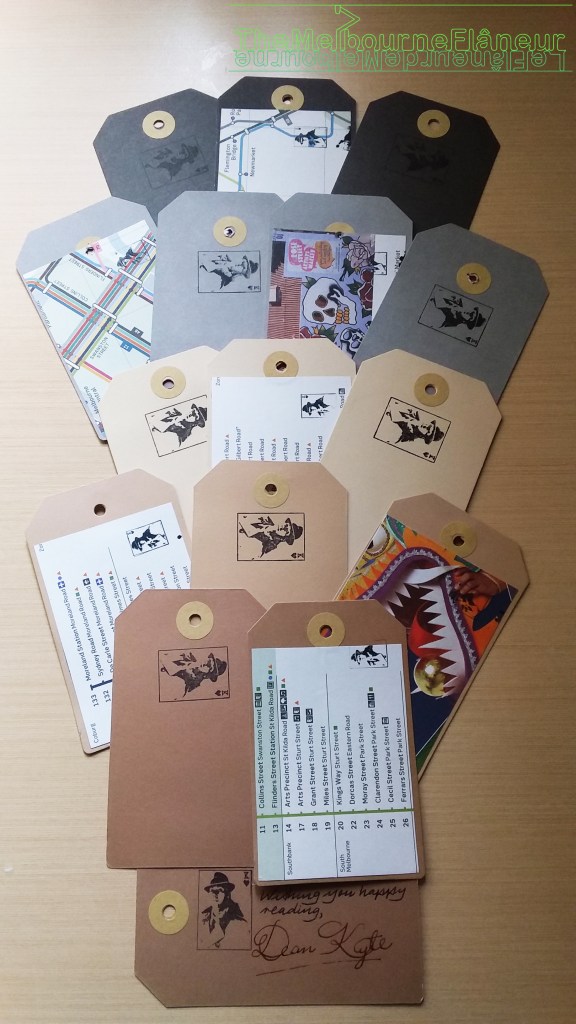
Or do you think that Orpheid: L’Arrivée might just be up the (dark) alley of someone you know? If you haven’t tried my custom order service and you’re thinking of buying some original gifts this Christmas, I invite you to take a browse in the Dean Kyte Bookstore. All my products come gift-wrapped by the same two hands that lovingly wrote the books. I also sign and wax-seal them and include a thoughtful, personalised message to the recipient, so if you want to give someone you love a thoroughly bespoke, artisanal reading experience to savour this Christmas, take a flash at my books or click the links below to purchase your own personal copy of Orpheid: L’Arrivée.

“Orpheid: L’Arrivée” [softcover]

Personally signed and sealed by author. Comes with frameable, handwritten manuscript page and custom bookmark. Price includes worldwide postage.

A$45.00

“Orpheid: L’Arrivée” [eBook]

PDF viewable on any device. Includes bonus audio track of page read by author. Worldwide delivery within 48 hours.

A$15.00
In this poetic video essay, Dean Kyte explores film scholar Vivian Sobchack’s concept of ‘lounge time’.

‘[Vivian] Sobchack builds on Bakhtin’s salon chronotope to identify the cocktail lounge and/or nightclub as a key film noir setting. What emerges in Sobchack’s analysis is the “lounge time” chronotope, which incorporates such public but anonymous sites as the cocktail lounge, the nightclub, the hotel room, the diner, the roadside café, and the motel. In contrast to the respectable domestic spaces of the home, these sites of aimless time and transient space give rise to louche characters and particular sets of, often criminal, activities.’

—Douglas McNaughton, “‘The Great Game’: Grids and Boxes in Cold War Screen Spaces” (2019)

Double Indemnity dramatizes this distancing from and yet reflection upon the nature of ordinary experience…. For anthropologists like [Victor] Turner, the characteristic cultural performance is ritual, in which participants find themselves on the border between “secular living and sacred living,” in a “limbo that was not any place they were before and not any place they would be in”…. Double Indemnity evokes a secular limbo. Walter and Phyllis, to use the term popularized by Turner, find themselves in a liminal social space, defined by its bordering engagement with contradictory social spaces…. Within this paradoxical space, the ordinary forms of everyday living are shown by Walter and Phyllis as what they always already are, that is, performances whose authenticity is by definition in question.’

—R. Barton Palmer, “The Divided Self and the Dark City: Film Noir and Liminality” (2007)

‘You have just met a woman, you are inches away from the greatest sex of your life, but within six weeks of meeting the woman, you will be framed for a crime you did not commit and you will end up in the gas chamber, and as they strap you in and you’re about to breathe the cyanide fumes, you’ll be grateful for the few weeks you had with her and grateful for your own death.’

—James Ellroy, Film Noir: Bringing Darkness to Light (2006)

Lounge time is this ‘liminal social space’, a limbo where the secular acquires, via the gloss of the sexual, a patina of the sacred.  In the chapel of the cocktail lounge, with its soft lighting (softened further still by the fog of cigarette smoke and dulled edges of drink), the social rituals of pickup transform an ordinary bar of chromium, zinc and glass (materials which, in the kaleidoscopic contrivance of their multiple reflectivities, dramatize ‘this distancing from and yet reflection upon the nature of ordinary experience’) into a site like Walker Percy’s ‘wonder’, an oasis outside of space and time, a place the noir man and woman were not in before they met, nor any place they will be in après cette rencontre—c’est-à-dire, la scène du crime.

I’ve felt it myself more than once, this quality of lounge time, at bars and pubs in Bellingen and Melbourne when sex seems imminent (and immanent) enough to touch.  It’s an eerie ambiance where the extension of space becomes borgesianly consubstantial with the temporal dimension, and ordinary, slightly tawdry surroundings are transformed, made exotic by the rare encounter with the erotic—which is necessarily dangerous.  Ennui, secular prisonworld apparently without end, makes the noir man a ripe rube for this brief encounter with the exotic erotic, and the familiar tools at the ritual of chasing away ennui, the chalice of glass and the censer of cigarette, are eager assistants at the epiphany of transsubstantiation, casting an aureole of precoital mystery around the noir woman, who condescends, in her own ennui, to allow herself to be seduced.  L’homme fatal equally presents to her a firedoor through which she may flee l’enfer of her embêtements ennuyeux et fâcheux—which are usually consubstantial with some other man she’s bored with or being bothered by.  Thus, this courtly Emil Jannings type presents a distinguished head upon which the maidenly mantis can prey, dispatching one man by chivalrous aid of another who has conveniently chanced across her path.

It is the chance aspect of both Daygame (when played by night in the setting of the bar) and noir, with its character of unremitting, dreary ennui in the unendurable monotonie of ordinary places and days (for the spaces of noir are temporally consubstantial with the experience of time as a jail) that appear eternal and impermeable to chance, which makes the secular transcendence of imminent sex implicit in the experience of lounge time apparently miraculous, ‘merveilleux’, plein with Percy’s wonder.  Luck seems so foreign, alien, foregone, impossible to the characters of noir, and yet the whole néant of the noirniverse is predicated on la malchance et le guignon.  Indeed, the irrationality of luck, its omnipresence even in its absence, is the one newtonian, urizenian law, firm as iron, in l’univers du noir:  ‘Yes, Fate, or some mysterious force, can put the finger on you, or me, for no good reason at all…’

In Maslow’s terms, lounge time is such a ‘peak experience’ for the men and women of noir, the place, the privileged moment they recur so often to in their flashbacks and confessions, because it was the one moment where they felt as if all their esperances were actualized, when it seemed as if the endless desert of their luck had broken its drought and they had found—miracle of miracles—in this place—le bar—which had delivered them no good luck before, the gushing rock, the shining penny, the sure thing, in the prospect of this étranger et étrangère they had not yet slept with.

—Dean Kyte,
“Invitation to a murder”

I’m grateful to Pamela Hutchinson of Silent London for bringing film scholar Vivian Sobchack’s concept of ‘lounge time’ to my attention a couple of years ago. You can read Pamela’s fascinating article about lounge time in the silent films of G.W. Pabst (and my response to her article) here.

In brief, as the first quotation, by Douglas McNaughton, at the head of my essay above explains, Ms. Sobchack’s concept of lounge time is an extension of Mikhail Bakhtin’s concept of the ‘salon chronotope’. Well, this takes a little unpacking too before we get down to brass tacks.

Bakhtin was a Russian philosopher and literary critic. As Mr. McNaughton elegantly summarizes it in his journal article (thus saving me a bit of trouble), Bakhtin came up with the concept of the ‘chronotope’ (the ‘time/space’), which he defined as ‘the intrinsic interconnectedness of temporal and spatial’ elements in a novel. The chronotope, in other words, is the warp and weft of space and time which forms the background tapestry of a fictional narrative. They need to be verisimilar with one another, and together they provide a sense of verisimilitude to the foreground actions of a fictional narrative.

But ‘chronotope’ is not simply a fancy narratological word for the ‘background’ of your novel. As Mr. McNaughton (citing Bakhtin) states in his article: ‘Chronotopes are “the organizing centers for the fundamental narrative events of the novel. The chronotope is the place where the knots of narrative are tied and untied.”’

In other words, the chronotope, as the complex nexus of realistic space and time, reaches directly into the narrative: locations and actions in time directly influence the foreground drama and the dynamics of character which take place against the backdrop of realistic space and time. It’s sort of like a spatiotemporal ‘archetype’ of setting that determines the kind of archetypal characters, situations, and stories that can realistically emerge from the matrix formed by the intersection of particular geographies and particular periods of time.

Bakhtin, as a pioneering narratologist, identified a number of ‘master chronotopes’, ur-spatiotemporal configurations, in novels, including the ‘salon chronotope’, which is a conspicuous setting in French nineteenth-century literature from Balzac to Proust.

But, as the notion of the salon implies, the salon chronotope is no more a ‘setting’ than it is a ‘background’; it’s more mystical than that. As space and time metaphysically meet in this physical room of a grande dame’s house, the chronotope of the salon is a kind of ‘cultural phenomenon’ that informs the total world of the narrative beyond the drawing-room. Tout Paris, c’est le salon (the whole social world of Paris is the drawing-room), if you’ll pardon the pun, and the intersection of physical spaces in time and culturally specific phenomena within them produces a set of determinable characters, situations, and plotlines which can occur within these physical/metaphysical, cultural time-spaces.

That’s the chronotope.

And as regards the salon chronotope, for example, we might say that the typically French, typically nineteenth-century story of the social ascension of Rastignac, charted by Balzac from Le Père Goriot (1835) to Les Comédiens sans le Savoir (1845), is morphologically the same chronotopic story as Georges Duroy’s social ascension in Maupassant’s Bel-Ami (1885), as is the passage of Proust’s narrateur from petit-bourgeois petit bonhomme in Du côté de chez Swann (1913) to elbow-rubbing equal of the Prince and Princesse de Guermantes by the end of Le Temps retrouvé (1927).

At a morphological level of recursion, they are all the same story, for the cultural phenomenon of the nineteenth-century Parisian salon determines the kinds of characters that can exist in nineteenth-century Paris, and the kinds of story that can be told in the space-time of nineteenth-century Paris, the democratic ascension of a clever young bourgeois man to the fashionable heights of quasi-nobility being one of them.

Ms. Sobchack built upon Bakhtin’s concept of the salon as a particularly potent spatiotemporal site of drama, and in an influential essay, “Lounge Time: Postwar Crises and the Chronotope of Film Noir” (1998), identified the transient settings of bars, nightclubs, cafés, cocktail lounges, hotels, motels and roadhouses as the key chronotope of film noir.

And again, it’s not that films noirs are set exclusively in cocktail lounges, it is that the spatiotemporal ‘atmosphere’ of the lounge as a transient, temporary space of flâneurial ease punctuating longer passages of anxious wandering through the urban night informs the Gestalt, the total world of film noir. As Ms. Sobchack explains in her essay, the of phenomenon of transient, shared public spaces where one momentarily rests from a condition of anxious displacement (such as the lounge) in post-war America determines, as the salon does for nineteenth-century Paris, the kind of characters that can exist in an American movie in the 1940’s or 1950’s, and the kind of story that can be told in America in the 1940’s and ’50’s.

It turns out that a film noir, an existential story of nihilistic crime resulting from a man’s succumbing to the temptation of a woman’s seduction, is one of those archetypal stories.

Why should this interest me and why should I have been so activated by Pamela’s post when she alerted me to the concept? Because it was one of those rare instances in intellectual life when someone else throws an astonishing sidelight on a problem so knotty (and so deeply, obsessively personal, it seems) that you can barely articulate the dimensions of it to yourself, such that there is a poverty of coverage about it in the literature, and thus, when you do come across a thesis closely linked to it, you are surprised that anyone else has even thought about the problem.

The recherché intellectual question of ‘the mood’ of places (which I seem to conceptualize to myself as an intersection of particular space and particular time), and how to represent the ‘character’ of places, independent of transient human occupancy, has become an increasingly salient æsthetic preoccupation in my writing and filmmaking over the last four years.

As I think my essay above makes clear, the first really important element that Ms. Sobchack’s concept illuminated for me is that, in almost a synæsthetic sense, in the film noir, space is time, and vice versa. The clue is in the name she gives to her concept—‘lounge time’, which connotes not merely a transient place where the characters of noir pass their time, but also the character of time’s passing in such places. There is a certain idleness, a certain flâneurial oisiveté implicit in the notion: time, in the space of the bar or cocktail lounge, does not pass quickly, ‘like sands through the hourglass’, but slowly, spasmodically, like the dripping from a leaky faucet.

There is, in other words, a Bergsonian (and even Borgesian) quality to how the characters of film noir experience time in the cocktail lounge. They experience temporal duration as spatial extension, and I give the image of the labyrinthine prison, the sæcula sæculorum of Catholicism, ‘from everlasting to everlasting’, ‘world without end’, as the metaphor for this Borgesian, Bergsonian space-time.

And Bergson leads us back to M. Proust, my cher maître, for, like the dear, divine Marcel, anyone who has read my flâneurial writing knows that I’m obsessed with spatial specificity and geographic particularity, and the temporal experience of walking through a precisely described physical landscape is likely to take much longer subjectively than objectively, the time between each footfall being measured by the tumult of thoughts that the landscape inspires in me at each step.

In Orpheid: L’Arrivée (2012), for instance, it takes me about a hundred pages to walk about a hundred metres, from the edge of the square Caulaincourt to my bed. In Things we do for Love (2015), I more modestly manage to take two train rides and a walk from Indooroopilly Station to Indooroopilly Shopping Centre in only a thousand words, but in Follow Me, My Lovely… (2016), I again haul you on a nine-hour, 20,000-word tour of Bellingen by night and by day as I bounce the most beautiful girl I’ve ever gotten into my bed all over town.

And in the forthcoming Sentimental Journey, expect to walk your eyes off, dear readers, as I march you (at bayonet-point, it might seem at times) through various Gold-Coastian, Brisbanian and Bellingenian locales.

The chronotopic relation between space and time;—the experience of space as time (and vice versa);—is, you might say, rather an entrenched and synæsthetic habit of thought in my writing.

Certainly, I see this apperception of time as spatial extension and space as temporal duration rarely represented in art, and little of the curious obsession I have for it represented in the academic literature, which made the encounter with Ms. Sobchack’s concept refreshing.

For perhaps even more than in my writing (or perhaps just more clearly, more appropriately to the medium), it is the organizing æsthetic principle which informs my filmmaking and videography—the films and videos you watch on this vlog. The confused perception of time as space and space as time is not merely the most conspicuous feature of my flâneurial writing, but it is, I contend, the most conspicuous quality of flâneurial filmmaking.

Elsewhere on The Melbourne Flâneur vlog, I’ve answered the question ‘Are there flâneur films?’. In that post, I stated categorically that there are flâneur films, but that it’s usually more a character of the films themselves—that is to say, a matter of style or cinematic technique—than the characters a film possesses that makes it ‘flâneurial’.

More precisely, it’s how a film deals technically, stylistically with space and time that tends to give it a flâneurial character. And as I said in the post “What is a flâneur?”, it’s an absolutely non-negotiable part of being flâneur, core to the definition, that one is a pedestrian by nature.

The word ‘pedestrian’ itself combines connotations of spatial extension and temporal duration, the time it takes to move through a landscape being directly linked to the mode of travel. There must be in the flâneurial film, therefore, a sense (so uncommon—even alien—to the apparatus of cinema) of being tied to a singular perspective, and a singular mode of movement through the world, one that is distinctly human and limited by the human viewpoint and human movement.

As Alan Saunders and Robert Sinnerbrink of Macquarie University discuss in this episode of ABC Radio National’s The Philosopher’s Zone, French philosopher Gilles Deleuze set the foundation for a flâneurial mode of cinema when he proposed that there was a ‘sensory motor-action scheme’ at work in filmmaking at least up to the outbreak of the Second World War, and one which is most perfectly realized in classical Hollywood cinema up to the ‘outbreak’ (I think we can call it that!) of Citizen Kane (1941).

In the first volume of his Cinéma (1983), M. Deleuze deals with this type of filmmaking, what he calls ‘l’image-mouvement’ (the ‘movement-image’), and he identifies three types of image which combine to form this sensory motor-action scheme: ‘l’image perception’ (the ‘perception image’), ‘l’image affection’ (the ‘affective image’), and ‘l’image action’ (the ‘action image’).

In fine, in M. Deleuze’s theory, we see; we feel something about what we see; and then we act in reaction to what we see. Perception leads to affect leads to action. Montage, the great discovery of the Soviet silent cinema, with its juxtaposition of images of perception, images of emotion, and images of action in a dynamic, plastic composition which is unique to the art-form of the cinema itself, is really the innovation that crystallizes the movement-image as a the central organizing principle of classical narrative filmmaking.

And as Messrs. Saunders and Sinnerbrink discuss, the cinema of Alfred Hitchcock is really the æsthetic high-water mark of classical Hollywood filmmaking in the movement-image style. Rear Window (1954), for instance, is entirely predicated upon the cumulative effect produced by montage as proposed by Soviet theorist Lev Kuleshov, and the tripartite formula of perception, affective, and action images are the technical basis by which Mr. Hitchcock, as a consummate ‘engineer of fright’, cumulatively produces the mechanics of suspense in that picture.

In fine, as Rear Window so peerlessly, rigorously, and consistently demonstrates, the palpable effect of that picture (as of all Mr. Hitchcock’s best work) produces a visceral somatic experience of suspense and fright in us precisely because the total assemblage of the film is rigorously anchored at every moment to this sensory motor-action scheme. Along with James Stewart, we look at something; we are emotionally affected by what we see; and the affect produces a bodily reaction in us. Donald Spoto, in his essay on Rear Window in The Art of Alfred Hitchcock (1976), notes that the moment when Raymond Burr looks directly at the camera still manages to produce the reactive action of an apprehensive murmur in the audience, despite familiarity with the film.

Indeed, it is this ‘mechanical’ schema about how we perceive spatial relations which gives classical cinema its engaging, involving quality, and it seems to explain (albeit in too neat and over-simplified a fashion) our experience of the world as bodies in space. The miracle is that a mechanical object with no consciousness of its own can (with the aid of judicious editing in post-production) ‘mimic’ how we perceive, react and act in relation to other spatial objects—including people—with some chronotopic verisimilitude.

In this conversation with Violet Lucca and Imogen Sara Smith, one of the most pragmatic and rigorous film scholars of our time, David Bordwell of the University of Wisconsin—Madison, explains why this should be so by comparing 1930’s cinema with 1940’s cinema.

As Mr. Bordwell and Ms. Smith discuss circa minute 16, thirties cinema is ‘behavioural’, ‘externalized’; it’s about putting on a show that the audience can easily read off through the spectacle of action. And as Mr. Bordwell explains, this æsthetic Gestalt is perfectly consonant with the implicit assumption of thirties cinema, which is that there is a kind of externalized ‘causal social mechanics’ at play which chronotopically produces, for instance, the thirties archetype of the gangster. As Ms. Smith points out, the characters of thirties cinema, whether they are gangsters, chorines, or screwball couples, seem to have ‘no interior life’: they are pure movement and externalized behaviour, bodies in kinetic (which is to say, photographable) spatial relation to one another.

Certainly, as Walker Percy observes in a memorable passage in The Moviegoer (1961), it is the spectacle of the movement of John Wayne ‘kill[ing] three men with a carbine as he was falling to the dusty street in Stagecoach (1939) that is palpably affecting for the spectator.

The difference between thirties cinema and forties cinema is something like the difference, I would contend, between commedia dell’arte and Shakespeare’s comedies. Though roughly coexistent, one derives its comedic force from visible actions in space, while the other derives its comedic force from the dynamic collision of antagonistic personalities over time. And ultimately, we find the verbal whaling of Benedick and Beatrice upon one another more comedically satisfying than the mutual physical attrition of Punch and Judy.

Moreover, I would contend that thirties cinema, whether it takes the particular form of the gangster movie, the Busby Berkeley musical, the Fordian western, or the screwball comedy, is the last frenetic spasm of pleasure produced by the movement-image as the defining æsthetic criterion of the cinema as a distinct art-form up to 1940. If Mr. Bordwell’s and Ms. Smith’s intuitions about thirties cinema have confirmable validity, I would say that a general morphological sense of people, objects, and society as being ‘mechanical’ and ‘mechanically determinable’, as a set of discreet bodies in a kinetic spatial relationship to one another that can be photographed in action, is what defines cinema from the Lumière brothers and Méliès up to 1940.

In fine, I am arguing that the conditions of a mechanised modernity chronotopically produced the matrix for cinematic stories which favoured the movement-image between 1895 and 1940. The assumption that the ‘source code of reality’ is fundamentally mechanical, and that even social relations are dictated by a Newtonian physics of bodies in spatial relation to one another, underlies stories in all media, but most particularly, and most perfectly, in the cinema.

M. Sartre’s definition of cinema as ‘le délire d’une muraille’ (the frenzy on the wall) could apply to any film from the actualités of the Lumières, to The Great Train Robbery, to Griffith, to Vertov’s delirious celebration of the worker’s paradise, to surrealist cinema’s fascination with the speedy repetitions and revolutions of machinery, to screwball comedy’s Punch and Judy show. The intoxicating spectacle of early cinema as pure, joyous movement photographed was somatically pleasing to audiences up to 1940. Nothing more was needed to make movies pleasurable than that photographed images of real objects in the world should move, and the miraculous correspondence between the mechanics of cinema and our own sensory motor-action schema produced this satisfying affect.

But in his second volume of Cinéma (1985), M. Deleuze identifies a rupture in the schema, so that it becomes difficult, dopoguerra, to know how to act in relation to what is being perceived. At about the time of the Second World War (a period of psychological schism which coincides with the ludic iconoclasm that Orson Welles, enfant terrible, will wreak upon the art-form in Citizen Kane), the cinematic image starts to become more temporally salient than spatially.

M. Deleuze identifies what he calls the gradual emergence of ‘l’image-temps’ (the ‘time-image’) during the war years, until it becomes an entrenched trend in cinema post-1945.

Now, it’s not an æsthetic coincidence that the phenomenon of film noir should emerge, as Citizen Kane does, at the commencement of American involvement in the war, nor that the trend toward darker and darker crime pictures should increase with American participation in it, and become an entrenched æsthetic movement after the war ends. The close relation of Citizen Kane to The Maltese Falcon and its successors has been remarked by many film scholars, but certainly, from a technical standpoint, the chief innovations of Kanechiaroscuro lighting and deep focus photography—are not merely techniques it bequeathed to film noir, but techniques which create the conditions for M. Deleuze’s time-image.

In fine, the technique, in Citizen Kane, of flooding a soundstage with so much sculpted light that one creates an image that is crisp and sharp to the furthest recession of the picture plain, one in which the ‘white space’ of perfect darkness is as photogenic and afforded as much visual weight as well-lit areas of action, now places the onus of ‘what to look at’ squarely upon the individual spectator. This was certainly not the way of 1930’s Hollywood films, where shots were lit in a façon laiteux and creamily focused so as to direct the audience’s gaze to the salient object of the shot.

With this new flâneurial liberty of the eye to roam about the image, time becomes a factor of salience in perception and action. You could say that the ambiguity between perception and action in films from 1941 onwards creates a delay, an interval in which one must process the affect created by a visual space in which everything is now equally salient for oneself.

Certainly the film noir, where the hyper-vigilant clarity of deep focus photography combines with large areas of screen real estate in ominous shadow, creates spaces in which everything is a potential threat—or where a threat could come from any sector of the screen.

No character can speak authoritatively from a space which is being continually cut into ribbons of light.

… [I]n film noir, the central character is likely to be standing in the shadow. When the environment is given an equal or greater weight than the actor, it, of course, creates a fatalistic, hopeless mood. There is nothing the protagonist can do, the city will outlast and negate even his best efforts.

—Paul Schrader, “Notes on Film Noir (1972)

The delay between perception and action as one cognitively processes the affect created by the ambiguous noir image of unfathomable depth and unfathomable darkness is a temporal equivalent, I submit, to that visual metaphor which T. S. Eliot, in “The Hollow Men” (1925), calls ‘the Shadow’:

Between the motion
And the act
Falls the Shadow

...

Between the desire
And the spasm
...
Falls the Shadow

The delay between perceiving and acting is, for post-war man, ‘the Shadow’: what is perceived in movies from Citizen Kane and film noir onwards is no longer clear, and thus there can be no pure, innocent jouissance obtained from the spectacle of action. Nothing that one does, now, ‘after Auschwitz’, is innocent and without consequence, and, as W. H. Auden presciently observed in his “New Year Letter” of 1941:

The situation of our time
Surrounds us like a baffling crime.

I suspect that the reason M. Deleuze’s time-image all but takes over the cinematic discourse by war’s end is that we are now confronted with images in which masses and masses of bodies lie motionless. The cameras linger in avid horror on the spectacle of sites where atrocious action occurred with fulgurant mechanical speed.

In an image where there is no movement, time, as I said, becomes the salient factor.

And as Ms. Smith observes at 33:45, time now becomes the subject of forties cinema in the same way that space held salience in the cinema of the thirties. More specifically, the extra-temporal narratival structures that come into vogue in the forties, and which are used with such brio in the film noir (the flashback, the voice-over, the superimposition, the dream sequence, etc.), are obsessed with the subject of the past. It is perhaps no coincidence that the greatest film noir references this obsession directly in its title:—Out of the Past (1947).

There is a definite sense of loss, of rift, of irrecoverable rupture in the films of the forties, and I would suggest that when you are confronted with moving images in which there is no movement, in which you are forced to perceive the consequence of human actions on motionless human bodies, these extra-temporal narrative devices which suggest memory and dream serve to supply the missing action, the joyous movement of living bodies that has been cruelly and irrecoverably lost.

But this sense that additional time is now required to parse and process the affect between perception and action is equally present in Italian Neorealism, in the cinema of Ozu, and that of Tarkovsky, who was wise enough to apprehend that the material he was sculpting his films in was not light, but time. As Mr. Sinnerbrink observes, these filmmakers (along with Welles and Renoir, as for instance) are actively seeking to ‘block’ the circuit of the sensory motor-action schema, and a handbrake is applied to narrative momentum through the cinematic strategies they devise to enhance the ambiguous affect of images.

Italian Neorealism, as a European cousin to film noir, employing many of the same cinematic techniques that Hollywood directors would apply to generic thriller material after the war, such as filming on location and employing non-professional ‘actors’ in the commission of their jobs, serves to effectively illuminate this point.

As Mr. Sinnerbrink says, in Italian Neorealism ‘you’ve got characters in an environment they no longer understand. … The faith or belief in how the world should be … has been severely shattered.’

Indeed, as far as action and movement goes, there is an ‘impotence’, oftentimes, displayed by the characters of Neorealism, best exemplified, I think, by De Sica’s Ladri di biciclette (1948). In that film, the ostensible action which drives the entire narrative (and which is so slender a premise that there is really only enough ‘story’ in it to sustain a one-reel silent comedy), the recovery of the stolen bicycle, is abortive, frustratingly unresolved.

Antonio’s ricerca through Rome (we can’t call it a flânerie, nor even the Italian equivalent, a passeggiata, for it’s too existential a trudge to be undertaken for idle pleasure) as he seeks to find his stolen bicycle is essentially a chase through dreams—or a nightmare. It’s as hopeless a quest as waiting for Godot, and that Sig. De Sica should extend so slight an idea for a film into a drama as endless and desolate as Beckett’s gives you a sense of the emotional ‘freight’ that the affective image must now bear, after the war, as it crowds out the perception-image and the action-image, problematizing the one and infinitely delaying the other.

The time-image of post-war cinema is all affect. The delay that is created by problematizing perception and deferring a decisive action in response to it means that more time is required by the spectator to scrutinize the ambiguous image and decide how he feels about what he is seeing. Paul Schrader says this about the famous shot in De Sica’s Umberto D. (1952), in which the camera holds for nearly thirty seconds upon a simple action—the striking of a match:

It was no longer about the activity of striking a match, it was about how long are you going to sit to watch? The filmmaker is using the power of cinema itself against itself to get you into a sense that you have to participate.

—Paul Schrader, “Transcendental Style in Film | Paul Schrader | TIFF 2017”

Moreover, as Kogonada observes in his video essay “What is Neorealism?”, in comparing David O. Selznick’s cut of Indiscretion of an American Wife (1953) side-by-side with De Sica’s own cut of the same film, Terminal Station (1953), we can easily see that Sig. De Sica consistently employs a narrative/editorial strategy of holding longer on shots, withholding the cut, allowing the camera to linger on extras whose stories we never get to explore, after the main characters have left the frame.

In other words, in Sig. De Sica’s version, the chronotopic setting for the foreground drama, the warp and weft of life that surrounds and enfolds the fiction, is allowed, in Neorealism, to ‘billow in’, like a curtain breathed upon by a gentle breeze, and fill the vacuum temporarily left by the absence of the characters after they have left the frame.

The action of striking the match is perhaps more neatly illustrative of my point, but both techniques partake of a general variety of narrative strategies in cinematic storytelling that privileges the time-image over the movement-image after World War II. That is, as an action that can be photographed, the striking of the match is no longer miraculous as a movement. The match fails to light. It requires a repetition—two repetitions, and they both fail. It requires even a second match and a fourth attempt before the maid in Umberto D. can light the stove.

The time it takes to perform an action is now the spectacle. It’s no longer the movement as an act in space, but the duration of the movement, as an act across time, that becomes visually salient and significant.

And perhaps we can even say that the difficulty of performing an action successfully becomes significant, since there seems to be a misalignment in the maid’s sensory motor-action schema, a momentary misalignment between perception and action before the final, successful striking of the match. In the fraught post-war world, not even the most simple actions (which the cinema of the thirties would have taken for granted) are as obviously simple as they appear.

And applied more broadly to the world beyond the narrative, longer shots which invite a chronotopic reality, redundant to the narrative, to enter and take up compositional space in time as the ‘white space’ of shadow does visually, means that the duration of a film becomes, in the forties, co-extensive with space: As a physical object, the film becomes longer, just as it becomes temporally longer.

Mr. Bordwell notes that forties films, with their obsessive preoccupations with time, now start to aim for a ‘novelistic density’, but he doesn’t notice this point, viz.—that if we accept the premise that thirties movement cinema is a cinema of spectacular theatrical display, the spatial extension of the image is one of length and width, like a framed painting, or like a play framed by the proscenium. But in the forties, cinema becomes, like the novel, a truly temporal art-form where the extension is into the experience of time—the time it requires to apprehend and appreciate the artwork.

The ‘thickness’ of a novel is an index for its temporal, experiential dimension. Likewise, the physical ‘length’ of a piece of film becomes indexical for its time relation. When directors like De Sica, Ozu, Tarkovsky, Renoir and Welles slow down their shots, add frames which freight the film with additional ambiguous affect, problematizing perception and delaying action, what can be potentially discovered in the frame by a self-directed spectator thrown back on his own resources of deciding ‘what to look at’ becomes, potentially, experientially infinite. Like a novel one periodically rereads, discovering something new each time, returning to a film whose spatial extension of length and width is predicated on the time-image now becomes a flânerie through un jardín de los senderos que se birfurcan.

What Mr. Sinnerbrink calls ‘a loss of faith in the world’ which the characters of Neorealism (and film noir) feel is really a loss of faith in the visible appearances of the world. The time-image is deeply sceptical of indexical appearances; hence its ambiguity. A direct line can be traced from the disappeared bike in Ladri di biciclette to the disappearing body in Antonioni’s Blowup (1966), and from Antonio’s impotent quest to recover his bike to utterly abortive quests for meaning, like Jack Nicholson’s odyssey in Antonioni’s The Passenger (1975).

The disappearing body of Blowup completely defies a semiotic, indexical interpretation of reality, a 1:1 relationship between image and world—which is a relationship the movement-image confidently assumes.

The pre-war confidence of the movement-image is permanently displaced by the post-war uncertainty that things are what they appear, and that we may act confidently on the report of our senses, a sensibility which is implicit in the time-image.

That seems to be the lesson of World War II: the apparently innocent joy of modern, mechanized movement done at dizzying speed ultimately produces piles of lifeless bodies.

M. Deleuze argues that we can ‘think’ through cinema, that cinema itself is a ‘medium of thought’. If we take the cinematic image of Fernand Léger’s gaily pumping pistons as a logical premise, it is hard to predict from that image of exhilarating force and speed the mechanics of the Final Solution, which is the inevitable conclusion of the unconscious logic of modernity—man as an interchangeable, eminently dispensable, disposable part in his own machine, to be thrown on the scrapheap, or fed through it like fodder, only to come out the other side as offal and carrion.

Between the idea
And the reality
...
Between the conception
And the creation
...
Falls the Shadow

To return more fully to film noir, which, in exercising a particularly nihilistic brush over generic mystery and thriller material, deals by metaphorical displacement with ‘the baffling crime’ of the Second World War, which surrounds everyone and implicates everyone in the forties, we begin to understand the chronotope of lounge time, the necessity for the compromised respite which transient, shared public spaces provide a traumatized and displaced American population.

In the lounge, we drown ourselves in drink and try to fumigate our brains with cigarettes, exorcising them temporarily of the devils we have seen and been. The lounge itself is a site and a period of delay: it too is a Shadow—but a welcome one. The shadows outside the bar, ‘the situation of our time’ which is the circumambient night and the threatening city of film noir, are a purgatorial holocaust we must trudge through when we have used up our ‘money time’, this moment of flâneurial ease between chapters of anxious hustling out there.

Film noir is not a genre in this understanding; it is an allegory. Film noir is a set of stylistic, æsthetic cinematic strategies and conventions which are visually applied to generic mystery and thriller material in such a way as to displace and disguise crime movies as cathartic allegories for the all-enveloping ‘Big Crime’ of modernity, the master chronotope that is the Second World War.

We think—wrongly, at this historical pass, because the conventions of noir have been so disgustingly abused by subsequent generations of filmmakers with no generational experience of all-encompassing crime and trauma and guilt—that film noir was a much more codified æsthetic movement than it was. Even if the term ‘film noir’ was unheard of in America until just before the end of the classic cycle, surely the filmmakers who created this very visually and narratively distinctive body of films were more conscious of what they were doing than they were.

But why should they be if, as I am arguing here, film noir is kind of cathartic allegory, an æsthetic penance by which one exorcises the unforgotten but deeply repressed memory of all those lifeless bodies whose joyous movement one has curtailed in wartime?

In his conversation with Ms. Lucca and Ms. Smith, Mr. Bordwell states that his research has positively shown that in the forties ‘mystery’, as a generic category, became a kind of ‘meta-genre’, that there was a craze in 1940’s Hollywood cinema to inject an element of mystery into almost every other kind of generic story. Although he doesn’t reference Citizen Kane directly, this is the best possible example of the prototypical film noir that isn’t a film noir, a mystery story where the mystery isn’t ‘Whodunnit?’ but, ‘What is the meaning of “Rosebud”?’

In fine, ‘mystery’ becomes a ludic device that structures narrative in forties films. In other words, an impression of ambiguity which disrupts straightforward narrative perception and action—and the affect of anxiety that this delayed resolution produces in the audience—comes to the foreground in how audiences of the forties experience narrative (which is to say, as a subjective interpretation of reality).

This makes sense. If the world around you is in epic upheaval, epic disruption due to war, making sense of what you see around you and knowing how to act appropriately becomes a business of plumbing mystery. As I said with respect to Antonioni, a semiotic sensemaking strategy, assuming that things are actually consubstantial with how they appear, is not necessarily a successful means of navigating a salience landscape of totalizing, existential disruption.

I would argue that people in the forties are essentially so traumatized by the split between appearances and actions that they are primed to accept mystery as an affective temporal dimension to cinematic images. If the perception-image is point A and the action-image is point B, audiences after 1940 become progressively primed to accept that there is a third point between appearances and actions which the films of the thirties elide, and this third, temporal point is the realm of ‘mystery’.

In some sense, the ‘lining’ of a mystery story, the true, unperceived actions which animate it, occur in another, interstitial dimension of the cinematic narrative between the perceptions and actions the narrative consciously notices as images and scenes registered on film. Which is to say that there is ‘lost’ or ‘missing time’ which makes the narrative-as-film necessarily ambiguous, and hence ‘mysterious’.

And this interstitial dimension often coincides with those ‘extra-temporal’ narrative devices which are such a salient structuring feature of film noir: the flashback, the voice-over, the superimposition, and the dream sequence.

Moreover, it is precisely these innovative cinematic techniques which the film noir avails itself of and uses more adroitly than any other type of film in the 1940’s which makes it a kind of ‘avant-garde cinema’ during the cycle of the classic period. As Mr. Bordwell points out, the widespread adoption of mystery as a meta-generic narrative style in the forties means that generic thriller material now becomes consequentially respectable as something to exercise your cinematic chops on, and (as film noir’s symbiotic association with the B-picture demonstrates), the making of thrillers becomes a cheap, effective way for filmmakers (especially young filmmakers) to demonstrate the scope of what they can creatively do with film form.

In fine, as I argued above, rather than being a genre in itself, film noir applies a set of æsthetic visual strategies, cinematic techniques and conventions which have their own chronotopic freight to generic narrative material. A generic crime story, a mystery or a thriller becomesnoir’ when a certain visual æsthetic is applied to it: unique to this visual æsthetic as to no other that I know of is a certain chronotopic weight which determines, as I said in my response to Pamela’s post, the nature and the kinds of stories that can be told in settings which are painted with the brush of noir.

In other words, this set of æsthetic visual strategies, cinematic techniques and conventions as a chronotopic meta-setting directly affects the foreground narrative. The types of photogenic and cinematic techniques that filmmakers apply to photograph the places, whether they be settings on a soundstage or actual locations, that constitute the typical locales of film noir in the 1940’s directly impacts the nature of the generic crime story that can be told against such spatiotemporal backgrounds.

In a sense, the visual choices foreclose other narrative choices, dictating the kinds of postmodern narrative devices that can satisfactorily accompany such an avant-garde visual style, narrative devices which are verisimilar to the avant-garde æsthetic. A film consequently becomesnoir’ because the dark visual treatment forecloses other narrative options and dictates the kinds of characters who can emerge in a locale painted with the brush of noir, the kinds of situations that can develop in such a place and time, and ultimately the kinds of stories that can be told by the dynamic interrelation of characters with each other, and with the setting.

Moreover, this totalizing visual æsthetic, with its potent photogenic affect, creates the fundamental conditions for the ambiguous time-image, which is so essential to film noir.

Finally, to return to my original premise, how does lounge time, as the organizing chronotopic principle of film noir, the visual æsthetic which carries the seed of the time-image implicit within it, relate to flâneurial cinema?

Well, as I said at the beginning, the clue is in the name that Ms. Sobchack gives to her concept: lounge time suggests a space that is simultaneously temporal, and a period of easeful respite from anxious wandering that is simultaneously a physical site of rest. It suggests an extra-temporal, interstitial realm or dimension, a place and an hour of luxe, calme et volupté.’

The oisiveté of M. Baudelaire’s credo of ‘luxe, calme et volupté’ is the beatific condition to which the flâneur aspires. And yet, like the harried, displaced protagonists of film noir, his condition of dandiacal poverty, the existential stress of being a ‘man of leisure’ on no private income, means that he must trudge on ‘à travers le grand désert des hommes’ just as the hopeless losers of film noir must trudge on through the asphalt jungle.

An intoxication comes over the man who walks long and aimlessly through the streets. With each step, the walk takes on greater momentum; ever weaker grow the temptations of shops, of bistros, of smiling women, ever more irresistible the magnetism of the next streetcorner, of a distant mass of foliage, of a street name. Then comes hunger. Our man wants nothing to do with the myriad possibilities offered to sate his appetite. Like an ascetic animal, he flits through unknown districts—until, utterly exhausted, he stumbles into his room, which receives him coldly and wears a strange air.

—Walter Benjamin, The Arcades Project, Convolute M: “The Flâneur

We crave the lounge, the place and time of leisure and pleasure, that womb-like matrix where the two intersect. And, as for M. Baudelaire, that terrestrial heaven is not only the place and time we would invite our daughter, our sister, the Elected One of our soul to join us in, but it is a place and time that is eminently feminine and consubstantial with her. That place of timeless ease is the eternal Her.

In lieu of an eternal milieu where we can stop walking, we plunge on, into the barren ocean of time, au fond de l’Inconnu pour trouver du nouveau!

I said at the start that flâneurial cinema, in contradistinction to the implicit æsthetic of cinema itself as a modern art-form predicated on mechanical speed, is pedestrian and tied to the slow rhythm of the foot. As such, flâneurial cinema is entirely predicated on the time-image: the movement of walking itself, while being an extension into space, is far less salient than the qualitative experience of walking, which is an extension of movement into duration.

Mr. Sinnerbrink has a couple of interesting tournures which are instructive on this point. At 14:11 of his conversation with Mr. Saunders he says: ‘With Ozu and with Orson Welles (others as well, like Jean Renoir), what you get are images that no longer are strictly driven by the narrative purpose, but start to take on a kind of descriptive function’ [my emphasis]. And again, at 22:28, he refers to ‘pure optical and sound descriptions’ [my emphasis].

We’re told, in classical screenwriting theory (as in writing more generally), that one should ‘show not tell’. The movement-image is all show. But the time-image, I submit, is the visual equivalent of a passage of description in literature: it doesn’t necessarily advance the well-oiled machine of the plot as the movement-image does, but, as Kogonada effectively demonstrates in his video essay on De Sica, describes something of the chronotopic reality which enfolds the drama.

The time-image, in fine, ‘tells us’ something about the nature of the world which is auxiliary to the drama, ‘redundant’, even, by the standards of a classical, mechanical cinema predicated on the movement-image.

And thus, if flâneurial cinema is entirely predicated on the time-image, it is entirely predicated on what Mr. Sinnerbrink calls these ‘pure optical and sound descriptions’ which are not ‘strictly driven by the narrative purpose’. Like the lounge, these extended moments which ‘describe’ the chronotopic actuality of the world are moments of rest, of pause, images which allow the eye to flâneurially explore the frame at ease.

Mr. Schrader calls it ‘leveraging boredom’, and certainly I know from personal experience that my films and videos, with their static setups and long takes looking at nothing, the void of empty spaces at dead hours of dawn or dusk, late afternoon and late night, the times of day (as in film noir) when the conditions of light impose their own æsthetic mood on places, are an ‘acquired taste’.

Some people don’t get these paradises of rest and are deeply bored by them. But I know, from having screened some of these films and videos in Melbourne and elsewhere, that for most people the rigorous simplicity of my technique, my foregrounding of the time-image and eschewal of the movement-image, produces a ‘restful’ effect of respite that contrasts pleasantly with the work of other filmmakers who are more focused on people, and the human dramas which take place against these chronotopic backgrounds.

I rarely move the camera, and thus spatial extension of the world (that is, what is visible within the frame) becomes temporal extension: a corner of the world regarded fixedly over time. Moreover, as the soundscapes of my films and videos are wholly invented, like these extra-temporal narrative devices in film noir which evoke the dimensions of time and memory and dream, the imagined aural landscape in and beyond the world delimited by the frame makes the image extend both in space and in time—into the imagination of the audience.

Ultimately, perhaps, it is the extra-temporal dimension of the imagination which the flâneur seeks, a place outside of space and time where he can quit his walk and permanently rest, content that le nouveau will infinitely find and refresh him there.

And having taken you, dear, indulgent readers, at bayonet-point on an epic flânerie through several disparate quartiers of my mental geography, let us turn in at this place and rest our dogs.

If you found my wild intellectual promenade invigorating, dear readers, you can support me via Bandcamp.

Some recent visitors to this vlog have decried the lack of a “Donate” button at the bottom of my posts. I prefer to give value for value, so if you’d like to signal your appreciation for what I write, I’d like to give you something of lasting value in exchange for your support. I’ve made the soundtrack of the abridged version of “Invitation to a murder” featured in my video essay available for purchase, streaming and download via my artist profile on Bandcamp, so for $A2.00 (make it more, if you like) you can have permanent access to the track.

Put me on your pod or phone, and then, when you need a moment of respite from the hurly-burly of the world, check in to my imaginary lounge and let my words lull you into a momentary place of restful ease. Just click the “Buy” link below, or feel free to “Share” the track with a friend.

Shout out to Coffs Harbour street photographer Jay Jones (@concretefashionista on Instagram) who captured your Melbourne Flâneur on the prowl at Coffs Central.

Jay snapped me sans overcoat but otherwise suited up for winter as I swanned around summery Coffs, an unofficial ambassador of Melbourne moda bringing a soupçon of Collins street chic to Harbour drive.

The only unfashionable touch by your Melbourne Flâneur’s über-æsthetic lights: the muzzle (or ‘chin-sling’, as I call it) in my south paw, a fad which no one will ever convince me is elegant—even the flower-bedizened variety I reluctantly port.

Even when forced to hide my mug behind a mask, dear readers, the dandy in me indomitably prevails, and I must bring a touch of the æsthetic even to this despised item of bourgeois uniformity.

But whether I am airing my dial or have my mug camouflaged behind a floral mask, it seems I am instantly recognized in these parts. Even at the bus stop, preparing to decamp from Coffs to Bellingen, I was recognized by someone I had never seen in my life.

‘You’re going to Bellingen, aren’t you?’ the guy asked.

‘Yes,’ I replied, somewhat surprised. Perhaps, I thought, the bowtie I was wearing gave me away as the type of person who would be waiting for the bus to Bello.

‘Yeah, I’ve seen you there,’ he said.

‘It must have been a long time ago,’ I said. ‘I haven’t been there in five years.’

He seemed doubtful about that claim, as if it were more likely that he had last seen me only five weeks ago.

The encounter puzzled me until I alighted in Bello. Hardly had I squared away my luggage at the Diggers Tavern and taken my first fashionable flânerie in æons up one side of Hyde street, the Champs-Élysées of Bellingen, and down the other before I was recognized by John Ross, owner of the Alternatives Bookshop, who greeted me with the words: ‘We were just talking about you.’

That is a phrase I have heard repeated continuously. Five years may have passed, but my ‘celebrity’ in Bellingen (as John called it, introducing me to two passers-by) as its most dandistic resident remained undimmed by half a decade’s absence. Indeed, on Sunday, as I lounged on the grassy bank of the Bellinger River, relishing the sun (a dominical ritual of confirmed Bellingenites), two friends sitting at some distance and recognizing a jaunty Fedora worn rakishly askew inquired of their companions if it could be me and, more to the point, if they had lived in Bellingen long enough ‘to know who Dean is.’

I’ve become a fabled creature here, which I didn’t expect. If you have lived in Bello in the years ‘A.D.’ (‘After Dean’), you have clearly missed a spectacle as dazzling and memorable (in the annals of fashion, at least) as the Transfiguration of Our Lord.

I used to have a lady friend here, a cute little sculptress who lived up the hill in Dorrigo and who would come down to Bello on a Sunday to work a shift at the former Lodge 241 café. It never ceased to amuse her how, on our dates or after-work flâneries, we were forced to stop every few metres in our progress along Hyde street to acknowledge the friendly salutations of the most diverse people.

To her, I seemed to know everyone in town, but to me, it felt more like everyone knew me—even the people I didn’t know.

Conspicuous as I was in my day, I thought that when I departed Bello for Melbourne five years ago, I would be promptly forgotten. But it was I who had forgotten the curious phenomenon of ‘Bello time’, whereby a man can go away for five years and be greeted warmly by half the town as if the last time he had been seen in these parts was last week.

But I suspect there’s more to it than that. I am certainly not the only literary man to have passed a season or two in this town, and certainly not the most internationally celebrated, Peter Carey having lived in Bellingen and having set the Booker Prize-winning Oscar and Lucinda (1988) in this landscape.

Moreover, journalist George Negus and I occasionally shared co-working space at ‘my office’, the Hyde, and one of the last times I imbibed a long black there before checking out, on a day when the café was particularly bondé de gens, Mr. Negus and I were forced to sit coude-à-coude at the counter and cement the distant intimacy of our long nodding acquaintance with some polite pleasantries about the political nouvelles du jour, that mustachioed gent never suspecting the local literary celebrity he was rubbing his grizzled elbow against.

I kid, of course.

But like all jests, there’s a zesty grain of truth in the observation that if these two literary gentlemen have more conspicuous clout in the world of letters than your presumptuous little flâneur, in the public imaginary of Bellingen, at least, with the rigorous rectitude and correctness of my dress, I have always fitted the image of an homme de lettres more thoroughly than my more famous colleagues—for all my friends and acquaintances here know that the hygiene of my deportment reflects the intellectual hygiene of a man who makes the most exquisite discriminations with words.

But I find myself in an odd—even an embarrassing—position, overwhelmed by the well-wishing of people who have never forgotten me and never, it seems, ceased to think well of me in my absence.

All the time I lived here, people predicted an imminent removal to Melbourne for me, telling me that, with my sens inné de la mode, I was meant more for Collins street than for Church street, but I think I defied even the most prevoyant forecast about that imminent departure date by staying nearly two and a half years in Bello.

When I did, finally, satisfy the prophecy which had attended me from the first and vamoosed to Victoria, it was with the deeply regretted sense that this beloved landscape had, indeed, been eventually exhausted for me as a source of flâneuristic exploit—particularly as regards the flâneur’s addictive habitude of æsthetically investigating the women of the cities and towns he prowls through.

The dandy is always seeking to crystallize his image, to make his outward appearance thoroughly congruent and consubstantial with his inward self, and in Melbourne, it’s true, I seemed to find and set in perfect place the last pieces of the puzzle to my character which I had been searching for in landscapes as various as the Gold Coast, Paris, and even Bellingen.

In my ‘Paris-on-the-Yarra’, I was able to find again the lost qualities of Parisian flânerie (albeit curiously perverted by antipodean climes), and regarding the most Parisian city on Australian soil dreamily through half-closed lids, I could, in my flâneries around Melbourne, pretend I was in something like my heart’s home.

I will always be, first and foremost, a Parisian, proud citoyen of the first city of modernity, and hence of modernity’s most decadent product, fashion. But if I have integrated the high polish of the dandistic Parisian flâneur with a life spent wandering the streets of this benighted antipodean isle’s provincial capital of fashion, such that I have become a Melbourne flâneur, it is fair to say that without a couple of years of my life spent squinting still more tightly, trying to disengage and draw forth, like a fabulous perfume, the flâneuristic romance of marvellous novelty from Bellingen’s streets through half-closed lids, I would not have been able to see, as a living reality, a fragrant atmosphere which thoroughly surrounds and suckles me, the poetic Parisian substrate to Melbourne’s pedestrian actuality.

In other words, in Bellingen too (which I have occasionally described to the uninitiated as being like the whole of Melbourne folded up into two short streets) I found the lost quality of Parisian romance, of marvellous novelty, and in some sense the narrow circuit I traced for more than two years up and down Hyde and Church streets prepared me, as no place since Paris had, for the assiduous literary oisiveté of wandering the streets of Melbourne, on the perennial trail for tails and tales.

In fine, I think that, unacknowledged as my literary genius may be by the wider world as compared with Bellingen’s more famous scrivenly denizens both past and present, if I hold a special affection nei cuori dei Bellingeni, it is perhaps because they sense that, fitting the bill of an homme de lettres more perfectly, as one who uses words with the precision of a camera, I have seen the secret essence in this town, in real scenes set in its streets, and have recorded that invisible, fragrant essence which makes this town such a special place.

My last book, Follow Me, My Lovely…, was set here, the history of a night and a morning when I navigated a gorgeous Norwegian tourist I picked up at the backpackers through a flurried flânerie of streets and scenes, and my next novel is also set in the same streets, where the ghost of the former girl—(and of others, bien entendu)—lingers over the marvellous novelty of my romance with another.

In my last post, datelined Wagga, I wrote that I was coming to the end of the second draft of that novel, and there was a moment, in my assiduous painting and repainting of the scene, set in the little park in front of the Bellingen library, where I and that other began a slow escalation of each other which would lead, inevitably, to a transcendent experience in the bedroom, when I felt again the palpability not merely of her body, but of the place and the hour.

On Sunday, not a block west of the library, I beheld her face—a face I had striven through five years to hold firm in my mind, and which I had believed I would never see again—and her neat little body, that body I had held tenderly in the park.

There she was, at some short distance from me, dear readers, at a tantalizing inconjunction of space and time which made it possible for us both to pretend that we had not seen each other, or that, seeing each other, we did not recognize each other. But I know she knew me at a glance, despite the obfuscating bowtie (a foppery I didn’t port in those days), just as I knew her at a glance, swaddled in the faux-fur collar of her velour jacket.

Oui, there she was, one of the feminine ‘Elect’, one of that modest corpus of dames who have undressed your Melbourne Flâneur, who have divested him of his fashionable armour and have laid him out in state, and who have had the dubious honour of beholding the holiest of holies behind that implacable front.

I’ve said that one of the few things which sustained me through our extended Melbourne lockdown was the ability, in concentrating on this novel, to escape the limited vision of the restricted present, and take flâneries through my memories of Bellingen, repainting with precision the Memorial Hall, the walk across Lavenders Bridge and up the path above the skate park, No. 5 Church Street, and Church street itself before the camphor laurels had been removed and replaced.

But when I saw my palpable paramour’s face once again, slightly longer and narrower than I remembered it, she who had led me, arm-in-arm, on months of painstaking promenade through my memories of the streets of Bellingen as perhaps the Eternal Feminine essence of the place, consubstantial with it—for it was her even more than here that I have been trying, through five years, to paint perfectly with words—I saw in her face the slight, painterly distortion, the fault of perspective I had made in my painting of the place.

That slight lengthening and narrowing of her actual visage (as compared to my lovingly beheld memory of it) was like all the slight displacements I have discovered in re-walking these streets I have loved and written lovingly about.

The streetlight in Short Street lane is white, not yellow as I remember it, and the strangler fig under which we exchanged our first kisses ‘feels’ further down the lane, towards Church street, than I have pictured it—even with assiduous referral to Google Maps to aid and orient me.

Most significantly, it was not until I sat on the bank of the river on Sunday afternoon, remembering all the women with whom I had passed a tender moment on that spot, that I realized, for all my concentration on precisely rendering the actuality of the place, how much the palpable, experienced memory of pleasure in Bellingen—how much I used to enjoy sitting on that riverbank, whether alone or in company—has lain buried, sleeping deeply in my unconscious for five years.

Through all my restless movement through places and scenes—not just in Melbourne, but in all the towns and cities my flâneries have taken me to—the memory of the place where I was, for the longest time in my life, most consistently happy has lain buried and is, perhaps, unpaintable, as closely as one might approximate the essence of it.

I recall a quote by M. Degas, who says:

‘C’est très bien de copier ce qu’on voit, c’est beaucoup mieux de dessiner ce que l’on ne voit plus que dans sa mémoire.  C’est une transformation pendant laquelle l’ingéniosité collabore avec la mémoire. Vous ne reproduisez que ce qui vous a frappé, c’est-à-dire le nécessaire. … Voilà pourquoi les tableaux faits de cette façon, par un homme ayant une mémoire cultivée, connaissant les maîtres et son métier, sont presque toujours des œuvres remarquables.’

‘It’s all very well to copy what you can see, but it’s even better to draw what you can no longer see, except in memory. A transformation is worked upon the base material of actuality in which genius collaborates with recollection. You only reproduce what has struck you, which is to say, that which is essential to the image. … That is why paintings made in such a manner by a man with a cultivated memory, one who knows both the Old Masters and his trade, are almost always remarkable works.’

—Edgar Degas (my translation)

Follow Me, My Lovely…, written in this landscape, while I still had immediate visual access to every point in the parcours, while I could still see and measure the relative distances between every spot through which I had escalated the Norwegian in our nine-hour flânerie around Bellingen, has a very different quality and character to the one this next novel, Sentimental Journey, will have.

It’s a book I began writing almost immediately after I left Bello five years ago, and being reliant on my memories of the place, and of the woman, slight distortions and displacements—those qualities that M. Degas calls ‘remarkable’—have crept into my rendition of Bellingen, such that, between the essential traits of the image—and even within them—an imaginative collaboration of genius with memory has inadvertently occurred.

I suspect that, at the deepest level, the reason why the good burghers of Bello hold me in a regard I feel I have hardly earned is that they sense, despite my punishing exactitude, despite my dandistic subscription to absolute, rigorous perfection in everything—the sincerity of my dedication to my art which flows out from it through all my life—before reality I fail to get it ‘quite right’—and in that tiny failure, that loophole where the genius of imagination intersects with a rigorously cultivated memory of the place, the inestimable ‘essence of Bellingen’ emerges in my writing about my remembered experiences here.

Other, more celebrated men of letters may have written about this place, but I think i Bellingeni know that their presumptuous little flâneur has observed and absorbed the essence of the living reality of this place, and in his Parisian hallucination of it, will one day present a startling snapshot of the town in tableau at a moment of its most recent history.

Longtemps, je n’ai pas aimé sortir le soir.

People are different at night.  Under cover of its camouflage, their true, lupine colours show through.

But after experiencing the giallonoir lights of Paris, I seemed to lose my fear of night and the city.  And over time, I learned to love to bathe in golden shadows.  For things other than fleurs du mal bloom at night:—I love the lights, which, like penetrating rays of consciousness, flashes of inspiration blossoming in the black soil of the subconscious, require the loam of deep darkness to spark the oneiric reverie of their fiorrific flames.

In time I understood, like reading the rebus of a dream, what the clairobscure image of night and light was telling me: the lonely tiges of these solitudinous sentinelles, aureoled in melting platinum and nodding in la notte, were images of my own sombre soul burning tygerbright fra le selve oscure della gente.

—Dean Kyte, “Nightflowers”

When I lived in Bellingen, I earned an epithet which never quite escaped me.

Every year, around the Queen’s Birthday, Bellingen hosts its annual Readers & Writers Festival, and the highlight is the Poetry Slam on the Saturday night, an event which draws as competitive a murmur around town as the Melbourne Cup. Form of certain contenders is compared and bruited abroad in the days and weeks leading up to it, a noise which gathers to a crescendo as the poetic nags prance up to the gate of the Mem Hall.

My first year living in Bello, I charged out of nowhere, surging out of the pack from six lengths behind at the turn, like a dark horse whose form was utterly unknown in those climes, to carry off the big novelty cheque bestowed upon the runner-up. It was a complete fluke, but after that night I was known around town as ‘The Poet’—an utterly undeserved appellation, as I had used up about half of all the poems I have ever written in my life that night.

Most of my ‘poetic output’ is, strictly speaking, not my own, but translations from French, Italian and Spanish. My reputation around town as a translator of Baudelaire contributed somewhat to the capital T, capital P appellation, and perhaps inheriting his credentials as a spiritual sire gave me the thoroughbred look of a literary man born to the saddle of poetry.

I have never regarded myself as being ‘a’ poet, let alone ‘the’, but I could never shake off the definite article designation after that, despite polite explanation that I’m a ‘writer’, not really a ‘poetper se. To my ear at least, the vocation of ‘writer’ has an all-around, tradesmanlike sound to it, one which indicates a general maestria of the manifold forms of written language (most of which are prose), rather than the specific expertise of the ‘poet’.

I admire poets enormously, but however masterful I am at hammering out a well-turned sentence, I don’t consider myself to be anywhere near their priestly rank in the hierarchy of writers. Poetry, it seems to me, is not something that you write: it is something that is written through you, a message from God that you channel. People who have their antennæ turned towards and tuned in to receive the celestial communication on a more than hit-or-miss basis have my admiration.

If I have written a dozen poems worthy of the name in my entire life, I would be surprised to discover such prodigious production from a soul who, like M. Flaubert, suffers to turn one golden word from the dross of his mind.

Most of the poetry I have ever written was written in a few months, on Parisian soil, when the fecund inspiration of ‘the reality of experience’, as Mr. Joyce calls it, interpenetrated the soil of my soul, made ready for it by thousands of hours of toil in another, antipodean atmosphere.

To carry on the metaphor, a poem is like a flower: it grows within you of its own volition, the natural product of soil and light and air, and you are the gardener charged by God with gathering this bud in the ephemeral fullness of its flowering. I have expressed this conviction more fully in a memoir yet to be published, recalling the moment, in the cours La Reine in Paris, when I felt the first thing I could honestly call a ‘poem’ germinate and spring to sudden life within me:

This was the truly rare thing, the thing which had made Orfeo despair of ever ‘being’ un poète rather than le prosateur he knew himself, aucœur, to be:—for he knew innately that this natural emergenza, this illuminating insight, this sudden, lucid pénétration de la conscience into la vraie nature des choses which takes sudden, stunning shape in a small number of perfect words perfectly arranged, could not be forced, could not be le produit d’un moi, of a mind consciously writing to ‘produce’ un poème, but was itself un acte gratuit de la Nature as rare, as long an odd as that interpénétration des individus which yet produces a third, equally unique, equally irreplaceable individu from that contingent comingtogether….

But now le miracle de la Nature was taking its course in him: the event longwaitedfor, almost despaired of, the spontaneous, paroozianic excrescence of something real, something that was meant to be, and to have une vie propre dans le monde indépendant d’Orfeo, the way any authentic poème which has survived to be repeated by successive générations des êtres humains as expressing in some perfect, immediately apprehendable way l’essence tragique de notre condition has lived, whether it emerges from la sensibilité unique of a Keats, a Coleridge, a Rimbaud, a Baudelaire, a Wordsworth, a Goethe, a Blake; and which we immediately sense, on the reading of it, the profound interaction of une conscience unique avec ce monde, such that these words in this form must be;—must take their life, separate de leur créateur and without propriety anymore than un enfant est la propriété de son parent; to strike their harmonious accord within him and then to vibrate outwards to touch des autres âmes à travers le temps as the apprehension—sudden, lucid, clear—of some vérité éternelle de notre relation avec la Nature.  Le poème was, in fine, necessary dans l’histoire du monde: it must be, just as those œuvres—les Manet, les Courbet—Orfeo had seen au musée d’Orsay,—et toutes les autres œuvres which he had been privileged to see all this extraordinary semaine de sa vie,—were fated by this same poetic inevitability to be.  They spoke to something essential dans la condition de l’homme, and those luminous, irridescent traits dans le bouquet de l’Olympia, no less rude and irregular than these crude lines taking spontaneous shape sous la main d’Orfeo, were, comme les enfants d’une vision formed in its own kink, et perversité de l’esprit, et particularité to see ces traits où les autres, avant Manet, could not, no less essential a fleuring in that concatenation de l’histoire than the flowering de l’orchidée rare qui était Manet luimême, budded up from the sterile staff d’un juge bourgeois out of the unpropitious field of une fille de diplomate.  Our presumptuous little hero had the grave and awful sense pour la première fois dans sa vie that what he committed here, en ce jour, dans le cours la Reine, would echo long into l’éternité:  The great grave bell had been struck, and the peal of his fame, that of our ridiculous little dandy, cloaked in the conspicuous sable of his ostentatious anonymity pendant sa vie, would resound from this moment of sincere sentiment when he had abased son âme devant l’Olympia, would echo, growing—ironically, paradoxically—louder, not dimmer and more muffled as this instant of time slipped further from him, the words he now committed à la page slipping further from his hand to become no longer his property, but something dans le patrimoine de toute humanité, to take its place, alongside the most essential art, in the vast, grand jardin du domaine public.  If he did nothing more with his life than what he did on this day, Orfeo had ascended, accédé à l’Académie des Phares with this cri which emerged, déchirant, de son cœur:  It would be taken up, cette torche, par mille sentinelles, par mille portevoix, passed, de main en main, d’âge en âge, only to flicker and die à la dernière syllabe of recorded time, at the last rippling ondulation of its écho, au bord de l’éternité.  Here was la poésie, in this osmotic interaction of that which was without Orfeo with that which was within him; it emerged, unforced, unbidden, by this mysterious alchimerical interaction, as rare a transubstantiation as lead into gold, and if the effect was rather, from a more objective standpoint, the imposition, by Orfeo, of his sensibilité sur la nature, as of a pathetic fallacy upon this indifferent scene, it had rather the effect upon him that he was discovering some profound truth latent in the design of what appeared to be un chaos harmonieux.

—Dean Kyte, Orpheid: L’Olympia

The babel of that quotation gives you some sense not only of how little I consider myself to be a poet, but, suffering like M. Flaubert from the knowledge that my antennæ are not turned, on balance, towards the celestial, poetic realm, but towards the prosaic, terrestrial world, how much, in compensation, I have sought to make my prose scintillate with that ‘speaking in tongues’ natural to the priestly poets.

With a deep bow of reverence to Howard Nemerov’s provocative entry on poetry in the Encyclopædia Britannica (which is worth repeated readings), one might almost say that prose is the ‘science’ of literature and poetry the ‘art’ of it.

Like science, prose is a purely descriptive account of nature. I often call written language ‘the algebra of thought’, and like the workaday symbology of algebra between scientists, prose is intended to get an idea, a descriptive account of external reality, out of one mind and as neatly, efficiently, and accurately into another.

Poetry, on the other hand, does something even more abstract with the abstract symbology of language than prose. It attempts to make music out of units of concrete meaning.

I have always been of the view that the highest demonstration of artistic genius is when an artist takes his medium and makes it do the opposite of what it is intended to do as, for example, when Robert Bresson suggested that the highest end of cinema was to ‘film the invisible’. In some sense, music (which it appears to have co-evolved with) is the contrary of language, and the poetic attempt to void words of their workaday meanings and make them into abstract sounds—the music of the spheres—is, in my view, the highest form of literary expression.

Samuel Taylor Coleridge proposed two neat equations, stating that ‘prose = words in the best order’ and that ‘poetry = the best words in the best order [my emphasis].’ The latter equation implies concision as a corollary, and concision seems to be a natural feature of poetry, from the haiku to the epic: If a poem constitutes the best words arranged in the best possible order, it naturally excludes from itself any words which do not cumulatively contribute to the peerless effect it produces.

I think this sense of concentrated concision native to poetry, which expresses the essence of living reality without superfluity, and yet transcends the purely descriptive account of prose, such that whatever description it does supply abstractly transcends the material so that multiple meanings operate simultaneously on multiple levels, is what makes even such fastidious craftsmen of prose as M. Flaubert and myself despair of ever being ‘poets’ in the priestly sense I have described above.

Though the modern prose poem was officially inaugurated by M. Baudelaire, arguably it is his contemporary, M. Flaubert, who is the first modern ‘poet in prose’. He suffered, as he wrote to Louise Colet in 1852, to write a style of prose ‘qui serait rythmé comme le vers, précis comme le langage des sciences’.

And as much as the recluse of Croisset was held, in the middle-class circles he despised, as a literary freak, dangerous to bon sens et bonnes mœurs, even M. Flaubert’s most tory critics had to concede that, despite the apparently insane ends to which he turned the French language, hardly anybody writing during the Second Empire had as firm a reign on words, nor could they polish each part of a prosaic sentence up to the point of being something akin to poetry.

M. Flaubert’s writing process has become legendary for its redundant exactitude, and when one reads of the tireless synopses, synopses of synopses, drafts and drafts of drafts that he went through, one almost feels as though the greatest writer of French prose in his day were conducting himself like an absolute neophyte, a perpetual student of bonne forme.

As his good friend, George Sand, wrote to M. Flaubert, chastising him for his grumbling over the negative reception of L’Éducation sentimentale (1869):

Au fond, tu lis, tu creuses, tu travailles plus que moi et qu’une foule d’autres. Tu as acquis une instruction à laquelle je n’arriverai jamais. Tu es donc plus riche cent fois que nous tous ; tu es un riche et tu cries comme un pauvre. Faites la charité à un gueux qui a de l’or plein sa paillasse, mais qui ne veut se nourrir que de phrases bien faites et de mots choisis. Mais, bêta, fouille dans ta paillasse et mange ton or. Nourris-toi des idées et des sentiments amassés dans ta tête et dans ton coeur ; les mots et les phrases, la forme dont tu fais tant de cas, sortira toute seule de ta digestion. Tu la considères comme un but, elle n’est qu’un effet.

In the final analysis, you dig, you work harder than myself and a whole host of other writers. You have acquired an erudition to which I shall never attain. You are a hundred times richer than the rest of us; you are rich and yet you cry poor! You want that I should dispense alms upon a beggar whose cup is full of gold, but who does not want to feast except on well-turned phrases and the choicest of words? Dummy, dig in your cup and eat your gold! Nourish yourself upon the feelings and ideas hoarded in your head and heart! The words and phrases, the ‘form’ over which you make such a fuss, will emerge naturally from your digestion. You consider ‘form’ to be an end in itself, but it’s merely an effect.

—George Sand to Gustave Flaubert, 12 January, 1876 (my translation)

Mme. Sand’s maternal whipping is a quote I come back to whenever I beweep my outcast state as a prosateur, aspiring, like le Grand Ours who predominates the firmament of French literature, to turn machine-tooled sentences as rhythmical as verse and as precise as the language of science.

Precision, by Coleridge’s definition, is the mark of both the prose stylist and the poet: both know the multifarious tools of written language to an extraordinarily intimate degree, and yet there is something altogether different—and missing in M. Flaubert’s sensibility, as in mine—between shaping the prosaic table of a sentence, which must bear all kinds of objects in carefully arranged orders upon the sturdy, yet elegantly turned, legs of grammar, and fashioning, as in Exodus 27, the high altar of a poetic strophe or stanza, which both comes from God and praises God in its infinitely rich design.

There is a certain point where precision turns towards analysis, and at this point prose and poetry would appear to diverge.

Though he had a poet’s command of his tools, M. Flaubert had an analytic sensibility, and he wielded words like a scalpel, not merely to gouge and dissect his eternal enemies, the bourgeoisie, but to layer on the tiny couches of colour which are the myriad details and objects he populates his canvas with.

The concision of the poet is, in some sense, a function of the holistic God’s eye view he taps into in a moment of inspiration. Analysis of detail is antithetical to this macro-level vision. But the writer of prose, the novelist or short story writer, is firmly on the ground. He gazes ahead and about himself, seeing a maze to be dissected by induction and deduction, not the mandala which the whole world forms when viewed from on high.

In this plodding, linear movement through the environmental and Balzacian social maze, the prosaic, purely descriptive account of phenomena is called for as a compass. Poetry won’t get you far when confronted with a Rastignac.

The modern poets of novelistic prose, M. Flaubert, Mr. Joyce, are very much in this naturalistic world which has its roots in the ‘social scientific’, analytic prose style of M. Balzac. Moreover, in the supremely artificial phenomenon of the City, these novelists no less than a prose poet like M. Baudelaire see in the multitude of details they microscopically describe and analyse some macrocosmic totality like unto the poet’s God. Mr. Joyce, of course, claimed to be an atheist, but the whole Dublin of Ulysses (1922) is pervaded with an atman-like oversoul which proclaims, echoing the throwaway pamphlet that Mr. Bloom sends sailing into the Liffey, that ‘Elijah is coming!’

It’s the great misfortune of a writer’s life to come upon Joyce and Ulysses too early, as I did at a tender, precocious age. You’re ruined for straight-talking, undemonstrative, definitely unpoetic, Hemingwayesque, prosy prose after that. When you see the peerless example that Mr. Joyce, battling both poverty and blindness, made to make every word of his prose shine with the celestial lustre of poetry, you must forge each word in the smithy of your soul under his heavy shadow, just as he forged words under M. Flaubert’s.

And it’s no disrespect to this all-around writer, this supreme homme de lettres who is the easy (and only) equal for verbal inventiveness to Shakespeare in our language, that he, like M. Flaubert, is not really a poet. There are a few charming lyrics in Chamber Music, and his long, Rabelaisian broadsides against the bourgeoisie of Dublin ought to be better known and widely recited for the comic masterpieces they are, but apart from “Ecce Puer”, almost none of Mr. Joyce’s poems are memorable.

We know Shem the Penman, il caro Giacomo, as the formidable maestro of Ulysses and Finnegans Wake (1939), two epic novels which render a city by day and again by night, and as the author of those vignettes in Dubliners (1914) which, in the tart cleanliness of their prose, out-Hemingways Hemingway well-avant la lettre.

In his exquisite workmanship with words, which do multiple functions and have multiple meanings even in the relatively straightforward short stories of Dubliners, Mr. Joyce follows the Flaubertian example of making every single word in every single sentence the best possible word in the best possible order. It is a mark of his poetic sensibility détourné de la poésie elle-même that Mr. Joyce finds poetry (which he called ‘epiphanies’) in the most prosaic moments of Leopold Bloom’s day—like letting go his bowels.

That analytic, microscopic, naturalistic vision of life, which parses reality and excludes no part of it, finding the poetic totality in the prosaic banality of describing everything, is where the great reconciliation between prose and poetry occurs in Mr. Joyce’s œuvre. He find the epiphanic God of poetry in everything: he has Stephen Dedalus call Him ‘a shout in the street’. He finds Him as present in Mr. Bloom’s merde as in the bar of Sweny’s lemon soap in his pocket.

Today we commemorate the 117th anniversary of Mr. Bloom’s immortal flânerie around Dublin (or equally, the 117th anniversary of Mr. Joyce’s first flâneuristic date with his future wife and muse, Nora Barnacle, the Galway lass who would ‘stick’ to him). In his encylopædia of Dublin on the day of June 16th, 1904, he shows us how prose—the unprosiest prose possible on what Arnold Bennett called ‘the dailiest day possible’—can be ineffably poetic. The God-like macrocosm is contained within the microcosm of Dublin, all time contained within the grain of sand of a single day, and poetic totality contained within the prosaic banality of everything.

If you enjoyed my prose poem, “Nightflowers”, you can download the soundtrack to the video for $A2.00. Just click the “Buy” link below.

Pigeons, O’Donnell Gardens, St Kilda. Shot on Kodak T-MAX 400. Shutter speed: 1000. Aperture: f.22. Focal range: 4m.

“Dreidel”: A short story by Dean Kyte. The track above is best heard through headphones.

Today on The Melbourne Flâneur, a treat for you: no video, chers lecteurs, but it’s been quite a while since I’ve posted what I call an ‘amplified flânograph’—that is, one of the photos I occasionally take on my flâneries amplified by an atmospheric soundscape of the location.

The last amplified flânograph I posted on The Melbourne Flâneur was in March last year, when we still had our heads stuck in the sand over Coronavirus. It featured my photo of Uniacke court, a laneway off Little Bourke street, which formed the basis for a soundscape and a super-short story.

I know how much you enjoy these evocative short stories based on my photographs, so I took the photograph above (which you can also find in The Melbourne Flâneur zine) and used it as the jumping-off point for a soundscape and short story set in O’Donnell Gardens, an espace vert next door to Melbourne’s world-famous Luna Park.

The main feature of O’Donnell Gardens, as you can see in the photo, is an impressive sandstone fountain in Art Déco style erected in 1935 as a memorial to Edward O’Donnell, who was a municipal councillor for the then City of St Kilda. According to Monuments Australia, Cr. O’Donnell served ‘without interruption for over forty years’, being first elected to council in 1888, serving as mayor of St Kilda on six occasions, and eventually losing the election of 1932, a year before his death.

As far as I know, the memorial no longer operates as a functioning fountain, but it’s a thoroughly photogenic piece of public sculpture in the high style of Art Déco, and on the grey, rainy day I snapped two half-frozen and depressed-looking pigeons using its niches as the one warm place to shelter, the grizzly griffins gave this 1930’s Déco memorial a very grim and Gothic air.

You wouldn’t believe it (unless you live in Melbourne, where any absurdity is possible, weather-wise), but I took this picture on 1 December, 2019—the first official day of summer, where my journal entry for that day notes that we reached a wintry top of just 17 degrees.

My journal also grumpily notes that I ‘made the mistake of not taking my overcoat as I set out to take a flânerie around St Kilda’ (which I had not visited in over a year) on that day. I remember being very sick of the way that winter was dragging on that year, so I evidently decided that ‘enough was bloody enough’ on what was supposed to be the first day of summer, and tried to get away with just wearing my trusty trenchcoat as a topcoat on what turned out to be a windy, wintry, rainy day.

Yes, even experienced Melbourne flâneurs make these optimistic rookie errors, dear readers.

But despite being underclad to the tune of two couches of wool, I was, as ever, everything the well-dressed flâneur ought to be in my greenish-grey double-breasted suit, lime-coloured shirt, aqua tie, and grey Stetson Whippet. Apart from putting my Pentax K1000 camera on the leash for a walk around St Kilda, seeing if anything photogenic would pop out at me in that locale and under those weather conditions, I was doing a bit of Daygame en passant, and I was evidently a picture myself to the feathered, fur-shawled Dutch girl I tied into in Carlisle street, whose return remark to me when I laid the genuine compliment on her was: ‘You look like a movie.’

It was a movie-ish kind of day.

There are days in Melbourne when weather and architecture combine suggestively and, seen through half-closed lids, the streets look vaguely Parisian or San Franciscan. As you know, I’m an analogue purist, shooting on film—black-and-white film at that. I think the analogue photo above—the only shot I snapped that day, the only image to which I deigned to commit a frame of film—shows that surreal, suggestive quality—an Australeuropean, Californated Gothic Déco—which, in evoking other places, is entirely, uniquely Melbourne’s own.

Melbourne must surely be one of the greatest cities for flâneurial street photography in the world. To a certain sensitive sensibility able not only to see but to imagine—and to paint its imaginings in the veritable reality that is seen and photographed—it possesses the cinematic, surreal qualities that Paris had for Atget and Brassaï, albeit in a vestigial, adulterated form.

That vestigial adumbration, adulteration and attenuation is what requires the ‘sensitive sensibility’ not only to perceive it but to draw it out in photography, and to my mind, only the discipline of film—the additional difficulty of getting good results with the medium—can really do it. I occasionally take a picture with my phone, flicking on the grey-scale filter (which is as close as a digital camera can come to velvety blacks and silky whites) beforehand. But the image is never as good, never as poetic as the picture my Pentax would see in pure black-and-white, through the mist of film grain.

That’s more like how I see Melbourne: it’s not a city meant to be seen sharply, as through the Hi-Def lens of a DSLR. It’s meant to be seen as in a dream, through half-closed lids. Nor is it, I think, a city meant to be seen in colour, despite the garish street art which helps to give it its surreal quality. To me, Melbourne’s a black-and-white city, a city of film, like Paris.

At the beginning of 2020, when the bushfires in Gippsland were so huge and so intense that they drifted their pall over Melbourne, there was one extraordinary afternoon when it was both rainy and smoky, so that it seemed as if the city was blanketed in a San Francisco fog.

I took my Pentax out and prowled around the CBD, getting some once-in-a-lifetime shots: a view of Eureka Skydeck from Bond street, for instance, its top half fading into invisibility. The trams along a misty Swanston street. The clock tower of the Town Hall and, a mere two blocks further up Collins street, in the Paris End, the iconic tower of No. 120 half-shrouded.

On that afternoon more than at any other time when I have captured aspects of this city on black-and-white film, Melbourne seemed to me like a city of dreams, a surreal, poetic city seen through half-closed lids, evoking other places with its mélange of architectural quotations and native elements, like weird weather and clanging trams, all its inimitable own.

In a post last year (also available in The Melbourne Flâneur zine), I called flânography, this dreamy style of film photography, contingent and yet decisive, that I occasionally practise as I wander the streets in my psychogeographic dérives, ‘the poetry of photography’.

And if I flatter myself that there is actually some extractable poetic content in images like the one above, it’s the poetry of amplification in the imagined audiostory I’ve attached to it—which in turn was ‘extracted’ from the soundscape I made to amplify and evoke my memory of the image I actually photographed that day.

Like nested boxes, the soundscape came out of the photograph, and the story out of the soundscape.

As in my videos and films, the story, or ‘script’, you might be surprised to learn, was actually the last part to be created. Like the surround sound you experience in a cinema which adds depth to the two dimensions of the image on the screen, I merely wanted to amplify the world of O’Donnell Gardens beyond the edges of the frame, and out of the ‘image’ of that environment of sound, a story unconsciously emerged—nothing I witnessed that day, but authentic elements of Melbourne life which my writer’s eyes and brain have seen and filed away only to emerge years later, jumbled together like the displaced symbols of a dream, in the story inspired by the photograph above.

I mentioned in a recent post that during our second Melbourne lockdown, when opportunities for flânerie were curtailed by cops and curfews, I went deep into this dreamlike state, re-membering in fiction the places and people I had encountered in some of my most baffling experiences as a pocket-edition Casanova tying into dames on the streets of Melbourne. That project is still highly classified and marked for my eyes only, but consider “Dreidel” another provocative down-payment on the dark plot I’m plotting, where the wide-awake world of Melbourne is not at all what it appears to be…

If you’ve enjoyed this ‘amplified flânograph’ and are interested in hearing more audiostories based on my photos on a more regular basis, you can support my work by putting some coffee-money in the fuel fund below. I have some postcards featuring the photo above, and if you purchase the MP3 audiostory of “Dreidel” for $A5.00, I will wave the magic wand of my Montblanc over a postcard, write a personalised message to you on it, sign it, stamp it, and send it to you with all the compliments of your Melbourne Flâneur.

(Please note that the postage of one [1] diamond-encrusted dreidel to you will cost extra.)

“Dreidel” MP3 audiostory

An unusual gift exchange occurs near Melbourne’s Luna Park in this intriguing and atmospheric short story by Dean Kyte, inspired by one of his photographs. Purchase the MP3 and receive a complementary handwritten postcard featuring the photo, personally addressed to you and signed by Dean Kyte!

A$5.00

The Melbourne Flâneur at his ‘head office’: Dean Kyte hard at work at the 3 Little Monkeys in Centre place, photographed by Denis Fitzgerald.

Special shout-out to Bendigo-based photographer Denis Fitzgerald (@denisfitzgerald_ on Instagram), who was kind enough to forward this ninja portrait of your Melbourne Flâneur, covertly snapped while intently bent over the means of his subsistence.

I was either concentrating very hard, or Denis was very jungled-up (which is hard to do in Centre place at the moment, still beaucoup underpopulated as Melbourne struggles to shake off the enduring shackles of lockdown), because I didn’t notice anyone lurking in the laneway with a camera trained on yours truly.

But I remember the day—how could I not when I had opted to break out the white tie, white French cuff shirt with spread collar, and white opal cufflinks to go with my dark grey suit with its alternating pink and white pinstripes? Consequently, I remember what I was writing that day, and I’ve got a pretty good idea what I was studying so intently when Denis captured me peering at my screen.

I think I was probably plotting a literary murder at that moment!

Yes, beneath the serene, snapbrim-shaded visage of your Melbourne Flâneur, it looks like Denis has caught me, not red-mitted, but with full mens rea and Machiavellian malice aforethought.

It’s a great photo. I particularly like the way Denis has dialled down the vividness of my preferred location for literary enterprise to emphasise the grey and white camouflage of my ensemble. The skin tone of face and hand are the only sign of anything human hiding out in the monochrome locale.

Though you probably wouldn’t imagine from Denis’s photo that I was meditating on hinky deeds at that moment, I think he’s probably captured something essential about me, wrapped up in dark labours which seem externalized to the environment around me. As a writer, I am as ‘un prince qui jouit partout de son incognito (‘a prince who revels in his anonymity everywhere he goes’), as M. Baudelaire puts it: to be an homme de lettres is to possess an exclusive species of celebrity—the freedom to walk the streets and still remain utterly unknown.

This is a deeply satisfying species of celebrity which Delta Goodrem, for instance (who just walked past me in Centre place wearing a horrendously ugly white overcoat, like the shaggy pelt of some synthetic beast), will never know.

Ms. Goodrem, God bless her, is no princess enjoying her incognito. She wishes very much to be seen by her serfs, if not actually approached by them.

When I’m at work at the 3 Little Monkeys, I often fancy myself (as Denis seems to have intuited) as being deep undercover—practically invisible to the environment, so invisible does the environment become to me when I enter deeply into the meditative state of writing. But being an unreconstructed dandy, even camo’d up in my grey combo, I recognize that I stand out as the one of the more conspicuous pieces of wildlife in vibrant Centre place.

Although I have many other secret and not-so-secret writing locations cached around Melbourne, the 3 Little Monkeys has been the Melbourne Flâneur’s ‘head office’ for as long as I’ve lived here: as tiny, as ‘inconvenient’ a locale in which to write as this little café might appear, practically from Day 1 of my vie melburnienne I have colonized a table on its shoulder-width terrace in Centre place, come rain or come shine, and have done the boulot of writing.

As a flâneur, the thing I love about Centre place is the Parisian ambiance of this narrow café strip. I fell in love with that ambiance almost immediately, for the dark grey slate of the ledge of sidewalk running along both sides of the laneway reminded me of the asphalt trottoirs of Paris. Then too, the absurdly narrow width of those sidewalks, crammed, on either side of the garage-like doorways of the cafés, with postage-stamp tables, stools and the upturned milkcrates which serve, in Melbourne, as our native seating, recalled to me some of the tiny, tavolino-lined terrasses I sat on in the backstreets of Paris, scribbling away.

From my vantage at either of the two tables on the terrace of the 3 Little Monkeys, I have a narrow vision of the grey Melbourne firmament between the CAE and the Punthill Hotel—almost as grey as the platinum sky of Paris. When I first came to Melbourne, the no outdoor smoking rule had not yet been introduced, so—most Parisian of all—the grey atmosphere of Centre place was typically further clouded with carcinogens.

Moreover, the 3 Little Monkeys faces the side entrance of the Majorca Building, one of the jewels of art déco architecture in Melbourne. It didn’t take me a week to realize the cinematic potential of the terrace of the 3 Little Monkeys, and very early on in my vie melburnienne, I made the video below, in which you can see me sitting in meditative bliss on the terrace of the café but reflected, ghost-like, in the elegant side entrance to the Majorca Building across the laneway.

In this brief video essay, Melbourne writer Dean Kyte offers a (self-)conscious (self-)reflection on the narcissistic art of the selfie.

I’ve always written outdoors, in parks and cafés. When I was a film critic on the Gold Coast, I got into the habit of writing the first draft of my reviews as soon as I came out of the cinema. I would write in cinema foyers, on the platform of train stations, at bus stops. The most uncomfortable locations served as ersatz offices for me, and I learned to block out the environment and go inward, projecting my thoughts onto the landscape around me.

I learned to enter something like a ‘conscious trance’ in public: within a few minutes of picking up my pen, all the noise and distraction of the place falls away, and it is almost as though material reality becomes a symbolic projection of what I’m thinking. The words are ‘out there’, occluded in the shapes of streets and people, trees and flowers, and the deeper my gaze penetrates into the environment around me as I write, the more I am mining out of myself the precise shape of a thought.

It’s in one of those trance-like states, when my introverted intuition is operating at maximum revs and, despite the manifold colourful distractions posed by Centre place, I’m locked onto an image deep within myself, one which I can see spelled out in the environment around me as I search for le seul mot juste, that Denis has captured me in the picture above.

But although I had gotten into the habit of taking the office outdoors on the Gold Coast, it was not until I went to Paris that the habit of conducting the most private, the most introverted of arts in the most public of places became a matter of the deepest necessity. In Paris, the streets were my office: having no private place in which to write, I bared all, exposing myself to the public gaze in parks, gardens, galleries, bars, cafés, street-side benches.

The analogy of the flasher, the exhibitionist is not sans raison for the écrivain en plein air—particularly one who is as unreconstructed a dandy as myself. I have written elsewhere of the deep introversion which is a prerequisite of dandysme pur-sang, and of how the dandy’s shy propensity towards introversion makes the literary art, one typically conducted in deepest privacy, almost the only profession that this ‘splendour among shades’ is fit for.

But for the writer who is a dandy and a flâneur, a man of the street, a man who is forced to make his home in the street, to treat the most public, the most impersonal and uncomfortable of environments as casually and comfortably as if he were relaxing in his own private parlour, there is almost a samurai-like discipline about the way in which he makes friends with discomfort, performing the most private art-form, the ‘art of thinking’—which is what writing is when it is performed with absolute sincerity—in the most public of places.

In fine, in making himself, in his deepest reflections and meditations, vulnerable to view, in entering that trance-like state of deepest, most concentrated intuition in public, he ‘exposes himself’ in the act of thinking.

Like public onanism, there’s something rather aberrant about writing en plein air, I admit, because we usually regard it as so difficult a task that a setting of perfect comfort and seclusion is required to optimally milk the muse of inspiration. All distractions must be banished so that we can concentrate.

There’s something aberrant, moreover, about thinking in our society, so that someone who is clearly ‘doing it’ in public is making rather a spectacle of himself!

But after a certain point in my career, having been jostled and hassled out of my sedentary nature by life, I found it almost impossible to have a private place in which to write, and having been forced to discipline myself by doing the work in public, making the best of all possible conditions, making myself oblivious to all external distractions by entering a conscious state of trance, I would not want to go back to the days when I had my own desk and chair in my own private office.

The experience of making do with my lap, with dirty park benches, with cramped and narrow tavolini or corners of noisy cafés and bars in Paris, of having my pages rained on or blown away by the wind, of being harassed by distracting gypsies wanting to gyp me out of a euro, was a salutary training for what my life, as a peripatetic writer living out of a suitcase and a duffel, has largely been since then. Like the samurai who makes a pillow of a stone, as a writer I have made the street my ‘private thinking parlour’, and I am perfectly comfortable and relaxed doing my private business of thinking in public.

In Paris, ‘my office’, the place I repaired to every evening to do my writing, was Le Cépage Montmartrois, at 65, rue Caulaincourt, the golden café I immortalized with page after page of hallucinatory description in my first book, Orpheid: L’Arrivée (2012).

For the price of a demi of Amstel, I could sit for hours on a grey-gold Parisian evening, my notes of the day, the drawings I had sketched before the works of the masters in the Louvre, the maps tracing my flâneries, my dog-eared copies of Flaubert and Baudelaire, my beautiful monograph on Ingres all spread open before me on the tiny table as I wrote, like fantastic celestial maps linking all my disparate thoughts.

I was, for a time, a subject of curiosity to the indulgent folk who ran Le Cépage, so extravagant and strange was the wealth of material I produced every evening in the arcane alchemy of converting the reality of experience into scintillating prose. They’ve probably forgotten me by now, but there was a brief period when the burning question of the day was what ‘le M’sieu’ (as I was then known aux bons gens du Cépage) was up to with all these puzzling pages covered in his cryptic script.

As Les Deux Magots was to Jean-Paul Sartre and Simone de Beauvoir, so Le Cépage was to me—and is, for it remains the café by which I have measured all my far-flung ‘offices’ ever since. As I wrote in L’Arrivée, the moment the taxi drew up, in the dark of night, before ‘le sein d’or du Cépage’, I knew (as one occasionally knows with a woman one meets by chance) that my life was inextricably linked to this café, and that we had been predestined by our mutual karma to meet and become historically significant to each other.

But Orfeo did not yet know that le mystère du nom de ce café-ci would be the least of les mystères which Le Cépage Montmartrois would pose for his sensuous investigation, nor that tous les mystères which it would pose before him would in one way or another be connected avec la question du nom.  How could he?  He had had no connaissance of its existence avant ce soir.  Nevertheless, faced avec ce café-ci with its enigmatic nom, ce café which immediately invited Orfeo’s sensuous investigation, he had the inescapable sense that somehow he had known that Le Cépage Montmartrois would be here, as if it were somehow connected à son destin and all that he had come à Paris à la recherche of, although he had had no premonition of it beforehand.  He had had no conscious premonition of it, but nevertheless he felt as though he had had some unconscious intimation of its existence; and however hard he stared into the alluring lueur of it, Orfeo could not for the life of him make out what it was about ce café-ci, what hovered in its golden radiance which made him feel as though its mystère—its mystique, même—was somehow personally and intimately connected with him, avec son destin.  He was bouleversed by the 哀れness that ce point-ci at which he had been destined to arrive since the dawn of his days, which he had worked towards in his soul without any conscious connaissance that this physical point dans l’espace was destined to be consubstantial with Orfeo’s psychological, and spiritual, and developmental arrivée à sa nouvelle réalité, was indeed ce point-là; and that henceforth ce point, as le cœur et l’épicentre of that experiential map which Orfeo would draw de sa nouvelle réalité, would be his anchorage, le point to which he would habitually return, whether or not it was precisely le point to which he had asked le chauffeur to deliver him to.  For the golden allueure du Cépage Montmartrois was too strong to be resisted, so that Orfeo felt that whatever was mystérieux about Le Cépage Montmartrois, whatever impalpable allure was atomized in that golden agency which had called to Orfeo’s unconscious mind from across oceans and was consubstantial avec la forme de ce café-ci, whatever it was that was in the yellowmellow beurrelueur of this particular café—nay, even inside of it—to be explored, was destined to be intimately connected with Orfeo’s sensuous investigations du monde parisien; and his explorations du nouveau monde de sa nouvelle réalité, as he redrew his own experiential map du monde de jour en jour, pushing back the boundaries of himself, would have their bearing upon ce lieu-ci as much they would derive their bearings from this anchoring point, such that whatever was le mystère du Cépage Montmartrois which le détective des belles choses, in his unique destin, had been called this great distance to rationalize and resolve, to reveal to all in all its mysterious relations, parttopart and parttowhole; this mystère had its inevitable cœur—its starting point—au sein d’or du Cépage Montmartrois.

—Dean Kyte, Orpheid: L’Arrivée (2012)

I think you can tell by the babel of lyricism which Le Cépage evoked in me that it was love at first sight!

Only in Bellingen, where the rather restless lifestyle I’ve led for the last seven years really began, have I had a similar experience of a café which felt as much to me like a ‘home’, a place where I would effectively ‘live’—and do my best living—when I went there every day to write.

When I stepped off the XPT and my friends straightway took me to the Vintage Nest (as the Hyde was then), a café-cum-quirky-antique-store in a former drapers’ shop on the main drag, I knew I would love Bellingen. At that time, the café was run by the church who owned the op-shop next door, as a rather upmarket outlet for their more valuable wares.

It was tragedy to me when it changed hands and the ever-altering array of beautiful antiques which gave the place so much character and charm gradually disappeared, but faithful to the last, for more than two years, rarely a nine o’clock would chime without me coming through the door to set up my laptop, pour a long black into the fuel tank, and start writing.

And it’s as much a testament to my affinity with the Hyde in the early days after the change-over that, as Le Cépage occupies so many pages of my first book, there’s a significant scene set at the Hyde in my last book, Follow Me, My Lovely… (2016). I think I devote some of the best writing in Follow Me, My Lovely… to the morning-after moment when I took the most beautiful girl I have ever had in my bed to ‘the best café in town’ for breakfast.

So cafés are, for me, more than merely ‘my office’, the places I go to in order to write: they are significant sources of inspiration in my writing. I love them as much as some of the women I have known, and like women who have left some lasting impact upon me, sometimes I feel driven to immortalize the ‘souls’ of these cafés in which I have done my work.

In July last year, Emily Temple wrote a blog post asking if global Coronavirus lockdowns would spell the end of writing in cafés. Admittedly, the hardest part of our insufferable (and multiple) Melbourne lockdowns last year was the fact that I was forced, finally, to do an extensive spell of writing in my hotel room, facing a wall.

I don’t think they saw me at the 3 Little Monkeys for the rest of the year after lockdown was declared in mid-March. But I still needed the matutinal fuel of writing. I discovered some good java-joints in North Melbourne, where I hunkered down to weather the storm, but it was not the same to have to dash out for five minutes each morning, hiding my beautiful mug behind a mask, simply to port back to my room a paper chalice I could suck on while punishing my brains.

As misanthropic as I am at mid-life, I missed the people, whose hubbub in the laneway makes the jangling music that accompanies my mental labours. Inured to distraction as unconducive circumstance has made me, I am probably one of those writers Ms. Temple cites in her post as actually requiring a measure of background noise to focus me: my literary antibodies need something in the environment to fight against.

There is, as Ms. Temple says, something vaguely ‘performative’ about being a café littérateur, but only, I would argue, if you’re there to make a ‘show’ of writing rather than to write. Whatever the artist, we can all tell a poseur from a professional—except, it seems, the poseur himself. As Denis’s portrait reveals, there is an earnestness, a look of presence—of investment in the present moment—which radiates from the writer who is really thinking, and who is not just licking the end of his pencil.

As a case of a writer who undertook the public performance of his craft with sincerity, Ms. Temple cites Harlan Ellison, who had the idée géniale of writing in the windows of bookshops, like a cobbler or a watchmaker plying his trade in his shop-window. ‘I do it because I think particularly in this country people … think that people who write are magicians on a mountaintop somewhere,’ Ellison said. ‘… So by doing it in public, I show people it’s a job … like being a plumber or an electrician.’

Living a peripatetic lifestyle, one of the joys of being a writer on the hoof is having an ‘office’ in every city, town and suburb I visit, just as a sailor has a girl in every port. Wherever my flâneries take me, the first order of business is to find a café that serves good coffee but, more importantly, has a good ambiance in which to write.

So in Sydney, you will typically find your Melbourne Flâneur stationed at Parisi or Jet, his ‘field offices’ in the Queen Victoria Building. In Brisbane, I have my command post set up at the suitably European Marchetti in the Tattersall’s Arcade, where you might hear me pass a few terse words of Italian with the wait staff.

Adelaide still poses a problem for me. Being a Parisian in my soul, I do like the French crêperie Le Carpe Diem in Grenfell street, but there’s unfortunately not a lot of visual interest or colourful foot-traffic at the eastern end of Grenfell street. The coffee is great, but the location is comme ci comme ça.

En revanche, you can get a good brew at the well-situated Larry & Ladd in the Regent Arcade. Unfortunately, if you want to write, you need to sit at the big benches outside the café in the middle of the arcade, because Messrs. Larry and Ladd play their dance music so loud it’s like a nightclub inside.

It certainly gives your literary antibodies something to fight!

By far the best café for writing in Adelaide, in my experience, is a little out-of-the-way place in Somerton Park, so if any Adelaidean writers can recommend a more central location, I would be happy to hear any suggestions in the comments below.

And I invite you to take a closer look at Denis’s Instagram. With so much of photographic interest in Bendigo to occupy him, I was very complimented to receive his picture of me out of the blue and discover that I had caught his savvy eye while revelling in my princely incognito! Check out more of his work here and on Facebook.

Il mio viaggio in Italia: The Melbourne Flâneur takes a flânerie to San Remo, Victoria, where he reads you his blow-by-blow analysis of Humphrey Bogart’s seduction of Jennifer Jones in Beat the Devil (1953).

Special shout-out to one of my readers in Brisbane, Mr. Glen Available of Scenic Writers Shack. Today’s video on The Melbourne Flâneur is the fulfilment of the infinitely delayed promise to Mr. Glen that the third instalment in my ongoing series of extracts from the novel I am currently writing, set in what he describes as ‘Australia’s third best city’, would be delivered ‘soon(ish)’.

‘Soon(ish)’, for me, evidently means eighteen months after Episode 2—but in my defence, Your Honour, I plead extenuating circumstances and throw myself upon the mercy of the Court. As I explain in the video above, I was all set to shoot Episode 3 at Broadford, or Seymour, or some equally picturesque spot in the vicinity of same, in March of last year when the Coronavirus caused us all to slam down steel shutters everywhere.

I never got to Broadford, but I think the universe was saving the video for a more suitably picturesque locale—the beautiful San Remo, a mere bridge-span from the world-famous Phillip Island, which you can just see behind me in the video.

I only had to get through three lockdowns (including one last week at San Remo itself) before circumstances finally smiled upon me and I had the perfect opportunity to shoot this video. Perfect, that is, except for the light shower you see occasionally moistening your Melbourne Flâneur, who was sans his trademark trenchcoat because the BOM promised him a sunny day!

The excerpt I read in the video is set in the Pig ’n’ Whistle, a veritable Brisbane institution with venues all over town. I was in the Brunswick street pub, in Fortitude Valley, one evening, debriefing my brains with my journal, when I happened to look up and see a scene from John Huston’s Beat the Devil (1953) playing, silently, on the TV in the corner of the bar. It was the scene where Humphrey Bogart and Jennifer Jones are enjoying una bella giornata on the terrace of an Italian villa, and no twist of fate could have pleased me more than to have an opportunity to regale you with my blow-by-blow analysis of Bogie’s textbook seduction with the Italianate backdrop of San Remo and Phillip Island alle spalle.

I hope it was worth the eighteen-month wait.

Eighteen months to go from 62 per cent completion of the second draft to 91 per cent might seem, to the blissfully uninitiated, a rather leisurely pace of literary production. What was, when I last updated you in this post, a novella of less than 40,000 words has, in that time, crossed the Rubicon into novel territory and is now advancing on 60,000 words. It’s been a difficult project for me since its commencement more than four years ago, and it’s only since February last year, when I finished revising and rewriting the section I share with you in the video, that I’ve really started to get a firm handle on this project.

Mr. Glen, in a recent post on his blog, admits—stout fellow—that he hasn’t the stamina for the marathon which is novel-writing. It’s a brave admission. But you may as well say that you haven’t the strength to write a book, for whether it’s fiction or non-fiction, the discipline of long-form writing is the same, and I would argue that the literary demands of non-fiction are as great, if not greater, than those of fiction.

Even I, after five books, went through a dark period just a few years ago, when this story was still in the infancy of its second draft, where I came to the sobering conclusion that it would die stillborn with me and I would never publish another book. Like Glen, I feared I hadn’t the strength and stamina to write in the tens of thousands of words anymore.

Fortunately, I recovered my mojo pour les mots, and though, having just passed my thirty-eighth lap of the sun last month, I find my physical energy for the mental exertion of writing is appreciably less than it was when I was 28, or 18, I nevertheless feel, as a writer, that I’m just coming into my prime.

It’s a strange intimation from the universe, for I’ve made no renovations in my style; that, I think, was set in stone by the age of thirty. Rather, I think, a writer, as he ages, uses his voice more adroitly. What he has to say and how he says it more seamlessly dovetails into one another; and perhaps, like all artists whose late styles have a loose, bravura freedom about them, a sense of the elegant essence of their youthful style now unconstrained—like Henry James in his late novels, for instance—there is more efficiency in how what an aging writer has to say dovetails with the way in which he says it.

Oy vey, that was a rather late-Jamesian sentence. But to summarize: the two, in other words, are more firmly and happily wedded.

The exigencies of being a businessman, of hiring my Montblanc out aux autres, of course eats into one’s time and energy for one’s own writing, but if anything, the mid-life rigours of running my pen on the rationalistic basis of a business has put infrastructure and processes under my own writing process, so that, even if I still sweat blood over every word I commit myself to, trying to make it le seul mot juste, I’m still more efficient than I was when I practised my art merely for art’s own sake.

And when, during our epic second lockdown in Melbourne, the decline in confidence correlated with a dip in demand for my personal services, I had not just the free time but the infrastructure and processes in place to really advance this work in progress—along with all my other artistic projects.

You’ll have to peel off my fingernails one by one to get me to admit there’s any good in lockdowns, but for writers or anyone else who is the least artistically inclined, I can offer this from my own experience of house arrest: Treat your art in a business-like manner and develop an infrastructure and internal processes for managing your time and assessing your progress. For when something like a four-month lockdown comes along, it’s manna from heaven in terms of making day-to-day progress on your projects.

And this commitment to day-to-day doing, I think, is the essential difference between being ‘an author’ and being ‘a writer’.

I first heard Hunter S. Thompson advance this line of reasoning many years ago, and it stuck with me. I don’t remember where I read it, but it may have been in The Rum Diary (1959). You can be the author of a book, he said, without necessarily being a writer. It doesn’t necessarily require any literary predisposition to be the author of a published book—and I can say without any irony or glib disparagement that the publishing landscape of today amply justifies Mr. Thompson’s view.

Of course, on deeper examination, the equation balances the other way, too: you can be a writer without necessarily being an author. But that realization is less revelatory than the one implicit in Mr. Thompson’s distinction between writers and authors.

And that realization is this: The fundamental difference between being a writer and being an author can be boiled down to the grammatical difference between being someone who does something and someone who has done something, between the present-tense act of writing itself and the past-tense achievement of having written a book which has then been published.

I’ve never forgotten how my fourth-grade teacher, Mrs. Foley, drummed into us the notion that the ‘-er’ and ‘-or’ suffixes mean ‘one who’—one who does something in the present tense. A writer, therefore, is ‘one who writes’.

But, English being a devil of a language, it doesn’t quite work the other way around. An author is not ‘one who auths’.

Shakespearean as it sounds, ‘to auth’ is not an occupation; it’s not even a verb. And yet to be ‘an author’ of a book signifies a past-tense achievement, some work that has been written and has been crowned with the ultimate literary laurel of publication, but which does not indicate that the individual in question is presently engaged in literary labours.

Having published five books, I guess I have the right to call myself ‘an author’, to rest on those laurels, but if I firmly believe, as I said in my last post, that a man is what he does, it follows that he isn’t what he has done.

It gets philosophical here, for at some fundamental level, to do is to be. When an animal stops doing, it dies. And then it stops being. The same with a man. When we stop engaging with all the living passion of our being in the creative activities which define us and instead sit in the empire of our past achievements, we’re as good as done.

In the dark days when I seriously thought my days of ‘authoring’ were over and I wouldn’t have the distinction to call myself an author on a sixth day of my life, the work in progress on that day being achevé, my thoughts born and holdable in my hands as a book, the only thought that cheered me was the notion that the doing is the thing.

We confuse being ‘a writer’ with being ‘an author’, the doing with the done, and consequently place too much value on publication as the quantifiable, verifiable product of our labours, when really it is the present-tense production of words, written by our own hands on pages, that signifies the ‘one who’ activity of being a writer.

As Jasmine B. Ulmer observes in her journal article “Writing Slow Ontology” (2017), there is an ontology, a specific mode of being coupled with this activity of doing. One isn’t a writer when one has ‘done’ the writing, but as one does it. The internal economy of the being who writes is connected, in that present-tense activity, with the words that pour out of his hand, thought and act being uniquely united in the process of writing.

And the awareness that there is a unique ontology to my profession and my art-form, that there is a unique mode of being in this doing which I do for its own sake, day by day, drawing slowly, inexorably, and with hope and faith towards the single day when what I am writing is done and published—but never counting on that day, never taking it for granted as a given vouchsafed by God—is particularly relevant to what I write; to what I have to say as a writer; and how I say it through my style.

This work in progress, like all my books, being a Sistine Chapel I’m always on my back to, the tirelessly retouched tableau of days of my life first sketched in the pages of my journal, is the infinitely rewritten act of that first writing, and therefore of experiences and sensations which my being actually did and had done to it.

And when it comes to the question of why a man would waste whole days of his life (as it might seem to denser souls) tirelessly rewriting in successive drafts the history of minute acts and experiences in other days of his life, the answer is circularly resolved by the ontology of the craft: I am a writer, and writing is what I do.

I look forward in hope and faith to the day when I can say this work is done and I can share with you the whole story of a few minutes of my life when a woman gave me a strange revelation between her legs, one which has always stuck with me as a tale I owed it to her soul, her being, as much as to my own, to tell—a modest testament to what James Joyce, in A Portrait of the Artist as a Young Man (1916), calls ‘the reality of experience’.

But if I were to meet with an accident before the work was achevé, that day of doneness when, mother unburdened of her travail, and I could call myself, for the sixth time, ‘an author’, I would feel more sanguine about the prospect than I used to as a younger man. Franz Kafka died a writer rather than an author and couldn’t even finish the three novels upon which his reputation rests. Indeed, he ordered his friend, Max Brod, to burn his writings, the evidence of his peculiar being on this plain, which must have seemed to him a hilarious hell.

The doing was enough for him. He would have been joyously, beatifically content if we had lost the evidence of his unique being. Achievement and the past-tense plaudits of publication were anathema to Herr Kafka’s perverse soul.

So I say to other writers who, as I do, despair of finishing what they start, the doing is the thing. Be a writer and let the achievement of your project take care of itself in the doing of your days.

In this short ficción, an hommage to the ‘objective’ snapshots of Alain Robbe-Grillet, Dean Kyte recounts a memorable tram ride from the point of view of his Super 8 camera—and a cartridge of expired film.

A cartridge of expired Kodachrome 40 Type A film of indeterminate date; a Chinon Super 8 motion picture camera dating presumably from the 1970’s—these two bounced and lunged with the movement of the 58 tram, Toorak-bound, as it turned left—that is to say, eastward—in an S from William street into Flinders lane, and thence almost immediately right—which is to say, south—into Market street.  Of this elegant manœuvre, the only instance where one of Melbourne’s 25 tram routes proceeds for even one short block along any of the ‘little streets’ or laneways which accompany the city’s major thoroughfares, neither film nor camera (which were then in operation to record this unique spectacle) captured anything.  Instead, during the ninety-second journey, both film and camera were fixated upon another image of uncertain definition, whether a scratch in the glass pane directly in front of the operator, through which he was filming, a mark too fine to be clearly perceived upon its surface except by film and camera held close to, or else a hair or fibre, itself of unusually elegant curvature—almost the only thing, despite its abstraction, with sufficient force of being to impress itself with permanence upon the expired film, rendered nearly blind by time, as a clearly discernible object—one which happened to lodge in the camera’s gate at the commencement of the journey, shuddering in consonance with the movement of the tram, and alighting coincident with the end of the trip at Flinders and Queensbridge streets, it is difficult to say with certainty.

Thus history, in its nearsightedness, chooses to record the passage of odd figures upon a background it retrospectively reduces to rheumy grain.

—Dean Kyte, “Objectif”

I got a nice surprise on Christmas Day: a cartridge of ancient Kodachrome Super 8 film, which I sent to Film Rescue International in Canada to have developed in October, was now ready for download.

I had low expectations for this film: my guess was that, at the time when I opened the cardboard box, cracked the mint-condition foil wrapping, and snapped the magazine into the butt of my Chinon Super 8 camera, the cartridge was at least thirty years old—probably closer to forty.

The cartridge of expired Kodachrome came with the camera, which I picked up for $20 at Hunter Gatherer, the boutique op-shop in the Royal Arcade. The shop assistant sliced ten clams off the price because I almost ruined the white shirt I was wearing just in handling the camera: the rubber eyepiece had melted all through the case and had gotten onto everything—including the box of film.

That gives you some sense of the conditions in which the film had been stored.

Nevertheless, I wanted to see if anything could be gotten out of three-and-a-half minutes of ancient Kodachrome. I locked and loaded my prize and went hunting for sights to clout.

I took it to Ballarat and prowled all through the Art Gallery, spending a lot of those precious frames on the two enigmatic Norman Lindsay paintings housed there. We took what I intended to be our own “Trip Down Market Street” together—(Market street, Melbourne, that is)—and various other things I don’t recall.

The problem is that you can’t get expired Super 8 film developed in Australia: the good folks at nano lab, in Daylesford, who have the domestic market cornered on this expensive obsession, won’t do it. Instead, they’ll refer you across the pond to Film Rescue International.

So what is, under normal circumstances, a prohibitively expensive hobby becomes more expensive still with expired film stock. There’s the cost of international postage to consider, and dealing in Canadian dinero, which adds a bump to the price.

Plus a long lead time, as you wait for your parcel to get across the pond and for Film Rescue to queue it into their bimonthly processing regimen.

Plus the fact that the colour dye couplers for Kodachrome no longer exist, so Film Rescue has to process your film in black and white.

All good excuses for me to procrastinate getting the film developed, and as I exercised my procrastinating skills, my cartridge of Kodachrome suffered further mistreatment: I stuffed it in my duffel (which, with my peripatetic lifestyle de flâneur, does not stay stationary for long), and for two-and-a-half years I lugged it all around the country under all kinds of weather conditions.

But finally, during lockdown, I decided to send it across the Pacific to our confrères in Canada and pay the price of discovering what, if anything, was on my cartridge of used and abused film.

Not much, it turns out. Apart from three very washed-out seconds at the end of the reel showing a tram passing before the Elizabeth street entrance of Flinders Street Station, the only clearly visible thing on the reel is the odd figure in the film above.

Super grainy: A tram passing before the Elizabeth street entrance to Flinders Street Station.

As I say in the short film I made of this miraculous mistake, I’m not altogether sure what it is, but it accompanied me all through my tram trip along Flinders lane and down Market street, an unwelcome passenger I did not see at the time, but almost the only thing on the whole reel that my film and camera did see.

I had just finished reading Alain Robbe-Grillet’s collection of short stories Instantanés (Snapshots) (1962) the day before the reel of Kodachrome turned up in my inbox, ready for download. When I saw this curious figure sketched on the otherwise blank film, the only image clearly preserved for posterity on a reel of film which is probably as old as I am, and which required decades of abused waiting and movements through space and time before its life intersected with mine so that we could both fulfil our destinies together as recorders of images, I was reminded of Robbe-Grillet’s ambiguous ‘court-métrages en mots’, and thought I would have a go at writing something in his style to accompany the short film I made of the out-take above.

I scored Instantanés off Amazon during Melbourne Lockdown 2.0, when the level of unread words left on my nightstand was verging on blinking red light territory. I was sold on disbursing my dough to the Bezos monolith after watching this discussion on Robbe-Grillet in which English writer Tom McCarthy intriguingly describes the first story in the collection, “Le mannequin” (1954), accompanied by his own ‘cute-crappy’ illustrations of it. (His exegesis of “Le mannequin” is between 4:28 and 7:15, if you’re interested.)

If you’re unfamiliar with Alain Robbe-Grillet, it’s probably not surprising. I find that most French people I mention him to don’t know who he is—at least not until you mention his most famous assignment as scenarist of L’année dernière à Marienbad (1961)—and even then, they tend to confuse him with the film’s director, Alain Resnais. This despite the fact that M. Robbe-Grillet was elected to the Académie française in 2004, to take his place among ‘les Immortels’ of French literature.

I guess having the magick formula ‘de l’Académie française’ after one’s name doesn’t count for much with the average Frenchman these days.

His writing is definitely an acquired taste, and the taste is difficult to acquire, because M. Robbe-Grillet is the most bitter, asper of all writers. There is no sweetness at all in his implacably ‘objective’, almost anti-human, novels, which focus obsessively on a world of external detail. Against these backgrounds, delineated with almost geometric precision, his ‘characters’ move, like the chess-piece people of L’année dernière à Marienbad, as vectors, algebraically quantified by letters (‘A’, ‘X’, ‘M’, etc.) rather than qualified by names.

M. Robbe-Grillet was the foremost exponent and theoretician of the nouveau roman (or ‘new novel’), a typically French literary movement of the fifties and sixties which rejected the humanist assumptions of the classical nineteenth-century novel, the novel of human-focused drama and intrigue with its roots in Balzac. You can well imagine that such a rigorously experimental literary movement would appeal to the French and that it would have little appeal or traction in the Anglophone world, for whom the premier nineteenth-century novelists are writers like Austen and Dickens—people deeply interested in other people.

So while M. Robbe-Grillet and his coterie (including Nathalie Sarraute and Marguerite Duras) made some strategic incursions into the Anglosphere, the nouveaux romanciers were largely a phenomenon restricted by the language of a culture—and thus of a particular place—and seem, in retrospect, to be very much a product of their time. They were part of the first generation of postmodernists, and in their work of rigorous deconstruction, they did for French fiction what writers like Foucault, Barthes and Derrida were doing for French non-fiction at the time.

And as we have seen with the poisonous fall-out of postmodernism in the Anglosphere, these ludic games with language that French intellectuals like to play—and which the wonderfully supple French language allows—do not translate well into English. The airy structural ambiguity of French, with its genders and tenses, collapses into oversimplified terms in English, which is a much more pragmatic language of ideas than French, focused as it is on material reality, efficacy of practical outcomes, and the terse eloquence of clipped statements that convey facts with no wastage of words—all the virtues of our ‘scientific’, ‘journalistic’ language which have made Hemingway, since the 1920’s, the supposed ideal of Anglophonic literature.

Given our cultural taste for the concrete and material, you might think that M. Robbe-Grillet would have found more popularity in the Anglosphere. It’s true that he had, with Richard Howard as his translator, the best possible letter of introduction to our world at the height of his intellectual respectability in France.

But despite the rigor of his factual, objective style, M. Robbe-Grillet is not merely a French Hemingway, and the deleterious narrowing of our ideals of good, clean, English prose does not adequately prepare us for the sum that cumulatively emerges from M. Robbe-Grillet’s laboriously delineated parts.

His French is not at all ‘simple’ as we might say that Hemingway is the epitome of good, simple English prose. He was a scientist, an agronomist, prior to becoming a novelist, and because his language is so precise, M. Robbe-Grillet’s French vocabulary is surprisingly large, studded with technical terms of art which further tax the English reader as we attempt to mentally construct the spaces described sentence by sentence in his novels and stories.

To give an example of how complex his deceptively simple language is, here is my translation of probably the most famous single passage in the whole of M. Robbe-Grillet’s œuvre—the description of a slice of tomato in his first published novel, Les Gommes (The Erasers) (1953):

A truly flawless wedge of tomato, machine-cut from a perfectly symmetrical fruit.

The peripheral flesh, compact and homogenous, of a handsome chemical red, is regularly thick between a band of shining skin and the cavity where the seeds are magazined, yellow, well-calibrated, held in place by a thin layer of greenish jelly along a bulge of the heart. This heart, of a slightly grainy, attenuated pink, commences, on the side of the lower depression, through a cluster of white veins, one of which extends itself towards the seeds in perhaps a little uncertain manner.

On top, an accident, barely visible, has occurred: a corner of skin, peeled away by one or two millimetres, raises itself imperceptibly.

Alain Robbe-Grillet, Les Gommes (translated by Dean Kyte)

Alors, you get the sense in this snippet of the formality of M. Robbe-Grillet’s language, which I haven’t substantially changed, just transferred across to English, and his use of the present tense and passive voice as a means of rendering an ‘objective’ present.

It’s almost impossible to adequately translate ‘d’un rose atténué légèrement granuleux’ which, as an adjectival phrase juxtaposing softness and roughness, lightness and slightness in four words, appears almost to contradict itself when one starts, from a literal place, to render it in English. Moreover, you get a sense of the technicality of M. Robbe-Grillet’s language with the ‘heart’ of the tomato sitting inside its ‘cavity’ (‘la loge’). I’ve been a little creative in availing myself of the very obsolete English verb ‘magazined’ as a translation of ‘où sont rangés’ in an attempt to give my vision of the seeds, ‘bien calibrés’, of this tomato ‘découpé à la machine’ as being almost like the bullets of a well-balanced automatic weapon.

If a prose poem dedicated to a quarter of a tomato doesn’t turn you on, you won’t get much kick out of the stories of Instantanés, published after L’année dernière à Marienbad, with its long tracking shots, its sculptural tableaux vivants, and its unreliable narration, had demonstrated what M. Robbe-Grillet’s very cinematic style of writing ‘looked like’ when translated to film.

But what I like about these super-short stories is that he seems to do in words something similar to what I try to do with my short films: they are descriptions of locales in which nothing (or nothing of dramatic import) happens, and yet there is a vaguely sinister air about the environments he describes, whether it’s the unattended room of “Le mannequin”, the theatre of “Scène” (1955), or the Métro station of “Dans les couloirs du métropolitain” (1959).

And in a couple of stories, like “Le remplaçant” (1954) (in which a dull history lesson is juxtaposed with a boy’s attempt to jump up and grasp the leaves of a tree outside), or “Le Chemin du retour” (1954) (which ends with an embarrassed trio failing to communicate their gratitude to the boatman who rescues them from an island), there is a sense of an ultimately more satisfying, more sinister moral emerging as a function of Robbe-Grillet’s description of the plotless, undramatic actions of everyday life—more satisfying and more sinister because the morals of these ‘fables of the everyday’ seem even more obscure.

I think it’s no coincidence that M. Robbe-Grillet (along with his nouveau roman colleague Marguerite Duras) is really the only writer to have ever made a second career for himself as a filmmaker: more than merely being boring ‘photographs in words’, the ‘snapshots’ of Instantanés are deeply cinematic short films.

In “Scène”, for instance, the description of a theatre performance, you can almost sense the placement of the camera in M. Robbe-Grillet’s words: for most of the story, it feels fixed at a point you might regard as the natural placement for a camera photographing a play—a master-shot that frames the whole proscenium, with maybe a telephoto lens affixed which allows us to see some of the smaller details alluded to in the text.

Then, at a point far advanced in this brief story, the implicit ‘camera’ of M. Robbe-Grillet’s prose draws back appreciably: the ‘master-shot’ through which we have been watching this performance is not the true master-shot at all. That shot would encompass the auditorium as well as the stage. By introducing an unexpected line of dialogue into the text, he creates a ‘cut’ that changes our perspective, a new placement in space that simultaneously alters our conception of the time at which the performance is occurring.

That line’s a bit of a spoiler, and I’m not going to give it away here. Infinitesimally slight as it is by comparison with the traditional plot twists the dramatic mechanics of the nineteenth-century novel have taught us to expect, the slightness of that revelation makes it all the more satisfying in reading and is an example of those sinister and obscure morals about the hidden order of the world which seem to emerge as the natural function of M. Robbe-Grillet’s implacable commitment to objectively describing the visible.

Moreover, certain of the stories, like “La Plage” (1956) and “L’escalier mécanique” (part of the triptych “Dans les couloirs du métropolitain”) evoke, as cinematic images, one of M. Robbe-Grillet’s abiding themes, that of temporal recursion.

If he will permit himself a metaphor (and Alain Robbe-Grillet is so dogmatically unromantic a writer that he will permit himself very few), the one metaphor that comes up time and again is the equation of the infinite repetition of space with the endless loop of time. The slow, stately tracking shots through the mirrored corridors of the château in L’année dernière à Marienbad is the visual evocation of this theme, which is equally present in the improbable recursive structure of Les Gommes, in which a detective sent to a city to investigate the murder of a man the night before ends up assassinating him exactly 24 hours later, with all the clues he gathers in the course of the day pointing to this unpredictable yet inevitable fait accompli.

Like Borges, the visual metaphor of the labyrinth, the repetitive extension into space which symbolizes the infinitely ramifying extension into time, obsesses M. Robbe-Grillet as a perfect geometric arrangement to describe the hidden order of the objective world. As in Koyaanisqatsi (1982), the cinematic image of people riding up an escalator in the Métro in “L’escalier mécanique” leaves us with the uneasy sense that the five people we watch getting on the conveyor belt at the beginning of the story are the same people we watch getting on again at the end of the story.

At the end of a fascinating, funny, and delightfully informal lecture at San Francisco University in 1989, M. Robbe-Grillet is challenged on the influence of the cinema upon the nouveau roman. A young man who is not easily dissuaded by the great man’s Gallic shrug of indifference presses his point: surely the nouveau roman, with its concern for surfaces and objectivity, is a reaction of the novel itself to the medium of cinema, just as Impressionism was a reaction against the objectivity of photography?

‘Ouais, j’n’cwois pas,’ M. Robbe-Grillet drawls, indulging the possibility, but clearly antagonistic to the idea, albeit humorously so. He shrugs with all the Olympian Gallic boredom he can muster—De Gaulle-grade stuff—and shakes his head. ‘Cwois pas.’

The cinema, he says, is more of a ‘meta-linguistic’ influence: it’s there in the culture, one of innumerable major landmarks which have erupted in modern life—like Marxism, or psychoanalysis, for example—and one which had equally influenced Surrealism and Existentialism before the advent of the nouveau roman.

It seems a remarkably facile—even disingenuous—remark for a novelist almost unique in having had a second career as a film director.

It’s indeed inevitable, as M. Robbe-Grillet admits, that the novel, after the invention of cinema, should adapt—or seek to adapt—itself to the innovations in the grammar of storytelling which are natural to the visual medium. But his style of writing (like that of his nouveau roman colleagues) is more deeply engaged with visual storytelling, with the problematic assumptions of objectivity which clear depictions of external surfaces allow, than would have been imagined without the referent of an economical visual storytelling medium for literary storytelling to react to.

For myself, as a wordsmith who is, paradoxically, primarily a visual thinker, a writer whose first love is film, not books, and who enjoys making short films as a relaxing creative alternative to the mental rigors of crafting perfect words, it’s not an error in my process that I make my films before I write the scripts for them.

I’m deeply marked, as a writer, by the grammar and conventions of visual storytelling. It is indeed a ‘meta-linguistic’ influence upon my books, but in terms of my films, they must work first of all as films—as the cinematic unfoldment of visual images across time—before I write the prose poems, ficciones or video essays I will read over them as narrations.

Even in the film above, where the image is no image, where I can’t say objectively what it is that has made this permanent imprint upon the fifty-foot conveyor belt of film as the only thing that can be clearly seen, the image comes first.

And there is, for me, a satisfying, albeit sinister moral about the hidden order of the objective world in that the one film I could make from those fifty feet of ancient, expired Kodachrome was a film in which the one objective image was a mistake that must be subjectively interpreted.

The temporal labyrinth of film records an endless loop of nothing but one inscrutable mistake that perfectly repeats itself each time, like a Rorschach test which is also a koan about the simultaneously objective and subjective nature of reality.

What I subjectively saw through the Chinon’s viewfinder as we bounced through Flinders lane and down Market street was not what it and the Kodachrome were objectively seeing at the moment when we three were realizing our destinies together as recorders of images.

As M. Robbe-Grillet says, the essence of his writing, and what, I think, brings it closer to the medium of film than that of any other writer, is that his rigorous objectivity is but a mask for the most rigorous subjectivity. It is both simultaneously. And only film and literature working together can realize each other’s strengths as both objective, and subjective, storytelling media.

You can support my work by purchasing the soundtrack of this film, available in MP3, FLAC, and other formats, via my artist profile on Bandcamp, or by clicking the “Buy” link below. The price is $A2.00, or, if you’re feeling generous, feel free to name your own price.


Click the cover to preview.

One of the several top-secret creative fruits which occupied me during the Melbourne lockdown has now arrived!

I’m pleased to announce the release of The Melbourne Flâneur zine, which collects the most popular posts appearing on The Melbourne Flâneur vlog between July 2019 and June 2020, as voted by you, chers lecteurs.

Your all-time faves, “What is a flâneur?” and “Are there flâneur films?”, are there, as well as articles about the father of flânerie, Charles Baudelaire, and my innovative art of ‘flânography’.

I’ve even included a bonus spread showcasing my moody black-and-white film photography. It features pix of Melbourne’s mean streets and gritty laneways as yet unorbed by you, dear readers.

A piece of fiction, plenty of groovy graphic design, and—most ambitious and gruelling of all—I even turned one of my videos, “Dismembrance of things past”, into a six-page, 54-frame comic strip.

Thank God the video was only one minute. Photoshop almost went into meltdown, and me with it.

Check out the super-short video below as I take you through a whirlwind flick-through of what you’ll find inside!

I’ve always loved the grungy zine æsthetic. As you can see in the video, with the slick paper and full-colour pages, this zine isn’t quite ‘grungy’, but it’s as close as a dandified fellow as your Melbourne Flâneur can come to getting ‘down and dirty’. I chose a dirty, low-res printing option to give it that grungy, Risograph-style sprezzatura.

Mostly, I used the zine æsthetic as a licence to take some innovative liberties with graphic design. You’ll notice, for instance, that in the article titles, I do some funky things like turning the lettering on its side, back-to-front, etc. I primarily designed The Melbourne Flâneur zine for print rather than for on-screen reading because, even though I crafted it on the laptop through my Artisanal Desktop Publishing process, I wanted it to be tangible, substantial, like an old-school zine, but handmade new-school-style.

The primary purpose of the zine was to create something exclusive I could give to my clients as a piece of added value. Often when I’m working with businesspeople, academics or other creatives, they evince an interest in reading my work or looking at my art, but the urgency of servicing their projects doesn’t leave a lot of time for that.

I wanted to design something tangible and substantial which would give them an insight into my world as a peripatetic writer, the Melbourne I see through the lens of my Pentax K1000 and my Minolta XL 401 Super 8 camera, as well as something a bit off-beat, design-wise, mixing the funkiness of the zine with the boutique approach I take to writing, editing, designing and publishing documentation.

The thing I like about zines is that the artisanal, handcrafted aspect of these typewritten, photocopied, stapled-together little mags gives them a sense of ‘exclusivity’.

The magazine proper is a totally commercial creation: it’s always pushing products at you. The zine, on the other hand, takes the commercial form and makes it distinctly personal. The exclusivity which comes as a function of a zine’s tiny print run subverts the slick-paper mag’s purpose to push as much soulless product to as many faces as possible and makes the format a humble, intimate ‘advertisement for oneself’.

I often drop in at Sticky Institute, the zine shop in Campbell Arcade, and pick up a few weird little creations. I love owning a few handcrafted zines by Melbourne writers and artists that I can puzzle and ponder over, and I wanted to give my clients something of that experience of exclusivity, of entering intimately into my world of flânerie, into my dark vision of Melbourne as a place of friendly menace.

The Melbourne Flâneur zine is now available for purchase in the Dean Kyte Bookstore. If you want to experience this feeling of exclusivity and re-read all your favourite articles, revised and illustrated for print, you can purchase a physical copy for $A25, including worldwide postage, or you can download the PDF eZine for free!

Just click this link to go straight to the product page in the Dean Kyte Bookstore.

And I now have brochures for my print and video products!

The two new brochures below are more of the many creative fruits I pumped out during lockdown. I’m really pleased with the designs I came up with. After a rocky start, I caught a wave of inspiration. I invite you to download my new brochures and check out what I came up for yourself!

Dean Kyte recites his translation of Charles Baudelaire’s poem “Les Bijoux” from his book Flowers Red and Black: Love Lyrics & Other Verses by Baudelaire.

In a recent post on The Melbourne Flâneur, I wrote that this period of ‘enforced leisure’ here in Melbourne has turned my flâneur’s eyes inwards to a remarkable degree: Unable, under pain of fine and police harassment, to walk the streets and seek in the world without the exteriorized symbols of my interior world, I have had to content myself with taking flâneries through old footage garnered in the course of my travels.

Scrounging around among my old footage for something to turn into a video, I chanced upon something I recorded more than two years ago, and which became the basis of the video above—an idle Friday night in Oakleigh, the Greek neighbourhood of Melbourne.

I was staying in an old California bungalow and the house had a beautiful study overlooking the quiet street, just perfect for a writer. It had a massive oak desk, glass-topped, with green leather blotter, and a beautiful antique office chair of stained wood, also upholstered in green leather. To cap it all, a gorgeous green-shaded banker’s lamp on the desk.

I decided to rotate the green shade of the lamp away from me and record myself reciting “The Jewels”, my translation of Charles Baudelaire’s erotic poem Les Bijoux, famous as one of the poems which caused M. Baudelaire to be hauled before a court on charges of obscenity when it was published in the first edition of Les Fleurs du mal (1857).

The poem, along with five others, was banned from publication in France until after World War II—some eighty years after the poet’s death.

The poem is almost like a short story. In just eight verses, Baudelaire takes us thoroughly inside his remembered experience of fooling around with his Creole mistress, Jeanne Duval, as they sport by firelight.

Under the druggy influence of Jeanne’s ‘chiming jewels’ dancing in the lamplight, Baudelaire sees his ‘Black Venus’ undergo a series of metamorphoses, changing into different animals and allegorical figures as they play together beside the fire.

My translation of Charles Baudelaire’s poem into English is very popular; having heard it once, it’s always the poem of Baudelaire’s that people ask me to read at poetry gatherings. I’ve recited it so many times by now that it’s practically committed to memory.

So I thought that beautiful old-fashioned study would be the perfect setting in which to commit my version permanently to pixels, a place similar in atmosphere to the muffled chambre evoked by M. Baudelaire.

The light of the banker’s lamp cast obliquely on me like a green fire evokes something of the hallucinatory, dream-like sense of the poem, and as I worked with the raw footage in post, I had l’idée géniale to try to use the green light to make myself appear progressively more ‘ghostly’—like the way the green neon sign outside Judy’s apartment in Vertigo (1958) gives her an eerie, uncanny air.

One of the foundations of Baudelaire’s æsthetic theory is his idea of ‘correspondances’—a kind of ‘poetic synæsthesia’ in which ‘[l]es parfums, les couleurs et les sons se répondent’ (‘sounds, scents and colours to one another correspond’).

In the second verse of “Les Bijoux”, Baudelaire expresses how he loves ‘à la fureur’ the experience of ‘hearing’ the colours of Jeanne’s jewels, and ‘seeing’ the sounds they make as they chime and clash with one another.

Similarly, there’s a correspondance, I think, between the green light, evocative of envy, a jealous craving, and of envie, a lustful yearning. But green is not just a colour which tells us to go ahead, to proceed without caution into love and lust. It is also a colour we associate with morbidity and putrefaction.

The obverse of Baudelaire’s lyrical elegy to Jeanne’s livingness in “Les Bijoux” is his imagining of her as a stinking corpse rotting in the sun in the poem Une Charogne. In that poem, he evokes her no less tenderly than in “Les Bijoux”, even as he flagellates her mercilessly with his scorn.

M. Baudelaire’s experience of love is necessarily a ‘sick’ and ‘decadent’ one in which sex and death, ‘les Deux Bonnes Sœurs’, twist and tryst.

The question, then, for this poet who (along with Ronsard) is the greatest lyricist of l’amour in the French language, and the greatest limner of women in French prosody, is whether Charles Baudelaire is a romantic?

Can one be as ineffably, as evanescently romantic as M. Baudelaire gives evidence of being in his highest raptures and still be as sadistically misogynistic as he also gives evidence of being in his most hellish fantasies?

The answer is mais ouievidemment.

If I wanted to give a statistical answer to support the contention, I would merely point out that I have had many more female purchasers of my book of Baudelaire translations, Flowers Red and Black, than male: the dames do grok a bad boy, and among men of letters, they get no more brooding than this bow-tied dandy.

Even Lord Byron—mad, bad, and dangerous to know—has nothing on M. Baudelaire when it comes to being an homme fatal.

Baudelaire is fundamentally a romantic in both senses of the word—as a member of an intellectual and artistic movement that championed sublime passion and the heroism of the individual, and as a poet of erotic verse.

But to say firmly yes on both scores is not to overlook the fact that including M. Baudelaire positively in both definitions is not an unambiguous statement.

As regards Romanticism, M. Baudelaire emerges at the tail-end of the movement. Les Fleurs du mal, as I said above, was published in 1857, and it is not coincidental that Baudelaire was successfully prosecuted for obscenity at the same time that M. Flaubert successfully skirted the same charge for Madame Bovary.

We cannot properly call Flaubert a ‘naturalist’ or a ‘realist’: in his heart of hearts, he is as deeply and perversely a Romantic as Baudelaire. But with Madame Bovary, M. Flaubert inaugurates a new movement in French literature and art, one that is diametrically opposed to Romanticism, one that embraces and recuperates the scientific, industrial, capitalistic and consumeristic assumptions which the Romantics were reacting negatively to.

The naturalistic novel of Zola and de Maupassant is the logical (and humourless) extension of an ‘objective’ formal æsthetic which M. Flaubert employed in his ‘modern novels’ with a glacial irony. In his heart of hearts, M. Flaubert was as morbid and unbridled a creature of perverse passion as M. Baudelaire and would have preferred the erotic phantasms of St. Anthony to the moronic notions of romance entertained by Emma Bovary.

For here is the thing: in both these writers materializing on the scene at the end of the Romantic movement we see the tenets of Romanticism—a lust to experience intense emotion and transcendent sublimity; an earnest belief in the heroism of the individual artist; an equally fervent belief in ‘l’art pour l’art’; and a passion for nature which reacts negatively against the encroaching mechanical artifice of industrialism and the city—morbidly present and perverted.

Both M. Flaubert and M. Baudelaire are to Romanticism what the Mannerists were to the Renaissance. They are the Mannerists of Romanticism.

The key feature of mannerism as an artistic tendency which manifests itself late in the life of a movement is exaggeration: what has been deemed to be formally beautiful during the life of the movement in its high style is pushed to an æsthetic extreme.

One might say that Romanticism, in its advocacy of ‘l’art pour l’art’, was already a form of mannerism in its own right, even though it was not an æsthetic exaggeration of Neoclassicism, but a reaction to it. But the principle of ‘art for art’s sake’ which underwrites Romanticism, when pushed to its æsthetic extreme, becomes grotesquerie.

We see this most vividly in Baudelaire, and in his visual ancestor, Goya, for whom the dream of reason brings forth monsters. The only other figure of late Romanticism I can think of who produces similarly grotesque imagery in which a high æsthetic style is pushed to a histrionic extreme is M. Baudelaire’s American twin, the brother of his soul, Edgar Allan Poe.

In the final chapter of his book La Folie Baudelaire (2008), Roberto Calasso cites the withering judgment of Charles Augustin Sainte-Beuve, the most authoritative French literary critic of the nineteenth century, upon his contemporary Baudelaire.

M. Baudelaire, Sainte-Beuve says, is like a little pavilion—what the French call a folie—on the extreme point of Kamchatka, that icy, volcanic Russian peninsula which juts out into the Sea of Okhotsk. From this inhospitable toehold of fire and ice, according to Sainte-Beuve, M. Baudelaire gazes avidly out upon Japan, the Orient, all that is weird and exotic to French prosody in the nineteenth century.

Baudelaire’s ‘Orient’ was the future. He makes a music in his rhymes (which are not without charm, Sainte-Beuve hedgingly admits), but the ear has not yet been born in the France of the nineteenth century which can make sense of this strange and foreign music, which apprehends a sublime and transcendent beauty in the fire and ice of Hell.

Which leads me to the perversity—the inversion, even—of Romanticism when pushed to this æsthetic extreme, the Baudelairean state of ‘Kamchatka’:—For Baudelaire’s natural abode is not merely an architectural folie in the sense of whimsy, nor even a folly to erect in such an unhospitable clime, but an uninsulated belvedere gazing out upon the frontier of madness—the madness of the modern world which will come after him.

As a very late Romantic to the scene, Baudelaire has no feeling for ‘nature’, as such. He would never, like Wordsworth, pen an elegy in praise of a flower: vegetables didn’t interest him.

The closest Baudelaire gets to the Romantic feeling for nature are a few lyrical poems about the sea and foreign ports, as he remembers an abortive voyage to India he was forced to take by his hated stepfather, General Aupick. Baudelaire never saw Calcutta. Taking grateful advantage of a shipwreck in Mauritius, he returned to Paris.

This is instructive. Baudelaire is thoroughly a man of the city, the first poet to write about it, and he does so glowingly, feeling none of the repulsion for its multitudinous horrors which drove his Romantic predecessors back to the countryside so as to escape ‘the dark Satanic Mills’ of industrial modernity.

Nothing is ‘grown’ in the city. It is a place of pure artifice—un paradis artificiel, to paraphrase the title of Baudelaire’s treatise on drugs.

And because nothing can grow in an artificial environment, everything must be manufactured in the city, or imported there from the countryside. The city, therefore, is the place of consumption, where everything can be bought.

Including love.

Where Ronsard emulates the Dantesque and Petrarchan model of glorifying tony dames like Cassandre and Hélène, Baudelaire is the lyricist of bought amour, venerating the venal souls of Parisian prostitutes in all the protean manifestations that the Belle Époque gave to the world’s oldest profession—actresses, dancers, singers, syphilitic little bitches, mewling Jewesses, regal African orchids transplanted to colder climes, widows fallen on hard times.

Baudelaire loves the soiled feminine face of Paris, that paradise of decadent luxury, as sterile and useless as a rented womb.

Paris, as Walter Benjamin stated, is the Capital of the Nineteenth Century. It is the pre-eminent paradis artificiel. It is the triumph of scientific industry and commerce over nature, a purely artificial environment, an utter repudiation of the humanistic spirit of Romanticism.

And yet the place is ineffably romantic—and was so in Baudelaire’s time.

But something happens to the nature of a man or a woman who lives in the purely artificial environment of a city. It rapidly becomes ‘decadent’, and Baudelaire, the total man of the city, the poet of the city who lauds Paris’s transcendent beauty in her hellish, whorish ugliness, marks the critical juncture where Romanticism curdles, turns perverse and inverted.

What M. Baudelaire said to his friend and fellow flâneur, M. Manet, he might have equally said of himself: ‘Vous n’êtes que le premier dans la décrépitude de votre art’—‘You are merely the first in the decadence of your art-form.’

Both artists are Kamchatkas of their kind—the pinnacle of European artistic evolution, the æsthetic distillation of the wisdom and skill of the Old Masters which reaches its finest point in the peculiar persons and sensibilities of M. Baudelaire and M. Manet—only then, with the next generation, to collapse under its own weight headlong into degeneracy.

These gentlemen still had the classical education in the craftsmanship of their respective art-forms necessary to make radical yet intellectually rigorous innovations based on an intensely personal vision and acute sensibility.

M. Manet could spray the canvas with paint and not wind up with a meaningless chromo à la Pollock. Likewise, M. Baudelaire could lavish elegies upon ugliness without degenerating into the ‘prose broken into lines’ which the grunting Beats called ‘free verse’.

In La Folie Baudelaire, Calasso invokes Max Nordau, a nineteenth-century essayist in that cradle of Romanticism which would become, in the next century, the sink of horror—Germany. Contemporary with Freud and Krafft-Ebing, Nordau published a two-volume tome in 1892 called Degeneration—a kind of Psychopathia Sexualis of art.

Calasso writes: ‘In Nordau’s view, the forerunner of all degeneration was Baudelaire. All the others—such as Villiers de l’Isle-Adam and Barbey d’Aurevilly—were instantly recognized by a certain “family resemblance” to him. These were the numerous insidious and indomitable crests of the Baudelaire wave.’

Though Nordau was probably not familiar with him, I cannot help but think, in tracing the lineage of artistic degeneration down from the pinnacle of Baudelaire and across the Channel, how impossible the most decadent of the English Decadents, Ernest Dowson, would have been without the forerunner of Baudelaire.

That young man who would take the bitterness and perversity of love as his only theme in poetry and in prose, who had such a French sense of its diabolical nature that he would translate Les Liaisons dangereuses, and who would pursue ‘madder music and stronger wine’ until they hustled him into an early grave, had Baudelaire’s syphilitic example of a life lived at Kamchatka’s dagger point—a life lived only for love and art—before him as his perversely heroic example.

Such a soul deformed by intimate infatuation with the artificial paradise of the city has a different experience of romance than the Romantics of the high period.

For M. Baudelaire, the sublimity of love, sex and eroticism is inseparably conjoined with the sublime, transcendent horror of decadence and death. Woman is a ‘Black Venus’ like Jeanne Duval, a murderous goddess whose womb is a tomb we want to plunge the dagger of ourselves into—like a bee who commits suicide by availing itself of its sting.

Given the deformity of M. Baudelaire’s soul and the perversity of his sense of romanticism, you might wonder why I have such a feeling for Baudelaire, why I have translated so many of his love poems—and why I find I can’t stop.

I really don’t know, except that he speaks to me, and that I find, in my translations of Charles Baudelaire into English, I am able to speak for him to people very far removed in place and time from the Paris of the Second Empire.

I’ve been told by readers of Flowers Red and Black, or by listeners who have heard me read some of the poems in that volume, that it seems as though I am ‘channelling’ M. Baudelaire. His lofty, distant voice, spewing offence in the most elegant and eloquent terms, is utterly unique in French literature and very difficult to convey in modern English without falling into pastiche.

The delicate feeling one must have for him can only really come, I think, from a sense of life like his own—a sense of ruthless desperation lived at the edge of Kamchatka—the mad desire to either transcend oneself or slay oneself in the sublime realization of one’s art.

‘Lis-moi, pour apprendre à m’aimer’—‘Read me, so as to learn to love me,’ he writes in Épigraphe pour un livre condamné. If you’re a curious soul who suffers like Baudelaire, you must learn to read him with a sympathetic spirit, letting your eye plunge into Hell without being charmed by the vertigo induced by the Abyss.

I invite you to purchase one of few remaining copies of the first edition of Flowers Red and Black. In fact, I’ve done a complete renovation of the Dean Kyte Bookstore (check out the groovy comic book-style links to the various product categories!), with dedicated pages for all my books, DVD and Blu-ray Discs.

I have also been amusing myself in my cell during lockdown by creating some handmade gift tags, like those in the picture below. In addition to being signed and wax-sealed as a mark of artistic authenticity, any physical product you purchase from me will come gift-wrapped and garnished with an autographed gift tag featuring your Melbourne Flâneur’s logo!

Experience the ultimate book unboxing with new Dean Kyte gift tags, handmade and signed by the author!

I can also do custom orders for you. There is a contact form on each product page, so if you’re thinking of purchasing some original Christmas gifts, you can make a direct inquiry with me. I can negotiate a deal with you in terms of cost and delivery time frames; I can write a thoughtful personalised message on your behalf to the recipients; and I can even handle gift-wrapping and postage on your behalf—to multiple recipients, even.

And if you would like to buy your Melbourne Flâneur half a java and have his dulcet tones seducing you with his rendition of “The Jewels”, I’ve released the soundtrack of the video above on my Bandcamp profile. For two Australian shekels, you can lube someone into the amorous mood with my vocals.

I’m not Barry White, but it does work. Just click the “Buy” link below, bo.