
A silent film at the Art Gallery of NSW in Sydney inspires a quick and dirty flâneurial video essay by Dean Kyte.

«Le spectacle n’est pas un ensemble d’images», notait Guy Debord en 1967, «mais un rapport social entre des personnes, médiatisé par des images». Un tel rapport social définit très précisement l’hysterie. C’est donc bien cette névrose généralisée qui caractérise la «société du spectacle». Le spectacle n’est pas «le capital à un tel degré d’accumulation qu’il devient image», c’est l’aliénation capitaliste devenue si générale et irrécusable qu’elle engendre une folie universelle. Le spectacle est l’aspect clinique de cette folie.

‘The spectacle is not an ensemble of images,’ Guy Debord would remark in 1967, ‘but a social relationship between people mediated by images.’ Hysteria is very precisely defined by just such a social relationship. It is therefore indeed this generalized neurosis which characterizes the society of the spectacle. The spectacle is not ‘capital accumulated to such a degree that is becomes image’, it’s the alienating effect of capital become so general and indisputable that it engenders a universal madness. The spectacle is the clinical aspect of this madness.

— Michel Bounan, La folle histoire du monde (2006, p. 109 [my translation])

In my æsthetic philosophy of flânerie, by far the largest branch is given over to the constellation of networked problems that arise from the issue of modernity.

Flânerie is a strategy that certain rare, dandistic men will always choose for gracefully surviving modernity:—for the accoutrements of modernity are products of civilization, and the condition of ‘civilization’ itself is produced precisely by the accoutrements of modernity.

Le dandysme apparaît surtout aux époques transitoires où la démocratie n’est pas encore toutepuissante, où l’aristocratie n’est que partiellement chancelante et avilie. Dans le trouble de ces époques quelques hommes déclassés, dégoûtés, désœuvrés, mais tous riches de force native, peuvent concevoir le projet de fonder une espèce nouvelle d’aristocratie, d’autant plus difficile à rompre qu’elle sera basée sur les facultés les plus précieuses, les plus indestructibles, et sur les dons célestes que le travail et l’argent ne peuvent conférer. Le dandysme est le dernier éclat d’héroïsme dans les décadences…. Le dandysme est un soleil couchant ; comme l’astre qui décline, il est superbe, sans chaleur et plein de mélancolie. Mais, hélas ! la marée montante de la démocratie, qui envahit tout et qui nivelle tout, noie jour à jour ces derniers représentants de l’orgueil humain et verse des flots d’oubli sur les traces de ces prodigieux myrmidons.

Dandyism appears especially during those transitional periods when democracy is not yet omnipotent and aristocracy is only partially debased and tottering. In the strife of these periods, certain classless, idle men, fed up but all of them flush with native force, are capable of conceptualizing the plan for the foundation of a new type of aristocracy, all the more difficult to break since it will be based upon the most precious and indestructible faculties, and upon divine gifts that cannot be conferred by labour and lucre. Dandyism is the last spark of heroism in the age of decadence…. [It] is a setting sun: like the declining luminary, it is superb, without heat and full of melancholy. But, alas, the rising tide of democracy, which seeps into and levels everything, daily drowns these last representatives of human pride and pours upon the traces left by these prodigious Myrmidons a deluge of oblivion.

— Charles Baudelaire, Le Peintre de la vie moderne (1885, pp. 94-9 [my translation])

In his critique of the Paris Salon of 1846, Baudelaire ended his diatribe with a manifesto proclaiming the heroism of modern life, declaring that the dandy’s black frock coat, so abused by the literati of his day as ‘unpoetic’, was the armour that the modern cavalier must wear, bearing upon his thin, bowed shoulders ‘the symbol of a perpetual mourning’—a cross as potent as Parsifal’s.

‘Modernity’ is as much a myth as ‘antiquity’, and as Louis Aragon says in the preface of his surrealist classic Le Paysan de Paris (1926), for the dandistic, flâneurial poet, bopping about the city in his sensual derangement, a new mythology of our modern condition springs fruitfully up at every step.

I notice in my own case, starting now to give an occasional live recitation of pieces from The Spleen of Melbourne CD, that my surreally Parisian vision of Melbourne has for my fellow citizens something of this effect: places and names rendered banal by familiarity are suddenly seen anew through the prism of a poetic prose; and it may be that the heroism of the urban everyday, the ‘actless act’ of observant walking, the flâneur’s fashionable swagger through the suburbs, will one day be thought as heroic a processional as the Snowy horseman’s ride.

But the problems of modernity give way to those of post-modernity, which is both imminent threat and immanent opportunity.

This is the penultimate period of the Spenglerian decline, the democratic tide of decadence risen so high that only the stiffest necks can pretend it isn’t up to their chins.

In our times, those stiff-necked captives are the Baby-Boomers, children of a liberal, international rules-based order. And at the other end of the spectrum, the poor souls trying to breathe underwater, are the Zoomers.

Neither demographic, I contend, has any idea what is going on, and both, in the chauvinism of mutual ignorance, are vociferous in prescriptions downward and proscriptions upward.

The Boomers, being thoroughly analogue people, cannot imagine a mode of life that is thoroughly mediated by the digital spectacle, and the Zoomers, who have no living experience except of an existence thoroughly mediated by imaged surfaces, cannot imagine a halcyon, organic time that was not exclusively dictated by 1’s and 0’s.

Only Generation X and the older Millennials—those of us who gained our majority before September 11, 2001—are really in a position to survey the salience landscape of opportunity and threat with something like a clear-eyed assessment.

As the waters rise around us in the West, those of us born between, say, 1966 and 1983 stand with one foot planted in a living memory of where humanity has been—its analogue history—and one in an imagining of where it must evolve to—its digital future.

We’re not digital natives, more like émigrés from the analogue to this new salience landscape. We’re forty years and more wandering in the desert, somewhat adapted to life in these climes but with a living remembrance of ‘the Old Country’ behind us.

As splenetic and depressive a soul as Baudelaire, as thoroughly ennuyé with life in the twentieth and twenty-first centuries as he was with life in the nineteenth, and as one who, like Baudelaire, was utterly alone in decrying the bourgeois myth of progress, scuttling my whole future in the 1990’s to become (of all unremunerative things) a ‘writer’ when it was unfashionable to believe that the bottom would soon drop out of capitalism, democracy and modernity, I smile with benign contempt at the leprous grifters online who now making a living sounding the bell about the decline of the West.

It is only now, as they start to take on ballast with every breath, that they can taste the salt in the air.

I made a fatal choice that I wasn’t going to buy in to this bourgeois myth of modernity, but that a ‘New Myth’ of modernity did indeed need to be written;—and that it had to be written; that the old analogue craft of taking a pen in one’s hand and shaping a thought on paper that was eminently ‘functional’, fit for its purpose but elegant in its form, could not be superseded by plastic keys, digital screens and spellcheck.

I was one of the few who actually drew the line in the sand of technological convenience beyond which I refused to cross when the stakes were still low enough to be containable, and I have held the line implacably, foreseeing the moral cul de sac of Web 2.0.

As analogue people, the Boomers are enthused by this ‘brave new world’, seeing nothing but exhilarating opportunity in the digital, while, as digital natives, the Zoomers, living with the moral consequences of a reified spectacle, see nothing but nihilistic threat in the social networking affordances of Web 2.0.

And observing the hopelessness of the younger generation—these young folks who were born after a time when a moral calculation on the relative costs and benefits of technological, capitalistic modernity could be made, and who are thus in no way responsible for the place, underwater, where they find themselves—as I said to someone recently, it feels, as a Gen-X/Gen-Y cusper, that the fatal decision I made on the verge of my majority to stove in my boat and go down, to pursue humanity over technology whatever the personal cost, to be a writer rather than a technocrat, was a premonition of the Zoomers’ future.

What I chose as a poet-prophet of the present has been forced upon them as an inevitability, and as the tide rises, the decline’s coming for us all.

Quand le monde semble une prison et l’existence une impasse, quand la conscience se révolte contre le lieu qu’elle occupe, ou quand elle erre désorientée comme dans les pièges d’un labyrinthe, ça s’appelle la mélancolie. Sa victime entretient avec l’espace la plus douloureuse des relations ; elle en éprouve tantôt le manque, tantôt l’excès ; sa finitude lui fait horreur, de même que l’infinitude la terrifie. D’où la recherche mélacolique des ailleurs et des lontains : à l’égaré, le voyage promet un but, au captif une évasion. L’ancienne médecine le savait bien, qui aux malades de l’âme prescrivait de prendre la route — soit pour conquérir un horizon et sortir de leur marasme, soit pour imposer un rhythme aux fluctuations de leur inquiétude.

Le XIXe siècle, âge du spleen, est aussi l’âge des partances. La grande époque des là-bas. De Chateaubriand à Nerval, de Baudelaire à Maupassant, pas un écrivain (laissons de côté les «bourgeois», condamnés aux faux-semblants de leurs circuits touristiques) qui n’entende l’appel du large et n’y réponde à sa manière. L’un, parmi les bruyères de Bretagne ou dans les forêts d’Amérique, rêve de part et d’autre de l’océan aux espaces d’une autre vie…. Le second poursuit jusqu’au pied des Pyramides sa recherche des grands mystères. San quitter Paris, le poète des Fleurs du Mal s’en va … à la poursuite de son désir, ou plonge au fond de l’inconnu … vers la nouveauté d’un ailleurs. Et en 1889, n’en pouvant plus de voir la tour Eiffel confirmer le triomphe des mercantis, Maupassant fait voile vers la Sicile, avant de s’embarquer dans la démence. La puissante rêverie de l’exilé, et la pérégrination romantique vers les prestiges de l’Orient ; l’odyssée toute spirituelle du voyageur presque immobile, et la fuite écœurée loin du monde matérialiste : quatre modes d’évasion qu’a inventés le mal du siècle.

When the world seems like a prison and existence an impasse, when consciousness rebels against the site it inhabits, or when it wanders, disoriented, as if among the traps of a maze, we call this melancholy. Its victim maintains the most painful relationship with space; he feels sometimes the lack of it, sometimes the excess; its limits inspire horror in him just as its limitlessness terrifies him. From whence emerges the sad quest for ‘elsewheres’ and ‘other places’: to the lost, travel promises a goal, to the captive, an escape. Ancient medicine understood this condition well and prescribed the road to those sick at soul—whether to conquer an horizon and thus overcome their slump, or to impose a rhythm on the fluctuations of their anxiety.

The nineteenth century, ‘age of spleen’, is also the era of departures, the great period of going overseas. From Chateaubriand to Nerval, from Baudelaire to Maupassant, there is not a writer who does not hear the call of the open sea and respond to it in his own way—leaving to one side the ‘popular’ writers, condemned to the false pretenses of their touristic parcours. One, on the moors of Brittany or in the forests of America, dreams of the spaces of another life on both sides of the Atlantic…. The second pursues his search for the great mysteries to the foot of the Pyramids. Without leaving Paris, the poet of Les Fleurs du mal goes … after his desire or plunges to the depths of the unknown … towards the novelty of somewhere else. And in 1889, no longer able to stand the sight of the Eiffel Tower confirming the triumph of the moneylenders, Maupassant sets sail for Sicily before embarking for madness. The powerful dream of the exile and the romantic pilgrimage towards famous sites of the Orient; the entirely spiritual odyssey of the almost paralyzed traveler, and the revolted flight far from materialistic society: these are four plan of escape devised in response to the malaise of the century.

— Yves Hersant, preface to J.-K. Huysmans, Là-Bas (1985, pp. 7-8 [my translation])

Thus it is that in France, the nation that, through all its revolutionary social experiments with governance in the nineteenth century, sets the tone of modernity for the rest of the world, all serious writers feel a ‘fruitful despair’ and an urge to set off for ‘somewhere else’—materially different conditions of space and time that are, geographically and temporally, consubstantial with a new spirit of life, their own place and time being dead to them.

Over Easter, traditionally humanity’s solemn feast time for marking the annual cycle of descent and ascent, of death and resurrection, I found my eye caught by a provocative title on YouTube: “Why Young People Want to Die | Derrick Jensen Interview”.

As a survival of the nineteenth-century ‘age of spleen’ into twenty-first-century postmodernity, as the ‘down under’ interpreter of Baudelaire—as ‘là-bas’ – simultaneously, antipodally ‘down there’ and ‘over there’ – as Baudelaire could have wished to get!—your Melbourne Flâneur, trudging the camino of a city and a country in search of a better life than technological, capitalistic modernity has offered us, was sure to be attracted by such a wrist-slitting title!

Apparently Derrick Jensen is a writer. I don’t know Mr. Jensen or his work; I had never heard of him before my eye alighted on this video and have never read any of his books. But I liked the way he conducted himself in this interview and he spoke just as writer should do:—as the conscience—both in the English sense and in the French, as the ‘consciousness’—of his time.

When we hear so much unconsidered chatter on all forms of media, social and otherwise, polluting the sensemaking commons, it’s for those few of us who have mastered the human skills of the métier of writing—the abstract ability to rotate concepts in our mind as you can see Jensen do in this interview, and to consider the modular constructions that can be formed by words and ideas before he speaks—to guide the discourse, for we’re in the crow’s nest and can see both the Old Country behind us and the Promised Land before us.

I bring your particular attention to the section of the interview between 59:19 and 1:03:39 where Jensen talks about his introduction to Guy Debord’s concept of la société du spectacle. It’s a pretty graphic example, I warn you, but that’s to the point.

As Debord states and Jensen explains, in our addictive ‘mal du siècle’, addicted to a global spectacle composed of a mosaic of reified digital images which have colonized analogue reality, the images of human life must themselves become more graphic to deliver even a little hit.

But what is gained by the image’s graphicness comes at the cost of emotion, of connection, of relation to the real person behind the fake image.

Guy Debord, in the sixties, wrote about how if you take away relationship, the spectacle itself becomes boring. … [I]f you take emotion away from sex, if you take any connection whatsoever away from sex, it frankly can get kind of boring. And if it gets boring like that, you have to continue to increase the stimulus to make it so it doesn’t get boring.

— Derrick Jensen

When I heard Jensen’s explication of the spectacle, I was reminded of a quick and dirty video essay I made some time ago in Sydney—the one at the top of this post.

Wandering around the 20th-century galleries one rainy December day in the Art Gallery of NSW, I found myself attracted to an old silent short, Toto exploite la curiosité (1909) by Pathé Frères, playing in the Australian room, one of a number of early French films restored by the National Film and Sound Archive.

The plot is simple enough: A Parisian gamin finds a kaleidoscope lying in the street, picks it up and, as you can see in the video essay, just about goes into sugar shock as soon as he raises it to his eye to view the spectacle of coloured beads within.

Another gosse comes along, curious about the epileptic fit Toto is having in the street, and asks to have a look—with the same result.

Soon there’s a whole crowd of bons bourgeois gathered around Toto, who has had the bright idea of charging a fee to see the spectacle of the kaleidoscope, and almost as quickly, a riot breaks out at this nascent display of capitalistic enterprise, with even the gendarme who comes to restore order jockeying to get a look-see and just about fainting under the force of the spectacle.

What fascinated me were the hand-coloured inserts of the inside of the kaleidoscope, which look to be animated, though I’m not sure. It’s a sophisticated piece of early narrative filmmaking, and with nothing on me but my phone to record a swatch of it, as someone whose filmmaking and videographic style is heavily influenced by pre-Griffith silent cinema, I had to nab a couple of minutes of “Toto exploite la curiosité” as a kind of ‘visual note’ to myself on the level of sophistication it’s possible to achieve with an economy of technique.

But then too, I’m fascinated by kaleidoscopes which, as Toto’s exploitative brainwave shows, are the proto-cinematic spectacle par excellence. As David Thomson tells us in The Whole Equation (2005), whereas the Lumière brothers imagined the movies as a communal spectacle, a single screen we share in the dark, it was their competitor, the enterprising American Thomas Edison, who had the longer vision for the medium, imagining it not as one big screen, but as many small screens that every audience member could voyeuristically enjoy on his own, tuning in to the spectacle of his choice.

In essence, Edison imagined the kaleidoscopic spectacle of television, the personal computer, and even the smartphone.

So the kind of unconscious meta-referentiality in “Toto exploite la curiosité”—the fact that this short French film was in some sense using the kaleidoscope, an invention of the early nineteenth century, to predict, at the dawn of cinema, a spectacularly mercantile, American-inflected future for the medium it could not possibly have imagined—seemed to me a miraculous bit of cinema poetry, one that illustrated a quotation from my reading, an extract from French essayist Michel Bounan’s book La folle histoire du monde (The Mad History of the World).

Bounan, a doctor and friend of Guy Debord, is no longer with us, having died in 2019. This is unfortunate, as I would love to translate Bounan’s short, prophetic book, written in 2006, just before the big uptake in social media, and introduce his premonitory thoughts on the spectacular state of clinical hysteria and mass psychosis we now find ourselves in—and into which the Zoomers have been effectively born—to an Anglophonic audience.

Though he’s writing a whole decade before Brexit and Trump, and he never lived to see the Coronavirus, when I first read La folle histoire du monde mid-way through the pandemic, I was sure that Bounan was coyly referring to events across the Channel and across the Pond, that’s how prophetic his book seems.

And yet social media was not yet really ‘a thing’, as the kids say, when he was writing it.

In the citation I translate in the video essay, Bounan quotes Debord’s fourth thesis in La société du spectacle (1967)—that the spectacle itself is not simply an ensemble of images, but, as Jensen explains, it is a relationship between people that is mediated by images.

And as Debord, in his sidebar commentary on his own work, points out, this thesis is a paraphrase of Marx’s statement in Capital:—that capital itself is not an object, but a social relationship between people which establishes itself via the mediation of objects.

We see both these things demonstrated in the excerpt from “Toto exploite la curiosité”: It is the object of common curiosity, the kaleidoscope, that establishes and mediates the initial relationship between Toto and the other boy. Equally, it is the common object of curiosity, the spectacular object of the kaleidoscope, that mediates the entire social network that assembles on the street around Toto.

And furthermore, as Toto begins to charge the badauds for access to the spectacle secreted within the kaleidoscope (over which, through the law of ‘finders keepers’, he has sole propriety), it is both capital and the spectacle that objectively mediates the relationships of the society around him.

In essence, it is the ensemble of subjective images within the black box of the kaleidoscope that objectively dictates the formation of the social network, its relationship to itself, and its relationship to Toto.

What fascinates me about the kaleidoscope as a proto-cinematic device is that it is the perhaps only instrument of objective vision—quite unlike a telescope or microscope—that projects a purely subjective image. Looking into the black box of a kaleidoscope is like seeing pictures in the abstract shapes of clouds—while looking outward, you see a spectacle within yourself.

We’re now at a point in our evolution where the globe is like a giant mirror ball over which we have glued the tiny subjective screens of our narcissistic reflections projected through the spectacular, kaleidoscopic medium of the Internet. And we have two generations now who have been born into this reified world of digital surfaces applied contiguously over the organic, analogue reality which supports our life and relations with each other.

And that’s Bounan’s ‘universal madness’, the generalized hysteria illustrated in “Toto exploite la curiosité”, the hyper-stimulated relationships without emotion, without authentic human connection Derrick Jensen observes with sympathetic sadness in the young.
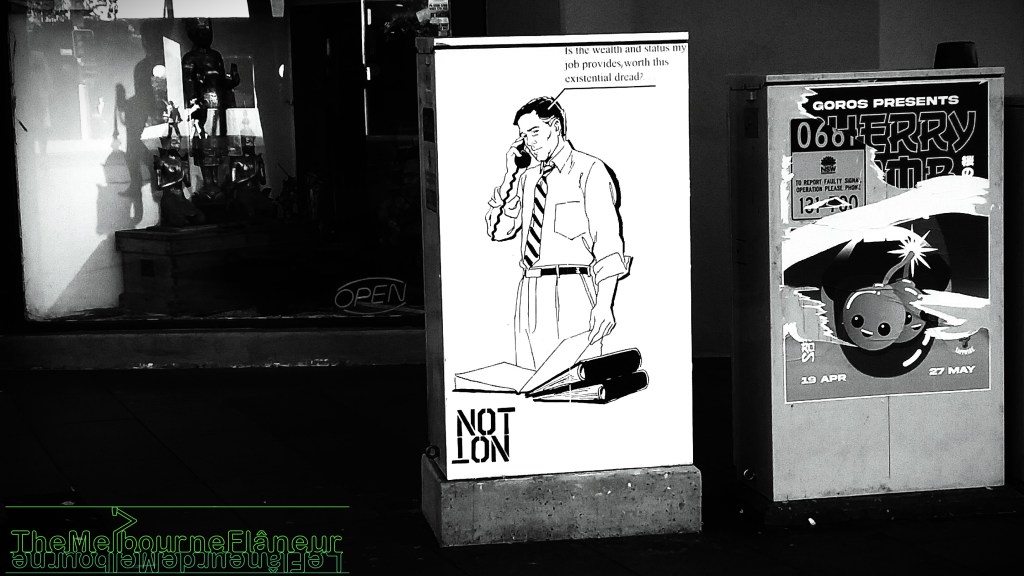
“‘Is the wealth and status my job provides worth this existential dread?’, Oxford Street, Darlinghurst”, by Dean Kyte.
‘Is the wealth and status my job provides worth this existential dread?’, Oxford Street, Darlinghurst.

Today on The Melbourne Flâneur I publish my first ‘amplified flânograph’ in quite a while—one of those photographs, taken in the course of mes flâneries, which later inspire something in me—a prose poem, a capsule essay or a ficción—and to which I add the third dimension of an evocative soundscape.

I photographed this signal box one weekday morning in May. I was coming out of the post office at the head of Oxford Street, annual runway for Sydney’s world-famous Gay and Lesbian Mardi Gras, and as I was crossing the street to get to Hyde Park, juggling my shipment of a brand new product—(more on that to come, chers lecteurs)—I was struck by this traffic signal box, one of three, looming towards me from the opposite sidewalk.

Despite having my arms full and nothing but my phone on me, I had to get a shot, sensing, ‘détective des belles choses’ that I am, that there was a clue for me in the message graphed on the side of this signal box.

I was not wrong.

“The Price”, the short story that eventually emerged two months later out of the image above, is an example of one of my literary crime ficciones, what I am calling the ‘nouvelle démeublée noire’—literally, the ‘unfurnished dark short story’.

Basically, the concept of the nouvelle démeublée I’m pioneering is a synthesis of the principles of the French Nouveau Roman (or ‘New Novel’) combined with Willa Cather’s notion of a ‘novel démeublé’ or ‘unfurnished’ novel.

Whatever is felt upon the page without being specifically named there—that, it seems to me, is created. It is the inexplicable presence of the thing not named, of the over-tone divined by the ear but not heard by it, the verbal mood, the emotional aura of the fact or the thing or the deed, that gives high quality to the novel or the drama, as well as to poetry itself.

—Willa Cather, “The Novel Démeublé”, The New Republic (April 12, 1922)

Though I am writing with respect to the French Nouveau Roman, I call these ‘unfurnished’ pieces in which something unsaid is nevertheless felt by the reader as a mood of ambiguity nouvelles démeublées because nouvelles nouvelles (literally, ‘new short stories’) just doesn’t make sense in French.

Last year, French literature celebrated the hundredth anniversary of the birth of Alain Robbe-Grillet, whose violently abstracted and anti-human style I take as my guiding light in the composition of these pieces, while 2023 marks the seventieth anniversary of a landmark event in modern letters: the first publication of a Robbe-Grillet novel, Les Gommes (The Erasers, 1953).

It’s difficult to convey what a scandal Les Gommes represented, first in French literature, then in English, as Robbe-Grillet’s literary influence as the ‘chef d’école’ of the Nouveau Roman was absorbed into Anglophonic culture—particularly in the U.S., where he enjoyed some celebrity as an avant-garde novelist and filmmaker in the sixties.

The apparition of Robbe-Grillet on the literary scene in 1953 represented the emergence of a literary pill that was particularly bitter and difficult to digest even for the most ‘modern’ sensibilities, and the publication of Les Gommes is one of those red-letter moments in twentieth-century history where a writer definitively crosses a boundary of taste that was previously believed to be uncrossable.

While Borges flirts with postmodernism in the thirties and forties, dancing on the threshold of it, it is Robbe-Grillet, in Les Gommes, who boldly and definitively steps through that portal into a vertiginous realm of infinite ambiguity and uncertainty, of radical scepticism and doubt.

Where Joyce’s Ulysses (1922) marks the frontier of modernism, the line in the sand after which nothing can be written that isn’t fundamentally ‘modern’ in its sensibility and style, Les Gommes marks the red line of postmodernism, a definite break with the modern tradition; and after its publication in 1953, we cannot ‘unsee’ the world as Robbe-Grillet shows it to us in that novel—as inhuman as his vision is to many readers, and as much as literature has sought to beat a cowardly retreat from the frontier of the Nouveau Roman he leads us up to.

Les Gommes owes a substantial debt to Ulysses: like Joyce’s novel, it transpires over the course of 24 hours, and like Ulysses, there is an archetypal mythic structure buried in Les Gommes. But where Joyce takes Homer’s Odyssey as the structural basis for Leopold Bloom’s flânerie around Dublin on June 16, 1904, Robbe-Grillet turns instead to Sophocles and the archetypal detective story of Western literature—Œdipus Rex.

For Les Gommes is a kind of ‘existential detective thriller’. Its protagonist is Wallas, a detective (an ‘agent spécial’ as we are continually reminded) assigned to the investigative bureau attached to the Ministry of the Interior—a secret policeman, in other words.

Wallas has been dispatched to an unnamed northern port city to investigate a political assassination, the murder of Daniel Dupont, a professor of economics, by a shadowy anarchist organization which has been waging a campaign of terror: Every night for the past week, at exactly 7:30 p.m., a member of the Deep State cadre to which Dupont belongs has been murdered.

Arriving late at night, just hours after the assassination, Wallas takes a room for the night at the Café des Alliés, a suburban bistro right next door to the victim’s home at the corner of the rue des Arpenteurs and the Boulevard Circulaire which girds the inner city. At the point where Robbe-Grillet takes up the syuzhet, it’s dawn on the morning after the shooting.

Il s’agit d’un événement précis, concret, essentiel : la mort d’un homme. C’est un événement à caractère policier—c’est-à-dire qu’il y a un assassin, un détective, une victime. En un sens, leurs rôles sont même respectés : l’assassin tire sur la victime, le détective résout la question, le victime meurt. Mais les relations qui les lient ne sont pas aussi simples qu’une fois le dernier chapitre terminé. Car le livre est justement le récit des vingt-quatre heures qui s’écoulent entre ce coup de pistolet et cette mort, le temps que la balle a mis pour parcourir trois ou quatre mètres—vingt-quatre heures « en trop ».

The novel is about an event that is precise, concrete, essential: a man’s death. It’s a typical mystery story incident—which is to say that there’s an assassin, a detective, and a victim. In a sense, even their rôles remain the same: the assassin shoots the victim, the detective solves the riddle, and the victim dies. But the relations which unite them are not quite that simple after you’ve read the last chapter. For the book is precisely the tale of 24 hours which pass between the shot being fired and the death, the time it takes for the bullet to travel three or four metres—24 additional hours.

—Alain Robbe-Grillet (my translation)

We know right from the prologue who the shooter is: It’s Garinati, a hired gun who is as incompetent to kill Daniel Dupont as Wallas is to solve Dupont’s murder—although admittedly, in Wallas’s defence, it is rarely the case in a mystery story that a detective is sent to investigate a murder that hasn’t actually happened.

For here too Robbe-Grillet yanks out the mystery, if not the suspense, right at the beginning of the book: Yes, Garinati has snuck into Dupont’s office and shot him, but the wound is only superficial. Despite the papers’ claim that the assassin shot the professor in the chest, Garinati is pretty sure he only got Dupont in the arm. It is Dupont, hiding out in the clinic of Dr. Juard, a shady gynæcologist, who has faked his own death so as to buy 24 hours—the time he needs to sneak back into his villa, grab some important documents, and amscray to the capital.

Thus there is a décalage, a ‘slippage’ in the traditional rôles of these three characters which is equally a lag in time: like Wallas’s stopped watch—stopped, coincidentally, at 7:30 p.m.—Robbe-Grillet has thrust a stick through the spokes of Les Gommes’ cyclical plot, and for 24 hours, the clockwork of the traditional detective story plot labours vainly against that resistance, struggling to advance, until the characters rotate, through a series of interstitial or extra-temporal changes, into their final positions and the generic narrative machinery can start ticking over again.

Robbe-Grillet says that Wallas ‘solves the riddle’, putting particular emphasis on the detective’s traditional rôle, but that’s not really the case. It’s Laurent, the police commissioner out of whose busy hands the case is removed early on, who works out, by a process of logical ratiocination, why the evidence fails to add up.

Rather, in his Œdipal rôle, it is the riddle that solves Wallas—and this is what I mean when I say that Les Gommes is an ‘existential’ detective thriller: our ‘agent spécial’ from the Bureau des Enquêtes is on a mission both epistemological and ontological—a quest in search of himself.

Quête/enquête—quest and investigation: If Wallas fails to solve a mystery twisted enough to riddle a sphinx, it’s because the agent spécial’s rôle in proceedings is purely flâneurial rather than inquisitive.

Right from the third sentence of Chapter 1, in introducing our sleuth, Robbe-Grillet tells us that Wallas has an ‘apparence de flâneur’, that he’s dressed rather nattily for the working-class faubourg of the rue des Arpenteurs, and that he lounges with a certain leisure that makes him a subject of surprise—and even of shock—for the workers making their way to the port.

Thus our ‘agent spécial’, who will spend most of the day exploring the city on foot, going into cafés and automats and ducking into stationer’s shops, is really in town to do something other than collar a killer. He’s an agent of fate.

Œdipus (whose name literally translates as ‘Swollen Foot’) is the first flatfoot, the first gumshoe in Western literature; to him is given the fateful (and fatal) rôle of solving the primal mystery to ‘Know Thyself’.

He’s a tragic detective. Where Joyce chooses another wanderer, Odysseus, ‘the master craftsman of crime’, as his archetype for Mr. Bloom, restoring the classical hero to the humble stature of a man, with Wallas, Robbe-Grillet does not elevate the man to the super-heroic level of the ‘Great Detective’. Wallas, whose ‘pieds sont enflés à force de marcher’ by the dawn of the following day from his traipsings around town, is not a figure who inspires great confidence.

He’s a poor Œdipus, a poor solver of riddles, and as a wanderer through the circular labyrinth of the unfamiliar city, his rôle is purely flâneurial. Rue des Arpenteurs, rue Joseph-Janeck, rue de Brabant, rue de Berlin… this man with swollen feet is condemned to trudge through a salience landscape he increasingly has little heart for, finding himself continually at crossroads with oblique turnings, drawbridges that are raised before him, and on tramways which lead him away from where he actually wants to go.

(It’s no coincidence that the street spoking off the Boulevard Circulaire which leads Wallas to his fate is called the rue des Arpenteurs: arpenter is ‘to pace back and forth’, in the manner of a surveyor, and Wallas spends a great deal of time walking up and down this unprepossessing street, surveying it.)

The pauvre petit bonhomme is such an incompetent detective that he cannot even find his ideal eraser—a quest tangential and incidental to the plot but one which overtakes Wallas’s ostensible mission the more he is diverted and discouraged by his failing to get effectively on the trail of Garinati—who, bizarrely, is trying to catch up with the detective in order to discover if he actually did kill Dupont.

As Alain-Michel Boyer says in his journal article L’Énigme, l’enquête et la quête du récit: La fiction policière dans Les Gommes et Le Voyeur d’Alain Robbe-Grillet (1981), right from the beginning, rather than leading his case, Wallas is led by it: he ‘gums up the works’, seeming to gain less impetus as he proceeds, and finds himself continually effaced in his quest to discover who rubbed out Dupont—for, strangely, every piece of evidence, every eye-witness testimony points to a shooter who resembles Wallas himself.

The question quite legitimately arises in the reader’s mind as to why Wallas is actually there since he has so little will for the work, is too self-effacing to question witnesses, treats his urgent mission almost as a pleasure trip, and only really seems motivated to inquire about the eraser he is desperate to buy in every stationer’s shop he comes to.

Much has been made about the significance of the objects accruing in Wallas’ pocket which give Les Gommes its title. An object that is insignificant to the plot becomes the obsessional lapis of all meaning.

Bruce Morrissette, Robbe-Grillet’s evangelist to the Anglophonic world, was the first to suggest that the half-erased brand name printed on the rubber was either Œdipe or Œdipus.

Spoken together, however, the remaining letters D and I sound in French like ‘’—the first syllable of the Latin deus. Of course, Œdipus solved a riddle in which the life of man was equated with a day, and our ‘agent spécial’ has been sent to the city to ‘accomplir son œuvre d’inéluctible justice’—something that might be said of an instrument of God on a ‘Day of Judgment’.

But equally, the unusual cubic form of this particular eraser suggests a —a die, reminding me of Cæsar’s fateful remark at the Rubicon: ‘The die is cast’ (Alea iacta est).

Though Morrissette is doubtless right, the alternative symbolic interpretations I suggest merely go to prove Robbe-Grillet’s later point that ‘no sooner does one describe an empty corridor than metaphysics comes rushing headlong into it.’

I’m not wedded to either of these interpretations, which disgust me only slightly less than Morrissette’s: any symbolic interpretation of the erasers is ‘on the nose’.

Though it’s probably not the case in this novel so over-determined with occult meaning (that, I think is Les Gommes’ weakness as compared to Robbe-Grillet’s work from La Jalousie [1957] onwards), I would prefer to think, in the spirit of the author’s later work, that there is no significance to the erasers at all—that they are merely there.

We live in an over-determined world where everything may be interpreted indexically as a clue. ‘Le Nouveau Roman, c’est le roman policier pris au sérieux’—‘The New Novel is the crime novel taken seriously,’ Ludovic Janvier stated. This is to say that the Nouveaux Romanciers—particularly Robbe-Grillet—were involved in a sensemaking enterprise.

As Boyer concludes in his 1981 article, paraphrasing Nietzsche, with the Robbe-Grilletian Nouveau Roman, the crime novel fundamentally ‘becomes what it is’—a first-principles, scientific attempt to describe—and thus make some preliminary sense—of a puzzling world from which we have become radically decoupled, and where the report of our own senses must now be taken with scepticism.

… [É]tant donné que le crime est la condition sine qua non du récit de l’enquête, l’enquête est la mise à jour du récit du crime, le récit du récit. … L’enquête, chez Robbe-Grillet, vise en revanche à substituer, au récit d’un crime et d’une enquête sur ce crime, l’histoire même de ce récit. Elle est la quête d’un roman.

Meurtre ou rapt, la situation initiale de tout roman policier est un manque. Il s’agit donc non seulement de transformer l’énigme en récit, mais de circonscrire ce manque, et de le combler. De sorte que le travail de l’écriture et celui du détective sont une lutte contre le silence des objets et le mensonge ou le mutisme des personnages. L’indicible devient question, puis langage. Qui a tué? ou Pourquoi a-t-on tué? ne sont les interrogations essentielles, mais plutôt: comment peut-on faire de cet événement prétexte—mort d’un homme—un récit? Et la question, comment écrire le crime? s’ouvre alors à une autre question, plus énigmatique encore: comment écrire?

Given that crime is the indispensable condition of the account of the investigation, the investigation is the bringing to light of the account of the crime, the account of the account. … On the other hand, Robbe-Grillet’s literary inquiry aims to substitute, in place of the account of a crime and the investigation into this crime, the very story of this account. It is the ‘quest for a novel’. …

Whether it’s a murder or an abduction, the initial situation of all crime novels is an absence. It is thus a question not only of transforming the enigma into an account, but to circumscribe this absence, and to fill it in, such that the work of writing and that of the detective are a struggle against the silence of objects and the characters’ lies or their refusal to speak. The unsayable becomes a question, hence, language. Who is the killer? or Why have they killed? are not the essential questions, but rather: How does one of make of this pretextual incident—a man’s death—an account? And the question, How to write the crime? then opens itself up to another, more enigmatic query: How to write?

—Alain-Michel Boyer, L’Énigme, l’enquête et la quête du récit: La fiction policière dans Les Gommes et Le Voyeur d’Alain Robbe-Grillet (1981, pp. 81-2 [my translation])

Given an initial void in knowledge, working backwards from that absence, the writer of literary crime fiction, if he is as intellectually honest as Robbe-Grillet, as determined to start from a place of first principles and to eschew the pathetic fallacy of humanistic magical thinking, is eventually led to ask himself: ‘What is it to write?’, or ‘What is writing?’

By playing with the generic elements of para-literature in a postmodern way, Robbe-Grillet constructs a meta-narrative out of the detective genre in Les Gommes, one which contains the generic elements and deals with the essential epistemological question of the form:—‘What is it to know?’

Footsore and weary from his flânerie, at the end of Les Gommes, Wallas comes eventually to know himself in a startling twist of his traditional rôle: Unlike Œdipus, who puts his own eyes out when he discovers who he really is, the murderer of his father and the husband of his mother, Wallas becomes suddenly ‘unblinded’ when he recognizes himself as the man he has been searching fruitlessly for all throughout the day.

Thus Robbe-Grillet shows us that there is a fundamental ontology—a beingness—to the detective’s fundamentally epistemological rôle as a ‘special agent’ in society, as one charged ‘to know’.

And for a dandiacal literary flâneur like myself, the détective des belles choses, the chasseur after beauty who is ever on the hunt for the æsthetic frisson of ‘the marvellous’, the most vivified being lies in knowing, as a city like Sydney, as hellishly labyrinthine as the unnamed harbour city of Les Gommes, gives up clues to the mystery I am writing about in images like those above.

“The Price” is the first audio track I’ve created using assets I’ve recorded myself ‘on location’, recreating Steve’s and Lance’s flânerie down—and across—Oxford Street after midday on a weekday afternoon, like a Method actor getting into the ‘rôles’ of the two characters I’ve created as a writer.

And it’s the first piece I’m officially publishing as a ficción adjacent to the story-world of the literary crime podcast I’ve been plotting since the second Melbourne lockdown, and which is now slowly moving into production—an existential detective thriller which I describe as something like a series such as Mad Men (of which Clive James said that ‘what sounds at first like a quick thriller by Raymond Chandler threatens to turn into a slow novel by Henry James’) meeting a David Lynch movie—I’m thinking of something like Blue Velvet or Mulholland Dr.—with this weird and unholy progeny being set on the streets of Melbourne.

“The Price” will give you some idea of the Jamesian/Robbe-Grilletian literary style I’ve developed for the series over the last three years. If you’re intrigued to hear the podcast, the best way you can support production of the project is to drop $A2 on the audio track below—or click the Share link to re-post it on your social media and help me to build a prospective audience for it.

What esprit de flânerie had drawn him here he could not say.  But the image of it,—the rusted tracks, their ties overtaken by the marauding verdure; the red, unrolling rollingstock blocking tracks which vanished in the horizon of ruinous green,—seemed an apt metaphor for his life with women.

As afternoon segued to evening with the savageness of a cut, he saw himself as an empty, twilit platform where no woman would again alight, the unchalerous shell of a darkened station which would no more warmly receive the transitory train of her ambassade through the embassy set over the foreign country of his interior life.  A lamp which illuminated nothing; a sign which apprised no one of nowhere; a bench conveniently placed, and upon whose convenience no one rested and refreshed themselves:—Sometimes places, in their abstraction, resemble us more closely than do other people.

—Dean Kyte,
“駅の物語”
(Conte de gare)

I’ve always had a fascination with trains and train stations. You might think train travel a rather contradictory passion for a flâneur, the most freewheeling of voyageurs: Why should this epic pedestrian, drawn in his dreamy dérive by lines of random desire which sing out to his eye from every street corner, be inexorably attracted to the most restrictive and linear mode of movement through space, one which offers only limited scope for him to exercise his predatory passion for æsthetic investigation?

Hélas, if, like Walt Whitman, I contradict myself, then, dear readers, I contradict myself. As I hope the video and prose poem above attest, I contain multitudes. My soul is as large, as empty and as cryptic a labyrinthine structure as that palatial tomb which lounges alongside the Yarra, receiving and debouching visitors to Melbourne.

And it is certainly no coincidence that as a Melbourne flâneur, I should equally be an aficiónado of that kissing cousin of the train, the tram.

As an aristocrat of the gutter, a gentleman who makes his home in the street, to park my wheels momentarily in the tram, democratic chariot of Melburnians of every caste and class, and exercise my penetrating gaze over Collins or Bourke or Flinders streets from the very midst of them is to enjoy a flâneurial delectation which no other city in the world can offer to as extensive an extent. Verily, to make one’s royal procession up Bourke street on the back of one of these reines de la rue, shaking her bells at the milling mallers who make deferential way for her, is really to get a recherché experience of one of the world’s great thoroughfares.

I’m not quite sure what it is about trains and stations that has always attracted me to them, except that, as Sig. De Chirico seemed to apprehend in paintings such as Gare Montparnasse (1914), both the station and the train are places of dream.

Like Cole Porter, I get no kick in a plane. Flying too high with some guy in the sky is my idea of nothing to do. But lay me down in the gently rocking berceau of a roomette and let me nurse my dreams on that flux of images flying by the window, towns known and unknown, and I will feel myself swaddled in a womb of contentment.

Soon my month-long sojourn in Wagga Wagga ends and I reboard the train, bound for the destinations which are the purpose of my three-month voyage in NSW—Coffs Harbour and Bellingen.

Of course, the destination is a woman. Or women, as the case may be.

I’ve been nursing the dream of seeing Bello again since our second, soul-destroying lockdown in Melbourne last year. In the four months I was under house arrest in a West Melbourne hotel room, my restless esprit ennuyeux de flâneur confined to perambulations through dreams and memories inspired by old photographs and footage taken, as in the video above, during other voyages, writing the second draft of my current work in progress, set in Bellingen, Brisbane, and the Gold Coast, was one of the few things that kept me sane.

To get on a train and get out of Stasiland and into NSW as soon as the border betwixt them opened up again became an obsession with me.

When our ‘Dear Leader’, Mr. Andrews, deigned to release us last November, dangling a tentative morsel of liberty before us (albeit one bounded by a radius of 25 kilometres), my experience of coming out of deep freeze was the inverse of what my Melburnian confrères had complained of all through lockdown: I had lived tensely on my nerve endings for so many months that I felt a sudden crash in energy and an onset of depression at being abbreviatedly free, whereas most of my fellow Melburnians had had their dose of depression in the prison of their homes.

Almost the first thing I did as soon as I was out of the cage was to re-open lines of communication with a woman, the thought of whom, like Dulcinea, had been one of those few things which kept my windmill-wizened brain sane when it seemed eminently possible that the Victorian Government and Victoria Police would go full Stasi on us.

And, as you can imagine with these undependable dames, even a polite inquiry into one’s health was met with radio silence.

That, and freedom, and the American election all coinciding at once seemed to soak my vibe of every adrenal ounce I had needed to endure four months of lockdown in a state which had descended with frightening rapidity towards totalitarianism.

And it was in that state of physical and emotional exhaustion that I made the video above and penned the attendant prose poem.

Trawling through my footage, I seemed to find in the abandoned Trentham train station an image of my soul at that desolate moment. Trentham’s a little town, about halfway between Woodend and Daylesford, which reminded me a great deal of Bellingen when I had stayed there about two years before. As refugees from Newtown in Sydney ‘tree change’ to Bellingen, imagining a verdant, paradisal embassy of inner-city liberalism in the country, so Fitzrovians fleeing Melbourne are steadily driving the property prices in Trentham up above a million dollars.

I’m told you can follow the old railway ties, half-buried in the verdure, from the station to quite a good pub in the next town, but that was a flânerie too energetic for yours truly, being more in the way of a ‘hike’, and my Italian-shod soul demands a nature denuded by copious asphalt and good paving to support it. I probably walked no further towards the slaking refreshment of that mythical pub than where you find my camera set up in the first two shots of the video.

But in the image of an abandoned country railway station at dusk, and in the ghostly sound of a spectral steam train puffing along a ruined route down which no train could nowadays pass, I saw an image of myself, shagged and fagged and fashed on the threshold of middle age, my days as a ladies’ man now well behind me down that ruined pike, having decided that there was one woman left for me in the world to conquer or none at all, one whose tardy silence to my text seemed to leave me, like my camera in the video, lingering restlessly for a train that had been infinitely delayed—and maybe even derailed long before I had arrived at the terminus of this moment of realization that there was but one woman in the world I would deign to travel to the end of the line with.

That sense of the mood—and often the melancholy mood—of empty places which I have elsewhere called ‘the Spleen of Melbourne’, a dark, ponderous sadness about the unpeopled spaces of the city, the unfathomable, heart-breaking mystery of the real and manifest and visible which I and my cameras seem very sensitive to, was potent for me then.

I did eventually hear from the lady in question, and her perky obliquities were worse than if she had left me mired in my tristes mystères of unknowing and Jamesian speculation upon the multiple potential motives of her silence.

And I admit that, since November of last year, I haven’t been quite myself, and I certainly haven’t been at my best. I haven’t entirely recovered from that triple blow of sudden decompression from lockdown, a conversation unresolved and infinitely deferred, and the latest (as it then was) apocalyptic twist to the devolving screw of Western civilization which an American election in the time of Coronavirus represented.

Mostly since then I’ve just tried to beat back my spleen, tamp it down by blows and kicks and cudgels until such time as I could get on that train and find out for myself what goes on with this dame.

Now the train of months has just about drawn up to the platform, and I’m about to find out if this whole trip to NSW, assiduously planned, was worth the price of knowing the truth, or whether I would have been happier trying to decipher unhappy mysteries from the distance of another state.

The train and the station seem quite significant symbols for me in my writing, as in my life. My latest work in progress, a memoir of seduction, is about an occasion when I took the XPT from Bello (or Urunga, to be more precise) to Brisbane, partly to catch the last few days of David Lynch’s exhibition at GoMA, Between Two Worlds, and partly to slay myself in the kind of unfettered Daygame you can’t do but covertly in a small town.

I was all set to get on the train at around 11:00 that night when, an hour or two before I was due at the station, I had the romantic encounter, right there in Bello, I was going to Brisbane for.

I almost missed my train: the lady in question was showing me such a good time I almost blew off a whole trip to Brisbane just to finish what I had started with her. I didn’t sleep that night—and not because it’s damn difficult to do blanket duty on the overnight XPT: I nursed the memory of her kisses as the train rocked and rolled me to Briz Vegas, tried not to let their reality dissolve into dreams until such time as I would be able to write this totally unexpected victory down verbatim in my journal.

I’m now 93% through the second draft of that book, and last week I had a chance to get down to the commencement of the finale, my second round with the redhead, when I was back in Bello, finishing off the pleasure I had deferred for the love of art.

Possibly it makes a difference to be on this side of the border, to be this much closer to the place, both in space and time, for there was a moment, in rewriting the scene, when the sensual reality of the experience—not just her hand in my lap and mine under her dress, but the little park before the library with its globes of yellow light giving it a Parisian air, and the delicious freddezza of Bello in June, made more delicious still when you have the warmth of a woman in your arms—produced the same sensual frisson in me as I felt that night so many years ago.

I could see the place and hear it again. I could feel the chill, valley night which I’ll know again, after so many years’ distance, in another week or two. Having taken me away from a place where the spectres of myself in scenes of dead love with various women are still vivid in my memory, the train will take me back there.

If I were to connect the psychological network map of my amours morts, I think I would discover that women and trains and stations all seem unconsciously connected to me, and that, indeed, I can plot the points of some of the stations of my experience as equally the terminuses of my affairs with several women.

There was the French girl, never to be forgotten, and never, I fear, to be sufficiently honoured in the pearl-like words of peerless prose her soul deserves, whom I kissed goodbye with the heart-breaking knowledge that I would never see her again in this life at the turnstile to the Métro in Belleville.

A few hours hence, I would be getting on the Eurostar to London, and thence, by tube, to Heathrow, carrying the sacred chalice of her kiss across continents and time zones as I wrote the memory of her down in my journal.

The last girl who was of any significance to me before I gave up Daygame, I also saw off on the Metro—at Eltham Station in Melbourne. A Dutch girl of Persian descent, I still see her pretty, dark face framed with ringlets becoming as small as a postage stamp through the pane of the door as it flies away from me, back to Holland.

And as for the object of my fact-finding mission north of the border, the last time I saw her was when we were on a train together in Brisbane, far removed from the climes in which we had known each other in Coffs.

I remember writing to her in a belated birthday card about a year after that last rendez-vous that, when I had gotten off the train at Roma Street, I had not looked back at her—had not been able to look back at her—because I was looking forward to the next time I would see her.

After a lot of near misses in the intervening years, the moment I have been looking forward to may be imminent. The tragedy would be to discover that that last moment of loving vision I sacrificed for this next moment, and which I have looked forward to with anticipation, was really the end of our relation; that I missed my connection with her; and that, for years, I have been wandering around the tomb of Roma Street, not even realizing that I am in the terminus of love.

If you enjoyed the video and the prose poem, you can download the soundtrack for $A2.00. Just click the “Buy” link below.

The Melbourne Flâneur at his ‘head office’: Dean Kyte hard at work at the 3 Little Monkeys in Centre place, photographed by Denis Fitzgerald.

Special shout-out to Bendigo-based photographer Denis Fitzgerald (@denisfitzgerald_ on Instagram), who was kind enough to forward this ninja portrait of your Melbourne Flâneur, covertly snapped while intently bent over the means of his subsistence.

I was either concentrating very hard, or Denis was very jungled-up (which is hard to do in Centre place at the moment, still beaucoup underpopulated as Melbourne struggles to shake off the enduring shackles of lockdown), because I didn’t notice anyone lurking in the laneway with a camera trained on yours truly.

But I remember the day—how could I not when I had opted to break out the white tie, white French cuff shirt with spread collar, and white opal cufflinks to go with my dark grey suit with its alternating pink and white pinstripes? Consequently, I remember what I was writing that day, and I’ve got a pretty good idea what I was studying so intently when Denis captured me peering at my screen.

I think I was probably plotting a literary murder at that moment!

Yes, beneath the serene, snapbrim-shaded visage of your Melbourne Flâneur, it looks like Denis has caught me, not red-mitted, but with full mens rea and Machiavellian malice aforethought.

It’s a great photo. I particularly like the way Denis has dialled down the vividness of my preferred location for literary enterprise to emphasise the grey and white camouflage of my ensemble. The skin tone of face and hand are the only sign of anything human hiding out in the monochrome locale.

Though you probably wouldn’t imagine from Denis’s photo that I was meditating on hinky deeds at that moment, I think he’s probably captured something essential about me, wrapped up in dark labours which seem externalized to the environment around me. As a writer, I am as ‘un prince qui jouit partout de son incognito (‘a prince who revels in his anonymity everywhere he goes’), as M. Baudelaire puts it: to be an homme de lettres is to possess an exclusive species of celebrity—the freedom to walk the streets and still remain utterly unknown.

This is a deeply satisfying species of celebrity which Delta Goodrem, for instance (who just walked past me in Centre place wearing a horrendously ugly white overcoat, like the shaggy pelt of some synthetic beast), will never know.

Ms. Goodrem, God bless her, is no princess enjoying her incognito. She wishes very much to be seen by her serfs, if not actually approached by them.

When I’m at work at the 3 Little Monkeys, I often fancy myself (as Denis seems to have intuited) as being deep undercover—practically invisible to the environment, so invisible does the environment become to me when I enter deeply into the meditative state of writing. But being an unreconstructed dandy, even camo’d up in my grey combo, I recognize that I stand out as the one of the more conspicuous pieces of wildlife in vibrant Centre place.

Although I have many other secret and not-so-secret writing locations cached around Melbourne, the 3 Little Monkeys has been the Melbourne Flâneur’s ‘head office’ for as long as I’ve lived here: as tiny, as ‘inconvenient’ a locale in which to write as this little café might appear, practically from Day 1 of my vie melburnienne I have colonized a table on its shoulder-width terrace in Centre place, come rain or come shine, and have done the boulot of writing.

As a flâneur, the thing I love about Centre place is the Parisian ambiance of this narrow café strip. I fell in love with that ambiance almost immediately, for the dark grey slate of the ledge of sidewalk running along both sides of the laneway reminded me of the asphalt trottoirs of Paris. Then too, the absurdly narrow width of those sidewalks, crammed, on either side of the garage-like doorways of the cafés, with postage-stamp tables, stools and the upturned milkcrates which serve, in Melbourne, as our native seating, recalled to me some of the tiny, tavolino-lined terrasses I sat on in the backstreets of Paris, scribbling away.

From my vantage at either of the two tables on the terrace of the 3 Little Monkeys, I have a narrow vision of the grey Melbourne firmament between the CAE and the Punthill Hotel—almost as grey as the platinum sky of Paris. When I first came to Melbourne, the no outdoor smoking rule had not yet been introduced, so—most Parisian of all—the grey atmosphere of Centre place was typically further clouded with carcinogens.

Moreover, the 3 Little Monkeys faces the side entrance of the Majorca Building, one of the jewels of art déco architecture in Melbourne. It didn’t take me a week to realize the cinematic potential of the terrace of the 3 Little Monkeys, and very early on in my vie melburnienne, I made the video below, in which you can see me sitting in meditative bliss on the terrace of the café but reflected, ghost-like, in the elegant side entrance to the Majorca Building across the laneway.

In this brief video essay, Melbourne writer Dean Kyte offers a (self-)conscious (self-)reflection on the narcissistic art of the selfie.

I’ve always written outdoors, in parks and cafés. When I was a film critic on the Gold Coast, I got into the habit of writing the first draft of my reviews as soon as I came out of the cinema. I would write in cinema foyers, on the platform of train stations, at bus stops. The most uncomfortable locations served as ersatz offices for me, and I learned to block out the environment and go inward, projecting my thoughts onto the landscape around me.

I learned to enter something like a ‘conscious trance’ in public: within a few minutes of picking up my pen, all the noise and distraction of the place falls away, and it is almost as though material reality becomes a symbolic projection of what I’m thinking. The words are ‘out there’, occluded in the shapes of streets and people, trees and flowers, and the deeper my gaze penetrates into the environment around me as I write, the more I am mining out of myself the precise shape of a thought.

It’s in one of those trance-like states, when my introverted intuition is operating at maximum revs and, despite the manifold colourful distractions posed by Centre place, I’m locked onto an image deep within myself, one which I can see spelled out in the environment around me as I search for le seul mot juste, that Denis has captured me in the picture above.

But although I had gotten into the habit of taking the office outdoors on the Gold Coast, it was not until I went to Paris that the habit of conducting the most private, the most introverted of arts in the most public of places became a matter of the deepest necessity. In Paris, the streets were my office: having no private place in which to write, I bared all, exposing myself to the public gaze in parks, gardens, galleries, bars, cafés, street-side benches.

The analogy of the flasher, the exhibitionist is not sans raison for the écrivain en plein air—particularly one who is as unreconstructed a dandy as myself. I have written elsewhere of the deep introversion which is a prerequisite of dandysme pur-sang, and of how the dandy’s shy propensity towards introversion makes the literary art, one typically conducted in deepest privacy, almost the only profession that this ‘splendour among shades’ is fit for.

But for the writer who is a dandy and a flâneur, a man of the street, a man who is forced to make his home in the street, to treat the most public, the most impersonal and uncomfortable of environments as casually and comfortably as if he were relaxing in his own private parlour, there is almost a samurai-like discipline about the way in which he makes friends with discomfort, performing the most private art-form, the ‘art of thinking’—which is what writing is when it is performed with absolute sincerity—in the most public of places.

In fine, in making himself, in his deepest reflections and meditations, vulnerable to view, in entering that trance-like state of deepest, most concentrated intuition in public, he ‘exposes himself’ in the act of thinking.

Like public onanism, there’s something rather aberrant about writing en plein air, I admit, because we usually regard it as so difficult a task that a setting of perfect comfort and seclusion is required to optimally milk the muse of inspiration. All distractions must be banished so that we can concentrate.

There’s something aberrant, moreover, about thinking in our society, so that someone who is clearly ‘doing it’ in public is making rather a spectacle of himself!

But after a certain point in my career, having been jostled and hassled out of my sedentary nature by life, I found it almost impossible to have a private place in which to write, and having been forced to discipline myself by doing the work in public, making the best of all possible conditions, making myself oblivious to all external distractions by entering a conscious state of trance, I would not want to go back to the days when I had my own desk and chair in my own private office.

The experience of making do with my lap, with dirty park benches, with cramped and narrow tavolini or corners of noisy cafés and bars in Paris, of having my pages rained on or blown away by the wind, of being harassed by distracting gypsies wanting to gyp me out of a euro, was a salutary training for what my life, as a peripatetic writer living out of a suitcase and a duffel, has largely been since then. Like the samurai who makes a pillow of a stone, as a writer I have made the street my ‘private thinking parlour’, and I am perfectly comfortable and relaxed doing my private business of thinking in public.

In Paris, ‘my office’, the place I repaired to every evening to do my writing, was Le Cépage Montmartrois, at 65, rue Caulaincourt, the golden café I immortalized with page after page of hallucinatory description in my first book, Orpheid: L’Arrivée (2012).

For the price of a demi of Amstel, I could sit for hours on a grey-gold Parisian evening, my notes of the day, the drawings I had sketched before the works of the masters in the Louvre, the maps tracing my flâneries, my dog-eared copies of Flaubert and Baudelaire, my beautiful monograph on Ingres all spread open before me on the tiny table as I wrote, like fantastic celestial maps linking all my disparate thoughts.

I was, for a time, a subject of curiosity to the indulgent folk who ran Le Cépage, so extravagant and strange was the wealth of material I produced every evening in the arcane alchemy of converting the reality of experience into scintillating prose. They’ve probably forgotten me by now, but there was a brief period when the burning question of the day was what ‘le M’sieu’ (as I was then known aux bons gens du Cépage) was up to with all these puzzling pages covered in his cryptic script.

As Les Deux Magots was to Jean-Paul Sartre and Simone de Beauvoir, so Le Cépage was to me—and is, for it remains the café by which I have measured all my far-flung ‘offices’ ever since. As I wrote in L’Arrivée, the moment the taxi drew up, in the dark of night, before ‘le sein d’or du Cépage’, I knew (as one occasionally knows with a woman one meets by chance) that my life was inextricably linked to this café, and that we had been predestined by our mutual karma to meet and become historically significant to each other.

But Orfeo did not yet know that le mystère du nom de ce café-ci would be the least of les mystères which Le Cépage Montmartrois would pose for his sensuous investigation, nor that tous les mystères which it would pose before him would in one way or another be connected avec la question du nom.  How could he?  He had had no connaissance of its existence avant ce soir.  Nevertheless, faced avec ce café-ci with its enigmatic nom, ce café which immediately invited Orfeo’s sensuous investigation, he had the inescapable sense that somehow he had known that Le Cépage Montmartrois would be here, as if it were somehow connected à son destin and all that he had come à Paris à la recherche of, although he had had no premonition of it beforehand.  He had had no conscious premonition of it, but nevertheless he felt as though he had had some unconscious intimation of its existence; and however hard he stared into the alluring lueur of it, Orfeo could not for the life of him make out what it was about ce café-ci, what hovered in its golden radiance which made him feel as though its mystère—its mystique, même—was somehow personally and intimately connected with him, avec son destin.  He was bouleversed by the 哀れness that ce point-ci at which he had been destined to arrive since the dawn of his days, which he had worked towards in his soul without any conscious connaissance that this physical point dans l’espace was destined to be consubstantial with Orfeo’s psychological, and spiritual, and developmental arrivée à sa nouvelle réalité, was indeed ce point-là; and that henceforth ce point, as le cœur et l’épicentre of that experiential map which Orfeo would draw de sa nouvelle réalité, would be his anchorage, le point to which he would habitually return, whether or not it was precisely le point to which he had asked le chauffeur to deliver him to.  For the golden allueure du Cépage Montmartrois was too strong to be resisted, so that Orfeo felt that whatever was mystérieux about Le Cépage Montmartrois, whatever impalpable allure was atomized in that golden agency which had called to Orfeo’s unconscious mind from across oceans and was consubstantial avec la forme de ce café-ci, whatever it was that was in the yellowmellow beurrelueur of this particular café—nay, even inside of it—to be explored, was destined to be intimately connected with Orfeo’s sensuous investigations du monde parisien; and his explorations du nouveau monde de sa nouvelle réalité, as he redrew his own experiential map du monde de jour en jour, pushing back the boundaries of himself, would have their bearing upon ce lieu-ci as much they would derive their bearings from this anchoring point, such that whatever was le mystère du Cépage Montmartrois which le détective des belles choses, in his unique destin, had been called this great distance to rationalize and resolve, to reveal to all in all its mysterious relations, parttopart and parttowhole; this mystère had its inevitable cœur—its starting point—au sein d’or du Cépage Montmartrois.

—Dean Kyte, Orpheid: L’Arrivée (2012)

I think you can tell by the babel of lyricism which Le Cépage evoked in me that it was love at first sight!

Only in Bellingen, where the rather restless lifestyle I’ve led for the last seven years really began, have I had a similar experience of a café which felt as much to me like a ‘home’, a place where I would effectively ‘live’—and do my best living—when I went there every day to write.

When I stepped off the XPT and my friends straightway took me to the Vintage Nest (as the Hyde was then), a café-cum-quirky-antique-store in a former drapers’ shop on the main drag, I knew I would love Bellingen. At that time, the café was run by the church who owned the op-shop next door, as a rather upmarket outlet for their more valuable wares.

It was tragedy to me when it changed hands and the ever-altering array of beautiful antiques which gave the place so much character and charm gradually disappeared, but faithful to the last, for more than two years, rarely a nine o’clock would chime without me coming through the door to set up my laptop, pour a long black into the fuel tank, and start writing.

And it’s as much a testament to my affinity with the Hyde in the early days after the change-over that, as Le Cépage occupies so many pages of my first book, there’s a significant scene set at the Hyde in my last book, Follow Me, My Lovely… (2016). I think I devote some of the best writing in Follow Me, My Lovely… to the morning-after moment when I took the most beautiful girl I have ever had in my bed to ‘the best café in town’ for breakfast.

So cafés are, for me, more than merely ‘my office’, the places I go to in order to write: they are significant sources of inspiration in my writing. I love them as much as some of the women I have known, and like women who have left some lasting impact upon me, sometimes I feel driven to immortalize the ‘souls’ of these cafés in which I have done my work.

In July last year, Emily Temple wrote a blog post asking if global Coronavirus lockdowns would spell the end of writing in cafés. Admittedly, the hardest part of our insufferable (and multiple) Melbourne lockdowns last year was the fact that I was forced, finally, to do an extensive spell of writing in my hotel room, facing a wall.

I don’t think they saw me at the 3 Little Monkeys for the rest of the year after lockdown was declared in mid-March. But I still needed the matutinal fuel of writing. I discovered some good java-joints in North Melbourne, where I hunkered down to weather the storm, but it was not the same to have to dash out for five minutes each morning, hiding my beautiful mug behind a mask, simply to port back to my room a paper chalice I could suck on while punishing my brains.

As misanthropic as I am at mid-life, I missed the people, whose hubbub in the laneway makes the jangling music that accompanies my mental labours. Inured to distraction as unconducive circumstance has made me, I am probably one of those writers Ms. Temple cites in her post as actually requiring a measure of background noise to focus me: my literary antibodies need something in the environment to fight against.

There is, as Ms. Temple says, something vaguely ‘performative’ about being a café littérateur, but only, I would argue, if you’re there to make a ‘show’ of writing rather than to write. Whatever the artist, we can all tell a poseur from a professional—except, it seems, the poseur himself. As Denis’s portrait reveals, there is an earnestness, a look of presence—of investment in the present moment—which radiates from the writer who is really thinking, and who is not just licking the end of his pencil.

As a case of a writer who undertook the public performance of his craft with sincerity, Ms. Temple cites Harlan Ellison, who had the idée géniale of writing in the windows of bookshops, like a cobbler or a watchmaker plying his trade in his shop-window. ‘I do it because I think particularly in this country people … think that people who write are magicians on a mountaintop somewhere,’ Ellison said. ‘… So by doing it in public, I show people it’s a job … like being a plumber or an electrician.’

Living a peripatetic lifestyle, one of the joys of being a writer on the hoof is having an ‘office’ in every city, town and suburb I visit, just as a sailor has a girl in every port. Wherever my flâneries take me, the first order of business is to find a café that serves good coffee but, more importantly, has a good ambiance in which to write.

So in Sydney, you will typically find your Melbourne Flâneur stationed at Parisi or Jet, his ‘field offices’ in the Queen Victoria Building. In Brisbane, I have my command post set up at the suitably European Marchetti in the Tattersall’s Arcade, where you might hear me pass a few terse words of Italian with the wait staff.

Adelaide still poses a problem for me. Being a Parisian in my soul, I do like the French crêperie Le Carpe Diem in Grenfell street, but there’s unfortunately not a lot of visual interest or colourful foot-traffic at the eastern end of Grenfell street. The coffee is great, but the location is comme ci comme ça.

En revanche, you can get a good brew at the well-situated Larry & Ladd in the Regent Arcade. Unfortunately, if you want to write, you need to sit at the big benches outside the café in the middle of the arcade, because Messrs. Larry and Ladd play their dance music so loud it’s like a nightclub inside.

It certainly gives your literary antibodies something to fight!

By far the best café for writing in Adelaide, in my experience, is a little out-of-the-way place in Somerton Park, so if any Adelaidean writers can recommend a more central location, I would be happy to hear any suggestions in the comments below.

And I invite you to take a closer look at Denis’s Instagram. With so much of photographic interest in Bendigo to occupy him, I was very complimented to receive his picture of me out of the blue and discover that I had caught his savvy eye while revelling in my princely incognito! Check out more of his work here and on Facebook.

Today The Melbourne Flâneur comes to you from Sydney!

Well, the video above does, anyway.  The footage—and the story contained in the brief essay I regale you with in the video—comes from a weekend stay in the inner-city suburb of Paddington some eighteen months ago.

I had just finished a housesit in Gosford.  I had been invited to stay a couple of nights in one of those beautiful old terrace houses which are so common in Sydney, looking after a couple of dogs for the weekend before I booked back to Melbourne.

The terrace house was a couple-three blocks back from Oxford street, overlooking the Art and Design campus of the University of NSW, housed in an old brick schoolhouse.  The terrace was two storeys and a sous-sol, one of those gloriously perverse constructions with Escher-like staircases, mashed in a block of similar houses on a slight slope.

When I have a housesit, I don’t usually go out at night.  As a flâneur, the street is my home, and I feel like I spend enough time on it, spinning my wheels ça et là in search of romance and adventure.

But to be so perfectly placed in Sydney for 48 hours was too good an opportunity to pass up.

Night #1 I ambled up Darlinghurst road to Kings Cross for dinner.  I was armed with my trusty Pentax K1000 and Minolta XL-401 Super 8 camera, both loaded for bear with Kodak Tri-X film.

My mission was to scout and clout some suitably seedy Sydney scenes on celluloid.

I chowed down in an Italian joint in Potts Point; took a tour of the lighted windows of the handsome homes in that part of town; dipped the bill on the terrace of Darlo as I scratched a dispatch to myself in the pages of my journal; and bopped back towards the pad.

My bowtie drew some comment as I crossed Oxford street, but I managed to make it to the other side without being assaulted.  As I was mainlining it down South Dowling street, my eagle œil de flâneur clocked something curious in Taylor street, a narrow, one-way artery branching off the Eastern Distributor.

That’s the footage you see in the video above.  My eye was caught by the gentle, teasing undulation of the verdant leaves veiling and unveiling the moon-like gleam of the streetlamp.  I set up my camera on the corner to capture it.

I sauntered back to the terrace house and ambulated the hounds, first one and then the other, before we all reported for sack duty.  The dogs were staffies, but the older one, Bella, was weak on her pins and only needed to go as far as the corner and back.  Buster was young and vigorous, and I was under orders to give him a tour of the whole block before retiring.

I got him on the lead.  The eerie, pregnant peacefulness of Paddington after midnight, an inchoate intimation of which I had scoped in Taylor street, symbolized for me in the striptease played by the leaves and the streetlamp, took hold of me as we passed the dark terrace houses.

I tried to imagine the inconceivable lives behind these elegant façades, the way you might take the front off a doll’s house to get a glim of the works inside.  I couldn’t do it.  The lives of Sydneysiders seemed too rich and strange.

We turned the corner into Josephson street, another narrow, one-way thoroughfare similar to Taylor street.  Buster got the snoot down to do some deep investigating while yours truly lounged idly by, doing some snooping of his own.

I took a hinge on the quiet street, attempting to penetrate the poetic mood of this friendly darkness which was in Josephson street too.  This ‘mood’ seemed to be general all over this part of Paddington.  I patted the pockets of my memory.  What did this place remind me of…?

It was then that ‘The Girl’ tied into us, and if you want to know what happens next—you’ll have to scroll up and watch the video essay!

It’s adapted from a couple of paragraphs I scribbled in my journal a couple of nights later, when I was on the train back to Melbourne, meditating on my weekend as a ‘Sydney flâneur’.  As the familiar scenes unspooled beside me on the XPT, taking me away from that brief oasis of unexpected experience, a nice coda to my Central Coast ‘holiday’, I got some perspective on what that poetic mood—which possesses me in all my photographs and videos—might be.

Nothing refreshes the flâneur, that restless spirit perpetually in search ‘du nouveau’, more than a fresh city to test his navigatory chops on.  My experience traipsing the streets of Paris has given me a navigatory nonchalance in any new urban environment which often astonishes—and sometimes even alarms—people.  Put a map in front of me and I’ll betray my bamboozlement by turning it ça et là, but my sense of topographical orientation—the map I make of places in my mind—is very good indeed.  I don’t have to be in a place very long before I’m naming streets to locals as though I’ve lived there all my life.

Sydney, however, still poses a challenge for me.  One of my readers, James O’Brien, put me on to the trick.  According to James, the secret to navigating Sydney is to think of it in terms of hills and Harbour: if you’re going uphill, you’re heading towards the Blue Mountains; if you’re going downhill, you’re heading towards Sydney Harbour.

It’s a neat trick.  I wish I had known it during my 48-hour furlough in Paddington.

On the Saturday, I decided to test my mastery of Sydney in a walk which will no doubt leave my Sydney readers wondering how I managed to do it without map or compass, a tent and several days’ provisions, and the assistance of a sherpa.

And indeed, as I look at my parcours in retrospect on Google Maps, the rather incredible breadth of that expedition (which included a few wrong turns) does seem to show up the difference between a ‘Melbourne flâneur’, like yours truly, and a ‘Sydney flâneur’.

A Sydney flâneur, I dare say, would never have attempted it, because the main difference between Melbourne and Sydney is that the former is a much more ‘walkable’ city.

In Melbourne, you can walk quite a distance, if you’re inclined to.  To walk from the city to Brunswick, or from the city to St Kilda, is not a wearisome proposition.  The streets are logically arranged, the terrain is not fatiguing, and the experience is altogether a pleasurable one.

But to be a Sydney flâneur requires strategy rather than rugged endurance.

To walk from Paddington to Green Square via Bourke street, then back up to Redfern via Elizabeth street, and finally across to Newtown, with no map and nothing but the sketchy guidance of the bicycle lane to orient you, probably strikes my Sydney readers as the flânerie d’un fou.

With time out for coffee at Bourke Street Bakery and diversions for the dispensing of dosh on vintage bowties and button suspenders at Mitchell Road Antiques, how on earth did I accomplish such a trajet in one day with hardly an idea where I was going?

Je ne sais pas.  But it was a thrilling experience to walk a city which I don’t think any city planner ever intended to be seriously trod.  You may be able to travel through Melbourne without a car, but Sydney?

Though I cheated on the way back, training from Newtown to Central, and bussing from Central to Flinders street, I wasn’t done filing down the heels on my handmade Italian shoes that day.

Night #2, heavily armed with cameras, tripod and paraphernalia, I attempted an even more ambitious nocturnal sortie for a flâneur who isn’t altogether au fait with Sydney.  My plan was to make a massive foot-tour to Circular Quay and back.

I struck out along Oxford street and rambled through Hyde Park around dusk.  I inhaled a digestif at Jet, in the Queen Victoria Building, while I unburdened myself to my journal.  Then I went on the prowl, Pentax primed, tacking stealthily towards Sydney Harbour by way of George street.

There was some sort of to-do in George street between the QVB and Martin place—I forget what, but a lot of revellers and rubberneckers.  My cat-like spirit bristled at the noise and lights and I was glad to get clear of them as I stalked north.

There was a full moon set to scale the sky over the Opera House that night.  Having purchased a fresh cartridge of Tri-X from Sydney Super 8, I set up my Super 8 camera by Circular Quay, counting off a long timelapse of the Harbour under my breath and remembering how I had once, on a disastrous second date, walked past this spot, arguing about the comparative architectural merits of the Harbour Bridge vis-à-vis the Opera House with a French girl I had picked up at Darling Harbour two days earlier.

We had not been able to agree on that or on anything else that day, and I had been glad to get my luggage out of her apartment, get rid of her, and get on a train back to Melbourne.

It was getting on towards midnight.  I retraced my way back to Town Hall via Pitt street, the lunacy of the high moon and the memory of past amours working their poetic powers upon my spirit, inspiring me to squeeze off a shadowy shot with the Pentax here and there.

I was too foot-sore to trudge on to Central.  I had been on my dogs all day, so I saved some Tuscan shoe leather and shouted myself a trip on the Opal card at Town Hall station.  On the short train ride, tired as I was, I had my senses sufficiently about me to admire the hard, shiny Sydney girls, hot and fast as the slug from a Saturday night special.

Once I had had it in me to cut across their frames and charm even the hardest chica, but I was beginning to think my days as a pocket-edition Casanova were over.

I thought of the girl in Josephson street.  Was I getting fussy in my encroaching middle age?  Or was I just developing belated good taste?

When I got back to the terrace around one a.m., I got the hounds out for their third and final walk of the day, but lightning did not strike twice:  I did not see the girl in Josephson street again.

I hope you enjoyed this reminiscence of one of my flâneries.  I received a lot of positive feedback from followers and visitors to this vlog saying that they enjoyed listening to me reading the audio versions of articles I wrote on the subject of the Coronavirus.  So I decided to start releasing the soundtracks of my videos—like the one at the head of this post—for purchase via my Bandcamp profile.

For $A2.00, less than the cost of a coffee, you can have my dulcet tones on your pod pour toujours.  Just click the “Buy” link below to support me.

‘From this epoch derive the arcades and intérieurs, the exhibition halls and panoramas. They are residues of a dream world.’

— Walter Benjamin, The Arcades Project (p. 13)

Sydney’s Queen Victoria Building is a bizarre Byzantine bazaar, a constantinopolean cathedral consecrated to commerce in the grand nineteenth century tradition.  Through the great rounded arches of its windows at dusk, it gives the flâneur a fortuitous glimpse of a world of light and colour, like a movie painted in the monochromatic darkness of a cinema…