Taking you line by line through the last three verses of Baudelaire’s « Les Phares », Dean Kyte explains the paradoxical relationship that damnation has to praise in Baudelaire’s thought.

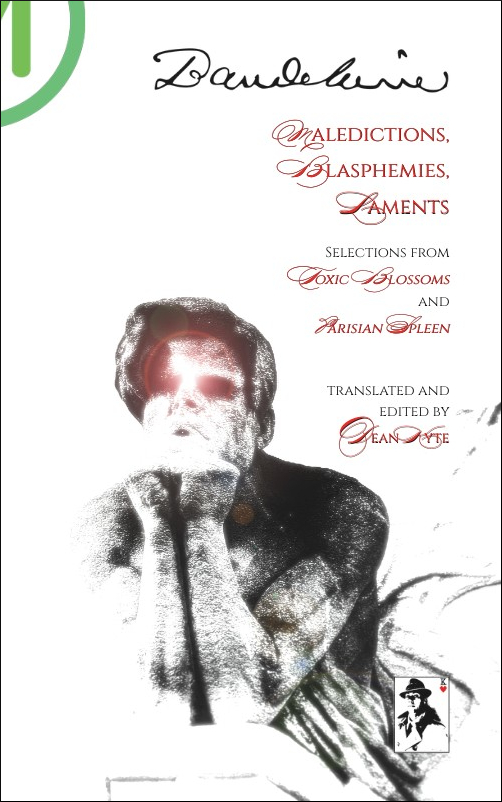
My new book of translations drawn from the works of Charles Baudelaire, Maledictions, Blasphemies, Laments: Selections from Toxic Blossoms and Parisian Spleen, is fast coming to press.

And in today’s video on The Melbourne Flâneur, I take you inside the softcover version of the book as I explain—with due reference to Baudelaire—the rationale behind my choice of such a bitter and pitiless title.

As I say in the video, what appears on its face to be a title utterly alienating in its satanic vituperation is in fact the highest possible homage that Baudelaire can render to God’s majesty, and the proof of his most fervent belief, as a heretical Catholic, in the Supreme Being.

Thus, at a plutonic hour of human history where faith in God and human goodness could not be more ridiculous, I too assert, in taking this title, my quixotic faith in what is highest in man by ‘praising with sharp damnation’ what is lowest in our species, we irredeemable children of the tribe of Cain.

For there must no longer be any doubt in our present year, even to the somnambulistic billions who would make ‘the Woman Question’ and ‘the Jewish Question’ of the nineteenth and twentieth centuries suddenly ‘the Human Question’ of the twenty-first, that Baudelaire’s apocalyptic prophecy of modernity—a veritable ‘Age of Iron’—has now properly revealed itself in our day.

The time could not be more right for the apparition of this book.

One hundred twenty-one years to the very day of my birth, Baudelaire writes in his journal that ‘today … I suffered a singular alarm: I felt the wind of the wing of madness pass over me.’

Charles Baudelaire is the Alpha of the dandy-flâneur, the man, in modernity, who still seeks to be a ‘man’—to live heroically in the strength of all our human frailties and the humility of our profound limits—and I am the Omega, the decadent result of two centuries of societal degeneracy in the West, the last quixotic figure, in the armour of my hat and suit, to intransigently ‘hold the faith’ in that utterly discredited, unconscionable project of embodying ‘Homo Occidentalis’ in all his risible nobility.

So, as a mad Aquarian, an avatar of the New, destiny has elected me for a task, chers lecteurs;—to be the ‘postrunner’ of this great fallen angel of modernity, this great albatross of a luciferic intellect who found his wingspan so vast he couldn’t walk easily among us, and interpret to the Anglosphere, as an evangelist after the fact, the poetry and prose poetry of Charles Baudelaire.

And I’m pleased as punch to advise you that Maledictions, Blasphemies, Laments is on the verge of seeing the light of day.

I explain the origins of the book’s title in the video above, but here below, I am posting for the first time the line-up of fifty pieces I have selected from Les Fleurs du mal and Le Spleen de Paris to take the field as the Baudelairean ‘dream team’ and represent our poet.

So, here we go…

From Toxic Blossoms (Les Fleurs du mal):

  • “To the Reader” (« Au Lecteur »)

From “Spleen and Ideal” (« Spleen et Idéal »):

  • “Blessing” (« Bénédiction »)
  • “The Albatross” (« L’Albatros »)
  • “Elevation” (« Élévation »)
  • “Correspondences” (« Correspondances »)
  • “The Venal Muse” (« La Muse vénale »)
  • “The Faithless Monk” (« Le Mauvais moine »)
  • “Illfated” (« Le Guignon »)
  • “Past Life” (« La Vie antérieure »)
  • “Beauty” (« La Beauté »)
  • “The Ideal” (« L’Idéal »)
  • “The Giantess” (« La Géante »)
  • “The Jewels” (« Les Bijoux »)
  • “Hymn to Beauty” (« Hymne à la Beauté »)
  • “You’d let all mankind dally in your alley…” (« Tu mettrais l’univers entier dans ta ruelle… »)
  • “With her raiment, sinuous and nacreous…” (« Avec ses vêtements ondoyants et nacrés… »)
  • “The Possessed” (« Le Possédé »)
  • “An Apparition” (« Un Fantôme »)
  • “I make a gift of these verses to you so that if my name…” (« Je te donnes ces vers afin qui si mon nom »)
  • “Vespers” (« Chanson d’après-midi »)
  • “Spleen” (« Quand le ciel bas et lourd pèse comme un couvercle… »)
  • “Warning” (« L’Avertissement »)

From “Parisian scenes” (« Tableaux parisiens »):

  • “The Sun” (« Le Soleil »)
  • “The Swan” (« Le Cygne »)
  • “To a Passerby” (« À une passante »)
  • “Evening Twilight” (« Le Crépuscule du soir »)

From “Wine” (« Le Vin »):

  • “The Soul of Wine” (« L’Âme du vin »)

From “Toxic Blossoms” (« Les Fleurs du mal »):

  • “Epigraph for a Condemned Book” (« Épigraphe pour un livre condamné »)
  • “The Two Wellbred Girls” (« Les Deux bonnes sœurs »)

From “Rebellion” (« Révolte »):

  • “Litanies of Satan” (« Les Litanies de Satan »)

From “Death” (« La Mort »):

  • “A Connoisseur’s Dream” (« Le Rêve d’un curieux »)
  • “The Journey” (« Le Voyage »)

I have selected fully one-fifth of the total number of poems published in the three editions of Les Fleurs du mal which Baudelaire, and then his mother, saw through the press.

At least twenty per cent of every section of Les Fleurs du mal is represented in Maledictions, Blasphemies, Laments, and because Baudelaire’s poetry collection is a psychological novel with a narrative order, in selecting at least a fifth of the poems from every section, I have taken care to choose those works which I think best highlight the themes of that section and carry the overarching drama forward.

The figure of one-fifth includes the six pieces that were struck from the first edition as obscene, banned in France, and were only subsequently available in Belgium among Les Épaves (1866).

One of the censored poems, « Les Bijoux », is included, and as you can see, that piece, which I published in my first collection of Baudelaire translations, Flowers Red and Black (2013), is listed in orange.

With the exception of « Spleen », the titles in orange are works from the earlier book which are still in the buffer awaiting revision.

As this post goes to press, I am about to start revising « Spleen », which I also translated in the years preceding the publication of Flowers Red and Black but declined to include in that book, so this poem will see the light of day for the first time in Maledictions, Blasphemies, Laments.

And the word ‘revise’ in this instance basically means ‘completely rewrite’.

While I was translating Baudelaire’s short story, « La Fanfarlo » between February and April, instead of working on the few remaining poems I have left to translate, I began to revise the pieces from Flowers Red and Black, but in every instance I found myself writing completely new translations of these existing poems.

So it’s going to be interesting when I look at “The Jewels” again in a couple of weeks, because this is by far my most well-known translation of a work by Baudelaire, the piece that often cliched sales of Flowers Red and Black. Is this poem going to run true to form with the rest of the book and am I going to see the text in a whole new light?

What I can tell you for certain is that a revised version of “The Jewels” will include a translation of the newly revealed ninth verse that was discovered in 1928, written in Baudelaire’s hand, in a first edition of Les Fleurs du mal which he gave to a friend but only made public when that copy came up for auction in 2019.

You will also notice that, in the list above, there are three titles in red: « Le Cygne », « Les Litanies de Satan », and « Le Voyage ».

These are the last outstanding selections from Les Fleurs du mal that I am yet to translate. They’re Baudelaire’s most famous poems; they’re among my longest selections, and they’re going to be the greatest tests of my interpretative abilities.

So that’s Les Fleurs du mal. Now let’s look at what you can expect to read from Le Spleen de Paris.

From Parisian Spleen (Le Spleen de Paris):

  • “To Arsène Houssaye” ( « À Arsène Houssaye »)
  • “The Stranger” (« L’Étranger »)
  • “The Artist’s Confiteor” (« Le Confiteor de l’artiste »)
  • “A Troll” (« Un plaisant »)
  • “Twin Suite” (« La Chambre double »)
  • “The Buffoon and the Venus” (« Le Fou et la Vénus »)
  • “At an Hour after Midnight” ( « À une heure de matin »)
  • “Crowds” (« Les Foules »)
  • “Invitation to the Journey” (« L’Invitation au voyage »)
  • “Hungry Eyes” (« Les Yeux des pauvres »)
  • “The Magnanimous Gambler” (« Le Joueur généreux »)
  • “Sozzle Yourself” (« Enivrez-vous »)
  • “Windows” (« Les Fenêtres »)
  • “The Port” (« Le Port »)
  • “Lost Halo” (« Perte d’auréole »)
  • “Anywhere Out of the World ” (« N’importe où hors du monde »)
  • “Epilogue” (« Épilogue »)

One-third of the total number of pieces from Le Spleen de Paris will be featured in Maledictions, Blasphemies, Laments, including Baudelaire’s prefatory letter to Arsène Houssaye—which ought to be considered a prose poem in its own right—and the poem that Baudelaire appends as epilogue to the collection.

I was convinced that these two pieces—which I had no previous intention of translating—needed to be included when I was in Brisbane in December. Reading Sonya Stephens’ insightful little book Baudelaire’s Prose Poems: The Practice and Politics of Irony (2000) at the State Library of Queensland convinced me that these were inescapable framing texts.

And you’ll notice we have one text in red: « Le Port ». After I complete the revision of « Spleen », that short, pretty little prose poem is next on my list.

So, if you’ve been keeping count, chers lecteurs, you’ve clocked 49 pieces and I promised you fifty. What’s the big 5-0?

“Fanfarlo” (« La Fanfarlo »)

The translation of Charles Baudelaire’s only known original short story is now complete.

The longest, most ambitious translating project I’ve undertaken in any language was completed to my satisfaction at the end of last month after 134 hours and seven drafts of work.

A task I approached with trepidation and misgivings, thinking I would be merely giving the reader a ‘bonus’ text that was still going to cost me time and sweat, I now believe to be one of the major selling points of Maledictions, Blasphemies, Laments.

One of the reasons I think this version of « La Fanfarlo » will last for quite a long time as an introduction to what is, for English readers, an overlooked part of Baudelaire’s œuvre is my decision to include footnotes to the text.

I found that there were three types of instance where a footnote would aid the reader’s understanding, the most important being the occasional footnote that takes you inside my process as a translator, shows you clearly what the French is and how it can be variously interpreted, and what ultimately informed the choice I’ve gone with in the text based on my intimacy with Baudelaire’s typical modes of thinking and expression.

So, 86 per cent of the poems, prose poems—and fiction—of Charles Baudelaire that you will shortly be reading in Maledictions, Blasphemies, Laments is now locked in.

And this week, apace with my final revisions and translations, I pulled out my trusty essay plan and began plugging in points and sources for the last remaining major task before this book goes to print:—my contribution, an 8,000-word critical monograph on Baudelaire that I hope will serve to honourably introduce the man, the myth, the œuvre to the English-speaking world.

What I’ve written about Baudelaire on The Melbourne Flâneur, I’ve written off the cuff.

But what I write in the critical monograph introducing Maledictions, Blasphemies, Laments, I intend to be my definitive statement on Baudelaire—at least for the next ten years, when I will have doubtless more translations of his work to offer the English-speaking world.

When I published Flowers Red and Black in 2013, I had no idea that people would see such a close connection between Baudelaire and myself, as parallel lives across centuries, souls who cannot take quiet desperation.

I am truly the ‘mon semblable, mon frère’ (‘my double, my brother’) whom he salutes in the last line of the very first poem of Les Fleurs du mal, « Au Lecteur »—a fraternal spirit of revolt.

What I say about Baudelaire in the critical monograph will be the fruit of some seventeen years of working intimately with the thoughts of a literary mind that is as much a black mirror to my own as Edgar Allan Poe’s was to Baudelaire’s.

And I intend it to stand the test of future times and tastes as Baudelaire’s critical essays on Poe have proven their lasting value as perspicacious insights into that poor unfortunate’s life and work from a fraternal spirit who knew the horror he was experiencing only too well.

I am now taking pre-orders for Maledictions, Blasphemies, Laments, and I invite you to get onboard now.

The price point I am looking at for the softcover version advertised in the video above is $A32.00, exclusive of shipping.

(For my American readers, that’s approximately $20.50 in your yanquí dinero.)

For that price, you’re going to receive:

  • A 180-page illustrated softcover edition with pages printed in full colour
  • Autographed and wax-sealed by me as a guarantee of authenticity
  • Handwritten, personalised inscription from me to you
  • Complementary custom bookmark

My proposal to you is to purchase now to guarantee your copy at that price point in the initial print run, and after I go to print, I will invoice you for shipping.

And by pre-ordering, you will also join the community of consumers who have already committed to purchase Maledictions, Blasphemies, Laments. I’m sending emails on a monthly basis to my readers, staying accountable by keeping them up to date with my progress towards publication—and taking them inside my Artisanal Desktop Publishing process, the joys and vagaries of writing, designing and publishing this book with exclusive content not posted here on The Melbourne Flâneur.

So, avail yourself of the order form below and book your ticket to Cythera on the Baudelaire boat.

“Maledictions, Blasphemies, Laments” [softcover]

Personally signed, sealed and inscribed by author. Comes with custom bookmark. Pre-order your copy and join an exclusive community of readers anticipating the release of Dean Kyte’s new book!

A$32.00

In this prose-poetic video essay, the Melbourne Flâneur returns to the city where his love of flânerie was born.

Brisbane, David Malouf exclaims exasperatedly in Johnno, is a city that ‘would have defeated even Baudelaire!’ ‘People suffered here without significance,’ he writes. Where hell is Sartre’s bourgeois autre, Brisbane is too middling, too mediocre even to be a suburb de l’Enfer, ‘[a] place,’ in Malouf’s avis, ‘where poetry could never occur.’

For Johnno, for Malouf, – for his Brisbanian Dante without even the dignity of Ravenna to suffer in, – it’s a city whose very soul is soullessness, characterized by the ramshackle, makeshift nature of the place.  Exiled from the empire of Western Europe, no classicism could possibly take root in this muddy colony of the maddog English.

And yet all my spleen with la vie de l’ennui en Australie was born in the ideal of this sultry river city, swampy Venise of vaporous, féerific CityCats plying gauche rives of odiferous mangroves.  And all mes désirs de Paris were born of mes flâneries to the Dendy, the Valley, to Indooroopilly or Rosalie in search of movies and thumbedthrough bouquins de seconde main.

City of ferries like Venice, city of bridges like Paris, like our national epic, the story of Brisbane is yet to be chanted. The civic classic sinking its piliers et poutres into Brisbane’s shores will sing l’esprit of contingency, of ersatz imperfection, and even of mouldy ugliness, of baudelairean putrefaction!

— Dean Kyte, “O Brisbane! O Baudelaire!”

Welcome back, chers lecteurs, to another year of investigating the æsthetic philosophy of flânerie here on The Melbourne Flâneur.

The Christmas/New Year period found Your Humble Servant sweltering in higher latitudes than the name of this vlog implies as I returned to my home city of Brisbane for the first time in over five years.

I spent seven weeks in the River City over December and January, and after what was probably the longest period of absence from it in my forty-year intimacy with Briz Vegas, when I stepped out of the chantier that has been dug from the defunct Roma Street Station, I felt like I was finally seeing the city in which my first flâneurial balbutiements were babyishly burbled and trébuchements were trippingly taken in its true, very reduced dimensions.

Sensation curieuse!

Even when Brisbane was the hellish destination that lay at the other end of a homeward journey that began at the gare du Nord, not even then did I feel, with all my desolate weeping at the sight of our Venetian-style City Hall—the most beautiful in Australia—that Brisbane is a very strait and provincial place.

It is not that my experience of the world has grown that very much larger in five years of absence from Brisbane, but that I became thrillingly aware that, in an exile from Paris I expect to be a permanent removal from the most vivifying spectacle I have ever beheld, ‘down under’, in the infernal antipodes of culture and civilization, what might be called ‘the lessons of Paris’ have at last been absorbed into my vision of the local scene during the last sixteen years of my literary life.

In fine, it is my eyes—the scope of my vision and the cognitive lens of the French language that I apply over everything—that has grown that much larger in the absence when Melbourne, as the local analogue for la vie parisienne, has been the concrete structure mediating the theoretical construct of applied flânerie on Australian soil, and has primarily occupied my vision, both physical and mental.

It is not a slight to Brisbane to say that I found the first city of my experience ‘smaller’, less abounding in absorbing, diverting novelty than in the days when I used to live on the Gold Coast and some of my first expeditions in flânerie involved weekends in Brisbane searching for the altered states of experience that movies, books and art—the ‘culture’ I was in thirst of—represented for me.

I still have affection for it. But I’ve travelled so far in my thinking now from those days in my twenties when, like the ‘hero’ (?) of David Malouf’s great Brisbane novel Johnno (1975), I was so desperate for a better life than South East Queensland could offer, that I just had to chuck the whole place up for a jaunt to the Mecca of flânerie itself.

Among the kilo or so of books I decided to bring with me on my expedition back to Brisbane was Johnno. I wanted to read it again ‘in situ’, to have the actual locations Malouf describes—and which are so familiar to me, despite the very different Brisbane of his day—before my enwidened eyes.

For it’s the case that the Brisbane of Malouf’s wartime childhood and post-war youth was just hanging on in my own, in the Bjelke-Petersen eighties and Wayne Goss nineties. Even then, it was ‘so sleepy, so slatternly, so sprawlingly unlovely!’

Johnno is so sensual a book that you might say that Malouf manages to poetically capture and convey something impalpable yet inhering about Brisbane—its ‘aroma’, perhaps—the way a fragrance lingers—for an ‘old Queenslander’ like myself—in an old Queenslander like the one in which I was staying in Aspley, throwing me back into childhood memories of my great-aunt’s home in Red Hill.

That’s perhaps not a surprise because this short novel, which has become a ‘classic’ of Australian literature, was published less than a decade before my birth. The city of the sixties Malouf describes in the later pages is definitely the ‘beautiful one day, perfect the next’ Bjelke-Petersen bog of glass, steel, bitumen and bad paving I remember from my enfance in the eighties and nineties.

It was the same all over. The sprawling weatherboard city we had grown up in was being torn down at last to make way for something grander and more solid. Old pubs like the Treasury, with their wooden verandahs hung with ferns, were unrecognisable now behind glazed brick facades. Whole blocks in the inner city had been excavated to make carparks, and there would eventually be open concrete squares filled with potted palms, where people could sit about in Brisbane’s blazing sun. Even Victoria Bridge was doomed. There were plans for a new bridge fifty yards upstream, and the old blue-grey metal structure was closed to heavy traffic, publicly unsafe. There would eventually be freeways along both banks of the river that would remove forever the sweetish stench of the mangroves that festered there, putting their roots down in the mud….

It is a sobering thing, at just thirty, to have outlived the landmarks of your youth. And to have them go, not in some violent cataclysm, an act of God, or under the fury of bombardment, but in the quiet way of our generation: by council ordinance and by-law; through shady land deals; in the name or order, and progress, and in contempt (or is it small-town embarrassment?) of all that is untidy and shabbily individual. Brisbane was on the way to becoming a minor metropolis. In ten years it would look impressively like everywhere else. The thought must have depressed Johnno even more than it did me. There wasn’t enough of the old Brisbane for him to hate even, let alone destroy.

— David Malouf, Johnno (1998, pp. 206-8)

I have a friend who reminds me of Johnno, but I ought to be careful what I say, for I’m sure that return fire could be made and that several of my friends probably think that I am Johnno—the discontented dilettante spewing spleen about the cultural desert de l’Australie, constitutionally incapable of getting on with life or along with people.

‘Johnno’ is Edward Athol Johnson, but for my readers abroad, he’s Harry Haller or Holden Caulfield; he’s the type of stifled rebel who doesn’t march to the beat of a different drum because he cannot even get in step with himself.

All that differentiates Johnno from those more famous examples is that he’s an Aussie—given to larrikin pranks with a long fuse, and feeling, from the distance of the infernal antipodes, the unreachability of the ‘culture’ he associates with Europe even more profoundly than an American might do.

An utterly characteristic gesture is that, when he departs Brisbane for darkest Africa to have his Heart of Darkness experience in the Congo, at his last meeting with the novel’s sensible, cissy narrator, it is Johnno who gives Dante the going-away present of a volume of Rimbaud.

He fancies himself a voyant whose vision is narrowed, unfairly hobbled by the unspeakable blahness of Brisbane, but even when he gets to Paris, improbably impersonating a Scottish English teacher since the French won’t entrust their sous to someone with an Aussie accent, Johnno finds himself trapped in the same ennui as in Brizzy.

Johnno’s whole life is the abject and undigested lesson that I learnt on my first unhappy day in Paris:—the realization that you port your troubles as a fardeau with you; that putting a fresh landscape before your eyes doesn’t fundamentally change you or your destiny; and that if you are miserable in Brisbane gazing at the Skyneedle, you will be just as miserable in Paris looking balefully at Notre-Dame.

… [U]nless the police were making one of their periodical raids (which they did every time there was a bomb blast or a murder under the trains at Châtelet, [the rue Monsieur-le-Prince] was as quiet and suburban as the Parc Monceau.

I got used to the raids. Like everyone else I would tumble out of bed at the first sound of the armoured car swinging in over the cobbles, and by the time the first hammering came on the door downstairs would be out on the landing with my passport, while Johnno shouted from the landing below: ‘Twice in a week, this is! It’s driving me crazy. You can see now why I wanted to get out.’ But when the uniformed officers arrived with their tommy-guns at the ready he was desperately eager not to give trouble. His student permit had expired several months ago, and if they had wanted to the police might have arrested him on the spot. But they were after terrorists, not petty violators of the civil code. They returned Johnno his papers with yet another warning, turned over the bedclothes while one of them covered him with a tommy-gun and the other went through the motions of a quick frisking, and it was over. Then my turn. And the others further up. Generally after a ‘visitation’ Johnno’s nerves were too shaken to go back to bed, and after three or four minutes of futile argument I would agree to go out with him and walk until dawn. We would stroll along the silver-grey quays where the tramps slept, stop and have coffee at one of the all-night bars, play the pinball machines whose terrible crash and rattle, in those early hours, had a more violent effect on my nerves than any flic with his toylike tommy-gun.

— Malouf (1998, pp. 166-7)

That’s the other thing about Johnno. Although he wants to put a bomb under Brisbane and claims to hate Paris, he’s a coward without the Rimbaudian convictions of the true æsthetic terrorist—which is what the dandy-flâneur essentially is in his explosively, kaleidoscopically light-filled heart of darkness.

Where Johnno boasts to Dante, in Brisbane, of consorting with a spy and assassin who ‘look[s] and act[s] like a bank clerk’, he hasn’t that true saboteurial spirit that Flaubert counselled—that one should be bourgeois in one’s habits so as to be radical in one’s art.

Johnno hasn’t any art, apart from the lie and the prank. His poetry and performance art is acting out a fantasy of rebellion against the very staid existence that he is just as pathologically adjusted to as Dante.

Both have what might be called a ‘free-floating discontent’ that manifests itself in a way that is superficially divergent but is actually, in terms of the deep structure of the novel, regrettably convergent.

It’s one of the weaknesses of Malouf’s book—which comes out in the overdetermined yet dribblingly vague and unresolved third act—that it’s ultimately not clear what moral he intends for us to draw from the mémoire of unlikely comradeship between this odd couple, who do not really contrast with one another, nor undergo any complementary inversion of rôles.

Rather, I think Malouf fumbles intuitively and yet artlessly into some clumsy irresolution about the character of Australian life, its vacancy, its makeshift nature, which is particularly potent in the psychogeographic character of Brisbane itself.

It’s hard to put one’s verbal finger quite on it, but there’s a certain abortive character to Australian life, a kind of unconscious will to failure or a dread of success that manifests in the irresolute half-lives of vacancy that both Johnno and Dante are more or less resigned to—and which mars even the best books of our literature, as it mars this one.

Perhaps more than any city on this continent, Brisbane sunnily manifests this blankness of temperate sameness which inspires Malouf/Dante to say that it is a city so deprived of the light and shade of spleen and the ideal—the blanc et noir possibilities of flânerie—that ‘[i]t would have defeated even Baudelaire!’

I don’t dispute this; I utterly repudiate it.

The whole intellectual history of my life disproves Malouf’s contention: As bitter and sinister an orchid as Baudelaire can spring up in these climes to stalk its streets and milk it of its healing poison.

Johnno may kick senselessly against the pricks of Brisbane and Dante may resist them with quiet desperation, but neither of these characters have that largeness of vision, that structural scope I indicated at the beginning of this article, to see Brisbane in its just proportions and its proper place in the broader context of modernity.

The vision and experience of Paris can fundamentally impress itself upon neither of these characters—eminently Australian in their unformed, ersatz natures—and it cannot fundamentally remold and refine them for the ironic æsthetic appreciation of the local scene en Australie because neither Johnno nor Dante, despite their hungry reading, have even a tentative hypothesis for an æsthetic lifestyle such as the one I formed in my splenetic traipsings through Brisbane and took with me to Paris, intending to prove or disprove my æsthetic theory there.

In fine, neither of these characters are really flâneurs—and yet Johnno is a flâneurial novel, and not just because Johnno and Dante spend most of the book ambling through its pages.

I liked the city in the early morning. The streets would be wet where one of the big, slow, cleaning-machines had been through. In the alleyways between shops florists would be setting out pails of fresh-cut flowers, dahlias and sweet william, or unpacking boxes of gladioli. After Johnno’s sullen rage I felt light and free. It was so fresh, so sparkling, the early morning air before the traffic started up; and the sun when it appeared was immediately warm enough to make you sweat. Between the tall city office blocks Queen Street was empty, its tramlines aglow. Despite Johnno’s assertion that Brisbane was absolutely the ugliest place in the world, I had the feeling as I walked across deserted intersections, past empty parks with their tropical trees all spiked and sharp-edged in the early sunlight, that it might even be beautiful. But that, no doubt, was light-headedness from lack of sleep or a trick of the dawn.

‘What a place!’ Johnno would snarl, exasperated by the dust and packed heat of an afternoon when even the glossy black mynah birds, picking about between the roots of the Moreton Bay figs, were too dispirited to dart out of the way of his boot. ‘This must be the bloody arsehole of the universe!’

— Malouf (1998, pp. 116-7)

Johnno is, for one thing, a great novel of place, which is why I wanted to read it again ‘in situ’ when I was up in Brisbane last month.

What Walker Percy, in his equally flâneurial novel The Moviegoer (1961), called ‘certification’—the ‘making real’ for a reader of a place he already intimately knows—is one of the deepest pleasures of regional literature.

Malouf paints with a looser brush than I generally prefer. It’s one that he handles adroitly when it comes to Brisbane and sloppily when it comes to Paris, which he limns in a curiously dull palette by comparison, and not, I think, by deliberate design, since the whole novel falls very badly away into busy incoherence when the action relocates to the Continent.

But the first two-thirds set in Brisbane are sketched with a colourful impressionism that is, as I said above, ‘aromatic’ of the city’s vibe even today, and Malouf treats a place that both Dante and Johnno regard as irrecuperably ugly as though it had the poetic dignity of Paris.

He certifies the city with les détails justes—with the names of streets and suburbs, with the presence of pubs that are still trading and where yours truly has sat and written, and even set some of his own scenes, drawn from his flâneurial vie in Briz Vegas, in their beery bosoms.

As a flâneur pur sang, the proper names of places, of streets and suburbs, of correct geography that allow for certification, carry an incantatory quality for me, and I sense that, for anyone unfamiliar with Brisbane, Malouf’s petites touches of impressionistic precision would enable a similar kind of ‘certification by proxy’.

Arran Avenue, Hamilton, Brisbane, Queensland, Australia, the World. That is the address that appears in my schoolbooks. But what does it mean? Where do I really stand?

The house at Arran Avenue is the grim, three-storeyed brick house my father built for us in one of the best suburbs in Brisbane. Arran Avenue is a narrow dead-end street that runs straight into the hillside, with houses piled steeply one above the other on either side and bush beginning where the bitumen peters out into a track. The traffic of Kingsford Smith Drive is less than fifty yards away but cannot be heard. The river, visible from the terrace outside my parents’ bedroom, widens here to a broad stream, low mudflats on one bank, with a colony of pelicans, and on the other steep hills covered with native pine, across which the switchback streets climb between gullies of morning glory and high creeper-covered walls.

— Malouf (1998, pp. 68-9)

The afternoon before I was due to book out of Brizzy, I took a flânerie, first by ferry, then by foot, to see this mythical Arran Avenue in Hamilton, wondering if I could find a house that geographically matched Malouf’s description.

He’s right about everything: Kingsford Smith Drive, which is six lanes of roaring non-stop traffic from Pinkenba to Albion Park, is almost silent as you pass up Crescent Road alongside the high-built old Queenslander on the bluff overlooking the river.

Arran Avenue is in sight of it, a mere 75 metres away. Dante/Malouf’s street is an arcing one-block spur off Crescent Road that shortly ends in the cul de sac of some richard’s driveway.

I didn’t think I would have much luck finding a three-storey, river-facing, brick-veneer house that must be at least seventy years old, but the déco frontage of no. 19—presently up for sale, if you’re interested—fits the bill of Malouf’s description.

You might still see the river from the third-storey balcony over the shoulder of the house facing no. 19 if you stand on tip-toes.

“19 Arran Avenue, Hamilton, late afternoon”, photographed by Dean Kyte.

That is certification, and there is an example of flâneurial writing right there for you, chers lecteurs: If you can draw an accurate bead on an actual location from the author’s description of it, you’re dealing with something in the flâneurial line.

In one of the most significant of its dimensions, flânerie, I have discovered in my rootless, restless wandering of a country I have only grudgingly learned to love, but which I would still blow up tomorrow with all Johnno’s anarchistic antipathy towards it, is a form of embodied poetry.

As I have amply demonstrated in flâneurial films and videos like the one at the head of this post, flânerie is the application of the lens of a poetic vision over prosaic actuality: the flâneur makes the spleen of his prosy existence in Brisbane bearable by finding, through John Grierson’s ‘creative treatment’ of the documentary matériel of his life, the poetry in his banal actuality.

It’s this that Malouf manages to partially do in his novel—viscerally, with respect to Brisbane—and which both of his characters fail utterly to do. Their oppressive apprehension of ennui in Brisbane leads to spleen, but the manifold novelty of Paris does not necessarily lead either Johnno or Dante to find the Baudelairean ideal du nouveau! there.

La vie parisienne est féconde en sujets poétiques et merveilleux. Le merveilleux nous enveloppe et nous abreuve comme l’atmosphère ; mais nous ne le voyons pas.

Parisian life is abundant in marvellous and poetic subjects. The marvellous surrounds us and suckles us like the air, but we do not see it.

— Charles Baudelaire, Le Salon de 1846, Curiosités esthétiques (1868, p. 198 [my translation])

Likewise, in the sultry, fuggish atmosphere of Brisbane, the milk and honey of poetry may yet be found by a soul that is not ersatz and barely sculpted, as if modelled in wet clay, but rigorously limned and scored, the æsthetic architecture of his life—the code by which he is determined to truly live—vigorously worked out.

Readers, I commence a new year on The Melbourne Flâneur with an important annonce: This year I begin rolling out The Melbourne Edition of my collected works, starting with a new volume of translations of the poetry and prose poetry of Charles Baudelaire which I intend to serve as the complement and counterpoint to my own work in The Spleen of Melbourne project.

Front cover image of the softcover edition of “Maledictions, Blasphemies, Laments: Selections from ‘Toxic Blossoms’ and ‘Parisian Spleen’”, by Charles Baudelaire, translated and edited by Dean Kyte.
A preview of Maledictions, Blasphemies, Laments: Selections from Toxic Blossoms and Parisian Spleen, by Charles Baudelaire, translated and edited by Dean Kyte.

This new book, whose layout and design I finalized last month in Brisbane, is scheduled for release at the end of June. It features one-fifth of the total number of poems featured in the three editions of Les Fleurs du mal which Baudelaire (and then his mother) saw through the press, and one-quarter of the prose poems from Le Spleen de Paris.

At the time of writing, I have translated 89 per cent of the poetic and prose-poetic content I intend to include as a representative selection of Baudelaire’s æsthetic philosophy of flânerie.

And as a bonus that bridges his poetic and prosaic œuvres, I have decided to do a brand new translation of the only work of fiction that Charles Baudelaire is known to have written, La Fanfarlo. As one of the last tasks remaining before I bring this book to print, I will commence drafting that translation this month.

With a substantial critical monograph on Baudelaire and full-colour illustrations, Maledictions, Blasphemies, Laments is going to be a very handsome volume in both its hard- and softcover formats and a valuable introduction to the work of the first philosopher of flânerie.

To register your interest in purchasing one of the first copies in June, I invite you to avail yourself of the contact form below and join the mailing list as I send out monthly updates to my readers.

Go back

Your message has been sent

Warning
Warning
Warning.

Another way you can support my work and keep abreast of developments is by purchasing the audio track of “O Brisbane! O Baudelaire!” featured in this post via my artist profile on Bandcamp.

Using the link below, for $A2.00, you can become a fan of your Melbourne Flâneur on BC and stay in the loop as I drop new tracks and merch.

Dean Kyte presents a literary crime ficción in the style he has developed based on the Nouveau Roman.

—I just think—…  Miriam abruptly swallowed her whispered words.

Al’s lips pressed more tightly together as he watched the needle indicating the floors sweep down.  If only Miriam were…—somewhere else.

Roberts staggered past them and swayed uncertainly in the lobby.  Verna was now very far away from him.

To Verna, he thought.

—Dean Kyte, “Crisscross”

Today’s video on The Melbourne Flâneur, “Crisscross”, represents an experimental departure for me, as I fling myself into new flâneurial territory of æsthetic investigation. I return to my pseudo-Cornellian, Conneresque roots, where the only ‘making’ of the film I can claim, in this instance, lies in the editorial realm of pure montage.

Three shots of second-unit stock footage mounted and hence tenuously related to each other, and an elliptical narrative in the nouvelle démeublée noire style which that short sequence seemed to suggest to me in a flash of inspiration;—C’est “Crisscross”.

I don’t know anything more about what’s going on in the conte than what the artifactual text (understood as the totality of image, sound and word) suggests, and this is the ambiguous, mysterious essence of the style of ‘literary crime fiction’ I call the nouvelle démeublée noire, based on the theoretical principles of the French Nouveau Roman articulated by Alain Robbe-Grillet.

Dans les constructions romanesques futures, gestes et objets seront avant d’être quelque chose ; et ils seront là après, durs, inaltérables, présents pour toujours et comme se moquant de leur propre sens….

In future novelistic constructions, gestures and things will be there before they are something; and they will continue to be there afterwards, hard, immutable, ever-present and as if mocking their own meaning….

—Alain Robbe-Grillet, “Une voie pour le roman futur”, in Pour un nouveau roman (1963, p. 20 [my translation])

I continue my ongoing deep dive into the novels of Alain Robbe-Grillet with a saunter through the eminent Academician’s collection of short stories, Instantanés (Snapshots, 1962).

Chers lecteurs with long memories may recall that I have already addressed the subject of Instantanés in a previous post on The Melbourne Flâneur“The cinematic writing of Alain Robbe-Grillet”, published en pleine pandémie back in January 2021.

That post is one of the ten most popular in the lifetime history of this vlog. Its ongoing popularity, racking up exponentially more page views every month, testifies to the interest I have succeeded in arousing—especially among nos amis aux États-Unis—with my modest crusade to rehabilitate the reputation of a once influential, now unfashionable, French novelist and filmmaker.

When I first wangled a French copy of Instantanés off Amazon as one of my reads during the pandemic, The Spleen of Melbourne project was not only starting to crystallize under the imaginative constraints and pressures of lockdown, but it began to kick tentatively into a new phase.

In fine, at that time, diverging from the main channel of the prose poetry I was then writing about Melbourne’s Parisian underbelly under the influence of Baudelaire, a specifically fictional—as opposed to prose-poetic—sub-project began to emerge as an offshoot of The Spleen of Melbourne.

Elements latent in the prose poems I had written up to that time began to take on a new clarity and definition and began to demand a more analytic rather than lyric treatment.

I went straight to Robbe-Grillet and the short stories of Instantanés as sources of advice and inspiration on how I should practically proceed in treating these short pieces which I instinctively knew would owe a debt to the theoretic principles of the Nouveau Roman.

Robbe-Grillet’s world is neither meaningful nor absurd; it merely exists. Omnipresent is the object—hard, polished, with only the measurable characteristics of pounds, inches, and wavelengths of reflected light. It overshadows and eliminates plot or character. …

If Robbe-Grillet’s fiction, with its timetables, careful inventories of things, and reports on arrivals and departures, owes anything to the traditional novel, it is to the detective story.

Encylopædia Britannica, “Alain Robbe-Grillet”

And hence, what I variously call ‘the Jamesian/Robbe-Grilletian style’, the ‘literary crime fiction’, and the ‘nouvelle démeublée noire’ was born as a sub-project of The Spleen of Melbourne.

More than four years on from those stuttering experiments ‘pour une nouvelle nouvelle’ (to coin a particularly unidiomatic Gallicism), it seems a good time to reinvestigate the six nouvelles Robbe-Grillet collects under the head of Instantanés.

This concise book is a pivotal work in quite a literal sense:—like a hinge, Robbe-Grillet’s whole career turns upon it.

Instantanés recapitulates in miniature the chosiste style and technique of the 1950s novels I have analyzed in my previous articles in this series and which form the basis of what I call—(with a reverential nod toward fellow Anglophonic Francophile Willa Cather)—the nouvelle démeublée or ‘unfurnished short story’, since the idea of a ‘Nouvelle Nouvelle’, or ‘New Short Story’ written in the style of the Robbe-Grilletian Nouveau Roman, doesn’t make a great deal of sense in French.

Moreover, in the final short story of Instantanés, written significantly after the other works in the volume, at a time in the early sixties when Robbe-Grillet’s public and critical reputation as a writer and filmmaker is at its absolute peak, he gives a tantalizing—and not altogether palatable—preview of his direction of æsthetic travel from this point forward to the end of his career.

In the last novel we examined, Dans le labyrinthe (1959), Robbe-Grillet had begun to diverge appreciably from the quasi-noirish, chosiste style of his first three novels. The first five stories of Instantanés—“Trois visions réfléchies” (“Three Reflected Visions” in Bruce Morrissette’s translation), “Le Chemin du retour” (“The Way Back”), “Scène” (“Scene”), “La Plage” (“The Shore”), and “Dans les couloirs du Métropolitain” (“In the Corridors of the Métro”)—date from the years between the publication of Les Gommes (1953) and Dans le labyrinthe, and display the cold, hard, objectival style that initially brought Robbe-Grillet to the attention of the French reading public as a savantic freak of literature specializing in an inhuman kind of novel.

But in those same years, through a succession of literary prizes and laudatory appraisals from perspicacious early critics like Roland Barthes, Robbe-Grillet had succeeded in finessing himself from the margins of French literature to become the absolutely central and dominating figure by the end of the decade as the veritable ‘chef d’écoledu Nouveau Roman.

At this point, at the end of the fifties, Robbe-Grillet’s public and critical reputation catalyzed into an international fame that transcended the Francophonic world. With American interpreters and translators like Bruce Morrissette and Richard Howard as his champions, he conquered the States and thus the English-speaking world.

Yet, at the height of his international fame as a quintessentially French, high-brow novelist of a new type, in the next few years, Robbe-Grillet’s schedule of literary production declined, and instead of releasing a new, critically anticipated novel in the expected year of 1961, he went the conventional route of the commercially successful novelist and became a screenwriter.

It is in that year that Alain Resnais’s L’Année dernière à Marienbad, based on a script by Robbe-Grillet, was released, and Marienbad became a global cause célèbre—‘le dernier cri’ in the phenomenon of the inscrutable European art film.

It was on the back of Marienbad that Instantanés was released, and if we see in the film not merely a lossless translation to cinematic form of Robbe-Grillet’s literary principles of chosisme as demonstrated in the short stories of the fifties, we can also see the generative influence of Marienbad reflected darkly, thematically forward in the last fiction of Instantanés, “La Chambre secrète” (“The Secret Room”), linking Robbe-Grillet’s new line of æsthetic experimentation, as commenced with Dans le labyrinthe, to the style of his films and novels in the 1960s.

As The Spleen of Melbourne project has advanced and developed simultaneously on two fronts which I regard as distinct—prose poetry and short fiction—Instantanés has remained as seminal a text for me with respect to the latter as Baudelaire’s Le Spleen de Paris (1868) is with respect to the former.

And as I now begin to rehearse the ‘scripts’—the cold, hard, objectival nouvelles démeublées of the forthcoming Melbourne Flâneur podcast written in a French-inflected, English version of the chosiste style of Instantanés—for audiences as part of my market testing for the podcast, I am surprised to hear how that bitterly analytic and inhumane fictive style sounds for my listeners like my lyrical, multilingual prose poetry!

It was not long after I released The Spleen of Melbourne CD in 2021 that I began to seriously interrogate myself as to whether Robbe-Grillet’s short stories in Instantanés, with their maniacal descriptive exactitude, could in fact be considered ‘petits poèmes en prose’.

Une idée folle, parbleu!

Description, deprecated by fiction as merely a utilitarian means of setting the scene for human drama, is elevated to a significant tool and strategy for forestalling and preventing the emergence of narrative in the prose poem.

As many listeners of my audio tracks note, as in Robbe-Grillet’s short stories, description plays such a salient rôle in my prose poetry that it overwhelms the human element, forcing what might become ‘characters’ in a story into the background, as mere figures in a landscape, pregnant with its own drama operating on longer, inhuman timelines, and thus unobservable by the anthropocentric eye.

While Robbe-Grillet might not have been personally hostile to poetry, he is hostile to the pathetic fallacy of poetry’s necessarily anthropocentric view of the objective world of things in his prose.

Narrative is the fallaciously selective structure that human subjects impose as a Foucauldian ‘grille over an objective world whose mathematical variety is beyond the regulation of our senses and cognition by incalculable orders of magnitude.

To put it unkindly (and I don’t think Robbe-Grillet would disagree too profoundly with me in this dismissive analysis), the mechanistic structure of faulty logic we call ‘narrative’ is a despicable form of ‘magical thinking’ whose evolutionary utility to human beings as a sensemaking heuristic has been over since at least the end of the Second World War.

In the nouvelles of Instantanés, Robbe-Grillet, by his maniacal technique of emphasizing static description and deprecating human agency, manages to forestall and prevent the emergence of narrative—of anthropocentrically observable cause and effect—more successfully than he is able to do so in his novels.

This is because the nouvelles of Instantanés share with prose poetry the fundamental criterion identified by the scholar Suzanne Bernard in her seminal—and monumental—work on the subject, Le poème en prose de Baudelaire jusqu’à nos jours (1959)—which is to say, these short stories are exceedingly brief.

Bernard identified the criterion of brevity as one of the few discernible essentials in this hybrid, interstitial genre of literature emerging from the French prosodic tradition in the nineteenth century.

Pedro Baños Gallego of the University of Murcia tested Bernard’s criterion by assessing the work of four nineteenth-century prose poets following Baudelaire’s trailblazing example and found that of all the criteria for the form suggested by various critics and scholars, brevity was in fact the most reliable trait for identifying a potentially poetic text written in prose.

Voici quatre auteurs qui représentent quatre manières assez dissemblables d’envisager la création du poème en prose. En laissant de côté leurs différences quant aux choix de thèmes, lexique, syntaxe ou distribution des paragraphes, nous observons qu’ils vont tous converger dans la recherche d’une certaine longueur dont les limites ne sont pas trop floues. Après la lecture des quatre recueils, il nous semble que la frontière établie entre les trois – quatre pages reste toujours présente pour eux. Même si c’était l’époque de l’éclatement du genre et de l’expérimentation technique, où le corpus des œuvres s’adhérant à l’étiquette « poème en prose » faisait preuve d’une hétérogénéité notoire, voici la constatation empirique de l’existence d’une conscience collective concernant, du moins, la longueur des textes.

Here are four authors who represent four quite different ways of considering the creation of a poem in prose. Leaving aside their differences concerning the choice of themes, vocabulary, syntax or paragraphing, we observe that all converge in their search for a certain length whose limits are not too vague. After reading the four collections, it seems to us that an established limit of between three and four pages remains a constant for these authors. Even if the late nineteenth century was the period in which the form—and technical experimentation with it—burst upon the scene, where the body of works adhering to the designation ‘prose poem’ displayed a notable heterogeneity, here a collective consciousness concerning, at least, the length of texts is empirically observed.

—Pedro Baños Gallego, À la recherche des traits fondamentaux du poème en prose (2019, p. 91 [my translation])

Three to four pages is the rough equivalent of 1,000 words, and thus, the threshold at which the static image of the prose poem undergoes a phase shift and the dynamism of narrative begins to enter the equation is round about the point where the prose text is accepted to be a ‘short story’—more specifically, what is nowadays termed ‘flash fiction’.

Except for the three quasi-independent vignettes which comprise both “Trois visions réfléchies” and “Dans les couloirs du Métropolitain”, the six short stories of Instantanés exceed this thousand-word threshold, but not by very much, with no work in the collection attaining even 2,500 words.

Thus, Robbe-Grillet largely manages to maintain the poetic ‘tension’ that scholar Yves Vadé saw as a peculiar property of the prosodic prose text, a tension of ‘stasis as image’ that fundamentally countervails against narrative’s prosaic drive towards dynamism, resisting its urge towards action, and thus the perception of human drama in the environment.

When we look at Marienbad, one of the first things we are struck by is Robbe-Grillet’s obsession with static tableaux, the mannequin-like poses of the actors, a signifying structure that appears prominently in no less than three of the short stories in Instantanés—“Le mannequin”, the first of the vignettes in “Trois visions réfléchies”; “L’escalier mécanique” and “La portillon automatique”, two of the vignettes in “Dans les couloirs du Métropolitain”; and “La Chambre secrète”.

According to Baños Gallego and Yves Vadé, ‘ekphrasis’, the detailed description of a work of visual art, was once a standard device in poetry, and as the ancient lyric poet Simonides of Ceos observed: ‘Poetry is a painting that speaks; painting, a silent poem.’

Since Baudelaire’s time, the relationship of prose poetry to photography has been remarked on by critics, and as a specifically modern, urban, poetic form, the poem in prose grew apace with the French—and specifically Parisian—revolution in photography during the nineteenth century.

Just as Baños Gallego finds a firm limit to the extent of the poem in prose, it seems more than structurally coincidental to me that the ‘flash fiction’ of Instantanés should take the ekphrastic concetto of the prosaic ‘snapshot’ as their literary analogue: The operative conceit of the ‘cliché’—(in both its French and English senses)—aligns Robbe-Grillet’s cinematic/literary project in this collection with the poetic tradition of ‘word-painting’ that Baudelaire’s direct and acknowledged influence, Aloysius Bertrand, invokes in the subtitle to his seminal collection of urban prose poems, Gaspard de la Nuit (1842).

Indeed, “La Chambre secrète” is entirely a deceptive exercise in pseudo-cinematic ekphrasis, and I would go so far as to say that “Scène”, with its theatrical aping of both painting and film, could also be considered an exercise in same.

Robbe-Grillet differs, however, from the poet in prose in that the function of description in the very elevated rôle he gives it in his fictions is essentially constructive: ‘Je ne décris pas, je construis’—‘I do not describe,’ he says, ‘I build.’

Here is explicit, definitive negation—by the author himself, no less—of Robbe-Grillet as a potential poet in prose: If description is a key tool and technique in prose poetry, Robbe-Grillet’s denial that he describes but rather ‘builds up’ a painterly image, as he does explicitly in “La Chambre secrète”, purely out of the material of words divorced from their referents, is a significant repudiation.

In this final nouvelle of the collection, written (one imagines) explicitly for the volume, Robbe-Grillet starts down a pathway that is appreciably different from the æsthetic parcours of the fifties charted by the first five stories and developmentally intercalated with the novels we have already investigated.

Where chosisme was Robbe-Grillet’s initial approach to a potential ‘New Novel’ and ‘New Short Story’, an explicit attention paid to the physical properties of objects and structures in the world without regard to their significance to human beings, in “La Chambre secrète” Robbe-Grillet develops a technique that is ancillary to the chosiste approach in Le Voyeur (1955), more significantly developed as a major branching from that path in Dans le labyrinthe, and, I suspect, was concretized by the kinetic affordances of cinema during his collaboration with Resnais on Marienbad.

Thus, rather than fictions that seek to forestall or prevent the emergence of a human-centred narrative by focusing as hard as possible on the world of things, in “La Chambre secrète”, we assist at a miniaturized, altogether more satisfying repetition of the experiment Robbe-Grillet undertakes in Dans le labyrinthe, watching as the text appears almost to ‘generate itself’.

Language and a certain poetic concatenation of ideas (which the poem in prose is perfectly poised to navigate and negotiate in its interstitial relation to both forms) work quasi-autonomously in this final nouvelle to generate a phantasy implied in Le Voyeur and Marienbad but now made explicit for the first time in Robbe-Grillet’s œuvre.

As Ronald L. Bogue makes clear in his article “A Generative Phantasy: Robbe-Grillet’s ‘La Chambre secrète’” (1981), a run of complex puns in the French serves, like a stream of consciousness, to progressively displace ideas produced in the ekphrastic description of images along tangential lines that ‘build up’ a unitary image in the most literal sense.

Bogue proposes the intriguing possibility of a coherent interrelationship between all the disparate texts in Instantanés written by Robbe-Grillet over an eight-year period, culminating in the tableau of “La Chambre secrète”.

I think this is unlikely, but as Roy J. Caldwell, Jr. argues in “Ludic Narrative in ‘La Chambre secrète’” (1993), in this final story, the operative conceit of the snapshot that Robbe-Grillet has employed to unify the disparate texts of the volume now becomes his modus ludens with the reader.

Doubtless inspired by his recent collaboration with Resnais and his own foray into filmmaking, whereas, in the preceding nouvelles, Robbe-Grillet has presented each story as reducible to a singular image (or triptych of such images), in the final and most ambitious story, the work is ‘composed’ of a montage of snapshots: It’s almost as if the earlier stories train us in how to read the last one as Robbe-Grillet prepares to go in a new direction in the sixties, abandoning chosisme for the auto-generative sado-erotic phantasies he dishonestly imputes to the novelistic and cinematic texts themselves.

L’écriture de Robbe-Grillet est sans alibi, sans épaisseur et sans profondeur : elle reste à la surface de l’objet et la parcourt également, sans privilégier telle ou telle de ses qualités : c’est donc le contraire même d’une écriture poétique.

Robbe-Grillet’s writing is without defence, lacking thickness and depth: it remains on the object’s surface and scans it evenly, without privileging any of its qualities. It is therefore the very opposite of poetic writing.

—Roland Barthes, “Littérature objective”, in Essais critiques (1964, p. 30 [my tranlsation])

I think this is undeniably true, and when I take the authoritative negation of Barthes along with denials made by the author himself, I have to rationally accept that Alain Robbe-Grillet is definitely not a poet in prose.

Yet, when it comes to the nouvelles of Instantanés which have been such fruitful sources of investigation in my own æsthetic parcours during the last four years, still I cannot shake the irrational feeling that, despite their coldness, their objectivity, their inhumanity, these short stories are so close to prose poetry as to be virtually indistinguishable from it.

Too many of the six pieces—“La mauvaise direction”, “Le Chemin du retour”, “La Plage”, and even “La Chambre secrète”—as much as they are ‘contes’ in the strict sense, take place in such abstract spaces (‘space’ as understood here as including the temporal dimension) that, as examinations of pre-existing structures in the environment that signify, they exist more in the kind of platonic, ideal world of the Rimbaudian illumination, the Kafkaesque fable—the various fragmentary territories taken in by the prose poem.

And even in those works which I have translated to refine my understanding of Robbe-Grillet’s style as I develop a French-inflected, English equivalent for the nouvelles démeublées of The Melbourne Flâneur, the purely mechanical structures of the Parisian Métro Robbe-Grillet describes—and which I recognize from my own experience of them—seem surreally, marvellously transformed by the flâneurial regard playing over escalator, tiled corridor, and possibly malfunctioning automatic gate.

As a sub-project of The Spleen of Melbourne, the chosiste pieces of The Melbourne Flâneur are moving ahead: In addition to writing new episodes, I am now designing soundscapes for the nouvelles démeublées, cobbled together from the more than 400 documentary recordings I have taken all over Melbourne during the past four years.

And as I begin to share the finished short stories in live readings, testing the market for a documentary on contemporary Melbourne life written in the objectival style of the Nouveau Roman, I am gratified to hear that there is curiosity, interest, and even a little excitement about this project—including a small knot of interest emanating from locations in Canada and the U.S.

I am still some distance from being in a place where I feel comfortable to begin releasing episodes on a regular basis, but if you are among those interested in speeding me along, the best way you can show your support is by purchasing the audio track below.

You can name your own price at the checkout and you can also opt in to become a fan of your Melbourne Flâneur on Bandcamp, where I will begin releasing episodes in due course.

On location at Albert Park, the Melbourne Flâneur discusses the noirish prose poetry and literary crime ficciones in his audiobook The Spleen of Melbourne.

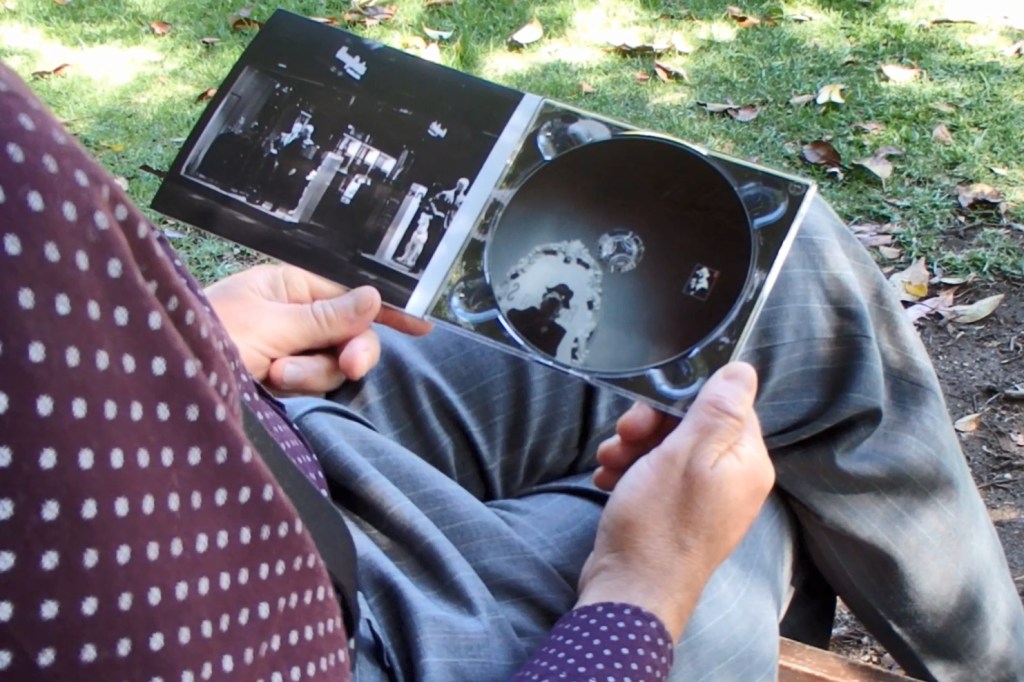
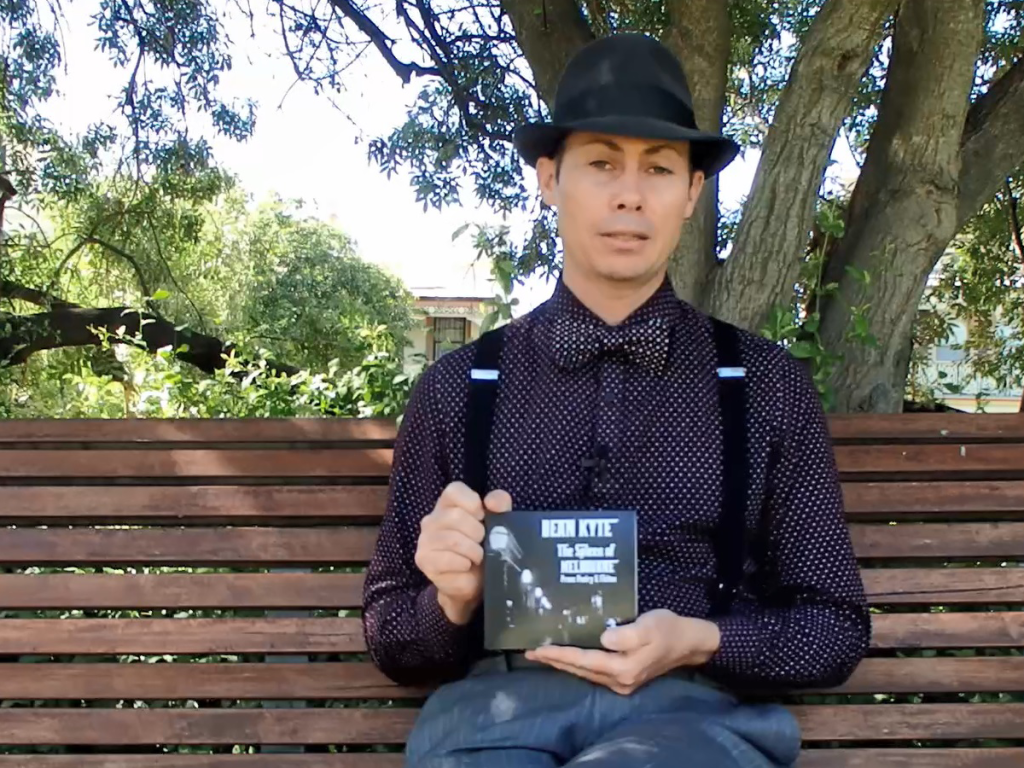
Today on The Melbourne Flâneur vlog, I come to you from St Vincent Gardens in Albert Park, the ritziest suburb in Melbourne, where I take you behind the cover of my CD audiobook The Spleen of Melbourne: Prose Poetry & Fiction.

As I say in the video above, I love St Vincent Gardens because it has a sort of ‘place des Vosges’ feel about it with its rows of Victorian terrace-houses boxing in the leafy square. In a moment of splenetic nostalgie leaning back against les bancs in the park, I can imagine myself back in my beloved Paris in those days of heroic flânerie when the productive indolence of walking and writing was my sole occupation.

It’s therefore the perfect Melburnian setting in which to introduce you in-depth to The Spleen of Melbourne project, which unites the most Parisian city on Australian soil with the first city of flânerie.

One of the key characteristics of my flâneurial literary style as a poet in prose on The Spleen of Melbourne CD is geographical precision: I want the listener to walk alongside me in my flâneries, to see exactly in his or her mind what I have seen with my eyes, to hear what I have heard, to share with me the full sensory experience of a real place in his or her imagination.

But as flânerie is a praxis for inducing in oneself an altered state of consciousness, I also want the reader to equally walk with me through a networked conceptual landscape—almost platonic in its forms—which the built urban environment educes from me.

In other words, I want the reader to also experience the thoughts and feelings I have as I flâne about Melbourne.

This geographic precision about the Melbourne of my prose poems is in distinct contrast to the approach that Charles Baudelaire takes with respect to the Paris of his own collection of prose poems, Le Spleen de Paris (1869). For, curiously, there is a conspicuous lack of geographic specificity in Le Spleen de Paris. No streets are directly referred to—not even the inescapable Seine.

This is a curious oversight since Baudelaire is the premier poet of modernity, the first to trade in the sublimity of Nature for the marvellous spectacle of the modern urban scene. As Carol Clark says in her introduction to the Selected Poems (1996), Baudelaire is the first versifier to introduce the ‘indecorous’, ‘improper’ subject of the modern city into French prosody—and the modern city, of course, is Paris, Walter Benjamin’s ‘Capital of the Nineteenth Century’.

Far less than Les Fleurs du mal, the Paris of Le Spleen de Paris, which takes as its ostensible subject this ‘Mecca of Modernity’ whose profane empire of taste has stretched around the globe to intimately influence every city—even far-flung Melbourne—is hardly there as a unifying ambiance, an organizing theme that lends coherence to the collection.

Il est un point par lequel la nouvelle a une supériorité, même sur le poëme. Le rhythme est nécessaire au développement de l’idée de la beauté, qui est le but le plus grand et le plus noble du poëme. Or, les artifices du rhythme sont un obstacle insurmontable à cette développement minutieux de pensées et d’expressions qui a pour objet la vérité.

There is a point through which the short prose account achieves a superiority, even over the poem. Rhythm is necessary to the development of the concept of beauty, which is the greatest and noblest end of the poem. Now, the artifices of rhythm present an insurmountable obstacle to that minute development of thoughts and expressions which has truth for its end.

—Charles Baudelaire, Nouvelles notes sur Edgar Poe, introduction to Nouvelles histoires extraordinaires (1884, p. xii [my translation])

I don’t entirely agree with this statement, for ‘truth’—the absolute vérité—can only be expressed in its wholeness, and that is the purview of poetry. But one must step a great deal back and see things at a lower level of resolution in order to see them in their totality.

Baudelaire is correct in noticing that prose, uncorseted from the straitjacket of rhythm, has a distinct advantage over poetry in being able to report the superficial detail which makes up that totality at a high level of resolution, but this is not necessarily ‘truth’—only the factitious parts of it seen in close-up.

This is the reef against which the analytic, prosaic sentiment founders. A poet pur-sang like Baudelaire, having a holistic, totalizing vision and world-view, sees the harmonious repetition of a beautiful order—its rhythm—throughout the cosmos.

A natural prosateur like myself, by contrast, sees the discordant disjunctions, juxtapositions, enjambments and adjacencies. The lines of logical thought may ‘flow’, as a set of premises to their conclusion, but not with the harmony of rhythm. Each premise as sentence or paragraph must be ‘developed’, like a musical theme, or a leitmotiv. It must be planed and turned and set into the logical architecture only once the prosateur is certain that it can bear the logical load of the next idea to be set upon it.

Thus the Melbourne of the prose poems on The Spleen of Melbourne CD is a very ‘concrete’ city: that built environment of conceptual forms which are consubstantial with actual things the contemporary flâneur will encounter in Melbourne is explicit.

And on the other hand, the Paris of Baudelaire’s Le Spleen de Paris is far less concretely delineated than my Melbourne. It is an implicit city.

Of course, Le Spleen de Paris is a largely ‘posthumous’ work: Published two years after Baudelaire’s death, we know that, at fifty completed pieces, he only achieved half of his projected vision for this collection before the paralyzing stroke which rendered him mute and immobile for the last year of his life.

What the book might have become if Baudelaire had lived to write another fifty prose poems is something we can only speculate on, and there’s debate in the critical literature as to whether Baudelaire even achieved his goal of a ‘poetic prose’ with the first fifty.

Having translated about a dozen of the prose poems in Le Spleen de Paris, I’m not sure myself whether many of the pieces in the collection genuinely qualify as being ‘musical without rhythm or rhyme’.

I’m not flattering myself to say that this discordant intellectual ‘music’ is something I regularly achieve in the prose poems which comprise The Spleen of Melbourne project: I’m a prosateur, and I have a more natural sense of the musical possibilities of the sentence—the sound that is linked directly to concrete sense—than Baudelaire, who more naturally inhabits the much stricter form of verse.

Moreover, the three titles that Baudelaire meditated for the collection complicates the issue of his ultimate artistic intent. Though first published—and equally known—under the title of Petits poèmes en prose (“Little Poems in Prose”), at a certain point early in the composition Baudelaire intended to call the collection “Le Rôdeur de Paris” (“The Prowler of Paris”), which sustains the view that the modern city of Paris, as a unifying subject and theme, is central to a global interpretation of the work.

I think we have to conclude, as a working hypothesis, that if as careful and precise a poet as Baudelaire declines to make explicit references to the contemporary urban scene in his prose poems (which comprise a form which lends itself more easily to explicit geographical precision than restrictive rhyming verse), then this is a deliberate æsthetic decision rather than a clumsy oversight on his part.

If, in a poem like Le Cygne—perhaps Baudelaire’s single greatest work in verse—as in the “Tableaux parisiens” section of Les Fleurs du mal more generally, he can find a way to make clear and explicit geographic references to the colossally disrupted Paris being pulled down and put up around him by Baron Haussmann within the restrictive straitjacket of the alexandrine, then there is no reason why he could not have taken the same high-resolution approach within the freer form of the prose poem—a form Baudelaire was essentially inventing.

Even if we allow that the corpus of prose poems Baudelaire has ultimately bequeathed to us in Le Spleen de Paris is only half-complete, there are simply too many of the fifty pieces that make some reference, however vague and anecdotal, to contemporary life in Paris under the Second Empire, for us not to provisionally conclude that his vagueness is an æsthetic strategy of some kind, though to what end it seems difficult, in light of the ‘inachevé’ nature of the work, to say.

Thus, while the Paris of Les Fleurs du mal is paradoxically ‘explicit’, clear-eyed, sharply defined, and high-resolution when it would seem that the extreme brevity, condensation and restriction of the verse form would call for a ‘softer’, more global and holistic vision of the modern city, the Paris of Le Spleen de Paris is ‘implicit’: it has this softer, vaguer quality where the freeness of the prosaic form would easily allow for cleaner lines and a sharper delineation of detail—an altogether more remorseless and unsentimental approach.

And without explicit geographic signifiers to orient us in space, Baudelaire’s mid-nineteenth-century Paris might, with a little mutatis mutandis, be any modern city anywhere.

Which leads me to propose, as I do in the sleeve booklet accompanying The Spleen of Melbourne CD, that Baudelairean Spleen, that ‘bilious melancholy’ and ‘choleric sorrow’ which Baudelaire perceived as a specific quality of modern Paris, is a mood of ‘sinister tristesse’ that attends every modern city everywhere that has been touched by the corrupting tentacle of that ‘empire of taste’ which had its Holy See aux Tuileries—including Marvellous Melbourne.

In reading Baudelaire’s tableaux parisiens redux in Le Spleen de Paris, with their hermetic discontinuity from each other, I am often reminded of those beautiful Japanese screens depicting scenes from The Tale of Genji, the salient ‘images’ of Lady Murasaki’s great novel, the high points of emotion in her long, story-like chapters being separated from each other by labyrinthine clouds of gold ground.

As I have written in one of the novelistic chapters of my Orpheid, my experience of Paris (particularly Montmartre) would be something like living in a Japanese screen where the discreet scenes of one’s existence, the high prosaic moments of flâneuristic exploit and artistic heroism dans le quotidien, were separated from one another by dense, serried hedges of cloud, as though one were wandering through a labyrinth that took in tout Paris.

One descended into the misty maze of the Métro at Lamarck-Caulaincourt and popped up again, by mysterious shifts onto other lines and arrow-led leggings through white-tiled corridors communicating between them, at some other point which had no visual continuity with it, prowled around in that milieu, learning its secret byways, how blocks, streets, whole neighbourhoods connected up with one another, and then re-descended to some other part to do the same again.

And yet somehow, a holistic sense of Paris, of the totality of its detailed organization, emerged by this flâneuristic means of random randonnée just as, in the letter to Arsène Houssaye which prefaces Le Spleen de Paris, Baudelaire proposes the ‘vertebral’ discontinuity of his work as its chief and unique virtue:

Mon cher ami, je vous envoie un petit ouvrage dont on ne pourrait pas dire, sans injustice, qu’il n’a ni queue ni tête, puisque tout, au contraire, y est à la fois tête et queue, alternativement et réciproquement. Considérez, je vous prie, quelles admirables commodités cette combinaison nous offre à tous, à vous, à moi et au lecteur. Nous pouvons couper où nous voulons, moi ma rêverie, vous le manuscrit, le lecteur sa lecture ; car je ne suspends pas la volonté rétive de celui-ci au fil interminable d’une intrigue superfine. Enlevez une vertèbre, et les deux morceaux de cette tortueuse fantaisie se rejoindront sans peine. Hachez-la en nombreux fragments, et vous verrez que chacun peut exister à part. Dans l’espérance que quelques-uns de ces tronçons seront assez vivants pour vous plaire et vous amuser, j’ose vous dédier le serpent tout entier.

My dear friend, I send you a little work of which one is not able to say, without being unjust, that it has neither top nor tail since everything in it is, on the contrary, top and tail simultaneously, alternatively, and reciprocally. Consider, if you please, what admirable convenience such a combination offers to all of us—to you, me, the reader. We can slice it and dice it as we please—me, my reverie, you, the manuscript, the reader, his reading; for I do not keep the restive attention of this latter hanging from the interminable thread of some super-fine plot. Take away a vertebra and the two pieces of this tortuous phantasy will merge together again effortlessly. Chop it up into numerous fragments and you will see that each of them can live on its own. In the hope that some of these sections are lively enough to please and amuse you, I take the liberty of dedicating the entire serpent to you.

—Charles Baudelaire, “À Arsène Houssaye”, Le Spleen de Paris (2000, p. 5 [my tranlsation])

Of course, there was no Métro in Baudelaire’s day, so he is proposing in his work, by a prophetic fantasy, the Ouroboran organization of the modern city Paris will become as a circular snake. Somehow the linear network of discreet vectors which compose the modern city of Paris as designed by Baron Haussmann form a recursive maze which feeds endlessly upon itself.

Thus, in place of geographic specificity in Le Spleen de Paris, we get a proto-Benjaminian catalogue of prototypical things commonly encountered in the implicit city—Paris in this instance, but it could be any modern city touched by Paris’s influence—repeated from prose poem to prose poem.

There is the theme of ‘the streets’ which crops up again and again as the principal linking vector. We are led from the streets back into ‘the room’ in prose poems like La Chambre double and À une heure de matin. Equally, there is the recurrent theme of ‘the park’ in Le Fou et la Vénus and Les Veuves, common ground for mutual civic enjoyment of the urban spectacle. And this theme segues into communal fêtes of marvellous spectacle, as in Le Vieux Saltimbanque.

A thematic organization of Le Spleen de Paris has not, as far as I know, been attempted along the Benjaminian lines of The Arcades Project (1927-40), but I’ve detected at least a dozen discreet urban themes into which the prose poems can be classified and re-classified.

And as per Baudelaire’s boast to Houssaye, if a thematic parcours of Le Spleen de Paris were attempted, one could create a conceptual city—perhaps an almost infinite number of conceptual cities—based upon the combinatorial and permutational arrangement and re-arrangement of the prose poems.

Commerce and fashion’, ‘urban types’, ‘the revolutionary spirit’, ‘sounds’, ‘food’, ‘animals’, ‘crowds’, ‘women’, ‘cafés, libraries, shops’:—In these content niches, into which the prose poems of Le Spleen de Paris can be endlessly categorized and re-categorized, Baudelaire prototypes an implicit modern city from the specific parts of his experience of Paris in the middle years of the nineteenth century.

The implicit Paris of the prose poems is one which we can still recognize today, wherever in the world we are. It is perhaps no coincidence that in the last line of the last prose poem on The Spleen of Melbourne CD, “Milton, when a youth”, I invoke ‘the labyrinthine banality of my habitual solitude as a flâneur in the grand green maze of a great city in the late afternoon.’

Melbourne is not invoked specifically in that line, and indeed, in the prose poem, set in the Carlton Gardens, I disturb my female companion by volubly evoking passionate memories of afternoons passed idly in Paris’s Tuileries Gardens: The two places and times merge momentarily for me, and in ‘the grand green maze’ of time and space linking the suburbs of my life across a universal city in two hemispheres, the city of Paris is implicit in the explicit city of Melbourne.

Paris, as Hemingway said, is ‘a moveable feast’: if you’ve had the good fortune to live there as a young man, you carry it with you wherever you go for the rest of your life.

And thus, Baudelairean Spleen—le spleen de Paris—that ‘bilious melancholy and choleric sorrow’ that modern urban life engenders in us, is equally, for the Parisian flâneur displaced to antipodean climes and damned to walk, as a refugee, down-under in search of his heart’s home, ‘the spleen of Melbourne’, the most Parisian city on Australian soil.

It is urban spleen tout court.

You can purchase your own copy of The Spleen of Melbourne audiobook below. As I say in the video, every copy of the physical CD comes personally signed, wax-sealed as a guarantee of artistic authenticity, and gift-wrapped by yours truly. If you choose to purchase the digital album, you’ll also get a bonus track not on the physical CD itself.

“The Spleen of Melbourne” [CD audiobook]

Personally signed, sealed and gift-wrapped by the author. Price includes worldwide postage. Purchase the physical CD and get bonus MP3 versions of all the tracks absolutely free!

A$31.95

“The Spleen of Melbourne” [MP3 audiobook]

12 MP3 tracks downloadable onto any device plus bonus trailer. 24-page PDF booklet featuring Dean Kyte’s evocative street photography of Melbourne. Worldwide delivery with 24 hours.

A$9.95

Download your free MP3 audio trailer for The Spleen of Melbourne CD as featured in this video!
Just click the options button on the player below to download.
“The Spleen of Melbourne” MP3 audiobook

‘This is the city.  Melbourne, Victoria.  It’s a big one.  Second-largest city in Australia; it’s still growing.  It’s a big animal with a big appetite.  Five million people.  There are five million stories in this naked city.  The stories you’re about to hear are true.  Only the names have been changed to protect the innocent.

Hell, nobody’s innocent.

There’s a bilious melancholy, a choleric sorrow to Melbourne behind the magic mystery of the real.  That’s the Spleen of Melbourne.  It’s Paris-on-the-Yarra, a place of love and crime.  And beneath its Parisian underbelly, the lonely experience of abortive, fugitive romance feels like the obscure workings of some organized crime.

And that’s my business.  I live here.  I’m a flâneur.

The Spleen of Melbourne: Prose Poetry & Fiction.  A new CD audiobook available from deankyte.com.’

—Dean Kyte, The Spleen of Melbourne trailer

Well, a happy new year to all the fans, friends and followers of The Melbourne Flâneur vlog at home and abroad! And as my personal new year gets set to kick off this week with the Sun’s segue out of Capricorn and into Aquarius, it augurs beaucoup propitious to announce the release (which formally occurred on New Year’s Day) of my brand-spanking-new audiobook, The Spleen of Melbourne: Prose Poetry & Fiction.

Feast your peepers upon the nouvel évangile below.

External cover design of “The Spleen of Melbourne” CD by Dean Kyte.
The Spleen of Melbourne CD features 12 audio tracks with a total run-time of approximately 50 minutes.

I’m very proud of this CD. It was the fruit of my lockdown in Newcastle last year, one of the very few things which kept me sane during that period (not always the easiest thing for an Aquarian to be). And a shout-out to Implant Media, in Brunswick East, who mastered and produced the album for me. Despite some fatiguing delays in production which prevented me from getting this baby out before 1st January, they rendered my vision exquisitely so that the physical artefact you see above is precisely what I was imagining in my little villa in Newy.

The Spleen of Melbourne is a project I’ve been working on almost for as long as I’ve been living in Melbourne, and I’m certainly not done with it yet—not by a long shot. In fact, in several of my posts on this vlog, you will have heard me use the phrase the spleen of Melbourne in reference to my prose poetry. As I explain in the short the preface to the sleeve booklet accompanying the CD:

There is a sinister tristesse, a bilious melancholy to Melbourne. Just as Baudelaire saw the choleric sorrow beneath the gaiety of Paris, the flâneur of Melbourne sees the chthonic element of its Parisian underbelly—the spleen of softly-lit milieux at eventide when the Angelus of the trambell tolls; or the rage of white-hot days when the Seine-like Yarra, in its moutonnement, mooches like brown mud between the quais as it mutters its way from Richmond.

—Dean Kyte, “Preface to The Spleen of Melbourne CD”

Of course, the title of this project is an hommage to Charles Baudelaire’s collection of prose poems, Le Spleen de Paris (Paris Spleen), published posthumously in 1869. Also known as Petits Poèmes en prose, this collection of fifty short prose pieces is as significant a landmark in modern poetry as M. Baudelaire’s Les Fleurs du mal (1857).

Indeed, although M. Baudelaire drew his inspiration, in turn, from Aloysius Bertrand’s Gaspard de la Nuit (1842), which is considered to be the first collection of ‘poems in prose’, imagining a kind of medieval Paris, it was not until M. Baudelaire turned his merciless gaze upon the modern ruins of that Paris imagined by M. Bertrand, the Paris of the Second Empire, undergoing radical renovation via the vandalism of the self-proclaimed ‘demolition artist’ Baron Haussmann, that ‘prose poetry’, as a peculiarly modern form of verse, one infinitely appropriate to modern, urban conditions of speed and rapid change, was legitimately born.

As M. Baudelaire writes in a letter to his friend, Arsène Houssaye, which forms the preface to Le Spleen de Paris:

Who among us has not, in his days of ambition, dreamed up the miracle of a poetic prose, musical without rhythm or rhyme, supple enough and yet sudden enough to adapt itself to the lyrical movements of the soul, to the undulations of reverie, to the somersaults of consciousness?

It is, above all, the frequentation of enormous cities, it is the intersection of their innumerable connections, which engenders this obsessive ideal.

—Charles Baudelaire, “À Arsène Houssaye” (my translation)

To which I can only say, with my hand on my heart and a profound reverence towards mon maître, ‘Mais oui.’

It is indeed ‘la fréquentation des villes énormes’ and the flâneur’s apperception of their ‘innombrables rapports’ which engenders in the literary soul given to strolling this ‘idéal obsédant’ to create prosody out of the prosaic, often horrifying, prose of modern, urban life.

Having been a flâneur in Paris, when I first came to Melbourne, I perceived immediately its intimate connection to my heart’s home, the first city of flânerie, the Capital of the Nineteenth Century. It’s an apperception which is, perhaps, not obvious to the native-born Melburnian, nor to the Australian generally, but to a Parisian soul whose karma has cursed him to be born in the antipodean hell of these climes, that clairvoyant poetic apperception of Melbourne’s subtle similitude to Paris makes my prosaic passegiate through this Inferno, far from my heart’s home, more bearable.

And in The Spleen of Melbourne audiobook, you’ll not only hear that subtle similitude to Paris in my prose poems, which are amplified by the artificial paradises and altered states of my dense soundscapes, but you’ll also see the similitude that I see. The CD, packaging, and 24-page sleeve booklet are all illustrated with my analogue photographs of Melbourne, shot on Kodak film.

Interior cover design of “The Spleen of Melbourne” CD by Dean Kyte.
The CD, packaging, and booklet are designed by Dean Kyte and feature his photographs shot on Kodak film.

The Spleen of Melbourne project, which has encompassed parts of my writing, sound design, videography, filmmaking, and photography for the last five years, is more than merely about prose poetry. M. Baudelaire dreamed of ‘le miracle d’une prose poétique, musicale sans rhythme et sans rime’, one capable of juxtaposing the Spleen and the Ideal of modern, urban life.

In other words, living and dying shortly before the birth of the cinema, he dreamed of a form of ‘literarymontage, an imperfect, proto-cinematic form of writing that Walter Benjamin would appropriate as the overarching editorial æsthetic of his Arcades Project.

As a writer whose first passion, above even words, is film, the art of mounted, edited, moving images, I dream of the miracle of a flâneurial cinema, prosaic and yet prosodic, one where sounds and images rhyme; and where the prosy poetry of my voice-overs and narrations reflect that lyrical movement of my soul in flânerie, the slow-sudden cuts and shifts of dream and memory, the cartwheels of consciousness I turn as I trip down la rue.

M. Baudelaire dreamed of a prose that was poetic; I dream of a cinema that is poetic.

The CD I imagined into being in Newcastle is but the first iteration, the first physical essay of an idea for a completely interactive, multimedia ‘book’ of some kind, the impractical idea of which I have dreamed of in my ‘jours d’ambition’ ever since I first sailed into Melbourne and saw that it was a place where the prose of its own life is profoundly overlaid, for the clairvoyant, Rimbaudian seer, with the poetry of a Paris remembered, imagined and dreamed. I have called this project in writing, audio, video, film and photography “The Spleen of Melbourne”, and over the next several years you will doubtless see further versions of this project in different media as I make other essays at realizing my impossible book.

The Spleen of Melbourne is about the poetic soul of the world’s most liveable city; it’s about how a poetic soul who suffers in the artificial paradise of this faux-Paris-on-the-Yarra experiences it in his flâneries. The theme of The Spleen of Melbourne is the inexplicable melancholy, grief and loneliness we feel as postmodern, urban men and women wandering amidst the wreckage and ruination of modernity which M. Baudelaire predicted as the end of technological progress in his visions of a ruined, renovated Paris.

But where, pray tell, is the guarantee of progress for the morrow? For the disciples of the sages of steam and chemical matches understand it thus: progress only manifests itself to them under the guise of an indefinite series. Where, then, is the guarantee? It only exists, I say, in your credulity and fatuity.

I leave to one side the scientific question of whether, in rendering humanity more delicate in direct proportion to the new pleasures it delivers them, indefinite progress might not be humanity’s most ingenious and cruellest of tortures; if, proceeding through an obstinate negation of itself, it might not be a form of suicide unceasingly renewed, and if, enclosed in the fiery circle of divine logic, it might not resemble the scorpion that stings itself with its terrible tail, this eternal desire which ultimately makes for eternal despair?

—Charles Baudelaire, “Exposition universelle, 1855” (my translation)

In this urban landscape of seductive alienation—the whole City as Luna Park—I write elegiacally about the frustrating griefs I’ve experienced pursuing the Baudelairean Ideal of love through Daygame—fugitive, ephemeral, abortive romances which all soured and turned rapidly to Baudelairean Spleen—sometimes within the course of a single day.

The constant metaphor I revert to in describing my experiences of love in The Spleen of Melbourne is the metaphor of crime. This is an appropriate poetic figure for a city notorious for its connections to the Calabrian Onorata Società, colloquially known not as the ‘underworld’ of Melbourne, but, in a particularly Aussie tournure, as its ‘underbelly’.

I speak on the CD, as I have done on this vlog, of the Parisian underbelly’ of Melbourne. The ‘chthonic element’ of Melbourne I mentioned above is this ‘under-world’, this poetic apperception of a stratum of reality beneath the manifest which is the intimate yet invisible relationship this city has for me with Paris. Sometimes at night, in the streets, in the dark, when I’m out with my cameras hunting, as Brassaï hunted his ‘Paris de nuit’, my Melbourne by night, I feel myself close to this soft, Parisian underbelly, and I can remember what it’s like to walk les rues de Montmartre, the friendly menace of the streets and squares softly-lit at late hours.

Thus, I hold a dark mirror up to the city in the prose poems and photographs on this CD, revealing a different, more Parisian, more surreally noirish Melbourne than most Melburnians will immediately recognize. But, as M. Rimbaud famously said:

… One must be a seer; one must make oneself a seer.

The poet makes himself a seer through a long, immense, and rational derangement of all his senses.

—Arthur Rimbaud, letter to Paul Demeny, 15 May 1871 (my translation)

As a Capricornian Aquarian—a ‘Capriquarian’, if you will—born on the cusp of Mystery and Imagination, like my fellow Capriquarians on the other side of the divide, David Lynch and Federico Fellini, altered states and artificial paradises of bleak fantasy appeal to me, and I think you’ll find a ‘friendly menace’ in my darkness and deranged vision of Melbourne.

Mystery and Imagination are two qualities distinct, and yet, like darkness and light, they co-exist in an inyo, ever-revolving, and one is needed to penetrate the other. All, for me, is Mystery; so much becomes clear in The Spleen of Melbourne as I ponder the ‘baffling crimes’ of my heartbreaks. And all, equally, is Imagination, that ‘Reine des Facultés’, as M. Baudelaire termed her—that Queen of the Faculties which every true poet from Blake onwards has intuitively known is the firm ground of our mysterious reality, and the one diamond-headed pick by which we may crack the granite fog of mysterious reality on which we eternally stand in perpetual darkness at noon.

You can purchase your copy of The Spleen of Melbourne below, or visit the product page in the Dean Kyte Bookstore for more info, including a video of yours truly giving you the guided tour. Every physical copy of the audiobook comes personally signed, wax-sealed, and gift-wrapped by the same two hands that wrote the poems, shot the photos, and designed the artefact. That’s your exclusive guarantee of artistic authenticity.

And to celebrate the release of my new audiobook, I am going to hold an online launch for The Spleen of Melbourne via Zoom. I’m currently developing a PowerPoint presentation in which I take you through the history of the project. I’m going to take you on a whirlwind tour from Paris to Melbourne, via Berlin, discussing my æsthetic philosophy of flânerie. I’ll introduce you to the landmark figures in my thinking, from Charles Baudelaire, to Walter Benjamin, to Oswald Spengler, and more.

It will be the first time I’ve ever attempted to set forth my philosophy of flânerie in public in a concentrated oral form, so if you want to know how all the diverse things I write about on The Melbourne Flânerie vlog dovetail in one Unified Field Theory of Flânerie, you won’t want to miss this dilly of a PowerPoint presentation I’m preparing.

There’ll be readings of pieces that are on the CD with live accompaniment, readings of pieces that aren’t but will be in future versions of this project, films, videos, and a live Q&A. A date hasn’t been definitely decided, but when it is, expect an invite in your inbox!

Dean Kyte on location with The Spleen of Melbourne CD.

Formats currently in stock

“The Spleen of Melbourne” [CD audiobook]

Personally signed, sealed and gift-wrapped by author. Price includes worldwide postage. Purchase the physical CD and get bonus MP3 versions of all the tracks absolutely free!

A$25.00

“The Spleen of Melbourne” [MP3 audiobook]

12 MP3 tracks downloadable onto any device, plus bonus trailer. 24-page PDF booklet featuring Dean Kyte’s evocative photographs of Melbourne. Worldwide delivery within 24 hours.

A$10.00


Download a free brochure