I admit it’s a bit unorthodox to release the single after you put out the album, but you know the Aquarian contrariety of your Melbourne Flâneur by now, chers lecteurs: Whatever the masses are doing, I’ve got to do the opposite.
But, more seriously, I could not have predicted beforehand that, of all the tracks on The Spleen of Melbourne CD, “Office at night” was going to be the one that would intrigue listeners on Bandcamp the most.
On the spectrum between ‘prose poetry’ and ‘fiction’, “Office at night” represents the most extreme pole of the latter on the album.
As an experimental preview for the forthcoming Melbourne Flâneur podcast, written in the Jamesian/Robbe-Grilletian style I call the ‘nouvelle démeublée noire’, I regard it as by far the most merciless application of the style featured on the CD, so I’m very surprised indeed to discover that this track, freezingly cold in its literary voice and brutally ‘objective’ in its treatment of the main character, the anonymous bald, stocky man in the window, should have proved to be so popular with listeners.
In light of its popularity over the last couple of years, I thought that “Office at night” deserved to be released as a single in its own right.
And remembering my misspent teenagerdom as a collector of CDs, I decided to ‘go a bit nineties’ and press it out as a CD single. (I know everyone reading this is old enough to remember what those are.)
The CD, packaging, and booklet are designed by Dean Kyte and feature his photographs shot on Kodak film.
The gang at Implant Media did a great job once again on helping me to realize my vision for the artifact.
Although I couldn’t achieve my initial nineties vision of presenting the CD single in one of those slim plastic J-card jewel cases you’ll remember, I think the glossy card-sleeve is actually a great compromise—one which better complements The Spleen of Melbourne CD, but which also, from a graphic design perspective, better complements the nineties vision I had for this product as a lightweight, portable, low-cost introduction to the fictional side of my literary œuvre on contemporary Melbourne life.
Slimmer than a book, and arguably more interactive than one, quickly consumable yet eminently collectable, I think the card-sleeve format has a certain funky, retro, analogue/digital cachet, as the CD singles of the nineties did. And the “Office at night” single is further enhanced by a four-page glossy sleeve booklet—an added luxury no single I ever bought in the nineties sprang to.
The nineties CD single was a subcultural artifact you could palm discreetly to a mate as a ‘gateway drug’ to a new musical experience, or press, as a volunteer evangelist for an underground band, on a new adherent you were sure ought to be ‘in the know’ of the Fitzroy/Fortitude Valley/Kings Cross scene.
And it’s in that spirit of underground, networkcentric distributivity that the “Office at night” CD single was conceived.
But the CD single was also an analogue/digital artifact that emerged as a transitional media technology during that golden decade which had one foot in the near-past of the vinyl record and one in the near-future of the infinite iPod. It’s an analogue object which records digital music—quite a steampunk little dingus when you think about it.
And with its blend of analogue tangibility and digital abstraction, the CD single is a neat conceptual fit for the bespoke, artisanal methodology which underlies the brand promise of all the books, eBooks, and audiobooks I publish under my own imprint through my Artisanal Desktop Publishing process.
As with The Spleen of Melbourne CD, all the photographs illustrating the “Office at night” single, including the one above which inspired the A-side, are examples of my analogue street photography of Melbourne, shot on Kodak film. In fact, the physical CD itself is designed to form a close-up iris shot, as if you’re sighting through the lens of a camera, of the bald, stocky man on the first floor of Block Court.
The graphic design of the CD itself gives a physical form to the central image of the short story on it.
So you can see how the analogue/digital interface works in the graphic design of the artifact: The analogue photo I took of the bald man is the ‘essential image’ that inspired me to write the story—and it’s that story you’re listening to in the abstract, conceptual, three-dimensional space of the sound world on the CD.
And yet the actual artifact of the CD, its ‘object quality’ as a flat, circular, very nearly two-dimensional design space, replicates as a tangible analogy the hidden perspective revealed at the end of the short story—the ‘plot twist’ which is the key to the enigmatic mystery, the ‘game of perspectives’ that listeners on Bandcamp have found so intriguing about “Office at night”.
Having come of age in the nineties, and working, as a writer, in one of the most analogue artistic media it’s possible to practise, I’m a hawkish chauvinist for analogue culture. And yet, straddling that millennial divide, I actually think there needs to be a practical reconciliation between analogue and digital media, that the digital needs to be ‘incarnated’, ‘embodied’ in some kind of tangible physical form for these abstract bits of data to become ‘real’, as cultural products, to us as human beings.
And in many ways, as a border-dwelling millennial literary artist who comes down hard on the side of analogue, but who has been forced by his semi-nativity to immigrate into—and adapt to—a digital world he regards with scepticism and suspicion, I see myself as a kind of bridgehead to that reconciliation, a new cultural order of life, an incarnated ‘analogue digitality’.
Perhaps more than any other writer working in Australia today, I’m quite sure that I define the term ‘avant-garde’: As a flâneurial writer, an undercover résistant to technological, capitalistic (post)modernity whose literary practice is directly inspired by his idle ambulations around the cities and towns of this country, I’m working at the edge of something that is mysterious even to me.
The two main ficciones on the single, “Office at night” and “The Trade”, deal with this numinous mystery in hard, pragmatic terms.
They’re examples of what I call ‘literary crime fiction’—literary fiction, – fiction, that is, that deals with human beings, with their psychological behaviour and interactions, – from which the melodramatic tropes of generic crime fiction have been largely erased, but which leave their vestigial traces as a ‘felt mood of mystery’, an ambiguous ambiance of vague yet realistic intrigue.
The inferior novelist tends to be preoccupied with plot; to the superior novelist the convolutions of the human personality, under the stress of artfully selected experience, are the chief fascination. Without character it was once accepted that there could be no fiction. In the period since World War II, the creators of what has come to be called the French nouveau roman (i.e., new novel) have deliberately demoted the human element, claiming the right of objects and processes to the writer’s and reader’s prior attention. Thus, in books termed chosiste (literally “thing-ist”), they make the furniture of a room more important than its human incumbents. This may be seen as a transitory protest against the long predominance of character in the novel, but, even on the popular level, there have been indications that readers can be held by things as much as by characters…. The popularity of much undistinguished but popular fiction has nothing to do with its wooden characters; it is machines, procedures, organizations that draw the reader. The success of Ian Fleming’s British spy stories in the 1960s had much to do with their hero, James Bond’s[,] car, gun, and preferred way of mixing a martini.
As I said in my recent post on Alain Robbe-Grillet’s Les Gommes, I also call this style, written under the influence of the French nouveau roman, the ‘nouvelle démeublée noire’—the ‘unfurnished dark short story’.
As an offshoot of The Spleen of Melbourne project, the short stories on the “Office at night” single deal with characters, locales and situations in a more explicitly fictional—as opposed to poetic—story-world that has organically emerged from the prose poems, and which forms the basis for the episodic narrative proposed in the projected Melbourne Flâneur podcast.
“Office at night”, for instance, is an ‘interstitial episode’ in that narrative, taking place halfway along the storyline, while “The Trade” is ‘adjacent to’ the narrative, referencing a major supporting character who steps out of the background to play a leading rôle in “Dreidel”, one of the other ficciones on The Spleen of Melbourne CD.
The literary style of these ficciones is much harder-edged, much less romantic in its vision than the ‘softer’, ‘more human’—‘more feminine’, even—style of the prose poems. In their hard-edged, more masculine and pragmatic style, they owe something to generic crime fiction in the hardboiled pulp style, but much more to French crime fiction, and even more still to the French nouveau roman.
And I’ve noticed that the audience for these ficciones which cast oblique and intriguing side-lights on what is now a very dense and precise story-world that has emerged organically in my mind over the past three years—a purely internal, fictional Melbourne of people, places and events that maps in incredible detail to the external, actual Melbourne we all know—is largely men.
While female listeners appear to prefer the ‘softer’, more romantic treatment I give the city in my prose poetry, male listeners have shown a preference for the brutally ‘objective’ style of literary crime ficciones such as “Office at night” and “The Trade”, these so-called nouvelles démeublées noires which ‘objectify’ their characters, treating them ruthlessly as ‘things’ in a world of yet more things.
I’ve been gratified to discover through my on-going market testing for this podcast that, although I have consciously removed and erased almost all the generic tropes of popular crime fiction, leaving only their traces as a felt sense of unease and ambiguity, a lot of people who have either listened to these tracks on Bandcamp or have heard me read the ficciones aloud in live performance—particularly men of my own age and older—have sensed the ‘density’ of this larger narrative they can only grasp obliquely in these interstitial and adjacent fragments.
They can sense that, like an iceberg, there is a significant and detailed story-world, one that maps accurately to the objective actuality of Melbourne, in back of these mysterious and intriguing ‘shards’ of a story—precise details I am choosing not to furnish the listeners with in the text, but whose presence they can feel.
So the “Office at night” CD single is not only a low-investment introduction to one end of my literary œuvre as represented on The Spleen of Melbourne CD, but it’s also an entry-level introduction into the dense and detailed story-world I’m building for the forthcoming Melbourne Flâneur podcast.
I’d also like to build the prospective audience for that serial, so to inaugurate the release of the “Office at night” single, I’m offering a special Christmas deal for the next two months: If you’re looking for a unique Christmas gift for someone you feel would be intrigued to enter my world, my dark and surreally Parisian Melbourne, I’d like you to introduce them to my writing.
Using the sales form below, you can purchase a copy of the “Office at night” single together with a copy of The Spleen of Melbourne CD and save 25% off the album’s usual price.
Keep one for yourself and give the other away to a friend who you think would be a ‘good fit’ for my style. Do me a favour and press me, like a secret handshake, into the palm of someone you think will be intrigued by my æsthetic philosophy of flânerie and help me to build a prospective audience for the larger narrative of which “Office at night” and “The Trade” are mere tasters.
Of course, all my products come autographed and wax-sealed as a mark and a guarantee of their artistic authenticity, so whichever CD you keep and whichever one you give away, there’s some added artisanal value attached to the artifact for both you and your mate: You’re getting something that comes directly from the author’s hand, but, more crucially, the entire tangible artifact you’re holding is a palpable realization of my inner vision:—it’s leapt directly from my brain to my hand and into yours.
Plus, of course, every CD I sell comes personally gift-wrapped in suitably Melbourne-centric apparel for an unparalleled unboxing experience.
“Office at night” [CD single]
Personally signed, sealed and gift-wrapped by the author. Price includes postage. Purchase the physical CD and get bonus MP3 versions of all the tracks absolutely free!
A$18.45
“Office at night” [MP3 single]
Get the main story plus 2 bonus B-sides and a 4-page PDF booklet featuring Dean Kyte’s noirish Melbourne street photography! Worldwide delivery within 24 hours.
A$4.95
“Office at night” and “The Spleen of Melbourne” [2 CD combo]
Buy the “Office at night” single and get 25% off “The Spleen of Melbourne” album! Price includes postage. Each CD comes personally signed, sealed and gift-wrapped by the author.
‘Is the wealth and status my job provides worth this existential dread?’, Oxford Street, Darlinghurst.
Today on The Melbourne Flâneur I publish my first ‘amplified flânograph’ in quite a while—one of those photographs, taken in the course of mes flâneries, which later inspire something in me—a prose poem, a capsule essay or a ficción—and to which I add the third dimension of an evocative soundscape.
I photographed this signal box one weekday morning in May. I was coming out of the post office at the head of Oxford Street, annual runway for Sydney’s world-famous Gay and Lesbian Mardi Gras, and as I was crossing the street to get to Hyde Park, juggling my shipment of a brand new product—(more on that to come, chers lecteurs)—I was struck by this traffic signal box, one of three, looming towards me from the opposite sidewalk.
Despite having my arms full and nothing but my phone on me, I had to get a shot, sensing, ‘détective des belles choses’ that I am, that there was a clue for me in the message graphed on the side of this signal box.
I was not wrong.
“The Price”, the short story that eventually emerged two months later out of the image above, is an example of one of my literary crime ficciones, what I am calling the ‘nouvelle démeublée noire’—literally, the ‘unfurnished dark short story’.
Basically, the concept of the nouvelle démeublée I’m pioneering is a synthesis of the principles of the French Nouveau Roman (or ‘New Novel’) combined with Willa Cather’s notion of a ‘novel démeublé’ or ‘unfurnished’ novel.
Whatever is felt upon the page without being specifically named there—that, it seems to me, is created. It is the inexplicable presence of the thing not named, of the over-tone divined by the ear but not heard by it, the verbal mood, the emotional aura of the fact or the thing or the deed, that gives high quality to the novel or the drama, as well as to poetry itself.
Though I am writing with respect to the French Nouveau Roman, I call these ‘unfurnished’ pieces in which something unsaid is nevertheless felt by the reader as a mood of ambiguity nouvelles démeublées because nouvelles nouvelles (literally, ‘new short stories’) just doesn’t make sense in French.
Last year, French literature celebrated the hundredth anniversary of the birth of Alain Robbe-Grillet, whose violently abstracted and anti-human style I take as my guiding light in the composition of these pieces, while 2023 marks the seventieth anniversary of a landmark event in modern letters: the first publication of a Robbe-Grillet novel, Les Gommes (The Erasers, 1953).
It’s difficult to convey what a scandal Les Gommes represented, first in French literature, then in English, as Robbe-Grillet’s literary influence as the ‘chef d’école’ of the Nouveau Roman was absorbed into Anglophonic culture—particularly in the U.S., where he enjoyed some celebrity as an avant-garde novelist and filmmaker in the sixties.
The apparition of Robbe-Grillet on the literary scene in 1953 represented the emergence of a literary pill that was particularly bitter and difficult to digest even for the most ‘modern’ sensibilities, and the publication of Les Gommes is one of those red-letter moments in twentieth-century history where a writer definitively crosses a boundary of taste that was previously believed to be uncrossable.
While Borges flirts with postmodernism in the thirties and forties, dancing on the threshold of it, it is Robbe-Grillet, in Les Gommes, who boldly and definitively steps through that portal into a vertiginous realm of infinite ambiguity and uncertainty, of radical scepticism and doubt.
Where Joyce’s Ulysses (1922) marks the frontier of modernism, the line in the sand after which nothing can be written that isn’t fundamentally ‘modern’ in its sensibility and style, Les Gommes marks the red line of postmodernism, a definite break with the modern tradition; and after its publication in 1953, we cannot ‘unsee’ the world as Robbe-Grillet shows it to us in that novel—as inhuman as his vision is to many readers, and as much as literature has sought to beat a cowardly retreat from the frontier of the Nouveau Roman he leads us up to.
Les Gommes owes a substantial debt to Ulysses: like Joyce’s novel, it transpires over the course of 24 hours, and like Ulysses, there is an archetypal mythic structure buried in Les Gommes. But where Joyce takes Homer’s Odyssey as the structural basis for Leopold Bloom’s flânerie around Dublin on June 16, 1904, Robbe-Grillet turns instead to Sophocles and the archetypal detective story of Western literature—Œdipus Rex.
For Les Gommes is a kind of ‘existential detective thriller’. Its protagonist is Wallas, a detective (an ‘agent spécial’ as we are continually reminded) assigned to the investigative bureau attached to the Ministry of the Interior—a secret policeman, in other words.
Wallas has been dispatched to an unnamed northern port city to investigate a political assassination, the murder of Daniel Dupont, a professor of economics, by a shadowy anarchist organization which has been waging a campaign of terror: Every night for the past week, at exactly 7:30 p.m., a member of the Deep State cadre to which Dupont belongs has been murdered.
Arriving late at night, just hours after the assassination, Wallas takes a room for the night at the Café des Alliés, a suburban bistro right next door to the victim’s home at the corner of the rue des Arpenteurs and the Boulevard Circulaire which girds the inner city. At the point where Robbe-Grillet takes up the syuzhet, it’s dawn on the morning after the shooting.
Il s’agit d’un événement précis, concret, essentiel : la mort d’un homme. C’est un événement à caractère policier—c’est-à-dire qu’il y a un assassin, un détective, une victime. En un sens, leurs rôles sont même respectés : l’assassin tire sur la victime, le détective résout la question, le victime meurt. Mais les relations qui les lient ne sont pas aussi simples qu’une fois le dernier chapitre terminé. Car le livre est justement le récit des vingt-quatre heures qui s’écoulent entre ce coup de pistolet et cette mort, le temps que la balle a mis pour parcourir trois ou quatre mètres—vingt-quatre heures « en trop ».
The novel is about an event that is precise, concrete, essential: a man’s death. It’s a typical mystery story incident—which is to say that there’s an assassin, a detective, and a victim. In a sense, even their rôles remain the same: the assassin shoots the victim, the detective solves the riddle, and the victim dies. But the relations which unite them are not quite that simple after you’ve read the last chapter. For the book is precisely the tale of 24 hours which pass between the shot being fired and the death, the time it takes for the bullet to travel three or four metres—24 additional hours.
—Alain Robbe-Grillet (my translation)
We know right from the prologue who the shooter is: It’s Garinati, a hired gun who is as incompetent to kill Daniel Dupont as Wallas is to solve Dupont’s murder—although admittedly, in Wallas’s defence, it is rarely the case in a mystery story that a detective is sent to investigate a murder that hasn’t actually happened.
For here too Robbe-Grillet yanks out the mystery, if not the suspense, right at the beginning of the book: Yes, Garinati has snuck into Dupont’s office and shot him, but the wound is only superficial. Despite the papers’ claim that the assassin shot the professor in the chest, Garinati is pretty sure he only got Dupont in the arm. It is Dupont, hiding out in the clinic of Dr. Juard, a shady gynæcologist, who has faked his own death so as to buy 24 hours—the time he needs to sneak back into his villa, grab some important documents, and amscray to the capital.
Thus there is a décalage, a ‘slippage’ in the traditional rôles of these three characters which is equally a lag in time: like Wallas’s stopped watch—stopped, coincidentally, at 7:30 p.m.—Robbe-Grillet has thrust a stick through the spokes of Les Gommes’ cyclical plot, and for 24 hours, the clockwork of the traditional detective story plot labours vainly against that resistance, struggling to advance, until the characters rotate, through a series of interstitial or extra-temporal changes, into their final positions and the generic narrative machinery can start ticking over again.
Robbe-Grillet says that Wallas ‘solves the riddle’, putting particular emphasis on the detective’s traditional rôle, but that’s not really the case. It’s Laurent, the police commissioner out of whose busy hands the case is removed early on, who works out, by a process of logical ratiocination, why the evidence fails to add up.
Rather, in his Œdipal rôle, it is the riddle that solves Wallas—and this is what I mean when I say that Les Gommes is an ‘existential’ detective thriller: our ‘agent spécial’ from the Bureau des Enquêtes is on a mission both epistemological and ontological—a quest in search of himself.
Quête/enquête—quest and investigation: If Wallas fails to solve a mystery twisted enough to riddle a sphinx, it’s because the agent spécial’s rôle in proceedings is purely flâneurial rather than inquisitive.
Right from the third sentence of Chapter 1, in introducing our sleuth, Robbe-Grillet tells us that Wallas has an ‘apparence de flâneur’, that he’s dressed rather nattily for the working-class faubourg of the rue des Arpenteurs, and that he lounges with a certain leisure that makes him a subject of surprise—and even of shock—for the workers making their way to the port.
Thus our ‘agent spécial’, who will spend most of the day exploring the city on foot, going into cafés and automats and ducking into stationer’s shops, is really in town to do something other than collar a killer. He’s an agent of fate.
Œdipus (whose name literally translates as ‘Swollen Foot’) is the first flatfoot, the first gumshoe in Western literature; to him is given the fateful (and fatal) rôle of solving the primal mystery to ‘Know Thyself’.
He’s a tragic detective. Where Joyce chooses another wanderer, Odysseus, ‘the master craftsman of crime’, as his archetype for Mr. Bloom, restoring the classical hero to the humble stature of a man, with Wallas, Robbe-Grillet does not elevate the man to the super-heroic level of the ‘Great Detective’. Wallas, whose ‘pieds sont enflés à force de marcher’ by the dawn of the following day from his traipsings around town, is not a figure who inspires great confidence.
He’s a poor Œdipus, a poor solver of riddles, and as a wanderer through the circular labyrinth of the unfamiliar city, his rôle is purely flâneurial. Rue des Arpenteurs, rue Joseph-Janeck, rue de Brabant, rue de Berlin… this man with swollen feet is condemned to trudge through a salience landscape he increasingly has little heart for, finding himself continually at crossroads with oblique turnings, drawbridges that are raised before him, and on tramways which lead him away from where he actually wants to go.
(It’s no coincidence that the street spoking off the Boulevard Circulaire which leads Wallas to his fate is called the rue des Arpenteurs: arpenter is ‘to pace back and forth’, in the manner of a surveyor, and Wallas spends a great deal of time walking up and down this unprepossessing street, surveying it.)
The pauvre petit bonhomme is such an incompetent detective that he cannot even find his ideal eraser—a quest tangential and incidental to the plot but one which overtakes Wallas’s ostensible mission the more he is diverted and discouraged by his failing to get effectively on the trail of Garinati—who, bizarrely, is trying to catch up with the detective in order to discover if he actually did kill Dupont.
As Alain-Michel Boyer says in his journal article “L’Énigme, l’enquête et la quête du récit: La fiction policière dans Les Gommes et Le Voyeur d’Alain Robbe-Grillet” (1981), right from the beginning, rather than leading his case, Wallas is led by it: he ‘gums up the works’, seeming to gain less impetus as he proceeds, and finds himself continually effaced in his quest to discover who rubbed out Dupont—for, strangely, every piece of evidence, every eye-witness testimony points to a shooter who resembles Wallas himself.
The question quite legitimately arises in the reader’s mind as to why Wallas is actually there since he has so little will for the work, is too self-effacing to question witnesses, treats his urgent mission almost as a pleasure trip, and only really seems motivated to inquire about the eraser he is desperate to buy in every stationer’s shop he comes to.
Much has been made about the significance of the objects accruing in Wallas’ pocket which give Les Gommes its title. An object that is insignificant to the plot becomes the obsessional lapis of all meaning.
Bruce Morrissette, Robbe-Grillet’s evangelist to the Anglophonic world, was the first to suggest that the half-erased brand name printed on the rubber was either Œdipe or Œdipus.
Spoken together, however, the remaining letters D and I sound in French like ‘dé’—the first syllable of the Latin deus. Of course, Œdipus solved a riddle in which the life of man was equated with a day, and our ‘agent spécial’ has been sent to the city to ‘accomplir son œuvre d’inéluctible justice’—something that might be said of an instrument of God on a ‘Day of Judgment’.
But equally, the unusual cubic form of this particular eraser suggests a dé—a die, reminding me of Cæsar’s fateful remark at the Rubicon: ‘The die is cast’ (Alea iacta est).
Though Morrissette is doubtless right, the alternative symbolic interpretations I suggest merely go to prove Robbe-Grillet’s later point that ‘no sooner does one describe an empty corridor than metaphysics comes rushing headlong into it.’
I’m not wedded to either of these interpretations, which disgust me only slightly less than Morrissette’s: any symbolic interpretation of the erasers is ‘on the nose’.
Though it’s probably not the case in this novel so over-determined with occult meaning (that, I think is Les Gommes’ weakness as compared to Robbe-Grillet’s work from La Jalousie [1957] onwards), I would prefer to think, in the spirit of the author’s later work, that there is no significance to the erasers at all—that they are merely there.
We live in an over-determined world where everything may be interpreted indexically as a clue. ‘Le Nouveau Roman, c’est le roman policier pris au sérieux’—‘The New Novel is the crime novel taken seriously,’ Ludovic Janvier stated. This is to say that the Nouveaux Romanciers—particularly Robbe-Grillet—were involved in a sensemaking enterprise.
As Boyer concludes in his 1981 article, paraphrasing Nietzsche, with the Robbe-Grilletian Nouveau Roman, the crime novel fundamentally ‘becomes what it is’—a first-principles, scientific attempt to describe—and thus make some preliminary sense—of a puzzling world from which we have become radically decoupled, and where the report of our own senses must now be taken with scepticism.
… [É]tant donné que le crime est la condition sine qua non du récit de l’enquête, l’enquête est la mise à jour du récit du crime, le récit du récit. … L’enquête, chez Robbe-Grillet, vise en revanche à substituer, au récit d’un crime et d’une enquête sur ce crime, l’histoire même de ce récit. Elle est la quête d’un roman. …
Meurtre ou rapt, la situation initiale de tout roman policier est un manque. Il s’agit donc non seulement de transformer l’énigme en récit, mais de circonscrire ce manque, et de le combler. De sorte que le travail de l’écriture et celui du détective sont une lutte contre le silence des objets et le mensonge ou le mutisme des personnages. L’indicible devient question, puis langage. Qui a tué? ou Pourquoi a-t-on tué? ne sont les interrogations essentielles, mais plutôt: comment peut-on faire de cet événement prétexte—mort d’un homme—un récit? Et la question, comment écrire le crime? s’ouvre alors à une autre question, plus énigmatique encore: comment écrire?
Given that crime is the indispensable condition of the account of the investigation, the investigation is the bringing to light of the account of the crime, the account of the account. … On the other hand, Robbe-Grillet’s literary inquiry aims to substitute, in place of the account of a crime and the investigation into this crime, the very story of this account. It is the ‘quest for a novel’. …
Whether it’s a murder or an abduction, the initial situation of all crime novels is an absence. It is thus a question not only of transforming the enigma into an account, but to circumscribe this absence, and to fill it in, such that the work of writing and that of the detective are a struggle against the silence of objects and the characters’ lies or their refusal to speak. The unsayable becomes a question, hence, language. Who is the killer? or Why have they killed? are not the essential questions, but rather: How does one of make of this pretextual incident—a man’s death—an account? And the question, How to write the crime? then opens itself up to another, more enigmatic query: How to write?
Given an initial void in knowledge, working backwards from that absence, the writer of literary crime fiction, if he is as intellectually honest as Robbe-Grillet, as determined to start from a place of first principles and to eschew the pathetic fallacy of humanistic magical thinking, is eventually led to ask himself: ‘What is it to write?’, or ‘What is writing?’
By playing with the generic elements of para-literature in a postmodern way, Robbe-Grillet constructs a meta-narrative out of the detective genre in Les Gommes, one which contains the generic elements and deals with the essential epistemological question of the form:—‘What is it to know?’
Footsore and weary from his flânerie, at the end of Les Gommes, Wallas comes eventually to know himself in a startling twist of his traditional rôle: Unlike Œdipus, who puts his own eyes out when he discovers who he really is, the murderer of his father and the husband of his mother, Wallas becomes suddenly ‘unblinded’ when he recognizes himself as the man he has been searching fruitlessly for all throughout the day.
Thus Robbe-Grillet shows us that there is a fundamental ontology—a beingness—to the detective’s fundamentally epistemological rôle as a ‘special agent’ in society, as one charged ‘to know’.
And for a dandiacal literary flâneur like myself, the détective des belles choses, the chasseur after beauty who is ever on the hunt for the æsthetic frisson of ‘the marvellous’, the most vivified being lies in knowing, as a city like Sydney, as hellishly labyrinthine as the unnamed harbour city of Les Gommes, gives up clues to the mystery I am writing about in images like those above.
“The Price” is the first audio track I’ve created using assets I’ve recorded myself ‘on location’, recreating Steve’s and Lance’s flânerie down—and across—Oxford Street after midday on a weekday afternoon, like a Method actor getting into the ‘rôles’ of the two characters I’ve created as a writer.
And it’s the first piece I’m officially publishing as a ficción adjacent to the story-world of the literary crime podcast I’ve been plotting since the second Melbourne lockdown, and which is now slowly moving into production—an existential detective thriller which I describe as something like a series such as Mad Men (of which Clive James said that ‘what sounds at first like a quick thriller by Raymond Chandler threatens to turn into a slow novel by Henry James’) meeting a David Lynch movie—I’m thinking of something like Blue Velvet or Mulholland Dr.—with this weird and unholy progeny being set on the streets of Melbourne.
“The Price” will give you some idea of the Jamesian/Robbe-Grilletian literary style I’ve developed for the series over the last three years. If you’re intrigued to hear the podcast, the best way you can support production of the project is to drop $A2 on the audio track below—or click the Share link to re-post it on your social media and help me to build a prospective audience for it.
As I say in the video above, I love St Vincent Gardens because it has a sort of ‘place des Vosges’ feel about it with its rows of Victorian terrace-houses boxing in the leafy square. In a moment of splenetic nostalgie leaning back against les bancs in the park, I can imagine myself back in my beloved Paris in those days of heroic flânerie when the productive indolence of walking and writing was my sole occupation.
It’s therefore the perfect Melburnian setting in which to introduce you in-depth to The Spleen of Melbourne project, which unites the most Parisian city on Australian soil with the first city of flânerie.
One of the key characteristics of my flâneurial literary style as a poet in prose on The Spleen of Melbourne CD is geographical precision: I want the listener to walk alongside me in my flâneries, to see exactly in his or her mind what I have seen with my eyes, to hear what I have heard, to share with me the full sensory experience of a real place in his or her imagination.
But as flânerie is a praxis for inducing in oneself an altered state of consciousness, I also want the reader to equally walk with me through a networked conceptual landscape—almost platonic in its forms—which the built urban environment educes from me.
In other words, I want the reader to also experience the thoughts and feelings I have as I flâne about Melbourne.
This geographic precision about the Melbourne of my prose poems is in distinct contrast to the approach that Charles Baudelaire takes with respect to the Paris of his own collection of prose poems, Le Spleen de Paris (1869). For, curiously, there is a conspicuous lack of geographic specificity in Le Spleen de Paris. No streets are directly referred to—not even the inescapable Seine.
This is a curious oversight since Baudelaire is the premier poet of modernity, the first to trade in the sublimity of Nature for the marvellous spectacle of the modern urban scene. As Carol Clark says in her introduction to the Selected Poems (1996), Baudelaire is the first versifier to introduce the ‘indecorous’, ‘improper’ subject of the modern city into French prosody—and the modern city, of course, is Paris, Walter Benjamin’s ‘Capital of the Nineteenth Century’.
Far less than Les Fleurs du mal, the Paris of Le Spleen de Paris, which takes as its ostensible subject this ‘Mecca of Modernity’ whose profane empire of taste has stretched around the globe to intimately influence every city—even far-flung Melbourne—is hardly there as a unifying ambiance, an organizing theme that lends coherence to the collection.
Il est un point par lequel la nouvelle a une supériorité, même sur le poëme. Le rhythme est nécessaire au développement de l’idée de la beauté, qui est le but le plus grand et le plus noble du poëme. Or, les artifices du rhythme sont un obstacle insurmontable à cette développement minutieux de pensées et d’expressions qui a pour objet la vérité.
There is a point through which the short prose account achieves a superiority, even over the poem. Rhythm is necessary to the development of the concept of beauty, which is the greatest and noblest end of the poem. Now, the artifices of rhythm present an insurmountable obstacle to that minute development of thoughts and expressions which has truth for its end.
I don’t entirely agree with this statement, for ‘truth’—the absolute vérité—can only be expressed in its wholeness, and that is the purview of poetry. But one must step a great deal back and see things at a lower level of resolution in order to see them in their totality.
Baudelaire is correct in noticing that prose, uncorseted from the straitjacket of rhythm, has a distinct advantage over poetry in being able to report the superficial detail which makes up that totality at a high level of resolution, but this is not necessarily ‘truth’—only the factitious parts of it seen in close-up.
This is the reef against which the analytic, prosaic sentiment founders. A poet pur-sang like Baudelaire, having a holistic, totalizing vision and world-view, sees the harmonious repetition of a beautiful order—its rhythm—throughout the cosmos.
A natural prosateur like myself, by contrast, sees the discordant disjunctions, juxtapositions, enjambments and adjacencies. The lines of logical thought may ‘flow’, as a set of premises to their conclusion, but not with the harmony of rhythm. Each premise as sentence or paragraph must be ‘developed’, like a musical theme, or a leitmotiv. It must be planed and turned and set into the logical architecture only once the prosateur is certain that it can bear the logical load of the next idea to be set upon it.
Thus the Melbourne of the prose poems on The Spleen of Melbourne CD is a very ‘concrete’ city: that built environment of conceptual forms which are consubstantial with actual things the contemporary flâneur will encounter in Melbourne is explicit.
And on the other hand, the Paris of Baudelaire’s Le Spleen de Paris is far less concretely delineated than my Melbourne. It is an implicit city.
Of course, Le Spleen de Paris is a largely ‘posthumous’ work: Published two years after Baudelaire’s death, we know that, at fifty completed pieces, he only achieved half of his projected vision for this collection before the paralyzing stroke which rendered him mute and immobile for the last year of his life.
Having translated about a dozen of the prose poems in Le Spleen de Paris, I’m not sure myself whether many of the pieces in the collection genuinely qualify as being ‘musical without rhythm or rhyme’.
I’m not flattering myself to say that this discordant intellectual ‘music’ is something I regularly achieve in the prose poems which comprise The Spleen of Melbourne project: I’m a prosateur, and I have a more natural sense of the musical possibilities of the sentence—the sound that is linked directly to concrete sense—than Baudelaire, who more naturally inhabits the much stricter form of verse.
Moreover, the three titles that Baudelaire meditated for the collection complicates the issue of his ultimate artistic intent. Though first published—and equally known—under the title of Petits poèmes en prose (“Little Poems in Prose”), at a certain point early in the composition Baudelaire intended to call the collection “Le Rôdeur de Paris” (“The Prowler of Paris”), which sustains the view that the modern city of Paris, as a unifying subject and theme, is central to a global interpretation of the work.
I think we have to conclude, as a working hypothesis, that if as careful and precise a poet as Baudelaire declines to make explicit references to the contemporary urban scene in his prose poems (which comprise a form which lends itself more easily to explicit geographical precision than restrictive rhyming verse), then this is a deliberate æsthetic decision rather than a clumsy oversight on his part.
If, in a poem like “Le Cygne”—perhaps Baudelaire’s single greatest work in verse—as in the “Tableaux parisiens” section of Les Fleurs du mal more generally, he can find a way to make clear and explicit geographic references to the colossally disrupted Paris being pulled down and put up around him by Baron Haussmann within the restrictive straitjacket of the alexandrine, then there is no reason why he could not have taken the same high-resolution approach within the freer form of the prose poem—a form Baudelaire was essentially inventing.
Even if we allow that the corpus of prose poems Baudelaire has ultimately bequeathed to us in Le Spleen de Paris is only half-complete, there are simply too many of the fifty pieces that make some reference, however vague and anecdotal, to contemporary life in Paris under the Second Empire, for us not to provisionally conclude that his vagueness is an æsthetic strategy of some kind, though to what end it seems difficult, in light of the ‘inachevé’ nature of the work, to say.
Thus, while the Paris of Les Fleurs du mal is paradoxically ‘explicit’, clear-eyed, sharply defined, and high-resolution when it would seem that the extreme brevity, condensation and restriction of the verse form would call for a ‘softer’, more global and holistic vision of the modern city, the Paris of Le Spleen de Paris is ‘implicit’: it has this softer, vaguer quality where the freeness of the prosaic form would easily allow for cleaner lines and a sharper delineation of detail—an altogether more remorseless and unsentimental approach.
And without explicit geographic signifiers to orient us in space, Baudelaire’s mid-nineteenth-century Paris might, with a little mutatis mutandis, be any modern city anywhere.
Which leads me to propose, as I do in the sleeve booklet accompanying The Spleen of Melbourne CD, that Baudelairean Spleen, that ‘bilious melancholy’ and ‘choleric sorrow’ which Baudelaire perceived as a specific quality of modern Paris, is a mood of ‘sinister tristesse’ that attends every modern city everywhere that has been touched by the corrupting tentacle of that ‘empire of taste’ which had its Holy See aux Tuileries—including Marvellous Melbourne.
In reading Baudelaire’s tableaux parisiens redux in Le Spleen de Paris, with their hermetic discontinuity from each other, I am often reminded of those beautiful Japanese screens depicting scenes from The Tale of Genji, the salient ‘images’ of Lady Murasaki’s great novel, the high points of emotion in her long, story-like chapters being separated from each other by labyrinthine clouds of gold ground.
As I have written in one of the novelistic chapters of my Orpheid, my experience of Paris (particularly Montmartre) would be something like living in a Japanese screen where the discreet scenes of one’s existence, the high prosaic moments of flâneuristic exploit and artistic heroism dans le quotidien, were separated from one another by dense, serried hedges of cloud, as though one were wandering through a labyrinth that took in tout Paris.
One descended into the misty maze of the Métro at Lamarck-Caulaincourt and popped up again, by mysterious shifts onto other lines and arrow-led leggings through white-tiled corridors communicating between them, at some other point which had no visual continuity with it, prowled around in that milieu, learning its secret byways, how blocks, streets, whole neighbourhoods connected up with one another, and then re-descended to some other part to do the same again.
And yet somehow, a holistic sense of Paris, of the totality of its detailed organization, emerged by this flâneuristic means of random randonnée just as, in the letter to Arsène Houssaye which prefaces Le Spleen de Paris, Baudelaire proposes the ‘vertebral’ discontinuity of his work as its chief and unique virtue:
Mon cher ami, je vous envoie un petit ouvrage dont on ne pourrait pas dire, sans injustice, qu’il n’a ni queue ni tête, puisque tout, au contraire, y est à la fois tête et queue, alternativement et réciproquement. Considérez, je vous prie, quelles admirables commodités cette combinaison nous offre à tous, à vous, à moi et au lecteur. Nous pouvons couper où nous voulons, moi ma rêverie, vous le manuscrit, le lecteur sa lecture ; car je ne suspends pas la volonté rétive de celui-ci au fil interminable d’une intrigue superfine. Enlevez une vertèbre, et les deux morceaux de cette tortueuse fantaisie se rejoindront sans peine. Hachez-la en nombreux fragments, et vous verrez que chacun peut exister à part. Dans l’espérance que quelques-uns de ces tronçons seront assez vivants pour vous plaire et vous amuser, j’ose vous dédier le serpent tout entier.
My dear friend, I send you a little work of which one is not able to say, without being unjust, that it has neither top nor tail since everything in it is, on the contrary, top and tail simultaneously, alternatively, and reciprocally. Consider, if you please, what admirable convenience such a combination offers to all of us—to you, me, the reader. We can slice it and dice it as we please—me, my reverie, you, the manuscript, the reader, his reading; for I do not keep the restive attention of this latter hanging from the interminable thread of some super-fine plot. Take away a vertebra and the two pieces of this tortuous phantasy will merge together again effortlessly. Chop it up into numerous fragments and you will see that each of them can live on its own. In the hope that some of these sections are lively enough to please and amuse you, I take the liberty of dedicating the entire serpent to you.
—Charles Baudelaire, “À Arsène Houssaye”, Le Spleen de Paris (2000, p. 5 [my tranlsation])
Of course, there was no Métro in Baudelaire’s day, so he is proposing in his work, by a prophetic fantasy, the Ouroboran organization of the modern city Paris will become as a circular snake. Somehow the linear network of discreet vectors which compose the modern city of Paris as designed by Baron Haussmann form a recursive maze which feeds endlessly upon itself.
Thus, in place of geographic specificity in Le Spleen de Paris, we get a proto-Benjaminian catalogue of prototypical things commonly encountered in the implicit city—Paris in this instance, but it could be any modern city touched by Paris’s influence—repeated from prose poem to prose poem.
There is the theme of ‘the streets’ which crops up again and again as the principal linking vector. We are led from the streets back into ‘the room’ in prose poems like “La Chambre double” and “À une heure de matin”. Equally, there is the recurrent theme of ‘the park’ in “Le Fou et la Vénus” and “Les Veuves”, common ground for mutual civic enjoyment of the urban spectacle. And this theme segues into communal fêtes of marvellous spectacle, as in “Le Vieux Saltimbanque”.
A thematic organization of Le Spleen de Paris has not, as far as I know, been attempted along the Benjaminian lines of The Arcades Project (1927-40), but I’ve detected at least a dozen discreet urban themes into which the prose poems can be classified and re-classified.
And as per Baudelaire’s boast to Houssaye, if a thematic parcours of Le Spleen de Paris were attempted, one could create a conceptual city—perhaps an almost infinite number of conceptual cities—based upon the combinatorial and permutational arrangement and re-arrangement of the prose poems.
‘Commerce and fashion’, ‘urban types’, ‘the revolutionary spirit’, ‘sounds’, ‘food’, ‘animals’, ‘crowds’, ‘women’, ‘cafés, libraries, shops’:—In these content niches, into which the prose poems of Le Spleen de Paris can be endlessly categorized and re-categorized, Baudelaire prototypes an implicit modern city from the specific parts of his experience of Paris in the middle years of the nineteenth century.
The implicit Paris of the prose poems is one which we can still recognize today, wherever in the world we are. It is perhaps no coincidence that in the last line of the last prose poem on The Spleen of Melbourne CD, “Milton, when a youth”, I invoke ‘the labyrinthine banality of my habitual solitude as a flâneur in the grand green maze of a great city in the late afternoon.’
Melbourne is not invoked specifically in that line, and indeed, in the prose poem, set in the Carlton Gardens, I disturb my female companion by volubly evoking passionate memories of afternoons passed idly in Paris’s Tuileries Gardens: The two places and times merge momentarily for me, and in ‘the grand green maze’ of time and space linking the suburbs of my life across a universal city in two hemispheres, the city of Paris is implicit in the explicit city of Melbourne.
Paris, as Hemingway said, is ‘a moveable feast’: if you’ve had the good fortune to live there as a young man, you carry it with you wherever you go for the rest of your life.
And thus, Baudelairean Spleen—le spleen de Paris—that ‘bilious melancholy and choleric sorrow’ that modern urban life engenders in us, is equally, for the Parisian flâneur displaced to antipodean climes and damned to walk, as a refugee, down-under in search of his heart’s home, ‘the spleen of Melbourne’, the most Parisian city on Australian soil.
It is urban spleen tout court.
You can purchase your own copy of The Spleen of Melbourne audiobook below. As I say in the video, every copy of the physical CD comes personally signed, wax-sealed as a guarantee of artistic authenticity, and gift-wrapped by yours truly. If you choose to purchase the digital album, you’ll also get a bonus track not on the physical CD itself.
“The Spleen of Melbourne” [CD audiobook]
Personally signed, sealed and gift-wrapped by the author. Price includes worldwide postage. Purchase the physical CD and get bonus MP3 versions of all the tracks absolutely free!
A$31.95
“The Spleen of Melbourne” [MP3 audiobook]
12 MP3 tracks downloadable onto any device plus bonus trailer. 24-page PDF booklet featuring Dean Kyte’s evocative street photography of Melbourne. Worldwide delivery with 24 hours.
824-8 Lygon Street, Carlton North, a typical example of nineteenth-century Melburnian row architecture. Beyond it, to the left, is the hall of the Società Isole Eolie Melbourne, an art déco gem dating from the period when Carlton was the Jewish, rather than Italian, quarter of Melbourne.
When Alizée turned north into Lygon Street out of Fenwick, she saw him wandering slowly in the opposite direction past the Eolian Hall. His head was turned towards the creamy déco pile, evocative, in its Mediterranean blancheur, of her homeland as it shimmered faintly in the midday heat. The bottlegreen brim of his Fedora described a gloomy arc of shadow which just veiled his eyes, further occluded by the bluish haze of smoke from his Candela, as he tacked past the hall in a not altogether steady drift, whether dreamily attracted by its magnetism, or faintly oppressed by the rising heat, it was difficult to say at that distance.
He had adjusted his wardrobe to the weather and was wearing the limegreen dress shirt, its French cuffs folded back and cinched together by gold links which matched the garters hitching up his sleeves. The skyblue waistcoat hung open, exposing a suggestion of suspender where the book, hugged loosely to his breast, pushed back the edge of his vest. The dark green patterned bowtie was a little askew, its jaunty angle mimicking the rakish slant of the Fedora’s brim. He wore the checked, mustardcoloured slacks, the breaks of which bounced gracefully over the tan, brogued wingtips of the derby boots along with his slow, loping gait as he sauntered past the hall, regarding it abstractedly and yet with a set to his mouth, around the butt of the green cigar, which implied contentment with life.
Alizée quickened her pace until just before he passed the Eolian Hall completely and turned his head back to twelve o’clock. When he seemed on the verge of noticing her, she slowed up abruptly to match his casual saunter, raising her right hand, encumbered, as always, with the iPhone, and waved it at him.
—Buongiorno! she greeted him enthusiastically as they closed the distance.
He took the Candela out of his mouth and saluted her with it as he approached.
She came on with her habitual onslaught of high energy, running into him just before the triple row of terraces under the creamy, partly mutilated cornice which dominated this block of Lygon Street, its mascarons, jutting from corbels, projecting from ends of plaster, gazing fixedly into the green wastes of the General Cemetery across the street, stoically ignorant of the exuberant display of affection to their collective left. For Alizée did not hesitate to kiss him fully on the lips as she flung her arms around his neck, rocking him back a little in his centre of gravity with the collision of her lips as he returned the embrace more equivocally, resting the free fingers of his right hand lightly, briefly on her flank.
—Una bella giornata, vero? she enthused. Che sole! che cielo! For once, Melbourne seems like home—though not, I should say, a Natale!
—Sì. I think we’re past winter now, he admitted coolly as he stepped back from her embrace, returning the green cigar to the corner of his mouth for a quick drag.
He turned his head a little to the right, blew a plume of smoke politely to one side of her, but his hard grey eyes remained firmly fixed ahead, on Alizée, as they took the measure of her very quickly through the veil of smoke. In an instant, his cool manner had softened a little. Though the eyes lost none of their probing, assessing quality, they seemed to smile at her.
—You’re not in your shop today. What are you up to? he asked with amiable brutality.
—Faccio del shopping, she said, holding up the green Woolies bag depending from her left hand. The bag was very light—empty even. E tu? What are you reading?
Without waiting for a reply, she grasped the book, a slim paperback, not rudely, but with a certain proprietorial familiarity, the fingers of her left hand curling around the pages until they were against his shirtfront. His face wore a faint, wry expression which might have signified amusement or annoyance as he let her take it away from him.
She flipped her wrist back to reveal the front cover. It was a French giallo. The cover showed a young brunette, slim with attractive, pointed features—not entirely dissimilar to Alizée herself—in a silk slip with spaghetti straps—rather like the green cotton playsuit she was wearing—squeezing her small tette together and regarding the graceful shadow between them with the proud absorption of feminine possession. The photograph had been solarized so that the lowlights of the brunette’s skin were weirdly purple and the bronzy slip had been rendered garish and fauvistic. The title was Le facteur fatal, by an author—a Belgian perhaps—calling himself Didier Daeninckx.
The left corner of Alizée’s mouth made a small reflexive moue.
—Tu lis d’trucs comme ça?
He shrugged Gallically, the end of the Candela sketching a volute of smoke—like a question mark—with the sprezzatura of the gesture. He gave an impression of being bored by the conversation.
—I just found it in an opshop in Brunswick Road, he said, jerking his thumb back over his shoulder, indicating the direction he had come. With the vertical movement of the cigar, the question mark crossed itself out.
—Je l’ai acheté pour lire du français.
With a slight inclination of his head,—like a very reduced bow,—he proffered his left hand, palm upward, to her, his eyes, fixed on hers with a polite insistence which seemed, simultaneously, to mock the courtliness of the silent request for repatriation.
Alizée returned Le facteur fatal to him.
There was a brief vacuum in the conversation filled only by the circulation beside them as they regarded each other for a moment of doubtful comfortability, their eyes palpating faces that were still inscrutable to each other even after six weeks. Alizée broke the pause cautiously.
—I haven’t seen you around for a couple of weeks, she essayed hesitantly;—not since the day we went to Williamstown together. I thought you must have gone somewhere to see your family—per Natale, perhaps?
His face lost none of its pleasant inscrutability, his eyes seeming to glitter as they squinted through the last puff of smoke he took from the Candela. He took his time dropping the fuming butt to the asphalt and heeling it out with his derby. He toed the flattened cylinder towards the bluestone gutter with what seemed a thoughtful bunt of his boot.
—I had to go to… Sydney per una settimana – o giù di lì.
—Ancora una volta? You were in Sydney last month as well.
Alizée’s eyes acquired a cautiously roguish twinkle.
—Ton métier de flâneur te porte loin.
His eyes searched her face for a halfbeat, and then:
—We never sleep.
Their eyes smiled at each other and her face flushed attractively beneath the Mediterranean tan, although the smile, on his side, did not quite reach his lips.
He broke eye contact with her after a circumspect interval. A southbound Route 1 tram was passing them, slowing with a screel of its wheels. It braked in the long perspective of Lygon Street under the petrified falaises of the City skyline erupting through the green amoncellement of trees that stood sentry along the fenceline of the General Cemetery. He watched as it drew to a stop at the corner of Fenwick Street, the train of southbound traffic pausing deferentially in its wake, and three passengers alighted from the B-class, going their several ways with caution.
One of the typical denizens of Yarra, this one an arts student who fancied herself a feminine John Lennon, with dark, round, silverrimmed sunglasses, a loud, mannish shirt and thin black jeans, the hems of which were rolled up to reveal her Doc Martens, passed them bearing a canvas tote over her shoulder, an obnoxious slogan against the government stencilled on the side of it. He looked down at his brogues and let the girl pass before speaking. When he did so, it was with an experimental essay at confidence that seemed scrupulously mindful of not appearing too forceful in pressing its suit, too inconsiderate of the manifold reasons Alizée might have for rejecting the proposition.
—Look, he said, I know you have no family in this country, but I understand that you might have other… engagements on Monday.
He paused momentarily. Alizée declined to take advantage of this fenestration in his speech as an opportunity to rise to the bait it implied.
He went on a deal more softly, and his eyes, though still sharp, still probing, still assessing her visage minutely as he spoke, almost gave an impression, as they narrowed slightly, of having hit upon a happy inspiration couched in the proposition his voice was rehearsing, one he himself had not previously divined.
—Would you perhaps like to take a cheeky avventura with me on Christmas Day? un picnic, perhaps? to an undisclosed location to be advised when your eyes are looking at it?
At the word ‘avventura’, the blue jets in Alizée’s silver eyes flared up appreciably.
—I don’t think it’s going to be as hot as this on Monday, he added as an afterthought, an additional justification to the good; an exculpation of Melbourne’s unbankable weather, of the debatable antipodean pleasure of passing a blazingly hot Christmas Day outdoors more generally—if she needed it.
Alizée did not. Her face broke into broad enthusiasm at the idea.
—O, un’avventura sounds brilliant! And if the weather isn’t fine, we will adventure anyway!
A soupçcon of roguish sidelight entered her eye briefly once again as her bangs shook with the enthusiastic upward movement of her head in a jerkish nod—or perhaps it was the sun alighting on her forehead as those parenthetical twin curtains moved briefly aside from their usual halfdrawn position occluding her features.
He seemed a little taken aback by how well this proposta had been received and watched her access of enthusiasm from those removes, the cool depths of assessment, with the wry indulgence of a parent giving a delightful child its head.
—Buono, he said in the next second, when she had settled down. Then I will make i preparativi. I’ll go to Rathdowne Street now and pick up a few things.
—Hai bisogno che porto qualcosa?
—Del vino, perhaps. I’ll leave it to you. Whatever you like.
—Allora…
—Allora.
His voice had acquired a seductive firmness and his mouth now joined his eyes, as they held hers gently in parting, in a very definite smile.
—A lunedì, he said softly.
—A lunedì—Ciao, caro!
She launched her lips at him again and he took the collision more gracefully this time, though he still demurred to linger long in her embrace.
—Ciao, he said, giving her one gentle pat on the derrière en passant and slipping smoothly past her to continue his southward flânerie, with more purpose in his stride this time.
He made the corner quickly, and when he had rounded it into Fenwick Street, he stopped abruptly just inside. His eyes were turned down to the pavement and, with the gravity of his reflections, his face slowly resumed its habitual cast of dour pensiveness as his eyes scanned the asphalt for something that was within himself. His posture seemed to relax of its own accord and he leant his shoulder to the white plaster wall of the house on the corner as he thought.
The persistent passage of traffic and trams behind him did not seem to reach him.
Then, rolling suddenly around, he turned, voltafaccia, towards Lygon Street and the grille of the General Cemetery. He moved stealthily forward two steps until he presented the narrowest possible profile to the street and, transferring the book to his other hand, reached into the left pocket of his waistcoat. He produced the small rectangular hand mirror and, holding it down at his hip, angled it back up Lygon Street until, in its arc, it caught the profile of the Maltese ragazza in the olive playsuit with the embroidered bodice.
Alizée had not advanced very far from where he had left her. She was standing in front of the Eolian Hall and was studying it intently. Her head turned from left to right, not in the big movements she had used with him, but in small ones, as if she were looking for something—a clue, perhaps, or something she had lost.
Then, as he watched her in the angle of the mirror, his face devoid of expression, she raised the iPhone and took a photo of the pile.
Ever a fall guy for a fatal blonde, Dean Kyte eulogizes a night-time flânerie from his recent holiday in Bellingen.
If Laura was still unconvinced of la bellezza di Bello, I proposed a flânerie of Hyde Street after dark. Unjekylled du jour, it wore its other face, the fearsomely romantic night, bright, in places, with livid bruises of light.
—Just look at this! I exclaimed, my voice full of the wonder: the night, and the light, and the silence.
I intoned those syllables with the reverence of an incantation, such is the awe that the perfumed music du noir, le 無 du néant, the 哀れness of nothingness, inspires in me.
Like the floating world of a Japanese screen, my friend the mist, that flâneuse affouleuse, wafted coldly down from Dorrigo like powdered gold, sifted by the streetlamps, to encumber la rue with her noisome bruit du néant.
—I’m scared of the silence, Laura said, as I walked her back to her van—or rather, she walked me back at her Sydney pace, her steps beating a tattoo in doubletime to mine, drifting in consonance with the mist.
Like Tanazaki, all that is obscurity excites my soul:—darkness, emptiness, stillness, and silence. I love les nuages, les songes, les ombres, les femmes, la brume, the mist of their mystery, and the conspiracy of their secrets.
—Dean Kyte, “Éloge au noir”
Well, your Melbourne Flâneur’s Bellingenian holiday is fini and I find myself in Sydney. On Friday morning I booked out of Bello il Bello with the deepest regret, but by the kind of uncanny coincidence that can only happen in Bellingen, I found myself thrown together on the train with a friend for whom I had a birthday present packed in my bagage.
Being able to take the train down to Sydney, a city (I say with no offence to my harbour-hugging friends and followers) I was not really looking forward to seeing, with a friend from the landscape I was déchiré to have to leave behind made the sorrow of that parting a little sweeter to bear.
For I discover that the Bellinger Valley still has a hold on my soul, years after I lived in that verdant éméraude entre Urunga et Dorrigo. For as decadent a city-slicker as yours truly, for a fashionable saunterer whose spiritual home is on the avenue des Champs-Élysées, whose pole-star is l’Étoile, and, failing that, is condemned to swan along Collins Street, to find that Hyde Street, the high street of a country town, is as memorable and significant a boulevard in my soul’s restless errance across the hellish plain of this earthly life is no small discovery.
You might recall, chers lecteurs, that I rushed up there this time last year, dodging the dreaded Lurgi when travel was verging perilously on verboten. Coronavirus or no Coronavirus, I had to see a woman I had not seen in years, but whose remembered image was the Dulcinea that had sustained me throughout sundry Melbourne lockdowns.
I feared, as I said in that post, that we had arrived unwittingly at ‘the terminus of love’:—that when I had turned my back on her at Roma Street Station, in Brisbane, several years before, determined not to look back but only forward to the next time I would see her, that this Eurydice was slipping behind me into the darkness of the past nevertheless.
It was a failed mission in many respects, and as I say in the dedication to my book Follow Me, My Lovely… (2016), if I learnt anything from doing Daygame, it was that ‘the hungry wolf never gets fed’: whenever you go after a woman with a desperate purpose, that hunger, that needy desperation, conspires with fate to throw off your vibe, and you end up going home alone.
I did not know whether, in my hunger to see this particular girl, I had voodoo’d my vibe with her, pushing her further away rather than drawing her towards me by that celestial clockwork which synchronizes the intermeshing Ferris wheels of our fates, or whether there was something else up there in that landscape I had arrived too early for. But my powerful intuition—(that same intuition which had dimly whispered to me as I turned away from C— at Roma Street Station, ‘You will never see her again in this life’)—told me that there was still something else in Bellingen for me, still lessons to be learned in that landscape, still a date I was destined for, even if the little gondola I was riding in had somehow gotten misaligned by my desperate vibe last year and I had yet to come into kissing contact with the other party, in the other gondola, I was due to meet there.
If you don’t know Bellingen, this talk of ‘celestial clockwork’ and ‘Ferris wheels of fate’ will doubtless sound like the ravings of a madman, but anyone who has set foot in that town knows there’s something about the vibe of the Bellinger Valley that makes inexplicable magic happen. The valley is sacred to the local Gumbaynggirr people as the place where their women went to give birth. The things that people need to heal their souls, they find in Bellingen, and the valley draws you in and won’t let you go until you’re healed.
Then it pushes you out without ceremony and tells you to get on with life.
So I was desperate to go back to Bello, but the desperation and the hunger were not to see this girl. More, I felt a soul-sickness when I left the place last year, something within me that I had left undone—or had arrived too early for—and which I needed to go back and complete—or experience.
And, certainly, there was the growing sense for me, during my two-week holiday there, that the renunciation of women, the slow whittling away of them from my life which has taken place since I left Bellingen for Melbourne in 2016, is not a done thing yet. I still have karma with the dames that I am yet to fulfil. I began to feel, despite myself, that there was still an encounter to be had, still something in a similar line to what I had experienced with Emma, the Norwegian tourist I took on a nine-hour flânerie of Bellingen, by night and by day, in Follow Me, My Lovely….
That book is only the most significant, the most memorable record of several flâneries de nuit I took with women through the streets of Bellingen in the years when I lived there. And as I said in my penultimate post, if you have never strolled the streets of Bello at night, in the dead of winter, with a beautiful girl on your arm, you have never experienced the most romantic place in the world for such a rotation.
Even in repetition, with another woman, it’s still a singular, rotatory event.
And it was just one of those ‘rotatory repetitions’—the experiencing with another woman of a singular pleasure I had experienced with so many before her—that is recorded in the video and prose poetic essay above.
I met this girl, a muse worthy to inspire Sg. Petrarca, at the monthly poetry reading at the Alternatives Bookshop, kissingly close to where three of the four shots in the video above were tourné. She had sat beside me and we had had an amicable conversation, but, as Raymond Chandler wrote, it is possible to have a hangover from women, and I have such a dog of one that I was sure I had forever sworn off a sauce that is damaging to me even in short sips.
I’m hard to move these days, having encountered, in my career as a pocket-edition Casanova, every kind of chicanery and con-artistry that women are capable of. And certainly, nel mezzo cammin di nostra vita, feminine beauty has little sway on me anymore. I’ve become hardened, rather dismissive of women since living in Melbourne, holding them in Delonian mépris. As I write in a prose poem on The Spleen of Melbourne CD:
Even smiling women bored him now: he had encountered all their infinite mendacities and deceptions, such that not one could impress him as being an original article.
And this girl certainly didn’t impress me as ‘an original article’—not immediately, at least.
But, as happens in Bellingen, I kept running into her over the course of a weekend, and each time she stopped to talk to me, she told me that she was leaving; that she had overstayed her scheduled stop here by several days, but couldn’t seem to pull herself out of the town’s mystic gravity. But this time she was off; it had been nice to meet me; good luck with the writing, etc., etc….
When our paths intersected at the top end of Hyde Street on Sunday morning (the spot depicted in the final shot of the video—and in the thumbnail), she sounded pretty determined this time, and I fully expected that she meant it.
But then, that evening, as I’m sitting in the Brewery, sipping my Porter and trying to shift some stuff out of the buffer of my memory and into the pages of my journal, positively the same dame turns up to chow down a woodfired pizza before getting on the road. She still can’t buck the Buñuelian forcefield around Bellingen, that strange gravity that draws you in, if you’ve got healing to do, and won’t let you leave until it’s done.
I’m a little annoyed that this girl is interrupting me when I’ve come (after my Parisian habitude of outdoor écriture) to the public venue of the Brewery for a little privacy, to closet myself with my brains, but I put Moleksine and Montblanc aside and go into a mode I’m known for in Bello—that of a sympathetic ear and occasional counsellor, as she asks me if, perhaps, she should stay here, having set out from Sydney on a solo around-Australia van adventure only a dozen days before.
The long and the short of it is that, despite a swearing-off of women I have largely kept to in the last four years, I find myself on my first instant date since before the Coronavirus, and here in what, in æons past, had served me very well as a date venue.
And it’s in this dangerously seductive atmosphere that has worked to my advantage in years gone by that I find myself being seduced. I now have a chance to really scrutinize this girl, to talk at length with her, and I begin to see, to my chagrin, that this instant date with the bespectacled blonde was the date with destiny I had been bound for.
Now, I said above that I’m not much moved by feminine beauty these days. My good friend Hermetrix, down from Brisbane to join me in a spree of intellectual bafflegabbery, also orbed this darb and will testify to the dame’s top-drawness, but in case, dear readers, you doubt my fortitude to resist a fine-framed dame—or in case you think this frill was less than the Ultimate Yelp in looks—let me give you my impression of her vibe:—for it is the vibe of women—their aura, their energy—that I see these days much more than their woo-bait.
With her tortoiseshell glasses and her rather dowdy brown get-up of puffer-jacket and loosely flared hipsters, in her energy, she reminded me of Dorothy Malone’s bookateria babe in The Big Sleep (1946): with her cheaters off and her hair down, she had the kind of cute librarian vibe I would have liked to have gotten stuck behind the stacks with.
The more she said to me, the more she ticked boxes in my mind—in pencil, at least—that I had given up hope of ever seeing ticked after C—, and I began to realize, to my chagrin, that this girl was my ‘type’.
Though I seem to have a lifelong fatal attraction for blondes, when I say that she was my ‘type’, I don’t mean in looks. I mean that her energy was of the sort that I very rarely run across these days—and which can still make me weak.
My ‘type’ is a kind of earthy, humorous, sensual girl, much more extroverted than myself, one who is capable and well-anchored, well-moored to the material plain of this anti-platonic reality I find so challenging to navigate, and who can thus draw me down, out of the æther of abstraction where I soar and sail, like a balloon adrift, buffeted by my thoughts, dreams, memories of the past and impressions of the future, and into my body, into the present.
Like many men, I’m turned off by intellectual women, but it must be a ‘meeting of minds’ with me: like one of these goofy, unworldly professorial types in a screwball comedy—Henry Fonda in The Lady Eve, say—I need a Barbara Stanwyck type to trip me up, to get my head out of the clouds and right down to ground-level—even if it means I graze my forehead in the process.
Blake, al pari di molti altri uomini di grande ingegno non si sentiva attrato dalla donna colta e raffinata sia che preferisce alle grazie da salotto alla cultura facile ed estesa … la donna semplice, di mentalità sensuale e nuvoloso….
Like many other brilliant men, Blake was not attracted to a refined and cultivated woman. Rather, he preferred, to the graces of the drawing room, with its broad but shallow sense of culture, … a simple woman of cloudy yet sensual intellect….
—James Joyce, “William Blake” (my translation)
I too love an earthy girl with whom I can have an intelligent—but not intellectual—conversation. I’ve always been stimulated by the sensual wit of a down-to-earth girl who can burst the bubble of my lofty thoughts with some stunningly grounded insight.
In that respect, I’m a lifelong sucker for Virgos. Throw an earthy Virgo at me and watch my airy Aquarian aloofness founder before her demure modesty and meticulous material capability.
I also have a perverse attraction to Leos. For my sins, I seem to attract a lot of Leos into my life. It’s the attraction of opposite signs: in the Aquarian, the show-offy Leo finds what she would like to be; for while it is impossible for a Leo not to seek attention, it is equally impossible for an Aquarian not to attract attention.
And if a woman happens to be a Leo-Virgo cusper, as C— was, it’s like romantic kryptonite to me, as one born on the cusp of Capricorn and Aquarius. More than most cuspers, both natives are seeking to balance and reconcile very contradictory energies within themselves: the Leo-Virgo is torn between a desire for self-exposure and an equally strong desire to hide her light under a bushel, while the Capriquarian is torn between traditional materialism and revolutionary ideation, which often takes the form of dark dreams and transcendent visions.
Leni Riefenstahl, the adventurous cinematic muse of ‘the Austrian Gentleman’, was a Leo-Virgo, as was compromised collaboratriceCoco Chanel. Leo-Virgos tend to lead extravagant private lives which trip them up publicly—think Bill Clinton.
And if you encounter a Leo-Virgo woman, the chances are that she’s a spy of some variety.
On the other hand, David Lynch and Federico Fellini, with their surreal and disturbing visions, are good examples of the Capriquarian vibe. Everyday mystics living immersed in their vivid imaginations, they’re beguiled by the dark mystery of the bright, wide-awake world. The demonic monk Rasputin was one—as was gregarious gangster Al Capone.
As you can perhaps intuit, what these disparate types have in common is an internal battle between darkness and light, between secrecy and revelation on the one hand, and consciousness and the unconscious on the other. One likes to keep secrets and the other to explore mysteries. It’s therefore a rather unstable relational combination, despite the powerful attraction between their mutually complementary light and dark sides.
Moreover, there is an angle of 150° between the sun placements of these two natives, which is a difficult aspect, neither as hostile as an opposition nor as harmonious as a trine. This inconjunction creates some friction, as their personalities are not quite complementary, although there is a large overlap in their worldviews.
Where the Leo-Virgo and the Capricorn-Aquarian find common ground is in their mutual love of travel, adventure, and elevated conversation, which was the case with C— and I. When I first met her, I actually had a case for her little friend, who stubbornly declined to unzip the gab, while this blonde Leo got continually up in my face with her intelligent talk.
In a case of what John Vervaeke calls ‘reciprocal opening’, by the end of one conversation with her, I had had the ‘meeting of minds’ I so rarely get with girls: we had opened each other up in conversation, adventured down such a wormhole of mutually stimulating ideas together, that it was rather embarrassing to come out the other side and have to pretend there was no attraction there.
And I was forced, by my karma, to repeat that experience with this girl at the Brewery. Though she wasn’t my bête noire, a Leo with a heavy Virgo bias, she resembled C— for me, energetically. Yes, there was a passing physical resemblance between them, as there would be between any two dishy blondes, but it wasn’t really that which attracted me to her.
I often describe my encounter with the material world as being like that of a mole: I’m a blind creature with senses evolved for darkness, for the underground—the underworld—of the unconscious. Hence my insistence on ‘organized crime’ as an organizing theme of The Spleen of Melbourne CD. In my clumsy flâneurial trébuchements through the city, I burrow slowly into the subterranean network of my ideas, impressions, intuitions—the deep mystery that lies on the surface, in plain view. I sense, I palpate in my blind tâtonnements, the hidden structure and clandestine connections of reality without ever seeing the vast totality I am groping slowly through—except abstractly, conceptually, with the mystic vision of my mind’s eye.
It is there I see light and colour, not up here on the surface where you, my readers, live. Dragged out of my depths by the scruff of the neck and dumped on this superficial plain, I’m dazzled by the éblouissement, and just as when you look too directly at the sun, there is for me a ‘darkness at noon’:—everything that is bright and ‘normal’ for you is bleak for me with the dismal darkness of Kurtzian horror.
With senses like these, in the dim light of the Brewery, I was finally able to see this girl, to probe her energy by gentle verbal jousts and parries. Like a blind person seeing another’s face through moth-like pats and taps of their hands, I was able to run mine over the faceted, etheric network of this girl’s form. She looked vaguely like C—, but more than that, she resembled her energy—that exuberant extroversion and earthy, unaffected intelligence that draws me down, out of the paradoxical heights of my depths, into the body, into the present, and will always be a weakness for me with women.
Et son ventre et ses seins, ces grappes de ma vigne,
S’avançaient, plus câlins que les Anges du mal,
Pour troubler le repos où mon âme était mise,
Et pour la déranger du rocher de cristal
Où, calme et solitaire, elle s'était assise.
And her belly and her breasts, these fruits of my vine
Crept, more affectionate than naughty angels,
In to trouble the repose where my soul was cloistered,
In order to shake it from the crystal throne
Where, calm and solitary, it sat.
—Charles Baudelaire, “Les Bijoux”, translated by Dean Kyte
As I said to a good friend who particularly appreciates my translation of this poem, this girl, evoking C—’s kryptonite vibe for me, managed to ‘shake my crystal throne’.
I wasn’t angling to escalate the instant date with her. I was just trying to keep the foundering barque of my reeling ego on an even keel. I was so unprepared for the unexpected discombobulation she had caused me that I did not want things to go any further. But at some point, if she really wanted to know whether Bello was a place worth chucking in her van-tour for, I knew I had to share with her the experience of Bellingen that makes it, for me, the most romantic place on earth: I had to invite her on a nighttime flânerie through the dark and silent streets.
Such a flânerie makes up a sizeable percentage of Follow Me, My Lovely…, and you’re going to read about another two flâneries with a different woman in the forthcoming follow-up, Sentimental Journey.
The rotatory repetition of walking with a beautiful girl, one who evoked the energy of C— for me, through Bellingen at night was the karmic experience I had come back for. I had been too early for it last year, but now I was on-time to meet the encounter that my heart still craves from that landscape, where all the poetic symbols of mystery that beguile my mystic vision meet: in blackness.
We walked along Church Street and turned up Hyde as I escorted her back to her van, and I went as far with this girl as I was prepared to go with her that night: in the spirit of reciprocal opening that our conversation had engendered in me, I tried to share with her the vision that is most precious to me.
As the video above gives some evidence, coming from the noise and bustle of Sydney, she didn’t quite get it. She couldn’t see that invisible substrate of darkness, silence, emptiness, stillness—the 無 of Keatsian negative capability—which is always shining brightly before my eyes as a mandala of transcendent beauty immanent in the bleak and sanguinary hell of the present.
It’s the eternal subject of my writing; it’s the thing I try to capture on film and video (as in the video above, shot minutes after we parted ways, on the very spot where her van was parked), it’s ‘the sound of silence’ I try to capture in my audio tracks, and which I long to be able to share with a woman who might be, as Catherine was for Mr. Blake or Nora for Mr. Joyce, the ‘sister of my soul’, the one who can share the inward vision of heaven and hell—of heaven in hell—that burdens me.
I invited her to hang around and share that bath of silence and shadows with me as I set up my camera and my sound recorder to capture the vivid spectacle of nothingness, but unfortunately, her senses were not evolved to perceive ‘the wonder’ which is the balm of my soul.
But I don’t begrudge her for that. She gave me the experience I had come to Bellingen for this time last year—my final vision, in this life, dim and misty as a cloud, of C—.
If you enjoy sharing my visions, why not consider supporting me in what I do by purchasing the soundtrack to the video below for $A2? Or perhaps share it with a friend.
Study in green and brown: A portrait of your Melbourne Flâneur in an autumnal-looking Edinburgh Gardens, Fitzroy North. Photograph by Mastaneh Nazarian.
I was throwing my foulard over my shoulder and buttoning myself up against the bitterness of another Melbourne winter, half-longing that Sunday was Wednesday, when I would be in Bello and practically in a bikini (stripped, as I would be, of the brown overcoat, scarf and gloves), when my cover as a man of the crowd was temporarily blown and I made an éblouissement to the eye of a passing photographer.
A shout-out to Melbourne guitarist and composer Mastaneh Nazarian, one-fourth of the collaborative quartet Kafka Pony, who tied into your Melbourne Flâneur outside the Tin Pot Café in Fitzroy North as I was tying off the loose ends of my toilette in public, preparatory to braving the bitter wind, and managed to break through my brooding mood de bourreau enough to persuade me to lighten up a little and stand still for a few photos.
‘You’re not really that serious,’ she jokingly chided me as she wrangled me into bearing my fangs in a grin.
‘I really am,’ I protested, and proceeded to regale her with a mangled version of the famous anecdote about Raffaello da Urbino, encumbered by his courtly retinue of pupils, coming across that solitary flâneur, the divine Michelangelo, so many of whose sonnets I have translated.
Il Divino, with his nez cassé, his saturnine, satyr-like features, and his filthy black rags and boots, would go glowering about le vie di Roma, according to Raffaello, alone and looking for all the world ‘like a hangman.’
As I explained to Mastaneh, even when I think I’m smiling, my face seems to naturally wear the mien of an executioner. Being an introvert, I am so mired dans les profondeurs of my dark dreams and deep cogitations, so far from the sunny surface of life on which le reste du monde mindlessly floats, that even when I make an epic breaststroke and launch myself off the ocean floor towards the surface in a display of exuberant extroversion, I still only get half-way, my ideas of extravagant, gregarious gaiety being, it seems, so subtle and leaden that they resemble the deadly seriousness of Keatonian, granite-faced gravity much more than gay levity.
My habitual, Delonian look of murderous earnestness also serves as the flâneur’s shield, as impermeable a defence against the elements of Melbourne as my trench-coat, discouraging an importunate approach from a stranger seeking to intrude upon and distract me from my splenetic poetic visions of the city—although the tacit threat in my funereal face didn’t seem to faze Mastaneh.
As I joked to her while we walked to the Edinburgh Gardens, following a brief stop-off at her apartment to grab her camera, I noticed that she didn’t invite me up in case I was Jack the Ripper.
I must admit, I have become a deal less tolerant of adventitious tyings-into by interested strangers on the streets of Melbourne since the CV. As a gentleman of the old school, I dislike familiarity and informality as a rule, and I was a little vexed when Mastaneh tied into me in front of the Tin Pot.
She caught me coming out of the café, where I had been plotting the literary crime I intend to commit against the citizens of Melbourne, and I was still half-dreaming of the heroine of my literary thriller, trying to see and understand who this fatal ‘girl of my dreams’ is.
Mastaneh caught me in a state of confusion, a kind of hypnopompic state as I emerged from both the café and the trance-like reverie of introverted intuition in which I do my best writing. Coming slowly to my senses, I was attending with the drunk’s narrowness of focus to the extroverted sensing activities of sorting out my toilette ahead of a long trudge back to Abbotsford in the cold.
My tongue was tied and rather tardy in coming loose as she launched a dozen questions at me, and I was faced with that problem which perplexes the person who habitually lives, as I do, in the platonic realms of thought, and for whom a dandified appearance, howsoever glamorous, is but the least and weakest anchor attaching him to this material reality; to wit:—how to answer the question, ‘Who am I?’
I confess, between the befuddlement of awaking from the waking dream of writing and the regrettable reluctance to allow myself to be abordé by a stranger (a consequence of the Coronavirus), I didn’t make it altogether easy for Mastaneh to get to know me, but all credit to her for breaking down my resistance, getting me to stand still for an impromptu modelling session in the Edinburgh Gardens—and even getting me to smile.
Man of the crowd: Dean Kyte, camouflaged in the Edinburgh Gardens. Photograph by Mastaneh Nazarian.
It’s my anecdotal impression that people have become a great deal less pleasant to interact with—even casually—since the Coronavirus, so it was a blessed relief to have an encounter with a stranger in Melbourne that left me feeling richer, not poorer, for the experience.
When I think of the often grating encounters I’ve had with people in Melbourne post-pandemic, full of casual impolitesses towards me, an assumed familiarity and informality with a perfect stranger I find detestable, and a marked decline in people’s social skills and graces after two years of enforced isolation, I’m reminded of the poetic homily which the Toronto radio DJ intones at the end of the Canadian short film Cold (2013):
When I first moved to Toronto, a lot of people told me to be ready for the cold. It’s funny, you know, because you get used to the weather pretty quick. It’s the city that takes a while to warm up to you – the people.
We’re so safe in everything we do, hiding behind head-phones and cell phones, stealing glances on the subway, sticking to what we know, who we know. God, do we ever stick to who we know! Maybe if we didn’t, we’d realize that we’re all a little lonely out here. Each of us is a little cold.
Melbourne is not quite as intemperate as Toronto, but certainly, the metaphor of the city’s weather as an analogue for the froideur of the people transfers rather neatly to Melbourne: each of us has become a little colder in the last two years, not least of all your Melbourne Flâneur, who has become a great deal more guarded in his dealings with people and colder of eye.
Despite the Victorian Government’s rhetoric, staying apart has certainly not kept us together socially, and I make no bones about the fact that, having observed a noticeable decline in people’s social skills during the past two years, the less I have to do with my fellow Melburnians post-pandemic, the happier I generally am.
What a regrettable state of affairs! It really oughn’t to be that way. As the Toronto DJ says at the beginning of Cold:
Well – I just think what makes the city colder is the fact that we’re so busy trying to stay out of each other’s way….
—Devo G., Cold
Although she tied into me awkwardly, my interaction with Mastaneh was perhaps the first pleasant encounter I’ve had with a stranger in Melbourne in two years—the first one where I didn’t wish that my mien de meurtrier was not merely a façade of pre-emptive defence against being bothered by someone who wants to take energy and value from me rather than, as Mastaneh did, generously give it.
Her impromptu approach was a pleasant premonition of what I was to expect later on in the week, for your Melbourne Flâneur is currently ‘out of the office’ and on holiday in Bellingen, that little town tucked away on the North Coast of NSW which is like the whole of Melbourne folded down to two small streets—a street-corner even, the corner of Hyde and Church streets being as legendary in the flâneurial experience of your peripatetic scribe as either Collins or Bourke streets.
If Paris is my spiritual home, my Mecca of memory and flânerie, and Melbourne my ‘Paris-on-the-Yarra’, a colony in the cultural caliphate of that ‘Capital of the Nineteenth Century’, then Bellingen—(Bello to the locals)—is some kind of ‘home away from home’ for me:—it has, like Paris, some spiritual resonance for me, some sympathetic vibration which makes my heart beat more easily here than it does even in Melbourne.
I’ve looked forward to my holiday for almost as long as I’ve been away. Last year I wrote a post, “The Bellingen Flâneur”, in which I recorded the gratifying discovery that, after five years away from this town, which I lived in comparatively briefly and left under a cloud of heartbreak to take up my life in Melbourne, I had merely to take one circuit of Hyde Street to find myself back in the bosom of people who thought well of me—a revelation which I hadn’t at all expected.
A poetic note I wrote in my notebook earlier this year, as I sat on the platform at Macedon Station, says it all:
I’m always searching for Bellingen, I realized, as I strolled beneath the low, lichened branches of Macedon, but I did not find it here. As I passed the welltended hedges, the verdant rues-murs of Victoria street, like Proust before the hawthorns, I had an intimation of something—too dim to be the image of a memory, yet too sharp to be a presentiment—but, like the inverted exposure of a negative, I could not say what it is. Except, perhaps, it occurred to me, it might have been the equation of an analogy: Macedon is to Woodend what Dorrigo is to Bello: beautiful but dead.
Why am I always searching for Bello? What did I leave behind there when I came down here? what life, or vision of life? I don’t know. But if I’m honest, even more than Paris, it seems a paradise lost I’m always searching for, a heart’shome, in these Victorian climes. Perhaps, as much as I hate to admit it, in Bellingen I found a community, a collective of which I was a part.
I ‘hate to admit it’ because, being a dandy and a flâneur, I am necessarily a solitary soul—wolfish, un homme à part. The dandy-flâneur may indeed be Mr. Poe’s ‘Man of the Crowd’, ‘the type and genius of deep crime’ who refuses to be physically alone. He may find himself, as its guiding spirit, the genius of that ambulating loci, in the amorphous foule as it vomits itself over the sidewalk, but like the old man of Mr. Poe’s tale, the dandy-flâneur, as a man who stubbornly stands outside the hierarchy of bourgeois masculine values, has nothing but an icy, Flaubertian contempt for the crowd he is ‘in’ but not really ‘of’.
He is only ‘of the crowd’ in the sense that Mr. Poe gives in his classic formulation, as being ‘the type and genius of deep crime.’ I have written elsewhere of the dandy’s ‘operative identity’, his ‘cover’ as a spy, a saboteur and æsthetic terrorist, a résistant to bourgeois, capitalistic values who blows up his whole life in an economic Non serviam, detonating himself in a vision of Truth and Beauty in the densest midst of the blandest crowd. The crowd too is part of the dandy-flâneur’s ‘operative identity’, a shield and a cover, a part of his fashionable armature, under cover of which he prosecutes his æsthetic crimes of resistance against the bourgeois madness of technocratic capitalism.
In Bellingen, I made a spectacular explosion every day on Hyde Street in my hat and my suit which, as people have frequently told me since, was an éblouissement which gladdened their eyes. In Melbourne, too, I make the same daily detonation, but the crowd is thicker, denser, more obviously a shield behind which even as conspicuous a dandy as myself can fade into the background of the crowd, an æsthetic terrorist ready to pull the pin of my poetic wit in the midst of this foule.
As a man of fashion, I pose a narrow portal onto immeasurable depths. And as a writer, the best and truest part of who I am lies in another dimension to the fashionable frame that wanders, lonely as a cloud, as a mere man of the crowd.
Melbourne has certainly grown a little colder since the Coronavirus, and I wish I hadn’t become more reluctant to engage with people.
In the days when I used to do Daygame myself, I believed it was the best way to cut across the frame of coldness people wear in the city to insulate themselves against importunate approach. You never know who an attractive stranger is—or could be—until you cut across their frame with a pre-emptive offer of value and warmth.
I didn’t know what a talented person was generously giving me her attention when Mastaneh tied into me. It was only when I was through two days of train travel and safely ensconced in Bello that I was at my leisure to see who Mastaneh was. As a literary man, I can only approve of a band with the good taste to name itself after a writer who was content to be another anonymous ‘man of the crowd’ and subversive saboteur of bourgeois society, and I invite you to check out Kafka Pony’s music on Bandcamp and show them some warmth.
Mastaneh gave me a good lesson as to what to expect when I got up to Bello, and what I missed about the place—that sense of warmth, of community.
I didn’t just shuck my overcoat when I got up here, out of the cold of Melbourne and into the bosom of people who think well of me, despite my singular oddity as the dandy of Hyde Street. I got into the warmth of who I really am when I don’t feel I have to wear the face of an executioner just to get from one end of Collins Street to the other unmolested by energy vampires.
It would be nice if, instead of staying out of each other’s way, we could get back into each other’s way in Melbourne—not with the sense that I have so often experienced it, post-pandemic, of strangers seeking to take energy and value from one another, but in the way that Mastaneh so generously demonstrated—of seeking to freely give a little warmth and value to a stranger.
The Melbourne Flâneur launches into an impromptu recitation of Baudelaire’s “Correspondances” as he strolls under the ‘living pillars’ of Geelong City Hall.
Commentary on “Correspondances” by Baudelaire
As I prepare to introduce you more fully to my new CD audiobook, The Spleen of Melbourne: Prose Poetry & Fiction, it occurred to me that it would be worth exploring my emotional, intellectual, and artistic relationship with the poet whose influence upon that work is as significant as any of the other broad strands of influence I’ve traced in my notes while developing the presentation for the formal product launch.
And today on The Melbourne Flâneur, I post for your delectation, dear readers, a video I recently shot on location in Geelong, strolling beneath the ‘living pillars’ of the City Hall as I recite my translation of Charles Baudelaire’s poem, “Correspondances”.
You will read a lot of commentary about this sonnet online, for “Correspondances”—(poem no. 4 in Les Fleurs du mal)—is M. Baudelaire’s æsthetic testament, the work in which he articulates his artistic cri de cœur. In it, he states his theory of ‘correspondences’, the synæsthetic intuition that ‘[l]es parfums, les couleurs et les sons se répondent’, or, as I translate it in the video above, ‘[s]ounds, scents and colours to one another correspond.’
Brief as it is, being a sonnet of just fourteen lines and 140 syllables, “Correspondances” is a notoriously difficult poem to translate into English, and being M. Baudelaire’s most important philosophical statement, it is the supreme test of anyone who aspires to translate the thoughts of this poet into la langue anglaise.
The second verse of “Correspondances”, written in rhyming couplets, appears as a teaser and a taster on the back of my book of Baudelaire translations, Flowers Red and Black (2013), and I confess that for years I could not get beyond that second verse.
The problem is that the poem, incontournable as it is in the œuvre of M. Baudelaire, is rather ‘disjointed’. The philosophic statement of the theory of correspondences—which is all the more profound for being all the more profoundly condensed—occurs in the two quatrains which form the first half of the sonnet. Then a sort of ‘cæsura in ideas’ occurs, a disjunction after which the two tercets of the second half explain the practical implications of the theory through specific examples, albeit rather oblique ones.
But, to my mind, there is also a ‘cæsura in ideas’ between the first quatrain and the second. It is the second in which the theory of correspondences is formally articulated, and between it and the first, the line of logic, the general premises M. Baudelaire advances as the set of assumptions which lead to the conclusion of the stated theory, is as oblique as between the first half of the poem and the second.
I have never read a really good translation of this poem in English, and to my mind, it is one of a small corpus of M. Baudelaire’s poems, including “Le Cygne” and “Le Voyage”, which, at some fundamental level, are basically untranslatable. The thought he expresses in “Correspondances” is a subtle intuition of, simultaneously, such profound extension and such profound condensation that it can only really be apprehended and comprehended in the French formulation he gives it.
And I make no claims of having solved the immense problems which “Correspondances” throws up for the English translator in selecting a unitary interpretation of those inscrutable lines which, in French, express multiple ideas simultaneously, except to say that of all the possible interpretations that I’ve read in English, mine appears (to me at least) to best convey ‘the spirit of the logic’ which is implicit in the language M. Baudelaire employs, and which is particularly extensive and particularly condensed in the two quatrains.
The second quatrain came rather easily to me, which is not to say that the subtle theory it articulates is not difficult to make comprehensible in English. But it is really the first verse that is a devil of a thing to translate into our bastard tongue, with its rather Teutonic utility and sense of the material rather than the metaphysic. It was purely on account of the first quatrain that, for eight years, I despaired of ever writing a full translation of those fourteen brief lines which are the supreme test of the Baudelairean interpreter.
It became like a ‘thought problem’ to me: at odd times over those eight years, I would pull out the first quatrain of “Correspondances” and take another look at it, trying to find a fresh key that would unlock the puzzle. I knew what M. Baudelaire was saying in French, even down to the intuitive subtleties which are implied, the ‘spirit of the philosophy’ which no other translator I’ve read seems to be really ‘get’, and which you can only understand if you are also an artist, like M. Baudelaire, who has crucified his whole life on the hellish nails that are words, living only for them. But I could not figure out a way of accurately representing those extensive densities in an equally concise English.
At its centre, the whole puzzle comes down to solving one word in line 3 of the poem—y. Appropriately algebraic, that single-letter word, sometimes a pronoun, sometimes an adverb in French, has no correspondence in English, and as a single syllable is capable of condensing several syllables of information in an elegant equivalence which communicates volumes.
To the unwary translator of “Correspondances”, y presents multiple traps. But if you solve for y, you’re out of the woods—if you’ll pardon the pun. Those who watch the video will get the joke.
The linked tercets of verses 3 and 4 are much less challenging to translate, except that the poem falls away rather dramatically from the philosophic heights M. Baudelaire attains at the end of verse 2.
This is not necessarily a criticism, or a suggestion that the poem, despite its importance in his œuvre, is somehow ‘underdone’. The sense of disjointedness I noted above seems to me to be both a deliberate ploy and an inevitable consequence of the intense compression attendant upon the sonnet form when faced with such a large idea.
Nevertheless, the challenge of verses 3 and 4 lies principally in the fact that, from the dense heights of abstraction M. Baudelaire attains in verses 1 and 2, the ‘cæsura in ideas’ involves a much more prosaic, worldly turn in the language. A straight English rendition of the trebly-linked examples in verses 3 and 4 tends to read rather underwhelmingly, and the challenge lies principally in conveying the synæsthetic potency of the trinitarian sensual correspondence of sound, scent and colour in a sufficiently forceful English without departing too far from the original letter of the French text.
I’m known for the ‘accuracy’ of my translations of Baudelaire. I avoid the distorting inventions of translators like the late Dr. William Crosby, who seek a rhyming equivalence in English. Only Edna St. Vincent Millay, a sufficiently desperate soul to share M. Baudelaire’s experience of life and his vision of it, was able to find rhymes in English which paralleled the spirit of his text without distorting the letter of it too greatly.
But being a prosateur rather than a poète pur-sang, I take a more analytic, critical approach to translation. I want a correspondence in images and ideas—the spirit of the letter, if you will—rather than a text in English, written with strict respect to the rules of English prosody, which parallels the French text but substitutes English forms for the equally strict—nay, stricter—rules of French prosody.
That is not a happy solution, and seems to me an untenable approach for a modern translator to take, in the main. Though separated only by a slender sleeve of water, the music of the French language is very different to the music of the English tongue: the rhythm and syllabic emphasis of words hit the ear differently, so finding equivalent rhyming schemes in English seems to me to be a laborious and impractical affair which introduces unnecessary distortions into the text.
Thus, when translating M. Baudelaire from French to English, rhyme must, regrettably, be the first casualty of war because only very rarely (as in verse 2 of my translation of “Correspondances”) will you chance upon the happy accident of a corresponding couplet in English that communicates the same idea M. Baudelaire is expressing in French.
He would disapprove of this, regarding rhythm and rhyme as being the essence of beauty in poetry, but, as T. S. Eliot observed, modern poetry begins with M. Baudelaire, and all the execrable excesses of our juvenile ‘free verse’ (a contradiction in terms that only we moronic moderns, the heretics of all inherited rules, could entertain with a straight face) can be laid at the feet of the poet who never availed himself of such an obscene form.
Thus a modern translation of the father of modern poets must take account of the æsthetic crimes he inadvertently unleashed upon the world when he opened the Pandora’s Box of modernity in verse. Crime and the nature of modern evil is the spirit and subject of Les Fleurs du mal. As I noted in a previous post, M. Baudelaire is the fountainhead of decadence and degeneracy in modern art, and though I might flatter myself on this score, I think that my free verse translations of him, which focus on conveying the spirit of the letter of the French text—the ‘ideational image’ of his poems—still manage to convey the loftiness, the freezing haughtiness, the alternating erudition and vulgarity of his voice, which trips out in strict alexandrines with the precise, Morse-like rap of a nail tapped on tin.
When I speak about ‘the idea’ of “Correspondances”, I am speaking about something that might equally be called ‘the image’ of it—the total image that the poem forms in the mind of the reader. The nature and quality of thought in poetry is very different to the analytic intellection which takes place in prose: ideation in poetry is imagistic.
When I translate a poem by M. Baudelaire, in place of the rhyme of the original, I am seeking instead to convey to the reader the most lucid distillation of that ideational image into English, the prosodic quality of M. Baudelaire’s thought by some of the other musical devices he typically avails himself of, such as alliteration, assonance and rhythm, and the jarring juxtaposition of a tony tone with slangy argot.
The ideational image of the poem is cumulatively formed by the actual words on the page. Thus, I seek the closest English words in sound and meaning, words that evoke that deeper image, the implicit, lucid one which shines through the French text, while equally seeking to balance the colloquial quirks that occur in both languages.
That approach usually serves me well, but with the first verse of “Correspondances”, I eventually realized that I would have to avail myself of a tool I rarely use. ‘Images that shine through’ the material manifestation of words, as of Nature itself, is the theme of that first verse of “Correspondances”—images almost untranslatable, in fact, except to the poet (‘l’homme’ of line 3) who walks, as a priest, through the ‘forêts de symboles’, trees upon whose trunks (the ‘vivants piliers’ of line 1) are engraved the ‘Bible’ of Nature, and which form a kind of Salomonic Temple which knows its priest—the poet-prophet—when it sees him, and trusts him to translate and voice the unvocable language of its celestial design.
Even in prose, as you can see by that summary, it’s almost impossible to comprehensibly express the cascade of logical premises which form the profound intuition at the heart of the ideational image in the first quatrain of “Correspondances”. To anyone who is not an artist in words, a priest in this deepest sense, one who has devoted his life to giving praise to God through the beauty of words, the image of that verse must read like a schizophrenic delusion, that cascade of logical premises as a psychotic break with material reality.
But that’s the tool I use with M. Baudelaire when strict attention to the actual words on the page fails me: Intuitively knowing in my soul what he means and feeling in my soul, and the experience of my life, the deep logic of it also, I place myself in his place and let our two sensibilities—separated by languages; separated by cultures, continents and hemispheres; separated by centuries—mingle and synthesize, and I allow him, in an act of ‘channelling’, to speak through me, through the particular thought, the particular language, the particular experience of this fraternal ‘autre moi’ separated from him by all that is foreign to his language, thought and experience, and to voice in his place—and in English—some personal amplification on what is implicit in the French lines.
Nowhere, for instance, in “Correspondances” does M. Baudelaire use the words ‘poet’ or ‘priest’ to designate the reader of Nature he refers to merely as ‘l’homme’ in line 3 of the poem. But I knew that ‘the man’ of the first verse of “Correspondances” is this figure I call ‘the poet-prophet’, the priest who reads the mystic signs of Nature, and who commits himself—at immense material sacrifice—to the holy penury of Art, the daily, unremunerative crucifixion of attempting to nail down the untranslatable beauty of God’s Creation in the fallen words of Man.
In the final verse of poem no. 2, “L’Albatros”, M. Baudelaire, referring obliquely to himself, names ‘Le Poëte’ as the ‘prince of air’ who reigns and ranges above the icy wastes of life like the mighty albatross, and yet, hobbled by the immensity of his mental wings, is condemned to suffer its base indignities on the ground, ‘in the midst of boos and jeers’. And in poem no. 3, “Élévation”, he writes of his mind as soaring, ‘like flocks of larks’, above this grounded, earthly prison to Heaven, seeking a union with all Creation, as ‘He who floats above life and understands without thought / The language of flowers, and of other mute things!’
Thus, ‘The Poet’ of “L’Albatros” and the ‘He’ of “Élévation” are consubstantial with ‘the man’ of “Correspondances”: the soaring poet of the first is the communing prophet of the second, and this reader-writer of the mute language of Nature is what I call the ‘poet-prophet’ of the third poem, the (re)unified man—Mr. Blake’s Albion—who is the priest of Nature, the translator of God’s Creation, the flâneur who traverses the Temple reading the mystic signs graven on the pillars, and who is recognized by the living Temple itself as its interpreter and intercessor with other men.
Le poète-prophète
Just as, in M. Baudelaire’s life, he was condemned to be known not as a poet in his right, but primarily as the translator of his spiritual frère, Edgar Allan Poe, into French, so it seems that in my life, I am known not for my own words, but as the translator of my spiritual brother, M. Baudelaire, into English, his interpreter and intercessor with the generations who are only now, in the last two terrible years, waking up to the full, sanguinary horror of capitalistic modernity he prophesied 150 years ago, an epic crime against humanity we are all complicit in.
I am the ‘post-runner’ rather than the forerunner of M. Baudelaire, his St. Paul rather than his St. John, the apostle and not the evangelist of his church of satanic Catholicism. As poet, dandy and flâneur, he predicted this hell of technological progress, this inferno of late-capitalistic modernity in exponential, existential decline, and which I, as writer, dandy and flâneur, ring in your ears with all the din of bitter prophecy in the prose poems of The Spleen of Melbourne.
And if I find, in my flâneurial trébuchements among les épaves of Melburnian postmodernity, some intimations of the Baudelairean ‘Ideal’ in the City to balance my Baudelairean ‘Spleen’ about it, some transcendent Beauty in the unutterable Horror of our postmodern, urban lives, it is because, like M. Baudelaire, I am prophet enough to see what comes next, the networkcentric spirit of life that may just succeed the sanguinary, Stygian darkness, the hellish abyss we are now joyously hurtling, as lemmings, headlong into.
The prophetic powers of the poet are not necessarily about seeing into the future. Rather, as I intimated above with respect to the nature and quality of thought in poetry, the prophetic powers of the poet lie in seeing into the present, into the consequential logic of the world-historical totality which surrounds him, the roots of distant premises which reach their intermediate conclusions in his burgeoning, and the burgeoning of the world of nature that is coexistent with his existence, and the far-off conclusions which will bud their fleurs du mal from this present.
The poet-prophet intuitively sees, in other words, the mandala of the world-historical totality’s ideational image in its eternal present, which is as much to say that he apprehends a vision of God. This is the condition of clairvoyance alluded to by M. Baudelaire’s spiritual heir, Arthur Rimbaud, in two famous letters, one of which I reproduce here.
… I want to be a poet, and I work to make myself a seer…. It involves attaining the unknown by a derangement of all the senses. The travails are enormous, but one must be strong to be born a poet, and I recognize myself as a poet. It isn’t my fault at all. It’s wrong to say: I think. One ought rather to say: I am thought. …
I am another. Too bad for the wood that discovers itself to be a violin.
What distinguishes the quality of thought displayed by the poet-prophet from the form of prosy ratiocination displayed by the scientist or savant is precisely this quality of ‘being’ thought, of being thought through by Nature. The ‘seer’ is the eye of panoptic Nature, that ‘forêt de symboles / Qui l’observent avec des regards familiers’, a mere viewing device It sees through, like a camera, and M. Baudelaire makes a similar observation to M. Rimbaud in his prose poem “Le Confiteor de l’Artiste”, when he says:
What greater delight than to drown one’s gaze in the immensity of sky and sea! Solitude. Silence. The peerless chastity of the azure!—A little sail shivering on the horizon which, in its puniness and isolation, imitates the inexorable march of my existence; the monotonous melody of the swell;—all these things think through me,—or I think through them (for in the vastness of reverie, the ego soon loses itself). They think, I say, but musically, or pictorially—without quibbles; without syllogisms; without deductions.
—Charles Baudelaire, “Le Confiteor de l’Artiste” (my translation)
There are no quibbles, syllogisms or deductions in poetic thought: however the roots of premises and the buds of conclusions extend over time, from man’s perspective, the Kabbalistic tree or burning bush is grown, is bloomed, is fully present and flaming in the eternal present, and the idea of this totality is apprehendable as poetic image.
To be a poet is to be a prophet, a visionary, and while M. Baudelaire predicts the hell of technological progress we are now inescapably in, our present subjugation to algorithms, as the great prophet of modernity, he is the visionary of our present troubles. The predictive quality of the prophet is a clairvoyance of present trends: the logical consequences of present premises are intuited in an image, and the act of ‘soothsaying’ is a mere articulation of the latent, the world-historical inevitability that is invisible to the smug bourgeois.
In my recent post announcing the release of The Spleen of Melbourne, I reproduced M. Baudelaire’s scathing critique of progress, a premonitory articulation of the consequential logic of capitalistic modernity which would have been obvious to the most fuggish thinker of his day, but the consideration of which the smug bourgeois was happy to defer for the bonheur of exponentially increasing material comfort.
But where, pray tell, is the guarantee of progress for the morrow? For the disciples of the sages of steam and chemical matches understand it thus: progress only manifests itself to them under the guise of an indefinite series. Where, then, is the guarantee? It only exists, I say, in your credulity and fatuity.
I leave to one side the scientific question of whether, in rendering humanity more delicate in direct proportion to the new pleasures it delivers them, indefinite progress might not be humanity’s most ingenious and cruellest of tortures; if, proceeding through an obstinate negation of itself, it might not be a form of suicide unceasingly renewed, and if, enclosed in the fiery circle of divine logic, it might not resemble the scorpion that stings itself with its terrible tail, this eternal desire which ultimately makes for eternal despair?
In the ideational image of the scorpion eternally stinging itself, we see the prediction of our present predicament, where we are driven ever onward to a more debased and aborted version of life by the needle of a technology that is on its own exponent of self-actualization, independent of man, but which requires, for the moment, a species of delusive slaves who believe that they control it to help it actualize itself.
That latent consequence, invisible to the smug partisans of progress who marvelled at the Paris Expo of 1855, was never a science fiction to be divined in a crystal ball. It was a fact of science, the line of which the holistic thinker, steeped in the world-historical actuality of his time, could trace in very few logical shinnyings down the decision tree of consequential logic.
In the last year on The Melbourne Flâneur vlog, I’ve variously voiced my misgivings to you about calling myself a ‘poet’, a laurel often tossed on my brow by others, but one which sits uncomfortably for me. The prose/poetry dichotomy is one I propose to address in my presentation at the formal product launch for The Spleen of Melbourne, offering a working definition of my prosy variety of prosody. But if I am a poet in any sense, it is in this quality of ever-present prophecy, in this dedication to seeing and voicing the unutterable, the untranslatable vision of modern Beauty and Horror which I share with M. Baudelaire.
Art is a priesthood into which no man should enter lightly, and an angel with a flaming sword should beat back most applicants at the gate. Eden is behind it, but it is an Eden of barely supportable Purgatory, Eden as Camino, as Way, as Path, as Dao. Once you’ve taken Holy Orders and are in the Path of Art, forsaking wife and child and every bourgeois compromise of delusive comfort in a gran rifiuto, the Way is cut off behind you by that same angel with a flaming sword.
You must walk onward to the Vision, traversing the selva oscura and saying what you see, nailing it down as perfectly as possible on the imperfect cross of human language.
This is the unremunerative path that M. Baudelaire chose for himself, though to say ‘choose’ is to make a falsehood of the Faustian pact. If you ‘choose’ Art, it is almost certain that you are not an artist. There is no material sacrifice in choice. Rather than choosing, one sacrifices, one gives up what is actually necessary and needful to survive. The artist prefers to die than live an inauthentic life.
In a choice between two suicides, the spiritual suicide of living a compromised, inauthentic life is more shameful and dishonourable than the physical wasting away of penury and starvation.
That was M. Baudelaire’s uncompromising view, and the incomprehensibility of such an extreme position to most of his translators is why, I find, they fail to understand him and make a grotesque exaggeration of his words.
They treat him like an eccentric figure from history, one who has been recuperated by the bourgeois spectacle of academe, and their pharisaical translations read as blandly as whited sepulchres erected to this Jeremiah made safe by time. But he is not an historical eccentric to me, and from his furious kicking against the pricks of ‘quantity’ and ‘utility’, the twin virtues of capitalistic progress, I draw a salutary example for my own life.
Compelled by the Vision of Beauty and possessed by it, M. Baudelaire, with his ‘ailes de géant’, had to hobble through the hell of an uncomprehending crowd, through its boos and jeers, its gifles and crachats, through the jostling of bailiffs and the haranguing of bratty mistresses, weathering the sneering indulgence of journalists and editors with eyes unevolved to share his vision, and who rated the work of his days a very cheap thing, hardly worth a sou.
The desperation to live
M. Baudelaire was possessed by a kind of ‘desperation to live’ which his impecunious lifestyle de dandy seems, to the bourgeois mind, to have been distinctly at odds with. With his talent for words (thus le bon bourgeois reasons), surely he could have made some mammon for his manna by turning out something more commercial than spleen-filled screeds, translations of the Yankee lunatic Poe, and critical manifesti which belabour the pates of right-thinking people?
But the ‘desperation to live’ of which I speak has nothing to do with the gross, vulgar, bourgeois suicide of ‘making a living’. More than the bourgeois abortions who keep the greased wheels of Capital a-turning by grace of their internalized protestant slavery, the artist is possessed by the very spirit of life. As a priest praising Creation through his very being, he must push forth his shoots, he must bud and bloom with the same desperate urge to be as the lilies of the field and the fowls of the air. If he ‘makes’ anything of his life, the products of his living are the artefacts and the testaments of his being—and having been—in the world.
In French, they call our English ‘lust for life’ (the title, of course, of a book and film on that poet-prophet in paint, the sainted Vincent) ‘rage de vivre’—a rage to live. M. Baudelaire, bien sûr, was possessed of plenty of rage:—it is a necessary alchemical constituent of the condition of spleen, that urban alienation which is attendant upon technological capitalism.
This desperation to really live, and this despair at what the bourgeois ‘market’ of technologically-driven capital offers us as ‘life’, is something I can passionately relate to. Indeed, it was the despair and the desperation to live that drove me to Paris, the capital of flânerie, and my fated encounter with M. Baudelaire.
In that seductive paradise of artifice which he had both loved and loathed, which had been his muse as it was mine, I carried him in my pocket, a handsome little edition of Richard Howard’s translations (still the best, à mon avis) which I had picked up from the Abbey Bookshop in the Quartier Latin, and a cheap little Folio edition, the kind that French high school students use for le Bac, scored from the Virgin Megastore on the Champs pour un peu d’euros.
How often I dipped into him in those dearly bought hours of ‘Life’ under the trees of the Tuileries, or in the golden bosom of Le Cépage! I had no plans of being M. Baudelaire’s amanuensis in those hours, no intimation that when I returned to the exile of this country, my hours of Life ‘spent’, I would commence, in my antipodean ‘after-Life’, a career as his interpreter and translator.
At first, writing translations of M. Baudelaire’s poems was merely a way to practise my French, but at once I felt the desperation and despair of his spirit, kindred to my own.
It’s this desperation to live and despair at what we are offered as life that other translators don’t seem to ‘grok’ about M. Baudelaire. Like his fraternal twin and the object upon whom he exercised his own powers of translations, Mr. Poe, M. Baudelaire is an easy poet to parody and burlesque.
That quality in his own writing which Mr. Poe called the ‘arabesque’, a kind of baroque grotesquerie, an exquisite, attenuated and diffuse sensation of all-pervading horror, as if it were worked and woven into the very design of the Creation, like the Islamic Allah Who is present everywhere and visible nowhere in the vaulted cave of the mosque, a quality which critics now file under the cliché head of ‘Gothic horror’, is also present in M. Baudelaire’s poetry.
To have the exquisitely tortured senses of a Roderick Usher and to feel all life to be ennuyeuse is beyond the ken of most English translators who presume to approach M. Baudelaire. The clerisy of capitalistic academe has made them too comfortable, too safe and pudgy to know the many meanings, the shades of sense, in the condition of ennui beyond boredom.
In our language and Anglophonic culture, the very name ‘Baudelaire’ has become a joke-word, a synonym for a kind of bilious, juvenile poetry, the hero of pretentious, self-regarding teenagers who churn out worthless, unrhyming doggerel. Look, for instance, at the desecration done to his reputation by Lemony Snicket.
But there is nothing juvenile in M. Baudelaire’s style, nor in his treatment of his habitual themes. The desperation to really live and the despair he feels at the commercial simulacrum of life is an oscillation between Spleen and the Ideal, an exquisite sensitivity to these two poles of the modern condition. It is at once an intense, almost suicidal desire to be ‘anywhere out of the world’ whilst simultaneously desiring, with all one’s being, to enter into the demiurgic paradise of eternally temporal, ephemerally everlasting existence—the Kingdom of Heaven which Christ promises us, and which no one has ever found.
The worthless, unrhyming doggerel of self-regarding teenagers (such as the Beats, for instance) is all pretentious spleen and no ideal. As a prosateur, as one whose mind is more naturally attuned to the critical and the analytic rather than the holistic, totalizing thinking of poetry, I often lament that we have no poets in this time.
How can we in a world undergoing an exponential, existential collapse, a world with no myths or gods to sing the eternal verity of?
A world without poetry
There cannot really be a poetry that is not deeply connected to Nature, that does not have its roots embedded in the life-supporting reality of Nature. The poet, as the first verse of “Correspondances” tells us, is the reader-writer who interprets and translates the eternal truth of Nature’s mythos. He is the one, in Mr. Milton’s words, who ‘justif[ies] the Ways of God to Men.’
To be a poet-prophet in these days of steam and science, this mystifying mummery of scientism, of unreflecting faith in a treacherous mythos cobbled together by a cabal of reptilian technocrats who parody and burlesque, with their perversion of the hypothetico-deductive scientific method, the means of critical thought is to be a most reactionary form of revolutionary, a voyant who is the most critical croyant.
For the poet-prophet in his priest-like calling, his abiding, unshakeable faith in the mystic and the magickal, is most violently at odds with the godless, nihilistic ‘spirituality’ of this scientific New Age. Truly, the poet in modern times, like M. Baudelaire, is the most intransigent enemy of doctrine and orthodoxy.
We have no poetry in this hell, and no poetry can live and grow in these insupportable, infernal climes of concrete, glass, steel, iron and plastic—plastic, parbleu!—except, perhaps, the passionate reactions of rejection, the Non serviams of souls like M. Baudelaire and myself who lust after the very worlds of abstract artificiality they execrate with venom, the paradisal, slatternly cities, the Babylonia they adore and abhor.
There is nothing juvenile in saying, ‘I love you, you Beautiful Bitch, but I will not serve you.’
M. Baudelaire and I are perhaps the first souls to breathe a totally artificial air that burns our souls at every avid breath, to have the cybernetic lungs capable of supporting ‘le feu clair’ of an algorithmic air. Despite ourselves, we have made a ‘New Nature’ of artificiality: we are the first colonists of the City, pioneers who have made our settlement in the inhospitable, unsupportable Kamchatka of pure artifice, like two men living on the moon. Somehow we thrive in the airless hell of the City, for we have lungs and etheric beings evolved to the New Nature of Absolute Artificiality.
In psycho-neurotics like M. Baudelaire and myself, a kind of ‘satanic Catholicism’ reaches its hysterical pitch: We recognize this Creation, which the poet is sacredly charged with lauding, as the work of the Urizenic Demiurge, and we must praise this paradisal hell we hate, bless it with curses, pile bileful hosannas in the highest upon it.
‘Love your enemy,’ Christ says. Verily, the poet-prophet in the modern era is an æsthetic terrorist to the totalitarian, bourgeois order of doctrinal ‘right thinking’ and orthodox ‘common sense’, one who detonates his life—which is an échec, an abortion, a failure by the mad economic standards of technological capitalism—in a vision of Truth and Beauty, a vision of how men and women could live as ghosts in the Lawrentian Machine of the City, an armée des ombres, résistants to the internalized esclavage, the dark, satanic mills and the mind-forged manacles of despotic progress.
The flâneur’s enemy, this empire of whorehouses and outhouses built on Seine, or Yarra, or Thames, or Tiber, or Euphrates, is the very thing this poet-prophet loves the most.
Ethics and æsthetics
We have had less and less poetry in the last hundred years until now we have none at all precisely because the Pandora’s Box of crimes in verse that M. Baudelaire inadvertently opened up has led to the denigration, the desecration, the degeneracy and decadence of the rules of prosody.
A laissez-faire ‘free verse’ where there are no rules and anything goes is no verse at all: it has no incantatory quality, that rhythm so dear to M. Baudelaire, and which is the beat of song and the heartbeat of prayer.
In its place, we have what I call ‘prose broken into lines’—bad prose—prosaic prose at that—the doggerel of narcissistic teenagers. This is prose that believes ‘vagueness’ of expression to be somehow ‘poetic’, when in fact poetry is the most precise language of all—more precise than the prosy language of science, even, for, as Mr. Coleridge noted, prose equals words in the best order, while poetry equals the best words in the best order.
The truth which we moronic moderns, we arrogant heretics of all inherited wisdom, are loath to admit is that æsthetics and ethics are one: man’s innate sense of ‘the good’, ‘the true’, and ‘the beautiful’ are a trinity of equivalencies, correspondences which have their union in God.
La bonne forme, le beau style: the sprezzatura of elegant expression, though a deeply contrived ‘effortlessness’, as per Sg. Castiglione, ultimately conforms to the naturalness which is godly creation, the good, the true, and the beautiful being ultimately the sole province of the Creator.
The ‘artifice’ of human Art thus aspires to godly Nature by following the Lawmaker’s rules. And, as Hr. Kant implies when he defines artistic genius as ‘the innate mental disposition … through which nature gives the rule to art’, these celestial æsthetic laws can only be inferred by close study of His Creation, since it ‘must be abstracted from what the artist has done’.
Hence, M. Baudelaire, anticipating Hr. Nietzsche, goes ‘beyond good and evil’ in Les Fleurs du mal and Le Spleen de Paris to create a new moral order of eternal beauty out of the hellish temporal chaos of the City.
These are the ‘æsthetics of transgression’ which Ms. Jamison ascribes to him, for M. Baudelaire—well before Hr. Nietzsche—creates for himself a ‘transvaluation of all values’ where Beauty is the paramount, superordinate Ideal, and, ‘being with God and next to God’, is embedded all through His demiurgic Creation—even in the temporal hell of urban Spleen.
‘The “Hymne” Beauty,’ she says, ‘transcends good and evil not because she is above them, removed from the fray, as the first goddess [of “La Beauté”] suggests of herself, but because she breaks the rules with impunity—she has all the power and answers to no authority.’
This Beauty makes evil good, and in some sense, this is the Nietzschean conception of going ‘beyond’ good and evil into some super-moral realm where these earthly ethical distinctions are transcended, but also radically reëvaluated, resolved, and reintegrated in a new union. In the godly cosmic totality, all the evil under the sun is good, it is a part—parts, even—of Creation, party to it. And as the analytic-critical prosateur rather than the holistic, totalizing poet deals specifically in ‘the parts’ of the Creation, he deals necessarily in the ambiguity of things which appear, at the material level, to be evil—even seductively beautiful in their apparent evil—fleurs du mal, as it were.
This is where I find myself (if I can call myself a poet at all) in the prose poems of The Spleen of Melbourne, taking my inspiration and my model from M. Baudelaire’s Le Spleen de Paris and Hr. Benjamin’s Arcades Project.
Between the poet in prose and the poet pur-sang, the hedgehog and the fox dichotomy rears its useful analogic head: Poetry, as I said above, expresses ‘the Idea’ (which is to say, God, the totality of Creation, its Brahmanic Oversoul) as an Image, a cosmological mandala, while prose expresses ‘ideas’, the discreet ‘bricks in the wall’ of His Creation.
There is an element through which the short story attains a superiority even over the poem. Rhythm is necessary to the development of the conception of beauty, and beauty is the grandest and most noble end of the poem. Now, the artifices of rhythm present an insurmountable obstacle to the minute development of thoughts and expressions which have truth as their object.
—Charles Baudelaire, “Notes nouvelles sur Edgar Poe” (my translation)
This is the reef against which the prosaic, analytic sentiment founders. The poet pur-sang, having a holistic, totalizing vision and worldview, sees the harmonious repetition of beautiful order—its rhythm—all throughout the cosmos—that Allah Who is present everywhere and visible nowhere.
The prosateur, by contrast, sees the discordant disjunctions, juxtapositions, enjambments and adjacencies between things—the grout between the bricks. These lines of logical thought sing out to him. They may ‘flow’ in their linear branchings, bifurcations and ramifications, as a set of premises to the inevitable estuary of their conclusion, but not with the harmony of rhythm. Each premise must be ‘developed’, like a musical theme, or leitmotiv. It must be planed, and turned, and set as a sovereign jewel into the logical architecture of the wall only once the prosateur is certain that it can bear the load of the next course of ideas to be placed upon it.
The model of the prose poem suggests the possibility of reading Baudelaire’s entire œuvre as an integrated performance of his transgressive concept of beauty. … Baudelaire’s very inconsistencies and contradictions effectively stage a performance of the transgressive aesthetic he valorizes in the 1855 “Exposition” essay. He enacts this drama in three genres [poetry, prose poetry, and art criticism] and the movement among and between them is as important as the aesthetic stances he achieves in each one. …
In order for the performance to be effective, however, Baudelaire would have to be alternately invested in both the rules he is drawing and the effects he achieves by their violation—violations practiced [sic] for mere shock value, without other justification or motivation, will not produce the desired effect….
—Jamison (2001, p. 280)
The wilfully sinful act of ‘breaking’ the æsthetic laws of poetic rhythm in his prose poetry and critical writings represents M. Baudelaire’s transvaluation of all æsthetic values, the reconciliation of what is ‘good’ (that is to say, ‘beautiful’) with what is ‘true’, which he finds better expressed in prose, the banal language of the fallen world of urban spleen, than in verse.
For M. Baudelaire, in “Hymne à la Beauté”, this Beauty who ‘breaks the rules with impunity’ because ‘she has all the power and answers to no authority’ comes from Satan:—‘Viens-tu du ciel profond ou sors-tu de l’abîme, / O Beauté?’ he asks in the very first lines, and concludes that whether she comes from Heaven or Hell is of very little import.
They are both the same, for that is the ‘Kingdom of Heaven’ promised us, this eternal present of ephemeral but ever-renewing ennuis, the self-stingings we sadomasochistically insist on inflicting upon ourselves and each other on this beautiful Earth of God’s Creation.
Beauty—Horrific Beauty, Babylonian Whore—comes from Satan, the demiurgic ‘Governor’ of this Creation, our grounded, earthly prison. He is with Him and next to Him Who made it All, and thus in praising the ‘Thrice-Great Satan’ of the prefatory poem to Les Fleurs du mal, “Au Lecteur”, M. Baudelaire praises God and serves Him faithfully through his rendition unto the Cæsar of our temporal empire that which is owed him.
A new poetry for a new earth in postmodernity
If the last two terrible years have shown us anything, it is that the banality of ‘the horror’, the Kurtzian Horror of Mr. Eliot’s Waste Land, is inescapably visible, and the ‘Final Solution’ of the logic of technological Modernity—man as an eminently dispensable and disposable, replaceable part in his own infernal Machine, man as fodder for its Mammonic, Molochian jaws, the presage of which we saw at Auschwitz—is imminent.
Unless we transcend—transvaluate—break through—go beyond the false dichotomy of good and evil in our irrational psychosis of Urizenic rationality to a new, networkcentric spirit and vision of life, I fully expect us to fulfil our Faustian destiny in an epic murder-suicide pact, a global holocaust in which we destroy ourselves—and take all the world of God’s Creation with us in our overweening egotism.
As a flâneur, I walk daily in the Melburnian ruins of modernity, and the wreckage of these cliffs of glass and steel smoulders before my eyes. I trip; I fall; my cheek is smudged. Dandy that I am, I try, like M. Baudelaire, to sail gracefully above life, but I can barely keep my tie straight. That is the ‘Spleen of Melbourne’: a presentiment of the totalizing hell of failed modernity; a Cassandrian despair; a vision of apocalypse the bourgeois scoffingly disbelieves; a phantasy of universal bloodshed, of Parisian terreur and revolution in the streets.
If I am a poet in prose rather than a poet pur-sang, it is because, in the postmodern ruins of a failed modernity, I must dissect and analyse the apparently evil parts of my totalizing vision of Beauty. I must, like M. Baudelaire, attempt a transvaluation of all the misbegotten values of modernity.
A new poetic form is required to praise the banal and prosaic hell we find ourselves in, adrift without a moral compass, and love our Adversary and Tempter—the Machine of technocratic Capital we hate. A new, networkcentric ethic must be inferred from the æsthetics of that form.
Hating the ‘prose broken into lines’ which passes for postmodern ‘poetry’, perhaps it has been given to me—critic, analyst, inveterate dissector of the parts of my pleasure—to follow belatedly in M. Baudelaire’s footsteps and abstract the rules of this new poetic form from the New Nature of Absolute Artificiality which is our postmodern, urban life in economic ruins.
In essence, as a rarefication of the scientific language of prose, the prose poem ‘debunks the myth’, as Ms. Jamison puts it, through its discreet analysis of the prayer of poetry, the ‘hymn to Creation’.
The temporal, ephemeral beauties of this Creation are tempting and seductive, and in some sense, they turn our eyes from the platonic Ideal, although through them, through the artificial paradises of material beauty, poets like M. Baudelaire and myself attempt to see and say the timeless and eternal Ideal of Beauty.
We are ‘True Believers’ in a world of faithless heretics possessed by scientism’s postmodern spirit of doubt. My relationship with M. Baudelaire—spiritual, fraternal, apostolic—is of one who also walks among the pillars of the Salomonic Temple of Mystery, interpreting them, as I interpret him, to a crowd who cannot quite yet share our bizarre vision of beautiful totality in abysmal bleakness.
If you would like to support my work, consider purchasing the audio track below.
Self-portrait with mannequin, Masons, Flinders lane, Sunday afternoon. Shot on Ilford XP2 Super 400 film.
Someone ought to stop me. Last Saturday I took a flânerie to Kyneton, a town I’ve long intended to visit, and trawling the thrift shops for a fashionable trouvaille (as is my wont), I walked out of the Salvation Army op-shop in the main street 75 scoots lighter.
I hadn’t even been looking at it. Perusing the glass cabinet behind the counter where they keep the precious stuff, my eye had been pursuing a pair of Parisian cufflinks with interest when it fell on the lowest shelf.
Camouflaged under a heavy patina of dust and looking as battered and dinted as a busted fender was a dark grey Fedora doing everything it could to fool the unwary that it was unwearable.
My connoisseur’s eye knew better.
As a man with more hats than Zaphod Beeblebrox could ever wear, one glance told me that it was my diminutive size. And if a hat is my size, dear readers, you better believe it’s got my name written on the sweatband.
God help me. Someone put the cuffs and camisole on me quick before my mitts reach my pocket!
It was too late. I asked the lady if she would let the beast out of captivity for a moment, and she obliged. It didn’t jump up and lick my face, but then it didn’t need to. It knew it was in the hands of its new owner.
The only surprise on my side was when I turned the hat over and gave it the customary glance inside the crown. I had thought that I was dealing with a vintage Akubra, some model they don’t make anymore, and I wanted to see what creative name the marketing boys had dubbed it with.
There was a lot of gold lettering on the leather sweatband, and all legible, telling me that this hat hadn’t been worn in two or three generations. But instead of the Akubra logo I had expected to find, I saw the much rarer shield of the John B. Stetson Company U.S.A., and beneath it, the words ‘MADE IN AUSTRALIA’.
It’s hard to find an Australian-made Stetson these days. I have two others, a Springaire and a Whippet, the latter of which I was wearing when I found this baby in Kyneton.
Aussie Stetsons were made by Akubra under exclusive licence between the 1950s and 1970s, representing a synthesis of two new-world hat-making traditions. The ruggedness of the American plains and the Australian outback both demanded native brands of durable headwear suited to those environments, and the Stetson and the Akubra brands have since become synonymous with the myth of the cowboy in one country and the myth of the bushman in the other.
At the time of writing, I own about a dozen hats, including four Akubras (three of which are vintage), three vintage Stetsons, a vintage Christys’, and a number of venerable hats from British and American brands so ancient they don’t exist anymore. These chapeaux are so old that even our all-seeing oracle, Mr. Google, is ignorant about them and incapable of giving me much enlightenment as to their age and provenance.
I have rarely bought a new hat. Almost all the quinzaine of hats I have ever owned, even those that have merely spent a season with me, have had a history preceding their visitation on my head, and the older the hat is, the more I adore it.
The Stetson Centennial, for instance, gives every evidence of hardly ever being worn, and certainly not in recent decades. But after I gave it a brisk brush, a thorough treatment with B.K. Smith’s Felt Hat Care Kit, and a good steam and block over the kettle, dust and dints dropped away like the years, and the Centennial came up as nicely if it had just come out of the Myer Store for Men.
Dean Kyte sporting his latest trophy, a vintage Australian-made Royal Stetson Centennial.
And therein lies the point: abandoned in the corner of an attic for decades, suggesting, with their mute testimony, that they may never even have seen the light of day atop some gent’s head, these antique hats have their proper lives with me. Antique as they are, they’re not curios to be displayed and never worn. They do a daily job of practical work for me, braving rain and shine as the companions of my flâneries.
I love my hats with a mad passion, and it’s fair to say that if I have one irresistible vice, it’s the acquisition of more hats, whenever and wherever I find them.
These days, I can withstand the blandishments of a beautiful dame with Olympian aloofness. But if that Lorelei were to wave a 6¾-size hat at me, I would just about debase myself in the dust at her feet in my urgent urge to acquire it. Give me more hats, O God! Let me swim in a river of rabbit fur like Scrooge McDuck in his lucre!
I don’t know where this bankrupting addiction to headgear came from, chers lecteurs, except to say that it emerged along with the passion for suits in my teenage years.
The dandy, the true-blue, pure-blood dandy, acquires a style in his youth and never renounces it. He would sooner abandon his mistress than his style. Sometimes he chooses poorly in these tender years, naïf as he is in the ways of fashion, and selects a style that does not age gracefully with him. This was the unfortunate fate of Barbey D’Aurevilly and of Robert de Montesquiou.
I think—(although I may flatter myself on this score)—that I chose more wisely than those two gents. As Richard Martin and Harold Koda say in Jocks and Nerds: Men’s Style in the Twentieth Century (1989), ‘[t]he dandy in historical regression most often directs his attention to those periods in history that provide a great wealth of æsthetic ideas.’ It would seem that for me, in my teens, when the love of suits and ties, hats and shoes overtook me as a commanding passion, that the years between roughly 1920 and 1960, between the enactment of the Eighteenth Amendment and the idiotic youthquake, I found that period of history rich in æsthetic ideas that are resonant for me.
In my soul, I’m essentially a mid-twentieth-century man, a grey flannel suit man, a silent generationer, if we take the average of those two arbitrary dates. The twenties, thirties, forties and fifties are the decades of high modernism in art and literature, which is to say, the period when the classic is at its most avant-garde. My style, as a man of letters and a man of fashion, is both classic and avant-garde, which is to say, highly modern.
The most durable thing in writing is style, and style is the single most valuable investment a writer can make with his time.
—Raymond Chandler
Having chosen the modern period as that period of history from which I draw æsthetic inspiration, and having a personal style, both literary and sartorial, that is simultaneously classic and cutting-edge, I think I have avoided the fate of those two aforementioned gentlemen. There’s still something very futuristic about the modern style, antique as it appears in our hellish period of postmodern decadence, and in a business meeting with other suited men, I can still pass, dandy that I am, as a contemporary at the forefront of creative imagination while simultaneously appearing to be a conservative standard-bearer of traditional taste.
The dandy ‘passes’ because he is the rigorous refinement of the rectitude and merciless geometry of men’s fashion: he is so ‘correct’ in his style that he shines with an uncommon éclat. Likewise, the littérateur of supreme style shines forth a unique light through the formal perfection of his manipulation of language.
In the art, the literature, the cinema of mid-century—and in its fashions—I seemed to see the diffuse image of my ‘Ideal of Personality’ as a teenager. And in the rule, the T-square, the compass and the protractor of mid-twentieth-century men’s fashion (which is to say, the suit, the tie, the shoes, the hat), I must have seen the elements of the dandy’s geometric art of correctness and precision, a supremely modern art where classical proportion meets avant-garde abstraction in the ‘putting-together’ of the individual’s vision of himself, just as the stylish writer communicates the totality of himself—his vision of the world—through the precise selection and assemblage of words.
Is it possible, dear readers, that I am the only writer who is known by his hat? The hat—more particularly, the Fedora—has become almost symbolic of me, and this seems infinitely à propos for an artist who makes his living by manipulating the abstract, cognitive tools of human language.
Hamlet claimed that he could be ‘bounded in a nutshell’ and yet call himself ‘a king of infinite space’. Similarly, that vast universe of imagination I Napoleonically command could be circled by the girth of a Fedora’s crown, say, 6¾ in size—6⅞ at most.
In thinking about this post, I scoured that sovereign empire I reign over as a despot, like Herod hunting out the boy babies, but I could not think of another writer whose image we automatically associate with the hat as a symbol of the cognitive world he commands. The closest I could come to another writer for whom the hat seems to have some stylish significance as a sartorial gesture towards literary panache is James Joyce.
As a fellow Aquarian (and thus no stranger to setting outrageous trends, literary and otherwise), Mr. Joyce had a dandistic taste for exotic headgear. Several photographs show the immense, lucid dome of Shem the Penman variously swathed in a newsboy’s flat cap, a Greek fisherman’s cap, a straw boater, and dinted, shaggy Fedoras worn with sprezzatura.
Undoubtedly, the Irish monarch of modern English letters liked a crown as much as I do. But despite this, I would hesitate to say that the first thing most people think of if they deign to bust a bissel of thought on the author of Ulysses is his hat. If anything, it’s his cane, the precious ‘ashplant’ he bequeaths to pretentious Stephen Dedalus.
So, being an ‘outdoor auteur’, a devotee of the café terrace, the park, and other undesked expanses in which it is impracticable to write, it could be that I have made the hat as much a part of my literary toolkit as my Montblanc, my Moleskine, or my manual typewriter.
I just turned 39 last month, and I bought my first hat in 1999, when I was 16 years old, so I have been wearing un beau chapeau for more than half my life—and much longer than it has been fashionable to do so.
My first hat was a black Derby of American origin—a particularly bold choice for a neophyte, and it was a bit of a false start in my hatting journey, for I recognized with the wisdom of hindsight that a Derby, or bowler hat, is better suited to a round face rather than to my narrow, delicate features.
It’s a hat that looks splendid on a fat man. Sydney Greenstreet, for instance, in The Maltese Falcon (1941), incarnates the corpulent elegance of classic British tailoring while on safari in San Francisco à la recherche du ‘black bird’, and he caps his cutaway ensemble off superbly with that signal symbol of ‘Britishness’, the black bowler hat.
Likewise, Alfred Hitchcock is everything the well-dressed London rubbernecker ought to be when he assists, at the beginning of Frenzy (1972), at the revelation of the Necktie Murderer’s latest divertissement along the Embankment. The black bowler hat completes the Master of Suspense’s funereal uniform in his brief cameo, the upward arc of the brim giving him a more than maudlin air as it contrasts with his pendulous jowls and protuberant downturned lips.
I still have my Derby, some 22 years later, and feel déchiré about the prospect of ever parting with it, even though I rarely wear it. As the most formal of my hats, it’s on active retirement, reserved for black-tie, or the races.
If you’re a gentleman, you ought to have at least one good hat that you wear regularly. A hat is the crown to any outfit you wear, and there’s rarely a man who is not improved by a good hat on his head.
And here’s a word of wisdom I can offer to the hesitant hat-virgin: If you fail to catch the hatting bug after your first acquisition, at least make sure that your sole purchase is based on what will sit well on your features; for a good hat should complete a man’s face. It should not only fit your head in girth, but in style.
With my second acquisition, made in 2000 when I was a mere gamin of 17, I was on surer footing than with the Derby. It was then that I purchased my first Fedora, a black number by Varden, a Melbourne brand that I believe has gone the way of all flesh, and which I purchased from a theatrical outfitter in Brisbane.
My goodness, did I cop some stick for wearing that hat! I was porting Fedoras years before the rappers re-popularized this piece of headgear to my generation, and you wouldn’t believe the brass-ball confidence it took to carry my crown off before the rappers made the Fedora ‘respectable’ to my millennial contemporaries.
Though the imprimatur of ‘legitimacy’ that the rappers’ gave to the Fedora subsequently made it easier for me to port my crown, it is questionable whether, in the long run, they have done the hat I loved avant la lettre any favours by their adoption of it.
Legion are now the online memes in which manboys port sweatshop ‘Fedoras’, cheaply made from synthetic patterned fabrics. And in Australia, one has to regularly swallow one’s bile at the sight of wrinkled-kneed Boomers, dressed like their grandsons in Bermuda shorts and printed T-shirts, pretending they’re at Byron with their scabrously woven sweatshop Trilbies.
Let us be clear: these cheaply-made, narrow-brimmed things clinging to the heads of Boomers and manboys are not Fedoras. A Fedora is not made in an Asian sweatshop from separate pieces of synthetic, patterned fabric machine-sewn together. It is a soft, malleable hat moulded from felted fur, such as rabbit or beaver, and as such, there is an artisanal handicraft to the creation of a Fedora.
Moreover, these imitation hats which the uninitiated partisans of YouTube cringe compilations are calling ‘Fedoras’ are, by any strict definition, no such thing. To call these ugly things ‘Trilbies’ is to give them too much dignity, but if they bear resemblance to any respectable variety of hat, the narrowness of the brim (which I suspect is more a function of the manufacturer’s miserliness than a function of fashion) brings them in line with the Trilby rather than the Fedora.
Another disservice that the rappers have done to the Fedora, and which their partisans have adopted by imitation, lies in the fundamental matter of how one wears the hat.
The problem is that the chain of succession in hat-wearing was broken by the Boomers somewhere in the mid-sixties. The abandonment of the hat, as of the suit, is one of those innumerable generational crimes for which the Boomers should be made to answer at a new Nuremberg. Contemptuous of their fathers’ style, the Boomers discarded suit and hat, and thus failed to model to their children how these items of apparel ought properly to be worn.
Consequently, when the rappers took up the Fedora a couple of generations later, they were not educated in the art of elegantly wearing it. One should never wear a Fedora straight down, with a level brim, on one’s head. Even worse, one should never wear a Fedora on the back of one’s head, like some striped-shirt hipster in Thornbury.
The Fedora, like almost all hats with a curved brim, is designed to be worn cocked forward on one’s temple, over one eye. This unwritten law was well-known to men between 1920 and 1960, in the days when a well-dressed man was not complete without his hat and fathers educated their sons in the arcanities of natural elegance by their example.
The Boomers would have had this example modelled to them by their fathers and grandfathers, but deprecating tradition, they abandoned the brimmed hat to go abroad bare-headed and bearded to the eyes, with Samson-like locks on full, flowing display.
I remember my mother said to me once, in the early years after the rage for Fedoras had been reignited by the rappers, that the hat suited me, but that she thought it rarely suited most men’s faces. I disagreed with this, as I do now, but I understood the subtler point she was making: most men who port a Fedora today don’t know how to wear it, and the Boomers who have taken up cheap imitations of the Fedora have actually forgotten how their fathers and grandfathers wore their hats.
Cock your hat—angles are atttitudes.
—Frank Sinatra
It’s not obvious that a brimmed hat, particularly a Fedora, should be worn at a distinct angle. It actually took me some time after acquiring my first Fedora to realize this fact. I would put it on in the first year and wonder why it didn’t look good.
It was Humphrey Bogart who taught me, by his inestimable example, how to port a Fedora with confident panache. While the hat, with its soft, casual elegance, eminently appropriate for most occasions, was the standard piece of all-purpose headwear for men between the wars, Mr. Bogart has become the only man one thinks of when one thinks of the Fedora.
Possibly this is due to the fact that, starting his film career in earnest as a screen gangster in the 1930’s, Mr. Bogart’s sartorial style owed a great deal to Messrs. Capone, Luciano et al., all great aficionados of the Fedora.
With the outbreak of World War II, Mr. Bogart seemed to transfer the image of the gangster to that of the crooked, though honourable, American gentleman in ambiguous circumstances—the M. Rick of Casablanca (1942), for instance. The Fedora, with its democratic adaptability, seems an appropriate hat for a man like Rick Blaine to port as he hobnobs casually with European refugees from all strata of society.
But to return to the Stetson as the best-selling brand of American Fedora, in the war years it became popular to say, quoting the company’s advertising, that one should keep information that might be valuable to the enemy ‘under your Stetson’. Mr. Bogart, representing, as no other Hollywood actor did in those years, the ‘grace under pressure’ of a kind of democratic American elegance, was perhaps the most famous wearer of a Stetson Fedora in the world at that time.
The Fedora is not a hat of the frontline, and yet it was the hat of the war years. That democratic adaptability which makes the Fedora casually elegant and appropriate for most occasions that a man might find himself in seems to fit neatly with the ambiguous image that adhered to Mr. Bogart during the war as a kind of ‘rugged gentleman’, a ‘cultivated gangster’, like glamorous M. Rick, who may be a racketeer, but who is ultimately shown to have a heart of gold.
Most days I port a Fedora of some sort, and I’m known to tout-Melbourne by my Fedoras, but my absolute favourite hat is a navy blue Homburg I acquired at an antique shop in Clunes about five years ago.
Like the Derby, I rarely wear this hat, but because, in the hierarchy of formality, the Homburg is a rung lower than the Derby, being a semi-formal hat, I wear it much more often. It’s a hat I will go months without wearing and then decide, on some random day, to wear for a ‘special occasion’—the special occasion being the occasion of wearing the hat itself.
The reason I love the Homburg so much is that it suits my features as well as the Fedora does, but adds several degrees of refinement to any outfit. I have one of the smallest heads it’s possible to hat, with a heart-shaped face and delicate, rather feminine features, so the soft yet masculine lines of the Fedora suit me well in the day-to-day. The Homburg, by contrast, has a tall but soft guttered crown and a stiff, exuberantly curved brim with a flamboyant ribbon trim, so the effect of the Fedora’s elegant lines is amplified.
The Homburg has acquired something of a reputation for stodginess, being the preferred hat of prime ministers and presidents from Eden to Eisenhower. Moreover, Tony Hancock, in his maudlin comic persona, made the lugubrious black Homburg and Astrakhan coat synonymous with postwar misery, misanthropy and miserliness in Britain.
The reputation for stuffiness is decidedly unfair, but it’s adhered so firmly to the Homburg that it’s a very uncommon chapeau to see abroad these days. Consequently, it’s a hat that requires a great deal of confidence to wear, and I would say that in our times it’s definitely the preserve of dandies like myself, because if you port a Homburg abroad, people will certainly look at you. It’s a hat that turns heads.
My Homburg is uncommonly dandistic, being a gorgeous shade of navy. The Homburg, traditionally, is either black or pearl grey, this latter being especially elegant. One often sees the grey hat paired with a black grosgrain ribbon, and it’s this variety that Michael Corleone ports in The Godfather (1972).
Though popular with gangsters in the thirties, the Homburg has less direct connection with those gents in the popular imaginary than the Fedora, and it signifies a man of affairs who is equally a man about town. It’s thus suitable for both street- and evening wear, and you can even get away with mixing a grey Homburg and black-tie if you have sufficient chutzpah to pull the combo off.
I would love to own another Homburg and am always on the lookout for one. I am a man of brims: though I have a small head and narrow features, the horizontal lines of a pencil-curled brim—not to mention the bounding arches of a Homburg’s crown—complete the bone structure of my face with an emphasis that even my customary Fedoras don’t achieve.
And here is the final tip I’ll offer about hats: When choosing a style, ask yourself to what extent the height of a crown or the width of a brim will ‘feature’ the shape of your head and your bone structure.
With a small head and delicate features, I’ve always been accused of a certain ‘prettiness’. When the lines are in proportion to my head, the exuberance and flamboyance of a brimmed hat make my head and face a site of interest.
I remember wearing my Homburg in Adelaide a few years ago and walking into a hat shop near the Central Markets. ‘The hat love you,’ the little Chinese lady behind the counter said to me. Whether she was referring to that particular hat or to the genus ‘hat’ generally, I don’t know, but certainly, having spent more than half my life wearing good hats, the confidence of a flamboyant, wide-brimmed hat says something, I think, about the strength of will, the character and cognitive capacity bounded by the crown.
I am, as I say, a ‘man of brims’. You may not be. Some men are well-served by a flat cap. The bad flat cap, however, is even more of a pestilence upon the land than the sweatshop Fedora. Be sure to get yourself a good tweed newsboy with a flexible crown attached to a short brim.
Out of curiosity, I picked up a newsboy of venerable quality from a church op-shop in Kings Cross in Sydney some years ago. You can see me sporting it in the photograph at the top of this post.
The Melbourne Flâneur undercover in tweed newsboy cap and French cuffs.
I got a lot of compliments about that cap. The flexibility of the crown was such that I could wear it with a considerable degree of beret-like jaunt, giving me the look of a Parisian apache as I wandered the streets of Melbourne with my Pentax. But despite the compliments I received, I eventually gave up the newsboy—with some lingering regret, I admit—because I had to come to terms with the fact that I am just not a ‘flat cap’ man:—I’m a man of exuberant brims, and if, as people say, there’s a touch of Gatsby about me, I’m the Gatsby of the white suit, not the newsboy cap.
The man of fashion is not complete without his hat. The dandy pur-sang is a celestial prince, like a prince of the Church. He carries the consciousness of his heavenly estate within him, and the hat is the prince’s crown. Go forth, therefore, in peace upon the earth and port thou thy hat!
Download your free MP3 audio trailer for The Spleen of Melbourne CD as featured in this video! Just click the options button on the player below to download.
‘This is the city. Melbourne, Victoria. It’s a big one. Second-largest city in Australia; it’s still growing. It’s a big animal with a big appetite. Five million people. There are five million stories in this naked city. The stories you’re about to hear are true. Only the names have been changed to protect the innocent.
Hell, nobody’s innocent.
There’s a bilious melancholy, a choleric sorrow to Melbourne behind the magic mystery of the real. That’s the Spleen of Melbourne. It’s Paris-on-the-Yarra, a place of love and crime. And beneath its Parisian underbelly, the lonely experience of abortive, fugitive romance feels like the obscure workings of some organized crime.
And that’s my business. I live here. I’m a flâneur.
Well, a happy new year to all the fans, friends and followers of The Melbourne Flâneur vlog at home and abroad! And as my personal new year gets set to kick off this week with the Sun’s segue out of Capricorn and into Aquarius, it augurs beaucoup propitious to announce the release (which formally occurred on New Year’s Day) of my brand-spanking-new audiobook, The Spleen of Melbourne: Prose Poetry & Fiction.
Feast your peepers upon the nouvel évangile below.
The Spleen of Melbourne CD features 12 audio tracks with a total run-time of approximately 50 minutes.
I’m very proud of this CD. It was the fruit of my lockdown in Newcastle last year, one of the very few things which kept me sane during that period (not always the easiest thing for an Aquarian to be). And a shout-out to Implant Media, in Brunswick East, who mastered and produced the album for me. Despite some fatiguing delays in production which prevented me from getting this baby out before 1st January, they rendered my vision exquisitely so that the physical artefact you see above is precisely what I was imagining in my little villa in Newy.
The Spleen of Melbourne is a project I’ve been working on almost for as long as I’ve been living in Melbourne, and I’m certainly not done with it yet—not by a long shot. In fact, in several of my posts on this vlog, you will have heard me use the phrase ‘the spleen of Melbourne’ in reference to my prose poetry. As I explain in the short the preface to the sleeve booklet accompanying the CD:
There is a sinister tristesse, a bilious melancholy to Melbourne. Just as Baudelaire saw the choleric sorrow beneath the gaiety of Paris, the flâneur of Melbourne sees the chthonic element of its Parisian underbelly—the spleen of softly-lit milieux at eventide when the Angelus of the trambell tolls; or the rage of white-hot days when the Seine-like Yarra, in its moutonnement, mooches like brown mud between the quais as it mutters its way from Richmond.
—Dean Kyte, “Preface to The Spleen of Melbourne CD”
Of course, the title of this project is an hommage to Charles Baudelaire’s collection of prose poems, Le Spleen de Paris (Paris Spleen), published posthumously in 1869. Also known as Petits Poèmes en prose, this collection of fifty short prose pieces is as significant a landmark in modern poetry as M. Baudelaire’s Les Fleurs du mal (1857).
Indeed, although M. Baudelaire drew his inspiration, in turn, from Aloysius Bertrand’s Gaspard de la Nuit (1842), which is considered to be the first collection of ‘poems in prose’, imagining a kind of medieval Paris, it was not until M. Baudelaire turned his merciless gaze upon the modern ruins of that Paris imagined by M. Bertrand, the Paris of the Second Empire, undergoing radical renovation via the vandalism of the self-proclaimed ‘demolition artist’ Baron Haussmann, that ‘prose poetry’, as a peculiarly modern form of verse, one infinitely appropriate to modern, urban conditions of speed and rapid change, was legitimately born.
As M. Baudelaire writes in a letter to his friend, Arsène Houssaye, which forms the preface to Le Spleen de Paris:
Who among us has not, in his days of ambition, dreamed up the miracle of a poetic prose, musical without rhythm or rhyme, supple enough and yet sudden enough to adapt itself to the lyrical movements of the soul, to the undulations of reverie, to the somersaults of consciousness?
It is, above all, the frequentation of enormous cities, it is the intersection of their innumerable connections, which engenders this obsessive ideal.
To which I can only say, with my hand on my heart and a profound reverence towards mon maître, ‘Mais oui.’
It is indeed ‘la fréquentation des villes énormes’ and the flâneur’s apperception of their ‘innombrables rapports’ which engenders in the literary soul given to strolling this ‘idéal obsédant’ to create prosody out of the prosaic, often horrifying, prose of modern, urban life.
Having been a flâneur in Paris, when I first came to Melbourne, I perceived immediately its intimate connection to my heart’s home, the first city of flânerie, the Capital of the Nineteenth Century. It’s an apperception which is, perhaps, not obvious to the native-born Melburnian, nor to the Australian generally, but to a Parisian soul whose karma has cursed him to be born in the antipodean hell of these climes, that clairvoyant poetic apperception of Melbourne’s subtle similitude to Paris makes my prosaic passegiate through this Inferno, far from my heart’s home, more bearable.
And in The Spleen of Melbourne audiobook, you’ll not only hear that subtle similitude to Paris in my prose poems, which are amplified by the artificial paradises and altered states of my dense soundscapes, but you’ll also see the similitude that I see. The CD, packaging, and 24-page sleeve booklet are all illustrated with my analogue photographs of Melbourne, shot on Kodak film.
The CD, packaging, and booklet are designed by Dean Kyte and feature his photographs shot on Kodak film.
The Spleen of Melbourne project, which has encompassed parts of my writing, sound design, videography, filmmaking, and photography for the last five years, is more than merely about prose poetry. M. Baudelaire dreamed of ‘le miracle d’une prose poétique, musicale sans rhythme et sans rime’, one capable of juxtaposing the Spleen and the Ideal of modern, urban life.
In other words, living and dying shortly before the birth of the cinema, he dreamed of a form of ‘literary’ montage, an imperfect, proto-cinematic form of writing that Walter Benjamin would appropriate as the overarching editorial æsthetic of his Arcades Project.
As a writer whose first passion, above even words, is film, the art of mounted, edited, moving images, I dream of the miracle of a flâneurial cinema, prosaic and yet prosodic, one where sounds and images rhyme; and where the prosy poetry of my voice-overs and narrations reflect that lyrical movement of my soul in flânerie, the slow-sudden cuts and shifts of dream and memory, the cartwheels of consciousness I turn as I trip down la rue.
M. Baudelaire dreamed of a prose that was poetic; I dream of a cinema that is poetic.
The CD I imagined into being in Newcastle is but the first iteration, the first physical essay of an idea for a completely interactive, multimedia ‘book’ of some kind, the impractical idea of which I have dreamed of in my ‘jours d’ambition’ ever since I first sailed into Melbourne and saw that it was a place where the prose of its own life is profoundly overlaid, for the clairvoyant, Rimbaudian seer, with the poetry of a Paris remembered, imagined and dreamed. I have called this project in writing, audio, video, film and photography “The Spleen of Melbourne”, and over the next several years you will doubtless see further versions of this project in different media as I make other essays at realizing my impossible book.
The Spleen of Melbourne is about the poetic soul of the world’s most liveable city; it’s about how a poetic soul who suffers in the artificial paradise of this faux-Paris-on-the-Yarra experiences it in his flâneries. The theme of The Spleen of Melbourne is the inexplicable melancholy, grief and loneliness we feel as postmodern, urban men and women wandering amidst the wreckage and ruination of modernity which M. Baudelaire predicted as the end of technological progress in his visions of a ruined, renovated Paris.
But where, pray tell, is the guarantee of progress for the morrow? For the disciples of the sages of steam and chemical matches understand it thus: progress only manifests itself to them under the guise of an indefinite series. Where, then, is the guarantee? It only exists, I say, in your credulity and fatuity.
I leave to one side the scientific question of whether, in rendering humanity more delicate in direct proportion to the new pleasures it delivers them, indefinite progress might not be humanity’s most ingenious and cruellest of tortures; if, proceeding through an obstinate negation of itself, it might not be a form of suicide unceasingly renewed, and if, enclosed in the fiery circle of divine logic, it might not resemble the scorpion that stings itself with its terrible tail, this eternal desire which ultimately makes for eternal despair?
In this urban landscape of seductive alienation—the whole City as Luna Park—I write elegiacally about the frustrating griefs I’ve experienced pursuing the Baudelairean Ideal of love through Daygame—fugitive, ephemeral, abortive romances which all soured and turned rapidly to Baudelairean Spleen—sometimes within the course of a single day.
The constant metaphor I revert to in describing my experiences of love in The Spleen of Melbourne is the metaphor of crime. This is an appropriate poetic figure for a city notorious for its connections to the Calabrian Onorata Società, colloquially known not as the ‘underworld’ of Melbourne, but, in a particularly Aussie tournure, as its ‘underbelly’.
I speak on the CD, as I have done on this vlog, of the ‘Parisian underbelly’ of Melbourne. The ‘chthonic element’ of Melbourne I mentioned above is this ‘under-world’, this poetic apperception of a stratum of reality beneath the manifest which is the intimate yet invisible relationship this city has for me with Paris. Sometimes at night, in the streets, in the dark, when I’m out with my cameras hunting, as Brassaï hunted his ‘Paris de nuit’, my Melbourne by night, I feel myself close to this soft, Parisian underbelly, and I can remember what it’s like to walk les rues de Montmartre, the friendly menace of the streets and squares softly-lit at late hours.
Thus, I hold a dark mirror up to the city in the prose poems and photographs on this CD, revealing a different, more Parisian, more surreally noirish Melbourne than most Melburnians will immediately recognize. But, as M. Rimbaud famously said:
… One must be a seer; one must make oneself a seer.
The poet makes himself a seer through a long, immense, and rational derangement of all his senses.
—Arthur Rimbaud, letter to Paul Demeny, 15 May 1871 (my translation)
As a Capricornian Aquarian—a ‘Capriquarian’, if you will—born on the cusp of Mystery and Imagination, like my fellow Capriquarians on the other side of the divide, David Lynch and Federico Fellini, altered states and artificial paradises of bleak fantasy appeal to me, and I think you’ll find a ‘friendly menace’ in my darkness and deranged vision of Melbourne.
Mystery and Imagination are two qualities distinct, and yet, like darkness and light, they co-exist in an inyo, ever-revolving, and one is needed to penetrate the other. All, for me, is Mystery; so much becomes clear in The Spleen of Melbourne as I ponder the ‘baffling crimes’ of my heartbreaks. And all, equally, is Imagination, that ‘Reine des Facultés’, as M. Baudelaire termed her—that Queen of the Faculties which every true poet from Blake onwards has intuitively known is the firm ground of our mysterious reality, and the one diamond-headed pick by which we may crack the granite fog of mysterious reality on which we eternally stand in perpetual darkness at noon.
You can purchase your copy of The Spleen of Melbourne below, or visit the product page in the Dean Kyte Bookstore for more info, including a video of yours truly giving you the guided tour. Every physical copy of the audiobook comes personally signed, wax-sealed, and gift-wrapped by the same two hands that wrote the poems, shot the photos, and designed the artefact. That’s your exclusive guarantee of artistic authenticity.
And to celebrate the release of my new audiobook, I am going to hold an online launch for The Spleen of Melbourne via Zoom. I’m currently developing a PowerPoint presentation in which I take you through the history of the project. I’m going to take you on a whirlwind tour from Paris to Melbourne, via Berlin, discussing my æsthetic philosophy of flânerie. I’ll introduce you to the landmark figures in my thinking, from Charles Baudelaire, to Walter Benjamin, to Oswald Spengler, and more.
It will be the first time I’ve ever attempted to set forth my philosophy of flânerie in public in a concentrated oral form, so if you want to know how all the diverse things I write about on The Melbourne Flânerie vlog dovetail in one Unified Field Theory of Flânerie, you won’t want to miss this dilly of a PowerPoint presentation I’m preparing.
There’ll be readings of pieces that are on the CD with live accompaniment, readings of pieces that aren’t but will be in future versions of this project, films, videos, and a live Q&A. A date hasn’t been definitely decided, but when it is, expect an invite in your inbox!
Dean Kyte on location with The Spleen of Melbourne CD.
Formats currently in stock
“The Spleen of Melbourne” [CD audiobook]
Personally signed, sealed and gift-wrapped by author. Price includes worldwide postage. Purchase the physical CD and get bonus MP3 versions of all the tracks absolutely free!
A$25.00
“The Spleen of Melbourne” [MP3 audiobook]
12 MP3 tracks downloadable onto any device, plus bonus trailer. 24-page PDF booklet featuring Dean Kyte’s evocative photographs of Melbourne. Worldwide delivery within 24 hours.
“Office at night”: A ficción by Dean Kyte. The track above is best heard through earphones.
Today on The Melbourne Flâneur I release a new ‘amplified flânograph’ for your delectation, chers lecteurs—one of those snapshots bagged in the course of my flâneries, enhanced with an atmospheric soundscape and a short story to animate and enliven the static image.
The photograph above was taken about two weeks before I booked out of Melbourne for warmer climes. I don’t usually shoot on colour film, being a black-and-white purist, so I wanted to use up the roll before I headed north. There were two nights in mid-May when I went a bit mad, and this image of a bald man on the ameche in his office on the first floor of Block Court, just before he shut up shop for the night, was snapped on the first.
Usually when your Melbourne Flâneur is between homes, he’s a night-cat, prowling the streets of the city after dark, and sometimes armed—with cameras, of course. But with all the lockdowns we endured in Melbourne last year, it had been a long time since I had been locked and loaded for a nighttime expedition to hunt down ‘the wonder’, ‘le merveilleux’, the magic mystery of the city at night.
It was a cold and bitter evening even in mid-May, and I cast off from The Miami Hotel, in West Melbourne, at sunset on a crazy trudge around the CBD and Carlton, bagging a number of sights I had thought, in my constrained flâneries during lockdown, might make good images—better ones in colour than in black-and-white.
Photographically inclined followers of this vlog will perhaps recognize this feeling, but when I exercised my inner cat (who had been housebound for too many months) and went on my first nighttime hunt in ages, the predatory activity of adding images to my bag took on an impetus of its own: The crazy, zigzagging walk, alone at night, through disparate zones of poetry and danger, guided only by the associations of memory, as I recalled some romantic place where I had added a girl to my trophy tally, or the instinct for a mystic image which seemed to hover, shimmering and glimmering, in the dusky light of a distant streetcorner, took on its own drunken momentum.
And the sound of that momentum (largely unknown to you souls too young to know the rigorous dérèglement de tous les sens induced by the LSD alchemy of film) was the mechanical ratchet, like a rising tempo, of winding on and snapping one image after another.
I’m usually stingier than Scrooge when it comes to using up my film, but that night I went through a third of a roll of Ektar, and the image above, taken halfway through my passeggiata ubriaca, was definitely the most memorable, an experience in itself.
It was so memorable an experience, in fact, that nearly two months later, as I was on the train to Coffs Harbour, I was inspired to write the first draft of a short story, “Office at night”, based on that image. I wrote two further drafts at Coffs and two in Bellingen during my holiday up there. The soundscape which accompanies the short story was also created in Coffs and refined during my fourth lockdown in Newcastle.
The six-minute tale is a fictionalized version of the taking of that photograph. I had always wanted to get a shot of Block Court, one of the great art déco arcades of Melbourne, and I think I was right in believing that it would look better on colour film than in black-and-white, as that eerie green glow over the bay window—like the Empire Hotel sign in Vertigo (1958)—gives some indication.
It was around 6:15, nearly an hour after sundown, when I hustled up Collins street to nab the shot. I just happened to be in time to see light in the office on the first floor directly over the arcade. There was a bald man framed in the corner of the window frame. He was standing in profile behind his desk and was taking a call on his mobile phone. He gave the impression of having just gotten up from his desk to leave for the evening when the phone call had come through and had been caught in that transitional moment of being physically still in one place while having left it mentally.
I don’t usually take photographs with people in them. I get photographed a good deal myself, and so I’m aware that there’s a certain moral dilemma about ‘stealing people’s souls’ which I’d rather avoid. And in any event, my interest (as you’ve doubtless gleaned from my films, videos, and photographs) is architecture, not people. Empty spaces are the actors in my dramas, not those pesky humans. I will usually disdain to take the shot if someone strays into my frame—unless their back is turned or (as in the instance above) they’re at a sufficient distance as to be individually unrecognizable—a mere generic sign for the human presence in the empty architectural spaces that fascinate me.
So I had to make a quick decision about whether to clip the bald man’s soul or pass up the shot, but that second source of light on the first floor directly over the arcade was too photogenic—as was the bald man’s presence, en plein action, right in the corner of the frame, as smeary a sign for the human presence as an artist’s signature in the corner of a canvas.
Those impromptu additions to the image of the arcade at night I had imagined were ultimately too good to pass up.
I’m not so hot at photographing action—which is another reason why I disdain to photograph people. I’m too considered a photographer, take too much time over composing the shot and testing my settings, to be good at snapshooting. But in this instance, I knew I had to be quick to get the shot without traffic—either vehicular or on the hoof—getting between me and the image of the arcade with the lighted windows above it. Moreover, I had to nail down the bald man before he changed his pose too dramatically or rung off.
I had hardly time to check my settings. I was really winging it—and in fact, I had to grab two shots, because the first one did involve some unphotogenic intrusions of silhouettes passing before the arcade. By the time I wound on and recomposed for shot #2, the bald man was hanging up.
There’s a useful phone kiosk à deux pas down Collins street, more or less in front of that engraved pilaster you see on the left-hand margin of the frame. I had my Pentax K1000 resting on the metal tray, which I was borrowing to note down the time, the settings I had used, and the exposure of the two shots. As I was rounding out my notes (a job that took no more than a minute), I looked up and was just in time to see that the lights in the office above the arcade were off. My eyes flicked to street level, and I was just in time to see the bald man walking out of Block Court and turning east up Collins street, towards Swanston.
And that image—both the photographic one that I took and the memorable, puzzling image a minute later of the darkened office and the man walking out of the arcade—is, in essence, the backstory which forms the story of “Office at night”.
Now I don’t know who the bald man is, and I don’t know what goes on in the office on the first floor above the arcade. I did try to find that information out when I was writing the subsequent drafts of the story in Coffs and Bello, but decided that I would rather the mystery to remain inviolate.
In any event, those facts are immaterial to the story that I tell in the ficción—mere MacGuffins, as Mr. Hitchcock would call them.
Don’t even ask me who the bald man is my fictionalized version of the story: I don’t know who he is even in my imagining of him, though I know what he does, and I have a very vague idea of what he takes out of the safe.
The point is that the image of him, with his gleaming pink pate and ill-fitting grey jacket, both taking the mysterious call in the office and leaving it to walk up Collins street towards the Paris End, carved itself indelibly upon my memory in those few brief seconds of sighting him through my viewfinder and, a minute later, when I looked up from my Moleskine to see him walking away from me forever.
Which is to say that, despite the physical distance between us, and despite the fact of his ignorance of me watching him, I formed ‘a connection’ with the bald man. The bullish bald head and the jacket too tight for his stocky body were the two details on the surface of that image that were enough to catapult me across Collins street and into the office with him, to empathize with him even in his mystery.
For the next seven weeks, first in Melbourne, and then, for much longer, in Wagga Wagga, as I worked at unkinking the larger story of which “Office at night”, like my previous flânograph on this vlog, “Dreidel”, is an experimental episode, the ‘total image’ of the bald man—of my brief encounter with him—stayed with me, percolating in my unconscious in other landscapes, so that, when I came to be sitting on the XPT, bored, tired and anxious on my way to Coffs as I struggled to breathe behind my mask, the total image of him swam up to consciousness again to distract me briefly from my discomfort, and to be transcribed in a fictionalized version of our encounter and connection, apparently from his perspective.
Why should this ‘total image’ of the bald man, of my brief encounter with him at a distance, have had such an enduring impact on me that I carried that image, in my mind, to Wagga, and Coffs, and Bello, and even to Newcastle?
Well, in large part it has to do with the fortunate intersection of what I had consciously come to Block Court to do on that particular evening in mid-May and the wholly unexpected illumination of another facet in my evolving æsthetic philosophy of flânerie which that lighted window on the second storey above the arcade represented.
During our dreary second lockdown in Melbourne last year (the one in which we earned the unenviable honour of being ‘the most locked down city in the world’), when opportunities for flânerie were constrained by a five-kilometre radius; only two permitted hours of exercise per day; a strict curfew; and the Stasi-like harassment of the cops, I took to wandering around the immediate neighbourhood of The Miami Hotel, in North Melbourne, and particularly, in my daily quest for that black nectar, the ebony ambrosia to which I am matutinally addicted, to the Mecca of cafés around Errol street.
An idea began to form for me in the streets of North Melbourne, one of those ideas, as Walter Benjamin says, that ‘feeds on the sensory data taking shape before [the flâneur’s] eyes but often possesses itself of abstract knowledge—indeed, of dead facts….’
Last year, during our second lockdown, I wrote a post entitled “A flâneur in Chinatown” in which I cited a journal article by Gary W. McDonogh and Cindy Hing-Yuk Wong, “The Flaneur Looks Up: Reading Chinatown Verticalities” (2019). While McDonogh and Wong used the metaphor of the verticality of global Chinatowns as an analogue for the verticality of Chinese writing—and the consequent illegibility of these densely layered urban spaces to Occidental eyes—I began to look at my circumscribed flâneurial neighbourhood through McDonogh and Wong’s lens of inscrutably illegible verticality.
Melbourne is actually a rather low-built city. But the impression of horizontality as a superordinate architectural æsthetic which strikes one rather forcefully in Adelaide, for instance, is not immediately obvious to the naked eye in Melbourne. On the contrary, Melbourne gives one a somewhat deceptive impression of verticality, which is perhaps partly a function of its density and narrowness even in suburbia.
But even in the inner-city suburbs with their famous and picturesque row houses, such as North Melbourne, the terraces rarely extend above two storeys. I think, in addition to the density of these terraces built cheek-by-jowl and the narrowness of the old streets and lanes tranched between the major thoroughfares, the grandiosity of the façades contributes to an impression of verticality which is slightly deceptive.
The horizontality of Melbourne is somewhat concealed from immediate perception by such nineteenth-century tricks as the love of iron Corinthians pegging the corrugated skirts of wide awnings to the edges of the street, as we see so picturesquely along that block of Errol street leading to the North Melbourne Town Hall; by rows of pilasters and harmoniously arched windows of Venetian Renaissance variety leaping along upper-storey façades; by the cowled escutcheons which bear the central plaques telling the musical, perfumed names of the terraces, or featuring crenelated shells, deeply recessed, evoking the Way of St. James; by plinth-like corners terminating in spiked and spired urns, and mass-produced mascarons bearing what I consider to be ‘the face of Melbourne’, that neo-classical, rather matronly dame of nondescript aspect with her Venusian hairdo.
I love all this with a rapture that sends me into flights of poetry, but it was the windows—particularly those arched, Venetian Renaissance-style windows, not entirely indigenous to Melbourne on our shores, but deeply characteristic of the place as of no other town or city in Australia—which captured my attention in my morning scuttles outdoors for coffee.
More than once, of a morning, as I waited on the sidewalk in Errol or Victoria streets, regarding with curiosity the row of terraces opposite me, I had to be awakened from my rêverie by having my name called twice. And in Queensberry street, standing in the bluestone gutter outside Bread Club, I was particularly fixated on the four, paired first-floor windows above Ace Antiques and Collectables across the street, around which faded advertisements for The Age and the Herald Sun still barely emblaze the red brickwork.
Who lives behind these first-floor windows which look down on Melbourne through winking, half-drawn curtains, or sleepy, half-lowered shades? Does anyone at all? In some perhaps, but in the suburbs of Melbourne immediately adjacent to the CBD where I was, that potential seemed more doubtful than likely, since the ground floors of many terraces in West and North Melbourne are occupied, as their nineteenth-century architects intended, by shops.
The question of who—or what—was up there on the storey above the street became a source of flâneurial fascination for me, the one riddle of the city which lockdown allowed my legs to consider as they carried me to one coffee shop or another. Forced to read into their sombre depths from the angle of the street below, I tried to make up with lateral movement what I couldn’t gain in vertical, eyeballing them in a tracking pan as I surveilled them in my passage so as to gain the widest arc of vision into their interiors from below.
Alas! to no avail. A view of ceiling, sometimes truncated by a slash of grimy, half-drawn curtain or half-lowered shade, gave some suggestion of a resident human presence domiciled (perhaps indigently) in the dress circle above the stage of Errol or Victoria streets, but just as often, an intimation of haphazardly piled and abandoned boxes, or dusty emptiness, implied their use as storerooms—sometimes storing nothing at all.
I began even to wonder if these first-floor windows were accessible to the tenants or owners of the ground-floor shops, or if, like Rapunzel’s tower, internal staircases hidden to my eyes had atrophied and fallen away in the sedimentary archaeology of Melbourne’s history, so that all that remained was an empire of empty or forgotten rooms which hovered at that stratum in the air above the city, and which could only be reached and explored if you cast a ladder up to the windows.
The mystery of who or what is up there on Melbourne’s second storeys remained, like the bald man’s grift on the first floor of Block Court, inviolate.
It’s not as though this question of what is on the upper storeys of buildings, inaccessible to penetration beyond their ground-floor commercial façades, hasn’t occurred to me before. Take an hour off to sit in the Bourke street mall and regard the opaque windows of the Diamond House and the Public Benefit Bootery, for instance, and the question of what all this commercial space—apparently empty, apparently even in disrepair—above the famously affaireux level of Bourke street is being used for will doubtless occur to you too.
But it took reading McDonogh and Wong’s journal article during lockdown for me to really begin formulating embodied ideas—these Eleusinian inferences and intuitions about the mysteries of actuality which strike the flâneur, in his ambulations, with the abstract force of ‘dead facts’—of my own.
And it’s from that place of inference and intuition, my sense of the tantalizing inaccessibility of the life (or lives) behind upper-storey windows when seen from the level of the street, that the mystery I’ve attempted to articulate in “Office at night” proceeded.
Those lit first-floor windows fortuitously intersected with my errand to make a record of Block Court on colour film at night, and the latter image (which would doubtless have been beautiful in itself) was enlivened by the image of the former, personified by the figure of the bald man engaged in his eternally mysterious activity of taking a phone call to which I had no access in a space to which I also had no access.
Prior to my encounter with McDonogh and Wong, the image of lighted windows at night had long fascinated me. There is an inaccessibility about these too, for although the ground-floor lighted windows of houses would appear to allow the voyeur to gaze directly in and see who, or what, exists inside the black box of the façade, when seen in lateral passage from a moving vehicle (from whence the image of lighted windows at night obtains its mysterious romance and power), this voyeuristic desire is denied.
Many has been the time, taking the overnight XPT between Melbourne and Sydney, or between Sydney and Brisbane, when, nearing some little country town in the dead of night and seeing a small flurry of these lit windows at a distance, I have felt (as I did with the bald man) a sense of my soul leaping across darkness and distance and wishing, for a moment, to be within that lighted window; to sample the atmosphere of respite from movement which it shines, like a welcoming hearth, to the weary traveller in flight past it; to know who also is awake at that hour (albeit in the moored comfort of their own home) and how their little bower is decorated.
I had a more localized experience of this sensation in Melbourne, on my birthday, some years ago.
I had dinner and drinks with some friends at Fed Square and had left their convivial company, as I often do, feeling more dissatisfied by the social experience than satisfied by it. I was staying at Fairfield that week, in one of Melbourne’s old brick-veneer bungalows. This one had been modernized and redecorated somewhat, but not so much, fortunately, as to ruin the charm of stoical discomfort which these old-fashioned suburban homes possess.
As it happened—annoyingly—Metro was doing trackwork on the Hurstbridge line that week, so I had to transfer onto a rail replacement bus at Clifton Hill which would swing by the inner-eastern stations of Westgarth and Dennis before depositing me at Fairfield.
It was late when I left my friends, and later still when the Hurstbridge train terminated at Clifton Hill and I transferred, along with the other tired, late-night refugees from the city, onto the bus. As it passed through Westgarth in the dark, I had that same experience of seeing an occasional lit window streak across the panes reflecting nothing back but my weary visage, and I felt my heart lift and leap towards these fugitive examples of Melbourne’s charming old suburban homes—brick-veneers behind low, redbrick fences and California bungalows with their columned porches—in which some soul, wealthier than I, was still awake.
There was the sense that the ‘black boxes’ formed by their attractive, tantalizing façades, beckoning to me (weary traveller that I was), were somewhat like Rubik’s Cubes, or Chinese puzzles:—they contained the mystery of an unimaginable life within which my mind, nevertheless, set itself to imagining, seeing a world of old-fashioned luxury and ease, of bibelots and bric-à-brac consonant with their exteriors—a world of ‘luxe, calme et volupté’ I would feel eternally at home in and would be endlessly content to explore, like a museum.
But the mystery of penetration had to be foregone as the bus bore me on to bed, and I could at least be satisfied that this week I would be able to penetrate one such example of the general mystery of what lies behind the façades of Melbourne’s delightfully decrepit inner-city houses.
And to extend the metaphor a little further, I had something of the sense which I imagine cat-burglars to have when I saw those occasional lit windows in Westgarth, provocatively beckoning me to peep at them and pry them, so forceful was the denied desire of the voyeur in lateral flight past them to pause, to stop, to investigate, and to know what manner of life lay behind the beautiful black box of the façade.
In some sense, I am fortunate, with my itinerant manner of life as a ‘writer-at-large’, to have had a wide experience of Melbourne homes, in many suburbs, and rather than being a cat-burglar, I am more like a safecracker: by the instinct bred of professional experience, I turn the mysterious dial of social convention and the door of the vault swings open to occasionally reveal to me the secret of what lies behind Melbourne’s beautiful suburban façades.
Être flâneur, c’est être voyeur.
One who understood this deep alliance between fleeting observation in movement and fixed, illicit spectatorship was Edward Hopper. During our second lockdown, I read Gail Levin’s Edward Hopper: An Intimate Biography(1995), a book I cannot recommend but from which I managed to dredge a few things that were barely useful to the ideas about windows and verticality then forming in me.
The window, of course, is the signature of Mr. Hopper’s art, the frame within the frame which subjects the private sphere of occluded domesticity to public speculation, the proscenium which externalizes the internal.
When I chanced serendipitously on the bald man publicly framed in private action in the bay window on the first floor of Block Court, it was with the consciousness that his presence in the corner of the lighted window above the empty arcade made the collision of these two images I’ve described somewhat ‘Hopperesque’.
And of course, when I came to write the ficción accompanying my flânograph, I chose the title “Office at night” with a deep tip of my Fedora towards Mr. Hopper, whose 1940 painting of that title, with its equally ambiguous narrative, hangs in the Walker Art Center at Minneapolis.
Of that work, Mr. Hopper explained to his patron at the Walker:
My aim was to try to give the sense of an isolated and lonely office interior rather high in the air with the office furniture which has a very definite meaning for me. … Any more than this, the picture will have to tell, but I hope it will not tell any obvious anecdote, for none is intended.
—Edward Hopper, letter to Norman A. Geske, as cited in Levin (1995, p. 324)
Mr. Hopper’s spirit of scrupulous crypticity, where the angle of vision is emphasised as salient, and the surfaces of things are described with a minuteness that almost invests them with an aura of obscure significance, but where all the internal, interior qualities of narrative are stubbornly elided, certainly guided me in the writing of this story.
And, certainly, I ‘worked on’ the central image of it much as Ms. Levin describes Mr. Hopper ‘working on’ the images of his paintings, trying to draw out something very vague yet very crystalline from himself through successive sketches and couches of colour as he modelled the concrete, physical details of images that are ultimately clairvoyant inner visions. A comparison of the five drafts I wrote of “Office at night” (including the final version in the audio track) would reveal significant differences, showing how much I cut, changed and sculpted the details in order for each one to add up to the final revelation of perspective expressed in the last sentence.
Likewise, the angle of vision in Mr. Hopper’s Office at Night is significant, if only because it jars the spectator. We are not moored to the floor, with its rich green carpet, but ‘rather high in the air’, floating within the office.
The picture was probably first suggested by many rides on the ‘L’ train in New York City after dark glimpses of office interiors that were so fleeting as to leave fresh and vivid impressions on my mind.
—Edward Hopper, letter to Norman A. Geske, as cited in Levin (1995, p. 324)
Like myself, Mr. Hopper loved the flâneuristic experience of travelling by train at night, the way vision in movement mingles with a certain voyeuristic scopophilia excited by the flashes of light and life issuing from windows which ‘tell a picture’, but ‘no obvious anecdote’.
Another of his ‘snapshots’, Night Windows (1928), also painted from the vantage of an elevated train in flight, features three windows, like the bay window of the office on the first floor of Block Court, which presents a kind of ‘triptych’, the central panel of which is the slightly pornographic image of the fesses of a girl in a pink slip bending over, her head out of frame.
Just as I said the gleaming pinkness of the bald man’s pate and the fashionable faux pas of his ill-fitting jacket were enough to suggest a ‘character’ to me in the weeks after seeing his fleeting image, Mr. Hopper said obliquely of his pornographic Madonna in Night Windows:
The way in which a few objects are arranged on a table, or a curtain billows in the breeze can set the mood and indicate the kind of person who inhabits the room.
—Edward Hopper, as cited in Levin (1995, p. 219)
Which is to say that, chez Hopper, the external world, comprised of superficial details, is the interior landscape of the ‘characters’ depicted: his interiors are their psychological interiors externalized. Just as we cannot see a person’s character but obliquely, as manifested in behaviour and action, dark façades, like the corner of the building depicted in Night Windows, are ‘cranial vaults’ which allow us, through their ocular fenestrations, to catch oblique glimpses of the private person fluttering about, like a moth, among the furnishings of their mind.
Moreover, what gives his paintings their uncanny, slightly surreal quality is his unique manner of representing people by the objects which surround them. I do not mean to imply that Mr. Hopper engages in any cheap literary symbolism of the type that we are used to, where x object is perfectly equivalent to y person—pas du tout.
Rather, as a writer with a visual bent myself, one who abhors the human presence in his films and photos and is perversely entranced by the photogenic possibilities of humans’ artistic and architectural products, the ‘ruins of modernity’ manifested as, and personified by, statues and buildings, I see a fraternal sensibility in operation chez Hopper: As in a dream, architectural details—houses, railroad tracks, tunnels, advertising signs, chimneys—are the people of his paintings. By an immense, convoluted process of displacement, things which have no obvious figurative similitude to the human being nevertheless stand in for the absent people of Mr. Hopper’s architectural ‘portraits’.
In one of his rare, groping moments of self-explanation, Mr. Hopper stated:
It’s hard for the layman to understand what the painter is trying to do. The painter himself is the only one that can really know…. And in the case of the objective painter, he uses natural phenomena to communicate … perhaps because it’s a universal vocabulary.
—Edward Hopper
The ‘universal vocabulary’ of concrete objects is Mr. Hopper’s private symbology, and you will recall, chers lecteurs, that in my last post I alerted you to Louis Aragon’s provocative claim, in Le Paysan de Paris, that the image—and the concrete image at that—is the singular source of the poetic and the surreal.
Hence, when I say that concrete objects, the elements and details of architecture ‘symbolize’ people in some substantial sense in Mr. Hopper’s work, it is with an eye to M. Aragon that I class Mr. Hopper among the surrealists—at the very pinnacle of the movement, in fact, an honour he would doubtless deprecate.
But he is more surreal than the surrealists, for in his conscious devotion to ‘objective painting’, to the draughtsman-like description of material reality, he unconsciously paints the sur-reality, the reality that is over and above this one, sharing with M. Aragon the same stubborn, innate sense that le merveilleux is not a Platonic conception but is deeply embedded in the world’s mass. For Mr. Hopper too, certain sights, certain places, certain objects become divinely transfigured merely by the fact of their ugly, debased being as actuality: they take on ‘neither the allegorical aspect nor the character of the symbol’, nor do they ‘so much manifest an idea as constitute that very idea.’
In that sense am I suggesting that buildings and architecture, as well as the modest objects of modern life, are deeply symbolic of the absent people in Mr. Hopper’s paintings. By a kind of Freudian dream displacement, people become the buildings they inhabit, and a painting like House by the Railroad (1925), for instance, can easily be read as a portrait of Mr. Hopper’s starchy Gilded Age youth, ‘gone with the wind’, struggling, like the gangling Nyacker himself in his stiff wing collar, to maintain a faintly ridiculous Victorian dignity against the locomotive onslaught of modernity.
To take just three examples, all painted in 1939, of how the concrete manifests its deep symbolism chez Hopper, there is such a dream-like collapse between the ‘natural phenomena’ which constitute Mr. Hopper’s universal vocabulary and the symbolic freight these objects of the world are intended to carry in Bridle Path, Cape Cod Evening, and Ground Swell.
These paintings which have, in their ostensible subject matter, nothing at all to do with the war in Europe and the looming threat that conflict posed to isolationist America, are in fact deeply obsessed by it. Indeed, there is not only such a surcharge of symbolic freight placed upon the ‘natural phenomena’—a rearing horse confronting a dark tunnel in Central Park; a dog amidst tall grass pricking up its ears; a shelf of wave threatening a pleasure craft on a sunny day—that serve as a universal vocabulary for Mr. Hopper’s anxieties about inevitable American involvement in the European conflict that these images, as symbols, collapse under the burden of communicating a diffuse and generalized state of anxiety, but, as in a dream (and there is an undeniably oneiric quality to Mr. Hopper’s employment of natural phenomena as a hieroglyphic vocabulary), between the original symbolic meaning, the hyperobject of world war that he intends to vocalize and express, and the final image, several displacements occur, so that the symbol undergoes multiple slippages, transfers, transformations, as in an intellectual game of Chinese Whispers.
It is as though, in these three paintings, Mr. Hopper is placing the original symbol of the war in Europe through such a succession of verbal and visual rhymes as to arrive at three separate images which, as ‘natural phenomena’ conveying only a disquieting sense of generalized anxiety, have nothing even implicit to do with the subject of the war, but in which, as in the images of the Tarot, the subterraneanly latent, chthonic significance of the original symbol can just barely be read in the manifest content of the tableaux.
Flâneur that he is, Mr. Hopper draws (to put another spin on that Benjaminian principle of ‘embodied knowledge’ I enunciated earlier) inferences and intuitions from a world of concrete symbolism: the ‘dead facts’ of concrete objects release, under his slavishly descriptive brush, the perfume of the marvellous and the surreal which is deeply embedded, as their Platonic substrate, in the DNA of dead matter.
As a quintessential surrealist, Mr. Hopper belongs for me among a very small cadre of artists—M. Ingres in the world of painting, and Mr. Hitchcock and Ozu-sensei in the world of cinema. What distinguishes these four artists is their slavish, obtusely unimaginative commitment to the depiction of concrete reality. They are so committed to the cause of realism that, as Sr. Picasso admiringly admitted with respect to M. Ingres, they are the greatest abstractionists of all.
The ‘abstraction’ of Mr. Hopper (again, he would deplore to be numbered among the non-objectivists) is similar to the abstraction of Ozu-sensei; and that abstraction, as a function of cinematic décor, is similar to M. Aragon’s apperception that the objects of the world ‘embody’ ideas rather than ‘manifest’ them. In Mr. Hopper’s concrete abstraction, as in that of Ozu-sensei, the objects of reality (or the reality of objects, if you prefer) are so compositionally potent in sensuous form and colour that they embody a symbolic character—the transfiguration of themselves sensed by M. Aragon.
Like Ozu-sensei, Mr. Hopper is one of the great painters of incidental still-lifes—those ‘few objects arranged on a table’ which reveal the psychological potency of a given space.
And it is perhaps this quality of the spiritual life of ‘things’ that M. Baudelaire referred to when he said that the marvellous and the poetic surrounds and suckles us like the air, but that we are oblivious to it. It requires some visionary sensibility that these artists had but denied—even to the point of doing violence to their own souls, attempting to ‘amputate’ it through repression—a ‘photogenic orientation’ towards the objects of reality, to draw out of them that store of poetry they are so fecund in—la photogénie—the abstract aspect they concretely embody.
These four artists lived so rigidly in their consciousnesses that the unconscious, for them, was pushed into such repressed abeyance that it could only manifest itself as concrete images that are abstractly distorted reports of reality. David Fincher talks about the ‘iron umbrella’ of Mr. Hitchcock’s vision, the suffocating rigour which murders creativity, foreclosing all other creative possibilities but the one he has decided upon in their cradle.
All these artists put up their iron umbrellas, erecting a suffocating bell-jar over their work, through whose translucent but distorting glass we see a world we recognize as rational fact, but fact viewed through the irrational prism of a deeply personal vision. For Ingres, Hopper, Hitchcock and Ozu in their respective ways, the rigorous, iron-clad verisimilitude of technical draughtsmanship is the very superstructure from which their deeply personal and idiosyncratic dreams emerge.
And for all these artists, the fetishization of material verisimilitude produces an ultimately symbolic, dreamlike effect upon us, but one which is eminently disavowable by the artist himself because the conscious concentration on describing what is material and actual is so scrupulously rigorous as to occupy all his artistic energies.
The deep affinity between Mr. Hopper’s painting and the art of the cinema has been exhaustively examined—not least by Ms. Levin, who devotes an appendix to the subject in her biography. Mr. Hitchcock himself was not shy in giving credit to Mr. Hopper, graciously confiding to interviewers that the Bates maison in Psycho (1960) was directly modelled on the House by the Railroad.
The trans-disciplinary respect was mutual. Mr. Hopper too, Ms. Levin tells us, was an avid cinephile, regularly ducking into cinemas in his predatory flâneries after fresh subject matter, and he kept abreast of developments in cinematic storytelling well into the age of Godard.
The cinema, and its root art-form of photography, were identified early by critics (not always favourably in an era of encroaching non-objectivism) as being unusually apposite to an understanding of Mr. Hopper’s painting.
I don’t think it is exactly accurate to say that Mr. Hopper was one of the last remaining adherents of ‘photorealism’ in a desertifying ocean of non-objectivism, the tide of which was ever-rising in his lifetime, and which he fought, with the valiant conservatism of his faith, to repulse. His style, to my mind, is slightly too gauche in its ponderous grasping for crystalline precision to be rightly compared with the dazzling illusions of photorealism that academicians like Cabanel and Bouguereau were capable of.
This is partly what I’m indicating when I talk about Mr. Hopper’s ‘inadvertent’ surrealism. He was an American commercial artist at the turn of the twentieth century, and his æsthetic is fundamentally based on the realistic and naturalistic premises of American commercial art.
He anticipates—but also, to my mind, emerges from, or in reaction to—the pulp fiction æsthetic of American commercial art. The ‘realism’ of this ‘genre painting’, its photographic veracity—which is to say, its legibility as an image—is in turn founded on the gritty ‘objectivity’ of nineteenth-century literary naturalism, imported into the Anglophone world from France. We know that Mr. Hopper was an immense Francophile, that he knew the language intimately, and was thoroughly versed in French nineteenth-century prose and poetry.
Mr. Hopper draws on the same ‘hyper-lucidity’ of pulp fiction and paperback cover artwork, a brand of realism that is both gritty and natural, and surreal and melodramatic. Being designed explicitly to advertise narratives, the paintings of pulp fiction are deeply premised on the narrative conventions of literature: the static, photographically veracious image must convey a proto-cinematic sense of ‘story’, of a beginning preceding the image we see; a middle it concretely represents; and an end, after it, we can anticipate—multiply—in tantalizing predictions of what might happen next.
Likewise, there is a sense of ‘narrative in motion’ in Mr. Hopper’s paintings which is a far more ‘literary’ corollary for the hyper-lucid mode of pulp fiction artwork. And to have a narrative that can be discerned across a narrow tranche of time in a single image, you require photographically realistic figures in recognizably naturalistic locales and situations.
But while Mr. Hopper partakes of the same conventions as American commercial painting, and while a tantalizing ambiguity similar to Mr. Hopper’s does exist in pulp fiction illustration, the point of divergence is this: the image depicted in the pulp cover painting tends to be what M. Cartier-Bresson calls ‘le moment décisif’ of the narrative in motion, whereas Mr. Hopper routinely chooses a ‘transitional moment’ in the narrative told by his paintings, one which renders their legibility, despite their photographic veracity, problematic.
Art director Robert Boyle, a close collaborator of Mr. Hitchcock, sees this same tendency between the two artists and calls it the ‘penultimate moment’:
‘The Hopper Look’ is the look of a moment in time before something has happened, or very often after it’s happened, but never at the moment of the happening. If you see a young woman in her room, very often bare, and she’s in a contemplative mood, has it happened? Or is it about to happen?
…
We’re used to the quick delivery, and we’re not always intrigued by the development. And with a Hitchcock film, the development is the interesting part. And I don’t mean to just say Hitchcock; I think this is true of most good films – maybe all of them.
The painting Mr. Boyle is referring to in that quote is Mr. Hopper’s Eleven a.m. (1926), another image in which the upper-storey window plays a significant rôle as a vector for voyeurism, although in this early instance, as in many of his later paintings, the angle of regard is reversed, from within to without.
Eleven a.m. … shows a woman in a quiet pose…. Yet, as so often, Hopper’s suggestion that this is a real, precise situation is not entirely borne out by the visual evidence….
Hopper presents us with a transitional situation. He permits us a tiny glimpse of the city outside, and, at the left, he gives a non-committal suggestion of another room behind the slightly open curtain. … The sense of mystery, instead of residing in an immaterial phenomenon, is engendered by the simple fact that we cannot see its origin. It is not metaphysical, but merely outside our field of perception.
—Ivo Kranzfelder, Hopper, p. 37
The décor of physical space is in some sense consubstantial with this transitional quality of time in Mr. Hopper’s paintings: he chooses what he going to be ‘real’ about, and works over certain areas of the canvas while treating others summarily. The effect of this is to complicate our reading of the image, to put us in the position, as Mr. Boyle observes, of wondering what has happened, or if it has happened yet, or what indeed may happen in this locale and situation which is photographically veracious enough for us to instantly recognize it, but not so realistic as to give us, as in the hyperlucid world of pulp fiction painting, an immediate sense of spatiotemporal orientation at the decisive moment of action in the drama.
In Mr. Hopper too, it is the ‘development’ that intrigues us, and the quick delivery of American commercial painting is infinitely delayed.
And thus, as the critics of his time recognized, while there is something of the ‘snapshot’ quality of photography in Mr. Hopper’s paintings, his brand of realism is not of the ‘photorealist’ variety—the kind of hyperlucidity that photography had already rendered redundant by the time MM. Cabanel et Bouguereau came on the scene:
This is an art of selection, of proper emphasis, of painstaking arrangement. Nature’s sayso is not the artist’s affirmation.
—Edward Alden Jewell, as cited in Levin (1995, p. 220)
Ms. Levin tells us that during his youthful apprenticeship in art and flânerie in Paris, Mr. Hopper flirted briefly with photography, taking pictures of architectural details such as those immensely photogenic staircases in Parisian apartment houses, the streets of the Rive Gauche, and the bridges spanning the Seine, emulating the lonely, melancholy manner of M. Atget, but that he gave up photography as an aide-mémoire to painting because ‘the camera sees things from a different angle, not like the eye.’
And this is the point that many photographers—particularly digital photographers—fail to grasp, but which, as a writer who takes photos and makes films, I am painfully aware of. It may be redundant to say it, but the camera is not capable of that ‘art of selection, of proper emphasis, of painstaking arrangement’ which can only proceed from a human consciousness deeply schooled in some art of representation. The camera, reporting Nature’s sayso with unimaginative veracity, sees things ‘from a different angle’ to the artist’s eye.
Particularly when the photographer works in the expensive medium of film, as I do, he becomes distinctly aware that what looks like it could potentially be ‘an image’ when regarded with the naked eye sometimes loses its apparent photogeneity when the arbitrary cadre of the viewfinder is set around it. And just as often, the putative ‘image’ of some architectural detail composed in the viewfinder with settings carefully adjusted turns out to be a picture of rien de tout.
In other words, what dissatisfied Mr. Hopper about photography, an art-form he would appear to have some natural affinity with, is that the photographic image can rarely tell a story. The mere veracious reporting of everything in the frame at a given moment of time, unselected, unemphasised, unarranged, is antithetical to his deeply literary style of painting, where there is a transitional sense of ‘narrative in motion’.
It’s exceedingly difficult—impossible in nine instances out of ten—to take a ‘good photograph’, which I define as one that requires no words, no story that has to be supplied after the fact as a commentary, to gloss what is visible in the image. That moment in time should be compositionally sufficient to supply a beginning and an end to the action frozen in time in the image which may be logically inferred—and almost no photographs, of the many billions that have been taken, do this.
Certainly, it is my consciousness of the insufficiency of photography as an art-form, its inability to reliably supply that narrative dimension of time to physical spaces (a problem which the invention of cinema solved), that has led me to write fictions like “Office at night” ‘based on’ or ‘inspired by’ my own photographs.
And certainly, in making a deep tip of my Fedora to Mr. Hopper in “Office at night”, I wrote that short story as a deliberate exercise with the conscious intention of ‘reverse-engineering’ the transitional, literary nature of his painting from imagistic description back into descriptive words, that sense, in his painting, that the obscurity of time is consubstantial with the obliquity of space.
I start my narrative at the moment the photograph was taken, the bald man finishing up his phone call. It’s a transitional moment, the moment, as Mr. Boyle says, after something significant has happened, and implying that the scene comes before some other significant happening. As in a Hopper painting, legibility of the bald man’s affect and behaviour is rendered difficult, for although the narrative voice carries on matter-of-factly as if the subject of the phone conversation were known to us, we cannot infer the cause from the effects we witness in the story.
The cause remains, as in Eleven a.m., ‘outside our field of perception’—but temporally, not, as in Mr. Hopper’s painting, spatially.
If you listen to the track a few times, you’ll notice that there are times when the description of objects, spatial relationships, the bald man’s affect and behaviour, seems needlessly minute for such a short story—minute to the point of redundancy. And yet there are other instances where, with the summariness of Mr. Hopper, I have treated these same details cavalierly.
Listening to the story a second or third time with the last sentence in mind will reveal the reason for this inconsistency of vision in a narrative whose tone gives the impression of being an objective report. As in Mr. Hopper’s paintings, perspective, in the final mental tableau completed by the crowning sentence, is shown to be the key to how clearly we see and interpret objects and their spatial relationships, and how clearly we can read behaviour and affect.
That inferential synthesis is really the purview of cinema as an art-form. It appropriates the spatial veracity of photography and supplies the missing dimension of time which gives physical objects in relational actuality to one another an experiential coherence, and it can, from without, approximate with more or less success the internal psychological drives and dynamics of human beings which is more perfectly realized in literary narratives.
It’s in this sense that Mr. Hopper’s painting is more closely aligned with cinema than with photography, despite the limitation of stasis. Mr. Hopper is a poet, essentially, but he is a prose poet, a master of the short story.
As I intended with “Office at night”, his paintings are like a handful of pages ripped out of a novel: they puzzle and intrigue us precisely because they are the moments of ‘development’ in a larger narrative they assume we are following, like a film, but can only see in a single frame, like a photograph.
Many of his works are like camera shots consciously framed to give us a purified version of that strange blend of communicativeness and incommunicativeness that is ‘Hollywood.’
—Parker Tyler, as cited in Levin (1995, pp. 506-7)
The paradox in Mr. Tyler’s quote is illuminating, for if we can conclude one definite thing about Mr. Hopper it is that ‘communication’ was very important to him, a problem made galling by the fact that this very poetic, literary man with the quality of the novelist about him was more adept at writing in the hieroglyphs of images than in words.
… Introspective and intellectual, yet distrustful of verbal communication, he continued to struggle when he had to express himself in writing. As he had throughout his life, he preferred to speak through visual images…. In his painting, this visual communication took on a subtlety: details, shapes, colors, postures, scale, and specific juxtapositions join to convey many levels of meaning.
—Gail Levin, Edward Hopper: An Intimate Biography, p. 282
Ms. Levin tells us that after reading the book The Naked Truth and Personal Vision by the director of the art gallery at Phillips Andover Academy in Massachusetts, Mr. Hopper felt sufficiently exercised to write to him:
I do not know what the ‘Naked Truth’ is, but I know that a ‘personal vision’ is the most important element in a painter’s equipment, but it must be communicated [doubly underlined].
—Edward Hopper, letter to Bartlett Hayes, as cited in Levin (1995, pp. 486-7)
We noticed above his telling remark that the ‘objective painter’ uses ‘natural phenomena to communicate perhaps because it’s a universal vocabulary.’ As a literary man at heart, he recurs to the metaphor of vocabulary to express what kind of tools are in his ‘painter’s equipment’.
Robert Frost, a poet whom Mr. Hopper greatly admired, and with whom he had a distant, occasional correspondence, stated that ‘every poem is an exaggeration carefully trammeled to suit the mood’, and as Ms. Levin explains:
[Hopper’s] reality, as always, was fabricated, not just from casual memories collected, but out of his personal vision. His every painting is an ‘exaggeration carefully trammeled to suit the mood.’
—Gail Levin, Edward Hopper: An Intimate Biography, p. 493
It is this ‘exaggeration’ that I mean when I talk about the ‘poetry’, the abstract quality deeply embedded within the mass of the objects of reality. In the paintings of Mr. Hopper or the films of Ozu-sensei, the ‘photogenic orientation’ of these artists abstracts the harmonious exaggeration of their poetry from objects, that harmonious exaggeration being the mood which is an emergent property of the Gestalt of décor in Mr. Hopper’s paintings as much as in Ozu-sensei’s films.
Writing in the first issue of the journal Reality, which he founded in 1953, Mr. Hopper made what amounts to his manifesto on this score, stating with earnest conviction:
Great art is the outward expression of an inner life of the artist, and this inner life will result in his personal vision [my emphasis] of the world.
—Edward Hopper, “Statements by Four Artists”, Reality, Spring 1953, p. 8
In some sense, as I said above, the means of expression at which he was most adept was incompatible with his message, the ‘inner life of the artist’ being perhaps better communicated through poetry or fiction than through the sculpting of the outward forms of objects in paint. Hence the admixture of ‘communicativeness and incommunicativeness’ which makes Mr. Hopper’s paintings seductive and intriguing.
In this struggle to communicate by one artistic means a message which is better suited to another medium, I can certainly sympathize with him, though in the opposite direction; for if Mr. Hopper, as a visual artist, is really a poet or novelist manqué, as a writer with a distinctly visual style, I am definitely filmmaker manqué. We have both missed our callings and have attempted, in mastering the arts we came to early in our lives, to make them do the opposite of what they are intended to do. He attempts to tell stories through images. I attempt to paint images through words.
But there is another sense in which the notion of a ‘personal vision’ to be communicated by imperfect means links us fraternally. I commenced by saying that to be a flâneur is to be a voyeur. Personal vision predicates both avocations, the latter pathologically, although if I am arguing for the studied idleness of flânerie as a fine art (and I am), in its close relationship with dandyism, it too is certainly also pathological.
We cannot claim for Mr. Hopper election to the academy of dandies, but he does belong to a very rare corpus of visual artists we can justifiably call flâneurs, other exemplars of this rare species being MM. Manet et Degas. Among painters, these gentlemen represent the arcane strain of flâneurism that runs, like the barest trickle of an underground stream, often lost for decades, the torch being carried by one man alone who doesn’t bear a direct heir, through the intellectual tradition of European modernity.
Mr. Hopper undertook his apprenticeship in the arcane tradition of flânerie on the holy ground of Paris, a spiritual successor to MM. Manet et Degas, and like them, he is un romancier des mœurs. The libertine French spirit suffuses his repressed Puritan soul, and smuggling that deep saturation of Parisian influence back into America, he paints the modes and manners of his native place and time with the same Flaubertian irony of those great moralists, MM. Manet et Degas.
To be a flâneur is to live a much more transitional, a much more osmotic existence than most people are comfortable with. The exteriority of the street is our salon; we are no more privately ‘at home’ than in the public sphere. And certainly, there are flâneries and there are flâneries that one might take: the æsthetic quest for the marvellous and the beautiful we undertake by day is very different from the more ruthless, predatory hunt after these same things we undertake by night.
Light (or the lack of it) determines the moral nature of the beautiful and marvellous things we discover in sunlight or in shade.
What comes out of Ms. Levin’s biography is that Mr. Hopper had a predilection for the nocturnal hunt. It more deeply inspired him, which is paradoxical, as his Puritanical Yankee nature reacted with apparent fear and loathing at the moral quality of the beautiful and marvellous things he saw in Paris at night. He was constitutionally unsuited to embrace his eyes’ desires and was self-condemned, like his youthful hero, M. Degas, to artistic voyeurism, flâneuristically sketching his croquis of Parisian mœurs in cafés.
Both Night Windows and Office at Night were products of nocturnal prowls. New York Post film critic Archer Winsten wrote that Mr. Hopper ‘spends a great deal of time walking in the city he loves and has always loved. He likes to look in windows and see people standing there in the light at night. For this same reason he likes to ride on els.’
Mr. Hopper betrayed himself as the perfect type of the artistic flâneur, the deceptively indolent man of the crowd driven by a deep, barely expressible vision of surreal beauty, when Mr. Winsten asked him what he did—outside of painting—for ‘fun’.
I get most of my pleasure out of the city itself.
—Edward Hopper to Archer Winsten, as cited in Levin (1995, p. 270)
The idea of ‘fun’ is as imponderable to a working artist as to an idle flâneur. Our only pleasure lies in the scopic activity of looking, whether with the fixity of the voyeur, or in fleeting movement, collecting those croquis des mœurs on the run, dashed down in a notebook as poetic snapshots of the city, this ruinous theme park of modernity we are wandering through in a continuous death march. The enforced leisure of our work is our pleasure.
And what makes Mr. Hopper a card-carrying member of this extremely exclusive clique of flâneurial artists is very much his subscription to an æsthetic cause articulated by M. Baudelaire in Le Peintre de la vie moderne; that is, to draw out the eternal from the ephemeral, to ‘crystallize’ or ‘arrest’, as Mr. Hopper said to his wife, ‘a moment of time acutely realized.’
We think of Mr. Hopper as a great painter in oils, a medium which, in visual terms, is the equivalent of the novel—slow to paint, slow to dry, with a heavy, enduring stasis about it, a substantiality equivalent to eternity, and not at all well-suited to the ‘portability’ of the transitory flâneurial quest to catch impressions on the fly.
But just as M. Manet was an exquisite café watercolourist, and M. Degas was capable, in his monotypes, of recording impressions of brothels almost daguerreotypic, Mr. Hopper was, in the twenties, a great printmaker, as capable as they of capturing immediate—almost photographic—sensations of the city. And all his life he remained a great field-sketcher, taking notes, in his flâneries, which he would then ‘work up’ into those novelistic fables of American morals and manners given enduring life in his oil paintings.
Herman Gulack recalled running into Hopper at the Automat, sitting by a window with just a plate with two rolls. When Gulack asked if he would like a cup of coffee, he replied that he was only making believe to be a customer in order to observe the view through the window and across the street. Hopper, having made sketches for the overall disposition of his composition, would then retain in his memory his impression of what he had seen.
—Gail Levin, Edward Hopper: An Intimate Biography, p. 518
It’s much easier, in the main, to be a flâneurial writer than a flâneurial artist, for, like spies, we can not only scope out our intel and note it down in the field without breaking cover, but because we carry the novelistic tableau we are painting in words in our heads, we are able, like guerrillas, to paint it in the sites and sights of the city without being discovered, to sail in, make our terroristic assaults upon the banality of the city, detonating our visions of beauty in the midst of the unsuspecting crowd, and sail out again.
Certainly, in my work, the weapon of the camera aids me in arresting that tableau of the ‘spleen of Melbourne’ I am building up in words. I’m not quite ready to tip my mitt and tell you, chers lecteurs, what great literary crime I am up to, but yes, both “Office at night” and “Dreidel” are episodes in a larger narrative, and the image of a third short story based on one of my photographs, a further clue to the big plot I am plotting, is just about developed in the darkroom of my mind and ready for writing.
If you enjoyed “Office at night” and want to hear episode 3 sooner rather than later, you can inspire me by plinking some coffee-cash in the fuel fund below. I have just had a new batch of branded Melbourne Flâneur postcards featuring “Block Court, Collins street, evening” printed, and if you purchase the MP3 audiostory of “Office at night” for $A5.00 using the link below, I will send you a copy of the postcard, featuring a short, personalised message of thanks just for you.
An official Melbourne Flâneur postcard featuring “Block Court, Collins street, evening”.
“Office at night” [MP3 audiostory and postcard]
An atmospheric short story where more is going on than meets the eye—or the ear. Purchase the MP3 of Dean Kyte’s new ficción and receive the postcard above, signed by Dean and featuring a handwritten, personalised message just for you!



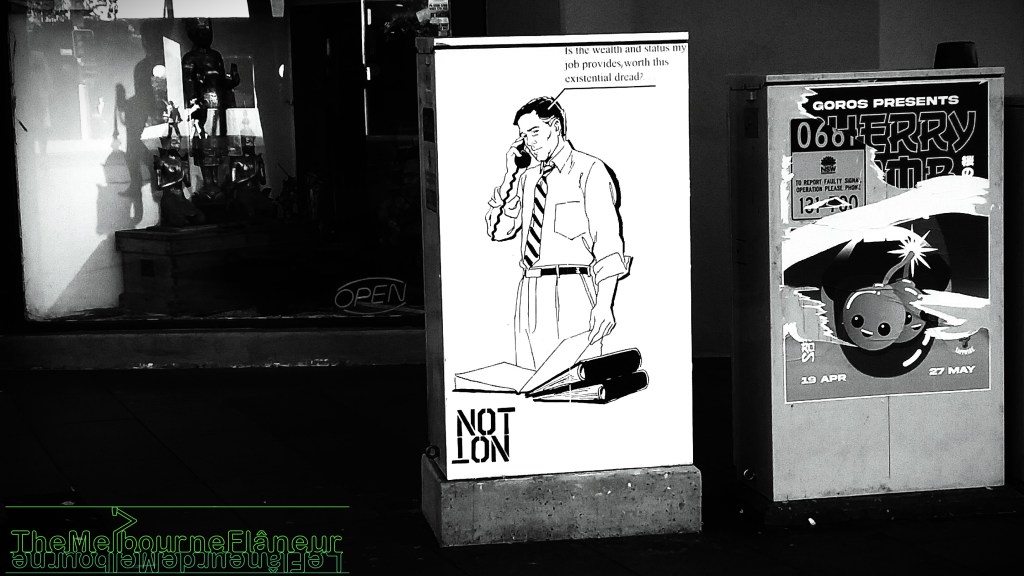

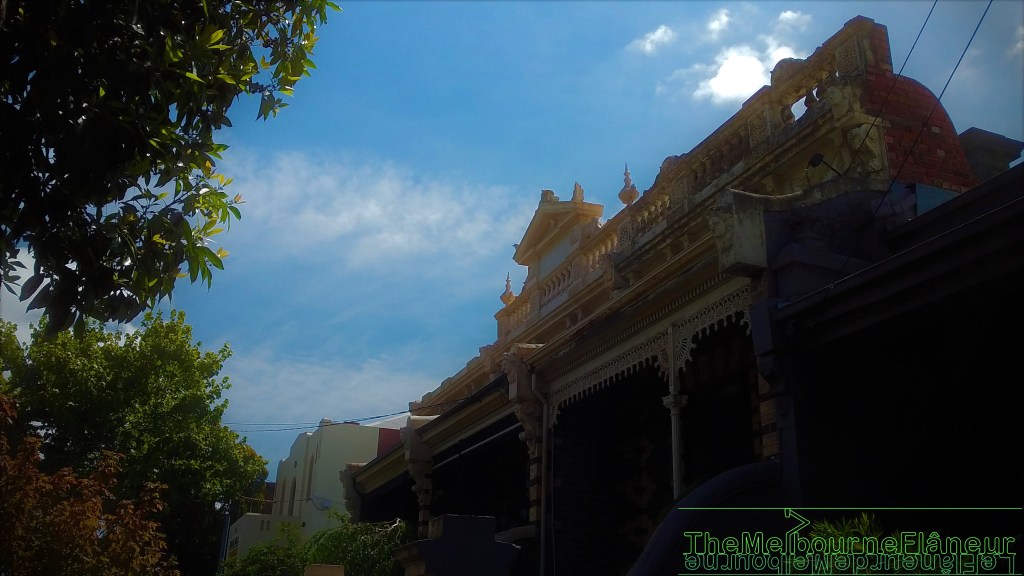


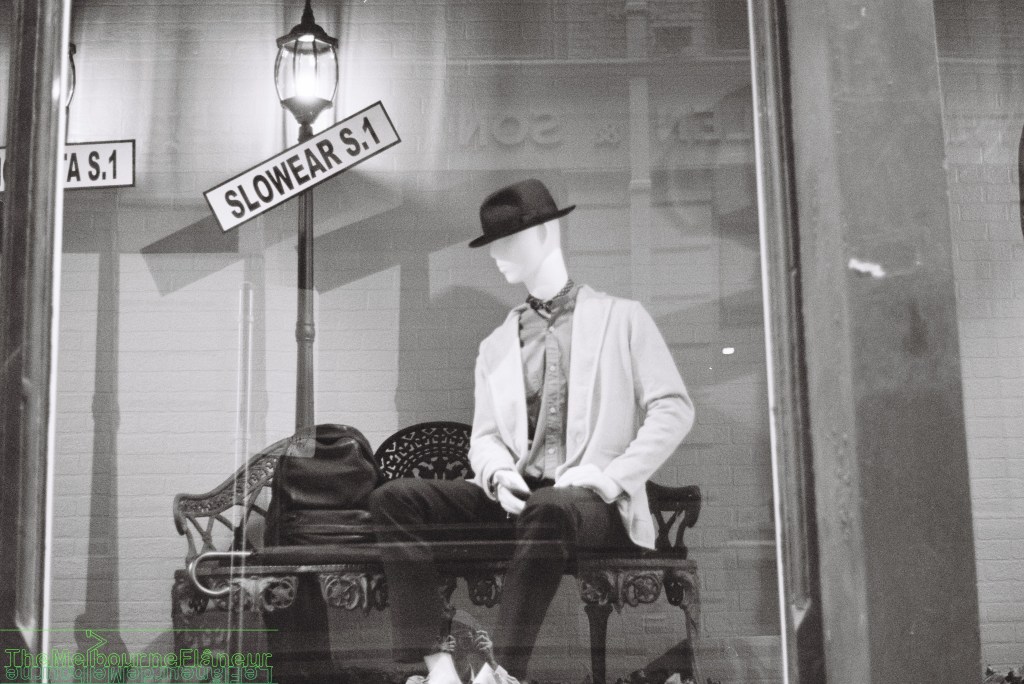

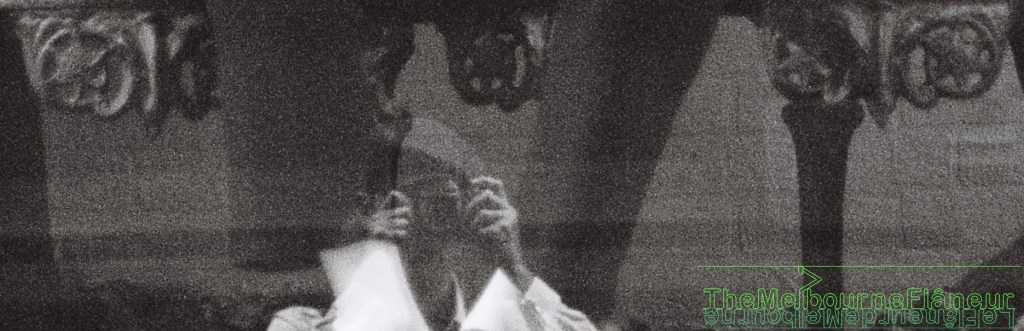

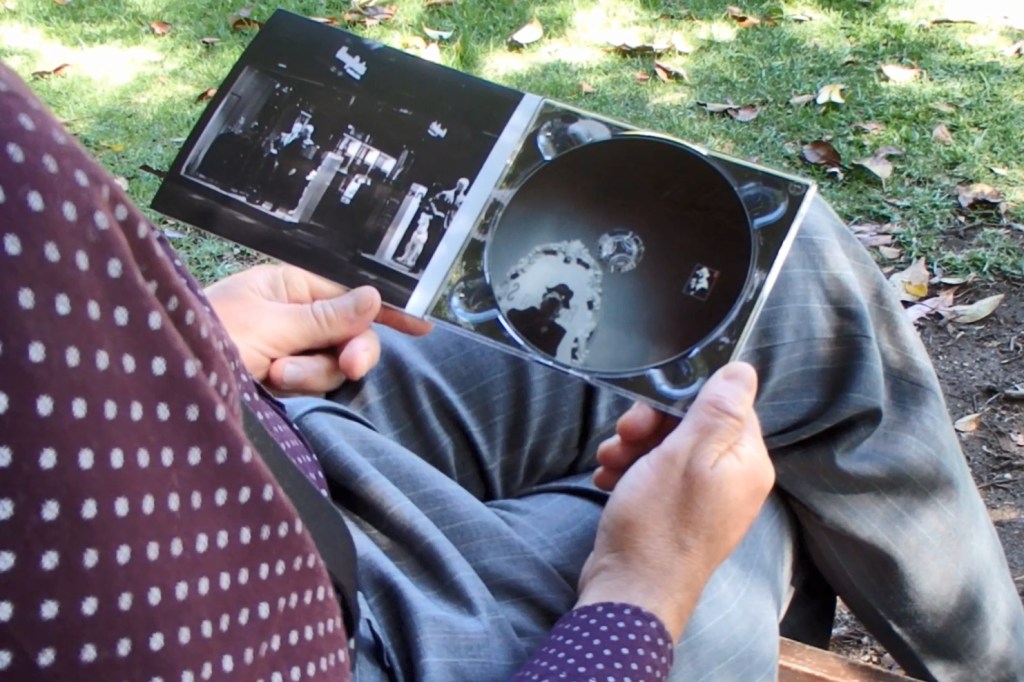
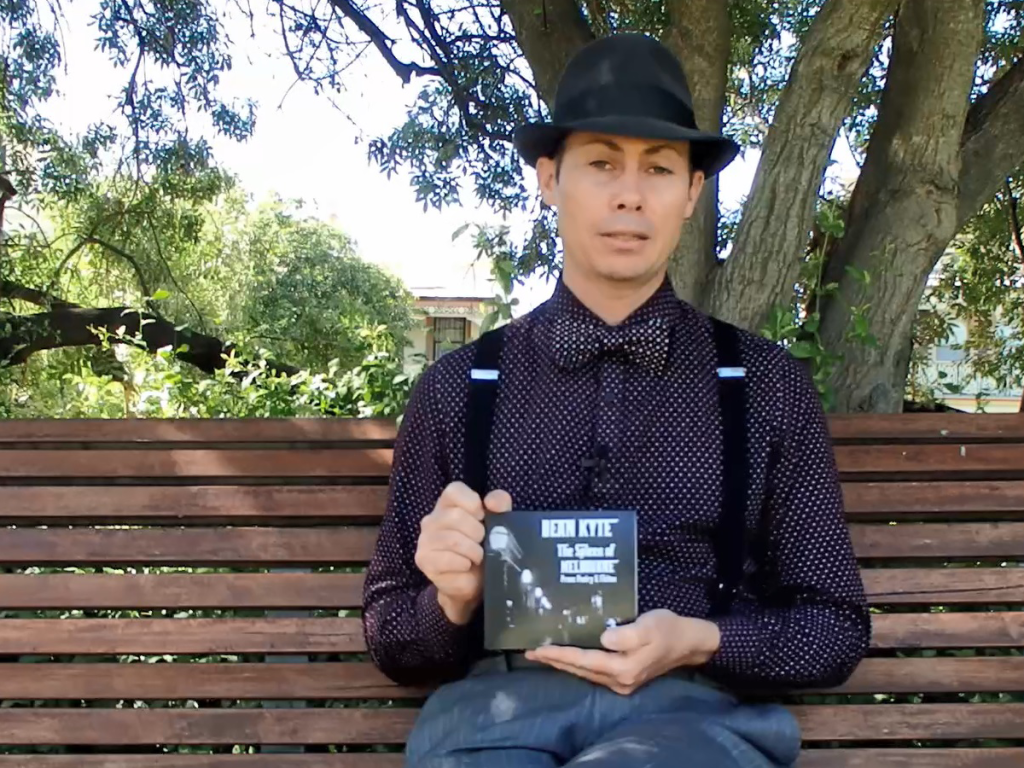


 deankyte.com