Dean Kyte walks you through the dust jacket for the hardcover edition of his new book of Baudelaire translations, Maledictions, Blasphemies, Laments.

June 2025 sees the scheduled release of my new book of translations drawn from the works of Charles Baudelaire, Maledictions, Blasphemies, Laments: Selections from Toxic Blossoms and Parisian Spleen.

As I explain in the video above, the book features one-fifth of the total number of poems published in the three editions of Baudelaire’s Les Fleurs du mal (1857), plus one-quarter of the prose poems from Le Spleen de Paris (1869).

But in addition to the 47 poems and prose poems I’ve selected as representative examples of Baudelaire’s flâneurial philosophy, as a bonus, I’ve also chosen to translate the M’sieu’s only work of fiction—La Fanfarlo (1847), adding significant value to this volume as a complement to the selections I have made from Les Fleurs du mal and Le Spleen de Paris.

At nearly 11,000 words in the original, “La Fanfarlo” is the most ambitious translation project I have undertaken in any language.

For the past month, I’ve been deeply engaged in hewing out a version of the source text in English, and as this post goes to press, I’m immersed in the third of five drafts, approximately half-way through the process of bringing this story to life in English.

The value of “La Fanfarlo” is chiefly documentary: preceding the bulk of Baudelaire’s œuvre as presented in the first two parts of Maledictions, Blasphemies, Laments, this ‘long short story’ will retrospectively show the 25-year-old poet first rehearsing the ideas and turns of phrase we recognize more brilliantly expressed in the poems and prose poems.

Published in January 1847, the story is a fictionalized account of Baudelaire’s first meeting with the Creole actress Jeanne Duval (c. 1820—after 1862), the Haitian beauty the poet would call his ‘Vénus noire’, and who, as his muse and mistress, is the recognizable inspiration behind at least four of the poems I’ve translated in Maledictions, Blasphemies, Laments:—Les Bijoux, Avec ses vêtements ondoyants et nacrés…, Un Fantôme, and Je te donnes ces vers afin que si mon nom….

Jeanne Duval is ‘la Fanfarlo’ of the story’s title—an exotic dancer who has her hooks sunk deep in a Parisian dandy, M. de Cosmelly.

This gent’s wife, Mme. de Cosmelly, is a minor aristocrat from Lyon, where, in her innocent girlhood, she was once friendly with a rakish young man who has grown into Samuel Cramer, Parisian poet-about-town, a dandy-flâneur who is clearly Baudelaire under another name.

La Fanfarlo” begins in imitation of Balzac’s novella La Fille aux yeux d’or (1835), with Samuel crossing paths with Mme. de Cosmelly in the jardin du Luxembourg.

But then it morphs into a curious variation on the plot of Choderlos de Laclos’ epistolary novel Les Liaisons dangereuses (1782), with the virtuous Mme. de Cosmelly—who is like a strange combination of the marquise de Merteuil wrapped in the girlish wile of Cécile de Volanges—plotting with Samuel, who fancies himself a novice vicomte de Valmont.

Mme. de Cosmelly engages the poet to take Fanfarlo off her husband’s hands and thus deliver him back into the amorous arms of his neglected wife—who gives Samuel to believe that she will bestow her gratitude upon him in the appropriate way.

As I’ve been working on translating this story over the last month, I’ve conceived of “La Fanfarlo” in several different ways. One of them is as a prophetic manifesto of Baudelaire’s artistic intent as a poet.

At the time the short story was published, Baudelaire was beginning his career as a journalist in Paris’s artistic milieu. While a few of the poems that would later appear in Les Fleurs du mal had been published in Parisian newspapers, Baudelaire was mainly known for his two lengthy reviews of the Salon exhibitions in 1845 and 1846.

In fact, the cover of Le Salon de 1846 advertises the imminent publication of the work that, eleven years later, would see the light of day under the allegorical title of Les Fleurs du mal.

Conversely, in “La Fanfarlo”, written in the months after Baudelaire’s Salon review was published in May 1846, his hero’s one claim to literary fame is as the author of a juvenile collection of sonnets—Baudelaire’s speciality—published under the equally inscrutable and difficult to translate title of “Les Orfraies”.

Le lendemain il la trouva, la tête inclinée par une mélancolie gracieuse et presque étudiée, vers les fleurs de la plate-bande, et il lui offrit son volume des Orfraies, recueil de sonnets, comme nous en avons tous fait et tous lu, dans le temps où nous avions le jugement si court et les cheveux si longs.

Samuel était fort curieux de savoir si ses Orfraies avaient charmé l’âme de cette belle mélancolique, et si les cris de ces vilains oiseaux lui avaient parlé en sa faveur ; mais quelques jours après elle lui dit avec une candeur et une honnêteté désespérantes :

— Monsieur, je ne suis qu’une femme, et, par conséquent, mon jugement est peu de chose ; mais il me paraît que les tristesses et les amours de messieurs les auteurs ne ressemblent guère aux tristesses et aux amours des autres hommes. … De plus, j’ignore pourquoi vous chérissez tant les sujets funèbres et les descriptions d’anatomie. Quand on est jeune, qu’on a comme vous un beau talent et toutes les conditions présumées du bonheur, il me paraît bien plus naturel de célébrer la santé et les joies de l’honnête homme, que de s’exercer à l’anathème, et de causer avec des Orfraies.

The next day, he located the lady, her head inclined by a gracious and almost studied melancholy towards the flowers of the parterre, and offered her his volume of Raptorsongs, a collection of sonnets of the type we have all written and read in days when we were so short in judgment and long in hair.

Samuel was most curious to discover if his Raptorsongs had charmed the soul of this beautiful melancholiac, and if the cries of these dreadful birds had spoken to her in his favour.  But a few days later, she told him with a disheartening candour and honesty:

—Monsieur, I am merely a woman, and consequently, my judgment is a thing of small worth.  But it appears to me that the passions and distresses of you authorial gentlemen hardly bear resemblance to the loves and sadnesses of other men. … Moreover, I know not why you so cherish funereal subjects and anatomical descriptions.  When one is young, when one has, as you do, a great talent and all the presumed conditions for happiness, it seems to me much more natural to celebrate health and an honest man’s joys than to practise anathema and to declaim in piercing cries.

— Charles Baudelaire, “La Fanfarlo” (1847, p. 9 [my translation, third draft])

Thus, the piercing cries of birds of prey which form the discordant music of Samuel Cramer’s sonnets in “La Fanfarlo” will, a decade later, become the ‘noisome posy’, the ‘toxic blossoms’—which is how I have chosen to translate Les Fleurs du mal in Maledictions, Blasphemies, Laments—and the title Baudelaire devises from Cramer’s recueil is prescient in its sinister ambiguity, anticipating the multiple insinuations that other translators have unimaginatively reduced to the literal phrase of ‘the flowers of evil’.

Baudelaire is barely commenced upon the project that will become Les Fleurs du mal. Yet he anticipates the critiques that will be levelled against his poisonous bouquet and rehearses them in “La Fanfarlo” by placing them in the mouth of Mme. de Cosmelly.

He also articulates his rebuttal—the rebuttal he might have given at his future obscenity trial—by ventriloquizing his self-defence through Samuel.

Madame, plaignez-moi, ou plutôt plaignez-nous, car j’ai beaucoup de frères de ma sorte ; c’est la haine de tous et de nous-mêmes qui nous a conduits vers ces mensonges. C’est par désespoir de ne pouvoir être nobles et beaux suivant les moyens naturels, que nous nous sommes si bizarrement fardé le visage. Nous nous sommes tellement appliqués à sophistiquer notre cœur, nous avons tant abusé du microscope pour étudier les hideuses excroissances et les honteuses verrues dont il est couvert, et que nous grossissons à plaisir, qu’il est impossible que nous parlions le langage des autres hommes. Ils vivent pour vivre, et nous, hélas ! nous vivons pour savoir. Tout le mystère est là.

Madame, pity me—or rather, pity us; for there are many brethren of my kind.  It is the hatred of everything—and of ourselves—which has led us to these lies.  It is out of the despair of impotence to be noble and beautiful through natural means that we have so bizarrely farded our faces.  We have so applied ourselves to over-refining the human heart, we have so abused the microscope so as to study the hideous growths and shameful warts with which it is covered—and which we inflame with pleasure!—that it is impossible that we should speak the language of other men.  They live to live, and we, alas!—we live in order to know.  The whole mystery lies in that.

— Charles Baudelaire, “La Fanfarlo” (1847, p. 10 [my translation, third draft])

This eloquent plea is, moreover, perspicacious to an extraordinary degree in that it reveals Baudelaire’s total awareness of his malady—his absolute inability to make his way in the world as either man or poet—so young in life. Through Samuel to Mme. de Cosmelly, Baudelaire throws himself upon the mercy of a future court of public opinion just as, following the adverse finding against him at his obscenity trial, he would seek the clemency of the Empress Eugénie.

In another of its dimensions, I see “La Fanfarlo” as rehearsing elements of the future ‘novel of realistic intrigue’—which is the umbrella term I apply to all subspecies of the crime novel, from the detective story to the spy thriller—any work of genre fiction that depends for its motive upon the revelation of a concealed truth.

Baudelaire is a proto-noir writer: his flâneurial ethos, drawing on the contemporary influences of Balzac, Eugène Sue, and Poe, braids the æsthetic strands of Gothic fiction and Romanticism with the emergent rational sensibility of science characteristic of the over-civilized city-man that, later in the nineteenth century, will produce the novel of realistic intrigue as the quintessential literary investigation of modern, metropolitan life.

I will go further than this and posit that Les Liaisons dangereuses is a proto-crime novel—perhaps the first crime novel—and specifically a proto-roman noir.

Noir as a literary and cinematic æsthetic rather than a genre in its own right is a stylization of the genre of realistic intrigue so as to produce the humane mood—the experiential atmosphere—associated with the commission of true acts that demand dissimulated concealment.

Which is to say that rage, fear, greed, melancholy, remorse—the whole gruesome psychology of cardinal sin associated with crime—are the transcendent subject of noir rather than the plot-based mechanics of the generic mystery or detective story.

In the pre-revolutionary epoch described by Les Liaisons dangereuses, well before Napoleon instituted the world’s first official police force in Paris to regulate public morals, ‘crime’ is a purely moral, ethical transgression rather than the legal matter that the generic novel of realistic intrigue will make of the humane dilemma to commit or not to commit.

Thus, understood in this way, Les Liaisons dangereuses—which we know from some illuminating notes that Baudelaire read with avidity—is a prototypical work of crime fiction, and, more specifically, of the stylistically abstracted and æstheticized variant on the novel of realistic intrigue we call the roman noir.

One of the archetypal tropic situations of noir—one which we see repeated in Baudelaire’s life, in his poetry, and in this single short story he chooses to commit to paper—is the triangular configuration of a man uncomfortably posed between two women, the good, domestic, ‘Madonna’ type, and the whore, the bad girl, the femme fatale who lures him into crime’s moral morass, the emotional place of wrongdoing where noir resides.

In “La Fanfarlo”, Baudelaire rehearses this archetypal trope of noir which we will recognize, a century later, more properly worked out in the romans noirs of David Goodis or in a movie like Pitfall (1948).

Even if she has a vestigial quality of the marquise de Merteuil, we may imagine Mme. de Cosmelly, ‘virginally maternal’, as pre-emptive of the presidential Apollonie Sabatier, to whom Baudelaire would later dedicate some of his most tender and reverential odes to women in Les Fleurs du mal.

As viewed from Samuel’s perspective, she is described throughout the story as a ‘femme honnête’, in spite of her Machiavellian trickery. In the parlance of the day, a woman’s ‘honesty’ is a function of her sexual purity—and as continently amorous wife, Mme. de Cosmelly is set up in distinct contrast to Fanfarlo—the femme fatale kept by her husband, incontinently available as a ‘fille publique’ upon the stage.

As per the triangular sexual dynamics that René Girard will later brilliantly identify as characteristic of the French nineteenth-century psychological novel, in “La Fanfarlo” Baudelaire sketches out the tropic plot of the later noir thriller, and it is precisely the æsthetic emphasis on the triangular structure of the psychological motive forces beneath the superficial mechanics of the plot that distinguishes noir from the generic crime, mystery, or detective story.

The moral dimensions of crime, the consequential human interest element of ethical transgression—beyond the bloodless legal mechanics of justice—that are implicit in this triangular structure of diverging, equivalent, but oppositional psychological forces, the ambiguous positioning of Samuel Cramer between Mme. de Cosmelly and Fanfarlo, between madone et putain, is what, I think, places this story in the primordial region of the nascent novel of realistic intrigue.

As primitive femme fatale, la Fanfarlo contrasts as a Dabrowskian ambivalent ambitendency in Samuel’s desires with the madonal/maternal Mme. de Cosmelly.

As a transparent disguise for Jeanne Duval—the second most important woman in Baudelaire’s life after his mother—the description he lavishes on Fanfarlo is the first sketch of the Baudelairean feminine ideal we will later recognize in the pages of Les Fleurs du mal—a totemically Orientalist representation of the fetishistically artificial femme fatale—literally ‘noire’ in her glorious négritude.

Elle fut accusée d’être brutale, commune, dénuée de goût, de vouloir importer sur le théâtre des habitudes d’outre-Rhin et d’outre-Pyrénées, des castagnettes, des éperons, des talons de bottes, — sans compter qu’elle buvait comme un grenadier, qu’elle aimait trop les petits chiens et la fille de sa portière, — et autres linges sales de la vie privée, qui sont la pâture et la friandise journalière de certains petits journaux. On lui opposait, avec cette tactique particulière aux journalistes, qui consiste à comparer des choses dissemblables, une danseuse éthérée, toujours habillée de blanc, et dont les chastes mouvements laissaient toutes les consciences en repos. Quelquefois la Fanfarlo criait et riait très-haut vers le parterre en achevant un bond sur la rampe ; elle osait marcher en dansant. Jamais elle ne portait de ces insipides robes de gaze qui laissent tout voir et ne font rien deviner. Elle aimait les étoffes qui font du bruit, les jupes longues, craquantes, pailletées, ferblantées, qu’il faut soulever très-haut d’un genou vigoureux, les corsages de saltimbanque ; elle dansait, non pas avec des boucles, mais avec des pendants d’oreilles, j’oserais presque dire des lustres. Elle eût volontiers attaché au bas de ses jupes une foule de petites poupées bizarres, comme le font les vieilles bohémiennes qui vous disent la bonne aventure d’une manière menaçante, et qu’on rencontre en plein midi sous les arceaux des ruines romaines ; toutes drôleries, du reste, dont le romantique Samuel, l’un des derniers romantiques que possède la France, raffolait fort.

She was accused of being brutal, common, devoid of taste, of wanting to important into the theatre some customs from across the Rhine or beyond the Pyrenees—castanets, spurs, heeled boots—quite apart from the fact that she was as bibulous as a grenadier, that she bore too much affection for small dogs and her concierge’s daughter—and other such dirty laundry drawn from her private life which are the daily lifeblood and confections of certain small newspapers.

They would oppose him with that particular tactic of journalists, which consists of drawing comparisons between unlike things—an ‘ethereal dancer’ – always habited in white – and whose ‘chaste movements’ could not disturb the peace of any conscience.  Sometimes, Fanfarlo would direct very loud tears and laughter towards the stalls in finishing off a leap above the footlights;—she would even dare to walk in dancing.  Never would she wear those insipid gauzy dresses which permit everything to be seen and nothing to be imagined.  She was fond of stuffs which made a sound—long, crunchy, sequined, metallic skirts that it was necessary to raise very high with a vigorous knee; clowny blouses.  She would dance—not with earrings, but with pendants hanging from her ears;—I might almost dare to say, with chandeliers.  She might willingly have fastened to the bottom of her skirts a host of bizarre little dolls—as the old gypsy women who tell your fortune in a menacing manner do, and whom one encounters at the height of noon under the arches of Roman ruins;—all kinds of amusements, moreover, over which the romantic Samuel—one of the last Romantics that France possesses—went very much mad.

— Charles Baudelaire, “La Fanfarlo” (1847, pp. 22-3 [my translation, second draft])

Thus, expressionistic to a Germanic degree, Fanfarlo primitively anticipates Sacher-Masoch’s Wanda von Dunajew, the gilded, metallic, mineral divine slatterns of Klimt, the deformed, degenerately angular mutant beauties of Schiele, and the utterly artificial fräulein flappers of Wedekindian Weimar Kinema.

As in the developed film and roman noir, Samuel falls prey to the fatal woman—but the fatality of la Fanfarlo’s arachnid trap is ‘les Limbes’ of common-law marriage. Just like the bohemian Baudelaire, a sexual liberal who was more than a century ahead of his time in his interracial proclivities, Samuel commits the only scandal available to the sexually un-scandal-izable French by ‘living in sin’ with his mistress.

In an original re-inversion of the later canons of law and order inverted by noir, Baudelaire’s hell is that of bourgeois convention and respectability, as Cramer succumbs to what he considers the ‘maladie d’araignée’—the ‘spider sickness’—of pregnancy.

In fine, the ‘bad girl’, Fanfarlo, leads the fallen hero off the straight path of art and into the inferno of domesticity as the father of twins rather than dangerously liberating him from the impotent prison of the hearth.

In the character of Samuel Cramer, so scrupulously delineated in the opening pages, Baudelaire curiously anticipates archetypal figures of the later, established genre from Sherlock Holmes to Philip Marlowe—and even to James Bond.

When Baudelaire is writing “La Fanfarlo”, the detective story is still so new a genre as to not even have that name. Indeed, the whole idea of a ‘detective’, that quintessentially flâneurial professional who can only bud up under conditions of late-civilized, urbanized modernity, is still yet to be fully articulated in the collective imaginary.

Baudelaire’s poetic hero, Edgar Allan Poe, writes the first detective story, “The Murders in the Rue Morgue”—set, significantly, in Paris—in 1841.

The first, plagiarized translations into French of Poe’s short story are published in the Paris newspapers in June and October 1846, and an ensuing lawsuit brings the name of Poe to the attention of the Parisian public for the first time—and doubtless to Baudelaire’s.

It is perhaps not insignificant that Poe’s detective, Auguste Dupin, is a chevalier—a knight—in the Légion d’honneur. In a conspicuous non sequitur diatribe to Mme. de Cosmelly, Samuel rails against the chivalrous, medieval romances of Sir Walter Scott, comparing them very disfavourably to the modern, psychological approach taken by ‘nos bons romanciers français’.

And yet, as Francis S. Heck observes in his article “Baudelaire’s ‘La Fanfarlo’: An Example of Romantic Irony” (1976), in his short story, Baudelaire burlesques the chivalrous romantic plot of a novel by the ‘ennuyeux’ Scott—just as he is burlesquing Les Liaisons dangereuses.

In some sense, as a dandy-flâneur, as a free-floating, mobile agent in the social scape of Paris, the poet Cramer fulfils the as yet undefined rôle of a private detective: He is charged with a secret mission by his Dulcineac ‘client’, Mme. de Cosmelly—the typical society dame who will later come through Sam Spade’s and Philip Marlowe’s pebbled glass door, setting the Scott-like plot of a detective novel in motion.

And like Spade or Marlowe, in the meta-ironic style with which Baudelaire limns Samuel Cramer, this knight-errant going forward in his lady love’s service with a Valmontian ethical flexibility and a latitude of action to guide him through the social strata of Paris is more than usually quixotic.

The popular notion of a ‘private investigator’ of confidential matters that Poe first posits with the archetypal figure of C. Auguste Dupin not yet being articulated as a definitive ‘type’ in the physiognomy of modern urban life, Samuel Cramer nevertheless fulfils the prototypical rôle of a ‘private inquiry agent’, an unofficial investigator in Mme. de Cosmelly’s behalf, and a champion in defence of her domestic interests.

But even as we first encounter Samuel, Baudelaire’s description of his digs overlooking the jardin du Luxembourg, in one of the most fashionable quartiers of Paris for a free-floating social aspirant allied with—but not quite of—the élite, foreshadows Sherlock Holmes’s ‘rooms’ at 221B Baker Street in Marylebone.

Un jour chaud et doré se précipita dans le cabinet poudreux. Samuel admira comme le printemps était venu vite en quelques jours, et sans crier gare. Un air tiède et imprégné de bonnes odeurs lui ouvrit les narines, — dont une partie étant montée au cerveau, le remplit de rêverie et de désir, et l’autre lui remua libertinement le cœur, l’estomac et le foie. — Il souffla résolûment ses deux bougies dont l’une palpitait encore sur un volume de Swedenborg, et l’autre s’éteignait sur un de ces livres honteux dont la lecture n’est profitable qu’aux esprits possédés d’un goût immodéré de la vérité.

Du haut de sa solitude, encombrée de paperasses, pavée de bouquins et peuplée de ses rêves, Samuel apercevait souvent, se promenant dans une allée du Luxembourg, une forme et une figure qu’il avait aimées en province, — à l’âge où l’on aime l’amour.

A warm and golden light rushed into the dusty study.  Samuel admired how quickly the spring had come—in a matter of days, and without warning.  An atmosphere, mild and steeped in pleasant scents, opened the portals of his nostrils, a fraction of which, having mounted to his brain, filled him with dreams and desires while another licentiously stirred his heart, stomach and spleen.  He resolutely snuffed out his two candles, one of which was still twitching atop a volume of Swedenborg while the other was guttering above one of those shameful books whose perusal merely profits spirits possessed with an immoderate appetite for truth.

From his lofty solitude encumbered with papers, paved with books, and peopled by his dreams, Samuel would often glimpse, strolling in an allée of the Luxembourg Gardens, a face and figure that he had loved in the countryside at the age when one is in love with love itself.

— Charles Baudelaire, “La Fanfarlo” (1847, pp. 4-5 [my translation, third draft])

In that brief but vivid sketch—in which we also recognize Baudelaire’s own tastes for the occult, alchemy and esotericism, to which his poems and prose poems give ample testimony—the Faustian magus style of Samuel’s chambers is not dissimilar to Dupin’s muffled bibliothèque or Holmes’s platonic realm of pure rationality, where the science of the chemistry kit is perfectly reconciled with the art of the violin.

As a primordial essay at the archetypal hero of the novel of realistic intrigue, Samuel evokes Holmes in his domain as much as he evokes Bond in his person.

In one of his mythic dimensions, the figure of James Bond accomplishes a modern type that has its first clear personification in the Romantic figure of Lord Byron.

We know that Baudelaire, as the latest poet of Romanticism, was deeply impressed by Byron’s heroic example—as were many of his contemporaries across the Channel, including his friend and mentor Delacroix, who interpreted some of Byron’s verses on canvas.

On the whole, the Parisians, adopting the mode of dandyism that had commenced in London, were much more receptive to English trends in the nineteenth century than the reverse, the islanders displaying their usual xenophobic suspicion for Continental fads, particularly those originating with the frivolous French.

As a translator from English, Baudelaire, like his contemporaries, was deeply immersed in cultural trends across the Channel and held a deep reverence for the well-worked consumer products of English artisanry and manufacture, which appeared to him, as to his cronies, to represent the nec plus ultra in good taste.

Of course, Ian Fleming’s James Bond is an utterly slavish advertisement for the sophisticated English gentleman, and a significant part of the charm of the Bond novels as examples of the genre of realistic intrigue resides in the inclusion of actual ‘marques’—brand names that testify to Fleming’s exquisitely snobbish good taste.

I contend that a straight line can be drawn from Lord Byron to James Bond that leads through Sherlock Holmes and passes equally through the character of Samuel Cramer as an entity clearly emulative of Byron but anticipating the refined, recuperated dandyism of Bond.

Bond completes the Byronic Übermensch that Sherlock Holmes would appear to be, except for his absence of heart, his invulnerability to the fairer sex. In the modern English literary tradition where chivalry is gradually sublimated to the modern project of science, commerce, engineering and empire-building, Byron, the heroic Romantic, a nobleman kicking against all these bourgeois pricks, ultimately becomes Bond, the romantic Hero, eminently middle-class but an aspirant to democratic nobility via the meritocracy of dandyism.

Samuel Cramer, who is as much a pseudonymous disguise for Charles Baudelaire as James Bond is for Ian Fleming, is this Byronic Übermensch burlesqued: The poet, quixotically hobbled by his romantic spleen, is charged by Mme. de Cosmelly as her agent in the secret mission to break up her husband’s affair by seducing la Fanfarlo.

And, uncannily, just as Bond, true to his cryptically middle-class origins, is not even an Englishman at all, being the product of a Scot out of a French-Swiss woman, so too does Baudelaire make a point of Samuel’s exotic mixed heritage, imparting the soupçon of something extra to the je-ne-sais-quoi of his dandyism.

Samuel Cramer, qui signa autrefois du nom de Manuela de Monteverde quelques folies romantiques, — dans le bon temps du Romantisme, — est le produit contradictoire d’un blême Allemand et d’une brune Chilienne. Ajoutez à cette double origine une éducation française et une civilisation littéraire, vous serez moins surpris, — sinon satisfait et édifié, — des complications bizarres de ce caractère.

Samuel Cramer, who, in days gone by,—in the good old days of Romanticism, that is,—signed some romantic fantasies with the name of Manuela de Monteverde, is the contradictory issue of a pale German and a tanned Chilean woman. Add to this double origin a French education and a literary culture and you will be less surprised—if not satisfied and edified—by the bizarre complications of his character.

— Charles Baudelaire, “La Fanfarlo” (1847, p. 1 [my translation, third draft])

Like Bond, who continues to impersonate the perfect Englishman in the imagination of a public ignorant of Fleming’s antecedents for him, Samuel’s mixed heritage is operationalized by Baudelaire to contrast—or exotically harmonize—a traditionally phlegmatic, Northern – even ‘masculine’ – side of this idealized version of himself with a more spontaneous, Southern – ‘feminine’ – side.

One could argue that Bond’s superheroic success at every endeavour is at least in part a function of the reconciliation of masculine and feminine, of rational and responsive elements of ‘race’ in his character: he unites the ‘imperturbable’ Scot with the sophisticated French-Swiss and—like nineteenth-century dandies in Paris such Baudelaire and his creation Cramer—effectively ‘passes’ for an Englishman.

So, in many ways, “La Fanfarlo”, as a work contemporary with Poe’s detective stories, written alongside the very birth of the genre of realistic intrigue that defines the modernity that Baudelaire himself would give the name to, is a fascinating exploration of primordial forms and structures in the Zeitgeist of mid-nineteenth-century Paris.

The work is by no means a success: Baudelaire demonstrates that he has no particular talent for fiction as he has an indisputable genius for poetry and the kind of perspicacious philosophical observation that comes through in his critical writings.

Though this work may not be great fiction, it is a subtle and penetrating study written in a suggestive and æsthetic style which would not have seemed out of place in the nineties. It is chiefly interesting now because, with rare insight and a singular power of self-analysis, Baudelaire has studied his own personality in the person of Samuel Cramer the hero; it does not show enough experience and diversity of knowledge of human nature to be great fiction.

— Enid Starkie, Baudelaire (1933, p. 130)

After “La Fanfarlo”, Baudelaire’s career as a fictioneer would be solely restricted to the handmaiden’s rôle of translator as he threw himself with holy zeal into the mission of setting versions of Poe’s extraordinary tales before the French public—versions that are still considered definitive, and which are studied in French high schools today.

La Fanfarlo” tells us an enormous deal about Baudelaire—about his life, about his relationships with women—in a medium—that of fiction—he would never again explore in his own behalf, and thus, it throws a documentary sidelight on the vision of his character I have traced in Maledictions, Blasphemies, Laments through my selections from Les Fleurs du mal and Le Spleen de Paris.

This ‘long short story’ will thus add considerable value to the volume as a unique document that throws another facet of interpretation upon the poems and prose poems.

With the completion of the translation of “La Fanfarlo” next month, I will be ready to open the doors to pre-orders of Maledictions, Blasphemies, Laments in a variety of formats ahead of its release in June.

You can register your interest in being notified when I am ready to accept down payments for pre-ordered copies of the book by entering your email address into the registration form below. That will put you on the mailing list of prospective collectors, and I will send you the first ‘chapterlet’ of the introductory monograph I am writing for the book to give you a taster of what to expect in June.
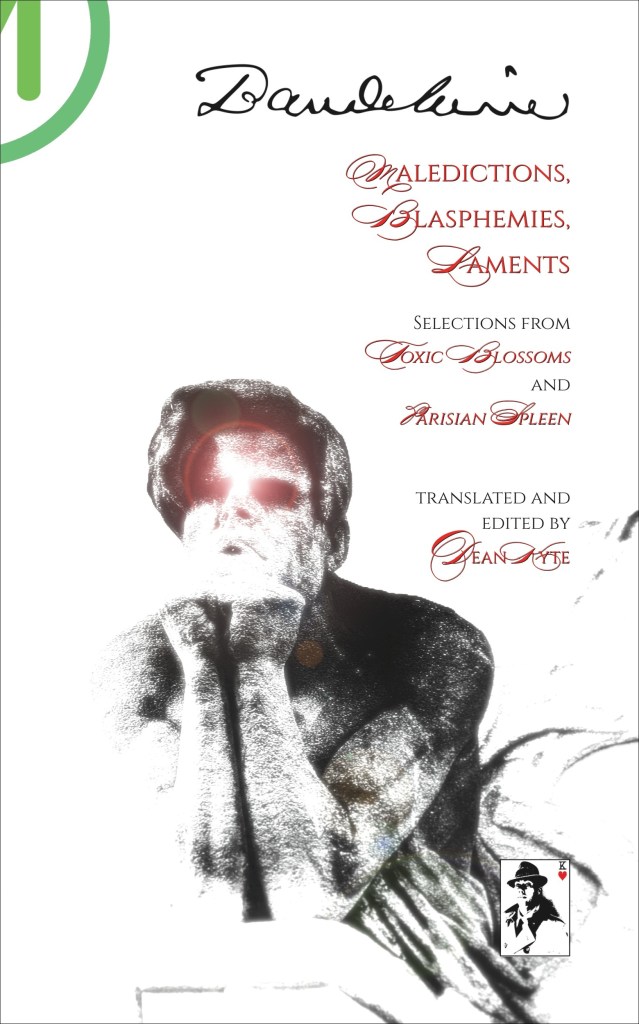
Front cover image of the softcover edition of “Maledictions, Blasphemies, Laments: Selections from ‘Toxic Blossoms’ and ‘Parisian Spleen’”, by Charles Baudelaire, translated and edited by Dean Kyte.

Dean Kyte’s new book of translations from Baudelaire, Maledictions, Blasphemies, Laments: Selections from Toxic Blossoms and Parisian Spleen, is on track for release in June.

To register your interest in buying a copy and receive exclusive monthly updates delivered to your inbox, enter your email below.

When you sign up, Dean Kyte will send you the first chapter of his critical introduction to the book!

Go back

Your message has been sent

Warning

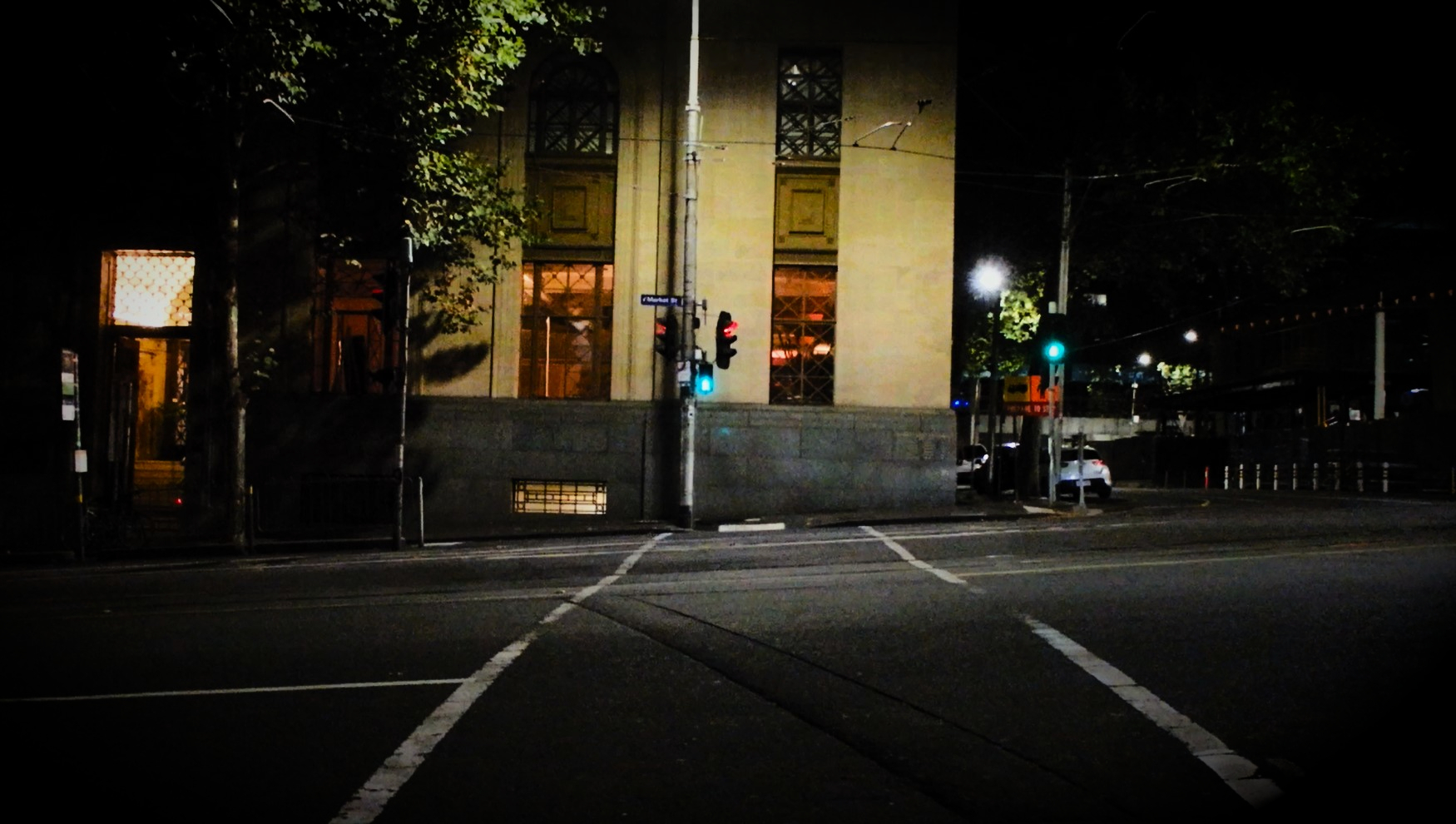
Block Court, Collins Street, evening.
Shot on Kodak Ektar 100. Shutter speed: 30. Aperture: f.2.82. Focal range: ∞.

“Office at night”: A ficción by Dean Kyte. The tracks below are best heard through earphones.

The year 2024 has been a landmark literary year for your Melbourne Flâneur.

Among the many achievements, after four years of patient plotting, planning, and pre-production, a formal commencement was made on production of the forthcoming Melbourne Flâneur podcast, an offshoot of The Spleen of Melbourne project which began to manifest itself during the epic Coronavirus lockdown of 2020.

“Office at night”, track 11 on The Spleen of Melbourne audiobook, was written while your Melbourne Flâneur was dodging the CV all over NSW in the winter of 2021. It is one of eight ‘experimental previews’ for the podcast I wrote, recorded, and sound-designed during the years of pre-production as I got a progressively firmer handle on both the literary and the auditory ‘style’ I am going for in the podcast.

I’m calling that style (at least in its auditory aspect) ‘audio noir’—although such a term is not the best French.

But I believe that I have found in the soundscapes cobbled together from the more than 400 recordings I have made all over Melbourne, Victoria, and points even further afield in the last two years, an auditory approximation of the pseudo-documentary style of post-war film noir, adapted, in its turn, from the pseudo-documentary principles of Italian neorealismo.

The ‘Italian connection’, the conceptual influence of a ‘new realism’ in cinema, derived from the documentary, on the fictional audio project that has emerged as a sub-project of the prose poems on The Spleen of Melbourne album, is a key theoretic base in my thinking, for in its literary dimension, as narrated texts intoned over these cinematic soundscapes, the style I have developed for The Melbourne Flâneur podcast has its ‘French connection’ too:—the post-war Nouveau Roman.

Over the past fifteen months, I’ve been taking you, book by book, through the work of the novelist who—along with my dear, adored Henry James—has shared with the Master co-regency as the chief stylistic influence on the podcast.

His theoretic principles ‘towards a new novel’ I have applied in experimental previews such as “Office at night”, and have eventually mastered and perfected as, in 2024, I wrote the first four canonical episodes of this dark documentary on contemporary Melbourne life, of which “Office at night” is an ‘interstitial episode’, taking place halfway through the series.

In 1963, the novelist in question, Alain Robbe-Grillet, was at the height of his international celebrity and his influence on Western culture.

In the ten years to that date, from the incomprehension that greeted his first published novel, Les Gommes (1953), Robbe-Grillet had quickly taken the citadel of French literature, going from dismissed madman to dean and spokesman for a diverse school of avant-garde French writers, many of whom were, like Robbe-Grillet himself, published by Les Éditions de Minuit.

The literary press of Paris, for want of a better term, said that the Minuit school of novelists were engaged in the project of writing a ‘nouveau roman’—a ‘new novel’—and the term, pejorative at first, signalling a definite break with the pre-war tradition of the French psychological novel that had come down from Balzac, stuck to the group.

Robbe-Grillet seemed the most iconoclastic of the Nouveaux Romanciers to the critics—and he was also the most charismatic, the most good-humoured in taking and batting back broadsides, and the most gregarious, showing a generosity towards the work of his fellow novelists exceedingly rare in a writer, taking their part and arguing the collective case of the group.

This movement from margins to mainstream-adjacent put Robbe-Grillet in a powerful personal position, both in French letters and, as the cachet of being a cutting-edge French novelist has a profound modishness for the Anglosphere, eventually globally. It led Robbe-Grillet to pen a mystifying screenplay for Alain Resnais in 1961 and, in 1962, to make his début as a filmmaker, becoming one of the few novelists in history to have a second career as a film director.

Robbe-Grillet’s coup was accompanied by the publication in the French press of a small corpus of articles in which he tentatively put forth the case for a new kind of novel that diverged radically from the French tradition and was adapted to the actual conditions of post-war life.

In 1963, with his star at its apogee, Robbe-Grillet collected these essays in a single volume, which he published under the title Pour un nouveau roman (For a New Novel).

Ces textes ne constituent en rien une théorie du roman ; ils tentent seulement de dégager quelques lignes d’évolution qui me paraissent capitales dans la littérature contemporaine. Si j’emploie volontiers, dans bien des pages, le terme de Nouveau Roman, ce n’est pas pour désigner une école, ni même un groupe défini et constitué d’écrivains qui travailleraient dans le même sens ; il n’y a là qu’une appellation commode englobant tous ceux qui cherchent de nouvelles formes romanesques, capables d’exprimer (ou de créer) de nouvelles relations entre l’homme et le monde, tous ceux qui sont décidés à inventer le roman, c’est-à-dire à inventer l’homme. … [E]n nous fermant les yeux sur notre situation réelle dans le monde présent, elle nous empêche en fin de compte de construire le monde et l’homme de demain.

These texts in no way constitute a theory of the novel; they merely attempt to clarify some evolutionary lines that appear essential to me in contemporary literature. If, in the course of many pages, I voluntarily employ the term ‘Nouveau Roman’, it is not to designate a school, nor even a defined and established group of writers potentially working in the same direction. It is simply a term that conveniently encompasses all writers seeking new novelistic forms capable of expressing (or creating) new relationships between man and the world, all those who have made up their mind to invent the novel—which is to say, to invent man. … [I]n closing our eyes to our real situation in the current world, [the systematic repetition of past novelistic forms] prevents us, at the end of the day, from constructing the world and the man of tomorrow.

— Alain Robbe-Grillet, « À quoi servent les théories », Pour un nouveau roman (1986, p. 9 [my translation])

Thus, for Robbe-Grillet, the Nouveau Roman is not a new ‘genre’ of novel (in the sense that we Anglophones [mis]understand the word ‘genre’) but an essentially earnest attitude of certain authors dissatisfied with the outmoded tropes of the great nineteenth-century psychological novel.

In Robbe-Grillet’s view, all authors who strive to break out of the moribund formulæ that have come down to us, generation after generation, from Balzac;—all writers who seek to grasp a ‘new reality’ rather than a ‘new realism’;—are fundamentally engaged in the project of writing a ‘New Novel’.

Before he became a novelist, Alain Robbe-Grillet was a scientist, an agronomist. For him, rather than being a defined genre of postmodern, avant-garde fiction, the Nouveau Roman, in its experimental capacity, is a ‘recherche’—a scientific investigation, but also a search, a quest.

The ‘chercheur’ (the scientist, but also the novelist as seeker, as querent) is engaged in an investigation of the world of today, of man’s relationship to the world of modernity, of his relationship with other people, and ultimately, under the conditions of the post-war moment, with himself.

Mais nous … qu’on accuse d’être des théoriciens, nous ne savons pas ce que doit être un roman, un vrai roman ; nous savons seulement que le roman d’aujourd’hui sera ce que nous le ferons, aujourd’hui, et que nous n’avons pas à cultiver la ressemblance avec ce qu’il était hier, mais à nous avancer plus loin.

But we … whom [the critics] accuse of being ‘theoretical novelists’, we do not know what a novel—a ‘real novel’—ought to be. We only know that the novel of today will be what we make it today and that we are under no obligation to maintain its resemblance to what it was yesterday but to push ourselves further still.

— Alain Robbe-Grillet. « Nouveau roman, nouveau homme » (as cited in ibid, p.115 [my translation])

The form of this scientific investigation into the current circumstances of postmodern life is ultimately reflected in the ‘form’ of the novel itself, in the individual form that each ‘new novel’ takes, shaped as it is by the writer’s earnest, intellectually honest attempt to ‘discover’ its form.

And I have certainly experienced this with the nouvelles démeublées—the ‘unfurnished short stories’—I have written, attempting to assiduously follow the theoretical principles Robbe-Grillet outlines in Pour un nouveau roman.

I have alternately called nouvelles démeublées noires such as “Office at night” ‘literary crime fictions’ as I have attempted to articulate to myself how the form of these ‘New Short Stories’ operates as a function of their function.

These are not necessarily ‘crime fictions’ in the way we understand the genre of ‘crime’. Rather, as the nature of the mystery story is to discover a hidden truth in the fabric of the text, the nature of the literary investigation I am engaged upon in the nouvelles démeublées of The Melbourne Flâneur is essentially scientific, detectival, as I probe ‘the mystery’ of their essential form, attempt to dynamically discover, in the course of writing each story, what the ‘shape’ of that final story actually is as an image, as a rotatable, circumnavigable, eminently flâneurial mental object hanging abstractly in conceptual space.

The principle of ‘unfurnishing’, of taking successive couches of description out of the texts, leaving only the resonance of their traces, reorganizing the sub-imagery of the total tableau, reveals radically different ‘shapes’ and ‘forms’ from draft to draft as the short story condenses progressively to a sharp, pregnant point.

Robbe-Grillet implies that the social-scientific art form of the novel is consubstantial with the shape of man himself. To construct a new novel that accurately describes our actual conditions post-modernity is to build the abstract, conceptual form that reflects the man of today. As it advances ‘plus loin’, that current form goes beyond outmoded constructions of the human identity, culturally engendering the world and the human being we are becoming and must become to surmount the existential crises of post-modernity.

Moreover, the Nouveau Romancier, particularly the New Novelist of the Robbe-Grilletian type, concerned exclusively with a scientifically rigorous description of the phenomenal world, is in creative search of himself.

He searches for himself in the lines and pages he writes without preconception of what the novel that reflects him must be, and as such, the essential question of the scientific investigation that the Nouveau Roman represents originates from a fundamental research question about the self.

Il sent la nécessité d’employer telle forme, de refuser tel adjectif, de construire ce paragraphe de telle façon. Il met tout son soin à la lente recherche du mot exact et de son juste emplacement. … Et lorsqu’on lui demande pourquoi il a écrit son livre, il n’a qu’une réponse : « C’est pour essayer de savoir pourquoi j’avais envie de l’écire. »

He feels the need to employ a particular form, to refuse such an adjective, to construct this paragraph in a certain way. He puts all his care into the slow search for the exact word and its precise placement. … And when we ask him why he wrote his book, he has only one response: ‘I wrote it in order to try to understand why I felt like writing it.’

— Alain Robbe-Grillet, « À quoi servent les théories » (as cited in ibid, p. 13 [my translation])

Why do I write? Why do I feel like writing this? Why do I want to write it in this way?

The Nouveau Romancier, in seeking honestly to grasp the reality of the present moment, is in search of himself, of his own actuality as he writes the work, and in placing every word, building every line and page, he dynamically constructs his present self in the present as he creates the novel, and, as the shaped artefact of a book that others will read in a ‘future present’, he is also culturally constructing the consciousnesses of tomorrow by his honest research into his own.

In fine, the Nouveau Romancier, in creating a new literary form of present-day novel, is inventing himself. He is also inventing the audience of the future who are bored with the moribund paradigms and formulæ of today’s generic entertainment, of phony ‘realism’, of didactic moral education in books and movies that are still beholden to the creaking mechanics of the nineteenth-century psychological novel.

I feel it myself most profoundly: A new audience is struggling to be born—in the Anglosphere most especially—and having lived for a century under the tyrannical cultural imperium of the United States—which effectively staged a coup, dragging the English language across the Atlantic and installing it wholesale in New York and Hollywood—readers and moviegoers keep frustratedly looking to America for mythos when the myth of America is effectively exhausted and irrelevant to our present postmodern conditions.

And yet, when I read the nouvelles démeublées from The Melbourne Flâneur at côteries and gatherings, shorn of their ‘audio noir’ soundscapes so that these ‘unfurnished short stories’ are merely bald, naked texts dependent upon my delivery for their effect and impact, I have seen people sit up straight in their chairs the way a dog will twist its head when you make an unfamiliar sound.

A profound signal is being sent to them.

The dark, brutally inhuman vision of human beings walking the streets of Melbourne as objects in an expressionistic world of objects—of architectural structures, like the office at night, that signify in the phenomenal plasticity of their material forms—seems to speak to people of the future we are presently living.

I’ve even tried this on the street a few times, experimenting with the stories’ ‘stopping power’ in live streetside performances, and have been myself surprised to see people utterly arrested and fascinated by the images being built in their minds of a Melburnian world they recognize from their actual experiences, but which is made expressionistically new.

So, what I have drawn from Robbe-Grillet specifically? What stylistic techniques peculiar to his brand of the Nouveau Roman are particularly crucial in disrupting outmoded ways of seeing the world and our relationship to it in stories?

Firstly, as we have seen throughout this series, and as Robbe-Grillet makes explicit in several essays in Pour un nouveau roman, description, which is generally deprecated in novels, conversely occupies a very privileged position in Robbe-Grillet’s novels.

The rôle of description, as an essential narrative tool in the novelist’s arsenal of æsthetic strategies, has become even more diminished in the twenty-first century than it was when Robbe-Grillet was publishing these articles in the mid-twentieth, with postmodern novelists typically receiving the utterly bogus advice, derived from screenwriting practice, that they should ‘show, not tell’.

In my article on the collection Instantanés (1962), I wrote that the salient rôle played by description in Robbe-Grillet’s work as a unique strategy for advancing the story linked these short stories to the imagistic practice of prose poetry.

And as, in the suite of nouvelles démeublées which comprise The Melbourne Flâneur, and which are derived from the prose-poetic praxis of The Spleen of Melbourne, I am concerned with reducing each story down to a singular, crystalline image like the one in “Office at night”, what ‘plot’ emerges from the concatenation of these images, what ‘human drama’ may be inferred from the conceptual arrangement of them as a cinematic sequence, is significantly reliant on the documentary description of streets, buildings and other concrete structures, patterns of traffic and patterns of behaviour that are typical of contemporary Melbourne life.

Then too, Robbe-Grillet identifies time as the novel’s real subject since at least 1900. The apperception that time is of a materially different quality under conditions of modernity is a fundamental subject for a new novel to address honestly.

However, Robbe-Grillet’s stylistic approach to time is typically undoctrinaire. He employs time in a technical, grammatical sense.

As I wrote in my article on Dans le labyrinthe (1959), the French present tense is as characteristic of Robbe-Grillet’s style as the imperfect is in Flaubert’s version of a ‘new novel’, and the conditional mood is characteristic of Proust’s take on same.

In English literature, the present tense is not generally used as the default operational tense of an extended narrative. We are used to novels written in the simple past tense, with the past progressive being subbed in, à la Flaubert, to change it up a little. To read an extended narrative written in the present tense in English often feels uncomfortable.

In French, however, employment of the present tense in fiction is not uncommon and feels natural. As an æsthetic strategy, however, Robbe-Grillet, takes stylistically foregrounds the present tense as much as he does description, and the two are linked.

The perception of time, the instability of what appears to be solid, is a key quality in modern literature, and chez Robbe-Grillet, this takes the form of a ‘self-effacing description’, one that appears both to write itself, to build itself up, and to ‘rub itself out’, to demolish itself as it is read.

Given the ‘étrangeté’, the foreignness of the present tense in English narrative accounts, and the fact that the style I have developed in The Spleen of Melbourne and The Melbourne Flâneur is so heavily inflected by my identification with French literature, resolving the question of tense in describing the Melbourne of my actuality has been an interesting one.

I have found that there are certain very specific uses—two, in fact—to which the English present tense can be put in fiction without the short story sounding as though it is an assignment stodgily produced by a creative writing student.

Where, for instance, there is a certain ‘shallowness’ in the décalage—the necessary lag—between an event occurring in real-time and the account given of it, the present tense in English can be surprisingly effective, lending a documentary effect to a narration which, having been written, clearly takes place in the past.

So, in my literary experiments following Robbe-Grillet’s principles as set forth in Pour un nouveau roman, an honest intellectual investigation directed simultaneously inward and outward—outward to the world, seeking to accurately describe its phenomenology in order to go inward to myself, describing my flâneurial experiences of it—I am doing my best to renew the novel via the short story—‘to Make Literature Great Again!

On répète, de l’extrême droite à l’extrême gauche, que cet art nouveau est malsain, décadent, inhumain et noir. Mais la bonne santé à laquelle ce jugement fait allusion est celle des œillères et du formol, celle de la mort. On est toujours décadent par rapport aux choses du passé : le béton armé par rapport à la pierre, le socialisme par rapport à la monarchie paternaliste, Proust par rapport à Balzac. Et ce n’est guère être inhumain que de vouloir bâtir une nouvelle vie pour l’homme ; cette vie ne paraît noire que si — toujours en train de pleurer les anciennes couleurs — on ne cherche pas à voir les nouvelles beautés qui l’éclairent. Ce que propose l’art d’aujourd’hui au lecteur, au spectateur, c’est en tout cas une façon de vivre, dans le monde présent, et de participer à la création permanente du monde de demain. Pour y parvenir, le nouveau roman demande seulement au public d’avoir confiance encore dans le pouvoir de la littérature, et il demande au romancier de n’avoir plus honte d’en faire.

We repeat that, from the extreme right to the extreme left, this new art is unhealthy, decadent, inhuman, and dark. But the ‘good health’ on which this judgment is based is that of blinkers and disinfectant—that of death. One is always decadent in relation to the things of the past: reinforced concrete as compared with stone, socialism as compared with absolute monarchy, Proust as compared with Balzac. And it is hardly ‘inhuman’ to want to build a new life for man: this life only appears dark if—perpetually boohooing over faded colours—we do not strive to see the new beauties that illuminate it. What today’s art offers to the reader and moviegoer is, at any rate, a way of living in today’s world and participating in the permanent creation of tomorrow’s world. In order to arrive at this place, the new novel only asks that the public maintains its faith in the power of literature and that the novelist no longer feels shame about creating it.

— Alain Robbe-Grillet, « Du réalisme à la réalité » (as cited in ibid, pp. 143-4 [my translation])

Where the old formulas of books and movies designed to ‘entertain’, ‘educate’, or ‘tell the truth’ about life in antiquated forms are dead—and are felt to be dead—in the West, the Nouveau Roman, among writers of good faith and goodwill, is an essentially creative, participatory enterprise of research in which readers—unafraid of the radical ambiguity of our times—‘complete’ the unfurnished work presented as a sincere investigation into self and world by the author.

And thus, as Robbe-Grillet says, the only sincere ‘political engagement’ the Nouveau Romancier can have is the engagement he shows in his enterprise, in the rigour of his research for a new self and a new world, in the intellectual honesty with which he asks himself the question: ‘Why do I write this?’

Redonnons donc à la notion d’engagement le seul sens qu’elle peut avoir pour nous. Au lieu d’être de nature politique, l’engagement c’est, pour l’écrivain, la pleine conscience des problèmes actuels de son propre langage, la conviction de leur extrême importance, la volonté de les résoudre de l’intérieur. C’est là, pour lui, la seule chance de demeurer un artiste et, sans doute, aussi, par voie de conséquence obscure et lointaine, de servir un jour peut-être à quelque-chose — peut-être même à la révolution.

Let us thus restore to the [Sartrean] notion of ‘engagement’ the only meaning it can have for us. Instead of being of a political nature, commitment is, for the writer, the full awareness of the current problems in his own language, the conviction of their extreme importance, the will to resolve them from within. For him, there lies the only chance of remaining an artist and, doubtless, by means of obscure and distant consequence, also of perhaps one day serving something—maybe even revolution.

— Alain Robbe-Grillet, « Sur quelques notions périmées » (quoted in ibid, p. 39 [my translation])

I am deeply conscious of the moribundity of English, its absolute inability, after more than a century of degradation, to convey meaning.

When the meaning of the good old-fashioned English word ‘woman’ has to be litigated in the House of Commons, you know that the language I am writing and you are reading is effectively dead.

Thus, in the prose poetry of The Spleen of Melbourne project and the nouvelles démeublées of The Melbourne Flâneur that have emerged from it, written with respect to the principles of the Nouveau Roman outlined by Alain Robbe-Grillet in this book, I am doing my level best to reform, to renovate—to renouvelate—English by bridging the Channel, reconciling it, in one of its lines of descent, with French.

I am creating the language of the future, enacting a one-man revolution that will one day be the lingua franca of literary Franglish.

The feedback in response to my experiments ‘towards a new short story’, wresting literary English out of the cold dead hands of the Amerloques and dragging it, by force of my own will, down under, at least encourages a tentative hypothesis pointing in that direction.

To support my efforts to make literature great again, I invite you to purchase a copy of the “Office at night” single. If you’re in the States, you might be particularly interested to hear what noir sounds like ‘down under’, in the most Parisian city on Australian soil.

“Office at night” [CD single]

Personally signed, sealed and gift-wrapped by the author. Price includes worldwide postage. Purchase the physical CD and get bonus MP3 versions of all the tracks!

A$18.45

“Office at night” [MP3 single]

Get the main story plus 2 bonus B-sides and a 4-page PDF booklet featuring Dean Kyte’s noirish Melbourne street photography. Worldwide delivery within 24 hours.

A$4.95

Dean Kyte presents a literary crime ficción in the style he has developed based on the Nouveau Roman.

—I just think—…  Miriam abruptly swallowed her whispered words.

Al’s lips pressed more tightly together as he watched the needle indicating the floors sweep down.  If only Miriam were…—somewhere else.

Roberts staggered past them and swayed uncertainly in the lobby.  Verna was now very far away from him.

To Verna, he thought.

—Dean Kyte, “Crisscross”

Today’s video on The Melbourne Flâneur, “Crisscross”, represents an experimental departure for me, as I fling myself into new flâneurial territory of æsthetic investigation. I return to my pseudo-Cornellian, Conneresque roots, where the only ‘making’ of the film I can claim, in this instance, lies in the editorial realm of pure montage.

Three shots of second-unit stock footage mounted and hence tenuously related to each other, and an elliptical narrative in the nouvelle démeublée noire style which that short sequence seemed to suggest to me in a flash of inspiration;—C’est “Crisscross”.

I don’t know anything more about what’s going on in the conte than what the artifactual text (understood as the totality of image, sound and word) suggests, and this is the ambiguous, mysterious essence of the style of ‘literary crime fiction’ I call the nouvelle démeublée noire, based on the theoretical principles of the French Nouveau Roman articulated by Alain Robbe-Grillet.

Dans les constructions romanesques futures, gestes et objets seront avant d’être quelque chose ; et ils seront là après, durs, inaltérables, présents pour toujours et comme se moquant de leur propre sens….

In future novelistic constructions, gestures and things will be there before they are something; and they will continue to be there afterwards, hard, immutable, ever-present and as if mocking their own meaning….

—Alain Robbe-Grillet, “Une voie pour le roman futur”, in Pour un nouveau roman (1963, p. 20 [my translation])

I continue my ongoing deep dive into the novels of Alain Robbe-Grillet with a saunter through the eminent Academician’s collection of short stories, Instantanés (Snapshots, 1962).

Chers lecteurs with long memories may recall that I have already addressed the subject of Instantanés in a previous post on The Melbourne Flâneur“The cinematic writing of Alain Robbe-Grillet”, published en pleine pandémie back in January 2021.

That post is one of the ten most popular in the lifetime history of this vlog. Its ongoing popularity, racking up exponentially more page views every month, testifies to the interest I have succeeded in arousing—especially among nos amis aux États-Unis—with my modest crusade to rehabilitate the reputation of a once influential, now unfashionable, French novelist and filmmaker.

When I first wangled a French copy of Instantanés off Amazon as one of my reads during the pandemic, The Spleen of Melbourne project was not only starting to crystallize under the imaginative constraints and pressures of lockdown, but it began to kick tentatively into a new phase.

In fine, at that time, diverging from the main channel of the prose poetry I was then writing about Melbourne’s Parisian underbelly under the influence of Baudelaire, a specifically fictional—as opposed to prose-poetic—sub-project began to emerge as an offshoot of The Spleen of Melbourne.

Elements latent in the prose poems I had written up to that time began to take on a new clarity and definition and began to demand a more analytic rather than lyric treatment.

I went straight to Robbe-Grillet and the short stories of Instantanés as sources of advice and inspiration on how I should practically proceed in treating these short pieces which I instinctively knew would owe a debt to the theoretic principles of the Nouveau Roman.

Robbe-Grillet’s world is neither meaningful nor absurd; it merely exists. Omnipresent is the object—hard, polished, with only the measurable characteristics of pounds, inches, and wavelengths of reflected light. It overshadows and eliminates plot or character. …

If Robbe-Grillet’s fiction, with its timetables, careful inventories of things, and reports on arrivals and departures, owes anything to the traditional novel, it is to the detective story.

Encylopædia Britannica, “Alain Robbe-Grillet”

And hence, what I variously call ‘the Jamesian/Robbe-Grilletian style’, the ‘literary crime fiction’, and the ‘nouvelle démeublée noire’ was born as a sub-project of The Spleen of Melbourne.

More than four years on from those stuttering experiments ‘pour une nouvelle nouvelle’ (to coin a particularly unidiomatic Gallicism), it seems a good time to reinvestigate the six nouvelles Robbe-Grillet collects under the head of Instantanés.

This concise book is a pivotal work in quite a literal sense:—like a hinge, Robbe-Grillet’s whole career turns upon it.

Instantanés recapitulates in miniature the chosiste style and technique of the 1950s novels I have analyzed in my previous articles in this series and which form the basis of what I call—(with a reverential nod toward fellow Anglophonic Francophile Willa Cather)—the nouvelle démeublée or ‘unfurnished short story’, since the idea of a ‘Nouvelle Nouvelle’, or ‘New Short Story’ written in the style of the Robbe-Grilletian Nouveau Roman, doesn’t make a great deal of sense in French.

Moreover, in the final short story of Instantanés, written significantly after the other works in the volume, at a time in the early sixties when Robbe-Grillet’s public and critical reputation as a writer and filmmaker is at its absolute peak, he gives a tantalizing—and not altogether palatable—preview of his direction of æsthetic travel from this point forward to the end of his career.

In the last novel we examined, Dans le labyrinthe (1959), Robbe-Grillet had begun to diverge appreciably from the quasi-noirish, chosiste style of his first three novels. The first five stories of Instantanés—“Trois visions réfléchies” (“Three Reflected Visions” in Bruce Morrissette’s translation), “Le Chemin du retour” (“The Way Back”), “Scène” (“Scene”), “La Plage” (“The Shore”), and “Dans les couloirs du Métropolitain” (“In the Corridors of the Métro”)—date from the years between the publication of Les Gommes (1953) and Dans le labyrinthe, and display the cold, hard, objectival style that initially brought Robbe-Grillet to the attention of the French reading public as a savantic freak of literature specializing in an inhuman kind of novel.

But in those same years, through a succession of literary prizes and laudatory appraisals from perspicacious early critics like Roland Barthes, Robbe-Grillet had succeeded in finessing himself from the margins of French literature to become the absolutely central and dominating figure by the end of the decade as the veritable ‘chef d’écoledu Nouveau Roman.

At this point, at the end of the fifties, Robbe-Grillet’s public and critical reputation catalyzed into an international fame that transcended the Francophonic world. With American interpreters and translators like Bruce Morrissette and Richard Howard as his champions, he conquered the States and thus the English-speaking world.

Yet, at the height of his international fame as a quintessentially French, high-brow novelist of a new type, in the next few years, Robbe-Grillet’s schedule of literary production declined, and instead of releasing a new, critically anticipated novel in the expected year of 1961, he went the conventional route of the commercially successful novelist and became a screenwriter.

It is in that year that Alain Resnais’s L’Année dernière à Marienbad, based on a script by Robbe-Grillet, was released, and Marienbad became a global cause célèbre—‘le dernier cri’ in the phenomenon of the inscrutable European art film.

It was on the back of Marienbad that Instantanés was released, and if we see in the film not merely a lossless translation to cinematic form of Robbe-Grillet’s literary principles of chosisme as demonstrated in the short stories of the fifties, we can also see the generative influence of Marienbad reflected darkly, thematically forward in the last fiction of Instantanés, “La Chambre secrète” (“The Secret Room”), linking Robbe-Grillet’s new line of æsthetic experimentation, as commenced with Dans le labyrinthe, to the style of his films and novels in the 1960s.

As The Spleen of Melbourne project has advanced and developed simultaneously on two fronts which I regard as distinct—prose poetry and short fiction—Instantanés has remained as seminal a text for me with respect to the latter as Baudelaire’s Le Spleen de Paris (1868) is with respect to the former.

And as I now begin to rehearse the ‘scripts’—the cold, hard, objectival nouvelles démeublées of the forthcoming Melbourne Flâneur podcast written in a French-inflected, English version of the chosiste style of Instantanés—for audiences as part of my market testing for the podcast, I am surprised to hear how that bitterly analytic and inhumane fictive style sounds for my listeners like my lyrical, multilingual prose poetry!

It was not long after I released The Spleen of Melbourne CD in 2021 that I began to seriously interrogate myself as to whether Robbe-Grillet’s short stories in Instantanés, with their maniacal descriptive exactitude, could in fact be considered ‘petits poèmes en prose’.

Une idée folle, parbleu!

Description, deprecated by fiction as merely a utilitarian means of setting the scene for human drama, is elevated to a significant tool and strategy for forestalling and preventing the emergence of narrative in the prose poem.

As many listeners of my audio tracks note, as in Robbe-Grillet’s short stories, description plays such a salient rôle in my prose poetry that it overwhelms the human element, forcing what might become ‘characters’ in a story into the background, as mere figures in a landscape, pregnant with its own drama operating on longer, inhuman timelines, and thus unobservable by the anthropocentric eye.

While Robbe-Grillet might not have been personally hostile to poetry, he is hostile to the pathetic fallacy of poetry’s necessarily anthropocentric view of the objective world of things in his prose.

Narrative is the fallaciously selective structure that human subjects impose as a Foucauldian ‘grille over an objective world whose mathematical variety is beyond the regulation of our senses and cognition by incalculable orders of magnitude.

To put it unkindly (and I don’t think Robbe-Grillet would disagree too profoundly with me in this dismissive analysis), the mechanistic structure of faulty logic we call ‘narrative’ is a despicable form of ‘magical thinking’ whose evolutionary utility to human beings as a sensemaking heuristic has been over since at least the end of the Second World War.

In the nouvelles of Instantanés, Robbe-Grillet, by his maniacal technique of emphasizing static description and deprecating human agency, manages to forestall and prevent the emergence of narrative—of anthropocentrically observable cause and effect—more successfully than he is able to do so in his novels.

This is because the nouvelles of Instantanés share with prose poetry the fundamental criterion identified by the scholar Suzanne Bernard in her seminal—and monumental—work on the subject, Le poème en prose de Baudelaire jusqu’à nos jours (1959)—which is to say, these short stories are exceedingly brief.

Bernard identified the criterion of brevity as one of the few discernible essentials in this hybrid, interstitial genre of literature emerging from the French prosodic tradition in the nineteenth century.

Pedro Baños Gallego of the University of Murcia tested Bernard’s criterion by assessing the work of four nineteenth-century prose poets following Baudelaire’s trailblazing example and found that of all the criteria for the form suggested by various critics and scholars, brevity was in fact the most reliable trait for identifying a potentially poetic text written in prose.

Voici quatre auteurs qui représentent quatre manières assez dissemblables d’envisager la création du poème en prose. En laissant de côté leurs différences quant aux choix de thèmes, lexique, syntaxe ou distribution des paragraphes, nous observons qu’ils vont tous converger dans la recherche d’une certaine longueur dont les limites ne sont pas trop floues. Après la lecture des quatre recueils, il nous semble que la frontière établie entre les trois – quatre pages reste toujours présente pour eux. Même si c’était l’époque de l’éclatement du genre et de l’expérimentation technique, où le corpus des œuvres s’adhérant à l’étiquette « poème en prose » faisait preuve d’une hétérogénéité notoire, voici la constatation empirique de l’existence d’une conscience collective concernant, du moins, la longueur des textes.

Here are four authors who represent four quite different ways of considering the creation of a poem in prose. Leaving aside their differences concerning the choice of themes, vocabulary, syntax or paragraphing, we observe that all converge in their search for a certain length whose limits are not too vague. After reading the four collections, it seems to us that an established limit of between three and four pages remains a constant for these authors. Even if the late nineteenth century was the period in which the form—and technical experimentation with it—burst upon the scene, where the body of works adhering to the designation ‘prose poem’ displayed a notable heterogeneity, here a collective consciousness concerning, at least, the length of texts is empirically observed.

—Pedro Baños Gallego, À la recherche des traits fondamentaux du poème en prose (2019, p. 91 [my translation])

Three to four pages is the rough equivalent of 1,000 words, and thus, the threshold at which the static image of the prose poem undergoes a phase shift and the dynamism of narrative begins to enter the equation is round about the point where the prose text is accepted to be a ‘short story’—more specifically, what is nowadays termed ‘flash fiction’.

Except for the three quasi-independent vignettes which comprise both “Trois visions réfléchies” and “Dans les couloirs du Métropolitain”, the six short stories of Instantanés exceed this thousand-word threshold, but not by very much, with no work in the collection attaining even 2,500 words.

Thus, Robbe-Grillet largely manages to maintain the poetic ‘tension’ that scholar Yves Vadé saw as a peculiar property of the prosodic prose text, a tension of ‘stasis as image’ that fundamentally countervails against narrative’s prosaic drive towards dynamism, resisting its urge towards action, and thus the perception of human drama in the environment.

When we look at Marienbad, one of the first things we are struck by is Robbe-Grillet’s obsession with static tableaux, the mannequin-like poses of the actors, a signifying structure that appears prominently in no less than three of the short stories in Instantanés—“Le mannequin”, the first of the vignettes in “Trois visions réfléchies”; “L’escalier mécanique” and “La portillon automatique”, two of the vignettes in “Dans les couloirs du Métropolitain”; and “La Chambre secrète”.

According to Baños Gallego and Yves Vadé, ‘ekphrasis’, the detailed description of a work of visual art, was once a standard device in poetry, and as the ancient lyric poet Simonides of Ceos observed: ‘Poetry is a painting that speaks; painting, a silent poem.’

Since Baudelaire’s time, the relationship of prose poetry to photography has been remarked on by critics, and as a specifically modern, urban, poetic form, the poem in prose grew apace with the French—and specifically Parisian—revolution in photography during the nineteenth century.

Just as Baños Gallego finds a firm limit to the extent of the poem in prose, it seems more than structurally coincidental to me that the ‘flash fiction’ of Instantanés should take the ekphrastic concetto of the prosaic ‘snapshot’ as their literary analogue: The operative conceit of the ‘cliché’—(in both its French and English senses)—aligns Robbe-Grillet’s cinematic/literary project in this collection with the poetic tradition of ‘word-painting’ that Baudelaire’s direct and acknowledged influence, Aloysius Bertrand, invokes in the subtitle to his seminal collection of urban prose poems, Gaspard de la Nuit (1842).

Indeed, “La Chambre secrète” is entirely a deceptive exercise in pseudo-cinematic ekphrasis, and I would go so far as to say that “Scène”, with its theatrical aping of both painting and film, could also be considered an exercise in same.

Robbe-Grillet differs, however, from the poet in prose in that the function of description in the very elevated rôle he gives it in his fictions is essentially constructive: ‘Je ne décris pas, je construis’—‘I do not describe,’ he says, ‘I build.’

Here is explicit, definitive negation—by the author himself, no less—of Robbe-Grillet as a potential poet in prose: If description is a key tool and technique in prose poetry, Robbe-Grillet’s denial that he describes but rather ‘builds up’ a painterly image, as he does explicitly in “La Chambre secrète”, purely out of the material of words divorced from their referents, is a significant repudiation.

In this final nouvelle of the collection, written (one imagines) explicitly for the volume, Robbe-Grillet starts down a pathway that is appreciably different from the æsthetic parcours of the fifties charted by the first five stories and developmentally intercalated with the novels we have already investigated.

Where chosisme was Robbe-Grillet’s initial approach to a potential ‘New Novel’ and ‘New Short Story’, an explicit attention paid to the physical properties of objects and structures in the world without regard to their significance to human beings, in “La Chambre secrète” Robbe-Grillet develops a technique that is ancillary to the chosiste approach in Le Voyeur (1955), more significantly developed as a major branching from that path in Dans le labyrinthe, and, I suspect, was concretized by the kinetic affordances of cinema during his collaboration with Resnais on Marienbad.

Thus, rather than fictions that seek to forestall or prevent the emergence of a human-centred narrative by focusing as hard as possible on the world of things, in “La Chambre secrète”, we assist at a miniaturized, altogether more satisfying repetition of the experiment Robbe-Grillet undertakes in Dans le labyrinthe, watching as the text appears almost to ‘generate itself’.

Language and a certain poetic concatenation of ideas (which the poem in prose is perfectly poised to navigate and negotiate in its interstitial relation to both forms) work quasi-autonomously in this final nouvelle to generate a phantasy implied in Le Voyeur and Marienbad but now made explicit for the first time in Robbe-Grillet’s œuvre.

As Ronald L. Bogue makes clear in his article “A Generative Phantasy: Robbe-Grillet’s ‘La Chambre secrète’” (1981), a run of complex puns in the French serves, like a stream of consciousness, to progressively displace ideas produced in the ekphrastic description of images along tangential lines that ‘build up’ a unitary image in the most literal sense.

Bogue proposes the intriguing possibility of a coherent interrelationship between all the disparate texts in Instantanés written by Robbe-Grillet over an eight-year period, culminating in the tableau of “La Chambre secrète”.

I think this is unlikely, but as Roy J. Caldwell, Jr. argues in “Ludic Narrative in ‘La Chambre secrète’” (1993), in this final story, the operative conceit of the snapshot that Robbe-Grillet has employed to unify the disparate texts of the volume now becomes his modus ludens with the reader.

Doubtless inspired by his recent collaboration with Resnais and his own foray into filmmaking, whereas, in the preceding nouvelles, Robbe-Grillet has presented each story as reducible to a singular image (or triptych of such images), in the final and most ambitious story, the work is ‘composed’ of a montage of snapshots: It’s almost as if the earlier stories train us in how to read the last one as Robbe-Grillet prepares to go in a new direction in the sixties, abandoning chosisme for the auto-generative sado-erotic phantasies he dishonestly imputes to the novelistic and cinematic texts themselves.

L’écriture de Robbe-Grillet est sans alibi, sans épaisseur et sans profondeur : elle reste à la surface de l’objet et la parcourt également, sans privilégier telle ou telle de ses qualités : c’est donc le contraire même d’une écriture poétique.

Robbe-Grillet’s writing is without defence, lacking thickness and depth: it remains on the object’s surface and scans it evenly, without privileging any of its qualities. It is therefore the very opposite of poetic writing.

—Roland Barthes, “Littérature objective”, in Essais critiques (1964, p. 30 [my tranlsation])

I think this is undeniably true, and when I take the authoritative negation of Barthes along with denials made by the author himself, I have to rationally accept that Alain Robbe-Grillet is definitely not a poet in prose.

Yet, when it comes to the nouvelles of Instantanés which have been such fruitful sources of investigation in my own æsthetic parcours during the last four years, still I cannot shake the irrational feeling that, despite their coldness, their objectivity, their inhumanity, these short stories are so close to prose poetry as to be virtually indistinguishable from it.

Too many of the six pieces—“La mauvaise direction”, “Le Chemin du retour”, “La Plage”, and even “La Chambre secrète”—as much as they are ‘contes’ in the strict sense, take place in such abstract spaces (‘space’ as understood here as including the temporal dimension) that, as examinations of pre-existing structures in the environment that signify, they exist more in the kind of platonic, ideal world of the Rimbaudian illumination, the Kafkaesque fable—the various fragmentary territories taken in by the prose poem.

And even in those works which I have translated to refine my understanding of Robbe-Grillet’s style as I develop a French-inflected, English equivalent for the nouvelles démeublées of The Melbourne Flâneur, the purely mechanical structures of the Parisian Métro Robbe-Grillet describes—and which I recognize from my own experience of them—seem surreally, marvellously transformed by the flâneurial regard playing over escalator, tiled corridor, and possibly malfunctioning automatic gate.

As a sub-project of The Spleen of Melbourne, the chosiste pieces of The Melbourne Flâneur are moving ahead: In addition to writing new episodes, I am now designing soundscapes for the nouvelles démeublées, cobbled together from the more than 400 documentary recordings I have taken all over Melbourne during the past four years.

And as I begin to share the finished short stories in live readings, testing the market for a documentary on contemporary Melbourne life written in the objectival style of the Nouveau Roman, I am gratified to hear that there is curiosity, interest, and even a little excitement about this project—including a small knot of interest emanating from locations in Canada and the U.S.

I am still some distance from being in a place where I feel comfortable to begin releasing episodes on a regular basis, but if you are among those interested in speeding me along, the best way you can show your support is by purchasing the audio track below.

You can name your own price at the checkout and you can also opt in to become a fan of your Melbourne Flâneur on Bandcamp, where I will begin releasing episodes in due course.

The former Port of Melbourne Authority Building, 29-31 Market Street, at night.  Photographed by Dean Kyte.
The former Port of Melbourne Authority Building, built between 1929 and 1931, at 29-31 Market Street.
To enjoy the full, immersive experience of the ficción, be sure to use headphones to listen to the track below.

Market Street was quiet at that late hour.  He stood casually at the corner of Flinders Lane, waiting for the lights to change.  The darkness and the muted rumours of the traffic in Collins and Flinders Streets gave this corner of Market Street, between them, a peaceful air, like an isle of repose cleaving the strong current of a river.

The lights changed, but he did not move.

He held himself in readiness to cross, but, like a mannequin, he did not break his pose of relaxed attention, as if he could not hear the staccato chatter of the walk signal beside him.

It cut out abruptly, settling back into its quiet, regular cluck.  He hit the call button again and continued to wait, as if he had only just arrived at the pedestrian crossing.

Across the street, the doorway of the Port Apartments was a tall, golden rectangle unblemished by the telltale shadow of human movement.  He gave no sign of being aware of this fact as he gazed around, turning his head regularly in both directions, as if cautiously preparing himself to take the negligible risk of stepping off the sidewalk and crossing the empty street.  Nevertheless, he was conscious of the flight of marble steps inside the heavy bronze streetdoor leading up to the foyer, across whose regular, foreshortened recession of greyish, horizontal shadows no oblique, concertina’d form passed.

One could also see, from that angle, the left-most margin of the foyer door, a column of translucent squares rendered triangular by the bronze diagonals dividing the lights, smaller versions of the diamond muntins that graced the windows of the old Port Authority Building’s ground floor.  Through that dark lattice of crisscrossing lines, as through the organic volutes springing obliquely from a potted fern before it, no movement marred the subdued but warming yellow of the foyer within.

The 58 tram, snaking its way towards West Coburg, passed before the Port Apartments like a curtain drawn across its doorway.  Warning the empty night of its turning manœuvre with a double clang of its bell, the tram slithered around the corner into Flinders Lane, trailing a wake of noisy lights.

Like the agitation of a curtain in a window, through the strobing double panes glazing the trailing second carriage as it swung away, he saw the penumbrous edge of a slender silhouette, elegant in its curvature, briefly mar the crisp gold border of the doorway as it slipped away into Market Street, the soupçon of fugitive movement masked by the departing tram.  The staccato click of heels rang in rapid report from the opposite sidewalk, making off in the direction of Flinders Street.

He started after it, crossing the street diagonally at something faster than a jog, gathering momentum as he reached the tramtracks.  The urgent sound of his footsteps was swallowed in the mounting rumble of a City Loop train charging across the Viaduct in Flinders Street.

The engine of the silver BMW roared to life beside the Immigration Museum and its wheels screeched forward, pawing asphalt.  Two lights like crosshairs blinked briefly against the dark granite of the Port Authority Building’s plinth as it passed.  Accompanying them, the cough of muffled gunfire.

The spaces of cinematic and literary noir have their roots in the supernatural vision of Poe. In this video essay, Dean Kyte reads a thoughtful, lyrical passage from Patricia Highsmith’s Strangers on a Train (1950).

He was staying at the Hotel Montecarlo, about ten blocks from the Hotel Ritz, a great shabby building that looked like the former residence of a military general. One entered it through a wide carriage drive, paved in black and white tile like a bathroom floor. This gave into a huge dark lobby, also tile floored. There was a grotto-like bar-room and a restaurant that was always empty. Stained marble stairs wound around the patio, and going up behind the bellhop yesterday, Guy had seen, through open doorways and windows, a Japanese couple playing cards, a woman kneeling at prayer, people writing letters at tables or merely standing with a strange air of captivity. A masculine gloom and an untraceable promise of the supernatural oppressed the whole place, and Guy had liked it instantly, though the Faulkners, including Anne, chaffed him about his choice.

His cheap little room in a back corner was crammed with pink and brown painted furniture, had a bed like a fallen cake, and a bath down the hall. Somewhere down in the patio, water dripped continuously, and the sporadic flush of toilets sounded torrential.

When he got back from the Ritz, Guy deposited his wristwatch, a present from Anne, on the pink bed table, and his billfold and keys on the scratched brown bureau, as he might have done at home. He felt very content as he got into bed with his Mexican newspaper and a book on English architecture that he had found at the Alameda book-store that afternoon. After a second plunge at the Spanish, he leaned his head back against the pillow and gazed at the offensive room, listened to the little ratlike sounds of human activity from all parts of the building. What was it that he liked, he wondered. To immerse himself in ugly, uncomfortable, undignified living so that he gained new power to fight it in his work? Or was it a sense of hiding from Miriam? He would be harder to find here than at the Ritz.

—Patricia Highsmith, Strangers on a Train (1950, pp. 50-1)

As un adhérent du Nouveau Roman who has decentred characters from his narratives and made architecture their star, I was delighted when I read the passage above in Patricia Highsmith’s Strangers on a Train (1950) last year.

Though a little purple round their edges—(as stained, perhaps, as the place they describe)—I nevertheless felt, for three paragraphs, almost as if I were reading one of my own ficciones intercalated into Highsmith’s literary crime novel.

In those three paragraphs, Patricia Highsmith imagines—fully a dozen years before Resnais and Robbe-Grillet—Marienbad, albeit she sites that labyrinthine hôtel onirique en Mexique, the land loved by the surrealists.

Strangers on a Train is a young novelist’s book: the brushwork is a little loose, the colour a little too chromatic. Highsmith is not yet in possession of the tight, Jamesian command of character and moral situation she will evince but half a decade later in The Talented Mr. Ripley (1955). Yet more so than in that book (which the Library of America chose to include as a representative example in its collection Crime Novels: American Noir of the 1950s), Strangers on a Train is definitely a roman noir.

And, as a mere slip of a girl at thirty, Highsmith had at least written a novel which could command the attention of Hitchcock.

A couple of months ago in Melbourne, I saw Hitchcock’s 1951 adaptation of Strangers on a Train in what I’m sure must have been the first time in over twenty years. It was the second half in a double-bill that included North by Northwest (1959)—(can you believe seeing those two together on the big screen in one night?)—and whereas I knew every line and shot of the first film by heart, Strangers on a Train had slumbered so long in my memory that it was virtually like seeing it fresh.

Like Highsmith’s novel, technically I was surprised to find the film a little slipshod for Hitch: he has a matte photograph of Washington’s Capitol that manages to jump three times in a single setup; he relies a little too heavily on ill-matching stock footage for the tennis match, and the pro doubling for Farley Granger can’t possibly be mistaken for him at a distance.

But I walked out of that double feature into a dark, rainy, prematurely chill midnight in Carlton pulling my trenchcoat more tightly about me and thinking that, if a legitimate case can be made for any of Alfred Hitchcock’s films as being ‘noir’, then surely Strangers on a Train is at least as viable a contender as the oft-proposed Shadow of a Doubt (1943).

The Highsmith/Hitchcock intersection points to something fundamental about this vaporous thing called ‘noir’: both the novelist and the cinéaste are moralists in the domain of crime fiction, tellers of ‘moral tales’, though the telling of such contes moraux comes more naturally to the writer than to the filmmaker, who must principally convey his moral tone visually rather than by means of language.

There’s a whole tedious chapter (if memory serves) of Notre-Dame de Paris (1831) in which Victor Hugo bangs on with his usual exhausting gusto about the architecture of the eponymous Parisian cathedral, sententiously arguing for it as a veritable ‘bible in stone’ whose every arch and capital is a letter in its visual language.

Film noir is primarily a ‘tonal’ quality of the cinematic treatment of those things in actuality which must serve the filmmaker as his alphabet—the streets, the buildings, the people, their fashions and conveyances, of modernity.

As an historical phenomenon, film noir was an æsthetic movement in the visual treatment of actuality, a distinctly expressionistic inflection of cinema’s native tendency towards realism.

As a stylistic movement proper to the artistic medium of film rather than a literary genre, film noir was, therefore, a set of ‘visual strategies’ for treating urban modernity that encompass all aspects of the cinematic apparatus but principally those native to the medium—lighting, camerawork, mise-en-scène and montage.

Film noir was an æsthetic portfolio of techniques for subjectively inflecting the image of built space, and as such, it produces an impression of ‘hyper-reality’, and thus a mood of ‘dis-ease’ in the viewer as he encounters a form of the ‘uncanny valley’ in the anthropocentric environment of the modern city.

The image of the city, this social environment built by humans ostensibly for humans—but which actually serves to alienate human beings precisely because of its ‘over-humanness’, its continual reference to anthropocentric concerns—becomes unsettlingly ambiguous in film noir.

As a tonal mood to depictions of the city, the affective character of film noir suggests an uncanny ‘doubleness’ to the faces which the spaces of modern actuality present to us when they are reduced to pure, geometric, architectonic forms by black-and-white cinematography.

… [O]blique and vertical lines are preferred to horizontal. Obliquity adheres to the choreography of the city, and is in direct opposition to the horizontal American tradition…. Oblique lines tend to splinter a screen, making it restless and unstable. Light enters the dingy rooms of film noir in such odd shapes—jagged trapezoids, obtuse triangles, vertical slits—that one suspects the windows were cut out with a pen-knife. No character can speak authoritatively from a space which is being continually cut into ribbons of light.

—Paul Schrader, “Notes on Film Noir”, Film Comment, (Spring, 1972, p. 11)

Richard W. Allen, drawing on the thinking of André Bazin, states in his article “The Aesthetic Experience of Modernity: Benjamin, Adorno, and Contemporary Film Theory” (1987) that ‘film is essentially a non-intentional medium’ (my emphasis);—that, all things being equal, if the filmed image is not too heavily inflected, its reproduction of actuality produces in the viewer an impression of realism.

I say ‘realism’ because a totally uninflected image—one that is Newtonianly objective, which does not assume the position of a limited, subjective observer—is presently impossible to us. That’s still one of the charming limits of the artistic medium of cinema: a filmed image partakes of the ‘genre’ of realism without ever attaining the objective reality of which it gives the viewer a convincing impression.

In this sense, at its least inflected, even a documentary film may be as much a work of ‘realism’ as a novel by Zola—and fall as far short of a purely scientific description of actuality as his pretenses to ‘objectivity’ through the literary medium of long-form fiction.

But what forcibly struck the French-Italian critic Nino Frank in the article where he coined the term ‘film noir’ to describe a certain genre of American policier was precisely this vigorous impression of a ‘new realism’—a ‘neorealismo’, if you will—in these wartime thrillers, detective stories for the most part, but also reverse-engineered stories—like Double Indemnity (1944)—in which ordinary men and women lured into committing crime played the starring rôles rather than the sleuth uncovering their guilt.

Ainsi ces films « noirs » n’ont-ils plus rien de commun avec les bandes policières du type habituel. Récits nettement psychologiques, l’action, violente ou mouvementée, y importe moins que les visages, les comportements, les paroles – donc la vérité des personnages, cette « troisième dimension » …. Et c’est un gros progrès : après les films comme ceux-ci, les personnages des bandes policières usuelles ont l’air de fantoches. Or il n’est rien à quoi le spectateur d’aujourd’hui soit plus sensible qu’à cette empreinte de la vie, du « vécu », et, pourquoi pas, à certaines atrocités qui existent effectivement et qu’il n’a jamais servi à rien d’occulter ; la lutte pour la vie n’est pas une invention actuelle.

Thus these ‘dark’ movies have nothing in common with the usual kind of detective yarns. Distinctly psychological stories, action, in these films, whether violent or frenetic, is less important than the faces, behaviours, words—hence, the truth of these characters, that ‘third dimension’…. And this is a major step forward: after movies like these, characters in the usual detective stories appear insubstantial. Now, there is nothing towards which today’s filmgoer might be more sensitive than this trace of life, of ‘life as it is lived’, and—why not?—towards certain atrocities that actually exist, and which it has never done any good at all to hide: The struggle for life is not a current invention.

—Nino Frank, “Un nouveau genre policier : l’aventure criminelle”, L’Écran français (August 1946 [my translation])

Frank was writing two years to the month after the Liberation of Paris, and ‘life as it is lived’ during what the French call ‘les années noires’ of the Nazi Occupation had certainly been dark and full of ‘certain atrocities’.

Just as, for the Italians, the dying months of Nazi Occupation give fruitful birth to a ‘new realism’ in cinema that trenchantly refuses to hide those ‘certain atrocities’ which actually exist in the struggle for life, so for the French, more keyed to the existential implications of the crime genre, film noir, as a stylistic inflection of generic thriller material, adds a ‘third dimension’ to cinema—that of the moral psychology of crime.

By German Expressionism out of French Poetic Realism, film noir is a set of visual strategies that forcibly inflect with psychological subjectivity the ‘objective’ image photographed by this non-intentional artistic medium: the architectonic shapes and spaces of urban modernity become effective ‘crime scenes’, freighted with desire, rage, melancholy and dread.

As Paul Schrader outlines in “Notes on Film Noir”, how the spaces of urban modernity are lit, the time of day at which they are photographed, whether the setting is given as much compositional emphasis as the actors, and how active a rôle the cinematic apparatus plays in advancing the narrative determines to what extent the image of actuality photographed is inflected with a moral character we call, after the French wartime experience of doubleness and ambiguity in the places of modernity, ‘noir’.

Carl Plantinga goes a great distance towards staking out the conceptual terrain of what constitutes a tonal ‘mood’, or what he calls an ‘affective character’, in film, art, and literature, taking Orson Welles’ Touch of Evil (1958) as his particular example in “Art Moods and Human Moods in Narrative Cinema” (2012).

Building on the work of Greg M. Smith, Plantinga argues that the plot-based ‘events’ in both literary and cinematic narratives (as, for instance, in both Highsmith’s and Hitchcock’s respective versions of Strangers on a Train) are clothed and cloaked in ‘an affective experience that permeates the fictional world of the work.’

Plantinga argues that this enveloping ‘mood’ of a given film ‘is something like its affective “character”,’ and that, to use his example, ‘[i]n Touch of Evil we could describe this [mood] as dark, foreboding, anxious, and unbalanced.’

As per Schrader’s iconographic summary of film noir stylistics, a preponderant percentage of scenes in Touch of Evil are shot in low light, at nighttime or in sombre interiors, with light sources stabbing stark rays into the frame from outré angles. Certainly, the baroque emphasis on the built environment of the Mexican border-town is given as much visual prominence as the actors. And, from the very first and famous shot crossing the frontier, Welles actively employs the cinematic apparatus to drive the moral tale he has to tell forward.

As Plantinga puts it, in a film noir like Touch of Evil (which he says is particularly effective at conveying its global mood of dread, anxiety and unbalance), the form of the film as much as its visual content is charged with an affective character whose essential qualia we might call ‘noir’.

… [T]he film noir may set the scene in a city late at night, the empty streets deserted and the rain falling, a few figures huddled in isolated doorways—all suggestive of darkness, wetness, coldness, and loneliness. On the soundtrack are the strains of melancholy music, together with the faint sounds of a quarreling couple in some nearby apartment.

—Carl Plantinga, “Art Moods and Narrative Moods in Narrative Cinema” (2012, p. 465)

In film noir, the visual ‘content’ of urban architectural forms—buildings, streets, doorways, apartments—undergo an epiphanic formal treatment. The qualities of darkness, emptiness, wetness, coldness and loneliness described by Plantinga in this imaginary example—not to mention the muted sound of anger—cloak the city in a shroud—but it’s a glamorous shroud.

In this epiphanic formal treatment, this intentional subjective inflection of visual content that carries no affective character in itself, the images of cities and the typical structures within them are glamorized by the cinematic apparatus, bringing out a supposed ‘poetic realism’ immanent in these objective structures, their implicit ‘photogénie’, their ‘sexy’ appeal to the camera’s non-intentional eye.

It’s arguable that what Frank was responding to in 1946 as a new realism in Hollywood crime dramas was in fact a ‘hyper-reality’ that the cinematic apparatus, with glamorizing intentionality, was painting on the banal visual content of actuality.

As I demonstrate in the video essay at the top of this post, somehow the hour of the day, the tightness of the aperture, the least inflection one can give to a photographed image of actuality in what was simply intended as a background for a Mexico City driving shot;—somehow all this plus the intrinsic, reductive beauty of black-and-white as an æsthetic limitation and inflection of reality works together to make even the most banal image of city streets and buildings ‘noir’.


On a personal note, your Melbourne Flâneur joined the new social medium AirChat this week and he’s loving it. Here’s a link to my feed:

https://www.air.chat/themelbflaneur

I’ve been very resistant to social media and I’m typically glacial in the speed of my take-up when it comes to new technologies, but when I heard about AirChat, I jumped on it. After twenty years of standing on the sidelines watching the other kids play, I think this is social medium I’ve been waiting for.

So far, AirChat gives evidence of being the perfect social medium for a writer to rehearse his ideas in public. I’ve been putting the voice-to-text AI through its paces by reading aloud daily drafts of a new short story I’m working on, and as you can see in the quick and dirty video below, the AI accurately renders complex sentences featuring a technical vocabulary of architectural and mathematical terms which (according to the OED) are typically not among the most frequently used words in English.

Dean Kyte has joined AirChat and he thinks it’s going to be a game-changer for introverted writers seeking a viable social medium with which to communicate their words to a primarily oral, rather than literate, audience.

I also find that it copes with my slippages into French and Italian pretty well, often correcting itself when it mistakes a foreign word for one that sounds similar in English. It seems to search the Internet for self-corrections: in an exchange with Naval Ravikant where I invoked the name of Carlo Gozzi, the AI subsequently fixed up its initial misrendering of ‘gotsy’ based on the context of my voice note—what is called a ‘chit’ on AirChat.

In addition to giving the good folk on AirChat a daily earful of what I have been writing in the mornings, I’ve also posted a few random thoughts throughout the day based on the notes I’ve taken from my readings in researching this article.

So if you would like to interact with your Melbourne Flâneur, take vicarious, asynchronous part in my flâneries, or perhaps listen in or contribute yourself to some of the generative intellectual conversations that are happening on AirChat, I invite you to follow me @themelbflaneur.

What would Philip Marlowe look like viewed through the lens of Robbe-Grillet’s La Jalousie? In this video essay, Dean Kyte experimentally subtitles a scene from Robert Montgomery’s Lady in the Lake to find out.

‘Seeking a term to describe the innovation in narrative viewpoint invented by Robbe-Grillet in La Jalousie, I called the new mode that of the “je-néant,” or absent-I. … [T]he je-néant may be defined as a technique of the suppressed first person in which all pronouns or forms associated with it (such as I, me, mine, and the like) are eliminated. A central focus of vision is created, in a style related to that of the cinematic subjective camera, but lacking the first person commentary on the sound track which typically accompanies the subjective sequences of films made in this mode, such as Lady in the Lake. A hole (Robbe-Grillet calls it a “creux”) is created at the core of the narrative, and the reader installs himself therein, assuming the narrator’s vision and performing, without verbal clues, all the unspoken and implicit interpretation of scenes and events that, in the conventional novel of psychological analysis and commentary, would normally be spelled out by the author or his character.’

— Bruce Morrissette, “The Evolution of Narrative Viewpoint in Robbe-Grillet” (1967, p. 28)


La porte se ferme avec netteté.

Au rez-de-chaussée, la maison a un air de repos.

L’escalier est à gauche, montant au premier étage.

Une lumière faible, oblique perce les jalousies.  Elle atteint à peine la balustrade.

Au coin du palier, la pendule sonne les huit heures.

Au premier étage, une porte ouverte fait face à l’escalier.  La chambre n’est pas tout à fait bien rangée.

À droite, il y a une armoire au bout du couloir.

À l’autre bout du couloir, une porte-fenêtre donne sur le balcon.

C’est une chambre masculine, avec des vêtements d’homme éparpillé çà et là.  On dirait que c’est la chambre du maître.

Il est un homme d’habitudes négligées.

Sur la coiffeuse, il y a un mouchoir d’étoffe fine, féminine.

Le monogramme d’A… est brodé au coin.

Il y a une deuxième chambre à côté de la porte-fenêtre, à la gauche.  La porte est entrouverte.  Celle donnant sur le balcon aussi.

En face de la deuxième chambre, une porte fermée.

Fermée, mais non à clef.

De l’eau coule du robinet.

Elle coule librement dans le lavabo, cascadant sur un gant de toilette.

Reflété au miroir, on voie des trous, des fissures dans la porte de verre de la douche.

Ce sont des trous et des fissures faits par des balles de petit calibre.  Ils descendent du haut de la porte en bas.

Dedans, les trous dans le carrelage correspondent à ceux de la porte.  Ils descendent également de haut en bas.

Le maître se penche dans le coin de la douche, du sang à la tempe.

—Dean Kyte, “The Absent Eye”

We kick off 2024 on The Melbourne Flâneur with a continuation of my ongoing deep dive into the novels of Alain Robbe-Grillet, taking a flânerie through the eminent Academician’s third and probably most famous novel, La Jalousie (Jealousy, 1957).

It’s the quintessential Robbe-Grillet novel, and probably the most perfect expression of his theoretic ideal for the nouveau roman as an absolute escape from anthropocentrism.

It’s also a transitional work, in some sense: whereas in Robbe-Grillet’s first two published novels, Les Gommes (1953) and Le Voyeur (1955), he self-consciously appropriates the polar and adapts the generic tropes of noir to provide a convenient scaffolding that will structure his ludic experiments with literary form in those novels, in La Jalousie Robbe-Grillet transitions away from the ‘training wheels’ of the crime genre to a more classically ‘literary’ situation, which is, in a nutshell, is the classic literary plot: the romantic triangle, a case of suspected infidelity.

In Les Gommes, Robbe-Grillet’s detective story-style ‘game’ involved the mapping of a small, nameless regional city over the course of 24 hours. In Le Voyeur, the game of Cluedo involved the mapping of a small island. In La Jalousie, Robbe-Grillet narrows the terrain of the game still further: the challenge he sets us, as readers, is to draw a map in our minds of a small house and its environs over a brief but indefinable period of time while never venturing beyond the confines of the house.

The house stands in the midst of a small banana plantation in a French colony. It’s square and backs onto a valley with a small river and a wooden bridge over the river that is currently under repair. In front of the house there is a wide gravel drive. A veranda runs around three sides of the house, including the rear, providing a nice, shady spot for evening drinks which overlooks the plantation, the river and the bridge. There are windows on all sides of the house, and these windows are shaded from the tropical sun by the type of slatted wooden shutters that the French call ‘jalousies’.

The cast of characters is similarly constrained. Though there are some native workmen who spend most of their days crouching by the river and contemplating how they’re going to repair the bridge, and ‘le boy’, a smiling young lad always ready to dispose the chairs on the back veranda and lay out the fixings for the cocktail hour, we are mostly concerned with two characters, A…, the mistress of the house, and Franck, a neighbour.

A… seems to be the premonition of Delphine Seyrig in L’Année dernière à Marienbad (1961); at least, that’s how I imagine her in terms of looks and style and affect based on Robbe-Grillet’s obsessive description, and I think it’s probable that he was also imagining someone like the future A of Marienbad.

A…’s not quite as ethereal as the later A, but, as a framed photograph on a desk in the office indicates, she belongs more on a café terrace in Europe than on a banana plantation in the colonies. She’s a ‘light’ person, graceful but superficial.

Franck, on the other hand, is heavy, virile, masculine. He’s master of a neighbouring plantation but seems to find every opportunity to leave his sickly wife and child at home to come visit with A… round about the drinks hour, inviting himself to dinner. They frequently discuss a ‘roman africain’ that Franck has read and that A… is currently reading, and into which neither shows any particular literary insight.

They clearly have a good rapport. These are two healthy, vivacious people who would be attractive to each other in any circumstances. In these circumstances, as two French colonists cut off from ‘civilization’, they find themselves somewhat ‘thrown together’.

The port city, their nearest source of supplies and news, is several hours’ drive away over bad roads. Somehow they contrive to go into town together, Franck to investigate the purchase of a new truck, A… to do some undisclosed shopping. If they leave before dawn, they should be back at the house after dark on the same day.

Somehow they manage to get back the following morning.

I think it is still possible to read La Jalousie in a vestigial noir context. With its steamy tropical plantation setting, there is a similarly ‘roman noir manqué’ quality to La Jalousie as there is to Somerset Maugham’s The Letter—at least as it is interpreted in the plausibly noirish 1940 melodrama starring Bette Davis, with its memorable opening—reminiscent, as I shall argue, of the ‘cinematic’ conceit of Robbe-Grillet’s writing in this novel—leading to la Davis getting her gun off.

A letter is also a significant piece of documentary evidence circumstantially pointing towards adultery in La Jalousie, and in her article “The Parody of Influence: The Heart of the Matter in Robbe-Grillet’s La Jalousie (1991), Ilinca Zarifopol-Johnston makes a persuasive case for Graham Greene’s 1948 colonial novel of romantic intrigue as the much-dissected ‘roman africain’, the mutual enjoyment of which is another piece of damning evidence in the case against the supposed lovers of La Jalousie.

Very similar to the tracking, booming crane shot which opens The Letter, Bruce Morrissette, in the quotation heading up my ficción, explicitly compares Robbe-Grillet’s literary approach in La Jalousie to the ‘objectively subjective’ cinematic approach that Robert Montgomery takes to his adaptation of Raymond Chandler’s The Lady in the Lake (1943).

But to my mind, La Jalousie is closer to James M. Cain’s Double Indemnity (1943)—if that story had been told from the perspective of the husband. And of course Cain, the godfather of the lurid love triangle plot, considered himself to be a ‘literary novelist’, not a jobbing member of the hardboiled school of crime fiction.

The state of jealousy—an abstract condition which can be rendered geometrically, as a triangular form—is one of the basic noir situations, and in this novel without guns, without crimes—almost without incidents—where the only violence is displaced onto a centipede, Robbe-Grillet achieves his end, an apparently objective description of the state of jealousy, by inviting the reader to hypothetically step into and occupy this state via a literary technique that objectively simulates the subjective camerawork of films noirs like Lady in the Lake and Dark Passage (both 1947).

In La Jalousie, this objective simulation of the subjective camera serves as what Morrissette, in a throwaway line from his article “The Evolution of Narrative Viewpoint in Robbe-Grillet”, describes vaguely as the ‘style Robbe-Grillet’—the presentation, from an unusual, non-human perspective, of the human element against a patterned décor.

According to Morrissette, the typical style Robbe-Grillet involves the arrangement and presentation of ‘objects and other consistent elements’ such as ‘geometrical terms, scientific precisions, deceptive qualifiers’ and so on in a manner that is not ‘specifically adapted to the character’s mentality.’

In La Jalousie, this definition does not hold quite true, for the external, objective topology of a concretized space becomes absolutely consubstantial with an internal, subjective perception of an abstract emotional state: as readers, we are placed in an objective relation to the story-world just as, in the video essay above, the objective movement of the cinematic apparatus through the mise-en-scène of a Hollywood studio set is perceptually consubstantial, from the viewer’s standpoint, with a subjective experience of flânerie through a crime scene.

In La Jalousie, therefore, objective space and subjective state are one.

As Robbe-Grillet assiduously builds up his objective description of aspects of the house as viewed from various angles at various times of day, we gradually become aware that a subjective state which can only be described as ‘jealousy’ is emerging as a property of the objective network of relations.

The house becomes the ‘domain of jealousy’ in which Morrissette’s ‘objects and other consistent elements’ reveal by their arrangement and presentation a subtle vectorial dimension in their connections which is not length, nor breadth, nor depth, nor time, but the suppressed psychological.

Robbe-Grillet achieves this paradoxical effect through a literary style that simulates both the mobile camera’s fluid movement through the conceptual space of the house and an organization of time that is similar to cinematic montage.

In addition to a constrained flâneurial liberty of regard, the assemblage of time in La Jalousie enajmbs discreet moments of objective relation in such a way as to press a certain ‘story’ of A…’s and Franck’s probable adultery to emerge from the apparatus of the narration.

The szyuzhet of La Jalousie does not advance in a linear fashion, but rather by ‘jump cuts’ that move us forward or backward through the fabula: in fine, Robbe-Grillet employs a grammatical equivalent of a montage-like technique whereby the syntactic logic of paragraphs may carry the narration forward in the same location but at a different time, whether in the past or the future of the previous scene, like two shots taken from the same setup that are interrupted by a cut.

It is as though the imaginary subjective camera of the narration has returned to a particular setup at another point in the fabula—and sometimes these ‘match-cuts’ are so precise that the transition between two distinct scenes can occur within a single sentence, such that the only clue that we are in the same place but at a different time is the movement of the sun, or the slight rearrangement of objects in the ‘setup’, or the sudden disappearance of something from the mise-en-scène altogether.

So how exactly does Robbe-Grillet make space into state?

In his pioneering article Surfaces et structures dans les romans de Robbe-Grillet (1958), Bruce Morrissette proposed the ‘corrélatif objectif’ or ‘objective correlative’ as Robbe-Grillet’s fundamentally new and original device for making sense of the world without recourse to the anthropomorphic ‘magical thinking’ of the metaphor or symbol.

The objective correlative, Morrissette says, is discovered manifestly on the surface of the thing-in-itself. It is right there in objects and acts that are not in themselves symbolic.

These ‘things-in-themselves’—A… and Franck, their gestures and behaviours, and the mise-en-scène of La Jalousie, the décor of the house—are in fact pre-symbolic, but their editorial combination as built up through Robbe-Grillet’s assiduous description gradually produces an implied response in the reader which is something like that produced by the traditional literary symbol.

I use the word ‘editorial’ specifically, for in La Jalousie, Robbe-Grillet’s narration is not merely ‘edited’ in the literary sense of choosing what to cut out of the book and what to leave in;—indeed, most readers will probably think Robbe-Grillet has cut out all the plot of his novel and left in only redundant description.

Rather, there is a cinematic sense of ‘editing’ in the literary narration, of montage, of ‘assemblage’: Robbe-Grillet ‘mounts’, as in a series of natures mortes, objects, characters and actions in superficial imagistic combinations, and for Morrissette, rather than individual objects-as-symbols, it is these edited combinatorial structures of superficial images that signify an implied meaning.

This is the eminently ‘cinematic’ quality of Robbe-Grillet’s writing I have referred to in a previous post on this vlog: before a thing that is to be filmed acquires any indexical relation to an abstract anthropomorphic conception that might potentially be regarded as ‘symbolic’, it exists as a physical ‘thing-in-itself’—an object, person, act or gesture that is capable of being filmed.

In this view, the actual elements of the story-world—the house and the veranda, A… and Franck, the chairs and their arrangement on the veranda, the number of place settings at the dinner table, the layout of the plantation, the number and arrangement of the workers as they contemplate the problem of the bridge, the shape left by the squashed centipede on the wall, the events of the African novel, the sound of the native song;—all these things pre-exist as material facts any symbolic interpretation of them, but in Morrissette’s view, somehow the accumulation and co-ordination of these things produces an affect of jealousy in the reader.

His basis for this proposition was Robbe-Grillet’s own statement that he was only interested in what I call the ‘-ness’ or ‘there-ness’ of things, not in their potential symbolic content.

Dans les constructions romanesques futures, gestes et objets seront avant d’être quelque chose ; et ils seront là après, durs, inaltérables, présents pour toujours et comme se moquant de leur propre sens….

In future novelistic constructions, gestures and things will be there before they are something; and they will continue to be there afterwards, hard, immutable, ever-present and as if mocking their own meaning…

—Alain Robbe-Grillet, “Une voie pour le roman futur”, in Pour un nouveau roman (1963, p. 20 [my translation])

The primary ‘objective correlative’ of La Jalousie—the only object that provides the book with any conventional novelistic ‘incident’ —is the enigmatic mark left on the wall of the dining room by the centipede that Franck gallantly gets up from the table to crush.

Pour voir le détail de cette tache avec netteté, afin d’en distinguer l’origine, il faut s’approcher tout près du mur et se tourner vers la porte de l’office. L’image du mille-pattes écrasé se dessine alors, non pas intégrale, mais composée de fragments assez précis pour ne laisser aucun doute. Plusieurs des articles du corps ou des appendices ont imprimé là leurs contours, sans bavure, et demeurent reproduits avec une fidélité de planche anatomique : une des antennes, deux mandibules recourbées, la tête et le premier anneau, la moitié du second, trois pattes de grande taille. Viennent ensuite des restes plus flous : morceaux de pattes en forme partielle d’un corps convulsé en point d’interrogation.

In order to see the detail of this stain clearly so as to make out its origin, it is necessary to get very close to the wall and turn towards the office door. The image of the crushed centipede then takes shape, not completely but composed of fragments that are precise enough as to leave no doubt. Many of the body’s articulations or extremities have unmistakably imprinted their contours there and remain reproduced with the fidelity of an anatomical plate: one of the antennæ, two hooked mandibles, the head and the first segment, half of the second, three legs of large size. Then follow more vague remains: bits of legs which partially form a body twisted into a question mark.

—Alain Robbe-Grillet, La Jalousie (2012, p. 44, [my translation])

Before it is anything else, the ‘tache’ formed by the crushed centipede against the wall is a pure graphic mark. You will note that even the putative interpretation of the shape of that superficial structure as a question mark comes after the fact of the mark on the wall in itself.

As an ‘objective correlative’ for something suspicious, that dark stain on the white wall which endures throughout the book might imply something ambiguous or unresolved in the centipede’s violent end, but it doesn’t necessarily have to.

As Dominique Penot writes in “Psychology of the Characters in Robbe-Grillet’s La jalousie (1966), in a novel where nothing of overt significance happens, Franck’s crushing of the centipede is mentioned seventeen times, and in one of the repetitions of this incident ‘is even described over five straight pages.’

That the narration editorially chooses to record and return to this incident, just as the editor of a film chooses which sequences, cut from the totality of reality, to mount before our vision as a coherent ‘digest’ of that reality, implies that there is something in the fact of the object which correlates to a certain interpretation we are intended to draw from Franck’s gestures and the permanent ‘stain’ he leaves on the wall of A…’s dining room.

There‘s a common interpretation in the academic literature around La Jalousie expressed by critics such Morrissette and Ben Stoltzfus as to why the narration of the novel returns obsessively to this incident, and while I accept its validity, I don’t personally buy it.

To my mind, looking forward to how Robbe-Grillet will graphically treat the A of Marienbad, the imagistic structure of the scutigera on the surface of the wall as potentially being interpretable as a question mark, literally symbolic of a unanswered question, represents a displaced act of violence against the mistress of the house by Franck.

Whether this ‘displaced act of violence’ against A… is foisted upon him by the narration as a wish-fulfilment, or perhaps as an apprehensive perception of the latent nature of his overly friendly rapport with A…, as a violent desire to possess her, I cannot say.

But, as Penot asserts, the nature of the objective correlative as sensemaking device is such that whenever Robbe-Grillet ‘objectively’ describes something like the crushed centipede on the wall, he intends that we should ‘subjectively’ draw an inference about that thing-in-itself.

As description is his main, circuitous device for advancing the plot in La Jalousie, there’s an obvious necessity for Robbe-Grillet to describe the house, its contents, and its occupants so that we can form an accurate mental picture. But beyond that, the nature of Robbe-Grillet’s game is that a certain ‘slant’ should be placed on the supposedly neutral facts he retails.

The fact of the number of the chairs on the veranda or the place settings at the dining table becomes implicitly significant of a dimension of meaning beyond length, width, depth, or time—one which can only be described as the ‘human‘ dimension of sensemaking.

Thus we cumulatively come to apprehend that the stratum of what is not being said by the narration and is merely implied as a consequence of stated facts has as much bearing on the elided plot of La Jalousie as what is actually being described, and that indeed, it is the suspicious implication of the facts of space that are producing a pervading ‘state’ throughout the house and its environs.

Si le narrateur parvient parfois à distinguer l’ordonnance des bananiers et à les dénombrer avec exactitude, la régularité idéale des alignements géométriques se trouve bientôt gauchie et les chiffres se révèlent purement théorique…. De ce point de vue, La Jalousie apparaît presque comme un anti-Discours de la méthode. … L’échec de l’instrument mathématique ne manifeste pas seulement l’insuffisance d’une technique. Il suggère encore l’insuffisance de la gnoséologie qui la fonde….

If the narrator sometimes manages to determine the layout of the banana trees and count them with exactitude, the ideal regularity of their geometric alignments is soon warped and the figures reveal themselves to be purely theoretical…. From this perspective, La Jalousie appears almost like an anti-Discourse on the Method. … The failure of the mathematical instrument not only reveals the insufficiency of a technique; it suggests, moreover, the insufficiency of the philosophy of mind on which mathematics is based….

— René M. Galand, La Dimension sociale dans La Jalousie de Robbe-Grillet (1966, pp. 706-7 [my translation])

Both Morrissette and Stoltzfus note that, with the device of the objective correlative, Robbe-Grillet declines to make the job of reading easy and leisurely for us. It is usually the case in novels, both critics observe, that the author (through his characters), has already done the work of analysis for us: the signal of meaning that is to be drawn from objects in the environment comes to us ‘pre-chewed’, ‘pre-digested’, and that predigested ‘message’ of what we are supposed to think about people, places, and events is regurgitated into our mouths for us to bovinely consume.

Like Robert Montgomery tipping us off at the beginning of Lady in the Lake as to the nature of the game of cinematic Cluedo he’s about to play, telling us: ‘You’ve got to watch them; you’ve got to watch them all the time,’ in La Jalousie Robbe-Grillet, through his technique, makes a similarly strict compact with us as readers. He put us under orders to pay permanent, vigilant attention to the material facts of the house; to do the digestive work of analysis for ourselves; and to build up the unstated ‘story’, the romantic mystery of the exact nature of A…’s and Franck’s relations, from the objective correlative of the house itself.

‘Robbe-Grillet’s artistic technique is an extreme objectification or objectivism which, however, is the subjective world of these two protagonists,’ Stoltzfus writes in “Alain Robbe-Grillet and Surrealism” (1963).

That statement of a paradoxical ‘objective subjectivity’ (or vice versa, if you prefer) in Le Voyeur and La Jalousie is key to understanding the ‘proto-cinematic’ style Robbe-Grillet—the view, from an unusual, non-human perspective, of the world of human affairs as flat, abstract pattern, such as the cinecamera affords us.

As I wrote in my previous post, in Le Voyeur the literary narration as proto-cinematic apparatus tends to stand to one side of—and slightly above—Mathias, looking down upon him even though, as Morrissette states in “Evolution of Narrative Viewpoint in Robbe-Grillet”, it represents a dissociated dual viewpoint couched within Mathias himself.

In La Jalousie, Robbe-Grillet extends the proto-cinematic experiment in narrational viewpoint still further. We no longer walk alongside the tropic noir character as he plays detective in his flânerie about the island, we enter a ‘creux’, a space in the virtual reality of the house as composed by the narrative, a hole in the matrix that Robbe-Grillet has carefully opened up for us to inhabit.

To use a word with both mechanical and spiritual connotations, he creates a vehicle for the reader.

As Morrissette explains, the narrational apparatus of this ‘vehicle’ gives the uncanny effect of the subjective camera in films noirs like Lady in the Lake. As in the video essay above, we tour the house as if on dolly tracks or the rubber wheels of a booming crane, floating, gliding rather than ‘walking’ through it, and taking note of objects and actions in our passage, the words on the page serving much the same purpose, as disinterested commentary, as the deliberately neutral subtitles I’ve appended to a sequence from Montgomery’s film.

Morrissette calls the hollowed-out space of this vehicle the ‘je-néant’ or ‘Absent-I’, and it’s the illusive objectivity that is created by precisely the schizoid, Cartesian suppression of subjectivity that Galand criticizes above;—for as science now knows, we can have no scientific observation without an ‘observer’.

And this is equally the disheartening discovery we make with the most ‘scientific’ of art-forms—the ‘Seventh Art’, which is the triumph of science.

The camera, tool of objective regard like the microscope or telescope, while capable of giving us an unblinking, ‘non-human perspective’ on human affairs, capable, like the camera in Montgomery’s film. of moving with a tracking, gliding gait that is not walking, of booming up the staircase in a way that feels more like floating than climbing, always has an ‘editorial regard’ in back of it.

In my post on Le Voyeur, I said that the proto-cinematic narrational apparatus was ‘aligned and allied to’ Mathias’s perspective, as if moving on a parallel track to his flânerie.

In La Jalousie, we’re behind the camera; we’re in back of the machine; we are the ghost within it. There’s no need for an ‘alliance’ with the narration or an alignment of its perspective to ours because the je-néant is the ‘origin point’ of all lines and angles of regard in the novel.

It’s the presence of an observer that throws an invidious ‘slant’ on any scientific observation, which causes an interpretative inference to be drawn from the material facts of objective relations. That’s precisely the work of analysis, of human sensemaking, and even if we’re looking through a lens, meaning that is relevant to humans, that is understandable by them, has to be ‘demodulated’ from the signal sent by the medium of the camera.

But in La Jalousie, the observational presence that makes meaning from the welter of objective phenomena is negated by the text as a conspicuous absence, and it is the vehicle of the narrational apparatus, the ‘Absent-I’, that inveigles the reader into fulfilling the rôle, just as Montgomery, in Lady in the Lake, invites us to ‘co-star’ with him as Marlowe through the medium of the mobile, subjective camera.

The problem of objectivity and subjectivity that the cinema proposed to solve in modernity and dishearteningly failed to solve hinges on the promise of ‘total sight’ and the fact that the camera, however uncoupled from alliance with and alignment to the human perspective, still has significant ‘blind spots’.

In La Jalousie, the system of louvred shutters over the windows of the house are objective correlatives for this state of partial vision: the slats of les jalousies create a ‘zone blanche’ in A…’s bedroom where she can hide in the corner of the room, beyond the angle of the narrational apparatus’s ‘jealous’ regard.

Elle s’est maintenant réfugiée, encore plus sur la droite, dans l’angle de la pièce, qui constitue aussi l’angle sud-ouest de la maison. Il serait facile de l’observer par l’une des deux portes, celle du couloir central ou celle de la salle des bains ; mais les portes sont en bois plein, sans système de jalousies qui laisse voir au travers. Quant aux jalousies des trois fenêtres, aucune d’elles ne permet plus maintenant de rien appercevoir.

Les trois fenêtres sont semblables, divisées chacune en quatre rectangles égaux, c’est-à-dire quatre séries de lames, chaque battant comprenant deux séries dans le sens de la hauteur. Les douze séries sont identiques : seize lames de bois manœuvrées ensemble par une baguette latérale, disposée verticalement contre le montant externe.

Les seize lames d’une même série demeurent constamment parallèles. Quand le système est clos, elles sont appliquées l’une contre l’autre par leurs bords, se recouvrant mutuellement d’environ un centimètre. En poussant la baguette vers le bas, on diminue l’inclinaison des lames, créant ainsi une série de jours dont la largeur s’accroît progressivement.

Lorsque les jalousies sont ouvertes au maximum, les lames sont presque horizontales et montrent leur tranchant. Le versant opposé du vallon apparaît alors en bandes successives, superposées, séparées par des blancs un peu plus étroits.

She has now taken refuge, even further to the right, in the corner of the room, which also constitutes the southwestern corner of the house. It would be easy to observe her through one of the two doors, that of the central corridor or that of the bathroom, but the doors are made of solid wood, lacking a system of blinds which allow one to see through. As for the blinds of the three windows, none currently permit one to see anything.

The three windows are alike, each one divided into four equal rectangles; that is to say, four sets of slats, each panel comprising two sets in terms of height. The twelve sets are identical: sixteen wooden slats operated as a piece by a lateral lever placed vertically against the external frame.

The sixteen slats of a given set remain continually parallel. When the system is closed, they are pressed against each other by their sides, overlapping one another by about a centimetre. By pushing the lever downwards, the inclination of the slats is reduced, thus creating a set of openings whose width progressively increases.

When the blinds are open to the maximum, the slats are almost horizontal and reveal their edge. The opposite slope of the valley then appears in successive, superimposed bands separated by slightly narrower gaps.

— Robbe-Grillet (2012, pp. 96. 141-2 [my translation])

Thus the obstructive white bands of the jalousies become objectively correlative for the state of jealousy itself: the ‘zone blanche’ of the sides of the slats and their edges creates a lacuna in the total sight of the narrational apparatus which can only be filled inferentially, hypothetically.

Inside her bedroom, A…’s actions, sitting at her desk writing a letter, are masked by the shutters. Equally, sitting on the veranda with Franck, the friendly act of sharing a drink becomes a ‘screen’ for plotting a potential assignation when viewed through the ‘système de jalousies‘—that is to say, through the sets of slats and through the machinery of the narrational apparatus itself.

Zarifopol-Johnston problematizes the ‘objective subjectivity’ of La Jalousie still further by arguing that the proto-cinematic style Robbe-Grillet of the novel is ‘a cinematic mind’, and Stoltzfus calls it an ‘inner film’—provocative assertions which further dematerialize the literary project of the most remorselessly materialistic writer in modernity.

Colette Audry, writing a year after the book’s release and anticipating Robbe-Grillet’s future career as a film director, perhaps put it best when she called the Absent-I technique a ‘regard déshumanisé, désensibilisé, objectal en un mot, d’une simple lentille de verre, d’un pur objectif’—a ‘gaze divested of humanity and sensitivity—in a word, material, as if made of a simple glass lens, a pure camera lens.’

And it is thus viewing these superficial structures of signification through the glassy lens of the Absent-I that we, as readers, feel rather than think the sensation of jealousy, as Morrissette puts it. The space, as a constellation of pregnant significations, becomes a state, a pre-conscious apprehension.

The suppressed subjectivity, as Stoltzfus says, becomes equally manifest as a material ‘fact’ of the objective environment in these early novels of Robbe-Grillet precisely by the ways in which the observer interacts in them. Thus you could say that the strategies of the Robbe-Grilletian ‘narration’, whether as what I called the ‘regard caché’ of Le Voyeur or as the je-néant of La Jalousie, is a means of ‘objectifying oneself’.

An amnesiac’s nightmarish return to consciousness coincides with the mood of one of Melbourne’s hidden laneways at night in this nouvelle démeublée noire from The Spleen of Melbourne project.

When I came to, I found myself in a black square.  My head was ringing, but nothing shook loose.

I listened for a clue:  The hour was so early that the gulls had drifted in to colonize the briefly abandoned city, and yet it was so late that even the last tram had retired.

I couldn’t shake that static.  Then I realized it wasn’t in my head:  I had tuned in to an empty channel.

Footsteps behind me—getting closer.

Were they coming to help or hurt me?  To these and other questions I framed to myself—who? what? where? why?—my mind drew a blank.

Out here, inside myself, something shattered in a scream.

—Dean Kyte, “Kulinbulok Square”

No matter how intimately familiar you are with Melbourne’s Hoddle Grid, that geometric intersection of major thoroughfares and their accompanying ‘little streets’ still has the capacity to occasionally surprise you.

Every now and then in a flânerie through the city, confidently navigating by dead reckoning through laneways, backstreets, arcades and passageways as I traverse, at apparent random, the most disparate parts of the labyrinth, a new turning reveals a street as yet unmet with.

That was the case with Kulinbulok Square, a dog-leg turning off Queen Street, opposite the Queen Victoria Market carpark.

I’m not quite sure now what exactly I was up to when I captured the raw footage that forms the basis for today’s video on The Melbourne Flâneur vlog, whether I was on a mission to collect sound assets for my proposed podcast or simply laden with cameras and equipment on a late-night hunting expedition in search of ‘the wonder’.

In any event, what I do remember is that I was coming to the end of that late-night flânerie and was making my way back to The Miami Hotel—a bit ‘shagged and fagged’, as Alex DeLarge would have it. It was well-after midnight—after 1:00 a.m., even, in that privileged lacuna of time when, for a few brief hours in Melbourne, you cannot hear the music of the trams, their ghostly rumour, their squeals and chimes.

Footsore and fagged out, I was marching with the clack of my English heels up Queen Street as fast as the getaway sticks would carry me, heading for Victoria Street and bed, when a light and a street sign, a brick wall, steps and an aluminium handrail arrested me at the end of an alleyway I was surprised I hadn’t noticed before.

I had to stop and set up the camera for just one more shot of the night, for this was one of the images which speak to me, wordlessly, of the Spleen of Melbourne:—the place and the hour when the poetry of the city’s banal prose is marvellously manifest to the flâneur, his senses totally ‘dérèglé’ by the delirium of his dérive.

Bivouaced at Bacchus Marsh earlier this year, I returned to the footage nabbed that distant night, set sounds to it, listened intently, my Montblanc primed, with inward ears as a narration fitfully emerged from that totalizing cinematic image of night and light and , and the horror of consciousness—for with me, ‘the cinematic image’ lies even more in the world of sound—and in what is unseen, beyond the edges of the frame—than in anything I choose to shoot.

The prose piece that emerged, “Kulinbulok Square”, lies more on the fictional side of the prose poetry/fiction spectrum of The Spleen of Melbourne project, a deal closer to the nouvelles démeublées noires such as “Office at night” which constitute experimental previews for the fictional offshoot of that project, the proposed Melbourne Flâneur podcast.

Albeit, “Kulinbulok Square” is written in the first person, a pronominal point of view I absolutely eschew in the Jamesian/Robbe-Grilletian style of the nouvelle démeublée I’ve developed to tell the story of the podcast.

I was inspired initially by Alain Robbe-Grillet’s short story “Le chemin de retour”, the only story in his collection Instantanés (Snapshots, 1962) to use the first person.

In that story, written in 1954, three men (including the unnamed narrator) cross an isthmus connecting the mainland to a tiny island at low tide. One of the men, Legrand, wants to take a short, late-afternoon flânerie around the coast over the objections of Franz, who predicts they won’t be able to get back.

Sure enough, the tide rises and the three men find themselves trapped on the island.

The experiment for me in “Kulinbulok Square”, under the influence of Robbe-Grillet’s example, was to see to what extent the brutal chosiste style of the Nouveau Roman could be maintained in the first person and yet still suggest some of the pulpy generic tones of that pronominal perspective—the kind of voice we associate with Hammett at its most objective, and Chandler at its most subjective.

In other words, how much could one conceivably empty a personal account of any abstract reference to the ego, concentrating on the purely material facts of a place and a time, on physical sensations and only the most immediate inferences that a consciousness could make from them—as if the empty Kulinbulok Square of the footage were itself the character of the unfurnished short story?

Tricky task, and it took me more than six months to get the narration down to the blank but pregnant text of the video above.

Le chemin de retour” was written at around the same time that Robbe-Grillet was working on his second published novel, Le Voyeur (The Voyeur, 1955), and as is often the case with Robbe-Grillet, the most explicitly ‘scientific’ of novelists, the literary ‘experiment’ of one piece of fiction directly influences another written during the same period of his development.

Le Voyeur is also about the flâneurial parcours of a small, unnamed island, and as in “Le chemin de retour”, the ‘intrigue’, from Robbe-Grillet’s perspective, is an abstract kind of suspense he develops purely from description as he builds up an extraordinarily detailed image of the island over the space of a few days.

In Le Voyeur, a door-to-door salesman, Mathias, returns to the isle of his birth on a desperate mission. When the narration takes him up, Mathias is about to step off the ferry between the isle and the unnamed port city on the mainland where he lives. It’s 10:00 a.m. on a Tuesday, and the ferry between the isle and the city operates twice a week.

If he doesn’t want to be stuck on his native isle until Friday, Mathias has exactly four hours and fifteen minutes to dispose of the ninety wristwatches in his mallette—(or 89 to be precise, for he has already sold one to a merchant sailor at the port)—among the approximately 200 inhabitants and be back at the quay by a quarter past four to catch the ferry back to the city.

It’s a matter of some urgency that he gets rid of all his merch today, for Mathias’s financial future, in the short term, depends upon it. He intends to rent a bicycle so as to facilitate his parcours around the island and speed up the disposal of the watches, but even then he knows, with a noirish fatality, that his mission is a bust:—It is mathematically impossible to sell 89 watches to the paysans of this impoverished backwater in just 375 minutes.

So Robbe-Grillet has kindly made of his novel a map and a timetable, providing us with spatiotemporal co-ordinates for every déplacement in Mathias’s itinerary around the island as prescribed by the forced time constraint of the ferry’s departure.

Every moment of his time on the island between 10:00 a.m. and 4:15 p.m. is theoretically accounted for, absorbed in the desperate division of time and motion in the exigencies of the boulot.

And with the incredibly detailed description of the island that Robbe-Grillet builds up as he moves Mathias around the map like a playing piece in a game of Cluedo, we build up a picture of the isle in our minds that is both geographical and topographical, such that we know the general relations between landmarks, routes, the township and various hamlets.

Robbe-Grillet asks us to pay much more attention than is customary in novels, to keep much more information in the buffer of our memory. His description is so detailed that we eventually know not only the layout of houses and shops on the island, but what is contained in closets of individual rooms. We even know what the contents of Mathias’s pockets are, and Robbe-Grillet asks us to bear in mind even what hand he is holding his mallette in from moment to moment.

What makes this strangely compelling is that, in the midst of his flat, inflected narration describing places, times and movements, Robbe-Grillet does something interesting: As we sum up all the data he is giving to us and redraw our mental map and schedule to accommodate the new information, we begin to note that there is a décalage—a gap, lag or lacuna—in the objective account of Mathias’s flânerie.

This gap seems to lie, temporally, somewhere in the region of 11:30 a.m. and 12:30 p.m., and spatially in an area of the island near the farm of Mathias’s old friends the Mareks and some rocky cliffs known to the locals as ‘le trou du Diable’—‘the Devil’s Hole’.

Meutre ou rapt, la situation de tout roman policier est un manque. Il s’agit donc non seulement de transformer l’énigme en récit, mais de circonscrire ce manque, et de le combler. De sorte que le travail de l’écriture et celui du détective sont une lutte contre le silence des objets et le mensonge ou mutisme des personnages.

Whether it is a murder or an abduction, the initial situation of all crime novels is an absence. It is thus a question not only of transforming the enigma into an account, but to circumscribe this absence and to fill it in, such that the work of writing and that of the detective are a struggle against the silence of objects and the characters’ lies or their refusals to speak.

—Alain-Michel Boyer, L’Énigme, l’enquête et la quête du récit: La fiction policière dans Les Gommes et Le Voyeur d’Alain Robbe-Grillet (1981, p. 81 [my translation])

In Le Voyeur, Robbe-Grillet continues his literary investigation of the generic crime novel as the paradigmatic form of the Nouveau Roman which he commenced with Les Gommes (1953), but whereas in the previous novel he took the primary viewpoint of the detective who becomes an unwitting criminal, in this one he takes the perspective of an ostensible criminal who plays detective.

Whereas Wallas in Les Gommes was a singularly ineffectual investigator who retreated into flânerie and consumerism to stave off the insoluble casse-tête of the boulot, Mathias is a ‘special agent’ of commerce who proves to be a singularly ineffective salesman, one who likewise retreats into the ‘enforced leisure’ of flânerie. And as he goes about the island ‘grilling’ les clilles, it gradually becomes clear that he is seeking to establish an alibi of some sort that fills in Boyer’s manque.

He is seeking, in other words, to ‘get his story straight’.

What Mathias’s story is exactly, Robbe-Grillet deftly avoids telling us, despite the sheer mass of objective evidence he piles up. ‘Un trou,’ as the narration ironically states late in the book, ‘demeurait toujours dans l’emploi du temps’—‘A hole would always remain in [Mathias’s] schedule.’

As Roland Barthes, a perspicacious early critic of Robbe-Grillet, would write in a contemporary analysis of the novel, all that can be said with certainty is that ‘the crime’ in Le Voyeur is ‘rien de plus qu’une faille de l’espace et du temps’—‘nothing more than a rupture in time and space’—since the island is nothing other than the physical mapping of a temporal parcours.

Barthes, who was an immensely sympathetic champion of what he called ‘la tentative Robbe-Grillet’—Robbe-Grillet’s ‘project’, but more in the sense of an ‘essay’ or ‘attempt’, an experiment that is not necessarily successful—was the first to perceive that the essence of the project lay in ‘spatializing’ time and ‘temporalizing’ space.

Robbe-Grillet donne à ses objets … une mutabilité dont le processus est invisible : un objet, décrit une première fois à un moment du continu romanesque, reparaît plus tard, muni d’une différence à peine perceptible. Cette différence est d’ordre spatial, situationnel (par exemple, ce qui était à droite, se trouve à gauche). Le temps déboîte l’espace et constitue l’objet comme une suite de tranches qui se recouvrent presque complètement les unes les autres : c’est dans ce « presque » spatial que gît la dimension temporelle de l’objet.

Robbe-Grillet gives his objects a mutability, the process of which is invisible: an object described for the first time at a given moment in the novelistic continuum reappears later furnished with a barely perceptible difference. That difference is of a spatial order, situational; for example, something that was on the right-hand side now finds itself on the left. Time dislocates space and builds up the object as if it were a series of slices, sections that cover one another almost perfectly;—but it’s in that spatial ‘almost’ where the temporal dimension of the object is found.

—Roland Barthes, “Littérature objective” (1954), in Essais critiques (1971, p. 35 [my translation])

What Barthes is describing here is a literary equivalent to cinematic montage—more specifically, a version of the ‘jump cut’ that, only a few years later, would become such a conspicuous feature of French Nouvelle Vague filmmaking—especially in the movies of Jean-Luc Godard.

It’s worth noting that Barthes goes on to compare Robbe-Grillet’s discreet, subtle, sectional, sequential treatment of objects in space to the motion of that proto-cinematic device, the magic lantern so beloved of that other novelist who took time as his field, Proust.

It becomes clear, then, according to Barthes, why Robbe-Grillet privileges the visual field exclusively in his writings: sight is the only sense that supports an entire field of subtle yet completed changes in the half-lives of objects:—‘l’homme ne participe jamais visuellement au processus interne d’une dégradation’—‘human beings never take part optically in this internal process of disintegration….’

In Le Voyeur, objects—the indices of ‘evidence’ in the conventional crime novel—mingle with the plot and even, as Barthes argues in the essay “Littérature littérale” (1955), confound themselves with it, overburden it with their sheer oppressive weight, and ultimately devour and destroy it.

Like the famous lead pipe, candlestick, wrench and rope of Cluedo—innocuous objects that, in the discordant context of ballroom, library, billiard room and conservatory, suddenly become surreally surcharged with a criminal significance—we have bonbons, a trio of cigarette butts that haven’t been smoked down quite enough, a length of lacy cord Mathias picks up on the ferry, and a blue cigarette packet.

Robbe-Grillet ‘scrubs’ these objects of any psychological or pathological significance. But their spatiotemporal co-ordination, the permutation of their arrangements in time and space as the narration revises Mathias’s story, gradually conditions the reader to hypothetically infer from their relations the probability of a crime that is never explicitly stated, as if—as Barthes suggests—the elided story of Le Voyeur, the tale that Robbe-Grillet declines to write, must pass through this indexical stratum of ‘things’ like a deductive exercise in pure Holmesian reason.

As Kathy J. Phillips writes in her article “The Double Trap of Robbe-Grillet: A Reading of Le Voyeur (1980), the novelist’s frequent, teasing recourse to ‘stock plots and type characters … lead us to construe typical adventures.’

But, like the newfangled bike Mathias rents from the mechanic-tobacconist which is replete with ‘all the bells and whistles’, in this ‘dernier cri’ of the ‘New Novel’ the ‘typical adventure’ of the roman noir plot Robbe-Grillet appropriates for his experiment in Le Voyeur continually breaks down by the wayside and, as Boyer states, the stranded reader is continually left awaiting ‘un crime, un détective, une arrestation—qui ne viendront point’—‘a crime, a detective, an arrest—none of which will ever arrive.’

A bit like waiting for Godot.

In the end, Robbe-Grillet allows Mathias to ‘get away with it’; to get free and clear of the island of his birth and whatever he has done or dreamt that burdens him with such guilt that he has to fill in the manque of the missing space and time with an alibi that his accomplice—the plot itself—providentially assists him to construct.

For in thinking about the narrational structure of Le Voyeur, it becomes apparent that not only is the island a spatial metaphor for time, as in Barthes’ reading, but that there is a ‘topology’ of salience in how Robbe-Grillet structures the syuzhet of his fabula.

One can almost read Le Voyeur ‘barometrically’, as systems of pressure, or like a heat map where some central point of high salience remains red-hot but unstated, and on which the major structuring images throw some sidelight or oblique perspective.

Thus the central image of the novel is one that appears not during the elision, but before Mathias has even set foot on the island—before the narration has even picked him up that morning, and is retrospectively reported in the early pages of the book.

Mathias is obliged to get up very early to make his ferry, and with no bus available at that hour, he walks all the way from his apartment to the port.

A bit like myself when confronted with the unexpected apparition of Kulinbulok Square—or perhaps like the anonymous narrator of the ficción confronted with its wondrous horror—Mathias sees an image in the dawn that alarms and arouses him:

À cette heure matinale, le quartier Saint-Jacques était désert. En passant dans une petite rue, qu’il pensait être un raccourci, Mathias crut entendre une plainte, assez faible, mais semblant venir de si près qu’il tourna la tête. Il n’y avait personne à côté de lui ; la ruelle était aussi vide en arrière qu’en avant. Il allait poursuivre sa route, quand il perçut une second fois le même gémissement, très distinct, tout contre son oreille. À cet instant il remarqua la fenêtre d’un rez-de-chaussée — juste à porté de sa main droite — où brillait une lumière, quoiqu’il fît déjà grand jour et que la clarté du dehors ne pût être arrêtée par le simple rideau de voile qui pendait derrière les carreaux. La pièce, il est vrai, parassait plutôt vaste et son unique fenêtre était de proportions médiocres : un mètre de large, peut-être, et à peine plus de haut ; avec ses quatres vitres égales, presque carées, elle eût mieux convenu à une ferme qu’à cette immeuble citadin. Les plis du rideau emphêchaient de bien distinguer le mobilier, à l’intérieur. On voyait seulement ce que la lumière électrique éclairait avec intensité, au fond de la chambre : l’abat-jour tronconique de la lampe — une lampe de chevet — et la forme plus vague d’un lit bouleversé. Debout près du lit, légèrement penchée au-dessus, une silhouette masculine levait un bras vers le plafond.

Tout la scène demeurait immobile. Malgré l’allure inachevée de son geste, l’homme ne bougeait pas plus qu’une statue. Sous la lampe il y avait, posée sur la table de nuit, une petit objet rectangulaire de couleur bleue — qui devait être un paquet de cigarettes.

At that hour of the morning, the quartier Saint-Jacques was deserted. In passing through a backstreet he thought might be a shortcut, Mathias believed that he heard a cry, quite weak, but seeming to come from so near at hand that he turned his head. There was no one beside him; the alley was as empty behind him as it was before him. He was going to go on his way when he heard the same whimper a second time, very distinctly, right up against his ear. At that moment, he noticed the window of a ground-floor flat—just within reach of his right hand—in which a light was shining, even though it was already daylight and the brightness outside could not be blocked by the simple net curtain that was hanging behind the windowpanes. The room, it’s true, did appear quite vast, and its only window was of insufficient size—a metre wide perhaps, and a little more than a metre high. With its four equal, almost square panes, it would have better suited a farmhouse than this urban dwelling. The folds of the curtain prevented one from clearly making out the furnishings within. One could only see what the electric light was illuminating with intensity at the back of the room: the frustoconical shade of the lamp—a bedside lamp—and the more indistinct form of a bed torn to pieces. Standing near the bed, slightly bending over it, a masculine silhouette was raising an arm towards the ceiling.

The entire scene remained still. Despite the incompleted aspect of his gesture, the man was as unmoving as a statue. Beneath the lamp was placed, on the nightstand, a small rectangular object, blue in colour, which must have been a packet of cigarettes.

—Alain Robbe-Grillet, Le Voyeur (2013, pp. 30-1 [my translation])

One desperately wants to resist—as Robbe-Grillet would prefer us to resist—a Freudian interpretation of this image, but even if we put Freud firmly to one side and simply concentrate on it as a ‘cinematic’ image, this is the ‘primal scene’ of Le Voyeur, the ‘scene of the crime’.

As Boyer says, Robbe-Grillet has literalized the crime novel’s structural conceit, its necessity to have a secret at its heart which is hermetically closed upon itself—just as Mathias’s primal, voyeuristic vision is enclosed behind the obstructive architecture of the flat—one which it preserves for as long as possible—and for Le Voyeur, with its double 0’s which form figure 8’s, that is infinitely.

And one might say that Mathias’s recursion to this potently cinematic image throughout the book, embroidering or adumbrating it as the needs of the alibi demand, is a kind of ‘self-soothing mechanism’, a comforting scratching at a mental plaie which the return to the isle of his nativity represents for him.

The return to the isle marks a return to the primal scene of his birth after many years, although the primal scene in the quartier Saint-Jacques takes place, in Robbe-Grillet’s syuzhet, ahead of Mathias even setting foot on the quay. Thus, in its embroidery and adumbration, one is never sure how much of what passes across Mathias’s consciousness in the re-evocation of this pregnant image is a ‘screen memory’—not just in a Freudian sense of that term, but also in a filmic one.

What I suggest is that, in the narrational structuring of this novel, which lounges flâneurially coude-à-coude, côte-à-côte with Mathias, Robbe-Grillet takes an alternative approach to narration and perspective, one which is eminently more cinematic than literary.

He takes, in fact, a similarly syntagmatic structuring approach as the one identified by Christian Metz as the fundamental grammar of cinema.

The plot of Le Voyeur is structured as a group of open-ended, object-based ‘essential images’ which can be perceptually reinterpreted, and which form syntagmatic ‘chaînes de relation’ in their permutational arrangements.

Rather than a classical ‘stream of consciousness’ that owes its influence to Joyce or Woolf, Robbe-Grillet’s literary technique is more like a cinematic montage. There are transitions, jump cuts, flashes, dissolves between these essential images, grouped in syntagmatic chaînes which move us not only forward in time and space, through the parcours identified by Barthes, but laterally, diagonally, at right-angled jumps, like a chess piece.

With these movements around the Cluedo board of the island, Robbe-Grillet demands that we mentally reconstruct the space-time of the fabula in order to identify the co-ordinates of the lacunal blind-spot in the narration, its unwritten centre.

I use the word ‘narration’ here very specifically in place of the more conventional ‘narrative’.

A narrative is something told. It is a story ‘after the fact’, a reconstruction of events.

What I am suggesting is that the ‘narration’ of Le Voyeur is a kind of ‘storytelling machine’. It is very much ‘present tense’. It is an active machinery, a techne for the production of narrative similar to the ‘apparatus which Christian Metz identified as the sensemaking machinery of cinema.

More than the technical tools of camera and cutting table, there are whole systems of ideological construction which go into making meaningful narratives in the cinema, and this total ‘cinema-making device’ is the Metzian ‘apparatus’.

Likewise, the Robbe-Grilletian ‘narration’, I posit, is a literary machinery for meaning-making which is directly inspired by the techniques available to the cinematic apparatus.

In the section of his article “The Evolution of Narrative Viewpoint in Robbe-Grillet” (1967) dealing with Le Voyeur, Bruce Morrissette invokes a stereotypical ‘“style Robbe-Grillet” whose objects and other consistent elements (geometrical terms, scientific precisions, deceptive qualifiers, and the like) mark the general “manner” of the author … and are not a style specifically adapted to the character’s mentality.’

I’ll go further and positively state that the quintessential ‘style Robbe-Grillet’, under this specifically cinematic influence, is a ‘non-human regard’ of the phenomenal world such as the filmic apparatus affords us.

As Robert Hughes argues in The Shock of the New (1980), the conditions of the visual field, the ways we actually see under conditions of modernity, changed radically with the opening of the tour Eiffel in 1889.

Only a few balloonists had ever seen Paris from the air before then. ‘There were individual pilots who saw the sight from their planes,’ Hughes says, ‘but it was the Eiffel Tower that gave a mass audience a chance to see what you and I take for granted every time we fly: the earth on which we live seen flat, as pattern, from above.’

As Hughes goes on to argue, the techne of the tour marked a radical shift in human consciousness, a view of our world from a non-human perspective. While the Impressionists had started to break down the visual field into abstract patterns, the opening of the tour was the watershed for all the innovations in modern art which were to follow—including the invention of cinema six years later.

The literary style Robbe-Grillet, I suggest, is this non-human perspective on events from an elevation, howsoever slight, that reduces the human drama which the novel (as a human-allied techne) shows from eye-level, to an abstract pattern. When seen from an unconventional angle, all our pathetic dramas are reduced to flat patterns, to shapes and fields of force, to vectors of movement, as the earth is from the air.

In Le Voyeur, the narration marches alongside Mathias, tracking him like a dollying camera, but it also ‘looks down upon him’ slightly.

Le style narratif, ou point de vue, du récit, c’est—ostensiblement—la troisième personne conventionelle ; mais c’est une troisième personne qui se fond dans la ‘personnalité’ du protagoniste Mathias….

The narrative style, or point of view of the account, is—ostensibly—the conventional third person; but it is a third person that is based in the ‘personality’ of the protagonist Mathias….

—Bruce Morrissette, Surfaces et structures dans les romans de Robbe-Grillet (1958, p. 367 [my translation])

While Morrissette identifies the ‘voyeur’ of the title with young Julien Marek, who believes that he sees Mathias behave suspiciously in the neighbourhood of the farm and the trou du Diable, as Robbe-Grillet will more explicitly demonstrate in his next novel, La Jalousie (1957), what might be termed the cinematic ‘regard caché’ Morrissette identifies with Julien ‘indique un centre de structure, un foyer de lignes de force’—‘indicates a structural centre, a common meeting point for vectors of tension….’

But while the voyeuristic, narrational third person is aligned (and allied) with Mathias’s perspective, in its foundation deep in his dissociated being, the ‘hidden watcher’ of Mathias’s incriminating behaviour is not really the super-egoic Julien—whose own motives and behaviours as reported through the third person account from Mathias’s POV are also troublingly illegible.

If we accept that the ostensibly ‘objective’ narration is aligned and allied with Mathias’s POV, and that the regard caché of the hidden watcher is both Julien watching Mathias and Mathias watching Julien, then we have a nexus of narrational ‘regards entremêlés’ altogether more confused than Morrissette’s account suggests, one which points towards the more radical experiment Robbe-Grillet will undertake in La Jalousie, where the singular narrative perspective is entirely elided as a lacunal negative space of positive structuring force.

I use the cinematic term ‘POV’ to describe the Robbe-Grilletian narration for, like the cold, inhuman eye of the camera, this overhead view or unconventional angle on human behaviour which emphasizes the formal geometry of objective relationships as compositional arrangements is a ‘mobile regard’ uncoupled from the human angle of view.

Although it is aligned and allied to Mathias’s perspective, marching alongside him, the Robbe-Grilletian narration is as glidingly inhuman in its tracking gait as the dollying, booming camera we will later see the auteur avail himself of as a descriptive device in L’Année dernière à Marienbad (1961) and L’Immortelle (1963).

So who then is the narrator and who is the voyeur of Le Voyeur?

Christian Milat provides a far more satisfying account than Morrissette in his article “Le Voyeur, ou l’érotisme de l’héautontimorouménos robbe-grillétien (2007).

Milat provides a persuasive ‘family tree’ for the characters of Le Voyeur. According to the Milatian reading, the principal characters such as Julien Marek are actually aspects of Mathias himself. But more than this, even the secondary masculine characters, like the bizarre mechanic-tobacconist or the menacing patron of the café, are distorted versions of Mathias.

While it is obviously the case to the reader that the precociously amorous gosse Jacqueline, that môme with ‘le démon au corps’, is a younger version of her mother, Mathias’s boyhood crush Violette, Milat argues that even female characters like Mme. et Mlle. Leduc have their origin in Mathias’s being as phantasies he tortures himself with just as much as Julien, whose ‘chastising regard’ is a super-egoic check to his libidinous id.

In Milat’s view, all these judgmental external regards which look down on Mathias, these lines of perspectival force which look inward on him, searching his soul and provoking him to lie about his suspicious behaviour, actually come out of Mathias himself.

Thus, Morrissette’s ‘conventional’ third person is complicated by Milat’s pseudo-Freudian ‘condensation’ of characters—both male and female—who have their common root in the superficially unprepossessing Mathias’s surprisingly rich ‘personality’.

Valerie Minogue goes even further. While Milat argues that all the characters surrounding Mathias emerge as distorted, phantasmal aspects of himself, in her article “The creator’s game: Some reflections on Robbe-Grillet’s Le Voyeur (1977), Minogue situates Mathias’s dissociated, externalized perspective on himself in Robbe-Grillet’s consciousness.

Thus, while the characters he meets and interacts with are externalized projections of Mathias, Mathias is an externalized projection of Robbe-Grillet.

But for Minogue, Mathias, dissociated as he is, is afforded a degree of quasi-autonomy by Robbe-Grillet—like a ‘handicap’; for in her reading of the novel, author and protagonist are locked in a brutal competition.

The supposed lacunal crime that is so terrible that the supposedly objective narration dares not even write it in Le Voyeur has its primal origin in the manque of Robbe-Grillet himself, and the author is as determined to ‘pin the rap’ for his dissociated phantasies on Mathias as Mathias is determined to slip out of the incriminating net that Robbe-Grillet’s text weaves around him.

The rules of the creator’s game, as played by Robbe-Grillet, seem to demand a constant challenging of the creator’s moves. The protagonist himself, as an extension of the creator, is used as a vehicle to question the plausibility, and, above all, the innocence of the text, and thus denounce the creator’s game.

—Valerie Minogue, “The creator’s game: Some reflections on Robbe-Grillet’s Le Voyeur (1977, p. 820)

Once he’s achieved his ‘literary destiny’, Minogue says, once Robbe-Grillet has successfully ‘framed’ Mathias, the auteur treats his defeated mannikin generously, indulgently, and, like a good sport, ‘lets him off the hook,’ allowing him to get off the island without anyone—except Julien Marek—suspecting what’s he’s been up to there.

Thus, as both Minogue and Kathy Phillips observe, in Robbe-Grillet’s literary investigation of the generic crime novel, it is language itself that first alerts us to the discrepancies in the ostensibly ‘objective’ account of Mathias’s story.

The very title is a clue. In Le Voyeur, when Robbe-Grillet declines to refer to Mathias by name, he always calls him ‘le voyageur’—‘the traveler’, in reference to his job as a commercial traveler, not ‘le voyeur’. That word never appears in the text.

The gommage of the middle syllable of voyageur, the telling erasure that contracts Mathias’s official designation as traveler and makes him synonymous with the hidden regard of the narrational watcher, is repeated as slippages throughout the text, the most damning of which, as Phillips observes, is the conflation of ‘ficelle’ (cord) with ‘fille’ (girl).

Thus, if we take all these perspectives on and readings of Le Voyeur, we see a triple recursion: Every character Mathias meets with in the novel emerges ex nihilo from himself, and he in turn emerges ex nihilo out of the blank void of Robbe-Grillet.

It is the dissociated narration, the objectivizing and externalizing of his own pathologies by Robbe-Grillet himself wherein the cinematic voyeur hides.

What I have called the ‘regard caché’, the ‘hidden watcher’, is nothing less than the narration itself, the machinal apparatus of this objectified phantasy as Robbe-Grillet takes a cold, hard, clinical look at himself, stalking himself like a camera and constructing, like a montage, in an illusion of ‘continuity editing’, his denial of sado-erotic desires in this book that he will later go on to declaim in future novels and films without alibi or exculpation.

It’s a salutary exercise, both literary and auto-psychological.

Le Voyeur seems to me to be the first book in which a mass of words have been assembled to say as close to nothing as is humanly possible in a novel.

The ‘adventure in reading’ which Le Voyeur represents involves us assisting as spectators at Robbe-Grillet’s assiduous building up of words on a blank page, a voyeuristic audience, through this cinematic narration, to the bravura performance of the auteur constructing his own alibi.

Like watching a building going up, implicated in the alibi-lie, we avidly observe from the shadows, riveted with suspense, as this brutal writer erects a complicated échafaudage, a screen, a veil, a bâche of noisy blankness over the void of the white page. Is this magician walking the cliffs of his virtual isle going to make a wrong move?

The story that emerges from the brutal machinery of the Robbe-Grilletian narration, the ‘intrigue’ of the author’s stabbing self-regard, is never positively stated, merely implied by blank negation—or rather is inferred by the reader as a novel that remains beautifully unwritten for all the ‘-ness’ of the words Robbe-Grillet actually puts on the page.

The artifactual book, the ‘unwritten novel’ of Le Voyeur, is ultimately a collation of densely blank pages on which Robbe-Grillet has assiduously scrivened nothing—a fiction of nothing which nevertheless imposes itself forcefully on our minds as a concrete fact.

The experiment, though doomed to be unsuccessful by the impossibly rigorous standards of his own tentative, is a magnificent effort, and Robbe-Grillet’s failed experiments as a writer are far more interesting than the conventional successes of any other novelist.

If you found this analysis valuable, I encourage you to help me to write more deep dives into French literature by purchasing the audio track below.

For $A2.00 you can follow me on Bandcamp, where I regularly release the soundtracks of my videos and films as stand-alone ficciones. I also post exclusive flâneurial content for my followers on the Community tab, including other microficciones adjacent to forthcoming Melbourne Flâneur podcast, so drop due dollari on “Kulinbulok Square” and follow me today.

Block Court, Collins street, evening.  Photographed by Dean Kyte.  Shot on Kodak Ektar 100 film.  Shutter speed: 30.  Aperture: f.2.82.  Focal range: infinity.
Block Court, Collins street, evening.
Shot on Kodak Ektar 100. Shutter speed: 30. Aperture: f.2.82. Focal range: infinity.

“Office at night”: A ficción by Dean Kyte.  The tracks below are best heard through earphones.

Thanks to our friends at Implant Media, who punched out the platters for The Spleen of Melbourne: Prose Poetry & Fiction (2021), I am pleased to announce the release of “Office at night”, a new CD single featuring the most popular track off the album—as voted by the attentive ears of my listeners on Bandcamp.

I admit it’s a bit unorthodox to release the single after you put out the album, but you know the Aquarian contrariety of your Melbourne Flâneur by now, chers lecteurs: Whatever the masses are doing, I’ve got to do the opposite.

But, more seriously, I could not have predicted beforehand that, of all the tracks on The Spleen of Melbourne CD, “Office at night” was going to be the one that would intrigue listeners on Bandcamp the most.

On the spectrum between ‘prose poetry’ and ‘fiction’, “Office at night” represents the most extreme pole of the latter on the album.

As an experimental preview for the forthcoming Melbourne Flâneur podcast, written in the Jamesian/Robbe-Grilletian style I call the ‘nouvelle démeublée noire, I regard it as by far the most merciless application of the style featured on the CD, so I’m very surprised indeed to discover that this track, freezingly cold in its literary voice and brutally ‘objective’ in its treatment of the main character, the anonymous bald, stocky man in the window, should have proved to be so popular with listeners.

In light of its popularity over the last couple of years, I thought that “Office at night” deserved to be released as a single in its own right.

And remembering my misspent teenagerdom as a collector of CDs, I decided to ‘go a bit nineties’ and press it out as a CD single. (I know everyone reading this is old enough to remember what those are.)

The CD, packaging, and booklet are designed by Dean Kyte and feature his photographs shot on Kodak film.

The gang at Implant Media did a great job once again on helping me to realize my vision for the artifact.

Although I couldn’t achieve my initial nineties vision of presenting the CD single in one of those slim plastic J-card jewel cases you’ll remember, I think the glossy card-sleeve is actually a great compromise—one which better complements The Spleen of Melbourne CD, but which also, from a graphic design perspective, better complements the nineties vision I had for this product as a lightweight, portable, low-cost introduction to the fictional side of my literary œuvre on contemporary Melbourne life.

(When I had to abandon the plastic J-card format and go back to the graphic design drawing-board, the card-sleeve slipcase for Jewel’s “You Were Meant for Me” single seemed to stand out in my memory as a simple yet elegant design inspiration.)

Slimmer than a book, and arguably more interactive than one, quickly consumable yet eminently collectable, I think the card-sleeve format has a certain funky, retro, analogue/digital cachet, as the CD singles of the nineties did. And the “Office at night” single is further enhanced by a four-page glossy sleeve booklet—an added luxury no single I ever bought in the nineties sprang to.

The nineties CD single was a subcultural artifact you could palm discreetly to a mate as a ‘gateway drug’ to a new musical experience, or press, as a volunteer evangelist for an underground band, on a new adherent you were sure ought to be ‘in the know’ of the Fitzroy/Fortitude Valley/Kings Cross scene.

And it’s in that spirit of underground, networkcentric distributivity that the “Office at night” CD single was conceived.

But the CD single was also an analogue/digital artifact that emerged as a transitional media technology during that golden decade which had one foot in the near-past of the vinyl record and one in the near-future of the infinite iPod. It’s an analogue object which records digital music—quite a steampunk little dingus when you think about it.

And with its blend of analogue tangibility and digital abstraction, the CD single is a neat conceptual fit for the bespoke, artisanal methodology which underlies the brand promise of all the books, eBooks, and audiobooks I publish under my own imprint through my Artisanal Desktop Publishing process.

As with The Spleen of Melbourne CD, all the photographs illustrating the “Office at night” single, including the one above which inspired the A-side, are examples of my analogue street photography of Melbourne, shot on Kodak film. In fact, the physical CD itself is designed to form a close-up iris shot, as if you’re sighting through the lens of a camera, of the bald, stocky man on the first floor of Block Court.

The graphic design of the CD itself gives a physical form to the central image of the short story on it.

So you can see how the analogue/digital interface works in the graphic design of the artifact: The analogue photo I took of the bald man is the ‘essential image’ that inspired me to write the story—and it’s that story you’re listening to in the abstract, conceptual, three-dimensional space of the sound world on the CD.

And yet the actual artifact of the CD, its ‘object quality’ as a flat, circular, very nearly two-dimensional design space, replicates as a tangible analogy the hidden perspective revealed at the end of the short story—the ‘plot twist’ which is the key to the enigmatic mystery, the ‘game of perspectives’ that listeners on Bandcamp have found so intriguing about “Office at night”.

Having come of age in the nineties, and working, as a writer, in one of the most analogue artistic media it’s possible to practise, I’m a hawkish chauvinist for analogue culture. And yet, straddling that millennial divide, I actually think there needs to be a practical reconciliation between analogue and digital media, that the digital needs to be ‘incarnated’, ‘embodied’ in some kind of tangible physical form for these abstract bits of data to become ‘real’, as cultural products, to us as human beings.

And in many ways, as a border-dwelling millennial literary artist who comes down hard on the side of analogue, but who has been forced by his semi-nativity to immigrate into—and adapt to—a digital world he regards with scepticism and suspicion, I see myself as a kind of bridgehead to that reconciliation, a new cultural order of life, an incarnated ‘analogue digitality’.

Perhaps more than any other writer working in Australia today, I’m quite sure that I define the term ‘avant-garde’: As a flâneurial writer, an undercover résistant to technological, capitalistic (post)modernity whose literary practice is directly inspired by his idle ambulations around the cities and towns of this country, I’m working at the edge of something that is mysterious even to me.

The two main ficciones on the single, “Office at night” and “The Trade”, deal with this numinous mystery in hard, pragmatic terms.

They’re examples of what I call ‘literary crime fiction’—literary fiction, – fiction, that is, that deals with human beings, with their psychological behaviour and interactions, – from which the melodramatic tropes of generic crime fiction have been largely erased, but which leave their vestigial traces as a ‘felt mood of mystery’, an ambiguous ambiance of vague yet realistic intrigue.

The inferior novelist tends to be preoccupied with plot; to the superior novelist the convolutions of the human personality, under the stress of artfully selected experience, are the chief fascination. Without character it was once accepted that there could be no fiction. In the period since World War II, the creators of what has come to be called the French nouveau roman (i.e., new novel) have deliberately demoted the human element, claiming the right of objects and processes to the writer’s and reader’s prior attention. Thus, in books termed chosiste (literally “thing-ist”), they make the furniture of a room more important than its human incumbents. This may be seen as a transitory protest against the long predominance of character in the novel, but, even on the popular level, there have been indications that readers can be held by things as much as by characters…. The popularity of much undistinguished but popular fiction has nothing to do with its wooden characters; it is machines, procedures, organizations that draw the reader. The success of Ian Fleming’s British spy stories in the 1960s had much to do with their hero, James Bond’s[,] car, gun, and preferred way of mixing a martini.

—Anthony Burgess, “Character”, in “novel”, Encyclopædia Britannica

As I said in my recent post on Alain Robbe-Grillet’s Les Gommes, I also call this style, written under the influence of the French nouveau roman, the ‘nouvelle démeublée noire’—the ‘unfurnished dark short story’.

As an offshoot of The Spleen of Melbourne project, the short stories on the “Office at night” single deal with characters, locales and situations in a more explicitly fictional—as opposed to poetic—story-world that has organically emerged from the prose poems, and which forms the basis for the episodic narrative proposed in the projected Melbourne Flâneur podcast.

“Office at night”, for instance, is an ‘interstitial episode’ in that narrative, taking place halfway along the storyline, while “The Trade” is ‘adjacent to’ the narrative, referencing a major supporting character who steps out of the background to play a leading rôle in “Dreidel”, one of the other ficciones on The Spleen of Melbourne CD.

The literary style of these ficciones is much harder-edged, much less romantic in its vision than the ‘softer’, ‘more human’—‘more feminine’, even—style of the prose poems. In their hard-edged, more masculine and pragmatic style, they owe something to generic crime fiction in the hardboiled pulp style, but much more to French crime fiction, and even more still to the French nouveau roman.

And I’ve noticed that the audience for these ficciones which cast oblique and intriguing side-lights on what is now a very dense and precise story-world that has emerged organically in my mind over the past three years—a purely internal, fictional Melbourne of people, places and events that maps in incredible detail to the external, actual Melbourne we all know—is largely men.

While female listeners appear to prefer the ‘softer’, more romantic treatment I give the city in my prose poetry, male listeners have shown a preference for the brutally ‘objective’ style of literary crime ficciones such as “Office at night” and “The Trade”, these so-called nouvelles démeublées noires which ‘objectify’ their characters, treating them ruthlessly as ‘things’ in a world of yet more things.

I’ve been gratified to discover through my on-going market testing for this podcast that, although I have consciously removed and erased almost all the generic tropes of popular crime fiction, leaving only their traces as a felt sense of unease and ambiguity, a lot of people who have either listened to these tracks on Bandcamp or have heard me read the ficciones aloud in live performance—particularly men of my own age and older—have sensed the ‘density’ of this larger narrative they can only grasp obliquely in these interstitial and adjacent fragments.

They can sense that, like an iceberg, there is a significant and detailed story-world, one that maps accurately to the objective actuality of Melbourne, in back of these mysterious and intriguing ‘shards’ of a story—precise details I am choosing not to furnish the listeners with in the text, but whose presence they can feel.

So the “Office at night” CD single is not only a low-investment introduction to one end of my literary œuvre as represented on The Spleen of Melbourne CD, but it’s also an entry-level introduction into the dense and detailed story-world I’m building for the forthcoming Melbourne Flâneur podcast.

I’d also like to build the prospective audience for that serial, so to inaugurate the release of the “Office at night” single, I’m offering a special Christmas deal for the next two months: If you’re looking for a unique Christmas gift for someone you feel would be intrigued to enter my world, my dark and surreally Parisian Melbourne, I’d like you to introduce them to my writing.

Using the sales form below, you can purchase a copy of the “Office at night” single together with a copy of The Spleen of Melbourne CD and save 25% off the album’s usual price.

Keep one for yourself and give the other away to a friend who you think would be a ‘good fit’ for my style. Do me a favour and press me, like a secret handshake, into the palm of someone you think will be intrigued by my æsthetic philosophy of flânerie and help me to build a prospective audience for the larger narrative of which “Office at night” and “The Trade” are mere tasters.

Of course, all my products come autographed and wax-sealed as a mark and a guarantee of their artistic authenticity, so whichever CD you keep and whichever one you give away, there’s some added artisanal value attached to the artifact for both you and your mate: You’re getting something that comes directly from the author’s hand, but, more crucially, the entire tangible artifact you’re holding is a palpable realization of my inner vision:—it’s leapt directly from my brain to my hand and into yours.

Plus, of course, every CD I sell comes personally gift-wrapped in suitably Melbourne-centric apparel for an unparalleled unboxing experience.

“Office at night” [CD single]

Personally signed, sealed and gift-wrapped by the author. Price includes postage. Purchase the physical CD and get bonus MP3 versions of all the tracks absolutely free!

A$18.45

“Office at night” [MP3 single]

Get the main story plus 2 bonus B-sides and a 4-page PDF booklet featuring Dean Kyte’s noirish Melbourne street photography! Worldwide delivery within 24 hours.

A$4.95

“Office at night” and “The Spleen of Melbourne” [2 CD combo]

Buy the “Office at night” single and get 25% off “The Spleen of Melbourne” album! Price includes postage. Each CD comes personally signed, sealed and gift-wrapped by the author.

A$41.45

“‘Is the wealth and status my job provides worth this existential dread?’, Oxford Street, Darlinghurst”, by Dean Kyte.
‘Is the wealth and status my job provides worth this existential dread?’, Oxford Street, Darlinghurst.

Today on The Melbourne Flâneur I publish my first ‘amplified flânograph’ in quite a while—one of those photographs, taken in the course of mes flâneries, which later inspire something in me—a prose poem, a capsule essay or a ficción—and to which I add the third dimension of an evocative soundscape.

I photographed this signal box one weekday morning in May. I was coming out of the post office at the head of Oxford Street, annual runway for Sydney’s world-famous Gay and Lesbian Mardi Gras, and as I was crossing the street to get to Hyde Park, juggling my shipment of a brand new product—(more on that to come, chers lecteurs)—I was struck by this traffic signal box, one of three, looming towards me from the opposite sidewalk.

Despite having my arms full and nothing but my phone on me, I had to get a shot, sensing, ‘détective des belles choses’ that I am, that there was a clue for me in the message graphed on the side of this signal box.

I was not wrong.

“The Price”, the short story that eventually emerged two months later out of the image above, is an example of one of my literary crime ficciones, what I am calling the ‘nouvelle démeublée noire’—literally, the ‘unfurnished dark short story’.

Basically, the concept of the nouvelle démeublée I’m pioneering is a synthesis of the principles of the French Nouveau Roman (or ‘New Novel’) combined with Willa Cather’s notion of a ‘novel démeublé’ or ‘unfurnished’ novel.

Whatever is felt upon the page without being specifically named there—that, it seems to me, is created. It is the inexplicable presence of the thing not named, of the over-tone divined by the ear but not heard by it, the verbal mood, the emotional aura of the fact or the thing or the deed, that gives high quality to the novel or the drama, as well as to poetry itself.

—Willa Cather, “The Novel Démeublé”, The New Republic (April 12, 1922)

Though I am writing with respect to the French Nouveau Roman, I call these ‘unfurnished’ pieces in which something unsaid is nevertheless felt by the reader as a mood of ambiguity nouvelles démeublées because nouvelles nouvelles (literally, ‘new short stories’) just doesn’t make sense in French.

Last year, French literature celebrated the hundredth anniversary of the birth of Alain Robbe-Grillet, whose violently abstracted and anti-human style I take as my guiding light in the composition of these pieces, while 2023 marks the seventieth anniversary of a landmark event in modern letters: the first publication of a Robbe-Grillet novel, Les Gommes (The Erasers, 1953).

It’s difficult to convey what a scandal Les Gommes represented, first in French literature, then in English, as Robbe-Grillet’s literary influence as the ‘chef d’école’ of the Nouveau Roman was absorbed into Anglophonic culture—particularly in the U.S., where he enjoyed some celebrity as an avant-garde novelist and filmmaker in the sixties.

The apparition of Robbe-Grillet on the literary scene in 1953 represented the emergence of a literary pill that was particularly bitter and difficult to digest even for the most ‘modern’ sensibilities, and the publication of Les Gommes is one of those red-letter moments in twentieth-century history where a writer definitively crosses a boundary of taste that was previously believed to be uncrossable.

While Borges flirts with postmodernism in the thirties and forties, dancing on the threshold of it, it is Robbe-Grillet, in Les Gommes, who boldly and definitively steps through that portal into a vertiginous realm of infinite ambiguity and uncertainty, of radical scepticism and doubt.

Where Joyce’s Ulysses (1922) marks the frontier of modernism, the line in the sand after which nothing can be written that isn’t fundamentally ‘modern’ in its sensibility and style, Les Gommes marks the red line of postmodernism, a definite break with the modern tradition; and after its publication in 1953, we cannot ‘unsee’ the world as Robbe-Grillet shows it to us in that novel—as inhuman as his vision is to many readers, and as much as literature has sought to beat a cowardly retreat from the frontier of the Nouveau Roman he leads us up to.

Les Gommes owes a substantial debt to Ulysses: like Joyce’s novel, it transpires over the course of 24 hours, and like Ulysses, there is an archetypal mythic structure buried in Les Gommes. But where Joyce takes Homer’s Odyssey as the structural basis for Leopold Bloom’s flânerie around Dublin on June 16, 1904, Robbe-Grillet turns instead to Sophocles and the archetypal detective story of Western literature—Œdipus Rex.

For Les Gommes is a kind of ‘existential detective thriller’. Its protagonist is Wallas, a detective (an ‘agent spécial’ as we are continually reminded) assigned to the investigative bureau attached to the Ministry of the Interior—a secret policeman, in other words.

Wallas has been dispatched to an unnamed northern port city to investigate a political assassination, the murder of Daniel Dupont, a professor of economics, by a shadowy anarchist organization which has been waging a campaign of terror: Every night for the past week, at exactly 7:30 p.m., a member of the Deep State cadre to which Dupont belongs has been murdered.

Arriving late at night, just hours after the assassination, Wallas takes a room for the night at the Café des Alliés, a suburban bistro right next door to the victim’s home at the corner of the rue des Arpenteurs and the Boulevard Circulaire which girds the inner city. At the point where Robbe-Grillet takes up the syuzhet, it’s dawn on the morning after the shooting.

Il s’agit d’un événement précis, concret, essentiel : la mort d’un homme. C’est un événement à caractère policier—c’est-à-dire qu’il y a un assassin, un détective, une victime. En un sens, leurs rôles sont même respectés : l’assassin tire sur la victime, le détective résout la question, le victime meurt. Mais les relations qui les lient ne sont pas aussi simples qu’une fois le dernier chapitre terminé. Car le livre est justement le récit des vingt-quatre heures qui s’écoulent entre ce coup de pistolet et cette mort, le temps que la balle a mis pour parcourir trois ou quatre mètres—vingt-quatre heures « en trop ».

The novel is about an event that is precise, concrete, essential: a man’s death. It’s a typical mystery story incident—which is to say that there’s an assassin, a detective, and a victim. In a sense, even their rôles remain the same: the assassin shoots the victim, the detective solves the riddle, and the victim dies. But the relations which unite them are not quite that simple after you’ve read the last chapter. For the book is precisely the tale of 24 hours which pass between the shot being fired and the death, the time it takes for the bullet to travel three or four metres—24 additional hours.

—Alain Robbe-Grillet (my translation)

We know right from the prologue who the shooter is: It’s Garinati, a hired gun who is as incompetent to kill Daniel Dupont as Wallas is to solve Dupont’s murder—although admittedly, in Wallas’s defence, it is rarely the case in a mystery story that a detective is sent to investigate a murder that hasn’t actually happened.

For here too Robbe-Grillet yanks out the mystery, if not the suspense, right at the beginning of the book: Yes, Garinati has snuck into Dupont’s office and shot him, but the wound is only superficial. Despite the papers’ claim that the assassin shot the professor in the chest, Garinati is pretty sure he only got Dupont in the arm. It is Dupont, hiding out in the clinic of Dr. Juard, a shady gynæcologist, who has faked his own death so as to buy 24 hours—the time he needs to sneak back into his villa, grab some important documents, and amscray to the capital.

Thus there is a décalage, a ‘slippage’ in the traditional rôles of these three characters which is equally a lag in time: like Wallas’s stopped watch—stopped, coincidentally, at 7:30 p.m.—Robbe-Grillet has thrust a stick through the spokes of Les Gommes’ cyclical plot, and for 24 hours, the clockwork of the traditional detective story plot labours vainly against that resistance, struggling to advance, until the characters rotate, through a series of interstitial or extra-temporal changes, into their final positions and the generic narrative machinery can start ticking over again.

Robbe-Grillet says that Wallas ‘solves the riddle’, putting particular emphasis on the detective’s traditional rôle, but that’s not really the case. It’s Laurent, the police commissioner out of whose busy hands the case is removed early on, who works out, by a process of logical ratiocination, why the evidence fails to add up.

Rather, in his Œdipal rôle, it is the riddle that solves Wallas—and this is what I mean when I say that Les Gommes is an ‘existential’ detective thriller: our ‘agent spécial’ from the Bureau des Enquêtes is on a mission both epistemological and ontological—a quest in search of himself.

Quête/enquête—quest and investigation: If Wallas fails to solve a mystery twisted enough to riddle a sphinx, it’s because the agent spécial’s rôle in proceedings is purely flâneurial rather than inquisitive.

Right from the third sentence of Chapter 1, in introducing our sleuth, Robbe-Grillet tells us that Wallas has an ‘apparence de flâneur’, that he’s dressed rather nattily for the working-class faubourg of the rue des Arpenteurs, and that he lounges with a certain leisure that makes him a subject of surprise—and even of shock—for the workers making their way to the port.

Thus our ‘agent spécial’, who will spend most of the day exploring the city on foot, going into cafés and automats and ducking into stationer’s shops, is really in town to do something other than collar a killer. He’s an agent of fate.

Œdipus (whose name literally translates as ‘Swollen Foot’) is the first flatfoot, the first gumshoe in Western literature; to him is given the fateful (and fatal) rôle of solving the primal mystery to ‘Know Thyself’.

He’s a tragic detective. Where Joyce chooses another wanderer, Odysseus, ‘the master craftsman of crime’, as his archetype for Mr. Bloom, restoring the classical hero to the humble stature of a man, with Wallas, Robbe-Grillet does not elevate the man to the super-heroic level of the ‘Great Detective’. Wallas, whose ‘pieds sont enflés à force de marcher’ by the dawn of the following day from his traipsings around town, is not a figure who inspires great confidence.

He’s a poor Œdipus, a poor solver of riddles, and as a wanderer through the circular labyrinth of the unfamiliar city, his rôle is purely flâneurial. Rue des Arpenteurs, rue Joseph-Janeck, rue de Brabant, rue de Berlin… this man with swollen feet is condemned to trudge through a salience landscape he increasingly has little heart for, finding himself continually at crossroads with oblique turnings, drawbridges that are raised before him, and on tramways which lead him away from where he actually wants to go.

(It’s no coincidence that the street spoking off the Boulevard Circulaire which leads Wallas to his fate is called the rue des Arpenteurs: arpenter is ‘to pace back and forth’, in the manner of a surveyor, and Wallas spends a great deal of time walking up and down this unprepossessing street, surveying it.)

The pauvre petit bonhomme is such an incompetent detective that he cannot even find his ideal eraser—a quest tangential and incidental to the plot but one which overtakes Wallas’s ostensible mission the more he is diverted and discouraged by his failing to get effectively on the trail of Garinati—who, bizarrely, is trying to catch up with the detective in order to discover if he actually did kill Dupont.

As Alain-Michel Boyer says in his journal article L’Énigme, l’enquête et la quête du récit: La fiction policière dans Les Gommes et Le Voyeur d’Alain Robbe-Grillet (1981), right from the beginning, rather than leading his case, Wallas is led by it: he ‘gums up the works’, seeming to gain less impetus as he proceeds, and finds himself continually effaced in his quest to discover who rubbed out Dupont—for, strangely, every piece of evidence, every eye-witness testimony points to a shooter who resembles Wallas himself.

The question quite legitimately arises in the reader’s mind as to why Wallas is actually there since he has so little will for the work, is too self-effacing to question witnesses, treats his urgent mission almost as a pleasure trip, and only really seems motivated to inquire about the eraser he is desperate to buy in every stationer’s shop he comes to.

Much has been made about the significance of the objects accruing in Wallas’ pocket which give Les Gommes its title. An object that is insignificant to the plot becomes the obsessional lapis of all meaning.

Bruce Morrissette, Robbe-Grillet’s evangelist to the Anglophonic world, was the first to suggest that the half-erased brand name printed on the rubber was either Œdipe or Œdipus.

Spoken together, however, the remaining letters D and I sound in French like ‘’—the first syllable of the Latin deus. Of course, Œdipus solved a riddle in which the life of man was equated with a day, and our ‘agent spécial’ has been sent to the city to ‘accomplir son œuvre d’inéluctible justice’—something that might be said of an instrument of God on a ‘Day of Judgment’.

But equally, the unusual cubic form of this particular eraser suggests a —a die, reminding me of Cæsar’s fateful remark at the Rubicon: ‘The die is cast’ (Alea iacta est).

Though Morrissette is doubtless right, the alternative symbolic interpretations I suggest merely go to prove Robbe-Grillet’s later point that ‘no sooner does one describe an empty corridor than metaphysics comes rushing headlong into it.’

I’m not wedded to either of these interpretations, which disgust me only slightly less than Morrissette’s: any symbolic interpretation of the erasers is ‘on the nose’.

Though it’s probably not the case in this novel so over-determined with occult meaning (that, I think is Les Gommes’ weakness as compared to Robbe-Grillet’s work from La Jalousie [1957] onwards), I would prefer to think, in the spirit of the author’s later work, that there is no significance to the erasers at all—that they are merely there.

We live in an over-determined world where everything may be interpreted indexically as a clue. ‘Le Nouveau Roman, c’est le roman policier pris au sérieux’—‘The New Novel is the crime novel taken seriously,’ Ludovic Janvier stated. This is to say that the Nouveaux Romanciers—particularly Robbe-Grillet—were involved in a sensemaking enterprise.

As Boyer concludes in his 1981 article, paraphrasing Nietzsche, with the Robbe-Grilletian Nouveau Roman, the crime novel fundamentally ‘becomes what it is’—a first-principles, scientific attempt to describe—and thus make some preliminary sense—of a puzzling world from which we have become radically decoupled, and where the report of our own senses must now be taken with scepticism.

… [É]tant donné que le crime est la condition sine qua non du récit de l’enquête, l’enquête est la mise à jour du récit du crime, le récit du récit. … L’enquête, chez Robbe-Grillet, vise en revanche à substituer, au récit d’un crime et d’une enquête sur ce crime, l’histoire même de ce récit. Elle est la quête d’un roman.

Meurtre ou rapt, la situation initiale de tout roman policier est un manque. Il s’agit donc non seulement de transformer l’énigme en récit, mais de circonscrire ce manque, et de le combler. De sorte que le travail de l’écriture et celui du détective sont une lutte contre le silence des objets et le mensonge ou le mutisme des personnages. L’indicible devient question, puis langage. Qui a tué? ou Pourquoi a-t-on tué? ne sont les interrogations essentielles, mais plutôt: comment peut-on faire de cet événement prétexte—mort d’un homme—un récit? Et la question, comment écrire le crime? s’ouvre alors à une autre question, plus énigmatique encore: comment écrire?

Given that crime is the indispensable condition of the account of the investigation, the investigation is the bringing to light of the account of the crime, the account of the account. … On the other hand, Robbe-Grillet’s literary inquiry aims to substitute, in place of the account of a crime and the investigation into this crime, the very story of this account. It is the ‘quest for a novel’. …

Whether it’s a murder or an abduction, the initial situation of all crime novels is an absence. It is thus a question not only of transforming the enigma into an account, but to circumscribe this absence, and to fill it in, such that the work of writing and that of the detective are a struggle against the silence of objects and the characters’ lies or their refusal to speak. The unsayable becomes a question, hence, language. Who is the killer? or Why have they killed? are not the essential questions, but rather: How does one of make of this pretextual incident—a man’s death—an account? And the question, How to write the crime? then opens itself up to another, more enigmatic query: How to write?

—Alain-Michel Boyer, L’Énigme, l’enquête et la quête du récit: La fiction policière dans Les Gommes et Le Voyeur d’Alain Robbe-Grillet (1981, pp. 81-2 [my translation])

Given an initial void in knowledge, working backwards from that absence, the writer of literary crime fiction, if he is as intellectually honest as Robbe-Grillet, as determined to start from a place of first principles and to eschew the pathetic fallacy of humanistic magical thinking, is eventually led to ask himself: ‘What is it to write?’, or ‘What is writing?’

By playing with the generic elements of para-literature in a postmodern way, Robbe-Grillet constructs a meta-narrative out of the detective genre in Les Gommes, one which contains the generic elements and deals with the essential epistemological question of the form:—‘What is it to know?’

Footsore and weary from his flânerie, at the end of Les Gommes, Wallas comes eventually to know himself in a startling twist of his traditional rôle: Unlike Œdipus, who puts his own eyes out when he discovers who he really is, the murderer of his father and the husband of his mother, Wallas becomes suddenly ‘unblinded’ when he recognizes himself as the man he has been searching fruitlessly for all throughout the day.

Thus Robbe-Grillet shows us that there is a fundamental ontology—a beingness—to the detective’s fundamentally epistemological rôle as a ‘special agent’ in society, as one charged ‘to know’.

And for a dandiacal literary flâneur like myself, the détective des belles choses, the chasseur after beauty who is ever on the hunt for the æsthetic frisson of ‘the marvellous’, the most vivified being lies in knowing, as a city like Sydney, as hellishly labyrinthine as the unnamed harbour city of Les Gommes, gives up clues to the mystery I am writing about in images like those above.

“The Price” is the first audio track I’ve created using assets I’ve recorded myself ‘on location’, recreating Steve’s and Lance’s flânerie down—and across—Oxford Street after midday on a weekday afternoon, like a Method actor getting into the ‘rôles’ of the two characters I’ve created as a writer.

And it’s the first piece I’m officially publishing as a ficción adjacent to the story-world of the literary crime podcast I’ve been plotting since the second Melbourne lockdown, and which is now slowly moving into production—an existential detective thriller which I describe as something like a series such as Mad Men (of which Clive James said that ‘what sounds at first like a quick thriller by Raymond Chandler threatens to turn into a slow novel by Henry James’) meeting a David Lynch movie—I’m thinking of something like Blue Velvet or Mulholland Dr.—with this weird and unholy progeny being set on the streets of Melbourne.

“The Price” will give you some idea of the Jamesian/Robbe-Grilletian literary style I’ve developed for the series over the last three years. If you’re intrigued to hear the podcast, the best way you can support production of the project is to drop $A2 on the audio track below—or click the Share link to re-post it on your social media and help me to build a prospective audience for it.

824-8 Lygon Street, Carlton North, a typical example of nineteenth-century Melburnian row architecture.  Beyond it, to the left, is the hall of the Società Isole Eolie Melbourne, an art déco gem dating from the period when Carlton was the Jewish, rather than Italian, enclave of Melbourne.  Photograph by Dean Kyte, the Melbourne Flâneur.
824-8 Lygon Street, Carlton North, a typical example of nineteenth-century Melburnian row architecture. Beyond it, to the left, is the hall of the Società Isole Eolie Melbourne, an art déco gem dating from the period when Carlton was the Jewish, rather than Italian, quarter of Melbourne.

When Alizée turned north into Lygon Street out of Fenwick, she saw him wandering slowly in the opposite direction past the Eolian Hall.  His head was turned towards the creamy déco pile, evocative, in its Mediterranean blancheur, of her homeland as it shimmered faintly in the midday heat.  The bottlegreen brim of his Fedora described a gloomy arc of shadow which just veiled his eyes, further occluded by the bluish haze of smoke from his Candela, as he tacked past the hall in a not altogether steady drift, whether dreamily attracted by its magnetism, or faintly oppressed by the rising heat, it was difficult to say at that distance.

He had adjusted his wardrobe to the weather and was wearing the limegreen dress shirt, its French cuffs folded back and cinched together by gold links which matched the garters hitching up his sleeves.  The skyblue waistcoat hung open, exposing a suggestion of suspender where the book, hugged loosely to his breast, pushed back the edge of his vest.  The dark green patterned bowtie was a little askew, its jaunty angle mimicking the rakish slant of the Fedora’s brim.  He wore the checked, mustardcoloured slacks, the breaks of which bounced gracefully over the tan, brogued wingtips of the derby boots along with his slow, loping gait as he sauntered past the hall, regarding it abstractedly and yet with a set to his mouth, around the butt of the green cigar, which implied contentment with life.

Alizée quickened her pace until just before he passed the Eolian Hall completely and turned his head back to twelve o’clock.  When he seemed on the verge of noticing her, she slowed up abruptly to match his casual saunter, raising her right hand, encumbered, as always, with the iPhone, and waved it at him.

—Buongiorno! she greeted him enthusiastically as they closed the distance.

He took the Candela out of his mouth and saluted her with it as he approached.

She came on with her habitual onslaught of high energy, running into him just before the triple row of terraces under the creamy, partly mutilated cornice which dominated this block of Lygon Street, its mascarons, jutting from corbels, projecting from ends of plaster, gazing fixedly into the green wastes of the General Cemetery across the street, stoically ignorant of the exuberant display of affection to their collective left.  For Alizée did not hesitate to kiss him fully on the lips as she flung her arms around his neck, rocking him back a little in his centre of gravity with the collision of her lips as he returned the embrace more equivocally, resting the free fingers of his right hand lightly, briefly on her flank.

—Una bella giornata, vero? she enthused.  Che sole! che cielo!  For once, Melbourne seems like home—though not, I should say, a Natale!

—Sì.  I think we’re past winter now, he admitted coolly as he stepped back from her embrace, returning the green cigar to the corner of his mouth for a quick drag.

He turned his head a little to the right, blew a plume of smoke politely to one side of her, but his hard grey eyes remained firmly fixed ahead, on Alizée, as they took the measure of her very quickly through the veil of smoke.  In an instant, his cool manner had softened a little.  Though the eyes lost none of their probing, assessing quality, they seemed to smile at her.

—You’re not in your shop today.  What are you up to? he asked with amiable brutality.

—Faccio del shopping, she said, holding up the green Woolies bag depending from her left hand.  The bag was very light—empty even.  E tu?  What are you reading?

Without waiting for a reply, she grasped the book, a slim paperback, not rudely, but with a certain proprietorial familiarity, the fingers of her left hand curling around the pages until they were against his shirtfront.  His face wore a faint, wry expression which might have signified amusement or annoyance as he let her take it away from him.

She flipped her wrist back to reveal the front cover.  It was a French giallo.  The cover showed a young brunette, slim with attractive, pointed features—not entirely dissimilar to Alizée herself—in a silk slip with spaghetti straps—rather like the green cotton playsuit she was wearing—squeezing her small tette together and regarding the graceful shadow between them with the proud absorption of feminine possession.  The photograph had been solarized so that the lowlights of the brunette’s skin were weirdly purple and the bronzy slip had been rendered garish and fauvistic.  The title was Le facteur fatal, by an author—a Belgian perhaps—calling himself Didier Daeninckx.

The left corner of Alizée’s mouth made a small reflexive moue.

—Tu lis d’trucs comme ça?

He shrugged Gallically, the end of the Candela sketching a volute of smoke—like a question mark—with the sprezzatura of the gesture.  He gave an impression of being bored by the conversation.

—I just found it in an opshop in Brunswick Road, he said, jerking his thumb back over his shoulder, indicating the direction he had come.  With the vertical movement of the cigar, the question mark crossed itself out.

—Je l’ai acheté pour lire du français.

With a slight inclination of his head,—like a very reduced bow,—he proffered his left hand, palm upward, to her, his eyes, fixed on hers with a polite insistence which seemed, simultaneously, to mock the courtliness of the silent request for repatriation.

Alizée returned Le facteur fatal to him.

There was a brief vacuum in the conversation filled only by the circulation beside them as they regarded each other for a moment of doubtful comfortability, their eyes palpating faces that were still inscrutable to each other even after six weeks.  Alizée broke the pause cautiously.

—I haven’t seen you around for a couple of weeks, she essayed hesitantly;—not since the day we went to Williamstown together.  I thought you must have gone somewhere to see your family—per Natale, perhaps?

His face lost none of its pleasant inscrutability, his eyes seeming to glitter as they squinted through the last puff of smoke he took from the Candela.  He took his time dropping the fuming butt to the asphalt and heeling it out with his derby.  He toed the flattened cylinder towards the bluestone gutter with what seemed a thoughtful bunt of his boot.

—I had to go to… Sydney per una settimana – o giù di lì.

—Ancora una volta?  You were in Sydney last month as well.

Alizée’s eyes acquired a cautiously roguish twinkle.

—Ton métier de flâneur te porte loin.

His eyes searched her face for a halfbeat, and then:

—We never sleep.

Their eyes smiled at each other and her face flushed attractively beneath the Mediterranean tan, although the smile, on his side, did not quite reach his lips.

He broke eye contact with her after a circumspect interval.  A southbound Route 1 tram was passing them, slowing with a screel of its wheels. It braked in the long perspective of Lygon Street under the petrified falaises of the City skyline erupting through the green amoncellement of trees that stood sentry along the fenceline of the General Cemetery.  He watched as it drew to a stop at the corner of Fenwick Street, the train of southbound traffic pausing deferentially in its wake, and three passengers alighted from the B-class, going their several ways with caution.

One of the typical denizens of Yarra, this one an arts student who fancied herself a feminine John Lennon, with dark, round, silverrimmed sunglasses, a loud, mannish shirt and thin black jeans, the hems of which were rolled up to reveal her Doc Martens, passed them bearing a canvas tote over her shoulder, an obnoxious slogan against the government stencilled on the side of it.  He looked down at his brogues and let the girl pass before speaking.  When he did so, it was with an experimental essay at confidence that seemed scrupulously mindful of not appearing too forceful in pressing its suit, too inconsiderate of the manifold reasons Alizée might have for rejecting the proposition.

—Look, he said, I know you have no family in this country, but I understand that you might have other… engagements on Monday.

He paused momentarily.  Alizée declined to take advantage of this fenestration in his speech as an opportunity to rise to the bait it implied.

He went on a deal more softly, and his eyes, though still sharp, still probing, still assessing her visage minutely as he spoke, almost gave an impression, as they narrowed slightly, of having hit upon a happy inspiration couched in the proposition his voice was rehearsing, one he himself had not previously divined.

—Would you perhaps like to take a cheeky avventura with me on Christmas Day? un picnic, perhaps? to an undisclosed location to be advised when your eyes are looking at it?

At the word ‘avventura’, the blue jets in Alizée’s silver eyes flared up appreciably.

—I don’t think it’s going to be as hot as this on Monday, he added as an afterthought, an additional justification to the good; an exculpation of Melbourne’s unbankable weather, of the debatable antipodean pleasure of passing a blazingly hot Christmas Day outdoors more generally—if she needed it.

Alizée did not.  Her face broke into broad enthusiasm at the idea.

—O, un’avventura sounds brilliant!  And if the weather isn’t fine, we will adventure anyway!

A soupçcon of roguish sidelight entered her eye briefly once again as her bangs shook with the enthusiastic upward movement of her head in a jerkish nod—or perhaps it was the sun alighting on her forehead as those parenthetical twin curtains moved briefly aside from their usual halfdrawn position occluding her features.

He seemed a little taken aback by how well this proposta had been received and watched her access of enthusiasm from those removes, the cool depths of assessment, with the wry indulgence of a parent giving a delightful child its head.

—Buono, he said in the next second, when she had settled down.  Then I will make i preparativi.  I’ll go to Rathdowne Street now and pick up a few things.

—Hai bisogno che porto qualcosa?

—Del vino, perhaps.  I’ll leave it to you.  Whatever you like.

—Allora…

—Allora.

His voice had acquired a seductive firmness and his mouth now joined his eyes, as they held hers gently in parting, in a very definite smile.

—A lunedì, he said softly.

—A lunedì—Ciao, caro!

She launched her lips at him again and he took the collision more gracefully this time, though he still demurred to linger long in her embrace.

—Ciao, he said, giving her one gentle pat on the derrière en passant and slipping smoothly past her to continue his southward flânerie, with more purpose in his stride this time.

He made the corner quickly, and when he had rounded it into Fenwick Street, he stopped abruptly just inside.  His eyes were turned down to the pavement and, with the gravity of his reflections, his face slowly resumed its habitual cast of dour pensiveness as his eyes scanned the asphalt for something that was within himself.  His posture seemed to relax of its own accord and he leant his shoulder to the white plaster wall of the house on the corner as he thought.

The persistent passage of traffic and trams behind him did not seem to reach him.

Then, rolling suddenly around, he turned, voltafaccia, towards Lygon Street and the grille of the General Cemetery.  He moved stealthily forward two steps until he presented the narrowest possible profile to the street and, transferring the book to his other hand, reached into the left pocket of his waistcoat.  He produced the small rectangular hand mirror and, holding it down at his hip, angled it back up Lygon Street until, in its arc, it caught the profile of the Maltese ragazza in the olive playsuit with the embroidered bodice.

Alizée had not advanced very far from where he had left her.  She was standing in front of the Eolian Hall and was studying it intently.  Her head turned from left to right, not in the big movements she had used with him, but in small ones, as if she were looking for something—a clue, perhaps, or something she had lost.

Then, as he watched her in the angle of the mirror, his face devoid of expression, she raised the iPhone and took a photo of the pile.