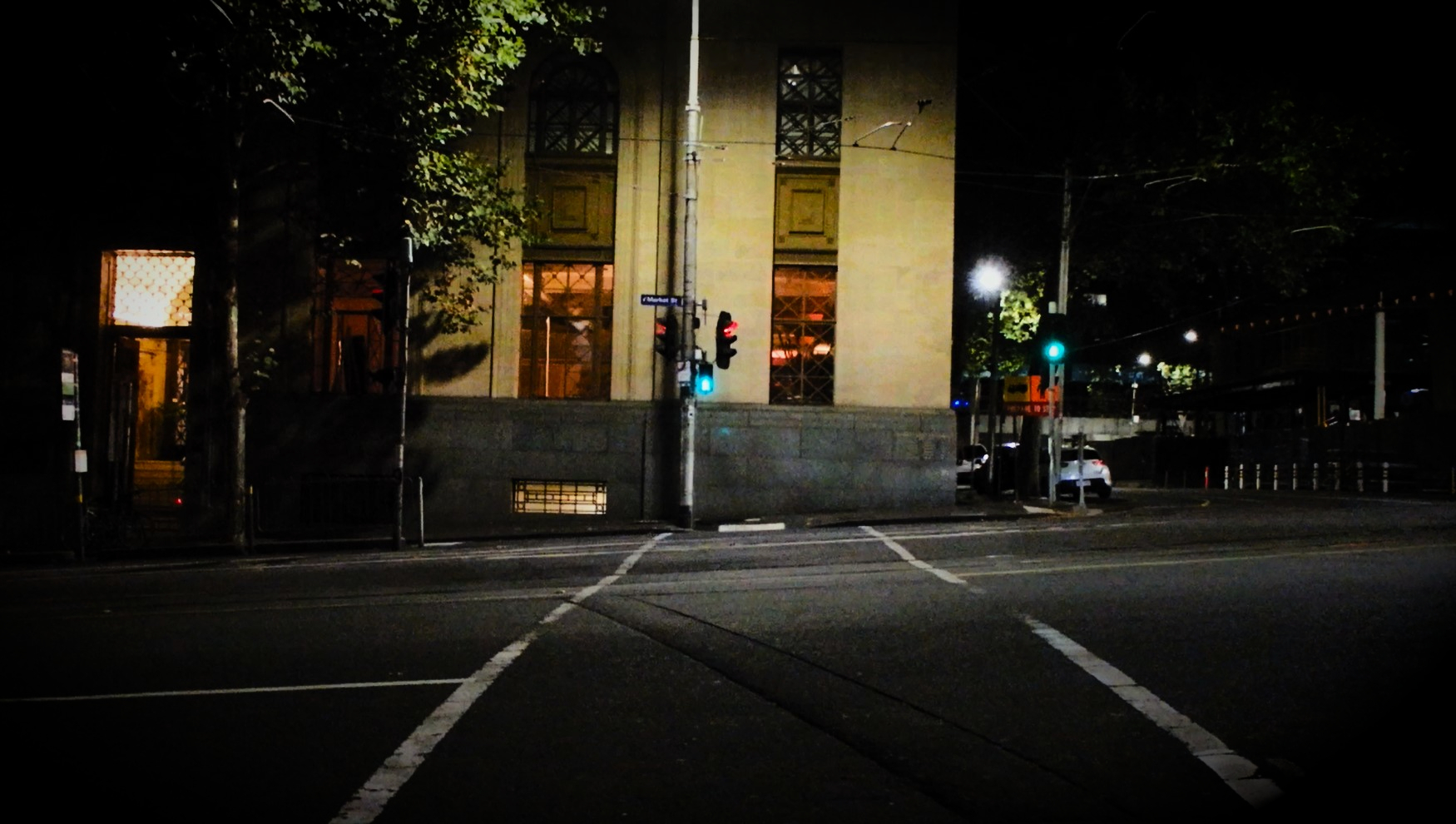
The Melbourne Flâneur launches into an impromptu recitation of Baudelaire’s “Correspondances” as he strolls under the ‘living pillars’ of Geelong City Hall.

Sons et paroles, couleurs et formes, le visible surtout, ne sont pourtant que des symboles de l’idée, symboles qui naissent dans l’âme de l’artiste quand il est agité par le saint-esprit du monde; ses œuvres ne sont que des symboles à l’aide desquels il communique aux autres âmes ses propres idées.

Sounds and words, colours and shapes—above all, the visible—are, nevertheless, merely symbols of the idea, symbols that arise in the artist’s soul when he is shaken by the holy spirit of the world. His works are but symbols through whose aid he communicates his own ideas to other souls.

— Heinrich Heine, « Le Salon de 1831 », De la France (1867, pp. 346-7 [my translation])

In “Heine and the French Symbolists” (1978), Haskell M. Block demonstrates that it was the German poet Heinrich Heine, who had settled in Paris in 1831, who introduced into French poetic thought a notion that was then prevalent in German Romanticism.

The idea of a fundamental and unitary correspondence between sense phenomena such as sound, scent and colour would have profound ramifications for the development of French prosody in the nineteenth century, influencing the poet whom Charles Baudelaire would hail, in the dedicatory device prefacing Les Fleurs du mal, as the ‘perfect magician in the field of French letters’, Théophile Gautier, and subsequently Baudelaire himself.

Heine, a melancholic yet ironic poet, would die in Paris in 1856, the year before the publication of the first edition of Les Fleurs du mal. In tracing the extent of Heine’s influence on French poets throughout the century, Block shows that Baudelaire had read deeply in Heine’s poetry and prose, and the correspondences in style and outlook between the older German poet and his younger French contemporary are striking, the more so because, as Block says, ‘despite these affinities, Heine is not a major force in shaping Baudelaire’s poetics or poetry.’

He did, however, influence Baudelaire’s æsthetics and, along with Diderot, Heine would provide Baudelaire with a model on which to base his reviews of the Salon exhibitions of 1845 and 1846. In the latter, Baudelaire cites directly from Heine’s review of the 1831 exhibition, substituting the name of his own artistic hero, Eugène Delacroix, for that of the Orientalist Alexandre-Gabriel Decamps, as a more convincing proof of Heine’s theory of correspondences:

En fait d’art, je suis surnaturaliste. Je crois que l’artiste ne peut trouver dans la nature tous ses types, mais que les plus remarquables lui sont révélés dans son âme comme la symbolique innée d’idées innées et au même instant.

In matters of art, I am a supernaturalist. I believe that the artist cannot find all his models in nature, but that the most remarkable are revealed to him in his soul simultaneously as the innate image of innate ideas.

— Heine (1867, p. 349 [my translation])

But as Block explains, this Germanic theory of a precise correspondence between the platonic Idea and the actual form that it takes in nature, symbolic of itself, was more philosophical than mystical, owing more to the speculations of Kant than to those of Swedenborg.

For the German Romantics, imagistic symbols had more of a psychological character than an esoteric one.

In appropriating this German Romantic philosophical idea that Heine had imported into France and superimposing it upon the artistic temper and process of France’s foremost contributor to the Romantic movement, Baudelaire would conflate the intellectual conception of a poetic correspondence between the phenomena of nature with the æsthetic supernaturalism to which Heine claimed to be an adherent.

From his hero Delacroix, Baudelaire would imbibe the belief, as expressed in his sonnet Correspondances, the most powerfully compressed æsthetic manifesto of the French nineteenth century, that nature—the sensual world that actually surrounds us—is nothing more or less than a ‘dictionnaire hiéroglyphique’, whose signs, as Richard Sieburth says in Late Fragments (2022), ‘always pointed elsewhere or beyond.’

In this sense of the ‘real’, Baudelaire was, like Heine, a ‘supernaturalist’ in artistic matters, one who sought the holy-spiritual model that is over and above an object’s manifestation in nature.

But Baudelaire goes further than Heine and the philosophically-inclined Germans.

If the magickal grimoire of the alchemists is simply, etymologically, a grammar, a book that sets forth the precise syntax and morphology of the Logos such that, when the Word of God is correctly pronounced and articulated, it will call forth invisible spirits latent in the natural, then the ‘hieroglyphical dictionary’ of visible nature is correspondent with the invisible Verbe—the Holy Word (and thus Christ as the Word made flesh)—that is consubstantial with the signs and symbols of the sensual phenomena that daily surround us.

Baudelaire had developed this notion from his readings of the scientist and Christian mystic Emmanuel Swedenborg, who, unlike Heine, would indeed be a ‘major force’ in shaping his poetics, as the sonnet “Correspondances” makes clear.

In addition, it is known that Baudelaire was familiar with the work of his elder contemporary Alphonse-Louis Constant, a former priest, an occasional poet and socialist literary man-about-Paris in the febrile years leading up to the fall of the July Monarchy, and better known to posterity as an occultist under the name he would take after the rise to power of Napoleon III, Eliphas Lévi.

Lévi, as Jon Leaver explains in an endnote to his article “‘Sorcellerie évocatoire’: Magic and Memory in Baudelaire and Eliphas Lévi” (2012), had also published a poem entitled “Correspondances” in his collection Les Trois harmonies (1845).

Leaver cites two instances of similar poetic ideas emerging from Lévi’s phraseology, but concludes that, despite some superficial similarities, it is ‘actually unhelpful’ to seek a source for Baudelaire’s sonnet in the elder man’s poem. I agree that, from the examples cited, Lévi’s concept of correspondence between man and nature appears to be less sophisticated than the immensely compressed, highly elliptical, and yet cosmically telescopic thesis Baudelaire presents as the very basis of his æsthetic credo in Les Fleurs du mal.

It is unknown whether Baudelaire had read the poem or even if he had met Lévi, despite both poets moving in the same Fourierist circles. However, in a footnote to the poem L’Imprévu, published in the late, abortive collection Les Épaves (1866), Baudelaire recommends to the reader Lévi’s Dogme et rituel de la haute magie (1854-6) as a secondary source on ‘sorcery, demonology, and satanic ritual’ useful to interpretation of the poem.

L’analogie est le seul médiateur possible entre le visible et l’invisible, entre le fini et l’infini. …

[L]’analogie est le quintessence de la pierre philosophale, c’est le secret du mouvement perpétuel, c’est la quadrature du cercle, … c’est la racine de l’arbre de vie, c’est la science du bien et du mal.

Analogy is the only possible intercessor between the visible and the invisible, between the finiite and the infinite. …

[A]nalogy is the quintessence of the Philosopher’s Stone; it is the secret of perpetual motion and the squaring of the circle; … it’s the root of the Tree of Life and the Knowledge of Good and Evil.

— Eliphas Lévi, Dogme et rituel de la haute magie (2008, pp. 215, 217 [my translation])

Thus, the essence of poetry itself—the operation of likening two disparate things via the correspondence of analogy—is, as Lévi explains, a fundamentally alchemical operation that calls forth from the visible and bounded the invisible and the infinite.

Séparer le subtil de l’épais, dans la première opération, qui est tout intérieure, c’est affranchir son âme de tout préjugé et de tout vice : ce qui se fait par l’usage du sel philosophique, c’est-à-dire de la sagesse ; du mercure, c’est-à-dire de l’habileté personnelle et du travail ; puis enfin du soufre, qui représente l’énergie vitale et la chaleur de la volonté. On arrive par ce moyen à changer en or spirituel les choses même les moins précieuses, et jusqu’aux immondices de la terre. C’est en ce sens qu’il faut entendre les paraboles de la tourbe des philosophes … et des autres prophètes de l’alchimie ; mais dans leurs œuvres, comme dans le grand œuvre, il faut séparer habilement le subtil de l’épais, le mystique du positif, l’allégorie de la théorie. Si on veut les lire avec plaisir et avec intelligence, il faut d’abord les entendre allégoriquement dans leur entier, puis descendre des allégories aux réalités par la voie des correspondances ou analogies indiquées dans le dogme unique :

Ce qui est en haut est comme ce qui est en bas, et réciproquement.

To divide the etheric from the carnal, in the first operation—which is entirely internal—is to liberate the soul of every prejudice and vice. This is accomplished through the employment of philosophical salt, which is to say, wisdom; through mercury, which is personal skill and labour; then, finally, through sulfur, which represents vital energy and the fervour of the will. By this process, one attains the ability to transform even the least precious things—right down to the filth of the earth—into spiritual gold. It is in this sense that one must understand the allegories of sod spoken of by the philosophers … and other prophets of alchemy. Yet in their works, as in the Magnum Opus, it is necessary to adroitly divide the subtle from the gross, the mystical from the scientific, the allegorical from the theoretic. If we desire to read these works with satisfaction and discernment, we must first understand them allegorically in their entirety, then descend from that level to concrete realities along the path of correspondences or analogies indicated in the only dogma:

As above so below, and vice versa.

— Lévi (2008, p. 152 [my translation])

Even in the disenchanted world of modernity, the objects of our actuality double as the signs of the inexpressible definitions in eternity that they refer to.

And thus, in taking for his hieroglyphic dictionary the unpoetic realm of the urban real, Baudelaire’s alchemical praxis as the first poet of modern life is a proto-noir ‘expressionism’ of what he had gathered, via Heine, from the earlier generation of German Romantics. His is the first form of a réalisme poétique.

As Alain Robbe-Grillet puts it, before being ‘something’—something that is graspable by and meaningful for human comprehension—objects are simply there.

And before this implacable ‘there-ness’, this ‘-ness’, according to Max Nordau, the degenerate feels mystified and plagued by doubts as to the unsearchable first causes of this implacable reality. ‘He is ever supplying new recruits to the army of … seekers for the philosopher’s stone, the squaring of the circle and perpetual motion’—the very problems that, according to Lévi, are solved by the alchemical operation of analogy, by the Baudelairean principle of poetic correspondence.

In Nordau’s account of poetic and artistic degeneration under the conditions of scientific, capitalistic, technological modernity, the good doctor can see no place for the poet, at least insofar as he occupies the traditional rôle he has played in all pre-Cultural societies—that of the priest, the prophet, the shaman, the man who, as I say in my translation of Baudelaire’s “Correspondances” above, ‘traverses this hierophantic grove of glyphs’, bridging, integrating the two hemispheres of the brain, the discreet, rational domain governed by Logos, and the holistic realm of perceived correspondences high and low, between all phenomena, presided over by Imago.

Baudelaire, as what Dr. Raymond Trial called ‘the typical superior degenerate’, is the cream and the crest of Western Civilization, a late-born member of the first generation to live under the declining ‘nouveau régime’ of Western modernity.

And as—(by comparison to ourselves)—the most healthy specimen of this type of ‘superior degenerate’, as an intransigent résistant, a Romantic revolter, an anti-Nietzschean naysayer to the liberal shibboleths of infinite scientific and social progress, Baudelaire finds himself left out of Nordau’s account of a ‘sane’—which is to say, etymologically, ‘healthy’—poetry.

Instead, he is the fountainhead, for Nordau, of the insane in poetry—the ‘malsain’.

In this rigidly rational, positivist régime that has driven us all, over the last two and a quarter centuries, to experience the crucible of paralyzing hysteria that Baudelaire was among the first to go through, we have seen how little place there is for poetry in the modern world, how little poetry there seems to be in the sensual phenomena of our actuality.

Yet from this bleak and noirish facticity, the unprepossessing ‘thereness’ of the inescapably ugly urban environment—‘the filth of the earth’, as Lévi calls it—Baudelaire discovered in the miasma of his Parisian reality the incantatory magick, the ‘evocative sorcery’, as he would call it, of the Verbe-made-flesh, of the indexical sign consubstantial with its correspondent referent in eternity, and thus the spell of rhythm and rhyme as the essential operation that transformed the base dross of his splenetic actuality into the incorruptible gold of an Ideal whose image is still chanted through the French-speaking world.

In Les Fleurs du mal, Baudelaire seeks to reclaim the pre-Cultural rôle of the poet as shaman, as witchdoctor, the esoteric alchemist of a society disenchanted by Luciferic positive science, the benighted mage who distils the healing quintessence from the poisonous herbarium of correspondent, actual nature that he gathers in the grimoire of his collection’s pages.

The built, lapidary environment of Baudelaire’s actual ‘nature’ is an utterly novel environment for Western man to attempt to colonize and thrive in. The Parisian megalopolis, the renovated Rome of the Civilized West, the Benjaminian ‘Capital of the Nineteenth Century’ stretching forth the tentacles of its cultural imperium of taste under the auspices of Napoleon III even to the antipodes of Melbourne, was a technological marvel of good living—a veritable ‘machine à vivre’—such as had never been seen before.

From hysterical Paris, fatigued, according to Nordau, by the general nervous exhaustion brought on by an unremitting tumult of frenzied revolution—political, cultural, artistic—modernity’s chief mechanism of mimetic propagation, fashion—the famous Paris fashion, desired by all the world—broadcast itself to the whole Occidental diaspora as le dernier cri in how to live comme il faut.

Benjamin quotes the Decadent and Symbolist poet Jules Laforgue as saying that Baudelaire was the first to speak of Paris ‘as someone condemned to live in the capital day after day.’ To be where all the world wants to be was, for this native-born Parisian, to be in ‘hell’, and Baudelaire baldly calls Paris by that name in his correspondence.

He is at the vanguard, on the barricades of this agonistic encounter with a ‘new nature’, mineral rather than vegetable, technological rather than magickal, artificial and spectacular rather than organic and authentic, that we have long regarded as our ‘new normal’.

The Paris of the mid-nineteenth-century—which is still the Paris of today—is necessarily an alienating environment. The medieval ‘forêt de symboles’ that Baudelaire had traversed in his youth falls beneath the ram and blow of Baron Haussmann’s renovations to be replaced by the new, geometric, astral order that we recognize today, a Lapis of glass, marble, macadam, iron and asphalt.

Even the Manhattan of Baudelaire’s transatlantic contemporary, Walt Whitman, is still rustic and provincial, and as yet nothing to compare, in world-historical terms, with the technological Babel of new hieroglyphs mutating daily around the islands of the Seine.

Everything Baudelaire beholds in his flâneries through the capital, practising, with diffuse attention, his ‘fantasque escrime’, speaks obscurely—‘de confuses paroles’— of the portentous future we now recognize as our globalized present. To capture, by a correspondent language, the ephemerality of the actual in this flux of mutating impressions that the cataract of fashion pushes past one’s eyes into the abyss of the past is to disengage what is eternal about these transitory phenomena.

In pre-Cultural social organizations, the medicine man, according to Michel Bounan, embodies, for his community, the rôle of the ‘universal living subject’—man in his correspondent relationship to the cosmos, something like Lévi’s vision.

The poet in scientistic modernity, finding his gnostic, shamanistic rôle deprecated by ‘the market’, that volatile, atomized, democratic entity which replaces the embodied ‘church’ of the community, now finds himself suddenly rendered impotent, stripped of the magickal powers that his prestigious command of the Verbe once invested him with, and alienated from this materialistic order deracinated from the eternal ground of Spirit.

In this brave, new, ‘re-cruded’ world of fungible commodities, the poem, that abstract, conceptual artwork with its roots plunged deeply in the purely oral pre-Culture of Western man’s infancy, as invocatory prayer to God and celebratory praise of the hero, must make a further leap beyond the technological revolution of writing.

In Baudelaire’s time, the press, that Gutenbergian innovation upon written language which, in the eighteenth century, had roused, stoked and maintained the sanguinary inferno of the Revolution, had, by the mid-nineteenth century, made the word as gross a journalistic commodity as the more tangible materials that supported Parisian life—coffee, chocolate, precious metals, iron and textiles.

From his early period on, he viewed the literary market without any illusions.  In 1846 he wrote: ‘No matter how beautiful a house may be, it is primarily, and before one dwells on its beauty, so-and-so many meters high and so-and-so many meters long.  In the same way, literature, which constitutes the most inestimable substance, is primarily a matter of filling up lines; and a literary architect whose mere name does not guarantee a profit must sell at any price.’  Until his dying day, Baudelaire had little status in the literary marketplace.

— Walter Benjamin, “The Paris of the Second Empire in Baudelaire”, The Writer of Modern Life: Essays on Charles Baudelaire (2006, p. 65)

In the marketplace of newspapers, reviews, and publishing houses of Paris, where he was, for owners, editors and printers alike, a frequent nuisance and encumbrance, Baudelaire, already alienated from this progressive order of laissez-faire trade, must sell his wares, these magickal words that remain the high-water mark of correct usage in modern French, as base articles of merchandise ‘by the gross’.

Baudelaire must do this, moreover, going cap in hand to the bourgeois ‘traders in words’, virtually begging them to print poems that, by the end of the century, will be regarded as among the immortal articulations of the language, on the lowest terms, for the meanest means of his subsistence, while simultaneously committing himself in hope and faith to the pre-enlightened Magnum Opus of reconstituting the magick Verbe, the Lapis Philosophorum, in an outré prosody that the journalists of the day regard as virtually worthless.

… [L]e grand oeuvre est quelque chose de plus qu’une opération chimique : c’est une véritable création du verbe humain initié à la puissance du verbe de Dieu même.

… [T]he Magnum Opus is something greater than a chemical operation: it is a veritable creation of human Logos initiated into the power of the very Word of God.

— Lévi (2008, p. 316 [my translation])

As Marc Eigeldinger explains in his article Baudelaire et l’alchimie verbale (1971), in one of its dual aspects, the alchemical process involves a conquest of temporality via the operatio of transmuting the base and corrupted world of matter. In its other aspect, it is the effort to revalorize the Word, to reimbue it with its sacred quality, and to quarry from its correspondent hieroglyphs in material nature a symbolic—which is to say, poetic—language buried in the dross of our fallen world.

In his article, Eigeldinger cites a letter that Baudelaire wrote to Alphonse Toussenel in January 1856. There, he goes exoterically further than he does in “Correspondances”, explicitly stating his belief to the naturalist and journalist that ‘la Nature est un verbe, une allégorie, un moule, une repoussé — Nature is a language, an allegory, a mold, a matrix’.

It is thus the case that the act of literary translation is an act of alchemical transmutation: Baudelaire’s unremunerative labour to decipher the hieroglyphical dictionary that is the modern environment of Paris, converting the ensouled symbology of the megalopolis’s ‘piliers vivants’ into the incorruptible, abstract artifacts of poems that correspond precisely and eternally with these material symbols’ ephemeral actuality, is an esoteric operation upon himself.

It is the attempt to revalorize his miserable existence of an all-too-brief moment, some 46 years of poverty and illness, loneliness and salutary madness that seem to him an eternal and infinite hell.

He was not to leave for Hell so soon.  Catulle Mendès chanced to meet him at the Gare du Nord: shabby, sullen, almost menacing.  He explained that he had come to Paris on business, and that he was going back to Brussels, but that he had missed the evening train.  Mendès lived near the station, in the rue de Douai.  He offered him a bed for the night.  Baudelaire accepted the offer.

In the rue de Douai, he stretched himself out, fully dressed, on the sofa, asked for a book, and began to read.  Suddenly he dropped the book, and asked: ‘Do you know, mon enfant, how much money I have earned since I began to work, since I was born?’

‘There was in his voice a heartrending bitterness of reproach and, as it were, of protest.  I shuddered [Mendès remembered].  “I don’t know,” I said.  “I’m going to count it out to you,” he cried.  And his voice grew exasperated as if with rage … He listed, with their payments, the articles, the poems, the prose poems, the translations, the re-publications, and, adding them all up, in his head, … he announced: “The total profits of my whole life: fifteen thousand eight hundred and ninety-two francs and sixty centimes!”  He added, with chattering teeth: “Note those sixty centimes—two Havana cigars!”’

Jacques Crépet was later to calculate that Baudelaire had earned 10,000 francs; Claude Pichois and Jean Ziegler were to put the sum at 9,900 francs.

On that summer night in Paris, in 1865, Mendès’ increasing sadness turned to anger:

‘I thought of the famous novelists, the prolific melodramatists, and … I thought of this great poet, this strange and delicate thinker, this perfect artist who, in twenty-six years of laborious existence, had earned about one franc seventy centimes a day.’

— Joanna Richardson, Baudelaire (1994, pp. 424-5)

In a proposed, unfinished epilogue intended for the second edition of Les Fleurs du mal, Baudelaire drafted two lines that have become the most cited lines in the language as they express the intention behind his alchemical poetic art: ‘Car j’ai de chaque chose extrait la quintessence, | Tu m’as donné ta boue et j’en ai fait de l’or — For, out of all things I have drawn forth the quintessence: | Alms of mud have you made me, and I’ve made gold from the putrescence’ [my translation].

Baudelaire transcends his impotent alienation from the means of industrial literary production that is enjoined upon him as a condition of living in materialistic modernity. But he is torn between the higher, esoteric sorcery of his craft and the crude demands of capitalism, the need, like that of the prostitutes he venerates, to ‘harvest gold from his celestial coffers’.

If, as I argue, Les Fleurs du mal should be understood as an alchemical tract, as a record of Baudelaire’s Faustian quest for the Lapis and the Elixir that will make modern urban life bearable, the most depressing critical realization is that, under the diabolical tyranny of capital, the inestimable gold he has fashioned as one of the great patrimonies of world literature, at the ultimate price of his life and soul, is a result of the unholy act of transmutation that the alchemists of old warn against:—the attempt by Baudelaire to make his leaden life into the mere filthy lucre he needed to survive it.


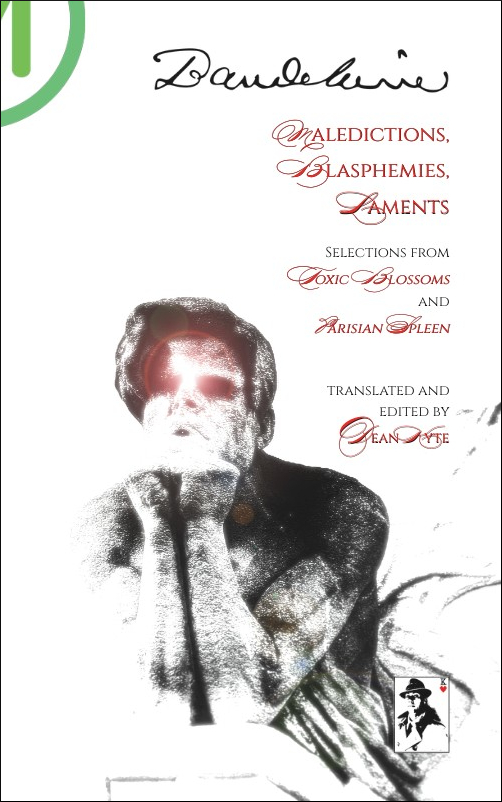
You’ve just been reading the first draft of a ‘chapterlet’ from the critical monograph on Baudelaire which will form the introduction to my forthcoming book of translations of Baudelaire’s poems and prose poems, Maledictions, Blasphemies, Laments: Selections from Toxic Blossoms & Parisian Spleen.

All 51 pieces in the book—33 poems, 17 prose poems, and 1 short story—are now complete.

As I put the final touches to the book, my last task is to complete a 10,000-word critical monograph on Charles Baudelaire in which I explain how, in his life and work, he both prophesies and embodies the decadence, decline, and degeneration of modern man that we are now experiencing all throughout the West—and particularly in the Anglosphere.

Pre-order your copy using the links below.

Two prints of Munch’s Madonna, variously tinted, hung sidebyside in square frames of blond wood.

The creamcoloured shade of a standing lamp overlapped the bottom lefthand corner of one.  The Madonnas hung in the corner of the room, perpendicular to the bookcase.  The room had been furnished in dark wood.  An armchair upholstered in a fabric with a foliate pattern stood under the leftmost Madonna, beside the standing lamp, angled away from the door.  The door stood open, framing the two Madonnas, the armchair, taking the morning light from a source beyond the jamb, the standing lamp, a radio, vase, and a framed photograph of a man.  The room appeared to be an office or study.

The room stood empty.

***

A shadow rippled over the jamb.

The standing lamp was on, casting two blank patches of light on the wall. The lefthand Madonna, in the waist of shadow described by the sections’ eccentricity, was tenebrously illumined, while the righthand Madonna, between the flaring curves’ divergence, lay in mottled darkness.

The shadow retraversed the jamb without crossing the open door.

The room stood empty.  But the warm light and mellow shadows allowed for the subtle play of reflected movement to ripple over the glossy panels of the open door.

In another room, a light flicked off.

— Dean Kyte, “Two Madonnas

Flânerie is an altered state, and as such, like all means and strategies we use for ‘getting out of ourselves’, from drunkenness to drugs, the strategy of seeking novelty in familiarity which is the psychogeographic praxis of flânerie may be filed under the head of the ultimate altered state:—poetry.

Going, with Pascalian ennui, out of his room for the millionth time, unable, in his boredom, to stay quietly in it, the flâneur seeks transcendent poetry in his (re-)encounter with the Joycean ‘reality of experience’—the banal prose of everyday life.

As a young writer learning my craft on the Gold Coast, still innocent of the beautiful French language to which I have subsequently consecrated my life and having only the barest concept of ‘flânerie’ as the thing that I was doing, the adventure of ‘going to the movies’, navigating by train, bus and foot the odyssey to distant cinemas to report on a film for one of the magazines I was then writing for, was the focusing object which directed the rudderless wandering of my dérives to and from the church of the cinema.

The religious experience is also a poetic altered state. So too is the revelation of light before us in the secular, platonic cave of the cinema.

From critiquing to doing, from the theoretic pleasure of receiving the revelation and then evangelizing about the experience for an audience of readers to the active æsthetic frisson of shooting footage on grainy video or Super 8, of recording location sound or cobbling together an imagined Foley after the fact, of mounting images and sounds beside each other and discovering new relations of significance refractory to human language, and finally, sometimes, as in the example above, writing the script after the film or video has been made, and finding, in the voice-over narration, another layer of meaning embedded invisibly in the visible;—this is, in rough summary, the altered state of embodied poetic praxis I call ‘flâneurial cinema’.

In the flâneurial video above, we have a study in stillness and subtle change:—two shots, taken more or less from the same setup, at different times of day and observing the interaction of light—natural and artificial—with a typical Melbourne interior—a California bungalow utterly characteristic of mid-twentieth-century domestic architecture in an inner-city suburb such as Brunswick, where this footage was shot.

It took me about eighteen months of staring at that peaceful domestic image in idle moments after I had made the video, entering and re-entering the two-dimensional ‘paradis artificiel’ I had created out of footage I had shot, sound I had recorded, other effects that my eye ‘heard’ in that paradisal stasis for me to ‘see’ with my inner ear the invisible text—the voice-over narration—embedded, buried in the banality of the visible—the reality in the actuality of that videographed experience.

Written in the style I call the nouvelle démeublée noire—the ‘unfurnished, dark short story’—the style I have been developing over a number of years, based on the French Nouveau Roman, to explore specifically fictional offshoots of the flâneurial prose poetry in The Spleen of Melbourne project, “Two Madonnas” is my modest hommage to a film I encountered far too late in my life for it to influence me as flâneurial filmmaker and videographer, but which I reverence as a writer, and which has deeply influenced how I approach words, not images.

In 2022, Sight and Sound, the house journal of the British Film Institute, conducted its eighth decennial poll of the world’s top film directors and critics to discover what these eminences thought were ‘The Greatest Films of All Time’.

In 1952, De Sica’s Ladri di biciclette (1947) got the guernsey. For fifty years, from 1962 to 2002, Orson Welles’s Citizen Kane (1941) was unassailable—and uncontestable, even. Then, in 2012, after thirty years of steadily closing in on Kane, rising up the ranks of critical opinion, my personal favourite, Hitchcock’s Vertigo (1958), the classic film of flânerie, claimed the top spot.

It had taken so many decades to dethrone Citizen Kane, for critical opinion, conservative and slow to change, to shift even slightly, that I think I was not alone in believing Vertigo would be safely returned in the 2022 poll as the Greatest Film of All Time.

But out of nowhere, a dark horse vaulted 34 places up the rankings from its entering position in 2012 to knock Vertigo off the top spot and Citizen Kane into third place—Jeanne Dielman, 23, quai du Commerce, 1080 Bruxelles (1975), directed by Chantal Akerman (1950-2015).

Despite my adoration of Vertigo, I was surprised—shocked, even—but not at all displeased by this result, for Jeanne Dielman (as this three-and-a-half-hour domestic epic is more frequently called) is the clearest example I can point to of a ‘flâneurial film’.

There are two currents in the cinematic tradition, the narrative and the experimental, and very early on—way back in the first decade of the twentieth century—the narrative current, which is a pseudo-literary, theatrical strand, not properly cinematic at all, foreclosed decisively on the experimental, which is intent upon investigating the native æsthetic properties of the cinematic apparatus itself.

As Laura Mulvey wrote in her appreciation of Jeanne Dielman for Sight and Sound:

Interest in gender in cinema and the objectification of women has gathered momentum, especially as awareness of the misogyny inherent in the industrial mode of production—what we call ‘Hollywood’—has become widespread. Perhaps as the oppression of women in the film industry has attracted attention, fuelled by the #MeToo hashtag, so has the oppression of women on the screen itself, in its fictions and inscribed into film language.

— Laura Mulvey, Jeanne Dielman, 23, quai du Commerce, 1080 Bruxelles, Sight and Sound, Vol. 33/01, Winter 2023, p. 88

The film’s dramatic elevation in esteem does speak to the political moment, post-#MeToo, and, coming from the theorist who has given the world beyond film studies the much-abused concept of the ‘male gaze’ inherent in the cinematic apparatus—with all the dubious ‘visual pleasures’ that the Hollywoodian exploitation of the feminine spectacle affords us in mainstream narrative cinema—this is a perspicacious insight into how cinematic form and content intersect and interact in an unusual and inseparable way in Jeanne Dielman.

Directed by a 25-year-old Belgian auteure and made with an almost all-female crew, Jeanne Dielman is both a political statement on and experiment in the material conditions of the art-form, and as a narrative emerges indirectly from the material conditions of the feminist experiment, as a productive consequence of the plastic properties of film form itself, I was not at all displeased to see Jeanne Dielman overtake my favourite film, because even more than Vertigo, Jeanne Dielman is the flâneurial film par excellence.

In one of the most cited articles on The Melbourne Flâneur , “Are there flâneur films?”, I stated unequivocally that it is in the character of the films themselves—that is, in their plastic form rather than in their ostensible narrative content—that the flâneurial resides.

Moreover, in advancing the theory behind my praxis, as an auteur who is seeking a new form of poetry embodied in the prose of quotidian life and inscribed through a new graphology of film, video, and audio, I have brought to your attention Bakhtin’s concept of the ‘chronotope—the ‘time-space’ of narrative.

In “Two Madonnas”—as in Jeanne Dielman—we have what might be termed the ‘domestic’ chronotope, a necessarily ‘feminine’ configuration of space and time that determines the kind of narrative that can emerge from the physical co-ordinates of a homely interior, whether it’s a suburban bungalow in Brunswick or a centre-ville apartment in Brussels, and the temporal co-ordinates of such a space in our day or in the mid-1970s.

The chronotope is the first formal constraint that limits the range of permissible content that may emerge in the sensemaking apparatus we call a ‘narrative’, that device which meaningfully interprets, for human beings, the configured co-ordinates of a particular space at a particular time in its history.

What I’m calling the ‘domestic chronotope’ is necessarily ‘feminine’ because it deals with the enclosed, sheltered space and with private life—spheres of peaceful retirement from the madding throng that are symbolically governed by the feminine.

The wide-open world of the street and public life, places and occasions of action, are necessarily masculine. These are the sites of flânerie and of the flâneur pur-sang, and as sites of action—visible, observable action—these are the kinetic sights that narrative cinema constructed on the Hollywood model prefers because they present visual pleasures as photographable and photogenic as the so often exploited (and exploitable) spectacle of the feminine.

I saw the films of Michael Snow and Jonas Mekas—they opened my mind to many things—the relationship between film and your body, time as the most important thing in film, time and energy. Seeing their films gave me courage to try something else, not just to make money. Before I went to New York, say in 1968, I thought Bergman and Fellini were the greatest film-makers. Not any more, because they are not dealing with time and space as the most important elements in film.

— Chantal Akerman, cited in Marsha Kinder, “Reflections on Jeanne Dielman, Film Quarterly, Vol. 30, No. 4, Summer 1977, p. 2

Could it be that the fourth dimension—not the length, breadth and depth of matter—is the essential subject and material of the cinematic medium?

And could it be that invisible time, as the essential subject and material of the art-form, has to be represented indirectly, as material space and spatial relations in order to make itself visible—registrable—on the plastic medium of film?

When we talk about ‘relations’, we begin to talk about another one of those concepts, like sheltered space and the private life, that is symbolically governed by the feminine principle.

The narrative cinema is one of visible kinesis. It’s a masculine cinema that appeals to our conscious, rational minds as linear cause and effect—the chatter of ‘discourse’, of superficial, ostensible ‘content’.

If ‘relations’ exist in this masculine cinema, then they are too often of the type which feminist film theoreticians decry—unequal, conflictual competitions for dominance: Duke Wayne and Monty Clift sending each other spectacularly flying with big, kinetic punches.

The narrative cinema has looked naïvely, instrumentally at material, representable objects in space, manipulating them as ‘actors’ and ‘props’ personifying fictitious ‘dramas’ while remaining, in its single-minded conscious concentration on the visible, the superficial spectacle, stubbornly blind to the invisible time that unconsciously governs these objects’ relations with each other as fluid patterns, subsisting, dissolving, reconstellating themselves continuously.

If the feminine governs these subtle temporal relations, then these physical ‘bodies’—a soup tureen containing cash, potatoes to be peeled, dishes to be washed, but also babies, people in stores, men ringing at the door, a son—exude their unique ‘energies’, their magnetisms of attraction or repulsion, into space.

Jeanne Dielman and the things of her environment are all in a subtle yet dynamic interaction with each other as an abstract pattern of relations, one that, through an experimental rather than narrative lens—which is to say, through a properly cinematic investigation of brute matter rather than through an exploitative operationalization of it for pseudo-literary, theatrical ends—cinema is capable of making visible to us in the medium’s initial form as actualité.

The actualité, the uninflected, static shot of undirected reality, is the basic building block of experimental cinema, and as primordial cinematic form, I propose it, in my own praxis, as the basic building block of a renascent, ‘flâneurial’ approach to filmmaking and videography.

The marvellous poetry of life—Joyce’s ‘reality of experience’—that is couched in the banal prose of the quotidian is made transcendentally manifest by the actualité, and yet it’s a form with which audiences, deranged by their identification with the conscious mind, all the melodramatic chatter of narrative ‘content’ they had absorbed from the stage and the nineteenth-century novel, had grown bored by the end of the first decade of the twentieth century.

The flâneurial film reclaims boredom, reclaims ennui as that privileged Baudelairean condition of profound, fruitful creativity, by leveraging empty time and undramatic space.

Appropriating two terms from Walker Percy’s The Moviegoer (1961), I have discovered from my own experience that there are two strategies by which one flâneurially chances upon marvellous novelty in the midst of banal familiarity: the rotation and the repetition.

The rotation is the singular altered state that takes us wholly out of the prison of Proustian habit, into a higher, broader consciousness of our unified relation with the cosmos and affording us the vision of a new life.

It is towards this fundamental breaking of the patterned cycle of stultifying habit that Jeanne Dielman is tending over the course of its three-and-a-half hours: Two novel events occur in rapid succession at the end of the film that break the pattern of established material relations decisively, and the final seven-minute scene is Jeanne confronted with the vision of her ‘New Life’—albeit she is gazing into the abyss of what I call ‘the Noir Place’.

Jeanne’s interior autonomy is complicated by a presence from outside, a hint of a parallel, perhaps film noir-ish universe: a blue neon light flashes continually into the sitting room, its penetrating beam hitting a glass-fronted case that stands directly behind the dining table. Almost invisibly, the flashing light unsettles the interior space, like a sign from the unconscious pointing to a site of repression.

— Mulvey (2023, p. 87)

The repetition, by contrast, is the conscious attempt to engineer a flâneurial rotation—to repeat the transcendentally novel experience, often with diminishing returns, for there tends to be a half-life on the transformative power of rotations.

The domestic space is a site of both rotation and repetition in Jeanne Dielman, and if the form of the film is tending ultimately toward a rotation that breaks Jeanne’s flâneurial pattern of regulated wandering decisively, it does so through a triple cycle of repetition, as we return, with her, to chronotopic sites of flânerie established in the first revolution of the quotidian cycle.

In repetition, familiarity preponderates over novelty: If we regain something of the initial rotatory force of our encounter with the reality of experience, that ‘something’ tends to be a subtle variation upon the first experience.

In Jeanne Dielman, the scopic pleasure of flâneurial repetition—Mulvey’s ‘visual pleasure’—tends to be more a pleasure for us than for Jeanne: The subtle variations in her (re)-encounters with the stultifying reality of her domestic experience in the second and third revolutions of the established cycle are like imperfect, degraded ‘impressions’ stamped on the plastic film form, and as our flâneurial regard wanders with leisure over frames which have ceased to scopically engage us as sites of novelty, the subtleties of these imperfect variations on the first, rotatory revolution gradually begin to acquire a freighted suspense driving towards a decisive shattering of the pattern.

Adding to the list of aspects that escape the reductions of the plot, a careful form of attention is demanded by Jeanne Dielman, since the film provides a kind of audiovisual detox from our usual privileged viewing position.  Our problems begin when we try to treat time and space as external to the ‘action’, when in fact they are protagonists with as much importance as Jeanne herself.  Akerman found her gaze in the cinema when she encountered Michael Snow’s Wavelength (1967) and La Région centrale … (1971), and space has never operated as background in her films since then.  When we try to provide a plot for Jeanne Dielman we tend to focus on changes in Jeanne’s psychology, unable to convey the drama of sunlight, shadows, emptiness and fullness through which the film ‘takes place’.  Akerman deletes the full range of devices through which a film can be said to interpret the surface of the world and inflect it with levels of significance, leaving a flat unaffective style of filming.  Suddenly, actions take their full duration with no intervention.  There are no close-ups or zooms, no camera angles or camera movements, and our position in relation to Jeanne remains at a neutral distance.  Similarly, there are no point-of-view shots to show us what she is seeing, or to promote identification or indicate significant narrative information, to heighten emotional intensity or comment on the characters or situation.

— Catherine Fowler, Jeanne Dielman, 23, quai du Commerce, 1080 Bruxelles (2021, p. 11)

And when we speak of Jeanne Dielman, possibly the most opaque character in cinema, it is impossible to avoid talking about the equally opaque Delphine Seyrig as the performer of this flânerie, the flâneuse who guides our scopic dérive across the frame and through this abstract, architectonic, chronotopic sculpture Akerman has fashioned from the brute material of time.

There are two definitional dimensions to flânerie, the activity of walking and the passivity of idle being, and both are privileged in this feminist experiment that depreciates masculinist histoire.

To walk is to march; to march is to protest: the flâneur protests, in his idle wandering, the unbearable conditions of technological, capitalistic modernity, and Delphine Seyrig, who would be radicalized by her participation in Akerman’s feminist experiment, protests constantly and eloquently, through the clipped sounds of her brisk footsteps, against the technological, capitalistic model of Hollywoodian narrative cinema with its exploitative male gaze.

In retreating back to the housewife in the kitchen and insisting that we share time with her and pay attention to how she lives her life, Akerman exposes how the patriarchal system works, thereby insisting that we remember the lives of those who can’t just drop everything and walk in the streets. … [B]y reintroducing the personal, we can understand the retreat to the housewife not simply as a gesture against patriarchy, but also as giving space to Akerman’s aunts and mother as a particular generation of Jewish women who had survived the Holocaust and were untouched by feminism. 

— Fowler (2021, pp. 54-5)

Seyrig is, of course, one of the most seraphically ethereal beauties in the history of the art-form, and as far as her acting chops go, it might be fair to amend the claim of Henri Langlois that ‘il n’y a que Louise Brooks’ to say that, in cinema, there is only Brooks and Delphine Seyrig; no other actresses count.

It might also be fair to say that her performance in Jeanne Dielman is easily the equal—and possibly even superior—to Falconetti’s performance in La Passion de Jeanne d’Arc (1928), for it is not a performance—an abbreviated simulation of action in the mode of narrative cinema—but an embodiment of every single action that Jeanne carries out, in the experimental mode of the actualité:—every dish she washes is actually being washed by the seraphic sphinx, Delphine Seyrig.

Dreyer famously tortured a performance out of Falconetti that has become definitional as the gold standard for female acting in the cinema, and Akerman similarly—though more subtly—tortures a performance out of the ‘grande dame’ Seyrig through domestic slavery, such that she transcends the definition of ‘performance’, embodying actions, carrying them through to their material ends as actualité.

I think it’s a very important film—a new step forward—not just for me, but for the history of film-making. I usually take an interest in the form or style of the films I act in; yet I realize that as an actress, I’ve been expressing things that are not my own, but others’. I feel a much greater involvement in this film. It’s not a coincidence that Chantal asked me to do it. … I can be my own size. It changes acting into action, what it was meant to be.

— Delphine Seyrig, as cited in Kinder (1977, p. 6)

I don’t invoke the comparisons to Brooks or Falconetti as the definitional silent screen actresses—and thus the definitional screen actresses tout court—frivolously: Catherine Fowler, in her monograph on Jeanne Dielman for the BFI Film Classics series, tells us that Seyrig frequently turned to actresses of the silent screen for inspiration in how to physically interpret her parts because, from their forced reliance purely on embodied action, without the advantage of Seyrig’s beautifully musical voice to aid them, she learnt ‘how gestures should always be carried out to their end point’.

Jeanne Dielman is essentially a silent film—which I also consider to be a fundamental criterion of a renascent flâneurial cinematic form—and Seyrig’s charming contralto and perfect French hardly aid her in interpreting Jeanne, who is as much pure body performing motion in space as the ‘labour-saving devices’ of domesticity whose operation enslaves her.

As Fowler (who devotes an entire chapter of her monograph to analyzing the omnipresent Seyrig’s performance) observes, the comédienne’s unusual interest in the plastic ‘form’ and material ‘style’ that the abstract temporal sculpture of a film takes is reflected in this almost ‘dancerly’ basis of the physical body completing a motion in space.

And as a physical structuring device for Seyrig’s psychological interpretation of her characters, I would argue that this ‘embodied’, almost choreographic style of acting is itself a fundamentally ‘feminine’ approach: The ‘brute matter’ of the beautiful female form is generative, through the embodiment of action, of the invisible psychology of actorly performance, as opposed to a more rational, masculine approach which starts from the ‘inside out’, reading interpretatively between the lines of superficial narrative content.

The physical structure of the female form in a chronotopic crystal lattice of space/time generates the type of fictional narrative that can potentially emerge from these actual structuring constraints.

Fowler, citing examples from Seyrig’s pre-Dielman filmography, convincingly shows how embodied feminine shapes—the fashionably gauche asymmetry of A’s poses in L’Année dernière à Marienbad (1961), Fabienne Tabbard’s seductive helicoid convolutions upon herself in Baisers volés (1968)—are as determinative of how Seyrig interprets the narrative text of a script as the physical form of the spatio-temporal chronotope is determinative of what kind of narrative can emerge from the embodied forms of an actual environment.

Surveying several of Seyrig’s most iconic performances of desirable characters lends insight into her method.  Turning back to Jeanne Dielman now, we should note how in those previous roles Seyrig’s gestures and movements responded to the spaces that surrounded her….  Seyrig brings this minute attention to the mise en scène that surrounds her to the character of Jeanne Dielman.  However, in order for Akerman’s vision of Jeanne as a non-seductive presence to succeed, Seyrig will have to find new shapes for her body, ones that continue to draw our attention ….

The close attention to gesture and to the movement of the body in space have the potential of taking us away from the narrative progression, to a world of movement, space and bodies. … [W]hen playing Jeanne, Seyrig firmly avoids creating … pleasurable and inviting shapes with her body; instead, her abiding posture is that of standing with her feet together. …

Most strikingly, while as ‘A’, Francesca, Fabienne and the Countess, Seyrig’s gestures were able to flow, extended by her costumes and graceful poses, as Jeanne, her movements—largely standing, walking, bending—are strictly regimented, and her gestures are designed with as much economy as possible.  This template is perfected on the first day, so that we notice its gradual derangement on days two and three.

— Fowler (2021, pp. 67-9)

In materially ‘doing the things’, in carrying out the actual actions of peeling potatoes and washing dishes, carrying these banal, quotidian gestures of domesticity through to their end point, Delphine Seyrig collaborates with Chantal Akerman as co-auteure of Jeanne Dielman to sculpt on film a visible record of invisible time.

The completely unforeseen elevation of Jeanne Dielman, 23, quai du Commerce, 1080 Bruxelles to the canonical, crowning position as ‘The Greatest Film of All Time’ until at least 2032 does not displease me as it has enraged so many others.

I think there’s something in the argument that Akerman’s death in 2015, so soon after the previous Sight and Sound poll, when her film first entered the rankings at No. 35, had something to do with Jeanne Dielman’s dramatic rise in critical opinion.

Remember that it took Hitchcock’s death in 1980 to provoke a widespread critical reappraisal of Vertigo in the 1982 poll, starting its slow climb up the rankings as a potential challenger to Citizen Kane.

Akerman’s death in 2015 as much as the #MeToo campaign in 2017 has certainly helped to put feminist issues and this quintessential feminist experiment in the material affordances of the cinematic art-form top of mind.

But those rusted-on partisans of narrative cinema, with its exploitative, consumptive male gaze and its juvenile fixation on ‘content’, unsophisticated thinkers who deride Jeanne Dielman’s current pre-eminence as another contemptible example of élitest wokery, are wrong in their obtuse, reactionary objections and fundamentally misunderstand what the film’s elevation means both politically and æsthetically.

I am not arguing for Jeanne Dielman as a feminist film; I am arguing for it as an experimental film, as a flâneurial film, as a fundamental æsthetic investigation of the material sensemaking affordances of the cinematic art-form, and thus film’s native capacity to produce rotation and repetition, to take us out of ourselves, out of the prison of our habits, to induce an altered state, a vision of a broader, higher, new life through the Joycean confrontation with ‘the reality of experience’—the transcendent, marvellous poetry of life that lies invisible but ever-present in the banal, quotidian prose of our visible material structures and circumstances.

In our deranged conscious identification with anthropocentric ‘stories’ in which mankind is the romantic, action-taking hero of the cosmos, we have been blind, as a species, for too long to the unconscious, feminine experience of the embodied structures of life that surround us daily.

In 1973 I worked on a script [« Elle vogue vers l’Amérique », the precursor to Jeanne Dielman] with a friend of mine, but it was too explanatory—it didn’t come from within myself. I got money to do it, but after awhile [sic] I realized it was not good. One night, the whole film came to me in one second. I suppose it came from my memories of all the women in my childhood, from my unconscious. I sat down and wrote it with no hesitation, no doubts. The same was true when I made the film. I did it like a bulldozer. You can feel it in the film. I knew exactly what to shoot and where to put the camera.

— Chantal Akerman, as cited in Kinder (1977, p. 3)

When I saw Delphine Seyrig checking her do on the cover of the Winter 2023 issue of Sight and Sound and knew we had a new winner, I felt another profound ‘oui’ from the cosmos that, as a writer, a filmmaker, a flâneur, I am on the right track in my literary, my cinematographic, my videographic, my audiographic experiments.

C’était presque écrit comme un Nouveau Roman : chaque geste, chaque, geste, chaque geste — [Jeanne Dielman] was almost written like a New Novel: every gesture, every motion, every action,’ Akerman told The Criterion Collection shortly before her death.

The Robbe-Grilletian re-investigation, from first principles, of the material structures of postmodern life that surround us daily which I have been undertaking in The Spleen of Melbourne project and its fictional offshoot, the nouvelles démeublées noires of The Melbourne Flâneur, is the way forward to ‘finding something new’—realizing the Baudelairean ambition pour trouver du nouveau!—a new common mythos in literature and film that can unite us all.

We discover the content that will mythically sustain our souls, as a globalized civilization, in the future by committing ourselves to a fundamental investigation, without pre-conception, of the actual forms of life that surround us now.

And, moreover, for the degraded and dead English language, utterly incapable of yielding further sense without massive renovation and renouvelation, the re-investigation of new sensemaking forms and structures, verbal and visual, that already exist in our actuality will come, as the diasporic Francophone Akerman demonstrates, not from the moribund Anglosphere, but by turning our eyes and ears to the structures of sense being made of brute reality in the French-speaking world.

To support me in my flâneurial investigations, I encourage you to purchase the soundtrack of “Two Madonnas” below.

In this prose-poetic video essay, the Melbourne Flâneur returns to the city where his love of flânerie was born.

Brisbane, David Malouf exclaims exasperatedly in Johnno, is a city that ‘would have defeated even Baudelaire!’ ‘People suffered here without significance,’ he writes. Where hell is Sartre’s bourgeois autre, Brisbane is too middling, too mediocre even to be a suburb de l’Enfer, ‘[a] place,’ in Malouf’s avis, ‘where poetry could never occur.’

For Johnno, for Malouf, – for his Brisbanian Dante without even the dignity of Ravenna to suffer in, – it’s a city whose very soul is soullessness, characterized by the ramshackle, makeshift nature of the place.  Exiled from the empire of Western Europe, no classicism could possibly take root in this muddy colony of the maddog English.

And yet all my spleen with la vie de l’ennui en Australie was born in the ideal of this sultry river city, swampy Venise of vaporous, féerific CityCats plying gauche rives of odiferous mangroves.  And all mes désirs de Paris were born of mes flâneries to the Dendy, the Valley, to Indooroopilly or Rosalie in search of movies and thumbedthrough bouquins de seconde main.

City of ferries like Venice, city of bridges like Paris, like our national epic, the story of Brisbane is yet to be chanted. The civic classic sinking its piliers et poutres into Brisbane’s shores will sing l’esprit of contingency, of ersatz imperfection, and even of mouldy ugliness, of baudelairean putrefaction!

— Dean Kyte, “O Brisbane! O Baudelaire!”

Welcome back, chers lecteurs, to another year of investigating the æsthetic philosophy of flânerie here on The Melbourne Flâneur.

The Christmas/New Year period found Your Humble Servant sweltering in higher latitudes than the name of this vlog implies as I returned to my home city of Brisbane for the first time in over five years.

I spent seven weeks in the River City over December and January, and after what was probably the longest period of absence from it in my forty-year intimacy with Briz Vegas, when I stepped out of the chantier that has been dug from the defunct Roma Street Station, I felt like I was finally seeing the city in which my first flâneurial balbutiements were babyishly burbled and trébuchements were trippingly taken in its true, very reduced dimensions.

Sensation curieuse!

Even when Brisbane was the hellish destination that lay at the other end of a homeward journey that began at the gare du Nord, not even then did I feel, with all my desolate weeping at the sight of our Venetian-style City Hall—the most beautiful in Australia—that Brisbane is a very strait and provincial place.

It is not that my experience of the world has grown that very much larger in five years of absence from Brisbane, but that I became thrillingly aware that, in an exile from Paris I expect to be a permanent removal from the most vivifying spectacle I have ever beheld, ‘down under’, in the infernal antipodes of culture and civilization, what might be called ‘the lessons of Paris’ have at last been absorbed into my vision of the local scene during the last sixteen years of my literary life.

In fine, it is my eyes—the scope of my vision and the cognitive lens of the French language that I apply over everything—that has grown that much larger in the absence when Melbourne, as the local analogue for la vie parisienne, has been the concrete structure mediating the theoretical construct of applied flânerie on Australian soil, and has primarily occupied my vision, both physical and mental.

It is not a slight to Brisbane to say that I found the first city of my experience ‘smaller’, less abounding in absorbing, diverting novelty than in the days when I used to live on the Gold Coast and some of my first expeditions in flânerie involved weekends in Brisbane searching for the altered states of experience that movies, books and art—the ‘culture’ I was in thirst of—represented for me.

I still have affection for it. But I’ve travelled so far in my thinking now from those days in my twenties when, like the ‘hero’ (?) of David Malouf’s great Brisbane novel Johnno (1975), I was so desperate for a better life than South East Queensland could offer, that I just had to chuck the whole place up for a jaunt to the Mecca of flânerie itself.

Among the kilo or so of books I decided to bring with me on my expedition back to Brisbane was Johnno. I wanted to read it again ‘in situ’, to have the actual locations Malouf describes—and which are so familiar to me, despite the very different Brisbane of his day—before my enwidened eyes.

For it’s the case that the Brisbane of Malouf’s wartime childhood and post-war youth was just hanging on in my own, in the Bjelke-Petersen eighties and Wayne Goss nineties. Even then, it was ‘so sleepy, so slatternly, so sprawlingly unlovely!’

Johnno is so sensual a book that you might say that Malouf manages to poetically capture and convey something impalpable yet inhering about Brisbane—its ‘aroma’, perhaps—the way a fragrance lingers—for an ‘old Queenslander’ like myself—in an old Queenslander like the one in which I was staying in Aspley, throwing me back into childhood memories of my great-aunt’s home in Red Hill.

That’s perhaps not a surprise because this short novel, which has become a ‘classic’ of Australian literature, was published less than a decade before my birth. The city of the sixties Malouf describes in the later pages is definitely the ‘beautiful one day, perfect the next’ Bjelke-Petersen bog of glass, steel, bitumen and bad paving I remember from my enfance in the eighties and nineties.

It was the same all over. The sprawling weatherboard city we had grown up in was being torn down at last to make way for something grander and more solid. Old pubs like the Treasury, with their wooden verandahs hung with ferns, were unrecognisable now behind glazed brick facades. Whole blocks in the inner city had been excavated to make carparks, and there would eventually be open concrete squares filled with potted palms, where people could sit about in Brisbane’s blazing sun. Even Victoria Bridge was doomed. There were plans for a new bridge fifty yards upstream, and the old blue-grey metal structure was closed to heavy traffic, publicly unsafe. There would eventually be freeways along both banks of the river that would remove forever the sweetish stench of the mangroves that festered there, putting their roots down in the mud….

It is a sobering thing, at just thirty, to have outlived the landmarks of your youth. And to have them go, not in some violent cataclysm, an act of God, or under the fury of bombardment, but in the quiet way of our generation: by council ordinance and by-law; through shady land deals; in the name or order, and progress, and in contempt (or is it small-town embarrassment?) of all that is untidy and shabbily individual. Brisbane was on the way to becoming a minor metropolis. In ten years it would look impressively like everywhere else. The thought must have depressed Johnno even more than it did me. There wasn’t enough of the old Brisbane for him to hate even, let alone destroy.

— David Malouf, Johnno (1998, pp. 206-8)

I have a friend who reminds me of Johnno, but I ought to be careful what I say, for I’m sure that return fire could be made and that several of my friends probably think that I am Johnno—the discontented dilettante spewing spleen about the cultural desert de l’Australie, constitutionally incapable of getting on with life or along with people.

‘Johnno’ is Edward Athol Johnson, but for my readers abroad, he’s Harry Haller or Holden Caulfield; he’s the type of stifled rebel who doesn’t march to the beat of a different drum because he cannot even get in step with himself.

All that differentiates Johnno from those more famous examples is that he’s an Aussie—given to larrikin pranks with a long fuse, and feeling, from the distance of the infernal antipodes, the unreachability of the ‘culture’ he associates with Europe even more profoundly than an American might do.

An utterly characteristic gesture is that, when he departs Brisbane for darkest Africa to have his Heart of Darkness experience in the Congo, at his last meeting with the novel’s sensible, cissy narrator, it is Johnno who gives Dante the going-away present of a volume of Rimbaud.

He fancies himself a voyant whose vision is narrowed, unfairly hobbled by the unspeakable blahness of Brisbane, but even when he gets to Paris, improbably impersonating a Scottish English teacher since the French won’t entrust their sous to someone with an Aussie accent, Johnno finds himself trapped in the same ennui as in Brizzy.

Johnno’s whole life is the abject and undigested lesson that I learnt on my first unhappy day in Paris:—the realization that you port your troubles as a fardeau with you; that putting a fresh landscape before your eyes doesn’t fundamentally change you or your destiny; and that if you are miserable in Brisbane gazing at the Skyneedle, you will be just as miserable in Paris looking balefully at Notre-Dame.

… [U]nless the police were making one of their periodical raids (which they did every time there was a bomb blast or a murder under the trains at Châtelet, [the rue Monsieur-le-Prince] was as quiet and suburban as the Parc Monceau.

I got used to the raids. Like everyone else I would tumble out of bed at the first sound of the armoured car swinging in over the cobbles, and by the time the first hammering came on the door downstairs would be out on the landing with my passport, while Johnno shouted from the landing below: ‘Twice in a week, this is! It’s driving me crazy. You can see now why I wanted to get out.’ But when the uniformed officers arrived with their tommy-guns at the ready he was desperately eager not to give trouble. His student permit had expired several months ago, and if they had wanted to the police might have arrested him on the spot. But they were after terrorists, not petty violators of the civil code. They returned Johnno his papers with yet another warning, turned over the bedclothes while one of them covered him with a tommy-gun and the other went through the motions of a quick frisking, and it was over. Then my turn. And the others further up. Generally after a ‘visitation’ Johnno’s nerves were too shaken to go back to bed, and after three or four minutes of futile argument I would agree to go out with him and walk until dawn. We would stroll along the silver-grey quays where the tramps slept, stop and have coffee at one of the all-night bars, play the pinball machines whose terrible crash and rattle, in those early hours, had a more violent effect on my nerves than any flic with his toylike tommy-gun.

— Malouf (1998, pp. 166-7)

That’s the other thing about Johnno. Although he wants to put a bomb under Brisbane and claims to hate Paris, he’s a coward without the Rimbaudian convictions of the true æsthetic terrorist—which is what the dandy-flâneur essentially is in his explosively, kaleidoscopically light-filled heart of darkness.

Where Johnno boasts to Dante, in Brisbane, of consorting with a spy and assassin who ‘look[s] and act[s] like a bank clerk’, he hasn’t that true saboteurial spirit that Flaubert counselled—that one should be bourgeois in one’s habits so as to be radical in one’s art.

Johnno hasn’t any art, apart from the lie and the prank. His poetry and performance art is acting out a fantasy of rebellion against the very staid existence that he is just as pathologically adjusted to as Dante.

Both have what might be called a ‘free-floating discontent’ that manifests itself in a way that is superficially divergent but is actually, in terms of the deep structure of the novel, regrettably convergent.

It’s one of the weaknesses of Malouf’s book—which comes out in the overdetermined yet dribblingly vague and unresolved third act—that it’s ultimately not clear what moral he intends for us to draw from the mémoire of unlikely comradeship between this odd couple, who do not really contrast with one another, nor undergo any complementary inversion of rôles.

Rather, I think Malouf fumbles intuitively and yet artlessly into some clumsy irresolution about the character of Australian life, its vacancy, its makeshift nature, which is particularly potent in the psychogeographic character of Brisbane itself.

It’s hard to put one’s verbal finger quite on it, but there’s a certain abortive character to Australian life, a kind of unconscious will to failure or a dread of success that manifests in the irresolute half-lives of vacancy that both Johnno and Dante are more or less resigned to—and which mars even the best books of our literature, as it mars this one.

Perhaps more than any city on this continent, Brisbane sunnily manifests this blankness of temperate sameness which inspires Malouf/Dante to say that it is a city so deprived of the light and shade of spleen and the ideal—the blanc et noir possibilities of flânerie—that ‘[i]t would have defeated even Baudelaire!’

I don’t dispute this; I utterly repudiate it.

The whole intellectual history of my life disproves Malouf’s contention: As bitter and sinister an orchid as Baudelaire can spring up in these climes to stalk its streets and milk it of its healing poison.

Johnno may kick senselessly against the pricks of Brisbane and Dante may resist them with quiet desperation, but neither of these characters have that largeness of vision, that structural scope I indicated at the beginning of this article, to see Brisbane in its just proportions and its proper place in the broader context of modernity.

The vision and experience of Paris can fundamentally impress itself upon neither of these characters—eminently Australian in their unformed, ersatz natures—and it cannot fundamentally remold and refine them for the ironic æsthetic appreciation of the local scene en Australie because neither Johnno nor Dante, despite their hungry reading, have even a tentative hypothesis for an æsthetic lifestyle such as the one I formed in my splenetic traipsings through Brisbane and took with me to Paris, intending to prove or disprove my æsthetic theory there.

In fine, neither of these characters are really flâneurs—and yet Johnno is a flâneurial novel, and not just because Johnno and Dante spend most of the book ambling through its pages.

I liked the city in the early morning. The streets would be wet where one of the big, slow, cleaning-machines had been through. In the alleyways between shops florists would be setting out pails of fresh-cut flowers, dahlias and sweet william, or unpacking boxes of gladioli. After Johnno’s sullen rage I felt light and free. It was so fresh, so sparkling, the early morning air before the traffic started up; and the sun when it appeared was immediately warm enough to make you sweat. Between the tall city office blocks Queen Street was empty, its tramlines aglow. Despite Johnno’s assertion that Brisbane was absolutely the ugliest place in the world, I had the feeling as I walked across deserted intersections, past empty parks with their tropical trees all spiked and sharp-edged in the early sunlight, that it might even be beautiful. But that, no doubt, was light-headedness from lack of sleep or a trick of the dawn.

‘What a place!’ Johnno would snarl, exasperated by the dust and packed heat of an afternoon when even the glossy black mynah birds, picking about between the roots of the Moreton Bay figs, were too dispirited to dart out of the way of his boot. ‘This must be the bloody arsehole of the universe!’

— Malouf (1998, pp. 116-7)

Johnno is, for one thing, a great novel of place, which is why I wanted to read it again ‘in situ’ when I was up in Brisbane last month.

What Walker Percy, in his equally flâneurial novel The Moviegoer (1961), called ‘certification’—the ‘making real’ for a reader of a place he already intimately knows—is one of the deepest pleasures of regional literature.

Malouf paints with a looser brush than I generally prefer. It’s one that he handles adroitly when it comes to Brisbane and sloppily when it comes to Paris, which he limns in a curiously dull palette by comparison, and not, I think, by deliberate design, since the whole novel falls very badly away into busy incoherence when the action relocates to the Continent.

But the first two-thirds set in Brisbane are sketched with a colourful impressionism that is, as I said above, ‘aromatic’ of the city’s vibe even today, and Malouf treats a place that both Dante and Johnno regard as irrecuperably ugly as though it had the poetic dignity of Paris.

He certifies the city with les détails justes—with the names of streets and suburbs, with the presence of pubs that are still trading and where yours truly has sat and written, and even set some of his own scenes, drawn from his flâneurial vie in Briz Vegas, in their beery bosoms.

As a flâneur pur sang, the proper names of places, of streets and suburbs, of correct geography that allow for certification, carry an incantatory quality for me, and I sense that, for anyone unfamiliar with Brisbane, Malouf’s petites touches of impressionistic precision would enable a similar kind of ‘certification by proxy’.

Arran Avenue, Hamilton, Brisbane, Queensland, Australia, the World. That is the address that appears in my schoolbooks. But what does it mean? Where do I really stand?

The house at Arran Avenue is the grim, three-storeyed brick house my father built for us in one of the best suburbs in Brisbane. Arran Avenue is a narrow dead-end street that runs straight into the hillside, with houses piled steeply one above the other on either side and bush beginning where the bitumen peters out into a track. The traffic of Kingsford Smith Drive is less than fifty yards away but cannot be heard. The river, visible from the terrace outside my parents’ bedroom, widens here to a broad stream, low mudflats on one bank, with a colony of pelicans, and on the other steep hills covered with native pine, across which the switchback streets climb between gullies of morning glory and high creeper-covered walls.

— Malouf (1998, pp. 68-9)

The afternoon before I was due to book out of Brizzy, I took a flânerie, first by ferry, then by foot, to see this mythical Arran Avenue in Hamilton, wondering if I could find a house that geographically matched Malouf’s description.

He’s right about everything: Kingsford Smith Drive, which is six lanes of roaring non-stop traffic from Pinkenba to Albion Park, is almost silent as you pass up Crescent Road alongside the high-built old Queenslander on the bluff overlooking the river.

Arran Avenue is in sight of it, a mere 75 metres away. Dante/Malouf’s street is an arcing one-block spur off Crescent Road that shortly ends in the cul de sac of some richard’s driveway.

I didn’t think I would have much luck finding a three-storey, river-facing, brick-veneer house that must be at least seventy years old, but the déco frontage of no. 19—presently up for sale, if you’re interested—fits the bill of Malouf’s description.

You might still see the river from the third-storey balcony over the shoulder of the house facing no. 19 if you stand on tip-toes.

“19 Arran Avenue, Hamilton, late afternoon”, photographed by Dean Kyte.

That is certification, and there is an example of flâneurial writing right there for you, chers lecteurs: If you can draw an accurate bead on an actual location from the author’s description of it, you’re dealing with something in the flâneurial line.

In one of the most significant of its dimensions, flânerie, I have discovered in my rootless, restless wandering of a country I have only grudgingly learned to love, but which I would still blow up tomorrow with all Johnno’s anarchistic antipathy towards it, is a form of embodied poetry.

As I have amply demonstrated in flâneurial films and videos like the one at the head of this post, flânerie is the application of the lens of a poetic vision over prosaic actuality: the flâneur makes the spleen of his prosy existence in Brisbane bearable by finding, through John Grierson’s ‘creative treatment’ of the documentary matériel of his life, the poetry in his banal actuality.

It’s this that Malouf manages to partially do in his novel—viscerally, with respect to Brisbane—and which both of his characters fail utterly to do. Their oppressive apprehension of ennui in Brisbane leads to spleen, but the manifold novelty of Paris does not necessarily lead either Johnno or Dante to find the Baudelairean ideal du nouveau! there.

La vie parisienne est féconde en sujets poétiques et merveilleux. Le merveilleux nous enveloppe et nous abreuve comme l’atmosphère ; mais nous ne le voyons pas.

Parisian life is abundant in marvellous and poetic subjects. The marvellous surrounds us and suckles us like the air, but we do not see it.

— Charles Baudelaire, Le Salon de 1846, Curiosités esthétiques (1868, p. 198 [my translation])

Likewise, in the sultry, fuggish atmosphere of Brisbane, the milk and honey of poetry may yet be found by a soul that is not ersatz and barely sculpted, as if modelled in wet clay, but rigorously limned and scored, the æsthetic architecture of his life—the code by which he is determined to truly live—vigorously worked out.

Readers, I commence a new year on The Melbourne Flâneur with an important annonce: This year I begin rolling out The Melbourne Edition of my collected works, starting with a new volume of translations of the poetry and prose poetry of Charles Baudelaire which I intend to serve as the complement and counterpoint to my own work in The Spleen of Melbourne project.

Front cover image of the softcover edition of “Maledictions, Blasphemies, Laments: Selections from ‘Toxic Blossoms’ and ‘Parisian Spleen’”, by Charles Baudelaire, translated and edited by Dean Kyte.
A preview of Maledictions, Blasphemies, Laments: Selections from Toxic Blossoms and Parisian Spleen, by Charles Baudelaire, translated and edited by Dean Kyte.

This new book, whose layout and design I finalized last month in Brisbane, is scheduled for release at the end of June. It features one-fifth of the total number of poems featured in the three editions of Les Fleurs du mal which Baudelaire (and then his mother) saw through the press, and one-quarter of the prose poems from Le Spleen de Paris.

At the time of writing, I have translated 89 per cent of the poetic and prose-poetic content I intend to include as a representative selection of Baudelaire’s æsthetic philosophy of flânerie.

And as a bonus that bridges his poetic and prosaic œuvres, I have decided to do a brand new translation of the only work of fiction that Charles Baudelaire is known to have written, La Fanfarlo. As one of the last tasks remaining before I bring this book to print, I will commence drafting that translation this month.

With a substantial critical monograph on Baudelaire and full-colour illustrations, Maledictions, Blasphemies, Laments is going to be a very handsome volume in both its hard- and softcover formats and a valuable introduction to the work of the first philosopher of flânerie.

To register your interest in purchasing one of the first copies in June, I invite you to avail yourself of the contact form below and join the mailing list as I send out monthly updates to my readers.

Go back

Your message has been sent

Warning
Warning
Warning.

Another way you can support my work and keep abreast of developments is by purchasing the audio track of “O Brisbane! O Baudelaire!” featured in this post via my artist profile on Bandcamp.

Using the link below, for $A2.00, you can become a fan of your Melbourne Flâneur on BC and stay in the loop as I drop new tracks and merch.

Dean Kyte presents a literary crime ficción in the style he has developed based on the Nouveau Roman.

—I just think—…  Miriam abruptly swallowed her whispered words.

Al’s lips pressed more tightly together as he watched the needle indicating the floors sweep down.  If only Miriam were…—somewhere else.

Roberts staggered past them and swayed uncertainly in the lobby.  Verna was now very far away from him.

To Verna, he thought.

—Dean Kyte, “Crisscross”

Today’s video on The Melbourne Flâneur, “Crisscross”, represents an experimental departure for me, as I fling myself into new flâneurial territory of æsthetic investigation. I return to my pseudo-Cornellian, Conneresque roots, where the only ‘making’ of the film I can claim, in this instance, lies in the editorial realm of pure montage.

Three shots of second-unit stock footage mounted and hence tenuously related to each other, and an elliptical narrative in the nouvelle démeublée noire style which that short sequence seemed to suggest to me in a flash of inspiration;—C’est “Crisscross”.

I don’t know anything more about what’s going on in the conte than what the artifactual text (understood as the totality of image, sound and word) suggests, and this is the ambiguous, mysterious essence of the style of ‘literary crime fiction’ I call the nouvelle démeublée noire, based on the theoretical principles of the French Nouveau Roman articulated by Alain Robbe-Grillet.

Dans les constructions romanesques futures, gestes et objets seront avant d’être quelque chose ; et ils seront là après, durs, inaltérables, présents pour toujours et comme se moquant de leur propre sens….

In future novelistic constructions, gestures and things will be there before they are something; and they will continue to be there afterwards, hard, immutable, ever-present and as if mocking their own meaning….

—Alain Robbe-Grillet, “Une voie pour le roman futur”, in Pour un nouveau roman (1963, p. 20 [my translation])

I continue my ongoing deep dive into the novels of Alain Robbe-Grillet with a saunter through the eminent Academician’s collection of short stories, Instantanés (Snapshots, 1962).

Chers lecteurs with long memories may recall that I have already addressed the subject of Instantanés in a previous post on The Melbourne Flâneur“The cinematic writing of Alain Robbe-Grillet”, published en pleine pandémie back in January 2021.

That post is one of the ten most popular in the lifetime history of this vlog. Its ongoing popularity, racking up exponentially more page views every month, testifies to the interest I have succeeded in arousing—especially among nos amis aux États-Unis—with my modest crusade to rehabilitate the reputation of a once influential, now unfashionable, French novelist and filmmaker.

When I first wangled a French copy of Instantanés off Amazon as one of my reads during the pandemic, The Spleen of Melbourne project was not only starting to crystallize under the imaginative constraints and pressures of lockdown, but it began to kick tentatively into a new phase.

In fine, at that time, diverging from the main channel of the prose poetry I was then writing about Melbourne’s Parisian underbelly under the influence of Baudelaire, a specifically fictional—as opposed to prose-poetic—sub-project began to emerge as an offshoot of The Spleen of Melbourne.

Elements latent in the prose poems I had written up to that time began to take on a new clarity and definition and began to demand a more analytic rather than lyric treatment.

I went straight to Robbe-Grillet and the short stories of Instantanés as sources of advice and inspiration on how I should practically proceed in treating these short pieces which I instinctively knew would owe a debt to the theoretic principles of the Nouveau Roman.

Robbe-Grillet’s world is neither meaningful nor absurd; it merely exists. Omnipresent is the object—hard, polished, with only the measurable characteristics of pounds, inches, and wavelengths of reflected light. It overshadows and eliminates plot or character. …

If Robbe-Grillet’s fiction, with its timetables, careful inventories of things, and reports on arrivals and departures, owes anything to the traditional novel, it is to the detective story.

Encylopædia Britannica, “Alain Robbe-Grillet”

And hence, what I variously call ‘the Jamesian/Robbe-Grilletian style’, the ‘literary crime fiction’, and the ‘nouvelle démeublée noire’ was born as a sub-project of The Spleen of Melbourne.

More than four years on from those stuttering experiments ‘pour une nouvelle nouvelle’ (to coin a particularly unidiomatic Gallicism), it seems a good time to reinvestigate the six nouvelles Robbe-Grillet collects under the head of Instantanés.

This concise book is a pivotal work in quite a literal sense:—like a hinge, Robbe-Grillet’s whole career turns upon it.

Instantanés recapitulates in miniature the chosiste style and technique of the 1950s novels I have analyzed in my previous articles in this series and which form the basis of what I call—(with a reverential nod toward fellow Anglophonic Francophile Willa Cather)—the nouvelle démeublée or ‘unfurnished short story’, since the idea of a ‘Nouvelle Nouvelle’, or ‘New Short Story’ written in the style of the Robbe-Grilletian Nouveau Roman, doesn’t make a great deal of sense in French.

Moreover, in the final short story of Instantanés, written significantly after the other works in the volume, at a time in the early sixties when Robbe-Grillet’s public and critical reputation as a writer and filmmaker is at its absolute peak, he gives a tantalizing—and not altogether palatable—preview of his direction of æsthetic travel from this point forward to the end of his career.

In the last novel we examined, Dans le labyrinthe (1959), Robbe-Grillet had begun to diverge appreciably from the quasi-noirish, chosiste style of his first three novels. The first five stories of Instantanés—“Trois visions réfléchies” (“Three Reflected Visions” in Bruce Morrissette’s translation), “Le Chemin du retour” (“The Way Back”), “Scène” (“Scene”), “La Plage” (“The Shore”), and “Dans les couloirs du Métropolitain” (“In the Corridors of the Métro”)—date from the years between the publication of Les Gommes (1953) and Dans le labyrinthe, and display the cold, hard, objectival style that initially brought Robbe-Grillet to the attention of the French reading public as a savantic freak of literature specializing in an inhuman kind of novel.

But in those same years, through a succession of literary prizes and laudatory appraisals from perspicacious early critics like Roland Barthes, Robbe-Grillet had succeeded in finessing himself from the margins of French literature to become the absolutely central and dominating figure by the end of the decade as the veritable ‘chef d’écoledu Nouveau Roman.

At this point, at the end of the fifties, Robbe-Grillet’s public and critical reputation catalyzed into an international fame that transcended the Francophonic world. With American interpreters and translators like Bruce Morrissette and Richard Howard as his champions, he conquered the States and thus the English-speaking world.

Yet, at the height of his international fame as a quintessentially French, high-brow novelist of a new type, in the next few years, Robbe-Grillet’s schedule of literary production declined, and instead of releasing a new, critically anticipated novel in the expected year of 1961, he went the conventional route of the commercially successful novelist and became a screenwriter.

It is in that year that Alain Resnais’s L’Année dernière à Marienbad, based on a script by Robbe-Grillet, was released, and Marienbad became a global cause célèbre—‘le dernier cri’ in the phenomenon of the inscrutable European art film.

It was on the back of Marienbad that Instantanés was released, and if we see in the film not merely a lossless translation to cinematic form of Robbe-Grillet’s literary principles of chosisme as demonstrated in the short stories of the fifties, we can also see the generative influence of Marienbad reflected darkly, thematically forward in the last fiction of Instantanés, “La Chambre secrète” (“The Secret Room”), linking Robbe-Grillet’s new line of æsthetic experimentation, as commenced with Dans le labyrinthe, to the style of his films and novels in the 1960s.

As The Spleen of Melbourne project has advanced and developed simultaneously on two fronts which I regard as distinct—prose poetry and short fiction—Instantanés has remained as seminal a text for me with respect to the latter as Baudelaire’s Le Spleen de Paris (1868) is with respect to the former.

And as I now begin to rehearse the ‘scripts’—the cold, hard, objectival nouvelles démeublées of the forthcoming Melbourne Flâneur podcast written in a French-inflected, English version of the chosiste style of Instantanés—for audiences as part of my market testing for the podcast, I am surprised to hear how that bitterly analytic and inhumane fictive style sounds for my listeners like my lyrical, multilingual prose poetry!

It was not long after I released The Spleen of Melbourne CD in 2021 that I began to seriously interrogate myself as to whether Robbe-Grillet’s short stories in Instantanés, with their maniacal descriptive exactitude, could in fact be considered ‘petits poèmes en prose’.

Une idée folle, parbleu!

Description, deprecated by fiction as merely a utilitarian means of setting the scene for human drama, is elevated to a significant tool and strategy for forestalling and preventing the emergence of narrative in the prose poem.

As many listeners of my audio tracks note, as in Robbe-Grillet’s short stories, description plays such a salient rôle in my prose poetry that it overwhelms the human element, forcing what might become ‘characters’ in a story into the background, as mere figures in a landscape, pregnant with its own drama operating on longer, inhuman timelines, and thus unobservable by the anthropocentric eye.

While Robbe-Grillet might not have been personally hostile to poetry, he is hostile to the pathetic fallacy of poetry’s necessarily anthropocentric view of the objective world of things in his prose.

Narrative is the fallaciously selective structure that human subjects impose as a Foucauldian ‘grille over an objective world whose mathematical variety is beyond the regulation of our senses and cognition by incalculable orders of magnitude.

To put it unkindly (and I don’t think Robbe-Grillet would disagree too profoundly with me in this dismissive analysis), the mechanistic structure of faulty logic we call ‘narrative’ is a despicable form of ‘magical thinking’ whose evolutionary utility to human beings as a sensemaking heuristic has been over since at least the end of the Second World War.

In the nouvelles of Instantanés, Robbe-Grillet, by his maniacal technique of emphasizing static description and deprecating human agency, manages to forestall and prevent the emergence of narrative—of anthropocentrically observable cause and effect—more successfully than he is able to do so in his novels.

This is because the nouvelles of Instantanés share with prose poetry the fundamental criterion identified by the scholar Suzanne Bernard in her seminal—and monumental—work on the subject, Le poème en prose de Baudelaire jusqu’à nos jours (1959)—which is to say, these short stories are exceedingly brief.

Bernard identified the criterion of brevity as one of the few discernible essentials in this hybrid, interstitial genre of literature emerging from the French prosodic tradition in the nineteenth century.

Pedro Baños Gallego of the University of Murcia tested Bernard’s criterion by assessing the work of four nineteenth-century prose poets following Baudelaire’s trailblazing example and found that of all the criteria for the form suggested by various critics and scholars, brevity was in fact the most reliable trait for identifying a potentially poetic text written in prose.

Voici quatre auteurs qui représentent quatre manières assez dissemblables d’envisager la création du poème en prose. En laissant de côté leurs différences quant aux choix de thèmes, lexique, syntaxe ou distribution des paragraphes, nous observons qu’ils vont tous converger dans la recherche d’une certaine longueur dont les limites ne sont pas trop floues. Après la lecture des quatre recueils, il nous semble que la frontière établie entre les trois – quatre pages reste toujours présente pour eux. Même si c’était l’époque de l’éclatement du genre et de l’expérimentation technique, où le corpus des œuvres s’adhérant à l’étiquette « poème en prose » faisait preuve d’une hétérogénéité notoire, voici la constatation empirique de l’existence d’une conscience collective concernant, du moins, la longueur des textes.

Here are four authors who represent four quite different ways of considering the creation of a poem in prose. Leaving aside their differences concerning the choice of themes, vocabulary, syntax or paragraphing, we observe that all converge in their search for a certain length whose limits are not too vague. After reading the four collections, it seems to us that an established limit of between three and four pages remains a constant for these authors. Even if the late nineteenth century was the period in which the form—and technical experimentation with it—burst upon the scene, where the body of works adhering to the designation ‘prose poem’ displayed a notable heterogeneity, here a collective consciousness concerning, at least, the length of texts is empirically observed.

—Pedro Baños Gallego, À la recherche des traits fondamentaux du poème en prose (2019, p. 91 [my translation])

Three to four pages is the rough equivalent of 1,000 words, and thus, the threshold at which the static image of the prose poem undergoes a phase shift and the dynamism of narrative begins to enter the equation is round about the point where the prose text is accepted to be a ‘short story’—more specifically, what is nowadays termed ‘flash fiction’.

Except for the three quasi-independent vignettes which comprise both “Trois visions réfléchies” and “Dans les couloirs du Métropolitain”, the six short stories of Instantanés exceed this thousand-word threshold, but not by very much, with no work in the collection attaining even 2,500 words.

Thus, Robbe-Grillet largely manages to maintain the poetic ‘tension’ that scholar Yves Vadé saw as a peculiar property of the prosodic prose text, a tension of ‘stasis as image’ that fundamentally countervails against narrative’s prosaic drive towards dynamism, resisting its urge towards action, and thus the perception of human drama in the environment.

When we look at Marienbad, one of the first things we are struck by is Robbe-Grillet’s obsession with static tableaux, the mannequin-like poses of the actors, a signifying structure that appears prominently in no less than three of the short stories in Instantanés—“Le mannequin”, the first of the vignettes in “Trois visions réfléchies”; “L’escalier mécanique” and “La portillon automatique”, two of the vignettes in “Dans les couloirs du Métropolitain”; and “La Chambre secrète”.

According to Baños Gallego and Yves Vadé, ‘ekphrasis’, the detailed description of a work of visual art, was once a standard device in poetry, and as the ancient lyric poet Simonides of Ceos observed: ‘Poetry is a painting that speaks; painting, a silent poem.’

Since Baudelaire’s time, the relationship of prose poetry to photography has been remarked on by critics, and as a specifically modern, urban, poetic form, the poem in prose grew apace with the French—and specifically Parisian—revolution in photography during the nineteenth century.

Just as Baños Gallego finds a firm limit to the extent of the poem in prose, it seems more than structurally coincidental to me that the ‘flash fiction’ of Instantanés should take the ekphrastic concetto of the prosaic ‘snapshot’ as their literary analogue: The operative conceit of the ‘cliché’—(in both its French and English senses)—aligns Robbe-Grillet’s cinematic/literary project in this collection with the poetic tradition of ‘word-painting’ that Baudelaire’s direct and acknowledged influence, Aloysius Bertrand, invokes in the subtitle to his seminal collection of urban prose poems, Gaspard de la Nuit (1842).

Indeed, “La Chambre secrète” is entirely a deceptive exercise in pseudo-cinematic ekphrasis, and I would go so far as to say that “Scène”, with its theatrical aping of both painting and film, could also be considered an exercise in same.

Robbe-Grillet differs, however, from the poet in prose in that the function of description in the very elevated rôle he gives it in his fictions is essentially constructive: ‘Je ne décris pas, je construis’—‘I do not describe,’ he says, ‘I build.’

Here is explicit, definitive negation—by the author himself, no less—of Robbe-Grillet as a potential poet in prose: If description is a key tool and technique in prose poetry, Robbe-Grillet’s denial that he describes but rather ‘builds up’ a painterly image, as he does explicitly in “La Chambre secrète”, purely out of the material of words divorced from their referents, is a significant repudiation.

In this final nouvelle of the collection, written (one imagines) explicitly for the volume, Robbe-Grillet starts down a pathway that is appreciably different from the æsthetic parcours of the fifties charted by the first five stories and developmentally intercalated with the novels we have already investigated.

Where chosisme was Robbe-Grillet’s initial approach to a potential ‘New Novel’ and ‘New Short Story’, an explicit attention paid to the physical properties of objects and structures in the world without regard to their significance to human beings, in “La Chambre secrète” Robbe-Grillet develops a technique that is ancillary to the chosiste approach in Le Voyeur (1955), more significantly developed as a major branching from that path in Dans le labyrinthe, and, I suspect, was concretized by the kinetic affordances of cinema during his collaboration with Resnais on Marienbad.

Thus, rather than fictions that seek to forestall or prevent the emergence of a human-centred narrative by focusing as hard as possible on the world of things, in “La Chambre secrète”, we assist at a miniaturized, altogether more satisfying repetition of the experiment Robbe-Grillet undertakes in Dans le labyrinthe, watching as the text appears almost to ‘generate itself’.

Language and a certain poetic concatenation of ideas (which the poem in prose is perfectly poised to navigate and negotiate in its interstitial relation to both forms) work quasi-autonomously in this final nouvelle to generate a phantasy implied in Le Voyeur and Marienbad but now made explicit for the first time in Robbe-Grillet’s œuvre.

As Ronald L. Bogue makes clear in his article “A Generative Phantasy: Robbe-Grillet’s ‘La Chambre secrète’” (1981), a run of complex puns in the French serves, like a stream of consciousness, to progressively displace ideas produced in the ekphrastic description of images along tangential lines that ‘build up’ a unitary image in the most literal sense.

Bogue proposes the intriguing possibility of a coherent interrelationship between all the disparate texts in Instantanés written by Robbe-Grillet over an eight-year period, culminating in the tableau of “La Chambre secrète”.

I think this is unlikely, but as Roy J. Caldwell, Jr. argues in “Ludic Narrative in ‘La Chambre secrète’” (1993), in this final story, the operative conceit of the snapshot that Robbe-Grillet has employed to unify the disparate texts of the volume now becomes his modus ludens with the reader.

Doubtless inspired by his recent collaboration with Resnais and his own foray into filmmaking, whereas, in the preceding nouvelles, Robbe-Grillet has presented each story as reducible to a singular image (or triptych of such images), in the final and most ambitious story, the work is ‘composed’ of a montage of snapshots: It’s almost as if the earlier stories train us in how to read the last one as Robbe-Grillet prepares to go in a new direction in the sixties, abandoning chosisme for the auto-generative sado-erotic phantasies he dishonestly imputes to the novelistic and cinematic texts themselves.

L’écriture de Robbe-Grillet est sans alibi, sans épaisseur et sans profondeur : elle reste à la surface de l’objet et la parcourt également, sans privilégier telle ou telle de ses qualités : c’est donc le contraire même d’une écriture poétique.

Robbe-Grillet’s writing is without defence, lacking thickness and depth: it remains on the object’s surface and scans it evenly, without privileging any of its qualities. It is therefore the very opposite of poetic writing.

—Roland Barthes, “Littérature objective”, in Essais critiques (1964, p. 30 [my tranlsation])

I think this is undeniably true, and when I take the authoritative negation of Barthes along with denials made by the author himself, I have to rationally accept that Alain Robbe-Grillet is definitely not a poet in prose.

Yet, when it comes to the nouvelles of Instantanés which have been such fruitful sources of investigation in my own æsthetic parcours during the last four years, still I cannot shake the irrational feeling that, despite their coldness, their objectivity, their inhumanity, these short stories are so close to prose poetry as to be virtually indistinguishable from it.

Too many of the six pieces—“La mauvaise direction”, “Le Chemin du retour”, “La Plage”, and even “La Chambre secrète”—as much as they are ‘contes’ in the strict sense, take place in such abstract spaces (‘space’ as understood here as including the temporal dimension) that, as examinations of pre-existing structures in the environment that signify, they exist more in the kind of platonic, ideal world of the Rimbaudian illumination, the Kafkaesque fable—the various fragmentary territories taken in by the prose poem.

And even in those works which I have translated to refine my understanding of Robbe-Grillet’s style as I develop a French-inflected, English equivalent for the nouvelles démeublées of The Melbourne Flâneur, the purely mechanical structures of the Parisian Métro Robbe-Grillet describes—and which I recognize from my own experience of them—seem surreally, marvellously transformed by the flâneurial regard playing over escalator, tiled corridor, and possibly malfunctioning automatic gate.

As a sub-project of The Spleen of Melbourne, the chosiste pieces of The Melbourne Flâneur are moving ahead: In addition to writing new episodes, I am now designing soundscapes for the nouvelles démeublées, cobbled together from the more than 400 documentary recordings I have taken all over Melbourne during the past four years.

And as I begin to share the finished short stories in live readings, testing the market for a documentary on contemporary Melbourne life written in the objectival style of the Nouveau Roman, I am gratified to hear that there is curiosity, interest, and even a little excitement about this project—including a small knot of interest emanating from locations in Canada and the U.S.

I am still some distance from being in a place where I feel comfortable to begin releasing episodes on a regular basis, but if you are among those interested in speeding me along, the best way you can show your support is by purchasing the audio track below.

You can name your own price at the checkout and you can also opt in to become a fan of your Melbourne Flâneur on Bandcamp, where I will begin releasing episodes in due course.

Before the former Colonial Bank in Euroa, the Melbourne Flâneur confronts the image of himself in the form of a fellow refugee from modernity.

Occasionally in mes flâneries, I meet the image of myself, bemisted in the palimpsest of signs.  I turn a corner at random in that grey hedgemaze of clouds which is our labyrinthine reality and find an uncanny anachronistic icon reared high against the sky, holding itself aloof above the fog of everyday ways we stumble and blunder through.

I love the statuary that old architecture makes, these dépassé neoclassical deities mutilated by time.  I remember seeing a painting by Russell Drysdale once—Hill End, painted in 1948, the portrait of a dilapidated bâtiment abandonné.  Two storeys of wounded brickwork, a peeling plaster peau, two doors to nowhere and a wroughtiron balcon, like a jetty projecting into air, presented the proud proue of its profile to the pitiless chastisement des éléments australiens, a fulgurant hellciel of merdescent orange grimacing under the bloodmauve nuages.

Such is le flâneur, heir apparent to a vanished patrimony, un visionnaire de l’invisible.  Rimbaudian dreamer in search of his bohemia, he goes, battered bateau ivre, réfugié de la modernité, holding the holes of his tattered dignity together, this aristocrat of the gutter, as he stumbles parmi les épaves, le nez en l’air, his eye anchored in the stars.

Undulant Ulysse, I port my only arm, la rame de la caméra, à l’épaule.  Avec ça je peins l’image blême—à peine visible—de moi-même que je vois dressé dans le bleu brumeux.  And like Albert Ryder, pale cavalier and blue pilot across many a dark, moonlit bar, je vois—là-haut! là-haut!—my eternal home, au-delà des nuages qui passent, marvellous vagabonds like myself.

I remember being affected by the vermiculated detail of the end brickwork of the façade, abutting nothing, in the Drysdale, as though a whole row of these hôtels had formed un rue-mur parisien, a barricade against the barren Australian hellscape, and now only this last brick existed in that invisible wall, fort of imported European sophistication and tradition, an antique stumblingblock, a toe of that colossus, les restes melted into airy ruins.

C’est moi, la dernière pierre d’un passé dépassé.

—Dean Kyte, “Ma Bohème

The annual mountain of administrivia associated with running a small enterprise surmounted, I warmly welcome you back, chers lecteurs, to another financial year of splenetic, prose-poetic rants, rambles and ruminations on French literature, film, and the æsthetic philosophy of flânerie in an Australian context here on The Melbourne Flâneur vlog.

And I commence to cudgel your eyes and ears anew with my Baudelairean clairvisions of Spleen and the Ideal down under by humbly submitting as Exhibit A in my literary crimes against English, seeking to rebridge la Manche and reconcile it with French, the cinepoem above, hybridgeously digital and co-written in the colourful light and movement of Kodak Super 8 film.

“Ma Bohème”, an entry in The Spleen of Melbourne project, explores the intersection of art, the shiftless rôle of the dandy-flâneur drifting amidst the ruins of modernity, and the pastoral extension of Melbourne beyond itself into country Victoria—all themes I recently shared with The Hague-based Romanian flâneuse Patricia Hurducas in an interview on her Substack blog The Flâneurs Project.

In “Walking in Melbourne with Dean Kyte”, we discuss these and other topics, including my own history with the notion of flânerie, my relationship with Charles Baudelaire, my love of Bellingen, and what, in capsule form, my æsthetic lifestyle philosophy of flânerie contains and entails.

I heartily recommend you to check out not only Patricia’s interview with me, but her interviews with other flâneurs from Amsterdam to Vilnius, from Austin to Vienna, and even from exotic Kuwait-City.

For regular readers, viewers and auditors of The Melbourne Flâneur, I think you will find The Flâneurs Project a refreshing complement to this vlog: Whereas I deal with French language and literature and Parisian culture in these pages, and my name has become linked with Baudelaire’s as a translator and interpreter of his work, Patricia speaks German and is versed in the Berlin current of flânerie represented by Walter Benjamin.

She also completed a Masters of American Studies at Humboldt University of Berlin, looking at those Amerloque authors within what I call the ‘flâneurial corpus’ of literature.

In the small world where certain men and women walk about their cities in sousveillance of the Balzacian comédie humaine, Patricia has been a post of observation in the field long tracked by my flâneurial radar.

I have been aware of her work for some years now, and as one of the leading feminine entrants into the field of psychogeographic urban exploration, I have looked seriously at her work as a potential source for an article I intend to write one day when the subject is a little less politically fraught; viz.—Is female flânerie even conceptually—let alone practically—possible?

We touched tantalizingly on this delicate issue in a recent Zoom call I had with her, and in the half-hour or so where time zones in two hemispheres happily, conveniently collided, I felt an interesting shift inside myself as I listened to Patricia relate to me her own history and experience of flânerie as a young woman from post-Communist Romania ambling about the cities of Western Europe.

I knew that Patricia would be a good source to cite and refer to when the furore around what a woman actually is dies down a little and I can diplomatically put what I still expect to be a controversial argument a little more piano piano.

So allow me, dear readers, to earnestly buttonhole you and urge you to show some support to Patricia at Substack, where you can subscribe to follow The Flâneurs Project.

And as we commence our sixth year of exploring French literature and flâneurial cinema together on The Melbourne Flâneur, batting steadily towards a century of posts on this vlog, if you want to show some support to me in my ongoing work, today is the best possible day to do it—for today is Bandcamp Friday!

Bandcamp Friday was an initiative started by BC in March 2020 to support artists on the platform during the pandemic. It’s been so successful that they have kept it going, with $120 million being given directly to artists and labels by their fans to date.

For today only, you can download the soundtrack of “Ma Bohème” in your choice of format for $A2.00 using the link below—or you can name your own price at the checkout—and Bandcamp will waive their share of the revenue and pass all the pognon directly on to your Melbourne Flâneur.

The former Port of Melbourne Authority Building, 29-31 Market Street, at night.  Photographed by Dean Kyte.
The former Port of Melbourne Authority Building, built between 1929 and 1931, at 29-31 Market Street.
To enjoy the full, immersive experience of the ficción, be sure to use headphones to listen to the track below.

Market Street was quiet at that late hour.  He stood casually at the corner of Flinders Lane, waiting for the lights to change.  The darkness and the muted rumours of the traffic in Collins and Flinders Streets gave this corner of Market Street, between them, a peaceful air, like an isle of repose cleaving the strong current of a river.

The lights changed, but he did not move.

He held himself in readiness to cross, but, like a mannequin, he did not break his pose of relaxed attention, as if he could not hear the staccato chatter of the walk signal beside him.

It cut out abruptly, settling back into its quiet, regular cluck.  He hit the call button again and continued to wait, as if he had only just arrived at the pedestrian crossing.

Across the street, the doorway of the Port Apartments was a tall, golden rectangle unblemished by the telltale shadow of human movement.  He gave no sign of being aware of this fact as he gazed around, turning his head regularly in both directions, as if cautiously preparing himself to take the negligible risk of stepping off the sidewalk and crossing the empty street.  Nevertheless, he was conscious of the flight of marble steps inside the heavy bronze streetdoor leading up to the foyer, across whose regular, foreshortened recession of greyish, horizontal shadows no oblique, concertina’d form passed.

One could also see, from that angle, the left-most margin of the foyer door, a column of translucent squares rendered triangular by the bronze diagonals dividing the lights, smaller versions of the diamond muntins that graced the windows of the old Port Authority Building’s ground floor.  Through that dark lattice of crisscrossing lines, as through the organic volutes springing obliquely from a potted fern before it, no movement marred the subdued but warming yellow of the foyer within.

The 58 tram, snaking its way towards West Coburg, passed before the Port Apartments like a curtain drawn across its doorway.  Warning the empty night of its turning manœuvre with a double clang of its bell, the tram slithered around the corner into Flinders Lane, trailing a wake of noisy lights.

Like the agitation of a curtain in a window, through the strobing double panes glazing the trailing second carriage as it swung away, he saw the penumbrous edge of a slender silhouette, elegant in its curvature, briefly mar the crisp gold border of the doorway as it slipped away into Market Street, the soupçon of fugitive movement masked by the departing tram.  The staccato click of heels rang in rapid report from the opposite sidewalk, making off in the direction of Flinders Street.

He started after it, crossing the street diagonally at something faster than a jog, gathering momentum as he reached the tramtracks.  The urgent sound of his footsteps was swallowed in the mounting rumble of a City Loop train charging across the Viaduct in Flinders Street.

The engine of the silver BMW roared to life beside the Immigration Museum and its wheels screeched forward, pawing asphalt.  Two lights like crosshairs blinked briefly against the dark granite of the Port Authority Building’s plinth as it passed.  Accompanying them, the cough of muffled gunfire.

The Melbourne Flâneur returns to Bellingen, NSW, and, in this lyrical prose poem enhanced with Super 8 film footage, ponders a flâneurial figure in the landscape even more conspicuous than himself—‘the Mem Hall’.

When God decides my days are done, perhaps then He’ll allow me to settle in Bellingen.  Perhaps then He’ll permit me to be as permanent as that pile, the hall in Hyde Street whose peachcoloured walls, for a hundred years, have overlooked it all—even my errances and romances.

At times my eyes gloss the Memorial Hall with the memorious glaze des jours perdus, and the faded veneer of flâneurial souvenirs recover their lost colours.

For we have both been secret historians of this place, observant actors in the life of Hyde Street.  His soldierly, literary footprint is sole and secular and unerasable while mine have been many, mobile and cancellable.

A holy light dawns about his walls and whole falls of buried memory cascade out of obscurity for me.

I hear an aura lingering in Maam Gaduying, scene of solitary sittings in wintry dusks, of escalations of les dames, things I’ve written about or hidden histories I am yet to write, but which the Mem Hall, whole library of unfiled memories, has watched, his façade regarding me as I act out my hours of drama in the Meeting Place Park.

The pillared bras of his façade have embraced it all; the corniced brows of his windowed yeux have watched me curiously through the years.  I’ve read my Parisian poèmes on his scène, and opposite, au parc, I’ve acted out my Parisian vie de flâneur in Bello’s narrow boulevard de Hyde Street.  For there is une autre espèce de flâneur—rooted, loitering—and the Mem Hall, in his commanding prospect de la rue, epitomizes him.

Perhaps one day mes os, in Bello, will be as permanent as the Mem Hall’s walls.

— Dean Kyte, “The Memorial Hall”

When duty called me up to the North Coast for two weeks in February, it had been twenty months since I had last seen Bellingen and a lot had happened during that time—very little of it unambiguously positive.

I dare say that the lifestyle of flânerie, seeking to fly by the nets of society at every turn, made the pandemic a more uniquely painful event for someone like myself who is both a Melburnian by election and a flâneur by inevitability.

And while I seemed, despite my lifestyle of country-wide travel, to come through the pandemic without either the CV or the vaccine ever touching me, the years 2020 through 2022 seem to run together for me in a lasting mental fog, leaving a scar on my life from which I’m still recovering.

Hence Bellingen in June of 2022, at the time when the images above were shot on Super 8 and digital video, seemed a very distant place when I saw the Memorial Hall for the first time in its new blue-and-cream livery in February.

Now I am coming rapidly—sadly—to the end of two months spent at Urunga, the town next door to Bello, which has allowed me to get across on a few occasions to the little town which ranks easily for me with Paris and Melbourne as a world capital of flânerie.

There was one Sunday in June 2022, just before I was due to depart Bellingen, when I spent a cartridge of Kodak Vision3 50D Super 8 film on two visions typical of the years I lived in Bello, including the Memorial Hall—affectionately known by the locals as ‘the Mem Hall’.

I had mentally budgeted out the three-and-a-half minutes of film available on the cartridge and knew exactly what shots I wanted from the two locations. And as is my usual practice when working with Super 8, I took back-up shots from the same set-ups using my trusty Olympus Stylus digital camera and recording location sound with my TASCAM digital sound recorder.

The only issue with the Mem Hall location, shot from the corner of Maam Gaduying, the ‘Meeting Place Park’ in front of the Bellingen Library, is that, at the time of my holiday in June 2022, temporary fencing garnished with a dirty great banner advertising Coffs Harbour Demolitions was set up before the doors of the Mem Hall.

Were they going to pull down our beloved, historic Mem Hall?

Fortunately not.

It was about to undergo renovation—including a new paint job—and although I had to grumpily contend with the banner and fencing prophesying the Mem Hall’s imminent demolition while I was filming it, when, in February, I saw the most iconically ‘Bellingen’ piece of architecture in Hyde Street for the first time in twenty months, now cream and blue instead of the surreal shades of rosy peach and apricot I had always known it as, I was glad that I had had an opportunity, on my last trip, to shoot it on Super 8 as I remembered it and had always experienced it—banner, fencing, and all.

This is not to cast shade on the new façade: I was blown away by the cream and blue. It gives the Mem Hall a more ‘Mediterranean’—rather than tropical—feel, and I actually prefer the new colour scheme.

But on Super 8, cream and blue would certainly not have come out as spectacularly as that peachy orange directly taking the rays of a Sunday afternoon in winter, reminding me, under the hybrid digital treatment I give those shots in the video above, of afternoons I spent sunning myself—gelidly, it seemed—in the Meeting Place Park.

For all the pseudo-Moorish intimations of the Mediterranean the new paint job gives it, whether in cream and blue or a rosy peach and apricot, the most iconically ‘Bellingen’ building in Hyde Street still manages to be marvellously surreal.

We can see the resulting building, a weird exercise in inclusiveness, and an attempt to reconcile irreconcilable functions: a library, a cinema, a dance hall, a theatre, an auditorium, a kitchen, a tea room, toilets, a war memorial and whatever other use you can make of it. Perhaps, in an exaggerated way, it reminds us that all buildings are like this. But at various meetings or in preparation for them people must have sketched designs that included space for the Literary Institute and library, absorbed the functions of the old School of Arts, made ‘provision of exclusive rooms for the use of returned soldiers’, tried to placate the view that ‘there was no form of sacrifice whatever about a hall and picture show as a memorial’. And in these drawings they would have accommodated or got rid of existing makeshift structures like the picture theatre and the dance floor. Rather than the result of a collaborative process consummated by a set of architectural drawings, it seems like the Hall designed and built itself in a self-steering process that went on over the heads of the individuals involved, like a demented version of Adam Smith’s guiding hand.

— Ross Macleay, “The Memorial Hall”, On, in, from, over, Bellingen (2013, p. 149)

The prose-poetic commentary to the video above falls into that category of my œuvre I am now consciously styling as ‘flâneries’—literary peregrinations through sensibility, variously poetic, essayistic or fictional, which arise from my wider wanderings through this country, outside the Melbourne which forms the geographic basis for the prose poetry in The Spleen of Melbourne.

And though it probably sounds like a scoffable claim to mention the name of Bellingen (a town which, even in this country, few people have heard of) alongside such world-class centres of flânerie as Paris and Melbourne, I mean the claim quite seriously.

As much as Paris and Melbourne, Bellingen stands at the absolute centre of my literary life, and I would not be the writer and filmmaker I am today but for thirty months I lived there between 2014 and 2016.

While certain ‘regional writers’ become poetic spokesmen for a place, unofficial laureates of certain cities, communicating the genius loci to readers further afield, I am hard pressed to think of another writer for whom the specificity of place and time is as salient as it is to my work, and yet who has as wide an experience of geographically specific places and times.

Thus, while there was a ‘Gold Coast period’ of my literary life, and there has been ‘Parisian’ and ‘Melburnian’ phases, there has also been the ‘Bellingenian period’, and my years in Bellingen stand in respect to the Melburnian period as my years on the Gold Coast stand with respect to Paris.

Which is to say that Bellingen did not quite ‘complete’ me as a flâneurial writer and filmmaker, but that it is the place, like Paris, where I had the first opportunity to practically implement the evolving principles of my æsthetic lifestyle philosophy of flânerie—the praxis of a theory I had developed to a certain point of refinement in other landscapes, at other times of my literary life.

In the flâneurial video essay “On having left, but not yet having arrived”—also partly shot on Super 8—I say that Bellingen was ‘the scene of my longestlasting happiness’: splenetic, ennuyé, utterly Baudelairean soul that I am, never was I more consistently happy in my life than during the years I lived in Bellingen.

Only Paris approached it for the number of ‘jours parfaits’ I spent there.

Hence they are, though hemispheres apart, elliptically linked on the prime meridian of flânerie: these are the epicentres of a new and fruitful æsthetic life.

When I left Paris, I wept for weeks like a man who had lost the love of his life—and indeed I had, having seen—in the arms of a Parisienne—a vision of holy wholeness in my dying hours there which I have committed the rest of my life to prophesying and proselytizing.

When I left Bellingen for Melbourne, it was on account of a woman I could no longer bear to see in the Meeting Place Park, or at the IGA, in company of another man, and although I went forward with excitement to the next scene of my literary life, I carried as much buried mourning for the woman—and for Bello—as I had done for Paris and the Parisienne.

There are two paradoxical modes of Parisian flânerie, the wandering walk and the lingering loiter, both of which allow observation of the life of the street.

And as I say in the video above, if, in my years of living in Bellingen, I made a Parisian boulevard of Hyde Street in my dandiacal circuit up and down it, the Mem Hall, in its vantage-point overlooking a particularly animated corner of Bello’s main street, represented, in its outrageous livery of peach and apricot, the other pole of flânerie, observing the spectacle of the passers-by rather than being itself an active, ambulatory participant in that spectacular parade.

Equally, the Mem Hall observed me, many times a day, swanning past its portals in both directions. It had the privilege of observing me doing so at all hours of the day and night in those years, and not infrequently, in those endless hours of happiness, in the midst of some flâneurial experience—often with a woman—that would afterwards find its permanent record in my writing.

It was past the Mem Hall, for instance, that I marched the beautiful, enigmatic Emma in Follow Me, My Lovely… (2016), and it was within sight of the Mem Hall, at the corner of Bridge Street, that I first attempted to ‘mash a pash out of her’.

We set out, manoamano, shouldertoshoulder in the cold, clear air of 3:30 a.m. I built a little light rapport with her by laying out the thumbnail version of how I came to be in Bello, but I was tired of unwinding that yarn and didn’t do it as well as I might have. At the corner of Ford Street, we turned right onto the main drag and walked along the brickpaved sidewalk fronting the park.

In retrospect, it seems to me that there had been enough time in the space of that short block to build sufficient rapport with Emma in order for her to feel comfortable with me, yet I couldn’t say just when I had first become aware that I would have to make my move. I think I only became conscious that the moment of truth was fast approaching and I would have to physically turn her steps towards the river when we passed the Mem Hall.

— Dean Kyte, Follow Me, My Lovely… (2016, pp. 34-6)

In Follow Me, My Lovely… the Mem Hall plays a cameo rôle, having been, before the action of the story begins, the place where I first espied Emma at the Barefoot Boogie, a dance party that used to take place there on the night of the full moon during the years when I lived in Bello.

And in another reminiscence of my years in Bello, a longer work, as yet unfinished, called “Sentimental Journey”, the Mem Hall plays a more salient part. It’s the place where my tale begins, when, in the hours before I am due to get on an overnight train to Brisbane, I see Polanski’s La Vénus à la fourrure (2013) there, an event which, by obscure tangents among the degrees of separation in my rather extensive social network in Bellingen, leads me unexpectedly into the arms of another woman.

She plunged her arm into mine and we rounded the corner into Hyde Street….

While she jawed, I cast a cautious slant around as we stepped off the kerb in front of the post office: beside us, Bridge Street was an empty corridor of darkness illuminated by a solitary streetlamp at the other end of Lavenders Bridge.  Across Hyde Street, a lonely brother to it loafing in front of the Mem Hall craned its neck over the main drag, the rose façade lit a livid orange by its yellow glare.

If anywhere in the world was a more romantic playground for seduction than Bello at night, I hadn’t yet experienced it.

We forded Bridge Street and regained the kerb—the kerb where I had tried to mash a pash out of Emma and had told her to come back to my place.  We passed it, walking through those ghosts, and changed tracks, shunting onto the spur of footpath leading into the Meeting Place Park.  A trio of lamps, spaced out in a loping curve, followed the line of the wide brick path sweeping round to the library and council buildings.  Their ramrodstraight figures picked out among the trunks of the eucalypts, almost as straight, on the green sward made the park seem vaguely like an image by Brassaï, reminding me of Paris.

At a lonely hour in the early evening, I sometimes liked to sit here alone, watching the traffic roil around the intersection as I huddled against the cold on the pew in front of the historical museum.  I scoped it out now as a potentially discreet venue for escalation: a lampadaire planted in the Lunchbox Garden in front of the council offices cast an oblique, chiaroscuro glare on that corner.  It wasn’t mood lighting, but it did raise some harsh shadows, and if we huddled at one end of the pew, we should be reasonably protected from view of the street by the corner of the red telephone box and the extension of the Neighbourhood Centre.

— Dean Kyte, “Sentimental Journey”

As I say in the video essay above, both of us, the Mem Hall and myself, have been secret historians of Bellingen, memorious flâneurial observers of otherwise unremarked moments in the life of Hyde Street. The Mem Hall has watched me conducting my vie de flâneur just as I have watched the colourful characters in Bello’s streets.

And I think it is no geographic accident of synchronicity that the Mem Hall, the original ‘literary institute’ of Bellingen, faces the present town library, for as I intimate in the video essay, the building seems to me a vast cabinet of unfiled memories, leaves of time—so sheer as to be invisible—of all it has witnessed in its century of life, the secret history of the town which no one yet has had the soul and vision, the heart and spirit of service to properly write.

As I said in a previous article on Bellingen, a few well-known men of letters have, for a season of their lives, made a home for themselves in Bello, and by far the most famous of these writers is Peter Carey.

Carey, who lived here in the eighties as a tree-changing refugee from Sydney, sets Oscar and Lucinda (1988) in the vicinity of the Gleniffer Hall, but Carey’s historical novel lies well beyond what Henry James calls ‘the visitable past’—the rememberable history of one’s own lifetime and experience.

As the young James, flush from his first adult experience of the Roman relics, wrote his sister Alice, unless one’s mind is veritably sagging beneath the weight of material facts about the subject, historical fiction, for a novelist, is the least worthwhile pursuit: ‘The present and the immediate future seem to me the best province of fiction—the latter especially—the future to which all our actual modern tendencies and leanings seem to build a sort of material pathway.’

As far I know, the high-flying Carey has written nothing to commemorate ‘the modern tendencies and leanings’ of his time in Bellingen, one of the most artistically fruitful places on earth, the very Mecca, in my view, of a global ‘Vita Nuova’ towards which Bellingen, in its present and by its example, builds a material pathway.

I take it as a point of pride that, as the least well-known among the men the letters who have made a temporary life for himself in the landscape of this ‘Promised Land’, I have been the most committed to memorializing the visitable past of my experience in these climes.

And as an unofficial historian of the unnoticed hours of Bellingen life, I see a co-conspirator to my project in the architectural figure of the Mem Hall itself, who reminds me of the eponymous character in Jorge Luis Borgesficción Funes, el memorioso (1942).

Nosotros, de un vistazo, percibimos tres copas en una mesa; Funes, todos los vástagos y racimos y frutos que comprende una parra. Sabía las formas de las nubes australes del amanecer del 30 de abril de 1882 y podía compararlas en el recuerdo con las vetas de un libro en pasta española que sólo había mirado una vez y con las líneas de la espuma que un remo levantó en el Río Negro la víspera de la acción del Quebracho. Esos recuerdos no eran simples; cada imagen visual estaba ligada a sensaciones musculares, térmicas, etcétera. Podía reconstruir todos los sueños, todos los entre sueños.

Dos o tres veces había reconstruido un día entero; no había dudado nunca, pero cada reconstrucción había requerido un día entero. Me dijo: ‘Más recuerdos tengo yo solo que los que habrán tenido todos los hombres desde que el mundo es mundo’. Y también: ‘Mis sueños son como la vigilia de ustedes’. Y también, hacia el alba: ‘Mi memoria, señor, es como vaciadero de basuras’. Una circunferencia en un pizarrón, un triángulo rectángulo, un rombo, son formas que podemos intuir plenamente; lo mismo le pasaba a Ireneo con las aborrascadas crines de un potro, con una punta de ganado en una cuchilla, con el fuego cambiante y con la innumerable ceniza, con las muchas caras de un muerto en un largo velorio. No sé cuántas estrellas veía en el cielo.

At a glance, we notice three glasses on a table; Funes, all the stems and branches and fruits that make up a vine. He knew the shapes of the southern clouds at dawn on 30 April 1882 and could compare them in his memory with the grain of a book bound in Spanish leather he saw only once, and with the lines of foam raised by an oar in the Rio Negro on the eve of the Battle of Quebracho. These were not simple memories: every visual image was linked to sensations—muscular, thermal, and so on. He could reconstruct all his dreams, all his dreams within dreams.

Two or three times he had reconstructed a whole day. He had never hesitated, but each reconstruction had required a whole day. He told me: ‘On my own I have more memories than all the men since the beginning of the world have had.’ And also: ‘My dreams are like the insomnia you fellows have.’ And also this, towards dawn: ‘My memory, sir, is like a garbage dump.’ A circle on a blackboard, a right-angled triangle, a rhombus; these are shapes that we can fully visualize. To Ireneo, the same thing happened with a colt’s wild mane, with the very tip of a knife, with the protean flames and innumerable ashes, with the many faces round a dead man at a large wake. I don’t know how many stars he saw in the sky.

— Jorge Luis Borges, Funes, el memorioso (1942 [my translation])

Like Ireneo Funes, the Memorial Hall, to me, is infinitely memorious of Bellingen. It has seen—in the most exquisite detail—everything that has passed before it in its century of life.

It is truly a book of days.

And although, in its infinite discretion, it does not speak of what it has seen as I have privately journaled it, the Mem Hall remembers everything that has passed before or within it—including my presence on its stage, reciting my Parisian poems at the annual Poetry Slam, and upon the stage of the Meeting Place Park opposite, solitudinously sunning myself at dusk or making out with some dame after dark.

But I’m not entirely alone in this self-imposed project to be a flâneurial historian of Bello, the memorious recorder of its forgotten hours. One local writer I have respect for, and who seems to be involved in an analogous, albeit more ‘official’ project of public memoration, is Ross Macleay, one half of the North Bank Institute, Bellingen’s oldest—and smallest—think tank.

In “The Memorial Hall”, one of the essays in his collection On, in, from, over, Bellingen (2013), Macleay tells us that the ‘Soldiers Memorial Hall and Literary Institute’ opened to great civic fanfare on Wednesday 19 January 1921 with (among other visual confections) a presentation of Charlie Chaplin’s comedy “Sunnyside” (1919).

Describing the cinematic bill of fare on that night in his essay, Macleay explains how ‘the Mem Hall’ as Bellingenians know it today had not even been built on that fateful date, the ‘Grand Opening Night’ of the Bellingen Memorial Hall Pictures being a fundraising event to build the pile on Hyde Street.

The Memorial Hall began its life as a war between two motions passed at two meetings. At the first on 4 December 1918 a motion was passed to build a War Memorial in Bellingen at a cost of no more than ₤500, and a committee of twenty was formed. At the second on 6 June 1919 the original motion was cancelled, a substantial majority voted to build a memorial hall instead, and the committee, trimmed from twenty to seventeen, was given the job of raising funds. The building of the hall would be a war on two fronts, the first was against those who thought a monument was more fitting for military commemoration than the frivolity of a pleasure dome (plus easier and cheaper). The second was the long campaign to raise the money.

— Macleay (2013, pp. 147-8)

The money came, as Macleay tells us, from the showing of movies, and on 19 January 1921, the good burghers of Bello crowded onto the site of the present Mem Hall, under an open-air shed set up as insurance against the rain, to see Charlie Chaplin, Sessue Hayakawa, and a Pathé newsreel at ‘two shillings for a chair up the back, one for down the front on a log, and children [at] half price.’

Thus, from its inception, the Mem Hall, doing surreal double service as a perpetual monument commemorating local casualties in the Great War and as a meeting place for the celebration of living culture in a small town, secularly profaned itself as a picture show.

My first experience of the Mem Hall was when my friends dragged me along to see a John Pilger documentary in the great barn behind the façade—a fragrant experience spiced with the familiar scent of the chai tea concession set up on two trestle tables on the eastern side of the salle.

John Pilger, chai on the side, and barefoot kids running wild: that sums up both the experience of the Mem Hall and of Bello—of the Mem Hall’s significance to Bello life as a communal meeting place. It was at that screening, as I now recall, that I met several of the people who would become significant to me in those years, and among whose ranks, in my hats and suits, I would be the most unlikely ‘hippie’ by comparison.

As I have written in another of my flâneries, ‘the elevating experience of “enlightened” leftwing documentaries spiced with chai tea at the Memorial Hall’ is one of the typical memories I most cherish about Bello.

And that says so much about the centrality of the Mem Hall to Bello life. When I was in Euroa two years ago and attending a presentation of the documentary Happy Sad Man (2018) at the Euroa Community Cinema (which is also housed in the shire hall), the film’s Melbourne-based director, Genevieve Bailey, told the assembled townspeople that she had recently screened her doco at Bellingen, a little town in NSW, she said, not dissimilar to Euroa, and in a hall not unlike the Strathbogie Shire Council building.

As probably the only person in that room besides Ms. Bailey to have an experience of both venues—and then far more extensively, as regards the Mem Hall, than Ms. Bailey herself—I knew in my heart and my gut the visceral truth of the comparison she was making.

I love Bellingen as much as I love Paris—and I love these places as much, and in the same way, as some of the dearest women I have known.

And as I say in the video above, one day I hope my flâneries will at last be done and I can permanently rest my bones in Bello.

To read more about my flâneurial adventures in Bellingen, you can purchase Follow Me, My Lovely… in the Dean Kyte Bookstore. You can also support my work by purchasing the soundtrack of “The Memorial Hall” for $A2.00 from my artist profile on Bandcamp using the link below.

In this short poetic video essay, Dean Kyte reflects on the rôle played by a streetlamp in the novel Dans le labyrinthe (1959) by Alain Robbe-Grillet.

À mon gré, c’est le réverbère qui est l’heros du Labyrinthe de Robbe-Grillet.  Multiple mais solitaire, étroit et droit, il est néanmoins un dédale conique, rectiligne comme la rue.  Sous la neige il se tient, digne, entouré des vignes, leur noirceur blanchie par la glace.  À l’abri de sa brillance, dans une ville bâtie de chance, un soldat froid trouve un foyer éphemère de lumière dans l’infini du temps et de l’espace.

— Dean Kyte, “Un lampadaire”

In the twenty-first century, it is neither the novel, as the representative of literature, nor the movie, as the representative of cinema, that holds cultural sway over the minds of postmodern peoples in the West.

Rather, it is the video game, I believe, that is the dominant form of cultural production.

This is a rather depressing prospect for an homme de lettres who is equally an homme du cinéma as your Melbourne Flâneur is—one of the last, stubborn survivals into this century of the Faustian twentieth-century project of universal literacy.

As Marshall McLuhan argued in Understanding Media (1964), and as Walter J. Ong later argued in Orality and Literacy (1982), for nearly two centuries our new media technologies, as extensions of our capacity to communicate at a distance and at scale, have been gradually facilitating an escalating shift away from the high literacy required to interpret print towards what I call a ‘renaissance of orality’.

The cinema as a ‘graphic medium’, a techne that allows one to ‘write’ on film with light and movement, was but the first and greatest of these pseudo-literary ‘new media’ to translate the long prose form of the novel back into ‘story’—a fiction that is told rather than ‘narrated’.

As a child of the twentieth century, I maintain my chauvinistic passion for both books and films, and even as a gosse in the eighties and nineties, when the video game was just starting to compete with these dominant cultural forms, I could never get too interested in playing screen-based games.

I was a true child of the century in that, despite the fact that I love all manner of board games and other abstract intellectual competitions of skill and chance, from gambling to RPGs, the video game as an innovative, immersive iteration of the pseudo-literary, virtually cinematic narrative form could never hold my attention as much as a good novel or movie.

What did fascinate me, however, as a thoroughly literary and cinematic enfant in those days when video games were much less sophisticated than they are now, was to watch other people play through these primitive first-person RPGs where the decisions for advance into the virtual labyrinth of the game were algorithmically binary.

These were the days, of course, when the Choose Your Own Adventure novels were a fad to encourage literacy among millennial children, and the labyrinthine, binary, non-linearity of the reading experience that could be had through those books was reflected, mutatis mutandis, in the digital, algorithmic medium of the video games of the late eighties and early nineties.

The Choose Your Own Adventure novels put authorial control into the hands of children just as, in the video game, the joystick and the game controller allowed kids to ‘write’ their own adventures in the present tense of virtual experience.

Just as there is a parallel between archetypal myth and novelistic narrative, I would argue that there is also a deep parallel between game and narrative which the multidimensional ludic structure of the video game makes particularly manifest, although the board game and the more abstract rôle-playing game also demonstrate my contention.

In fine, the formal, rule-based elements of a multi-player game furnish the architecture for an emergent synchronous narrative to consequentially unfold. This is a form of synergistic ‘group writing’ distinct from the solo calculatory operations of the novelist working, in the privacy of his room, through the chain of logical consequences which fall out of the conceptual grille he instantiates in his solitary act of creative imagination.

In our postmodern age, the video game has ludically problematized the logical linear narrativity of the long prose form of the novel by making the three fundamental elements of an extensive narrative—location, character, and time—into a virtual, interactive gaming space.

These fundamental elements of literary narrative become like the three dimensions of the crystal lattice which comprise the labyrinthine grid of a video game: Through the first-person perspective of a character ranging over space and enduring over time, the player is able to penetrate and explore this virtual grid, and his interactions with non-player characters, whether helpful or antagonistic to his mission, furnish the ‘events’ of novelistic drama.

With his fourth published novel Dans le labyrinthe (In the Labyrinth, 1959), Alain Robbe-Grillet presciently writes what I think should properly be considered ‘the first video game’—albeit in print form: The technology of the mission-based, first-person rôle-playing computer game being not yet in existence, through his eminently cinematic writing, le père du Nouveau Roman essentially writes what will become ‘the novel of the future’—the postmodern video game.

The plot of Dans le labyrinthe is as schematic as that of any video game: Following the defeat of his army in a battle at Reichenfels, a soldier with a paper-wrapped box under his arm is on a mission to deliver it to someone he has never met in a city he has never visited before.

The details of the assignation are vague. The soldier has forgotten the name of the street where he is supposed to meet the recipient of the package and all he knows for sure is that he is supposed to wait beside a particular lamppost at a particular streetcorner out front of a particular building.

But all the lampposts, streetcorners and buildings of the city seem the same, and whatever route he takes in his search, the cold and weary soldier seems to find himself continually returning to the same lamppost at the same streetcorner before the same building, where he finds himself continually confronted by the same quizzical little boy who guides him back to the same place.

As Bruce Morrissette says in his article “Games and game structures in Robbe-Grillet” (1968), puzzles, riddles, illusions—all manner of ludic paradoxes—fascinated Alain Robbe-Grillet from his childhood, and his novels and films are filled with allusions to games.

‘I recall his once calculating rapidly and precisely the number of times a single sheet of paper would have to be folded to make its increased thickness reach from the earth to the moon,’ Morrissette writes, adding (in parentheses) that such a ludic enterprise ‘is a mathematical possibility’.

As Morrissette puts it at the end of his article, the game for Robbe-Grillet, as a form analogous to the literary enterprise of the Nouveau Roman, ‘has come to mean structural freedom, absence of traditional rules of transition, viewpoint, chronology, and other parameters of previous fiction….’

There is distinct game that Robbe-Grillet plays with the reader in each of his fictions, but of the four novels I have thus far addressed in this series of articles on his work, nowhere is the concept of ‘the game’ more salient as an operative metaphor for approaching the novel than in Dans le labyrinthe.

As Roy C. Caldwell, Jr. states in “The Robbe-Grillet Game” (1992), there is a ‘Labyrinthe game’ just as, in the previous novel I addressed, there was a ‘Jalousie game’. And, above and beyond all the individual games played by his literature, there is a superordinate ‘meta-game’—a ‘Robbe-Grillet game’—the author’s œuvre plays with us as readers.

One might even be tempted to define the ludism of the Robbe-Grilletian text by [Roger] Caillois’s term paidia (free-play) rather than by what he calls ludus (game). Paidia is play without rules; it occurs when no conventions yet exist to organize the operations in the play. While a ludic activity may originate as free-play, as it is repeated, it develops a convention, a tradition, a set of rules. Paidia tends inevitably towards ludus. When players first play a given game, they may be free to invent or include any kind of activity; if they play again, however, they inevitably refer to the authority of what happened the first time. Ludus requires memory; paidia has none. Robbe-Grillet’s texts are more aptly described not as exercises of free invention, but as peculiar, dynamic games which continue to formulate their body of rules as their narratives unfold. (Inventing the rules as one proceeds to play is generally considered something less than good sportsmanship, and thus Robbe-Grillet’s readers have often felt confused, if not ‘cheated.’)

— Roy C. Caldwell, Jr, “The Robbe-Grillet Game” (1992, pp. 549-50)

We assist at Robbe-Grillet’s improvisation as he essentially ‘makes up the rules’ of the novel as he goes along from the first pages of Dans le labyrinthe, which begins in a spirit of free imaginative play, rehearsing the potential ways a narrative could ‘get going’ out of objective relations suggested by the furnishings of a room.

A bed, a table, a lamp, the shapes described by objects that have interrupted the uniform patina of dust on surfaces:—these things suggest various structural permutations in the first twenty pages of the novel, out of which a snowy street and a soldier leaning against a lamppost with a wrapped box under his arm fitfully emerge.

Robbe-Grillet is ‘writing the code’ in these early pages: we assist as he establishes the algorithmic elements of the game-play—soldier, street, lamppost, snow, child, café, door, corridor, staircase, room, woman, box. From these fundamental elements he will rarely divert himself, though the variety he gives to these configurations over 200 pages appears to us as infinitely extensive a hermetic world as the virtual grid of a video game.

Thus, it is fair to say that the ‘operating system’ of the game, the initial labyrinth we enter as players in our contention with Robbe-Grillet’s text, is the algorithmic labyrinth of language itself.

Aussitôt le soldat confirme par des explications plus détaillées : mais, à peine lancé, un doute le prend, si bien qu’il préfère se limiter, par prudence, à une succession de phrases décousues, c’est-à-dire sans lien apparent, pour la plupart inachevées, et de toute façon très obscures pour son interlocuteur, où lui-même d’ailleurs s’embrouille davantage à chaque mot….

Le soldat, lui, ne sait plus comment s’arrêter. Il a tiré sa main droite de sa poche et l’avance en crispant les doigts, comme celui qui craindrait de laisser échapper quelque détail dont il se croit sur le point de fixer le souvenir, ou comme celui qui veut obtenir un encouragement, ou qui ne parvient pas à convaincre. Et il continue de parler, s’égarant dans une surabondance de précisions d’une confusion sans cesse croissante, s’en rendant compte tout à fait, s’arrêtant presque à chaque pas pour repartir dans une direction différente, persuadé maintenant, mais trop tard, de s’être fouvoyé dès le début et n’apercevant pas le moyen de se tirer d’affaire sans faire naître des soupçons plus graves encore chez cet anonyme promeneur qui prétendait seulement parler de la température, ou d’un sujet anodin du même genre, ou qui même ne lui demandait rien du tout — et qui du reste persiste à se taire.

The soldier immediately confirms with more detailed explanations; but, barely commenced, a doubt seizes him, so much so that he prefers to limit himself, out of prudence, to a succession of disjointed sentences, that is to say, without apparent connection, for the most part unfinished, and in any case very obscure for his interlocutor, in which he himself becomes more muddled with every word….

The soldier himself no longer knows how to stop. He has withdrawn his right hand from his pocket and advances it, clenching his fingers like someone possibly fearful of letting slip some detail he thinks himself on the verge of remembering, or like someone seeking to obtain encouragement, or who fails to convince. And he continues to talk, losing himself in a superabundance of details with an ever-growing confusion, quite conscious of the fact, halting almost at every step so as to start afresh in a different direction, now convinced—but too late—of having gone astray from the start and not seeing a way to extricate himself from the situation without causing even graver suspicions to be born in this anonymous passer-by who was merely purporting to talk about the temperature, or some anodyne subject of the same type, or who wasn’t even asking him anything at all—and who, moreover, persists in remaining silent.

— Alain Robbe-Grillet, Dans le labyrinthe (1988, pp. 150-1 [my translation])

Aligned with the perspective of the soldier as our avatar in Robbe-Grillet’s Labyrinthe game, we find ourselves in continual contention with NPCs the author throws across our path as aids and adversaries to completion of the mission.

Some, like the young woman in the room upstairs, help us, while others, like the child who is apparently her son, seem more ambiguous in the information or assistance they provide, and others still, like the man with the crutch, appear alternately helpful and hostile to our attempts to deliver the box.

And as the algorithmic ‘rules of the game’ that bootstrap even the emergent property of narrative, the subtleties of the French language, as E. T. Rahv shows in her article “Robbe-Grillet’s uses of the past in Dans le labyrinthe (1971), are significant markers in orienting us temporally, if not spatially, in Robbe-Grillet’s Labyrinthe game.

As the excerpt above demonstrates, the French present tense is to Robbe-Grillet’s style what the imperfect was to Flaubert’s or the conditional tense to Proust’s: it is his habitual mode of literary expression.

In English, the present tense has very limited literary utility. It sounds awkward to render sentence after sentence in a novel—which is necessarily a past-tense account rather than a present-tense recounting—in the English present tense, and it becomes eventually fatiguing to the reader.

By contrast, the French present tense sounds much more natural in the past-tense context of a novelistic account, possibly because the French present tense is much less reliant on the gerund form than English to convey a sense of real-time ‘happening’, and among French writers, Robbe-Grillet makes the most consistent use of its affordance to convey a sense of cinematic instantaneity.

And of course, in its illusionistic, cinematic quality of recounting something that has been written as if it were happening right now as in the dynamic algorithmic narrative of a video game, the present tense is eminently appropriate for a novel that utilizes the iterative, real-time randomnicity of game-play as an analogical conceit for its plot development.

But as Rahv shows in her article, where Robbe-Grillet uses the present perfect or the imperfect tense instead of conforming to his preference for the simple present tense in Dans le labyrinthe, he does so subtly yet pointedly to indicate that, although we might be in the same place as in the previous sentence or paragraph, we are there at a different time.

And in fact, as the novel progresses, Robbe-Grillet’s unusual employment of the past tense—what Rahv calls a ‘textual past’ similar to the present perfect tense of a cinematic flashback—takes over the account more or less completely.

A video game is conceptually similar to a labyrinth in that both structures appear infinite in their extension and convolution while being, in fact, paradoxically finite. They achieve this felt sense of infinity by means of two principles, repetition and recursion.

The plot of Dans le labyrinthe may be summarized as a repetitive, recursive re-entry into a sheltered space: whichever way the soldier turns, wherever he goes within the grid-like gaming space of Robbe-Grillet’s fictional city, he is repetitively, recursively returned to the same streetcorner, to the same building with its door ajar, to the same corridor and room.

Le soldat est seul, il regarde la porte devant laquelle il se trouve. Pourquoi l’enfant lui a-t-il indiqué cette maison-là plutôt qu’une autre, puisqu’il n’était chargé que de le mener jusqu’à cette rue? Quelle est d’ailleurs cette rue? Est-ce bien celle dont il s’agissait tout à l’heure? Le soldat ne parvient plus à se souvenir du nom auquel l’invalide tenait tant : c’était quelque chose comme Mallart ou Malabar, Malardier, Montoire, Moutardier… Non, ça ne ressemblait pas à cela.

… Il remarque à cet instant que la porte est entrouverte : porte, couloir, porte, vestibule, porte, puis enfin une pièce éclairée, et une table avec un verre vide dont le fond contient encore un cercle de liquide rouge sombre, et un infirme qui s’appuie sur sa béquille, penché en avant dans un équilibre précaire. Non. Porte entrebâillée. Couloir. Escalier. Femme qui monte en courant d’étage en étage, tout au long de l’étroit colimaçon où son tablier gris tournoie en spirale. Porte. Et enfin une pièce éclairée : lit, commode, cheminée, bureau avec une lampe posée dans son coin gauche, et l’abat-jour qui dessine au plafond un cercle blanc. Non. Au-dessus de la commode une gravure encadrée de bois noir est fixée… Non. Non. Non.

The soldier is alone. He looks at the door before which he finds himself. Why has the child pointed out this house rather than another since his only duty was to lead the soldier to this street? What is this street anyway? Is this the one they were discussing earlier? The soldier can no longer manage to remember the name the invalid was so definite about: it was something like Mallart or Malabar, Malardier, Montoire, Moutardier… No, it was nothing like that.

… At that moment he notices that the door is ajar: Door, corridor, door, vestibule, door, then finally a lighted room, and a table with an empty glass whose bottom still contains a circle of dark red liquid, and a disabled man who leans on his crutch, tilted forward in a precarious equilibrium. No. Half-open door. Corridor. Staircase. Woman who mounts at a run from floor to floor along the narrow staircase, her grey apron turning in a spiral. Door. And finally a lighted room: bed, chest of drawers, fireplace, desk with a lamp placed in its left corner, and the shade which draws a white circle on the ceiling. No. Above the chest of drawers an engraving framed in black wood is attached… No. No. No.

— Robbe-Grillet (1988, pp. 95-6 [my translation])

More than delivering the box even, his ‘challenge’, as our avatar in this ludic space, is to re-enter, to return to safety, and, like a character in a video game, the soldier, unable to graduate beyond this simple challenge, must eternally repeat it, extending the physical labyrinth of the gaming space into the dimension of time.

But as the excerpt above shows, Robbe-Grillet anticipates the future video game by matrically rearranging a fundamental set of ordering elements that structure the algorithmic gameplay of the novelistic narrative. The permutations that this closed set of objects may undergo is not infinite, but there are enough of these replicable elements that the n of potential combinations they can be put through appears to the perplexed reader/soldier lost in this conceptual labyrinth to be effectively infinite.

Thus, whatever street he turns down, the soldier is turning down the same street, and as Robbe-Grillet, in his customarily meticulous description of the lamppost, shows, with the basis for its intricate design in a cast-iron mold, once described, it’s a very simple process for the novelist to ‘copy paste’ this singular lamppost all along the length and breadth of his infinite street.

Indeed, one of the few things that fascinated me as an ado either watching or playing video games—(and this is perhaps an early indication of my pedestrian destiny as a flâneur IRL)—lay in exploring the limits and boundaries of the seemingly infinite gaming space.

I don’t know if it’s still the case today, but in those days if one kept walking long enough down the seemingly endless corridor or past the infinitely copy-pasted trees, one would always find oneself nez-à-nez against a hard, though invisible, wall, a forcefield representing the computational limits of the gaming space.

As an artefactual object, the physical novel itself imposes similar limits and boundaries upon the game that Robbe-Grillet can play with his reader, but ‘dans le labyrinthe’—within the abstract conceptual grid of 200 pages, each covered with a maximum 28 lines of the French language put through its combinatorial possibilities—he goes quite far in giving us an impression, as in a video game, that the space is infinite due to these replicated repetitions of modular elements.

This repetition of elements iterated through conceptual space that Robbe-Grillet effects through a modern, literary version of our postmodern ‘copy paste’ æsthetic opens out the novel for the reader with a feeling of infinity while strictly bounding the legal moves Robbe-Grillet can narratively play, when his structure is fully instantiated, within the labyrinth.

And of course, replicated repetition extends even to the characters—none of whom have even names to distinguish them, such that the dramatis personæ of Dans le labyrinthe are truly the first NPCs in literature.

Thus we meet with the archetypal n of potential human forms—man, woman and child—infinitely iterated by this ‘copy paste’ æsthetic, and the weary soldier—who may be any soldier—is continually asking himself if it’s the same child or another he is continually meeting beneath the same lamppost or another.

Repetition of formal elements in extensivity is also reflected in the dimension of depth as recursion in Dans le labyrinthe. Thus, as I said above, if anything could be said to ‘happen’ in the novel, it is the soldier’s action of continual re-entry into sheltered space—into building, café, room—but also into the engraving on the wall of that room depicting reactions to the news of the army’s defeat at Reichenfels in the café downstairs—and which appears to show our soldier as one of the assistants at that announcement.

In a hand-drawn graph appended to his pioneering article on the novel, “The Structure of Robbe-Grillet’s Labyrinth” (1965), James Lethcoe convincingly argues that there are actually three nested layers of linear plot in Dans le labyrinthe—not to mention the fourth conceptual level of the labyrinth within the imagination of Robbe-Grillet himself.

James Lethcoe’s graph of the plot of Dans le labyrinthe. He argues that there are three recursive layers of reality to the plot which, despite the novel’s appearance of randomnicity, actually unfolds in a linear fashion on all three levels. Page numbers refer to the first French edition of 1959, reprinted in the 1988 edition cited here.

In Lethcoe’s view, it is this engraving, “La défaite de Reichenfels”, which is the generative ludic matrix bounding the entire novel, and among the buveurs and bavardeurs in the café which is sometimes situated on the ground floor of the building before which the soldier stands, we find the soldier himself seated between two comrades who are sometimes transposed reflections of himself.

Tous les personnages y sont à leur place: le patron derrière son bar, le médecin au manteau doublé de fourrure dans le groupe des bourgeois qui se tiennent par-devant, mais posté un peu à l’écart des autres et ne se mêlant pas à leur conversation, l’enfant assis par terre contre un banc surchargé de buveurs, près d’une chaise renversée, tenant toujours la boîte serrée dans ses bras, et la jeune femme en robe froncée, aux cheveux sombres, au port majestueux, élevant son plateau garni d’une unique bouteille par-dessus la tête des consommateurs attablés, le soldat enfin, assis à la plus petite des tables entre ses deux camarades, simples fantassins comme lui, vêtus comme lui d’un capote boutonnée jusqu’au col et d’un calot, fatigués comme lui, ne voyant rien — non plus — autour d’eux, se tenant comme lui raides sur leurs chaises et se taisant comme lui. Ils ont tous les trois exactement le même visage ; la seule différence entre eux est que l’un se présente de profil gauche, le second de face, le troisième de profil droite ; et leurs bras sont pliés pareillement, les six mains reposant de la même façon sur la table, dont la toile cirée à petits carreaux retombe, à l’angle, en plis rigides aux formes coniques.

All the characters are in their place: the publican behind his bar, the doctor with the fur-lined overcoat among the group of burghers who stand in front, but placed a little apart from the others and not involving himself in their conversation, the child seated on the ground against a banquette overloaded with drinkers, near an overturned chair, forever holding the box tightly in his arms, and the young woman in the frilly dress, with the dark hair, with the majestic bearing, raising her tray garnished with a single bottle above the heads of the patrons at their tables, finally the soldier, seated at the smallest table between his two comrades, simple infantrymen like himself, dressed like him in a greatcoat buttoned to the neck and a forage cap, tired like him, seeing nothing—anymore—in their vicinity, holding themselves stiffly on their seats like him and keeping quiet like him. All three have exactly the same face; the only difference between them is that one presents his left profile, the second faces forward, and the third his right profile; and their arms are likewise folded, the six hands resting in the same manner on the table, whose oilcloth with small checks falls, at its corners, in rigid folds with conical shapes.

— Robbe-Grillet (1988, pp. 203-4 [my translation])

According to Lethcoe, this puzzling image, which is first described extensively between pages 24 and 29, on the base level of the novel’s reality, and which periodically recurs throughout the book, its details being further shaded in or changed, is the two-dimensional source of the entire three-dimensional game space Robbe-Grillet imagines for us.

As Jean Ricardou (cited by Caldwell in his 1992 article) might put it, “La défaite de Reichenfels” is the ‘dispositif’—the fundamental device, the elemental engine—that pre-exists the narrative, and which determines what algorithmic ‘turns’ or ‘moves’ in storytelling may legally fall out of the engraving’s labyrinthine network of logical constraints.

Whatever turns he takes once his ludic narrative structure is fully established, there must always be a soldier, a woman, a child in Robbe-Grillet’s narrative; there must always be a street, a building, a lamppost, a mysterious box and snow; there must always be the shelter of a room and a bed, and the comfort of a chair, a table, and a glass of red wine to which the soldier must repetitively, recursively attempt to return.

If you got something out of this article, I encourage you to purchase the soundtrack from the video essay below for $A2.00. It’s a small investment and it helps me to continue to share my passion for French literature with you in these deep-dives.

In this prose poem from The Spleen of Melbourne, Dean Kyte takes a nostalgic flânerie up the so-called ‘Paris End’ of Melbourne’s Collins Street as he reminisces about his last night in the Ville Lumière.

‘The Paris End’:—it’s one of those magick phrases which evoke the sweet life of flâneurial streetlife for me.  And whenever I treat myself to a flânerie up ‘the Paris End’ of Collins Street, like someone raising and lowering their shades, I shuffle the rosetinted souvenirs de Paris over les scènes melburniennes before my gaze.

When I saw the rougetainted Regent Theatre lit up to fête Moulin Rouge!, like le coup d’un souvenir enfoui, the farded façade dans la place Blanche floated up, suddenly unballasted, and I remembered standing on the little asphalt île de la place on my dernière nuit à Paris.  Then I knew what the phrase ‘the Paris End’ meant to me; it meant ‘la fin de Paris’.

—Dean Kyte, “The Paris End”

Last Monday night as I was hiking up Foveaux Street to The Carrington Hotel (your Melbourne Flâneur’s Sydney ‘office’, his lubricated lieu de l’écriture in the barbarous Harbour City), puffing hard as I approached the lip of Riley Street, Conte before me glowing redly in the dusk, I realized with a thrill of satisfaction so rare in my life that my whole relationship with France and the French language has undergone a quantum change in the last two or three years.

As I laboured up the hill, in my mind’s eye I saw myself more than a year ago frequently taking this flânerie up Foveaux Street to The Carro, the 1,300-page Gallimard edition of Jean-Patrick Manchette’s complete Romans noirs cuddled to my breast.

In a moment of expensive madness I had acquired the Manchette for a portrait of Monash upon discovering Sydney’s Abbey’s Bookshop and its feast of foreign-language books on the first floor some months before. I knew nothing of M’sieu Manchette; I was literally judging this hundred-dollar book by its cover—a print, by Gérard Fromanger, of the Parisian café Le Paillard rendered in an inky blue with the red silhouettes of some hinky flâneurs fogging up the boulevard des Italiens before it.

Manchette, I suspected, would be un type sympa—or at least, he would be a writer sympathetic to my cause of a Melburnian literature flâneurially evocative of Paris, of the nouveau roman written under the guise of the roman noir.

My mission on those nights, as on this, was to enjoy a good dinner and a Guinness at The Carro, masticating my Manchette over my parma and pint, and then, my wits sufficiently elevated by the brew, to debrief my brains of the day’s doings in my journal.

And now as I was grappling up the escarpment of Foveaux Street over a year later, another wad of dough freshly blown on bloody French books from Abbey’s, the red neon and the green bricks of Conte burning provocatively—like the Negroni they serve there and the Absinthe they ought to—in the sympa Sydney dusk, that small, irrational feeling of bien-être the flâneur occasionally feels when there’s no objective reason for contentment with his ennuyé life now descended on me.

Ah! comme la vie est belle!

I’m not quite sure why Conte should bring this feeling of the flâneurial merveilleux out of me: Did it, in its ‘italienneté’, recall Fromanger’s depiction of the boulevard des Italiens on the cover of the Manchette?

Or, in its position à l’angle, on the plateau of Riley Street, ahead of me as I marched the martyrizing hill of Foveaux Street as I had once climbed steeper streets in Montmartre, throwing its deep red and green over the corner, did it recall to me my beloved Cépage Montmartrois, the ‘sein d’or’ whose catalyzing golden light upon the rue Caulaincourt I immortalized in my first book Orpheid: L’Arrivée (2012), the golden bosom where I went to write every night in Paris over a demi de bière—indeed, where I learned this Parisian habitude, which has served me so well en Australie, of writing in bars and cafés?

Or was it simply that, one night, diverted from The Carro and into the boisterous bosom of Conte, I had, with my Manchette, sat at the bar, swooning over my Negroni and a piatto di prosciutto beneath the Italian movie posters, looking as keenly up at the red one-sheet for Blowup (1966) over the bar, hypnotized by it as if it were the movie itself?

Je ne sais pas.

What I know is that something has fundamentally changed for me in my relationship with France and its language during the last few years.

I’m hard pressed to put a date to it, and I only became conscious that a major phase shift had occurred in January this year, on my forty-first birthday, when I found myself sitting in Chloe’s Room, at Young & Jackson, arguably ‘the nation’s pub’, writing my first poem in French, moved by the French muse who holds court in this very Australian bar.

Like one of the archeologists who have dug up the corner behind Young & Jackson as part of the Metro Tunnel works, cataloguing the international artefacts that went into the soil of the city as the gold was coming out of it during Melbourne’s ‘marvellous’ period, in The Spleen of Melbourne, I have been at pains to unearth a ‘chthonic French connection’ between Melbourne, one of the major cities born of the nineteenth-century, and Paris, the first city of flânerie, Walter Benjamin’s ‘Capital of the Nineteenth Century’.

It’s a connection still very much buried to the eyes of my countrymen.

While the British colonial influence still lies on the surface of everyday life in Melbourne, with the lion and unicorn of the Royal Coat of Arms gracing everything from the portico of the Immigration Museum to the masthead of The Age, the French connection lies at a deeper, subtler stratum—deeper even than the Chinese, Greek and Italian influences on Melbourne life.

One has to dig back into the literature of the nineteenth century, when Paris was indisputably the capital of the civilized world, or the first half of the twentieth, when it was still coasting on a century of accumulated cultural prestige even after World War II, to perceive where and how Melbourne owes a subtle debt to French culture.

The clues to that subterranean French influence upon our civic life are buried in plain sight: they’re in the mansarded roofs of various town halls and the oblique allées of public gardens, the stone quays which pen the Yarra and the plane trees lining Collins Street.

Indeed, the eastern end of Collins Street, between Spring and Swanston, just barely retains into the twenty-first century its nineteenth-century designation as ‘the Paris End’, the prestigious address of doctors during the marvellous period, then, in the twentieth, with all the connotations of fashion that the magic name of Paris had conferred upon it, the favoured address of milliners, couturiers and cosmeticians.

Everyone important in the monde de la mode from Helena Rubinstein to Helmut Newton has either hung out their shingle or just plain hung out in ‘the Paris End’ of Collins Street, the most fashionable thoroughfare in this nation for nigh on two centuries.

To see these chthonic clues to the French influence upon our civic life, one has to have a constant eye to Paris: she must forever be in one’s consciousness, as she is in mine, for one to perceive these subtle analogies between the Mecca of modernity and her cultural colony at the nethermost ends of the earth.

Paris is always ‘devant mes yeux’, perhaps now more than she ever was, even when I was writing daily of my remembered experiences in her streets in Orpheid: L’Arrivée.

She has truly become the ‘moveable feast’ promised and prophesied by Hemingway as the eternal boon of the man lucky enough to have walked her streets, sat in her cafés, and loafed in her parks in his youth.

Doubtful that I will ever lay eyes again upon this city more beloved by me than any woman I have ever known, somehow the longer I have lived in exile from Paris in the country of my nativity, the more subtly French, the more subtly Parisian I have become.

It is a fact that certain writers and artists can live a very great deal on their memories, and in the exile of return to their homelands, the places of their actual experience are subtly, albeit marvellously transformed—as the façade of Conte momentarily was—by analogy with Paris.

Edward Hopper, for instance, though a painter, was no mean expert in French poetry, keeping abreast of literary developments in France even after he had ceased to go there for the living tutelage that the streets of Paris provide the artistic student of life.

Condemning himself to his native New York, Hopper had absorbed enough of the French spirit of life to infuse his visions of the local scene with some curious quality, apprehended at first as a weird novelty by his fellow countrymen, but later recognized as an authentic vision of American life in the first half of the twentieth century.

C’est très bien de copier ce qu’on voit, c’est beaucoup mieux de dessiner ce que l’on ne voit plus que dans sa mémoire.  C’est une transformation pendant laquelle l’ingéniosité collabore avec la mémoire. Vous ne reproduisez que ce qui vous a frappé, c’est-à-dire le nécessaire. … Voilà pourquoi les tableaux faits de cette façon, par un homme ayant une mémoire cultivée, connaissant les maîtres et son métier, sont presque toujours des œuvres remarquables.

It’s all very well to copy what you can see, but it’s even better to draw what you can no longer see, except in memory. A transformation is worked upon the base material of actuality in which genius collaborates with recollection. You only reproduce what has struck you, which is to say, that which is essential to the image. … That is why paintings made in such a manner by a man with a cultivated memory, one who knows both the Old Masters and his trade, are almost always remarkable works.

—Edgar Degas (my translation)

Such artists hold themselves aloof from the circumambient culture of their countries and yet are more in the vital current of the nation’s life than their fellow countrymen, for the gift of the supple, subtle French language gives them an alternative grille through which to view the humdrum actuality before their eyes.

In the days when I wrote my first book, I did everything to keep myself insulated from the common life of Australia, to focus only on my memories of Paris, terrified that I would lose some detail which was, as Degas says, ‘essential to the image.’

Probably the work which marks the climax of my jeunesse, I still think Orpheid: L’Arrivée is a ‘remarkable’ tableau of the rue Caulaincourt in Degas’s sense, almost Rousseauian (by which I mean le Douanier, not Jean-Jacques) in the naïveté of its ‘weird novelty’, but I think the approach of hermetic insulation from the common life de l’Australie was wrong to take, though perhaps necessary and inevitable for a young man still learning his métier.

In those days, I needed my eyes and ears to be blindfolded and plugged against the actuality of my prosaic surroundings with media that reminded me of the poetry of my life in France. I couldn’t take on any new sensual experiences in these climes until I had gotten the results of the Parisian experiment in flânerie down on paper in a form I was substantially satisfied with.

But one grows, and the harder one works in youth to master the craft of writing, the more the RAM expands and the wider one’s capacities grow to register and retain those ‘essential traits’ of life which Degas says mark out the remarkable works of the artists of genius—for as Proust is at pains to impress upon us, the greater part of artistic genius lies in memory.

One is more able to take into oneself the poetic riches that lie in prosaic banality and the material conditions of one’s life are marvellously transformed by their analogy with the places and experiences of memory.

At mid-life, reconciled to my exile in the country of my birth, I now carry a bit of Paris, a morceau of its moveable feast, about with me as I sweep my fashionable path through Melbourne’s streets, unnoticed by my countrymen except as novel spectacle.

How do I do it? How do I subtly maintain the flâneurial ethos I acquired in Paris here en Australie?

The simple answer is the language, which provides me with a point of view, one of critical removal upon the currents of cultural life around me.

I think it’s fair to say that if one comes to a foreign language much beyond the age of easy acquisition in childhood, one will always be a ‘student’ of it to some extent, the more so if one comes to a foreign language in adulthood, as I did to French.

As Henry James—whose prodigious command of the language had been easily acquired in his Continental childhood—once wrote to a young French author, enjoining diligence upon him in his study of English: ‘One’s own language is one’s mother, but the language one adopts, as a career, as a study, is one’s wife, and it is with one’s wife that on se met en ménage [“one makes a common life”].’

I’ve been an earnest ‘student of French’ now for about two-fifths of my life, but it seems that at some point in the last few years, I became substantially less of a ‘student’ than I had been: having joined my life to the French language some quinzaine d’années ago, somehow my ‘wife’ and I have truly become one, body and soul, only lately in our marriage.

More than half my reading diet these days is composed of books in French, and when Abbey’s Bookshop isn’t getting a substantial tranche of cash out of me for crisp, virginal volumes like the Manchette, I’m on the hunt in thrift stores and secondhand bookshops for old books that have been passed around as once I prowled the booklined quays of Paris for saucy finds.

And just as, ‘in my day’, the bouquiniste on the quai des Célestins used to be a good place to go for a disreputable pute of a book, in Melbourne, if you like to get your tongue around a little French, certain lieux in the City of Yarra and the City of Darebin can be depended on to furnish an encounter with a vieille fille ‘on the shelf’.

Though I have largely given up the fetishistic desire which possessed me in my youth to acquire new books, I find at mid-life a resurgence in that desire when it comes to French literature: to have a naughty French novel in my satchel to whip out at an idle moment in my flâneries, to be able to momentarily set a bit of Paris before my eyes as I sit on Melbourne’s Metro, puts me simultaneously in the swim of two cultures.

To be able to excavate my copy of Camus’s L’Étranger (1942)—another Abbey’s trouvaille—from my Commie officer’s mapcase recently made the interminable trajet on the Lilydale line more bearable. At least I could fill the time by substituting Meursault’s ennui for my own.

Then too, in place of consuming much local media, I listen to a great deal of Radio France and watch French movies. I think I was partly inspired to write my first poem in French on my birthday after seeing Coup de chance (2023) at Palace Kino, in the Paris End.

Having failed to quite catch Woody Allen’s Whatever Works (2009) in Paris, posters for which frequently tantalized me in my flâneries through the Quartier latin, to immerse my eyes and ears in—of all improbable things—two of my favourite things in the world combined, a Woody Allen movie and a French film, probably helped to inspire me after a morning of frittering my fric away on Balzac, Chateaubriand and Adamov.

Listening to the world through the medium of a language where one is perpetually the amorous student is actually more fruitful for a writer than paying attention to his own media.

It is not merely that, in training the ear trumpet far afield and listening to what is going on in the Francophonic world, ignoring what is going on closer to hand in Australia, I hear a perspective on global events that is not parochially Anglocentric, but when I do happen to tune in to a few minutes of Australian media, I’m often surprised at the comparative puerility of what the media is propagandizing as ‘mainstream’ Australian culture.

The one exception to this is Australian cinema. I find I’ve been getting a lot of value lately out of revisiting the Aussie films I reviewed twenty years ago as a film critic on the Gold Coast, and this engagement with an aspect of our culture that has always struggled (under the Anglophonic imperium of Hollywood) to be ‘mainstream’—even domestically—supports my diet of French cinema.

In the interplay between French and Australian films, I find the questions I ask myself as a writer, with respect to literature, even more keenly put: Does Australia have a ‘national cinema’ that is equally an ‘art cinema’ the way that the French have a proud national cinematic tradition? Have we yet produced a stylistic storyteller who has written the national myth in images?

The films that represented us at Cannes in the years I was writing for magazines—the domestically decorated Somersault (2004), for instance—now seem to me interesting and instructive failures, fruitful clues for a writer and filmmaker embedded in the subterranean stream of his society and yet able, via the supple and subtle French language, to view the mainstream trends on the surface of Australian life with some critical distance.

In some significant sense, the prose poems of The Spleen of Melbourne project in their visual form, as hybrid Super 8 and video ‘cinepoems’ like “The Paris End”, constitute my own practical attempts to wrestle with those theoretic questions.

And what becomes clear to me as I begin to show and perform pieces from The Spleen of Melbourne is that, like the epiphany in Foveaux Street, what is felt by the flâneur walking the streets of this country as an inward experience of total sensual derangement à la Rimbaud is outwardly experienced by his fellow countrymen as ‘surrealism’: the supple and subtle French language putting a gloss of romance upon places familiar to Melburnians renders these recognizable places ‘new’ to their eyes.

Thus it is that I’m in the swim of two cultures at once. Becoming less of a student and more of a master of French in the last few years has allowed me to see a subterranean dimension of Australian life and bring it to the surface of my country’s vision.

And it could well be that, like Edward Hopper with respect to New York, in seeing what is quintessentially ‘Parisian’ about Melbourne, I am seeing something that was always there as a chthonic layer of our culture, but that only future eyes will recognize as an authentic vision of Australia’s present.

There are now nearly forty pieces in The Spleen of Melbourne project and I’m getting on towards the next iteration of the collection as a thematically navigable Blu-ray Disc of films and videos. You can support me in that endeavour by purchasing the soundtrack of “The Paris End” for $A2.00 below—or by naming your own price at the checkout, if you feel more generous.

The advantage is that by purchasing the soundtrack to the video, not only do you get access to unlimited streaming and/or high-quality download in your choice of audio format, but you can also opt in to become one of my fans on Bandcamp, where I occasionally post new pieces from The Spleen of Melbourne project which don’t have an audio or video component, as well as other photos and prose poems from my flâneries around this country exclusively for my fans on the Community tab.

An amnesiac’s nightmarish return to consciousness coincides with the mood of one of Melbourne’s hidden laneways at night in this nouvelle démeublée noire from The Spleen of Melbourne project.

When I came to, I found myself in a black square.  My head was ringing, but nothing shook loose.

I listened for a clue:  The hour was so early that the gulls had drifted in to colonize the briefly abandoned city, and yet it was so late that even the last tram had retired.

I couldn’t shake that static.  Then I realized it wasn’t in my head:  I had tuned in to an empty channel.

Footsteps behind me—getting closer.

Were they coming to help or hurt me?  To these and other questions I framed to myself—who? what? where? why?—my mind drew a blank.

Out here, inside myself, something shattered in a scream.

—Dean Kyte, “Kulinbulok Square”

No matter how intimately familiar you are with Melbourne’s Hoddle Grid, that geometric intersection of major thoroughfares and their accompanying ‘little streets’ still has the capacity to occasionally surprise you.

Every now and then in a flânerie through the city, confidently navigating by dead reckoning through laneways, backstreets, arcades and passageways as I traverse, at apparent random, the most disparate parts of the labyrinth, a new turning reveals a street as yet unmet with.

That was the case with Kulinbulok Square, a dog-leg turning off Queen Street, opposite the Queen Victoria Market carpark.

I’m not quite sure now what exactly I was up to when I captured the raw footage that forms the basis for today’s video on The Melbourne Flâneur vlog, whether I was on a mission to collect sound assets for my proposed podcast or simply laden with cameras and equipment on a late-night hunting expedition in search of ‘the wonder’.

In any event, what I do remember is that I was coming to the end of that late-night flânerie and was making my way back to The Miami Hotel—a bit ‘shagged and fagged’, as Alex DeLarge would have it. It was well-after midnight—after 1:00 a.m., even, in that privileged lacuna of time when, for a few brief hours in Melbourne, you cannot hear the music of the trams, their ghostly rumour, their squeals and chimes.

Footsore and fagged out, I was marching with the clack of my English heels up Queen Street as fast as the getaway sticks would carry me, heading for Victoria Street and bed, when a light and a street sign, a brick wall, steps and an aluminium handrail arrested me at the end of an alleyway I was surprised I hadn’t noticed before.

I had to stop and set up the camera for just one more shot of the night, for this was one of the images which speak to me, wordlessly, of the Spleen of Melbourne:—the place and the hour when the poetry of the city’s banal prose is marvellously manifest to the flâneur, his senses totally ‘dérèglé’ by the delirium of his dérive.

Bivouaced at Bacchus Marsh earlier this year, I returned to the footage nabbed that distant night, set sounds to it, listened intently, my Montblanc primed, with inward ears as a narration fitfully emerged from that totalizing cinematic image of night and light and , and the horror of consciousness—for with me, ‘the cinematic image’ lies even more in the world of sound—and in what is unseen, beyond the edges of the frame—than in anything I choose to shoot.

The prose piece that emerged, “Kulinbulok Square”, lies more on the fictional side of the prose poetry/fiction spectrum of The Spleen of Melbourne project, a deal closer to the nouvelles démeublées noires such as “Office at night” which constitute experimental previews for the fictional offshoot of that project, the proposed Melbourne Flâneur podcast.

Albeit, “Kulinbulok Square” is written in the first person, a pronominal point of view I absolutely eschew in the Jamesian/Robbe-Grilletian style of the nouvelle démeublée I’ve developed to tell the story of the podcast.

I was inspired initially by Alain Robbe-Grillet’s short story “Le chemin de retour”, the only story in his collection Instantanés (Snapshots, 1962) to use the first person.

In that story, written in 1954, three men (including the unnamed narrator) cross an isthmus connecting the mainland to a tiny island at low tide. One of the men, Legrand, wants to take a short, late-afternoon flânerie around the coast over the objections of Franz, who predicts they won’t be able to get back.

Sure enough, the tide rises and the three men find themselves trapped on the island.

The experiment for me in “Kulinbulok Square”, under the influence of Robbe-Grillet’s example, was to see to what extent the brutal chosiste style of the Nouveau Roman could be maintained in the first person and yet still suggest some of the pulpy generic tones of that pronominal perspective—the kind of voice we associate with Hammett at its most objective, and Chandler at its most subjective.

In other words, how much could one conceivably empty a personal account of any abstract reference to the ego, concentrating on the purely material facts of a place and a time, on physical sensations and only the most immediate inferences that a consciousness could make from them—as if the empty Kulinbulok Square of the footage were itself the character of the unfurnished short story?

Tricky task, and it took me more than six months to get the narration down to the blank but pregnant text of the video above.

Le chemin de retour” was written at around the same time that Robbe-Grillet was working on his second published novel, Le Voyeur (The Voyeur, 1955), and as is often the case with Robbe-Grillet, the most explicitly ‘scientific’ of novelists, the literary ‘experiment’ of one piece of fiction directly influences another written during the same period of his development.

Le Voyeur is also about the flâneurial parcours of a small, unnamed island, and as in “Le chemin de retour”, the ‘intrigue’, from Robbe-Grillet’s perspective, is an abstract kind of suspense he develops purely from description as he builds up an extraordinarily detailed image of the island over the space of a few days.

In Le Voyeur, a door-to-door salesman, Mathias, returns to the isle of his birth on a desperate mission. When the narration takes him up, Mathias is about to step off the ferry between the isle and the unnamed port city on the mainland where he lives. It’s 10:00 a.m. on a Tuesday, and the ferry between the isle and the city operates twice a week.

If he doesn’t want to be stuck on his native isle until Friday, Mathias has exactly four hours and fifteen minutes to dispose of the ninety wristwatches in his mallette—(or 89 to be precise, for he has already sold one to a merchant sailor at the port)—among the approximately 200 inhabitants and be back at the quay by a quarter past four to catch the ferry back to the city.

It’s a matter of some urgency that he gets rid of all his merch today, for Mathias’s financial future, in the short term, depends upon it. He intends to rent a bicycle so as to facilitate his parcours around the island and speed up the disposal of the watches, but even then he knows, with a noirish fatality, that his mission is a bust:—It is mathematically impossible to sell 89 watches to the paysans of this impoverished backwater in just 375 minutes.

So Robbe-Grillet has kindly made of his novel a map and a timetable, providing us with spatiotemporal co-ordinates for every déplacement in Mathias’s itinerary around the island as prescribed by the forced time constraint of the ferry’s departure.

Every moment of his time on the island between 10:00 a.m. and 4:15 p.m. is theoretically accounted for, absorbed in the desperate division of time and motion in the exigencies of the boulot.

And with the incredibly detailed description of the island that Robbe-Grillet builds up as he moves Mathias around the map like a playing piece in a game of Cluedo, we build up a picture of the isle in our minds that is both geographical and topographical, such that we know the general relations between landmarks, routes, the township and various hamlets.

Robbe-Grillet asks us to pay much more attention than is customary in novels, to keep much more information in the buffer of our memory. His description is so detailed that we eventually know not only the layout of houses and shops on the island, but what is contained in closets of individual rooms. We even know what the contents of Mathias’s pockets are, and Robbe-Grillet asks us to bear in mind even what hand he is holding his mallette in from moment to moment.

What makes this strangely compelling is that, in the midst of his flat, inflected narration describing places, times and movements, Robbe-Grillet does something interesting: As we sum up all the data he is giving to us and redraw our mental map and schedule to accommodate the new information, we begin to note that there is a décalage—a gap, lag or lacuna—in the objective account of Mathias’s flânerie.

This gap seems to lie, temporally, somewhere in the region of 11:30 a.m. and 12:30 p.m., and spatially in an area of the island near the farm of Mathias’s old friends the Mareks and some rocky cliffs known to the locals as ‘le trou du Diable’—‘the Devil’s Hole’.

Meutre ou rapt, la situation de tout roman policier est un manque. Il s’agit donc non seulement de transformer l’énigme en récit, mais de circonscrire ce manque, et de le combler. De sorte que le travail de l’écriture et celui du détective sont une lutte contre le silence des objets et le mensonge ou mutisme des personnages.

Whether it is a murder or an abduction, the initial situation of all crime novels is an absence. It is thus a question not only of transforming the enigma into an account, but to circumscribe this absence and to fill it in, such that the work of writing and that of the detective are a struggle against the silence of objects and the characters’ lies or their refusals to speak.

—Alain-Michel Boyer, L’Énigme, l’enquête et la quête du récit: La fiction policière dans Les Gommes et Le Voyeur d’Alain Robbe-Grillet (1981, p. 81 [my translation])

In Le Voyeur, Robbe-Grillet continues his literary investigation of the generic crime novel as the paradigmatic form of the Nouveau Roman which he commenced with Les Gommes (1953), but whereas in the previous novel he took the primary viewpoint of the detective who becomes an unwitting criminal, in this one he takes the perspective of an ostensible criminal who plays detective.

Whereas Wallas in Les Gommes was a singularly ineffectual investigator who retreated into flânerie and consumerism to stave off the insoluble casse-tête of the boulot, Mathias is a ‘special agent’ of commerce who proves to be a singularly ineffective salesman, one who likewise retreats into the ‘enforced leisure’ of flânerie. And as he goes about the island ‘grilling’ les clilles, it gradually becomes clear that he is seeking to establish an alibi of some sort that fills in Boyer’s manque.

He is seeking, in other words, to ‘get his story straight’.

What Mathias’s story is exactly, Robbe-Grillet deftly avoids telling us, despite the sheer mass of objective evidence he piles up. ‘Un trou,’ as the narration ironically states late in the book, ‘demeurait toujours dans l’emploi du temps’—‘A hole would always remain in [Mathias’s] schedule.’

As Roland Barthes, a perspicacious early critic of Robbe-Grillet, would write in a contemporary analysis of the novel, all that can be said with certainty is that ‘the crime’ in Le Voyeur is ‘rien de plus qu’une faille de l’espace et du temps’—‘nothing more than a rupture in time and space’—since the island is nothing other than the physical mapping of a temporal parcours.

Barthes, who was an immensely sympathetic champion of what he called ‘la tentative Robbe-Grillet’—Robbe-Grillet’s ‘project’, but more in the sense of an ‘essay’ or ‘attempt’, an experiment that is not necessarily successful—was the first to perceive that the essence of the project lay in ‘spatializing’ time and ‘temporalizing’ space.

Robbe-Grillet donne à ses objets … une mutabilité dont le processus est invisible : un objet, décrit une première fois à un moment du continu romanesque, reparaît plus tard, muni d’une différence à peine perceptible. Cette différence est d’ordre spatial, situationnel (par exemple, ce qui était à droite, se trouve à gauche). Le temps déboîte l’espace et constitue l’objet comme une suite de tranches qui se recouvrent presque complètement les unes les autres : c’est dans ce « presque » spatial que gît la dimension temporelle de l’objet.

Robbe-Grillet gives his objects a mutability, the process of which is invisible: an object described for the first time at a given moment in the novelistic continuum reappears later furnished with a barely perceptible difference. That difference is of a spatial order, situational; for example, something that was on the right-hand side now finds itself on the left. Time dislocates space and builds up the object as if it were a series of slices, sections that cover one another almost perfectly;—but it’s in that spatial ‘almost’ where the temporal dimension of the object is found.

—Roland Barthes, “Littérature objective” (1954), in Essais critiques (1971, p. 35 [my translation])

What Barthes is describing here is a literary equivalent to cinematic montage—more specifically, a version of the ‘jump cut’ that, only a few years later, would become such a conspicuous feature of French Nouvelle Vague filmmaking—especially in the movies of Jean-Luc Godard.

It’s worth noting that Barthes goes on to compare Robbe-Grillet’s discreet, subtle, sectional, sequential treatment of objects in space to the motion of that proto-cinematic device, the magic lantern so beloved of that other novelist who took time as his field, Proust.

It becomes clear, then, according to Barthes, why Robbe-Grillet privileges the visual field exclusively in his writings: sight is the only sense that supports an entire field of subtle yet completed changes in the half-lives of objects:—‘l’homme ne participe jamais visuellement au processus interne d’une dégradation’—‘human beings never take part optically in this internal process of disintegration….’

In Le Voyeur, objects—the indices of ‘evidence’ in the conventional crime novel—mingle with the plot and even, as Barthes argues in the essay “Littérature littérale” (1955), confound themselves with it, overburden it with their sheer oppressive weight, and ultimately devour and destroy it.

Like the famous lead pipe, candlestick, wrench and rope of Cluedo—innocuous objects that, in the discordant context of ballroom, library, billiard room and conservatory, suddenly become surreally surcharged with a criminal significance—we have bonbons, a trio of cigarette butts that haven’t been smoked down quite enough, a length of lacy cord Mathias picks up on the ferry, and a blue cigarette packet.

Robbe-Grillet ‘scrubs’ these objects of any psychological or pathological significance. But their spatiotemporal co-ordination, the permutation of their arrangements in time and space as the narration revises Mathias’s story, gradually conditions the reader to hypothetically infer from their relations the probability of a crime that is never explicitly stated, as if—as Barthes suggests—the elided story of Le Voyeur, the tale that Robbe-Grillet declines to write, must pass through this indexical stratum of ‘things’ like a deductive exercise in pure Holmesian reason.

As Kathy J. Phillips writes in her article “The Double Trap of Robbe-Grillet: A Reading of Le Voyeur (1980), the novelist’s frequent, teasing recourse to ‘stock plots and type characters … lead us to construe typical adventures.’

But, like the newfangled bike Mathias rents from the mechanic-tobacconist which is replete with ‘all the bells and whistles’, in this ‘dernier cri’ of the ‘New Novel’ the ‘typical adventure’ of the roman noir plot Robbe-Grillet appropriates for his experiment in Le Voyeur continually breaks down by the wayside and, as Boyer states, the stranded reader is continually left awaiting ‘un crime, un détective, une arrestation—qui ne viendront point’—‘a crime, a detective, an arrest—none of which will ever arrive.’

A bit like waiting for Godot.

In the end, Robbe-Grillet allows Mathias to ‘get away with it’; to get free and clear of the island of his birth and whatever he has done or dreamt that burdens him with such guilt that he has to fill in the manque of the missing space and time with an alibi that his accomplice—the plot itself—providentially assists him to construct.

For in thinking about the narrational structure of Le Voyeur, it becomes apparent that not only is the island a spatial metaphor for time, as in Barthes’ reading, but that there is a ‘topology’ of salience in how Robbe-Grillet structures the syuzhet of his fabula.

One can almost read Le Voyeur ‘barometrically’, as systems of pressure, or like a heat map where some central point of high salience remains red-hot but unstated, and on which the major structuring images throw some sidelight or oblique perspective.

Thus the central image of the novel is one that appears not during the elision, but before Mathias has even set foot on the island—before the narration has even picked him up that morning, and is retrospectively reported in the early pages of the book.

Mathias is obliged to get up very early to make his ferry, and with no bus available at that hour, he walks all the way from his apartment to the port.

A bit like myself when confronted with the unexpected apparition of Kulinbulok Square—or perhaps like the anonymous narrator of the ficción confronted with its wondrous horror—Mathias sees an image in the dawn that alarms and arouses him:

À cette heure matinale, le quartier Saint-Jacques était désert. En passant dans une petite rue, qu’il pensait être un raccourci, Mathias crut entendre une plainte, assez faible, mais semblant venir de si près qu’il tourna la tête. Il n’y avait personne à côté de lui ; la ruelle était aussi vide en arrière qu’en avant. Il allait poursuivre sa route, quand il perçut une second fois le même gémissement, très distinct, tout contre son oreille. À cet instant il remarqua la fenêtre d’un rez-de-chaussée — juste à porté de sa main droite — où brillait une lumière, quoiqu’il fît déjà grand jour et que la clarté du dehors ne pût être arrêtée par le simple rideau de voile qui pendait derrière les carreaux. La pièce, il est vrai, parassait plutôt vaste et son unique fenêtre était de proportions médiocres : un mètre de large, peut-être, et à peine plus de haut ; avec ses quatres vitres égales, presque carées, elle eût mieux convenu à une ferme qu’à cette immeuble citadin. Les plis du rideau emphêchaient de bien distinguer le mobilier, à l’intérieur. On voyait seulement ce que la lumière électrique éclairait avec intensité, au fond de la chambre : l’abat-jour tronconique de la lampe — une lampe de chevet — et la forme plus vague d’un lit bouleversé. Debout près du lit, légèrement penchée au-dessus, une silhouette masculine levait un bras vers le plafond.

Tout la scène demeurait immobile. Malgré l’allure inachevée de son geste, l’homme ne bougeait pas plus qu’une statue. Sous la lampe il y avait, posée sur la table de nuit, une petit objet rectangulaire de couleur bleue — qui devait être un paquet de cigarettes.

At that hour of the morning, the quartier Saint-Jacques was deserted. In passing through a backstreet he thought might be a shortcut, Mathias believed that he heard a cry, quite weak, but seeming to come from so near at hand that he turned his head. There was no one beside him; the alley was as empty behind him as it was before him. He was going to go on his way when he heard the same whimper a second time, very distinctly, right up against his ear. At that moment, he noticed the window of a ground-floor flat—just within reach of his right hand—in which a light was shining, even though it was already daylight and the brightness outside could not be blocked by the simple net curtain that was hanging behind the windowpanes. The room, it’s true, did appear quite vast, and its only window was of insufficient size—a metre wide perhaps, and a little more than a metre high. With its four equal, almost square panes, it would have better suited a farmhouse than this urban dwelling. The folds of the curtain prevented one from clearly making out the furnishings within. One could only see what the electric light was illuminating with intensity at the back of the room: the frustoconical shade of the lamp—a bedside lamp—and the more indistinct form of a bed torn to pieces. Standing near the bed, slightly bending over it, a masculine silhouette was raising an arm towards the ceiling.

The entire scene remained still. Despite the incompleted aspect of his gesture, the man was as unmoving as a statue. Beneath the lamp was placed, on the nightstand, a small rectangular object, blue in colour, which must have been a packet of cigarettes.

—Alain Robbe-Grillet, Le Voyeur (2013, pp. 30-1 [my translation])

One desperately wants to resist—as Robbe-Grillet would prefer us to resist—a Freudian interpretation of this image, but even if we put Freud firmly to one side and simply concentrate on it as a ‘cinematic’ image, this is the ‘primal scene’ of Le Voyeur, the ‘scene of the crime’.

As Boyer says, Robbe-Grillet has literalized the crime novel’s structural conceit, its necessity to have a secret at its heart which is hermetically closed upon itself—just as Mathias’s primal, voyeuristic vision is enclosed behind the obstructive architecture of the flat—one which it preserves for as long as possible—and for Le Voyeur, with its double 0’s which form figure 8’s, that is infinitely.

And one might say that Mathias’s recursion to this potently cinematic image throughout the book, embroidering or adumbrating it as the needs of the alibi demand, is a kind of ‘self-soothing mechanism’, a comforting scratching at a mental plaie which the return to the isle of his nativity represents for him.

The return to the isle marks a return to the primal scene of his birth after many years, although the primal scene in the quartier Saint-Jacques takes place, in Robbe-Grillet’s syuzhet, ahead of Mathias even setting foot on the quay. Thus, in its embroidery and adumbration, one is never sure how much of what passes across Mathias’s consciousness in the re-evocation of this pregnant image is a ‘screen memory’—not just in a Freudian sense of that term, but also in a filmic one.

What I suggest is that, in the narrational structuring of this novel, which lounges flâneurially coude-à-coude, côte-à-côte with Mathias, Robbe-Grillet takes an alternative approach to narration and perspective, one which is eminently more cinematic than literary.

He takes, in fact, a similarly syntagmatic structuring approach as the one identified by Christian Metz as the fundamental grammar of cinema.

The plot of Le Voyeur is structured as a group of open-ended, object-based ‘essential images’ which can be perceptually reinterpreted, and which form syntagmatic ‘chaînes de relation’ in their permutational arrangements.

Rather than a classical ‘stream of consciousness’ that owes its influence to Joyce or Woolf, Robbe-Grillet’s literary technique is more like a cinematic montage. There are transitions, jump cuts, flashes, dissolves between these essential images, grouped in syntagmatic chaînes which move us not only forward in time and space, through the parcours identified by Barthes, but laterally, diagonally, at right-angled jumps, like a chess piece.

With these movements around the Cluedo board of the island, Robbe-Grillet demands that we mentally reconstruct the space-time of the fabula in order to identify the co-ordinates of the lacunal blind-spot in the narration, its unwritten centre.

I use the word ‘narration’ here very specifically in place of the more conventional ‘narrative’.

A narrative is something told. It is a story ‘after the fact’, a reconstruction of events.

What I am suggesting is that the ‘narration’ of Le Voyeur is a kind of ‘storytelling machine’. It is very much ‘present tense’. It is an active machinery, a techne for the production of narrative similar to the ‘apparatus which Christian Metz identified as the sensemaking machinery of cinema.

More than the technical tools of camera and cutting table, there are whole systems of ideological construction which go into making meaningful narratives in the cinema, and this total ‘cinema-making device’ is the Metzian ‘apparatus’.

Likewise, the Robbe-Grilletian ‘narration’, I posit, is a literary machinery for meaning-making which is directly inspired by the techniques available to the cinematic apparatus.

In the section of his article “The Evolution of Narrative Viewpoint in Robbe-Grillet” (1967) dealing with Le Voyeur, Bruce Morrissette invokes a stereotypical ‘“style Robbe-Grillet” whose objects and other consistent elements (geometrical terms, scientific precisions, deceptive qualifiers, and the like) mark the general “manner” of the author … and are not a style specifically adapted to the character’s mentality.’

I’ll go further and positively state that the quintessential ‘style Robbe-Grillet’, under this specifically cinematic influence, is a ‘non-human regard’ of the phenomenal world such as the filmic apparatus affords us.

As Robert Hughes argues in The Shock of the New (1980), the conditions of the visual field, the ways we actually see under conditions of modernity, changed radically with the opening of the tour Eiffel in 1889.

Only a few balloonists had ever seen Paris from the air before then. ‘There were individual pilots who saw the sight from their planes,’ Hughes says, ‘but it was the Eiffel Tower that gave a mass audience a chance to see what you and I take for granted every time we fly: the earth on which we live seen flat, as pattern, from above.’

As Hughes goes on to argue, the techne of the tour marked a radical shift in human consciousness, a view of our world from a non-human perspective. While the Impressionists had started to break down the visual field into abstract patterns, the opening of the tour was the watershed for all the innovations in modern art which were to follow—including the invention of cinema six years later.

The literary style Robbe-Grillet, I suggest, is this non-human perspective on events from an elevation, howsoever slight, that reduces the human drama which the novel (as a human-allied techne) shows from eye-level, to an abstract pattern. When seen from an unconventional angle, all our pathetic dramas are reduced to flat patterns, to shapes and fields of force, to vectors of movement, as the earth is from the air.

In Le Voyeur, the narration marches alongside Mathias, tracking him like a dollying camera, but it also ‘looks down upon him’ slightly.

Le style narratif, ou point de vue, du récit, c’est—ostensiblement—la troisième personne conventionelle ; mais c’est une troisième personne qui se fond dans la ‘personnalité’ du protagoniste Mathias….

The narrative style, or point of view of the account, is—ostensibly—the conventional third person; but it is a third person that is based in the ‘personality’ of the protagonist Mathias….

—Bruce Morrissette, Surfaces et structures dans les romans de Robbe-Grillet (1958, p. 367 [my translation])

While Morrissette identifies the ‘voyeur’ of the title with young Julien Marek, who believes that he sees Mathias behave suspiciously in the neighbourhood of the farm and the trou du Diable, as Robbe-Grillet will more explicitly demonstrate in his next novel, La Jalousie (1957), what might be termed the cinematic ‘regard caché’ Morrissette identifies with Julien ‘indique un centre de structure, un foyer de lignes de force’—‘indicates a structural centre, a common meeting point for vectors of tension….’

But while the voyeuristic, narrational third person is aligned (and allied) with Mathias’s perspective, in its foundation deep in his dissociated being, the ‘hidden watcher’ of Mathias’s incriminating behaviour is not really the super-egoic Julien—whose own motives and behaviours as reported through the third person account from Mathias’s POV are also troublingly illegible.

If we accept that the ostensibly ‘objective’ narration is aligned and allied with Mathias’s POV, and that the regard caché of the hidden watcher is both Julien watching Mathias and Mathias watching Julien, then we have a nexus of narrational ‘regards entremêlés’ altogether more confused than Morrissette’s account suggests, one which points towards the more radical experiment Robbe-Grillet will undertake in La Jalousie, where the singular narrative perspective is entirely elided as a lacunal negative space of positive structuring force.

I use the cinematic term ‘POV’ to describe the Robbe-Grilletian narration for, like the cold, inhuman eye of the camera, this overhead view or unconventional angle on human behaviour which emphasizes the formal geometry of objective relationships as compositional arrangements is a ‘mobile regard’ uncoupled from the human angle of view.

Although it is aligned and allied to Mathias’s perspective, marching alongside him, the Robbe-Grilletian narration is as glidingly inhuman in its tracking gait as the dollying, booming camera we will later see the auteur avail himself of as a descriptive device in L’Année dernière à Marienbad (1961) and L’Immortelle (1963).

So who then is the narrator and who is the voyeur of Le Voyeur?

Christian Milat provides a far more satisfying account than Morrissette in his article “Le Voyeur, ou l’érotisme de l’héautontimorouménos robbe-grillétien (2007).

Milat provides a persuasive ‘family tree’ for the characters of Le Voyeur. According to the Milatian reading, the principal characters such as Julien Marek are actually aspects of Mathias himself. But more than this, even the secondary masculine characters, like the bizarre mechanic-tobacconist or the menacing patron of the café, are distorted versions of Mathias.

While it is obviously the case to the reader that the precociously amorous gosse Jacqueline, that môme with ‘le démon au corps’, is a younger version of her mother, Mathias’s boyhood crush Violette, Milat argues that even female characters like Mme. et Mlle. Leduc have their origin in Mathias’s being as phantasies he tortures himself with just as much as Julien, whose ‘chastising regard’ is a super-egoic check to his libidinous id.

In Milat’s view, all these judgmental external regards which look down on Mathias, these lines of perspectival force which look inward on him, searching his soul and provoking him to lie about his suspicious behaviour, actually come out of Mathias himself.

Thus, Morrissette’s ‘conventional’ third person is complicated by Milat’s pseudo-Freudian ‘condensation’ of characters—both male and female—who have their common root in the superficially unprepossessing Mathias’s surprisingly rich ‘personality’.

Valerie Minogue goes even further. While Milat argues that all the characters surrounding Mathias emerge as distorted, phantasmal aspects of himself, in her article “The creator’s game: Some reflections on Robbe-Grillet’s Le Voyeur (1977), Minogue situates Mathias’s dissociated, externalized perspective on himself in Robbe-Grillet’s consciousness.

Thus, while the characters he meets and interacts with are externalized projections of Mathias, Mathias is an externalized projection of Robbe-Grillet.

But for Minogue, Mathias, dissociated as he is, is afforded a degree of quasi-autonomy by Robbe-Grillet—like a ‘handicap’; for in her reading of the novel, author and protagonist are locked in a brutal competition.

The supposed lacunal crime that is so terrible that the supposedly objective narration dares not even write it in Le Voyeur has its primal origin in the manque of Robbe-Grillet himself, and the author is as determined to ‘pin the rap’ for his dissociated phantasies on Mathias as Mathias is determined to slip out of the incriminating net that Robbe-Grillet’s text weaves around him.

The rules of the creator’s game, as played by Robbe-Grillet, seem to demand a constant challenging of the creator’s moves. The protagonist himself, as an extension of the creator, is used as a vehicle to question the plausibility, and, above all, the innocence of the text, and thus denounce the creator’s game.

—Valerie Minogue, “The creator’s game: Some reflections on Robbe-Grillet’s Le Voyeur (1977, p. 820)

Once he’s achieved his ‘literary destiny’, Minogue says, once Robbe-Grillet has successfully ‘framed’ Mathias, the auteur treats his defeated mannikin generously, indulgently, and, like a good sport, ‘lets him off the hook,’ allowing him to get off the island without anyone—except Julien Marek—suspecting what’s he’s been up to there.

Thus, as both Minogue and Kathy Phillips observe, in Robbe-Grillet’s literary investigation of the generic crime novel, it is language itself that first alerts us to the discrepancies in the ostensibly ‘objective’ account of Mathias’s story.

The very title is a clue. In Le Voyeur, when Robbe-Grillet declines to refer to Mathias by name, he always calls him ‘le voyageur’—‘the traveler’, in reference to his job as a commercial traveler, not ‘le voyeur’. That word never appears in the text.

The gommage of the middle syllable of voyageur, the telling erasure that contracts Mathias’s official designation as traveler and makes him synonymous with the hidden regard of the narrational watcher, is repeated as slippages throughout the text, the most damning of which, as Phillips observes, is the conflation of ‘ficelle’ (cord) with ‘fille’ (girl).

Thus, if we take all these perspectives on and readings of Le Voyeur, we see a triple recursion: Every character Mathias meets with in the novel emerges ex nihilo from himself, and he in turn emerges ex nihilo out of the blank void of Robbe-Grillet.

It is the dissociated narration, the objectivizing and externalizing of his own pathologies by Robbe-Grillet himself wherein the cinematic voyeur hides.

What I have called the ‘regard caché’, the ‘hidden watcher’, is nothing less than the narration itself, the machinal apparatus of this objectified phantasy as Robbe-Grillet takes a cold, hard, clinical look at himself, stalking himself like a camera and constructing, like a montage, in an illusion of ‘continuity editing’, his denial of sado-erotic desires in this book that he will later go on to declaim in future novels and films without alibi or exculpation.

It’s a salutary exercise, both literary and auto-psychological.

Le Voyeur seems to me to be the first book in which a mass of words have been assembled to say as close to nothing as is humanly possible in a novel.

The ‘adventure in reading’ which Le Voyeur represents involves us assisting as spectators at Robbe-Grillet’s assiduous building up of words on a blank page, a voyeuristic audience, through this cinematic narration, to the bravura performance of the auteur constructing his own alibi.

Like watching a building going up, implicated in the alibi-lie, we avidly observe from the shadows, riveted with suspense, as this brutal writer erects a complicated échafaudage, a screen, a veil, a bâche of noisy blankness over the void of the white page. Is this magician walking the cliffs of his virtual isle going to make a wrong move?

The story that emerges from the brutal machinery of the Robbe-Grilletian narration, the ‘intrigue’ of the author’s stabbing self-regard, is never positively stated, merely implied by blank negation—or rather is inferred by the reader as a novel that remains beautifully unwritten for all the ‘-ness’ of the words Robbe-Grillet actually puts on the page.

The artifactual book, the ‘unwritten novel’ of Le Voyeur, is ultimately a collation of densely blank pages on which Robbe-Grillet has assiduously scrivened nothing—a fiction of nothing which nevertheless imposes itself forcefully on our minds as a concrete fact.

The experiment, though doomed to be unsuccessful by the impossibly rigorous standards of his own tentative, is a magnificent effort, and Robbe-Grillet’s failed experiments as a writer are far more interesting than the conventional successes of any other novelist.

If you found this analysis valuable, I encourage you to help me to write more deep dives into French literature by purchasing the audio track below.

For $A2.00 you can follow me on Bandcamp, where I regularly release the soundtracks of my videos and films as stand-alone ficciones. I also post exclusive flâneurial content for my followers on the Community tab, including other microficciones adjacent to forthcoming Melbourne Flâneur podcast, so drop due dollari on “Kulinbulok Square” and follow me today.