The title of Charles Baudelaire’s only completed book of poetry has remained an inscrutable rebus for English translators, despite the simplicity of the title’s formulation—two nouns, one concrete, one abstract, the definite article in its plural form, and a preposition implying possession of the concrete noun by the abstract.
This simple phrase, ‘Les Fleurs du mal’, presents no obvious difficulty to translation, and yet it has confounded generations of English translators for over a century, almost all of whom have collapsed in defeat on the prosaically literal, unpoetic phrase ‘The Flowers of Evil’.
We see at once from Mossop’s account what the basic problem for the English translator has been—the fact that the concrete noun ‘fleurs’ (literally, prosaically, ‘flowers’) is doing double service as an abstract noun in this context—but not that the second term of the equation, the abstract noun ‘mal’—traditionally interpreted by the English-speaking peoples in an absolute moralistic sense as ‘evil’—is also doing double service in its meaning.
Baudelaire’s original intention was that his collection should be published with an allegorical frontispiece, and his friend and publisher, Auguste Poulet-Malassis, gave the commission to the engraver Félix Bracquemond, who executed a number of designs based on Baudelaire’s specifications, including the variation above.
The image was to show an allegorical figure that was both skeleton and tree, rooted to the earth, and surrounded by the Seven Deadly Sins in the form of seven weedy flowers.
None of the variations that Bracquemond produced satisfied Baudelaire, and the closest that a graphic artist would come to realizing the allegorical device that Baudelaire envisioned would be in 1866, when the poet’s idée fixe was revived by Félicien Rops and applied as frontispiece over his last, brief collection of ‘scraps’ and banned works, Les Épaves.
In addition to the emblematic intent behind the formulation ‘Les Fleurs du mal’, Baudelaire’s chosen title must be understood in light of the prefatory dedication of the collection that he makes to his ‘master and friend’, Théophile Gautier.
In her 1994 biography of Baudelaire, Joanna Richardson shows that the precise wording of the dedicatory device was carefully worked out and ratified by Gautier in collaboration with Baudelaire.
On 9 March [1857], he [Baudelaire] sent the patient Malassis ‘the new dedication, discussed, agreed and authorised by the magician, who explained to me very clearly that a dedication should not be a profession of faith – which also had the fault of drawing attention to the dangerous side of the work.’
As elliptical and ambiguous as the title itself, the dedication to Gautier has been the source of over a century of contention as critics have wrangled over its wording, some seeing in it Baudelaire’s propensity for base flattery towards a well-placed confrère, others his talent for the most cynical satire, laughing up his sleeve at a man of letters, powerful in his day, now diminished in history’s eyes as compared to the lowly poet supplicating Gautier for his critical protection of the work.
But in lieu of the unsatisfactorily realized allegorical image that Baudelaire intended to serve as frontispiece to the collection and explain the meaning of its title, this emblematic invocation of the ‘poète impeccable’ Gautier, whom Baudelaire calls the ‘parfait magicien ès lettres françaises — perfect magician in the field of French letters’ (my translation), is the key for the English translator to properly interpret the meaning of the elusive and enigmatic phrase ‘Les Fleurs du mal’.
Théophile Gautier, Baudelaire’s senior by a decade, had been his co-researcher in the poetic effects produced by drugs when they had both been living in the hôtel Pimodan on the île Saint-Louis in the 1840s.
Nous préférons vous offrir un simple bouquet de fleurs de fantaisie, aux parfums pénétrants, aux couleurs éclatantes.
We prefer to offer you a simple bouquet of fantastical flowers, with penetrating scents and flamboyant colours.
— Gérard de Nerval, “Les Poésies de Henri Heine”, Revue des Deux Mondes, Nouvelle série, XXIII (1848, p. 224 [my translation])
In that short statement we already perceive the essential traits distinguishing the poems that Baudelaire will begin to lay before the public over the next decade.
The metaphorical notion of the poem as being a ‘flower’, a proportionate, symmetrical form with its regular lines of syllables branching from a single axial stem of text, an exquisite, exotic miniature that emits an æsthetically pleasing quality to the ear, one that is sonically correspondent to the pleasing scent and colour which strike nose and eye, was thus well-established in the Parisian literary milieu by the time Baudelaire embarked upon Les Fleurs du mal.
Across the Channel, we can trace an etymological line between the Middle English ‘poesy’ (imported from the French ‘poésie’) and ‘posy’, a small bunch of flowers, a nosegay or ‘bouquet’, to use Nerval’s term for the collection of works he selects to translate from Heine.
And it should be noted, in passing, that the Greek origins of their common cognate ‘poiesis’ emphasizes the ‘artificial’ nature of the poem: it is a ‘creation’, a ‘production’—a work of art, in fine, that rivals the natural beauty of God’s creation.
The archaic meaning of ‘posy’ dating from the Middle English period of Norman influence is both ‘poetry’ and an ‘arrangement of flowers’. It is also, in this obsolete usage, ‘an emblem or emblematic device’—just like the allegorical image conceived by Baudelaire as a frontispiece for his collection and the dedicatory device he worked out in collaboration with Gautier.
There should therefore be no reason why generations of English translators, with hardly an exception, should all have collapsed in defeat upon the gauche and unpoetically literal phrase ‘The Flowers of Evil’ to translate the invocatory formula ‘Les Fleurs du mal’.
Once the ancient relationship between the concrete and abstract senses of ‘poesy’ are seen, half the battle in understanding Baudelaire’s cryptic intention with this phrase is won, and the possibilities for new, more accurate essays on the esoteric meaning of the formula increase substantially.
However, the wearisome literal-mindedness of the English-speaking peoples in seeing only ‘flowers’ in ‘fleurs’ is as nothing compared to their unsubtle Protestantism, which insists on seeing nothing but absolute evil in the second term of the equation, ‘mal’.
Given Mossop’s explanation, that Baudelaire’s poems are ‘works of æsthetic beauty’ that correspond with the floral products of divine craftsmanship, the Gordian way that all comers have attempted to square the impossible circle in their minds, blasphemously affirming that concrete examples of God’s handiwork can only be, in the condensed way Baudelaire expresses himself in this phrase, Satanic masterpieces, appears to me not only the consequence of the absurd materiality of the English language, but of our gross, wrongheaded Protestantism as English-speaking peoples.
Baudelaire, to be sure, is the most absolute moralist in poetry since Dante.
But, as Mossop puts it, ‘One’s attitude may be no less moral when one is conscious of the evil that is within one, than when one is conscious of one’s own virtue and the evil of others. One may be none the less against evil, for being aware that part of one is for evil…. Similarly, Baudelaire’s complex attitude … is not the simple attitude of being “against evil”, nor is it the equally simple attitude of being “for evil”: it is the complex attitude of being “against evil including the evil part of himself which is for evil”.’
The simplistic theology of a Luther or Calvin cannot hope to cope with the Catholic subtlety of such an involuted moral argument.
Baudelaire very clearly bore the physical stigmata of a fall from moral grace.
If he did not contract syphilis from his first sexual encounter with a prostitute at the age of eighteen, within a few such encounters, he was certainly carrying within himself the seeds of a slow-acting poison that would eventually cripple him, degrade his mental faculties, and render the most peerless singer of the French language in the last 200 years almost mute.
Thus, for Baudelaire, the condition of ‘badness’, of ‘wrongness’ signified by the word ‘mal’ is not so much moral as physical:—it is from his embodied experience of ‘doing ill’—‘the evil part of himself which is for evil’—that the ‘malady’ du mal proceeds, not from the absolute, abstract condition of Capital-E ‘Evil’ that almost all previous English translators have simplistically settled upon.
As the wording of the emblematic device dedicated to Gautier reveals, when Baudelaire calls the poems gathered in his collection ‘ces fleurs maladives’, he is not referring, in the first instance, to the absolute moral principle that encompasses all that is ‘bad’ and ‘wrong’, from sin to error.
Baudelaire’s first concern is with physical health.
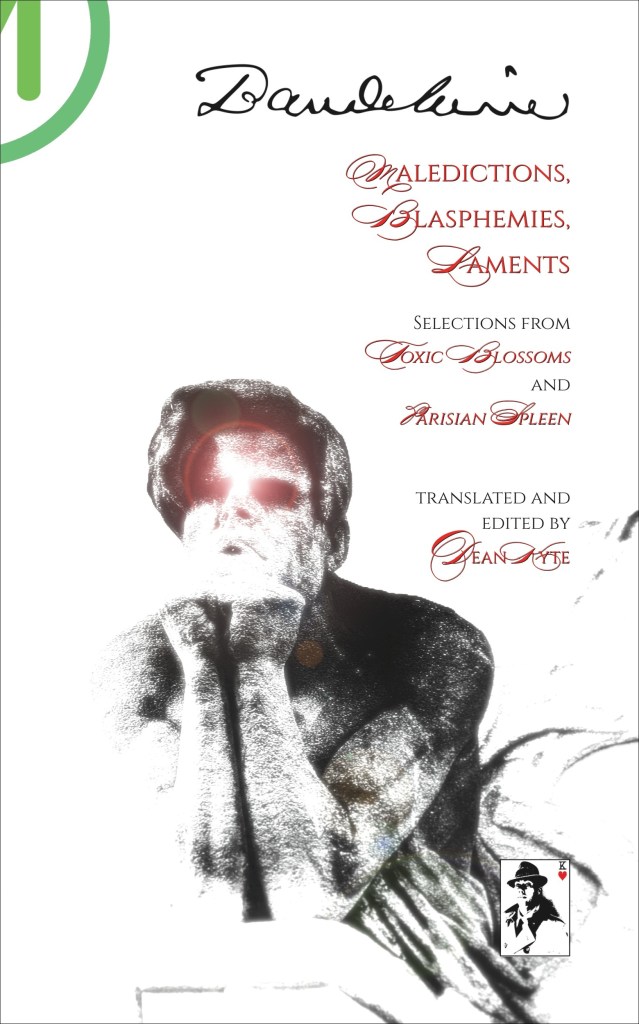
Dean Kyte takes you inside The Melbourne Edition of his new book of Baudelaire translations, Maledictions, Blasphemies, Laments, explaining the meaning of Baudelaire’s dedication to Théophile Gautier.
The titles of both of his major collections of prosody refer explicitly to the physical state of ill-health as the correspondent analogue for mental health, and the psychosomatic caduceus, the involuted double helix of the mind-body problem, the homeostatic regulation of the temporal, outer man by the eternal, inner person and vice versa, lies at the centre of Baudelaire’s conception du mal.
Hence, Baudelaire dedicates to the perfect magician Gautier ‘ces fleurs maladives’—‘these unhealthy, sickly, unwholesome flowers’—but also these ‘evil poems’, these perverse creations, these artificial ‘paper flowers’ whose ‘badness’ or ‘wrongness’ is inextricable from their formal beauty as poetry.
These are ‘fantastical blooms of imagination’—flamboyant, pungent effusions, as per Nerval—that are themselves ‘sickly’, and which induce sickness—malady—in the reader.
In that work, Morel proposed a simple definition of human degeneration, one that would be frequently cited throughout the second half of the nineteenth century.
… [L]’idée plus claire que nous puissions nous former de la dégénérescence de l’espèce humaine, est de nous représenter comme une déviation maladive d’un type primitive.
… [T]he clearest notion we can possibly form of the phenomenon of degeneration in the human species is to represent it to ourselves as an unwholesome deviation from a primal type.
— Bénédict Morel, Traité des dégénérescences physiques, intellectuelles, morales de l’espèce humaine et des causes qui produisent ces variétés maladives (1857, p. 5 [my translation])
According to Max Nordau, who would adopt Morel’s definition, it is this derivation from a basic, healthy type of man that produces the ‘stigmata’—that is a technical, not moralistic term, Nordau assures us—of physical and intellectual degeneration.
The leading cause of this ‘unwholesome deviation’ from basic health, according to Morel, is poisoning—addiction to narcotics and stimulants, such as alcohol and tobacco, which alternately depress and excite the human organism, and the consumption of polluted foods.
Nordau, writing forty years after Morel, adds another etiological factor to these ‘noxious influences’ in his Degeneration (1895)—‘residence in large towns.’
Under the conditions of modern, technological capitalism in these great ‘machines à vivre’ taking their model from Paris, Walter Benjamin’s ‘Capital of the Nineteenth Century’, man, according to Nordau, ‘breathes an air charged with organic detritus; he eats stale, contaminated, and adulterated food; he feels himself in a state of constant nervous excitement, and one can compare him without exaggeration to the inhabitants of a marshy district.’
‘No matter which party one may belong to,’ wrote Baudelaire in 1851, ‘it is impossible not to be gripped by the spectacle of this sickly population, which swallows the dust of factories, breathes in particles of cotton, and lets its tissues be permeated by white lead, mercury, and all the poisons needed for the production of masterpieces…; the spectacle of this languishing and pining population to whom the earth owes its wonders, who feel hot, crimson blood coursing through their veins, and who cast a long, sorrowful look at the sunlight and shadows of the great parks.’ … Baudelaire supplied his own caption for the image he presents. Beneath it he wrote the words: ‘La Modernité.’
According to Nordau, these poisonous environmental conditions attendant on modern life in great cities produce a ‘fatigue’—an escalating ‘burnout’ of the human organism—an hysterical malady that places increasing wear and tear on the brain and tissue of each successive generation of human beings undergoing the ordeal of modernity.
‘The resistance that modernity offers to the natural productive élan of an individual is out of all proportion to his strength,’ Benjamin writes, and, as Nordau notices, in no place on earth were the nerves of human beings more frayed in the nineteenth century than in Benjamin’s capital of modernity itself—the epicentre of a political revolution that, in its continuing aftershocks, had become a social, cultural, and artistic revolution.
It was in this poisonous atmosphere of addiction, fashionable excitation, debased victuals, and political volatility that Charles Baudelaire was born and lived almost all of his brief, unhappy life.
Les Fleurs du mal are therefore not, as generations of English translators have so crudely rendered them, ‘The Flowers of Evil’.
In their exoteric aspect, the ‘allegorical image’ Baudelaire intended by that title, Les Fleurs du mal are emblems of malady, of a physical debility which is correspondent with a mental degeneration and vice versa.
As stigmatized derivatives of a primal, healthy type ‘before the Fall’ of modernity, it is only in this sense that these exotic, poisonous cultivars, weedy, unnatural blooms that Baudelaire has nursed in the hothouse of his soul—itself formed in the ‘artificial paradise’ of Paris—should be regarded as the products of an absolute immorality.
The skeletal Tree of Knowledge depicted by Rops—Science in its essence—unbandages man’s eyes from the blissful ignorance of God’s Nature.
When we enter the condition of modernity, we enter an artificial paradise, a fallen place of our own making, seductive and yet poisonous, in which the generations of Adam who work in the big cities bear the marks of Science’s guilty knowledge on their bodies and in their brains.
In its exoteric dimension, the title ‘Les Fleurs du mal’ might better be rendered, as I have chosen to do so, as ‘Toxic Blossoms’: these are creations of poisonous beauty that throw us back on the secondary paradox that arises from the primary fact of their being:—From whence does the Good, the True, the Beautiful really proceed?—from God, or from the Devil?
All 51 pieces in the book—33 poems, 17 prose poems, and 1 short story—are now complete.
As I put the final touches to the book, my last task is to complete a 10,000-word critical monograph on Charles Baudelaire in which I explain how, in his life and work, he both prophesies and embodies the decadence, decline, and degeneration of modern man that we are now experiencing all throughout the West—and particularly in the Anglosphere.
Croyez-vous que vous soyez le premier homme dans ce cas ? Avez-vous plus de génie que Chateaubriand et que Wagner ? On s’est bien moqué d’eux cependant ? Ils n’en sont pas morts. Et pour ne pas vous inspirer trop d’orgeuil, je vous dirai que ces hommes sont des modèles, chacun dans son genre, et dans un monde très riche et que vous, vous n’êtes que le premier dans la décrepitude de votre art.
Do you think you’re the first man to have been laughed at? Have you more genius than Chateaubriand and Wagner? Have they not been made fun of? They haven’t died of it. And so as not to puff up your pride too much, I will tell you that these men are models, each in his own field and in a very rich world, and that you—you are merely the first in the degeneracy of your art-form.
— Charles Baudelaire to Édouard Manet, letter of 11 May, 1865 [my translation]
Baudelaire’s recognition of a incipient degeneracy in the art of Édouard Manet would be the most significant remark, either public or private, that the poet would make on the work of his painter-friend, and, indeed, Baudelaire’s slighting comparison of Manet to another personal friend whose genius, by contrast, he had been the first man in France to recognize—Richard Wagner—is telling. As Spengler observes: ‘Between Wagner and Manet there is a deep relationship, which is not, indeed, obvious to everyone but which Baudelaire with his unerring flair for the decadent detected at once.’
It is an enduring mystery of criticism why Baudelaire, so sensitively attuned to the etiolation of forms that would, in time, mark itself out as the pathological trait of modern art—and so quick, moreover, to perceive the chthonic correspondences between his project of a modern, urban poetry and the work of artists in other media whose formal æsthetics bore similarities to his own—should have signally failed to see that it was Manet—not Constantin Guys—whom future historians and critics would deem to have embodied Baudelaire’s own notions of modern artistic heroism, as the quintessential ‘Painter of Modern Life’.
Beaucoup de gens attribueront la décadence de la peinture à la décadence des mœurs. …
Avant de rechercher quel peut être le côté épique de la vie moderne, et de prouver par des exemples que notre époque n’est pas moins féconde que les anciennes en motifs sublimes, on peut affirmer que puisque tous les siècles et tous les peuples ont eu leur beauté, nous avons inévitablement la nôtre.
… [N]’a-t-il pas sa beauté et son charme indigène, cet habit tant victimé ? N’est-il pas l’habit nécessaire de notre époque, souffrante et portant jusque sur ses épaules noires et maigres le symbole d’un deuil perpétuel ? Remarquez bien que l’habit noir et la redingote ont non seulement leur beauté politique, qui est l’expression de l’égalité universelle, mais encore leur beauté poétique, qui est l’expression de l’âme publique ; — une immense défilade de croque-morts, croque-morts politiques, croque-morts amoureux, croque-morts bourgeois. Nous célébrons tous quelque enterrement.
…
Le spectacle de la vie élégante et des milliers d’existences flottantes qui circulent dans les souterrains d’une grande ville, — criminels et filles entretenues, — la Gazette des Tribunaux et le Moniteur nous prouvent que nous n’avons qu’à ouvrir les yeux pour connaître notre héroïsme.
…
La vie parisienne est féconde en sujets poétiques et merveilleux. Le merveilleux nous enveloppe et nous abreuve comme l’atmosphère ; mais nous ne le voyons pas.
Le nu, cette chose si chère aux artistes, cet élément nécessaire de succès, est aussi fréquent et aussi nécessaire que dans la vie ancienne : — au lit, au bain, à l’amphithéâtre. Les moyens et les motifs de la peinture sont également abondants et variés ; mais il y a un élément nouveau, qui est la beauté moderne.
Car les héros de l’Iliade ne vont qu’à votre cheville, ô Vautrin, ô Rastignac, ô Birotteau, — et vous, ô Fontanarès, qui n’avez pas osé raconter au public vos douleurs sous le frac funèbre et convulsionné que nous endossons tous ; — et vous, ô Honoré de Balzac, vous le plus héroïque, le plus singulier, le plus romantique et le plus poétique parmi tous les personnages que vous avez tirés de votre sein !
Many people will attribute the decadence in painting to the degeneration of customs. …
Before we investigate what the epic side of modern life may be and prove, through example, that our era is not less fruitful in sublime motifs than antiquity, it may be averred that since every age and nation has possessed its proper beauty, we, inevitably, have our own.
… Has it not its beauty and its native charm, this oh-so-maligned suit? Is not the suit essential for our age, suffering and bearing upon its very shoulders, puny and black, the symbol of a perpetual mourning? Note well that the black suit and frock coat have not merely their social beauty (which is the expression of universal equality), but also their poetic beauty, which is the expression of the public spirit:—an immense cortège of undertakers – political morticians, romantic embalmers, middleclass funeral directors. We are all of us celebrating some sort of burial.
…
The spectacle of fashion and of the countless floating existences which circulate in the bowels of a great city—crooks and whores—the court reports and tabloids prove to us that we have merely to open our eyes to meet with our brand of heroism.
…
Parisian life is abundant in marvellous and poetic subjects. The marvellous surrounds us and suckles us like the air, but we do not see it.
The nude, that object so dear to artists, that essential ingredient of success, is just as common and indispensable as it was in antique life: in the bed, the bath, upon the stage. The means and the motifs of painting are equally abundant and varied; but there is a new element—modern beauty.
For the heroes of the Iliad do not come up to your ankle, O Vautrin, O Rastignac, O Birotteau!—and you, O Fontanarès, who haven’t dared to recount to the public your chagrins under the tail coat, funereal and wracked with sobs, that all of us wear. —Nor you, O Honoré de Balzac; you, the most heroic, the most original, the most romantic and poetic of all the characters you have drawn forth from your heart!
It is clear that Baudelaire sees the essence of modern beauty as crime—committing le mal.
The heroes of modern life, far superior to the strong men of antiquity, are the decadent, elegant criminal masterminds of the Balzacian social network of the city, the dandiacal flâneurs for whom the funereal uniform of the black frock coat is a democratic disguise that allows the artistic observer to take the total measure of the urban scene, du grand monde au demi-monde.
L’ordre social, l’action de la société sur l’individu, dans les diverses phases et aux diverses époques, ce réseau d’institutions et de conventions qui nous enveloppe dès notre naissance et ne se rompt qu’à notre mort, sont des ressorts tragiques qu’il ne faut que savoir manier. Ils sont tout à fait équivalents à la fatalité des anciens ; leur poids a tout ce qui était invincible et oppressif dans cette fatalité ; les habitudes qui en découlent, l’insolence, la dureté frivole, l’incurie obstinée, ont tout ce que cette fatalité avait de désespérant et de déchirant : si vous représentez avec vérité cet état de choses, l’homme des temps modernes frémira de ne pouvoir s’y soustraire, comme celui des temps anciens frémissait sous la puissance mystérieuse et sombre à laquelle il ne lui était pas permis d’échapper, et notre public sera plus ému de ce combat de l’individu contre l’ordre social qui le dépouille ou qui le garotte, que d’Œdipe poursuivi par le Destin, ou d’Oreste par les Furies.
Social order—the action of society upon the individual—in various phases and during various epochs; this network of institutions and conventions which catches us in its toils at the moment of our birth and is only broken at the hour of our death, furnishes the mainspring for tragedy which the dramatist need only know how to manipulate. These institutions and conventions are perfectly equivalent to the ‘destiny’ of the ancients; their gravitas possesses everything that was invincible and oppressive in the ancient notion of ‘fate’. The customs that flow from them—insolence, frivolous cynicism, stubborn unconcern—is replete with all that ‘fate’ had in it to inspire heartbreak and despair: If you truthfully depict this state of affairs, modern man will tremble from his incapacity to extricate himself from it just as the man of ancient times used to quiver beneath the obscure and sombre power from which he was forbidden to escape, and our modern audience will be more moved by the individual’s fight against the social order which seeks to strip or strangle him than by Œdipus pursued by Destiny, or Orestes by the Furies.
— Benjamin Constant, « Réflexions sur la tragédie », Revue de Paris (1829, p. 136 [my translation])
Echoing the insight of Benjamin Constant nearly two decades before him, Baudelaire is of the view that urban crime is the sole field of heroism available to men possessed of any spirit of adventure in modernity.
And artists—whether of word or paint—are the supreme outlaws, the supreme non-conformers to the social order.
The dandy-flâneurs, those ‘æsthetic terrorists’ of the bourgeois order who act in resolute defiance of the safetyist constraints of the law—who seek to break the social network of the civilized community binding them to impotence from birth to death, and who refuse to serve the metropolitan machine in the slavery of ‘gainful employment’, preferring instead what I call ‘productive indolence’—those elegant, artistic, criminal souls, deserters of their society but drawn like moths, by grace of their macabre curiosity, to it—to be the ironic witnesses of its criminal beauty, its crime against humanity—are the only heroes in modern life equal to the ancients.
Manet, a dandiacal flâneur as given as Baudelaire to Balzacian survey of the great machine à vivre that was the modern metropolis of Paris, wore the uniform of the fashionable man about town for his undercover excursions into observation of its many strata and facets.
Baudelaire had no lack of opportunities to observe Manet at this idle labour and know that, with the appropriate changes being made, Manet’s visual style and technique was the counterpart to his own literary approach to the modern urban scene of Second Empire Paris.
As two dandy-flâneurs, the poet had often been the painter’s Balzacian bosom companion—the Paul de Manerville to his Henry de Marsay—on sketching expeditions to the jardin des Tuileries.
With his black stovepipe, his exuberant black silk bowtie, his prematurely greying locks and his Satanic profile, Baudelaire would more than once provide Manet with the subject for a snapshot-like sketch that, in its curious caricatural indefiniteness, would trace with ‘vague precision’ the smeary mark that Baudelaire would leave on the margins of the vast, Balzacian tableau of modern Parisian life, a figure in the background, like Vautrin, only afterwards to be recognized as the absolute centre of the cultural scene for the whole nineteenth century.
Thus, as David Carrier, summarizing the position of critics who have lamented Baudelaire’s stunning failure of perspicacity in appreciating the revolutionary rôle that Manet would play in the art of the future, regretfully puts it, ‘it is embarrassing that a great critic failed to see the value of the work of a friend.’
‘It has been alleged,’ writes Joanna Richardson, ‘that Baudelaire did not appreciate Manet at his true worth. … It might indeed be said that Delacroix concealed the modernity and the stature of Manet from him.’
Baudelaire was caught up as a partisan in the great controversy that would preoccupy French art during the second third of the nineteenth century, and which would only retrospectively appear to history as a minor theatre of conflict, a very distant skirmish from the front lines of avant-garde battle that were then drawing themselves behind Manet and in opposition to his sure sense of what constituted modern beauty.
This was the great contest between the primacy of line—precise, classical draughtsmanship as personified by Ingres—and the vibrancy of colour as the expression of romantic emotion, and personified by Baudelaire’s enduring hero, Delacroix.
Manet resolved the problem of line and colour in a novel way that nevertheless looked back—with ambiguous irony—to the classical models claimed by the two masters. Manet’s lines, as in Olympia (1863), were often gross in their salience, an infantile perversion of Ingres’ tin-type kind of design, his fields of unbroken colour vibrant but inharmonious to sensibilities that admitted that Delacroix, despite his lack of draughtsmanly clarity, achieved something poetic and musically suggestive in his tonal arrangements.
In « Le Peintre de la vie moderne », Baudelaire would call genius ‘childhood wilfully, skilfully regained’, and in the novelty of Manet’s visual style, an apparently infantile—even imbecilic—degeneracy of facture that was, in fact, meticulously laboured over as a way of expressing the spectacle of modern Paris in its marvellous, poetic welter of instantaneous impressions, the painter proved that he possessed the ‘lively sense organs and the analytic spirit which enable him to impose order upon the sum of visual materials unconsciously amassed’ which Baudelaire ascribed to Guys.
Manet was half a generation younger than Baudelaire and was thus somewhat removed from the pitched contention between neo-classical line and romantic colour: Born on 23 January 1832, Manet was ineluctably destined, like Baudelaire, to be pilloried by the establishment in his lifetime, shunted to the margins of Parisian society as a stubborn madman one could do nothing with, only to become posthumously influential, lionized for the moral determination of his conscientious rebellion against the artistic mores of the Second Empire, vindicated as the most intransigent stumbling-block upon which the future edifice of modern art would be founded.
January 23rd is a sinister and potent date.
The Sabian symbol for the third degree of Aquarius, coinciding with the Sun’s transit through it on this date, is ‘A deserter from the navy’: That image symbolizes the rebellious—indeed, criminal—abandonment of a rigid, hierarchical structure, an established institution, an ark-like architecture that is designed to safely carry one over ‘le gouffre’ (to use a word we frequently encounter in Baudelaire’s maritime poetry)—the bitter abyss, the hellish, mazy chaos of the waves that are ever under man’s feet.
In his refusal to serve a structure he sees as foundering, the rebellious deserter who jumps ship chooses to become an uncompromising outlaw of society.
In their youths during the 1840s, both Baudelaire and Manet had been forced by their respective families to quit what the older man’s stepfather called ‘the slippery streets of Paris’ and take long, exotic sea voyages—brutal separations designed to quell the rebellious desires of their hearts for poetry on the one hand and painting on the other.
Manet had been forced on a voyage to Rio de Janeiro by his father—a judge—to qualify for induction into the Navy. Manet studiously failed the entrance examinations twice, his non-conforming Aquarian spirit refusing to submit to his father’s authority as it would later refuse to submit to the established judgments of the Académie des beaux-arts.
In the end, by his strategy of ‘compliant resistance’, going along with his father’s dictates while secretly sabotaging them by his intransigent determination to do nothing but become a painter, Manet would get his own way and be allowed to enter to atelier of Thomas Couture.
Baudelaire’s stepfather, the maréchal du camp Aupick, ‘violently disturbed’ by young Charles’s avid pursuit of ‘the perdition of the streets of Paris’, would bundle the aspiring poet off to India, hoping that the exoticism of the East would return a matured young man inclined to read law—or at least, as mother and stepfather muttered between themselves, privately recognizing that they were up against a similarly stubborn case, a poet who would write of honourable subjects and not the ambulatory muses of the Parisian streets.
Baudelaire jumped ship in Mauritius, and within eight months would be back on the ‘slippery streets’ of the capital, returning, as Manet would do some seven years later, as indissuadable from the mad career pathway he was determined to pursue as when he had left, but bringing to his vision of the modern Parisian spectacle all the decadent exoticism he had absorbed in Cape Town, Mauritius, and Réunion.
Thus, January 23 is a date that portends criminal rebellion, the radical overthrow of all monolithic structures of orthodox ‘right thought’ designed to float us, as in an ark, safely over the raging sea of life.
On the same date in 1862, his friend Manet’s thirtieth birthday, the forty-year-old Baudelaire would do what he would hardly ever do in the pages of his Journaux intimes, and mark this fatal date as a dark and potent inflection point in his life.
J’ai cultivé mon hystérie avec jouissance et terreur. Maintenant, j’ai toujours le vertige, et aujourd’hui, 23 janvier 1862, j’ai subi un singulier avertissement, j’ai senti passer sur moi le vent de l’aile de l’imbécillité.
I have cultivated my hysteria with relish and dread. Nowadays, I always feel vertigo, and today, 23 January 1862, I suffered a singular presentiment:—I felt the wind of the wing of mental degeneration sweep over my being.
This book is on the verge of being born and will be out before Christmas. I urge you to purchase copies in your choice and quantity of formats now using the payment buttons below, with invoicing for shipping to occur when the first batch of orders goes to press at the end of this month.
Édouard Manet, Olympia (1863-5), oil on canvas, 130.5 cm × 190 cm, musée d’Orsay, Paris.
L’usage social de la liberté littéraire deviendra de plus en plus rare et précieux. Les grandes démocraties de l’avenir seront peu libérales pour les écrivains ; il est bon de planter très haut des poètes drapeaux comme Baudelaire.
On pourra les agiter de temps en temps afin d’ameuter le petit nombre des esclaves encore frémissants.
The social use of free literary expression will become increasingly rare and precious. The great democracies of the future will be very illiberal for writers; it is therefore good to plant poets like Baudelaire upon the highest eminences as standards.
We will be able to wave them from time to time so as to riotously rouse the small number of slaves still trembling for freedom.
In May of 1865, the talk of tout Paris was the scandal of the Salon, the inclusion of Édouard Manet’s Olympia in the annual exhibition of painting and sculpture held by the Académie des beaux-arts. Two years earlier, Manet had been in the thick of an agitation, his provocative canvas Le Déjeuner sur l’herbe serving as a convenient standard behind which a group of disaffected artists could rally, petitioning the Emperor, Napoléon III, in protest at their rejection by the jury. Now Manet was at it again with something that had been accepted by the jury but which was—if possible—even more outrageous a slap in the face than his Luncheon on the grass had been.
Manet had expected trouble, but from a different quarter, his other entry in the Salon of that year, a history painting showing the Saviour being insulted by the Roman soldiers, going unremarked as compared to Olympia, an uncompromising nude of a contemporary Parisian prostitute so offensive in her frankness that she excited embarrassed ridicule from visitors to the Louvre when she did not actually excite physical attack. Manet, a naïve revolutionary with an earnest desire for the respectability of the Académie, was nonplussed. He wrote his friend, the poet Charles Baudelaire, who had frequently covered the Salon as an art critic of exquisite though outré tastes, seeking guidance and reassurance.
Je voudrais bien vous avoir ici mon cher Baudelaire, les injures pleuvent sur moi comme grêle…. J’aurais voulu avoir votre jugement sain sur mes tableaux car tous ces cris agacent, et il est évident qu’il y a quelqu’un qui se trompe.
I very much wish you were here, my dear Baudelaire, for insults rain on me like hail…. I should have liked to have your healthy judgment on my paintings, for all these cries grate on me, and it’s clear that someone is in the wrong.
— Édouard Manet to Charles Baudelaire, undated letter of early May 1865 [my translation]
The 44-year-old poet was then in Brussels, where he had been for over a year, escaping his Parisian creditors, attempting to sell the rights to his works to Belgian publishers, giving scarcely attended lectures on modern French art to the uncultured Bruxellois, drinking heavily, and roundly hating the place, which he condemned in poems and pamphlets. Sick, penniless, within a year of suffering a mysterious crisis that would leave him partially paralyzed, almost mute, and barely sensible, two years away from his death, Baudelaire had little time for Manet’s complaint. Hearing without sympathy his friend’s lament from the capital of fashion and culture, on 11 May, 1865, Baudelaire fired off an exasperated epistle from the Godforsaken Belgian backwater to the man whom future generations would acknowledge to have been the reluctant, unfairly crucified father of modern art.
Croyez-vous que vous soyez le premier homme dans ce cas ? Avez-vous plus de génie que Chateaubriand et que Wagner ? On s’est bien moqué d’eux cependant ? Ils n’en sont pas morts. Et pour ne pas vous inspirer trop d’orgeuil, je vous dirai que ces hommes sont des modèles, chacun dans son genre, et dans un monde très riche et que vous, vous n’êtes que le premier dans la décrepitude de votre art.
Do you think you’re the first man to have been laughed at? Have you more genius than Chateaubriand and Wagner? Have they not been made fun of? They haven’t died of it. And so as not to puff up your pride too much, I will tell you that these men are models, each in his own field and in a very rich world, and that you—you are merely the first in the degeneracy of your art-form.
— Charles Baudelaire to Édouard Manet, letter of 11 May, 1865 [my translation]
Those last, emphasized words would be prophetic, not merely of Édouard Manet’s destiny to embody the title that his friend had incorrectly or churlishly ascribed to another, lesser artist, to be ‘the Painter of Modern Life’, but it would equally be prophetic of the destiny of Baudelaire himself: By the end of the century, this poet, mocked and derided in his lifetime for his own pretensions to academic respectability as a troubadour of prostitutes, would be regarded by the physician and social critic Max Nordau as having been the fountainhead of degeneracy in modern life and the chef d’école in the Decadent movement of modern poetry, and early in the next century, T. S. Eliot would declare that modernism in poetry had definitively begun with Charles Baudelaire.
With 96 per cent of the poems, prose poems—and fiction (!)—of Charles Baudelaire now translated and in place, Maledictions, Blasphemies, Laments is on-track for release before Christmas.
Pre-orders for the book in three formats—the hardcover dust jacket “Melbourne Edition”, the Economy Softcover version, and the PDF eBook—are now being accepted at an early-bird price.
Select your choice and quantity below to secure your copies in the desired formats, with invoicing for shipping to occur when the first print run occurs in a month’s time.
Taking you line by line through the last three verses of Baudelaire’s « Les Phares », Dean Kyte explains the paradoxical relationship that damnation has to praise in Baudelaire’s thought.
And in today’s video on The Melbourne Flâneur, I take you inside the softcover version of the book as I explain—with due reference to Baudelaire—the rationale behind my choice of such a bitter and pitiless title.
As I say in the video, what appears on its face to be a title utterly alienating in its satanic vituperation is in fact the highest possible homage that Baudelaire can render to God’s majesty, and the proof of his most fervent belief, as a heretical Catholic, in the Supreme Being.
Thus, at a plutonic hour of human history where faith in God and human goodness could not be more ridiculous, I too assert, in taking this title, my quixotic faith in what is highest in man by ‘praising with sharp damnation’ what is lowest in our species, we irredeemable children of the tribe of Cain.
For there must no longer be any doubt in our present year, even to the somnambulistic billions who would make ‘the Woman Question’ and ‘the Jewish Question’ of the nineteenth and twentieth centuries suddenly ‘the Human Question’ of the twenty-first, that Baudelaire’s apocalyptic prophecy of modernity—a veritable ‘Age of Iron’—has now properly revealed itself in our day.
The time could not be more right for the apparition of this book.
One hundred twenty-one years to the very day of my birth, Baudelaire writes in his journal that ‘today … I suffered a singular alarm: I felt the wind of the wing of madness pass over me.’
Charles Baudelaire is the Alpha of the dandy-flâneur, the man, in modernity, who still seeks to be a ‘man’—to live heroically in the strength of all our human frailties and the humility of our profound limits—and I am the Omega, the decadent result of two centuries of societal degeneracy in the West, the last quixotic figure, in the armour of my hat and suit, to intransigently ‘hold the faith’ in that utterly discredited, unconscionable project of embodying ‘Homo Occidentalis’ in all his risible nobility.
So, as a mad Aquarian, an avatar of the New, destiny has elected me for a task, chers lecteurs;—to be the ‘postrunner’ of this great fallen angel of modernity, this great albatross of a luciferic intellect who found his wingspan so vast he couldn’t walk easily among us, and interpret to the Anglosphere, as an evangelist after the fact, the poetry and prose poetry of Charles Baudelaire.
And I’m pleased as punch to advise you that Maledictions, Blasphemies, Laments is on the verge of seeing the light of day.
I explain the origins of the book’s title in the video above, but here below, I am posting for the first time the line-up of fifty pieces I have selected from Les Fleurs du mal and Le Spleen de Paris to take the field as the Baudelairean ‘dream team’ and represent our poet.
So, here we go…
From Toxic Blossoms (Les Fleurs du mal):
“To the Reader” (« Au Lecteur »)
From “Spleen and Ideal” (« Spleen et Idéal »):
“Blessing” (« Bénédiction »)
“The Albatross” (« L’Albatros »)
“Elevation” (« Élévation »)
“Correspondences” (« Correspondances »)
“The Venal Muse” (« La Muse vénale »)
“The Faithless Monk” (« Le Mauvais moine »)
“Illfated” (« Le Guignon »)
“Past Life” (« La Vie antérieure »)
“Beauty” (« La Beauté »)
“The Ideal” (« L’Idéal »)
“The Giantess” (« La Géante »)
“The Jewels” (« Les Bijoux »)
“Hymn to Beauty” (« Hymne àla Beauté »)
“You’d let all mankind dally in your alley…” (« Tu mettrais l’univers entier dans ta ruelle… »)
“With her raiment, sinuous and nacreous…” (« Avec ses vêtements ondoyants et nacrés… »)
“The Possessed” (« Le Possédé »)
“An Apparition” (« Un Fantôme »)
“I make a gift of these verses to you so that if my name…” (« Je te donnes ces vers afin qui si mon nom… »)
“Vespers” (« Chanson d’après-midi »)
“Spleen” (« Quand le ciel bas et lourd pèse comme un couvercle… »)
“Warning” (« L’Avertissement »)
From “Parisian scenes” (« Tableaux parisiens »):
“The Sun” (« Le Soleil »)
“The Swan” (« Le Cygne »)
“To a Passerby” (« À une passante »)
“Evening Twilight” (« Le Crépuscule du soir »)
From “Wine” (« Le Vin »):
“The Soul of Wine” (« L’Âme du vin »)
From “Toxic Blossoms” (« Les Fleurs du mal »):
“Epigraph for a Condemned Book” (« Épigraphe pour un livre condamné »)
“The Two Wellbred Girls” (« Les Deux bonnes sœurs »)
From “Rebellion” (« Révolte »):
“Litanies of Satan” (« Les Litanies de Satan »)
From “Death” (« La Mort »):
“A Connoisseur’s Dream” (« Le Rêve d’un curieux »)
“The Journey” (« Le Voyage »)
I have selected fully one-fifth of the total number of poems published in the three editions of Les Fleurs du mal which Baudelaire, and then his mother, saw through the press.
At least twenty per cent of every section of Les Fleurs du mal is represented in Maledictions, Blasphemies, Laments, and because Baudelaire’s poetry collection is a psychological novel with a narrative order, in selecting at least a fifth of the poems from every section, I have taken care to choose those works which I think best highlight the themes of that section and carry the overarching drama forward.
The figure of one-fifth includes the six pieces that were struck from the first edition as obscene, banned in France, and were only subsequently available in Belgium among Les Épaves (1866).
One of the censored poems, « Les Bijoux », is included, and as you can see, that piece, which I published in my first collection of Baudelaire translations, Flowers Red and Black (2013), is listed in orange.
With the exception of « Spleen », the titles in orange are works from the earlier book which are still in the buffer awaiting revision.
As this post goes to press, I am about to start revising « Spleen », which I also translated in the years preceding the publication of Flowers Red and Black but declined to include in that book, so this poem will see the light of day for the first time in Maledictions, Blasphemies, Laments.
And the word ‘revise’ in this instance basically means ‘completely rewrite’.
So it’s going to be interesting when I look at “The Jewels” again in a couple of weeks, because this is by far my most well-known translation of a work by Baudelaire, the piece that often cliched sales of Flowers Red and Black. Is this poem going to run true to form with the rest of the book and am I going to see the text in a whole new light?
What I can tell you for certain is that a revised version of “The Jewels” will include a translation of the newly revealed ninth verse that was discovered in 1928, written in Baudelaire’s hand, in a first edition of Les Fleurs du mal which he gave to a friend but only made public when that copy came up for auction in 2019.
These are the last outstanding selections from Les Fleurs du mal that I am yet to translate. They’re Baudelaire’s most famous poems; they’re among my longest selections, and they’re going to be the greatest tests of my interpretative abilities.
So that’s Les Fleurs du mal. Now let’s look at what you can expect to read from Le Spleen de Paris.
From Parisian Spleen (Le Spleen de Paris):
“To Arsène Houssaye” ( « À Arsène Houssaye »)
“The Stranger” (« L’Étranger »)
“The Artist’s Confiteor” (« Le Confiteor de l’artiste »)
“A Troll” (« Un plaisant »)
“Twin Suite” (« La Chambre double »)
“The Buffoon and the Venus” (« Le Fou et la Vénus »)
“At an Hour after Midnight” ( « À une heure de matin »)
“Crowds” (« Les Foules »)
“Invitation to the Journey” (« L’Invitation au voyage »)
“Hungry Eyes” (« Les Yeux des pauvres »)
“The Magnanimous Gambler” (« Le Joueur généreux »)
“Sozzle Yourself” (« Enivrez-vous »)
“Windows” (« Les Fenêtres »)
“The Port” (« Le Port »)
“Lost Halo” (« Perte d’auréole »)
“Anywhere Out of the World ” (« N’importe où hors du monde »)
“Epilogue” (« Épilogue »)
One-third of the total number of pieces from Le Spleen de Paris will be featured in Maledictions, Blasphemies, Laments, including Baudelaire’s prefatory letter to Arsène Houssaye—which ought to be considered a prose poem in its own right—and the poem that Baudelaire appends as epilogue to the collection.
And you’ll notice we have one text in red: « Le Port ». After I complete the revision of « Spleen », that short, pretty little prose poem is next on my list.
So, if you’ve been keeping count, chers lecteurs, you’ve clocked 49 pieces and I promised you fifty. What’s the big 5-0?
“Fanfarlo” (« La Fanfarlo »)
The translation of Charles Baudelaire’s only known original short story is now complete.
The longest, most ambitious translating project I’ve undertaken in any language was completed to my satisfaction at the end of last month after 134 hours and seven drafts of work.
A task I approached with trepidation and misgivings, thinking I would be merely giving the reader a ‘bonus’ text that was still going to cost me time and sweat, I now believe to be one of the major selling points of Maledictions, Blasphemies, Laments.
One of the reasons I think this version of « La Fanfarlo » will last for quite a long time as an introduction to what is, for English readers, an overlooked part of Baudelaire’s œuvre is my decision to include footnotes to the text.
I found that there were three types of instance where a footnote would aid the reader’s understanding, the most important being the occasional footnote that takes you inside my process as a translator, shows you clearly what the French is and how it can be variously interpreted, and what ultimately informed the choice I’ve gone with in the text based on my intimacy with Baudelaire’s typical modes of thinking and expression.
So, 86 per cent of the poems, prose poems—and fiction—of Charles Baudelaire that you will shortly be reading in Maledictions, Blasphemies, Laments is now locked in.
And this week, apace with my final revisions and translations, I pulled out my trusty essay plan and began plugging in points and sources for the last remaining major task before this book goes to print:—my contribution, an 8,000-word critical monograph on Baudelaire that I hope will serve to honourably introduce the man, the myth, the œuvre to the English-speaking world.
But what I write in the critical monograph introducing Maledictions, Blasphemies, Laments, I intend to be my definitive statement on Baudelaire—at least for the next ten years, when I will have doubtless more translations of his work to offer the English-speaking world.
When I published Flowers Red and Black in 2013, I had no idea that people would see such a close connection between Baudelaire and myself, as parallel lives across centuries, souls who cannot take quiet desperation.
I am truly the ‘mon semblable, mon frère’ (‘my double, my brother’) whom he salutes in the last line of the very first poem of Les Fleurs du mal, « Au Lecteur »—a fraternal spirit of revolt.
What I say about Baudelaire in the critical monograph will be the fruit of some seventeen years of working intimately with the thoughts of a literary mind that is as much a black mirror to my own as Edgar Allan Poe’s was to Baudelaire’s.
And I intend it to stand the test of future times and tastes as Baudelaire’s critical essays on Poe have proven their lasting value as perspicacious insights into that poor unfortunate’s life and work from a fraternal spirit who knew the horror he was experiencing only too well.
I am now taking pre-orders for Maledictions, Blasphemies, Laments, and I invite you to get onboard now.
The price point I am looking at for the softcover version advertised in the video above is $A32.00, exclusive of shipping.
(For my American readers, that’s approximately $20.50 in your yanquí dinero.)
For that price, you’re going to receive:
A 180-page illustrated softcover edition with pages printed in full colour
Autographed and wax-sealed by me as a guarantee of authenticity
Handwritten, personalised inscription from me to you
Complementary custom bookmark
My proposal to you is to purchase now to guarantee your copy at that price point in the initial print run, and after I go to print, I will invoice you for shipping.
And by pre-ordering, you will also join the community of consumers who have already committed to purchase Maledictions, Blasphemies, Laments. I’m sending emails on a monthly basis to my readers, staying accountable by keeping them up to date with my progress towards publication—and taking them inside my Artisanal Desktop Publishing process, the joys and vagaries of writing, designing and publishing this book with exclusive content not posted here on The Melbourne Flâneur.
So, avail yourself of the order form below and book your ticket to Cythera on the Baudelaire boat.
“Maledictions, Blasphemies, Laments” [softcover]
Personally signed, sealed and inscribed by author. Comes with custom bookmark. Pre-order your copy and join an exclusive community of readers anticipating the release of Dean Kyte’s new book!
As I explain in the video above, the book features one-fifth of the total number of poems published in the three editions of Baudelaire’s Les Fleurs du mal (1857), plus one-quarter of the prose poems from Le Spleen de Paris (1869).
But in addition to the 47 poems and prose poems I’ve selected as representative examples of Baudelaire’s flâneurial philosophy, as a bonus, I’ve also chosen to translate the M’sieu’s only work of fiction—“La Fanfarlo” (1847), adding significant value to this volume as a complement to the selections I have made from Les Fleurs du mal and Le Spleen de Paris.
At nearly 11,000 words in the original, “La Fanfarlo” is the most ambitious translation project I have undertaken in any language.
For the past month, I’ve been deeply engaged in hewing out a version of the source text in English, and as this post goes to press, I’m immersed in the third of five drafts, approximately half-way through the process of bringing this story to life in English.
The value of “La Fanfarlo” is chiefly documentary: preceding the bulk of Baudelaire’s œuvre as presented in the first two parts of Maledictions, Blasphemies, Laments, this ‘long short story’ will retrospectively show the 25-year-old poet first rehearsing the ideas and turns of phrase we recognize more brilliantly expressed in the poems and prose poems.
Published in January 1847, the story is a fictionalized account of Baudelaire’s first meeting with the Creole actress Jeanne Duval (c. 1820—after 1862), the Haitian beauty the poet would call his ‘Vénus noire’, and who, as his muse and mistress, is the recognizable inspiration behind at least four of the poems I’ve translated in Maledictions, Blasphemies, Laments:—“Les Bijoux”, “Avec ses vêtements ondoyants et nacrés…”, “Un Fantôme”, and “Je te donnes ces vers afin que si mon nom…”.
Jeanne Duval is ‘la Fanfarlo’ of the story’s title—an exotic dancer who has her hooks sunk deep in a Parisian dandy, M. de Cosmelly.
This gent’s wife, Mme. de Cosmelly, is a minor aristocrat from Lyon, where, in her innocent girlhood, she was once friendly with a rakish young man who has grown into Samuel Cramer, Parisian poet-about-town, a dandy-flâneur who is clearly Baudelaire under another name.
“La Fanfarlo” begins in imitation of Balzac’s novella “La Fille aux yeux d’or” (1835), with Samuel crossing paths with Mme. de Cosmelly in the jardin du Luxembourg.
But then it morphs into a curious variation on the plot of Choderlos de Laclos’ epistolary novel Les Liaisons dangereuses (1782), with the virtuous Mme. de Cosmelly—who is like a strange combination of the marquise de Merteuil wrapped in the girlish wile of Cécile de Volanges—plotting with Samuel, who fancies himself a novice vicomte de Valmont.
Mme. de Cosmelly engages the poet to take Fanfarlo off her husband’s hands and thus deliver him back into the amorous arms of his neglected wife—who gives Samuel to believe that she will bestow her gratitude upon him in the appropriate way.
As I’ve been working on translating this story over the last month, I’ve conceived of “La Fanfarlo” in several different ways. One of them is as a prophetic manifesto of Baudelaire’s artistic intent as a poet.
At the time the short story was published, Baudelaire was beginning his career as a journalist in Paris’s artistic milieu. While a few of the poems that would later appear in Les Fleurs du mal had been published in Parisian newspapers, Baudelaire was mainly known for his two lengthy reviews of the Salon exhibitions in 1845 and 1846.
In fact, the cover of Le Salon de 1846 advertises the imminent publication of the work that, eleven years later, would see the light of day under the allegorical title of Les Fleurs du mal.
Conversely, in “La Fanfarlo”, written in the months after Baudelaire’s Salon review was published in May 1846, his hero’s one claim to literary fame is as the author of a juvenile collection of sonnets—Baudelaire’s speciality—published under the equally inscrutable and difficult to translate title of “Les Orfraies”.
Le lendemain il la trouva, la tête inclinée par une mélancolie gracieuse et presque étudiée, vers les fleurs de la plate-bande, et il lui offrit son volume des Orfraies, recueil de sonnets, comme nous en avons tous fait et tous lu, dans le temps où nous avions le jugement si court et les cheveux si longs.
Samuel était fort curieux de savoir si ses Orfraies avaient charmé l’âme de cette belle mélancolique, et si les cris de ces vilains oiseaux lui avaient parlé en sa faveur ; mais quelques jours après elle lui dit avec une candeur et une honnêteté désespérantes :
— Monsieur, je ne suis qu’une femme, et, par conséquent, mon jugement est peu de chose ; mais il me paraît que les tristesses et les amours de messieurs les auteurs ne ressemblent guère aux tristesses et aux amours des autres hommes. … De plus, j’ignore pourquoi vous chérissez tant les sujets funèbres et les descriptions d’anatomie. Quand on est jeune, qu’on a comme vous un beau talent et toutes les conditions présumées du bonheur, il me paraît bien plus naturel de célébrer la santé et les joies de l’honnête homme, que de s’exercer à l’anathème, et de causer avec des Orfraies.
The next day, he located the lady, her head inclined by a gracious and almost studied melancholy towards the flowers of the parterre, and offered her his volume of Raptorsongs, a collection of sonnets of the type we have all written and read in days when we were so short in judgment and long in hair.
Samuel was most curious to discover if his Raptorsongs had charmed the soul of this beautiful melancholiac, and if the cries of these dreadful birds had spoken to her in his favour. But a few days later, she told him with a disheartening candour and honesty:
—Monsieur, I am merely a woman, and consequently, my judgment is a thing of small worth. But it appears to me that the passions and distresses of you authorial gentlemen hardly bear resemblance to the loves and sadnesses of other men. … Moreover, I know not why you so cherish funereal subjects and anatomical descriptions. When one is young, when one has, as you do, a great talent and all the presumed conditions for happiness, it seems to me much more natural to celebrate health and an honest man’s joys than to practise anathema and to declaim in piercing cries.
— Charles Baudelaire, “La Fanfarlo” (1847, p. 9 [my translation, third draft])
Thus, the piercing cries of birds of prey which form the discordant music of Samuel Cramer’s sonnets in “La Fanfarlo” will, a decade later, become the ‘noisome posy’, the ‘toxic blossoms’—which is how I have chosen to translate Les Fleurs du mal in Maledictions, Blasphemies, Laments—and the title Baudelaire devises from Cramer’s recueil is prescient in its sinister ambiguity, anticipating the multiple insinuations that other translators have unimaginatively reduced to the literal phrase of ‘the flowers of evil’.
Baudelaire is barely commenced upon the project that will become Les Fleurs du mal. Yet he anticipates the critiques that will be levelled against his poisonous bouquet and rehearses them in “La Fanfarlo” by placing them in the mouth of Mme. de Cosmelly.
He also articulates his rebuttal—the rebuttal he might have given at his future obscenity trial—by ventriloquizing his self-defence through Samuel.
Madame, plaignez-moi, ou plutôt plaignez-nous, car j’ai beaucoup de frères de ma sorte ; c’est la haine de tous et de nous-mêmes qui nous a conduits vers ces mensonges. C’est par désespoir de ne pouvoir être nobles et beaux suivant les moyens naturels, que nous nous sommes si bizarrement fardé le visage. Nous nous sommes tellement appliqués à sophistiquer notre cœur, nous avons tant abusé du microscope pour étudier les hideuses excroissances et les honteuses verrues dont il est couvert, et que nous grossissons à plaisir, qu’il est impossible que nous parlions le langage des autres hommes. Ils vivent pour vivre, et nous, hélas ! nous vivons pour savoir. Tout le mystère est là.
Madame, pity me—or rather, pity us; for there are many brethren of my kind. It is the hatred of everything—and of ourselves—which has led us to these lies. It is out of the despair of impotence to be noble and beautiful through natural means that we have so bizarrely farded our faces. We have so applied ourselves to over-refining the human heart, we have so abused the microscope so as to study the hideous growths and shameful warts with which it is covered—and which we inflame with pleasure!—that it is impossible that we should speak the language of other men. They live to live, and we, alas!—we live in order to know. The whole mystery lies in that.
— Charles Baudelaire, “La Fanfarlo” (1847, p. 10 [my translation, third draft])
This eloquent plea is, moreover, perspicacious to an extraordinary degree in that it reveals Baudelaire’s total awareness of his malady—his absolute inability to make his way in the world as either man or poet—so young in life. Through Samuel to Mme. de Cosmelly, Baudelaire throws himself upon the mercy of a future court of public opinion just as, following the adverse finding against him at his obscenity trial, he would seek the clemency of the Empress Eugénie.
In another of its dimensions, I see “La Fanfarlo” as rehearsing elements of the future ‘novel of realistic intrigue’—which is the umbrella term I apply to all subspecies of the crime novel, from the detective story to the spy thriller—any work of genre fiction that depends for its motive upon the revelation of a concealed truth.
Baudelaire is a proto-noir writer: his flâneurial ethos, drawing on the contemporary influences of Balzac, Eugène Sue, and Poe, braids the æsthetic strands of Gothic fiction and Romanticism with the emergent rational sensibility of science characteristic of the over-civilized city-man that, later in the nineteenth century, will produce the novel of realistic intrigue as the quintessential literary investigation of modern, metropolitan life.
I will go further than this and posit that Les Liaisons dangereuses is a proto-crime novel—perhaps the first crime novel—and specifically a proto-roman noir.
Noir as a literary and cinematic æsthetic rather than a genre in its own right is a stylization of the genre of realistic intrigue so as to produce the humane mood—the experiential atmosphere—associated with the commission of true acts that demand dissimulated concealment.
Which is to say that rage, fear, greed, melancholy, remorse—the whole gruesome psychology of cardinal sin associated with crime—are the transcendent subject of noir rather than the plot-based mechanics of the generic mystery or detective story.
In the pre-revolutionary epoch described by Les Liaisons dangereuses, well before Napoleon instituted the world’s first official police force in Paris to regulate public morals, ‘crime’ is a purely moral, ethical transgression rather than the legal matter that the generic novel of realistic intrigue will make of the humane dilemma to commit or not to commit.
Thus, understood in this way, Les Liaisons dangereuses—which we know from some illuminating notes that Baudelaire read with avidity—is a prototypical work of crime fiction, and, more specifically, of the stylistically abstracted and æstheticized variant on the novel of realistic intrigue we call the roman noir.
One of the archetypal tropic situations of noir—one which we see repeated in Baudelaire’s life, in his poetry, and in this single short story he chooses to commit to paper—is the triangular configuration of a man uncomfortably posed between two women, the good, domestic, ‘Madonna’ type, and the whore, the bad girl, the femme fatale who lures him into crime’s moral morass, the emotional place of wrongdoing where noir resides.
In “La Fanfarlo”, Baudelaire rehearses this archetypal trope of noir which we will recognize, a century later, more properly worked out in the romans noirs of David Goodis or in a movie like Pitfall (1948).
Even if she has a vestigial quality of the marquise de Merteuil, we may imagine Mme. de Cosmelly, ‘virginally maternal’, as pre-emptive of the presidential Apollonie Sabatier, to whom Baudelaire would later dedicate some of his most tender and reverential odes to women in Les Fleurs du mal.
As viewed from Samuel’s perspective, she is described throughout the story as a ‘femme honnête’, in spite of her Machiavellian trickery. In the parlance of the day, a woman’s ‘honesty’ is a function of her sexual purity—and as continently amorous wife, Mme. de Cosmelly is set up in distinct contrast to Fanfarlo—the femme fatale kept by her husband, incontinently available as a ‘fille publique’ upon the stage.
As per the triangular sexual dynamics that René Girard will later brilliantly identify as characteristic of the French nineteenth-century psychological novel, in “La Fanfarlo” Baudelaire sketches out the tropic plot of the later noir thriller, and it is precisely the æsthetic emphasis on the triangular structure of the psychological motive forces beneath the superficial mechanics of the plot that distinguishes noir from the generic crime, mystery, or detective story.
The moral dimensions of crime, the consequential human interest element of ethical transgression—beyond the bloodless legal mechanics of justice—that are implicit in this triangular structure of diverging, equivalent, but oppositional psychological forces, the ambiguous positioning of Samuel Cramer between Mme. de Cosmelly and Fanfarlo, between madone et putain, is what, I think, places this story in the primordial region of the nascent novel of realistic intrigue.
As primitive femme fatale, la Fanfarlo contrasts as a Dabrowskian ambivalent ambitendency in Samuel’s desires with the madonal/maternal Mme. de Cosmelly.
As a transparent disguise for Jeanne Duval—the second most important woman in Baudelaire’s life after his mother—the description he lavishes on Fanfarlo is the first sketch of the Baudelairean feminine ideal we will later recognize in the pages of Les Fleurs du mal—a totemically Orientalist representation of the fetishistically artificial femme fatale—literally ‘noire’ in her glorious négritude.
Elle fut accusée d’être brutale, commune, dénuée de goût, de vouloir importer sur le théâtre des habitudes d’outre-Rhin et d’outre-Pyrénées, des castagnettes, des éperons, des talons de bottes, — sans compter qu’elle buvait comme un grenadier, qu’elle aimait trop les petits chiens et la fille de sa portière, — et autres linges sales de la vie privée, qui sont la pâture et la friandise journalière de certains petits journaux. On lui opposait, avec cette tactique particulière aux journalistes, qui consiste à comparer des choses dissemblables, une danseuse éthérée, toujours habillée de blanc, et dont les chastes mouvements laissaient toutes les consciences en repos. Quelquefois la Fanfarlo criait et riait très-haut vers le parterre en achevant un bond sur la rampe ; elle osait marcher en dansant. Jamais elle ne portait de ces insipides robes de gaze qui laissent tout voir et ne font rien deviner. Elle aimait les étoffes qui font du bruit, les jupes longues, craquantes, pailletées, ferblantées, qu’il faut soulever très-haut d’un genou vigoureux, les corsages de saltimbanque ; elle dansait, non pas avec des boucles, mais avec des pendants d’oreilles, j’oserais presque dire des lustres. Elle eût volontiers attaché au bas de ses jupes une foule de petites poupées bizarres, comme le font les vieilles bohémiennes qui vous disent la bonne aventure d’une manière menaçante, et qu’on rencontre en plein midi sous les arceaux des ruines romaines ; toutes drôleries, du reste, dont le romantique Samuel, l’un des derniers romantiques que possède la France, raffolait fort.
She was accused of being brutal, common, devoid of taste, of wanting to important into the theatre some customs from across the Rhine or beyond the Pyrenees—castanets, spurs, heeled boots—quite apart from the fact that she was as bibulous as a grenadier, that she bore too much affection for small dogs and her concierge’s daughter—and other such dirty laundry drawn from her private life which are the daily lifeblood and confections of certain small newspapers.
They would oppose him with that particular tactic of journalists, which consists of drawing comparisons between unlike things—an ‘ethereal dancer’ – always habited in white – and whose ‘chaste movements’ could not disturb the peace of any conscience. Sometimes, Fanfarlo would direct very loud tears and laughter towards the stalls in finishing off a leap above the footlights;—she would even dare to walk in dancing. Never would she wear those insipid gauzy dresses which permit everything to be seen and nothing to be imagined. She was fond of stuffs which made a sound—long, crunchy, sequined, metallic skirts that it was necessary to raise very high with a vigorous knee; clowny blouses. She would dance—not with earrings, but with pendants hanging from her ears;—I might almost dare to say, with chandeliers. She might willingly have fastened to the bottom of her skirts a host of bizarre little dolls—as the old gypsy women who tell your fortune in a menacing manner do, and whom one encounters at the height of noon under the arches of Roman ruins;—all kinds of amusements, moreover, over which the romantic Samuel—one of the last Romantics that France possesses—went very much mad.
— Charles Baudelaire, “La Fanfarlo” (1847, pp. 22-3 [my translation, second draft])
Thus, expressionistic to a Germanic degree, Fanfarlo primitively anticipates Sacher-Masoch’s Wanda von Dunajew, the gilded, metallic, mineral divine slatterns of Klimt, the deformed, degenerately angular mutant beauties of Schiele, and the utterly artificial fräulein flappers of Wedekindian Weimar Kinema.
As in the developed film and roman noir, Samuel falls prey to the fatal woman—but the fatality of la Fanfarlo’s arachnid trap is ‘les Limbes’ of common-law marriage. Just like the bohemian Baudelaire, a sexual liberal who was more than a century ahead of his time in his interracial proclivities, Samuel commits the only scandal available to the sexually un-scandal-izable French by ‘living in sin’ with his mistress.
In an original re-inversion of the later canons of law and order inverted by noir, Baudelaire’s hell is that of bourgeois convention and respectability, as Cramer succumbs to what he considers the ‘maladie d’araignée’—the ‘spider sickness’—of pregnancy.
In fine, the ‘bad girl’, Fanfarlo, leads the fallen hero off the straight path of art and into the inferno of domesticity as the father of twins rather than dangerously liberating him from the impotent prison of the hearth.
In the character of Samuel Cramer, so scrupulously delineated in the opening pages, Baudelaire curiously anticipates archetypal figures of the later, established genre from Sherlock Holmes to Philip Marlowe—and even to James Bond.
When Baudelaire is writing “La Fanfarlo”, the detective story is still so new a genre as to not even have that name. Indeed, the whole idea of a ‘detective’, that quintessentially flâneurial professional who can only bud up under conditions of late-civilized, urbanized modernity, is still yet to be fully articulated in the collective imaginary.
Baudelaire’s poetic hero, Edgar Allan Poe, writes the first detective story, “The Murders in the Rue Morgue”—set, significantly, in Paris—in 1841.
The first, plagiarized translations into French of Poe’s short story are published in the Paris newspapers in June and October 1846, and an ensuing lawsuit brings the name of Poe to the attention of the Parisian public for the first time—and doubtless to Baudelaire’s.
It is perhaps not insignificant that Poe’s detective, Auguste Dupin, is a chevalier—a knight—in the Légion d’honneur. In a conspicuous non sequitur diatribe to Mme. de Cosmelly, Samuel rails against the chivalrous, medieval romances of Sir Walter Scott, comparing them very disfavourably to the modern, psychological approach taken by ‘nos bons romanciers français’.
And yet, as Francis S. Heck observes in his article “Baudelaire’s ‘La Fanfarlo’: An Example of Romantic Irony” (1976), in his short story, Baudelaire burlesques the chivalrous romantic plot of a novel by the ‘ennuyeux’ Scott—just as he is burlesquing Les Liaisons dangereuses.
In some sense, as a dandy-flâneur, as a free-floating, mobile agent in the social scape of Paris, the poet Cramer fulfils the as yet undefined rôle of a private detective: He is charged with a secret mission by his Dulcineac ‘client’, Mme. de Cosmelly—the typical society dame who will later come through Sam Spade’s and Philip Marlowe’s pebbled glass door, setting the Scott-like plot of a detective novel in motion.
And like Spade or Marlowe, in the meta-ironic style with which Baudelaire limns Samuel Cramer, this knight-errant going forward in his lady love’s service with a Valmontian ethical flexibility and a latitude of action to guide him through the social strata of Paris is more than usually quixotic.
The popular notion of a ‘private investigator’ of confidential matters that Poe first posits with the archetypal figure of C. Auguste Dupin not yet being articulated as a definitive ‘type’ in the physiognomy of modern urban life, Samuel Cramer nevertheless fulfils the prototypical rôle of a ‘private inquiry agent’, an unofficial investigator in Mme. de Cosmelly’s behalf, and a champion in defence of her domestic interests.
But even as we first encounter Samuel, Baudelaire’s description of his digs overlooking the jardin du Luxembourg, in one of the most fashionable quartiers of Paris for a free-floating social aspirant allied with—but not quite of—the élite, foreshadows Sherlock Holmes’s ‘rooms’ at 221B Baker Street in Marylebone.
Un jour chaud et doré se précipita dans le cabinet poudreux. Samuel admira comme le printemps était venu vite en quelques jours, et sans crier gare. Un air tiède et imprégné de bonnes odeurs lui ouvrit les narines, — dont une partie étant montée au cerveau, le remplit de rêverie et de désir, et l’autre lui remua libertinement le cœur, l’estomac et le foie. — Il souffla résolûment ses deux bougies dont l’une palpitait encore sur un volume de Swedenborg, et l’autre s’éteignait sur un de ces livres honteux dont la lecture n’est profitable qu’aux esprits possédés d’un goût immodéré de la vérité.
Du haut de sa solitude, encombrée de paperasses, pavée de bouquins et peuplée de ses rêves, Samuel apercevait souvent, se promenant dans une allée du Luxembourg, une forme et une figure qu’il avait aimées en province, — à l’âge où l’on aime l’amour.
A warm and golden light rushed into the dusty study. Samuel admired how quickly the spring had come—in a matter of days, and without warning. An atmosphere, mild and steeped in pleasant scents, opened the portals of his nostrils, a fraction of which, having mounted to his brain, filled him with dreams and desires while another licentiously stirred his heart, stomach and spleen. He resolutely snuffed out his two candles, one of which was still twitching atop a volume of Swedenborg while the other was guttering above one of those shameful books whose perusal merely profits spirits possessed with an immoderate appetite for truth.
From his lofty solitude encumbered with papers, paved with books, and peopled by his dreams, Samuel would often glimpse, strolling in an allée of the Luxembourg Gardens, a face and figure that he had loved in the countryside at the age when one is in love with love itself.
— Charles Baudelaire, “La Fanfarlo” (1847, pp. 4-5 [my translation, third draft])
In that brief but vivid sketch—in which we also recognize Baudelaire’s own tastes for the occult, alchemy and esotericism, to which his poems and prose poems give ample testimony—the Faustian magus style of Samuel’s chambers is not dissimilar to Dupin’s muffled bibliothèque or Holmes’s platonic realm of pure rationality, where the science of the chemistry kit is perfectly reconciled with the art of the violin.
As a primordial essay at the archetypal hero of the novel of realistic intrigue, Samuel evokes Holmes in his domain as much as he evokes Bond in his person.
In one of his mythic dimensions, the figure of James Bond accomplishes a modern type that has its first clear personification in the Romantic figure of Lord Byron.
We know that Baudelaire, as the latest poet of Romanticism, was deeply impressed by Byron’s heroic example—as were many of his contemporaries across the Channel, including his friend and mentor Delacroix, who interpreted some of Byron’s verses on canvas.
On the whole, the Parisians, adopting the mode of dandyism that had commenced in London, were much more receptive to English trends in the nineteenth century than the reverse, the islanders displaying their usual xenophobic suspicion for Continental fads, particularly those originating with the frivolous French.
As a translator from English, Baudelaire, like his contemporaries, was deeply immersed in cultural trends across the Channel and held a deep reverence for the well-worked consumer products of English artisanry and manufacture, which appeared to him, as to his cronies, to represent the nec plus ultra in good taste.
Of course, Ian Fleming’s James Bond is an utterly slavish advertisement for the sophisticated English gentleman, and a significant part of the charm of the Bond novels as examples of the genre of realistic intrigue resides in the inclusion of actual ‘marques’—brand names that testify to Fleming’s exquisitely snobbish good taste.
I contend that a straight line can be drawn from Lord Byron to James Bond that leads through Sherlock Holmes and passes equally through the character of Samuel Cramer as an entity clearly emulative of Byron but anticipating the refined, recuperated dandyism of Bond.
Bond completes the Byronic Übermensch that Sherlock Holmes would appear to be, except for his absence of heart, his invulnerability to the fairer sex. In the modern English literary tradition where chivalry is gradually sublimated to the modern project of science, commerce, engineering and empire-building, Byron, the heroic Romantic, a nobleman kicking against all these bourgeois pricks, ultimately becomes Bond, the romantic Hero, eminently middle-class but an aspirant to democratic nobility via the meritocracy of dandyism.
Samuel Cramer, who is as much a pseudonymous disguise for Charles Baudelaire as James Bond is for Ian Fleming, is this Byronic Übermensch burlesqued: The poet, quixotically hobbled by his romantic spleen, is charged by Mme. de Cosmelly as her agent in the secret mission to break up her husband’s affair by seducing la Fanfarlo.
And, uncannily, just as Bond, true to his cryptically middle-class origins, is not even an Englishman at all, being the product of a Scot out of a French-Swiss woman, so too does Baudelaire make a point of Samuel’s exotic mixed heritage, imparting the soupçon of something extra to the je-ne-sais-quoi of his dandyism.
Samuel Cramer, qui signa autrefois du nom de Manuela de Monteverde quelques folies romantiques, — dans le bon temps du Romantisme, — est le produit contradictoire d’un blême Allemand et d’une brune Chilienne. Ajoutez à cette double origine une éducation française et une civilisation littéraire, vous serez moins surpris, — sinon satisfait et édifié, — des complications bizarres de ce caractère.
Samuel Cramer, who, in days gone by,—in the good old days of Romanticism, that is,—signed some romantic fantasies with the name of Manuela de Monteverde, is the contradictory issue of a pale German and a tanned Chilean woman. Add to this double origin a French education and a literary culture and you will be less surprised—if not satisfied and edified—by the bizarre complications of his character.
— Charles Baudelaire, “La Fanfarlo” (1847, p. 1 [my translation, third draft])
Like Bond, who continues to impersonate the perfect Englishman in the imagination of a public ignorant of Fleming’s antecedents for him, Samuel’s mixed heritage is operationalized by Baudelaire to contrast—or exotically harmonize—a traditionally phlegmatic, Northern – even ‘masculine’ – side of this idealized version of himself with a more spontaneous, Southern – ‘feminine’ – side.
One could argue that Bond’s superheroic success at every endeavour is at least in part a function of the reconciliation of masculine and feminine, of rational and responsive elements of ‘race’ in his character: he unites the ‘imperturbable’ Scot with the sophisticated French-Swiss and—like nineteenth-century dandies in Paris such Baudelaire and his creation Cramer—effectively ‘passes’ for an Englishman.
So, in many ways, “La Fanfarlo”, as a work contemporary with Poe’s detective stories, written alongside the very birth of the genre of realistic intrigue that defines the modernity that Baudelaire himself would give the name to, is a fascinating exploration of primordial forms and structures in the Zeitgeist of mid-nineteenth-century Paris.
The work is by no means a success: Baudelaire demonstrates that he has no particular talent for fiction as he has an indisputable genius for poetry and the kind of perspicacious philosophical observation that comes through in his critical writings.
Though this work may not be great fiction, it is a subtle and penetrating study written in a suggestive and æsthetic style which would not have seemed out of place in the nineties. It is chiefly interesting now because, with rare insight and a singular power of self-analysis, Baudelaire has studied his own personality in the person of Samuel Cramer the hero; it does not show enough experience and diversity of knowledge of human nature to be great fiction.
After “La Fanfarlo”, Baudelaire’s career as a fictioneer would be solely restricted to the handmaiden’s rôle of translator as he threw himself with holy zeal into the mission of setting versions of Poe’s extraordinary tales before the French public—versions that are still considered definitive, and which are studied in French high schools today.
“La Fanfarlo” tells us an enormous deal about Baudelaire—about his life, about his relationships with women—in a medium—that of fiction—he would never again explore in his own behalf, and thus, it throws a documentary sidelight on the vision of his character I have traced in Maledictions, Blasphemies, Laments through my selections from Les Fleurs du mal and Le Spleen de Paris.
This ‘long short story’ will thus add considerable value to the volume as a unique document that throws another facet of interpretation upon the poems and prose poems.
With the completion of the translation of “La Fanfarlo” next month, I will be ready to open the doors to pre-orders of Maledictions, Blasphemies, Laments in a variety of formats ahead of its release in June.
You can register your interest in being notified when I am ready to accept down payments for pre-ordered copies of the book by entering your email address into the registration form below. That will put you on the mailing list of prospective collectors, and I will send you the first ‘chapterlet’ of the introductory monograph I am writing for the book to give you a taster of what to expect in June.
The Melbourne Flâneur returns to Bellingen, NSW, and, in this lyrical prose poem enhanced with Super 8 film footage, ponders a flâneurial figure in the landscape even more conspicuous than himself—‘the Mem Hall’.
When God decides my days are done, perhaps then He’ll allow me to settle in Bellingen. Perhaps then He’ll permit me to be as permanent as that pile, the hall in Hyde Street whose peachcoloured walls, for a hundred years, have overlooked it all—even my errances and romances.
At times my eyes gloss the Memorial Hall with the memorious glaze des jours perdus, and the faded veneer of flâneurial souvenirs recover their lost colours.
For we have both been secret historians of this place, observant actors in the life of Hyde Street. His soldierly, literary footprint is sole and secular and unerasable while mine have been many, mobile and cancellable.
A holy light dawns about his walls and whole falls of buried memory cascade out of obscurity for me.
I hear an aura lingering in Maam Gaduying, scene of solitary sittings in wintry dusks, of escalations of les dames, things I’ve written about or hidden histories I am yet to write, but which the Mem Hall, whole library of unfiled memories, has watched, his façade regarding me as I act out my hours of drama in the Meeting Place Park.
The pillared bras of his façade have embraced it all; the corniced brows of his windowed yeux have watched me curiously through the years. I’ve read my Parisian poèmes on his scène, and opposite, au parc, I’ve acted out my Parisian vie de flâneur in Bello’s narrow boulevard de Hyde Street. For there is une autre espèce de flâneur—rooted, loitering—and the Mem Hall, in his commanding prospect de la rue, epitomizes him.
Perhaps one day mes os, in Bello, will be as permanent as the Mem Hall’s walls.
— Dean Kyte, “The Memorial Hall”
When duty called me up to the North Coast for two weeks in February, it had been twenty months since I had last seen Bellingen and a lot had happened during that time—very little of it unambiguously positive.
I dare say that the lifestyle of flânerie, seeking to fly by the nets of society at every turn, made the pandemic a more uniquely painful event for someone like myself who is both a Melburnian by election and a flâneur by inevitability.
And while I seemed, despite my lifestyle of country-wide travel, to come through the pandemic without either the CV or the vaccine ever touching me, the years 2020 through 2022 seem to run together for me in a lasting mental fog, leaving a scar on my life from which I’m still recovering.
Hence Bellingen in June of 2022, at the time when the images above were shot on Super 8 and digital video, seemed a very distant place when I saw the Memorial Hall for the first time in its new blue-and-cream livery in February.
Now I am coming rapidly—sadly—to the end of two months spent at Urunga, the town next door to Bello, which has allowed me to get across on a few occasions to the little town which ranks easily for me with Paris and Melbourne as a world capital of flânerie.
There was one Sunday in June 2022, just before I was due to depart Bellingen, when I spent a cartridge of Kodak Vision3 50D Super 8 film on two visions typical of the years I lived in Bello, including the Memorial Hall—affectionately known by the locals as ‘the Mem Hall’.
I had mentally budgeted out the three-and-a-half minutes of film available on the cartridge and knew exactly what shots I wanted from the two locations. And as is my usual practice when working with Super 8, I took back-up shots from the same set-ups using my trusty Olympus Stylus digital camera and recording location sound with my TASCAM digital sound recorder.
The only issue with the Mem Hall location, shot from the corner of Maam Gaduying, the ‘Meeting Place Park’ in front of the Bellingen Library, is that, at the time of my holiday in June 2022, temporary fencing garnished with a dirty great banner advertising Coffs Harbour Demolitions was set up before the doors of the Mem Hall.
Were they going to pull down our beloved, historic Mem Hall?
Fortunately not.
It was about to undergo renovation—including a new paint job—and although I had to grumpily contend with the banner and fencing prophesying the Mem Hall’s imminent demolition while I was filming it, when, in February, I saw the most iconically ‘Bellingen’ piece of architecture in Hyde Street for the first time in twenty months, now cream and blue instead of the surreal shades of rosy peach and apricot I had always known it as, I was glad that I had had an opportunity, on my last trip, to shoot it on Super 8 as I remembered it and had always experienced it—banner, fencing, and all.
This is not to cast shade on the new façade: I was blown away by the cream and blue. It gives the Mem Hall a more ‘Mediterranean’—rather than tropical—feel, and I actually prefer the new colour scheme.
But on Super 8, cream and blue would certainly not have come out as spectacularly as that peachy orange directly taking the rays of a Sunday afternoon in winter, reminding me, under the hybrid digital treatment I give those shots in the video above, of afternoons I spent sunning myself—gelidly, it seemed—in the Meeting Place Park.
For all the pseudo-Moorish intimations of the Mediterranean the new paint job gives it, whether in cream and blue or a rosy peach and apricot, the most iconically ‘Bellingen’ building in Hyde Street still manages to be marvellously surreal.
We can see the resulting building, a weird exercise in inclusiveness, and an attempt to reconcile irreconcilable functions: a library, a cinema, a dance hall, a theatre, an auditorium, a kitchen, a tea room, toilets, a war memorial and whatever other use you can make of it. Perhaps, in an exaggerated way, it reminds us that all buildings are like this. But at various meetings or in preparation for them people must have sketched designs that included space for the Literary Institute and library, absorbed the functions of the old School of Arts, made ‘provision of exclusive rooms for the use of returned soldiers’, tried to placate the view that ‘there was no form of sacrifice whatever about a hall and picture show as a memorial’. And in these drawings they would have accommodated or got rid of existing makeshift structures like the picture theatre and the dance floor. Rather than the result of a collaborative process consummated by a set of architectural drawings, it seems like the Hall designed and built itself in a self-steering process that went on over the heads of the individuals involved, like a demented version of Adam Smith’s guiding hand.
The prose-poetic commentary to the video above falls into that category of my œuvre I am now consciously styling as ‘flâneries’—literary peregrinations through sensibility, variously poetic, essayistic or fictional, which arise from my wider wanderings through this country, outside the Melbourne which forms the geographic basis for the prose poetry in The Spleen of Melbourne.
And though it probably sounds like a scoffable claim to mention the name of Bellingen (a town which, even in this country, few people have heard of) alongside such world-class centres of flânerie as Paris and Melbourne, I mean the claim quite seriously.
As much as Paris and Melbourne, Bellingen stands at the absolute centre of my literary life, and I would not be the writer and filmmaker I am today but for thirty months I lived there between 2014 and 2016.
While certain ‘regional writers’ become poetic spokesmen for a place, unofficial laureates of certain cities, communicating the genius loci to readers further afield, I am hard pressed to think of another writer for whom the specificity of place and time is as salient as it is to my work, and yet who has as wide an experience of geographically specific places and times.
Thus, while there was a ‘Gold Coast period’ of my literary life, and there has been ‘Parisian’ and ‘Melburnian’ phases, there has also been the ‘Bellingenian period’, and my years in Bellingen stand in respect to the Melburnian period as my years on the Gold Coast stand with respect to Paris.
Which is to say that Bellingen did not quite ‘complete’ me as a flâneurial writer and filmmaker, but that it is the place, like Paris, where I had the first opportunity to practically implement the evolving principles of my æsthetic lifestyle philosophy of flânerie—the praxis of a theory I had developed to a certain point of refinement in other landscapes, at other times of my literary life.
In the flâneurial video essay “On having left, but not yet having arrived”—also partly shot on Super 8—I say that Bellingen was ‘the scene of my longestlasting happiness’: splenetic, ennuyé, utterly Baudelairean soul that I am, never was I more consistently happy in my life than during the years I lived in Bellingen.
Only Paris approached it for the number of ‘jours parfaits’ I spent there.
Hence they are, though hemispheres apart, elliptically linked on the prime meridian of flânerie: these are the epicentres of a new and fruitful æsthetic life.
When I left Paris, I wept for weeks like a man who had lost the love of his life—and indeed I had, having seen—in the arms of a Parisienne—a vision of holy wholeness in my dying hours there which I have committed the rest of my life to prophesying and proselytizing.
When I left Bellingen for Melbourne, it was on account of a woman I could no longer bear to see in the Meeting Place Park, or at the IGA, in company of another man, and although I went forward with excitement to the next scene of my literary life, I carried as much buried mourning for the woman—and for Bello—as I had done for Paris and the Parisienne.
There are two paradoxical modes of Parisian flânerie, the wandering walk and the lingering loiter, both of which allow observation of the life of the street.
And as I say in the video above, if, in my years of living in Bellingen, I made a Parisian boulevard of Hyde Street in my dandiacal circuit up and down it, the Mem Hall, in its vantage-point overlooking a particularly animated corner of Bello’s main street, represented, in its outrageous livery of peach and apricot, the other pole of flânerie, observing the spectacle of the passers-by rather than being itself an active, ambulatory participant in that spectacular parade.
Equally, the Mem Hall observed me, many times a day, swanning past its portals in both directions. It had the privilege of observing me doing so at all hours of the day and night in those years, and not infrequently, in those endless hours of happiness, in the midst of some flâneurial experience—often with a woman—that would afterwards find its permanent record in my writing.
It was past the Mem Hall, for instance, that I marched the beautiful, enigmatic Emma in Follow Me, My Lovely… (2016), and it was within sight of the Mem Hall, at the corner of Bridge Street, that I first attempted to ‘mash a pash out of her’.
We set out, manoamano, shouldertoshoulder in the cold, clear air of 3:30 a.m. I built a little light rapport with her by laying out the thumbnail version of how I came to be in Bello, but I was tired of unwinding that yarn and didn’t do it as well as I might have. At the corner of Ford Street, we turned right onto the main drag and walked along the brickpaved sidewalk fronting the park.
…
In retrospect, it seems to me that there had been enough time in the space of that short block to build sufficient rapport with Emma in order for her to feel comfortable with me, yet I couldn’t say just when I had first become aware that I would have to make my move. I think I only became conscious that the moment of truth was fast approaching and I would have to physically turn her steps towards the river when we passed the Mem Hall.
In Follow Me, My Lovely… the Mem Hall plays a cameo rôle, having been, before the action of the story begins, the place where I first espied Emma at the Barefoot Boogie, a dance party that used to take place there on the night of the full moon during the years when I lived in Bello.
And in another reminiscence of my years in Bello, a longer work, as yet unfinished, called “Sentimental Journey”, the Mem Hall plays a more salient part. It’s the place where my tale begins, when, in the hours before I am due to get on an overnight train to Brisbane, I see Polanski’s La Vénus à la fourrure (2013) there, an event which, by obscure tangents among the degrees of separation in my rather extensive social network in Bellingen, leads me unexpectedly into the arms of another woman.
She plunged her arm into mine and we rounded the corner into Hyde Street….
While she jawed, I cast a cautious slant around as we stepped off the kerb in front of the post office: beside us, Bridge Street was an empty corridor of darkness illuminated by a solitary streetlamp at the other end of Lavenders Bridge. Across Hyde Street, a lonely brother to it loafing in front of the Mem Hall craned its neck over the main drag, the rose façade lit a livid orange by its yellow glare.
If anywhere in the world was a more romantic playground for seduction than Bello at night, I hadn’t yet experienced it.
We forded Bridge Street and regained the kerb—the kerb where I had tried to mash a pash out of Emma and had told her to come back to my place. We passed it, walking through those ghosts, and changed tracks, shunting onto the spur of footpath leading into the Meeting Place Park. A trio of lamps, spaced out in a loping curve, followed the line of the wide brick path sweeping round to the library and council buildings. Their ramrodstraight figures picked out among the trunks of the eucalypts, almost as straight, on the green sward made the park seem vaguely like an image by Brassaï, reminding me of Paris.
At a lonely hour in the early evening, I sometimes liked to sit here alone, watching the traffic roil around the intersection as I huddled against the cold on the pew in front of the historical museum. I scoped it out now as a potentially discreet venue for escalation: a lampadaire planted in the Lunchbox Garden in front of the council offices cast an oblique, chiaroscuro glare on that corner. It wasn’t mood lighting, but it did raise some harsh shadows, and if we huddled at one end of the pew, we should be reasonably protected from view of the street by the corner of the red telephone box and the extension of the Neighbourhood Centre.
— Dean Kyte, “Sentimental Journey”
As I say in the video essay above, both of us, the Mem Hall and myself, have been secret historians of Bellingen, memorious flâneurial observers of otherwise unremarked moments in the life of Hyde Street. The Mem Hall has watched me conducting my vie de flâneur just as I have watched the colourful characters in Bello’s streets.
And I think it is no geographic accident of synchronicity that the Mem Hall, the original ‘literary institute’ of Bellingen, faces the present town library, for as I intimate in the video essay, the building seems to me a vast cabinet of unfiled memories, leaves of time—so sheer as to be invisible—of all it has witnessed in its century of life, the secret history of the town which no one yet has had the soul and vision, the heart and spirit of service to properly write.
As I said in a previous article on Bellingen, a few well-known men of letters have, for a season of their lives, made a home for themselves in Bello, and by far the most famous of these writers is Peter Carey.
Carey, who lived here in the eighties as a tree-changing refugee from Sydney, sets Oscar and Lucinda (1988) in the vicinity of the Gleniffer Hall, but Carey’s historical novel lies well beyond what Henry James calls ‘the visitable past’—the rememberable history of one’s own lifetime and experience.
As the young James, flush from his first adult experience of the Roman relics, wrote his sister Alice, unless one’s mind is veritably sagging beneath the weight of material facts about the subject, historical fiction, for a novelist, is the least worthwhile pursuit: ‘The present and the immediate future seem to me the best province of fiction—the latter especially—the future to which all our actual modern tendencies and leanings seem to build a sort of material pathway.’
As far I know, the high-flying Carey has written nothing to commemorate ‘the modern tendencies and leanings’ of his time in Bellingen, one of the most artistically fruitful places on earth, the very Mecca, in my view, of a global ‘Vita Nuova’ towards which Bellingen, in its present and by its example, builds a material pathway.
I take it as a point of pride that, as the least well-known among the men the letters who have made a temporary life for himself in the landscape of this ‘Promised Land’, I have been the most committed to memorializing the visitable past of my experience in these climes.
And as an unofficial historian of the unnoticed hours of Bellingen life, I see a co-conspirator to my project in the architectural figure of the Mem Hall itself, who reminds me of the eponymous character in Jorge Luis Borges’ ficción“Funes, el memorioso” (1942).
Nosotros, de un vistazo, percibimos tres copas en una mesa; Funes, todos los vástagos y racimos y frutos que comprende una parra. Sabía las formas de las nubes australes del amanecer del 30 de abril de 1882 y podía compararlas en el recuerdo con las vetas de un libro en pasta española que sólo había mirado una vez y con las líneas de la espuma que un remo levantó en el Río Negro la víspera de la acción del Quebracho. Esos recuerdos no eran simples; cada imagen visual estaba ligada a sensaciones musculares, térmicas, etcétera. Podía reconstruir todos los sueños, todos los entre sueños.
Dos o tres veces había reconstruido un día entero; no había dudado nunca, pero cada reconstrucción había requerido un día entero. Me dijo: ‘Más recuerdos tengo yo solo que los que habrán tenido todos los hombres desde que el mundo es mundo’. Y también: ‘Mis sueños son como la vigilia de ustedes’. Y también, hacia el alba: ‘Mi memoria, señor, es como vaciadero de basuras’. Una circunferencia en un pizarrón, un triángulo rectángulo, un rombo, son formas que podemos intuir plenamente; lo mismo le pasaba a Ireneo con las aborrascadas crines de un potro, con una punta de ganado en una cuchilla, con el fuego cambiante y con la innumerable ceniza, con las muchas caras de un muerto en un largo velorio. No sé cuántas estrellas veía en el cielo.
At a glance, we notice three glasses on a table; Funes, all the stems and branches and fruits that make up a vine. He knew the shapes of the southern clouds at dawn on 30 April 1882 and could compare them in his memory with the grain of a book bound in Spanish leather he saw only once, and with the lines of foam raised by an oar in the Rio Negro on the eve of the Battle of Quebracho. These were not simple memories: every visual image was linked to sensations—muscular, thermal, and so on. He could reconstruct all his dreams, all his dreams within dreams.
Two or three times he had reconstructed a whole day. He had never hesitated, but each reconstruction had required a whole day. He told me: ‘On my own I have more memories than all the men since the beginning of the world have had.’ And also: ‘My dreams are like the insomnia you fellows have.’ And also this, towards dawn: ‘My memory, sir, is like a garbage dump.’ A circle on a blackboard, a right-angled triangle, a rhombus; these are shapes that we can fully visualize. To Ireneo, the same thing happened with a colt’s wild mane, with the very tip of a knife, with the protean flames and innumerable ashes, with the many faces round a dead man at a large wake. I don’t know how many stars he saw in the sky.
Like Ireneo Funes, the Memorial Hall, to me, is infinitely memorious of Bellingen. It has seen—in the most exquisite detail—everything that has passed before it in its century of life.
It is truly a book of days.
And although, in its infinite discretion, it does not speak of what it has seen as I have privately journaled it, the Mem Hall remembers everything that has passed before or within it—including my presence on its stage, reciting my Parisian poems at the annual Poetry Slam, and upon the stage of the Meeting Place Park opposite, solitudinously sunning myself at dusk or making out with some dame after dark.
But I’m not entirely alone in this self-imposed project to be a flâneurial historian of Bello, the memorious recorder of its forgotten hours. One local writer I have respect for, and who seems to be involved in an analogous, albeit more ‘official’ project of public memoration, is Ross Macleay, one half of the North Bank Institute, Bellingen’s oldest—and smallest—think tank.
In “The Memorial Hall”, one of the essays in his collection On, in, from, over, Bellingen (2013), Macleay tells us that the ‘Soldiers Memorial Hall and Literary Institute’ opened to great civic fanfare on Wednesday 19 January 1921 with (among other visual confections) a presentation of Charlie Chaplin’s comedy “Sunnyside” (1919).
Describing the cinematic bill of fare on that night in his essay, Macleay explains how ‘the Mem Hall’ as Bellingenians know it today had not even been built on that fateful date, the ‘Grand Opening Night’ of the Bellingen Memorial Hall Pictures being a fundraising event to build the pile on Hyde Street.
The Memorial Hall began its life as a war between two motions passed at two meetings. At the first on 4 December 1918 a motion was passed to build a War Memorial in Bellingen at a cost of no more than ₤500, and a committee of twenty was formed. At the second on 6 June 1919 the original motion was cancelled, a substantial majority voted to build a memorial hall instead, and the committee, trimmed from twenty to seventeen, was given the job of raising funds. The building of the hall would be a war on two fronts, the first was against those who thought a monument was more fitting for military commemoration than the frivolity of a pleasure dome (plus easier and cheaper). The second was the long campaign to raise the money.
— Macleay (2013, pp. 147-8)
The money came, as Macleay tells us, from the showing of movies, and on 19 January 1921, the good burghers of Bello crowded onto the site of the present Mem Hall, under an open-air shed set up as insurance against the rain, to see Charlie Chaplin, Sessue Hayakawa, and a Pathé newsreel at ‘two shillings for a chair up the back, one for down the front on a log, and children [at] half price.’
Thus, from its inception, the Mem Hall, doing surreal double service as a perpetual monument commemorating local casualties in the Great War and as a meeting place for the celebration of living culture in a small town, secularly profaned itself as a picture show.
My first experience of the Mem Hall was when my friends dragged me along to see a John Pilger documentary in the great barn behind the façade—a fragrant experience spiced with the familiar scent of the chai tea concession set up on two trestle tables on the eastern side of the salle.
John Pilger, chai on the side, and barefoot kids running wild: that sums up both the experience of the Mem Hall and of Bello—of the Mem Hall’s significance to Bello life as a communal meeting place. It was at that screening, as I now recall, that I met several of the people who would become significant to me in those years, and among whose ranks, in my hats and suits, I would be the most unlikely ‘hippie’ by comparison.
As I have written in another of my flâneries, ‘the elevating experience of “enlightened” leftwing documentaries spiced with chai tea at the Memorial Hall’ is one of the typical memories I most cherish about Bello.
And that says so much about the centrality of the Mem Hall to Bello life. When I was in Euroa two years ago and attending a presentation of the documentary Happy Sad Man (2018) at the Euroa Community Cinema (which is also housed in the shire hall), the film’s Melbourne-based director, Genevieve Bailey, told the assembled townspeople that she had recently screened her doco at Bellingen, a little town in NSW, she said, not dissimilar to Euroa, and in a hall not unlike the Strathbogie Shire Council building.
As probably the only person in that room besides Ms. Bailey to have an experience of both venues—and then far more extensively, as regards the Mem Hall, than Ms. Bailey herself—I knew in my heart and my gut the visceral truth of the comparison she was making.
I love Bellingen as much as I love Paris—and I love these places as much, and in the same way, as some of the dearest women I have known.
And as I say in the video above, one day I hope my flâneries will at last be done and I can permanently rest my bones in Bello.
In this prose poem from The Spleen of Melbourne, Dean Kyte takes a nostalgic flânerie up the so-called ‘Paris End’ of Melbourne’s Collins Street as he reminisces about his last night in the Ville Lumière.
‘The Paris End’:—it’s one of those magick phrases which evoke the sweet life of flâneurial streetlife for me. And whenever I treat myself to a flânerie up ‘the Paris End’ of Collins Street, like someone raising and lowering their shades, I shuffle the rosetinted souvenirs de Paris over les scènes melburniennes before my gaze.
When I saw the rougetainted Regent Theatre lit up to fête Moulin Rouge!, like le coup d’un souvenir enfoui, the farded façade dans la place Blanche floated up, suddenly unballasted, and I remembered standing on the little asphalt île de la place on my dernière nuit à Paris. Then I knew what the phrase ‘the Paris End’ meant to me; it meant ‘la fin de Paris’.
—Dean Kyte, “The Paris End”
Last Monday night as I was hiking up Foveaux Street to The Carrington Hotel (your Melbourne Flâneur’s Sydney ‘office’, his lubricated lieu de l’écriture in the barbarous Harbour City), puffing hard as I approached the lip of Riley Street, Conte before me glowing redly in the dusk, I realized with a thrill of satisfaction so rare in my life that my whole relationship with France and the French language has undergone a quantum change in the last two or three years.
As I laboured up the hill, in my mind’s eye I saw myself more than a year ago frequently taking this flânerie up Foveaux Street to The Carro, the 1,300-page Gallimard edition of Jean-Patrick Manchette’s complete Romans noirs cuddled to my breast.
In a moment of expensive madness I had acquired the Manchette for a portrait of Monash upon discovering Sydney’s Abbey’s Bookshop and its feast of foreign-language books on the first floor some months before. I knew nothing of M’sieu Manchette; I was literally judging this hundred-dollar book by its cover—a print, by Gérard Fromanger, of the Parisian café Le Paillard rendered in an inky blue with the red silhouettes of some hinky flâneurs fogging up the boulevard des Italiens before it.
Manchette, I suspected, would be un type sympa—or at least, he would be a writer sympathetic to my cause of a Melburnian literature flâneurially evocative of Paris, of the nouveau roman written under the guise of the roman noir.
My mission on those nights, as on this, was to enjoy a good dinner and a Guinness at The Carro, masticating my Manchette over my parma and pint, and then, my wits sufficiently elevated by the brew, to debrief my brains of the day’s doings in my journal.
And now as I was grappling up the escarpment of Foveaux Street over a year later, another wad of dough freshly blown on bloody French books from Abbey’s, the red neon and the green bricks of Conte burning provocatively—like the Negroni they serve there and the Absinthe they ought to—in the sympa Sydney dusk, that small, irrational feeling of bien-être the flâneur occasionally feels when there’s no objective reason for contentment with his ennuyé life now descended on me.
Ah! comme la vie est belle!
I’m not quite sure why Conte should bring this feeling of the flâneurial merveilleux out of me: Did it, in its ‘italienneté’, recall Fromanger’s depiction of the boulevard des Italiens on the cover of the Manchette?
Or, in its position à l’angle, on the plateau of Riley Street, ahead of me as I marched the martyrizing hill of Foveaux Street as I had once climbed steeper streets in Montmartre, throwing its deep red and green over the corner, did it recall to me my beloved Cépage Montmartrois, the ‘sein d’or’ whose catalyzing golden light upon the rue Caulaincourt I immortalized in my first book Orpheid: L’Arrivée (2012), the golden bosom where I went to write every night in Paris over a demi de bière—indeed, where I learned this Parisian habitude, which has served me so well en Australie, of writing in bars and cafés?
Or was it simply that, one night, diverted from The Carro and into the boisterous bosom of Conte, I had, with my Manchette, sat at the bar, swooning over my Negroni and a piatto di prosciutto beneath the Italian movie posters, looking as keenly up at the red one-sheet for Blowup (1966) over the bar, hypnotized by it as if it were the movie itself?
Je ne sais pas.
What I know is that something has fundamentally changed for me in my relationship with France and its language during the last few years.
I’m hard pressed to put a date to it, and I only became conscious that a major phase shift had occurred in January this year, on my forty-first birthday, when I found myself sitting in Chloe’s Room, at Young & Jackson, arguably ‘the nation’s pub’, writing my first poem in French, moved by the French muse who holds court in this very Australian bar.
It’s a connection still very much buried to the eyes of my countrymen.
While the British colonial influence still lies on the surface of everyday life in Melbourne, with the lion and unicorn of the Royal Coat of Arms gracing everything from the portico of the Immigration Museum to the masthead of The Age, the French connection lies at a deeper, subtler stratum—deeper even than the Chinese, Greek and Italian influences on Melbourne life.
One has to dig back into the literature of the nineteenth century, when Paris was indisputably the capital of the civilized world, or the first half of the twentieth, when it was still coasting on a century of accumulated cultural prestige even after World War II, to perceive where and how Melbourne owes a subtle debt to French culture.
The clues to that subterranean French influence upon our civic life are buried in plain sight: they’re in the mansarded roofs of various town halls and the oblique allées of public gardens, the stone quays which pen the Yarra and the plane trees lining Collins Street.
Indeed, the eastern end of Collins Street, between Spring and Swanston, just barely retains into the twenty-first century its nineteenth-century designation as ‘the Paris End’, the prestigious address of doctors during the marvellous period, then, in the twentieth, with all the connotations of fashion that the magic name of Paris had conferred upon it, the favoured address of milliners, couturiers and cosmeticians.
Everyone important in the monde de la mode from Helena Rubinstein to Helmut Newton has either hung out their shingle or just plain hung out in ‘the Paris End’ of Collins Street, the most fashionable thoroughfare in this nation for nigh on two centuries.
To see these chthonic clues to the French influence upon our civic life, one has to have a constant eye to Paris: she must forever be in one’s consciousness, as she is in mine, for one to perceive these subtle analogies between the Mecca of modernity and her cultural colony at the nethermost ends of the earth.
Paris is always ‘devant mes yeux’, perhaps now more than she ever was, even when I was writing daily of my remembered experiences in her streets in Orpheid: L’Arrivée.
She has truly become the ‘moveable feast’ promised and prophesied by Hemingway as the eternal boon of the man lucky enough to have walked her streets, sat in her cafés, and loafed in her parks in his youth.
Doubtful that I will ever lay eyes again upon this city more beloved by me than any woman I have ever known, somehow the longer I have lived in exile from Paris in the country of my nativity, the more subtly French, the more subtly Parisian I have become.
It is a fact that certain writers and artists can live a very great deal on their memories, and in the exile of return to their homelands, the places of their actual experience are subtly, albeit marvellously transformed—as the façade of Conte momentarily was—by analogy with Paris.
Edward Hopper, for instance, though a painter, was no mean expert in French poetry, keeping abreast of literary developments in France even after he had ceased to go there for the living tutelage that the streets of Paris provide the artistic student of life.
Condemning himself to his native New York, Hopper had absorbed enough of the French spirit of life to infuse his visions of the local scene with some curious quality, apprehended at first as a weird novelty by his fellow countrymen, but later recognized as an authentic vision of American life in the first half of the twentieth century.
C’est très bien de copier ce qu’on voit, c’est beaucoup mieux de dessiner ce que l’on ne voit plus que dans sa mémoire. C’est une transformation pendant laquelle l’ingéniosité collabore avec la mémoire. Vous ne reproduisez que ce qui vous a frappé, c’est-à-dire le nécessaire. … Voilà pourquoi les tableaux faits de cette façon, par un homme ayant une mémoire cultivée, connaissant les maîtres et son métier, sont presque toujours des œuvres remarquables.
It’s all very well to copy what you can see, but it’s even better to draw what you can no longer see, except in memory. A transformation is worked upon the base material of actuality in which genius collaborates with recollection. You only reproduce what has struck you, which is to say, that which is essential to the image. … That is why paintings made in such a manner by a man with a cultivated memory, one who knows both the Old Masters and his trade, are almost always remarkable works.
—Edgar Degas (my translation)
Such artists hold themselves aloof from the circumambient culture of their countries and yet are more in the vital current of the nation’s life than their fellow countrymen, for the gift of the supple, subtle French language gives them an alternative grille through which to view the humdrum actuality before their eyes.
In the days when I wrote my first book, I did everything to keep myself insulated from the common life of Australia, to focus only on my memories of Paris, terrified that I would lose some detail which was, as Degas says, ‘essential to the image.’
Probably the work which marks the climax of my jeunesse, I still think Orpheid: L’Arrivée is a ‘remarkable’ tableau of the rue Caulaincourt in Degas’s sense, almost Rousseauian (by which I mean le Douanier, not Jean-Jacques) in the naïveté of its ‘weird novelty’, but I think the approach of hermetic insulation from the common life de l’Australie was wrong to take, though perhaps necessary and inevitable for a young man still learning his métier.
In those days, I needed my eyes and ears to be blindfolded and plugged against the actuality of my prosaic surroundings with media that reminded me of the poetry of my life in France. I couldn’t take on any new sensual experiences in these climes until I had gotten the results of the Parisian experiment in flânerie down on paper in a form I was substantially satisfied with.
But one grows, and the harder one works in youth to master the craft of writing, the more the RAM expands and the wider one’s capacities grow to register and retain those ‘essential traits’ of life which Degas says mark out the remarkable works of the artists of genius—for as Proust is at pains to impress upon us, the greater part of artistic genius lies in memory.
One is more able to take into oneself the poetic riches that lie in prosaic banality and the material conditions of one’s life are marvellously transformed by their analogy with the places and experiences of memory.
At mid-life, reconciled to my exile in the country of my birth, I now carry a bit of Paris, a morceau of its moveable feast, about with me as I sweep my fashionable path through Melbourne’s streets, unnoticed by my countrymen except as novel spectacle.
How do I do it? How do I subtly maintain the flâneurial ethos I acquired in Paris here en Australie?
The simple answer is the language, which provides me with a point of view, one of critical removal upon the currents of cultural life around me.
I think it’s fair to say that if one comes to a foreign language much beyond the age of easy acquisition in childhood, one will always be a ‘student’ of it to some extent, the more so if one comes to a foreign language in adulthood, as I did to French.
As Henry James—whose prodigious command of the language had been easily acquired in his Continental childhood—once wrote to a young French author, enjoining diligence upon him in his study of English: ‘One’s own language is one’s mother, but the language one adopts, as a career, as a study, is one’s wife, and it is with one’s wife that on se met en ménage [“one makes a common life”].’
I’ve been an earnest ‘student of French’ now for about two-fifths of my life, but it seems that at some point in the last few years, I became substantially less of a ‘student’ than I had been: having joined my life to the French language some quinzaine d’années ago, somehow my ‘wife’ and I have truly become one, body and soul, only lately in our marriage.
More than half my reading diet these days is composed of books in French, and when Abbey’s Bookshop isn’t getting a substantial tranche of cash out of me for crisp, virginal volumes like the Manchette, I’m on the hunt in thrift stores and secondhand bookshops for old books that have been passed around as once I prowled the booklined quays of Paris for saucy finds.
And just as, ‘in my day’, the bouquiniste on the quai des Célestins used to be a good place to go for a disreputable pute of a book, in Melbourne, if you like to get your tongue around a little French, certain lieux in the City of Yarra and the City of Darebin can be depended on to furnish an encounter with a vieille fille ‘on the shelf’.
Though I have largely given up the fetishistic desire which possessed me in my youth to acquire new books, I find at mid-life a resurgence in that desire when it comes to French literature: to have a naughty French novel in my satchel to whip out at an idle moment in my flâneries, to be able to momentarily set a bit of Paris before my eyes as I sit on Melbourne’s Metro, puts me simultaneously in the swim of two cultures.
To be able to excavate my copy of Camus’s L’Étranger (1942)—another Abbey’s trouvaille—from my Commie officer’s mapcase recently made the interminable trajet on the Lilydale line more bearable. At least I could fill the time by substituting Meursault’s ennui for my own.
Then too, in place of consuming much local media, I listen to a great deal of Radio France and watch French movies. I think I was partly inspired to write my first poem in French on my birthday after seeing Coup de chance (2023) at Palace Kino, in the Paris End.
Having failed to quite catch Woody Allen’s Whatever Works (2009) in Paris, posters for which frequently tantalized me in my flâneries through the Quartier latin, to immerse my eyes and ears in—of all improbable things—two of my favourite things in the world combined, a Woody Allen movie and a French film, probably helped to inspire me after a morning of frittering my fric away on Balzac, Chateaubriand and Adamov.
Listening to the world through the medium of a language where one is perpetually the amorous student is actually more fruitful for a writer than paying attention to his own media.
It is not merely that, in training the ear trumpet far afield and listening to what is going on in the Francophonic world, ignoring what is going on closer to hand in Australia, I hear a perspective on global events that is not parochially Anglocentric, but when I do happen to tune in to a few minutes of Australian media, I’m often surprised at the comparative puerility of what the media is propagandizing as ‘mainstream’ Australian culture.
The one exception to this is Australian cinema. I find I’ve been getting a lot of value lately out of revisiting the Aussie films I reviewed twenty years ago as a film critic on the Gold Coast, and this engagement with an aspect of our culture that has always struggled (under the Anglophonic imperium of Hollywood) to be ‘mainstream’—even domestically—supports my diet of French cinema.
In the interplay between French and Australian films, I find the questions I ask myself as a writer, with respect to literature, even more keenly put: Does Australia have a ‘national cinema’ that is equally an ‘art cinema’ the way that the French have a proud national cinematic tradition? Have we yet produced a stylistic storyteller who has written the national myth in images?
The films that represented us at Cannes in the years I was writing for magazines—the domestically decorated Somersault (2004), for instance—now seem to me interesting and instructive failures, fruitful clues for a writer and filmmaker embedded in the subterranean stream of his society and yet able, via the supple and subtle French language, to view the mainstream trends on the surface of Australian life with some critical distance.
In some significant sense, the prose poems of The Spleen of Melbourne project in their visual form, as hybrid Super 8 and video ‘cinepoems’ like “The Paris End”, constitute my own practical attempts to wrestle with those theoretic questions.
And what becomes clear to me as I begin to show and perform pieces from The Spleen of Melbourne is that, like the epiphany in Foveaux Street, what is felt by the flâneur walking the streets of this country as an inward experience of total sensual derangement à la Rimbaud is outwardly experienced by his fellow countrymen as ‘surrealism’: the supple and subtle French language putting a gloss of romance upon places familiar to Melburnians renders these recognizable places ‘new’ to their eyes.
Thus it is that I’m in the swim of two cultures at once. Becoming less of a student and more of a master of French in the last few years has allowed me to see a subterranean dimension of Australian life and bring it to the surface of my country’s vision.
And it could well be that, like Edward Hopper with respect to New York, in seeing what is quintessentially ‘Parisian’ about Melbourne, I am seeing something that was always there as a chthonic layer of our culture, but that only future eyes will recognize as an authentic vision of Australia’s present.
There are now nearly forty pieces in The Spleen of Melbourne project and I’m getting on towards the next iteration of the collection as a thematically navigable Blu-ray Disc of films and videos. You can support me in that endeavour by purchasing the soundtrack of “The Paris End” for $A2.00 below—or by naming your own price at the checkout, if you feel more generous.
The advantage is that by purchasing the soundtrack to the video, not only do you get access to unlimited streaming and/or high-quality download in your choice of audio format, but you can also opt in to become one of my fans on Bandcamp, where I occasionally post new pieces from The Spleen of Melbourne project which don’t have an audio or video component, as well as other photos and prose poems from my flâneries around this country exclusively for my fans on the Community tab.
Ever a fall guy for a fatal blonde, Dean Kyte eulogizes a night-time flânerie from his recent holiday in Bellingen.
If Laura was still unconvinced of la bellezza di Bello, I proposed a flânerie of Hyde Street after dark. Unjekylled du jour, it wore its other face, the fearsomely romantic night, bright, in places, with livid bruises of light.
—Just look at this! I exclaimed, my voice full of the wonder: the night, and the light, and the silence.
I intoned those syllables with the reverence of an incantation, such is the awe that the perfumed music du noir, le 無 du néant, the 哀れness of nothingness, inspires in me.
Like the floating world of a Japanese screen, my friend the mist, that flâneuse affouleuse, wafted coldly down from Dorrigo like powdered gold, sifted by the streetlamps, to encumber la rue with her noisome bruit du néant.
—I’m scared of the silence, Laura said, as I walked her back to her van—or rather, she walked me back at her Sydney pace, her steps beating a tattoo in doubletime to mine, drifting in consonance with the mist.
Like Tanazaki, all that is obscurity excites my soul:—darkness, emptiness, stillness, and silence. I love les nuages, les songes, les ombres, les femmes, la brume, the mist of their mystery, and the conspiracy of their secrets.
—Dean Kyte, “Éloge au noir”
Well, your Melbourne Flâneur’s Bellingenian holiday is fini and I find myself in Sydney. On Friday morning I booked out of Bello il Bello with the deepest regret, but by the kind of uncanny coincidence that can only happen in Bellingen, I found myself thrown together on the train with a friend for whom I had a birthday present packed in my bagage.
Being able to take the train down to Sydney, a city (I say with no offence to my harbour-hugging friends and followers) I was not really looking forward to seeing, with a friend from the landscape I was déchiré to have to leave behind made the sorrow of that parting a little sweeter to bear.
For I discover that the Bellinger Valley still has a hold on my soul, years after I lived in that verdant éméraude entre Urunga et Dorrigo. For as decadent a city-slicker as yours truly, for a fashionable saunterer whose spiritual home is on the avenue des Champs-Élysées, whose pole-star is l’Étoile, and, failing that, is condemned to swan along Collins Street, to find that Hyde Street, the high street of a country town, is as memorable and significant a boulevard in my soul’s restless errance across the hellish plain of this earthly life is no small discovery.
You might recall, chers lecteurs, that I rushed up there this time last year, dodging the dreaded Lurgi when travel was verging perilously on verboten. Coronavirus or no Coronavirus, I had to see a woman I had not seen in years, but whose remembered image was the Dulcinea that had sustained me throughout sundry Melbourne lockdowns.
I feared, as I said in that post, that we had arrived unwittingly at ‘the terminus of love’:—that when I had turned my back on her at Roma Street Station, in Brisbane, several years before, determined not to look back but only forward to the next time I would see her, that this Eurydice was slipping behind me into the darkness of the past nevertheless.
It was a failed mission in many respects, and as I say in the dedication to my book Follow Me, My Lovely… (2016), if I learnt anything from doing Daygame, it was that ‘the hungry wolf never gets fed’: whenever you go after a woman with a desperate purpose, that hunger, that needy desperation, conspires with fate to throw off your vibe, and you end up going home alone.
I did not know whether, in my hunger to see this particular girl, I had voodoo’d my vibe with her, pushing her further away rather than drawing her towards me by that celestial clockwork which synchronizes the intermeshing Ferris wheels of our fates, or whether there was something else up there in that landscape I had arrived too early for. But my powerful intuition—(that same intuition which had dimly whispered to me as I turned away from C— at Roma Street Station, ‘You will never see her again in this life’)—told me that there was still something else in Bellingen for me, still lessons to be learned in that landscape, still a date I was destined for, even if the little gondola I was riding in had somehow gotten misaligned by my desperate vibe last year and I had yet to come into kissing contact with the other party, in the other gondola, I was due to meet there.
If you don’t know Bellingen, this talk of ‘celestial clockwork’ and ‘Ferris wheels of fate’ will doubtless sound like the ravings of a madman, but anyone who has set foot in that town knows there’s something about the vibe of the Bellinger Valley that makes inexplicable magic happen. The valley is sacred to the local Gumbaynggirr people as the place where their women went to give birth. The things that people need to heal their souls, they find in Bellingen, and the valley draws you in and won’t let you go until you’re healed.
Then it pushes you out without ceremony and tells you to get on with life.
So I was desperate to go back to Bello, but the desperation and the hunger were not to see this girl. More, I felt a soul-sickness when I left the place last year, something within me that I had left undone—or had arrived too early for—and which I needed to go back and complete—or experience.
And, certainly, there was the growing sense for me, during my two-week holiday there, that the renunciation of women, the slow whittling away of them from my life which has taken place since I left Bellingen for Melbourne in 2016, is not a done thing yet. I still have karma with the dames that I am yet to fulfil. I began to feel, despite myself, that there was still an encounter to be had, still something in a similar line to what I had experienced with Emma, the Norwegian tourist I took on a nine-hour flânerie of Bellingen, by night and by day, in Follow Me, My Lovely….
That book is only the most significant, the most memorable record of several flâneries de nuit I took with women through the streets of Bellingen in the years when I lived there. And as I said in my penultimate post, if you have never strolled the streets of Bello at night, in the dead of winter, with a beautiful girl on your arm, you have never experienced the most romantic place in the world for such a rotation.
Even in repetition, with another woman, it’s still a singular, rotatory event.
And it was just one of those ‘rotatory repetitions’—the experiencing with another woman of a singular pleasure I had experienced with so many before her—that is recorded in the video and prose poetic essay above.
I met this girl, a muse worthy to inspire Sg. Petrarca, at the monthly poetry reading at the Alternatives Bookshop, kissingly close to where three of the four shots in the video above were tourné. She had sat beside me and we had had an amicable conversation, but, as Raymond Chandler wrote, it is possible to have a hangover from women, and I have such a dog of one that I was sure I had forever sworn off a sauce that is damaging to me even in short sips.
I’m hard to move these days, having encountered, in my career as a pocket-edition Casanova, every kind of chicanery and con-artistry that women are capable of. And certainly, nel mezzo cammin di nostra vita, feminine beauty has little sway on me anymore. I’ve become hardened, rather dismissive of women since living in Melbourne, holding them in Delonian mépris. As I write in a prose poem on The Spleen of Melbourne CD:
Even smiling women bored him now: he had encountered all their infinite mendacities and deceptions, such that not one could impress him as being an original article.
And this girl certainly didn’t impress me as ‘an original article’—not immediately, at least.
But, as happens in Bellingen, I kept running into her over the course of a weekend, and each time she stopped to talk to me, she told me that she was leaving; that she had overstayed her scheduled stop here by several days, but couldn’t seem to pull herself out of the town’s mystic gravity. But this time she was off; it had been nice to meet me; good luck with the writing, etc., etc….
When our paths intersected at the top end of Hyde Street on Sunday morning (the spot depicted in the final shot of the video—and in the thumbnail), she sounded pretty determined this time, and I fully expected that she meant it.
But then, that evening, as I’m sitting in the Brewery, sipping my Porter and trying to shift some stuff out of the buffer of my memory and into the pages of my journal, positively the same dame turns up to chow down a woodfired pizza before getting on the road. She still can’t buck the Buñuelian forcefield around Bellingen, that strange gravity that draws you in, if you’ve got healing to do, and won’t let you leave until it’s done.
I’m a little annoyed that this girl is interrupting me when I’ve come (after my Parisian habitude of outdoor écriture) to the public venue of the Brewery for a little privacy, to closet myself with my brains, but I put Moleksine and Montblanc aside and go into a mode I’m known for in Bello—that of a sympathetic ear and occasional counsellor, as she asks me if, perhaps, she should stay here, having set out from Sydney on a solo around-Australia van adventure only a dozen days before.
The long and the short of it is that, despite a swearing-off of women I have largely kept to in the last four years, I find myself on my first instant date since before the Coronavirus, and here in what, in æons past, had served me very well as a date venue.
And it’s in this dangerously seductive atmosphere that has worked to my advantage in years gone by that I find myself being seduced. I now have a chance to really scrutinize this girl, to talk at length with her, and I begin to see, to my chagrin, that this instant date with the bespectacled blonde was the date with destiny I had been bound for.
Now, I said above that I’m not much moved by feminine beauty these days. My good friend Hermetrix, down from Brisbane to join me in a spree of intellectual bafflegabbery, also orbed this darb and will testify to the dame’s top-drawness, but in case, dear readers, you doubt my fortitude to resist a fine-framed dame—or in case you think this frill was less than the Ultimate Yelp in looks—let me give you my impression of her vibe:—for it is the vibe of women—their aura, their energy—that I see these days much more than their woo-bait.
With her tortoiseshell glasses and her rather dowdy brown get-up of puffer-jacket and loosely flared hipsters, in her energy, she reminded me of Dorothy Malone’s bookateria babe in The Big Sleep (1946): with her cheaters off and her hair down, she had the kind of cute librarian vibe I would have liked to have gotten stuck behind the stacks with.
The more she said to me, the more she ticked boxes in my mind—in pencil, at least—that I had given up hope of ever seeing ticked after C—, and I began to realize, to my chagrin, that this girl was my ‘type’.
Though I seem to have a lifelong fatal attraction for blondes, when I say that she was my ‘type’, I don’t mean in looks. I mean that her energy was of the sort that I very rarely run across these days—and which can still make me weak.
My ‘type’ is a kind of earthy, humorous, sensual girl, much more extroverted than myself, one who is capable and well-anchored, well-moored to the material plain of this anti-platonic reality I find so challenging to navigate, and who can thus draw me down, out of the æther of abstraction where I soar and sail, like a balloon adrift, buffeted by my thoughts, dreams, memories of the past and impressions of the future, and into my body, into the present.
Like many men, I’m turned off by intellectual women, but it must be a ‘meeting of minds’ with me: like one of these goofy, unworldly professorial types in a screwball comedy—Henry Fonda in The Lady Eve, say—I need a Barbara Stanwyck type to trip me up, to get my head out of the clouds and right down to ground-level—even if it means I graze my forehead in the process.
Blake, al pari di molti altri uomini di grande ingegno non si sentiva attrato dalla donna colta e raffinata sia che preferisce alle grazie da salotto alla cultura facile ed estesa … la donna semplice, di mentalità sensuale e nuvoloso….
Like many other brilliant men, Blake was not attracted to a refined and cultivated woman. Rather, he preferred, to the graces of the drawing room, with its broad but shallow sense of culture, … a simple woman of cloudy yet sensual intellect….
—James Joyce, “William Blake” (my translation)
I too love an earthy girl with whom I can have an intelligent—but not intellectual—conversation. I’ve always been stimulated by the sensual wit of a down-to-earth girl who can burst the bubble of my lofty thoughts with some stunningly grounded insight.
In that respect, I’m a lifelong sucker for Virgos. Throw an earthy Virgo at me and watch my airy Aquarian aloofness founder before her demure modesty and meticulous material capability.
I also have a perverse attraction to Leos. For my sins, I seem to attract a lot of Leos into my life. It’s the attraction of opposite signs: in the Aquarian, the show-offy Leo finds what she would like to be; for while it is impossible for a Leo not to seek attention, it is equally impossible for an Aquarian not to attract attention.
And if a woman happens to be a Leo-Virgo cusper, as C— was, it’s like romantic kryptonite to me, as one born on the cusp of Capricorn and Aquarius. More than most cuspers, both natives are seeking to balance and reconcile very contradictory energies within themselves: the Leo-Virgo is torn between a desire for self-exposure and an equally strong desire to hide her light under a bushel, while the Capriquarian is torn between traditional materialism and revolutionary ideation, which often takes the form of dark dreams and transcendent visions.
Leni Riefenstahl, the adventurous cinematic muse of ‘the Austrian Gentleman’, was a Leo-Virgo, as was compromised collaboratriceCoco Chanel. Leo-Virgos tend to lead extravagant private lives which trip them up publicly—think Bill Clinton.
And if you encounter a Leo-Virgo woman, the chances are that she’s a spy of some variety.
On the other hand, David Lynch and Federico Fellini, with their surreal and disturbing visions, are good examples of the Capriquarian vibe. Everyday mystics living immersed in their vivid imaginations, they’re beguiled by the dark mystery of the bright, wide-awake world. The demonic monk Rasputin was one—as was gregarious gangster Al Capone.
As you can perhaps intuit, what these disparate types have in common is an internal battle between darkness and light, between secrecy and revelation on the one hand, and consciousness and the unconscious on the other. One likes to keep secrets and the other to explore mysteries. It’s therefore a rather unstable relational combination, despite the powerful attraction between their mutually complementary light and dark sides.
Moreover, there is an angle of 150° between the sun placements of these two natives, which is a difficult aspect, neither as hostile as an opposition nor as harmonious as a trine. This inconjunction creates some friction, as their personalities are not quite complementary, although there is a large overlap in their worldviews.
Where the Leo-Virgo and the Capricorn-Aquarian find common ground is in their mutual love of travel, adventure, and elevated conversation, which was the case with C— and I. When I first met her, I actually had a case for her little friend, who stubbornly declined to unzip the gab, while this blonde Leo got continually up in my face with her intelligent talk.
In a case of what John Vervaeke calls ‘reciprocal opening’, by the end of one conversation with her, I had had the ‘meeting of minds’ I so rarely get with girls: we had opened each other up in conversation, adventured down such a wormhole of mutually stimulating ideas together, that it was rather embarrassing to come out the other side and have to pretend there was no attraction there.
And I was forced, by my karma, to repeat that experience with this girl at the Brewery. Though she wasn’t my bête noire, a Leo with a heavy Virgo bias, she resembled C— for me, energetically. Yes, there was a passing physical resemblance between them, as there would be between any two dishy blondes, but it wasn’t really that which attracted me to her.
I often describe my encounter with the material world as being like that of a mole: I’m a blind creature with senses evolved for darkness, for the underground—the underworld—of the unconscious. Hence my insistence on ‘organized crime’ as an organizing theme of The Spleen of Melbourne CD. In my clumsy flâneurial trébuchements through the city, I burrow slowly into the subterranean network of my ideas, impressions, intuitions—the deep mystery that lies on the surface, in plain view. I sense, I palpate in my blind tâtonnements, the hidden structure and clandestine connections of reality without ever seeing the vast totality I am groping slowly through—except abstractly, conceptually, with the mystic vision of my mind’s eye.
It is there I see light and colour, not up here on the surface where you, my readers, live. Dragged out of my depths by the scruff of the neck and dumped on this superficial plain, I’m dazzled by the éblouissement, and just as when you look too directly at the sun, there is for me a ‘darkness at noon’:—everything that is bright and ‘normal’ for you is bleak for me with the dismal darkness of Kurtzian horror.
With senses like these, in the dim light of the Brewery, I was finally able to see this girl, to probe her energy by gentle verbal jousts and parries. Like a blind person seeing another’s face through moth-like pats and taps of their hands, I was able to run mine over the faceted, etheric network of this girl’s form. She looked vaguely like C—, but more than that, she resembled her energy—that exuberant extroversion and earthy, unaffected intelligence that draws me down, out of the paradoxical heights of my depths, into the body, into the present, and will always be a weakness for me with women.
Et son ventre et ses seins, ces grappes de ma vigne,
S’avançaient, plus câlins que les Anges du mal,
Pour troubler le repos où mon âme était mise,
Et pour la déranger du rocher de cristal
Où, calme et solitaire, elle s'était assise.
And her belly and her breasts, these fruits of my vine
Crept, more affectionate than naughty angels,
In to trouble the repose where my soul was cloistered,
In order to shake it from the crystal throne
Where, calm and solitary, it sat.
—Charles Baudelaire, “Les Bijoux”, translated by Dean Kyte
As I said to a good friend who particularly appreciates my translation of this poem, this girl, evoking C—’s kryptonite vibe for me, managed to ‘shake my crystal throne’.
I wasn’t angling to escalate the instant date with her. I was just trying to keep the foundering barque of my reeling ego on an even keel. I was so unprepared for the unexpected discombobulation she had caused me that I did not want things to go any further. But at some point, if she really wanted to know whether Bello was a place worth chucking in her van-tour for, I knew I had to share with her the experience of Bellingen that makes it, for me, the most romantic place on earth: I had to invite her on a nighttime flânerie through the dark and silent streets.
Such a flânerie makes up a sizeable percentage of Follow Me, My Lovely…, and you’re going to read about another two flâneries with a different woman in the forthcoming follow-up, Sentimental Journey.
The rotatory repetition of walking with a beautiful girl, one who evoked the energy of C— for me, through Bellingen at night was the karmic experience I had come back for. I had been too early for it last year, but now I was on-time to meet the encounter that my heart still craves from that landscape, where all the poetic symbols of mystery that beguile my mystic vision meet: in blackness.
We walked along Church Street and turned up Hyde as I escorted her back to her van, and I went as far with this girl as I was prepared to go with her that night: in the spirit of reciprocal opening that our conversation had engendered in me, I tried to share with her the vision that is most precious to me.
As the video above gives some evidence, coming from the noise and bustle of Sydney, she didn’t quite get it. She couldn’t see that invisible substrate of darkness, silence, emptiness, stillness—the 無 of Keatsian negative capability—which is always shining brightly before my eyes as a mandala of transcendent beauty immanent in the bleak and sanguinary hell of the present.
It’s the eternal subject of my writing; it’s the thing I try to capture on film and video (as in the video above, shot minutes after we parted ways, on the very spot where her van was parked), it’s ‘the sound of silence’ I try to capture in my audio tracks, and which I long to be able to share with a woman who might be, as Catherine was for Mr. Blake or Nora for Mr. Joyce, the ‘sister of my soul’, the one who can share the inward vision of heaven and hell—of heaven in hell—that burdens me.
I invited her to hang around and share that bath of silence and shadows with me as I set up my camera and my sound recorder to capture the vivid spectacle of nothingness, but unfortunately, her senses were not evolved to perceive ‘the wonder’ which is the balm of my soul.
But I don’t begrudge her for that. She gave me the experience I had come to Bellingen for this time last year—my final vision, in this life, dim and misty as a cloud, of C—.
If you enjoy sharing my visions, why not consider supporting me in what I do by purchasing the soundtrack to the video below for $A2? Or perhaps share it with a friend.
Dean Kyte, in Geelong’s Johnstone Park, reads a passage from his book Follow Me, My Lovely… (2016).
In today’s video on The Melbourne Flâneur, I share with you an extract from my book Follow Me, My Lovely… (2016), the memoir of a most memorable flânerie, as I escalated the most beautiful girl I have ever gotten on the bed through a tour of Bellingen, NSW by night.
I intended to shoot this video when I was up in Bello last year, on the actual location where the scene I read to you takes place—the Meeting Place Park in front of the town library, the romantic backdrop to my famous attempt to ‘mash a pash’ out of the Norwegian tourist as it was to some of my other (more successful) efforts at seduction.
But I was having too much fun running the gab with my friends in weighty convos as we solved the problems of the world, so the video above didn’t get shot until after my abortive voyage to NSW was over and I was back in Victoria. You’ll have to imagine Geelong’s Johnstone Park—an altogether more grandiose green space—as standing in for the humble Meeting Place Park while you listen to me lube your lugs with the lubricious details of my adventitious adventure date with la Norvégienne.
Your Melbourne Flâneur goes on tour again to NSW from the middle of June—and hopefully this year, it won’t be an abortive experience!
First stop is Bello il Bello, where I alight on 15 June, so to all my friends in Bellingen, you will find me safely ensconced in my ‘office’, the Hyde café, and holding court for une quinzaine de jours from the following day, that feast day sacred to all writers (particularly those of a flâneurial disposition), the holy Bloomsday.
After that, it’s on to Sydney for another dizaine de jours in early July, and then your Melbourne Flâneur gets diplomatic and makes an embassy to our nation’s capital, running amok among the Canberran architecture for two weeks.
But to return to the raconteurial anecdote I unpack in the video above, the escalation of la belle Emma to the bedroom was the most memorable and significant of several such flâneurial encounters I had in the couple of years I lived in Bellingen.
As I say in the video, there are a few places in the world more romantic than Bellingen at night—particularly in the dead of winter, and the Meeting Place Park, which more than once served me as an impromptu boudoir for entertaining some lady-friend met fugitively, always had a resonance of Paris for me.
Indeed, even alone (and there were certain evenings when I went and huddled in the park for an hour or so, enjoying the triste twilight of winter), the flâneur in me could evoke from the trio of lamps in the Meeting Place Park and the façade of the Memorial Hall across the street the memory of the humble little neighbourhood parks of Montmartre—the one in the place Constantin Pecqueur (since renamed the square Joël Le Tac, after a hero of the Résistance), or the square Carpeaux, places I would go to sit on a summer evening before dinner.
At the risk of ‘Byronizing’ Bellingen and having a foule de touristes descend upon it, I’ll go so far as to make the bold claim that, on a winter’s night, nowhere in the world—not even my best belovèd Paris—is as romantic as Bellingen when you have a girl on your arm—particularly when she’s a beautiful Norwegian tourist with dark hair, pale, delicate features, and a smile as inscrutable as la Gioconda’s.
And without wishing to inflate my credentials as a pocket-edition Casanova too greatly, I’m no stranger, as a flâneur and a former Daygamer, to the peculiar pleasure of playing cicerone to some girl I’ve just met, conducting her on an epic escalation that ends in a place and an experience I could not have anticipated when I first tied into this attractive étrangère on the street, this passante I heroically resist passing by but choose to approach.
I’ve given you, dear readers, some hints, some teases of a plot I’ve been plotting since our second lockdown in Melbourne, when the only flâneries I could take were through memory and imagination, transmuting some of the experiences I had had doing Daygame on the streets of Melbourne into my first substantial work of fiction in about fifteen years.
And though I hesitate to tell you more about the literary crime I am plotting, which emerges as an off-shoot of The Spleen of Melbourne project, suffice it to say that, like Thomas Hardy re-entering ‘the olden haunts at last’ in one of my favourite poems, “After a Journey”, I have had cause and occasion in the last three months to re-enter ‘the dead scenes’ of my Melburnian amours and attempt to track, digital sound recorder in hand, the ‘voiceless ghosts’ of myself and some girl I briefly loved lingering in the traces of these places.
Last Tuesday night, for instance, I was up till after 2:00 a.m. in the city, re-tracing with my sound recorder the steps of a flânerie I had taken with a Canadian lady who had tied into me, liking, as she did, the cut of my dandified jib, from a certain cocktail bar in Swanston Street to a point, in Elizabeth Street, which ended in enigma and mystery for me.
I have written elsewhere on this vlog of the immense pleasure that nighttime flânerie gives me when I go out, analogue camera in hand, to bag some image of beauty that has caught my eye in other wanderings, how the walk takes on an intoxicating momentum of its own, leading me to other prospects, other potential images. In the last three months, I have found a similar, but even more rarefied pleasure in retracing my night walks through Melbourne with women using the sound recorder.
There’s a fair amount of ‘method acting’ involved even in the passive process of recording: four times between midnight and 2:00 a.m. last Tuesday, I retraced the steps I had taken, arm-in-arm, with la Canadienne. I was reliving in my memory what I had actually experienced with her and simultaneously imagining myself in the fictional version of our flânerie, which is altogether more surreal and sinister.
By the third time I set off from my ‘first position’ and passed the security guys in front of The Toff in Town, treading stealthily so as to get as little sound of a solo set of footsteps on the recording as possible, they must have thought I was some fou and wondered what the hell I was up to.
One woman with whom I shared a few beautiful flâneries de nuit in Melbourne used to call me ‘Puss in Boots’ due to my dandified prowling. The nickname confused me at first. Dredging up a dim memory of the fairy tale from childhood, I asked her: ‘Wasn’t he some kind of con man?’
Bien sûr, and she was savvy enough to intuit my Machiavellian admiration for these artists who are, as David W. Maurer calls them in The Big Con (1940), ‘the aristocrats of crime’. But more than that, she was savvy enough to tell me, in that intuition, what my ‘totem animal’ is: at night, I am the cat, that furry flâneur who is the urban hunter of big cities, as aristocratic a prowler as the little black panther who treads stealthily through Saul Bass’ title sequence to Walk on the Wild Side (1962).
I can’t wait to get up to Bello and do some night shooting. All the time I lived up there, the magic of midnight in Bellingen seemed so much a part of life it never occurred to me to record an instance of it. When I was up there last year, on my final night, loitering in Church Street after even No. 5 had closed, I knew I had had too much fun—I had been so run off my feet with it, with my Proustian obligations to be the literary social butterfly of Bellingen, that I had forgotten to haul out my camera even once to capture the ‘dead scenes’ of all my amours.
If you would like to read how it turned out with la Emma, you can purchase a personally inscribed and wax-sealed copy of Follow Me, My Lovely… below.
“Follow Me, My Lovely…” [softcover]
Personally signed and sealed by author. Comes with custom bookmark. Price includes worldwide postage.
A$40.00
“Follow Me, My Lovely…” [eBook]
PDF viewable on any device. Portable and easily stored.
Worldwide delivery within 24 hours.
The Melbourne Flâneur launches into an impromptu recitation of Baudelaire’s “Correspondances” as he strolls under the ‘living pillars’ of Geelong City Hall.
Commentary on “Correspondances” by Baudelaire
As I prepare to introduce you more fully to my new CD audiobook, The Spleen of Melbourne: Prose Poetry & Fiction, it occurred to me that it would be worth exploring my emotional, intellectual, and artistic relationship with the poet whose influence upon that work is as significant as any of the other broad strands of influence I’ve traced in my notes while developing the presentation for the formal product launch.
And today on The Melbourne Flâneur, I post for your delectation, dear readers, a video I recently shot on location in Geelong, strolling beneath the ‘living pillars’ of the City Hall as I recite my translation of Charles Baudelaire’s poem, “Correspondances”.
You will read a lot of commentary about this sonnet online, for “Correspondances”—(poem no. 4 in Les Fleurs du mal)—is M. Baudelaire’s æsthetic testament, the work in which he articulates his artistic cri de cœur. In it, he states his theory of ‘correspondences’, the synæsthetic intuition that ‘[l]es parfums, les couleurs et les sons se répondent’, or, as I translate it in the video above, ‘[s]ounds, scents and colours to one another correspond.’
Brief as it is, being a sonnet of just fourteen lines and 140 syllables, “Correspondances” is a notoriously difficult poem to translate into English, and being M. Baudelaire’s most important philosophical statement, it is the supreme test of anyone who aspires to translate the thoughts of this poet into la langue anglaise.
The second verse of “Correspondances”, written in rhyming couplets, appears as a teaser and a taster on the back of my book of Baudelaire translations, Flowers Red and Black (2013), and I confess that for years I could not get beyond that second verse.
The problem is that the poem, incontournable as it is in the œuvre of M. Baudelaire, is rather ‘disjointed’. The philosophic statement of the theory of correspondences—which is all the more profound for being all the more profoundly condensed—occurs in the two quatrains which form the first half of the sonnet. Then a sort of ‘cæsura in ideas’ occurs, a disjunction after which the two tercets of the second half explain the practical implications of the theory through specific examples, albeit rather oblique ones.
But, to my mind, there is also a ‘cæsura in ideas’ between the first quatrain and the second. It is the second in which the theory of correspondences is formally articulated, and between it and the first, the line of logic, the general premises M. Baudelaire advances as the set of assumptions which lead to the conclusion of the stated theory, is as oblique as between the first half of the poem and the second.
I have never read a really good translation of this poem in English, and to my mind, it is one of a small corpus of M. Baudelaire’s poems, including “Le Cygne” and “Le Voyage”, which, at some fundamental level, are basically untranslatable. The thought he expresses in “Correspondances” is a subtle intuition of, simultaneously, such profound extension and such profound condensation that it can only really be apprehended and comprehended in the French formulation he gives it.
And I make no claims of having solved the immense problems which “Correspondances” throws up for the English translator in selecting a unitary interpretation of those inscrutable lines which, in French, express multiple ideas simultaneously, except to say that of all the possible interpretations that I’ve read in English, mine appears (to me at least) to best convey ‘the spirit of the logic’ which is implicit in the language M. Baudelaire employs, and which is particularly extensive and particularly condensed in the two quatrains.
The second quatrain came rather easily to me, which is not to say that the subtle theory it articulates is not difficult to make comprehensible in English. But it is really the first verse that is a devil of a thing to translate into our bastard tongue, with its rather Teutonic utility and sense of the material rather than the metaphysic. It was purely on account of the first quatrain that, for eight years, I despaired of ever writing a full translation of those fourteen brief lines which are the supreme test of the Baudelairean interpreter.
It became like a ‘thought problem’ to me: at odd times over those eight years, I would pull out the first quatrain of “Correspondances” and take another look at it, trying to find a fresh key that would unlock the puzzle. I knew what M. Baudelaire was saying in French, even down to the intuitive subtleties which are implied, the ‘spirit of the philosophy’ which no other translator I’ve read seems to be really ‘get’, and which you can only understand if you are also an artist, like M. Baudelaire, who has crucified his whole life on the hellish nails that are words, living only for them. But I could not figure out a way of accurately representing those extensive densities in an equally concise English.
At its centre, the whole puzzle comes down to solving one word in line 3 of the poem—y. Appropriately algebraic, that single-letter word, sometimes a pronoun, sometimes an adverb in French, has no correspondence in English, and as a single syllable is capable of condensing several syllables of information in an elegant equivalence which communicates volumes.
To the unwary translator of “Correspondances”, y presents multiple traps. But if you solve for y, you’re out of the woods—if you’ll pardon the pun. Those who watch the video will get the joke.
The linked tercets of verses 3 and 4 are much less challenging to translate, except that the poem falls away rather dramatically from the philosophic heights M. Baudelaire attains at the end of verse 2.
This is not necessarily a criticism, or a suggestion that the poem, despite its importance in his œuvre, is somehow ‘underdone’. The sense of disjointedness I noted above seems to me to be both a deliberate ploy and an inevitable consequence of the intense compression attendant upon the sonnet form when faced with such a large idea.
Nevertheless, the challenge of verses 3 and 4 lies principally in the fact that, from the dense heights of abstraction M. Baudelaire attains in verses 1 and 2, the ‘cæsura in ideas’ involves a much more prosaic, worldly turn in the language. A straight English rendition of the trebly-linked examples in verses 3 and 4 tends to read rather underwhelmingly, and the challenge lies principally in conveying the synæsthetic potency of the trinitarian sensual correspondence of sound, scent and colour in a sufficiently forceful English without departing too far from the original letter of the French text.
I’m known for the ‘accuracy’ of my translations of Baudelaire. I avoid the distorting inventions of translators like the late Dr. William Crosby, who seek a rhyming equivalence in English. Only Edna St. Vincent Millay, a sufficiently desperate soul to share M. Baudelaire’s experience of life and his vision of it, was able to find rhymes in English which paralleled the spirit of his text without distorting the letter of it too greatly.
But being a prosateur rather than a poète pur-sang, I take a more analytic, critical approach to translation. I want a correspondence in images and ideas—the spirit of the letter, if you will—rather than a text in English, written with strict respect to the rules of English prosody, which parallels the French text but substitutes English forms for the equally strict—nay, stricter—rules of French prosody.
That is not a happy solution, and seems to me an untenable approach for a modern translator to take, in the main. Though separated only by a slender sleeve of water, the music of the French language is very different to the music of the English tongue: the rhythm and syllabic emphasis of words hit the ear differently, so finding equivalent rhyming schemes in English seems to me to be a laborious and impractical affair which introduces unnecessary distortions into the text.
Thus, when translating M. Baudelaire from French to English, rhyme must, regrettably, be the first casualty of war because only very rarely (as in verse 2 of my translation of “Correspondances”) will you chance upon the happy accident of a corresponding couplet in English that communicates the same idea M. Baudelaire is expressing in French.
He would disapprove of this, regarding rhythm and rhyme as being the essence of beauty in poetry, but, as T. S. Eliot observed, modern poetry begins with M. Baudelaire, and all the execrable excesses of our juvenile ‘free verse’ (a contradiction in terms that only we moronic moderns, the heretics of all inherited rules, could entertain with a straight face) can be laid at the feet of the poet who never availed himself of such an obscene form.
Thus a modern translation of the father of modern poets must take account of the æsthetic crimes he inadvertently unleashed upon the world when he opened the Pandora’s Box of modernity in verse. Crime and the nature of modern evil is the spirit and subject of Les Fleurs du mal. As I noted in a previous post, M. Baudelaire is the fountainhead of decadence and degeneracy in modern art, and though I might flatter myself on this score, I think that my free verse translations of him, which focus on conveying the spirit of the letter of the French text—the ‘ideational image’ of his poems—still manage to convey the loftiness, the freezing haughtiness, the alternating erudition and vulgarity of his voice, which trips out in strict alexandrines with the precise, Morse-like rap of a nail tapped on tin.
When I speak about ‘the idea’ of “Correspondances”, I am speaking about something that might equally be called ‘the image’ of it—the total image that the poem forms in the mind of the reader. The nature and quality of thought in poetry is very different to the analytic intellection which takes place in prose: ideation in poetry is imagistic.
When I translate a poem by M. Baudelaire, in place of the rhyme of the original, I am seeking instead to convey to the reader the most lucid distillation of that ideational image into English, the prosodic quality of M. Baudelaire’s thought by some of the other musical devices he typically avails himself of, such as alliteration, assonance and rhythm, and the jarring juxtaposition of a tony tone with slangy argot.
The ideational image of the poem is cumulatively formed by the actual words on the page. Thus, I seek the closest English words in sound and meaning, words that evoke that deeper image, the implicit, lucid one which shines through the French text, while equally seeking to balance the colloquial quirks that occur in both languages.
That approach usually serves me well, but with the first verse of “Correspondances”, I eventually realized that I would have to avail myself of a tool I rarely use. ‘Images that shine through’ the material manifestation of words, as of Nature itself, is the theme of that first verse of “Correspondances”—images almost untranslatable, in fact, except to the poet (‘l’homme’ of line 3) who walks, as a priest, through the ‘forêts de symboles’, trees upon whose trunks (the ‘vivants piliers’ of line 1) are engraved the ‘Bible’ of Nature, and which form a kind of Salomonic Temple which knows its priest—the poet-prophet—when it sees him, and trusts him to translate and voice the unvocable language of its celestial design.
Even in prose, as you can see by that summary, it’s almost impossible to comprehensibly express the cascade of logical premises which form the profound intuition at the heart of the ideational image in the first quatrain of “Correspondances”. To anyone who is not an artist in words, a priest in this deepest sense, one who has devoted his life to giving praise to God through the beauty of words, the image of that verse must read like a schizophrenic delusion, that cascade of logical premises as a psychotic break with material reality.
But that’s the tool I use with M. Baudelaire when strict attention to the actual words on the page fails me: Intuitively knowing in my soul what he means and feeling in my soul, and the experience of my life, the deep logic of it also, I place myself in his place and let our two sensibilities—separated by languages; separated by cultures, continents and hemispheres; separated by centuries—mingle and synthesize, and I allow him, in an act of ‘channelling’, to speak through me, through the particular thought, the particular language, the particular experience of this fraternal ‘autre moi’ separated from him by all that is foreign to his language, thought and experience, and to voice in his place—and in English—some personal amplification on what is implicit in the French lines.
Nowhere, for instance, in “Correspondances” does M. Baudelaire use the words ‘poet’ or ‘priest’ to designate the reader of Nature he refers to merely as ‘l’homme’ in line 3 of the poem. But I knew that ‘the man’ of the first verse of “Correspondances” is this figure I call ‘the poet-prophet’, the priest who reads the mystic signs of Nature, and who commits himself—at immense material sacrifice—to the holy penury of Art, the daily, unremunerative crucifixion of attempting to nail down the untranslatable beauty of God’s Creation in the fallen words of Man.
In the final verse of poem no. 2, “L’Albatros”, M. Baudelaire, referring obliquely to himself, names ‘Le Poëte’ as the ‘prince of air’ who reigns and ranges above the icy wastes of life like the mighty albatross, and yet, hobbled by the immensity of his mental wings, is condemned to suffer its base indignities on the ground, ‘in the midst of boos and jeers’. And in poem no. 3, “Élévation”, he writes of his mind as soaring, ‘like flocks of larks’, above this grounded, earthly prison to Heaven, seeking a union with all Creation, as ‘He who floats above life and understands without thought / The language of flowers, and of other mute things!’
Thus, ‘The Poet’ of “L’Albatros” and the ‘He’ of “Élévation” are consubstantial with ‘the man’ of “Correspondances”: the soaring poet of the first is the communing prophet of the second, and this reader-writer of the mute language of Nature is what I call the ‘poet-prophet’ of the third poem, the (re)unified man—Mr. Blake’s Albion—who is the priest of Nature, the translator of God’s Creation, the flâneur who traverses the Temple reading the mystic signs graven on the pillars, and who is recognized by the living Temple itself as its interpreter and intercessor with other men.
Le poète-prophète
Just as, in M. Baudelaire’s life, he was condemned to be known not as a poet in his right, but primarily as the translator of his spiritual frère, Edgar Allan Poe, into French, so it seems that in my life, I am known not for my own words, but as the translator of my spiritual brother, M. Baudelaire, into English, his interpreter and intercessor with the generations who are only now, in the last two terrible years, waking up to the full, sanguinary horror of capitalistic modernity he prophesied 150 years ago, an epic crime against humanity we are all complicit in.
I am the ‘post-runner’ rather than the forerunner of M. Baudelaire, his St. Paul rather than his St. John, the apostle and not the evangelist of his church of satanic Catholicism. As poet, dandy and flâneur, he predicted this hell of technological progress, this inferno of late-capitalistic modernity in exponential, existential decline, and which I, as writer, dandy and flâneur, ring in your ears with all the din of bitter prophecy in the prose poems of The Spleen of Melbourne.
And if I find, in my flâneurial trébuchements among les épaves of Melburnian postmodernity, some intimations of the Baudelairean ‘Ideal’ in the City to balance my Baudelairean ‘Spleen’ about it, some transcendent Beauty in the unutterable Horror of our postmodern, urban lives, it is because, like M. Baudelaire, I am prophet enough to see what comes next, the networkcentric spirit of life that may just succeed the sanguinary, Stygian darkness, the hellish abyss we are now joyously hurtling, as lemmings, headlong into.
The prophetic powers of the poet are not necessarily about seeing into the future. Rather, as I intimated above with respect to the nature and quality of thought in poetry, the prophetic powers of the poet lie in seeing into the present, into the consequential logic of the world-historical totality which surrounds him, the roots of distant premises which reach their intermediate conclusions in his burgeoning, and the burgeoning of the world of nature that is coexistent with his existence, and the far-off conclusions which will bud their fleurs du mal from this present.
The poet-prophet intuitively sees, in other words, the mandala of the world-historical totality’s ideational image in its eternal present, which is as much to say that he apprehends a vision of God. This is the condition of clairvoyance alluded to by M. Baudelaire’s spiritual heir, Arthur Rimbaud, in two famous letters, one of which I reproduce here.
… I want to be a poet, and I work to make myself a seer…. It involves attaining the unknown by a derangement of all the senses. The travails are enormous, but one must be strong to be born a poet, and I recognize myself as a poet. It isn’t my fault at all. It’s wrong to say: I think. One ought rather to say: I am thought. …
I am another. Too bad for the wood that discovers itself to be a violin.
What distinguishes the quality of thought displayed by the poet-prophet from the form of prosy ratiocination displayed by the scientist or savant is precisely this quality of ‘being’ thought, of being thought through by Nature. The ‘seer’ is the eye of panoptic Nature, that ‘forêt de symboles / Qui l’observent avec des regards familiers’, a mere viewing device It sees through, like a camera, and M. Baudelaire makes a similar observation to M. Rimbaud in his prose poem “Le Confiteor de l’Artiste”, when he says:
What greater delight than to drown one’s gaze in the immensity of sky and sea! Solitude. Silence. The peerless chastity of the azure!—A little sail shivering on the horizon which, in its puniness and isolation, imitates the inexorable march of my existence; the monotonous melody of the swell;—all these things think through me,—or I think through them (for in the vastness of reverie, the ego soon loses itself). They think, I say, but musically, or pictorially—without quibbles; without syllogisms; without deductions.
—Charles Baudelaire, “Le Confiteor de l’Artiste” (my translation)
There are no quibbles, syllogisms or deductions in poetic thought: however the roots of premises and the buds of conclusions extend over time, from man’s perspective, the Kabbalistic tree or burning bush is grown, is bloomed, is fully present and flaming in the eternal present, and the idea of this totality is apprehendable as poetic image.
To be a poet is to be a prophet, a visionary, and while M. Baudelaire predicts the hell of technological progress we are now inescapably in, our present subjugation to algorithms, as the great prophet of modernity, he is the visionary of our present troubles. The predictive quality of the prophet is a clairvoyance of present trends: the logical consequences of present premises are intuited in an image, and the act of ‘soothsaying’ is a mere articulation of the latent, the world-historical inevitability that is invisible to the smug bourgeois.
In my recent post announcing the release of The Spleen of Melbourne, I reproduced M. Baudelaire’s scathing critique of progress, a premonitory articulation of the consequential logic of capitalistic modernity which would have been obvious to the most fuggish thinker of his day, but the consideration of which the smug bourgeois was happy to defer for the bonheur of exponentially increasing material comfort.
But where, pray tell, is the guarantee of progress for the morrow? For the disciples of the sages of steam and chemical matches understand it thus: progress only manifests itself to them under the guise of an indefinite series. Where, then, is the guarantee? It only exists, I say, in your credulity and fatuity.
I leave to one side the scientific question of whether, in rendering humanity more delicate in direct proportion to the new pleasures it delivers them, indefinite progress might not be humanity’s most ingenious and cruellest of tortures; if, proceeding through an obstinate negation of itself, it might not be a form of suicide unceasingly renewed, and if, enclosed in the fiery circle of divine logic, it might not resemble the scorpion that stings itself with its terrible tail, this eternal desire which ultimately makes for eternal despair?
In the ideational image of the scorpion eternally stinging itself, we see the prediction of our present predicament, where we are driven ever onward to a more debased and aborted version of life by the needle of a technology that is on its own exponent of self-actualization, independent of man, but which requires, for the moment, a species of delusive slaves who believe that they control it to help it actualize itself.
That latent consequence, invisible to the smug partisans of progress who marvelled at the Paris Expo of 1855, was never a science fiction to be divined in a crystal ball. It was a fact of science, the line of which the holistic thinker, steeped in the world-historical actuality of his time, could trace in very few logical shinnyings down the decision tree of consequential logic.
In the last year on The Melbourne Flâneur vlog, I’ve variously voiced my misgivings to you about calling myself a ‘poet’, a laurel often tossed on my brow by others, but one which sits uncomfortably for me. The prose/poetry dichotomy is one I propose to address in my presentation at the formal product launch for The Spleen of Melbourne, offering a working definition of my prosy variety of prosody. But if I am a poet in any sense, it is in this quality of ever-present prophecy, in this dedication to seeing and voicing the unutterable, the untranslatable vision of modern Beauty and Horror which I share with M. Baudelaire.
Art is a priesthood into which no man should enter lightly, and an angel with a flaming sword should beat back most applicants at the gate. Eden is behind it, but it is an Eden of barely supportable Purgatory, Eden as Camino, as Way, as Path, as Dao. Once you’ve taken Holy Orders and are in the Path of Art, forsaking wife and child and every bourgeois compromise of delusive comfort in a gran rifiuto, the Way is cut off behind you by that same angel with a flaming sword.
You must walk onward to the Vision, traversing the selva oscura and saying what you see, nailing it down as perfectly as possible on the imperfect cross of human language.
This is the unremunerative path that M. Baudelaire chose for himself, though to say ‘choose’ is to make a falsehood of the Faustian pact. If you ‘choose’ Art, it is almost certain that you are not an artist. There is no material sacrifice in choice. Rather than choosing, one sacrifices, one gives up what is actually necessary and needful to survive. The artist prefers to die than live an inauthentic life.
In a choice between two suicides, the spiritual suicide of living a compromised, inauthentic life is more shameful and dishonourable than the physical wasting away of penury and starvation.
That was M. Baudelaire’s uncompromising view, and the incomprehensibility of such an extreme position to most of his translators is why, I find, they fail to understand him and make a grotesque exaggeration of his words.
They treat him like an eccentric figure from history, one who has been recuperated by the bourgeois spectacle of academe, and their pharisaical translations read as blandly as whited sepulchres erected to this Jeremiah made safe by time. But he is not an historical eccentric to me, and from his furious kicking against the pricks of ‘quantity’ and ‘utility’, the twin virtues of capitalistic progress, I draw a salutary example for my own life.
Compelled by the Vision of Beauty and possessed by it, M. Baudelaire, with his ‘ailes de géant’, had to hobble through the hell of an uncomprehending crowd, through its boos and jeers, its gifles and crachats, through the jostling of bailiffs and the haranguing of bratty mistresses, weathering the sneering indulgence of journalists and editors with eyes unevolved to share his vision, and who rated the work of his days a very cheap thing, hardly worth a sou.
The desperation to live
M. Baudelaire was possessed by a kind of ‘desperation to live’ which his impecunious lifestyle de dandy seems, to the bourgeois mind, to have been distinctly at odds with. With his talent for words (thus le bon bourgeois reasons), surely he could have made some mammon for his manna by turning out something more commercial than spleen-filled screeds, translations of the Yankee lunatic Poe, and critical manifesti which belabour the pates of right-thinking people?
But the ‘desperation to live’ of which I speak has nothing to do with the gross, vulgar, bourgeois suicide of ‘making a living’. More than the bourgeois abortions who keep the greased wheels of Capital a-turning by grace of their internalized protestant slavery, the artist is possessed by the very spirit of life. As a priest praising Creation through his very being, he must push forth his shoots, he must bud and bloom with the same desperate urge to be as the lilies of the field and the fowls of the air. If he ‘makes’ anything of his life, the products of his living are the artefacts and the testaments of his being—and having been—in the world.
In French, they call our English ‘lust for life’ (the title, of course, of a book and film on that poet-prophet in paint, the sainted Vincent) ‘rage de vivre’—a rage to live. M. Baudelaire, bien sûr, was possessed of plenty of rage:—it is a necessary alchemical constituent of the condition of spleen, that urban alienation which is attendant upon technological capitalism.
This desperation to really live, and this despair at what the bourgeois ‘market’ of technologically-driven capital offers us as ‘life’, is something I can passionately relate to. Indeed, it was the despair and the desperation to live that drove me to Paris, the capital of flânerie, and my fated encounter with M. Baudelaire.
In that seductive paradise of artifice which he had both loved and loathed, which had been his muse as it was mine, I carried him in my pocket, a handsome little edition of Richard Howard’s translations (still the best, à mon avis) which I had picked up from the Abbey Bookshop in the Quartier Latin, and a cheap little Folio edition, the kind that French high school students use for le Bac, scored from the Virgin Megastore on the Champs pour un peu d’euros.
How often I dipped into him in those dearly bought hours of ‘Life’ under the trees of the Tuileries, or in the golden bosom of Le Cépage! I had no plans of being M. Baudelaire’s amanuensis in those hours, no intimation that when I returned to the exile of this country, my hours of Life ‘spent’, I would commence, in my antipodean ‘after-Life’, a career as his interpreter and translator.
At first, writing translations of M. Baudelaire’s poems was merely a way to practise my French, but at once I felt the desperation and despair of his spirit, kindred to my own.
It’s this desperation to live and despair at what we are offered as life that other translators don’t seem to ‘grok’ about M. Baudelaire. Like his fraternal twin and the object upon whom he exercised his own powers of translations, Mr. Poe, M. Baudelaire is an easy poet to parody and burlesque.
That quality in his own writing which Mr. Poe called the ‘arabesque’, a kind of baroque grotesquerie, an exquisite, attenuated and diffuse sensation of all-pervading horror, as if it were worked and woven into the very design of the Creation, like the Islamic Allah Who is present everywhere and visible nowhere in the vaulted cave of the mosque, a quality which critics now file under the cliché head of ‘Gothic horror’, is also present in M. Baudelaire’s poetry.
To have the exquisitely tortured senses of a Roderick Usher and to feel all life to be ennuyeuse is beyond the ken of most English translators who presume to approach M. Baudelaire. The clerisy of capitalistic academe has made them too comfortable, too safe and pudgy to know the many meanings, the shades of sense, in the condition of ennui beyond boredom.
In our language and Anglophonic culture, the very name ‘Baudelaire’ has become a joke-word, a synonym for a kind of bilious, juvenile poetry, the hero of pretentious, self-regarding teenagers who churn out worthless, unrhyming doggerel. Look, for instance, at the desecration done to his reputation by Lemony Snicket.
But there is nothing juvenile in M. Baudelaire’s style, nor in his treatment of his habitual themes. The desperation to really live and the despair he feels at the commercial simulacrum of life is an oscillation between Spleen and the Ideal, an exquisite sensitivity to these two poles of the modern condition. It is at once an intense, almost suicidal desire to be ‘anywhere out of the world’ whilst simultaneously desiring, with all one’s being, to enter into the demiurgic paradise of eternally temporal, ephemerally everlasting existence—the Kingdom of Heaven which Christ promises us, and which no one has ever found.
The worthless, unrhyming doggerel of self-regarding teenagers (such as the Beats, for instance) is all pretentious spleen and no ideal. As a prosateur, as one whose mind is more naturally attuned to the critical and the analytic rather than the holistic, totalizing thinking of poetry, I often lament that we have no poets in this time.
How can we in a world undergoing an exponential, existential collapse, a world with no myths or gods to sing the eternal verity of?
A world without poetry
There cannot really be a poetry that is not deeply connected to Nature, that does not have its roots embedded in the life-supporting reality of Nature. The poet, as the first verse of “Correspondances” tells us, is the reader-writer who interprets and translates the eternal truth of Nature’s mythos. He is the one, in Mr. Milton’s words, who ‘justif[ies] the Ways of God to Men.’
To be a poet-prophet in these days of steam and science, this mystifying mummery of scientism, of unreflecting faith in a treacherous mythos cobbled together by a cabal of reptilian technocrats who parody and burlesque, with their perversion of the hypothetico-deductive scientific method, the means of critical thought is to be a most reactionary form of revolutionary, a voyant who is the most critical croyant.
For the poet-prophet in his priest-like calling, his abiding, unshakeable faith in the mystic and the magickal, is most violently at odds with the godless, nihilistic ‘spirituality’ of this scientific New Age. Truly, the poet in modern times, like M. Baudelaire, is the most intransigent enemy of doctrine and orthodoxy.
We have no poetry in this hell, and no poetry can live and grow in these insupportable, infernal climes of concrete, glass, steel, iron and plastic—plastic, parbleu!—except, perhaps, the passionate reactions of rejection, the Non serviams of souls like M. Baudelaire and myself who lust after the very worlds of abstract artificiality they execrate with venom, the paradisal, slatternly cities, the Babylonia they adore and abhor.
There is nothing juvenile in saying, ‘I love you, you Beautiful Bitch, but I will not serve you.’
M. Baudelaire and I are perhaps the first souls to breathe a totally artificial air that burns our souls at every avid breath, to have the cybernetic lungs capable of supporting ‘le feu clair’ of an algorithmic air. Despite ourselves, we have made a ‘New Nature’ of artificiality: we are the first colonists of the City, pioneers who have made our settlement in the inhospitable, unsupportable Kamchatka of pure artifice, like two men living on the moon. Somehow we thrive in the airless hell of the City, for we have lungs and etheric beings evolved to the New Nature of Absolute Artificiality.
In psycho-neurotics like M. Baudelaire and myself, a kind of ‘satanic Catholicism’ reaches its hysterical pitch: We recognize this Creation, which the poet is sacredly charged with lauding, as the work of the Urizenic Demiurge, and we must praise this paradisal hell we hate, bless it with curses, pile bileful hosannas in the highest upon it.
‘Love your enemy,’ Christ says. Verily, the poet-prophet in the modern era is an æsthetic terrorist to the totalitarian, bourgeois order of doctrinal ‘right thinking’ and orthodox ‘common sense’, one who detonates his life—which is an échec, an abortion, a failure by the mad economic standards of technological capitalism—in a vision of Truth and Beauty, a vision of how men and women could live as ghosts in the Lawrentian Machine of the City, an armée des ombres, résistants to the internalized esclavage, the dark, satanic mills and the mind-forged manacles of despotic progress.
The flâneur’s enemy, this empire of whorehouses and outhouses built on Seine, or Yarra, or Thames, or Tiber, or Euphrates, is the very thing this poet-prophet loves the most.
Ethics and æsthetics
We have had less and less poetry in the last hundred years until now we have none at all precisely because the Pandora’s Box of crimes in verse that M. Baudelaire inadvertently opened up has led to the denigration, the desecration, the degeneracy and decadence of the rules of prosody.
A laissez-faire ‘free verse’ where there are no rules and anything goes is no verse at all: it has no incantatory quality, that rhythm so dear to M. Baudelaire, and which is the beat of song and the heartbeat of prayer.
In its place, we have what I call ‘prose broken into lines’—bad prose—prosaic prose at that—the doggerel of narcissistic teenagers. This is prose that believes ‘vagueness’ of expression to be somehow ‘poetic’, when in fact poetry is the most precise language of all—more precise than the prosy language of science, even, for, as Mr. Coleridge noted, prose equals words in the best order, while poetry equals the best words in the best order.
The truth which we moronic moderns, we arrogant heretics of all inherited wisdom, are loath to admit is that æsthetics and ethics are one: man’s innate sense of ‘the good’, ‘the true’, and ‘the beautiful’ are a trinity of equivalencies, correspondences which have their union in God.
La bonne forme, le beau style: the sprezzatura of elegant expression, though a deeply contrived ‘effortlessness’, as per Sg. Castiglione, ultimately conforms to the naturalness which is godly creation, the good, the true, and the beautiful being ultimately the sole province of the Creator.
The ‘artifice’ of human Art thus aspires to godly Nature by following the Lawmaker’s rules. And, as Hr. Kant implies when he defines artistic genius as ‘the innate mental disposition … through which nature gives the rule to art’, these celestial æsthetic laws can only be inferred by close study of His Creation, since it ‘must be abstracted from what the artist has done’.
Hence, M. Baudelaire, anticipating Hr. Nietzsche, goes ‘beyond good and evil’ in Les Fleurs du mal and Le Spleen de Paris to create a new moral order of eternal beauty out of the hellish temporal chaos of the City.
These are the ‘æsthetics of transgression’ which Ms. Jamison ascribes to him, for M. Baudelaire—well before Hr. Nietzsche—creates for himself a ‘transvaluation of all values’ where Beauty is the paramount, superordinate Ideal, and, ‘being with God and next to God’, is embedded all through His demiurgic Creation—even in the temporal hell of urban Spleen.
‘The “Hymne” Beauty,’ she says, ‘transcends good and evil not because she is above them, removed from the fray, as the first goddess [of “La Beauté”] suggests of herself, but because she breaks the rules with impunity—she has all the power and answers to no authority.’
This Beauty makes evil good, and in some sense, this is the Nietzschean conception of going ‘beyond’ good and evil into some super-moral realm where these earthly ethical distinctions are transcended, but also radically reëvaluated, resolved, and reintegrated in a new union. In the godly cosmic totality, all the evil under the sun is good, it is a part—parts, even—of Creation, party to it. And as the analytic-critical prosateur rather than the holistic, totalizing poet deals specifically in ‘the parts’ of the Creation, he deals necessarily in the ambiguity of things which appear, at the material level, to be evil—even seductively beautiful in their apparent evil—fleurs du mal, as it were.
This is where I find myself (if I can call myself a poet at all) in the prose poems of The Spleen of Melbourne, taking my inspiration and my model from M. Baudelaire’s Le Spleen de Paris and Hr. Benjamin’s Arcades Project.
Between the poet in prose and the poet pur-sang, the hedgehog and the fox dichotomy rears its useful analogic head: Poetry, as I said above, expresses ‘the Idea’ (which is to say, God, the totality of Creation, its Brahmanic Oversoul) as an Image, a cosmological mandala, while prose expresses ‘ideas’, the discreet ‘bricks in the wall’ of His Creation.
There is an element through which the short story attains a superiority even over the poem. Rhythm is necessary to the development of the conception of beauty, and beauty is the grandest and most noble end of the poem. Now, the artifices of rhythm present an insurmountable obstacle to the minute development of thoughts and expressions which have truth as their object.
—Charles Baudelaire, “Notes nouvelles sur Edgar Poe” (my translation)
This is the reef against which the prosaic, analytic sentiment founders. The poet pur-sang, having a holistic, totalizing vision and worldview, sees the harmonious repetition of beautiful order—its rhythm—all throughout the cosmos—that Allah Who is present everywhere and visible nowhere.
The prosateur, by contrast, sees the discordant disjunctions, juxtapositions, enjambments and adjacencies between things—the grout between the bricks. These lines of logical thought sing out to him. They may ‘flow’ in their linear branchings, bifurcations and ramifications, as a set of premises to the inevitable estuary of their conclusion, but not with the harmony of rhythm. Each premise must be ‘developed’, like a musical theme, or leitmotiv. It must be planed, and turned, and set as a sovereign jewel into the logical architecture of the wall only once the prosateur is certain that it can bear the load of the next course of ideas to be placed upon it.
The model of the prose poem suggests the possibility of reading Baudelaire’s entire œuvre as an integrated performance of his transgressive concept of beauty. … Baudelaire’s very inconsistencies and contradictions effectively stage a performance of the transgressive aesthetic he valorizes in the 1855 “Exposition” essay. He enacts this drama in three genres [poetry, prose poetry, and art criticism] and the movement among and between them is as important as the aesthetic stances he achieves in each one. …
In order for the performance to be effective, however, Baudelaire would have to be alternately invested in both the rules he is drawing and the effects he achieves by their violation—violations practiced [sic] for mere shock value, without other justification or motivation, will not produce the desired effect….
—Jamison (2001, p. 280)
The wilfully sinful act of ‘breaking’ the æsthetic laws of poetic rhythm in his prose poetry and critical writings represents M. Baudelaire’s transvaluation of all æsthetic values, the reconciliation of what is ‘good’ (that is to say, ‘beautiful’) with what is ‘true’, which he finds better expressed in prose, the banal language of the fallen world of urban spleen, than in verse.
For M. Baudelaire, in “Hymne à la Beauté”, this Beauty who ‘breaks the rules with impunity’ because ‘she has all the power and answers to no authority’ comes from Satan:—‘Viens-tu du ciel profond ou sors-tu de l’abîme, / O Beauté?’ he asks in the very first lines, and concludes that whether she comes from Heaven or Hell is of very little import.
They are both the same, for that is the ‘Kingdom of Heaven’ promised us, this eternal present of ephemeral but ever-renewing ennuis, the self-stingings we sadomasochistically insist on inflicting upon ourselves and each other on this beautiful Earth of God’s Creation.
Beauty—Horrific Beauty, Babylonian Whore—comes from Satan, the demiurgic ‘Governor’ of this Creation, our grounded, earthly prison. He is with Him and next to Him Who made it All, and thus in praising the ‘Thrice-Great Satan’ of the prefatory poem to Les Fleurs du mal, “Au Lecteur”, M. Baudelaire praises God and serves Him faithfully through his rendition unto the Cæsar of our temporal empire that which is owed him.
A new poetry for a new earth in postmodernity
If the last two terrible years have shown us anything, it is that the banality of ‘the horror’, the Kurtzian Horror of Mr. Eliot’s Waste Land, is inescapably visible, and the ‘Final Solution’ of the logic of technological Modernity—man as an eminently dispensable and disposable, replaceable part in his own infernal Machine, man as fodder for its Mammonic, Molochian jaws, the presage of which we saw at Auschwitz—is imminent.
Unless we transcend—transvaluate—break through—go beyond the false dichotomy of good and evil in our irrational psychosis of Urizenic rationality to a new, networkcentric spirit and vision of life, I fully expect us to fulfil our Faustian destiny in an epic murder-suicide pact, a global holocaust in which we destroy ourselves—and take all the world of God’s Creation with us in our overweening egotism.
As a flâneur, I walk daily in the Melburnian ruins of modernity, and the wreckage of these cliffs of glass and steel smoulders before my eyes. I trip; I fall; my cheek is smudged. Dandy that I am, I try, like M. Baudelaire, to sail gracefully above life, but I can barely keep my tie straight. That is the ‘Spleen of Melbourne’: a presentiment of the totalizing hell of failed modernity; a Cassandrian despair; a vision of apocalypse the bourgeois scoffingly disbelieves; a phantasy of universal bloodshed, of Parisian terreur and revolution in the streets.
If I am a poet in prose rather than a poet pur-sang, it is because, in the postmodern ruins of a failed modernity, I must dissect and analyse the apparently evil parts of my totalizing vision of Beauty. I must, like M. Baudelaire, attempt a transvaluation of all the misbegotten values of modernity.
A new poetic form is required to praise the banal and prosaic hell we find ourselves in, adrift without a moral compass, and love our Adversary and Tempter—the Machine of technocratic Capital we hate. A new, networkcentric ethic must be inferred from the æsthetics of that form.
Hating the ‘prose broken into lines’ which passes for postmodern ‘poetry’, perhaps it has been given to me—critic, analyst, inveterate dissector of the parts of my pleasure—to follow belatedly in M. Baudelaire’s footsteps and abstract the rules of this new poetic form from the New Nature of Absolute Artificiality which is our postmodern, urban life in economic ruins.
In essence, as a rarefication of the scientific language of prose, the prose poem ‘debunks the myth’, as Ms. Jamison puts it, through its discreet analysis of the prayer of poetry, the ‘hymn to Creation’.
The temporal, ephemeral beauties of this Creation are tempting and seductive, and in some sense, they turn our eyes from the platonic Ideal, although through them, through the artificial paradises of material beauty, poets like M. Baudelaire and myself attempt to see and say the timeless and eternal Ideal of Beauty.
We are ‘True Believers’ in a world of faithless heretics possessed by scientism’s postmodern spirit of doubt. My relationship with M. Baudelaire—spiritual, fraternal, apostolic—is of one who also walks among the pillars of the Salomonic Temple of Mystery, interpreting them, as I interpret him, to a crowd who cannot quite yet share our bizarre vision of beautiful totality in abysmal bleakness.
If you would like to support my work, consider purchasing the audio track below.