In this prose-poetic video essay, the Melbourne Flâneur returns to the city where his love of flânerie was born.

Brisbane, David Malouf exclaims exasperatedly in Johnno, is a city that ‘would have defeated even Baudelaire!’ ‘People suffered here without significance,’ he writes. Where hell is Sartre’s bourgeois autre, Brisbane is too middling, too mediocre even to be a suburb de l’Enfer, ‘[a] place,’ in Malouf’s avis, ‘where poetry could never occur.’

For Johnno, for Malouf, – for his Brisbanian Dante without even the dignity of Ravenna to suffer in, – it’s a city whose very soul is soullessness, characterized by the ramshackle, makeshift nature of the place.  Exiled from the empire of Western Europe, no classicism could possibly take root in this muddy colony of the maddog English.

And yet all my spleen with la vie de l’ennui en Australie was born in the ideal of this sultry river city, swampy Venise of vaporous, féerific CityCats plying gauche rives of odiferous mangroves.  And all mes désirs de Paris were born of mes flâneries to the Dendy, the Valley, to Indooroopilly or Rosalie in search of movies and thumbedthrough bouquins de seconde main.

City of ferries like Venice, city of bridges like Paris, like our national epic, the story of Brisbane is yet to be chanted. The civic classic sinking its piliers et poutres into Brisbane’s shores will sing l’esprit of contingency, of ersatz imperfection, and even of mouldy ugliness, of baudelairean putrefaction!

— Dean Kyte, “O Brisbane! O Baudelaire!”

Welcome back, chers lecteurs, to another year of investigating the æsthetic philosophy of flânerie here on The Melbourne Flâneur.

The Christmas/New Year period found Your Humble Servant sweltering in higher latitudes than the name of this vlog implies as I returned to my home city of Brisbane for the first time in over five years.

I spent seven weeks in the River City over December and January, and after what was probably the longest period of absence from it in my forty-year intimacy with Briz Vegas, when I stepped out of the chantier that has been dug from the defunct Roma Street Station, I felt like I was finally seeing the city in which my first flâneurial balbutiements were babyishly burbled and trébuchements were trippingly taken in its true, very reduced dimensions.

Sensation curieuse!

Even when Brisbane was the hellish destination that lay at the other end of a homeward journey that began at the gare du Nord, not even then did I feel, with all my desolate weeping at the sight of our Venetian-style City Hall—the most beautiful in Australia—that Brisbane is a very strait and provincial place.

It is not that my experience of the world has grown that very much larger in five years of absence from Brisbane, but that I became thrillingly aware that, in an exile from Paris I expect to be a permanent removal from the most vivifying spectacle I have ever beheld, ‘down under’, in the infernal antipodes of culture and civilization, what might be called ‘the lessons of Paris’ have at last been absorbed into my vision of the local scene during the last sixteen years of my literary life.

In fine, it is my eyes—the scope of my vision and the cognitive lens of the French language that I apply over everything—that has grown that much larger in the absence when Melbourne, as the local analogue for la vie parisienne, has been the concrete structure mediating the theoretical construct of applied flânerie on Australian soil, and has primarily occupied my vision, both physical and mental.

It is not a slight to Brisbane to say that I found the first city of my experience ‘smaller’, less abounding in absorbing, diverting novelty than in the days when I used to live on the Gold Coast and some of my first expeditions in flânerie involved weekends in Brisbane searching for the altered states of experience that movies, books and art—the ‘culture’ I was in thirst of—represented for me.

I still have affection for it. But I’ve travelled so far in my thinking now from those days in my twenties when, like the ‘hero’ (?) of David Malouf’s great Brisbane novel Johnno (1975), I was so desperate for a better life than South East Queensland could offer, that I just had to chuck the whole place up for a jaunt to the Mecca of flânerie itself.

Among the kilo or so of books I decided to bring with me on my expedition back to Brisbane was Johnno. I wanted to read it again ‘in situ’, to have the actual locations Malouf describes—and which are so familiar to me, despite the very different Brisbane of his day—before my enwidened eyes.

For it’s the case that the Brisbane of Malouf’s wartime childhood and post-war youth was just hanging on in my own, in the Bjelke-Petersen eighties and Wayne Goss nineties. Even then, it was ‘so sleepy, so slatternly, so sprawlingly unlovely!’

Johnno is so sensual a book that you might say that Malouf manages to poetically capture and convey something impalpable yet inhering about Brisbane—its ‘aroma’, perhaps—the way a fragrance lingers—for an ‘old Queenslander’ like myself—in an old Queenslander like the one in which I was staying in Aspley, throwing me back into childhood memories of my great-aunt’s home in Red Hill.

That’s perhaps not a surprise because this short novel, which has become a ‘classic’ of Australian literature, was published less than a decade before my birth. The city of the sixties Malouf describes in the later pages is definitely the ‘beautiful one day, perfect the next’ Bjelke-Petersen bog of glass, steel, bitumen and bad paving I remember from my enfance in the eighties and nineties.

It was the same all over. The sprawling weatherboard city we had grown up in was being torn down at last to make way for something grander and more solid. Old pubs like the Treasury, with their wooden verandahs hung with ferns, were unrecognisable now behind glazed brick facades. Whole blocks in the inner city had been excavated to make carparks, and there would eventually be open concrete squares filled with potted palms, where people could sit about in Brisbane’s blazing sun. Even Victoria Bridge was doomed. There were plans for a new bridge fifty yards upstream, and the old blue-grey metal structure was closed to heavy traffic, publicly unsafe. There would eventually be freeways along both banks of the river that would remove forever the sweetish stench of the mangroves that festered there, putting their roots down in the mud….

It is a sobering thing, at just thirty, to have outlived the landmarks of your youth. And to have them go, not in some violent cataclysm, an act of God, or under the fury of bombardment, but in the quiet way of our generation: by council ordinance and by-law; through shady land deals; in the name or order, and progress, and in contempt (or is it small-town embarrassment?) of all that is untidy and shabbily individual. Brisbane was on the way to becoming a minor metropolis. In ten years it would look impressively like everywhere else. The thought must have depressed Johnno even more than it did me. There wasn’t enough of the old Brisbane for him to hate even, let alone destroy.

— David Malouf, Johnno (1998, pp. 206-8)

I have a friend who reminds me of Johnno, but I ought to be careful what I say, for I’m sure that return fire could be made and that several of my friends probably think that I am Johnno—the discontented dilettante spewing spleen about the cultural desert de l’Australie, constitutionally incapable of getting on with life or along with people.

‘Johnno’ is Edward Athol Johnson, but for my readers abroad, he’s Harry Haller or Holden Caulfield; he’s the type of stifled rebel who doesn’t march to the beat of a different drum because he cannot even get in step with himself.

All that differentiates Johnno from those more famous examples is that he’s an Aussie—given to larrikin pranks with a long fuse, and feeling, from the distance of the infernal antipodes, the unreachability of the ‘culture’ he associates with Europe even more profoundly than an American might do.

An utterly characteristic gesture is that, when he departs Brisbane for darkest Africa to have his Heart of Darkness experience in the Congo, at his last meeting with the novel’s sensible, cissy narrator, it is Johnno who gives Dante the going-away present of a volume of Rimbaud.

He fancies himself a voyant whose vision is narrowed, unfairly hobbled by the unspeakable blahness of Brisbane, but even when he gets to Paris, improbably impersonating a Scottish English teacher since the French won’t entrust their sous to someone with an Aussie accent, Johnno finds himself trapped in the same ennui as in Brizzy.

Johnno’s whole life is the abject and undigested lesson that I learnt on my first unhappy day in Paris:—the realization that you port your troubles as a fardeau with you; that putting a fresh landscape before your eyes doesn’t fundamentally change you or your destiny; and that if you are miserable in Brisbane gazing at the Skyneedle, you will be just as miserable in Paris looking balefully at Notre-Dame.

… [U]nless the police were making one of their periodical raids (which they did every time there was a bomb blast or a murder under the trains at Châtelet, [the rue Monsieur-le-Prince] was as quiet and suburban as the Parc Monceau.

I got used to the raids. Like everyone else I would tumble out of bed at the first sound of the armoured car swinging in over the cobbles, and by the time the first hammering came on the door downstairs would be out on the landing with my passport, while Johnno shouted from the landing below: ‘Twice in a week, this is! It’s driving me crazy. You can see now why I wanted to get out.’ But when the uniformed officers arrived with their tommy-guns at the ready he was desperately eager not to give trouble. His student permit had expired several months ago, and if they had wanted to the police might have arrested him on the spot. But they were after terrorists, not petty violators of the civil code. They returned Johnno his papers with yet another warning, turned over the bedclothes while one of them covered him with a tommy-gun and the other went through the motions of a quick frisking, and it was over. Then my turn. And the others further up. Generally after a ‘visitation’ Johnno’s nerves were too shaken to go back to bed, and after three or four minutes of futile argument I would agree to go out with him and walk until dawn. We would stroll along the silver-grey quays where the tramps slept, stop and have coffee at one of the all-night bars, play the pinball machines whose terrible crash and rattle, in those early hours, had a more violent effect on my nerves than any flic with his toylike tommy-gun.

— Malouf (1998, pp. 166-7)

That’s the other thing about Johnno. Although he wants to put a bomb under Brisbane and claims to hate Paris, he’s a coward without the Rimbaudian convictions of the true æsthetic terrorist—which is what the dandy-flâneur essentially is in his explosively, kaleidoscopically light-filled heart of darkness.

Where Johnno boasts to Dante, in Brisbane, of consorting with a spy and assassin who ‘look[s] and act[s] like a bank clerk’, he hasn’t that true saboteurial spirit that Flaubert counselled—that one should be bourgeois in one’s habits so as to be radical in one’s art.

Johnno hasn’t any art, apart from the lie and the prank. His poetry and performance art is acting out a fantasy of rebellion against the very staid existence that he is just as pathologically adjusted to as Dante.

Both have what might be called a ‘free-floating discontent’ that manifests itself in a way that is superficially divergent but is actually, in terms of the deep structure of the novel, regrettably convergent.

It’s one of the weaknesses of Malouf’s book—which comes out in the overdetermined yet dribblingly vague and unresolved third act—that it’s ultimately not clear what moral he intends for us to draw from the mémoire of unlikely comradeship between this odd couple, who do not really contrast with one another, nor undergo any complementary inversion of rôles.

Rather, I think Malouf fumbles intuitively and yet artlessly into some clumsy irresolution about the character of Australian life, its vacancy, its makeshift nature, which is particularly potent in the psychogeographic character of Brisbane itself.

It’s hard to put one’s verbal finger quite on it, but there’s a certain abortive character to Australian life, a kind of unconscious will to failure or a dread of success that manifests in the irresolute half-lives of vacancy that both Johnno and Dante are more or less resigned to—and which mars even the best books of our literature, as it mars this one.

Perhaps more than any city on this continent, Brisbane sunnily manifests this blankness of temperate sameness which inspires Malouf/Dante to say that it is a city so deprived of the light and shade of spleen and the ideal—the blanc et noir possibilities of flânerie—that ‘[i]t would have defeated even Baudelaire!’

I don’t dispute this; I utterly repudiate it.

The whole intellectual history of my life disproves Malouf’s contention: As bitter and sinister an orchid as Baudelaire can spring up in these climes to stalk its streets and milk it of its healing poison.

Johnno may kick senselessly against the pricks of Brisbane and Dante may resist them with quiet desperation, but neither of these characters have that largeness of vision, that structural scope I indicated at the beginning of this article, to see Brisbane in its just proportions and its proper place in the broader context of modernity.

The vision and experience of Paris can fundamentally impress itself upon neither of these characters—eminently Australian in their unformed, ersatz natures—and it cannot fundamentally remold and refine them for the ironic æsthetic appreciation of the local scene en Australie because neither Johnno nor Dante, despite their hungry reading, have even a tentative hypothesis for an æsthetic lifestyle such as the one I formed in my splenetic traipsings through Brisbane and took with me to Paris, intending to prove or disprove my æsthetic theory there.

In fine, neither of these characters are really flâneurs—and yet Johnno is a flâneurial novel, and not just because Johnno and Dante spend most of the book ambling through its pages.

I liked the city in the early morning. The streets would be wet where one of the big, slow, cleaning-machines had been through. In the alleyways between shops florists would be setting out pails of fresh-cut flowers, dahlias and sweet william, or unpacking boxes of gladioli. After Johnno’s sullen rage I felt light and free. It was so fresh, so sparkling, the early morning air before the traffic started up; and the sun when it appeared was immediately warm enough to make you sweat. Between the tall city office blocks Queen Street was empty, its tramlines aglow. Despite Johnno’s assertion that Brisbane was absolutely the ugliest place in the world, I had the feeling as I walked across deserted intersections, past empty parks with their tropical trees all spiked and sharp-edged in the early sunlight, that it might even be beautiful. But that, no doubt, was light-headedness from lack of sleep or a trick of the dawn.

‘What a place!’ Johnno would snarl, exasperated by the dust and packed heat of an afternoon when even the glossy black mynah birds, picking about between the roots of the Moreton Bay figs, were too dispirited to dart out of the way of his boot. ‘This must be the bloody arsehole of the universe!’

— Malouf (1998, pp. 116-7)

Johnno is, for one thing, a great novel of place, which is why I wanted to read it again ‘in situ’ when I was up in Brisbane last month.

What Walker Percy, in his equally flâneurial novel The Moviegoer (1961), called ‘certification’—the ‘making real’ for a reader of a place he already intimately knows—is one of the deepest pleasures of regional literature.

Malouf paints with a looser brush than I generally prefer. It’s one that he handles adroitly when it comes to Brisbane and sloppily when it comes to Paris, which he limns in a curiously dull palette by comparison, and not, I think, by deliberate design, since the whole novel falls very badly away into busy incoherence when the action relocates to the Continent.

But the first two-thirds set in Brisbane are sketched with a colourful impressionism that is, as I said above, ‘aromatic’ of the city’s vibe even today, and Malouf treats a place that both Dante and Johnno regard as irrecuperably ugly as though it had the poetic dignity of Paris.

He certifies the city with les détails justes—with the names of streets and suburbs, with the presence of pubs that are still trading and where yours truly has sat and written, and even set some of his own scenes, drawn from his flâneurial vie in Briz Vegas, in their beery bosoms.

As a flâneur pur sang, the proper names of places, of streets and suburbs, of correct geography that allow for certification, carry an incantatory quality for me, and I sense that, for anyone unfamiliar with Brisbane, Malouf’s petites touches of impressionistic precision would enable a similar kind of ‘certification by proxy’.

Arran Avenue, Hamilton, Brisbane, Queensland, Australia, the World. That is the address that appears in my schoolbooks. But what does it mean? Where do I really stand?

The house at Arran Avenue is the grim, three-storeyed brick house my father built for us in one of the best suburbs in Brisbane. Arran Avenue is a narrow dead-end street that runs straight into the hillside, with houses piled steeply one above the other on either side and bush beginning where the bitumen peters out into a track. The traffic of Kingsford Smith Drive is less than fifty yards away but cannot be heard. The river, visible from the terrace outside my parents’ bedroom, widens here to a broad stream, low mudflats on one bank, with a colony of pelicans, and on the other steep hills covered with native pine, across which the switchback streets climb between gullies of morning glory and high creeper-covered walls.

— Malouf (1998, pp. 68-9)

The afternoon before I was due to book out of Brizzy, I took a flânerie, first by ferry, then by foot, to see this mythical Arran Avenue in Hamilton, wondering if I could find a house that geographically matched Malouf’s description.

He’s right about everything: Kingsford Smith Drive, which is six lanes of roaring non-stop traffic from Pinkenba to Albion Park, is almost silent as you pass up Crescent Road alongside the high-built old Queenslander on the bluff overlooking the river.

Arran Avenue is in sight of it, a mere 75 metres away. Dante/Malouf’s street is an arcing one-block spur off Crescent Road that shortly ends in the cul de sac of some richard’s driveway.

I didn’t think I would have much luck finding a three-storey, river-facing, brick-veneer house that must be at least seventy years old, but the déco frontage of no. 19—presently up for sale, if you’re interested—fits the bill of Malouf’s description.

You might still see the river from the third-storey balcony over the shoulder of the house facing no. 19 if you stand on tip-toes.

“19 Arran Avenue, Hamilton, late afternoon”, photographed by Dean Kyte.

That is certification, and there is an example of flâneurial writing right there for you, chers lecteurs: If you can draw an accurate bead on an actual location from the author’s description of it, you’re dealing with something in the flâneurial line.

In one of the most significant of its dimensions, flânerie, I have discovered in my rootless, restless wandering of a country I have only grudgingly learned to love, but which I would still blow up tomorrow with all Johnno’s anarchistic antipathy towards it, is a form of embodied poetry.

As I have amply demonstrated in flâneurial films and videos like the one at the head of this post, flânerie is the application of the lens of a poetic vision over prosaic actuality: the flâneur makes the spleen of his prosy existence in Brisbane bearable by finding, through John Grierson’s ‘creative treatment’ of the documentary matériel of his life, the poetry in his banal actuality.

It’s this that Malouf manages to partially do in his novel—viscerally, with respect to Brisbane—and which both of his characters fail utterly to do. Their oppressive apprehension of ennui in Brisbane leads to spleen, but the manifold novelty of Paris does not necessarily lead either Johnno or Dante to find the Baudelairean ideal du nouveau! there.

La vie parisienne est féconde en sujets poétiques et merveilleux. Le merveilleux nous enveloppe et nous abreuve comme l’atmosphère ; mais nous ne le voyons pas.

Parisian life is abundant in marvellous and poetic subjects. The marvellous surrounds us and suckles us like the air, but we do not see it.

— Charles Baudelaire, Le Salon de 1846, Curiosités esthétiques (1868, p. 198 [my translation])

Likewise, in the sultry, fuggish atmosphere of Brisbane, the milk and honey of poetry may yet be found by a soul that is not ersatz and barely sculpted, as if modelled in wet clay, but rigorously limned and scored, the æsthetic architecture of his life—the code by which he is determined to truly live—vigorously worked out.

Readers, I commence a new year on The Melbourne Flâneur with an important annonce: This year I begin rolling out The Melbourne Edition of my collected works, starting with a new volume of translations of the poetry and prose poetry of Charles Baudelaire which I intend to serve as the complement and counterpoint to my own work in The Spleen of Melbourne project.
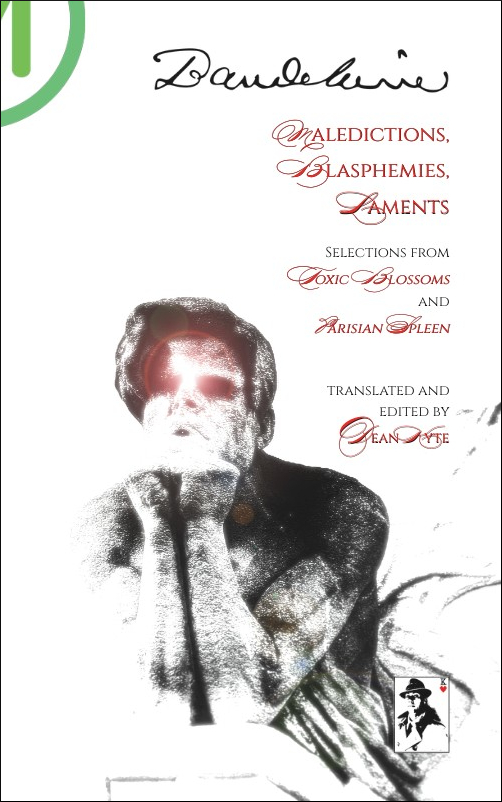
Front cover image of the softcover edition of “Maledictions, Blasphemies, Laments: Selections from ‘Toxic Blossoms’ and ‘Parisian Spleen’”, by Charles Baudelaire, translated and edited by Dean Kyte.
A preview of Maledictions, Blasphemies, Laments: Selections from Toxic Blossoms and Parisian Spleen, by Charles Baudelaire, translated and edited by Dean Kyte.

This new book, whose layout and design I finalized last month in Brisbane, is scheduled for release at the end of June. It features one-fifth of the total number of poems featured in the three editions of Les Fleurs du mal which Baudelaire (and then his mother) saw through the press, and one-quarter of the prose poems from Le Spleen de Paris.

At the time of writing, I have translated 89 per cent of the poetic and prose-poetic content I intend to include as a representative selection of Baudelaire’s æsthetic philosophy of flânerie.

And as a bonus that bridges his poetic and prosaic œuvres, I have decided to do a brand new translation of the only work of fiction that Charles Baudelaire is known to have written, La Fanfarlo. As one of the last tasks remaining before I bring this book to print, I will commence drafting that translation this month.

With a substantial critical monograph on Baudelaire and full-colour illustrations, Maledictions, Blasphemies, Laments is going to be a very handsome volume in both its hard- and softcover formats and a valuable introduction to the work of the first philosopher of flânerie.

To register your interest in purchasing one of the first copies in June, I invite you to avail yourself of the contact form below and join the mailing list as I send out monthly updates to my readers.

Go back

Your message has been sent

Warning
Warning
Warning.

Another way you can support my work and keep abreast of developments is by purchasing the audio track of “O Brisbane! O Baudelaire!” featured in this post via my artist profile on Bandcamp.

Using the link below, for $A2.00, you can become a fan of your Melbourne Flâneur on BC and stay in the loop as I drop new tracks and merch.

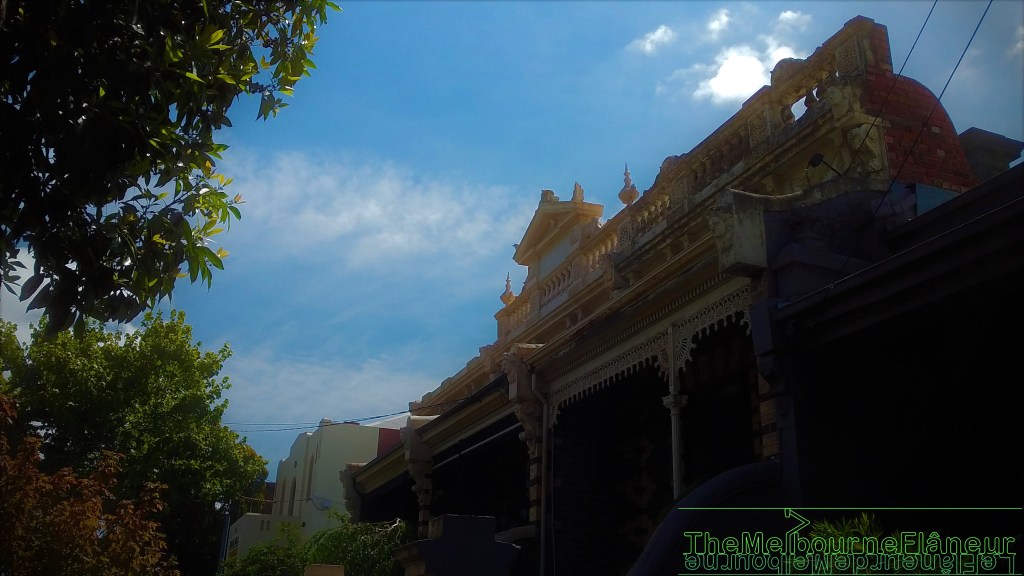
The Melbourne Flâneur returns to Bellingen, NSW, and, in this lyrical prose poem enhanced with Super 8 film footage, ponders a flâneurial figure in the landscape even more conspicuous than himself—‘the Mem Hall’.

When God decides my days are done, perhaps then He’ll allow me to settle in Bellingen.  Perhaps then He’ll permit me to be as permanent as that pile, the hall in Hyde Street whose peachcoloured walls, for a hundred years, have overlooked it all—even my errances and romances.

At times my eyes gloss the Memorial Hall with the memorious glaze des jours perdus, and the faded veneer of flâneurial souvenirs recover their lost colours.

For we have both been secret historians of this place, observant actors in the life of Hyde Street.  His soldierly, literary footprint is sole and secular and unerasable while mine have been many, mobile and cancellable.

A holy light dawns about his walls and whole falls of buried memory cascade out of obscurity for me.

I hear an aura lingering in Maam Gaduying, scene of solitary sittings in wintry dusks, of escalations of les dames, things I’ve written about or hidden histories I am yet to write, but which the Mem Hall, whole library of unfiled memories, has watched, his façade regarding me as I act out my hours of drama in the Meeting Place Park.

The pillared bras of his façade have embraced it all; the corniced brows of his windowed yeux have watched me curiously through the years.  I’ve read my Parisian poèmes on his scène, and opposite, au parc, I’ve acted out my Parisian vie de flâneur in Bello’s narrow boulevard de Hyde Street.  For there is une autre espèce de flâneur—rooted, loitering—and the Mem Hall, in his commanding prospect de la rue, epitomizes him.

Perhaps one day mes os, in Bello, will be as permanent as the Mem Hall’s walls.

— Dean Kyte, “The Memorial Hall”

When duty called me up to the North Coast for two weeks in February, it had been twenty months since I had last seen Bellingen and a lot had happened during that time—very little of it unambiguously positive.

I dare say that the lifestyle of flânerie, seeking to fly by the nets of society at every turn, made the pandemic a more uniquely painful event for someone like myself who is both a Melburnian by election and a flâneur by inevitability.

And while I seemed, despite my lifestyle of country-wide travel, to come through the pandemic without either the CV or the vaccine ever touching me, the years 2020 through 2022 seem to run together for me in a lasting mental fog, leaving a scar on my life from which I’m still recovering.

Hence Bellingen in June of 2022, at the time when the images above were shot on Super 8 and digital video, seemed a very distant place when I saw the Memorial Hall for the first time in its new blue-and-cream livery in February.

Now I am coming rapidly—sadly—to the end of two months spent at Urunga, the town next door to Bello, which has allowed me to get across on a few occasions to the little town which ranks easily for me with Paris and Melbourne as a world capital of flânerie.

There was one Sunday in June 2022, just before I was due to depart Bellingen, when I spent a cartridge of Kodak Vision3 50D Super 8 film on two visions typical of the years I lived in Bello, including the Memorial Hall—affectionately known by the locals as ‘the Mem Hall’.

I had mentally budgeted out the three-and-a-half minutes of film available on the cartridge and knew exactly what shots I wanted from the two locations. And as is my usual practice when working with Super 8, I took back-up shots from the same set-ups using my trusty Olympus Stylus digital camera and recording location sound with my TASCAM digital sound recorder.

The only issue with the Mem Hall location, shot from the corner of Maam Gaduying, the ‘Meeting Place Park’ in front of the Bellingen Library, is that, at the time of my holiday in June 2022, temporary fencing garnished with a dirty great banner advertising Coffs Harbour Demolitions was set up before the doors of the Mem Hall.

Were they going to pull down our beloved, historic Mem Hall?

Fortunately not.

It was about to undergo renovation—including a new paint job—and although I had to grumpily contend with the banner and fencing prophesying the Mem Hall’s imminent demolition while I was filming it, when, in February, I saw the most iconically ‘Bellingen’ piece of architecture in Hyde Street for the first time in twenty months, now cream and blue instead of the surreal shades of rosy peach and apricot I had always known it as, I was glad that I had had an opportunity, on my last trip, to shoot it on Super 8 as I remembered it and had always experienced it—banner, fencing, and all.

This is not to cast shade on the new façade: I was blown away by the cream and blue. It gives the Mem Hall a more ‘Mediterranean’—rather than tropical—feel, and I actually prefer the new colour scheme.

But on Super 8, cream and blue would certainly not have come out as spectacularly as that peachy orange directly taking the rays of a Sunday afternoon in winter, reminding me, under the hybrid digital treatment I give those shots in the video above, of afternoons I spent sunning myself—gelidly, it seemed—in the Meeting Place Park.

For all the pseudo-Moorish intimations of the Mediterranean the new paint job gives it, whether in cream and blue or a rosy peach and apricot, the most iconically ‘Bellingen’ building in Hyde Street still manages to be marvellously surreal.

We can see the resulting building, a weird exercise in inclusiveness, and an attempt to reconcile irreconcilable functions: a library, a cinema, a dance hall, a theatre, an auditorium, a kitchen, a tea room, toilets, a war memorial and whatever other use you can make of it. Perhaps, in an exaggerated way, it reminds us that all buildings are like this. But at various meetings or in preparation for them people must have sketched designs that included space for the Literary Institute and library, absorbed the functions of the old School of Arts, made ‘provision of exclusive rooms for the use of returned soldiers’, tried to placate the view that ‘there was no form of sacrifice whatever about a hall and picture show as a memorial’. And in these drawings they would have accommodated or got rid of existing makeshift structures like the picture theatre and the dance floor. Rather than the result of a collaborative process consummated by a set of architectural drawings, it seems like the Hall designed and built itself in a self-steering process that went on over the heads of the individuals involved, like a demented version of Adam Smith’s guiding hand.

— Ross Macleay, “The Memorial Hall”, On, in, from, over, Bellingen (2013, p. 149)

The prose-poetic commentary to the video above falls into that category of my œuvre I am now consciously styling as ‘flâneries’—literary peregrinations through sensibility, variously poetic, essayistic or fictional, which arise from my wider wanderings through this country, outside the Melbourne which forms the geographic basis for the prose poetry in The Spleen of Melbourne.

And though it probably sounds like a scoffable claim to mention the name of Bellingen (a town which, even in this country, few people have heard of) alongside such world-class centres of flânerie as Paris and Melbourne, I mean the claim quite seriously.

As much as Paris and Melbourne, Bellingen stands at the absolute centre of my literary life, and I would not be the writer and filmmaker I am today but for thirty months I lived there between 2014 and 2016.

While certain ‘regional writers’ become poetic spokesmen for a place, unofficial laureates of certain cities, communicating the genius loci to readers further afield, I am hard pressed to think of another writer for whom the specificity of place and time is as salient as it is to my work, and yet who has as wide an experience of geographically specific places and times.

Thus, while there was a ‘Gold Coast period’ of my literary life, and there has been ‘Parisian’ and ‘Melburnian’ phases, there has also been the ‘Bellingenian period’, and my years in Bellingen stand in respect to the Melburnian period as my years on the Gold Coast stand with respect to Paris.

Which is to say that Bellingen did not quite ‘complete’ me as a flâneurial writer and filmmaker, but that it is the place, like Paris, where I had the first opportunity to practically implement the evolving principles of my æsthetic lifestyle philosophy of flânerie—the praxis of a theory I had developed to a certain point of refinement in other landscapes, at other times of my literary life.

In the flâneurial video essay “On having left, but not yet having arrived”—also partly shot on Super 8—I say that Bellingen was ‘the scene of my longestlasting happiness’: splenetic, ennuyé, utterly Baudelairean soul that I am, never was I more consistently happy in my life than during the years I lived in Bellingen.

Only Paris approached it for the number of ‘jours parfaits’ I spent there.

Hence they are, though hemispheres apart, elliptically linked on the prime meridian of flânerie: these are the epicentres of a new and fruitful æsthetic life.

When I left Paris, I wept for weeks like a man who had lost the love of his life—and indeed I had, having seen—in the arms of a Parisienne—a vision of holy wholeness in my dying hours there which I have committed the rest of my life to prophesying and proselytizing.

When I left Bellingen for Melbourne, it was on account of a woman I could no longer bear to see in the Meeting Place Park, or at the IGA, in company of another man, and although I went forward with excitement to the next scene of my literary life, I carried as much buried mourning for the woman—and for Bello—as I had done for Paris and the Parisienne.

There are two paradoxical modes of Parisian flânerie, the wandering walk and the lingering loiter, both of which allow observation of the life of the street.

And as I say in the video above, if, in my years of living in Bellingen, I made a Parisian boulevard of Hyde Street in my dandiacal circuit up and down it, the Mem Hall, in its vantage-point overlooking a particularly animated corner of Bello’s main street, represented, in its outrageous livery of peach and apricot, the other pole of flânerie, observing the spectacle of the passers-by rather than being itself an active, ambulatory participant in that spectacular parade.

Equally, the Mem Hall observed me, many times a day, swanning past its portals in both directions. It had the privilege of observing me doing so at all hours of the day and night in those years, and not infrequently, in those endless hours of happiness, in the midst of some flâneurial experience—often with a woman—that would afterwards find its permanent record in my writing.

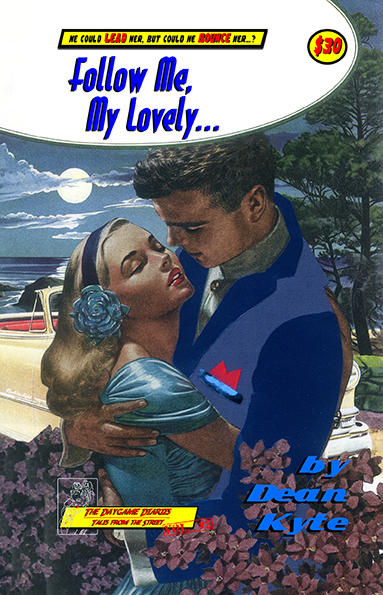
It was past the Mem Hall, for instance, that I marched the beautiful, enigmatic Emma in Follow Me, My Lovely… (2016), and it was within sight of the Mem Hall, at the corner of Bridge Street, that I first attempted to ‘mash a pash out of her’.

We set out, manoamano, shouldertoshoulder in the cold, clear air of 3:30 a.m. I built a little light rapport with her by laying out the thumbnail version of how I came to be in Bello, but I was tired of unwinding that yarn and didn’t do it as well as I might have. At the corner of Ford Street, we turned right onto the main drag and walked along the brickpaved sidewalk fronting the park.

In retrospect, it seems to me that there had been enough time in the space of that short block to build sufficient rapport with Emma in order for her to feel comfortable with me, yet I couldn’t say just when I had first become aware that I would have to make my move. I think I only became conscious that the moment of truth was fast approaching and I would have to physically turn her steps towards the river when we passed the Mem Hall.

— Dean Kyte, Follow Me, My Lovely… (2016, pp. 34-6)

In Follow Me, My Lovely… the Mem Hall plays a cameo rôle, having been, before the action of the story begins, the place where I first espied Emma at the Barefoot Boogie, a dance party that used to take place there on the night of the full moon during the years when I lived in Bello.

And in another reminiscence of my years in Bello, a longer work, as yet unfinished, called “Sentimental Journey”, the Mem Hall plays a more salient part. It’s the place where my tale begins, when, in the hours before I am due to get on an overnight train to Brisbane, I see Polanski’s La Vénus à la fourrure (2013) there, an event which, by obscure tangents among the degrees of separation in my rather extensive social network in Bellingen, leads me unexpectedly into the arms of another woman.

She plunged her arm into mine and we rounded the corner into Hyde Street….

While she jawed, I cast a cautious slant around as we stepped off the kerb in front of the post office: beside us, Bridge Street was an empty corridor of darkness illuminated by a solitary streetlamp at the other end of Lavenders Bridge.  Across Hyde Street, a lonely brother to it loafing in front of the Mem Hall craned its neck over the main drag, the rose façade lit a livid orange by its yellow glare.

If anywhere in the world was a more romantic playground for seduction than Bello at night, I hadn’t yet experienced it.

We forded Bridge Street and regained the kerb—the kerb where I had tried to mash a pash out of Emma and had told her to come back to my place.  We passed it, walking through those ghosts, and changed tracks, shunting onto the spur of footpath leading into the Meeting Place Park.  A trio of lamps, spaced out in a loping curve, followed the line of the wide brick path sweeping round to the library and council buildings.  Their ramrodstraight figures picked out among the trunks of the eucalypts, almost as straight, on the green sward made the park seem vaguely like an image by Brassaï, reminding me of Paris.

At a lonely hour in the early evening, I sometimes liked to sit here alone, watching the traffic roil around the intersection as I huddled against the cold on the pew in front of the historical museum.  I scoped it out now as a potentially discreet venue for escalation: a lampadaire planted in the Lunchbox Garden in front of the council offices cast an oblique, chiaroscuro glare on that corner.  It wasn’t mood lighting, but it did raise some harsh shadows, and if we huddled at one end of the pew, we should be reasonably protected from view of the street by the corner of the red telephone box and the extension of the Neighbourhood Centre.

— Dean Kyte, “Sentimental Journey”

As I say in the video essay above, both of us, the Mem Hall and myself, have been secret historians of Bellingen, memorious flâneurial observers of otherwise unremarked moments in the life of Hyde Street. The Mem Hall has watched me conducting my vie de flâneur just as I have watched the colourful characters in Bello’s streets.

And I think it is no geographic accident of synchronicity that the Mem Hall, the original ‘literary institute’ of Bellingen, faces the present town library, for as I intimate in the video essay, the building seems to me a vast cabinet of unfiled memories, leaves of time—so sheer as to be invisible—of all it has witnessed in its century of life, the secret history of the town which no one yet has had the soul and vision, the heart and spirit of service to properly write.

As I said in a previous article on Bellingen, a few well-known men of letters have, for a season of their lives, made a home for themselves in Bello, and by far the most famous of these writers is Peter Carey.

Carey, who lived here in the eighties as a tree-changing refugee from Sydney, sets Oscar and Lucinda (1988) in the vicinity of the Gleniffer Hall, but Carey’s historical novel lies well beyond what Henry James calls ‘the visitable past’—the rememberable history of one’s own lifetime and experience.

As the young James, flush from his first adult experience of the Roman relics, wrote his sister Alice, unless one’s mind is veritably sagging beneath the weight of material facts about the subject, historical fiction, for a novelist, is the least worthwhile pursuit: ‘The present and the immediate future seem to me the best province of fiction—the latter especially—the future to which all our actual modern tendencies and leanings seem to build a sort of material pathway.’

As far I know, the high-flying Carey has written nothing to commemorate ‘the modern tendencies and leanings’ of his time in Bellingen, one of the most artistically fruitful places on earth, the very Mecca, in my view, of a global ‘Vita Nuova’ towards which Bellingen, in its present and by its example, builds a material pathway.

I take it as a point of pride that, as the least well-known among the men the letters who have made a temporary life for himself in the landscape of this ‘Promised Land’, I have been the most committed to memorializing the visitable past of my experience in these climes.

And as an unofficial historian of the unnoticed hours of Bellingen life, I see a co-conspirator to my project in the architectural figure of the Mem Hall itself, who reminds me of the eponymous character in Jorge Luis Borgesficción Funes, el memorioso (1942).

Nosotros, de un vistazo, percibimos tres copas en una mesa; Funes, todos los vástagos y racimos y frutos que comprende una parra. Sabía las formas de las nubes australes del amanecer del 30 de abril de 1882 y podía compararlas en el recuerdo con las vetas de un libro en pasta española que sólo había mirado una vez y con las líneas de la espuma que un remo levantó en el Río Negro la víspera de la acción del Quebracho. Esos recuerdos no eran simples; cada imagen visual estaba ligada a sensaciones musculares, térmicas, etcétera. Podía reconstruir todos los sueños, todos los entre sueños.

Dos o tres veces había reconstruido un día entero; no había dudado nunca, pero cada reconstrucción había requerido un día entero. Me dijo: ‘Más recuerdos tengo yo solo que los que habrán tenido todos los hombres desde que el mundo es mundo’. Y también: ‘Mis sueños son como la vigilia de ustedes’. Y también, hacia el alba: ‘Mi memoria, señor, es como vaciadero de basuras’. Una circunferencia en un pizarrón, un triángulo rectángulo, un rombo, son formas que podemos intuir plenamente; lo mismo le pasaba a Ireneo con las aborrascadas crines de un potro, con una punta de ganado en una cuchilla, con el fuego cambiante y con la innumerable ceniza, con las muchas caras de un muerto en un largo velorio. No sé cuántas estrellas veía en el cielo.

At a glance, we notice three glasses on a table; Funes, all the stems and branches and fruits that make up a vine. He knew the shapes of the southern clouds at dawn on 30 April 1882 and could compare them in his memory with the grain of a book bound in Spanish leather he saw only once, and with the lines of foam raised by an oar in the Rio Negro on the eve of the Battle of Quebracho. These were not simple memories: every visual image was linked to sensations—muscular, thermal, and so on. He could reconstruct all his dreams, all his dreams within dreams.

Two or three times he had reconstructed a whole day. He had never hesitated, but each reconstruction had required a whole day. He told me: ‘On my own I have more memories than all the men since the beginning of the world have had.’ And also: ‘My dreams are like the insomnia you fellows have.’ And also this, towards dawn: ‘My memory, sir, is like a garbage dump.’ A circle on a blackboard, a right-angled triangle, a rhombus; these are shapes that we can fully visualize. To Ireneo, the same thing happened with a colt’s wild mane, with the very tip of a knife, with the protean flames and innumerable ashes, with the many faces round a dead man at a large wake. I don’t know how many stars he saw in the sky.

— Jorge Luis Borges, Funes, el memorioso (1942 [my translation])

Like Ireneo Funes, the Memorial Hall, to me, is infinitely memorious of Bellingen. It has seen—in the most exquisite detail—everything that has passed before it in its century of life.

It is truly a book of days.

And although, in its infinite discretion, it does not speak of what it has seen as I have privately journaled it, the Mem Hall remembers everything that has passed before or within it—including my presence on its stage, reciting my Parisian poems at the annual Poetry Slam, and upon the stage of the Meeting Place Park opposite, solitudinously sunning myself at dusk or making out with some dame after dark.

But I’m not entirely alone in this self-imposed project to be a flâneurial historian of Bello, the memorious recorder of its forgotten hours. One local writer I have respect for, and who seems to be involved in an analogous, albeit more ‘official’ project of public memoration, is Ross Macleay, one half of the North Bank Institute, Bellingen’s oldest—and smallest—think tank.

In “The Memorial Hall”, one of the essays in his collection On, in, from, over, Bellingen (2013), Macleay tells us that the ‘Soldiers Memorial Hall and Literary Institute’ opened to great civic fanfare on Wednesday 19 January 1921 with (among other visual confections) a presentation of Charlie Chaplin’s comedy “Sunnyside” (1919).

Describing the cinematic bill of fare on that night in his essay, Macleay explains how ‘the Mem Hall’ as Bellingenians know it today had not even been built on that fateful date, the ‘Grand Opening Night’ of the Bellingen Memorial Hall Pictures being a fundraising event to build the pile on Hyde Street.

The Memorial Hall began its life as a war between two motions passed at two meetings. At the first on 4 December 1918 a motion was passed to build a War Memorial in Bellingen at a cost of no more than ₤500, and a committee of twenty was formed. At the second on 6 June 1919 the original motion was cancelled, a substantial majority voted to build a memorial hall instead, and the committee, trimmed from twenty to seventeen, was given the job of raising funds. The building of the hall would be a war on two fronts, the first was against those who thought a monument was more fitting for military commemoration than the frivolity of a pleasure dome (plus easier and cheaper). The second was the long campaign to raise the money.

— Macleay (2013, pp. 147-8)

The money came, as Macleay tells us, from the showing of movies, and on 19 January 1921, the good burghers of Bello crowded onto the site of the present Mem Hall, under an open-air shed set up as insurance against the rain, to see Charlie Chaplin, Sessue Hayakawa, and a Pathé newsreel at ‘two shillings for a chair up the back, one for down the front on a log, and children [at] half price.’

Thus, from its inception, the Mem Hall, doing surreal double service as a perpetual monument commemorating local casualties in the Great War and as a meeting place for the celebration of living culture in a small town, secularly profaned itself as a picture show.

My first experience of the Mem Hall was when my friends dragged me along to see a John Pilger documentary in the great barn behind the façade—a fragrant experience spiced with the familiar scent of the chai tea concession set up on two trestle tables on the eastern side of the salle.

John Pilger, chai on the side, and barefoot kids running wild: that sums up both the experience of the Mem Hall and of Bello—of the Mem Hall’s significance to Bello life as a communal meeting place. It was at that screening, as I now recall, that I met several of the people who would become significant to me in those years, and among whose ranks, in my hats and suits, I would be the most unlikely ‘hippie’ by comparison.

As I have written in another of my flâneries, ‘the elevating experience of “enlightened” leftwing documentaries spiced with chai tea at the Memorial Hall’ is one of the typical memories I most cherish about Bello.

And that says so much about the centrality of the Mem Hall to Bello life. When I was in Euroa two years ago and attending a presentation of the documentary Happy Sad Man (2018) at the Euroa Community Cinema (which is also housed in the shire hall), the film’s Melbourne-based director, Genevieve Bailey, told the assembled townspeople that she had recently screened her doco at Bellingen, a little town in NSW, she said, not dissimilar to Euroa, and in a hall not unlike the Strathbogie Shire Council building.

As probably the only person in that room besides Ms. Bailey to have an experience of both venues—and then far more extensively, as regards the Mem Hall, than Ms. Bailey herself—I knew in my heart and my gut the visceral truth of the comparison she was making.

I love Bellingen as much as I love Paris—and I love these places as much, and in the same way, as some of the dearest women I have known.

And as I say in the video above, one day I hope my flâneries will at last be done and I can permanently rest my bones in Bello.

To read more about my flâneurial adventures in Bellingen, you can purchase Follow Me, My Lovely… in the Dean Kyte Bookstore. You can also support my work by purchasing the soundtrack of “The Memorial Hall” for $A2.00 from my artist profile on Bandcamp using the link below.

A silent film at the Art Gallery of NSW in Sydney inspires a quick and dirty flâneurial video essay by Dean Kyte.

«Le spectacle n’est pas un ensemble d’images», notait Guy Debord en 1967, «mais un rapport social entre des personnes, médiatisé par des images». Un tel rapport social définit très précisement l’hysterie. C’est donc bien cette névrose généralisée qui caractérise la «société du spectacle». Le spectacle n’est pas «le capital à un tel degré d’accumulation qu’il devient image», c’est l’aliénation capitaliste devenue si générale et irrécusable qu’elle engendre une folie universelle. Le spectacle est l’aspect clinique de cette folie.

‘The spectacle is not an ensemble of images,’ Guy Debord would remark in 1967, ‘but a social relationship between people mediated by images.’ Hysteria is very precisely defined by just such a social relationship. It is therefore indeed this generalized neurosis which characterizes the society of the spectacle. The spectacle is not ‘capital accumulated to such a degree that is becomes image’, it’s the alienating effect of capital become so general and indisputable that it engenders a universal madness. The spectacle is the clinical aspect of this madness.

— Michel Bounan, La folle histoire du monde (2006, p. 109 [my translation])

In my æsthetic philosophy of flânerie, by far the largest branch is given over to the constellation of networked problems that arise from the issue of modernity.

Flânerie is a strategy that certain rare, dandistic men will always choose for gracefully surviving modernity:—for the accoutrements of modernity are products of civilization, and the condition of ‘civilization’ itself is produced precisely by the accoutrements of modernity.

Le dandysme apparaît surtout aux époques transitoires où la démocratie n’est pas encore toutepuissante, où l’aristocratie n’est que partiellement chancelante et avilie. Dans le trouble de ces époques quelques hommes déclassés, dégoûtés, désœuvrés, mais tous riches de force native, peuvent concevoir le projet de fonder une espèce nouvelle d’aristocratie, d’autant plus difficile à rompre qu’elle sera basée sur les facultés les plus précieuses, les plus indestructibles, et sur les dons célestes que le travail et l’argent ne peuvent conférer. Le dandysme est le dernier éclat d’héroïsme dans les décadences…. Le dandysme est un soleil couchant ; comme l’astre qui décline, il est superbe, sans chaleur et plein de mélancolie. Mais, hélas ! la marée montante de la démocratie, qui envahit tout et qui nivelle tout, noie jour à jour ces derniers représentants de l’orgueil humain et verse des flots d’oubli sur les traces de ces prodigieux myrmidons.

Dandyism appears especially during those transitional periods when democracy is not yet omnipotent and aristocracy is only partially debased and tottering. In the strife of these periods, certain classless, idle men, fed up but all of them flush with native force, are capable of conceptualizing the plan for the foundation of a new type of aristocracy, all the more difficult to break since it will be based upon the most precious and indestructible faculties, and upon divine gifts that cannot be conferred by labour and lucre. Dandyism is the last spark of heroism in the age of decadence…. [It] is a setting sun: like the declining luminary, it is superb, without heat and full of melancholy. But, alas, the rising tide of democracy, which seeps into and levels everything, daily drowns these last representatives of human pride and pours upon the traces left by these prodigious Myrmidons a deluge of oblivion.

— Charles Baudelaire, Le Peintre de la vie moderne (1885, pp. 94-9 [my translation])

In his critique of the Paris Salon of 1846, Baudelaire ended his diatribe with a manifesto proclaiming the heroism of modern life, declaring that the dandy’s black frock coat, so abused by the literati of his day as ‘unpoetic’, was the armour that the modern cavalier must wear, bearing upon his thin, bowed shoulders ‘the symbol of a perpetual mourning’—a cross as potent as Parsifal’s.

‘Modernity’ is as much a myth as ‘antiquity’, and as Louis Aragon says in the preface of his surrealist classic Le Paysan de Paris (1926), for the dandistic, flâneurial poet, bopping about the city in his sensual derangement, a new mythology of our modern condition springs fruitfully up at every step.

I notice in my own case, starting now to give an occasional live recitation of pieces from The Spleen of Melbourne CD, that my surreally Parisian vision of Melbourne has for my fellow citizens something of this effect: places and names rendered banal by familiarity are suddenly seen anew through the prism of a poetic prose; and it may be that the heroism of the urban everyday, the ‘actless act’ of observant walking, the flâneur’s fashionable swagger through the suburbs, will one day be thought as heroic a processional as the Snowy horseman’s ride.

But the problems of modernity give way to those of post-modernity, which is both imminent threat and immanent opportunity.

This is the penultimate period of the Spenglerian decline, the democratic tide of decadence risen so high that only the stiffest necks can pretend it isn’t up to their chins.

In our times, those stiff-necked captives are the Baby-Boomers, children of a liberal, international rules-based order. And at the other end of the spectrum, the poor souls trying to breathe underwater, are the Zoomers.

Neither demographic, I contend, has any idea what is going on, and both, in the chauvinism of mutual ignorance, are vociferous in prescriptions downward and proscriptions upward.

The Boomers, being thoroughly analogue people, cannot imagine a mode of life that is thoroughly mediated by the digital spectacle, and the Zoomers, who have no living experience except of an existence thoroughly mediated by imaged surfaces, cannot imagine a halcyon, organic time that was not exclusively dictated by 1’s and 0’s.

Only Generation X and the older Millennials—those of us who gained our majority before September 11, 2001—are really in a position to survey the salience landscape of opportunity and threat with something like a clear-eyed assessment.

As the waters rise around us in the West, those of us born between, say, 1966 and 1983 stand with one foot planted in a living memory of where humanity has been—its analogue history—and one in an imagining of where it must evolve to—its digital future.

We’re not digital natives, more like émigrés from the analogue to this new salience landscape. We’re forty years and more wandering in the desert, somewhat adapted to life in these climes but with a living remembrance of ‘the Old Country’ behind us.

As splenetic and depressive a soul as Baudelaire, as thoroughly ennuyé with life in the twentieth and twenty-first centuries as he was with life in the nineteenth, and as one who, like Baudelaire, was utterly alone in decrying the bourgeois myth of progress, scuttling my whole future in the 1990’s to become (of all unremunerative things) a ‘writer’ when it was unfashionable to believe that the bottom would soon drop out of capitalism, democracy and modernity, I smile with benign contempt at the leprous grifters online who now making a living sounding the bell about the decline of the West.

It is only now, as they start to take on ballast with every breath, that they can taste the salt in the air.

I made a fatal choice that I wasn’t going to buy in to this bourgeois myth of modernity, but that a ‘New Myth’ of modernity did indeed need to be written;—and that it had to be written; that the old analogue craft of taking a pen in one’s hand and shaping a thought on paper that was eminently ‘functional’, fit for its purpose but elegant in its form, could not be superseded by plastic keys, digital screens and spellcheck.

I was one of the few who actually drew the line in the sand of technological convenience beyond which I refused to cross when the stakes were still low enough to be containable, and I have held the line implacably, foreseeing the moral cul de sac of Web 2.0.

As analogue people, the Boomers are enthused by this ‘brave new world’, seeing nothing but exhilarating opportunity in the digital, while, as digital natives, the Zoomers, living with the moral consequences of a reified spectacle, see nothing but nihilistic threat in the social networking affordances of Web 2.0.

And observing the hopelessness of the younger generation—these young folks who were born after a time when a moral calculation on the relative costs and benefits of technological, capitalistic modernity could be made, and who are thus in no way responsible for the place, underwater, where they find themselves—as I said to someone recently, it feels, as a Gen-X/Gen-Y cusper, that the fatal decision I made on the verge of my majority to stove in my boat and go down, to pursue humanity over technology whatever the personal cost, to be a writer rather than a technocrat, was a premonition of the Zoomers’ future.

What I chose as a poet-prophet of the present has been forced upon them as an inevitability, and as the tide rises, the decline’s coming for us all.

Quand le monde semble une prison et l’existence une impasse, quand la conscience se révolte contre le lieu qu’elle occupe, ou quand elle erre désorientée comme dans les pièges d’un labyrinthe, ça s’appelle la mélancolie. Sa victime entretient avec l’espace la plus douloureuse des relations ; elle en éprouve tantôt le manque, tantôt l’excès ; sa finitude lui fait horreur, de même que l’infinitude la terrifie. D’où la recherche mélacolique des ailleurs et des lontains : à l’égaré, le voyage promet un but, au captif une évasion. L’ancienne médecine le savait bien, qui aux malades de l’âme prescrivait de prendre la route — soit pour conquérir un horizon et sortir de leur marasme, soit pour imposer un rhythme aux fluctuations de leur inquiétude.

Le XIXe siècle, âge du spleen, est aussi l’âge des partances. La grande époque des là-bas. De Chateaubriand à Nerval, de Baudelaire à Maupassant, pas un écrivain (laissons de côté les «bourgeois», condamnés aux faux-semblants de leurs circuits touristiques) qui n’entende l’appel du large et n’y réponde à sa manière. L’un, parmi les bruyères de Bretagne ou dans les forêts d’Amérique, rêve de part et d’autre de l’océan aux espaces d’une autre vie…. Le second poursuit jusqu’au pied des Pyramides sa recherche des grands mystères. San quitter Paris, le poète des Fleurs du Mal s’en va … à la poursuite de son désir, ou plonge au fond de l’inconnu … vers la nouveauté d’un ailleurs. Et en 1889, n’en pouvant plus de voir la tour Eiffel confirmer le triomphe des mercantis, Maupassant fait voile vers la Sicile, avant de s’embarquer dans la démence. La puissante rêverie de l’exilé, et la pérégrination romantique vers les prestiges de l’Orient ; l’odyssée toute spirituelle du voyageur presque immobile, et la fuite écœurée loin du monde matérialiste : quatre modes d’évasion qu’a inventés le mal du siècle.

When the world seems like a prison and existence an impasse, when consciousness rebels against the site it inhabits, or when it wanders, disoriented, as if among the traps of a maze, we call this melancholy. Its victim maintains the most painful relationship with space; he feels sometimes the lack of it, sometimes the excess; its limits inspire horror in him just as its limitlessness terrifies him. From whence emerges the sad quest for ‘elsewheres’ and ‘other places’: to the lost, travel promises a goal, to the captive, an escape. Ancient medicine understood this condition well and prescribed the road to those sick at soul—whether to conquer an horizon and thus overcome their slump, or to impose a rhythm on the fluctuations of their anxiety.

The nineteenth century, ‘age of spleen’, is also the era of departures, the great period of going overseas. From Chateaubriand to Nerval, from Baudelaire to Maupassant, there is not a writer who does not hear the call of the open sea and respond to it in his own way—leaving to one side the ‘popular’ writers, condemned to the false pretenses of their touristic parcours. One, on the moors of Brittany or in the forests of America, dreams of the spaces of another life on both sides of the Atlantic…. The second pursues his search for the great mysteries to the foot of the Pyramids. Without leaving Paris, the poet of Les Fleurs du mal goes … after his desire or plunges to the depths of the unknown … towards the novelty of somewhere else. And in 1889, no longer able to stand the sight of the Eiffel Tower confirming the triumph of the moneylenders, Maupassant sets sail for Sicily before embarking for madness. The powerful dream of the exile and the romantic pilgrimage towards famous sites of the Orient; the entirely spiritual odyssey of the almost paralyzed traveler, and the revolted flight far from materialistic society: these are four plan of escape devised in response to the malaise of the century.

— Yves Hersant, preface to J.-K. Huysmans, Là-Bas (1985, pp. 7-8 [my translation])

Thus it is that in France, the nation that, through all its revolutionary social experiments with governance in the nineteenth century, sets the tone of modernity for the rest of the world, all serious writers feel a ‘fruitful despair’ and an urge to set off for ‘somewhere else’—materially different conditions of space and time that are, geographically and temporally, consubstantial with a new spirit of life, their own place and time being dead to them.

Over Easter, traditionally humanity’s solemn feast time for marking the annual cycle of descent and ascent, of death and resurrection, I found my eye caught by a provocative title on YouTube: “Why Young People Want to Die | Derrick Jensen Interview”.

As a survival of the nineteenth-century ‘age of spleen’ into twenty-first-century postmodernity, as the ‘down under’ interpreter of Baudelaire—as ‘là-bas’ – simultaneously, antipodally ‘down there’ and ‘over there’ – as Baudelaire could have wished to get!—your Melbourne Flâneur, trudging the camino of a city and a country in search of a better life than technological, capitalistic modernity has offered us, was sure to be attracted by such a wrist-slitting title!

Apparently Derrick Jensen is a writer. I don’t know Mr. Jensen or his work; I had never heard of him before my eye alighted on this video and have never read any of his books. But I liked the way he conducted himself in this interview and he spoke just as writer should do:—as the conscience—both in the English sense and in the French, as the ‘consciousness’—of his time.

When we hear so much unconsidered chatter on all forms of media, social and otherwise, polluting the sensemaking commons, it’s for those few of us who have mastered the human skills of the métier of writing—the abstract ability to rotate concepts in our mind as you can see Jensen do in this interview, and to consider the modular constructions that can be formed by words and ideas before he speaks—to guide the discourse, for we’re in the crow’s nest and can see both the Old Country behind us and the Promised Land before us.

I bring your particular attention to the section of the interview between 59:19 and 1:03:39 where Jensen talks about his introduction to Guy Debord’s concept of la société du spectacle. It’s a pretty graphic example, I warn you, but that’s to the point.

As Debord states and Jensen explains, in our addictive ‘mal du siècle’, addicted to a global spectacle composed of a mosaic of reified digital images which have colonized analogue reality, the images of human life must themselves become more graphic to deliver even a little hit.

But what is gained by the image’s graphicness comes at the cost of emotion, of connection, of relation to the real person behind the fake image.

Guy Debord, in the sixties, wrote about how if you take away relationship, the spectacle itself becomes boring. … [I]f you take emotion away from sex, if you take any connection whatsoever away from sex, it frankly can get kind of boring. And if it gets boring like that, you have to continue to increase the stimulus to make it so it doesn’t get boring.

— Derrick Jensen

When I heard Jensen’s explication of the spectacle, I was reminded of a quick and dirty video essay I made some time ago in Sydney—the one at the top of this post.

Wandering around the 20th-century galleries one rainy December day in the Art Gallery of NSW, I found myself attracted to an old silent short, Toto exploite la curiosité (1909) by Pathé Frères, playing in the Australian room, one of a number of early French films restored by the National Film and Sound Archive.

The plot is simple enough: A Parisian gamin finds a kaleidoscope lying in the street, picks it up and, as you can see in the video essay, just about goes into sugar shock as soon as he raises it to his eye to view the spectacle of coloured beads within.

Another gosse comes along, curious about the epileptic fit Toto is having in the street, and asks to have a look—with the same result.

Soon there’s a whole crowd of bons bourgeois gathered around Toto, who has had the bright idea of charging a fee to see the spectacle of the kaleidoscope, and almost as quickly, a riot breaks out at this nascent display of capitalistic enterprise, with even the gendarme who comes to restore order jockeying to get a look-see and just about fainting under the force of the spectacle.

What fascinated me were the hand-coloured inserts of the inside of the kaleidoscope, which look to be animated, though I’m not sure. It’s a sophisticated piece of early narrative filmmaking, and with nothing on me but my phone to record a swatch of it, as someone whose filmmaking and videographic style is heavily influenced by pre-Griffith silent cinema, I had to nab a couple of minutes of “Toto exploite la curiosité” as a kind of ‘visual note’ to myself on the level of sophistication it’s possible to achieve with an economy of technique.

But then too, I’m fascinated by kaleidoscopes which, as Toto’s exploitative brainwave shows, are the proto-cinematic spectacle par excellence. As David Thomson tells us in The Whole Equation (2005), whereas the Lumière brothers imagined the movies as a communal spectacle, a single screen we share in the dark, it was their competitor, the enterprising American Thomas Edison, who had the longer vision for the medium, imagining it not as one big screen, but as many small screens that every audience member could voyeuristically enjoy on his own, tuning in to the spectacle of his choice.

In essence, Edison imagined the kaleidoscopic spectacle of television, the personal computer, and even the smartphone.

So the kind of unconscious meta-referentiality in “Toto exploite la curiosité”—the fact that this short French film was in some sense using the kaleidoscope, an invention of the early nineteenth century, to predict, at the dawn of cinema, a spectacularly mercantile, American-inflected future for the medium it could not possibly have imagined—seemed to me a miraculous bit of cinema poetry, one that illustrated a quotation from my reading, an extract from French essayist Michel Bounan’s book La folle histoire du monde (The Mad History of the World).

Bounan, a doctor and friend of Guy Debord, is no longer with us, having died in 2019. This is unfortunate, as I would love to translate Bounan’s short, prophetic book, written in 2006, just before the big uptake in social media, and introduce his premonitory thoughts on the spectacular state of clinical hysteria and mass psychosis we now find ourselves in—and into which the Zoomers have been effectively born—to an Anglophonic audience.

Though he’s writing a whole decade before Brexit and Trump, and he never lived to see the Coronavirus, when I first read La folle histoire du monde mid-way through the pandemic, I was sure that Bounan was coyly referring to events across the Channel and across the Pond, that’s how prophetic his book seems.

And yet social media was not yet really ‘a thing’, as the kids say, when he was writing it.

In the citation I translate in the video essay, Bounan quotes Debord’s fourth thesis in La société du spectacle (1967)—that the spectacle itself is not simply an ensemble of images, but, as Jensen explains, it is a relationship between people that is mediated by images.

And as Debord, in his sidebar commentary on his own work, points out, this thesis is a paraphrase of Marx’s statement in Capital:—that capital itself is not an object, but a social relationship between people which establishes itself via the mediation of objects.

We see both these things demonstrated in the excerpt from “Toto exploite la curiosité”: It is the object of common curiosity, the kaleidoscope, that establishes and mediates the initial relationship between Toto and the other boy. Equally, it is the common object of curiosity, the spectacular object of the kaleidoscope, that mediates the entire social network that assembles on the street around Toto.

And furthermore, as Toto begins to charge the badauds for access to the spectacle secreted within the kaleidoscope (over which, through the law of ‘finders keepers’, he has sole propriety), it is both capital and the spectacle that objectively mediates the relationships of the society around him.

In essence, it is the ensemble of subjective images within the black box of the kaleidoscope that objectively dictates the formation of the social network, its relationship to itself, and its relationship to Toto.

What fascinates me about the kaleidoscope as a proto-cinematic device is that it is the perhaps only instrument of objective vision—quite unlike a telescope or microscope—that projects a purely subjective image. Looking into the black box of a kaleidoscope is like seeing pictures in the abstract shapes of clouds—while looking outward, you see a spectacle within yourself.

We’re now at a point in our evolution where the globe is like a giant mirror ball over which we have glued the tiny subjective screens of our narcissistic reflections projected through the spectacular, kaleidoscopic medium of the Internet. And we have two generations now who have been born into this reified world of digital surfaces applied contiguously over the organic, analogue reality which supports our life and relations with each other.

And that’s Bounan’s ‘universal madness’, the generalized hysteria illustrated in “Toto exploite la curiosité”, the hyper-stimulated relationships without emotion, without authentic human connection Derrick Jensen observes with sympathetic sadness in the young.

On location at Albert Park, the Melbourne Flâneur discusses the noirish prose poetry and literary crime ficciones in his audiobook The Spleen of Melbourne.

Today on The Melbourne Flâneur vlog, I come to you from St Vincent Gardens in Albert Park, the ritziest suburb in Melbourne, where I take you behind the cover of my CD audiobook The Spleen of Melbourne: Prose Poetry & Fiction.

As I say in the video above, I love St Vincent Gardens because it has a sort of ‘place des Vosges’ feel about it with its rows of Victorian terrace-houses boxing in the leafy square. In a moment of splenetic nostalgie leaning back against les bancs in the park, I can imagine myself back in my beloved Paris in those days of heroic flânerie when the productive indolence of walking and writing was my sole occupation.

It’s therefore the perfect Melburnian setting in which to introduce you in-depth to The Spleen of Melbourne project, which unites the most Parisian city on Australian soil with the first city of flânerie.

One of the key characteristics of my flâneurial literary style as a poet in prose on The Spleen of Melbourne CD is geographical precision: I want the listener to walk alongside me in my flâneries, to see exactly in his or her mind what I have seen with my eyes, to hear what I have heard, to share with me the full sensory experience of a real place in his or her imagination.

But as flânerie is a praxis for inducing in oneself an altered state of consciousness, I also want the reader to equally walk with me through a networked conceptual landscape—almost platonic in its forms—which the built urban environment educes from me.

In other words, I want the reader to also experience the thoughts and feelings I have as I flâne about Melbourne.

This geographic precision about the Melbourne of my prose poems is in distinct contrast to the approach that Charles Baudelaire takes with respect to the Paris of his own collection of prose poems, Le Spleen de Paris (1869). For, curiously, there is a conspicuous lack of geographic specificity in Le Spleen de Paris. No streets are directly referred to—not even the inescapable Seine.

This is a curious oversight since Baudelaire is the premier poet of modernity, the first to trade in the sublimity of Nature for the marvellous spectacle of the modern urban scene. As Carol Clark says in her introduction to the Selected Poems (1996), Baudelaire is the first versifier to introduce the ‘indecorous’, ‘improper’ subject of the modern city into French prosody—and the modern city, of course, is Paris, Walter Benjamin’s ‘Capital of the Nineteenth Century’.

Far less than Les Fleurs du mal, the Paris of Le Spleen de Paris, which takes as its ostensible subject this ‘Mecca of Modernity’ whose profane empire of taste has stretched around the globe to intimately influence every city—even far-flung Melbourne—is hardly there as a unifying ambiance, an organizing theme that lends coherence to the collection.

Il est un point par lequel la nouvelle a une supériorité, même sur le poëme. Le rhythme est nécessaire au développement de l’idée de la beauté, qui est le but le plus grand et le plus noble du poëme. Or, les artifices du rhythme sont un obstacle insurmontable à cette développement minutieux de pensées et d’expressions qui a pour objet la vérité.

There is a point through which the short prose account achieves a superiority, even over the poem. Rhythm is necessary to the development of the concept of beauty, which is the greatest and noblest end of the poem. Now, the artifices of rhythm present an insurmountable obstacle to that minute development of thoughts and expressions which has truth for its end.

—Charles Baudelaire, Nouvelles notes sur Edgar Poe, introduction to Nouvelles histoires extraordinaires (1884, p. xii [my translation])

I don’t entirely agree with this statement, for ‘truth’—the absolute vérité—can only be expressed in its wholeness, and that is the purview of poetry. But one must step a great deal back and see things at a lower level of resolution in order to see them in their totality.

Baudelaire is correct in noticing that prose, uncorseted from the straitjacket of rhythm, has a distinct advantage over poetry in being able to report the superficial detail which makes up that totality at a high level of resolution, but this is not necessarily ‘truth’—only the factitious parts of it seen in close-up.

This is the reef against which the analytic, prosaic sentiment founders. A poet pur-sang like Baudelaire, having a holistic, totalizing vision and world-view, sees the harmonious repetition of a beautiful order—its rhythm—throughout the cosmos.

A natural prosateur like myself, by contrast, sees the discordant disjunctions, juxtapositions, enjambments and adjacencies. The lines of logical thought may ‘flow’, as a set of premises to their conclusion, but not with the harmony of rhythm. Each premise as sentence or paragraph must be ‘developed’, like a musical theme, or a leitmotiv. It must be planed and turned and set into the logical architecture only once the prosateur is certain that it can bear the logical load of the next idea to be set upon it.

Thus the Melbourne of the prose poems on The Spleen of Melbourne CD is a very ‘concrete’ city: that built environment of conceptual forms which are consubstantial with actual things the contemporary flâneur will encounter in Melbourne is explicit.

And on the other hand, the Paris of Baudelaire’s Le Spleen de Paris is far less concretely delineated than my Melbourne. It is an implicit city.

Of course, Le Spleen de Paris is a largely ‘posthumous’ work: Published two years after Baudelaire’s death, we know that, at fifty completed pieces, he only achieved half of his projected vision for this collection before the paralyzing stroke which rendered him mute and immobile for the last year of his life.

What the book might have become if Baudelaire had lived to write another fifty prose poems is something we can only speculate on, and there’s debate in the critical literature as to whether Baudelaire even achieved his goal of a ‘poetic prose’ with the first fifty.

Having translated about a dozen of the prose poems in Le Spleen de Paris, I’m not sure myself whether many of the pieces in the collection genuinely qualify as being ‘musical without rhythm or rhyme’.

I’m not flattering myself to say that this discordant intellectual ‘music’ is something I regularly achieve in the prose poems which comprise The Spleen of Melbourne project: I’m a prosateur, and I have a more natural sense of the musical possibilities of the sentence—the sound that is linked directly to concrete sense—than Baudelaire, who more naturally inhabits the much stricter form of verse.

Moreover, the three titles that Baudelaire meditated for the collection complicates the issue of his ultimate artistic intent. Though first published—and equally known—under the title of Petits poèmes en prose (“Little Poems in Prose”), at a certain point early in the composition Baudelaire intended to call the collection “Le Rôdeur de Paris” (“The Prowler of Paris”), which sustains the view that the modern city of Paris, as a unifying subject and theme, is central to a global interpretation of the work.

I think we have to conclude, as a working hypothesis, that if as careful and precise a poet as Baudelaire declines to make explicit references to the contemporary urban scene in his prose poems (which comprise a form which lends itself more easily to explicit geographical precision than restrictive rhyming verse), then this is a deliberate æsthetic decision rather than a clumsy oversight on his part.

If, in a poem like Le Cygne—perhaps Baudelaire’s single greatest work in verse—as in the “Tableaux parisiens” section of Les Fleurs du mal more generally, he can find a way to make clear and explicit geographic references to the colossally disrupted Paris being pulled down and put up around him by Baron Haussmann within the restrictive straitjacket of the alexandrine, then there is no reason why he could not have taken the same high-resolution approach within the freer form of the prose poem—a form Baudelaire was essentially inventing.

Even if we allow that the corpus of prose poems Baudelaire has ultimately bequeathed to us in Le Spleen de Paris is only half-complete, there are simply too many of the fifty pieces that make some reference, however vague and anecdotal, to contemporary life in Paris under the Second Empire, for us not to provisionally conclude that his vagueness is an æsthetic strategy of some kind, though to what end it seems difficult, in light of the ‘inachevé’ nature of the work, to say.

Thus, while the Paris of Les Fleurs du mal is paradoxically ‘explicit’, clear-eyed, sharply defined, and high-resolution when it would seem that the extreme brevity, condensation and restriction of the verse form would call for a ‘softer’, more global and holistic vision of the modern city, the Paris of Le Spleen de Paris is ‘implicit’: it has this softer, vaguer quality where the freeness of the prosaic form would easily allow for cleaner lines and a sharper delineation of detail—an altogether more remorseless and unsentimental approach.

And without explicit geographic signifiers to orient us in space, Baudelaire’s mid-nineteenth-century Paris might, with a little mutatis mutandis, be any modern city anywhere.

Which leads me to propose, as I do in the sleeve booklet accompanying The Spleen of Melbourne CD, that Baudelairean Spleen, that ‘bilious melancholy’ and ‘choleric sorrow’ which Baudelaire perceived as a specific quality of modern Paris, is a mood of ‘sinister tristesse’ that attends every modern city everywhere that has been touched by the corrupting tentacle of that ‘empire of taste’ which had its Holy See aux Tuileries—including Marvellous Melbourne.

In reading Baudelaire’s tableaux parisiens redux in Le Spleen de Paris, with their hermetic discontinuity from each other, I am often reminded of those beautiful Japanese screens depicting scenes from The Tale of Genji, the salient ‘images’ of Lady Murasaki’s great novel, the high points of emotion in her long, story-like chapters being separated from each other by labyrinthine clouds of gold ground.

As I have written in one of the novelistic chapters of my Orpheid, my experience of Paris (particularly Montmartre) would be something like living in a Japanese screen where the discreet scenes of one’s existence, the high prosaic moments of flâneuristic exploit and artistic heroism dans le quotidien, were separated from one another by dense, serried hedges of cloud, as though one were wandering through a labyrinth that took in tout Paris.

One descended into the misty maze of the Métro at Lamarck-Caulaincourt and popped up again, by mysterious shifts onto other lines and arrow-led leggings through white-tiled corridors communicating between them, at some other point which had no visual continuity with it, prowled around in that milieu, learning its secret byways, how blocks, streets, whole neighbourhoods connected up with one another, and then re-descended to some other part to do the same again.

And yet somehow, a holistic sense of Paris, of the totality of its detailed organization, emerged by this flâneuristic means of random randonnée just as, in the letter to Arsène Houssaye which prefaces Le Spleen de Paris, Baudelaire proposes the ‘vertebral’ discontinuity of his work as its chief and unique virtue:

Mon cher ami, je vous envoie un petit ouvrage dont on ne pourrait pas dire, sans injustice, qu’il n’a ni queue ni tête, puisque tout, au contraire, y est à la fois tête et queue, alternativement et réciproquement. Considérez, je vous prie, quelles admirables commodités cette combinaison nous offre à tous, à vous, à moi et au lecteur. Nous pouvons couper où nous voulons, moi ma rêverie, vous le manuscrit, le lecteur sa lecture ; car je ne suspends pas la volonté rétive de celui-ci au fil interminable d’une intrigue superfine. Enlevez une vertèbre, et les deux morceaux de cette tortueuse fantaisie se rejoindront sans peine. Hachez-la en nombreux fragments, et vous verrez que chacun peut exister à part. Dans l’espérance que quelques-uns de ces tronçons seront assez vivants pour vous plaire et vous amuser, j’ose vous dédier le serpent tout entier.

My dear friend, I send you a little work of which one is not able to say, without being unjust, that it has neither top nor tail since everything in it is, on the contrary, top and tail simultaneously, alternatively, and reciprocally. Consider, if you please, what admirable convenience such a combination offers to all of us—to you, me, the reader. We can slice it and dice it as we please—me, my reverie, you, the manuscript, the reader, his reading; for I do not keep the restive attention of this latter hanging from the interminable thread of some super-fine plot. Take away a vertebra and the two pieces of this tortuous phantasy will merge together again effortlessly. Chop it up into numerous fragments and you will see that each of them can live on its own. In the hope that some of these sections are lively enough to please and amuse you, I take the liberty of dedicating the entire serpent to you.

—Charles Baudelaire, “À Arsène Houssaye”, Le Spleen de Paris (2000, p. 5 [my tranlsation])

Of course, there was no Métro in Baudelaire’s day, so he is proposing in his work, by a prophetic fantasy, the Ouroboran organization of the modern city Paris will become as a circular snake. Somehow the linear network of discreet vectors which compose the modern city of Paris as designed by Baron Haussmann form a recursive maze which feeds endlessly upon itself.

Thus, in place of geographic specificity in Le Spleen de Paris, we get a proto-Benjaminian catalogue of prototypical things commonly encountered in the implicit city—Paris in this instance, but it could be any modern city touched by Paris’s influence—repeated from prose poem to prose poem.

There is the theme of ‘the streets’ which crops up again and again as the principal linking vector. We are led from the streets back into ‘the room’ in prose poems like La Chambre double and À une heure de matin. Equally, there is the recurrent theme of ‘the park’ in Le Fou et la Vénus and Les Veuves, common ground for mutual civic enjoyment of the urban spectacle. And this theme segues into communal fêtes of marvellous spectacle, as in Le Vieux Saltimbanque.

A thematic organization of Le Spleen de Paris has not, as far as I know, been attempted along the Benjaminian lines of The Arcades Project (1927-40), but I’ve detected at least a dozen discreet urban themes into which the prose poems can be classified and re-classified.

And as per Baudelaire’s boast to Houssaye, if a thematic parcours of Le Spleen de Paris were attempted, one could create a conceptual city—perhaps an almost infinite number of conceptual cities—based upon the combinatorial and permutational arrangement and re-arrangement of the prose poems.

Commerce and fashion’, ‘urban types’, ‘the revolutionary spirit’, ‘sounds’, ‘food’, ‘animals’, ‘crowds’, ‘women’, ‘cafés, libraries, shops’:—In these content niches, into which the prose poems of Le Spleen de Paris can be endlessly categorized and re-categorized, Baudelaire prototypes an implicit modern city from the specific parts of his experience of Paris in the middle years of the nineteenth century.

The implicit Paris of the prose poems is one which we can still recognize today, wherever in the world we are. It is perhaps no coincidence that in the last line of the last prose poem on The Spleen of Melbourne CD, “Milton, when a youth”, I invoke ‘the labyrinthine banality of my habitual solitude as a flâneur in the grand green maze of a great city in the late afternoon.’

Melbourne is not invoked specifically in that line, and indeed, in the prose poem, set in the Carlton Gardens, I disturb my female companion by volubly evoking passionate memories of afternoons passed idly in Paris’s Tuileries Gardens: The two places and times merge momentarily for me, and in ‘the grand green maze’ of time and space linking the suburbs of my life across a universal city in two hemispheres, the city of Paris is implicit in the explicit city of Melbourne.

Paris, as Hemingway said, is ‘a moveable feast’: if you’ve had the good fortune to live there as a young man, you carry it with you wherever you go for the rest of your life.

And thus, Baudelairean Spleen—le spleen de Paris—that ‘bilious melancholy and choleric sorrow’ that modern urban life engenders in us, is equally, for the Parisian flâneur displaced to antipodean climes and damned to walk, as a refugee, down-under in search of his heart’s home, ‘the spleen of Melbourne’, the most Parisian city on Australian soil.

It is urban spleen tout court.

You can purchase your own copy of The Spleen of Melbourne audiobook below. As I say in the video, every copy of the physical CD comes personally signed, wax-sealed as a guarantee of artistic authenticity, and gift-wrapped by yours truly. If you choose to purchase the digital album, you’ll also get a bonus track not on the physical CD itself.

“The Spleen of Melbourne” [CD audiobook]

Personally signed, sealed and gift-wrapped by the author. Price includes worldwide postage. Purchase the physical CD and get bonus MP3 versions of all the tracks absolutely free!

A$31.95

“The Spleen of Melbourne” [MP3 audiobook]

12 MP3 tracks downloadable onto any device plus bonus trailer. 24-page PDF booklet featuring Dean Kyte’s evocative street photography of Melbourne. Worldwide delivery with 24 hours.

A$9.95

824-8 Lygon Street, Carlton North, a typical example of nineteenth-century Melburnian row architecture.  Beyond it, to the left, is the hall of the Società Isole Eolie Melbourne, an art déco gem dating from the period when Carlton was the Jewish, rather than Italian, enclave of Melbourne.  Photograph by Dean Kyte, the Melbourne Flâneur.
824-8 Lygon Street, Carlton North, a typical example of nineteenth-century Melburnian row architecture. Beyond it, to the left, is the hall of the Società Isole Eolie Melbourne, an art déco gem dating from the period when Carlton was the Jewish, rather than Italian, quarter of Melbourne.

When Alizée turned north into Lygon Street out of Fenwick, she saw him wandering slowly in the opposite direction past the Eolian Hall.  His head was turned towards the creamy déco pile, evocative, in its Mediterranean blancheur, of her homeland as it shimmered faintly in the midday heat.  The bottlegreen brim of his Fedora described a gloomy arc of shadow which just veiled his eyes, further occluded by the bluish haze of smoke from his Candela, as he tacked past the hall in a not altogether steady drift, whether dreamily attracted by its magnetism, or faintly oppressed by the rising heat, it was difficult to say at that distance.

He had adjusted his wardrobe to the weather and was wearing the limegreen dress shirt, its French cuffs folded back and cinched together by gold links which matched the garters hitching up his sleeves.  The skyblue waistcoat hung open, exposing a suggestion of suspender where the book, hugged loosely to his breast, pushed back the edge of his vest.  The dark green patterned bowtie was a little askew, its jaunty angle mimicking the rakish slant of the Fedora’s brim.  He wore the checked, mustardcoloured slacks, the breaks of which bounced gracefully over the tan, brogued wingtips of the derby boots along with his slow, loping gait as he sauntered past the hall, regarding it abstractedly and yet with a set to his mouth, around the butt of the green cigar, which implied contentment with life.

Alizée quickened her pace until just before he passed the Eolian Hall completely and turned his head back to twelve o’clock.  When he seemed on the verge of noticing her, she slowed up abruptly to match his casual saunter, raising her right hand, encumbered, as always, with the iPhone, and waved it at him.

—Buongiorno! she greeted him enthusiastically as they closed the distance.

He took the Candela out of his mouth and saluted her with it as he approached.

She came on with her habitual onslaught of high energy, running into him just before the triple row of terraces under the creamy, partly mutilated cornice which dominated this block of Lygon Street, its mascarons, jutting from corbels, projecting from ends of plaster, gazing fixedly into the green wastes of the General Cemetery across the street, stoically ignorant of the exuberant display of affection to their collective left.  For Alizée did not hesitate to kiss him fully on the lips as she flung her arms around his neck, rocking him back a little in his centre of gravity with the collision of her lips as he returned the embrace more equivocally, resting the free fingers of his right hand lightly, briefly on her flank.

—Una bella giornata, vero? she enthused.  Che sole! che cielo!  For once, Melbourne seems like home—though not, I should say, a Natale!

—Sì.  I think we’re past winter now, he admitted coolly as he stepped back from her embrace, returning the green cigar to the corner of his mouth for a quick drag.

He turned his head a little to the right, blew a plume of smoke politely to one side of her, but his hard grey eyes remained firmly fixed ahead, on Alizée, as they took the measure of her very quickly through the veil of smoke.  In an instant, his cool manner had softened a little.  Though the eyes lost none of their probing, assessing quality, they seemed to smile at her.

—You’re not in your shop today.  What are you up to? he asked with amiable brutality.

—Faccio del shopping, she said, holding up the green Woolies bag depending from her left hand.  The bag was very light—empty even.  E tu?  What are you reading?

Without waiting for a reply, she grasped the book, a slim paperback, not rudely, but with a certain proprietorial familiarity, the fingers of her left hand curling around the pages until they were against his shirtfront.  His face wore a faint, wry expression which might have signified amusement or annoyance as he let her take it away from him.

She flipped her wrist back to reveal the front cover.  It was a French giallo.  The cover showed a young brunette, slim with attractive, pointed features—not entirely dissimilar to Alizée herself—in a silk slip with spaghetti straps—rather like the green cotton playsuit she was wearing—squeezing her small tette together and regarding the graceful shadow between them with the proud absorption of feminine possession.  The photograph had been solarized so that the lowlights of the brunette’s skin were weirdly purple and the bronzy slip had been rendered garish and fauvistic.  The title was Le facteur fatal, by an author—a Belgian perhaps—calling himself Didier Daeninckx.

The left corner of Alizée’s mouth made a small reflexive moue.

—Tu lis d’trucs comme ça?

He shrugged Gallically, the end of the Candela sketching a volute of smoke—like a question mark—with the sprezzatura of the gesture.  He gave an impression of being bored by the conversation.

—I just found it in an opshop in Brunswick Road, he said, jerking his thumb back over his shoulder, indicating the direction he had come.  With the vertical movement of the cigar, the question mark crossed itself out.

—Je l’ai acheté pour lire du français.

With a slight inclination of his head,—like a very reduced bow,—he proffered his left hand, palm upward, to her, his eyes, fixed on hers with a polite insistence which seemed, simultaneously, to mock the courtliness of the silent request for repatriation.

Alizée returned Le facteur fatal to him.

There was a brief vacuum in the conversation filled only by the circulation beside them as they regarded each other for a moment of doubtful comfortability, their eyes palpating faces that were still inscrutable to each other even after six weeks.  Alizée broke the pause cautiously.

—I haven’t seen you around for a couple of weeks, she essayed hesitantly;—not since the day we went to Williamstown together.  I thought you must have gone somewhere to see your family—per Natale, perhaps?

His face lost none of its pleasant inscrutability, his eyes seeming to glitter as they squinted through the last puff of smoke he took from the Candela.  He took his time dropping the fuming butt to the asphalt and heeling it out with his derby.  He toed the flattened cylinder towards the bluestone gutter with what seemed a thoughtful bunt of his boot.

—I had to go to… Sydney per una settimana – o giù di lì.

—Ancora una volta?  You were in Sydney last month as well.

Alizée’s eyes acquired a cautiously roguish twinkle.

—Ton métier de flâneur te porte loin.

His eyes searched her face for a halfbeat, and then:

—We never sleep.

Their eyes smiled at each other and her face flushed attractively beneath the Mediterranean tan, although the smile, on his side, did not quite reach his lips.

He broke eye contact with her after a circumspect interval.  A southbound Route 1 tram was passing them, slowing with a screel of its wheels. It braked in the long perspective of Lygon Street under the petrified falaises of the City skyline erupting through the green amoncellement of trees that stood sentry along the fenceline of the General Cemetery.  He watched as it drew to a stop at the corner of Fenwick Street, the train of southbound traffic pausing deferentially in its wake, and three passengers alighted from the B-class, going their several ways with caution.

One of the typical denizens of Yarra, this one an arts student who fancied herself a feminine John Lennon, with dark, round, silverrimmed sunglasses, a loud, mannish shirt and thin black jeans, the hems of which were rolled up to reveal her Doc Martens, passed them bearing a canvas tote over her shoulder, an obnoxious slogan against the government stencilled on the side of it.  He looked down at his brogues and let the girl pass before speaking.  When he did so, it was with an experimental essay at confidence that seemed scrupulously mindful of not appearing too forceful in pressing its suit, too inconsiderate of the manifold reasons Alizée might have for rejecting the proposition.

—Look, he said, I know you have no family in this country, but I understand that you might have other… engagements on Monday.

He paused momentarily.  Alizée declined to take advantage of this fenestration in his speech as an opportunity to rise to the bait it implied.

He went on a deal more softly, and his eyes, though still sharp, still probing, still assessing her visage minutely as he spoke, almost gave an impression, as they narrowed slightly, of having hit upon a happy inspiration couched in the proposition his voice was rehearsing, one he himself had not previously divined.

—Would you perhaps like to take a cheeky avventura with me on Christmas Day? un picnic, perhaps? to an undisclosed location to be advised when your eyes are looking at it?

At the word ‘avventura’, the blue jets in Alizée’s silver eyes flared up appreciably.

—I don’t think it’s going to be as hot as this on Monday, he added as an afterthought, an additional justification to the good; an exculpation of Melbourne’s unbankable weather, of the debatable antipodean pleasure of passing a blazingly hot Christmas Day outdoors more generally—if she needed it.

Alizée did not.  Her face broke into broad enthusiasm at the idea.

—O, un’avventura sounds brilliant!  And if the weather isn’t fine, we will adventure anyway!

A soupçcon of roguish sidelight entered her eye briefly once again as her bangs shook with the enthusiastic upward movement of her head in a jerkish nod—or perhaps it was the sun alighting on her forehead as those parenthetical twin curtains moved briefly aside from their usual halfdrawn position occluding her features.

He seemed a little taken aback by how well this proposta had been received and watched her access of enthusiasm from those removes, the cool depths of assessment, with the wry indulgence of a parent giving a delightful child its head.

—Buono, he said in the next second, when she had settled down.  Then I will make i preparativi.  I’ll go to Rathdowne Street now and pick up a few things.

—Hai bisogno che porto qualcosa?

—Del vino, perhaps.  I’ll leave it to you.  Whatever you like.

—Allora…

—Allora.

His voice had acquired a seductive firmness and his mouth now joined his eyes, as they held hers gently in parting, in a very definite smile.

—A lunedì, he said softly.

—A lunedì—Ciao, caro!

She launched her lips at him again and he took the collision more gracefully this time, though he still demurred to linger long in her embrace.

—Ciao, he said, giving her one gentle pat on the derrière en passant and slipping smoothly past her to continue his southward flânerie, with more purpose in his stride this time.

He made the corner quickly, and when he had rounded it into Fenwick Street, he stopped abruptly just inside.  His eyes were turned down to the pavement and, with the gravity of his reflections, his face slowly resumed its habitual cast of dour pensiveness as his eyes scanned the asphalt for something that was within himself.  His posture seemed to relax of its own accord and he leant his shoulder to the white plaster wall of the house on the corner as he thought.

The persistent passage of traffic and trams behind him did not seem to reach him.

Then, rolling suddenly around, he turned, voltafaccia, towards Lygon Street and the grille of the General Cemetery.  He moved stealthily forward two steps until he presented the narrowest possible profile to the street and, transferring the book to his other hand, reached into the left pocket of his waistcoat.  He produced the small rectangular hand mirror and, holding it down at his hip, angled it back up Lygon Street until, in its arc, it caught the profile of the Maltese ragazza in the olive playsuit with the embroidered bodice.

Alizée had not advanced very far from where he had left her.  She was standing in front of the Eolian Hall and was studying it intently.  Her head turned from left to right, not in the big movements she had used with him, but in small ones, as if she were looking for something—a clue, perhaps, or something she had lost.

Then, as he watched her in the angle of the mirror, his face devoid of expression, she raised the iPhone and took a photo of the pile.

Jean-Antoine Houdon’s Buste de jeune fille (1791), surrounded by works including Gyokusen’s Wagtails by a rocky torrent (Meiji period, at rear) and Monet’s Nymphéas (c. 1914-7, at right).
«Les Créateurs...
veulent l’Éternel.  Ils disent: pierre
sois éternelle...»


Artists...
Desire immortality.  They say: ‘Stone,
May you live forever...’

—Rainer Maria Rilke, Le livre du pèlerinage (my translation)

A quick and dirty video postcard from your humble servant, currently on tour in the bristlingly cold Canberra. It’s the first time that your Melbourne Flâneur has visited our nation’s capital, and as always, for as voracious and avaricious an aficionado of art as I, a flânerie through the National Gallery of Australia was in urgent order.

True to what I have rapidly (and disconcertingly) discovered to be Canberran form, there’s not a lot going on there.

Apart from Jackson Pollock’s Blue Poles (1952), the coup de scandale of the Whitlam Government, most of the international collection is jungled up.

But I did encounter a familiar face—albeit at a distance. Behind the velvet rope in a salle being prepared for a future display, I espied Jean-Antoine Houdon’s Buste de jeune fille (1791), which had been passing several seasons in Melbourne, on loan to the NGV.

That delightful demoiselle was one of the first femmes de Melbourne I met when I decamped down there, and she has always remained one of my favourite dames at the NGV, so much so that I photographed her gracious gorge in situ when she was living in our second city.

Houdon, “Buste de jeune fille” (1791), National Gallery of Victoria.  Photographed by Dean Kyte.  Shot on Kodak T-MAX 400.
Houdon, Buste de jeune fille (1791), NGV-I.
Shot on Kodak T-MAX 400.

I think it’s one of my best photographs: a very shallow depth of field and a reasonably tight aperture at a reasonably fast shutter speed gives the little angel the look of swimming in a starry night. You can just see the ghost of her left profile reflected in miniature—hardly more than a memory—on the inside of the glass cage which was this little bird’s home in Melbourne.

So I was surprised to see ma p’tite chérie out of her box and out of the NGV;—surprised, a little saddened to know I would no longer be able to pay an occasional call on her at her hôtel in St Kilda Road, the Faubourg St-Germain of Melbourne, but also happy to see her free and proud as a figurehead on her new plinth, with a pair of Monets off to one side in her new boudoir, and a beautiful Japanese screen by Mochizuki Gyokusen at her back, draped round her bare shoulders like an exquisite kimono.

I’ve always loved this little girl because, like that glimmering ghost of her double profile mirrored in the glass, she is a link for me with the distant dream of Paris, where I first came to appreciate M. Houdon, one of the great French neo-classical sculptors of the eighteenth century. He was one of those aristocrats of talent, a favourite of both the ancien régime and the enlightened philosophes, who was able—narrowly—to keep his head pendant la Terreur.

He served, in fact, the court of Louis XVI, the cause of the Revolution, the Directory of the First Republic, and the First Empire of the Corsican Gentleman, the immortal Lui. Not a bad bit of politicking for an artist in days when being a priest du Beau was not protection enough to keep one’s head and neck together.

Heads and necks, perhaps unsurprisingly, figure beaucoup in this sculptor’s œuvre.

M. Houdon’s best-known for his busts and statues of the grand personages of the Siècle des Lumières, from Catherine the Great to George Washington. He was particularly well-disposed towards literary gentlemen, and his marble portrait of a seated Voltaire is still enthroned in the library of the Comédie-Française to this day, presiding over that section of la Maison de Molière.

The work is entirely characteristic of M. Houdon, who is almost like a photographer in marble: there is an extraordinary vivacity to all the sculptor’s portraits, which are distinguished by their extreme netteté, a precision of line, a sharpness of definition that puts one in mind of a candid snapshot.

The author of Candide is set before us with sparkling modesty, flirtatiously informal as he sits sans perruque in that work, one of several that M. Houdon made from the subject. There is, in fact, a beautiful small bronze bust of M. Voltaire by M. Houdon in the collection of the NGV which testifies to the great satirist’s generosity of spirit. His crooked, close-lipped smile and benevolent, shining eyes make him almost as great an object in my affection as the Buste de jeune fille.

She is indicative of another significant strain in M. Houdon’s œuvre; for in addition to being a lively and reliable recorder des grands hommes, there is another, more domestic side to this sculptor very much in demand and en vogue through successive French political fashions.

Rather like his late contemporary M. Ingres, M. Houdon was not above putting his precious materials and skills to use in making society portraits, including études of the children of his wealthy patrons which are numbered among his greatest works.

Even more beautiful than the Buste de jeune fille is the darling little portrait in terra cotta of Louise Brongniart, the daughter of an architect, which is one of the treasures of the musée du Louvre. There are nearly 40 photos of the bust on the official website of the Louvre showing the terra cotta study of Louise (who would then have been about five years old) from every angle, and which reveal an alertness, a quiet intelligence, and a sense of character which is truly exquisite in a head small enough to fit into your hand.

The Louvre also possesses a similar, though much later portrait of Louise’s brother Alexandre Brongniart, as well as busts in marble M. Houdon made of his own wife and children, but the bust of Louise Brongniart in the Louvre is justifiably known throughout the world as one of his masterpieces, despite the modesty of scale and materials.

All the art of Jean-Antoine Houdon, that vivacité et netteté I spoke of, is contained in that charming little head, the surviving shadow of which I see, on this side of the world, in my little friend, the Buste de jeune fille.

Having finally seen ‘the Bush Capital’, Canberra’s not a place I have any burning desire to revisit, and it’s hardly a place worthy of a perky Parisienne. So I may not see her again any more than I may see la petite Louise, or my best-belovèd, le grand Paris, in this life.

So it was good to take a final video souvenir of her ensconced in her permanent home, a shaky shadow of the bright bust I had more accurately captured on film.

Alors, au revoir, mon amour…

Ever a fall guy for a fatal blonde, Dean Kyte eulogizes a night-time flânerie from his recent holiday in Bellingen.

If Laura was still unconvinced of la bellezza di Bello, I proposed a flânerie of Hyde Street after dark.  Unjekylled du jour, it wore its other face, the fearsomely romantic night, bright, in places, with livid bruises of light.

—Just look at this! I exclaimed, my voice full of the wonder: the night, and the light, and the silence.

I intoned those syllables with the reverence of an incantation, such is the awe that the perfumed music du noir, le 無 du néant, the 哀れness of nothingness, inspires in me.

Like the floating world of a Japanese screen, my friend the mist, that flâneuse affouleuse, wafted coldly down from Dorrigo like powdered gold, sifted by the streetlamps, to encumber la rue with her noisome bruit du néant.

—I’m scared of the silence, Laura said, as I walked her back to her van—or rather, she walked me back at her Sydney pace, her steps beating a tattoo in doubletime to mine, drifting in consonance with the mist.

Like Tanazaki, all that is obscurity excites my soul:—darkness, emptiness, stillness, and silence.  I love les nuages, les songes, les ombres, les femmes, la brume, the mist of their mystery, and the conspiracy of their secrets.

—Dean Kyte, “Éloge au noir

Well, your Melbourne Flâneur’s Bellingenian holiday is fini and I find myself in Sydney. On Friday morning I booked out of Bello il Bello with the deepest regret, but by the kind of uncanny coincidence that can only happen in Bellingen, I found myself thrown together on the train with a friend for whom I had a birthday present packed in my bagage.

Being able to take the train down to Sydney, a city (I say with no offence to my harbour-hugging friends and followers) I was not really looking forward to seeing, with a friend from the landscape I was déchiré to have to leave behind made the sorrow of that parting a little sweeter to bear.

For I discover that the Bellinger Valley still has a hold on my soul, years after I lived in that verdant éméraude entre Urunga et Dorrigo. For as decadent a city-slicker as yours truly, for a fashionable saunterer whose spiritual home is on the avenue des Champs-Élysées, whose pole-star is l’Étoile, and, failing that, is condemned to swan along Collins Street, to find that Hyde Street, the high street of a country town, is as memorable and significant a boulevard in my soul’s restless errance across the hellish plain of this earthly life is no small discovery.

You might recall, chers lecteurs, that I rushed up there this time last year, dodging the dreaded Lurgi when travel was verging perilously on verboten. Coronavirus or no Coronavirus, I had to see a woman I had not seen in years, but whose remembered image was the Dulcinea that had sustained me throughout sundry Melbourne lockdowns.

I feared, as I said in that post, that we had arrived unwittingly at ‘the terminus of love’:—that when I had turned my back on her at Roma Street Station, in Brisbane, several years before, determined not to look back but only forward to the next time I would see her, that this Eurydice was slipping behind me into the darkness of the past nevertheless.

It was a failed mission in many respects, and as I say in the dedication to my book Follow Me, My Lovely… (2016), if I learnt anything from doing Daygame, it was that ‘the hungry wolf never gets fed’: whenever you go after a woman with a desperate purpose, that hunger, that needy desperation, conspires with fate to throw off your vibe, and you end up going home alone.

And so when I left Bello at the beginning of August last year and promptly set foot in the man-trap that Newcastle became for me, it was with the sense that I had left unfinished business in that landscape: the cycle wasn’t complete.

I did not know whether, in my hunger to see this particular girl, I had voodoo’d my vibe with her, pushing her further away rather than drawing her towards me by that celestial clockwork which synchronizes the intermeshing Ferris wheels of our fates, or whether there was something else up there in that landscape I had arrived too early for. But my powerful intuition—(that same intuition which had dimly whispered to me as I turned away from C— at Roma Street Station, ‘You will never see her again in this life’)—told me that there was still something else in Bellingen for me, still lessons to be learned in that landscape, still a date I was destined for, even if the little gondola I was riding in had somehow gotten misaligned by my desperate vibe last year and I had yet to come into kissing contact with the other party, in the other gondola, I was due to meet there.

If you don’t know Bellingen, this talk of ‘celestial clockwork’ and ‘Ferris wheels of fate’ will doubtless sound like the ravings of a madman, but anyone who has set foot in that town knows there’s something about the vibe of the Bellinger Valley that makes inexplicable magic happen. The valley is sacred to the local Gumbaynggirr people as the place where their women went to give birth. The things that people need to heal their souls, they find in Bellingen, and the valley draws you in and won’t let you go until you’re healed.

Then it pushes you out without ceremony and tells you to get on with life.

So I was desperate to go back to Bello, but the desperation and the hunger were not to see this girl. More, I felt a soul-sickness when I left the place last year, something within me that I had left undone—or had arrived too early forand which I needed to go back and completeor experience.

And, certainly, there was the growing sense for me, during my two-week holiday there, that the renunciation of women, the slow whittling away of them from my life which has taken place since I left Bellingen for Melbourne in 2016, is not a done thing yet. I still have karma with the dames that I am yet to fulfil. I began to feel, despite myself, that there was still an encounter to be had, still something in a similar line to what I had experienced with Emma, the Norwegian tourist I took on a nine-hour flânerie of Bellingen, by night and by day, in Follow Me, My Lovely….

That book is only the most significant, the most memorable record of several flâneries de nuit I took with women through the streets of Bellingen in the years when I lived there. And as I said in my penultimate post, if you have never strolled the streets of Bello at night, in the dead of winter, with a beautiful girl on your arm, you have never experienced the most romantic place in the world for such a rotation.

Even in repetition, with another woman, it’s still a singular, rotatory event.

And it was just one of those ‘rotatory repetitions’—the experiencing with another woman of a singular pleasure I had experienced with so many before her—that is recorded in the video and prose poetic essay above.

I met this girl, a muse worthy to inspire Sg. Petrarca, at the monthly poetry reading at the Alternatives Bookshop, kissingly close to where three of the four shots in the video above were tourné. She had sat beside me and we had had an amicable conversation, but, as Raymond Chandler wrote, it is possible to have a hangover from women, and I have such a dog of one that I was sure I had forever sworn off a sauce that is damaging to me even in short sips.

I’m hard to move these days, having encountered, in my career as a pocket-edition Casanova, every kind of chicanery and con-artistry that women are capable of. And certainly, nel mezzo cammin di nostra vita, feminine beauty has little sway on me anymore. I’ve become hardened, rather dismissive of women since living in Melbourne, holding them in Delonian mépris. As I write in a prose poem on The Spleen of Melbourne CD:

Even smiling women bored him now: he had encountered all their infinite mendacities and deceptions, such that not one could impress him as being an original article.

—Dean Kyte, “In a lonely street”

And this girl certainly didn’t impress me as ‘an original article’—not immediately, at least.

But, as happens in Bellingen, I kept running into her over the course of a weekend, and each time she stopped to talk to me, she told me that she was leaving; that she had overstayed her scheduled stop here by several days, but couldn’t seem to pull herself out of the town’s mystic gravity. But this time she was off; it had been nice to meet me; good luck with the writing, etc., etc….

When our paths intersected at the top end of Hyde Street on Sunday morning (the spot depicted in the final shot of the video—and in the thumbnail), she sounded pretty determined this time, and I fully expected that she meant it.

But then, that evening, as I’m sitting in the Brewery, sipping my Porter and trying to shift some stuff out of the buffer of my memory and into the pages of my journal, positively the same dame turns up to chow down a woodfired pizza before getting on the road. She still can’t buck the Buñuelian forcefield around Bellingen, that strange gravity that draws you in, if you’ve got healing to do, and won’t let you leave until it’s done.

I’m a little annoyed that this girl is interrupting me when I’ve come (after my Parisian habitude of outdoor écriture) to the public venue of the Brewery for a little privacy, to closet myself with my brains, but I put Moleksine and Montblanc aside and go into a mode I’m known for in Bello—that of a sympathetic ear and occasional counsellor, as she asks me if, perhaps, she should stay here, having set out from Sydney on a solo around-Australia van adventure only a dozen days before.

The long and the short of it is that, despite a swearing-off of women I have largely kept to in the last four years, I find myself on my first instant date since before the Coronavirus, and here in what, in æons past, had served me very well as a date venue.

And it’s in this dangerously seductive atmosphere that has worked to my advantage in years gone by that I find myself being seduced. I now have a chance to really scrutinize this girl, to talk at length with her, and I begin to see, to my chagrin, that this instant date with the bespectacled blonde was the date with destiny I had been bound for.

Now, I said above that I’m not much moved by feminine beauty these days. My good friend Hermetrix, down from Brisbane to join me in a spree of intellectual bafflegabbery, also orbed this darb and will testify to the dame’s top-drawness, but in case, dear readers, you doubt my fortitude to resist a fine-framed dame—or in case you think this frill was less than the Ultimate Yelp in looks—let me give you my impression of her vibe:—for it is the vibe of women—their aura, their energy—that I see these days much more than their woo-bait.

With her tortoiseshell glasses and her rather dowdy brown get-up of puffer-jacket and loosely flared hipsters, in her energy, she reminded me of Dorothy Malone’s bookateria babe in The Big Sleep (1946): with her cheaters off and her hair down, she had the kind of cute librarian vibe I would have liked to have gotten stuck behind the stacks with.

The more she said to me, the more she ticked boxes in my mind—in pencil, at least—that I had given up hope of ever seeing ticked after C—, and I began to realize, to my chagrin, that this girl was my ‘type’.

Though I seem to have a lifelong fatal attraction for blondes, when I say that she was my ‘type’, I don’t mean in looks. I mean that her energy was of the sort that I very rarely run across these days—and which can still make me weak.

My ‘type’ is a kind of earthy, humorous, sensual girl, much more extroverted than myself, one who is capable and well-anchored, well-moored to the material plain of this anti-platonic reality I find so challenging to navigate, and who can thus draw me down, out of the æther of abstraction where I soar and sail, like a balloon adrift, buffeted by my thoughts, dreams, memories of the past and impressions of the future, and into my body, into the present.

Like many men, I’m turned off by intellectual women, but it must be a ‘meeting of minds’ with me: like one of these goofy, unworldly professorial types in a screwball comedy—Henry Fonda in The Lady Eve, say—I need a Barbara Stanwyck type to trip me up, to get my head out of the clouds and right down to ground-level—even if it means I graze my forehead in the process.

William Blake had his Catherine Boucher and James Joyce had his Nora Barnacle (of whom Joyce père prophetically declared, when he heard the improbable moniker of his son’s mistress, ‘She’ll stick to you!’). In a lecture at the Università Popolare di Trieste in 1912, Mr. Joyce said of the Blake-Boucher ménage:

Blake, al pari di molti altri uomini di grande ingegno non si sentiva attrato dalla donna colta e raffinata sia che preferisce alle grazie da salotto alla cultura facile ed estesa … la donna semplice, di mentalità sensuale e nuvoloso….

Like many other brilliant men, Blake was not attracted to a refined and cultivated woman. Rather, he preferred, to the graces of the drawing room, with its broad but shallow sense of culture, … a simple woman of cloudy yet sensual intellect….

—James Joyce, “William Blake” (my translation)

I too love an earthy girl with whom I can have an intelligent—but not intellectual—conversation. I’ve always been stimulated by the sensual wit of a down-to-earth girl who can burst the bubble of my lofty thoughts with some stunningly grounded insight.

In that respect, I’m a lifelong sucker for Virgos. Throw an earthy Virgo at me and watch my airy Aquarian aloofness founder before her demure modesty and meticulous material capability.

I also have a perverse attraction to Leos. For my sins, I seem to attract a lot of Leos into my life. It’s the attraction of opposite signs: in the Aquarian, the show-offy Leo finds what she would like to be; for while it is impossible for a Leo not to seek attention, it is equally impossible for an Aquarian not to attract attention.

And if a woman happens to be a Leo-Virgo cusper, as C— was, it’s like romantic kryptonite to me, as one born on the cusp of Capricorn and Aquarius. More than most cuspers, both natives are seeking to balance and reconcile very contradictory energies within themselves: the Leo-Virgo is torn between a desire for self-exposure and an equally strong desire to hide her light under a bushel, while the Capriquarian is torn between traditional materialism and revolutionary ideation, which often takes the form of dark dreams and transcendent visions.

Leni Riefenstahl, the adventurous cinematic muse of ‘the Austrian Gentleman’, was a Leo-Virgo, as was compromised collaboratrice Coco Chanel. Leo-Virgos tend to lead extravagant private lives which trip them up publicly—think Bill Clinton.

And if you encounter a Leo-Virgo woman, the chances are that she’s a spy of some variety.

On the other hand, David Lynch and Federico Fellini, with their surreal and disturbing visions, are good examples of the Capriquarian vibe. Everyday mystics living immersed in their vivid imaginations, they’re beguiled by the dark mystery of the bright, wide-awake world. The demonic monk Rasputin was one—as was gregarious gangster Al Capone.

As you can perhaps intuit, what these disparate types have in common is an internal battle between darkness and light, between secrecy and revelation on the one hand, and consciousness and the unconscious on the other. One likes to keep secrets and the other to explore mysteries. It’s therefore a rather unstable relational combination, despite the powerful attraction between their mutually complementary light and dark sides.

Moreover, there is an angle of 150° between the sun placements of these two natives, which is a difficult aspect, neither as hostile as an opposition nor as harmonious as a trine. This inconjunction creates some friction, as their personalities are not quite complementary, although there is a large overlap in their worldviews.

Where the Leo-Virgo and the Capricorn-Aquarian find common ground is in their mutual love of travel, adventure, and elevated conversation, which was the case with C— and I. When I first met her, I actually had a case for her little friend, who stubbornly declined to unzip the gab, while this blonde Leo got continually up in my face with her intelligent talk.

In a case of what John Vervaeke calls ‘reciprocal opening’, by the end of one conversation with her, I had had the ‘meeting of minds’ I so rarely get with girls: we had opened each other up in conversation, adventured down such a wormhole of mutually stimulating ideas together, that it was rather embarrassing to come out the other side and have to pretend there was no attraction there.

And I was forced, by my karma, to repeat that experience with this girl at the Brewery. Though she wasn’t my bête noire, a Leo with a heavy Virgo bias, she resembled C— for me, energetically. Yes, there was a passing physical resemblance between them, as there would be between any two dishy blondes, but it wasn’t really that which attracted me to her.

I often describe my encounter with the material world as being like that of a mole: I’m a blind creature with senses evolved for darkness, for the underground—the underworld—of the unconscious. Hence my insistence on ‘organized crime’ as an organizing theme of The Spleen of Melbourne CD. In my clumsy flâneurial trébuchements through the city, I burrow slowly into the subterranean network of my ideas, impressions, intuitions—the deep mystery that lies on the surface, in plain view. I sense, I palpate in my blind tâtonnements, the hidden structure and clandestine connections of reality without ever seeing the vast totality I am groping slowly through—except abstractly, conceptually, with the mystic vision of my mind’s eye.

It is there I see light and colour, not up here on the surface where you, my readers, live. Dragged out of my depths by the scruff of the neck and dumped on this superficial plain, I’m dazzled by the éblouissement, and just as when you look too directly at the sun, there is for me a ‘darkness at noon’:—everything that is bright and ‘normal’ for you is bleak for me with the dismal darkness of Kurtzian horror.

With senses like these, in the dim light of the Brewery, I was finally able to see this girl, to probe her energy by gentle verbal jousts and parries. Like a blind person seeing another’s face through moth-like pats and taps of their hands, I was able to run mine over the faceted, etheric network of this girl’s form. She looked vaguely like C—, but more than that, she resembled her energy—that exuberant extroversion and earthy, unaffected intelligence that draws me down, out of the paradoxical heights of my depths, into the body, into the present, and will always be a weakness for me with women.

Et son ventre et ses seins, ces grappes de ma vigne,
S’avançaient, plus câlins que les Anges du mal,
Pour troubler le repos où mon âme était mise,
Et pour la déranger du rocher de cristal
Où, calme et solitaire, elle s'était assise.
And her belly and her breasts, these fruits of my vine
Crept, more affectionate than naughty angels,
In to trouble the repose where my soul was cloistered,
In order to shake it from the crystal throne
Where, calm and solitary, it sat.
—Charles Baudelaire, Les Bijoux, translated by Dean Kyte

As I said to a good friend who particularly appreciates my translation of this poem, this girl, evoking C—’s kryptonite vibe for me, managed to ‘shake my crystal throne’.

I wasn’t angling to escalate the instant date with her. I was just trying to keep the foundering barque of my reeling ego on an even keel. I was so unprepared for the unexpected discombobulation she had caused me that I did not want things to go any further. But at some point, if she really wanted to know whether Bello was a place worth chucking in her van-tour for, I knew I had to share with her the experience of Bellingen that makes it, for me, the most romantic place on earth: I had to invite her on a nighttime flânerie through the dark and silent streets.

Such a flânerie makes up a sizeable percentage of Follow Me, My Lovely…, and you’re going to read about another two flâneries with a different woman in the forthcoming follow-up, Sentimental Journey.

The rotatory repetition of walking with a beautiful girl, one who evoked the energy of C— for me, through Bellingen at night was the karmic experience I had come back for. I had been too early for it last year, but now I was on-time to meet the encounter that my heart still craves from that landscape, where all the poetic symbols of mystery that beguile my mystic vision meet: in blackness.

We walked along Church Street and turned up Hyde as I escorted her back to her van, and I went as far with this girl as I was prepared to go with her that night: in the spirit of reciprocal opening that our conversation had engendered in me, I tried to share with her the vision that is most precious to me.

As the video above gives some evidence, coming from the noise and bustle of Sydney, she didn’t quite get it. She couldn’t see that invisible substrate of darkness, silence, emptiness, stillness—the of Keatsian negative capability—which is always shining brightly before my eyes as a mandala of transcendent beauty immanent in the bleak and sanguinary hell of the present.

It’s the eternal subject of my writing; it’s the thing I try to capture on film and video (as in the video above, shot minutes after we parted ways, on the very spot where her van was parked), it’s ‘the sound of silence’ I try to capture in my audio tracks, and which I long to be able to share with a woman who might be, as Catherine was for Mr. Blake or Nora for Mr. Joyce, the ‘sister of my soul’, the one who can share the inward vision of heaven and hell—of heaven in hell—that burdens me.

I invited her to hang around and share that bath of silence and shadows with me as I set up my camera and my sound recorder to capture the vivid spectacle of nothingness, but unfortunately, her senses were not evolved to perceive the wonder which is the balm of my soul.

But I don’t begrudge her for that. She gave me the experience I had come to Bellingen for this time last year—my final vision, in this life, dim and misty as a cloud, of C—.

If you enjoy sharing my visions, why not consider supporting me in what I do by purchasing the soundtrack to the video below for $A2? Or perhaps share it with a friend.

Dean Kyte, in Geelong’s Johnstone Park, reads a passage from his book Follow Me, My Lovely… (2016).

In today’s video on The Melbourne Flâneur, I share with you an extract from my book Follow Me, My Lovely… (2016), the memoir of a most memorable flânerie, as I escalated the most beautiful girl I have ever gotten on the bed through a tour of Bellingen, NSW by night.

I intended to shoot this video when I was up in Bello last year, on the actual location where the scene I read to you takes place—the Meeting Place Park in front of the town library, the romantic backdrop to my famous attempt to ‘mash a pash’ out of the Norwegian tourist as it was to some of my other (more successful) efforts at seduction.

But I was having too much fun running the gab with my friends in weighty convos as we solved the problems of the world, so the video above didn’t get shot until after my abortive voyage to NSW was over and I was back in Victoria. You’ll have to imagine Geelong’s Johnstone Park—an altogether more grandiose green space—as standing in for the humble Meeting Place Park while you listen to me lube your lugs with the lubricious details of my adventitious adventure date with la Norvégienne.

Your Melbourne Flâneur goes on tour again to NSW from the middle of June—and hopefully this year, it won’t be an abortive experience!

First stop is Bello il Bello, where I alight on 15 June, so to all my friends in Bellingen, you will find me safely ensconced in my ‘office’, the Hyde café, and holding court for une quinzaine de jours from the following day, that feast day sacred to all writers (particularly those of a flâneurial disposition), the holy Bloomsday.

After that, it’s on to Sydney for another dizaine de jours in early July, and then your Melbourne Flâneur gets diplomatic and makes an embassy to our nation’s capital, running amok among the Canberran architecture for two weeks.

So, if you happen to be in any of these three locales—Bellingen, Sydney, or Canberra—in June or July and would be interested in meeting me to discuss how I can assist you in getting your message elegantly into print, do get in touch. You can reach me via the inquiry form or the Calendly app on the Contact page.

But to return to the raconteurial anecdote I unpack in the video above, the escalation of la belle Emma to the bedroom was the most memorable and significant of several such flâneurial encounters I had in the couple of years I lived in Bellingen.

As I say in the video, there are a few places in the world more romantic than Bellingen at night—particularly in the dead of winter, and the Meeting Place Park, which more than once served me as an impromptu boudoir for entertaining some lady-friend met fugitively, always had a resonance of Paris for me.

Indeed, even alone (and there were certain evenings when I went and huddled in the park for an hour or so, enjoying the triste twilight of winter), the flâneur in me could evoke from the trio of lamps in the Meeting Place Park and the façade of the Memorial Hall across the street the memory of the humble little neighbourhood parks of Montmartre—the one in the place Constantin Pecqueur (since renamed the square Joël Le Tac, after a hero of the Résistance), or the square Carpeaux, places I would go to sit on a summer evening before dinner.

At the risk of ‘Byronizing’ Bellingen and having a foule de touristes descend upon it, I’ll go so far as to make the bold claim that, on a winter’s night, nowhere in the world—not even my best belovèd Paris—is as romantic as Bellingen when you have a girl on your arm—particularly when she’s a beautiful Norwegian tourist with dark hair, pale, delicate features, and a smile as inscrutable as la Gioconda’s.

And without wishing to inflate my credentials as a pocket-edition Casanova too greatly, I’m no stranger, as a flâneur and a former Daygamer, to the peculiar pleasure of playing cicerone to some girl I’ve just met, conducting her on an epic escalation that ends in a place and an experience I could not have anticipated when I first tied into this attractive étrangère on the street, this passante I heroically resist passing by but choose to approach.

I’ve given you, dear readers, some hints, some teases of a plot I’ve been plotting since our second lockdown in Melbourne, when the only flâneries I could take were through memory and imagination, transmuting some of the experiences I had had doing Daygame on the streets of Melbourne into my first substantial work of fiction in about fifteen years.

And though I hesitate to tell you more about the literary crime I am plotting, which emerges as an off-shoot of The Spleen of Melbourne project, suffice it to say that, like Thomas Hardy re-entering ‘the olden haunts at last’ in one of my favourite poems, “After a Journey”, I have had cause and occasion in the last three months to re-enter ‘the dead scenes’ of my Melburnian amours and attempt to track, digital sound recorder in hand, the ‘voiceless ghosts’ of myself and some girl I briefly loved lingering in the traces of these places.

Last Tuesday night, for instance, I was up till after 2:00 a.m. in the city, re-tracing with my sound recorder the steps of a flânerie I had taken with a Canadian lady who had tied into me, liking, as she did, the cut of my dandified jib, from a certain cocktail bar in Swanston Street to a point, in Elizabeth Street, which ended in enigma and mystery for me.

I have written elsewhere on this vlog of the immense pleasure that nighttime flânerie gives me when I go out, analogue camera in hand, to bag some image of beauty that has caught my eye in other wanderings, how the walk takes on an intoxicating momentum of its own, leading me to other prospects, other potential images. In the last three months, I have found a similar, but even more rarefied pleasure in retracing my night walks through Melbourne with women using the sound recorder.

There’s a fair amount of ‘method acting’ involved even in the passive process of recording: four times between midnight and 2:00 a.m. last Tuesday, I retraced the steps I had taken, arm-in-arm, with la Canadienne. I was reliving in my memory what I had actually experienced with her and simultaneously imagining myself in the fictional version of our flânerie, which is altogether more surreal and sinister.

By the third time I set off from my ‘first position’ and passed the security guys in front of The Toff in Town, treading stealthily so as to get as little sound of a solo set of footsteps on the recording as possible, they must have thought I was some fou and wondered what the hell I was up to.

One woman with whom I shared a few beautiful flâneries de nuit in Melbourne used to call me ‘Puss in Boots’ due to my dandified prowling. The nickname confused me at first. Dredging up a dim memory of the fairy tale from childhood, I asked her: ‘Wasn’t he some kind of con man?’

Bien sûr, and she was savvy enough to intuit my Machiavellian admiration for these artists who are, as David W. Maurer calls them in The Big Con (1940), ‘the aristocrats of crime’. But more than that, she was savvy enough to tell me, in that intuition, what my ‘totem animal’ is: at night, I am the cat, that furry flâneur who is the urban hunter of big cities, as aristocratic a prowler as the little black panther who treads stealthily through Saul Bass’ title sequence to Walk on the Wild Side (1962).

And indeed, in one post on this vlog, I compared myself, lurking in my belovèd laneways on some rainy night, enjoying, as a cat does, the inhuman ambiance of this asphalt jungle, to that consummate con man Harry Lime—he whose totem animal, the cute but amoral kitten, finds this penicillin pedlar and killer of children smirking in the doorway.

I can’t wait to get up to Bello and do some night shooting. All the time I lived up there, the magic of midnight in Bellingen seemed so much a part of life it never occurred to me to record an instance of it. When I was up there last year, on my final night, loitering in Church Street after even No. 5 had closed, I knew I had had too much fun—I had been so run off my feet with it, with my Proustian obligations to be the literary social butterfly of Bellingen, that I had forgotten to haul out my camera even once to capture the ‘dead scenes’ of all my amours.

If you would like to read how it turned out with la Emma, you can purchase a personally inscribed and wax-sealed copy of Follow Me, My Lovely… below.

“Follow Me, My Lovely…” [softcover]

Personally signed and sealed by author. Comes with custom bookmark. Price includes worldwide postage.

A$40.00

“Follow Me, My Lovely…” [eBook]

PDF viewable on any device. Portable and easily stored. Worldwide delivery within 24 hours.

A$10.00

A new Super 8 film from Dean Kyte, shot while on flânerie in Newcastle.

Quelle belle journée!  The hell of life is rendered almost tolerable by the cerulean ciel, and for the flâneur, all earth appears to be a church.

The drug of heaven rains its cobalt light on the squalor of our lives, and Nature buzzes with its mystic business, indifferent to the dernier cri of man’s madness, which is sufficient unto this day.

But then, through filmrheumed eyes, I see une image de bonheur égale à celle de Marker, and all the world swoons to silence.

The drug of sun and sky and cycling enfants on film briefly redeems my noirish novocastrian days sans soleil.

—Dean Kyte, “Quelle belle journée!

As promised, new Super 8 film content on The Melbourne Flâneur vlog!

I’ve got a year’s worth of film cooling in le frigo, and a number of Super 8-based videos either finished or in the works, with more to be shot throughout the year.

Today’s video comes from my rather abortive voyage to NSW last year. I brought one cartridge of Kodak Vision3 50D with me when I booked out of Melbourne last May, beginning what turned out to be a five-month dance of dodging and weaving the Coronavirus as it chased me from Wagga to Coffs, and finally ran me to ground, forcing me to take cover in Newcastle.

Thus began the uncanny experience of spending three-and-a-half months locked down in a place so distant in memory that, for all practical purposes, I had no experience of Newcastle to draw upon. The unfamiliar streets were like a hedge maze to me: the ten-kilometre rule came into effect two days after I arrived, almost instantly narrowed to five, which meant that half of Newcastle was soon outside my radius of legal flânerie.

Before the snap lockdown was announced, I had had one opportunity to get my bearings and see what the place looked like. To be in a city I didn’t know and couldn’t explore was disorienting. I got to know about a dozen streets in Shortland, Jesmond, Lambton, and New Lambton well. Those were the vectors of the hedge maze I had cause venture down with regularity as I hoofed it to the IGA, sometimes even to Officeworks.

Beyond that, I knew nothing of where I was for a good two-and-a-half months. I felt like I was in a prison of fog.

It was only towards the end of October that I had a chance to look around me and see what had been in darkness, but being excluded from most places I should have liked to enter, and fatigued by the distances between things in Newcastle (which is just barely ‘walkable’ and strained even my prodigious appetite for ambling), I hardly stirred myself to enjoy my freedom.

It was only on the Sunday before I was due to risk another cross-border dash, getting home to Melbourne while the getting was good, that I decided to try and fill in some of the map of downtown Newcastle, and to use up my cartridge of film on a venerable advertisement for ETA peanut butter I had espied on my very first day.

The film above is not that film, which is still in production. I managed to get material for three films off the reel of 50D, and the video above is the first one, taken as I was wandering randomly around Cooks Hill.

Drifting up Laman Street, I found myself confronted by the elegant pillared and pedimented façade of the Newcastle Baptist Tabernacle. I was taken by the photogenic contrast between the plastered façade in Laman Street and the red brickwork extending behind it on the Dawson Street side.

The sky was a brilliant blue that day—and the sun was brilliant also, a combination not only perfect for Super 8, but perfect for 50D, Kodak’s finest Super 8 stock, designed specifically for outdoor shooting in natural light. There was no traffic in the street—not even foot traffic, which was also perfect since, as you know by now, I love shots of empty places.

The brilliant blueness of the sky, the pitiless yellow of the sun, the fatigued feeling before the beauty of this neoclassical pile that a man might have felt in the jardin des Tuileries the day after the Terror had ended:—that’s what I felt before the Baptist Tabernacle as I crouched down and set up my camera.

I was exhausted with life, overcome with the beauty of architecture and of nature in this city I was only now able to see in my last hours there, and bitter at my fellow man for keeping me out of the ‘insides’ of this city I couldn’t properly explore;—for one half of flânerie is walking, and the better half is loitering, or loafing, on some café terrace.

That’s the sense of the prose poem accompanying the image of the Tabernacle: the bourgeois madness of the Coronavirus had died down temporarily, but still I felt as though I was in the eye of the storm, and outside that sanctuary of peace, beyond the ambit of Newcastle I was permitted to see, that area of blue sky and yellow sun, the dark clouds were already gathering for another round of insanity.

I set up the self-timer on the camera and took one shot. Two people walked past the church and a car came by, spoiling the shot. After taking a backup shot with my trusty Olympus Stylus, I decided to spend another ten seconds of precious film risking a second shot from the same set-up.

And then the miracle happened.

Three children cycled past the façade of the church, interrupting the perfect emptiness of my shot, but in a way I was grateful for. Did kids ride bikes—unaccompanied by an adult—these days?

It was completely unexpected, strangely uncanny, and, as you can see, on Super 8, there’s an innocence and a nostalgia to the kids’ cameo appearance as they cycle through my frame, as though they come from another time, before helicopter parents and too much ‘screen time’ had atrophied a generation’s legs and love of the outdoors.

My heart gasped when it saw them, and I knew the shot would be a good one, worth the interruption: they were the antidote, the soupçon of optimism to leaven my feeling of fragile exhaustion with life, my éblouissement at the dazzling beauty of nature and architecture, indifferent to the frenzy of madness which had emptied Newcastle’s streets for months, and the bourgeois cruelty of people keeping me out of galleries and cafés.

I had, in my fine, my ‘image of happiness’, that shot at the beginning of Chris Marker’s flâneuristic documentary Sans Soleil (1982) which cannot be paired with anything else, and is self-evidently an image of happiness for the creator but cryptic as a koan to the rest of us.

The film—the English version, at least—opens with a quotation from Eliot: ‘Because I know that time is always time / And place is always and only place’.  Then there is blackness—and a woman’s voice.  ‘The first image he told me about was of three children on a road in Iceland, in 1965,’ she says.  We see the children walking along a country lane, looking at the camera in a way we will see repeated many times throughout the movie: it is a gaze which is both timid and direct, one that reveals both flattery and annoyance at the attention directed toward it.  Then, once again, there is blackness.

‘He said that for him, it was the image of happiness, and also that he had tried several times to link it to other images, but it never worked,’ the woman continues.  As if to demonstrate the point, we see a brief fragment of film that is utterly incongruous with the preceding image: a fighter jet descending into the bowels of an aircraft carrier, just as we descend back into the same airless blackness when the shot ends.  The woman says: ‘He wrote me: “One day I’ll have to put it all alone at the beginning of a film with a long piece of black leader.  If they don’t see happiness in the picture, at least they’ll see the black.”’

Chris Marker’s Sans Soleil is a travelogue. But M. Marker, the consummate global flâneur, is a time traveller, and his dispatches come to us from that foreign country L. P. Hartley called ‘the past’. In some critical orthodoxy, the documentary film is supposed to ‘show us the world’, as if it were holding a mirror up to nature. Sans Soleil certainly does that, but it reflects back another continuum of thought and experience, as if M. Marker were a traveller into a parallel universe—the first filmmaker to take a camera through Alice’s looking glass.  ‘What we call the past is somehow similar to what we call abroad,’ M. Marker once remarked.  ‘It is not a matter of distance, it is the passing of a boundary.’

For anyone who has not seen a Marker film, their varied effects may be compared with that obtained in reading the journal of some eighteenth-century traveler: Johnson in the Hebrides, Rousseau’s promenade through his own sensibility, or Goethe’s visit to Rome. The work makes no attempt to be cinematic or literary; it is based, instead, on the assumption that a cultivated man should express himself in words or in film.

—David Thomson, The New Biographical Dictionary of Film

We never see Sandor Krasna, the globetrotting cameraman whose images enliven the screen, and whose letters are read and commented on by the anonymous woman who narrates the film (smoky-toned Alexandra Stewart in the English version).  An inveterate flâneur, Krasna travels the world seeking images, those souvenirs which are the tangible records of memory for a filmmaker, but he is drawn most often to Japan and Africa—‘the two extreme poles of survival’, as he calls them.

In Japan, he sees his own images of civil unrest transformed into the pixelated vortices of another reality by his friend Hayao Yamaneko, who creates digital graffiti with his image synthesizer, ‘The Zone’, named after that region in Tarkovsky’s Stalker (1979) in which a liminal boundary is passed.  And in the tiny West African nation of Guinea-Bissau, Krasna ruminates on the failure of revolutionary politics, which collapsed after the assassination of guerrilla leader Amílcar Cabral, who was murdered in 1973 during his crusade to liberate the peoples of Guinea and the Cape Verde Islands.

In San Francisco, he scouts the locations used by Alfred Hitchcock in Vertigo (1958), reworking the film’s story of obsessive love into a twisted spiral of time and memory.  The visit inspires Krasna to return to Iceland to scout out locations for his own movie, a Borgesian science fiction tale about a man with total recall who travels back in time from the distant future to learn what it was like for human beings to forget.  Krasna’s own journey ends back in Tokyo with the filmmaker watching his images filtered through Yamaneko’s Zone, the digital distortion of re-creative memory already altering the molecules of celluloid ‘truth’.

I first saw Sans Soleil nearly twenty years ago when it was screened by the State Library of Queensland as part of a program devoted to ‘films that change the meaning of documentary’. But I think that Sans Soleil is, rather, a documentary that changes the meaning of film. In the British Film Institute’s survey of the fifty greatest documentaries of all time back in 2014, Sans Soleil was voted No. 3—behind only Man with a Movie Camera (1929) and Shoah (1985), two documentaries which equally revolutionize (albeit in equally idiosyncratic ways) what it means to make a document of actuality, of ‘happening now’ or of ‘what has happened then’, on the medium of film.

‘In place of fiction’s access to “a world”,’ Bruce Hodsdon wrote in his notes accompanying the State Library series, ‘documentary claims to provide access to “the world”, a claim for special status, even moral superiority….’ Where Sans Soleil earns its special status is in its blurring of the distinction between the definite concepts we have about cinema’s ability to represent the world either as fact or as fiction. 

M. Marker shows us ‘the world’ in all its solidity and the immutability of objective fact, but he filters ‘the world-as-fact’ through the visceral, subjective prism of ‘a world’, the hero’s.  To use the word ‘hero’ to describe a personage in a documentary might seem a little problematic, since this is a term we usually reserve for fiction, but Sandor Krasna, it transpires, is a fictional construct, his letters and diaries (and even the anonymous woman’s commentary on them) literary inventions of the director himself. Like ego and anima, these two ‘characters’ are fictionalized aspects of the director himself, and carry on, at the level of fiction, a coded communication between themselves that comments upon the filmmaker’s actual experience.

I’ve had the good fortune to see Sans Soleil twice on a big screen, and watching the documentary, therefore, is rather like having an out-of-body experience: there is an ectoplasmic, ‘floating’ quality to the images and the logic of reverie to their unfoldment which is quite unique in cinema, but highly characteristic of Chris Marker’s flâneurial style of filmmaking.

Divested of our bodies and of our individual egos, parties to a conversation between M. Marker’s conscious and unconscious minds, we are at once of the world and in a world, citizens of a soul without borders.  The  English translation of the title, taken from a song cycle by Modest Mussorgsky, is Sunless, as if in the darkness of the cinema we become mole-like creatures, groping blindly toward some subterranean reality.  In truth, watching the film for the first time, I felt as if I were at last feeling the sun’s rays upon my face.

At its essence, Sans Soleil encapsulates its own purpose and meaning early on in a digression on Sei Shōnagon, the eleventh-century lady-in-waiting to the Japanese Empress Teishi who composed The Pillow Book, one of the pillars of Japanese literature.  ‘Shōnagon had a passion for lists,’ the narrator explains to us, almost certainly speaking on behalf of M. Marker himself, albeit through Krasna.  ‘The list of… elegant things; distressing things, or even of things not worth doing.  One day she got the idea of drawing up a list of things that quicken the heart.  Not a bad criterion, I realize when I’m filming.’

Shōnagon-sama’s criterion is the one constant in an endless, disparate catalogue of cats and owls, people and places, ideas and images, a flânerie through the exquisite sensibility of M. Marker, who was as sensitive and witty a soul as Shōnagon-sama herself.  Nothing so much as the foreignness of travel makes us aware of what we truly value at home.  Sans Soleil is itself a meditation on those things that quicken M. Marker’s heart, an hommage to them—like the people he films gathered to pray for the souls of broken dolls at the Temple of Kiyomitsu, or the distorted images so prized by Yamaneko (‘“Pictures that are less deceptive,” he says with the conviction of a fanatic, “than those you see on television”’).

Mr. Thomson’s remark that ‘a cultivated man should express himself in words or in film’, goes to the heart of this concept I call ‘flâneurial cinema’. M. Marker exemplified the ‘cultivation’ of the flâneurial filmmaker. In a previous post, I wrote that there is a certain dandysme in the nature of the flâneurial filmmaker, a kind of ‘ostentatious modesty’ to his idiosyncratic visual style. I don’t know that Chris Marker was ever a dandy in the proper sense of the term, being too undercover an assassin of images to ever affect a Bondian devotion to deportment, but the immense cultivation of the literary man, the dandistic finesse de l’esprit, the erudition and urbanity of his intellect, was certainly there—remarkable in a man who devoted himself to mechanically reproduced images.

In fine, if M. Marker had not the dandy’s passion for fashion, he had at least the flâneur’s breadth of spirit, a literariness borne of ‘literateness’—and the literacy de l’homme de lettres is none too common a quality among les hommes du cinéma, that rare breed of men—almost as rare as dandies themselves—who devote their lives à l’écritures des images.

Observateur, amateur: M. Marker was a collectionneur of the crowd, whom he gathered, in its multiplicity, through images. He wrote with the camera as few are capable of doing, having both the breadth of spirit and the force of a cultivated, literate vision to reach through the dead eye of the machine and impress himself, as a sovereign auteur, upon les images qu’il cueillait. He himself was the ‘kaléidoscope doué de conscience’, and consequently he made this ‘box for transporting images’, as John Berger calls the camera, a ‘kaleidoscope endowed with consciousness’ in its turn.

M. Marker once said, ‘I claim for the image the humility and powers of a madeleine,’ referring, of course, to the scallop-shaped cake from which the whole edifice of M. Proust’s cathedral of memory springs. But not only to that, for if M. Marker is literate enough to pass among the cognoscenti as a thoroughgoing Proustian, he is equally well-read in the literature of images, and as his CD-ROM Immemory (1998) showed, he had wit enough to perceive that the cake by which M. Proust found the possibility of regaining lost time was consubstantial with the woman through whose image Mr. Hitchcock lost his impossible dream of love in the spiral of time.

In the image is contained the atom of memory, and in memory the comprehension of time.  ‘I will have spent my life trying to understand the function of remembering, which is not the opposite of forgetting, but rather its lining,’ Krasna/Marker says in Sans Soleil

At one point he recounts a dream which becomes the dream of all of Tokyo, its mass transit system acting as the corridor along which image passes into memory.  ‘The train inhabited by sleeping people puts together all the fragments of dreams, makes a single film of themthe ultimate film,’ he rhapsodizes.  ‘The tickets from the automatic dispenser grant admission to the show.’  We watch as people rush by the ticket collector in a torrent, passing through the portal into dreaming: a train moving through the arteries of Tokyo like a thought along the neural pathways of the brain. 

There is a sombre grey light to the montage of closeups that follows, showing the passengers caught in various attitudes of rest and reflection.  This grey light gives their journey almost a Stygian quality, as if they were crossing a river whose two banks were life and death.  As they sleep, oneiric snatches of anime and Japanese horror movies insert themselves into the montage: one young man dreams he is the hero (or perhaps the heroine) of a samurai movie; a salaryman flashes on a private pornographic fantasy, while the mind of the woman beside him remains curiously blank.

In this way, M. Marker demonstrates how an image, like a crumb of petite madeleine, can become freighted with the personal significance of a souvenir.  The images are like windows in the walls of the train, but these windows don’t look out, they look inward at the passengers.  The boundary separating definite objectivity and indefinite subjectivity has been made so porous by the flux of images that all we accept as solid and immutable about the world has become an osmotic partition through which image takes on the appearance of memory, just as the sleepers on the train take on the appearance of the dead in repose.

During a ceremony for children held at the Ueno Zoo in memory of animals who have died during the past year, Krasna meditates on the way our perception of images informs our views of life and death.  ‘I’ve heard this sentence: “The partition that separates life from death does not appear so thick to us as it does to a westerner.”  What I’ve read most often in the eyes of people about to die is surprise.’  Marker inserts a brief piece of file footage into the sequence showing a giraffe gambolling across the African savannah.  ‘What I read right now in the eyes of Japanese children is curiosity, as if they were trying in order to understand the death of an animal to stare through the partition.’ 

We too stare through a partition, but our partition is the cinema screen, and it serves to insulate us from the death of the giraffe, which is shot and killed by a hunter, and then preyed on by vultures.  Not surprisingly, the first part of the dead animal they feast on is its eyes. 

These vultures are like entities from the other side of that partition which separates life from death and real from reel, communicating directly with us from beyond the screen, warning us against trusting too much to our eyes, which are deceived by images, just as Krasna’s friend Hayao has stated.  ‘I returned from a country where death is not a partition to cross through but a road to follow,’ Krasna concludes.

As virtual flânerie, Sans Soleil is such a restless, peripatetic film that I remember seeing it for the first time and not being sure where that road was going to take me. And yet, as if by some magical intuition embedded within its labyrinthine, spiral structure of random randonnée, I wound up at the very place I most wanted to be, the setting of one of my favourite film.

‘He wrote me that only one film had been capable of portraying impossible memory, insane memory: Alfred Hitchcock’s Vertigo,’ the woman tells us.  Few movies are so thoroughly immersed in their locales as Vertigo is immersed in the city of San Francisco, and few movies are so adept at triggering the things which quicken my own heart as Sans Soleil.

I remember that when I first saw the screen fill with the blood-red suffusion of Saul Bass’s famous title sequence, I felt that innate tranquillity of a traveller who has, at last, arrived at his destination—the San Francisco so scrupulously evoked in Mr. Hitchcock’s movie of course, but also in the private place it occupies in my heart.  It is the documentary’s most perfect sequence: a beautiful extended video essay avant la lettre in which Marker-as-Krasna tours the locations used by Mr. Hitchcock, re-imagining the movie’s themes of obsessive love and the resurrection of the dead as an ode to time and memory.

We see contemporary San Francisco juxtaposed with stills from Vertigo as Krasna drives the hilly streets of the Bay Area, just as James Stewart once tailed Kim Novak.  At the Palace of the Legion of Honor, he sees time trapped in the hair of the portrait of Carlotta, ‘… so carefully coded within the spiral that you could miss it, and not discover immediately that this vertigo of space in reality stands for the vertigo of time.’  And at San Juan Bautista, he runs beneath the arches of the plaza at the Mission, just as Madeleine does when she runs toward her death, and re-imagines Scottie as ‘time’s fool of love, finding it impossible to live with memory without falsifying it, inventing a double for Madeleine in another a dimension of time, a zone that would belong only to him….’ 

Christian François Bouche-Villeneuve (1921-2012) was the Ulysses of the twentieth century, carrying a camera on his shoulder just as the cunning voyager of antiquity once carried an oar, searching for a place to settle.  Like Ulysses himself, the flâneurial M. Marker was a part of all that he had met in his travels from Siberia, to Israel, to Cuba, and beyond.

Although his documentaries are justly famous among cinephiles, M. Marker’s best-known work is, paradoxically, his only foray into fiction, the short film La Jetée (1961). Referencing Vertigo both overtly and covertly, it is about a time traveller from post-apocalyptic Paris whose future depends upon him falling in love with an image from his past.  Composed almost entirely of haunting black and white stills, it encapsulates so much of Marker’s unique vision even as it diverges from it.

But Chris Marker is not just a promise of a world to come. Perhaps his physical existence in the era of Hitler, Hiroshima, Castro, and the new Israel is simply a nexus of ideas that reach back and forward in time. Marker is here, with us, but perhaps he is a man of the twenty-second and of the eighteenth centuries. Of course, it is easier to look for men who resemble Marker in our past than estimate where he stands in the future. It is quite possible that he is an ordinary enough fellow in the twenty-second century, for he does not carry himself with the self-importance expected of filmmakers in our present age. His films see nothing exceptional in an inquisitive traveler sending back films about the lands he has seen and the thoughts he has had while there.

—David Thomson, The New Biographical Dictionary of Film

They say that one should never meet the people one admires. That’s relatively easy for me: feeling, like M. Marker, a man adrift in his century, almost every artist I admire is dead; and like dead stars, their fading light calls me back to another century, another time when a man could be ‘cultivated’, and, in expressing himself with cultivation, would not go misunderstood by his contemporaries.

But if I could have met one of the few artists living in my own lifetime whom I admire, I should have liked to have met M. Marker one afternoon in Paris in 2009. His films—not least of all Sans Soleil—influenced me as a writer long before they ever exerted the influence of style upon me as a filmmaker.

Through M. Marker and Sans Soleil, I was introduced to Sei Shōnagon, and through her to Murasaki Shikabu, discovering the pleasures of ancient Japanese literature. Those two ladies, with their proto-flâneurial concern for the small thing, the overlooked incident, the decorous, poetic touch, have exercised as great an influence upon me as a writer as James Joyce and Marcel Proust, and I owe my acquaintance with those ladies entirely to M. Marker.

If I could have met him one afternoon in Paris on that odyssey in flânerie he had, in part, led me to as a film critic and could have thanked him for the introduction, that would have been honour enough.

But when I finally began to make my own videos and, later, films like the one above, when cinema became more than academic for me and I had passed, like MM. Truffaut et Godard, that reverse apprenticeship which only applies in film, from the theory of literary critique to the practice of discovering just how one produces cinematic effects on no budget at all, M. Marker was one of the half-dozen guiding lights for me in personal cinematic style.

L’avenir du cinématographe est à une race neuve de jeunes solitaires qui tourneront en y mettant leur dernier sou et sans se laisser avoir par les routines matérielles du métier.

The future of filmmaking belongs to a new race of young loners who will sink their last penny into shooting without letting themselves be tied down to the worldly routines of work.

—Robert Bresson, Notes sur la cinématographe (my translation)

M. Bresson might there have been describing M. Marker, who maintained a youthful curiosity about the means of multimedia production to the end of his days. Certainly, as I choose to translate it (and there are a couple of ways his typically cryptic koan can be read), M. Bresson is prophetically describing a ‘cinematic dandy’—a broke and quixotic idiosyncrat, rich only in style, who throws himself bodily into the lucre-devouring art-form, living only for it, for the expression of himself through it, willing to pawn the tailored shirt off his back for the expensive element.

If it isn’t clear by now, there’s a fundamental, an essential loneliness in flânerie, a solitude to the practice of the drifting hunt for beauty that cannot be shared, and which thus makes it cognate with the artistic practice of writing. And likewise, the solitude of flânerie makes it as antithetical to the collaborative, compromised and capital-intensive seventh art as literature is.

M. Marker is almost unique among filmmakers in that he took the lonely practice of writing and somehow transferred it to the practice of making a film: all those tedious little chores of detail, divvied up by department because of the sheer, encyclopædic mass of them, M. Marker took upon himself—the absolutely essential ones at least, getting rid of the rest. As Mr. Thomson said, he never allowed himself to become ‘rigidly professional’, and if there is a certain homely quality to his films—even Sans Soleil, an epic of production values by his one-man standards—it is because he took the amateur æsthetic of the home movie, the film-souvenir and made a virtue of the solo effort.

He was truly the auteur of his films, as no other director can quite claim to be. And as a writer, a filmmaker manqué endlessly seduced by images, I respond with fraternal sympathy to this photographer and filmmaker who seemed to be as much in love with words as a writer. Among his many adventures—wartime résistant, Marxist provocateur—M. Marker was briefly a writer after the war, a one-book novelist of no renown—un écrivain manqué, one might say, a poet who just missed his calling, as if he narrowly slipped into one of those Borgesian parallel times depicted in La Jetée.

In the alternate universe we exist in, someone put a camera in his hand instead of a pen, and away the legend of Chris Marker went, our man in Havana, our man in Peking, our man in Siberia and Israel—our man everywhere, a spy behind his Minox, leaving no trace behind him, like a grin without a cat.

The process of making films in communion with oneself, the way a painter works or a writer, need not now be solely experimental. Contrary to what people say, using the first-person in films tends to be a sign of humility: All I have to offer is myself.

—Chris Marker

He’s a constant inspiration to me as both a writer and a filmmaker. Flâneurial cinema is about this lonely, literary détournement du spectacle that is ‘cinema’, so uncultivated an art-form. There are no special effects, nothing but the magick of actuality, of real places undergoing the imperceptible metamorphosis of real time.

It’s about a singular, cultivated sensibility expressing itself in words, images, and sounds, writing with light and movement, but also with stillness, silence, and darkness. And it’s about trying to get cinema to do its opposite, to get that magick kinesis out of mu, out of the ‘nothingness’ of actuality, of unspectacular ‘isness’.

Flâneurial cinema is, therefore, a kind of ‘amateurish maîtrise’ of the elements of cinema—shooting, editing, recording and mounting sound—in such a way as to preserve the homely intimacy, the mono no aware, of memory, some of the ‘roughness’ of a sensation or experience re-membered in a film-souvenir.

For me, M. Marker exemplified, avant la lettre, this concept of flâneurial cinema I have coined, and which I am seeking every time I crouch down behind my camera. We are two artists whose violons d’Ingres are precisely the inverse of each other’s medium of expertise, and in some sense, I feel I am carrying the torch for M. Marker, continuing a project he began naïvely, without self-consciousness, in film, but which requires another, more sentimental soul, a more cerebral and literary mind, to codify as a definite æsthetic and a distinct branch of the art-form we both love.

If you would like to donate a few sous to the film fund and keep me in the expensive element, consider purchasing the soundtrack of “Quelle belle journée!” below.

The Melbourne Flâneur, on location in Eltham, reading an extract from his first book.

Today The Melbourne Flâneur comes to you from Eltham, a charming suburb on the northeastern outskirts of Melbourne where urbanity begins to shade into rusticity.

I love Eltham. It’s got a good bookshop in the main street, a multitude of nice cafés in which to write, and it was the memorable scene of your Melbourne Flâneur’s last great seduction before he retired from Daygame, so its streets have the vivid imprint of potent memories embedded in them for your pocket-edition Casanova.

But rather than reflect on that, in the video above I lounge with all my flâneurial indolence in Eltham’s gilded greenery (reminiscent, when viewed through heavily squinting eyes, of a Parisian park) as I read you a few pages from my first book, Orpheid: L’Arrivée (2012).

That’s the non-fiction novel where a very thinly disguised avatar for yours truly (one who is hardly more than a floating consciousness with a mythological nom de guerre) makes an epic voyage as laborious as walking across the bottom of the sea in a diving bell.

The premise of the book is very simple: my first night in Paris, the first night of my life off the terrestrial shore de l’Australie in foreign climes. But the extended metaphor I use throughout the book to describe the experience of being halfway around the world, at night, in a foreign country is the metaphor of space travel and setting foot on the moon. And nowhere do I use this metaphor more extensively than in the extract I read you above, which I think contains one of the longest sentences in the entire book, a burlesque of President Kennedy’s famous speech at Rice University which lasts more than an entire page.

Watch for the moment in the video when I have to sneak a breath to get through it!

I don’t really consider myself to be a comic writer, although some people have told me that they like my writing best when my satirical fangs show through. In this book, the fangs are definitely embedded in myself—right up to the gums: I never miss an opportunity to ironize my own neurotic foibles, frequently styling myself, in my Chaplinical dandyism, as ‘our presumptuous little hero’.

In that sense Orpheid: L’Arrivée is a ‘comic epic’: the ‘comedy’ lies in the fact that I treat—with a Keatonianly straight face—what would ordinarily be the most banal events and actions as I undertake to manœuvre myself and my small mountain of luggage de l’aéroport Charles-de-Gaulle à l’Hôtel Caulaincourt as if these were noble and heroic acts worthy of immortalization in an Homeric epic.

Like an astronaut setting foot upon a foreign world, everything that passes before my eyes becomes fascinating, exerts its own peculiar gravity which arrests my progress momentarily, drawing me towards it to pause and investigate. In fine, the experience of the book is intended, for the reader, to be what the experience of that night was for me: the most acute example I had yet known of the psychogeographic experience of flânerie itself—what M. Rimbaud calls ‘un long, immense et raisonné dérèglement de tous les sens’ (‘a long, immense and rational derangement of all the senses’).

I’ve described Orpheid: L’Arrivée as an ‘epic prose poem’, and I think that sums up both my strengths and my limits as a writer. In a recent post on this vlog I asked the question ‘Can prose be poetry?’, and admitted that, like M. Flaubert, one of the great banes of my life is that I’m a prosateur by nature, not a poète—although I have the reputation of being one.

As I said in that post, the habits of mind associated with prose and poetry are really antithetical to each other, and I’m rarely so inspired as to write verse. Most of my poetic output was written in France, when, like a flower, I felt my soul expand in its natural climes, swimming in the sea of soil and air, of Truth and Beauty, which surrounded me every day.

Otherwise, like M. Flaubert, whatever inclination to lyricism there is in me (et l’inclination est forte) finds itself kinkily perverted away from prosody and funnelled along the unnatural channel of prose, a narrow watercourse most unsuitable for the efflorescent floods of rhapsody which overtake me. Like M. Flaubert, I have the rather painful experience, as a writer, of being a poet by inclination but without natural talent in that direction, my analytic habits of mind, like his, being more suited to prose than prosody.

And yet, for reasons which mystify and miff me, I have the reputation of being ‘a poet’.

In recent years, I’ve come to terms with the fact that I will never succeed in talking people out of this misconception of me, and even to feel that, if they’re so stubbornly insistent in their error, then they’re probably right.

In lieu of forcing my mind into the crystal lattices of verse, a skill and habit I admire in poètes pur-sang but cannot emulate, I have always written my peculiar espèce de prose prosodique with its multilingual patois and neologisms, and have always been, bastard cousin to them, un poète en prose.

The essence of prose poetry, I think (an essence which Orpheid L’Arrivée demonstrates at quite a remarkable scale of simultaneous expansion and concentration, considering the typical brevity of the form), is ‘seeing the ordinary anew’.

What people have most often remarked to me about a prose they deem to be ‘poetic’ is that there is an unusual capacity in my writing to present a new vision of things, a different angle on the familiar which they recognize but which they tell me is not necessarily obvious to them until I drew their attention to it, a quality which is more ‘latent’ in the things themselves than apparent on first view.

Well, this is a perfectly natural skill for someone who began his career as a professional writer in the domain of film criticism to possess. My ‘journalistic training’ was as a foreign correspondent in a realm which is all about reporting vivid descriptions of vision, about lyrically communicating the experience which these visions in the dark provoked in me. It was a training which both formed and rewarded the analytic habit of mind, the incontournable désir to break down the parts of my pleasure and analyse what makes the machine of it run, which is natural to me.

I don’t know that I was ever conscious, as a young man writing film criticism for magazines on the Gold Coast, of styling my thumbnail reviews as ‘poems in prose’, but certainly I was so conscious of the little space I was afforded that, in retrospect, it seems I schooled myself in squeezing my mind into something like the crystal lattice of verse. I made a form of my own which was so tight that the rhapsodic results were often explosive for the readers.

In order to see the prosaic world painted anew on the page, a lyrical, rhapsodic style of prose is called for. If I’m honest, I don’t know if there are any poètes pur-sang today. A poet is a flower of humanity that can only grow up in a natural environment, and we live in such an artificial one, where technology is the very air that we breathe, that perhaps prose is the only weak poetic weapon with which to tackle and attack our prosaic reality, to beat back its encroachment on our humanity.

Which brings me to Louis Aragon and another magisterial work of poetry in prose, Le Paysan de Paris (Paris Peasant [1926]).

M. Aragon was a poet first and prose-writer second, a survivor of the race of poets when there were still some lines of lineage of that endangered species left to dribble into the future. He was also a surrealist in the first, enthusiastic, misguided but organic flush of that movement when, weak as it was, surrealism was yet a shield to bludgeon and beat back a usurping technological artificiality which was not yet all-powerful.

The English title of Le Paysan de Paris does not quite give the sense which M. Aragon intends to convey in French. Yes, ‘paysan’ may be translated as ‘peasant’, but in poetic conjunction with the name of the French metropolis, the Capital of Modernity, he is trying to suggest that to be a Parisian is to be a type of provincial, someone who is yet still close to nature in the midst of this technological marvel with all its glittering, seductive artificiality.

Now, here we have a little secret password of freemasonry by which fanatical Paris aficionados, French as well as foreign, recognize one another. This word is ‘province.’ With a shrug of the shoulders, the true Parisian, though he may never travel out of the city for years at a stretch, refuses to live in Paris. He lives in the treizième or the deuxième or the dix-huitième; not in Paris but in his arrondissement—in the third, the seventh, the twentieth. And this is the provinces.

—Walter Benjamin, The Arcades Project, “First Sketches”, p. 832

It took reading Hr. Benjamin’s insight to put the vague apprehension into sharp relief, but as soon as I read those words, I recognized the truth of them in my own experience.

Only the day after the events recounted in Orpheid: L’Arrivée, as I ambled about the 18e, seeking by daylight what I had but glimpsed in a tourbillon of light and colour the night before, I would have the sense—which would never leave me in Montmartre—that this paradis artificiel would be sufficient for a lifetime. You could live in this small tranche of Paris, on its northern outskirts, and never be bored, never have cause to venture outside it.

I seem to associate that sensation of mind—too diffuse to be a thought—with the memory of a man, grey-haired, who shuffled out of the dazzling sunlight and into the cool, wood-panelled oasis of the Café de la Place and up to the comptoir beside me as I was drinking my demi. Between him and the patron passed that secret handshake of freemasonry, the handshake of merely being Montmartreans together on another day in bourgeois paradise, and by the end my time there, the ineffaceable patina of being a ‘Parisian provincial’, a ‘dix-huitièmard’ (to coin a term), would varnish the wood of my soul too.

In her journal article “The Surrealism of the Habitual: From Poetic Language to the Prose of Life” (2011), Alison James discusses surrealist prose poetry with respect to Wittgenstein’s philosophical investigations into language. She cites André Breton’s argument in defence of M. Aragon when he was accused, after the publication of one of his poems, of incitement to murder.

… [T]he goal of poetry and art [according to Breton] has always been to soar above the real and above common thought…. In formulating this argument, Breton refers to Hegel’s lectures on aesthetics and in particular to Hegel’s insistence on the distinction between poetry and prose. For Hegel, poetry is the most perfect and universal of the arts because it comes closest to the self-apprehension of spirit. However, its linguistic medium poses a problem, for art ‘ought to place us on ground different from that adopted in everyday life, as well as in our religious ideas and actions, and in the speculations of philosophy’…. Language, when used in poetry, should therefore not be left ‘in a state in which it is used every day’ … but must set itself apart from the ‘common prose of life’ … —an expression that Hegel uses to refer to both the ‘prosaic’ dimension of existence and to linguistic signs that mediate this level of experience.

—Alison James, “The Surrealism of the Habitual: From Poetic Language to the Prose of Life” (2011), p. 408

But in Le Paysan de Paris, M. Aragon (who himself has not infrequent recourse to Hegel) is most trenchant in his view that the prosodic lies in the prosaic. This is perhaps one of the few genuinely revelatory concetti to emerge from surrealism as an intellectual movement and as an artistic mode of militant resistance to the increasing ‘banalization’ of technologically-driven modern life.

Certains lieux, plusieurs spectacles, j’éprouvais leur force contre moi bien grande, sans découvrir le principe de cet enchantement. Il y avait des objets usuels qui, à n’en pas douter, participaient pour moi du mystère, me plongeaient dans le mystère. … Il me semblait bien que l’essence de ces plaisirs fût toute métaphysique, il me semblait bien qu’elle impliquât à leur occasion une sorte de goût passionné de la révélation. Un objet se transfigurait à mes yeux, il ne prenait point l’allure allégorique ni le caractère du symbole; il manifestait moins une idée qu’il n’était cette idée même. Il se prolongeait ainsi profondément dans la masse du monde.

I felt the great power that certain places, certain sights exercised over me, without discovering the principle of this enchantment. Some everyday objects unquestionably contained for me a part of that mystery, plunged me into that mystery. … I felt sure that the essence of such pleasures was entirely metaphysical and involved a sort of passion for revelation with regard to them. The way I saw it, an object became transfigured: it took on neither the allegorical aspect nor the character of the symbol, it did not so much manifest an idea as constitute that very idea. Thus it extended deeply into the world’s mass.

—Louis Aragon, Le Paysan de Paris, “Le sentiment de la nature aux Buttes-Chaumont” (translated by Simon Watson Taylor), pp. 140-1 [p. 128]

This anti-platonic intuition that objects themselves—in all their crude, material reality—are the eternal Forms is perhaps, as I say, the only really revelatory idea to come out of surrealism, and sets the stage for a ‘poetry of modern life’ that is deeply immersed in the prosaic and the temporal, in the marvellous flux of artificial forms that speed surreally by the flâneur’s eyes in his investigations of arcades and parks.

In his coda to Le Paysan de Paris, M. Aragon indulges himself (perhaps satirically) in one of those chauvinistic manifestoes favoured by the surrealists—or at least by his hierophantic, inquisitorial friend, M. Breton. But M. Aragon is a greater intellect than M. Breton, just as he was a greater writer, and the slash and sweep of his pronouncements cut vividly through, just as the notion articulated in the quote above does, to add in one breathless burst of premises several firm planks to a nascent æsthetic philosophy of literary flâneurism:

Du plus rapide apercevoir une apparition se levait. Je ne me sentais pas responsable de ce fantastique où je vivais. Le fantastique ou le merveilleux. C’est dans cette zone que ma connaissance était proprement la notion. J’y accédais par un escalier dérobé, l’image. La recherche abstraite me l’a fait tenir pour une illusion grossière, et voici qu’à son terme la notion, dans sa forme concrète, avec son trésor de particularités, ne me semble plus en rien différente de ce mode méprisé de la connaissance, l’image, qui est la connaissance poétique, et les formes vulgaires de la connaissance ne sont, sous le prétexte de la science ou de la logique, que les étapes conscientes que brûle merveilleusement l’image, le buisson ardent.

Je sais ce qu’une telle conception choque, et l’objection qu’elle comporte. Un certain sentiment du réel. Pur sentiment. Car où prend-on que le concret soit le réel? N’est-il pas au contraire tout ce qui est hors du réel, le réel n’est-il pas le jugement abstrait, que le concret ne présuppose que dans la dialectique? Et l’image n’a-t-elle pas, en tant que telle, sa réalité qui est son application, sa substitution à la connaissance? Sans doute l’image n’est-elle pas le concret, mais la conscience possible, la plus grande conscience possible du concret. D’ailleurs peu importe l’objection quelle qu’elle soit qu’on oppose à une semblable vue de l’esprit. Cette objection même est une image. Il n’y a pas, foncièrement, une façon de penser qui ne soit une image. Seulement la plupart des images, faiblement prises, ne comportent dans l’esprit qui les emploie aucun jugement de réalité, et c’est par là qu’elles gardent ce caractère abstrait, qui fait leur pauvreté et leur inefficience. Le propre de l’image poétique à l’encontre de l’image essentielle, pour m’en remettre à ce qualificatif médiocre, est de comporter ce caractère de matérialisation, qui a sur l’homme un grand pouvoir, qui lui ferait croire à une impossibilité logique au nom de sa logique. L’image poétique se présente sous la forme du fait, avec tout le nécessaire de celui-ci. Or le fait, que personne jamais n’a songé à contester, fût-ce Hegel, et même celui-ci ne lui accordait-il pas une importance prépondérante, le fait n’est point dans l’objet, mais dans le sujet: le fait n’existe qu’en fonction du temps, c’est-à-dire du langage. Le fait n’est qu’une catégorie. Mais l’image emprunte seulement la forme du fait, car l’esprit peut l’envisager en dehors de lui. L’image donc aux divers stades de son développement apparaît à l’esprit avec toutes les garanties qu’il réclame des modes de sa connaissance. Elle est la loi dans le domaine de l’abstraction, le fait dans celui de l’événement, la connaissance dans le concret. C’est par ce dernier terme qu’on en juge, et qu’on peut brièvement déclarer que l’image est la voie de toute connaissance. Alors on est fondé à considérer l’image comme la résultante de tout le mouvement de l’esprit, à négliger tout ce qui n’est pas elle, à ne s’adonner qu’à l’activité poétique au détriment de toute autre activité.

C’est à la poésie que tend l’homme.

Il n’y a de connaissance que du particulier.

Il n’y a de poésie que du concret.

La folie est la prédominance de l’abstrait et du général sur le concret et la poésie.

La réalité est l’absence apparente de contradiction.

Le merveilleux, c’est la contradiction qui apparaît dans le réel.

L’amour est un état de confusion du réel et du merveilleux. Dans cet état, les contradictions de l’être apparaissent comme réellement essentielles à l’être.

Où le merveilleux perd ses droits commence l’abstrait.

Le fantastique, l’au-delà, le rêve, la survie, le paradis, l’enfer, la poésie, autant de mots pour signifier le concret.

Il n’est d’amour que du concret.

From the swiftest glimpse an apparition arose. I did not feel responsible for this zone of the fantastic in which I was living. The fantastic or the marvellous. It is within this zone that my knowledge constituted true notion. My access to it was by a secret stairway, the image. Abstract research had induced me to consider it a crude illusion, yet finally notion, in its concrete form, with its treasure of particularities, no longer seems to me in any respect different from this despised method of knowledge, the image, which is poetic knowledge; while the vulgar forms of knowledge are nothing more, under their guise of science or logic, than the conscious halting places past which the image scorches, the image transformed marvellously into a burning bush.

I realize how shocking such a conception seems, I know the objection that may be made to it. A certain feeling for the real. For how did the idea come about that it is the concrete which is the real? Is not the concrete, on the contrary, all that is beyond the real, is not the real the abstract judgment which the concrete presupposes only in the dialectical process? And does not the image, as such, possess its own reality which is its application to knowledge, its substitution for it? The image is not in itself the concrete, of course, but the consciousness, the greatest possible consciousness of the concrete. In any case, whatever kind of objection may be made to such a view of the mind is itself of little importance, that very objection being an image. Basically, no way of thought exists that is not an image. However, most images are registered so weakly by the mind employing them that they incarnate absolutely no estimation of reality, and consequently retain the abstract nature which determines their impoverishment and ineffectiveness. The property of the poetic image, as opposed to the essential image, … is to incarnate this quality of materialization, one that exercises a tremendous power over man and is quite capable of making him believe in a logical impossibility in the name of logic. … [T]he image is the path of all knowledge. One is then justified in regarding the image as the resultant of all the mind’s impulses, in ignoring everything that is not image, and in devoting oneself exclusively to poetic activity at the expense of all other activity.

It is towards poetry that man is gravitating.

There is no other knowledge than that of the particular.

There is no other poetry than that of the concrete.

Madness is the predominance of the abstract and the general over the concrete, over poetry.

Reality is the apparent absence of contradiction.

The marvellous is the eruption of contradiction within the real.

Love is a state of confusion between the real and the marvellous. In this state, the contradictions of being seem really essential to being.

Wherever the marvellous is dispossessed, the abstract moves in.

The fantastic, the beyond, dream, survival, paradise, hell, poetry, so many words signifying the concrete.

There is no other love than that of the concrete.

—Louis Aragon, Le Paysan de Paris, “Le songe du paysan” (translated by Simon Watson Taylor), pp. 243-5, 248 [pp. 213-4, 217]

Thus, in M. Aragon’s surrealistic view, the poetic is quite firmly embedded in the concrete, in the prosaic, and what appeals to the eye as a poetic image provokes M. Rimbaud’s definition of ‘clairvoyance’—literally ‘clear-seeing’—that ‘long, immense et raisonné dérèglement de tous les sens.’

Etymologically, the concept of ‘surréalisme’ suggests something—a dimension, a reality—above or over concrete reality, and this view of surrealism as a poetic reaction to the banality of the everyday is certainly implied by M. Breton’s appeal to the æsthetic authority of Hegel.

And this doctrinaire view of what it is for a work of art to be ‘surreal’—to be ‘over’-real, too real to be apprehensible with the concrete eye in our diminished platonic state—is a view that M. Aragon appears to reject. One paints not what is in the mind’s eye, superimposing this image, as a kind of overlay, or ‘filter’, upon the image of the world which appeals to our physical vision, but the disruptive element of the marvellous which is always—and already—present within things as their secret substance, the irrational contradictions which are already there, in plain sight but overlooked, ignored by consciousness.

La vie parisienne est féconde en sujets poétiques et merveilleux. Le merveilleux nous enveloppe et nous abreuve comme l’atmosphère; mais nous ne le voyons pas.

Parisian life is abundant in marvellous and poetic subjects.  The marvellous surrounds us and suckles us like the air, but we do not see it.

—Charles Baudelaire, Le Salon de 1846 (my translation)

Hr. Benjamin, in his classic essay on surrealism, written when the movement was already on the intellectual decline, speaks of it as possessing access to ‘profane illumination’. With as cunning an artificer as Hr. Benjamin, we must assume that an indirect reference to the title of M. Rimbaud’s prose poetry collection (which he cites directly in his essay) is not coincidental.

Taking the word ‘vulgar’ in its Catholic sense, the ‘vulgar incidents’ and the ‘vulgar objects’ of our banal, artificial modernity shine forth their ‘profane illuminations’, and as M. Aragon states in his preface to Le Paysan de Paris:

Des mythes nouveaux naissent sous chacun de nos pas. Là où l’homme a vécu commence la légende, là où il vit. … Chaque jour se modifie le sentiment moderne de l’existence. Une mythologie se noue et se dénoue. … M’appartient-il, j’ai déjà vingt-six ans, de participer à ce miracle? Aurai-je longtemps le sentiment du merveilleux quotidien? Je le vois qui se perd dans chaque homme qui avance dans sa propre vie comme dans un chemin de mieux en mieux pavé, qui avance dans l’habitude du monde avec une aisance croissante, qui se défait progressivement du goût et de la perception de l’insolite.

New myths spring up beneath each step we take. Legend begins where man has lived, where he lives. … Each day the modern sense of existence becomes subtly altered. A mythology ravels and unravels. … I am already twenty-six years old, am I still privileged to take part in this miracle? How long shall I retain this sense of the marvellous suffusing everyday existence? I see it fade away in every man who advances into his life as though along an always smoother road, who advances into the world’s habits with an increasing ease, who rids himself progressively of the taste and texture of the unwonted, the unthought of.

—Louis Aragon, Le Paysan de Paris, “Préface à une mythologie moderne” (translated by Simon Watson Taylor), pp. 15-6 [p. 24]

In fine, rather than a superimposition of something above this reality upon our vision of it, the surrealist dérèglement is ‘seeing anew’, perceiving the marvellous reality of the poetic that is already there in our stultifying banality, the irrational discordances between our bizarre, artificial objects and customs—the whole apparatus of ‘le spectacle’, as Guy Debord calls it—which familiarity with them has made us blind to.

As Ms. James explains, Hr. Wittgenstein was deeply concerned with the problem of ‘re-concretizing’ language (to coin a term), to bring words back from the airy abstractions of the intellectuals and re-couple them to the gold standard of everyday usage. But, as she states in her article, ‘[r]ather than “bringing words back”, [surrealism] is a literature that aims to defamiliarize, to make new, to take language and thought away from the commonplace.’

The aspects of things that are most important for us are hidden because of their simplicity and familiarity. (One is unable to notice something—because it is always before one’s eyes.)

—Ludwig Wittgenstein, cited in James (2011, p. 416)

Refamiliarization by defamiliarization: To take the pseudo-Freudian aspect of surrealism’s revolutionary program, if we are so immersed in the abstract, artificial spectacle of modern life that we cannot perceive the irrational discordances embedded in our artefacts and customs, the defamiliarization of abstracted language serves as a lens to consciously refocus our inward vision upon the madness of our concrete reality.

One might say that the prose poetic impulse to ‘see the ordinary anew’ is a function of Ezra Pound’s demand of modern artists that they should ‘make it new’—create (as M. Aragon seeks to do in Le Paysan de Paris) a mythology of the modern which is itself the basis of a new classicism.

The classical forms of poetry are unsuited to the spirit and conditions of our prosaic modern life, one in which Mr. Kurtz’s horror is kept in continual, uneasy abeyance, but which forever threatens to eclipse and overwhelm us. Beauty and horror, as M. Baudelaire, exercising profound clairvoyance, could perceive at the birth of modern poetry, are the two sides of the coin of banality we trade in daily.

Thus, in this banal, prosy landscape of indentured drudgery which is the modern city, perhaps only a ‘poetic’ prose, one which re-alerts us to the omnipresent but invisible marvellous by stealth, appropriating the utilitarian literary form of prose which science and commerce have elevated to a global lingua franca, is the only means to be authentically a ‘poet’ in this open-air, unbarred prison we all live in.

The poet in prose sneaks his profane illuminations of the marvellous reality, the beauty of our universal horror, out through the horizontal bars of uniform, black-inked type. He squeezes the folded letter out through the bars, but because it is written in prose, the cryptic cypher of the concealed poem fails signally to reach all but his fellow illuminati—the brethren of other flâneuristic souls who suffer in our Edenic Hell.

… [T]he most passionate investigation of the hashish trance will not teach us half as much about thinking (which is eminently narcotic), as the profane illumination of thinking about the hashish trance. The reader, the thinker, the loiterer, the flâneur, are types of illuminati just as much as the opium eater, the dreamer, the ecstatic. And more profane. Not to mention that most terrible drug—ourselves—which we take in solitude.

—Walter Benjamin, “Surrealism: The Last Snapshot of the European Intelligentsia” (1929)

The situationists, who were really the last inheritors of the tribal, faddish tendencies of European modernism, tracing their line of descent directly from the surrealists, were also, like them, one of the last résistants to the bulldozing banality of modern life, the flipside of its horrible beauty.

In their pseudo-scientific study of the urban environment known as psychogeography, and more specifically in their method of scientific investigation, the dérive (literally, the ‘drift’), the situationists codified a method of experimental urban exploration pioneered by the surrealists, and of which M. Aragon gives us perhaps the first scientific account in the second movement of Le Paysan de Paris: “Le sentiment de la nature aux Buttes-Chaumont” (“A Feeling for Nature at the Buttes-Chaumont”).

In that section, he describes how he, M. Breton, and a fellow Surrealist, Marcel Noll, undertook an ambitious pilgrimage one night to the parc des Buttes-Chaumont, in the 19e arrondissement, on the northeastern outskirts of Paris. Assailing the gates of the citadel (which they found, to their surprise and delight, to be open), the three amigos undertook a circumambulation of the park, which centres around a man-made lake and a tiny, mountainous island. At the top of the butte is a very picturesque little belvedere which one approaches by means of a footbridge known to Parisians as ‘le pont des Suicidées’ because it’s a charming spot to take a brodie from.

The dérive, to my mind, is slightly different to flânerie, and therefore more suited to having a ‘surreal experience’ of the ordinary places of modernity, such as the parc des Buttes-Chaumont as M. Aragon describes it in Le Paysan de Paris.

The dérive, in my experience, is more about the absorption and synthesis of the ‘trade winds of vibe’ that course through the vectors of the urban milieu, while flânerie is an æsthetic investigation, and therefore more analytic. The flâneur is on the hunt for modernity, as M. Baudelaire says, whereas the dériveur opens himself up to being a willing prey to modernity’s alternating, alienating vibes of beauty and horror.

Walking is itself the most prosaic experience, and as American poet Edward Hirsch writes in his article “‘My Pace Provokes My Thoughts’: Poetry and Walking” (2011), walking through artificial urban spaces is, for the modern, urban poet, a most fructifying experience.

Daydreaming is one of the key sources of poetry—a poem often starts as a daydream that finds its way into language—and walking seems to bring a sort of alertness, an associative kind of thinking, a drifting state of mind.

A walk is a way of entering the body, and also of leaving it. I am both here and there, betwixt and between, strolling along, observing things, thinking of something else. I move in a liminal space.

—Edward Hirsch, “‘My Pace Provokes My Thoughts’: Poetry and Walking” (2011), p. 5

You will recall, chers lecteurs, that in my previous post I said that the bar, the café, the scene of Vivian Sobchack’s ‘lounge time’ and another site of flânerie, was a ‘liminal social space’. Whether walking or pausing in his progress, the flâneur’s natural environment is not so much the city itself as liminal space—adjacent places of multiple, contradictory usage, spheres of ambiguity, sites of transitory passage.

Mr. Hirsch, in his article, delineates the types of walking, and he cites Thoreau, who mistook the origins of the word ‘saunter’, a type of frolicking stroll akin to flânerie at its most energetic, as coming from medieval pilgrimages ‘à la Sainte Terre’ (to the Holy Land). Mr. Hirsch sets us straight on this score, telling us that ‘[t]he word saunter comes from santer, meaning “to muse”, to “be in a reverie”’. Thus, the flâneuristic relationship between walking and thinking is still completed in the word, though not in the way Mr. Thoreau imagined.

Mr. Hirsch goes on to describe this ambulatory form of reverie, this ‘dream-walking’ while wide-awake, as ‘a way of ruminating, … a form of labor without laboring, what Kant calls “purposiveness without purpose.”’

Now, these two paradoxical phrases are instructive, for a phrase of my own which you will encounter time and again in the Orpheid is the description of ‘our presumptuous little hero’ as being engaged in the equally paradoxical occupation of ‘productive indolence’: My flâneuristic days in Paris were taken up with the ‘work’ of walking, of thinking, of lounging in cafés, of writing in parks, of drawing at the Louvre. By the standards of our technocratic society, I was a ‘fainéant’—literally, a ‘do-nothing’, an idler, and yet I have never, in my entire life, turned out more pages of prose, and poetry, and art, than in those days.

That’s the flâneurial paradox of Hirsch’s ‘labor without laboring’, of Kant’s ‘purposiveness without purpose’, and my own ‘productive indolence’: the prosaic poet of modern life is a résistant in the ‘Worker’s Paradise’ of the City, a passive idler by the standards of commerce, but as much of a driven ‘producer’—and not a passive consumer—as one of Ayn Rand’s technocratic supermen.

I had my own ‘dérive à trois’ at the parc des Buttes-Chaumont, with a couple of Californian friends I met in Paris, one of whom I still keep in occasional contact with. It was nothing near as blissful as M. Aragon’s tramp by night with MM. Breton et Noll, but I still remember the vivid poetry of life in ‘les Tuileries des gens’: a girl, lying on the grass in the sunshine, reading Flaubert’s L’Éducation sentimentale in a cream-coloured, Gallimard wrapper; the gaggle of little French schoolchildren who descended on us from the pont des Suicidées as we paused in our ramble under the shelter of the belvedere at the top of the butte.

Rereading my second draft of the account of that day, I notice that I say that the children’s voices ‘perfumed’ the air for me, a poetic tournure that suggests the evanescent beauty that quite ordinary (and I’m sure, for my companions, quite unmemorable) incursion into our sanctuary had for me as we gazed back towards Sacré Cœur.

The ambition is still to tell the story of that day, and of the days preceding it, when an Englishman we met introduced me to my destiny as a poet, albeit in prose. To be a flâneur; to be deeply embedded as an anarchic undercover résistant in this prosaic modern reality, with its banal horror and flashes of beauty; to be able to see, and to say, both; to allow the dérèglement du dérive to surreally overtake one like a drug, but then to be able to apply analysis to the parts of one’s pleasure;—that is really what it is to be a prose poet.

But that memoir of my halcyon days in Paris is some way off. In the meantime, if what I have said here has whetted your appetite for what might just be one of the most surreal reading experiences you’ve ever had, do you dare to take a walk on the wild side, accompanying yours truly on a neurotic comic dérive around Montmartre by night?

Or do you think that Orpheid: L’Arrivée might just be up the (dark) alley of someone you know? If you haven’t tried my custom order service and you’re thinking of buying some original gifts this Christmas, I invite you to take a browse in the Dean Kyte Bookstore. All my products come gift-wrapped by the same two hands that lovingly wrote the books. I also sign and wax-seal them and include a thoughtful, personalised message to the recipient, so if you want to give someone you love a thoroughly bespoke, artisanal reading experience to savour this Christmas, take a flash at my books or click the links below to purchase your own personal copy of Orpheid: L’Arrivée.

“Orpheid: L’Arrivée” [softcover]

Personally signed and sealed by author. Comes with frameable, handwritten manuscript page and custom bookmark. Price includes worldwide postage.

A$45.00

“Orpheid: L’Arrivée” [eBook]

PDF viewable on any device. Includes bonus audio track of page read by author. Worldwide delivery within 48 hours.

A$15.00