In this prose-poetic video essay, the Melbourne Flâneur returns to the city where his love of flânerie was born.

Brisbane, David Malouf exclaims exasperatedly in Johnno, is a city that ‘would have defeated even Baudelaire!’ ‘People suffered here without significance,’ he writes. Where hell is Sartre’s bourgeois autre, Brisbane is too middling, too mediocre even to be a suburb de l’Enfer, ‘[a] place,’ in Malouf’s avis, ‘where poetry could never occur.’

For Johnno, for Malouf, – for his Brisbanian Dante without even the dignity of Ravenna to suffer in, – it’s a city whose very soul is soullessness, characterized by the ramshackle, makeshift nature of the place.  Exiled from the empire of Western Europe, no classicism could possibly take root in this muddy colony of the maddog English.

And yet all my spleen with la vie de l’ennui en Australie was born in the ideal of this sultry river city, swampy Venise of vaporous, féerific CityCats plying gauche rives of odiferous mangroves.  And all mes désirs de Paris were born of mes flâneries to the Dendy, the Valley, to Indooroopilly or Rosalie in search of movies and thumbedthrough bouquins de seconde main.

City of ferries like Venice, city of bridges like Paris, like our national epic, the story of Brisbane is yet to be chanted. The civic classic sinking its piliers et poutres into Brisbane’s shores will sing l’esprit of contingency, of ersatz imperfection, and even of mouldy ugliness, of baudelairean putrefaction!

— Dean Kyte, “O Brisbane! O Baudelaire!”

Welcome back, chers lecteurs, to another year of investigating the æsthetic philosophy of flânerie here on The Melbourne Flâneur.

The Christmas/New Year period found Your Humble Servant sweltering in higher latitudes than the name of this vlog implies as I returned to my home city of Brisbane for the first time in over five years.

I spent seven weeks in the River City over December and January, and after what was probably the longest period of absence from it in my forty-year intimacy with Briz Vegas, when I stepped out of the chantier that has been dug from the defunct Roma Street Station, I felt like I was finally seeing the city in which my first flâneurial balbutiements were babyishly burbled and trébuchements were trippingly taken in its true, very reduced dimensions.

Sensation curieuse!

Even when Brisbane was the hellish destination that lay at the other end of a homeward journey that began at the gare du Nord, not even then did I feel, with all my desolate weeping at the sight of our Venetian-style City Hall—the most beautiful in Australia—that Brisbane is a very strait and provincial place.

It is not that my experience of the world has grown that very much larger in five years of absence from Brisbane, but that I became thrillingly aware that, in an exile from Paris I expect to be a permanent removal from the most vivifying spectacle I have ever beheld, ‘down under’, in the infernal antipodes of culture and civilization, what might be called ‘the lessons of Paris’ have at last been absorbed into my vision of the local scene during the last sixteen years of my literary life.

In fine, it is my eyes—the scope of my vision and the cognitive lens of the French language that I apply over everything—that has grown that much larger in the absence when Melbourne, as the local analogue for la vie parisienne, has been the concrete structure mediating the theoretical construct of applied flânerie on Australian soil, and has primarily occupied my vision, both physical and mental.

It is not a slight to Brisbane to say that I found the first city of my experience ‘smaller’, less abounding in absorbing, diverting novelty than in the days when I used to live on the Gold Coast and some of my first expeditions in flânerie involved weekends in Brisbane searching for the altered states of experience that movies, books and art—the ‘culture’ I was in thirst of—represented for me.

I still have affection for it. But I’ve travelled so far in my thinking now from those days in my twenties when, like the ‘hero’ (?) of David Malouf’s great Brisbane novel Johnno (1975), I was so desperate for a better life than South East Queensland could offer, that I just had to chuck the whole place up for a jaunt to the Mecca of flânerie itself.

Among the kilo or so of books I decided to bring with me on my expedition back to Brisbane was Johnno. I wanted to read it again ‘in situ’, to have the actual locations Malouf describes—and which are so familiar to me, despite the very different Brisbane of his day—before my enwidened eyes.

For it’s the case that the Brisbane of Malouf’s wartime childhood and post-war youth was just hanging on in my own, in the Bjelke-Petersen eighties and Wayne Goss nineties. Even then, it was ‘so sleepy, so slatternly, so sprawlingly unlovely!’

Johnno is so sensual a book that you might say that Malouf manages to poetically capture and convey something impalpable yet inhering about Brisbane—its ‘aroma’, perhaps—the way a fragrance lingers—for an ‘old Queenslander’ like myself—in an old Queenslander like the one in which I was staying in Aspley, throwing me back into childhood memories of my great-aunt’s home in Red Hill.

That’s perhaps not a surprise because this short novel, which has become a ‘classic’ of Australian literature, was published less than a decade before my birth. The city of the sixties Malouf describes in the later pages is definitely the ‘beautiful one day, perfect the next’ Bjelke-Petersen bog of glass, steel, bitumen and bad paving I remember from my enfance in the eighties and nineties.

It was the same all over. The sprawling weatherboard city we had grown up in was being torn down at last to make way for something grander and more solid. Old pubs like the Treasury, with their wooden verandahs hung with ferns, were unrecognisable now behind glazed brick facades. Whole blocks in the inner city had been excavated to make carparks, and there would eventually be open concrete squares filled with potted palms, where people could sit about in Brisbane’s blazing sun. Even Victoria Bridge was doomed. There were plans for a new bridge fifty yards upstream, and the old blue-grey metal structure was closed to heavy traffic, publicly unsafe. There would eventually be freeways along both banks of the river that would remove forever the sweetish stench of the mangroves that festered there, putting their roots down in the mud….

It is a sobering thing, at just thirty, to have outlived the landmarks of your youth. And to have them go, not in some violent cataclysm, an act of God, or under the fury of bombardment, but in the quiet way of our generation: by council ordinance and by-law; through shady land deals; in the name or order, and progress, and in contempt (or is it small-town embarrassment?) of all that is untidy and shabbily individual. Brisbane was on the way to becoming a minor metropolis. In ten years it would look impressively like everywhere else. The thought must have depressed Johnno even more than it did me. There wasn’t enough of the old Brisbane for him to hate even, let alone destroy.

— David Malouf, Johnno (1998, pp. 206-8)

I have a friend who reminds me of Johnno, but I ought to be careful what I say, for I’m sure that return fire could be made and that several of my friends probably think that I am Johnno—the discontented dilettante spewing spleen about the cultural desert de l’Australie, constitutionally incapable of getting on with life or along with people.

‘Johnno’ is Edward Athol Johnson, but for my readers abroad, he’s Harry Haller or Holden Caulfield; he’s the type of stifled rebel who doesn’t march to the beat of a different drum because he cannot even get in step with himself.

All that differentiates Johnno from those more famous examples is that he’s an Aussie—given to larrikin pranks with a long fuse, and feeling, from the distance of the infernal antipodes, the unreachability of the ‘culture’ he associates with Europe even more profoundly than an American might do.

An utterly characteristic gesture is that, when he departs Brisbane for darkest Africa to have his Heart of Darkness experience in the Congo, at his last meeting with the novel’s sensible, cissy narrator, it is Johnno who gives Dante the going-away present of a volume of Rimbaud.

He fancies himself a voyant whose vision is narrowed, unfairly hobbled by the unspeakable blahness of Brisbane, but even when he gets to Paris, improbably impersonating a Scottish English teacher since the French won’t entrust their sous to someone with an Aussie accent, Johnno finds himself trapped in the same ennui as in Brizzy.

Johnno’s whole life is the abject and undigested lesson that I learnt on my first unhappy day in Paris:—the realization that you port your troubles as a fardeau with you; that putting a fresh landscape before your eyes doesn’t fundamentally change you or your destiny; and that if you are miserable in Brisbane gazing at the Skyneedle, you will be just as miserable in Paris looking balefully at Notre-Dame.

… [U]nless the police were making one of their periodical raids (which they did every time there was a bomb blast or a murder under the trains at Châtelet, [the rue Monsieur-le-Prince] was as quiet and suburban as the Parc Monceau.

I got used to the raids. Like everyone else I would tumble out of bed at the first sound of the armoured car swinging in over the cobbles, and by the time the first hammering came on the door downstairs would be out on the landing with my passport, while Johnno shouted from the landing below: ‘Twice in a week, this is! It’s driving me crazy. You can see now why I wanted to get out.’ But when the uniformed officers arrived with their tommy-guns at the ready he was desperately eager not to give trouble. His student permit had expired several months ago, and if they had wanted to the police might have arrested him on the spot. But they were after terrorists, not petty violators of the civil code. They returned Johnno his papers with yet another warning, turned over the bedclothes while one of them covered him with a tommy-gun and the other went through the motions of a quick frisking, and it was over. Then my turn. And the others further up. Generally after a ‘visitation’ Johnno’s nerves were too shaken to go back to bed, and after three or four minutes of futile argument I would agree to go out with him and walk until dawn. We would stroll along the silver-grey quays where the tramps slept, stop and have coffee at one of the all-night bars, play the pinball machines whose terrible crash and rattle, in those early hours, had a more violent effect on my nerves than any flic with his toylike tommy-gun.

— Malouf (1998, pp. 166-7)

That’s the other thing about Johnno. Although he wants to put a bomb under Brisbane and claims to hate Paris, he’s a coward without the Rimbaudian convictions of the true æsthetic terrorist—which is what the dandy-flâneur essentially is in his explosively, kaleidoscopically light-filled heart of darkness.

Where Johnno boasts to Dante, in Brisbane, of consorting with a spy and assassin who ‘look[s] and act[s] like a bank clerk’, he hasn’t that true saboteurial spirit that Flaubert counselled—that one should be bourgeois in one’s habits so as to be radical in one’s art.

Johnno hasn’t any art, apart from the lie and the prank. His poetry and performance art is acting out a fantasy of rebellion against the very staid existence that he is just as pathologically adjusted to as Dante.

Both have what might be called a ‘free-floating discontent’ that manifests itself in a way that is superficially divergent but is actually, in terms of the deep structure of the novel, regrettably convergent.

It’s one of the weaknesses of Malouf’s book—which comes out in the overdetermined yet dribblingly vague and unresolved third act—that it’s ultimately not clear what moral he intends for us to draw from the mémoire of unlikely comradeship between this odd couple, who do not really contrast with one another, nor undergo any complementary inversion of rôles.

Rather, I think Malouf fumbles intuitively and yet artlessly into some clumsy irresolution about the character of Australian life, its vacancy, its makeshift nature, which is particularly potent in the psychogeographic character of Brisbane itself.

It’s hard to put one’s verbal finger quite on it, but there’s a certain abortive character to Australian life, a kind of unconscious will to failure or a dread of success that manifests in the irresolute half-lives of vacancy that both Johnno and Dante are more or less resigned to—and which mars even the best books of our literature, as it mars this one.

Perhaps more than any city on this continent, Brisbane sunnily manifests this blankness of temperate sameness which inspires Malouf/Dante to say that it is a city so deprived of the light and shade of spleen and the ideal—the blanc et noir possibilities of flânerie—that ‘[i]t would have defeated even Baudelaire!’

I don’t dispute this; I utterly repudiate it.

The whole intellectual history of my life disproves Malouf’s contention: As bitter and sinister an orchid as Baudelaire can spring up in these climes to stalk its streets and milk it of its healing poison.

Johnno may kick senselessly against the pricks of Brisbane and Dante may resist them with quiet desperation, but neither of these characters have that largeness of vision, that structural scope I indicated at the beginning of this article, to see Brisbane in its just proportions and its proper place in the broader context of modernity.

The vision and experience of Paris can fundamentally impress itself upon neither of these characters—eminently Australian in their unformed, ersatz natures—and it cannot fundamentally remold and refine them for the ironic æsthetic appreciation of the local scene en Australie because neither Johnno nor Dante, despite their hungry reading, have even a tentative hypothesis for an æsthetic lifestyle such as the one I formed in my splenetic traipsings through Brisbane and took with me to Paris, intending to prove or disprove my æsthetic theory there.

In fine, neither of these characters are really flâneurs—and yet Johnno is a flâneurial novel, and not just because Johnno and Dante spend most of the book ambling through its pages.

I liked the city in the early morning. The streets would be wet where one of the big, slow, cleaning-machines had been through. In the alleyways between shops florists would be setting out pails of fresh-cut flowers, dahlias and sweet william, or unpacking boxes of gladioli. After Johnno’s sullen rage I felt light and free. It was so fresh, so sparkling, the early morning air before the traffic started up; and the sun when it appeared was immediately warm enough to make you sweat. Between the tall city office blocks Queen Street was empty, its tramlines aglow. Despite Johnno’s assertion that Brisbane was absolutely the ugliest place in the world, I had the feeling as I walked across deserted intersections, past empty parks with their tropical trees all spiked and sharp-edged in the early sunlight, that it might even be beautiful. But that, no doubt, was light-headedness from lack of sleep or a trick of the dawn.

‘What a place!’ Johnno would snarl, exasperated by the dust and packed heat of an afternoon when even the glossy black mynah birds, picking about between the roots of the Moreton Bay figs, were too dispirited to dart out of the way of his boot. ‘This must be the bloody arsehole of the universe!’

— Malouf (1998, pp. 116-7)

Johnno is, for one thing, a great novel of place, which is why I wanted to read it again ‘in situ’ when I was up in Brisbane last month.

What Walker Percy, in his equally flâneurial novel The Moviegoer (1961), called ‘certification’—the ‘making real’ for a reader of a place he already intimately knows—is one of the deepest pleasures of regional literature.

Malouf paints with a looser brush than I generally prefer. It’s one that he handles adroitly when it comes to Brisbane and sloppily when it comes to Paris, which he limns in a curiously dull palette by comparison, and not, I think, by deliberate design, since the whole novel falls very badly away into busy incoherence when the action relocates to the Continent.

But the first two-thirds set in Brisbane are sketched with a colourful impressionism that is, as I said above, ‘aromatic’ of the city’s vibe even today, and Malouf treats a place that both Dante and Johnno regard as irrecuperably ugly as though it had the poetic dignity of Paris.

He certifies the city with les détails justes—with the names of streets and suburbs, with the presence of pubs that are still trading and where yours truly has sat and written, and even set some of his own scenes, drawn from his flâneurial vie in Briz Vegas, in their beery bosoms.

As a flâneur pur sang, the proper names of places, of streets and suburbs, of correct geography that allow for certification, carry an incantatory quality for me, and I sense that, for anyone unfamiliar with Brisbane, Malouf’s petites touches of impressionistic precision would enable a similar kind of ‘certification by proxy’.

Arran Avenue, Hamilton, Brisbane, Queensland, Australia, the World. That is the address that appears in my schoolbooks. But what does it mean? Where do I really stand?

The house at Arran Avenue is the grim, three-storeyed brick house my father built for us in one of the best suburbs in Brisbane. Arran Avenue is a narrow dead-end street that runs straight into the hillside, with houses piled steeply one above the other on either side and bush beginning where the bitumen peters out into a track. The traffic of Kingsford Smith Drive is less than fifty yards away but cannot be heard. The river, visible from the terrace outside my parents’ bedroom, widens here to a broad stream, low mudflats on one bank, with a colony of pelicans, and on the other steep hills covered with native pine, across which the switchback streets climb between gullies of morning glory and high creeper-covered walls.

— Malouf (1998, pp. 68-9)

The afternoon before I was due to book out of Brizzy, I took a flânerie, first by ferry, then by foot, to see this mythical Arran Avenue in Hamilton, wondering if I could find a house that geographically matched Malouf’s description.

He’s right about everything: Kingsford Smith Drive, which is six lanes of roaring non-stop traffic from Pinkenba to Albion Park, is almost silent as you pass up Crescent Road alongside the high-built old Queenslander on the bluff overlooking the river.

Arran Avenue is in sight of it, a mere 75 metres away. Dante/Malouf’s street is an arcing one-block spur off Crescent Road that shortly ends in the cul de sac of some richard’s driveway.

I didn’t think I would have much luck finding a three-storey, river-facing, brick-veneer house that must be at least seventy years old, but the déco frontage of no. 19—presently up for sale, if you’re interested—fits the bill of Malouf’s description.

You might still see the river from the third-storey balcony over the shoulder of the house facing no. 19 if you stand on tip-toes.

“19 Arran Avenue, Hamilton, late afternoon”, photographed by Dean Kyte.

That is certification, and there is an example of flâneurial writing right there for you, chers lecteurs: If you can draw an accurate bead on an actual location from the author’s description of it, you’re dealing with something in the flâneurial line.

In one of the most significant of its dimensions, flânerie, I have discovered in my rootless, restless wandering of a country I have only grudgingly learned to love, but which I would still blow up tomorrow with all Johnno’s anarchistic antipathy towards it, is a form of embodied poetry.

As I have amply demonstrated in flâneurial films and videos like the one at the head of this post, flânerie is the application of the lens of a poetic vision over prosaic actuality: the flâneur makes the spleen of his prosy existence in Brisbane bearable by finding, through John Grierson’s ‘creative treatment’ of the documentary matériel of his life, the poetry in his banal actuality.

It’s this that Malouf manages to partially do in his novel—viscerally, with respect to Brisbane—and which both of his characters fail utterly to do. Their oppressive apprehension of ennui in Brisbane leads to spleen, but the manifold novelty of Paris does not necessarily lead either Johnno or Dante to find the Baudelairean ideal du nouveau! there.

La vie parisienne est féconde en sujets poétiques et merveilleux. Le merveilleux nous enveloppe et nous abreuve comme l’atmosphère ; mais nous ne le voyons pas.

Parisian life is abundant in marvellous and poetic subjects. The marvellous surrounds us and suckles us like the air, but we do not see it.

— Charles Baudelaire, Le Salon de 1846, Curiosités esthétiques (1868, p. 198 [my translation])

Likewise, in the sultry, fuggish atmosphere of Brisbane, the milk and honey of poetry may yet be found by a soul that is not ersatz and barely sculpted, as if modelled in wet clay, but rigorously limned and scored, the æsthetic architecture of his life—the code by which he is determined to truly live—vigorously worked out.

Readers, I commence a new year on The Melbourne Flâneur with an important annonce: This year I begin rolling out The Melbourne Edition of my collected works, starting with a new volume of translations of the poetry and prose poetry of Charles Baudelaire which I intend to serve as the complement and counterpoint to my own work in The Spleen of Melbourne project.
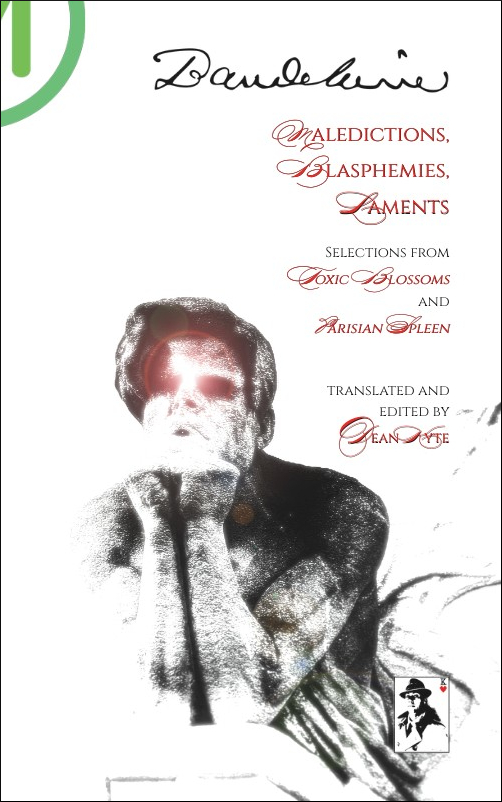
Front cover image of the softcover edition of “Maledictions, Blasphemies, Laments: Selections from ‘Toxic Blossoms’ and ‘Parisian Spleen’”, by Charles Baudelaire, translated and edited by Dean Kyte.
A preview of Maledictions, Blasphemies, Laments: Selections from Toxic Blossoms and Parisian Spleen, by Charles Baudelaire, translated and edited by Dean Kyte.

This new book, whose layout and design I finalized last month in Brisbane, is scheduled for release at the end of June. It features one-fifth of the total number of poems featured in the three editions of Les Fleurs du mal which Baudelaire (and then his mother) saw through the press, and one-quarter of the prose poems from Le Spleen de Paris.

At the time of writing, I have translated 89 per cent of the poetic and prose-poetic content I intend to include as a representative selection of Baudelaire’s æsthetic philosophy of flânerie.

And as a bonus that bridges his poetic and prosaic œuvres, I have decided to do a brand new translation of the only work of fiction that Charles Baudelaire is known to have written, La Fanfarlo. As one of the last tasks remaining before I bring this book to print, I will commence drafting that translation this month.

With a substantial critical monograph on Baudelaire and full-colour illustrations, Maledictions, Blasphemies, Laments is going to be a very handsome volume in both its hard- and softcover formats and a valuable introduction to the work of the first philosopher of flânerie.

To register your interest in purchasing one of the first copies in June, I invite you to avail yourself of the contact form below and join the mailing list as I send out monthly updates to my readers.

Go back

Your message has been sent

Warning
Warning
Warning.

Another way you can support my work and keep abreast of developments is by purchasing the audio track of “O Brisbane! O Baudelaire!” featured in this post via my artist profile on Bandcamp.

Using the link below, for $A2.00, you can become a fan of your Melbourne Flâneur on BC and stay in the loop as I drop new tracks and merch.
The Melbourne Flâneur returns to Bellingen, NSW, and, in this lyrical prose poem enhanced with Super 8 film footage, ponders a flâneurial figure in the landscape even more conspicuous than himself—‘the Mem Hall’.

When God decides my days are done, perhaps then He’ll allow me to settle in Bellingen.  Perhaps then He’ll permit me to be as permanent as that pile, the hall in Hyde Street whose peachcoloured walls, for a hundred years, have overlooked it all—even my errances and romances.

At times my eyes gloss the Memorial Hall with the memorious glaze des jours perdus, and the faded veneer of flâneurial souvenirs recover their lost colours.

For we have both been secret historians of this place, observant actors in the life of Hyde Street.  His soldierly, literary footprint is sole and secular and unerasable while mine have been many, mobile and cancellable.

A holy light dawns about his walls and whole falls of buried memory cascade out of obscurity for me.

I hear an aura lingering in Maam Gaduying, scene of solitary sittings in wintry dusks, of escalations of les dames, things I’ve written about or hidden histories I am yet to write, but which the Mem Hall, whole library of unfiled memories, has watched, his façade regarding me as I act out my hours of drama in the Meeting Place Park.

The pillared bras of his façade have embraced it all; the corniced brows of his windowed yeux have watched me curiously through the years.  I’ve read my Parisian poèmes on his scène, and opposite, au parc, I’ve acted out my Parisian vie de flâneur in Bello’s narrow boulevard de Hyde Street.  For there is une autre espèce de flâneur—rooted, loitering—and the Mem Hall, in his commanding prospect de la rue, epitomizes him.

Perhaps one day mes os, in Bello, will be as permanent as the Mem Hall’s walls.

— Dean Kyte, “The Memorial Hall”

When duty called me up to the North Coast for two weeks in February, it had been twenty months since I had last seen Bellingen and a lot had happened during that time—very little of it unambiguously positive.

I dare say that the lifestyle of flânerie, seeking to fly by the nets of society at every turn, made the pandemic a more uniquely painful event for someone like myself who is both a Melburnian by election and a flâneur by inevitability.

And while I seemed, despite my lifestyle of country-wide travel, to come through the pandemic without either the CV or the vaccine ever touching me, the years 2020 through 2022 seem to run together for me in a lasting mental fog, leaving a scar on my life from which I’m still recovering.

Hence Bellingen in June of 2022, at the time when the images above were shot on Super 8 and digital video, seemed a very distant place when I saw the Memorial Hall for the first time in its new blue-and-cream livery in February.

Now I am coming rapidly—sadly—to the end of two months spent at Urunga, the town next door to Bello, which has allowed me to get across on a few occasions to the little town which ranks easily for me with Paris and Melbourne as a world capital of flânerie.

There was one Sunday in June 2022, just before I was due to depart Bellingen, when I spent a cartridge of Kodak Vision3 50D Super 8 film on two visions typical of the years I lived in Bello, including the Memorial Hall—affectionately known by the locals as ‘the Mem Hall’.

I had mentally budgeted out the three-and-a-half minutes of film available on the cartridge and knew exactly what shots I wanted from the two locations. And as is my usual practice when working with Super 8, I took back-up shots from the same set-ups using my trusty Olympus Stylus digital camera and recording location sound with my TASCAM digital sound recorder.

The only issue with the Mem Hall location, shot from the corner of Maam Gaduying, the ‘Meeting Place Park’ in front of the Bellingen Library, is that, at the time of my holiday in June 2022, temporary fencing garnished with a dirty great banner advertising Coffs Harbour Demolitions was set up before the doors of the Mem Hall.

Were they going to pull down our beloved, historic Mem Hall?

Fortunately not.

It was about to undergo renovation—including a new paint job—and although I had to grumpily contend with the banner and fencing prophesying the Mem Hall’s imminent demolition while I was filming it, when, in February, I saw the most iconically ‘Bellingen’ piece of architecture in Hyde Street for the first time in twenty months, now cream and blue instead of the surreal shades of rosy peach and apricot I had always known it as, I was glad that I had had an opportunity, on my last trip, to shoot it on Super 8 as I remembered it and had always experienced it—banner, fencing, and all.

This is not to cast shade on the new façade: I was blown away by the cream and blue. It gives the Mem Hall a more ‘Mediterranean’—rather than tropical—feel, and I actually prefer the new colour scheme.

But on Super 8, cream and blue would certainly not have come out as spectacularly as that peachy orange directly taking the rays of a Sunday afternoon in winter, reminding me, under the hybrid digital treatment I give those shots in the video above, of afternoons I spent sunning myself—gelidly, it seemed—in the Meeting Place Park.

For all the pseudo-Moorish intimations of the Mediterranean the new paint job gives it, whether in cream and blue or a rosy peach and apricot, the most iconically ‘Bellingen’ building in Hyde Street still manages to be marvellously surreal.

We can see the resulting building, a weird exercise in inclusiveness, and an attempt to reconcile irreconcilable functions: a library, a cinema, a dance hall, a theatre, an auditorium, a kitchen, a tea room, toilets, a war memorial and whatever other use you can make of it. Perhaps, in an exaggerated way, it reminds us that all buildings are like this. But at various meetings or in preparation for them people must have sketched designs that included space for the Literary Institute and library, absorbed the functions of the old School of Arts, made ‘provision of exclusive rooms for the use of returned soldiers’, tried to placate the view that ‘there was no form of sacrifice whatever about a hall and picture show as a memorial’. And in these drawings they would have accommodated or got rid of existing makeshift structures like the picture theatre and the dance floor. Rather than the result of a collaborative process consummated by a set of architectural drawings, it seems like the Hall designed and built itself in a self-steering process that went on over the heads of the individuals involved, like a demented version of Adam Smith’s guiding hand.

— Ross Macleay, “The Memorial Hall”, On, in, from, over, Bellingen (2013, p. 149)

The prose-poetic commentary to the video above falls into that category of my œuvre I am now consciously styling as ‘flâneries’—literary peregrinations through sensibility, variously poetic, essayistic or fictional, which arise from my wider wanderings through this country, outside the Melbourne which forms the geographic basis for the prose poetry in The Spleen of Melbourne.

And though it probably sounds like a scoffable claim to mention the name of Bellingen (a town which, even in this country, few people have heard of) alongside such world-class centres of flânerie as Paris and Melbourne, I mean the claim quite seriously.

As much as Paris and Melbourne, Bellingen stands at the absolute centre of my literary life, and I would not be the writer and filmmaker I am today but for thirty months I lived there between 2014 and 2016.

While certain ‘regional writers’ become poetic spokesmen for a place, unofficial laureates of certain cities, communicating the genius loci to readers further afield, I am hard pressed to think of another writer for whom the specificity of place and time is as salient as it is to my work, and yet who has as wide an experience of geographically specific places and times.

Thus, while there was a ‘Gold Coast period’ of my literary life, and there has been ‘Parisian’ and ‘Melburnian’ phases, there has also been the ‘Bellingenian period’, and my years in Bellingen stand in respect to the Melburnian period as my years on the Gold Coast stand with respect to Paris.

Which is to say that Bellingen did not quite ‘complete’ me as a flâneurial writer and filmmaker, but that it is the place, like Paris, where I had the first opportunity to practically implement the evolving principles of my æsthetic lifestyle philosophy of flânerie—the praxis of a theory I had developed to a certain point of refinement in other landscapes, at other times of my literary life.

In the flâneurial video essay “On having left, but not yet having arrived”—also partly shot on Super 8—I say that Bellingen was ‘the scene of my longestlasting happiness’: splenetic, ennuyé, utterly Baudelairean soul that I am, never was I more consistently happy in my life than during the years I lived in Bellingen.

Only Paris approached it for the number of ‘jours parfaits’ I spent there.

Hence they are, though hemispheres apart, elliptically linked on the prime meridian of flânerie: these are the epicentres of a new and fruitful æsthetic life.

When I left Paris, I wept for weeks like a man who had lost the love of his life—and indeed I had, having seen—in the arms of a Parisienne—a vision of holy wholeness in my dying hours there which I have committed the rest of my life to prophesying and proselytizing.

When I left Bellingen for Melbourne, it was on account of a woman I could no longer bear to see in the Meeting Place Park, or at the IGA, in company of another man, and although I went forward with excitement to the next scene of my literary life, I carried as much buried mourning for the woman—and for Bello—as I had done for Paris and the Parisienne.

There are two paradoxical modes of Parisian flânerie, the wandering walk and the lingering loiter, both of which allow observation of the life of the street.

And as I say in the video above, if, in my years of living in Bellingen, I made a Parisian boulevard of Hyde Street in my dandiacal circuit up and down it, the Mem Hall, in its vantage-point overlooking a particularly animated corner of Bello’s main street, represented, in its outrageous livery of peach and apricot, the other pole of flânerie, observing the spectacle of the passers-by rather than being itself an active, ambulatory participant in that spectacular parade.

Equally, the Mem Hall observed me, many times a day, swanning past its portals in both directions. It had the privilege of observing me doing so at all hours of the day and night in those years, and not infrequently, in those endless hours of happiness, in the midst of some flâneurial experience—often with a woman—that would afterwards find its permanent record in my writing.

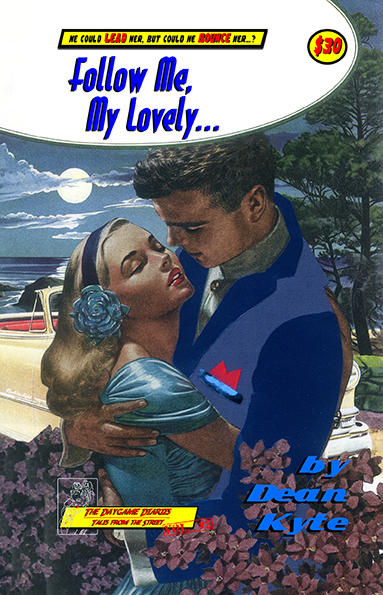
It was past the Mem Hall, for instance, that I marched the beautiful, enigmatic Emma in Follow Me, My Lovely… (2016), and it was within sight of the Mem Hall, at the corner of Bridge Street, that I first attempted to ‘mash a pash out of her’.

We set out, manoamano, shouldertoshoulder in the cold, clear air of 3:30 a.m. I built a little light rapport with her by laying out the thumbnail version of how I came to be in Bello, but I was tired of unwinding that yarn and didn’t do it as well as I might have. At the corner of Ford Street, we turned right onto the main drag and walked along the brickpaved sidewalk fronting the park.

In retrospect, it seems to me that there had been enough time in the space of that short block to build sufficient rapport with Emma in order for her to feel comfortable with me, yet I couldn’t say just when I had first become aware that I would have to make my move. I think I only became conscious that the moment of truth was fast approaching and I would have to physically turn her steps towards the river when we passed the Mem Hall.

— Dean Kyte, Follow Me, My Lovely… (2016, pp. 34-6)

In Follow Me, My Lovely… the Mem Hall plays a cameo rôle, having been, before the action of the story begins, the place where I first espied Emma at the Barefoot Boogie, a dance party that used to take place there on the night of the full moon during the years when I lived in Bello.

And in another reminiscence of my years in Bello, a longer work, as yet unfinished, called “Sentimental Journey”, the Mem Hall plays a more salient part. It’s the place where my tale begins, when, in the hours before I am due to get on an overnight train to Brisbane, I see Polanski’s La Vénus à la fourrure (2013) there, an event which, by obscure tangents among the degrees of separation in my rather extensive social network in Bellingen, leads me unexpectedly into the arms of another woman.

She plunged her arm into mine and we rounded the corner into Hyde Street….

While she jawed, I cast a cautious slant around as we stepped off the kerb in front of the post office: beside us, Bridge Street was an empty corridor of darkness illuminated by a solitary streetlamp at the other end of Lavenders Bridge.  Across Hyde Street, a lonely brother to it loafing in front of the Mem Hall craned its neck over the main drag, the rose façade lit a livid orange by its yellow glare.

If anywhere in the world was a more romantic playground for seduction than Bello at night, I hadn’t yet experienced it.

We forded Bridge Street and regained the kerb—the kerb where I had tried to mash a pash out of Emma and had told her to come back to my place.  We passed it, walking through those ghosts, and changed tracks, shunting onto the spur of footpath leading into the Meeting Place Park.  A trio of lamps, spaced out in a loping curve, followed the line of the wide brick path sweeping round to the library and council buildings.  Their ramrodstraight figures picked out among the trunks of the eucalypts, almost as straight, on the green sward made the park seem vaguely like an image by Brassaï, reminding me of Paris.

At a lonely hour in the early evening, I sometimes liked to sit here alone, watching the traffic roil around the intersection as I huddled against the cold on the pew in front of the historical museum.  I scoped it out now as a potentially discreet venue for escalation: a lampadaire planted in the Lunchbox Garden in front of the council offices cast an oblique, chiaroscuro glare on that corner.  It wasn’t mood lighting, but it did raise some harsh shadows, and if we huddled at one end of the pew, we should be reasonably protected from view of the street by the corner of the red telephone box and the extension of the Neighbourhood Centre.

— Dean Kyte, “Sentimental Journey”

As I say in the video essay above, both of us, the Mem Hall and myself, have been secret historians of Bellingen, memorious flâneurial observers of otherwise unremarked moments in the life of Hyde Street. The Mem Hall has watched me conducting my vie de flâneur just as I have watched the colourful characters in Bello’s streets.

And I think it is no geographic accident of synchronicity that the Mem Hall, the original ‘literary institute’ of Bellingen, faces the present town library, for as I intimate in the video essay, the building seems to me a vast cabinet of unfiled memories, leaves of time—so sheer as to be invisible—of all it has witnessed in its century of life, the secret history of the town which no one yet has had the soul and vision, the heart and spirit of service to properly write.

As I said in a previous article on Bellingen, a few well-known men of letters have, for a season of their lives, made a home for themselves in Bello, and by far the most famous of these writers is Peter Carey.

Carey, who lived here in the eighties as a tree-changing refugee from Sydney, sets Oscar and Lucinda (1988) in the vicinity of the Gleniffer Hall, but Carey’s historical novel lies well beyond what Henry James calls ‘the visitable past’—the rememberable history of one’s own lifetime and experience.

As the young James, flush from his first adult experience of the Roman relics, wrote his sister Alice, unless one’s mind is veritably sagging beneath the weight of material facts about the subject, historical fiction, for a novelist, is the least worthwhile pursuit: ‘The present and the immediate future seem to me the best province of fiction—the latter especially—the future to which all our actual modern tendencies and leanings seem to build a sort of material pathway.’

As far I know, the high-flying Carey has written nothing to commemorate ‘the modern tendencies and leanings’ of his time in Bellingen, one of the most artistically fruitful places on earth, the very Mecca, in my view, of a global ‘Vita Nuova’ towards which Bellingen, in its present and by its example, builds a material pathway.

I take it as a point of pride that, as the least well-known among the men the letters who have made a temporary life for himself in the landscape of this ‘Promised Land’, I have been the most committed to memorializing the visitable past of my experience in these climes.

And as an unofficial historian of the unnoticed hours of Bellingen life, I see a co-conspirator to my project in the architectural figure of the Mem Hall itself, who reminds me of the eponymous character in Jorge Luis Borgesficción Funes, el memorioso (1942).

Nosotros, de un vistazo, percibimos tres copas en una mesa; Funes, todos los vástagos y racimos y frutos que comprende una parra. Sabía las formas de las nubes australes del amanecer del 30 de abril de 1882 y podía compararlas en el recuerdo con las vetas de un libro en pasta española que sólo había mirado una vez y con las líneas de la espuma que un remo levantó en el Río Negro la víspera de la acción del Quebracho. Esos recuerdos no eran simples; cada imagen visual estaba ligada a sensaciones musculares, térmicas, etcétera. Podía reconstruir todos los sueños, todos los entre sueños.

Dos o tres veces había reconstruido un día entero; no había dudado nunca, pero cada reconstrucción había requerido un día entero. Me dijo: ‘Más recuerdos tengo yo solo que los que habrán tenido todos los hombres desde que el mundo es mundo’. Y también: ‘Mis sueños son como la vigilia de ustedes’. Y también, hacia el alba: ‘Mi memoria, señor, es como vaciadero de basuras’. Una circunferencia en un pizarrón, un triángulo rectángulo, un rombo, son formas que podemos intuir plenamente; lo mismo le pasaba a Ireneo con las aborrascadas crines de un potro, con una punta de ganado en una cuchilla, con el fuego cambiante y con la innumerable ceniza, con las muchas caras de un muerto en un largo velorio. No sé cuántas estrellas veía en el cielo.

At a glance, we notice three glasses on a table; Funes, all the stems and branches and fruits that make up a vine. He knew the shapes of the southern clouds at dawn on 30 April 1882 and could compare them in his memory with the grain of a book bound in Spanish leather he saw only once, and with the lines of foam raised by an oar in the Rio Negro on the eve of the Battle of Quebracho. These were not simple memories: every visual image was linked to sensations—muscular, thermal, and so on. He could reconstruct all his dreams, all his dreams within dreams.

Two or three times he had reconstructed a whole day. He had never hesitated, but each reconstruction had required a whole day. He told me: ‘On my own I have more memories than all the men since the beginning of the world have had.’ And also: ‘My dreams are like the insomnia you fellows have.’ And also this, towards dawn: ‘My memory, sir, is like a garbage dump.’ A circle on a blackboard, a right-angled triangle, a rhombus; these are shapes that we can fully visualize. To Ireneo, the same thing happened with a colt’s wild mane, with the very tip of a knife, with the protean flames and innumerable ashes, with the many faces round a dead man at a large wake. I don’t know how many stars he saw in the sky.

— Jorge Luis Borges, Funes, el memorioso (1942 [my translation])

Like Ireneo Funes, the Memorial Hall, to me, is infinitely memorious of Bellingen. It has seen—in the most exquisite detail—everything that has passed before it in its century of life.

It is truly a book of days.

And although, in its infinite discretion, it does not speak of what it has seen as I have privately journaled it, the Mem Hall remembers everything that has passed before or within it—including my presence on its stage, reciting my Parisian poems at the annual Poetry Slam, and upon the stage of the Meeting Place Park opposite, solitudinously sunning myself at dusk or making out with some dame after dark.

But I’m not entirely alone in this self-imposed project to be a flâneurial historian of Bello, the memorious recorder of its forgotten hours. One local writer I have respect for, and who seems to be involved in an analogous, albeit more ‘official’ project of public memoration, is Ross Macleay, one half of the North Bank Institute, Bellingen’s oldest—and smallest—think tank.

In “The Memorial Hall”, one of the essays in his collection On, in, from, over, Bellingen (2013), Macleay tells us that the ‘Soldiers Memorial Hall and Literary Institute’ opened to great civic fanfare on Wednesday 19 January 1921 with (among other visual confections) a presentation of Charlie Chaplin’s comedy “Sunnyside” (1919).

Describing the cinematic bill of fare on that night in his essay, Macleay explains how ‘the Mem Hall’ as Bellingenians know it today had not even been built on that fateful date, the ‘Grand Opening Night’ of the Bellingen Memorial Hall Pictures being a fundraising event to build the pile on Hyde Street.

The Memorial Hall began its life as a war between two motions passed at two meetings. At the first on 4 December 1918 a motion was passed to build a War Memorial in Bellingen at a cost of no more than ₤500, and a committee of twenty was formed. At the second on 6 June 1919 the original motion was cancelled, a substantial majority voted to build a memorial hall instead, and the committee, trimmed from twenty to seventeen, was given the job of raising funds. The building of the hall would be a war on two fronts, the first was against those who thought a monument was more fitting for military commemoration than the frivolity of a pleasure dome (plus easier and cheaper). The second was the long campaign to raise the money.

— Macleay (2013, pp. 147-8)

The money came, as Macleay tells us, from the showing of movies, and on 19 January 1921, the good burghers of Bello crowded onto the site of the present Mem Hall, under an open-air shed set up as insurance against the rain, to see Charlie Chaplin, Sessue Hayakawa, and a Pathé newsreel at ‘two shillings for a chair up the back, one for down the front on a log, and children [at] half price.’

Thus, from its inception, the Mem Hall, doing surreal double service as a perpetual monument commemorating local casualties in the Great War and as a meeting place for the celebration of living culture in a small town, secularly profaned itself as a picture show.

My first experience of the Mem Hall was when my friends dragged me along to see a John Pilger documentary in the great barn behind the façade—a fragrant experience spiced with the familiar scent of the chai tea concession set up on two trestle tables on the eastern side of the salle.

John Pilger, chai on the side, and barefoot kids running wild: that sums up both the experience of the Mem Hall and of Bello—of the Mem Hall’s significance to Bello life as a communal meeting place. It was at that screening, as I now recall, that I met several of the people who would become significant to me in those years, and among whose ranks, in my hats and suits, I would be the most unlikely ‘hippie’ by comparison.

As I have written in another of my flâneries, ‘the elevating experience of “enlightened” leftwing documentaries spiced with chai tea at the Memorial Hall’ is one of the typical memories I most cherish about Bello.

And that says so much about the centrality of the Mem Hall to Bello life. When I was in Euroa two years ago and attending a presentation of the documentary Happy Sad Man (2018) at the Euroa Community Cinema (which is also housed in the shire hall), the film’s Melbourne-based director, Genevieve Bailey, told the assembled townspeople that she had recently screened her doco at Bellingen, a little town in NSW, she said, not dissimilar to Euroa, and in a hall not unlike the Strathbogie Shire Council building.

As probably the only person in that room besides Ms. Bailey to have an experience of both venues—and then far more extensively, as regards the Mem Hall, than Ms. Bailey herself—I knew in my heart and my gut the visceral truth of the comparison she was making.

I love Bellingen as much as I love Paris—and I love these places as much, and in the same way, as some of the dearest women I have known.

And as I say in the video above, one day I hope my flâneries will at last be done and I can permanently rest my bones in Bello.

To read more about my flâneurial adventures in Bellingen, you can purchase Follow Me, My Lovely… in the Dean Kyte Bookstore. You can also support my work by purchasing the soundtrack of “The Memorial Hall” for $A2.00 from my artist profile on Bandcamp using the link below.

In this prose poem from The Spleen of Melbourne, Dean Kyte takes a nostalgic flânerie up the so-called ‘Paris End’ of Melbourne’s Collins Street as he reminisces about his last night in the Ville Lumière.

‘The Paris End’:—it’s one of those magick phrases which evoke the sweet life of flâneurial streetlife for me.  And whenever I treat myself to a flânerie up ‘the Paris End’ of Collins Street, like someone raising and lowering their shades, I shuffle the rosetinted souvenirs de Paris over les scènes melburniennes before my gaze.

When I saw the rougetainted Regent Theatre lit up to fête Moulin Rouge!, like le coup d’un souvenir enfoui, the farded façade dans la place Blanche floated up, suddenly unballasted, and I remembered standing on the little asphalt île de la place on my dernière nuit à Paris.  Then I knew what the phrase ‘the Paris End’ meant to me; it meant ‘la fin de Paris’.

—Dean Kyte, “The Paris End”

Last Monday night as I was hiking up Foveaux Street to The Carrington Hotel (your Melbourne Flâneur’s Sydney ‘office’, his lubricated lieu de l’écriture in the barbarous Harbour City), puffing hard as I approached the lip of Riley Street, Conte before me glowing redly in the dusk, I realized with a thrill of satisfaction so rare in my life that my whole relationship with France and the French language has undergone a quantum change in the last two or three years.

As I laboured up the hill, in my mind’s eye I saw myself more than a year ago frequently taking this flânerie up Foveaux Street to The Carro, the 1,300-page Gallimard edition of Jean-Patrick Manchette’s complete Romans noirs cuddled to my breast.

In a moment of expensive madness I had acquired the Manchette for a portrait of Monash upon discovering Sydney’s Abbey’s Bookshop and its feast of foreign-language books on the first floor some months before. I knew nothing of M’sieu Manchette; I was literally judging this hundred-dollar book by its cover—a print, by Gérard Fromanger, of the Parisian café Le Paillard rendered in an inky blue with the red silhouettes of some hinky flâneurs fogging up the boulevard des Italiens before it.

Manchette, I suspected, would be un type sympa—or at least, he would be a writer sympathetic to my cause of a Melburnian literature flâneurially evocative of Paris, of the nouveau roman written under the guise of the roman noir.

My mission on those nights, as on this, was to enjoy a good dinner and a Guinness at The Carro, masticating my Manchette over my parma and pint, and then, my wits sufficiently elevated by the brew, to debrief my brains of the day’s doings in my journal.

And now as I was grappling up the escarpment of Foveaux Street over a year later, another wad of dough freshly blown on bloody French books from Abbey’s, the red neon and the green bricks of Conte burning provocatively—like the Negroni they serve there and the Absinthe they ought to—in the sympa Sydney dusk, that small, irrational feeling of bien-être the flâneur occasionally feels when there’s no objective reason for contentment with his ennuyé life now descended on me.

Ah! comme la vie est belle!

I’m not quite sure why Conte should bring this feeling of the flâneurial merveilleux out of me: Did it, in its ‘italienneté’, recall Fromanger’s depiction of the boulevard des Italiens on the cover of the Manchette?

Or, in its position à l’angle, on the plateau of Riley Street, ahead of me as I marched the martyrizing hill of Foveaux Street as I had once climbed steeper streets in Montmartre, throwing its deep red and green over the corner, did it recall to me my beloved Cépage Montmartrois, the ‘sein d’or’ whose catalyzing golden light upon the rue Caulaincourt I immortalized in my first book Orpheid: L’Arrivée (2012), the golden bosom where I went to write every night in Paris over a demi de bière—indeed, where I learned this Parisian habitude, which has served me so well en Australie, of writing in bars and cafés?

Or was it simply that, one night, diverted from The Carro and into the boisterous bosom of Conte, I had, with my Manchette, sat at the bar, swooning over my Negroni and a piatto di prosciutto beneath the Italian movie posters, looking as keenly up at the red one-sheet for Blowup (1966) over the bar, hypnotized by it as if it were the movie itself?

Je ne sais pas.

What I know is that something has fundamentally changed for me in my relationship with France and its language during the last few years.

I’m hard pressed to put a date to it, and I only became conscious that a major phase shift had occurred in January this year, on my forty-first birthday, when I found myself sitting in Chloe’s Room, at Young & Jackson, arguably ‘the nation’s pub’, writing my first poem in French, moved by the French muse who holds court in this very Australian bar.

Like one of the archeologists who have dug up the corner behind Young & Jackson as part of the Metro Tunnel works, cataloguing the international artefacts that went into the soil of the city as the gold was coming out of it during Melbourne’s ‘marvellous’ period, in The Spleen of Melbourne, I have been at pains to unearth a ‘chthonic French connection’ between Melbourne, one of the major cities born of the nineteenth-century, and Paris, the first city of flânerie, Walter Benjamin’s ‘Capital of the Nineteenth Century’.

It’s a connection still very much buried to the eyes of my countrymen.

While the British colonial influence still lies on the surface of everyday life in Melbourne, with the lion and unicorn of the Royal Coat of Arms gracing everything from the portico of the Immigration Museum to the masthead of The Age, the French connection lies at a deeper, subtler stratum—deeper even than the Chinese, Greek and Italian influences on Melbourne life.

One has to dig back into the literature of the nineteenth century, when Paris was indisputably the capital of the civilized world, or the first half of the twentieth, when it was still coasting on a century of accumulated cultural prestige even after World War II, to perceive where and how Melbourne owes a subtle debt to French culture.

The clues to that subterranean French influence upon our civic life are buried in plain sight: they’re in the mansarded roofs of various town halls and the oblique allées of public gardens, the stone quays which pen the Yarra and the plane trees lining Collins Street.

Indeed, the eastern end of Collins Street, between Spring and Swanston, just barely retains into the twenty-first century its nineteenth-century designation as ‘the Paris End’, the prestigious address of doctors during the marvellous period, then, in the twentieth, with all the connotations of fashion that the magic name of Paris had conferred upon it, the favoured address of milliners, couturiers and cosmeticians.

Everyone important in the monde de la mode from Helena Rubinstein to Helmut Newton has either hung out their shingle or just plain hung out in ‘the Paris End’ of Collins Street, the most fashionable thoroughfare in this nation for nigh on two centuries.

To see these chthonic clues to the French influence upon our civic life, one has to have a constant eye to Paris: she must forever be in one’s consciousness, as she is in mine, for one to perceive these subtle analogies between the Mecca of modernity and her cultural colony at the nethermost ends of the earth.

Paris is always ‘devant mes yeux’, perhaps now more than she ever was, even when I was writing daily of my remembered experiences in her streets in Orpheid: L’Arrivée.

She has truly become the ‘moveable feast’ promised and prophesied by Hemingway as the eternal boon of the man lucky enough to have walked her streets, sat in her cafés, and loafed in her parks in his youth.

Doubtful that I will ever lay eyes again upon this city more beloved by me than any woman I have ever known, somehow the longer I have lived in exile from Paris in the country of my nativity, the more subtly French, the more subtly Parisian I have become.

It is a fact that certain writers and artists can live a very great deal on their memories, and in the exile of return to their homelands, the places of their actual experience are subtly, albeit marvellously transformed—as the façade of Conte momentarily was—by analogy with Paris.

Edward Hopper, for instance, though a painter, was no mean expert in French poetry, keeping abreast of literary developments in France even after he had ceased to go there for the living tutelage that the streets of Paris provide the artistic student of life.

Condemning himself to his native New York, Hopper had absorbed enough of the French spirit of life to infuse his visions of the local scene with some curious quality, apprehended at first as a weird novelty by his fellow countrymen, but later recognized as an authentic vision of American life in the first half of the twentieth century.

C’est très bien de copier ce qu’on voit, c’est beaucoup mieux de dessiner ce que l’on ne voit plus que dans sa mémoire.  C’est une transformation pendant laquelle l’ingéniosité collabore avec la mémoire. Vous ne reproduisez que ce qui vous a frappé, c’est-à-dire le nécessaire. … Voilà pourquoi les tableaux faits de cette façon, par un homme ayant une mémoire cultivée, connaissant les maîtres et son métier, sont presque toujours des œuvres remarquables.

It’s all very well to copy what you can see, but it’s even better to draw what you can no longer see, except in memory. A transformation is worked upon the base material of actuality in which genius collaborates with recollection. You only reproduce what has struck you, which is to say, that which is essential to the image. … That is why paintings made in such a manner by a man with a cultivated memory, one who knows both the Old Masters and his trade, are almost always remarkable works.

—Edgar Degas (my translation)

Such artists hold themselves aloof from the circumambient culture of their countries and yet are more in the vital current of the nation’s life than their fellow countrymen, for the gift of the supple, subtle French language gives them an alternative grille through which to view the humdrum actuality before their eyes.

In the days when I wrote my first book, I did everything to keep myself insulated from the common life of Australia, to focus only on my memories of Paris, terrified that I would lose some detail which was, as Degas says, ‘essential to the image.’

Probably the work which marks the climax of my jeunesse, I still think Orpheid: L’Arrivée is a ‘remarkable’ tableau of the rue Caulaincourt in Degas’s sense, almost Rousseauian (by which I mean le Douanier, not Jean-Jacques) in the naïveté of its ‘weird novelty’, but I think the approach of hermetic insulation from the common life de l’Australie was wrong to take, though perhaps necessary and inevitable for a young man still learning his métier.

In those days, I needed my eyes and ears to be blindfolded and plugged against the actuality of my prosaic surroundings with media that reminded me of the poetry of my life in France. I couldn’t take on any new sensual experiences in these climes until I had gotten the results of the Parisian experiment in flânerie down on paper in a form I was substantially satisfied with.

But one grows, and the harder one works in youth to master the craft of writing, the more the RAM expands and the wider one’s capacities grow to register and retain those ‘essential traits’ of life which Degas says mark out the remarkable works of the artists of genius—for as Proust is at pains to impress upon us, the greater part of artistic genius lies in memory.

One is more able to take into oneself the poetic riches that lie in prosaic banality and the material conditions of one’s life are marvellously transformed by their analogy with the places and experiences of memory.

At mid-life, reconciled to my exile in the country of my birth, I now carry a bit of Paris, a morceau of its moveable feast, about with me as I sweep my fashionable path through Melbourne’s streets, unnoticed by my countrymen except as novel spectacle.

How do I do it? How do I subtly maintain the flâneurial ethos I acquired in Paris here en Australie?

The simple answer is the language, which provides me with a point of view, one of critical removal upon the currents of cultural life around me.

I think it’s fair to say that if one comes to a foreign language much beyond the age of easy acquisition in childhood, one will always be a ‘student’ of it to some extent, the more so if one comes to a foreign language in adulthood, as I did to French.

As Henry James—whose prodigious command of the language had been easily acquired in his Continental childhood—once wrote to a young French author, enjoining diligence upon him in his study of English: ‘One’s own language is one’s mother, but the language one adopts, as a career, as a study, is one’s wife, and it is with one’s wife that on se met en ménage [“one makes a common life”].’

I’ve been an earnest ‘student of French’ now for about two-fifths of my life, but it seems that at some point in the last few years, I became substantially less of a ‘student’ than I had been: having joined my life to the French language some quinzaine d’années ago, somehow my ‘wife’ and I have truly become one, body and soul, only lately in our marriage.

More than half my reading diet these days is composed of books in French, and when Abbey’s Bookshop isn’t getting a substantial tranche of cash out of me for crisp, virginal volumes like the Manchette, I’m on the hunt in thrift stores and secondhand bookshops for old books that have been passed around as once I prowled the booklined quays of Paris for saucy finds.

And just as, ‘in my day’, the bouquiniste on the quai des Célestins used to be a good place to go for a disreputable pute of a book, in Melbourne, if you like to get your tongue around a little French, certain lieux in the City of Yarra and the City of Darebin can be depended on to furnish an encounter with a vieille fille ‘on the shelf’.

Though I have largely given up the fetishistic desire which possessed me in my youth to acquire new books, I find at mid-life a resurgence in that desire when it comes to French literature: to have a naughty French novel in my satchel to whip out at an idle moment in my flâneries, to be able to momentarily set a bit of Paris before my eyes as I sit on Melbourne’s Metro, puts me simultaneously in the swim of two cultures.

To be able to excavate my copy of Camus’s L’Étranger (1942)—another Abbey’s trouvaille—from my Commie officer’s mapcase recently made the interminable trajet on the Lilydale line more bearable. At least I could fill the time by substituting Meursault’s ennui for my own.

Then too, in place of consuming much local media, I listen to a great deal of Radio France and watch French movies. I think I was partly inspired to write my first poem in French on my birthday after seeing Coup de chance (2023) at Palace Kino, in the Paris End.

Having failed to quite catch Woody Allen’s Whatever Works (2009) in Paris, posters for which frequently tantalized me in my flâneries through the Quartier latin, to immerse my eyes and ears in—of all improbable things—two of my favourite things in the world combined, a Woody Allen movie and a French film, probably helped to inspire me after a morning of frittering my fric away on Balzac, Chateaubriand and Adamov.

Listening to the world through the medium of a language where one is perpetually the amorous student is actually more fruitful for a writer than paying attention to his own media.

It is not merely that, in training the ear trumpet far afield and listening to what is going on in the Francophonic world, ignoring what is going on closer to hand in Australia, I hear a perspective on global events that is not parochially Anglocentric, but when I do happen to tune in to a few minutes of Australian media, I’m often surprised at the comparative puerility of what the media is propagandizing as ‘mainstream’ Australian culture.

The one exception to this is Australian cinema. I find I’ve been getting a lot of value lately out of revisiting the Aussie films I reviewed twenty years ago as a film critic on the Gold Coast, and this engagement with an aspect of our culture that has always struggled (under the Anglophonic imperium of Hollywood) to be ‘mainstream’—even domestically—supports my diet of French cinema.

In the interplay between French and Australian films, I find the questions I ask myself as a writer, with respect to literature, even more keenly put: Does Australia have a ‘national cinema’ that is equally an ‘art cinema’ the way that the French have a proud national cinematic tradition? Have we yet produced a stylistic storyteller who has written the national myth in images?

The films that represented us at Cannes in the years I was writing for magazines—the domestically decorated Somersault (2004), for instance—now seem to me interesting and instructive failures, fruitful clues for a writer and filmmaker embedded in the subterranean stream of his society and yet able, via the supple and subtle French language, to view the mainstream trends on the surface of Australian life with some critical distance.

In some significant sense, the prose poems of The Spleen of Melbourne project in their visual form, as hybrid Super 8 and video ‘cinepoems’ like “The Paris End”, constitute my own practical attempts to wrestle with those theoretic questions.

And what becomes clear to me as I begin to show and perform pieces from The Spleen of Melbourne is that, like the epiphany in Foveaux Street, what is felt by the flâneur walking the streets of this country as an inward experience of total sensual derangement à la Rimbaud is outwardly experienced by his fellow countrymen as ‘surrealism’: the supple and subtle French language putting a gloss of romance upon places familiar to Melburnians renders these recognizable places ‘new’ to their eyes.

Thus it is that I’m in the swim of two cultures at once. Becoming less of a student and more of a master of French in the last few years has allowed me to see a subterranean dimension of Australian life and bring it to the surface of my country’s vision.

And it could well be that, like Edward Hopper with respect to New York, in seeing what is quintessentially ‘Parisian’ about Melbourne, I am seeing something that was always there as a chthonic layer of our culture, but that only future eyes will recognize as an authentic vision of Australia’s present.

There are now nearly forty pieces in The Spleen of Melbourne project and I’m getting on towards the next iteration of the collection as a thematically navigable Blu-ray Disc of films and videos. You can support me in that endeavour by purchasing the soundtrack of “The Paris End” for $A2.00 below—or by naming your own price at the checkout, if you feel more generous.

The advantage is that by purchasing the soundtrack to the video, not only do you get access to unlimited streaming and/or high-quality download in your choice of audio format, but you can also opt in to become one of my fans on Bandcamp, where I occasionally post new pieces from The Spleen of Melbourne project which don’t have an audio or video component, as well as other photos and prose poems from my flâneries around this country exclusively for my fans on the Community tab.

A silent film at the Art Gallery of NSW in Sydney inspires a quick and dirty flâneurial video essay by Dean Kyte.

«Le spectacle n’est pas un ensemble d’images», notait Guy Debord en 1967, «mais un rapport social entre des personnes, médiatisé par des images». Un tel rapport social définit très précisement l’hysterie. C’est donc bien cette névrose généralisée qui caractérise la «société du spectacle». Le spectacle n’est pas «le capital à un tel degré d’accumulation qu’il devient image», c’est l’aliénation capitaliste devenue si générale et irrécusable qu’elle engendre une folie universelle. Le spectacle est l’aspect clinique de cette folie.

‘The spectacle is not an ensemble of images,’ Guy Debord would remark in 1967, ‘but a social relationship between people mediated by images.’ Hysteria is very precisely defined by just such a social relationship. It is therefore indeed this generalized neurosis which characterizes the society of the spectacle. The spectacle is not ‘capital accumulated to such a degree that is becomes image’, it’s the alienating effect of capital become so general and indisputable that it engenders a universal madness. The spectacle is the clinical aspect of this madness.

— Michel Bounan, La folle histoire du monde (2006, p. 109 [my translation])

In my æsthetic philosophy of flânerie, by far the largest branch is given over to the constellation of networked problems that arise from the issue of modernity.

Flânerie is a strategy that certain rare, dandistic men will always choose for gracefully surviving modernity:—for the accoutrements of modernity are products of civilization, and the condition of ‘civilization’ itself is produced precisely by the accoutrements of modernity.

Le dandysme apparaît surtout aux époques transitoires où la démocratie n’est pas encore toutepuissante, où l’aristocratie n’est que partiellement chancelante et avilie. Dans le trouble de ces époques quelques hommes déclassés, dégoûtés, désœuvrés, mais tous riches de force native, peuvent concevoir le projet de fonder une espèce nouvelle d’aristocratie, d’autant plus difficile à rompre qu’elle sera basée sur les facultés les plus précieuses, les plus indestructibles, et sur les dons célestes que le travail et l’argent ne peuvent conférer. Le dandysme est le dernier éclat d’héroïsme dans les décadences…. Le dandysme est un soleil couchant ; comme l’astre qui décline, il est superbe, sans chaleur et plein de mélancolie. Mais, hélas ! la marée montante de la démocratie, qui envahit tout et qui nivelle tout, noie jour à jour ces derniers représentants de l’orgueil humain et verse des flots d’oubli sur les traces de ces prodigieux myrmidons.

Dandyism appears especially during those transitional periods when democracy is not yet omnipotent and aristocracy is only partially debased and tottering. In the strife of these periods, certain classless, idle men, fed up but all of them flush with native force, are capable of conceptualizing the plan for the foundation of a new type of aristocracy, all the more difficult to break since it will be based upon the most precious and indestructible faculties, and upon divine gifts that cannot be conferred by labour and lucre. Dandyism is the last spark of heroism in the age of decadence…. [It] is a setting sun: like the declining luminary, it is superb, without heat and full of melancholy. But, alas, the rising tide of democracy, which seeps into and levels everything, daily drowns these last representatives of human pride and pours upon the traces left by these prodigious Myrmidons a deluge of oblivion.

— Charles Baudelaire, Le Peintre de la vie moderne (1885, pp. 94-9 [my translation])

In his critique of the Paris Salon of 1846, Baudelaire ended his diatribe with a manifesto proclaiming the heroism of modern life, declaring that the dandy’s black frock coat, so abused by the literati of his day as ‘unpoetic’, was the armour that the modern cavalier must wear, bearing upon his thin, bowed shoulders ‘the symbol of a perpetual mourning’—a cross as potent as Parsifal’s.

‘Modernity’ is as much a myth as ‘antiquity’, and as Louis Aragon says in the preface of his surrealist classic Le Paysan de Paris (1926), for the dandistic, flâneurial poet, bopping about the city in his sensual derangement, a new mythology of our modern condition springs fruitfully up at every step.

I notice in my own case, starting now to give an occasional live recitation of pieces from The Spleen of Melbourne CD, that my surreally Parisian vision of Melbourne has for my fellow citizens something of this effect: places and names rendered banal by familiarity are suddenly seen anew through the prism of a poetic prose; and it may be that the heroism of the urban everyday, the ‘actless act’ of observant walking, the flâneur’s fashionable swagger through the suburbs, will one day be thought as heroic a processional as the Snowy horseman’s ride.

But the problems of modernity give way to those of post-modernity, which is both imminent threat and immanent opportunity.

This is the penultimate period of the Spenglerian decline, the democratic tide of decadence risen so high that only the stiffest necks can pretend it isn’t up to their chins.

In our times, those stiff-necked captives are the Baby-Boomers, children of a liberal, international rules-based order. And at the other end of the spectrum, the poor souls trying to breathe underwater, are the Zoomers.

Neither demographic, I contend, has any idea what is going on, and both, in the chauvinism of mutual ignorance, are vociferous in prescriptions downward and proscriptions upward.

The Boomers, being thoroughly analogue people, cannot imagine a mode of life that is thoroughly mediated by the digital spectacle, and the Zoomers, who have no living experience except of an existence thoroughly mediated by imaged surfaces, cannot imagine a halcyon, organic time that was not exclusively dictated by 1’s and 0’s.

Only Generation X and the older Millennials—those of us who gained our majority before September 11, 2001—are really in a position to survey the salience landscape of opportunity and threat with something like a clear-eyed assessment.

As the waters rise around us in the West, those of us born between, say, 1966 and 1983 stand with one foot planted in a living memory of where humanity has been—its analogue history—and one in an imagining of where it must evolve to—its digital future.

We’re not digital natives, more like émigrés from the analogue to this new salience landscape. We’re forty years and more wandering in the desert, somewhat adapted to life in these climes but with a living remembrance of ‘the Old Country’ behind us.

As splenetic and depressive a soul as Baudelaire, as thoroughly ennuyé with life in the twentieth and twenty-first centuries as he was with life in the nineteenth, and as one who, like Baudelaire, was utterly alone in decrying the bourgeois myth of progress, scuttling my whole future in the 1990’s to become (of all unremunerative things) a ‘writer’ when it was unfashionable to believe that the bottom would soon drop out of capitalism, democracy and modernity, I smile with benign contempt at the leprous grifters online who now making a living sounding the bell about the decline of the West.

It is only now, as they start to take on ballast with every breath, that they can taste the salt in the air.

I made a fatal choice that I wasn’t going to buy in to this bourgeois myth of modernity, but that a ‘New Myth’ of modernity did indeed need to be written;—and that it had to be written; that the old analogue craft of taking a pen in one’s hand and shaping a thought on paper that was eminently ‘functional’, fit for its purpose but elegant in its form, could not be superseded by plastic keys, digital screens and spellcheck.

I was one of the few who actually drew the line in the sand of technological convenience beyond which I refused to cross when the stakes were still low enough to be containable, and I have held the line implacably, foreseeing the moral cul de sac of Web 2.0.

As analogue people, the Boomers are enthused by this ‘brave new world’, seeing nothing but exhilarating opportunity in the digital, while, as digital natives, the Zoomers, living with the moral consequences of a reified spectacle, see nothing but nihilistic threat in the social networking affordances of Web 2.0.

And observing the hopelessness of the younger generation—these young folks who were born after a time when a moral calculation on the relative costs and benefits of technological, capitalistic modernity could be made, and who are thus in no way responsible for the place, underwater, where they find themselves—as I said to someone recently, it feels, as a Gen-X/Gen-Y cusper, that the fatal decision I made on the verge of my majority to stove in my boat and go down, to pursue humanity over technology whatever the personal cost, to be a writer rather than a technocrat, was a premonition of the Zoomers’ future.

What I chose as a poet-prophet of the present has been forced upon them as an inevitability, and as the tide rises, the decline’s coming for us all.

Quand le monde semble une prison et l’existence une impasse, quand la conscience se révolte contre le lieu qu’elle occupe, ou quand elle erre désorientée comme dans les pièges d’un labyrinthe, ça s’appelle la mélancolie. Sa victime entretient avec l’espace la plus douloureuse des relations ; elle en éprouve tantôt le manque, tantôt l’excès ; sa finitude lui fait horreur, de même que l’infinitude la terrifie. D’où la recherche mélacolique des ailleurs et des lontains : à l’égaré, le voyage promet un but, au captif une évasion. L’ancienne médecine le savait bien, qui aux malades de l’âme prescrivait de prendre la route — soit pour conquérir un horizon et sortir de leur marasme, soit pour imposer un rhythme aux fluctuations de leur inquiétude.

Le XIXe siècle, âge du spleen, est aussi l’âge des partances. La grande époque des là-bas. De Chateaubriand à Nerval, de Baudelaire à Maupassant, pas un écrivain (laissons de côté les «bourgeois», condamnés aux faux-semblants de leurs circuits touristiques) qui n’entende l’appel du large et n’y réponde à sa manière. L’un, parmi les bruyères de Bretagne ou dans les forêts d’Amérique, rêve de part et d’autre de l’océan aux espaces d’une autre vie…. Le second poursuit jusqu’au pied des Pyramides sa recherche des grands mystères. San quitter Paris, le poète des Fleurs du Mal s’en va … à la poursuite de son désir, ou plonge au fond de l’inconnu … vers la nouveauté d’un ailleurs. Et en 1889, n’en pouvant plus de voir la tour Eiffel confirmer le triomphe des mercantis, Maupassant fait voile vers la Sicile, avant de s’embarquer dans la démence. La puissante rêverie de l’exilé, et la pérégrination romantique vers les prestiges de l’Orient ; l’odyssée toute spirituelle du voyageur presque immobile, et la fuite écœurée loin du monde matérialiste : quatre modes d’évasion qu’a inventés le mal du siècle.

When the world seems like a prison and existence an impasse, when consciousness rebels against the site it inhabits, or when it wanders, disoriented, as if among the traps of a maze, we call this melancholy. Its victim maintains the most painful relationship with space; he feels sometimes the lack of it, sometimes the excess; its limits inspire horror in him just as its limitlessness terrifies him. From whence emerges the sad quest for ‘elsewheres’ and ‘other places’: to the lost, travel promises a goal, to the captive, an escape. Ancient medicine understood this condition well and prescribed the road to those sick at soul—whether to conquer an horizon and thus overcome their slump, or to impose a rhythm on the fluctuations of their anxiety.

The nineteenth century, ‘age of spleen’, is also the era of departures, the great period of going overseas. From Chateaubriand to Nerval, from Baudelaire to Maupassant, there is not a writer who does not hear the call of the open sea and respond to it in his own way—leaving to one side the ‘popular’ writers, condemned to the false pretenses of their touristic parcours. One, on the moors of Brittany or in the forests of America, dreams of the spaces of another life on both sides of the Atlantic…. The second pursues his search for the great mysteries to the foot of the Pyramids. Without leaving Paris, the poet of Les Fleurs du mal goes … after his desire or plunges to the depths of the unknown … towards the novelty of somewhere else. And in 1889, no longer able to stand the sight of the Eiffel Tower confirming the triumph of the moneylenders, Maupassant sets sail for Sicily before embarking for madness. The powerful dream of the exile and the romantic pilgrimage towards famous sites of the Orient; the entirely spiritual odyssey of the almost paralyzed traveler, and the revolted flight far from materialistic society: these are four plan of escape devised in response to the malaise of the century.

— Yves Hersant, preface to J.-K. Huysmans, Là-Bas (1985, pp. 7-8 [my translation])

Thus it is that in France, the nation that, through all its revolutionary social experiments with governance in the nineteenth century, sets the tone of modernity for the rest of the world, all serious writers feel a ‘fruitful despair’ and an urge to set off for ‘somewhere else’—materially different conditions of space and time that are, geographically and temporally, consubstantial with a new spirit of life, their own place and time being dead to them.

Over Easter, traditionally humanity’s solemn feast time for marking the annual cycle of descent and ascent, of death and resurrection, I found my eye caught by a provocative title on YouTube: “Why Young People Want to Die | Derrick Jensen Interview”.

As a survival of the nineteenth-century ‘age of spleen’ into twenty-first-century postmodernity, as the ‘down under’ interpreter of Baudelaire—as ‘là-bas’ – simultaneously, antipodally ‘down there’ and ‘over there’ – as Baudelaire could have wished to get!—your Melbourne Flâneur, trudging the camino of a city and a country in search of a better life than technological, capitalistic modernity has offered us, was sure to be attracted by such a wrist-slitting title!

Apparently Derrick Jensen is a writer. I don’t know Mr. Jensen or his work; I had never heard of him before my eye alighted on this video and have never read any of his books. But I liked the way he conducted himself in this interview and he spoke just as writer should do:—as the conscience—both in the English sense and in the French, as the ‘consciousness’—of his time.

When we hear so much unconsidered chatter on all forms of media, social and otherwise, polluting the sensemaking commons, it’s for those few of us who have mastered the human skills of the métier of writing—the abstract ability to rotate concepts in our mind as you can see Jensen do in this interview, and to consider the modular constructions that can be formed by words and ideas before he speaks—to guide the discourse, for we’re in the crow’s nest and can see both the Old Country behind us and the Promised Land before us.

I bring your particular attention to the section of the interview between 59:19 and 1:03:39 where Jensen talks about his introduction to Guy Debord’s concept of la société du spectacle. It’s a pretty graphic example, I warn you, but that’s to the point.

As Debord states and Jensen explains, in our addictive ‘mal du siècle’, addicted to a global spectacle composed of a mosaic of reified digital images which have colonized analogue reality, the images of human life must themselves become more graphic to deliver even a little hit.

But what is gained by the image’s graphicness comes at the cost of emotion, of connection, of relation to the real person behind the fake image.

Guy Debord, in the sixties, wrote about how if you take away relationship, the spectacle itself becomes boring. … [I]f you take emotion away from sex, if you take any connection whatsoever away from sex, it frankly can get kind of boring. And if it gets boring like that, you have to continue to increase the stimulus to make it so it doesn’t get boring.

— Derrick Jensen

When I heard Jensen’s explication of the spectacle, I was reminded of a quick and dirty video essay I made some time ago in Sydney—the one at the top of this post.

Wandering around the 20th-century galleries one rainy December day in the Art Gallery of NSW, I found myself attracted to an old silent short, Toto exploite la curiosité (1909) by Pathé Frères, playing in the Australian room, one of a number of early French films restored by the National Film and Sound Archive.

The plot is simple enough: A Parisian gamin finds a kaleidoscope lying in the street, picks it up and, as you can see in the video essay, just about goes into sugar shock as soon as he raises it to his eye to view the spectacle of coloured beads within.

Another gosse comes along, curious about the epileptic fit Toto is having in the street, and asks to have a look—with the same result.

Soon there’s a whole crowd of bons bourgeois gathered around Toto, who has had the bright idea of charging a fee to see the spectacle of the kaleidoscope, and almost as quickly, a riot breaks out at this nascent display of capitalistic enterprise, with even the gendarme who comes to restore order jockeying to get a look-see and just about fainting under the force of the spectacle.

What fascinated me were the hand-coloured inserts of the inside of the kaleidoscope, which look to be animated, though I’m not sure. It’s a sophisticated piece of early narrative filmmaking, and with nothing on me but my phone to record a swatch of it, as someone whose filmmaking and videographic style is heavily influenced by pre-Griffith silent cinema, I had to nab a couple of minutes of “Toto exploite la curiosité” as a kind of ‘visual note’ to myself on the level of sophistication it’s possible to achieve with an economy of technique.

But then too, I’m fascinated by kaleidoscopes which, as Toto’s exploitative brainwave shows, are the proto-cinematic spectacle par excellence. As David Thomson tells us in The Whole Equation (2005), whereas the Lumière brothers imagined the movies as a communal spectacle, a single screen we share in the dark, it was their competitor, the enterprising American Thomas Edison, who had the longer vision for the medium, imagining it not as one big screen, but as many small screens that every audience member could voyeuristically enjoy on his own, tuning in to the spectacle of his choice.

In essence, Edison imagined the kaleidoscopic spectacle of television, the personal computer, and even the smartphone.

So the kind of unconscious meta-referentiality in “Toto exploite la curiosité”—the fact that this short French film was in some sense using the kaleidoscope, an invention of the early nineteenth century, to predict, at the dawn of cinema, a spectacularly mercantile, American-inflected future for the medium it could not possibly have imagined—seemed to me a miraculous bit of cinema poetry, one that illustrated a quotation from my reading, an extract from French essayist Michel Bounan’s book La folle histoire du monde (The Mad History of the World).

Bounan, a doctor and friend of Guy Debord, is no longer with us, having died in 2019. This is unfortunate, as I would love to translate Bounan’s short, prophetic book, written in 2006, just before the big uptake in social media, and introduce his premonitory thoughts on the spectacular state of clinical hysteria and mass psychosis we now find ourselves in—and into which the Zoomers have been effectively born—to an Anglophonic audience.

Though he’s writing a whole decade before Brexit and Trump, and he never lived to see the Coronavirus, when I first read La folle histoire du monde mid-way through the pandemic, I was sure that Bounan was coyly referring to events across the Channel and across the Pond, that’s how prophetic his book seems.

And yet social media was not yet really ‘a thing’, as the kids say, when he was writing it.

In the citation I translate in the video essay, Bounan quotes Debord’s fourth thesis in La société du spectacle (1967)—that the spectacle itself is not simply an ensemble of images, but, as Jensen explains, it is a relationship between people that is mediated by images.

And as Debord, in his sidebar commentary on his own work, points out, this thesis is a paraphrase of Marx’s statement in Capital:—that capital itself is not an object, but a social relationship between people which establishes itself via the mediation of objects.

We see both these things demonstrated in the excerpt from “Toto exploite la curiosité”: It is the object of common curiosity, the kaleidoscope, that establishes and mediates the initial relationship between Toto and the other boy. Equally, it is the common object of curiosity, the spectacular object of the kaleidoscope, that mediates the entire social network that assembles on the street around Toto.

And furthermore, as Toto begins to charge the badauds for access to the spectacle secreted within the kaleidoscope (over which, through the law of ‘finders keepers’, he has sole propriety), it is both capital and the spectacle that objectively mediates the relationships of the society around him.

In essence, it is the ensemble of subjective images within the black box of the kaleidoscope that objectively dictates the formation of the social network, its relationship to itself, and its relationship to Toto.

What fascinates me about the kaleidoscope as a proto-cinematic device is that it is the perhaps only instrument of objective vision—quite unlike a telescope or microscope—that projects a purely subjective image. Looking into the black box of a kaleidoscope is like seeing pictures in the abstract shapes of clouds—while looking outward, you see a spectacle within yourself.

We’re now at a point in our evolution where the globe is like a giant mirror ball over which we have glued the tiny subjective screens of our narcissistic reflections projected through the spectacular, kaleidoscopic medium of the Internet. And we have two generations now who have been born into this reified world of digital surfaces applied contiguously over the organic, analogue reality which supports our life and relations with each other.

And that’s Bounan’s ‘universal madness’, the generalized hysteria illustrated in “Toto exploite la curiosité”, the hyper-stimulated relationships without emotion, without authentic human connection Derrick Jensen observes with sympathetic sadness in the young.

An amnesiac’s nightmarish return to consciousness coincides with the mood of one of Melbourne’s hidden laneways at night in this nouvelle démeublée noire from The Spleen of Melbourne project.

When I came to, I found myself in a black square.  My head was ringing, but nothing shook loose.

I listened for a clue:  The hour was so early that the gulls had drifted in to colonize the briefly abandoned city, and yet it was so late that even the last tram had retired.

I couldn’t shake that static.  Then I realized it wasn’t in my head:  I had tuned in to an empty channel.

Footsteps behind me—getting closer.

Were they coming to help or hurt me?  To these and other questions I framed to myself—who? what? where? why?—my mind drew a blank.

Out here, inside myself, something shattered in a scream.

—Dean Kyte, “Kulinbulok Square”

No matter how intimately familiar you are with Melbourne’s Hoddle Grid, that geometric intersection of major thoroughfares and their accompanying ‘little streets’ still has the capacity to occasionally surprise you.

Every now and then in a flânerie through the city, confidently navigating by dead reckoning through laneways, backstreets, arcades and passageways as I traverse, at apparent random, the most disparate parts of the labyrinth, a new turning reveals a street as yet unmet with.

That was the case with Kulinbulok Square, a dog-leg turning off Queen Street, opposite the Queen Victoria Market carpark.

I’m not quite sure now what exactly I was up to when I captured the raw footage that forms the basis for today’s video on The Melbourne Flâneur vlog, whether I was on a mission to collect sound assets for my proposed podcast or simply laden with cameras and equipment on a late-night hunting expedition in search of ‘the wonder’.

In any event, what I do remember is that I was coming to the end of that late-night flânerie and was making my way back to The Miami Hotel—a bit ‘shagged and fagged’, as Alex DeLarge would have it. It was well-after midnight—after 1:00 a.m., even, in that privileged lacuna of time when, for a few brief hours in Melbourne, you cannot hear the music of the trams, their ghostly rumour, their squeals and chimes.

Footsore and fagged out, I was marching with the clack of my English heels up Queen Street as fast as the getaway sticks would carry me, heading for Victoria Street and bed, when a light and a street sign, a brick wall, steps and an aluminium handrail arrested me at the end of an alleyway I was surprised I hadn’t noticed before.

I had to stop and set up the camera for just one more shot of the night, for this was one of the images which speak to me, wordlessly, of the Spleen of Melbourne:—the place and the hour when the poetry of the city’s banal prose is marvellously manifest to the flâneur, his senses totally ‘dérèglé’ by the delirium of his dérive.

Bivouaced at Bacchus Marsh earlier this year, I returned to the footage nabbed that distant night, set sounds to it, listened intently, my Montblanc primed, with inward ears as a narration fitfully emerged from that totalizing cinematic image of night and light and , and the horror of consciousness—for with me, ‘the cinematic image’ lies even more in the world of sound—and in what is unseen, beyond the edges of the frame—than in anything I choose to shoot.

The prose piece that emerged, “Kulinbulok Square”, lies more on the fictional side of the prose poetry/fiction spectrum of The Spleen of Melbourne project, a deal closer to the nouvelles démeublées noires such as “Office at night” which constitute experimental previews for the fictional offshoot of that project, the proposed Melbourne Flâneur podcast.

Albeit, “Kulinbulok Square” is written in the first person, a pronominal point of view I absolutely eschew in the Jamesian/Robbe-Grilletian style of the nouvelle démeublée I’ve developed to tell the story of the podcast.

I was inspired initially by Alain Robbe-Grillet’s short story “Le chemin de retour”, the only story in his collection Instantanés (Snapshots, 1962) to use the first person.

In that story, written in 1954, three men (including the unnamed narrator) cross an isthmus connecting the mainland to a tiny island at low tide. One of the men, Legrand, wants to take a short, late-afternoon flânerie around the coast over the objections of Franz, who predicts they won’t be able to get back.

Sure enough, the tide rises and the three men find themselves trapped on the island.

The experiment for me in “Kulinbulok Square”, under the influence of Robbe-Grillet’s example, was to see to what extent the brutal chosiste style of the Nouveau Roman could be maintained in the first person and yet still suggest some of the pulpy generic tones of that pronominal perspective—the kind of voice we associate with Hammett at its most objective, and Chandler at its most subjective.

In other words, how much could one conceivably empty a personal account of any abstract reference to the ego, concentrating on the purely material facts of a place and a time, on physical sensations and only the most immediate inferences that a consciousness could make from them—as if the empty Kulinbulok Square of the footage were itself the character of the unfurnished short story?

Tricky task, and it took me more than six months to get the narration down to the blank but pregnant text of the video above.

Le chemin de retour” was written at around the same time that Robbe-Grillet was working on his second published novel, Le Voyeur (The Voyeur, 1955), and as is often the case with Robbe-Grillet, the most explicitly ‘scientific’ of novelists, the literary ‘experiment’ of one piece of fiction directly influences another written during the same period of his development.

Le Voyeur is also about the flâneurial parcours of a small, unnamed island, and as in “Le chemin de retour”, the ‘intrigue’, from Robbe-Grillet’s perspective, is an abstract kind of suspense he develops purely from description as he builds up an extraordinarily detailed image of the island over the space of a few days.

In Le Voyeur, a door-to-door salesman, Mathias, returns to the isle of his birth on a desperate mission. When the narration takes him up, Mathias is about to step off the ferry between the isle and the unnamed port city on the mainland where he lives. It’s 10:00 a.m. on a Tuesday, and the ferry between the isle and the city operates twice a week.

If he doesn’t want to be stuck on his native isle until Friday, Mathias has exactly four hours and fifteen minutes to dispose of the ninety wristwatches in his mallette—(or 89 to be precise, for he has already sold one to a merchant sailor at the port)—among the approximately 200 inhabitants and be back at the quay by a quarter past four to catch the ferry back to the city.

It’s a matter of some urgency that he gets rid of all his merch today, for Mathias’s financial future, in the short term, depends upon it. He intends to rent a bicycle so as to facilitate his parcours around the island and speed up the disposal of the watches, but even then he knows, with a noirish fatality, that his mission is a bust:—It is mathematically impossible to sell 89 watches to the paysans of this impoverished backwater in just 375 minutes.

So Robbe-Grillet has kindly made of his novel a map and a timetable, providing us with spatiotemporal co-ordinates for every déplacement in Mathias’s itinerary around the island as prescribed by the forced time constraint of the ferry’s departure.

Every moment of his time on the island between 10:00 a.m. and 4:15 p.m. is theoretically accounted for, absorbed in the desperate division of time and motion in the exigencies of the boulot.

And with the incredibly detailed description of the island that Robbe-Grillet builds up as he moves Mathias around the map like a playing piece in a game of Cluedo, we build up a picture of the isle in our minds that is both geographical and topographical, such that we know the general relations between landmarks, routes, the township and various hamlets.

Robbe-Grillet asks us to pay much more attention than is customary in novels, to keep much more information in the buffer of our memory. His description is so detailed that we eventually know not only the layout of houses and shops on the island, but what is contained in closets of individual rooms. We even know what the contents of Mathias’s pockets are, and Robbe-Grillet asks us to bear in mind even what hand he is holding his mallette in from moment to moment.

What makes this strangely compelling is that, in the midst of his flat, inflected narration describing places, times and movements, Robbe-Grillet does something interesting: As we sum up all the data he is giving to us and redraw our mental map and schedule to accommodate the new information, we begin to note that there is a décalage—a gap, lag or lacuna—in the objective account of Mathias’s flânerie.

This gap seems to lie, temporally, somewhere in the region of 11:30 a.m. and 12:30 p.m., and spatially in an area of the island near the farm of Mathias’s old friends the Mareks and some rocky cliffs known to the locals as ‘le trou du Diable’—‘the Devil’s Hole’.

Meutre ou rapt, la situation de tout roman policier est un manque. Il s’agit donc non seulement de transformer l’énigme en récit, mais de circonscrire ce manque, et de le combler. De sorte que le travail de l’écriture et celui du détective sont une lutte contre le silence des objets et le mensonge ou mutisme des personnages.

Whether it is a murder or an abduction, the initial situation of all crime novels is an absence. It is thus a question not only of transforming the enigma into an account, but to circumscribe this absence and to fill it in, such that the work of writing and that of the detective are a struggle against the silence of objects and the characters’ lies or their refusals to speak.

—Alain-Michel Boyer, L’Énigme, l’enquête et la quête du récit: La fiction policière dans Les Gommes et Le Voyeur d’Alain Robbe-Grillet (1981, p. 81 [my translation])

In Le Voyeur, Robbe-Grillet continues his literary investigation of the generic crime novel as the paradigmatic form of the Nouveau Roman which he commenced with Les Gommes (1953), but whereas in the previous novel he took the primary viewpoint of the detective who becomes an unwitting criminal, in this one he takes the perspective of an ostensible criminal who plays detective.

Whereas Wallas in Les Gommes was a singularly ineffectual investigator who retreated into flânerie and consumerism to stave off the insoluble casse-tête of the boulot, Mathias is a ‘special agent’ of commerce who proves to be a singularly ineffective salesman, one who likewise retreats into the ‘enforced leisure’ of flânerie. And as he goes about the island ‘grilling’ les clilles, it gradually becomes clear that he is seeking to establish an alibi of some sort that fills in Boyer’s manque.

He is seeking, in other words, to ‘get his story straight’.

What Mathias’s story is exactly, Robbe-Grillet deftly avoids telling us, despite the sheer mass of objective evidence he piles up. ‘Un trou,’ as the narration ironically states late in the book, ‘demeurait toujours dans l’emploi du temps’—‘A hole would always remain in [Mathias’s] schedule.’

As Roland Barthes, a perspicacious early critic of Robbe-Grillet, would write in a contemporary analysis of the novel, all that can be said with certainty is that ‘the crime’ in Le Voyeur is ‘rien de plus qu’une faille de l’espace et du temps’—‘nothing more than a rupture in time and space’—since the island is nothing other than the physical mapping of a temporal parcours.

Barthes, who was an immensely sympathetic champion of what he called ‘la tentative Robbe-Grillet’—Robbe-Grillet’s ‘project’, but more in the sense of an ‘essay’ or ‘attempt’, an experiment that is not necessarily successful—was the first to perceive that the essence of the project lay in ‘spatializing’ time and ‘temporalizing’ space.

Robbe-Grillet donne à ses objets … une mutabilité dont le processus est invisible : un objet, décrit une première fois à un moment du continu romanesque, reparaît plus tard, muni d’une différence à peine perceptible. Cette différence est d’ordre spatial, situationnel (par exemple, ce qui était à droite, se trouve à gauche). Le temps déboîte l’espace et constitue l’objet comme une suite de tranches qui se recouvrent presque complètement les unes les autres : c’est dans ce « presque » spatial que gît la dimension temporelle de l’objet.

Robbe-Grillet gives his objects a mutability, the process of which is invisible: an object described for the first time at a given moment in the novelistic continuum reappears later furnished with a barely perceptible difference. That difference is of a spatial order, situational; for example, something that was on the right-hand side now finds itself on the left. Time dislocates space and builds up the object as if it were a series of slices, sections that cover one another almost perfectly;—but it’s in that spatial ‘almost’ where the temporal dimension of the object is found.

—Roland Barthes, “Littérature objective” (1954), in Essais critiques (1971, p. 35 [my translation])

What Barthes is describing here is a literary equivalent to cinematic montage—more specifically, a version of the ‘jump cut’ that, only a few years later, would become such a conspicuous feature of French Nouvelle Vague filmmaking—especially in the movies of Jean-Luc Godard.

It’s worth noting that Barthes goes on to compare Robbe-Grillet’s discreet, subtle, sectional, sequential treatment of objects in space to the motion of that proto-cinematic device, the magic lantern so beloved of that other novelist who took time as his field, Proust.

It becomes clear, then, according to Barthes, why Robbe-Grillet privileges the visual field exclusively in his writings: sight is the only sense that supports an entire field of subtle yet completed changes in the half-lives of objects:—‘l’homme ne participe jamais visuellement au processus interne d’une dégradation’—‘human beings never take part optically in this internal process of disintegration….’

In Le Voyeur, objects—the indices of ‘evidence’ in the conventional crime novel—mingle with the plot and even, as Barthes argues in the essay “Littérature littérale” (1955), confound themselves with it, overburden it with their sheer oppressive weight, and ultimately devour and destroy it.

Like the famous lead pipe, candlestick, wrench and rope of Cluedo—innocuous objects that, in the discordant context of ballroom, library, billiard room and conservatory, suddenly become surreally surcharged with a criminal significance—we have bonbons, a trio of cigarette butts that haven’t been smoked down quite enough, a length of lacy cord Mathias picks up on the ferry, and a blue cigarette packet.

Robbe-Grillet ‘scrubs’ these objects of any psychological or pathological significance. But their spatiotemporal co-ordination, the permutation of their arrangements in time and space as the narration revises Mathias’s story, gradually conditions the reader to hypothetically infer from their relations the probability of a crime that is never explicitly stated, as if—as Barthes suggests—the elided story of Le Voyeur, the tale that Robbe-Grillet declines to write, must pass through this indexical stratum of ‘things’ like a deductive exercise in pure Holmesian reason.

As Kathy J. Phillips writes in her article “The Double Trap of Robbe-Grillet: A Reading of Le Voyeur (1980), the novelist’s frequent, teasing recourse to ‘stock plots and type characters … lead us to construe typical adventures.’

But, like the newfangled bike Mathias rents from the mechanic-tobacconist which is replete with ‘all the bells and whistles’, in this ‘dernier cri’ of the ‘New Novel’ the ‘typical adventure’ of the roman noir plot Robbe-Grillet appropriates for his experiment in Le Voyeur continually breaks down by the wayside and, as Boyer states, the stranded reader is continually left awaiting ‘un crime, un détective, une arrestation—qui ne viendront point’—‘a crime, a detective, an arrest—none of which will ever arrive.’

A bit like waiting for Godot.

In the end, Robbe-Grillet allows Mathias to ‘get away with it’; to get free and clear of the island of his birth and whatever he has done or dreamt that burdens him with such guilt that he has to fill in the manque of the missing space and time with an alibi that his accomplice—the plot itself—providentially assists him to construct.

For in thinking about the narrational structure of Le Voyeur, it becomes apparent that not only is the island a spatial metaphor for time, as in Barthes’ reading, but that there is a ‘topology’ of salience in how Robbe-Grillet structures the syuzhet of his fabula.

One can almost read Le Voyeur ‘barometrically’, as systems of pressure, or like a heat map where some central point of high salience remains red-hot but unstated, and on which the major structuring images throw some sidelight or oblique perspective.

Thus the central image of the novel is one that appears not during the elision, but before Mathias has even set foot on the island—before the narration has even picked him up that morning, and is retrospectively reported in the early pages of the book.

Mathias is obliged to get up very early to make his ferry, and with no bus available at that hour, he walks all the way from his apartment to the port.

A bit like myself when confronted with the unexpected apparition of Kulinbulok Square—or perhaps like the anonymous narrator of the ficción confronted with its wondrous horror—Mathias sees an image in the dawn that alarms and arouses him:

À cette heure matinale, le quartier Saint-Jacques était désert. En passant dans une petite rue, qu’il pensait être un raccourci, Mathias crut entendre une plainte, assez faible, mais semblant venir de si près qu’il tourna la tête. Il n’y avait personne à côté de lui ; la ruelle était aussi vide en arrière qu’en avant. Il allait poursuivre sa route, quand il perçut une second fois le même gémissement, très distinct, tout contre son oreille. À cet instant il remarqua la fenêtre d’un rez-de-chaussée — juste à porté de sa main droite — où brillait une lumière, quoiqu’il fît déjà grand jour et que la clarté du dehors ne pût être arrêtée par le simple rideau de voile qui pendait derrière les carreaux. La pièce, il est vrai, parassait plutôt vaste et son unique fenêtre était de proportions médiocres : un mètre de large, peut-être, et à peine plus de haut ; avec ses quatres vitres égales, presque carées, elle eût mieux convenu à une ferme qu’à cette immeuble citadin. Les plis du rideau emphêchaient de bien distinguer le mobilier, à l’intérieur. On voyait seulement ce que la lumière électrique éclairait avec intensité, au fond de la chambre : l’abat-jour tronconique de la lampe — une lampe de chevet — et la forme plus vague d’un lit bouleversé. Debout près du lit, légèrement penchée au-dessus, une silhouette masculine levait un bras vers le plafond.

Tout la scène demeurait immobile. Malgré l’allure inachevée de son geste, l’homme ne bougeait pas plus qu’une statue. Sous la lampe il y avait, posée sur la table de nuit, une petit objet rectangulaire de couleur bleue — qui devait être un paquet de cigarettes.

At that hour of the morning, the quartier Saint-Jacques was deserted. In passing through a backstreet he thought might be a shortcut, Mathias believed that he heard a cry, quite weak, but seeming to come from so near at hand that he turned his head. There was no one beside him; the alley was as empty behind him as it was before him. He was going to go on his way when he heard the same whimper a second time, very distinctly, right up against his ear. At that moment, he noticed the window of a ground-floor flat—just within reach of his right hand—in which a light was shining, even though it was already daylight and the brightness outside could not be blocked by the simple net curtain that was hanging behind the windowpanes. The room, it’s true, did appear quite vast, and its only window was of insufficient size—a metre wide perhaps, and a little more than a metre high. With its four equal, almost square panes, it would have better suited a farmhouse than this urban dwelling. The folds of the curtain prevented one from clearly making out the furnishings within. One could only see what the electric light was illuminating with intensity at the back of the room: the frustoconical shade of the lamp—a bedside lamp—and the more indistinct form of a bed torn to pieces. Standing near the bed, slightly bending over it, a masculine silhouette was raising an arm towards the ceiling.

The entire scene remained still. Despite the incompleted aspect of his gesture, the man was as unmoving as a statue. Beneath the lamp was placed, on the nightstand, a small rectangular object, blue in colour, which must have been a packet of cigarettes.

—Alain Robbe-Grillet, Le Voyeur (2013, pp. 30-1 [my translation])

One desperately wants to resist—as Robbe-Grillet would prefer us to resist—a Freudian interpretation of this image, but even if we put Freud firmly to one side and simply concentrate on it as a ‘cinematic’ image, this is the ‘primal scene’ of Le Voyeur, the ‘scene of the crime’.

As Boyer says, Robbe-Grillet has literalized the crime novel’s structural conceit, its necessity to have a secret at its heart which is hermetically closed upon itself—just as Mathias’s primal, voyeuristic vision is enclosed behind the obstructive architecture of the flat—one which it preserves for as long as possible—and for Le Voyeur, with its double 0’s which form figure 8’s, that is infinitely.

And one might say that Mathias’s recursion to this potently cinematic image throughout the book, embroidering or adumbrating it as the needs of the alibi demand, is a kind of ‘self-soothing mechanism’, a comforting scratching at a mental plaie which the return to the isle of his nativity represents for him.

The return to the isle marks a return to the primal scene of his birth after many years, although the primal scene in the quartier Saint-Jacques takes place, in Robbe-Grillet’s syuzhet, ahead of Mathias even setting foot on the quay. Thus, in its embroidery and adumbration, one is never sure how much of what passes across Mathias’s consciousness in the re-evocation of this pregnant image is a ‘screen memory’—not just in a Freudian sense of that term, but also in a filmic one.

What I suggest is that, in the narrational structuring of this novel, which lounges flâneurially coude-à-coude, côte-à-côte with Mathias, Robbe-Grillet takes an alternative approach to narration and perspective, one which is eminently more cinematic than literary.

He takes, in fact, a similarly syntagmatic structuring approach as the one identified by Christian Metz as the fundamental grammar of cinema.

The plot of Le Voyeur is structured as a group of open-ended, object-based ‘essential images’ which can be perceptually reinterpreted, and which form syntagmatic ‘chaînes de relation’ in their permutational arrangements.

Rather than a classical ‘stream of consciousness’ that owes its influence to Joyce or Woolf, Robbe-Grillet’s literary technique is more like a cinematic montage. There are transitions, jump cuts, flashes, dissolves between these essential images, grouped in syntagmatic chaînes which move us not only forward in time and space, through the parcours identified by Barthes, but laterally, diagonally, at right-angled jumps, like a chess piece.

With these movements around the Cluedo board of the island, Robbe-Grillet demands that we mentally reconstruct the space-time of the fabula in order to identify the co-ordinates of the lacunal blind-spot in the narration, its unwritten centre.

I use the word ‘narration’ here very specifically in place of the more conventional ‘narrative’.

A narrative is something told. It is a story ‘after the fact’, a reconstruction of events.

What I am suggesting is that the ‘narration’ of Le Voyeur is a kind of ‘storytelling machine’. It is very much ‘present tense’. It is an active machinery, a techne for the production of narrative similar to the ‘apparatus which Christian Metz identified as the sensemaking machinery of cinema.

More than the technical tools of camera and cutting table, there are whole systems of ideological construction which go into making meaningful narratives in the cinema, and this total ‘cinema-making device’ is the Metzian ‘apparatus’.

Likewise, the Robbe-Grilletian ‘narration’, I posit, is a literary machinery for meaning-making which is directly inspired by the techniques available to the cinematic apparatus.

In the section of his article “The Evolution of Narrative Viewpoint in Robbe-Grillet” (1967) dealing with Le Voyeur, Bruce Morrissette invokes a stereotypical ‘“style Robbe-Grillet” whose objects and other consistent elements (geometrical terms, scientific precisions, deceptive qualifiers, and the like) mark the general “manner” of the author … and are not a style specifically adapted to the character’s mentality.’

I’ll go further and positively state that the quintessential ‘style Robbe-Grillet’, under this specifically cinematic influence, is a ‘non-human regard’ of the phenomenal world such as the filmic apparatus affords us.

As Robert Hughes argues in The Shock of the New (1980), the conditions of the visual field, the ways we actually see under conditions of modernity, changed radically with the opening of the tour Eiffel in 1889.

Only a few balloonists had ever seen Paris from the air before then. ‘There were individual pilots who saw the sight from their planes,’ Hughes says, ‘but it was the Eiffel Tower that gave a mass audience a chance to see what you and I take for granted every time we fly: the earth on which we live seen flat, as pattern, from above.’

As Hughes goes on to argue, the techne of the tour marked a radical shift in human consciousness, a view of our world from a non-human perspective. While the Impressionists had started to break down the visual field into abstract patterns, the opening of the tour was the watershed for all the innovations in modern art which were to follow—including the invention of cinema six years later.

The literary style Robbe-Grillet, I suggest, is this non-human perspective on events from an elevation, howsoever slight, that reduces the human drama which the novel (as a human-allied techne) shows from eye-level, to an abstract pattern. When seen from an unconventional angle, all our pathetic dramas are reduced to flat patterns, to shapes and fields of force, to vectors of movement, as the earth is from the air.

In Le Voyeur, the narration marches alongside Mathias, tracking him like a dollying camera, but it also ‘looks down upon him’ slightly.

Le style narratif, ou point de vue, du récit, c’est—ostensiblement—la troisième personne conventionelle ; mais c’est une troisième personne qui se fond dans la ‘personnalité’ du protagoniste Mathias….

The narrative style, or point of view of the account, is—ostensibly—the conventional third person; but it is a third person that is based in the ‘personality’ of the protagonist Mathias….

—Bruce Morrissette, Surfaces et structures dans les romans de Robbe-Grillet (1958, p. 367 [my translation])

While Morrissette identifies the ‘voyeur’ of the title with young Julien Marek, who believes that he sees Mathias behave suspiciously in the neighbourhood of the farm and the trou du Diable, as Robbe-Grillet will more explicitly demonstrate in his next novel, La Jalousie (1957), what might be termed the cinematic ‘regard caché’ Morrissette identifies with Julien ‘indique un centre de structure, un foyer de lignes de force’—‘indicates a structural centre, a common meeting point for vectors of tension….’

But while the voyeuristic, narrational third person is aligned (and allied) with Mathias’s perspective, in its foundation deep in his dissociated being, the ‘hidden watcher’ of Mathias’s incriminating behaviour is not really the super-egoic Julien—whose own motives and behaviours as reported through the third person account from Mathias’s POV are also troublingly illegible.

If we accept that the ostensibly ‘objective’ narration is aligned and allied with Mathias’s POV, and that the regard caché of the hidden watcher is both Julien watching Mathias and Mathias watching Julien, then we have a nexus of narrational ‘regards entremêlés’ altogether more confused than Morrissette’s account suggests, one which points towards the more radical experiment Robbe-Grillet will undertake in La Jalousie, where the singular narrative perspective is entirely elided as a lacunal negative space of positive structuring force.

I use the cinematic term ‘POV’ to describe the Robbe-Grilletian narration for, like the cold, inhuman eye of the camera, this overhead view or unconventional angle on human behaviour which emphasizes the formal geometry of objective relationships as compositional arrangements is a ‘mobile regard’ uncoupled from the human angle of view.

Although it is aligned and allied to Mathias’s perspective, marching alongside him, the Robbe-Grilletian narration is as glidingly inhuman in its tracking gait as the dollying, booming camera we will later see the auteur avail himself of as a descriptive device in L’Année dernière à Marienbad (1961) and L’Immortelle (1963).

So who then is the narrator and who is the voyeur of Le Voyeur?

Christian Milat provides a far more satisfying account than Morrissette in his article “Le Voyeur, ou l’érotisme de l’héautontimorouménos robbe-grillétien (2007).

Milat provides a persuasive ‘family tree’ for the characters of Le Voyeur. According to the Milatian reading, the principal characters such as Julien Marek are actually aspects of Mathias himself. But more than this, even the secondary masculine characters, like the bizarre mechanic-tobacconist or the menacing patron of the café, are distorted versions of Mathias.

While it is obviously the case to the reader that the precociously amorous gosse Jacqueline, that môme with ‘le démon au corps’, is a younger version of her mother, Mathias’s boyhood crush Violette, Milat argues that even female characters like Mme. et Mlle. Leduc have their origin in Mathias’s being as phantasies he tortures himself with just as much as Julien, whose ‘chastising regard’ is a super-egoic check to his libidinous id.

In Milat’s view, all these judgmental external regards which look down on Mathias, these lines of perspectival force which look inward on him, searching his soul and provoking him to lie about his suspicious behaviour, actually come out of Mathias himself.

Thus, Morrissette’s ‘conventional’ third person is complicated by Milat’s pseudo-Freudian ‘condensation’ of characters—both male and female—who have their common root in the superficially unprepossessing Mathias’s surprisingly rich ‘personality’.

Valerie Minogue goes even further. While Milat argues that all the characters surrounding Mathias emerge as distorted, phantasmal aspects of himself, in her article “The creator’s game: Some reflections on Robbe-Grillet’s Le Voyeur (1977), Minogue situates Mathias’s dissociated, externalized perspective on himself in Robbe-Grillet’s consciousness.

Thus, while the characters he meets and interacts with are externalized projections of Mathias, Mathias is an externalized projection of Robbe-Grillet.

But for Minogue, Mathias, dissociated as he is, is afforded a degree of quasi-autonomy by Robbe-Grillet—like a ‘handicap’; for in her reading of the novel, author and protagonist are locked in a brutal competition.

The supposed lacunal crime that is so terrible that the supposedly objective narration dares not even write it in Le Voyeur has its primal origin in the manque of Robbe-Grillet himself, and the author is as determined to ‘pin the rap’ for his dissociated phantasies on Mathias as Mathias is determined to slip out of the incriminating net that Robbe-Grillet’s text weaves around him.

The rules of the creator’s game, as played by Robbe-Grillet, seem to demand a constant challenging of the creator’s moves. The protagonist himself, as an extension of the creator, is used as a vehicle to question the plausibility, and, above all, the innocence of the text, and thus denounce the creator’s game.

—Valerie Minogue, “The creator’s game: Some reflections on Robbe-Grillet’s Le Voyeur (1977, p. 820)

Once he’s achieved his ‘literary destiny’, Minogue says, once Robbe-Grillet has successfully ‘framed’ Mathias, the auteur treats his defeated mannikin generously, indulgently, and, like a good sport, ‘lets him off the hook,’ allowing him to get off the island without anyone—except Julien Marek—suspecting what’s he’s been up to there.

Thus, as both Minogue and Kathy Phillips observe, in Robbe-Grillet’s literary investigation of the generic crime novel, it is language itself that first alerts us to the discrepancies in the ostensibly ‘objective’ account of Mathias’s story.

The very title is a clue. In Le Voyeur, when Robbe-Grillet declines to refer to Mathias by name, he always calls him ‘le voyageur’—‘the traveler’, in reference to his job as a commercial traveler, not ‘le voyeur’. That word never appears in the text.

The gommage of the middle syllable of voyageur, the telling erasure that contracts Mathias’s official designation as traveler and makes him synonymous with the hidden regard of the narrational watcher, is repeated as slippages throughout the text, the most damning of which, as Phillips observes, is the conflation of ‘ficelle’ (cord) with ‘fille’ (girl).

Thus, if we take all these perspectives on and readings of Le Voyeur, we see a triple recursion: Every character Mathias meets with in the novel emerges ex nihilo from himself, and he in turn emerges ex nihilo out of the blank void of Robbe-Grillet.

It is the dissociated narration, the objectivizing and externalizing of his own pathologies by Robbe-Grillet himself wherein the cinematic voyeur hides.

What I have called the ‘regard caché’, the ‘hidden watcher’, is nothing less than the narration itself, the machinal apparatus of this objectified phantasy as Robbe-Grillet takes a cold, hard, clinical look at himself, stalking himself like a camera and constructing, like a montage, in an illusion of ‘continuity editing’, his denial of sado-erotic desires in this book that he will later go on to declaim in future novels and films without alibi or exculpation.

It’s a salutary exercise, both literary and auto-psychological.

Le Voyeur seems to me to be the first book in which a mass of words have been assembled to say as close to nothing as is humanly possible in a novel.

The ‘adventure in reading’ which Le Voyeur represents involves us assisting as spectators at Robbe-Grillet’s assiduous building up of words on a blank page, a voyeuristic audience, through this cinematic narration, to the bravura performance of the auteur constructing his own alibi.

Like watching a building going up, implicated in the alibi-lie, we avidly observe from the shadows, riveted with suspense, as this brutal writer erects a complicated échafaudage, a screen, a veil, a bâche of noisy blankness over the void of the white page. Is this magician walking the cliffs of his virtual isle going to make a wrong move?

The story that emerges from the brutal machinery of the Robbe-Grilletian narration, the ‘intrigue’ of the author’s stabbing self-regard, is never positively stated, merely implied by blank negation—or rather is inferred by the reader as a novel that remains beautifully unwritten for all the ‘-ness’ of the words Robbe-Grillet actually puts on the page.

The artifactual book, the ‘unwritten novel’ of Le Voyeur, is ultimately a collation of densely blank pages on which Robbe-Grillet has assiduously scrivened nothing—a fiction of nothing which nevertheless imposes itself forcefully on our minds as a concrete fact.

The experiment, though doomed to be unsuccessful by the impossibly rigorous standards of his own tentative, is a magnificent effort, and Robbe-Grillet’s failed experiments as a writer are far more interesting than the conventional successes of any other novelist.

If you found this analysis valuable, I encourage you to help me to write more deep dives into French literature by purchasing the audio track below.

For $A2.00 you can follow me on Bandcamp, where I regularly release the soundtracks of my videos and films as stand-alone ficciones. I also post exclusive flâneurial content for my followers on the Community tab, including other microficciones adjacent to forthcoming Melbourne Flâneur podcast, so drop due dollari on “Kulinbulok Square” and follow me today.

“‘Is the wealth and status my job provides worth this existential dread?’, Oxford Street, Darlinghurst”, by Dean Kyte.
‘Is the wealth and status my job provides worth this existential dread?’, Oxford Street, Darlinghurst.

Today on The Melbourne Flâneur I publish my first ‘amplified flânograph’ in quite a while—one of those photographs, taken in the course of mes flâneries, which later inspire something in me—a prose poem, a capsule essay or a ficción—and to which I add the third dimension of an evocative soundscape.

I photographed this signal box one weekday morning in May. I was coming out of the post office at the head of Oxford Street, annual runway for Sydney’s world-famous Gay and Lesbian Mardi Gras, and as I was crossing the street to get to Hyde Park, juggling my shipment of a brand new product—(more on that to come, chers lecteurs)—I was struck by this traffic signal box, one of three, looming towards me from the opposite sidewalk.

Despite having my arms full and nothing but my phone on me, I had to get a shot, sensing, ‘détective des belles choses’ that I am, that there was a clue for me in the message graphed on the side of this signal box.

I was not wrong.

“The Price”, the short story that eventually emerged two months later out of the image above, is an example of one of my literary crime ficciones, what I am calling the ‘nouvelle démeublée noire’—literally, the ‘unfurnished dark short story’.

Basically, the concept of the nouvelle démeublée I’m pioneering is a synthesis of the principles of the French Nouveau Roman (or ‘New Novel’) combined with Willa Cather’s notion of a ‘novel démeublé’ or ‘unfurnished’ novel.

Whatever is felt upon the page without being specifically named there—that, it seems to me, is created. It is the inexplicable presence of the thing not named, of the over-tone divined by the ear but not heard by it, the verbal mood, the emotional aura of the fact or the thing or the deed, that gives high quality to the novel or the drama, as well as to poetry itself.

—Willa Cather, “The Novel Démeublé”, The New Republic (April 12, 1922)

Though I am writing with respect to the French Nouveau Roman, I call these ‘unfurnished’ pieces in which something unsaid is nevertheless felt by the reader as a mood of ambiguity nouvelles démeublées because nouvelles nouvelles (literally, ‘new short stories’) just doesn’t make sense in French.

Last year, French literature celebrated the hundredth anniversary of the birth of Alain Robbe-Grillet, whose violently abstracted and anti-human style I take as my guiding light in the composition of these pieces, while 2023 marks the seventieth anniversary of a landmark event in modern letters: the first publication of a Robbe-Grillet novel, Les Gommes (The Erasers, 1953).

It’s difficult to convey what a scandal Les Gommes represented, first in French literature, then in English, as Robbe-Grillet’s literary influence as the ‘chef d’école’ of the Nouveau Roman was absorbed into Anglophonic culture—particularly in the U.S., where he enjoyed some celebrity as an avant-garde novelist and filmmaker in the sixties.

The apparition of Robbe-Grillet on the literary scene in 1953 represented the emergence of a literary pill that was particularly bitter and difficult to digest even for the most ‘modern’ sensibilities, and the publication of Les Gommes is one of those red-letter moments in twentieth-century history where a writer definitively crosses a boundary of taste that was previously believed to be uncrossable.

While Borges flirts with postmodernism in the thirties and forties, dancing on the threshold of it, it is Robbe-Grillet, in Les Gommes, who boldly and definitively steps through that portal into a vertiginous realm of infinite ambiguity and uncertainty, of radical scepticism and doubt.

Where Joyce’s Ulysses (1922) marks the frontier of modernism, the line in the sand after which nothing can be written that isn’t fundamentally ‘modern’ in its sensibility and style, Les Gommes marks the red line of postmodernism, a definite break with the modern tradition; and after its publication in 1953, we cannot ‘unsee’ the world as Robbe-Grillet shows it to us in that novel—as inhuman as his vision is to many readers, and as much as literature has sought to beat a cowardly retreat from the frontier of the Nouveau Roman he leads us up to.

Les Gommes owes a substantial debt to Ulysses: like Joyce’s novel, it transpires over the course of 24 hours, and like Ulysses, there is an archetypal mythic structure buried in Les Gommes. But where Joyce takes Homer’s Odyssey as the structural basis for Leopold Bloom’s flânerie around Dublin on June 16, 1904, Robbe-Grillet turns instead to Sophocles and the archetypal detective story of Western literature—Œdipus Rex.

For Les Gommes is a kind of ‘existential detective thriller’. Its protagonist is Wallas, a detective (an ‘agent spécial’ as we are continually reminded) assigned to the investigative bureau attached to the Ministry of the Interior—a secret policeman, in other words.

Wallas has been dispatched to an unnamed northern port city to investigate a political assassination, the murder of Daniel Dupont, a professor of economics, by a shadowy anarchist organization which has been waging a campaign of terror: Every night for the past week, at exactly 7:30 p.m., a member of the Deep State cadre to which Dupont belongs has been murdered.

Arriving late at night, just hours after the assassination, Wallas takes a room for the night at the Café des Alliés, a suburban bistro right next door to the victim’s home at the corner of the rue des Arpenteurs and the Boulevard Circulaire which girds the inner city. At the point where Robbe-Grillet takes up the syuzhet, it’s dawn on the morning after the shooting.

Il s’agit d’un événement précis, concret, essentiel : la mort d’un homme. C’est un événement à caractère policier—c’est-à-dire qu’il y a un assassin, un détective, une victime. En un sens, leurs rôles sont même respectés : l’assassin tire sur la victime, le détective résout la question, le victime meurt. Mais les relations qui les lient ne sont pas aussi simples qu’une fois le dernier chapitre terminé. Car le livre est justement le récit des vingt-quatre heures qui s’écoulent entre ce coup de pistolet et cette mort, le temps que la balle a mis pour parcourir trois ou quatre mètres—vingt-quatre heures « en trop ».

The novel is about an event that is precise, concrete, essential: a man’s death. It’s a typical mystery story incident—which is to say that there’s an assassin, a detective, and a victim. In a sense, even their rôles remain the same: the assassin shoots the victim, the detective solves the riddle, and the victim dies. But the relations which unite them are not quite that simple after you’ve read the last chapter. For the book is precisely the tale of 24 hours which pass between the shot being fired and the death, the time it takes for the bullet to travel three or four metres—24 additional hours.

—Alain Robbe-Grillet (my translation)

We know right from the prologue who the shooter is: It’s Garinati, a hired gun who is as incompetent to kill Daniel Dupont as Wallas is to solve Dupont’s murder—although admittedly, in Wallas’s defence, it is rarely the case in a mystery story that a detective is sent to investigate a murder that hasn’t actually happened.

For here too Robbe-Grillet yanks out the mystery, if not the suspense, right at the beginning of the book: Yes, Garinati has snuck into Dupont’s office and shot him, but the wound is only superficial. Despite the papers’ claim that the assassin shot the professor in the chest, Garinati is pretty sure he only got Dupont in the arm. It is Dupont, hiding out in the clinic of Dr. Juard, a shady gynæcologist, who has faked his own death so as to buy 24 hours—the time he needs to sneak back into his villa, grab some important documents, and amscray to the capital.

Thus there is a décalage, a ‘slippage’ in the traditional rôles of these three characters which is equally a lag in time: like Wallas’s stopped watch—stopped, coincidentally, at 7:30 p.m.—Robbe-Grillet has thrust a stick through the spokes of Les Gommes’ cyclical plot, and for 24 hours, the clockwork of the traditional detective story plot labours vainly against that resistance, struggling to advance, until the characters rotate, through a series of interstitial or extra-temporal changes, into their final positions and the generic narrative machinery can start ticking over again.

Robbe-Grillet says that Wallas ‘solves the riddle’, putting particular emphasis on the detective’s traditional rôle, but that’s not really the case. It’s Laurent, the police commissioner out of whose busy hands the case is removed early on, who works out, by a process of logical ratiocination, why the evidence fails to add up.

Rather, in his Œdipal rôle, it is the riddle that solves Wallas—and this is what I mean when I say that Les Gommes is an ‘existential’ detective thriller: our ‘agent spécial’ from the Bureau des Enquêtes is on a mission both epistemological and ontological—a quest in search of himself.

Quête/enquête—quest and investigation: If Wallas fails to solve a mystery twisted enough to riddle a sphinx, it’s because the agent spécial’s rôle in proceedings is purely flâneurial rather than inquisitive.

Right from the third sentence of Chapter 1, in introducing our sleuth, Robbe-Grillet tells us that Wallas has an ‘apparence de flâneur’, that he’s dressed rather nattily for the working-class faubourg of the rue des Arpenteurs, and that he lounges with a certain leisure that makes him a subject of surprise—and even of shock—for the workers making their way to the port.

Thus our ‘agent spécial’, who will spend most of the day exploring the city on foot, going into cafés and automats and ducking into stationer’s shops, is really in town to do something other than collar a killer. He’s an agent of fate.

Œdipus (whose name literally translates as ‘Swollen Foot’) is the first flatfoot, the first gumshoe in Western literature; to him is given the fateful (and fatal) rôle of solving the primal mystery to ‘Know Thyself’.

He’s a tragic detective. Where Joyce chooses another wanderer, Odysseus, ‘the master craftsman of crime’, as his archetype for Mr. Bloom, restoring the classical hero to the humble stature of a man, with Wallas, Robbe-Grillet does not elevate the man to the super-heroic level of the ‘Great Detective’. Wallas, whose ‘pieds sont enflés à force de marcher’ by the dawn of the following day from his traipsings around town, is not a figure who inspires great confidence.

He’s a poor Œdipus, a poor solver of riddles, and as a wanderer through the circular labyrinth of the unfamiliar city, his rôle is purely flâneurial. Rue des Arpenteurs, rue Joseph-Janeck, rue de Brabant, rue de Berlin… this man with swollen feet is condemned to trudge through a salience landscape he increasingly has little heart for, finding himself continually at crossroads with oblique turnings, drawbridges that are raised before him, and on tramways which lead him away from where he actually wants to go.

(It’s no coincidence that the street spoking off the Boulevard Circulaire which leads Wallas to his fate is called the rue des Arpenteurs: arpenter is ‘to pace back and forth’, in the manner of a surveyor, and Wallas spends a great deal of time walking up and down this unprepossessing street, surveying it.)

The pauvre petit bonhomme is such an incompetent detective that he cannot even find his ideal eraser—a quest tangential and incidental to the plot but one which overtakes Wallas’s ostensible mission the more he is diverted and discouraged by his failing to get effectively on the trail of Garinati—who, bizarrely, is trying to catch up with the detective in order to discover if he actually did kill Dupont.

As Alain-Michel Boyer says in his journal article L’Énigme, l’enquête et la quête du récit: La fiction policière dans Les Gommes et Le Voyeur d’Alain Robbe-Grillet (1981), right from the beginning, rather than leading his case, Wallas is led by it: he ‘gums up the works’, seeming to gain less impetus as he proceeds, and finds himself continually effaced in his quest to discover who rubbed out Dupont—for, strangely, every piece of evidence, every eye-witness testimony points to a shooter who resembles Wallas himself.

The question quite legitimately arises in the reader’s mind as to why Wallas is actually there since he has so little will for the work, is too self-effacing to question witnesses, treats his urgent mission almost as a pleasure trip, and only really seems motivated to inquire about the eraser he is desperate to buy in every stationer’s shop he comes to.

Much has been made about the significance of the objects accruing in Wallas’ pocket which give Les Gommes its title. An object that is insignificant to the plot becomes the obsessional lapis of all meaning.

Bruce Morrissette, Robbe-Grillet’s evangelist to the Anglophonic world, was the first to suggest that the half-erased brand name printed on the rubber was either Œdipe or Œdipus.

Spoken together, however, the remaining letters D and I sound in French like ‘’—the first syllable of the Latin deus. Of course, Œdipus solved a riddle in which the life of man was equated with a day, and our ‘agent spécial’ has been sent to the city to ‘accomplir son œuvre d’inéluctible justice’—something that might be said of an instrument of God on a ‘Day of Judgment’.

But equally, the unusual cubic form of this particular eraser suggests a —a die, reminding me of Cæsar’s fateful remark at the Rubicon: ‘The die is cast’ (Alea iacta est).

Though Morrissette is doubtless right, the alternative symbolic interpretations I suggest merely go to prove Robbe-Grillet’s later point that ‘no sooner does one describe an empty corridor than metaphysics comes rushing headlong into it.’

I’m not wedded to either of these interpretations, which disgust me only slightly less than Morrissette’s: any symbolic interpretation of the erasers is ‘on the nose’.

Though it’s probably not the case in this novel so over-determined with occult meaning (that, I think is Les Gommes’ weakness as compared to Robbe-Grillet’s work from La Jalousie [1957] onwards), I would prefer to think, in the spirit of the author’s later work, that there is no significance to the erasers at all—that they are merely there.

We live in an over-determined world where everything may be interpreted indexically as a clue. ‘Le Nouveau Roman, c’est le roman policier pris au sérieux’—‘The New Novel is the crime novel taken seriously,’ Ludovic Janvier stated. This is to say that the Nouveaux Romanciers—particularly Robbe-Grillet—were involved in a sensemaking enterprise.

As Boyer concludes in his 1981 article, paraphrasing Nietzsche, with the Robbe-Grilletian Nouveau Roman, the crime novel fundamentally ‘becomes what it is’—a first-principles, scientific attempt to describe—and thus make some preliminary sense—of a puzzling world from which we have become radically decoupled, and where the report of our own senses must now be taken with scepticism.

… [É]tant donné que le crime est la condition sine qua non du récit de l’enquête, l’enquête est la mise à jour du récit du crime, le récit du récit. … L’enquête, chez Robbe-Grillet, vise en revanche à substituer, au récit d’un crime et d’une enquête sur ce crime, l’histoire même de ce récit. Elle est la quête d’un roman.

Meurtre ou rapt, la situation initiale de tout roman policier est un manque. Il s’agit donc non seulement de transformer l’énigme en récit, mais de circonscrire ce manque, et de le combler. De sorte que le travail de l’écriture et celui du détective sont une lutte contre le silence des objets et le mensonge ou le mutisme des personnages. L’indicible devient question, puis langage. Qui a tué? ou Pourquoi a-t-on tué? ne sont les interrogations essentielles, mais plutôt: comment peut-on faire de cet événement prétexte—mort d’un homme—un récit? Et la question, comment écrire le crime? s’ouvre alors à une autre question, plus énigmatique encore: comment écrire?

Given that crime is the indispensable condition of the account of the investigation, the investigation is the bringing to light of the account of the crime, the account of the account. … On the other hand, Robbe-Grillet’s literary inquiry aims to substitute, in place of the account of a crime and the investigation into this crime, the very story of this account. It is the ‘quest for a novel’. …

Whether it’s a murder or an abduction, the initial situation of all crime novels is an absence. It is thus a question not only of transforming the enigma into an account, but to circumscribe this absence, and to fill it in, such that the work of writing and that of the detective are a struggle against the silence of objects and the characters’ lies or their refusal to speak. The unsayable becomes a question, hence, language. Who is the killer? or Why have they killed? are not the essential questions, but rather: How does one of make of this pretextual incident—a man’s death—an account? And the question, How to write the crime? then opens itself up to another, more enigmatic query: How to write?

—Alain-Michel Boyer, L’Énigme, l’enquête et la quête du récit: La fiction policière dans Les Gommes et Le Voyeur d’Alain Robbe-Grillet (1981, pp. 81-2 [my translation])

Given an initial void in knowledge, working backwards from that absence, the writer of literary crime fiction, if he is as intellectually honest as Robbe-Grillet, as determined to start from a place of first principles and to eschew the pathetic fallacy of humanistic magical thinking, is eventually led to ask himself: ‘What is it to write?’, or ‘What is writing?’

By playing with the generic elements of para-literature in a postmodern way, Robbe-Grillet constructs a meta-narrative out of the detective genre in Les Gommes, one which contains the generic elements and deals with the essential epistemological question of the form:—‘What is it to know?’

Footsore and weary from his flânerie, at the end of Les Gommes, Wallas comes eventually to know himself in a startling twist of his traditional rôle: Unlike Œdipus, who puts his own eyes out when he discovers who he really is, the murderer of his father and the husband of his mother, Wallas becomes suddenly ‘unblinded’ when he recognizes himself as the man he has been searching fruitlessly for all throughout the day.

Thus Robbe-Grillet shows us that there is a fundamental ontology—a beingness—to the detective’s fundamentally epistemological rôle as a ‘special agent’ in society, as one charged ‘to know’.

And for a dandiacal literary flâneur like myself, the détective des belles choses, the chasseur after beauty who is ever on the hunt for the æsthetic frisson of ‘the marvellous’, the most vivified being lies in knowing, as a city like Sydney, as hellishly labyrinthine as the unnamed harbour city of Les Gommes, gives up clues to the mystery I am writing about in images like those above.

“The Price” is the first audio track I’ve created using assets I’ve recorded myself ‘on location’, recreating Steve’s and Lance’s flânerie down—and across—Oxford Street after midday on a weekday afternoon, like a Method actor getting into the ‘rôles’ of the two characters I’ve created as a writer.

And it’s the first piece I’m officially publishing as a ficción adjacent to the story-world of the literary crime podcast I’ve been plotting since the second Melbourne lockdown, and which is now slowly moving into production—an existential detective thriller which I describe as something like a series such as Mad Men (of which Clive James said that ‘what sounds at first like a quick thriller by Raymond Chandler threatens to turn into a slow novel by Henry James’) meeting a David Lynch movie—I’m thinking of something like Blue Velvet or Mulholland Dr.—with this weird and unholy progeny being set on the streets of Melbourne.

“The Price” will give you some idea of the Jamesian/Robbe-Grilletian literary style I’ve developed for the series over the last three years. If you’re intrigued to hear the podcast, the best way you can support production of the project is to drop $A2 on the audio track below—or click the Share link to re-post it on your social media and help me to build a prospective audience for it.

Jean-Antoine Houdon’s Buste de jeune fille (1791), surrounded by works including Gyokusen’s Wagtails by a rocky torrent (Meiji period, at rear) and Monet’s Nymphéas (c. 1914-7, at right).
«Les Créateurs...
veulent l’Éternel.  Ils disent: pierre
sois éternelle...»


Artists...
Desire immortality.  They say: ‘Stone,
May you live forever...’

—Rainer Maria Rilke, Le livre du pèlerinage (my translation)

A quick and dirty video postcard from your humble servant, currently on tour in the bristlingly cold Canberra. It’s the first time that your Melbourne Flâneur has visited our nation’s capital, and as always, for as voracious and avaricious an aficionado of art as I, a flânerie through the National Gallery of Australia was in urgent order.

True to what I have rapidly (and disconcertingly) discovered to be Canberran form, there’s not a lot going on there.

Apart from Jackson Pollock’s Blue Poles (1952), the coup de scandale of the Whitlam Government, most of the international collection is jungled up.

But I did encounter a familiar face—albeit at a distance. Behind the velvet rope in a salle being prepared for a future display, I espied Jean-Antoine Houdon’s Buste de jeune fille (1791), which had been passing several seasons in Melbourne, on loan to the NGV.

That delightful demoiselle was one of the first femmes de Melbourne I met when I decamped down there, and she has always remained one of my favourite dames at the NGV, so much so that I photographed her gracious gorge in situ when she was living in our second city.

Houdon, “Buste de jeune fille” (1791), National Gallery of Victoria.  Photographed by Dean Kyte.  Shot on Kodak T-MAX 400.
Houdon, Buste de jeune fille (1791), NGV-I.
Shot on Kodak T-MAX 400.

I think it’s one of my best photographs: a very shallow depth of field and a reasonably tight aperture at a reasonably fast shutter speed gives the little angel the look of swimming in a starry night. You can just see the ghost of her left profile reflected in miniature—hardly more than a memory—on the inside of the glass cage which was this little bird’s home in Melbourne.

So I was surprised to see ma p’tite chérie out of her box and out of the NGV;—surprised, a little saddened to know I would no longer be able to pay an occasional call on her at her hôtel in St Kilda Road, the Faubourg St-Germain of Melbourne, but also happy to see her free and proud as a figurehead on her new plinth, with a pair of Monets off to one side in her new boudoir, and a beautiful Japanese screen by Mochizuki Gyokusen at her back, draped round her bare shoulders like an exquisite kimono.

I’ve always loved this little girl because, like that glimmering ghost of her double profile mirrored in the glass, she is a link for me with the distant dream of Paris, where I first came to appreciate M. Houdon, one of the great French neo-classical sculptors of the eighteenth century. He was one of those aristocrats of talent, a favourite of both the ancien régime and the enlightened philosophes, who was able—narrowly—to keep his head pendant la Terreur.

He served, in fact, the court of Louis XVI, the cause of the Revolution, the Directory of the First Republic, and the First Empire of the Corsican Gentleman, the immortal Lui. Not a bad bit of politicking for an artist in days when being a priest du Beau was not protection enough to keep one’s head and neck together.

Heads and necks, perhaps unsurprisingly, figure beaucoup in this sculptor’s œuvre.

M. Houdon’s best-known for his busts and statues of the grand personages of the Siècle des Lumières, from Catherine the Great to George Washington. He was particularly well-disposed towards literary gentlemen, and his marble portrait of a seated Voltaire is still enthroned in the library of the Comédie-Française to this day, presiding over that section of la Maison de Molière.

The work is entirely characteristic of M. Houdon, who is almost like a photographer in marble: there is an extraordinary vivacity to all the sculptor’s portraits, which are distinguished by their extreme netteté, a precision of line, a sharpness of definition that puts one in mind of a candid snapshot.

The author of Candide is set before us with sparkling modesty, flirtatiously informal as he sits sans perruque in that work, one of several that M. Houdon made from the subject. There is, in fact, a beautiful small bronze bust of M. Voltaire by M. Houdon in the collection of the NGV which testifies to the great satirist’s generosity of spirit. His crooked, close-lipped smile and benevolent, shining eyes make him almost as great an object in my affection as the Buste de jeune fille.

She is indicative of another significant strain in M. Houdon’s œuvre; for in addition to being a lively and reliable recorder des grands hommes, there is another, more domestic side to this sculptor very much in demand and en vogue through successive French political fashions.

Rather like his late contemporary M. Ingres, M. Houdon was not above putting his precious materials and skills to use in making society portraits, including études of the children of his wealthy patrons which are numbered among his greatest works.

Even more beautiful than the Buste de jeune fille is the darling little portrait in terra cotta of Louise Brongniart, the daughter of an architect, which is one of the treasures of the musée du Louvre. There are nearly 40 photos of the bust on the official website of the Louvre showing the terra cotta study of Louise (who would then have been about five years old) from every angle, and which reveal an alertness, a quiet intelligence, and a sense of character which is truly exquisite in a head small enough to fit into your hand.

The Louvre also possesses a similar, though much later portrait of Louise’s brother Alexandre Brongniart, as well as busts in marble M. Houdon made of his own wife and children, but the bust of Louise Brongniart in the Louvre is justifiably known throughout the world as one of his masterpieces, despite the modesty of scale and materials.

All the art of Jean-Antoine Houdon, that vivacité et netteté I spoke of, is contained in that charming little head, the surviving shadow of which I see, on this side of the world, in my little friend, the Buste de jeune fille.

Having finally seen ‘the Bush Capital’, Canberra’s not a place I have any burning desire to revisit, and it’s hardly a place worthy of a perky Parisienne. So I may not see her again any more than I may see la petite Louise, or my best-belovèd, le grand Paris, in this life.

So it was good to take a final video souvenir of her ensconced in her permanent home, a shaky shadow of the bright bust I had more accurately captured on film.

Alors, au revoir, mon amour…

Ever a fall guy for a fatal blonde, Dean Kyte eulogizes a night-time flânerie from his recent holiday in Bellingen.

If Laura was still unconvinced of la bellezza di Bello, I proposed a flânerie of Hyde Street after dark.  Unjekylled du jour, it wore its other face, the fearsomely romantic night, bright, in places, with livid bruises of light.

—Just look at this! I exclaimed, my voice full of the wonder: the night, and the light, and the silence.

I intoned those syllables with the reverence of an incantation, such is the awe that the perfumed music du noir, le 無 du néant, the 哀れness of nothingness, inspires in me.

Like the floating world of a Japanese screen, my friend the mist, that flâneuse affouleuse, wafted coldly down from Dorrigo like powdered gold, sifted by the streetlamps, to encumber la rue with her noisome bruit du néant.

—I’m scared of the silence, Laura said, as I walked her back to her van—or rather, she walked me back at her Sydney pace, her steps beating a tattoo in doubletime to mine, drifting in consonance with the mist.

Like Tanazaki, all that is obscurity excites my soul:—darkness, emptiness, stillness, and silence.  I love les nuages, les songes, les ombres, les femmes, la brume, the mist of their mystery, and the conspiracy of their secrets.

—Dean Kyte, “Éloge au noir

Well, your Melbourne Flâneur’s Bellingenian holiday is fini and I find myself in Sydney. On Friday morning I booked out of Bello il Bello with the deepest regret, but by the kind of uncanny coincidence that can only happen in Bellingen, I found myself thrown together on the train with a friend for whom I had a birthday present packed in my bagage.

Being able to take the train down to Sydney, a city (I say with no offence to my harbour-hugging friends and followers) I was not really looking forward to seeing, with a friend from the landscape I was déchiré to have to leave behind made the sorrow of that parting a little sweeter to bear.

For I discover that the Bellinger Valley still has a hold on my soul, years after I lived in that verdant éméraude entre Urunga et Dorrigo. For as decadent a city-slicker as yours truly, for a fashionable saunterer whose spiritual home is on the avenue des Champs-Élysées, whose pole-star is l’Étoile, and, failing that, is condemned to swan along Collins Street, to find that Hyde Street, the high street of a country town, is as memorable and significant a boulevard in my soul’s restless errance across the hellish plain of this earthly life is no small discovery.

You might recall, chers lecteurs, that I rushed up there this time last year, dodging the dreaded Lurgi when travel was verging perilously on verboten. Coronavirus or no Coronavirus, I had to see a woman I had not seen in years, but whose remembered image was the Dulcinea that had sustained me throughout sundry Melbourne lockdowns.

I feared, as I said in that post, that we had arrived unwittingly at ‘the terminus of love’:—that when I had turned my back on her at Roma Street Station, in Brisbane, several years before, determined not to look back but only forward to the next time I would see her, that this Eurydice was slipping behind me into the darkness of the past nevertheless.

It was a failed mission in many respects, and as I say in the dedication to my book Follow Me, My Lovely… (2016), if I learnt anything from doing Daygame, it was that ‘the hungry wolf never gets fed’: whenever you go after a woman with a desperate purpose, that hunger, that needy desperation, conspires with fate to throw off your vibe, and you end up going home alone.

And so when I left Bello at the beginning of August last year and promptly set foot in the man-trap that Newcastle became for me, it was with the sense that I had left unfinished business in that landscape: the cycle wasn’t complete.

I did not know whether, in my hunger to see this particular girl, I had voodoo’d my vibe with her, pushing her further away rather than drawing her towards me by that celestial clockwork which synchronizes the intermeshing Ferris wheels of our fates, or whether there was something else up there in that landscape I had arrived too early for. But my powerful intuition—(that same intuition which had dimly whispered to me as I turned away from C— at Roma Street Station, ‘You will never see her again in this life’)—told me that there was still something else in Bellingen for me, still lessons to be learned in that landscape, still a date I was destined for, even if the little gondola I was riding in had somehow gotten misaligned by my desperate vibe last year and I had yet to come into kissing contact with the other party, in the other gondola, I was due to meet there.

If you don’t know Bellingen, this talk of ‘celestial clockwork’ and ‘Ferris wheels of fate’ will doubtless sound like the ravings of a madman, but anyone who has set foot in that town knows there’s something about the vibe of the Bellinger Valley that makes inexplicable magic happen. The valley is sacred to the local Gumbaynggirr people as the place where their women went to give birth. The things that people need to heal their souls, they find in Bellingen, and the valley draws you in and won’t let you go until you’re healed.

Then it pushes you out without ceremony and tells you to get on with life.

So I was desperate to go back to Bello, but the desperation and the hunger were not to see this girl. More, I felt a soul-sickness when I left the place last year, something within me that I had left undone—or had arrived too early forand which I needed to go back and completeor experience.

And, certainly, there was the growing sense for me, during my two-week holiday there, that the renunciation of women, the slow whittling away of them from my life which has taken place since I left Bellingen for Melbourne in 2016, is not a done thing yet. I still have karma with the dames that I am yet to fulfil. I began to feel, despite myself, that there was still an encounter to be had, still something in a similar line to what I had experienced with Emma, the Norwegian tourist I took on a nine-hour flânerie of Bellingen, by night and by day, in Follow Me, My Lovely….

That book is only the most significant, the most memorable record of several flâneries de nuit I took with women through the streets of Bellingen in the years when I lived there. And as I said in my penultimate post, if you have never strolled the streets of Bello at night, in the dead of winter, with a beautiful girl on your arm, you have never experienced the most romantic place in the world for such a rotation.

Even in repetition, with another woman, it’s still a singular, rotatory event.

And it was just one of those ‘rotatory repetitions’—the experiencing with another woman of a singular pleasure I had experienced with so many before her—that is recorded in the video and prose poetic essay above.

I met this girl, a muse worthy to inspire Sg. Petrarca, at the monthly poetry reading at the Alternatives Bookshop, kissingly close to where three of the four shots in the video above were tourné. She had sat beside me and we had had an amicable conversation, but, as Raymond Chandler wrote, it is possible to have a hangover from women, and I have such a dog of one that I was sure I had forever sworn off a sauce that is damaging to me even in short sips.

I’m hard to move these days, having encountered, in my career as a pocket-edition Casanova, every kind of chicanery and con-artistry that women are capable of. And certainly, nel mezzo cammin di nostra vita, feminine beauty has little sway on me anymore. I’ve become hardened, rather dismissive of women since living in Melbourne, holding them in Delonian mépris. As I write in a prose poem on The Spleen of Melbourne CD:

Even smiling women bored him now: he had encountered all their infinite mendacities and deceptions, such that not one could impress him as being an original article.

—Dean Kyte, “In a lonely street”

And this girl certainly didn’t impress me as ‘an original article’—not immediately, at least.

But, as happens in Bellingen, I kept running into her over the course of a weekend, and each time she stopped to talk to me, she told me that she was leaving; that she had overstayed her scheduled stop here by several days, but couldn’t seem to pull herself out of the town’s mystic gravity. But this time she was off; it had been nice to meet me; good luck with the writing, etc., etc….

When our paths intersected at the top end of Hyde Street on Sunday morning (the spot depicted in the final shot of the video—and in the thumbnail), she sounded pretty determined this time, and I fully expected that she meant it.

But then, that evening, as I’m sitting in the Brewery, sipping my Porter and trying to shift some stuff out of the buffer of my memory and into the pages of my journal, positively the same dame turns up to chow down a woodfired pizza before getting on the road. She still can’t buck the Buñuelian forcefield around Bellingen, that strange gravity that draws you in, if you’ve got healing to do, and won’t let you leave until it’s done.

I’m a little annoyed that this girl is interrupting me when I’ve come (after my Parisian habitude of outdoor écriture) to the public venue of the Brewery for a little privacy, to closet myself with my brains, but I put Moleksine and Montblanc aside and go into a mode I’m known for in Bello—that of a sympathetic ear and occasional counsellor, as she asks me if, perhaps, she should stay here, having set out from Sydney on a solo around-Australia van adventure only a dozen days before.

The long and the short of it is that, despite a swearing-off of women I have largely kept to in the last four years, I find myself on my first instant date since before the Coronavirus, and here in what, in æons past, had served me very well as a date venue.

And it’s in this dangerously seductive atmosphere that has worked to my advantage in years gone by that I find myself being seduced. I now have a chance to really scrutinize this girl, to talk at length with her, and I begin to see, to my chagrin, that this instant date with the bespectacled blonde was the date with destiny I had been bound for.

Now, I said above that I’m not much moved by feminine beauty these days. My good friend Hermetrix, down from Brisbane to join me in a spree of intellectual bafflegabbery, also orbed this darb and will testify to the dame’s top-drawness, but in case, dear readers, you doubt my fortitude to resist a fine-framed dame—or in case you think this frill was less than the Ultimate Yelp in looks—let me give you my impression of her vibe:—for it is the vibe of women—their aura, their energy—that I see these days much more than their woo-bait.

With her tortoiseshell glasses and her rather dowdy brown get-up of puffer-jacket and loosely flared hipsters, in her energy, she reminded me of Dorothy Malone’s bookateria babe in The Big Sleep (1946): with her cheaters off and her hair down, she had the kind of cute librarian vibe I would have liked to have gotten stuck behind the stacks with.

The more she said to me, the more she ticked boxes in my mind—in pencil, at least—that I had given up hope of ever seeing ticked after C—, and I began to realize, to my chagrin, that this girl was my ‘type’.

Though I seem to have a lifelong fatal attraction for blondes, when I say that she was my ‘type’, I don’t mean in looks. I mean that her energy was of the sort that I very rarely run across these days—and which can still make me weak.

My ‘type’ is a kind of earthy, humorous, sensual girl, much more extroverted than myself, one who is capable and well-anchored, well-moored to the material plain of this anti-platonic reality I find so challenging to navigate, and who can thus draw me down, out of the æther of abstraction where I soar and sail, like a balloon adrift, buffeted by my thoughts, dreams, memories of the past and impressions of the future, and into my body, into the present.

Like many men, I’m turned off by intellectual women, but it must be a ‘meeting of minds’ with me: like one of these goofy, unworldly professorial types in a screwball comedy—Henry Fonda in The Lady Eve, say—I need a Barbara Stanwyck type to trip me up, to get my head out of the clouds and right down to ground-level—even if it means I graze my forehead in the process.

William Blake had his Catherine Boucher and James Joyce had his Nora Barnacle (of whom Joyce père prophetically declared, when he heard the improbable moniker of his son’s mistress, ‘She’ll stick to you!’). In a lecture at the Università Popolare di Trieste in 1912, Mr. Joyce said of the Blake-Boucher ménage:

Blake, al pari di molti altri uomini di grande ingegno non si sentiva attrato dalla donna colta e raffinata sia che preferisce alle grazie da salotto alla cultura facile ed estesa … la donna semplice, di mentalità sensuale e nuvoloso….

Like many other brilliant men, Blake was not attracted to a refined and cultivated woman. Rather, he preferred, to the graces of the drawing room, with its broad but shallow sense of culture, … a simple woman of cloudy yet sensual intellect….

—James Joyce, “William Blake” (my translation)

I too love an earthy girl with whom I can have an intelligent—but not intellectual—conversation. I’ve always been stimulated by the sensual wit of a down-to-earth girl who can burst the bubble of my lofty thoughts with some stunningly grounded insight.

In that respect, I’m a lifelong sucker for Virgos. Throw an earthy Virgo at me and watch my airy Aquarian aloofness founder before her demure modesty and meticulous material capability.

I also have a perverse attraction to Leos. For my sins, I seem to attract a lot of Leos into my life. It’s the attraction of opposite signs: in the Aquarian, the show-offy Leo finds what she would like to be; for while it is impossible for a Leo not to seek attention, it is equally impossible for an Aquarian not to attract attention.

And if a woman happens to be a Leo-Virgo cusper, as C— was, it’s like romantic kryptonite to me, as one born on the cusp of Capricorn and Aquarius. More than most cuspers, both natives are seeking to balance and reconcile very contradictory energies within themselves: the Leo-Virgo is torn between a desire for self-exposure and an equally strong desire to hide her light under a bushel, while the Capriquarian is torn between traditional materialism and revolutionary ideation, which often takes the form of dark dreams and transcendent visions.

Leni Riefenstahl, the adventurous cinematic muse of ‘the Austrian Gentleman’, was a Leo-Virgo, as was compromised collaboratrice Coco Chanel. Leo-Virgos tend to lead extravagant private lives which trip them up publicly—think Bill Clinton.

And if you encounter a Leo-Virgo woman, the chances are that she’s a spy of some variety.

On the other hand, David Lynch and Federico Fellini, with their surreal and disturbing visions, are good examples of the Capriquarian vibe. Everyday mystics living immersed in their vivid imaginations, they’re beguiled by the dark mystery of the bright, wide-awake world. The demonic monk Rasputin was one—as was gregarious gangster Al Capone.

As you can perhaps intuit, what these disparate types have in common is an internal battle between darkness and light, between secrecy and revelation on the one hand, and consciousness and the unconscious on the other. One likes to keep secrets and the other to explore mysteries. It’s therefore a rather unstable relational combination, despite the powerful attraction between their mutually complementary light and dark sides.

Moreover, there is an angle of 150° between the sun placements of these two natives, which is a difficult aspect, neither as hostile as an opposition nor as harmonious as a trine. This inconjunction creates some friction, as their personalities are not quite complementary, although there is a large overlap in their worldviews.

Where the Leo-Virgo and the Capricorn-Aquarian find common ground is in their mutual love of travel, adventure, and elevated conversation, which was the case with C— and I. When I first met her, I actually had a case for her little friend, who stubbornly declined to unzip the gab, while this blonde Leo got continually up in my face with her intelligent talk.

In a case of what John Vervaeke calls ‘reciprocal opening’, by the end of one conversation with her, I had had the ‘meeting of minds’ I so rarely get with girls: we had opened each other up in conversation, adventured down such a wormhole of mutually stimulating ideas together, that it was rather embarrassing to come out the other side and have to pretend there was no attraction there.

And I was forced, by my karma, to repeat that experience with this girl at the Brewery. Though she wasn’t my bête noire, a Leo with a heavy Virgo bias, she resembled C— for me, energetically. Yes, there was a passing physical resemblance between them, as there would be between any two dishy blondes, but it wasn’t really that which attracted me to her.

I often describe my encounter with the material world as being like that of a mole: I’m a blind creature with senses evolved for darkness, for the underground—the underworld—of the unconscious. Hence my insistence on ‘organized crime’ as an organizing theme of The Spleen of Melbourne CD. In my clumsy flâneurial trébuchements through the city, I burrow slowly into the subterranean network of my ideas, impressions, intuitions—the deep mystery that lies on the surface, in plain view. I sense, I palpate in my blind tâtonnements, the hidden structure and clandestine connections of reality without ever seeing the vast totality I am groping slowly through—except abstractly, conceptually, with the mystic vision of my mind’s eye.

It is there I see light and colour, not up here on the surface where you, my readers, live. Dragged out of my depths by the scruff of the neck and dumped on this superficial plain, I’m dazzled by the éblouissement, and just as when you look too directly at the sun, there is for me a ‘darkness at noon’:—everything that is bright and ‘normal’ for you is bleak for me with the dismal darkness of Kurtzian horror.

With senses like these, in the dim light of the Brewery, I was finally able to see this girl, to probe her energy by gentle verbal jousts and parries. Like a blind person seeing another’s face through moth-like pats and taps of their hands, I was able to run mine over the faceted, etheric network of this girl’s form. She looked vaguely like C—, but more than that, she resembled her energy—that exuberant extroversion and earthy, unaffected intelligence that draws me down, out of the paradoxical heights of my depths, into the body, into the present, and will always be a weakness for me with women.

Et son ventre et ses seins, ces grappes de ma vigne,
S’avançaient, plus câlins que les Anges du mal,
Pour troubler le repos où mon âme était mise,
Et pour la déranger du rocher de cristal
Où, calme et solitaire, elle s'était assise.
And her belly and her breasts, these fruits of my vine
Crept, more affectionate than naughty angels,
In to trouble the repose where my soul was cloistered,
In order to shake it from the crystal throne
Where, calm and solitary, it sat.
—Charles Baudelaire, Les Bijoux, translated by Dean Kyte

As I said to a good friend who particularly appreciates my translation of this poem, this girl, evoking C—’s kryptonite vibe for me, managed to ‘shake my crystal throne’.

I wasn’t angling to escalate the instant date with her. I was just trying to keep the foundering barque of my reeling ego on an even keel. I was so unprepared for the unexpected discombobulation she had caused me that I did not want things to go any further. But at some point, if she really wanted to know whether Bello was a place worth chucking in her van-tour for, I knew I had to share with her the experience of Bellingen that makes it, for me, the most romantic place on earth: I had to invite her on a nighttime flânerie through the dark and silent streets.

Such a flânerie makes up a sizeable percentage of Follow Me, My Lovely…, and you’re going to read about another two flâneries with a different woman in the forthcoming follow-up, Sentimental Journey.

The rotatory repetition of walking with a beautiful girl, one who evoked the energy of C— for me, through Bellingen at night was the karmic experience I had come back for. I had been too early for it last year, but now I was on-time to meet the encounter that my heart still craves from that landscape, where all the poetic symbols of mystery that beguile my mystic vision meet: in blackness.

We walked along Church Street and turned up Hyde as I escorted her back to her van, and I went as far with this girl as I was prepared to go with her that night: in the spirit of reciprocal opening that our conversation had engendered in me, I tried to share with her the vision that is most precious to me.

As the video above gives some evidence, coming from the noise and bustle of Sydney, she didn’t quite get it. She couldn’t see that invisible substrate of darkness, silence, emptiness, stillness—the of Keatsian negative capability—which is always shining brightly before my eyes as a mandala of transcendent beauty immanent in the bleak and sanguinary hell of the present.

It’s the eternal subject of my writing; it’s the thing I try to capture on film and video (as in the video above, shot minutes after we parted ways, on the very spot where her van was parked), it’s ‘the sound of silence’ I try to capture in my audio tracks, and which I long to be able to share with a woman who might be, as Catherine was for Mr. Blake or Nora for Mr. Joyce, the ‘sister of my soul’, the one who can share the inward vision of heaven and hell—of heaven in hell—that burdens me.

I invited her to hang around and share that bath of silence and shadows with me as I set up my camera and my sound recorder to capture the vivid spectacle of nothingness, but unfortunately, her senses were not evolved to perceive the wonder which is the balm of my soul.

But I don’t begrudge her for that. She gave me the experience I had come to Bellingen for this time last year—my final vision, in this life, dim and misty as a cloud, of C—.

If you enjoy sharing my visions, why not consider supporting me in what I do by purchasing the soundtrack to the video below for $A2? Or perhaps share it with a friend.

Study in green and brown:  A portrait of the Melbourne Flâneur, Dean Kyte, in an autumnal-looking Edinburgh Gardens, Fitzroy North.  Photograph by Mastaneh Nazarian.
Study in green and brown: A portrait of your Melbourne Flâneur in an autumnal-looking Edinburgh Gardens, Fitzroy North. Photograph by Mastaneh Nazarian.

I was throwing my foulard over my shoulder and buttoning myself up against the bitterness of another Melbourne winter, half-longing that Sunday was Wednesday, when I would be in Bello and practically in a bikini (stripped, as I would be, of the brown overcoat, scarf and gloves), when my cover as a man of the crowd was temporarily blown and I made an éblouissement to the eye of a passing photographer.

A shout-out to Melbourne guitarist and composer Mastaneh Nazarian, one-fourth of the collaborative quartet Kafka Pony, who tied into your Melbourne Flâneur outside the Tin Pot Café in Fitzroy North as I was tying off the loose ends of my toilette in public, preparatory to braving the bitter wind, and managed to break through my brooding mood de bourreau enough to persuade me to lighten up a little and stand still for a few photos.

‘You’re not really that serious,’ she jokingly chided me as she wrangled me into bearing my fangs in a grin.

‘I really am,’ I protested, and proceeded to regale her with a mangled version of the famous anecdote about Raffaello da Urbino, encumbered by his courtly retinue of pupils, coming across that solitary flâneur, the divine Michelangelo, so many of whose sonnets I have translated.

Il Divino, with his nez cassé, his saturnine, satyr-like features, and his filthy black rags and boots, would go glowering about le vie di Roma, according to Raffaello, alone and looking for all the world ‘like a hangman.’

As I explained to Mastaneh, even when I think I’m smiling, my face seems to naturally wear the mien of an executioner. Being an introvert, I am so mired dans les profondeurs of my dark dreams and deep cogitations, so far from the sunny surface of life on which le reste du monde mindlessly floats, that even when I make an epic breaststroke and launch myself off the ocean floor towards the surface in a display of exuberant extroversion, I still only get half-way, my ideas of extravagant, gregarious gaiety being, it seems, so subtle and leaden that they resemble the deadly seriousness of Keatonian, granite-faced gravity much more than gay levity.

My habitual, Delonian look of murderous earnestness also serves as the flâneur’s shield, as impermeable a defence against the elements of Melbourne as my trench-coat, discouraging an importunate approach from a stranger seeking to intrude upon and distract me from my splenetic poetic visions of the city—although the tacit threat in my funereal face didn’t seem to faze Mastaneh.

As I joked to her while we walked to the Edinburgh Gardens, following a brief stop-off at her apartment to grab her camera, I noticed that she didn’t invite me up in case I was Jack the Ripper.

I must admit, I have become a deal less tolerant of adventitious tyings-into by interested strangers on the streets of Melbourne since the CV. As a gentleman of the old school, I dislike familiarity and informality as a rule, and I was a little vexed when Mastaneh tied into me in front of the Tin Pot.

She caught me coming out of the café, where I had been plotting the literary crime I intend to commit against the citizens of Melbourne, and I was still half-dreaming of the heroine of my literary thriller, trying to see and understand who this fatal ‘girl of my dreams’ is.

Mastaneh caught me in a state of confusion, a kind of hypnopompic state as I emerged from both the café and the trance-like reverie of introverted intuition in which I do my best writing. Coming slowly to my senses, I was attending with the drunk’s narrowness of focus to the extroverted sensing activities of sorting out my toilette ahead of a long trudge back to Abbotsford in the cold.

My tongue was tied and rather tardy in coming loose as she launched a dozen questions at me, and I was faced with that problem which perplexes the person who habitually lives, as I do, in the platonic realms of thought, and for whom a dandified appearance, howsoever glamorous, is but the least and weakest anchor attaching him to this material reality; to wit:—how to answer the question, ‘Who am I?’

I confess, between the befuddlement of awaking from the waking dream of writing and the regrettable reluctance to allow myself to be abordé by a stranger (a consequence of the Coronavirus), I didn’t make it altogether easy for Mastaneh to get to know me, but all credit to her for breaking down my resistance, getting me to stand still for an impromptu modelling session in the Edinburgh Gardens—and even getting me to smile.

Man of the crowd:  Dean Kyte, camouflaged in the Edinburgh Gardens.
Man of the crowd: Dean Kyte, camouflaged in the Edinburgh Gardens. Photograph by Mastaneh Nazarian.

It’s my anecdotal impression that people have become a great deal less pleasant to interact with—even casually—since the Coronavirus, so it was a blessed relief to have an encounter with a stranger in Melbourne that left me feeling richer, not poorer, for the experience.

When I think of the often grating encounters I’ve had with people in Melbourne post-pandemic, full of casual impolitesses towards me, an assumed familiarity and informality with a perfect stranger I find detestable, and a marked decline in people’s social skills and graces after two years of enforced isolation, I’m reminded of the poetic homily which the Toronto radio DJ intones at the end of the Canadian short film Cold (2013):

When I first moved to Toronto, a lot of people told me to be ready for the cold. It’s funny, you know, because you get used to the weather pretty quick. It’s the city that takes a while to warm up to you – the people.

We’re so safe in everything we do, hiding behind head-phones and cell phones, stealing glances on the subway, sticking to what we know, who we know. God, do we ever stick to who we know! Maybe if we didn’t, we’d realize that we’re all a little lonely out here. Each of us is a little cold.

—Devo G. (Rodrigo Fernandez-Stoll), Cold (2013)

Melbourne is not quite as intemperate as Toronto, but certainly, the metaphor of the city’s weather as an analogue for the froideur of the people transfers rather neatly to Melbourne: each of us has become a little colder in the last two years, not least of all your Melbourne Flâneur, who has become a great deal more guarded in his dealings with people and colder of eye.

Despite the Victorian Government’s rhetoric, staying apart has certainly not kept us together socially, and I make no bones about the fact that, having observed a noticeable decline in people’s social skills during the past two years, the less I have to do with my fellow Melburnians post-pandemic, the happier I generally am.

What a regrettable state of affairs! It really oughn’t to be that way. As the Toronto DJ says at the beginning of Cold:

Well – I just think what makes the city colder is the fact that we’re so busy trying to stay out of each other’s way….

—Devo G., Cold

Although she tied into me awkwardly, my interaction with Mastaneh was perhaps the first pleasant encounter I’ve had with a stranger in Melbourne in two years—the first one where I didn’t wish that my mien de meurtrier was not merely a façade of pre-emptive defence against being bothered by someone who wants to take energy and value from me rather than, as Mastaneh did, generously give it.

Her impromptu approach was a pleasant premonition of what I was to expect later on in the week, for your Melbourne Flâneur is currently ‘out of the office’ and on holiday in Bellingen, that little town tucked away on the North Coast of NSW which is like the whole of Melbourne folded down to two small streets—a street-corner even, the corner of Hyde and Church streets being as legendary in the flâneurial experience of your peripatetic scribe as either Collins or Bourke streets.

If Paris is my spiritual home, my Mecca of memory and flânerie, and Melbourne my ‘Paris-on-the-Yarra’, a colony in the cultural caliphate of that ‘Capital of the Nineteenth Century’, then Bellingen—(Bello to the locals)—is some kind of ‘home away from home’ for me:—it has, like Paris, some spiritual resonance for me, some sympathetic vibration which makes my heart beat more easily here than it does even in Melbourne.

I’ve looked forward to my holiday for almost as long as I’ve been away. Last year I wrote a post, “The Bellingen Flâneur”, in which I recorded the gratifying discovery that, after five years away from this town, which I lived in comparatively briefly and left under a cloud of heartbreak to take up my life in Melbourne, I had merely to take one circuit of Hyde Street to find myself back in the bosom of people who thought well of me—a revelation which I hadn’t at all expected.

A poetic note I wrote in my notebook earlier this year, as I sat on the platform at Macedon Station, says it all:

I’m always searching for Bellingen, I realized, as I strolled beneath the low, lichened branches of Macedon, but I did not find it here. As I passed the welltended hedges, the verdant rues-murs of Victoria street, like Proust before the hawthorns, I had an intimation of something—too dim to be the image of a memory, yet too sharp to be a presentiment—but, like the inverted exposure of a negative, I could not say what it is. Except, perhaps, it occurred to me, it might have been the equation of an analogy: Macedon is to Woodend what Dorrigo is to Bello: beautiful but dead.

Why am I always searching for Bello? What did I leave behind there when I came down here? what life, or vision of life? I don’t know. But if I’m honest, even more than Paris, it seems a paradise lost I’m always searching for, a heart’shome, in these Victorian climes. Perhaps, as much as I hate to admit it, in Bellingen I found a community, a collective of which I was a part.

I ‘hate to admit it’ because, being a dandy and a flâneur, I am necessarily a solitary soul—wolfish, un homme à part. The dandy-flâneur may indeed be Mr. Poe’s ‘Man of the Crowd’, ‘the type and genius of deep crime’ who refuses to be physically alone. He may find himself, as its guiding spirit, the genius of that ambulating loci, in the amorphous foule as it vomits itself over the sidewalk, but like the old man of Mr. Poe’s tale, the dandy-flâneur, as a man who stubbornly stands outside the hierarchy of bourgeois masculine values, has nothing but an icy, Flaubertian contempt for the crowd he is ‘in’ but not really ‘of’.

He is only ‘of the crowd’ in the sense that Mr. Poe gives in his classic formulation, as being ‘the type and genius of deep crime.’ I have written elsewhere of the dandy’s ‘operative identity’, his ‘cover’ as a spy, a saboteur and æsthetic terrorist, a résistant to bourgeois, capitalistic values who blows up his whole life in an economic Non serviam, detonating himself in a vision of Truth and Beauty in the densest midst of the blandest crowd. The crowd too is part of the dandy-flâneur’s ‘operative identity’, a shield and a cover, a part of his fashionable armature, under cover of which he prosecutes his æsthetic crimes of resistance against the bourgeois madness of technocratic capitalism.

In Bellingen, I made a spectacular explosion every day on Hyde Street in my hat and my suit which, as people have frequently told me since, was an éblouissement which gladdened their eyes. In Melbourne, too, I make the same daily detonation, but the crowd is thicker, denser, more obviously a shield behind which even as conspicuous a dandy as myself can fade into the background of the crowd, an æsthetic terrorist ready to pull the pin of my poetic wit in the midst of this foule.

As a man of fashion, I pose a narrow portal onto immeasurable depths. And as a writer, the best and truest part of who I am lies in another dimension to the fashionable frame that wanders, lonely as a cloud, as a mere man of the crowd.

Melbourne has certainly grown a little colder since the Coronavirus, and I wish I hadn’t become more reluctant to engage with people.

In the days when I used to do Daygame myself, I believed it was the best way to cut across the frame of coldness people wear in the city to insulate themselves against importunate approach. You never know who an attractive stranger is—or could be—until you cut across their frame with a pre-emptive offer of value and warmth.

I didn’t know what a talented person was generously giving me her attention when Mastaneh tied into me. It was only when I was through two days of train travel and safely ensconced in Bello that I was at my leisure to see who Mastaneh was. As a literary man, I can only approve of a band with the good taste to name itself after a writer who was content to be another anonymous ‘man of the crowd’ and subversive saboteur of bourgeois society, and I invite you to check out Kafka Pony’s music on Bandcamp and show them some warmth.

Mastaneh gave me a good lesson as to what to expect when I got up to Bello, and what I missed about the place—that sense of warmth, of community.

I didn’t just shuck my overcoat when I got up here, out of the cold of Melbourne and into the bosom of people who think well of me, despite my singular oddity as the dandy of Hyde Street. I got into the warmth of who I really am when I don’t feel I have to wear the face of an executioner just to get from one end of Collins Street to the other unmolested by energy vampires.

It would be nice if, instead of staying out of each other’s way, we could get back into each other’s way in Melbourne—not with the sense that I have so often experienced it, post-pandemic, of strangers seeking to take energy and value from one another, but in the way that Mastaneh so generously demonstrated—of seeking to freely give a little warmth and value to a stranger.

Dean Kyte, in Geelong’s Johnstone Park, reads a passage from his book Follow Me, My Lovely… (2016).

In today’s video on The Melbourne Flâneur, I share with you an extract from my book Follow Me, My Lovely… (2016), the memoir of a most memorable flânerie, as I escalated the most beautiful girl I have ever gotten on the bed through a tour of Bellingen, NSW by night.

I intended to shoot this video when I was up in Bello last year, on the actual location where the scene I read to you takes place—the Meeting Place Park in front of the town library, the romantic backdrop to my famous attempt to ‘mash a pash’ out of the Norwegian tourist as it was to some of my other (more successful) efforts at seduction.

But I was having too much fun running the gab with my friends in weighty convos as we solved the problems of the world, so the video above didn’t get shot until after my abortive voyage to NSW was over and I was back in Victoria. You’ll have to imagine Geelong’s Johnstone Park—an altogether more grandiose green space—as standing in for the humble Meeting Place Park while you listen to me lube your lugs with the lubricious details of my adventitious adventure date with la Norvégienne.

Your Melbourne Flâneur goes on tour again to NSW from the middle of June—and hopefully this year, it won’t be an abortive experience!

First stop is Bello il Bello, where I alight on 15 June, so to all my friends in Bellingen, you will find me safely ensconced in my ‘office’, the Hyde café, and holding court for une quinzaine de jours from the following day, that feast day sacred to all writers (particularly those of a flâneurial disposition), the holy Bloomsday.

After that, it’s on to Sydney for another dizaine de jours in early July, and then your Melbourne Flâneur gets diplomatic and makes an embassy to our nation’s capital, running amok among the Canberran architecture for two weeks.

So, if you happen to be in any of these three locales—Bellingen, Sydney, or Canberra—in June or July and would be interested in meeting me to discuss how I can assist you in getting your message elegantly into print, do get in touch. You can reach me via the inquiry form or the Calendly app on the Contact page.

But to return to the raconteurial anecdote I unpack in the video above, the escalation of la belle Emma to the bedroom was the most memorable and significant of several such flâneurial encounters I had in the couple of years I lived in Bellingen.

As I say in the video, there are a few places in the world more romantic than Bellingen at night—particularly in the dead of winter, and the Meeting Place Park, which more than once served me as an impromptu boudoir for entertaining some lady-friend met fugitively, always had a resonance of Paris for me.

Indeed, even alone (and there were certain evenings when I went and huddled in the park for an hour or so, enjoying the triste twilight of winter), the flâneur in me could evoke from the trio of lamps in the Meeting Place Park and the façade of the Memorial Hall across the street the memory of the humble little neighbourhood parks of Montmartre—the one in the place Constantin Pecqueur (since renamed the square Joël Le Tac, after a hero of the Résistance), or the square Carpeaux, places I would go to sit on a summer evening before dinner.

At the risk of ‘Byronizing’ Bellingen and having a foule de touristes descend upon it, I’ll go so far as to make the bold claim that, on a winter’s night, nowhere in the world—not even my best belovèd Paris—is as romantic as Bellingen when you have a girl on your arm—particularly when she’s a beautiful Norwegian tourist with dark hair, pale, delicate features, and a smile as inscrutable as la Gioconda’s.

And without wishing to inflate my credentials as a pocket-edition Casanova too greatly, I’m no stranger, as a flâneur and a former Daygamer, to the peculiar pleasure of playing cicerone to some girl I’ve just met, conducting her on an epic escalation that ends in a place and an experience I could not have anticipated when I first tied into this attractive étrangère on the street, this passante I heroically resist passing by but choose to approach.

I’ve given you, dear readers, some hints, some teases of a plot I’ve been plotting since our second lockdown in Melbourne, when the only flâneries I could take were through memory and imagination, transmuting some of the experiences I had had doing Daygame on the streets of Melbourne into my first substantial work of fiction in about fifteen years.

And though I hesitate to tell you more about the literary crime I am plotting, which emerges as an off-shoot of The Spleen of Melbourne project, suffice it to say that, like Thomas Hardy re-entering ‘the olden haunts at last’ in one of my favourite poems, “After a Journey”, I have had cause and occasion in the last three months to re-enter ‘the dead scenes’ of my Melburnian amours and attempt to track, digital sound recorder in hand, the ‘voiceless ghosts’ of myself and some girl I briefly loved lingering in the traces of these places.

Last Tuesday night, for instance, I was up till after 2:00 a.m. in the city, re-tracing with my sound recorder the steps of a flânerie I had taken with a Canadian lady who had tied into me, liking, as she did, the cut of my dandified jib, from a certain cocktail bar in Swanston Street to a point, in Elizabeth Street, which ended in enigma and mystery for me.

I have written elsewhere on this vlog of the immense pleasure that nighttime flânerie gives me when I go out, analogue camera in hand, to bag some image of beauty that has caught my eye in other wanderings, how the walk takes on an intoxicating momentum of its own, leading me to other prospects, other potential images. In the last three months, I have found a similar, but even more rarefied pleasure in retracing my night walks through Melbourne with women using the sound recorder.

There’s a fair amount of ‘method acting’ involved even in the passive process of recording: four times between midnight and 2:00 a.m. last Tuesday, I retraced the steps I had taken, arm-in-arm, with la Canadienne. I was reliving in my memory what I had actually experienced with her and simultaneously imagining myself in the fictional version of our flânerie, which is altogether more surreal and sinister.

By the third time I set off from my ‘first position’ and passed the security guys in front of The Toff in Town, treading stealthily so as to get as little sound of a solo set of footsteps on the recording as possible, they must have thought I was some fou and wondered what the hell I was up to.

One woman with whom I shared a few beautiful flâneries de nuit in Melbourne used to call me ‘Puss in Boots’ due to my dandified prowling. The nickname confused me at first. Dredging up a dim memory of the fairy tale from childhood, I asked her: ‘Wasn’t he some kind of con man?’

Bien sûr, and she was savvy enough to intuit my Machiavellian admiration for these artists who are, as David W. Maurer calls them in The Big Con (1940), ‘the aristocrats of crime’. But more than that, she was savvy enough to tell me, in that intuition, what my ‘totem animal’ is: at night, I am the cat, that furry flâneur who is the urban hunter of big cities, as aristocratic a prowler as the little black panther who treads stealthily through Saul Bass’ title sequence to Walk on the Wild Side (1962).

And indeed, in one post on this vlog, I compared myself, lurking in my belovèd laneways on some rainy night, enjoying, as a cat does, the inhuman ambiance of this asphalt jungle, to that consummate con man Harry Lime—he whose totem animal, the cute but amoral kitten, finds this penicillin pedlar and killer of children smirking in the doorway.

I can’t wait to get up to Bello and do some night shooting. All the time I lived up there, the magic of midnight in Bellingen seemed so much a part of life it never occurred to me to record an instance of it. When I was up there last year, on my final night, loitering in Church Street after even No. 5 had closed, I knew I had had too much fun—I had been so run off my feet with it, with my Proustian obligations to be the literary social butterfly of Bellingen, that I had forgotten to haul out my camera even once to capture the ‘dead scenes’ of all my amours.

If you would like to read how it turned out with la Emma, you can purchase a personally inscribed and wax-sealed copy of Follow Me, My Lovely… below.

“Follow Me, My Lovely…” [softcover]

Personally signed and sealed by author. Comes with custom bookmark. Price includes worldwide postage.

A$40.00

“Follow Me, My Lovely…” [eBook]

PDF viewable on any device. Portable and easily stored. Worldwide delivery within 24 hours.

A$10.00