
‘The Paris End’:—it’s one of those magick phrases which evoke the sweet life of flâneurial streetlife for me. And whenever I treat myself to a flânerie up ‘the Paris End’ of Collins Street, like someone raising and lowering their shades, I shuffle the rosetinted souvenirs de Paris over les scènes melburniennes before my gaze.
When I saw the rougetainted Regent Theatre lit up to fête Moulin Rouge!, like le coup d’un souvenir enfoui, the farded façade dans la place Blanche floated up, suddenly unballasted, and I remembered standing on the little asphalt île de la place on my dernière nuit à Paris. Then I knew what the phrase ‘the Paris End’ meant to me; it meant ‘la fin de Paris’.
—Dean Kyte, “The Paris End”
Last Monday night as I was hiking up Foveaux Street to The Carrington Hotel (your Melbourne Flâneur’s Sydney ‘office’, his lubricated lieu de l’écriture in the barbarous Harbour City), puffing hard as I approached the lip of Riley Street, Conte before me glowing redly in the dusk, I realized with a thrill of satisfaction so rare in my life that my whole relationship with France and the French language has undergone a quantum change in the last two or three years.
As I laboured up the hill, in my mind’s eye I saw myself more than a year ago frequently taking this flânerie up Foveaux Street to The Carro, the 1,300-page Gallimard edition of Jean-Patrick Manchette’s complete Romans noirs cuddled to my breast.
In a moment of expensive madness I had acquired the Manchette for a portrait of Monash upon discovering Sydney’s Abbey’s Bookshop and its feast of foreign-language books on the first floor some months before. I knew nothing of M’sieu Manchette; I was literally judging this hundred-dollar book by its cover—a print, by Gérard Fromanger, of the Parisian café Le Paillard rendered in an inky blue with the red silhouettes of some hinky flâneurs fogging up the boulevard des Italiens before it.
Manchette, I suspected, would be un type sympa—or at least, he would be a writer sympathetic to my cause of a Melburnian literature flâneurially evocative of Paris, of the nouveau roman written under the guise of the roman noir.
My mission on those nights, as on this, was to enjoy a good dinner and a Guinness at The Carro, masticating my Manchette over my parma and pint, and then, my wits sufficiently elevated by the brew, to debrief my brains of the day’s doings in my journal.
And now as I was grappling up the escarpment of Foveaux Street over a year later, another wad of dough freshly blown on bloody French books from Abbey’s, the red neon and the green bricks of Conte burning provocatively—like the Negroni they serve there and the Absinthe they ought to—in the sympa Sydney dusk, that small, irrational feeling of bien-être the flâneur occasionally feels when there’s no objective reason for contentment with his ennuyé life now descended on me.
Ah! comme la vie est belle!
I’m not quite sure why Conte should bring this feeling of the flâneurial merveilleux out of me: Did it, in its ‘italienneté’, recall Fromanger’s depiction of the boulevard des Italiens on the cover of the Manchette?
Or, in its position à l’angle, on the plateau of Riley Street, ahead of me as I marched the martyrizing hill of Foveaux Street as I had once climbed steeper streets in Montmartre, throwing its deep red and green over the corner, did it recall to me my beloved Cépage Montmartrois, the ‘sein d’or’ whose catalyzing golden light upon the rue Caulaincourt I immortalized in my first book Orpheid: L’Arrivée (2012), the golden bosom where I went to write every night in Paris over a demi de bière—indeed, where I learned this Parisian habitude, which has served me so well en Australie, of writing in bars and cafés?
Or was it simply that, one night, diverted from The Carro and into the boisterous bosom of Conte, I had, with my Manchette, sat at the bar, swooning over my Negroni and a piatto di prosciutto beneath the Italian movie posters, looking as keenly up at the red one-sheet for Blowup (1966) over the bar, hypnotized by it as if it were the movie itself?
Je ne sais pas.
What I know is that something has fundamentally changed for me in my relationship with France and its language during the last few years.
I’m hard pressed to put a date to it, and I only became conscious that a major phase shift had occurred in January this year, on my forty-first birthday, when I found myself sitting in Chloe’s Room, at Young & Jackson, arguably ‘the nation’s pub’, writing my first poem in French, moved by the French muse who holds court in this very Australian bar.
Like one of the archeologists who have dug up the corner behind Young & Jackson as part of the Metro Tunnel works, cataloguing the international artefacts that went into the soil of the city as the gold was coming out of it during Melbourne’s ‘marvellous’ period, in The Spleen of Melbourne, I have been at pains to unearth a ‘chthonic French connection’ between Melbourne, one of the major cities born of the nineteenth-century, and Paris, the first city of flânerie, Walter Benjamin’s ‘Capital of the Nineteenth Century’.
It’s a connection still very much buried to the eyes of my countrymen.
While the British colonial influence still lies on the surface of everyday life in Melbourne, with the lion and unicorn of the Royal Coat of Arms gracing everything from the portico of the Immigration Museum to the masthead of The Age, the French connection lies at a deeper, subtler stratum—deeper even than the Chinese, Greek and Italian influences on Melbourne life.
One has to dig back into the literature of the nineteenth century, when Paris was indisputably the capital of the civilized world, or the first half of the twentieth, when it was still coasting on a century of accumulated cultural prestige even after World War II, to perceive where and how Melbourne owes a subtle debt to French culture.
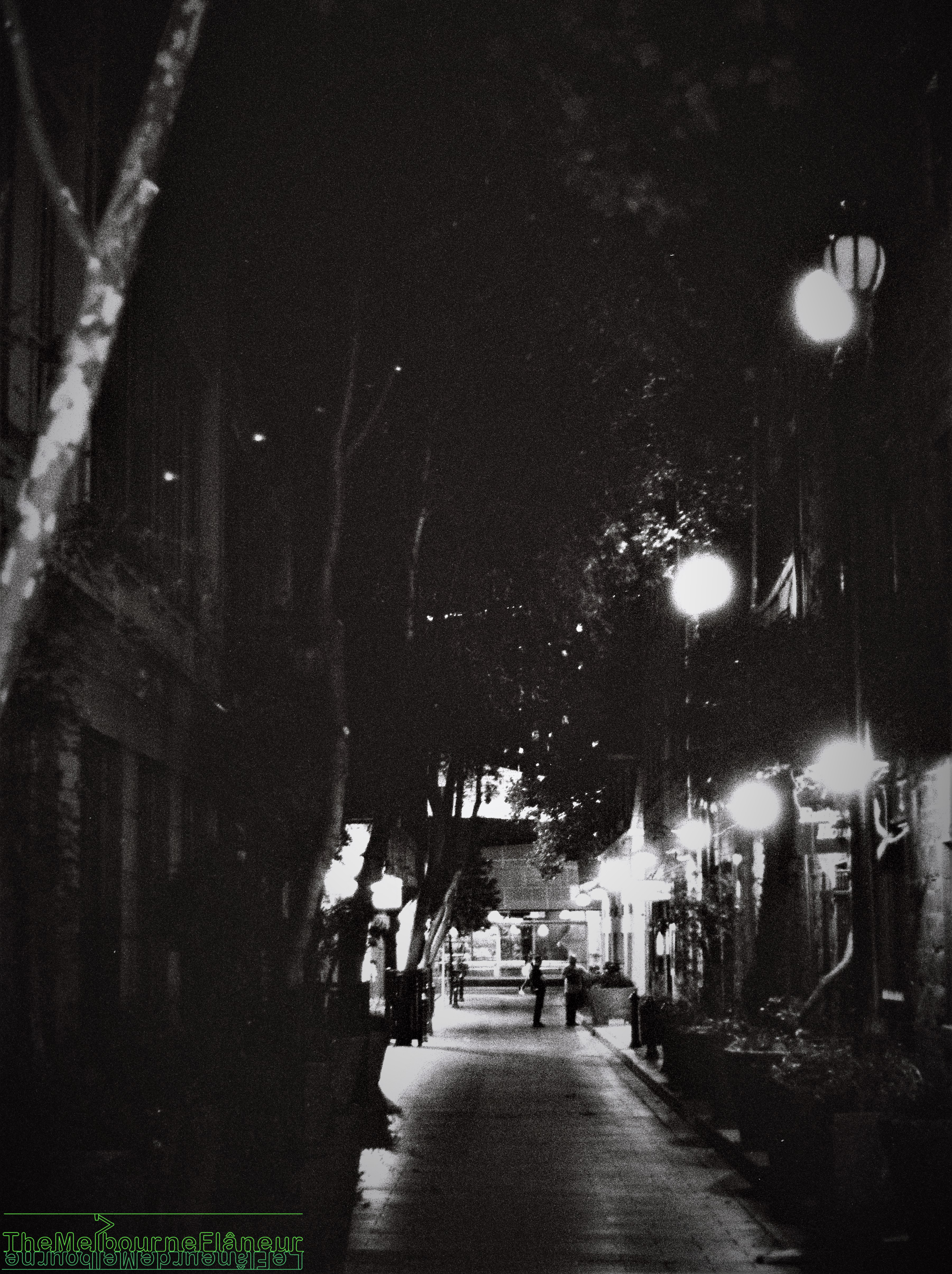
The clues to that subterranean French influence upon our civic life are buried in plain sight: they’re in the mansarded roofs of various town halls and the oblique allées of public gardens, the stone quays which pen the Yarra and the plane trees lining Collins Street.
Indeed, the eastern end of Collins Street, between Spring and Swanston, just barely retains into the twenty-first century its nineteenth-century designation as ‘the Paris End’, the prestigious address of doctors during the marvellous period, then, in the twentieth, with all the connotations of fashion that the magic name of Paris had conferred upon it, the favoured address of milliners, couturiers and cosmeticians.
Everyone important in the monde de la mode from Helena Rubinstein to Helmut Newton has either hung out their shingle or just plain hung out in ‘the Paris End’ of Collins Street, the most fashionable thoroughfare in this nation for nigh on two centuries.
To see these chthonic clues to the French influence upon our civic life, one has to have a constant eye to Paris: she must forever be in one’s consciousness, as she is in mine, for one to perceive these subtle analogies between the Mecca of modernity and her cultural colony at the nethermost ends of the earth.
Paris is always ‘devant mes yeux’, perhaps now more than she ever was, even when I was writing daily of my remembered experiences in her streets in Orpheid: L’Arrivée.
She has truly become the ‘moveable feast’ promised and prophesied by Hemingway as the eternal boon of the man lucky enough to have walked her streets, sat in her cafés, and loafed in her parks in his youth.
Doubtful that I will ever lay eyes again upon this city more beloved by me than any woman I have ever known, somehow the longer I have lived in exile from Paris in the country of my nativity, the more subtly French, the more subtly Parisian I have become.
It is a fact that certain writers and artists can live a very great deal on their memories, and in the exile of return to their homelands, the places of their actual experience are subtly, albeit marvellously transformed—as the façade of Conte momentarily was—by analogy with Paris.
Edward Hopper, for instance, though a painter, was no mean expert in French poetry, keeping abreast of literary developments in France even after he had ceased to go there for the living tutelage that the streets of Paris provide the artistic student of life.
Condemning himself to his native New York, Hopper had absorbed enough of the French spirit of life to infuse his visions of the local scene with some curious quality, apprehended at first as a weird novelty by his fellow countrymen, but later recognized as an authentic vision of American life in the first half of the twentieth century.
C’est très bien de copier ce qu’on voit, c’est beaucoup mieux de dessiner ce que l’on ne voit plus que dans sa mémoire. C’est une transformation pendant laquelle l’ingéniosité collabore avec la mémoire. Vous ne reproduisez que ce qui vous a frappé, c’est-à-dire le nécessaire. … Voilà pourquoi les tableaux faits de cette façon, par un homme ayant une mémoire cultivée, connaissant les maîtres et son métier, sont presque toujours des œuvres remarquables.
It’s all very well to copy what you can see, but it’s even better to draw what you can no longer see, except in memory. A transformation is worked upon the base material of actuality in which genius collaborates with recollection. You only reproduce what has struck you, which is to say, that which is essential to the image. … That is why paintings made in such a manner by a man with a cultivated memory, one who knows both the Old Masters and his trade, are almost always remarkable works.
—Edgar Degas (my translation)
Such artists hold themselves aloof from the circumambient culture of their countries and yet are more in the vital current of the nation’s life than their fellow countrymen, for the gift of the supple, subtle French language gives them an alternative grille through which to view the humdrum actuality before their eyes.
In the days when I wrote my first book, I did everything to keep myself insulated from the common life of Australia, to focus only on my memories of Paris, terrified that I would lose some detail which was, as Degas says, ‘essential to the image.’
Probably the work which marks the climax of my jeunesse, I still think Orpheid: L’Arrivée is a ‘remarkable’ tableau of the rue Caulaincourt in Degas’s sense, almost Rousseauian (by which I mean le Douanier, not Jean-Jacques) in the naïveté of its ‘weird novelty’, but I think the approach of hermetic insulation from the common life de l’Australie was wrong to take, though perhaps necessary and inevitable for a young man still learning his métier.
In those days, I needed my eyes and ears to be blindfolded and plugged against the actuality of my prosaic surroundings with media that reminded me of the poetry of my life in France. I couldn’t take on any new sensual experiences in these climes until I had gotten the results of the Parisian experiment in flânerie down on paper in a form I was substantially satisfied with.
But one grows, and the harder one works in youth to master the craft of writing, the more the RAM expands and the wider one’s capacities grow to register and retain those ‘essential traits’ of life which Degas says mark out the remarkable works of the artists of genius—for as Proust is at pains to impress upon us, the greater part of artistic genius lies in memory.
One is more able to take into oneself the poetic riches that lie in prosaic banality and the material conditions of one’s life are marvellously transformed by their analogy with the places and experiences of memory.
At mid-life, reconciled to my exile in the country of my birth, I now carry a bit of Paris, a morceau of its moveable feast, about with me as I sweep my fashionable path through Melbourne’s streets, unnoticed by my countrymen except as novel spectacle.
How do I do it? How do I subtly maintain the flâneurial ethos I acquired in Paris here en Australie?
The simple answer is the language, which provides me with a point of view, one of critical removal upon the currents of cultural life around me.
I think it’s fair to say that if one comes to a foreign language much beyond the age of easy acquisition in childhood, one will always be a ‘student’ of it to some extent, the more so if one comes to a foreign language in adulthood, as I did to French.
As Henry James—whose prodigious command of the language had been easily acquired in his Continental childhood—once wrote to a young French author, enjoining diligence upon him in his study of English: ‘One’s own language is one’s mother, but the language one adopts, as a career, as a study, is one’s wife, and it is with one’s wife that on se met en ménage [“one makes a common life”].’
I’ve been an earnest ‘student of French’ now for about two-fifths of my life, but it seems that at some point in the last few years, I became substantially less of a ‘student’ than I had been: having joined my life to the French language some quinzaine d’années ago, somehow my ‘wife’ and I have truly become one, body and soul, only lately in our marriage.
More than half my reading diet these days is composed of books in French, and when Abbey’s Bookshop isn’t getting a substantial tranche of cash out of me for crisp, virginal volumes like the Manchette, I’m on the hunt in thrift stores and secondhand bookshops for old books that have been passed around as once I prowled the booklined quays of Paris for saucy finds.
And just as, ‘in my day’, the bouquiniste on the quai des Célestins used to be a good place to go for a disreputable pute of a book, in Melbourne, if you like to get your tongue around a little French, certain lieux in the City of Yarra and the City of Darebin can be depended on to furnish an encounter with a vieille fille ‘on the shelf’.
Though I have largely given up the fetishistic desire which possessed me in my youth to acquire new books, I find at mid-life a resurgence in that desire when it comes to French literature: to have a naughty French novel in my satchel to whip out at an idle moment in my flâneries, to be able to momentarily set a bit of Paris before my eyes as I sit on Melbourne’s Metro, puts me simultaneously in the swim of two cultures.
To be able to excavate my copy of Camus’s L’Étranger (1942)—another Abbey’s trouvaille—from my Commie officer’s mapcase recently made the interminable trajet on the Lilydale line more bearable. At least I could fill the time by substituting Meursault’s ennui for my own.
Then too, in place of consuming much local media, I listen to a great deal of Radio France and watch French movies. I think I was partly inspired to write my first poem in French on my birthday after seeing Coup de chance (2023) at Palace Kino, in the Paris End.
Having failed to quite catch Woody Allen’s Whatever Works (2009) in Paris, posters for which frequently tantalized me in my flâneries through the Quartier latin, to immerse my eyes and ears in—of all improbable things—two of my favourite things in the world combined, a Woody Allen movie and a French film, probably helped to inspire me after a morning of frittering my fric away on Balzac, Chateaubriand and Adamov.
Listening to the world through the medium of a language where one is perpetually the amorous student is actually more fruitful for a writer than paying attention to his own media.
It is not merely that, in training the ear trumpet far afield and listening to what is going on in the Francophonic world, ignoring what is going on closer to hand in Australia, I hear a perspective on global events that is not parochially Anglocentric, but when I do happen to tune in to a few minutes of Australian media, I’m often surprised at the comparative puerility of what the media is propagandizing as ‘mainstream’ Australian culture.
The one exception to this is Australian cinema. I find I’ve been getting a lot of value lately out of revisiting the Aussie films I reviewed twenty years ago as a film critic on the Gold Coast, and this engagement with an aspect of our culture that has always struggled (under the Anglophonic imperium of Hollywood) to be ‘mainstream’—even domestically—supports my diet of French cinema.
In the interplay between French and Australian films, I find the questions I ask myself as a writer, with respect to literature, even more keenly put: Does Australia have a ‘national cinema’ that is equally an ‘art cinema’ the way that the French have a proud national cinematic tradition? Have we yet produced a stylistic storyteller who has written the national myth in images?
The films that represented us at Cannes in the years I was writing for magazines—the domestically decorated Somersault (2004), for instance—now seem to me interesting and instructive failures, fruitful clues for a writer and filmmaker embedded in the subterranean stream of his society and yet able, via the supple and subtle French language, to view the mainstream trends on the surface of Australian life with some critical distance.
In some significant sense, the prose poems of The Spleen of Melbourne project in their visual form, as hybrid Super 8 and video ‘cinepoems’ like “The Paris End”, constitute my own practical attempts to wrestle with those theoretic questions.
And what becomes clear to me as I begin to show and perform pieces from The Spleen of Melbourne is that, like the epiphany in Foveaux Street, what is felt by the flâneur walking the streets of this country as an inward experience of total sensual derangement à la Rimbaud is outwardly experienced by his fellow countrymen as ‘surrealism’: the supple and subtle French language putting a gloss of romance upon places familiar to Melburnians renders these recognizable places ‘new’ to their eyes.
Thus it is that I’m in the swim of two cultures at once. Becoming less of a student and more of a master of French in the last few years has allowed me to see a subterranean dimension of Australian life and bring it to the surface of my country’s vision.
And it could well be that, like Edward Hopper with respect to New York, in seeing what is quintessentially ‘Parisian’ about Melbourne, I am seeing something that was always there as a chthonic layer of our culture, but that only future eyes will recognize as an authentic vision of Australia’s present.
There are now nearly forty pieces in The Spleen of Melbourne project and I’m getting on towards the next iteration of the collection as a thematically navigable Blu-ray Disc of films and videos. You can support me in that endeavour by purchasing the soundtrack of “The Paris End” for $A2.00 below—or by naming your own price at the checkout, if you feel more generous.
The advantage is that by purchasing the soundtrack to the video, not only do you get access to unlimited streaming and/or high-quality download in your choice of audio format, but you can also opt in to become one of my fans on Bandcamp, where I occasionally post new pieces from The Spleen of Melbourne project which don’t have an audio or video component, as well as other photos and prose poems from my flâneries around this country exclusively for my fans on the Community tab.


 deankyte.com