Dean Kyte is a Melbourne-based writer, filmmaker and flâneur. The author of “The Melbourne Flâneur” and “The Spleen of Melbourne”, he is a craftsman of fine literature who writes prose poetry and literary noir fiction about contemporary Melburnian life.
Dean is also a translator of French literature, specializing in the poetry and prose poetry of Charles Baudelaire. His new book of translations, “Maledictions, Blasphemies, Laments: Selections from ‘Toxic Blossoms’ and ‘Parisian Spleen’”, will be published by Dean Kyte Press in June 2025.
In addition to publishing his own work, Dean provides Bespoke Document Tailoring and Artisanal Desktop Publishing services to Australian and international clients via his website, https://deankyte.com.
Before the former Colonial Bank in Euroa, the Melbourne Flâneur confronts the image of himself in the form of a fellow refugee from modernity.
Occasionally in mes flâneries, I meet the image of myself, bemisted in the palimpsest of signs. I turn a corner at random in that grey hedgemaze of clouds which is our labyrinthine reality and find an uncanny anachronistic icon reared high against the sky, holding itself aloof above the fog of everyday ways we stumble and blunder through.
I love the statuary that old architecture makes, these dépassé neoclassical deities mutilated by time. I remember seeing a painting by Russell Drysdale once—Hill End, painted in 1948, the portrait of a dilapidated bâtiment abandonné. Two storeys of wounded brickwork, a peeling plaster peau, two doors to nowhere and a wroughtiron balcon, like a jetty projecting into air, presented the proud proue of its profile to the pitiless chastisement des éléments australiens, a fulgurant hellciel of merdescent orange grimacing under the bloodmauve nuages.
Such is le flâneur, heir apparent to a vanished patrimony, un visionnaire de l’invisible. Rimbaudian dreamer in search of his bohemia, he goes, battered bateau ivre, réfugié de la modernité, holding the holes of his tattered dignity together, this aristocrat of the gutter, as he stumbles parmi les épaves, le nez en l’air, his eye anchored in the stars.
Undulant Ulysse, I port my only arm, la rame de la caméra, à l’épaule. Avec ça je peins l’image blême—à peine visible—de moi-même que je vois dressé dans le bleu brumeux. And like Albert Ryder, pale cavalier and blue pilot across many a dark, moonlit bar, je vois—là-haut! là-haut!—my eternal home, au-delà des nuages qui passent, marvellous vagabonds like myself.
I remember being affected by the vermiculated detail of the end brickwork of the façade, abutting nothing, in the Drysdale, as though a whole row of these hôtels had formed un rue-mur parisien, a barricade against the barren Australian hellscape, and now only this last brick existed in that invisible wall, fort of imported European sophistication and tradition, an antique stumblingblock, a toe of that colossus, les restes melted into airy ruins.
C’est moi, la dernière pierre d’un passé dépassé.
—Dean Kyte, “Ma Bohème”
The annual mountain of administrivia associated with running a small enterprise surmounted, I warmly welcome you back, chers lecteurs, to another financial year of splenetic, prose-poetic rants, rambles and ruminations on French literature, film, and the æsthetic philosophy of flânerie in an Australian context here on The Melbourne Flâneur vlog.
And I commence to cudgel your eyes and ears anew with my Baudelairean clairvisions of Spleen and the Ideal down under by humbly submitting as Exhibit A in my literary crimes against English, seeking to rebridge la Manche and reconcile it with French, the cinepoem above, hybridgeously digital and co-written in the colourful light and movement of Kodak Super 8 film.
“Ma Bohème”, an entry in The Spleen of Melbourne project, explores the intersection of art, the shiftless rôle of the dandy-flâneur drifting amidst the ruins of modernity, and the pastoral extension of Melbourne beyond itself into country Victoria—all themes I recently shared with The Hague-based Romanian flâneusePatricia Hurducas in an interview on her Substack blog The Flâneurs Project.
I heartily recommend you to check out not only Patricia’s interview with me, but her interviews with other flâneurs from Amsterdam to Vilnius, from Austin to Vienna, and even from exotic Kuwait-City.
For regular readers, viewers and auditors of The Melbourne Flâneur, I think you will find The Flâneurs Project a refreshing complement to this vlog: Whereas I deal with French language and literature and Parisian culture in these pages, and my name has become linked with Baudelaire’s as a translator and interpreter of his work, Patricia speaks German and is versed in the Berlin current of flânerie represented by Walter Benjamin.
She also completed a Masters of American Studies at Humboldt University of Berlin, looking at those Amerloque authors within what I call the ‘flâneurial corpus’ of literature.
In the small world where certain men and women walk about their cities in sousveillance of the Balzacian comédie humaine, Patricia has been a post of observation in the field long tracked by my flâneurial radar.
I have been aware of her work for some years now, and as one of the leading feminine entrants into the field of psychogeographic urban exploration, I have looked seriously at her work as a potential source for an article I intend to write one day when the subject is a little less politically fraught; viz.—Is female flânerie even conceptually—let alone practically—possible?
We touched tantalizingly on this delicate issue in a recent Zoom call I had with her, and in the half-hour or so where time zones in two hemispheres happily, conveniently collided, I felt an interesting shift inside myself as I listened to Patricia relate to me her own history and experience of flânerie as a young woman from post-Communist Romania ambling about the cities of Western Europe.
I knew that Patricia would be a good source to cite and refer to when the furore around what a woman actually is dies down a little and I can diplomatically put what I still expect to be a controversial argument a little more piano piano.
So allow me, dear readers, to earnestly buttonhole you and urge you to show some support to Patricia at Substack, where you can subscribe to follow The Flâneurs Project.
And as we commence our sixth year of exploring French literature and flâneurial cinema together on The Melbourne Flâneur, batting steadily towards a century of posts on this vlog, if you want to show some support to me in my ongoing work, today is the best possible day to do it—for today is Bandcamp Friday!
Bandcamp Friday was an initiative started by BC in March 2020 to support artists on the platform during the pandemic. It’s been so successful that they have kept it going, with $120 million being given directly to artists and labels by their fans to date.
For today only, you can download the soundtrack of “Ma Bohème” in your choice of format for $A2.00 using the link below—or you can name your own price at the checkout—and Bandcamp will waive their share of the revenue and pass all the pognon directly on to your Melbourne Flâneur.
The Melbourne Flâneur has just joined AirChat. You can follow Dean Kyte’s flâneries@themelbflaneur.
The challenge for this post comes from Rebecca Bardess, one of my co-conversants on AirChat, a new social medium that allows for asynchronous voice-to-voice conversations.
Rebecca, a pioneer of the Blogosphere (remember when that was a thing?), has challenged the members of the Blogging channel on AirChat to write a post without any regard to SEO.
‘I want you to look at the real conversations that you’re having on AirChat and elsewhere, the real stuff, and what inspires you and then journal on your blog, just kind of like, these are my thoughts for today….’ she says.
I feel myself inwardly groaning at the challenge already.
What?—no talk of film or French literature? no explications of aspects of my complicated æsthetic philosophy of flânerie?
This isn’t even going to be what I call (with an eye towards SEO) a ‘lifestyle post’—one of those occasional, more informal entries where I talk about what it’s like to be a Melburnian flâneurial writer.
Nope. This is pure stream-of-consciousness rambling, and I have no idea where this post is going.
O.K., Rebecca:—‘the real stuff’, the real conversations I’m having on AirChat and elsewhere. What is inspiring me there?
The first words that leap to mind are that ‘it’s all about the vibe’: When I think back on the first couple of chits I posted on AirChat more than two months ago, I feel like my voice is stiff and shy—like someone arriving at a party where he knows no one and who is seeking to introduce himself to people when the party is well underway.
But after more than two months on this platform, having asynchronous ‘voice-to-voice’ conversations with people in all parts of the world, the barriers to authentic communication are largely down and some of the playfulness that only my most intimate IRL conversational partners get to experience in face-to-face chat starts to shine through.
And as demonstrated by the current debate in the Film Channel on who, among directors, might be the GOAT, a certain ludic spirit attends even my participation in serious attempts at collective sensemaking.
As one of the few Australian accents to have taken to AirChat, I was surprised and moved to hear that, despite a small following, my voice is regarded in certain quarters as one of the most significant sources of signal on the platform.
Of course, since AirChat is still in its early days, hardly anyone apart from the co-founder, Naval Ravikant, has what might yet be considered a ‘large’ following, but as a user in the Australia Channel noted, those Aussies who have adopted this social medium early account for 0.0006% of the population.
That’s less than 200 people.
Anyone who has been in a real-life rap session with me knows that I’m not nearly as eloquent in conversation as I am on the page. I tend to talk around my points rather than land a direct blow on them. I often need a bit of labyrinthine conversational runway before I can find the right path to approach what I am trying to say.
What can I say?—I’m a writer, not a speaker.
The time to think, to draft and to craft a message is where my forte lies. And yet, on occasions when I have read my writing aloud, I’ve often been told that I have ‘a good voice’—a compliment I take as graciously as possible because, to quote Canadian chanteuseDiana Krall, I don’t think that I have a particularly ‘pretty voice’.
But it’s also the case that however incompetent I feel as a conversationalist, there’s something in my Proustian longueurs and labyrinthine searchings for my point that my conversational partners seem to find compelling when we get a good rap going between us.
And so, as someone who is paradoxically precise in his written communication and yet scatty in his conversation, it should be strange that I have been an early adopter of a social audio medium in these days when an ill-formed thought or informal word can be so costly.
But the early adopters of AirChat are all people of goodwill, genuinely committed to reviving the moribund art of civilized conversation. This has caused me to state that what Naval styles as a ‘dinner party in your pocket’ is really more like a salon: We early adopters are the leaders of fashion and culture meeting in Mr. Ravikant’s drawing room, modelling the future etiquette of a new ‘informal formality’ with one another.
And as a flâneur, as a graceful wanderer through, loiterer within, and observer of the social scene, perhaps I am the perfect creature of this conceptual drawing room designed by Naval: As a passive assistant at others’ conversations and as an active interlocutor in my own, I navigate the channels and topics aired on the platform, whether grave or gay, with the grace of the dandiacal flâneur who finds himself in his natural element—the crowd.
And this is perhaps entirely appropriate for, as I wrote in the preface of the second edition of my Œuvres back in January, ‘The flânerie is an ambulatory intellectual parcours; an investigative promenade through some embodied thought, feeling, idea, impression, sensation, experience, memory, dream, or intuition….’
Not only have I found a social medium that suits the peripatetic quality of my thought, one that I can engage in during my random peregrinations, but the varieties of channels of thought that the feed opens up to me is one that I can indulge in flâneuristically, whether as active participant in a conversation or passive assistant at the conversation of others, floating in and out as one might wander through the rooms of an enormous house where a party is going on.
But this platform may not be for everyone, and I wonder if it has the capacity to scale.
Despite Naval’s concerted efforts to limit performativity, which has been one of the significant externalities of social media, because users are thrown back on the unvarnished nakedness of their own voices, there is definitely a sense early on that when you press down your thumb on the record button you are in some literal sense ‘stepping onto the public stage’.
And as a couple of users have noted, with the damage that has been done to Generation Z’s social skills, there are unfortunately few young people on this app, which I think is probably a prerequisite for mainstream take-up.
If all of your social interaction has taken place behind keyboards and avatars, pressing the record button and speaking in your natural voice to a stranger on the other side of the world might be too confronting for most young people.
I hope that changes in the short to medium term, for it’s ‘the real stuff’, the real conversations that are being had on AirChat, that have been inspiring me these past several weeks. I would love young people to be able to experience a genuine human pleasure that all their living forebears know: the positive joy of having a truly generative conversation with a partner of goodwill.
You can check out my feed to listen in on the conversations I’ve been having or follow my flâneries on AirChat @themelbflaneur.
The former Port of Melbourne Authority Building, built between 1929 and 1931, at 29-31 Market Street. To enjoy the full, immersive experience of the ficción, be sure to use headphones to listen to the track below.
Market Street was quiet at that late hour. He stood casually at the corner of Flinders Lane, waiting for the lights to change. The darkness and the muted rumours of the traffic in Collins and Flinders Streets gave this corner of Market Street, between them, a peaceful air, like an isle of repose cleaving the strong current of a river.
The lights changed, but he did not move.
He held himself in readiness to cross, but, like a mannequin, he did not break his pose of relaxed attention, as if he could not hear the staccato chatter of the walk signal beside him.
It cut out abruptly, settling back into its quiet, regular cluck. He hit the call button again and continued to wait, as if he had only just arrived at the pedestrian crossing.
Across the street, the doorway of the Port Apartments was a tall, golden rectangle unblemished by the telltale shadow of human movement. He gave no sign of being aware of this fact as he gazed around, turning his head regularly in both directions, as if cautiously preparing himself to take the negligible risk of stepping off the sidewalk and crossing the empty street. Nevertheless, he was conscious of the flight of marble steps inside the heavy bronze streetdoor leading up to the foyer, across whose regular, foreshortened recession of greyish, horizontal shadows no oblique, concertina’d form passed.
One could also see, from that angle, the left-most margin of the foyer door, a column of translucent squares rendered triangular by the bronze diagonals dividing the lights, smaller versions of the diamond muntins that graced the windows of the old Port Authority Building’s ground floor. Through that dark lattice of crisscrossing lines, as through the organic volutes springing obliquely from a potted fern before it, no movement marred the subdued but warming yellow of the foyer within.
The 58 tram, snaking its way towards West Coburg, passed before the Port Apartments like a curtain drawn across its doorway. Warning the empty night of its turning manœuvre with a double clang of its bell, the tram slithered around the corner into Flinders Lane, trailing a wake of noisy lights.
Like the agitation of a curtain in a window, through the strobing double panes glazing the trailing second carriage as it swung away, he saw the penumbrous edge of a slender silhouette, elegant in its curvature, briefly mar the crisp gold border of the doorway as it slipped away into Market Street, the soupçon of fugitive movement masked by the departing tram. The staccato click of heels rang in rapid report from the opposite sidewalk, making off in the direction of Flinders Street.
He started after it, crossing the street diagonally at something faster than a jog, gathering momentum as he reached the tramtracks. The urgent sound of his footsteps was swallowed in the mounting rumble of a City Loop train charging across the Viaduct in Flinders Street.
The engine of the silver BMW roared to life beside the Immigration Museum and its wheels screeched forward, pawing asphalt. Two lights like crosshairs blinked briefly against the dark granite of the Port Authority Building’s plinth as it passed. Accompanying them, the cough of muffled gunfire.
The Melbourne Flâneur returns to Bellingen, NSW, and, in this lyrical prose poem enhanced with Super 8 film footage, ponders a flâneurial figure in the landscape even more conspicuous than himself—‘the Mem Hall’.
When God decides my days are done, perhaps then He’ll allow me to settle in Bellingen. Perhaps then He’ll permit me to be as permanent as that pile, the hall in Hyde Street whose peachcoloured walls, for a hundred years, have overlooked it all—even my errances and romances.
At times my eyes gloss the Memorial Hall with the memorious glaze des jours perdus, and the faded veneer of flâneurial souvenirs recover their lost colours.
For we have both been secret historians of this place, observant actors in the life of Hyde Street. His soldierly, literary footprint is sole and secular and unerasable while mine have been many, mobile and cancellable.
A holy light dawns about his walls and whole falls of buried memory cascade out of obscurity for me.
I hear an aura lingering in Maam Gaduying, scene of solitary sittings in wintry dusks, of escalations of les dames, things I’ve written about or hidden histories I am yet to write, but which the Mem Hall, whole library of unfiled memories, has watched, his façade regarding me as I act out my hours of drama in the Meeting Place Park.
The pillared bras of his façade have embraced it all; the corniced brows of his windowed yeux have watched me curiously through the years. I’ve read my Parisian poèmes on his scène, and opposite, au parc, I’ve acted out my Parisian vie de flâneur in Bello’s narrow boulevard de Hyde Street. For there is une autre espèce de flâneur—rooted, loitering—and the Mem Hall, in his commanding prospect de la rue, epitomizes him.
Perhaps one day mes os, in Bello, will be as permanent as the Mem Hall’s walls.
— Dean Kyte, “The Memorial Hall”
When duty called me up to the North Coast for two weeks in February, it had been twenty months since I had last seen Bellingen and a lot had happened during that time—very little of it unambiguously positive.
I dare say that the lifestyle of flânerie, seeking to fly by the nets of society at every turn, made the pandemic a more uniquely painful event for someone like myself who is both a Melburnian by election and a flâneur by inevitability.
And while I seemed, despite my lifestyle of country-wide travel, to come through the pandemic without either the CV or the vaccine ever touching me, the years 2020 through 2022 seem to run together for me in a lasting mental fog, leaving a scar on my life from which I’m still recovering.
Hence Bellingen in June of 2022, at the time when the images above were shot on Super 8 and digital video, seemed a very distant place when I saw the Memorial Hall for the first time in its new blue-and-cream livery in February.
Now I am coming rapidly—sadly—to the end of two months spent at Urunga, the town next door to Bello, which has allowed me to get across on a few occasions to the little town which ranks easily for me with Paris and Melbourne as a world capital of flânerie.
There was one Sunday in June 2022, just before I was due to depart Bellingen, when I spent a cartridge of Kodak Vision3 50D Super 8 film on two visions typical of the years I lived in Bello, including the Memorial Hall—affectionately known by the locals as ‘the Mem Hall’.
I had mentally budgeted out the three-and-a-half minutes of film available on the cartridge and knew exactly what shots I wanted from the two locations. And as is my usual practice when working with Super 8, I took back-up shots from the same set-ups using my trusty Olympus Stylus digital camera and recording location sound with my TASCAM digital sound recorder.
The only issue with the Mem Hall location, shot from the corner of Maam Gaduying, the ‘Meeting Place Park’ in front of the Bellingen Library, is that, at the time of my holiday in June 2022, temporary fencing garnished with a dirty great banner advertising Coffs Harbour Demolitions was set up before the doors of the Mem Hall.
Were they going to pull down our beloved, historic Mem Hall?
Fortunately not.
It was about to undergo renovation—including a new paint job—and although I had to grumpily contend with the banner and fencing prophesying the Mem Hall’s imminent demolition while I was filming it, when, in February, I saw the most iconically ‘Bellingen’ piece of architecture in Hyde Street for the first time in twenty months, now cream and blue instead of the surreal shades of rosy peach and apricot I had always known it as, I was glad that I had had an opportunity, on my last trip, to shoot it on Super 8 as I remembered it and had always experienced it—banner, fencing, and all.
This is not to cast shade on the new façade: I was blown away by the cream and blue. It gives the Mem Hall a more ‘Mediterranean’—rather than tropical—feel, and I actually prefer the new colour scheme.
But on Super 8, cream and blue would certainly not have come out as spectacularly as that peachy orange directly taking the rays of a Sunday afternoon in winter, reminding me, under the hybrid digital treatment I give those shots in the video above, of afternoons I spent sunning myself—gelidly, it seemed—in the Meeting Place Park.
For all the pseudo-Moorish intimations of the Mediterranean the new paint job gives it, whether in cream and blue or a rosy peach and apricot, the most iconically ‘Bellingen’ building in Hyde Street still manages to be marvellously surreal.
We can see the resulting building, a weird exercise in inclusiveness, and an attempt to reconcile irreconcilable functions: a library, a cinema, a dance hall, a theatre, an auditorium, a kitchen, a tea room, toilets, a war memorial and whatever other use you can make of it. Perhaps, in an exaggerated way, it reminds us that all buildings are like this. But at various meetings or in preparation for them people must have sketched designs that included space for the Literary Institute and library, absorbed the functions of the old School of Arts, made ‘provision of exclusive rooms for the use of returned soldiers’, tried to placate the view that ‘there was no form of sacrifice whatever about a hall and picture show as a memorial’. And in these drawings they would have accommodated or got rid of existing makeshift structures like the picture theatre and the dance floor. Rather than the result of a collaborative process consummated by a set of architectural drawings, it seems like the Hall designed and built itself in a self-steering process that went on over the heads of the individuals involved, like a demented version of Adam Smith’s guiding hand.
The prose-poetic commentary to the video above falls into that category of my œuvre I am now consciously styling as ‘flâneries’—literary peregrinations through sensibility, variously poetic, essayistic or fictional, which arise from my wider wanderings through this country, outside the Melbourne which forms the geographic basis for the prose poetry in The Spleen of Melbourne.
And though it probably sounds like a scoffable claim to mention the name of Bellingen (a town which, even in this country, few people have heard of) alongside such world-class centres of flânerie as Paris and Melbourne, I mean the claim quite seriously.
As much as Paris and Melbourne, Bellingen stands at the absolute centre of my literary life, and I would not be the writer and filmmaker I am today but for thirty months I lived there between 2014 and 2016.
While certain ‘regional writers’ become poetic spokesmen for a place, unofficial laureates of certain cities, communicating the genius loci to readers further afield, I am hard pressed to think of another writer for whom the specificity of place and time is as salient as it is to my work, and yet who has as wide an experience of geographically specific places and times.
Thus, while there was a ‘Gold Coast period’ of my literary life, and there has been ‘Parisian’ and ‘Melburnian’ phases, there has also been the ‘Bellingenian period’, and my years in Bellingen stand in respect to the Melburnian period as my years on the Gold Coast stand with respect to Paris.
Which is to say that Bellingen did not quite ‘complete’ me as a flâneurial writer and filmmaker, but that it is the place, like Paris, where I had the first opportunity to practically implement the evolving principles of my æsthetic lifestyle philosophy of flânerie—the praxis of a theory I had developed to a certain point of refinement in other landscapes, at other times of my literary life.
In the flâneurial video essay “On having left, but not yet having arrived”—also partly shot on Super 8—I say that Bellingen was ‘the scene of my longestlasting happiness’: splenetic, ennuyé, utterly Baudelairean soul that I am, never was I more consistently happy in my life than during the years I lived in Bellingen.
Only Paris approached it for the number of ‘jours parfaits’ I spent there.
Hence they are, though hemispheres apart, elliptically linked on the prime meridian of flânerie: these are the epicentres of a new and fruitful æsthetic life.
When I left Paris, I wept for weeks like a man who had lost the love of his life—and indeed I had, having seen—in the arms of a Parisienne—a vision of holy wholeness in my dying hours there which I have committed the rest of my life to prophesying and proselytizing.
When I left Bellingen for Melbourne, it was on account of a woman I could no longer bear to see in the Meeting Place Park, or at the IGA, in company of another man, and although I went forward with excitement to the next scene of my literary life, I carried as much buried mourning for the woman—and for Bello—as I had done for Paris and the Parisienne.
There are two paradoxical modes of Parisian flânerie, the wandering walk and the lingering loiter, both of which allow observation of the life of the street.
And as I say in the video above, if, in my years of living in Bellingen, I made a Parisian boulevard of Hyde Street in my dandiacal circuit up and down it, the Mem Hall, in its vantage-point overlooking a particularly animated corner of Bello’s main street, represented, in its outrageous livery of peach and apricot, the other pole of flânerie, observing the spectacle of the passers-by rather than being itself an active, ambulatory participant in that spectacular parade.
Equally, the Mem Hall observed me, many times a day, swanning past its portals in both directions. It had the privilege of observing me doing so at all hours of the day and night in those years, and not infrequently, in those endless hours of happiness, in the midst of some flâneurial experience—often with a woman—that would afterwards find its permanent record in my writing.
It was past the Mem Hall, for instance, that I marched the beautiful, enigmatic Emma in Follow Me, My Lovely… (2016), and it was within sight of the Mem Hall, at the corner of Bridge Street, that I first attempted to ‘mash a pash out of her’.
We set out, manoamano, shouldertoshoulder in the cold, clear air of 3:30 a.m. I built a little light rapport with her by laying out the thumbnail version of how I came to be in Bello, but I was tired of unwinding that yarn and didn’t do it as well as I might have. At the corner of Ford Street, we turned right onto the main drag and walked along the brickpaved sidewalk fronting the park.
…
In retrospect, it seems to me that there had been enough time in the space of that short block to build sufficient rapport with Emma in order for her to feel comfortable with me, yet I couldn’t say just when I had first become aware that I would have to make my move. I think I only became conscious that the moment of truth was fast approaching and I would have to physically turn her steps towards the river when we passed the Mem Hall.
In Follow Me, My Lovely… the Mem Hall plays a cameo rôle, having been, before the action of the story begins, the place where I first espied Emma at the Barefoot Boogie, a dance party that used to take place there on the night of the full moon during the years when I lived in Bello.
And in another reminiscence of my years in Bello, a longer work, as yet unfinished, called “Sentimental Journey”, the Mem Hall plays a more salient part. It’s the place where my tale begins, when, in the hours before I am due to get on an overnight train to Brisbane, I see Polanski’s La Vénus à la fourrure (2013) there, an event which, by obscure tangents among the degrees of separation in my rather extensive social network in Bellingen, leads me unexpectedly into the arms of another woman.
She plunged her arm into mine and we rounded the corner into Hyde Street….
While she jawed, I cast a cautious slant around as we stepped off the kerb in front of the post office: beside us, Bridge Street was an empty corridor of darkness illuminated by a solitary streetlamp at the other end of Lavenders Bridge. Across Hyde Street, a lonely brother to it loafing in front of the Mem Hall craned its neck over the main drag, the rose façade lit a livid orange by its yellow glare.
If anywhere in the world was a more romantic playground for seduction than Bello at night, I hadn’t yet experienced it.
We forded Bridge Street and regained the kerb—the kerb where I had tried to mash a pash out of Emma and had told her to come back to my place. We passed it, walking through those ghosts, and changed tracks, shunting onto the spur of footpath leading into the Meeting Place Park. A trio of lamps, spaced out in a loping curve, followed the line of the wide brick path sweeping round to the library and council buildings. Their ramrodstraight figures picked out among the trunks of the eucalypts, almost as straight, on the green sward made the park seem vaguely like an image by Brassaï, reminding me of Paris.
At a lonely hour in the early evening, I sometimes liked to sit here alone, watching the traffic roil around the intersection as I huddled against the cold on the pew in front of the historical museum. I scoped it out now as a potentially discreet venue for escalation: a lampadaire planted in the Lunchbox Garden in front of the council offices cast an oblique, chiaroscuro glare on that corner. It wasn’t mood lighting, but it did raise some harsh shadows, and if we huddled at one end of the pew, we should be reasonably protected from view of the street by the corner of the red telephone box and the extension of the Neighbourhood Centre.
— Dean Kyte, “Sentimental Journey”
As I say in the video essay above, both of us, the Mem Hall and myself, have been secret historians of Bellingen, memorious flâneurial observers of otherwise unremarked moments in the life of Hyde Street. The Mem Hall has watched me conducting my vie de flâneur just as I have watched the colourful characters in Bello’s streets.
And I think it is no geographic accident of synchronicity that the Mem Hall, the original ‘literary institute’ of Bellingen, faces the present town library, for as I intimate in the video essay, the building seems to me a vast cabinet of unfiled memories, leaves of time—so sheer as to be invisible—of all it has witnessed in its century of life, the secret history of the town which no one yet has had the soul and vision, the heart and spirit of service to properly write.
As I said in a previous article on Bellingen, a few well-known men of letters have, for a season of their lives, made a home for themselves in Bello, and by far the most famous of these writers is Peter Carey.
Carey, who lived here in the eighties as a tree-changing refugee from Sydney, sets Oscar and Lucinda (1988) in the vicinity of the Gleniffer Hall, but Carey’s historical novel lies well beyond what Henry James calls ‘the visitable past’—the rememberable history of one’s own lifetime and experience.
As the young James, flush from his first adult experience of the Roman relics, wrote his sister Alice, unless one’s mind is veritably sagging beneath the weight of material facts about the subject, historical fiction, for a novelist, is the least worthwhile pursuit: ‘The present and the immediate future seem to me the best province of fiction—the latter especially—the future to which all our actual modern tendencies and leanings seem to build a sort of material pathway.’
As far I know, the high-flying Carey has written nothing to commemorate ‘the modern tendencies and leanings’ of his time in Bellingen, one of the most artistically fruitful places on earth, the very Mecca, in my view, of a global ‘Vita Nuova’ towards which Bellingen, in its present and by its example, builds a material pathway.
I take it as a point of pride that, as the least well-known among the men the letters who have made a temporary life for himself in the landscape of this ‘Promised Land’, I have been the most committed to memorializing the visitable past of my experience in these climes.
And as an unofficial historian of the unnoticed hours of Bellingen life, I see a co-conspirator to my project in the architectural figure of the Mem Hall itself, who reminds me of the eponymous character in Jorge Luis Borges’ ficción“Funes, el memorioso” (1942).
Nosotros, de un vistazo, percibimos tres copas en una mesa; Funes, todos los vástagos y racimos y frutos que comprende una parra. Sabía las formas de las nubes australes del amanecer del 30 de abril de 1882 y podía compararlas en el recuerdo con las vetas de un libro en pasta española que sólo había mirado una vez y con las líneas de la espuma que un remo levantó en el Río Negro la víspera de la acción del Quebracho. Esos recuerdos no eran simples; cada imagen visual estaba ligada a sensaciones musculares, térmicas, etcétera. Podía reconstruir todos los sueños, todos los entre sueños.
Dos o tres veces había reconstruido un día entero; no había dudado nunca, pero cada reconstrucción había requerido un día entero. Me dijo: ‘Más recuerdos tengo yo solo que los que habrán tenido todos los hombres desde que el mundo es mundo’. Y también: ‘Mis sueños son como la vigilia de ustedes’. Y también, hacia el alba: ‘Mi memoria, señor, es como vaciadero de basuras’. Una circunferencia en un pizarrón, un triángulo rectángulo, un rombo, son formas que podemos intuir plenamente; lo mismo le pasaba a Ireneo con las aborrascadas crines de un potro, con una punta de ganado en una cuchilla, con el fuego cambiante y con la innumerable ceniza, con las muchas caras de un muerto en un largo velorio. No sé cuántas estrellas veía en el cielo.
At a glance, we notice three glasses on a table; Funes, all the stems and branches and fruits that make up a vine. He knew the shapes of the southern clouds at dawn on 30 April 1882 and could compare them in his memory with the grain of a book bound in Spanish leather he saw only once, and with the lines of foam raised by an oar in the Rio Negro on the eve of the Battle of Quebracho. These were not simple memories: every visual image was linked to sensations—muscular, thermal, and so on. He could reconstruct all his dreams, all his dreams within dreams.
Two or three times he had reconstructed a whole day. He had never hesitated, but each reconstruction had required a whole day. He told me: ‘On my own I have more memories than all the men since the beginning of the world have had.’ And also: ‘My dreams are like the insomnia you fellows have.’ And also this, towards dawn: ‘My memory, sir, is like a garbage dump.’ A circle on a blackboard, a right-angled triangle, a rhombus; these are shapes that we can fully visualize. To Ireneo, the same thing happened with a colt’s wild mane, with the very tip of a knife, with the protean flames and innumerable ashes, with the many faces round a dead man at a large wake. I don’t know how many stars he saw in the sky.
Like Ireneo Funes, the Memorial Hall, to me, is infinitely memorious of Bellingen. It has seen—in the most exquisite detail—everything that has passed before it in its century of life.
It is truly a book of days.
And although, in its infinite discretion, it does not speak of what it has seen as I have privately journaled it, the Mem Hall remembers everything that has passed before or within it—including my presence on its stage, reciting my Parisian poems at the annual Poetry Slam, and upon the stage of the Meeting Place Park opposite, solitudinously sunning myself at dusk or making out with some dame after dark.
But I’m not entirely alone in this self-imposed project to be a flâneurial historian of Bello, the memorious recorder of its forgotten hours. One local writer I have respect for, and who seems to be involved in an analogous, albeit more ‘official’ project of public memoration, is Ross Macleay, one half of the North Bank Institute, Bellingen’s oldest—and smallest—think tank.
In “The Memorial Hall”, one of the essays in his collection On, in, from, over, Bellingen (2013), Macleay tells us that the ‘Soldiers Memorial Hall and Literary Institute’ opened to great civic fanfare on Wednesday 19 January 1921 with (among other visual confections) a presentation of Charlie Chaplin’s comedy “Sunnyside” (1919).
Describing the cinematic bill of fare on that night in his essay, Macleay explains how ‘the Mem Hall’ as Bellingenians know it today had not even been built on that fateful date, the ‘Grand Opening Night’ of the Bellingen Memorial Hall Pictures being a fundraising event to build the pile on Hyde Street.
The Memorial Hall began its life as a war between two motions passed at two meetings. At the first on 4 December 1918 a motion was passed to build a War Memorial in Bellingen at a cost of no more than ₤500, and a committee of twenty was formed. At the second on 6 June 1919 the original motion was cancelled, a substantial majority voted to build a memorial hall instead, and the committee, trimmed from twenty to seventeen, was given the job of raising funds. The building of the hall would be a war on two fronts, the first was against those who thought a monument was more fitting for military commemoration than the frivolity of a pleasure dome (plus easier and cheaper). The second was the long campaign to raise the money.
— Macleay (2013, pp. 147-8)
The money came, as Macleay tells us, from the showing of movies, and on 19 January 1921, the good burghers of Bello crowded onto the site of the present Mem Hall, under an open-air shed set up as insurance against the rain, to see Charlie Chaplin, Sessue Hayakawa, and a Pathé newsreel at ‘two shillings for a chair up the back, one for down the front on a log, and children [at] half price.’
Thus, from its inception, the Mem Hall, doing surreal double service as a perpetual monument commemorating local casualties in the Great War and as a meeting place for the celebration of living culture in a small town, secularly profaned itself as a picture show.
My first experience of the Mem Hall was when my friends dragged me along to see a John Pilger documentary in the great barn behind the façade—a fragrant experience spiced with the familiar scent of the chai tea concession set up on two trestle tables on the eastern side of the salle.
John Pilger, chai on the side, and barefoot kids running wild: that sums up both the experience of the Mem Hall and of Bello—of the Mem Hall’s significance to Bello life as a communal meeting place. It was at that screening, as I now recall, that I met several of the people who would become significant to me in those years, and among whose ranks, in my hats and suits, I would be the most unlikely ‘hippie’ by comparison.
As I have written in another of my flâneries, ‘the elevating experience of “enlightened” leftwing documentaries spiced with chai tea at the Memorial Hall’ is one of the typical memories I most cherish about Bello.
And that says so much about the centrality of the Mem Hall to Bello life. When I was in Euroa two years ago and attending a presentation of the documentary Happy Sad Man (2018) at the Euroa Community Cinema (which is also housed in the shire hall), the film’s Melbourne-based director, Genevieve Bailey, told the assembled townspeople that she had recently screened her doco at Bellingen, a little town in NSW, she said, not dissimilar to Euroa, and in a hall not unlike the Strathbogie Shire Council building.
As probably the only person in that room besides Ms. Bailey to have an experience of both venues—and then far more extensively, as regards the Mem Hall, than Ms. Bailey herself—I knew in my heart and my gut the visceral truth of the comparison she was making.
I love Bellingen as much as I love Paris—and I love these places as much, and in the same way, as some of the dearest women I have known.
And as I say in the video above, one day I hope my flâneries will at last be done and I can permanently rest my bones in Bello.
In this short poetic video essay, Dean Kyte reflects on the rôle played by a streetlamp in the novel Dans le labyrinthe (1959) by Alain Robbe-Grillet.
À mon gré, c’est le réverbère qui est l’heros du Labyrinthe de Robbe-Grillet. Multiple mais solitaire, étroit et droit, il est néanmoins un dédale conique, rectiligne comme la rue. Sous la neige il se tient, digne, entouré des vignes, leur noirceur blanchie par la glace. À l’abri de sa brillance, dans une ville bâtie de chance, un soldat froid trouve un foyer éphemère de lumière dans l’infini du temps et de l’espace.
— Dean Kyte, “Un lampadaire”
In the twenty-first century, it is neither the novel, as the representative of literature, nor the movie, as the representative of cinema, that holds cultural sway over the minds of postmodern peoples in the West.
Rather, it is the video game, I believe, that is the dominant form of cultural production.
This is a rather depressing prospect for an homme de lettres who is equally an homme du cinéma as your Melbourne Flâneur is—one of the last, stubborn survivals into this century of the Faustian twentieth-century project of universal literacy.
As Marshall McLuhan argued in Understanding Media (1964), and as Walter J. Ong later argued in Orality and Literacy (1982), for nearly two centuries our new media technologies, as extensions of our capacity to communicate at a distance and at scale, have been gradually facilitating an escalating shift away from the high literacy required to interpret print towards what I call a ‘renaissance of orality’.
The cinema as a ‘graphic medium’, a techne that allows one to ‘write’ on film with light and movement, was but the first and greatest of these pseudo-literary ‘new media’ to translate the long prose form of the novel back into ‘story’—a fiction that is told rather than ‘narrated’.
As a child of the twentieth century, I maintain my chauvinistic passion for both books and films, and even as a gosse in the eighties and nineties, when the video game was just starting to compete with these dominant cultural forms, I could never get too interested in playing screen-based games.
I was a true child of the century in that, despite the fact that I love all manner of board games and other abstract intellectual competitions of skill and chance, from gambling to RPGs, the video game as an innovative, immersive iteration of the pseudo-literary, virtually cinematic narrative form could never hold my attention as much as a good novel or movie.
What did fascinate me, however, as a thoroughly literary and cinematic enfant in those days when video games were much less sophisticated than they are now, was to watch other people play through these primitive first-person RPGs where the decisions for advance into the virtual labyrinth of the game were algorithmically binary.
These were the days, of course, when the Choose Your Own Adventure novels were a fad to encourage literacy among millennial children, and the labyrinthine, binary, non-linearity of the reading experience that could be had through those books was reflected, mutatis mutandis, in the digital, algorithmic medium of the video games of the late eighties and early nineties.
The Choose Your Own Adventure novels put authorial control into the hands of children just as, in the video game, the joystick and the game controller allowed kids to ‘write’ their own adventures in the present tense of virtual experience.
Just as there is a parallel between archetypal myth and novelistic narrative, I would argue that there is also a deep parallel between game and narrative which the multidimensional ludic structure of the video game makes particularly manifest, although the board game and the more abstract rôle-playing game also demonstrate my contention.
In fine, the formal, rule-based elements of a multi-player game furnish the architecture for an emergent synchronous narrative to consequentially unfold. This is a form of synergistic ‘group writing’ distinct from the solo calculatory operations of the novelist working, in the privacy of his room, through the chain of logical consequences which fall out of the conceptual grille he instantiates in his solitary act of creative imagination.
In our postmodern age, the video game has ludically problematized the logical linear narrativity of the long prose form of the novel by making the three fundamental elements of an extensive narrative—location, character, and time—into a virtual, interactive gaming space.
These fundamental elements of literary narrative become like the three dimensions of the crystal lattice which comprise the labyrinthine grid of a video game: Through the first-person perspective of a character ranging over space and enduring over time, the player is able to penetrate and explore this virtual grid, and his interactions with non-player characters, whether helpful or antagonistic to his mission, furnish the ‘events’ of novelistic drama.
With his fourth published novel Dans le labyrinthe (In the Labyrinth, 1959), Alain Robbe-Grillet presciently writes what I think should properly be considered ‘the first video game’—albeit in print form: The technology of the mission-based, first-person rôle-playing computer game being not yet in existence, through his eminently cinematic writing, le père du Nouveau Roman essentially writes what will become ‘the novel of the future’—the postmodern video game.
The plot of Dans le labyrinthe is as schematic as that of any video game: Following the defeat of his army in a battle at Reichenfels, a soldier with a paper-wrapped box under his arm is on a mission to deliver it to someone he has never met in a city he has never visited before.
The details of the assignation are vague. The soldier has forgotten the name of the street where he is supposed to meet the recipient of the package and all he knows for sure is that he is supposed to wait beside a particular lamppost at a particular streetcorner out front of a particular building.
But all the lampposts, streetcorners and buildings of the city seem the same, and whatever route he takes in his search, the cold and weary soldier seems to find himself continually returning to the same lamppost at the same streetcorner before the same building, where he finds himself continually confronted by the same quizzical little boy who guides him back to the same place.
As Bruce Morrissette says in his article “Games and game structures in Robbe-Grillet” (1968), puzzles, riddles, illusions—all manner of ludic paradoxes—fascinated Alain Robbe-Grillet from his childhood, and his novels and films are filled with allusions to games.
‘I recall his once calculating rapidly and precisely the number of times a single sheet of paper would have to be folded to make its increased thickness reach from the earth to the moon,’ Morrissette writes, adding (in parentheses) that such a ludic enterprise ‘is a mathematical possibility’.
As Morrissette puts it at the end of his article, the game for Robbe-Grillet, as a form analogous to the literary enterprise of the Nouveau Roman, ‘has come to mean structural freedom, absence of traditional rules of transition, viewpoint, chronology, and other parameters of previous fiction….’
There is distinct game that Robbe-Grillet plays with the reader in each of his fictions, but of the four novels I have thus far addressed in this series of articles on his work, nowhere is the concept of ‘the game’ more salient as an operative metaphor for approaching the novel than in Dans le labyrinthe.
As Roy C. Caldwell, Jr. states in “The Robbe-Grillet Game” (1992), there is a ‘Labyrinthe game’ just as, in the previous novel I addressed, there was a ‘Jalousie game’. And, above and beyond all the individual games played by his literature, there is a superordinate ‘meta-game’—a ‘Robbe-Grillet game’—the author’s œuvre plays with us as readers.
One might even be tempted to define the ludism of the Robbe-Grilletian text by [Roger] Caillois’s term paidia (free-play) rather than by what he calls ludus (game). Paidia is play without rules; it occurs when no conventions yet exist to organize the operations in the play. While a ludic activity may originate as free-play, as it is repeated, it develops a convention, a tradition, a set of rules. Paidia tends inevitably towards ludus. When players first play a given game, they may be free to invent or include any kind of activity; if they play again, however, they inevitably refer to the authority of what happened the first time. Ludus requires memory; paidia has none. Robbe-Grillet’s texts are more aptly described not as exercises of free invention, but as peculiar, dynamic games which continue to formulate their body of rules as their narratives unfold. (Inventing the rules as one proceeds to play is generally considered something less than good sportsmanship, and thus Robbe-Grillet’s readers have often felt confused, if not ‘cheated.’)
— Roy C. Caldwell, Jr, “The Robbe-Grillet Game” (1992, pp. 549-50)
We assist at Robbe-Grillet’s improvisation as he essentially ‘makes up the rules’ of the novel as he goes along from the first pages of Dans le labyrinthe, which begins in a spirit of free imaginative play, rehearsing the potential ways a narrative could ‘get going’ out of objective relations suggested by the furnishings of a room.
A bed, a table, a lamp, the shapes described by objects that have interrupted the uniform patina of dust on surfaces:—these things suggest various structural permutations in the first twenty pages of the novel, out of which a snowy street and a soldier leaning against a lamppost with a wrapped box under his arm fitfully emerge.
Robbe-Grillet is ‘writing the code’ in these early pages: we assist as he establishes the algorithmic elements of the game-play—soldier, street, lamppost, snow, child, café, door, corridor, staircase, room, woman, box. From these fundamental elements he will rarely divert himself, though the variety he gives to these configurations over 200 pages appears to us as infinitely extensive a hermetic world as the virtual grid of a video game.
Thus, it is fair to say that the ‘operating system’ of the game, the initial labyrinth we enter as players in our contention with Robbe-Grillet’s text, is the algorithmic labyrinth of language itself.
Aussitôt le soldat confirme par des explications plus détaillées : mais, à peine lancé, un doute le prend, si bien qu’il préfère se limiter, par prudence, à une succession de phrases décousues, c’est-à-dire sans lien apparent, pour la plupart inachevées, et de toute façon très obscures pour son interlocuteur, où lui-même d’ailleurs s’embrouille davantage à chaque mot….
Le soldat, lui, ne sait plus comment s’arrêter. Il a tiré sa main droite de sa poche et l’avance en crispant les doigts, comme celui qui craindrait de laisser échapper quelque détail dont il se croit sur le point de fixer le souvenir, ou comme celui qui veut obtenir un encouragement, ou qui ne parvient pas à convaincre. Et il continue de parler, s’égarant dans une surabondance de précisions d’une confusion sans cesse croissante, s’en rendant compte tout à fait, s’arrêtant presque à chaque pas pour repartir dans une direction différente, persuadé maintenant, mais trop tard, de s’être fouvoyé dès le début et n’apercevant pas le moyen de se tirer d’affaire sans faire naître des soupçons plus graves encore chez cet anonyme promeneur qui prétendait seulement parler de la température, ou d’un sujet anodin du même genre, ou qui même ne lui demandait rien du tout — et qui du reste persiste à se taire.
The soldier immediately confirms with more detailed explanations; but, barely commenced, a doubt seizes him, so much so that he prefers to limit himself, out of prudence, to a succession of disjointed sentences, that is to say, without apparent connection, for the most part unfinished, and in any case very obscure for his interlocutor, in which he himself becomes more muddled with every word….
The soldier himself no longer knows how to stop. He has withdrawn his right hand from his pocket and advances it, clenching his fingers like someone possibly fearful of letting slip some detail he thinks himself on the verge of remembering, or like someone seeking to obtain encouragement, or who fails to convince. And he continues to talk, losing himself in a superabundance of details with an ever-growing confusion, quite conscious of the fact, halting almost at every step so as to start afresh in a different direction, now convinced—but too late—of having gone astray from the start and not seeing a way to extricate himself from the situation without causing even graver suspicions to be born in this anonymous passer-by who was merely purporting to talk about the temperature, or some anodyne subject of the same type, or who wasn’t even asking him anything at all—and who, moreover, persists in remaining silent.
— Alain Robbe-Grillet, Dans le labyrinthe (1988, pp. 150-1 [my translation])
Aligned with the perspective of the soldier as our avatar in Robbe-Grillet’s Labyrinthe game, we find ourselves in continual contention with NPCs the author throws across our path as aids and adversaries to completion of the mission.
Some, like the young woman in the room upstairs, help us, while others, like the child who is apparently her son, seem more ambiguous in the information or assistance they provide, and others still, like the man with the crutch, appear alternately helpful and hostile to our attempts to deliver the box.
And as the algorithmic ‘rules of the game’ that bootstrap even the emergent property of narrative, the subtleties of the French language, as E. T. Rahv shows in her article “Robbe-Grillet’s uses of the past in Dans le labyrinthe” (1971), are significant markers in orienting us temporally, if not spatially, in Robbe-Grillet’s Labyrinthe game.
As the excerpt above demonstrates, the French present tense is to Robbe-Grillet’s style what the imperfect was to Flaubert’s or the conditional tense to Proust’s: it is his habitual mode of literary expression.
In English, the present tense has very limited literary utility. It sounds awkward to render sentence after sentence in a novel—which is necessarily a past-tense account rather than a present-tense recounting—in the English present tense, and it becomes eventually fatiguing to the reader.
By contrast, the French present tense sounds much more natural in the past-tense context of a novelistic account, possibly because the French present tense is much less reliant on the gerund form than English to convey a sense of real-time ‘happening’, and among French writers, Robbe-Grillet makes the most consistent use of its affordance to convey a sense of cinematic instantaneity.
And of course, in its illusionistic, cinematic quality of recounting something that has been written as if it were happening right now as in the dynamic algorithmic narrative of a video game, the present tense is eminently appropriate for a novel that utilizes the iterative, real-time randomnicity of game-play as an analogical conceit for its plot development.
But as Rahv shows in her article, where Robbe-Grillet uses the present perfect or the imperfect tense instead of conforming to his preference for the simple present tense in Dans le labyrinthe, he does so subtly yet pointedly to indicate that, although we might be in the same place as in the previous sentence or paragraph, we are there at a different time.
And in fact, as the novel progresses, Robbe-Grillet’s unusual employment of the past tense—what Rahv calls a ‘textual past’ similar to the present perfect tense of a cinematic flashback—takes over the account more or less completely.
A video game is conceptually similar to a labyrinth in that both structures appear infinite in their extension and convolution while being, in fact, paradoxically finite. They achieve this felt sense of infinity by means of two principles, repetition and recursion.
The plot of Dans le labyrinthe may be summarized as a repetitive, recursive re-entry into a sheltered space: whichever way the soldier turns, wherever he goes within the grid-like gaming space of Robbe-Grillet’s fictional city, he is repetitively, recursively returned to the same streetcorner, to the same building with its door ajar, to the same corridor and room.
Le soldat est seul, il regarde la porte devant laquelle il se trouve. Pourquoi l’enfant lui a-t-il indiqué cette maison-là plutôt qu’une autre, puisqu’il n’était chargé que de le mener jusqu’à cette rue? Quelle est d’ailleurs cette rue? Est-ce bien celle dont il s’agissait tout à l’heure? Le soldat ne parvient plus à se souvenir du nom auquel l’invalide tenait tant : c’était quelque chose comme Mallart ou Malabar, Malardier, Montoire, Moutardier… Non, ça ne ressemblait pas à cela.
… Il remarque à cet instant que la porte est entrouverte : porte, couloir, porte, vestibule, porte, puis enfin une pièce éclairée, et une table avec un verre vide dont le fond contient encore un cercle de liquide rouge sombre, et un infirme qui s’appuie sur sa béquille, penché en avant dans un équilibre précaire. Non. Porte entrebâillée. Couloir. Escalier. Femme qui monte en courant d’étage en étage, tout au long de l’étroit colimaçon où son tablier gris tournoie en spirale. Porte. Et enfin une pièce éclairée : lit, commode, cheminée, bureau avec une lampe posée dans son coin gauche, et l’abat-jour qui dessine au plafond un cercle blanc. Non. Au-dessus de la commode une gravure encadrée de bois noir est fixée… Non. Non. Non.
The soldier is alone. He looks at the door before which he finds himself. Why has the child pointed out this house rather than another since his only duty was to lead the soldier to this street? What is this street anyway? Is this the one they were discussing earlier? The soldier can no longer manage to remember the name the invalid was so definite about: it was something like Mallart or Malabar, Malardier, Montoire, Moutardier… No, it was nothing like that.
… At that moment he notices that the door is ajar: Door, corridor, door, vestibule, door, then finally a lighted room, and a table with an empty glass whose bottom still contains a circle of dark red liquid, and a disabled man who leans on his crutch, tilted forward in a precarious equilibrium. No. Half-open door. Corridor. Staircase. Woman who mounts at a run from floor to floor along the narrow staircase, her grey apron turning in a spiral. Door. And finally a lighted room: bed, chest of drawers, fireplace, desk with a lamp placed in its left corner, and the shade which draws a white circle on the ceiling. No. Above the chest of drawers an engraving framed in black wood is attached… No. No. No.
— Robbe-Grillet (1988, pp. 95-6 [my translation])
More than delivering the box even, his ‘challenge’, as our avatar in this ludic space, is to re-enter, to return to safety, and, like a character in a video game, the soldier, unable to graduate beyond this simple challenge, must eternally repeat it, extending the physical labyrinth of the gaming space into the dimension of time.
But as the excerpt above shows, Robbe-Grillet anticipates the future video game by matrically rearranging a fundamental set of ordering elements that structure the algorithmic gameplay of the novelistic narrative. The permutations that this closed set of objects may undergo is not infinite, but there are enough of these replicable elements that the n of potential combinations they can be put through appears to the perplexed reader/soldier lost in this conceptual labyrinth to be effectively infinite.
Thus, whatever street he turns down, the soldier is turning down the same street, and as Robbe-Grillet, in his customarily meticulous description of the lamppost, shows, with the basis for its intricate design in a cast-iron mold, once described, it’s a very simple process for the novelist to ‘copy paste’ this singular lamppost all along the length and breadth of his infinite street.
Indeed, one of the few things that fascinated me as an ado either watching or playing video games—(and this is perhaps an early indication of my pedestrian destiny as a flâneur IRL)—lay in exploring the limits and boundaries of the seemingly infinite gaming space.
I don’t know if it’s still the case today, but in those days if one kept walking long enough down the seemingly endless corridor or past the infinitely copy-pasted trees, one would always find oneself nez-à-nez against a hard, though invisible, wall, a forcefield representing the computational limits of the gaming space.
As an artefactual object, the physical novel itself imposes similar limits and boundaries upon the game that Robbe-Grillet can play with his reader, but ‘dans le labyrinthe’—within the abstract conceptual grid of 200 pages, each covered with a maximum 28 lines of the French language put through its combinatorial possibilities—he goes quite far in giving us an impression, as in a video game, that the space is infinite due to these replicated repetitions of modular elements.
This repetition of elements iterated through conceptual space that Robbe-Grillet effects through a modern, literary version of our postmodern ‘copy paste’ æsthetic opens out the novel for the reader with a feeling of infinity while strictly bounding the legal moves Robbe-Grillet can narratively play, when his structure is fully instantiated, within the labyrinth.
And of course, replicated repetition extends even to the characters—none of whom have even names to distinguish them, such that the dramatis personæ of Dans le labyrinthe are truly the first NPCs in literature.
Thus we meet with the archetypal n of potential human forms—man, woman and child—infinitely iterated by this ‘copy paste’ æsthetic, and the weary soldier—who may be any soldier—is continually asking himself if it’s the same child or another he is continually meeting beneath the same lamppost or another.
Repetition of formal elements in extensivity is also reflected in the dimension of depth as recursion in Dans le labyrinthe. Thus, as I said above, if anything could be said to ‘happen’ in the novel, it is the soldier’s action of continual re-entry into sheltered space—into building, café, room—but also into the engraving on the wall of that room depicting reactions to the news of the army’s defeat at Reichenfels in the café downstairs—and which appears to show our soldier as one of the assistants at that announcement.
In a hand-drawn graph appended to his pioneering article on the novel, “The Structure of Robbe-Grillet’s Labyrinth” (1965), James Lethcoe convincingly argues that there are actually three nested layers of linear plot in Dans le labyrinthe—not to mention the fourth conceptual level of the labyrinth within the imagination of Robbe-Grillet himself.
James Lethcoe’s graph of the plot of Dans le labyrinthe. He argues that there are three recursive layers of reality to the plot which, despite the novel’s appearance of randomnicity, actually unfolds in a linear fashion on all three levels. Page numbers refer to the first French edition of 1959, reprinted in the 1988 edition cited here.
In Lethcoe’s view, it is this engraving, “La défaite de Reichenfels”, which is the generative ludic matrix bounding the entire novel, and among the buveurs and bavardeurs in the café which is sometimes situated on the ground floor of the building before which the soldier stands, we find the soldier himself seated between two comrades who are sometimes transposed reflections of himself.
Tous les personnages y sont à leur place: le patron derrière son bar, le médecin au manteau doublé de fourrure dans le groupe des bourgeois qui se tiennent par-devant, mais posté un peu à l’écart des autres et ne se mêlant pas à leur conversation, l’enfant assis par terre contre un banc surchargé de buveurs, près d’une chaise renversée, tenant toujours la boîte serrée dans ses bras, et la jeune femme en robe froncée, aux cheveux sombres, au port majestueux, élevant son plateau garni d’une unique bouteille par-dessus la tête des consommateurs attablés, le soldat enfin, assis à la plus petite des tables entre ses deux camarades, simples fantassins comme lui, vêtus comme lui d’un capote boutonnée jusqu’au col et d’un calot, fatigués comme lui, ne voyant rien — non plus — autour d’eux, se tenant comme lui raides sur leurs chaises et se taisant comme lui. Ils ont tous les trois exactement le même visage ; la seule différence entre eux est que l’un se présente de profil gauche, le second de face, le troisième de profil droite ; et leurs bras sont pliés pareillement, les six mains reposant de la même façon sur la table, dont la toile cirée à petits carreaux retombe, à l’angle, en plis rigides aux formes coniques.
All the characters are in their place: the publican behind his bar, the doctor with the fur-lined overcoat among the group of burghers who stand in front, but placed a little apart from the others and not involving himself in their conversation, the child seated on the ground against a banquette overloaded with drinkers, near an overturned chair, forever holding the box tightly in his arms, and the young woman in the frilly dress, with the dark hair, with the majestic bearing, raising her tray garnished with a single bottle above the heads of the patrons at their tables, finally the soldier, seated at the smallest table between his two comrades, simple infantrymen like himself, dressed like him in a greatcoat buttoned to the neck and a forage cap, tired like him, seeing nothing—anymore—in their vicinity, holding themselves stiffly on their seats like him and keeping quiet like him. All three have exactly the same face; the only difference between them is that one presents his left profile, the second faces forward, and the third his right profile; and their arms are likewise folded, the six hands resting in the same manner on the table, whose oilcloth with small checks falls, at its corners, in rigid folds with conical shapes.
— Robbe-Grillet (1988, pp. 203-4 [my translation])
According to Lethcoe, this puzzling image, which is first described extensively between pages 24 and 29, on the base level of the novel’s reality, and which periodically recurs throughout the book, its details being further shaded in or changed, is the two-dimensional source of the entire three-dimensional game space Robbe-Grillet imagines for us.
As Jean Ricardou (cited by Caldwell in his 1992 article) might put it, “La défaite de Reichenfels” is the ‘dispositif’—the fundamental device, the elemental engine—that pre-exists the narrative, and which determines what algorithmic ‘turns’ or ‘moves’ in storytelling may legally fall out of the engraving’s labyrinthine network of logical constraints.
Whatever turns he takes once his ludic narrative structure is fully established, there must always be a soldier, a woman, a child in Robbe-Grillet’s narrative; there must always be a street, a building, a lamppost, a mysterious box and snow; there must always be the shelter of a room and a bed, and the comfort of a chair, a table, and a glass of red wine to which the soldier must repetitively, recursively attempt to return.
If you got something out of this article, I encourage you to purchase the soundtrack from the video essay below for $A2.00. It’s a small investment and it helps me to continue to share my passion for French literature with you in these deep-dives.
The spaces of cinematic and literary noir have their roots in the supernatural vision of Poe. In this video essay, Dean Kyte reads a thoughtful, lyrical passage from Patricia Highsmith’s Strangers on a Train (1950).
He was staying at the Hotel Montecarlo, about ten blocks from the Hotel Ritz, a great shabby building that looked like the former residence of a military general. One entered it through a wide carriage drive, paved in black and white tile like a bathroom floor. This gave into a huge dark lobby, also tile floored. There was a grotto-like bar-room and a restaurant that was always empty. Stained marble stairs wound around the patio, and going up behind the bellhop yesterday, Guy had seen, through open doorways and windows, a Japanese couple playing cards, a woman kneeling at prayer, people writing letters at tables or merely standing with a strange air of captivity. A masculine gloom and an untraceable promise of the supernatural oppressed the whole place, and Guy had liked it instantly, though the Faulkners, including Anne, chaffed him about his choice.
His cheap little room in a back corner was crammed with pink and brown painted furniture, had a bed like a fallen cake, and a bath down the hall. Somewhere down in the patio, water dripped continuously, and the sporadic flush of toilets sounded torrential.
When he got back from the Ritz, Guy deposited his wristwatch, a present from Anne, on the pink bed table, and his billfold and keys on the scratched brown bureau, as he might have done at home. He felt very content as he got into bed with his Mexican newspaper and a book on English architecture that he had found at the Alameda book-store that afternoon. After a second plunge at the Spanish, he leaned his head back against the pillow and gazed at the offensive room, listened to the little ratlike sounds of human activity from all parts of the building. What was it that he liked, he wondered. To immerse himself in ugly, uncomfortable, undignified living so that he gained new power to fight it in his work? Or was it a sense of hiding from Miriam? He would be harder to find here than at the Ritz.
—Patricia Highsmith, Strangers on a Train (1950, pp. 50-1)
As un adhérent du Nouveau Roman who has decentred characters from his narratives and made architecture their star, I was delighted when I read the passage above in Patricia Highsmith’s Strangers on a Train (1950) last year.
Though a little purple round their edges—(as stained, perhaps, as the place they describe)—I nevertheless felt, for three paragraphs, almost as if I were reading one of my own ficciones intercalated into Highsmith’s literary crime novel.
In those three paragraphs, Patricia Highsmith imagines—fully a dozen years before Resnais and Robbe-Grillet—Marienbad, albeit she sites that labyrinthine hôtel onirique en Mexique, the land loved by the surrealists.
Strangers on a Train is a young novelist’s book: the brushwork is a little loose, the colour a little too chromatic. Highsmith is not yet in possession of the tight, Jamesian command of character and moral situation she will evince but half a decade later in The Talented Mr. Ripley (1955). Yet more so than in that book (which the Library of America chose to include as a representative example in its collection Crime Novels: American Noir of the 1950s), Strangers on a Train is definitely a roman noir.
And, as a mere slip of a girl at thirty, Highsmith had at least written a novel which could command the attention of Hitchcock.
A couple of months ago in Melbourne, I saw Hitchcock’s 1951 adaptation of Strangers on a Train in what I’m sure must have been the first time in over twenty years. It was the second half in a double-bill that included North by Northwest (1959)—(can you believe seeing those two together on the big screen in one night?)—and whereas I knew every line and shot of the first film by heart, Strangers on a Train had slumbered so long in my memory that it was virtually like seeing it fresh.
Like Highsmith’s novel, technically I was surprised to find the film a little slipshod for Hitch: he has a matte photograph of Washington’s Capitol that manages to jump three times in a single setup; he relies a little too heavily on ill-matching stock footage for the tennis match, and the pro doubling for Farley Granger can’t possibly be mistaken for him at a distance.
But I walked out of that double feature into a dark, rainy, prematurely chill midnight in Carlton pulling my trenchcoat more tightly about me and thinking that, if a legitimate case can be made for any of Alfred Hitchcock’s films as being ‘noir’, then surely Strangers on a Train is at least as viable a contender as the oft-proposed Shadow of a Doubt (1943).
The Highsmith/Hitchcock intersection points to something fundamental about this vaporous thing called ‘noir’: both the novelist and the cinéaste are moralists in the domain of crime fiction, tellers of ‘moral tales’, though the telling of such contes moraux comes more naturally to the writer than to the filmmaker, who must principally convey his moral tone visually rather than by means of language.
There’s a whole tedious chapter (if memory serves) of Notre-Dame de Paris (1831) in which Victor Hugo bangs on with his usual exhausting gusto about the architecture of the eponymous Parisian cathedral, sententiously arguing for it as a veritable ‘bible in stone’ whose every arch and capital is a letter in its visual language.
Film noir is primarily a ‘tonal’ quality of the cinematic treatment of those things in actuality which must serve the filmmaker as his alphabet—the streets, the buildings, the people, their fashions and conveyances, of modernity.
As an historical phenomenon, film noir was an æsthetic movement in the visual treatment of actuality, a distinctly expressionistic inflection of cinema’s native tendency towards realism.
As a stylistic movement proper to the artistic medium of film rather than a literary genre, film noir was, therefore, a set of ‘visual strategies’ for treating urban modernity that encompass all aspects of the cinematic apparatus but principally those native to the medium—lighting, camerawork, mise-en-scène and montage.
Film noir was an æsthetic portfolio of techniques for subjectively inflecting the image of built space, and as such, it produces an impression of ‘hyper-reality’, and thus a mood of ‘dis-ease’ in the viewer as he encounters a form of the ‘uncanny valley’ in the anthropocentric environment of the modern city.
The image of the city, this social environment built by humans ostensibly for humans—but which actually serves to alienate human beings precisely because of its ‘over-humanness’, its continual reference to anthropocentric concerns—becomes unsettlingly ambiguous in film noir.
As a tonal mood to depictions of the city, the affective character of film noir suggests an uncanny ‘doubleness’ to the faces which the spaces of modern actuality present to us when they are reduced to pure, geometric, architectonic forms by black-and-white cinematography.
… [O]blique and vertical lines are preferred to horizontal. Obliquity adheres to the choreography of the city, and is in direct opposition to the horizontal American tradition…. Oblique lines tend to splinter a screen, making it restless and unstable. Light enters the dingy rooms of film noir in such odd shapes—jagged trapezoids, obtuse triangles, vertical slits—that one suspects the windows were cut out with a pen-knife. No character can speak authoritatively from a space which is being continually cut into ribbons of light.
I say ‘realism’ because a totally uninflected image—one that is Newtonianly objective, which does not assume the position of a limited, subjective observer—is presently impossible to us. That’s still one of the charming limits of the artistic medium of cinema: a filmed image partakes of the ‘genre’ of realism without ever attaining the objective reality of which it gives the viewer a convincing impression.
In this sense, at its least inflected, even a documentary film may be as much a work of ‘realism’ as a novel by Zola—and fall as far short of a purely scientific description of actuality as his pretenses to ‘objectivity’ through the literary medium of long-form fiction.
But what forcibly struck the French-Italian critic Nino Frank in the article where he coined the term ‘film noir’ to describe a certain genre of American policier was precisely this vigorous impression of a ‘new realism’—a ‘neorealismo’, if you will—in these wartime thrillers, detective stories for the most part, but also reverse-engineered stories—like Double Indemnity (1944)—in which ordinary men and women lured into committing crime played the starring rôles rather than the sleuth uncovering their guilt.
Ainsi ces films « noirs » n’ont-ils plus rien de commun avec les bandes policières du type habituel. Récits nettement psychologiques, l’action, violente ou mouvementée, y importe moins que les visages, les comportements, les paroles – donc la vérité des personnages, cette « troisième dimension » …. Et c’est un gros progrès : après les films comme ceux-ci, les personnages des bandes policières usuelles ont l’air de fantoches. Or il n’est rien à quoi le spectateur d’aujourd’hui soit plus sensible qu’à cette empreinte de la vie, du « vécu », et, pourquoi pas, à certaines atrocités qui existent effectivement et qu’il n’a jamais servi à rien d’occulter ; la lutte pour la vie n’est pas une invention actuelle.
Thus these ‘dark’ movies have nothing in common with the usual kind of detective yarns. Distinctly psychological stories, action, in these films, whether violent or frenetic, is less important than the faces, behaviours, words—hence, the truth of these characters, that ‘third dimension’…. And this is a major step forward: after movies like these, characters in the usual detective stories appear insubstantial. Now, there is nothing towards which today’s filmgoer might be more sensitive than this trace of life, of ‘life as it is lived’, and—why not?—towards certain atrocities that actually exist, and which it has never done any good at all to hide: The struggle for life is not a current invention.
Frank was writing two years to the month after the Liberation of Paris, and ‘life as it is lived’ during what the French call ‘les années noires’ of the Nazi Occupation had certainly been dark and full of ‘certain atrocities’.
Just as, for the Italians, the dying months of Nazi Occupation give fruitful birth to a ‘new realism’ in cinema that trenchantly refuses to hide those ‘certain atrocities’ which actually exist in the struggle for life, so for the French, more keyed to the existential implications of the crime genre, film noir, as a stylistic inflection of generic thriller material, adds a ‘third dimension’ to cinema—that of the moral psychology of crime.
By German Expressionism out of French Poetic Realism, film noir is a set of visual strategies that forcibly inflect with psychological subjectivity the ‘objective’ image photographed by this non-intentional artistic medium: the architectonic shapes and spaces of urban modernity become effective ‘crime scenes’, freighted with desire, rage, melancholy and dread.
As Paul Schrader outlines in “Notes on Film Noir”, how the spaces of urban modernity are lit, the time of day at which they are photographed, whether the setting is given as much compositional emphasis as the actors, and how active a rôle the cinematic apparatus plays in advancing the narrative determines to what extent the image of actuality photographed is inflected with a moral character we call, after the French wartime experience of doubleness and ambiguity in the places of modernity, ‘noir’.
Carl Plantinga goes a great distance towards staking out the conceptual terrain of what constitutes a tonal ‘mood’, or what he calls an ‘affective character’, in film, art, and literature, taking Orson Welles’ Touch of Evil (1958) as his particular example in “Art Moods and Human Moods in Narrative Cinema” (2012).
Building on the work of Greg M. Smith, Plantinga argues that the plot-based ‘events’ in both literary and cinematic narratives (as, for instance, in both Highsmith’s and Hitchcock’s respective versions of Strangers on a Train) are clothed and cloaked in ‘an affective experience that permeates the fictional world of the work.’
Plantinga argues that this enveloping ‘mood’ of a given film ‘is something like its affective “character”,’ and that, to use his example, ‘[i]n Touch of Evil we could describe this [mood] as dark, foreboding, anxious, and unbalanced.’
As per Schrader’s iconographic summary of film noir stylistics, a preponderant percentage of scenes in Touch of Evil are shot in low light, at nighttime or in sombre interiors, with light sources stabbing stark rays into the frame from outré angles. Certainly, the baroque emphasis on the built environment of the Mexican border-town is given as much visual prominence as the actors. And, from the very first and famous shot crossing the frontier, Welles actively employs the cinematic apparatus to drive the moral tale he has to tell forward.
As Plantinga puts it, in a film noir like Touch of Evil (which he says is particularly effective at conveying its global mood of dread, anxiety and unbalance), the form of the film as much as its visual content is charged with an affective character whose essential qualia we might call ‘noir’.
… [T]he film noir may set the scene in a city late at night, the empty streets deserted and the rain falling, a few figures huddled in isolated doorways—all suggestive of darkness, wetness, coldness, and loneliness. On the soundtrack are the strains of melancholy music, together with the faint sounds of a quarreling couple in some nearby apartment.
—Carl Plantinga, “Art Moods and Narrative Moods in Narrative Cinema” (2012, p. 465)
In film noir, the visual ‘content’ of urban architectural forms—buildings, streets, doorways, apartments—undergo an epiphanic formal treatment. The qualities of darkness, emptiness, wetness, coldness and loneliness described by Plantinga in this imaginary example—not to mention the muted sound of anger—cloak the city in a shroud—but it’s a glamorous shroud.
In this epiphanic formal treatment, this intentional subjective inflection of visual content that carries no affective character in itself, the images of cities and the typical structures within them are glamorized by the cinematic apparatus, bringing out a supposed ‘poetic realism’ immanent in these objective structures, their implicit ‘photogénie’, their ‘sexy’ appeal to the camera’s non-intentional eye.
It’s arguable that what Frank was responding to in 1946 as a new realism in Hollywood crime dramas was in fact a ‘hyper-reality’ that the cinematic apparatus, with glamorizing intentionality, was painting on the banal visual content of actuality.
As I demonstrate in the video essay at the top of this post, somehow the hour of the day, the tightness of the aperture, the least inflection one can give to a photographed image of actuality in what was simply intended as a background for a Mexico City driving shot;—somehow all this plus the intrinsic, reductive beauty of black-and-white as an æsthetic limitation and inflection of reality works together to make even the most banal image of city streets and buildings ‘noir’.
On a personal note, your Melbourne Flâneur joined the new social medium AirChat this week and he’s loving it. Here’s a link to my feed:
I’ve been very resistant to social media and I’m typically glacial in the speed of my take-up when it comes to new technologies, but when I heard about AirChat, I jumped on it. After twenty years of standing on the sidelines watching the other kids play, I think this is social medium I’ve been waiting for.
So far, AirChat gives evidence of being the perfect social medium for a writer to rehearse his ideas in public. I’ve been putting the voice-to-text AI through its paces by reading aloud daily drafts of a new short story I’m working on, and as you can see in the quick and dirty video below, the AI accurately renders complex sentences featuring a technical vocabulary of architectural and mathematical terms which (according to the OED) are typically not among the most frequently used words in English.
Dean Kyte has joined AirChat and he thinks it’s going to be a game-changer for introverted writers seeking a viable social medium with which to communicate their words to a primarily oral, rather than literate, audience.
I also find that it copes with my slippages into French and Italian pretty well, often correcting itself when it mistakes a foreign word for one that sounds similar in English. It seems to search the Internet for self-corrections: in an exchange with Naval Ravikant where I invoked the name of Carlo Gozzi, the AI subsequently fixed up its initial misrendering of ‘gotsy’ based on the context of my voice note—what is called a ‘chit’ on AirChat.
In addition to giving the good folk on AirChat a daily earful of what I have been writing in the mornings, I’ve also posted a few random thoughts throughout the day based on the notes I’ve taken from my readings in researching this article.
So if you would like to interact with your Melbourne Flâneur, take vicarious, asynchronous part in my flâneries, or perhaps listen in or contribute yourself to some of the generative intellectual conversations that are happening on AirChat, I invite you to follow me @themelbflaneur.
In this prose poem from The Spleen of Melbourne, Dean Kyte takes a nostalgic flânerie up the so-called ‘Paris End’ of Melbourne’s Collins Street as he reminisces about his last night in the Ville Lumière.
‘The Paris End’:—it’s one of those magick phrases which evoke the sweet life of flâneurial streetlife for me. And whenever I treat myself to a flânerie up ‘the Paris End’ of Collins Street, like someone raising and lowering their shades, I shuffle the rosetinted souvenirs de Paris over les scènes melburniennes before my gaze.
When I saw the rougetainted Regent Theatre lit up to fête Moulin Rouge!, like le coup d’un souvenir enfoui, the farded façade dans la place Blanche floated up, suddenly unballasted, and I remembered standing on the little asphalt île de la place on my dernière nuit à Paris. Then I knew what the phrase ‘the Paris End’ meant to me; it meant ‘la fin de Paris’.
—Dean Kyte, “The Paris End”
Last Monday night as I was hiking up Foveaux Street to The Carrington Hotel (your Melbourne Flâneur’s Sydney ‘office’, his lubricated lieu de l’écriture in the barbarous Harbour City), puffing hard as I approached the lip of Riley Street, Conte before me glowing redly in the dusk, I realized with a thrill of satisfaction so rare in my life that my whole relationship with France and the French language has undergone a quantum change in the last two or three years.
As I laboured up the hill, in my mind’s eye I saw myself more than a year ago frequently taking this flânerie up Foveaux Street to The Carro, the 1,300-page Gallimard edition of Jean-Patrick Manchette’s complete Romans noirs cuddled to my breast.
In a moment of expensive madness I had acquired the Manchette for a portrait of Monash upon discovering Sydney’s Abbey’s Bookshop and its feast of foreign-language books on the first floor some months before. I knew nothing of M’sieu Manchette; I was literally judging this hundred-dollar book by its cover—a print, by Gérard Fromanger, of the Parisian café Le Paillard rendered in an inky blue with the red silhouettes of some hinky flâneurs fogging up the boulevard des Italiens before it.
Manchette, I suspected, would be un type sympa—or at least, he would be a writer sympathetic to my cause of a Melburnian literature flâneurially evocative of Paris, of the nouveau roman written under the guise of the roman noir.
My mission on those nights, as on this, was to enjoy a good dinner and a Guinness at The Carro, masticating my Manchette over my parma and pint, and then, my wits sufficiently elevated by the brew, to debrief my brains of the day’s doings in my journal.
And now as I was grappling up the escarpment of Foveaux Street over a year later, another wad of dough freshly blown on bloody French books from Abbey’s, the red neon and the green bricks of Conte burning provocatively—like the Negroni they serve there and the Absinthe they ought to—in the sympa Sydney dusk, that small, irrational feeling of bien-être the flâneur occasionally feels when there’s no objective reason for contentment with his ennuyé life now descended on me.
Ah! comme la vie est belle!
I’m not quite sure why Conte should bring this feeling of the flâneurial merveilleux out of me: Did it, in its ‘italienneté’, recall Fromanger’s depiction of the boulevard des Italiens on the cover of the Manchette?
Or, in its position à l’angle, on the plateau of Riley Street, ahead of me as I marched the martyrizing hill of Foveaux Street as I had once climbed steeper streets in Montmartre, throwing its deep red and green over the corner, did it recall to me my beloved Cépage Montmartrois, the ‘sein d’or’ whose catalyzing golden light upon the rue Caulaincourt I immortalized in my first book Orpheid: L’Arrivée (2012), the golden bosom where I went to write every night in Paris over a demi de bière—indeed, where I learned this Parisian habitude, which has served me so well en Australie, of writing in bars and cafés?
Or was it simply that, one night, diverted from The Carro and into the boisterous bosom of Conte, I had, with my Manchette, sat at the bar, swooning over my Negroni and a piatto di prosciutto beneath the Italian movie posters, looking as keenly up at the red one-sheet for Blowup (1966) over the bar, hypnotized by it as if it were the movie itself?
Je ne sais pas.
What I know is that something has fundamentally changed for me in my relationship with France and its language during the last few years.
I’m hard pressed to put a date to it, and I only became conscious that a major phase shift had occurred in January this year, on my forty-first birthday, when I found myself sitting in Chloe’s Room, at Young & Jackson, arguably ‘the nation’s pub’, writing my first poem in French, moved by the French muse who holds court in this very Australian bar.
It’s a connection still very much buried to the eyes of my countrymen.
While the British colonial influence still lies on the surface of everyday life in Melbourne, with the lion and unicorn of the Royal Coat of Arms gracing everything from the portico of the Immigration Museum to the masthead of The Age, the French connection lies at a deeper, subtler stratum—deeper even than the Chinese, Greek and Italian influences on Melbourne life.
One has to dig back into the literature of the nineteenth century, when Paris was indisputably the capital of the civilized world, or the first half of the twentieth, when it was still coasting on a century of accumulated cultural prestige even after World War II, to perceive where and how Melbourne owes a subtle debt to French culture.
The clues to that subterranean French influence upon our civic life are buried in plain sight: they’re in the mansarded roofs of various town halls and the oblique allées of public gardens, the stone quays which pen the Yarra and the plane trees lining Collins Street.
Indeed, the eastern end of Collins Street, between Spring and Swanston, just barely retains into the twenty-first century its nineteenth-century designation as ‘the Paris End’, the prestigious address of doctors during the marvellous period, then, in the twentieth, with all the connotations of fashion that the magic name of Paris had conferred upon it, the favoured address of milliners, couturiers and cosmeticians.
Everyone important in the monde de la mode from Helena Rubinstein to Helmut Newton has either hung out their shingle or just plain hung out in ‘the Paris End’ of Collins Street, the most fashionable thoroughfare in this nation for nigh on two centuries.
To see these chthonic clues to the French influence upon our civic life, one has to have a constant eye to Paris: she must forever be in one’s consciousness, as she is in mine, for one to perceive these subtle analogies between the Mecca of modernity and her cultural colony at the nethermost ends of the earth.
Paris is always ‘devant mes yeux’, perhaps now more than she ever was, even when I was writing daily of my remembered experiences in her streets in Orpheid: L’Arrivée.
She has truly become the ‘moveable feast’ promised and prophesied by Hemingway as the eternal boon of the man lucky enough to have walked her streets, sat in her cafés, and loafed in her parks in his youth.
Doubtful that I will ever lay eyes again upon this city more beloved by me than any woman I have ever known, somehow the longer I have lived in exile from Paris in the country of my nativity, the more subtly French, the more subtly Parisian I have become.
It is a fact that certain writers and artists can live a very great deal on their memories, and in the exile of return to their homelands, the places of their actual experience are subtly, albeit marvellously transformed—as the façade of Conte momentarily was—by analogy with Paris.
Edward Hopper, for instance, though a painter, was no mean expert in French poetry, keeping abreast of literary developments in France even after he had ceased to go there for the living tutelage that the streets of Paris provide the artistic student of life.
Condemning himself to his native New York, Hopper had absorbed enough of the French spirit of life to infuse his visions of the local scene with some curious quality, apprehended at first as a weird novelty by his fellow countrymen, but later recognized as an authentic vision of American life in the first half of the twentieth century.
C’est très bien de copier ce qu’on voit, c’est beaucoup mieux de dessiner ce que l’on ne voit plus que dans sa mémoire. C’est une transformation pendant laquelle l’ingéniosité collabore avec la mémoire. Vous ne reproduisez que ce qui vous a frappé, c’est-à-dire le nécessaire. … Voilà pourquoi les tableaux faits de cette façon, par un homme ayant une mémoire cultivée, connaissant les maîtres et son métier, sont presque toujours des œuvres remarquables.
It’s all very well to copy what you can see, but it’s even better to draw what you can no longer see, except in memory. A transformation is worked upon the base material of actuality in which genius collaborates with recollection. You only reproduce what has struck you, which is to say, that which is essential to the image. … That is why paintings made in such a manner by a man with a cultivated memory, one who knows both the Old Masters and his trade, are almost always remarkable works.
—Edgar Degas (my translation)
Such artists hold themselves aloof from the circumambient culture of their countries and yet are more in the vital current of the nation’s life than their fellow countrymen, for the gift of the supple, subtle French language gives them an alternative grille through which to view the humdrum actuality before their eyes.
In the days when I wrote my first book, I did everything to keep myself insulated from the common life of Australia, to focus only on my memories of Paris, terrified that I would lose some detail which was, as Degas says, ‘essential to the image.’
Probably the work which marks the climax of my jeunesse, I still think Orpheid: L’Arrivée is a ‘remarkable’ tableau of the rue Caulaincourt in Degas’s sense, almost Rousseauian (by which I mean le Douanier, not Jean-Jacques) in the naïveté of its ‘weird novelty’, but I think the approach of hermetic insulation from the common life de l’Australie was wrong to take, though perhaps necessary and inevitable for a young man still learning his métier.
In those days, I needed my eyes and ears to be blindfolded and plugged against the actuality of my prosaic surroundings with media that reminded me of the poetry of my life in France. I couldn’t take on any new sensual experiences in these climes until I had gotten the results of the Parisian experiment in flânerie down on paper in a form I was substantially satisfied with.
But one grows, and the harder one works in youth to master the craft of writing, the more the RAM expands and the wider one’s capacities grow to register and retain those ‘essential traits’ of life which Degas says mark out the remarkable works of the artists of genius—for as Proust is at pains to impress upon us, the greater part of artistic genius lies in memory.
One is more able to take into oneself the poetic riches that lie in prosaic banality and the material conditions of one’s life are marvellously transformed by their analogy with the places and experiences of memory.
At mid-life, reconciled to my exile in the country of my birth, I now carry a bit of Paris, a morceau of its moveable feast, about with me as I sweep my fashionable path through Melbourne’s streets, unnoticed by my countrymen except as novel spectacle.
How do I do it? How do I subtly maintain the flâneurial ethos I acquired in Paris here en Australie?
The simple answer is the language, which provides me with a point of view, one of critical removal upon the currents of cultural life around me.
I think it’s fair to say that if one comes to a foreign language much beyond the age of easy acquisition in childhood, one will always be a ‘student’ of it to some extent, the more so if one comes to a foreign language in adulthood, as I did to French.
As Henry James—whose prodigious command of the language had been easily acquired in his Continental childhood—once wrote to a young French author, enjoining diligence upon him in his study of English: ‘One’s own language is one’s mother, but the language one adopts, as a career, as a study, is one’s wife, and it is with one’s wife that on se met en ménage [“one makes a common life”].’
I’ve been an earnest ‘student of French’ now for about two-fifths of my life, but it seems that at some point in the last few years, I became substantially less of a ‘student’ than I had been: having joined my life to the French language some quinzaine d’années ago, somehow my ‘wife’ and I have truly become one, body and soul, only lately in our marriage.
More than half my reading diet these days is composed of books in French, and when Abbey’s Bookshop isn’t getting a substantial tranche of cash out of me for crisp, virginal volumes like the Manchette, I’m on the hunt in thrift stores and secondhand bookshops for old books that have been passed around as once I prowled the booklined quays of Paris for saucy finds.
And just as, ‘in my day’, the bouquiniste on the quai des Célestins used to be a good place to go for a disreputable pute of a book, in Melbourne, if you like to get your tongue around a little French, certain lieux in the City of Yarra and the City of Darebin can be depended on to furnish an encounter with a vieille fille ‘on the shelf’.
Though I have largely given up the fetishistic desire which possessed me in my youth to acquire new books, I find at mid-life a resurgence in that desire when it comes to French literature: to have a naughty French novel in my satchel to whip out at an idle moment in my flâneries, to be able to momentarily set a bit of Paris before my eyes as I sit on Melbourne’s Metro, puts me simultaneously in the swim of two cultures.
To be able to excavate my copy of Camus’s L’Étranger (1942)—another Abbey’s trouvaille—from my Commie officer’s mapcase recently made the interminable trajet on the Lilydale line more bearable. At least I could fill the time by substituting Meursault’s ennui for my own.
Then too, in place of consuming much local media, I listen to a great deal of Radio France and watch French movies. I think I was partly inspired to write my first poem in French on my birthday after seeing Coup de chance (2023) at Palace Kino, in the Paris End.
Having failed to quite catch Woody Allen’s Whatever Works (2009) in Paris, posters for which frequently tantalized me in my flâneries through the Quartier latin, to immerse my eyes and ears in—of all improbable things—two of my favourite things in the world combined, a Woody Allen movie and a French film, probably helped to inspire me after a morning of frittering my fric away on Balzac, Chateaubriand and Adamov.
Listening to the world through the medium of a language where one is perpetually the amorous student is actually more fruitful for a writer than paying attention to his own media.
It is not merely that, in training the ear trumpet far afield and listening to what is going on in the Francophonic world, ignoring what is going on closer to hand in Australia, I hear a perspective on global events that is not parochially Anglocentric, but when I do happen to tune in to a few minutes of Australian media, I’m often surprised at the comparative puerility of what the media is propagandizing as ‘mainstream’ Australian culture.
The one exception to this is Australian cinema. I find I’ve been getting a lot of value lately out of revisiting the Aussie films I reviewed twenty years ago as a film critic on the Gold Coast, and this engagement with an aspect of our culture that has always struggled (under the Anglophonic imperium of Hollywood) to be ‘mainstream’—even domestically—supports my diet of French cinema.
In the interplay between French and Australian films, I find the questions I ask myself as a writer, with respect to literature, even more keenly put: Does Australia have a ‘national cinema’ that is equally an ‘art cinema’ the way that the French have a proud national cinematic tradition? Have we yet produced a stylistic storyteller who has written the national myth in images?
The films that represented us at Cannes in the years I was writing for magazines—the domestically decorated Somersault (2004), for instance—now seem to me interesting and instructive failures, fruitful clues for a writer and filmmaker embedded in the subterranean stream of his society and yet able, via the supple and subtle French language, to view the mainstream trends on the surface of Australian life with some critical distance.
In some significant sense, the prose poems of The Spleen of Melbourne project in their visual form, as hybrid Super 8 and video ‘cinepoems’ like “The Paris End”, constitute my own practical attempts to wrestle with those theoretic questions.
And what becomes clear to me as I begin to show and perform pieces from The Spleen of Melbourne is that, like the epiphany in Foveaux Street, what is felt by the flâneur walking the streets of this country as an inward experience of total sensual derangement à la Rimbaud is outwardly experienced by his fellow countrymen as ‘surrealism’: the supple and subtle French language putting a gloss of romance upon places familiar to Melburnians renders these recognizable places ‘new’ to their eyes.
Thus it is that I’m in the swim of two cultures at once. Becoming less of a student and more of a master of French in the last few years has allowed me to see a subterranean dimension of Australian life and bring it to the surface of my country’s vision.
And it could well be that, like Edward Hopper with respect to New York, in seeing what is quintessentially ‘Parisian’ about Melbourne, I am seeing something that was always there as a chthonic layer of our culture, but that only future eyes will recognize as an authentic vision of Australia’s present.
There are now nearly forty pieces in The Spleen of Melbourne project and I’m getting on towards the next iteration of the collection as a thematically navigable Blu-ray Disc of films and videos. You can support me in that endeavour by purchasing the soundtrack of “The Paris End” for $A2.00 below—or by naming your own price at the checkout, if you feel more generous.
The advantage is that by purchasing the soundtrack to the video, not only do you get access to unlimited streaming and/or high-quality download in your choice of audio format, but you can also opt in to become one of my fans on Bandcamp, where I occasionally post new pieces from The Spleen of Melbourne project which don’t have an audio or video component, as well as other photos and prose poems from my flâneries around this country exclusively for my fans on the Community tab.
A silent film at the Art Gallery of NSW in Sydney inspires a quick and dirty flâneurial video essay by Dean Kyte.
«Le spectacle n’est pas un ensemble d’images», notait Guy Debord en 1967, «mais un rapport social entre des personnes, médiatisé par des images». Un tel rapport social définit très précisement l’hysterie. C’est donc bien cette névrose généralisée qui caractérise la «société du spectacle». Le spectacle n’est pas «le capital à un tel degré d’accumulation qu’il devient image», c’est l’aliénation capitaliste devenue si générale et irrécusable qu’elle engendre une folie universelle. Le spectacle est l’aspect clinique de cette folie.
‘The spectacle is not an ensemble of images,’ Guy Debord would remark in 1967, ‘but a social relationship between people mediated by images.’ Hysteria is very precisely defined by just such a social relationship. It is therefore indeed this generalized neurosis which characterizes the society of the spectacle. The spectacle is not ‘capital accumulated to such a degree that is becomes image’, it’s the alienating effect of capital become so general and indisputable that it engenders a universal madness. The spectacle is the clinical aspect of this madness.
In my æsthetic philosophy of flânerie, by far the largest branch is given over to the constellation of networked problems that arise from the issue of modernity.
Flânerie is a strategy that certain rare, dandistic men will always choose for gracefully surviving modernity:—for the accoutrements of modernity are products of civilization, and the condition of ‘civilization’ itself is produced precisely by the accoutrements of modernity.
Le dandysme apparaît surtout aux époques transitoires où la démocratie n’est pas encore toutepuissante, où l’aristocratie n’est que partiellement chancelante et avilie. Dans le trouble de ces époques quelques hommes déclassés, dégoûtés, désœuvrés, mais tous riches de force native, peuvent concevoir le projet de fonder une espèce nouvelle d’aristocratie, d’autant plus difficile à rompre qu’elle sera basée sur les facultés les plus précieuses, les plus indestructibles, et sur les dons célestes que le travail et l’argent ne peuvent conférer. Le dandysme est le dernier éclat d’héroïsme dans les décadences…. Le dandysme est un soleil couchant ; comme l’astre qui décline, il est superbe, sans chaleur et plein de mélancolie. Mais, hélas ! la marée montante de la démocratie, qui envahit tout et qui nivelle tout, noie jour à jour ces derniers représentants de l’orgueil humain et verse des flots d’oubli sur les traces de ces prodigieux myrmidons.
Dandyism appears especially during those transitional periods when democracy is not yet omnipotent and aristocracy is only partially debased and tottering. In the strife of these periods, certain classless, idle men, fed up but all of them flush with native force, are capable of conceptualizing the plan for the foundation of a new type of aristocracy, all the more difficult to break since it will be based upon the most precious and indestructible faculties, and upon divine gifts that cannot be conferred by labour and lucre. Dandyism is the last spark of heroism in the age of decadence…. [It] is a setting sun: like the declining luminary, it is superb, without heat and full of melancholy. But, alas, the rising tide of democracy, which seeps into and levels everything, daily drowns these last representatives of human pride and pours upon the traces left by these prodigious Myrmidons a deluge of oblivion.
In his critique of the Paris Salon of 1846, Baudelaire ended his diatribe with a manifesto proclaiming the heroism of modern life, declaring that the dandy’s black frock coat, so abused by the literati of his day as ‘unpoetic’, was the armour that the modern cavalier must wear, bearing upon his thin, bowed shoulders ‘the symbol of a perpetual mourning’—a cross as potent as Parsifal’s.
‘Modernity’ is as much a myth as ‘antiquity’, and as Louis Aragon says in the preface of his surrealist classic Le Paysan de Paris (1926), for the dandistic, flâneurial poet, bopping about the city in his sensual derangement, a new mythology of our modern condition springs fruitfully up at every step.
I notice in my own case, starting now to give an occasional live recitation of pieces from The Spleen of Melbourne CD, that my surreally Parisian vision of Melbourne has for my fellow citizens something of this effect: places and names rendered banal by familiarity are suddenly seen anew through the prism of a poetic prose; and it may be that the heroism of the urban everyday, the ‘actless act’ of observant walking, the flâneur’s fashionable swagger through the suburbs, will one day be thought as heroic a processional as the Snowy horseman’s ride.
But the problems of modernity give way to those of post-modernity, which is both imminent threat and immanent opportunity.
This is the penultimate period of the Spenglerian decline, the democratic tide of decadence risen so high that only the stiffest necks can pretend it isn’t up to their chins.
In our times, those stiff-necked captives are the Baby-Boomers, children of a liberal, international rules-based order. And at the other end of the spectrum, the poor souls trying to breathe underwater, are the Zoomers.
Neither demographic, I contend, has any idea what is going on, and both, in the chauvinism of mutual ignorance, are vociferous in prescriptions downward and proscriptions upward.
The Boomers, being thoroughly analogue people, cannot imagine a mode of life that is thoroughly mediated by the digital spectacle, and the Zoomers, who have no living experience except of an existence thoroughly mediated by imaged surfaces, cannot imagine a halcyon, organic time that was not exclusively dictated by 1’s and 0’s.
Only Generation X and the older Millennials—those of us who gained our majority before September 11, 2001—are really in a position to survey the salience landscape of opportunity and threat with something like a clear-eyed assessment.
As the waters rise around us in the West, those of us born between, say, 1966 and 1983 stand with one foot planted in a living memory of where humanity has been—its analogue history—and one in an imagining of where it must evolve to—its digital future.
We’re not digital natives, more like émigrés from the analogue to this new salience landscape. We’re forty years and more wandering in the desert, somewhat adapted to life in these climes but with a living remembrance of ‘the Old Country’ behind us.
As splenetic and depressive a soul as Baudelaire, as thoroughly ennuyé with life in the twentieth and twenty-first centuries as he was with life in the nineteenth, and as one who, like Baudelaire, was utterly alone in decrying the bourgeois myth of progress, scuttling my whole future in the 1990’s to become (of all unremunerative things) a ‘writer’ when it was unfashionable to believe that the bottom would soon drop out of capitalism, democracy and modernity, I smile with benign contempt at the leprous grifters online who now making a living sounding the bell about the decline of the West.
It is only now, as they start to take on ballast with every breath, that they can taste the salt in the air.
I made a fatal choice that I wasn’t going to buy in to this bourgeois myth of modernity, but that a ‘New Myth’ of modernity did indeed need to be written;—and that it had to be written; that the old analogue craft of taking a pen in one’s hand and shaping a thought on paper that was eminently ‘functional’, fit for its purpose but elegant in its form, could not be superseded by plastic keys, digital screens and spellcheck.
I was one of the few who actually drew the line in the sand of technological convenience beyond which I refused to cross when the stakes were still low enough to be containable, and I have held the line implacably, foreseeing the moral cul de sac of Web 2.0.
As analogue people, the Boomers are enthused by this ‘brave new world’, seeing nothing but exhilarating opportunity in the digital, while, as digital natives, the Zoomers, living with the moral consequences of a reified spectacle, see nothing but nihilistic threat in the social networking affordances of Web 2.0.
And observing the hopelessness of the younger generation—these young folks who were born after a time when a moral calculation on the relative costs and benefits of technological, capitalistic modernity could be made, and who are thus in no way responsible for the place, underwater, where they find themselves—as I said to someone recently, it feels, as a Gen-X/Gen-Y cusper, that the fatal decision I made on the verge of my majority to stove in my boat and go down, to pursue humanity over technology whatever the personal cost, to be a writer rather than a technocrat, was a premonition of the Zoomers’ future.
What I chose as a poet-prophet of the present has been forced upon them as an inevitability, and as the tide rises, the decline’s coming for us all.
Quand le monde semble une prison et l’existence une impasse, quand la conscience se révolte contre le lieu qu’elle occupe, ou quand elle erre désorientée comme dans les pièges d’un labyrinthe, ça s’appelle la mélancolie. Sa victime entretient avec l’espace la plus douloureuse des relations ; elle en éprouve tantôt le manque, tantôt l’excès ; sa finitude lui fait horreur, de même que l’infinitude la terrifie. D’où la recherche mélacolique des ailleurs et des lontains : à l’égaré, le voyage promet un but, au captif une évasion. L’ancienne médecine le savait bien, qui aux malades de l’âme prescrivait de prendre la route — soit pour conquérir un horizon et sortir de leur marasme, soit pour imposer un rhythme aux fluctuations de leur inquiétude.
Le XIXe siècle, âge du spleen, est aussi l’âge des partances. La grande époque des là-bas. De Chateaubriand à Nerval, de Baudelaire à Maupassant, pas un écrivain (laissons de côté les «bourgeois», condamnés aux faux-semblants de leurs circuits touristiques) qui n’entende l’appel du large et n’y réponde à sa manière. L’un, parmi les bruyères de Bretagne ou dans les forêts d’Amérique, rêve de part et d’autre de l’océan aux espaces d’une autre vie…. Le second poursuit jusqu’au pied des Pyramides sa recherche des grands mystères. San quitter Paris, le poète des Fleurs du Mal s’en va … à la poursuite de son désir, ou plonge au fond de l’inconnu … vers la nouveauté d’un ailleurs. Et en 1889, n’en pouvant plus de voir la tour Eiffel confirmer le triomphe des mercantis, Maupassant fait voile vers la Sicile, avant de s’embarquer dans la démence. La puissante rêverie de l’exilé, et la pérégrination romantique vers les prestiges de l’Orient ; l’odyssée toute spirituelle du voyageur presque immobile, et la fuite écœurée loin du monde matérialiste : quatre modes d’évasion qu’a inventés le mal du siècle.
When the world seems like a prison and existence an impasse, when consciousness rebels against the site it inhabits, or when it wanders, disoriented, as if among the traps of a maze, we call this melancholy. Its victim maintains the most painful relationship with space; he feels sometimes the lack of it, sometimes the excess; its limits inspire horror in him just as its limitlessness terrifies him. From whence emerges the sad quest for ‘elsewheres’ and ‘other places’: to the lost, travel promises a goal, to the captive, an escape. Ancient medicine understood this condition well and prescribed the road to those sick at soul—whether to conquer an horizon and thus overcome their slump, or to impose a rhythm on the fluctuations of their anxiety.
The nineteenth century, ‘age of spleen’, is also the era of departures, the great period of going overseas. From Chateaubriand to Nerval, from Baudelaire to Maupassant, there is not a writer who does not hear the call of the open sea and respond to it in his own way—leaving to one side the ‘popular’ writers, condemned to the false pretenses of their touristic parcours. One, on the moors of Brittany or in the forests of America, dreams of the spaces of another life on both sides of the Atlantic…. The second pursues his search for the great mysteries to the foot of the Pyramids. Without leaving Paris, the poet of Les Fleurs du mal goes … after his desire or plunges to the depths of the unknown … towards the novelty of somewhere else. And in 1889, no longer able to stand the sight of the Eiffel Tower confirming the triumph of the moneylenders, Maupassant sets sail for Sicily before embarking for madness. The powerful dream of the exile and the romantic pilgrimage towards famous sites of the Orient; the entirely spiritual odyssey of the almost paralyzed traveler, and the revolted flight far from materialistic society: these are four plan of escape devised in response to the malaise of the century.
— Yves Hersant, preface to J.-K. Huysmans, Là-Bas (1985, pp. 7-8 [my translation])
Thus it is that in France, the nation that, through all its revolutionary social experiments with governance in the nineteenth century, sets the tone of modernity for the rest of the world, all serious writers feel a ‘fruitful despair’ and an urge to set off for ‘somewhere else’—materially different conditions of space and time that are, geographically and temporally, consubstantial with a new spirit of life, their own place and time being dead to them.
Over Easter, traditionally humanity’s solemn feast time for marking the annual cycle of descent and ascent, of death and resurrection, I found my eye caught by a provocative title on YouTube: “Why Young People Want to Die | Derrick Jensen Interview”.
As a survival of the nineteenth-century ‘age of spleen’ into twenty-first-century postmodernity, as the ‘down under’ interpreter of Baudelaire—as ‘là-bas’ – simultaneously, antipodally ‘down there’ and ‘over there’ – as Baudelaire could have wished to get!—your Melbourne Flâneur, trudging the camino of a city and a country in search of a better life than technological, capitalistic modernity has offered us, was sure to be attracted by such a wrist-slitting title!
Apparently Derrick Jensen is a writer. I don’t know Mr. Jensen or his work; I had never heard of him before my eye alighted on this video and have never read any of his books. But I liked the way he conducted himself in this interview and he spoke just as writer should do:—as the conscience—both in the English sense and in the French, as the ‘consciousness’—of his time.
When we hear so much unconsidered chatter on all forms of media, social and otherwise, polluting the sensemaking commons, it’s for those few of us who have mastered the human skills of the métier of writing—the abstract ability to rotate concepts in our mind as you can see Jensen do in this interview, and to consider the modular constructions that can be formed by words and ideas before he speaks—to guide the discourse, for we’re in the crow’s nest and can see both the Old Country behind us and the Promised Land before us.
I bring your particular attention to the section of the interview between 59:19 and 1:03:39 where Jensen talks about his introduction to Guy Debord’s concept of ‘la société du spectacle’. It’s a pretty graphic example, I warn you, but that’s to the point.
As Debord states and Jensen explains, in our addictive ‘mal du siècle’, addicted to a global spectacle composed of a mosaic of reified digital images which have colonized analogue reality, the images of human life must themselves become more graphic to deliver even a little hit.
But what is gained by the image’s graphicness comes at the cost of emotion, of connection, of relation to the real person behind the fake image.
Guy Debord, in the sixties, wrote about how if you take away relationship, the spectacle itself becomes boring. … [I]f you take emotion away from sex, if you take any connection whatsoever away from sex, it frankly can get kind of boring. And if it gets boring like that, you have to continue to increase the stimulus to make it so it doesn’t get boring.
— Derrick Jensen
When I heard Jensen’s explication of the spectacle, I was reminded of a quick and dirty video essay I made some time ago in Sydney—the one at the top of this post.
Wandering around the 20th-century galleries one rainy December day in the Art Gallery of NSW, I found myself attracted to an old silent short, “Toto exploite la curiosité” (1909) by Pathé Frères, playing in the Australian room, one of a number of early French films restored by the National Film and Sound Archive.
The plot is simple enough: A Parisian gamin finds a kaleidoscope lying in the street, picks it up and, as you can see in the video essay, just about goes into sugar shock as soon as he raises it to his eye to view the spectacle of coloured beads within.
Another gosse comes along, curious about the epileptic fit Toto is having in the street, and asks to have a look—with the same result.
Soon there’s a whole crowd of bons bourgeois gathered around Toto, who has had the bright idea of charging a fee to see the spectacle of the kaleidoscope, and almost as quickly, a riot breaks out at this nascent display of capitalistic enterprise, with even the gendarme who comes to restore order jockeying to get a look-see and just about fainting under the force of the spectacle.
What fascinated me were the hand-coloured inserts of the inside of the kaleidoscope, which look to be animated, though I’m not sure. It’s a sophisticated piece of early narrative filmmaking, and with nothing on me but my phone to record a swatch of it, as someone whose filmmaking and videographic style is heavily influenced by pre-Griffith silent cinema, I had to nab a couple of minutes of “Toto exploite la curiosité” as a kind of ‘visual note’ to myself on the level of sophistication it’s possible to achieve with an economy of technique.
But then too, I’m fascinated by kaleidoscopes which, as Toto’s exploitative brainwave shows, are the proto-cinematic spectacle par excellence. As David Thomson tells us in The Whole Equation (2005), whereas the Lumière brothers imagined the movies as a communal spectacle, a single screen we share in the dark, it was their competitor, the enterprising American Thomas Edison, who had the longer vision for the medium, imagining it not as one big screen, but as many small screens that every audience member could voyeuristically enjoy on his own, tuning in to the spectacle of his choice.
In essence, Edison imagined the kaleidoscopic spectacle of television, the personal computer, and even the smartphone.
So the kind of unconscious meta-referentiality in “Toto exploite la curiosité”—the fact that this short French film was in some sense using the kaleidoscope, an invention of the early nineteenth century, to predict, at the dawn of cinema, a spectacularly mercantile, American-inflected future for the medium it could not possibly have imagined—seemed to me a miraculous bit of cinema poetry, one that illustrated a quotation from my reading, an extract from French essayist Michel Bounan’s book La folle histoire du monde (The Mad History of the World).
Bounan, a doctor and friend of Guy Debord, is no longer with us, having died in 2019. This is unfortunate, as I would love to translate Bounan’s short, prophetic book, written in 2006, just before the big uptake in social media, and introduce his premonitory thoughts on the spectacular state of clinical hysteria and mass psychosis we now find ourselves in—and into which the Zoomers have been effectively born—to an Anglophonic audience.
Though he’s writing a whole decade before Brexit and Trump, and he never lived to see the Coronavirus, when I first read La folle histoire du monde mid-way through the pandemic, I was sure that Bounan was coyly referring to events across the Channel and across the Pond, that’s how prophetic his book seems.
And yet social media was not yet really ‘a thing’, as the kids say, when he was writing it.
In the citation I translate in the video essay, Bounan quotes Debord’s fourth thesis in La société du spectacle (1967)—that the spectacle itself is not simply an ensemble of images, but, as Jensen explains, it is a relationship between people that is mediated by images.
And as Debord, in his sidebar commentary on his own work, points out, this thesis is a paraphrase of Marx’s statement in Capital:—that capital itself is not an object, but a social relationship between people which establishes itself via the mediation of objects.
We see both these things demonstrated in the excerpt from “Toto exploite la curiosité”: It is the object of common curiosity, the kaleidoscope, that establishes and mediates the initial relationship between Toto and the other boy. Equally, it is the common object of curiosity, the spectacular object of the kaleidoscope, that mediates the entire social network that assembles on the street around Toto.
And furthermore, as Toto begins to charge the badauds for access to the spectacle secreted within the kaleidoscope (over which, through the law of ‘finders keepers’, he has sole propriety), it is both capital and the spectacle that objectively mediates the relationships of the society around him.
In essence, it is the ensemble of subjective images within the black box of the kaleidoscope that objectively dictates the formation of the social network, its relationship to itself, and its relationship to Toto.
What fascinates me about the kaleidoscope as a proto-cinematic device is that it is the perhaps only instrument of objective vision—quite unlike a telescope or microscope—that projects a purely subjective image. Looking into the black box of a kaleidoscope is like seeing pictures in the abstract shapes of clouds—while looking outward, you see a spectacle within yourself.
We’re now at a point in our evolution where the globe is like a giant mirror ball over which we have glued the tiny subjective screens of our narcissistic reflections projected through the spectacular, kaleidoscopic medium of the Internet. And we have two generations now who have been born into this reified world of digital surfaces applied contiguously over the organic, analogue reality which supports our life and relations with each other.
And that’s Bounan’s ‘universal madness’, the generalized hysteria illustrated in “Toto exploite la curiosité”, the hyper-stimulated relationships without emotion, without authentic human connection Derrick Jensen observes with sympathetic sadness in the young.
What would Philip Marlowe look like viewed through the lens of Robbe-Grillet’s La Jalousie? In this video essay, Dean Kyte experimentally subtitles a scene from Robert Montgomery’s Lady in the Lake to find out.
‘Seeking a term to describe the innovation in narrative viewpoint invented by Robbe-Grillet in La Jalousie, I called the new mode that of the “je-néant,” or absent-I. … [T]he je-néant may be defined as a technique of the suppressed first person in which all pronouns or forms associated with it (such as I, me, mine, and the like) are eliminated. A central focus of vision is created, in a style related to that of the cinematic subjective camera, but lacking the first person commentary on the sound track which typically accompanies the subjective sequences of films made in this mode, such as Lady in the Lake. A hole (Robbe-Grillet calls it a “creux”) is created at the core of the narrative, and the reader installs himself therein, assuming the narrator’s vision and performing, without verbal clues, all the unspoken and implicit interpretation of scenes and events that, in the conventional novel of psychological analysis and commentary, would normally be spelled out by the author or his character.’
It’s the quintessential Robbe-Grillet novel, and probably the most perfect expression of his theoretic ideal for the nouveau roman as an absolute escape from anthropocentrism.
It’s also a transitional work, in some sense: whereas in Robbe-Grillet’s first two published novels, Les Gommes (1953) and Le Voyeur (1955), he self-consciously appropriates the polar and adapts the generic tropes of noir to provide a convenient scaffolding that will structure his ludic experiments with literary form in those novels, in La Jalousie Robbe-Grillet transitions away from the ‘training wheels’ of the crime genre to a more classically ‘literary’ situation, which is, in a nutshell, is the classic literary plot: the romantic triangle, a case of suspected infidelity.
In Les Gommes, Robbe-Grillet’s detective story-style ‘game’ involved the mapping of a small, nameless regional city over the course of 24 hours. In Le Voyeur, the game of Cluedo involved the mapping of a small island. In La Jalousie, Robbe-Grillet narrows the terrain of the game still further: the challenge he sets us, as readers, is to draw a map in our minds of a small house and its environs over a brief but indefinable period of time while never venturing beyond the confines of the house.
The house stands in the midst of a small banana plantation in a French colony. It’s square and backs onto a valley with a small river and a wooden bridge over the river that is currently under repair. In front of the house there is a wide gravel drive. A veranda runs around three sides of the house, including the rear, providing a nice, shady spot for evening drinks which overlooks the plantation, the river and the bridge. There are windows on all sides of the house, and these windows are shaded from the tropical sun by the type of slatted wooden shutters that the French call ‘jalousies’.
The cast of characters is similarly constrained. Though there are some native workmen who spend most of their days crouching by the river and contemplating how they’re going to repair the bridge, and ‘le boy’, a smiling young lad always ready to dispose the chairs on the back veranda and lay out the fixings for the cocktail hour, we are mostly concerned with two characters, A…, the mistress of the house, and Franck, a neighbour.
A… seems to be the premonition of Delphine Seyrig in L’Année dernière à Marienbad (1961); at least, that’s how I imagine her in terms of looks and style and affect based on Robbe-Grillet’s obsessive description, and I think it’s probable that he was also imagining someone like the future A of Marienbad.
A…’s not quite as ethereal as the later A, but, as a framed photograph on a desk in the office indicates, she belongs more on a café terrace in Europe than on a banana plantation in the colonies. She’s a ‘light’ person, graceful but superficial.
Franck, on the other hand, is heavy, virile, masculine. He’s master of a neighbouring plantation but seems to find every opportunity to leave his sickly wife and child at home to come visit with A… round about the drinks hour, inviting himself to dinner. They frequently discuss a ‘roman africain’ that Franck has read and that A… is currently reading, and into which neither shows any particular literary insight.
They clearly have a good rapport. These are two healthy, vivacious people who would be attractive to each other in any circumstances. In these circumstances, as two French colonists cut off from ‘civilization’, they find themselves somewhat ‘thrown together’.
The port city, their nearest source of supplies and news, is several hours’ drive away over bad roads. Somehow they contrive to go into town together, Franck to investigate the purchase of a new truck, A… to do some undisclosed shopping. If they leave before dawn, they should be back at the house after dark on the same day.
Somehow they manage to get back the following morning.
I think it is still possible to read La Jalousie in a vestigial noir context. With its steamy tropical plantation setting, there is a similarly ‘roman noir manqué’ quality to La Jalousie as there is to Somerset Maugham’s The Letter—at least as it is interpreted in the plausibly noirish 1940 melodrama starring Bette Davis, with its memorable opening—reminiscent, as I shall argue, of the ‘cinematic’ conceit of Robbe-Grillet’s writing in this novel—leading to la Davis getting her gun off.
A letter is also a significant piece of documentary evidence circumstantially pointing towards adultery in La Jalousie, and in her article “The Parody of Influence: The Heart of the Matter in Robbe-Grillet’s La Jalousie” (1991), Ilinca Zarifopol-Johnston makes a persuasive case for Graham Greene’s 1948 colonial novel of romantic intrigue as the much-dissected ‘roman africain’, the mutual enjoyment of which is another piece of damning evidence in the case against the supposed lovers of La Jalousie.
Very similar to the tracking, booming crane shot which opens The Letter, Bruce Morrissette, in the quotation heading up my ficción, explicitly compares Robbe-Grillet’s literary approach in La Jalousie to the ‘objectively subjective’ cinematic approach that Robert Montgomery takes to his adaptation of Raymond Chandler’s The Lady in the Lake (1943).
But to my mind, La Jalousie is closer to James M. Cain’s Double Indemnity (1943)—if that story had been told from the perspective of the husband. And of course Cain, the godfather of the lurid love triangle plot, considered himself to be a ‘literary novelist’, not a jobbing member of the hardboiled school of crime fiction.
The state of jealousy—an abstract condition which can be rendered geometrically, as a triangular form—is one of the basic noir situations, and in this novel without guns, without crimes—almost without incidents—where the only violence is displaced onto a centipede, Robbe-Grillet achieves his end, an apparently objective description of the state of jealousy, by inviting the reader to hypothetically step into and occupy this state via a literary technique that objectively simulates the subjective camerawork of films noirs like Lady in the Lake and Dark Passage (both 1947).
In La Jalousie, this objective simulation of the subjective camera serves as what Morrissette, in a throwaway line from his article “The Evolution of Narrative Viewpoint in Robbe-Grillet”, describes vaguely as the ‘style Robbe-Grillet’—the presentation, from an unusual, non-human perspective, of the human element against a patterned décor.
According to Morrissette, the typical style Robbe-Grillet involves the arrangement and presentation of ‘objects and other consistent elements’ such as ‘geometrical terms, scientific precisions, deceptive qualifiers’ and so on in a manner that is not ‘specifically adapted to the character’s mentality.’
In La Jalousie, this definition does not hold quite true, for the external, objective topology of a concretized space becomes absolutely consubstantial with an internal, subjective perception of an abstract emotional state: as readers, we are placed in an objective relation to the story-world just as, in the video essay above, the objective movement of the cinematic apparatus through the mise-en-scène of a Hollywood studio set is perceptually consubstantial, from the viewer’s standpoint, with a subjective experience of flânerie through a crime scene.
In La Jalousie, therefore, objective space and subjective state are one.
As Robbe-Grillet assiduously builds up his objective description of aspects of the house as viewed from various angles at various times of day, we gradually become aware that a subjective state which can only be described as ‘jealousy’ is emerging as a property of the objective network of relations.
The house becomes the ‘domain of jealousy’ in which Morrissette’s ‘objects and other consistent elements’ reveal by their arrangement and presentation a subtle vectorial dimension in their connections which is not length, nor breadth, nor depth, nor time, but the suppressed psychological.
Robbe-Grillet achieves this paradoxical effect through a literary style that simulates both the mobile camera’s fluid movement through the conceptual space of the house and an organization of time that is similar to cinematic montage.
In addition to a constrained flâneurial liberty of regard, the assemblage of time in La Jalousie enajmbs discreet moments of objective relation in such a way as to press a certain ‘story’ of A…’s and Franck’s probable adultery to emerge from the apparatus of the narration.
The szyuzhet of La Jalousie does not advance in a linear fashion, but rather by ‘jump cuts’ that move us forward or backward through the fabula: in fine, Robbe-Grillet employs a grammatical equivalent of a montage-like technique whereby the syntactic logic of paragraphs may carry the narration forward in the same location but at a different time, whether in the past or the future of the previous scene, like two shots taken from the same setup that are interrupted by a cut.
It is as though the imaginary subjective camera of the narration has returned to a particular setup at another point in the fabula—and sometimes these ‘match-cuts’ are so precise that the transition between two distinct scenes can occur within a single sentence, such that the only clue that we are in the same place but at a different time is the movement of the sun, or the slight rearrangement of objects in the ‘setup’, or the sudden disappearance of something from the mise-en-scène altogether.
So how exactly does Robbe-Grillet make space into state?
In his pioneering article “Surfaces et structures dans les romans de Robbe-Grillet” (1958), Bruce Morrissette proposed the ‘corrélatif objectif’ or ‘objective correlative’ as Robbe-Grillet’s fundamentally new and original device for making sense of the world without recourse to the anthropomorphic ‘magical thinking’ of the metaphor or symbol.
The objective correlative, Morrissette says, is discovered manifestly on the surface of the thing-in-itself. It is right there in objects and acts that are not in themselves symbolic.
These ‘things-in-themselves’—A… and Franck, their gestures and behaviours, and the mise-en-scène of La Jalousie, the décor of the house—are in fact pre-symbolic, but their editorial combination as built up through Robbe-Grillet’s assiduous description gradually produces an implied response in the reader which is something like that produced by the traditional literary symbol.
I use the word ‘editorial’ specifically, for in La Jalousie, Robbe-Grillet’s narration is not merely ‘edited’ in the literary sense of choosing what to cut out of the book and what to leave in;—indeed, most readers will probably think Robbe-Grillet has cut out all the plot of his novel and left in only redundant description.
Rather, there is a cinematic sense of ‘editing’ in the literary narration, of montage, of ‘assemblage’: Robbe-Grillet ‘mounts’, as in a series of natures mortes, objects, characters and actions in superficial imagistic combinations, and for Morrissette, rather than individual objects-as-symbols, it is these edited combinatorial structures of superficial images that signify an implied meaning.
This is the eminently ‘cinematic’ quality of Robbe-Grillet’s writing I have referred to in a previous post on this vlog: before a thing that is to be filmed acquires any indexical relation to an abstract anthropomorphic conception that might potentially be regarded as ‘symbolic’, it exists as a physical ‘thing-in-itself’—an object, person, act or gesture that is capable of being filmed.
In this view, the actual elements of the story-world—the house and the veranda, A… and Franck, the chairs and their arrangement on the veranda, the number of place settings at the dinner table, the layout of the plantation, the number and arrangement of the workers as they contemplate the problem of the bridge, the shape left by the squashed centipede on the wall, the events of the African novel, the sound of the native song;—all these things pre-exist as material facts any symbolic interpretation of them, but in Morrissette’s view, somehow the accumulation and co-ordination of these things produces an affect of jealousy in the reader.
His basis for this proposition was Robbe-Grillet’s own statement that he was only interested in what I call the ‘là-ness’ or ‘there-ness’ of things, not in their potential symbolic content.
Dans les constructions romanesques futures, gestes et objets seront là avant d’être quelque chose ; et ils seront là après, durs, inaltérables, présents pour toujours et comme se moquant de leur propre sens….
In future novelistic constructions, gestures and things will be there before they are something; and they will continue to be there afterwards, hard, immutable, ever-present and as if mocking their own meaning…
—Alain Robbe-Grillet, “Une voie pour le roman futur”, in Pour un nouveau roman (1963, p. 20 [my translation])
The primary ‘objective correlative’ of La Jalousie—the only object that provides the book with any conventional novelistic ‘incident’ —is the enigmatic mark left on the wall of the dining room by the centipede that Franck gallantly gets up from the table to crush.
Pour voir le détail de cette tache avec netteté, afin d’en distinguer l’origine, il faut s’approcher tout près du mur et se tourner vers la porte de l’office. L’image du mille-pattes écrasé se dessine alors, non pas intégrale, mais composée de fragments assez précis pour ne laisser aucun doute. Plusieurs des articles du corps ou des appendices ont imprimé là leurs contours, sans bavure, et demeurent reproduits avec une fidélité de planche anatomique : une des antennes, deux mandibules recourbées, la tête et le premier anneau, la moitié du second, trois pattes de grande taille. Viennent ensuite des restes plus flous : morceaux de pattes en forme partielle d’un corps convulsé en point d’interrogation.
In order to see the detail of this stain clearly so as to make out its origin, it is necessary to get very close to the wall and turn towards the office door. The image of the crushed centipede then takes shape, not completely but composed of fragments that are precise enough as to leave no doubt. Many of the body’s articulations or extremities have unmistakably imprinted their contours there and remain reproduced with the fidelity of an anatomical plate: one of the antennæ, two hooked mandibles, the head and the first segment, half of the second, three legs of large size. Then follow more vague remains: bits of legs which partially form a body twisted into a question mark.
—Alain Robbe-Grillet, La Jalousie (2012, p. 44, [my translation])
Before it is anything else, the ‘tache’ formed by the crushed centipede against the wall is a pure graphic mark. You will note that even the putative interpretation of the shape of that superficial structure as a question mark comes after the fact of the mark on the wall in itself.
As an ‘objective correlative’ for something suspicious, that dark stain on the white wall which endures throughout the book might imply something ambiguous or unresolved in the centipede’s violent end, but it doesn’t necessarily have to.
As Dominique Penot writes in “Psychology of the Characters in Robbe-Grillet’s La jalousie” (1966), in a novel where nothing of overt significance happens, Franck’s crushing of the centipede is mentioned seventeen times, and in one of the repetitions of this incident ‘is even described over five straight pages.’
That the narration editorially chooses to record and return to this incident, just as the editor of a film chooses which sequences, cut from the totality of reality, to mount before our vision as a coherent ‘digest’ of that reality, implies that there is something in the fact of the object which correlates to a certain interpretation we are intended to draw from Franck’s gestures and the permanent ‘stain’ he leaves on the wall of A…’s dining room.
There‘s a common interpretation in the academic literature around La Jalousie expressed by critics such Morrissette and Ben Stoltzfus as to why the narration of the novel returns obsessively to this incident, and while I accept its validity, I don’t personally buy it.
To my mind, looking forward to how Robbe-Grillet will graphically treat the A of Marienbad, the imagistic structure of the scutigera on the surface of the wall as potentially being interpretable as a question mark, literally symbolic of a unanswered question, represents a displaced act of violence against the mistress of the house by Franck.
Whether this ‘displaced act of violence’ against A… is foisted upon him by the narration as a wish-fulfilment, or perhaps as an apprehensive perception of the latent nature of his overly friendly rapport with A…, as a violent desire to possess her, I cannot say.
But, as Penot asserts, the nature of the objective correlative as sensemaking device is such that whenever Robbe-Grillet ‘objectively’ describes something like the crushed centipede on the wall, he intends that we should ‘subjectively’ draw an inference about that thing-in-itself.
As description is his main, circuitous device for advancing the plot in La Jalousie, there’s an obvious necessity for Robbe-Grillet to describe the house, its contents, and its occupants so that we can form an accurate mental picture. But beyond that, the nature of Robbe-Grillet’s game is that a certain ‘slant’ should be placed on the supposedly neutral facts he retails.
The fact of the number of the chairs on the veranda or the place settings at the dining table becomes implicitly significant of a dimension of meaning beyond length, width, depth, or time—one which can only be described as the ‘human‘ dimension of sensemaking.
Thus we cumulatively come to apprehend that the stratum of what is not being said by the narration and is merely implied as a consequence of stated facts has as much bearing on the elided plot of La Jalousie as what is actually being described, and that indeed, it is the suspicious implication of the facts of space that are producing a pervading ‘state’ throughout the house and its environs.
Si le narrateur parvient parfois à distinguer l’ordonnance des bananiers et à les dénombrer avec exactitude, la régularité idéale des alignements géométriques se trouve bientôt gauchie et les chiffres se révèlent purement théorique…. De ce point de vue, La Jalousie apparaît presque comme un anti-Discours de la méthode. … L’échec de l’instrument mathématique ne manifeste pas seulement l’insuffisance d’une technique. Il suggère encore l’insuffisance de la gnoséologie qui la fonde….
If the narrator sometimes manages to determine the layout of the banana trees and count them with exactitude, the ideal regularity of their geometric alignments is soon warped and the figures reveal themselves to be purely theoretical…. From this perspective, La Jalousie appears almost like an anti-Discourse on the Method. … The failure of the mathematical instrument not only reveals the insufficiency of a technique; it suggests, moreover, the insufficiency of the philosophy of mind on which mathematics is based….
Both Morrissette and Stoltzfus note that, with the device of the objective correlative, Robbe-Grillet declines to make the job of reading easy and leisurely for us. It is usually the case in novels, both critics observe, that the author (through his characters), has already done the work of analysis for us: the signal of meaning that is to be drawn from objects in the environment comes to us ‘pre-chewed’, ‘pre-digested’, and that predigested ‘message’ of what we are supposed to think about people, places, and events is regurgitated into our mouths for us to bovinely consume.
Like Robert Montgomery tipping us off at the beginning of Lady in the Lake as to the nature of the game of cinematic Cluedo he’s about to play, telling us: ‘You’ve got to watch them; you’ve got to watch them all the time,’ in La Jalousie Robbe-Grillet, through his technique, makes a similarly strict compact with us as readers. He put us under orders to pay permanent, vigilant attention to the material facts of the house; to do the digestive work of analysis for ourselves; and to build up the unstated ‘story’, the romantic mystery of the exact nature of A…’s and Franck’s relations, from the objective correlative of the house itself.
‘Robbe-Grillet’s artistic technique is an extreme objectification or objectivism which, however, is the subjective world of these two protagonists,’ Stoltzfus writes in “Alain Robbe-Grillet and Surrealism” (1963).
That statement of a paradoxical ‘objective subjectivity’ (or vice versa, if you prefer) in Le Voyeur and La Jalousie is key to understanding the ‘proto-cinematic’ style Robbe-Grillet—the view, from an unusual, non-human perspective, of the world of human affairs as flat, abstract pattern, such as the cinecamera affords us.
As I wrote in my previous post, in Le Voyeur the literary narration as proto-cinematic apparatus tends to stand to one side of—and slightly above—Mathias, looking down upon him even though, as Morrissette states in “Evolution of Narrative Viewpoint in Robbe-Grillet”, it represents a dissociated dual viewpoint couched within Mathias himself.
In La Jalousie, Robbe-Grillet extends the proto-cinematic experiment in narrational viewpoint still further. We no longer walk alongside the tropic noir character as he plays detective in his flânerie about the island, we enter a ‘creux’, a space in the virtual reality of the house as composed by the narrative, a hole in the matrix that Robbe-Grillet has carefully opened up for us to inhabit.
To use a word with both mechanical and spiritual connotations, he creates a vehicle for the reader.
As Morrissette explains, the narrational apparatus of this ‘vehicle’ gives the uncanny effect of the subjective camera in films noirs like Lady in the Lake. As in the video essay above, we tour the house as if on dolly tracks or the rubber wheels of a booming crane, floating, gliding rather than ‘walking’ through it, and taking note of objects and actions in our passage, the words on the page serving much the same purpose, as disinterested commentary, as the deliberately neutral subtitles I’ve appended to a sequence from Montgomery’s film.
Morrissette calls the hollowed-out space of this vehicle the ‘je-néant’ or ‘Absent-I’, and it’s the illusive objectivity that is created by precisely the schizoid, Cartesian suppression of subjectivity that Galand criticizes above;—for as science now knows, we can have no scientific observation without an ‘observer’.
And this is equally the disheartening discovery we make with the most ‘scientific’ of art-forms—the ‘Seventh Art’, which is the triumph of science.
The camera, tool of objective regard like the microscope or telescope, while capable of giving us an unblinking, ‘non-human perspective’ on human affairs, capable, like the camera in Montgomery’s film. of moving with a tracking, gliding gait that is not walking, of booming up the staircase in a way that feels more like floating than climbing, always has an ‘editorial regard’ in back of it.
In my post on Le Voyeur, I said that the proto-cinematic narrational apparatus was ‘aligned and allied to’ Mathias’s perspective, as if moving on a parallel track to his flânerie.
In La Jalousie, we’re behind the camera; we’re in back of the machine; we are the ghost within it. There’s no need for an ‘alliance’ with the narration or an alignment of its perspective to ours because the je-néant is the ‘origin point’ of all lines and angles of regard in the novel.
It’s the presence of an observer that throws an invidious ‘slant’ on any scientific observation, which causes an interpretative inference to be drawn from the material facts of objective relations. That’s precisely the work of analysis, of human sensemaking, and even if we’re looking through a lens, meaning that is relevant to humans, that is understandable by them, has to be ‘demodulated’ from the signal sent by the medium of the camera.
But in La Jalousie, the observational presence that makes meaning from the welter of objective phenomena is negated by the text as a conspicuous absence, and it is the vehicle of the narrational apparatus, the ‘Absent-I’, that inveigles the reader into fulfilling the rôle, just as Montgomery, in Lady in the Lake, invites us to ‘co-star’ with him as Marlowe through the medium of the mobile, subjective camera.
The problem of objectivity and subjectivity that the cinema proposed to solve in modernity and dishearteningly failed to solve hinges on the promise of ‘total sight’ and the fact that the camera, however uncoupled from alliance with and alignment to the human perspective, still has significant ‘blind spots’.
In La Jalousie, the system of louvred shutters over the windows of the house are objective correlatives for this state of partial vision: the slats of les jalousies create a ‘zone blanche’ in A…’s bedroom where she can hide in the corner of the room, beyond the angle of the narrational apparatus’s ‘jealous’ regard.
Elle s’est maintenant réfugiée, encore plus sur la droite, dans l’angle de la pièce, qui constitue aussi l’angle sud-ouest de la maison. Il serait facile de l’observer par l’une des deux portes, celle du couloir central ou celle de la salle des bains ; mais les portes sont en bois plein, sans système de jalousies qui laisse voir au travers. Quant aux jalousies des trois fenêtres, aucune d’elles ne permet plus maintenant de rien appercevoir.
…
Les trois fenêtres sont semblables, divisées chacune en quatre rectangles égaux, c’est-à-dire quatre séries de lames, chaque battant comprenant deux séries dans le sens de la hauteur. Les douze séries sont identiques : seize lames de bois manœuvrées ensemble par une baguette latérale, disposée verticalement contre le montant externe.
Les seize lames d’une même série demeurent constamment parallèles. Quand le système est clos, elles sont appliquées l’une contre l’autre par leurs bords, se recouvrant mutuellement d’environ un centimètre. En poussant la baguette vers le bas, on diminue l’inclinaison des lames, créant ainsi une série de jours dont la largeur s’accroît progressivement.
Lorsque les jalousies sont ouvertes au maximum, les lames sont presque horizontales et montrent leur tranchant. Le versant opposé du vallon apparaît alors en bandes successives, superposées, séparées par des blancs un peu plus étroits.
She has now taken refuge, even further to the right, in the corner of the room, which also constitutes the southwestern corner of the house. It would be easy to observe her through one of the two doors, that of the central corridor or that of the bathroom, but the doors are made of solid wood, lacking a system of blinds which allow one to see through. As for the blinds of the three windows, none currently permit one to see anything.
…
The three windows are alike, each one divided into four equal rectangles; that is to say, four sets of slats, each panel comprising two sets in terms of height. The twelve sets are identical: sixteen wooden slats operated as a piece by a lateral lever placed vertically against the external frame.
The sixteen slats of a given set remain continually parallel. When the system is closed, they are pressed against each other by their sides, overlapping one another by about a centimetre. By pushing the lever downwards, the inclination of the slats is reduced, thus creating a set of openings whose width progressively increases.
When the blinds are open to the maximum, the slats are almost horizontal and reveal their edge. The opposite slope of the valley then appears in successive, superimposed bands separated by slightly narrower gaps.
— Robbe-Grillet (2012, pp. 96. 141-2 [my translation])
Thus the obstructive white bands of the jalousies become objectively correlative for the state of jealousy itself: the ‘zone blanche’ of the sides of the slats and their edges creates a lacuna in the total sight of the narrational apparatus which can only be filled inferentially, hypothetically.
Inside her bedroom, A…’s actions, sitting at her desk writing a letter, are masked by the shutters. Equally, sitting on the veranda with Franck, the friendly act of sharing a drink becomes a ‘screen’ for plotting a potential assignation when viewed through the ‘système de jalousies‘—that is to say, through the sets of slats and through the machinery of the narrational apparatus itself.
Zarifopol-Johnston problematizes the ‘objective subjectivity’ of La Jalousie still further by arguing that the proto-cinematic style Robbe-Grillet of the novel is ‘a cinematic mind’, and Stoltzfus calls it an ‘inner film’—provocative assertions which further dematerialize the literary project of the most remorselessly materialistic writer in modernity.
Colette Audry, writing a year after the book’s release and anticipating Robbe-Grillet’s future career as a film director, perhaps put it best when she called the Absent-I technique a ‘regard déshumanisé, désensibilisé, objectal en un mot, d’une simple lentille de verre, d’un pur objectif’—a ‘gaze divested of humanity and sensitivity—in a word, material, as if made of a simple glass lens, a pure camera lens.’
And it is thus viewing these superficial structures of signification through the glassy lens of the Absent-I that we, as readers, feel rather than think the sensation of jealousy, as Morrissette puts it. The space, as a constellation of pregnant significations, becomes a state, a pre-conscious apprehension.
The suppressed subjectivity, as Stoltzfus says, becomes equally manifest as a material ‘fact’ of the objective environment in these early novels of Robbe-Grillet precisely by the ways in which the observer interacts in them. Thus you could say that the strategies of the Robbe-Grilletian ‘narration’, whether as what I called the ‘regard caché’ of Le Voyeur or as the je-néant of La Jalousie, is a means of ‘objectifying oneself’.
An amnesiac’s nightmarish return to consciousness coincides with the mood of one of Melbourne’s hidden laneways at night in this nouvelle démeublée noire from The Spleen of Melbourne project.
When I came to, I found myself in a black square. My head was ringing, but nothing shook loose.
I listened for a clue: The hour was so early that the gulls had drifted in to colonize the briefly abandoned city, and yet it was so late that even the last tram had retired.
I couldn’t shake that static. Then I realized it wasn’t in my head: I had tuned in to an empty channel.
Footsteps behind me—getting closer.
Were they coming to help or hurt me? To these and other questions I framed to myself—who? what? where? why?—my mind drew a blank.
Out here, inside myself, something shattered in a scream.
—Dean Kyte, “Kulinbulok Square”
No matter how intimately familiar you are with Melbourne’s Hoddle Grid, that geometric intersection of major thoroughfares and their accompanying ‘little streets’ still has the capacity to occasionally surprise you.
Every now and then in a flânerie through the city, confidently navigating by dead reckoning through laneways, backstreets, arcades and passageways as I traverse, at apparent random, the most disparate parts of the labyrinth, a new turning reveals a street as yet unmet with.
That was the case with Kulinbulok Square, a dog-leg turning off Queen Street, opposite the Queen Victoria Market carpark.
I’m not quite sure now what exactly I was up to when I captured the raw footage that forms the basis for today’s video on The Melbourne Flâneur vlog, whether I was on a mission to collect sound assets for my proposed podcast or simply laden with cameras and equipment on a late-night hunting expedition in search of ‘the wonder’.
In any event, what I do remember is that I was coming to the end of that late-night flânerie and was making my way back to The Miami Hotel—a bit ‘shagged and fagged’, as Alex DeLarge would have it. It was well-after midnight—after 1:00 a.m., even, in that privileged lacuna of time when, for a few brief hours in Melbourne, you cannot hear the music of the trams, their ghostly rumour, their squeals and chimes.
Footsore and fagged out, I was marching with the clack of my English heels up Queen Street as fast as the getaway sticks would carry me, heading for Victoria Street and bed, when a light and a street sign, a brick wall, steps and an aluminium handrail arrested me at the end of an alleyway I was surprised I hadn’t noticed before.
I had to stop and set up the camera for just one more shot of the night, for this was one of the images which speak to me, wordlessly, of ‘the Spleen of Melbourne’:—the place and the hour when the poetry of the city’s banal prose is marvellously manifest to the flâneur, his senses totally ‘dérèglé’ by the delirium of his dérive.
Bivouaced at Bacchus Marsh earlier this year, I returned to the footage nabbed that distant night, set sounds to it, listened intently, my Montblanc primed, with inward ears as a narration fitfully emerged from that totalizing cinematic image of night and light and 無, and the horror of consciousness—for with me, ‘the cinematic image’ lies even more in the world of sound—and in what is unseen, beyond the edges of the frame—than in anything I choose to shoot.
The prose piece that emerged, “Kulinbulok Square”, lies more on the fictional side of the prose poetry/fiction spectrum of The Spleen of Melbourne project, a deal closer to the nouvelles démeublées noires such as “Office at night” which constitute experimental previews for the fictional offshoot of that project, the proposed Melbourne Flâneur podcast.
Albeit, “Kulinbulok Square” is written in the first person, a pronominal point of view I absolutely eschew in the Jamesian/Robbe-Grilletian style of the nouvelle démeublée I’ve developed to tell the story of the podcast.
I was inspired initially by Alain Robbe-Grillet’s short story “Le chemin de retour”, the only story in his collection Instantanés (Snapshots, 1962) to use the first person.
In that story, written in 1954, three men (including the unnamed narrator) cross an isthmus connecting the mainland to a tiny island at low tide. One of the men, Legrand, wants to take a short, late-afternoon flânerie around the coast over the objections of Franz, who predicts they won’t be able to get back.
Sure enough, the tide rises and the three men find themselves trapped on the island.
The experiment for me in “Kulinbulok Square”, under the influence of Robbe-Grillet’s example, was to see to what extent the brutal chosiste style of the Nouveau Roman could be maintained in the first person and yet still suggest some of the pulpy generic tones of that pronominal perspective—the kind of voice we associate with Hammett at its most objective, and Chandler at its most subjective.
In other words, how much could one conceivably empty a personal account of any abstract reference to the ego, concentrating on the purely material facts of a place and a time, on physical sensations and only the most immediate inferences that a consciousness could make from them—as if the empty Kulinbulok Square of the footage were itself the character of the unfurnished short story?
Tricky task, and it took me more than six months to get the narration down to the blank but pregnant text of the video above.
“Le chemin de retour” was written at around the same time that Robbe-Grillet was working on his second published novel, Le Voyeur (The Voyeur, 1955), and as is often the case with Robbe-Grillet, the most explicitly ‘scientific’ of novelists, the literary ‘experiment’ of one piece of fiction directly influences another written during the same period of his development.
Le Voyeur is also about the flâneurial parcours of a small, unnamed island, and as in “Le chemin de retour”, the ‘intrigue’, from Robbe-Grillet’s perspective, is an abstract kind of suspense he develops purely from description as he builds up an extraordinarily detailed image of the island over the space of a few days.
In Le Voyeur, a door-to-door salesman, Mathias, returns to the isle of his birth on a desperate mission. When the narration takes him up, Mathias is about to step off the ferry between the isle and the unnamed port city on the mainland where he lives. It’s 10:00 a.m. on a Tuesday, and the ferry between the isle and the city operates twice a week.
If he doesn’t want to be stuck on his native isle until Friday, Mathias has exactly four hours and fifteen minutes to dispose of the ninety wristwatches in his mallette—(or 89 to be precise, for he has already sold one to a merchant sailor at the port)—among the approximately 200 inhabitants and be back at the quay by a quarter past four to catch the ferry back to the city.
It’s a matter of some urgency that he gets rid of all his merch today, for Mathias’s financial future, in the short term, depends upon it. He intends to rent a bicycle so as to facilitate his parcours around the island and speed up the disposal of the watches, but even then he knows, with a noirish fatality, that his mission is a bust:—It is mathematically impossible to sell 89 watches to the paysans of this impoverished backwater in just 375 minutes.
So Robbe-Grillet has kindly made of his novel a map and a timetable, providing us with spatiotemporal co-ordinates for every déplacement in Mathias’s itinerary around the island as prescribed by the forced time constraint of the ferry’s departure.
Every moment of his time on the island between 10:00 a.m. and 4:15 p.m. is theoretically accounted for, absorbed in the desperate division of time and motion in the exigencies of the boulot.
And with the incredibly detailed description of the island that Robbe-Grillet builds up as he moves Mathias around the map like a playing piece in a game of Cluedo, we build up a picture of the isle in our minds that is both geographical and topographical, such that we know the general relations between landmarks, routes, the township and various hamlets.
Robbe-Grillet asks us to pay much more attention than is customary in novels, to keep much more information in the buffer of our memory. His description is so detailed that we eventually know not only the layout of houses and shops on the island, but what is contained in closets of individual rooms. We even know what the contents of Mathias’s pockets are, and Robbe-Grillet asks us to bear in mind even what hand he is holding his mallette in from moment to moment.
What makes this strangely compelling is that, in the midst of his flat, inflected narration describing places, times and movements, Robbe-Grillet does something interesting: As we sum up all the data he is giving to us and redraw our mental map and schedule to accommodate the new information, we begin to note that there is a décalage—a gap, lag or lacuna—in the objective account of Mathias’s flânerie.
This gap seems to lie, temporally, somewhere in the region of 11:30 a.m. and 12:30 p.m., and spatially in an area of the island near the farm of Mathias’s old friends the Mareks and some rocky cliffs known to the locals as ‘le trou du Diable’—‘the Devil’s Hole’.
Meutre ou rapt, la situation de tout roman policier est un manque. Il s’agit donc non seulement de transformer l’énigme en récit, mais de circonscrire ce manque, et de le combler. De sorte que le travail de l’écriture et celui du détective sont une lutte contre le silence des objets et le mensonge ou mutisme des personnages.
Whether it is a murder or an abduction, the initial situation of all crime novels is an absence. It is thus a question not only of transforming the enigma into an account, but to circumscribe this absence and to fill it in, such that the work of writing and that of the detective are a struggle against the silence of objects and the characters’ lies or their refusals to speak.
In Le Voyeur, Robbe-Grillet continues his literary investigation of the generic crime novel as the paradigmatic form of the Nouveau Roman which he commenced with Les Gommes (1953), but whereas in the previous novel he took the primary viewpoint of the detective who becomes an unwitting criminal, in this one he takes the perspective of an ostensible criminal who plays detective.
Whereas Wallas in Les Gommes was a singularly ineffectual investigator who retreated into flânerie and consumerism to stave off the insoluble casse-tête of the boulot, Mathias is a ‘special agent’ of commerce who proves to be a singularly ineffective salesman, one who likewise retreats into the ‘enforced leisure’ of flânerie. And as he goes about the island ‘grilling’ les clilles, it gradually becomes clear that he is seeking to establish an alibi of some sort that fills in Boyer’s manque.
He is seeking, in other words, to ‘get his story straight’.
What Mathias’s story is exactly, Robbe-Grillet deftly avoids telling us, despite the sheer mass of objective evidence he piles up. ‘Un trou,’ as the narration ironically states late in the book, ‘demeurait toujours dans l’emploi du temps’—‘A hole would always remain in [Mathias’s] schedule.’
As Roland Barthes, a perspicacious early critic of Robbe-Grillet, would write in a contemporary analysis of the novel, all that can be said with certainty is that ‘the crime’ in Le Voyeur is ‘rien de plus qu’une faille de l’espace et du temps’—‘nothing more than a rupture in time and space’—since the island is nothing other than the physical mapping of a temporal parcours.
Barthes, who was an immensely sympathetic champion of what he called ‘la tentative Robbe-Grillet’—Robbe-Grillet’s ‘project’, but more in the sense of an ‘essay’ or ‘attempt’, an experiment that is not necessarily successful—was the first to perceive that the essence of the project lay in ‘spatializing’ time and ‘temporalizing’ space.
Robbe-Grillet donne à ses objets … une mutabilité dont le processus est invisible : un objet, décrit une première fois à un moment du continu romanesque, reparaît plus tard, muni d’une différence à peine perceptible. Cette différence est d’ordre spatial, situationnel (par exemple, ce qui était à droite, se trouve à gauche). Le temps déboîte l’espace et constitue l’objet comme une suite de tranches qui se recouvrent presque complètement les unes les autres : c’est dans ce « presque » spatial que gît la dimension temporelle de l’objet.
Robbe-Grillet gives his objects a mutability, the process of which is invisible: an object described for the first time at a given moment in the novelistic continuum reappears later furnished with a barely perceptible difference. That difference is of a spatial order, situational; for example, something that was on the right-hand side now finds itself on the left. Time dislocates space and builds up the object as if it were a series of slices, sections that cover one another almost perfectly;—but it’s in that spatial ‘almost’ where the temporal dimension of the object is found.
—Roland Barthes, “Littérature objective” (1954), in “Essais critiques” (1971, p. 35 [my translation])
What Barthes is describing here is a literary equivalent to cinematic montage—more specifically, a version of the ‘jump cut’ that, only a few years later, would become such a conspicuous feature of French Nouvelle Vague filmmaking—especially in the movies of Jean-Luc Godard.
It’s worth noting that Barthes goes on to compare Robbe-Grillet’s discreet, subtle, sectional, sequential treatment of objects in space to the motion of that proto-cinematic device, the magic lantern so beloved of that other novelist who took time as his field, Proust.
It becomes clear, then, according to Barthes, why Robbe-Grillet privileges the visual field exclusively in his writings: sight is the only sense that supports an entire field of subtle yet completed changes in the half-lives of objects:—‘l’homme ne participe jamais visuellement au processus interne d’une dégradation’—‘human beings never take part optically in this internal process of disintegration….’
In Le Voyeur, objects—the indices of ‘evidence’ in the conventional crime novel—mingle with the plot and even, as Barthes argues in the essay “Littérature littérale” (1955), confound themselves with it, overburden it with their sheer oppressive weight, and ultimately devour and destroy it.
Like the famous lead pipe, candlestick, wrench and rope of Cluedo—innocuous objects that, in the discordant context of ballroom, library, billiard room and conservatory, suddenly become surreally surcharged with a criminal significance—we have bonbons, a trio of cigarette butts that haven’t been smoked down quite enough, a length of lacy cord Mathias picks up on the ferry, and a blue cigarette packet.
Robbe-Grillet ‘scrubs’ these objects of any psychological or pathological significance. But their spatiotemporal co-ordination, the permutation of their arrangements in time and space as the narration revises Mathias’s story, gradually conditions the reader to hypothetically infer from their relations the probability of a crime that is never explicitly stated, as if—as Barthes suggests—the elided story of Le Voyeur, the tale that Robbe-Grillet declines to write, must pass through this indexical stratum of ‘things’ like a deductive exercise in pure Holmesian reason.
But, like the newfangled bike Mathias rents from the mechanic-tobacconist which is replete with ‘all the bells and whistles’, in this ‘dernier cri’ of the ‘New Novel’ the ‘typical adventure’ of the roman noir plot Robbe-Grillet appropriates for his experiment in Le Voyeur continually breaks down by the wayside and, as Boyer states, the stranded reader is continually left awaiting ‘un crime, un détective, une arrestation—qui ne viendront point’—‘a crime, a detective, an arrest—none of which will ever arrive.’
A bit like waiting for Godot.
In the end, Robbe-Grillet allows Mathias to ‘get away with it’; to get free and clear of the island of his birth and whatever he has done or dreamt that burdens him with such guilt that he has to fill in the manque of the missing space and time with an alibi that his accomplice—the plot itself—providentially assists him to construct.
For in thinking about the narrational structure of Le Voyeur, it becomes apparent that not only is the island a spatial metaphor for time, as in Barthes’ reading, but that there is a ‘topology’ of salience in how Robbe-Grillet structures the syuzhet of his fabula.
One can almost read Le Voyeur ‘barometrically’, as systems of pressure, or like a heat map where some central point of high salience remains red-hot but unstated, and on which the major structuring images throw some sidelight or oblique perspective.
Thus the central image of the novel is one that appears not during the elision, but before Mathias has even set foot on the island—before the narration has even picked him up that morning, and is retrospectively reported in the early pages of the book.
Mathias is obliged to get up very early to make his ferry, and with no bus available at that hour, he walks all the way from his apartment to the port.
A bit like myself when confronted with the unexpected apparition of Kulinbulok Square—or perhaps like the anonymous narrator of the ficción confronted with its wondrous horror—Mathias sees an image in the dawn that alarms and arouses him:
À cette heure matinale, le quartier Saint-Jacques était désert. En passant dans une petite rue, qu’il pensait être un raccourci, Mathias crut entendre une plainte, assez faible, mais semblant venir de si près qu’il tourna la tête. Il n’y avait personne à côté de lui ; la ruelle était aussi vide en arrière qu’en avant. Il allait poursuivre sa route, quand il perçut une second fois le même gémissement, très distinct, tout contre son oreille. À cet instant il remarqua la fenêtre d’un rez-de-chaussée — juste à porté de sa main droite — où brillait une lumière, quoiqu’il fît déjà grand jour et que la clarté du dehors ne pût être arrêtée par le simple rideau de voile qui pendait derrière les carreaux. La pièce, il est vrai, parassait plutôt vaste et son unique fenêtre était de proportions médiocres : un mètre de large, peut-être, et à peine plus de haut ; avec ses quatres vitres égales, presque carées, elle eût mieux convenu à une ferme qu’à cette immeuble citadin. Les plis du rideau emphêchaient de bien distinguer le mobilier, à l’intérieur. On voyait seulement ce que la lumière électrique éclairait avec intensité, au fond de la chambre : l’abat-jour tronconique de la lampe — une lampe de chevet — et la forme plus vague d’un lit bouleversé. Debout près du lit, légèrement penchée au-dessus, une silhouette masculine levait un bras vers le plafond.
Tout la scène demeurait immobile.Malgré l’allure inachevée de son geste, l’homme ne bougeait pas plus qu’une statue. Sous la lampe il y avait, posée sur la table de nuit, une petit objet rectangulaire de couleur bleue — qui devait être un paquet de cigarettes.
At that hour of the morning, the quartier Saint-Jacques was deserted. In passing through a backstreet he thought might be a shortcut, Mathias believed that he heard a cry, quite weak, but seeming to come from so near at hand that he turned his head. There was no one beside him; the alley was as empty behind him as it was before him. He was going to go on his way when he heard the same whimper a second time, very distinctly, right up against his ear. At that moment, he noticed the window of a ground-floor flat—just within reach of his right hand—in which a light was shining, even though it was already daylight and the brightness outside could not be blocked by the simple net curtain that was hanging behind the windowpanes. The room, it’s true, did appear quite vast, and its only window was of insufficient size—a metre wide perhaps, and a little more than a metre high. With its four equal, almost square panes, it would have better suited a farmhouse than this urban dwelling. The folds of the curtain prevented one from clearly making out the furnishings within. One could only see what the electric light was illuminating with intensity at the back of the room: the frustoconical shade of the lamp—a bedside lamp—and the more indistinct form of a bed torn to pieces. Standing near the bed, slightly bending over it, a masculine silhouette was raising an arm towards the ceiling.
The entire scene remained still. Despite the incompleted aspect of his gesture, the man was as unmoving as a statue. Beneath the lamp was placed, on the nightstand, a small rectangular object, blue in colour, which must have been a packet of cigarettes.
—Alain Robbe-Grillet, Le Voyeur (2013, pp. 30-1 [my translation])
One desperately wants to resist—as Robbe-Grillet would prefer us to resist—a Freudian interpretation of this image, but even if we put Freud firmly to one side and simply concentrate on it as a ‘cinematic’ image, this is the ‘primal scene’ of Le Voyeur, the ‘scene of the crime’.
As Boyer says, Robbe-Grillet has literalized the crime novel’s structural conceit, its necessity to have a secret at its heart which is hermetically closed upon itself—just as Mathias’s primal, voyeuristic vision is enclosed behind the obstructive architecture of the flat—one which it preserves for as long as possible—and for Le Voyeur, with its double 0’s which form figure 8’s, that is infinitely.
And one might say that Mathias’s recursion to this potently cinematic image throughout the book, embroidering or adumbrating it as the needs of the alibi demand, is a kind of ‘self-soothing mechanism’, a comforting scratching at a mental plaie which the return to the isle of his nativity represents for him.
The return to the isle marks a return to the primal scene of his birth after many years, although the primal scene in the quartier Saint-Jacques takes place, in Robbe-Grillet’s syuzhet, ahead of Mathias even setting foot on the quay. Thus, in its embroidery and adumbration, one is never sure how much of what passes across Mathias’s consciousness in the re-evocation of this pregnant image is a ‘screen memory’—not just in a Freudian sense of that term, but also in a filmic one.
What I suggest is that, in the narrational structuring of this novel, which lounges flâneurially coude-à-coude, côte-à-côte with Mathias, Robbe-Grillet takes an alternative approach to narration and perspective, one which is eminently more cinematic than literary.
The plot of Le Voyeur is structured as a group of open-ended, object-based ‘essential images’ which can be perceptually reinterpreted, and which form syntagmatic ‘chaînes de relation’ in their permutational arrangements.
Rather than a classical ‘stream of consciousness’ that owes its influence to Joyce or Woolf, Robbe-Grillet’s literary technique is more like a cinematic montage. There are transitions, jump cuts, flashes, dissolves between these essential images, grouped in syntagmatic chaînes which move us not only forward in time and space, through the parcours identified by Barthes, but laterally, diagonally, at right-angled jumps, like a chess piece.
With these movements around the Cluedo board of the island, Robbe-Grillet demands that we mentally reconstruct the space-time of the fabula in order to identify the co-ordinates of the lacunal blind-spot in the narration, its unwritten centre.
I use the word ‘narration’ here very specifically in place of the more conventional ‘narrative’.
A narrative is something told. It is a story ‘after the fact’, a reconstruction of events.
What I am suggesting is that the ‘narration’ of Le Voyeur is a kind of ‘storytelling machine’. It is very much ‘present tense’. It is an active machinery, a techne for the production of narrative similar to the ‘apparatus’ which Christian Metz identified as the sensemaking machinery of cinema.
More than the technical tools of camera and cutting table, there are whole systems of ideological construction which go into making meaningful narratives in the cinema, and this total ‘cinema-making device’ is the Metzian ‘apparatus’.
Likewise, the Robbe-Grilletian ‘narration’, I posit, is a literary machinery for meaning-making which is directly inspired by the techniques available to the cinematic apparatus.
In the section of his article “The Evolution of Narrative Viewpoint in Robbe-Grillet” (1967) dealing with Le Voyeur, Bruce Morrissette invokes a stereotypical ‘“style Robbe-Grillet” whose objects and other consistent elements (geometrical terms, scientific precisions, deceptive qualifiers, and the like) mark the general “manner” of the author … and are not a style specifically adapted to the character’s mentality.’
I’ll go further and positively state that the quintessential ‘style Robbe-Grillet’, under this specifically cinematic influence, is a ‘non-human regard’ of the phenomenal world such as the filmic apparatus affords us.
As Robert Hughes argues in The Shock of the New (1980), the conditions of the visual field, the ways we actually see under conditions of modernity, changed radically with the opening of the tour Eiffel in 1889.
Only a few balloonists had ever seen Paris from the air before then. ‘There were individual pilots who saw the sight from their planes,’ Hughes says, ‘but it was the Eiffel Tower that gave a mass audience a chance to see what you and I take for granted every time we fly: the earth on which we live seen flat, as pattern, from above.’
As Hughes goes on to argue, the techne of the tour marked a radical shift in human consciousness, a view of our world from a non-human perspective. While the Impressionists had started to break down the visual field into abstract patterns, the opening of the tour was the watershed for all the innovations in modern art which were to follow—including the invention of cinema six years later.
The literary style Robbe-Grillet, I suggest, is this non-human perspective on events from an elevation, howsoever slight, that reduces the human drama which the novel (as a human-allied techne) shows from eye-level, to an abstract pattern. When seen from an unconventional angle, all our pathetic dramas are reduced to flat patterns, to shapes and fields of force, to vectors of movement, as the earth is from the air.
In Le Voyeur, the narration marches alongside Mathias, tracking him like a dollying camera, but it also ‘looks down upon him’ slightly.
Le style narratif, ou point de vue, du récit, c’est—ostensiblement—la troisième personne conventionelle ; mais c’est une troisième personne qui se fond dans la ‘personnalité’ du protagoniste Mathias….
The narrative style, or point of view of the account, is—ostensibly—the conventional third person; but it is a third person that is based in the ‘personality’ of the protagonist Mathias….
While Morrissette identifies the ‘voyeur’ of the title with young Julien Marek, who believes that he sees Mathias behave suspiciously in the neighbourhood of the farm and the trou du Diable, as Robbe-Grillet will more explicitly demonstrate in his next novel, La Jalousie (1957), what might be termed the cinematic ‘regard caché’ Morrissette identifies with Julien ‘indique un centre de structure, un foyer de lignes de force’—‘indicates a structural centre, a common meeting point for vectors of tension….’
But while the voyeuristic, narrational third person is aligned (and allied) with Mathias’s perspective, in its foundation deep in his dissociated being, the ‘hidden watcher’ of Mathias’s incriminating behaviour is not really the super-egoic Julien—whose own motives and behaviours as reported through the third person account from Mathias’s POV are also troublingly illegible.
If we accept that the ostensibly ‘objective’ narration is aligned and allied with Mathias’s POV, and that the regard caché of the hidden watcher is both Julien watching Mathias and Mathias watching Julien, then we have a nexus of narrational ‘regards entremêlés’ altogether more confused than Morrissette’s account suggests, one which points towards the more radical experiment Robbe-Grillet will undertake in La Jalousie, where the singular narrative perspective is entirely elided as a lacunal negative space of positive structuring force.
I use the cinematic term ‘POV’ to describe the Robbe-Grilletian narration for, like the cold, inhuman eye of the camera, this overhead view or unconventional angle on human behaviour which emphasizes the formal geometry of objective relationships as compositional arrangements is a ‘mobile regard’ uncoupled from the human angle of view.
Although it is aligned and allied to Mathias’s perspective, marching alongside him, the Robbe-Grilletian narration is as glidingly inhuman in its tracking gait as the dollying, booming camera we will later see the auteur avail himself of as a descriptive device in L’Année dernière à Marienbad (1961) and L’Immortelle (1963).
So who then is the narrator and who is the voyeur of Le Voyeur?
Milat provides a persuasive ‘family tree’ for the characters of Le Voyeur. According to the Milatian reading, the principal characters such as Julien Marek are actually aspects of Mathias himself. But more than this, even the secondary masculine characters, like the bizarre mechanic-tobacconist or the menacing patron of the café, are distorted versions of Mathias.
While it is obviously the case to the reader that the precociously amorous gosse Jacqueline, that môme with ‘le démon au corps’, is a younger version of her mother, Mathias’s boyhood crush Violette, Milat argues that even female characters like Mme. et Mlle. Leduc have their origin in Mathias’s being as phantasies he tortures himself with just as much as Julien, whose ‘chastising regard’ is a super-egoic check to his libidinous id.
In Milat’s view, all these judgmental external regards which look down on Mathias, these lines of perspectival force which look inward on him, searching his soul and provoking him to lie about his suspicious behaviour, actually come out of Mathias himself.
Thus, Morrissette’s ‘conventional’ third person is complicated by Milat’s pseudo-Freudian ‘condensation’ of characters—both male and female—who have their common root in the superficially unprepossessing Mathias’s surprisingly rich ‘personality’.
Valerie Minogue goes even further. While Milat argues that all the characters surrounding Mathias emerge as distorted, phantasmal aspects of himself, in her article “The creator’s game: Some reflections on Robbe-Grillet’s Le Voyeur” (1977), Minogue situates Mathias’s dissociated, externalized perspective on himself in Robbe-Grillet’s consciousness.
Thus, while the characters he meets and interacts with are externalized projections of Mathias, Mathias is an externalized projection of Robbe-Grillet.
But for Minogue, Mathias, dissociated as he is, is afforded a degree of quasi-autonomy by Robbe-Grillet—like a ‘handicap’; for in her reading of the novel, author and protagonist are locked in a brutal competition.
The supposed lacunal crime that is so terrible that the supposedly objective narration dares not even write it in Le Voyeur has its primal origin in the manque of Robbe-Grillet himself, and the author is as determined to ‘pin the rap’ for his dissociated phantasies on Mathias as Mathias is determined to slip out of the incriminating net that Robbe-Grillet’s text weaves around him.
The rules of the creator’s game, as played by Robbe-Grillet, seem to demand a constant challenging of the creator’s moves. The protagonist himself, as an extension of the creator, is used as a vehicle to question the plausibility, and, above all, the innocence of the text, and thus denounce the creator’s game.
Once he’s achieved his ‘literary destiny’, Minogue says, once Robbe-Grillet has successfully ‘framed’ Mathias, the auteur treats his defeated mannikin generously, indulgently, and, like a good sport, ‘lets him off the hook,’ allowing him to get off the island without anyone—except Julien Marek—suspecting what’s he’s been up to there.
Thus, as both Minogue and Kathy Phillips observe, in Robbe-Grillet’s literary investigation of the generic crime novel, it is language itself that first alerts us to the discrepancies in the ostensibly ‘objective’ account of Mathias’s story.
The very title is a clue. In Le Voyeur, when Robbe-Grillet declines to refer to Mathias by name, he always calls him ‘le voyageur’—‘the traveler’, in reference to his job as a commercial traveler, not ‘le voyeur’. That word never appears in the text.
The gommage of the middle syllable of voyageur, the telling erasure that contracts Mathias’s official designation as traveler and makes him synonymous with the hidden regard of the narrational watcher, is repeated as slippages throughout the text, the most damning of which, as Phillips observes, is the conflation of ‘ficelle’ (cord) with ‘fille’ (girl).
Thus, if we take all these perspectives on and readings of Le Voyeur, we see a triple recursion: Every character Mathias meets with in the novel emerges ex nihilo from himself, and he in turn emerges ex nihilo out of the blank void of Robbe-Grillet.
It is the dissociated narration, the objectivizing and externalizing of his own pathologies by Robbe-Grillet himself wherein the cinematic voyeur hides.
What I have called the ‘regard caché’, the ‘hidden watcher’, is nothing less than the narration itself, the machinal apparatus of this objectified phantasy as Robbe-Grillet takes a cold, hard, clinical look at himself, stalking himself like a camera and constructing, like a montage, in an illusion of ‘continuity editing’, his denial of sado-erotic desires in this book that he will later go on to declaim in future novels and films without alibi or exculpation.
It’s a salutary exercise, both literary and auto-psychological.
Le Voyeur seems to me to be the first book in which a mass of words have been assembled to say as close to nothing as is humanly possible in a novel.
The ‘adventure in reading’ which Le Voyeur represents involves us assisting as spectators at Robbe-Grillet’s assiduous building up of words on a blank page, a voyeuristic audience, through this cinematic narration, to the bravura performance of the auteur constructing his own alibi.
Like watching a building going up, implicated in the alibi-lie, we avidly observe from the shadows, riveted with suspense, as this brutal writer erects a complicated échafaudage, a screen, a veil, a bâche of noisy blankness over the void of the white page. Is this magician walking the cliffs of his virtual isle going to make a wrong move?
The story that emerges from the brutal machinery of the Robbe-Grilletian narration, the ‘intrigue’ of the author’s stabbing self-regard, is never positively stated, merely implied by blank negation—or rather is inferred by the reader as a novel that remains beautifully unwritten for all the ‘là-ness’ of the words Robbe-Grillet actually puts on the page.
The artifactual book, the ‘unwritten novel’ of Le Voyeur, is ultimately a collation of densely blank pages on which Robbe-Grillet has assiduously scrivened nothing—a fiction of nothing which nevertheless imposes itself forcefully on our minds as a concrete fact.
The experiment, though doomed to be unsuccessful by the impossibly rigorous standards of his own tentative, is a magnificent effort, and Robbe-Grillet’s failed experiments as a writer are far more interesting than the conventional successes of any other novelist.
If you found this analysis valuable, I encourage you to help me to write more deep dives into French literature by purchasing the audio track below.
For $A2.00 you can follow me on Bandcamp, where I regularly release the soundtracks of my videos and films as stand-alone ficciones. I also post exclusive flâneurial content for my followers on the Community tab, including other microficciones adjacent to forthcoming Melbourne Flâneur podcast, so drop due dollari on “Kulinbulok Square” and follow me today.

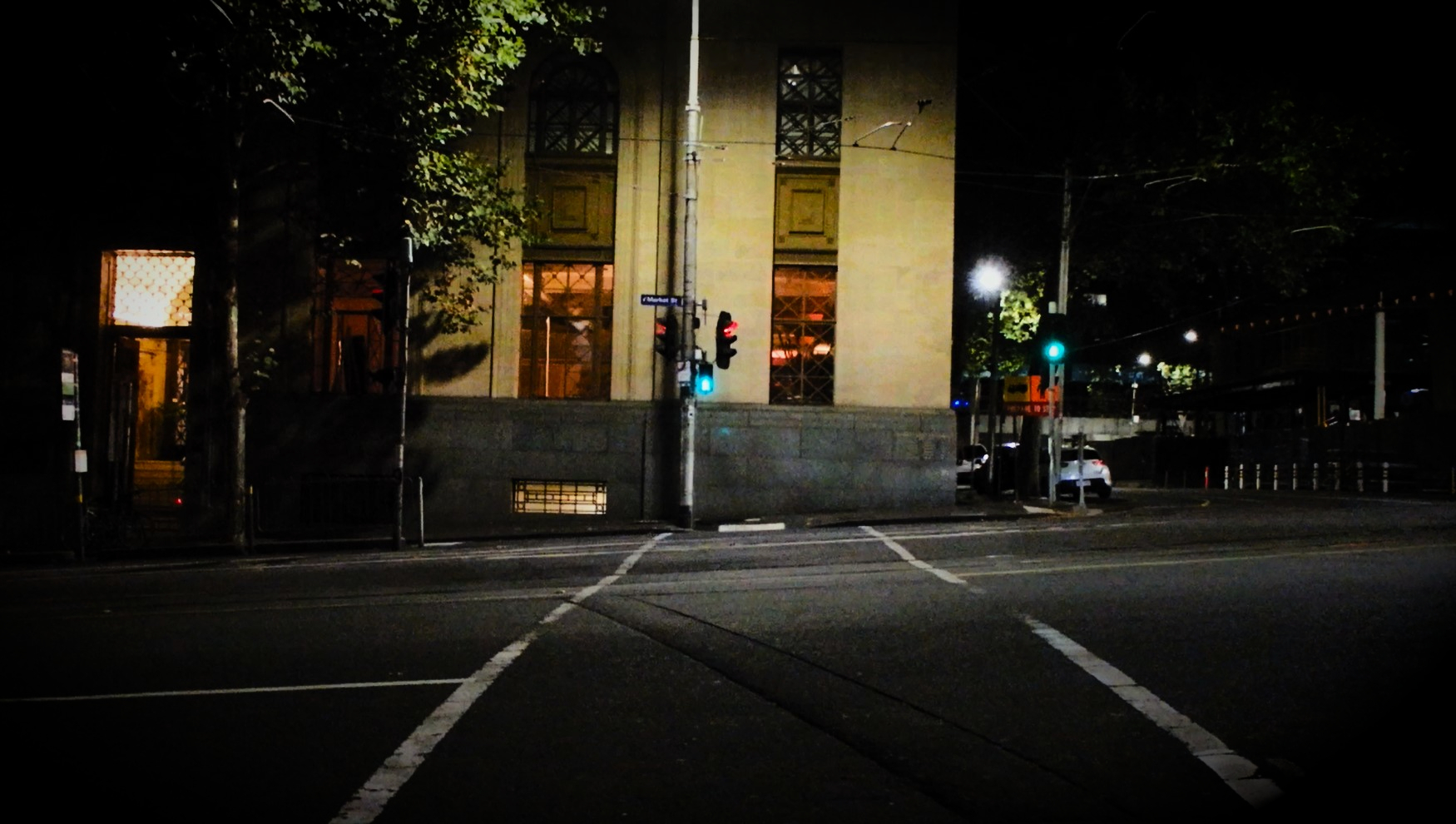

 deankyte.com