Félix Bracquemond, “Frontispiece for ‘Les Fleurs du mal’” (1857), 26.4 × 18 cm, The Metropolitan Museum of Art, New York.
Félix Bracquemond, “Frontispiece for Les Fleurs du mal (1857), 26.4 × 18 cm, The Metropolitan Museum of Art, New York.

The title of Charles Baudelaire’s only completed book of poetry has remained an inscrutable rebus for English translators, despite the simplicity of the title’s formulation—two nouns, one concrete, one abstract, the definite article in its plural form, and a preposition implying possession of the concrete noun by the abstract.

This simple phrase, ‘Les Fleurs du mal’, presents no obvious difficulty to translation, and yet it has confounded generations of English translators for over a century, almost all of whom have collapsed in defeat on the prosaically literal, unpoetic phrase ‘The Flowers of Evil’.

In his indispensable commentary Baudelaire’s Tragic Hero: A Study of the Architecture of Les Fleurs du Mal (1961), D. J. Mossop states that a literal rendering of the central metaphor of the title might be ‘Poems (i.e. works of æsthetic beauty) written on the subject of evil’.

But Mossop is only stating half the problem.

We see at once from Mossop’s account what the basic problem for the English translator has been—the fact that the concrete noun ‘fleurs’ (literally, prosaically, ‘flowers’) is doing double service as an abstract noun in this context—but not that the second term of the equation, the abstract noun ‘mal’—traditionally interpreted by the English-speaking peoples in an absolute moralistic sense as ‘evil’—is also doing double service in its meaning.

Baudelaire’s original intention was that his collection should be published with an allegorical frontispiece, and his friend and publisher, Auguste Poulet-Malassis, gave the commission to the engraver Félix Bracquemond, who executed a number of designs based on Baudelaire’s specifications, including the variation above.

The image was to show an allegorical figure that was both skeleton and tree, rooted to the earth, and surrounded by the Seven Deadly Sins in the form of seven weedy flowers.

None of the variations that Bracquemond produced satisfied Baudelaire, and the closest that a graphic artist would come to realizing the allegorical device that Baudelaire envisioned would be in 1866, when the poet’s idée fixe was revived by Félicien Rops and applied as frontispiece over his last, brief collection of ‘scraps’ and banned works, Les Épaves.

Félicien Rops, “Frontispiece for Les Épaves” (1866).
Félicien Rops, “Frontispiece: The Waifs (Les Épaves)” (1866), 16 × 10.2 cm, National Gallery of Art, Washington, D.C.

In addition to the emblematic intent behind the formulation ‘Les Fleurs du mal’, Baudelaire’s chosen title must be understood in light of the prefatory dedication of the collection that he makes to his ‘master and friend’, Théophile Gautier.

In her 1994 biography of Baudelaire, Joanna Richardson shows that the precise wording of the dedicatory device was carefully worked out and ratified by Gautier in collaboration with Baudelaire.

On 9 March [1857], he [Baudelaire] sent the patient Malassis ‘the new dedication, discussed, agreed and authorised by the magician, who explained to me very clearly that a dedication should not be a profession of faith – which also had the fault of drawing attention to the dangerous side of the work.’

— Joanna Richardson, Baudelaire (1994, p. 210)

As elliptical and ambiguous as the title itself, the dedication to Gautier has been the source of over a century of contention as critics have wrangled over its wording, some seeing in it Baudelaire’s propensity for base flattery towards a well-placed confrère, others his talent for the most cynical satire, laughing up his sleeve at a man of letters, powerful in his day, now diminished in history’s eyes as compared to the lowly poet supplicating Gautier for his critical protection of the work.

But in lieu of the unsatisfactorily realized allegorical image that Baudelaire intended to serve as frontispiece to the collection and explain the meaning of its title, this emblematic invocation of the ‘poète impeccable’ Gautier, whom Baudelaire calls the ‘parfait magicien ès lettres françaises — perfect magician in the field of French letters’ (my translation), is the key for the English translator to properly interpret the meaning of the elusive and enigmatic phrase ‘Les Fleurs du mal’.

Théophile Gautier, Baudelaire’s senior by a decade, had been his co-researcher in the poetic effects produced by drugs when they had both been living in the hôtel Pimodan on the île Saint-Louis in the 1840s.

In Une collaboration Gautier-Gérard: L’Étude sur Henri Heine signée de Nerval (1955) Jean Richer revealed that, during those years, Gautier wrote a substantial part of Gérard de Nerval’s critical study on the poetry of Heinrich Heine, in which the Baudelairean notion of ‘correspondences’ found its entry into French literature from the German Romantics.

Nous préférons vous offrir un simple bouquet de fleurs de fantaisie, aux parfums pénétrants, aux couleurs éclatantes.

We prefer to offer you a simple bouquet of fantastical flowers, with penetrating scents and flamboyant colours.

— Gérard de Nerval, “Les Poésies de Henri Heine”, Revue des Deux Mondes, Nouvelle série, XXIII (1848, p. 224 [my translation])

In that short statement we already perceive the essential traits distinguishing the poems that Baudelaire will begin to lay before the public over the next decade.

The metaphorical notion of the poem as being a ‘flower’, a proportionate, symmetrical form with its regular lines of syllables branching from a single axial stem of text, an exquisite, exotic miniature that emits an æsthetically pleasing quality to the ear, one that is sonically correspondent to the pleasing scent and colour which strike nose and eye, was thus well-established in the Parisian literary milieu by the time Baudelaire embarked upon Les Fleurs du mal.

Across the Channel, we can trace an etymological line between the Middle English ‘poesy’ (imported from the French ‘poésie’) and ‘posy’, a small bunch of flowers, a nosegay or ‘bouquet’, to use Nerval’s term for the collection of works he selects to translate from Heine.

And it should be noted, in passing, that the Greek origins of their common cognate ‘poiesis’ emphasizes the ‘artificial’ nature of the poem: it is a ‘creation’, a ‘production’—a work of art, in fine, that rivals the natural beauty of God’s creation.

The archaic meaning of ‘posy’ dating from the Middle English period of Norman influence is both ‘poetry’ and an ‘arrangement of flowers’. It is also, in this obsolete usage, ‘an emblem or emblematic device’—just like the allegorical image conceived by Baudelaire as a frontispiece for his collection and the dedicatory device he worked out in collaboration with Gautier.

There should therefore be no reason why generations of English translators, with hardly an exception, should all have collapsed in defeat upon the gauche and unpoetically literal phrase ‘The Flowers of Evil’ to translate the invocatory formula ‘Les Fleurs du mal’.

Once the ancient relationship between the concrete and abstract senses of ‘poesy’ are seen, half the battle in understanding Baudelaire’s cryptic intention with this phrase is won, and the possibilities for new, more accurate essays on the esoteric meaning of the formula increase substantially.

However, the wearisome literal-mindedness of the English-speaking peoples in seeing only ‘flowers’ in ‘fleurs’ is as nothing compared to their unsubtle Protestantism, which insists on seeing nothing but absolute evil in the second term of the equation, ‘mal’.

Given Mossop’s explanation, that Baudelaire’s poems are ‘works of æsthetic beauty’ that correspond with the floral products of divine craftsmanship, the Gordian way that all comers have attempted to square the impossible circle in their minds, blasphemously affirming that concrete examples of God’s handiwork can only be, in the condensed way Baudelaire expresses himself in this phrase, Satanic masterpieces, appears to me not only the consequence of the absurd materiality of the English language, but of our gross, wrongheaded Protestantism as English-speaking peoples.

Baudelaire, to be sure, is the most absolute moralist in poetry since Dante.

But, as Mossop puts it, ‘One’s attitude may be no less moral when one is conscious of the evil that is within one, than when one is conscious of one’s own virtue and the evil of others. One may be none the less against evil, for being aware that part of one is for evil…. Similarly, Baudelaire’s complex attitude … is not the simple attitude of being “against evil”, nor is it the equally simple attitude of being “for evil”: it is the complex attitude of being “against evil including the evil part of himself which is for evil”.’

The simplistic theology of a Luther or Calvin cannot hope to cope with the Catholic subtlety of such an involuted moral argument.

Baudelaire very clearly bore the physical stigmata of a fall from moral grace.

If he did not contract syphilis from his first sexual encounter with a prostitute at the age of eighteen, within a few such encounters, he was certainly carrying within himself the seeds of a slow-acting poison that would eventually cripple him, degrade his mental faculties, and render the most peerless singer of the French language in the last 200 years almost mute.

Thus, for Baudelaire, the condition of ‘badness’, of ‘wrongness’ signified by the word ‘mal’ is not so much moral as physical:—it is from his embodied experience of ‘doing ill’—‘the evil part of himself which is for evil’—that the ‘maladydu mal proceeds, not from the absolute, abstract condition of Capital-E ‘Evil’ that almost all previous English translators have simplistically settled upon.

As the wording of the emblematic device dedicated to Gautier reveals, when Baudelaire calls the poems gathered in his collection ‘ces fleurs maladives’, he is not referring, in the first instance, to the absolute moral principle that encompasses all that is ‘bad’ and ‘wrong’, from sin to error.

Baudelaire’s first concern is with physical health.

Dean Kyte takes you inside The Melbourne Edition of his new book of Baudelaire translations, Maledictions, Blasphemies, Laments, explaining the meaning of Baudelaire’s dedication to Théophile Gautier.

The titles of both of his major collections of prosody refer explicitly to the physical state of ill-health as the correspondent analogue for mental health, and the psychosomatic caduceus, the involuted double helix of the mind-body problem, the homeostatic regulation of the temporal, outer man by the eternal, inner person and vice versa, lies at the centre of Baudelaire’s conception du mal.

Hence, Baudelaire dedicates to the perfect magician Gautier ‘ces fleurs maladives’—‘these unhealthy, sickly, unwholesome flowers’—but also these ‘evil poems’, these perverse creations, these artificial ‘paper flowers’ whose ‘badness’ or ‘wrongness’ is inextricable from their formal beauty as poetry.

These are ‘fantastical blooms of imagination’—flamboyant, pungent effusions, as per Nerval—that are themselves ‘sickly’, and which induce sickness—malady—in the reader.

In 1857, the very year in which Baudelaire first published the bouquet of ‘unwholesome flowers’ he presented to Gautier, the pre-Freudian psychiatrist Bénédict Morel published his pioneering Traité des dégénérescences physiques, intellectuelles, morales de l’espèce humaine et des causes qui produisent ces variétés maladives.

In that work, Morel proposed a simple definition of human degeneration, one that would be frequently cited throughout the second half of the nineteenth century.

… [L]’idée plus claire que nous puissions nous former de la dégénérescence de l’espèce humaine, est de nous représenter comme une déviation maladive d’un type primitive.

… [T]he clearest notion we can possibly form of the phenomenon of degeneration in the human species is to represent it to ourselves as an unwholesome deviation from a primal type.

— Bénédict Morel, Traité des dégénérescences physiques, intellectuelles, morales de l’espèce humaine et des causes qui produisent ces variétés maladives (1857, p. 5 [my translation])

According to Max Nordau, who would adopt Morel’s definition, it is this derivation from a basic, healthy type of man that produces the ‘stigmata’—that is a technical, not moralistic term, Nordau assures us—of physical and intellectual degeneration.

The leading cause of this ‘unwholesome deviation’ from basic health, according to Morel, is poisoning—addiction to narcotics and stimulants, such as alcohol and tobacco, which alternately depress and excite the human organism, and the consumption of polluted foods.

Nordau, writing forty years after Morel, adds another etiological factor to these ‘noxious influences’ in his Degeneration (1895)—‘residence in large towns.’

Under the conditions of modern, technological capitalism in these great ‘machines à vivre’ taking their model from Paris, Walter Benjamin’s ‘Capital of the Nineteenth Century’, man, according to Nordau, ‘breathes an air charged with organic detritus; he eats stale, contaminated, and adulterated food; he feels himself in a state of constant nervous excitement, and one can compare him without exaggeration to the inhabitants of a marshy district.’

‘No matter which party one may belong to,’ wrote Baudelaire in 1851, ‘it is impossible not to be gripped by the spectacle of this sickly population, which swallows the dust of factories, breathes in particles of cotton, and lets its tissues be permeated by white lead, mercury, and all the poisons needed for the production of masterpieces…; the spectacle of this languishing and pining population to whom the earth owes its wonders, who feel hot, crimson blood coursing through their veins, and who cast a long, sorrowful look at the sunlight and shadows of the great parks.’ … Baudelaire supplied his own caption for the image he presents.  Beneath it he wrote the words: ‘La Modernité.’

— Walter Benjamin, “The Paris of the Second Empire in Baudelaire”, in The Writer of Modern Life: Essays on Charles Baudelaire (2006, pp. 102-3)

According to Nordau, these poisonous environmental conditions attendant on modern life in great cities produce a ‘fatigue’—an escalating ‘burnout’ of the human organism—an hysterical malady that places increasing wear and tear on the brain and tissue of each successive generation of human beings undergoing the ordeal of modernity.

‘The resistance that modernity offers to the natural productive élan of an individual is out of all proportion to his strength,’ Benjamin writes, and, as Nordau notices, in no place on earth were the nerves of human beings more frayed in the nineteenth century than in Benjamin’s capital of modernity itself—the epicentre of a political revolution that, in its continuing aftershocks, had become a social, cultural, and artistic revolution.

It was in this poisonous atmosphere of addiction, fashionable excitation, debased victuals, and political volatility that Charles Baudelaire was born and lived almost all of his brief, unhappy life.

Les Fleurs du mal are therefore not, as generations of English translators have so crudely rendered them, ‘The Flowers of Evil’.

In their exoteric aspect, the ‘allegorical image’ Baudelaire intended by that title, Les Fleurs du mal are emblems of malady, of a physical debility which is correspondent with a mental degeneration and vice versa.

As stigmatized derivatives of a primal, healthy type ‘before the Fall’ of modernity, it is only in this sense that these exotic, poisonous cultivars, weedy, unnatural blooms that Baudelaire has nursed in the hothouse of his soul—itself formed in the ‘artificial paradise’ of Paris—should be regarded as the products of an absolute immorality.

The skeletal Tree of Knowledge depicted by Rops—Science in its essence—unbandages man’s eyes from the blissful ignorance of God’s Nature.

When we enter the condition of modernity, we enter an artificial paradise, a fallen place of our own making, seductive and yet poisonous, in which the generations of Adam who work in the big cities bear the marks of Science’s guilty knowledge on their bodies and in their brains.

In its exoteric dimension, the title ‘Les Fleurs du mal’ might better be rendered, as I have chosen to do so, as ‘Toxic Blossoms’: these are creations of poisonous beauty that throw us back on the secondary paradox that arises from the primary fact of their being:—From whence does the Good, the True, the Beautiful really proceed?—from God, or from the Devil?


You’ve just been reading the first draft of a ‘chapterlet’ from the critical monograph on Baudelaire which will form the introduction to my forthcoming book of translations of Baudelaire’s poems and prose poems, Maledictions, Blasphemies, Laments: Selections from Toxic Blossoms & Parisian Spleen.

All 51 pieces in the book—33 poems, 17 prose poems, and 1 short story—are now complete.

As I put the final touches to the book, my last task is to complete a 10,000-word critical monograph on Charles Baudelaire in which I explain how, in his life and work, he both prophesies and embodies the decadence, decline, and degeneration of modern man that we are now experiencing all throughout the West—and particularly in the Anglosphere.

Pre-order your copy using the links below.

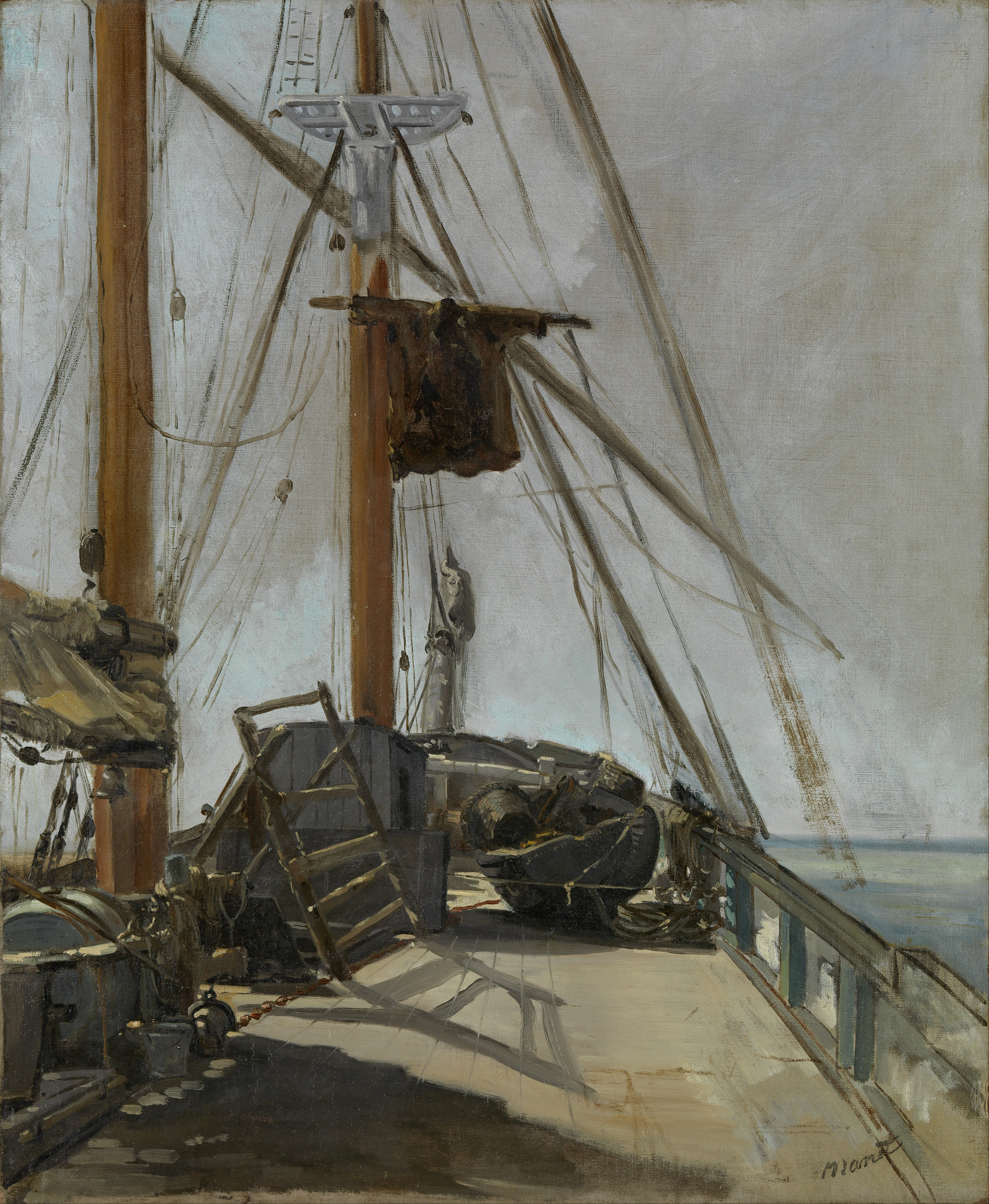
Édouard Manet, “The ship’s deck” (c. 1860), oil on canvas, 56.4 cm × 47.0 cm, National Gallery of Victoria, Melbourne.
Édouard Manet, The ship’s deck (c. 1860), oil on canvas, 56.4 cm × 47.0 cm, National Gallery of Victoria, Melbourne.

Croyez-vous que vous soyez le premier homme dans ce cas ? Avez-vous plus de génie que Chateaubriand et que Wagner ? On s’est bien moqué d’eux cependant ? Ils n’en sont pas morts. Et pour ne pas vous inspirer trop d’orgeuil, je vous dirai que ces hommes sont des modèles, chacun dans son genre, et dans un monde très riche et que vous, vous n’êtes que le premier dans la décrepitude de votre art.

Do you think you’re the first man to have been laughed at? Have you more genius than Chateaubriand and Wagner? Have they not been made fun of? They haven’t died of it. And so as not to puff up your pride too much, I will tell you that these men are models, each in his own field and in a very rich world, and that you—you are merely the first in the degeneracy of your art-form.

— Charles Baudelaire to Édouard Manet, letter of 11 May, 1865 [my translation]

Baudelaire’s recognition of a incipient degeneracy in the art of Édouard Manet would be the most significant remark, either public or private, that the poet would make on the work of his painter-friend, and, indeed, Baudelaire’s slighting comparison of Manet to another personal friend whose genius, by contrast, he had been the first man in France to recognize—Richard Wagner—is telling. As Spengler observes: ‘Between Wagner and Manet there is a deep relationship, which is not, indeed, obvious to everyone but which Baudelaire with his unerring flair for the decadent detected at once.’

It is an enduring mystery of criticism why Baudelaire, so sensitively attuned to the etiolation of forms that would, in time, mark itself out as the pathological trait of modern art—and so quick, moreover, to perceive the chthonic correspondences between his project of a modern, urban poetry and the work of artists in other media whose formal æsthetics bore similarities to his own—should have signally failed to see that it was Manet—not Constantin Guys—whom future historians and critics would deem to have embodied Baudelaire’s own notions of modern artistic heroism, as the quintessential ‘Painter of Modern Life’.

Beaucoup de gens attribueront la décadence de la peinture à la décadence des mœurs. …

Avant de rechercher quel peut être le côté épique de la vie moderne, et de prouver par des exemples que notre époque n’est pas moins féconde que les anciennes en motifs sublimes, on peut affirmer que puisque tous les siècles et tous les peuples ont eu leur beauté, nous avons inévitablement la nôtre.

… [N]’a-t-il pas sa beauté et son charme indigène, cet habit tant victimé ? N’est-il pas l’habit nécessaire de notre époque, souffrante et portant jusque sur ses épaules noires et maigres le symbole d’un deuil perpétuel ? Remarquez bien que l’habit noir et la redingote ont non seulement leur beauté politique, qui est l’expression de l’égalité universelle, mais encore leur beauté poétique, qui est l’expression de l’âme publique ; — une immense défilade de croque-morts, croque-morts politiques, croque-morts amoureux, croque-morts bourgeois. Nous célébrons tous quelque enterrement.

Le spectacle de la vie élégante et des milliers d’existences flottantes qui circulent dans les souterrains d’une grande ville, — criminels et filles entretenues, — la Gazette des Tribunaux et le Moniteur nous prouvent que nous n’avons qu’à ouvrir les yeux pour connaître notre héroïsme.

La vie parisienne est féconde en sujets poétiques et merveilleux. Le merveilleux nous enveloppe et nous abreuve comme l’atmosphère ; mais nous ne le voyons pas.

Le nu, cette chose si chère aux artistes, cet élément nécessaire de succès, est aussi fréquent et aussi nécessaire que dans la vie ancienne : — au lit, au bain, à l’amphithéâtre. Les moyens et les motifs de la peinture sont également abondants et variés ; mais il y a un élément nouveau, qui est la beauté moderne.

Car les héros de l’Iliade ne vont qu’à votre cheville, ô Vautrin, ô Rastignac, ô Birotteau, — et vous, ô Fontanarès, qui n’avez pas osé raconter au public vos douleurs sous le frac funèbre et convulsionné que nous endossons tous ; — et vous, ô Honoré de Balzac, vous le plus héroïque, le plus singulier, le plus romantique et le plus poétique parmi tous les personnages que vous avez tirés de votre sein !

Many people will attribute the decadence in painting to the degeneration of customs. …

Before we investigate what the epic side of modern life may be and prove, through example, that our era is not less fruitful in sublime motifs than antiquity, it may be averred that since every age and nation has possessed its proper beauty, we, inevitably, have our own.

… Has it not its beauty and its native charm, this oh-so-maligned suit? Is not the suit essential for our age, suffering and bearing upon its very shoulders, puny and black, the symbol of a perpetual mourning? Note well that the black suit and frock coat have not merely their social beauty (which is the expression of universal equality), but also their poetic beauty, which is the expression of the public spirit:—an immense cortège of undertakers – political morticians, romantic embalmers, middleclass funeral directors. We are all of us celebrating some sort of burial.

The spectacle of fashion and of the countless floating existences which circulate in the bowels of a great city—crooks and whores—the court reports and tabloids prove to us that we have merely to open our eyes to meet with our brand of heroism.

Parisian life is abundant in marvellous and poetic subjects. The marvellous surrounds us and suckles us like the air, but we do not see it.

The nude, that object so dear to artists, that essential ingredient of success, is just as common and indispensable as it was in antique life: in the bed, the bath, upon the stage. The means and the motifs of painting are equally abundant and varied; but there is a new element—modern beauty.

For the heroes of the Iliad do not come up to your ankle, O Vautrin, O Rastignac, O Birotteau!—and you, O Fontanarès, who haven’t dared to recount to the public your chagrins under the tail coat, funereal and wracked with sobs, that all of us wear. —Nor you, O Honoré de Balzac; you, the most heroic, the most original, the most romantic and poetic of all the characters you have drawn forth from your heart!

— Charles Baudelaire, « Salon de 1846 », Curiosités esthétiques (1868, pp. 193, 194, 195, 196-7, 198 [my translation])

It is clear that Baudelaire sees the essence of modern beauty as crime—committing le mal.

The heroes of modern life, far superior to the strong men of antiquity, are the decadent, elegant criminal masterminds of the Balzacian social network of the city, the dandiacal flâneurs for whom the funereal uniform of the black frock coat is a democratic disguise that allows the artistic observer to take the total measure of the urban scene, du grand monde au demi-monde.

L’ordre social, l’action de la société sur l’individu, dans les diverses phases et aux diverses époques, ce réseau d’institutions et de conventions qui nous enveloppe dès notre naissance et ne se rompt qu’à notre mort, sont des ressorts tragiques qu’il ne faut que savoir manier. Ils sont tout à fait équivalents à la fatalité des anciens ; leur poids a tout ce qui était invincible et oppressif dans cette fatalité ; les habitudes qui en découlent, l’insolence, la dureté frivole, l’incurie obstinée, ont tout ce que cette fatalité avait de désespérant et de déchirant : si vous représentez avec vérité cet état de choses, l’homme des temps modernes frémira de ne pouvoir s’y soustraire, comme celui des temps anciens frémissait sous la puissance mystérieuse et sombre à laquelle il ne lui était pas permis d’échapper, et notre public sera plus ému de ce combat de l’individu contre l’ordre social qui le dépouille ou qui le garotte, que d’Œdipe poursuivi par le Destin, ou d’Oreste par les Furies.

Social order—the action of society upon the individual—in various phases and during various epochs; this network of institutions and conventions which catches us in its toils at the moment of our birth and is only broken at the hour of our death, furnishes the mainspring for tragedy which the dramatist need only know how to manipulate. These institutions and conventions are perfectly equivalent to the ‘destiny’ of the ancients; their gravitas possesses everything that was invincible and oppressive in the ancient notion of ‘fate’. The customs that flow from them—insolence, frivolous cynicism, stubborn unconcern—is replete with all that ‘fate’ had in it to inspire heartbreak and despair: If you truthfully depict this state of affairs, modern man will tremble from his incapacity to extricate himself from it just as the man of ancient times used to quiver beneath the obscure and sombre power from which he was forbidden to escape, and our modern audience will be more moved by the individual’s fight against the social order which seeks to strip or strangle him than by Œdipus pursued by Destiny, or Orestes by the Furies.

— Benjamin Constant, « Réflexions sur la tragédie », Revue de Paris (1829, p. 136 [my translation])

Echoing the insight of Benjamin Constant nearly two decades before him, Baudelaire is of the view that urban crime is the sole field of heroism available to men possessed of any spirit of adventure in modernity.

And artists—whether of word or paint—are the supreme outlaws, the supreme non-conformers to the social order.

The dandy-flâneurs, those ‘æsthetic terrorists’ of the bourgeois order who act in resolute defiance of the safetyist constraints of the law—who seek to break the social network of the civilized community binding them to impotence from birth to death, and who refuse to serve the metropolitan machine in the slavery of ‘gainful employment’, preferring instead what I call ‘productive indolence’—those elegant, artistic, criminal souls, deserters of their society but drawn like moths, by grace of their macabre curiosity, to it—to be the ironic witnesses of its criminal beauty, its crime against humanity—are the only heroes in modern life equal to the ancients.

Manet, a dandiacal flâneur as given as Baudelaire to Balzacian survey of the great machine à vivre that was the modern metropolis of Paris, wore the uniform of the fashionable man about town for his undercover excursions into observation of its many strata and facets.

Baudelaire had no lack of opportunities to observe Manet at this idle labour and know that, with the appropriate changes being made, Manet’s visual style and technique was the counterpart to his own literary approach to the modern urban scene of Second Empire Paris.

As two dandy-flâneurs, the poet had often been the painter’s Balzacian bosom companion—the Paul de Manerville to his Henry de Marsay—on sketching expeditions to the jardin des Tuileries.

With his black stovepipe, his exuberant black silk bowtie, his prematurely greying locks and his Satanic profile, Baudelaire would more than once provide Manet with the subject for a snapshot-like sketch that, in its curious caricatural indefiniteness, would trace with ‘vague precision’ the smeary mark that Baudelaire would leave on the margins of the vast, Balzacian tableau of modern Parisian life, a figure in the background, like Vautrin, only afterwards to be recognized as the absolute centre of the cultural scene for the whole nineteenth century.

Édouard Manet, Musique aux Tuileries (1862), oil on canvas, 
76 cm × 118 cm, Hugh Lane Gallery, Dublin. (Baudelaire’s portrait is circled in red.)
Édouard Manet, Musique aux Tuileries (1862), oil on canvas,
76 cm × 118 cm, Hugh Lane Gallery, Dublin. (Baudelaire’s portrait is circled in red.)

Thus, as David Carrier, summarizing the position of critics who have lamented Baudelaire’s stunning failure of perspicacity in appreciating the revolutionary rôle that Manet would play in the art of the future, regretfully puts it, ‘it is embarrassing that a great critic failed to see the value of the work of a friend.’

‘It has been alleged,’ writes Joanna Richardson, ‘that Baudelaire did not appreciate Manet at his true worth. … It might indeed be said that Delacroix concealed the modernity and the stature of Manet from him.’

Baudelaire was caught up as a partisan in the great controversy that would preoccupy French art during the second third of the nineteenth century, and which would only retrospectively appear to history as a minor theatre of conflict, a very distant skirmish from the front lines of avant-garde battle that were then drawing themselves behind Manet and in opposition to his sure sense of what constituted modern beauty.

This was the great contest between the primacy of line—precise, classical draughtsmanship as personified by Ingres—and the vibrancy of colour as the expression of romantic emotion, and personified by Baudelaire’s enduring hero, Delacroix.

Manet resolved the problem of line and colour in a novel way that nevertheless looked back—with ambiguous irony—to the classical models claimed by the two masters. Manet’s lines, as in Olympia (1863), were often gross in their salience, an infantile perversion of Ingres’ tin-type kind of design, his fields of unbroken colour vibrant but inharmonious to sensibilities that admitted that Delacroix, despite his lack of draughtsmanly clarity, achieved something poetic and musically suggestive in his tonal arrangements.

In « Le Peintre de la vie moderne », Baudelaire would call genius ‘childhood wilfully, skilfully regained’, and in the novelty of Manet’s visual style, an apparently infantile—even imbecilic—degeneracy of facture that was, in fact, meticulously laboured over as a way of expressing the spectacle of modern Paris in its marvellous, poetic welter of instantaneous impressions, the painter proved that he possessed the ‘lively sense organs and the analytic spirit which enable him to impose order upon the sum of visual materials unconsciously amassed’ which Baudelaire ascribed to Guys.

Manet was half a generation younger than Baudelaire and was thus somewhat removed from the pitched contention between neo-classical line and romantic colour: Born on 23 January 1832, Manet was ineluctably destined, like Baudelaire, to be pilloried by the establishment in his lifetime, shunted to the margins of Parisian society as a stubborn madman one could do nothing with, only to become posthumously influential, lionized for the moral determination of his conscientious rebellion against the artistic mores of the Second Empire, vindicated as the most intransigent stumbling-block upon which the future edifice of modern art would be founded.

January 23rd is a sinister and potent date.

The Sabian symbol for the third degree of Aquarius, coinciding with the Sun’s transit through it on this date, is ‘A deserter from the navy’: That image symbolizes the rebellious—indeed, criminal—abandonment of a rigid, hierarchical structure, an established institution, an ark-like architecture that is designed to safely carry one over ‘le gouffre’ (to use a word we frequently encounter in Baudelaire’s maritime poetry)—the bitter abyss, the hellish, mazy chaos of the waves that are ever under man’s feet.

In his refusal to serve a structure he sees as foundering, the rebellious deserter who jumps ship chooses to become an uncompromising outlaw of society.

In their youths during the 1840s, both Baudelaire and Manet had been forced by their respective families to quit what the older man’s stepfather called ‘the slippery streets of Paris’ and take long, exotic sea voyages—brutal separations designed to quell the rebellious desires of their hearts for poetry on the one hand and painting on the other.

Manet had been forced on a voyage to Rio de Janeiro by his father—a judge—to qualify for induction into the Navy. Manet studiously failed the entrance examinations twice, his non-conforming Aquarian spirit refusing to submit to his father’s authority as it would later refuse to submit to the established judgments of the Académie des beaux-arts.

In the end, by his strategy of ‘compliant resistance’, going along with his father’s dictates while secretly sabotaging them by his intransigent determination to do nothing but become a painter, Manet would get his own way and be allowed to enter to atelier of Thomas Couture.

Baudelaire’s stepfather, the maréchal du camp Aupick, ‘violently disturbed’ by young Charles’s avid pursuit of ‘the perdition of the streets of Paris’, would bundle the aspiring poet off to India, hoping that the exoticism of the East would return a matured young man inclined to read law—or at least, as mother and stepfather muttered between themselves, privately recognizing that they were up against a similarly stubborn case, a poet who would write of honourable subjects and not the ambulatory muses of the Parisian streets.

Baudelaire jumped ship in Mauritius, and within eight months would be back on the ‘slippery streets’ of the capital, returning, as Manet would do some seven years later, as indissuadable from the mad career pathway he was determined to pursue as when he had left, but bringing to his vision of the modern Parisian spectacle all the decadent exoticism he had absorbed in Cape Town, Mauritius, and Réunion.

Thus, January 23 is a date that portends criminal rebellion, the radical overthrow of all monolithic structures of orthodox ‘right thought’ designed to float us, as in an ark, safely over the raging sea of life.

On the same date in 1862, his friend Manet’s thirtieth birthday, the forty-year-old Baudelaire would do what he would hardly ever do in the pages of his Journaux intimes, and mark this fatal date as a dark and potent inflection point in his life.

J’ai cultivé mon hystérie avec jouissance et terreur. Maintenant, j’ai toujours le vertige, et aujourd’hui, 23 janvier 1862, j’ai subi un singulier avertissement, j’ai senti passer sur moi le vent de l’aile de l’imbécillité.

I have cultivated my hysteria with relish and dread. Nowadays, I always feel vertigo, and today, 23 January 1862, I suffered a singular presentiment:—I felt the wind of the wing of mental degeneration sweep over my being.

— Charles Baudelaire, « Mon Cœur mis à nu » (1864, p. 130 [my translation])

And on the same date 121 years later, in the wastes of Australia, I would enter this world of ennui.


You’ve been reading the first draft of the second ‘chapterlet’ in the critical monograph on Baudelaire which will form the introduction to my forthcoming book of translations of Baudelaire’s poems and prose poems, Maledictions, Blasphemies, Laments: Selections from Toxic Blossoms & Parisian Spleen.

This book is on the verge of being born and will be out before Christmas. I urge you to purchase copies in your choice and quantity of formats now using the payment buttons below, with invoicing for shipping to occur when the first batch of orders goes to press at the end of this month.

Édouard Manet, “Olympia” (1863-5), oil on canvas, 130.5 cm × 190 cm, musée d’Orsay, Paris.
Édouard Manet, Olympia (1863-5), oil on canvas, 130.5 cm × 190 cm, musée d’Orsay, Paris.

L’usage social de la liberté littéraire deviendra de plus en plus rare et précieux. Les grandes démocraties de l’avenir seront peu libérales pour les écrivains ; il est bon de planter très haut des poètes drapeaux comme Baudelaire.

On pourra les agiter de temps en temps afin d’ameuter le petit nombre des esclaves encore frémissants.

The social use of free literary expression will become increasingly rare and precious. The great democracies of the future will be very illiberal for writers; it is therefore good to plant poets like Baudelaire upon the highest eminences as standards.

We will be able to wave them from time to time so as to riotously rouse the small number of slaves still trembling for freedom.

— Guillaume Apollinaire, introduction to L’Œuvre poétique de Charles Baudelaire (1924) [my translation]

In May of 1865, the talk of tout Paris was the scandal of the Salon, the inclusion of Édouard Manet’s Olympia in the annual exhibition of painting and sculpture held by the Académie des beaux-arts. Two years earlier, Manet had been in the thick of an agitation, his provocative canvas Le Déjeuner sur l’herbe serving as a convenient standard behind which a group of disaffected artists could rally, petitioning the Emperor, Napoléon III, in protest at their rejection by the jury. Now Manet was at it again with something that had been accepted by the jury but which was—if possible—even more outrageous a slap in the face than his Luncheon on the grass had been.

Manet had expected trouble, but from a different quarter, his other entry in the Salon of that year, a history painting showing the Saviour being insulted by the Roman soldiers, going unremarked as compared to Olympia, an uncompromising nude of a contemporary Parisian prostitute so offensive in her frankness that she excited embarrassed ridicule from visitors to the Louvre when she did not actually excite physical attack. Manet, a naïve revolutionary with an earnest desire for the respectability of the Académie, was nonplussed. He wrote his friend, the poet Charles Baudelaire, who had frequently covered the Salon as an art critic of exquisite though outré tastes, seeking guidance and reassurance.

Je voudrais bien vous avoir ici mon cher Baudelaire, les injures pleuvent sur moi comme grêle…. J’aurais voulu avoir votre jugement sain sur mes tableaux car tous ces cris agacent, et il est évident qu’il y a quelqu’un qui se trompe.

I very much wish you were here, my dear Baudelaire, for insults rain on me like hail…. I should have liked to have your healthy judgment on my paintings, for all these cries grate on me, and it’s clear that someone is in the wrong.

— Édouard Manet to Charles Baudelaire, undated letter of early May 1865 [my translation]

The 44-year-old poet was then in Brussels, where he had been for over a year, escaping his Parisian creditors, attempting to sell the rights to his works to Belgian publishers, giving scarcely attended lectures on modern French art to the uncultured Bruxellois, drinking heavily, and roundly hating the place, which he condemned in poems and pamphlets. Sick, penniless, within a year of suffering a mysterious crisis that would leave him partially paralyzed, almost mute, and barely sensible, two years away from his death, Baudelaire had little time for Manet’s complaint. Hearing without sympathy his friend’s lament from the capital of fashion and culture, on 11 May, 1865, Baudelaire fired off an exasperated epistle from the Godforsaken Belgian backwater to the man whom future generations would acknowledge to have been the reluctant, unfairly crucified father of modern art.

Croyez-vous que vous soyez le premier homme dans ce cas ? Avez-vous plus de génie que Chateaubriand et que Wagner ? On s’est bien moqué d’eux cependant ? Ils n’en sont pas morts. Et pour ne pas vous inspirer trop d’orgeuil, je vous dirai que ces hommes sont des modèles, chacun dans son genre, et dans un monde très riche et que vous, vous n’êtes que le premier dans la décrepitude de votre art.

Do you think you’re the first man to have been laughed at? Have you more genius than Chateaubriand and Wagner? Have they not been made fun of? They haven’t died of it. And so as not to puff up your pride too much, I will tell you that these men are models, each in his own field and in a very rich world, and that you—you are merely the first in the degeneracy of your art-form.

— Charles Baudelaire to Édouard Manet, letter of 11 May, 1865 [my translation]

Those last, emphasized words would be prophetic, not merely of Édouard Manet’s destiny to embody the title that his friend had incorrectly or churlishly ascribed to another, lesser artist, to be the Painter of Modern Life’, but it would equally be prophetic of the destiny of Baudelaire himself: By the end of the century, this poet, mocked and derided in his lifetime for his own pretensions to academic respectability as a troubadour of prostitutes, would be regarded by the physician and social critic Max Nordau as having been the fountainhead of degeneracy in modern life and the chef d’école in the Decadent movement of modern poetry, and early in the next century, T. S. Eliot would declare that modernism in poetry had definitively begun with Charles Baudelaire.


What you have just read is the proposed first ‘chapterlet’ of the critical monograph that opens my forthcoming book of translations drawn from the works of Baudelaire: Malediction, Blasphemies, Laments: Selections from Toxic Blossoms & Parisian Spleen.

With 96 per cent of the poems, prose poems—and fiction (!)—of Charles Baudelaire now translated and in place, Maledictions, Blasphemies, Laments is on-track for release before Christmas.

Pre-orders for the book in three formats—the hardcover dust jacket “Melbourne Edition”, the Economy Softcover version, and the PDF eBook—are now being accepted at an early-bird price.

Select your choice and quantity below to secure your copies in the desired formats, with invoicing for shipping to occur when the first print run occurs in a month’s time.

Taking you line by line through the last three verses of Baudelaire’s « Les Phares », Dean Kyte explains the paradoxical relationship that damnation has to praise in Baudelaire’s thought.

My new book of translations drawn from the works of Charles Baudelaire, Maledictions, Blasphemies, Laments: Selections from Toxic Blossoms and Parisian Spleen, is fast coming to press.

And in today’s video on The Melbourne Flâneur, I take you inside the softcover version of the book as I explain—with due reference to Baudelaire—the rationale behind my choice of such a bitter and pitiless title.

As I say in the video, what appears on its face to be a title utterly alienating in its satanic vituperation is in fact the highest possible homage that Baudelaire can render to God’s majesty, and the proof of his most fervent belief, as a heretical Catholic, in the Supreme Being.

Thus, at a plutonic hour of human history where faith in God and human goodness could not be more ridiculous, I too assert, in taking this title, my quixotic faith in what is highest in man by ‘praising with sharp damnation’ what is lowest in our species, we irredeemable children of the tribe of Cain.

For there must no longer be any doubt in our present year, even to the somnambulistic billions who would make ‘the Woman Question’ and ‘the Jewish Question’ of the nineteenth and twentieth centuries suddenly ‘the Human Question’ of the twenty-first, that Baudelaire’s apocalyptic prophecy of modernity—a veritable ‘Age of Iron’—has now properly revealed itself in our day.

The time could not be more right for the apparition of this book.

One hundred twenty-one years to the very day of my birth, Baudelaire writes in his journal that ‘today … I suffered a singular alarm: I felt the wind of the wing of madness pass over me.’

Charles Baudelaire is the Alpha of the dandy-flâneur, the man, in modernity, who still seeks to be a ‘man’—to live heroically in the strength of all our human frailties and the humility of our profound limits—and I am the Omega, the decadent result of two centuries of societal degeneracy in the West, the last quixotic figure, in the armour of my hat and suit, to intransigently ‘hold the faith’ in that utterly discredited, unconscionable project of embodying ‘Homo Occidentalis’ in all his risible nobility.

So, as a mad Aquarian, an avatar of the New, destiny has elected me for a task, chers lecteurs;—to be the ‘postrunner’ of this great fallen angel of modernity, this great albatross of a luciferic intellect who found his wingspan so vast he couldn’t walk easily among us, and interpret to the Anglosphere, as an evangelist after the fact, the poetry and prose poetry of Charles Baudelaire.

And I’m pleased as punch to advise you that Maledictions, Blasphemies, Laments is on the verge of seeing the light of day.

I explain the origins of the book’s title in the video above, but here below, I am posting for the first time the line-up of fifty pieces I have selected from Les Fleurs du mal and Le Spleen de Paris to take the field as the Baudelairean ‘dream team’ and represent our poet.

So, here we go…

From Toxic Blossoms (Les Fleurs du mal):

  • “To the Reader” (« Au Lecteur »)

From “Spleen and Ideal” (« Spleen et Idéal »):

  • “Blessing” (« Bénédiction »)
  • “The Albatross” (« L’Albatros »)
  • “Elevation” (« Élévation »)
  • “Correspondences” (« Correspondances »)
  • “The Venal Muse” (« La Muse vénale »)
  • “The Faithless Monk” (« Le Mauvais moine »)
  • “Illfated” (« Le Guignon »)
  • “Past Life” (« La Vie antérieure »)
  • “Beauty” (« La Beauté »)
  • “The Ideal” (« L’Idéal »)
  • “The Giantess” (« La Géante »)
  • “The Jewels” (« Les Bijoux »)
  • “Hymn to Beauty” (« Hymne à la Beauté »)
  • “You’d let all mankind dally in your alley…” (« Tu mettrais l’univers entier dans ta ruelle… »)
  • “With her raiment, sinuous and nacreous…” (« Avec ses vêtements ondoyants et nacrés… »)
  • “The Possessed” (« Le Possédé »)
  • “An Apparition” (« Un Fantôme »)
  • “I make a gift of these verses to you so that if my name…” (« Je te donnes ces vers afin qui si mon nom »)
  • “Vespers” (« Chanson d’après-midi »)
  • “Spleen” (« Quand le ciel bas et lourd pèse comme un couvercle… »)
  • “Warning” (« L’Avertissement »)

From “Parisian scenes” (« Tableaux parisiens »):

  • “The Sun” (« Le Soleil »)
  • “The Swan” (« Le Cygne »)
  • “To a Passerby” (« À une passante »)
  • “Evening Twilight” (« Le Crépuscule du soir »)

From “Wine” (« Le Vin »):

  • “The Soul of Wine” (« L’Âme du vin »)

From “Toxic Blossoms” (« Les Fleurs du mal »):

  • “Epigraph for a Condemned Book” (« Épigraphe pour un livre condamné »)
  • “The Two Wellbred Girls” (« Les Deux bonnes sœurs »)

From “Rebellion” (« Révolte »):

  • “Litanies of Satan” (« Les Litanies de Satan »)

From “Death” (« La Mort »):

  • “A Connoisseur’s Dream” (« Le Rêve d’un curieux »)
  • “The Journey” (« Le Voyage »)

I have selected fully one-fifth of the total number of poems published in the three editions of Les Fleurs du mal which Baudelaire, and then his mother, saw through the press.

At least twenty per cent of every section of Les Fleurs du mal is represented in Maledictions, Blasphemies, Laments, and because Baudelaire’s poetry collection is a psychological novel with a narrative order, in selecting at least a fifth of the poems from every section, I have taken care to choose those works which I think best highlight the themes of that section and carry the overarching drama forward.

The figure of one-fifth includes the six pieces that were struck from the first edition as obscene, banned in France, and were only subsequently available in Belgium among Les Épaves (1866).

One of the censored poems, « Les Bijoux », is included, and as you can see, that piece, which I published in my first collection of Baudelaire translations, Flowers Red and Black (2013), is listed in orange.

With the exception of « Spleen », the titles in orange are works from the earlier book which are still in the buffer awaiting revision.

As this post goes to press, I am about to start revising « Spleen », which I also translated in the years preceding the publication of Flowers Red and Black but declined to include in that book, so this poem will see the light of day for the first time in Maledictions, Blasphemies, Laments.

And the word ‘revise’ in this instance basically means ‘completely rewrite’.

While I was translating Baudelaire’s short story, « La Fanfarlo » between February and April, instead of working on the few remaining poems I have left to translate, I began to revise the pieces from Flowers Red and Black, but in every instance I found myself writing completely new translations of these existing poems.

So it’s going to be interesting when I look at “The Jewels” again in a couple of weeks, because this is by far my most well-known translation of a work by Baudelaire, the piece that often cliched sales of Flowers Red and Black. Is this poem going to run true to form with the rest of the book and am I going to see the text in a whole new light?

What I can tell you for certain is that a revised version of “The Jewels” will include a translation of the newly revealed ninth verse that was discovered in 1928, written in Baudelaire’s hand, in a first edition of Les Fleurs du mal which he gave to a friend but only made public when that copy came up for auction in 2019.

You will also notice that, in the list above, there are three titles in red: « Le Cygne », « Les Litanies de Satan », and « Le Voyage ».

These are the last outstanding selections from Les Fleurs du mal that I am yet to translate. They’re Baudelaire’s most famous poems; they’re among my longest selections, and they’re going to be the greatest tests of my interpretative abilities.

So that’s Les Fleurs du mal. Now let’s look at what you can expect to read from Le Spleen de Paris.

From Parisian Spleen (Le Spleen de Paris):

  • “To Arsène Houssaye” ( « À Arsène Houssaye »)
  • “The Stranger” (« L’Étranger »)
  • “The Artist’s Confiteor” (« Le Confiteor de l’artiste »)
  • “A Troll” (« Un plaisant »)
  • “Twin Suite” (« La Chambre double »)
  • “The Buffoon and the Venus” (« Le Fou et la Vénus »)
  • “At an Hour after Midnight” ( « À une heure de matin »)
  • “Crowds” (« Les Foules »)
  • “Invitation to the Journey” (« L’Invitation au voyage »)
  • “Hungry Eyes” (« Les Yeux des pauvres »)
  • “The Magnanimous Gambler” (« Le Joueur généreux »)
  • “Sozzle Yourself” (« Enivrez-vous »)
  • “Windows” (« Les Fenêtres »)
  • “The Port” (« Le Port »)
  • “Lost Halo” (« Perte d’auréole »)
  • “Anywhere Out of the World ” (« N’importe où hors du monde »)
  • “Epilogue” (« Épilogue »)

One-third of the total number of pieces from Le Spleen de Paris will be featured in Maledictions, Blasphemies, Laments, including Baudelaire’s prefatory letter to Arsène Houssaye—which ought to be considered a prose poem in its own right—and the poem that Baudelaire appends as epilogue to the collection.

I was convinced that these two pieces—which I had no previous intention of translating—needed to be included when I was in Brisbane in December. Reading Sonya Stephens’ insightful little book Baudelaire’s Prose Poems: The Practice and Politics of Irony (2000) at the State Library of Queensland convinced me that these were inescapable framing texts.

And you’ll notice we have one text in red: « Le Port ». After I complete the revision of « Spleen », that short, pretty little prose poem is next on my list.

So, if you’ve been keeping count, chers lecteurs, you’ve clocked 49 pieces and I promised you fifty. What’s the big 5-0?

“Fanfarlo” (« La Fanfarlo »)

The translation of Charles Baudelaire’s only known original short story is now complete.

The longest, most ambitious translating project I’ve undertaken in any language was completed to my satisfaction at the end of last month after 134 hours and seven drafts of work.

A task I approached with trepidation and misgivings, thinking I would be merely giving the reader a ‘bonus’ text that was still going to cost me time and sweat, I now believe to be one of the major selling points of Maledictions, Blasphemies, Laments.

One of the reasons I think this version of « La Fanfarlo » will last for quite a long time as an introduction to what is, for English readers, an overlooked part of Baudelaire’s œuvre is my decision to include footnotes to the text.

I found that there were three types of instance where a footnote would aid the reader’s understanding, the most important being the occasional footnote that takes you inside my process as a translator, shows you clearly what the French is and how it can be variously interpreted, and what ultimately informed the choice I’ve gone with in the text based on my intimacy with Baudelaire’s typical modes of thinking and expression.

So, 86 per cent of the poems, prose poems—and fiction—of Charles Baudelaire that you will shortly be reading in Maledictions, Blasphemies, Laments is now locked in.

And this week, apace with my final revisions and translations, I pulled out my trusty essay plan and began plugging in points and sources for the last remaining major task before this book goes to print:—my contribution, an 8,000-word critical monograph on Baudelaire that I hope will serve to honourably introduce the man, the myth, the œuvre to the English-speaking world.

What I’ve written about Baudelaire on The Melbourne Flâneur, I’ve written off the cuff.

But what I write in the critical monograph introducing Maledictions, Blasphemies, Laments, I intend to be my definitive statement on Baudelaire—at least for the next ten years, when I will have doubtless more translations of his work to offer the English-speaking world.

When I published Flowers Red and Black in 2013, I had no idea that people would see such a close connection between Baudelaire and myself, as parallel lives across centuries, souls who cannot take quiet desperation.

I am truly the ‘mon semblable, mon frère’ (‘my double, my brother’) whom he salutes in the last line of the very first poem of Les Fleurs du mal, « Au Lecteur »—a fraternal spirit of revolt.

What I say about Baudelaire in the critical monograph will be the fruit of some seventeen years of working intimately with the thoughts of a literary mind that is as much a black mirror to my own as Edgar Allan Poe’s was to Baudelaire’s.

And I intend it to stand the test of future times and tastes as Baudelaire’s critical essays on Poe have proven their lasting value as perspicacious insights into that poor unfortunate’s life and work from a fraternal spirit who knew the horror he was experiencing only too well.

I am now taking pre-orders for Maledictions, Blasphemies, Laments, and I invite you to get onboard now.

The price point I am looking at for the softcover version advertised in the video above is $A32.00, exclusive of shipping.

(For my American readers, that’s approximately $20.50 in your yanquí dinero.)

For that price, you’re going to receive:

  • A 180-page illustrated softcover edition with pages printed in full colour
  • Autographed and wax-sealed by me as a guarantee of authenticity
  • Handwritten, personalised inscription from me to you
  • Complementary custom bookmark

My proposal to you is to purchase now to guarantee your copy at that price point in the initial print run, and after I go to print, I will invoice you for shipping.

And by pre-ordering, you will also join the community of consumers who have already committed to purchase Maledictions, Blasphemies, Laments. I’m sending emails on a monthly basis to my readers, staying accountable by keeping them up to date with my progress towards publication—and taking them inside my Artisanal Desktop Publishing process, the joys and vagaries of writing, designing and publishing this book with exclusive content not posted here on The Melbourne Flâneur.

So, avail yourself of the order form below and book your ticket to Cythera on the Baudelaire boat.

“Maledictions, Blasphemies, Laments” [softcover]

Personally signed, sealed and inscribed by author. Comes with custom bookmark. Pre-order your copy and join an exclusive community of readers anticipating the release of Dean Kyte’s new book!

A$32.00