The Melbourne Flâneur has just joined AirChat. You can follow Dean Kyte’s flâneries@themelbflaneur.
The challenge for this post comes from Rebecca Bardess, one of my co-conversants on AirChat, a new social medium that allows for asynchronous voice-to-voice conversations.
Rebecca, a pioneer of the Blogosphere (remember when that was a thing?), has challenged the members of the Blogging channel on AirChat to write a post without any regard to SEO.
‘I want you to look at the real conversations that you’re having on AirChat and elsewhere, the real stuff, and what inspires you and then journal on your blog, just kind of like, these are my thoughts for today….’ she says.
I feel myself inwardly groaning at the challenge already.
What?—no talk of film or French literature? no explications of aspects of my complicated æsthetic philosophy of flânerie?
This isn’t even going to be what I call (with an eye towards SEO) a ‘lifestyle post’—one of those occasional, more informal entries where I talk about what it’s like to be a Melburnian flâneurial writer.
Nope. This is pure stream-of-consciousness rambling, and I have no idea where this post is going.
O.K., Rebecca:—‘the real stuff’, the real conversations I’m having on AirChat and elsewhere. What is inspiring me there?
The first words that leap to mind are that ‘it’s all about the vibe’: When I think back on the first couple of chits I posted on AirChat more than two months ago, I feel like my voice is stiff and shy—like someone arriving at a party where he knows no one and who is seeking to introduce himself to people when the party is well underway.
But after more than two months on this platform, having asynchronous ‘voice-to-voice’ conversations with people in all parts of the world, the barriers to authentic communication are largely down and some of the playfulness that only my most intimate IRL conversational partners get to experience in face-to-face chat starts to shine through.
And as demonstrated by the current debate in the Film Channel on who, among directors, might be the GOAT, a certain ludic spirit attends even my participation in serious attempts at collective sensemaking.
As one of the few Australian accents to have taken to AirChat, I was surprised and moved to hear that, despite a small following, my voice is regarded in certain quarters as one of the most significant sources of signal on the platform.
Of course, since AirChat is still in its early days, hardly anyone apart from the co-founder, Naval Ravikant, has what might yet be considered a ‘large’ following, but as a user in the Australia Channel noted, those Aussies who have adopted this social medium early account for 0.0006% of the population.
That’s less than 200 people.
Anyone who has been in a real-life rap session with me knows that I’m not nearly as eloquent in conversation as I am on the page. I tend to talk around my points rather than land a direct blow on them. I often need a bit of labyrinthine conversational runway before I can find the right path to approach what I am trying to say.
What can I say?—I’m a writer, not a speaker.
The time to think, to draft and to craft a message is where my forte lies. And yet, on occasions when I have read my writing aloud, I’ve often been told that I have ‘a good voice’—a compliment I take as graciously as possible because, to quote Canadian chanteuseDiana Krall, I don’t think that I have a particularly ‘pretty voice’.
But it’s also the case that however incompetent I feel as a conversationalist, there’s something in my Proustian longueurs and labyrinthine searchings for my point that my conversational partners seem to find compelling when we get a good rap going between us.
And so, as someone who is paradoxically precise in his written communication and yet scatty in his conversation, it should be strange that I have been an early adopter of a social audio medium in these days when an ill-formed thought or informal word can be so costly.
But the early adopters of AirChat are all people of goodwill, genuinely committed to reviving the moribund art of civilized conversation. This has caused me to state that what Naval styles as a ‘dinner party in your pocket’ is really more like a salon: We early adopters are the leaders of fashion and culture meeting in Mr. Ravikant’s drawing room, modelling the future etiquette of a new ‘informal formality’ with one another.
And as a flâneur, as a graceful wanderer through, loiterer within, and observer of the social scene, perhaps I am the perfect creature of this conceptual drawing room designed by Naval: As a passive assistant at others’ conversations and as an active interlocutor in my own, I navigate the channels and topics aired on the platform, whether grave or gay, with the grace of the dandiacal flâneur who finds himself in his natural element—the crowd.
And this is perhaps entirely appropriate for, as I wrote in the preface of the second edition of my Œuvres back in January, ‘The flânerie is an ambulatory intellectual parcours; an investigative promenade through some embodied thought, feeling, idea, impression, sensation, experience, memory, dream, or intuition….’
Not only have I found a social medium that suits the peripatetic quality of my thought, one that I can engage in during my random peregrinations, but the varieties of channels of thought that the feed opens up to me is one that I can indulge in flâneuristically, whether as active participant in a conversation or passive assistant at the conversation of others, floating in and out as one might wander through the rooms of an enormous house where a party is going on.
But this platform may not be for everyone, and I wonder if it has the capacity to scale.
Despite Naval’s concerted efforts to limit performativity, which has been one of the significant externalities of social media, because users are thrown back on the unvarnished nakedness of their own voices, there is definitely a sense early on that when you press down your thumb on the record button you are in some literal sense ‘stepping onto the public stage’.
And as a couple of users have noted, with the damage that has been done to Generation Z’s social skills, there are unfortunately few young people on this app, which I think is probably a prerequisite for mainstream take-up.
If all of your social interaction has taken place behind keyboards and avatars, pressing the record button and speaking in your natural voice to a stranger on the other side of the world might be too confronting for most young people.
I hope that changes in the short to medium term, for it’s ‘the real stuff’, the real conversations that are being had on AirChat, that have been inspiring me these past several weeks. I would love young people to be able to experience a genuine human pleasure that all their living forebears know: the positive joy of having a truly generative conversation with a partner of goodwill.
You can check out my feed to listen in on the conversations I’ve been having or follow my flâneries on AirChat @themelbflaneur.
Download your free MP3 audio trailer for The Spleen of Melbourne CD as featured in this video! Just click the options button on the player below to download.
‘This is the city. Melbourne, Victoria. It’s a big one. Second-largest city in Australia; it’s still growing. It’s a big animal with a big appetite. Five million people. There are five million stories in this naked city. The stories you’re about to hear are true. Only the names have been changed to protect the innocent.
Hell, nobody’s innocent.
There’s a bilious melancholy, a choleric sorrow to Melbourne behind the magic mystery of the real. That’s the Spleen of Melbourne. It’s Paris-on-the-Yarra, a place of love and crime. And beneath its Parisian underbelly, the lonely experience of abortive, fugitive romance feels like the obscure workings of some organized crime.
And that’s my business. I live here. I’m a flâneur.
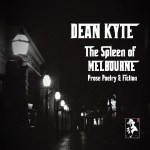
Well, a happy new year to all the fans, friends and followers of The Melbourne Flâneur vlog at home and abroad! And as my personal new year gets set to kick off this week with the Sun’s segue out of Capricorn and into Aquarius, it augurs beaucoup propitious to announce the release (which formally occurred on New Year’s Day) of my brand-spanking-new audiobook, The Spleen of Melbourne: Prose Poetry & Fiction.
Feast your peepers upon the nouvel évangile below.
The Spleen of Melbourne CD features 12 audio tracks with a total run-time of approximately 50 minutes.
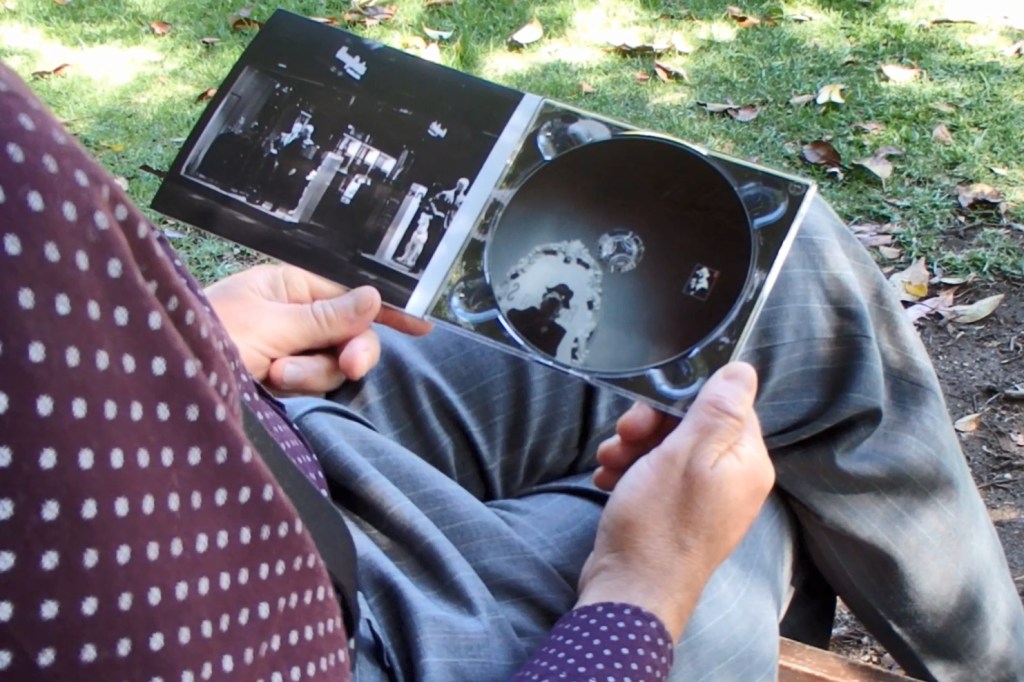
I’m very proud of this CD. It was the fruit of my lockdown in Newcastle last year, one of the very few things which kept me sane during that period (not always the easiest thing for an Aquarian to be). And a shout-out to Implant Media, in Brunswick East, who mastered and produced the album for me. Despite some fatiguing delays in production which prevented me from getting this baby out before 1st January, they rendered my vision exquisitely so that the physical artefact you see above is precisely what I was imagining in my little villa in Newy.
The Spleen of Melbourne is a project I’ve been working on almost for as long as I’ve been living in Melbourne, and I’m certainly not done with it yet—not by a long shot. In fact, in several of my posts on this vlog, you will have heard me use the phrase ‘the spleen of Melbourne’ in reference to my prose poetry. As I explain in the short the preface to the sleeve booklet accompanying the CD:
There is a sinister tristesse, a bilious melancholy to Melbourne. Just as Baudelaire saw the choleric sorrow beneath the gaiety of Paris, the flâneur of Melbourne sees the chthonic element of its Parisian underbelly—the spleen of softly-lit milieux at eventide when the Angelus of the trambell tolls; or the rage of white-hot days when the Seine-like Yarra, in its moutonnement, mooches like brown mud between the quais as it mutters its way from Richmond.
—Dean Kyte, “Preface to The Spleen of Melbourne CD”
Of course, the title of this project is an hommage to Charles Baudelaire’s collection of prose poems, Le Spleen de Paris (Paris Spleen), published posthumously in 1869. Also known as Petits Poèmes en prose, this collection of fifty short prose pieces is as significant a landmark in modern poetry as M. Baudelaire’s Les Fleurs du mal (1857).
Indeed, although M. Baudelaire drew his inspiration, in turn, from Aloysius Bertrand’s Gaspard de la Nuit (1842), which is considered to be the first collection of ‘poems in prose’, imagining a kind of medieval Paris, it was not until M. Baudelaire turned his merciless gaze upon the modern ruins of that Paris imagined by M. Bertrand, the Paris of the Second Empire, undergoing radical renovation via the vandalism of the self-proclaimed ‘demolition artist’ Baron Haussmann, that ‘prose poetry’, as a peculiarly modern form of verse, one infinitely appropriate to modern, urban conditions of speed and rapid change, was legitimately born.
As M. Baudelaire writes in a letter to his friend, Arsène Houssaye, which forms the preface to Le Spleen de Paris:
Who among us has not, in his days of ambition, dreamed up the miracle of a poetic prose, musical without rhythm or rhyme, supple enough and yet sudden enough to adapt itself to the lyrical movements of the soul, to the undulations of reverie, to the somersaults of consciousness?
It is, above all, the frequentation of enormous cities, it is the intersection of their innumerable connections, which engenders this obsessive ideal.
To which I can only say, with my hand on my heart and a profound reverence towards mon maître, ‘Mais oui.’
It is indeed ‘la fréquentation des villes énormes’ and the flâneur’s apperception of their ‘innombrables rapports’ which engenders in the literary soul given to strolling this ‘idéal obsédant’ to create prosody out of the prosaic, often horrifying, prose of modern, urban life.
Having been a flâneur in Paris, when I first came to Melbourne, I perceived immediately its intimate connection to my heart’s home, the first city of flânerie, the Capital of the Nineteenth Century. It’s an apperception which is, perhaps, not obvious to the native-born Melburnian, nor to the Australian generally, but to a Parisian soul whose karma has cursed him to be born in the antipodean hell of these climes, that clairvoyant poetic apperception of Melbourne’s subtle similitude to Paris makes my prosaic passegiate through this Inferno, far from my heart’s home, more bearable.
And in The Spleen of Melbourne audiobook, you’ll not only hear that subtle similitude to Paris in my prose poems, which are amplified by the artificial paradises and altered states of my dense soundscapes, but you’ll also see the similitude that I see. The CD, packaging, and 24-page sleeve booklet are all illustrated with my analogue photographs of Melbourne, shot on Kodak film.
The CD, packaging, and booklet are designed by Dean Kyte and feature his photographs shot on Kodak film.
The Spleen of Melbourne project, which has encompassed parts of my writing, sound design, videography, filmmaking, and photography for the last five years, is more than merely about prose poetry. M. Baudelaire dreamed of ‘le miracle d’une prose poétique, musicale sans rhythme et sans rime’, one capable of juxtaposing the Spleen and the Ideal of modern, urban life.
In other words, living and dying shortly before the birth of the cinema, he dreamed of a form of ‘literary’ montage, an imperfect, proto-cinematic form of writing that Walter Benjamin would appropriate as the overarching editorial æsthetic of his Arcades Project.
As a writer whose first passion, above even words, is film, the art of mounted, edited, moving images, I dream of the miracle of a flâneurial cinema, prosaic and yet prosodic, one where sounds and images rhyme; and where the prosy poetry of my voice-overs and narrations reflect that lyrical movement of my soul in flânerie, the slow-sudden cuts and shifts of dream and memory, the cartwheels of consciousness I turn as I trip down la rue.
M. Baudelaire dreamed of a prose that was poetic; I dream of a cinema that is poetic.
The CD I imagined into being in Newcastle is but the first iteration, the first physical essay of an idea for a completely interactive, multimedia ‘book’ of some kind, the impractical idea of which I have dreamed of in my ‘jours d’ambition’ ever since I first sailed into Melbourne and saw that it was a place where the prose of its own life is profoundly overlaid, for the clairvoyant, Rimbaudian seer, with the poetry of a Paris remembered, imagined and dreamed. I have called this project in writing, audio, video, film and photography “The Spleen of Melbourne”, and over the next several years you will doubtless see further versions of this project in different media as I make other essays at realizing my impossible book.
The Spleen of Melbourne is about the poetic soul of the world’s most liveable city; it’s about how a poetic soul who suffers in the artificial paradise of this faux-Paris-on-the-Yarra experiences it in his flâneries. The theme of The Spleen of Melbourne is the inexplicable melancholy, grief and loneliness we feel as postmodern, urban men and women wandering amidst the wreckage and ruination of modernity which M. Baudelaire predicted as the end of technological progress in his visions of a ruined, renovated Paris.
But where, pray tell, is the guarantee of progress for the morrow? For the disciples of the sages of steam and chemical matches understand it thus: progress only manifests itself to them under the guise of an indefinite series. Where, then, is the guarantee? It only exists, I say, in your credulity and fatuity.
I leave to one side the scientific question of whether, in rendering humanity more delicate in direct proportion to the new pleasures it delivers them, indefinite progress might not be humanity’s most ingenious and cruellest of tortures; if, proceeding through an obstinate negation of itself, it might not be a form of suicide unceasingly renewed, and if, enclosed in the fiery circle of divine logic, it might not resemble the scorpion that stings itself with its terrible tail, this eternal desire which ultimately makes for eternal despair?
In this urban landscape of seductive alienation—the whole City as Luna Park—I write elegiacally about the frustrating griefs I’ve experienced pursuing the Baudelairean Ideal of love through Daygame—fugitive, ephemeral, abortive romances which all soured and turned rapidly to Baudelairean Spleen—sometimes within the course of a single day.
The constant metaphor I revert to in describing my experiences of love in The Spleen of Melbourne is the metaphor of crime. This is an appropriate poetic figure for a city notorious for its connections to the Calabrian Onorata Società, colloquially known not as the ‘underworld’ of Melbourne, but, in a particularly Aussie tournure, as its ‘underbelly’.
I speak on the CD, as I have done on this vlog, of the ‘Parisian underbelly’ of Melbourne. The ‘chthonic element’ of Melbourne I mentioned above is this ‘under-world’, this poetic apperception of a stratum of reality beneath the manifest which is the intimate yet invisible relationship this city has for me with Paris. Sometimes at night, in the streets, in the dark, when I’m out with my cameras hunting, as Brassaï hunted his ‘Paris de nuit’, my Melbourne by night, I feel myself close to this soft, Parisian underbelly, and I can remember what it’s like to walk les rues de Montmartre, the friendly menace of the streets and squares softly-lit at late hours.
Thus, I hold a dark mirror up to the city in the prose poems and photographs on this CD, revealing a different, more Parisian, more surreally noirish Melbourne than most Melburnians will immediately recognize. But, as M. Rimbaud famously said:
… One must be a seer; one must make oneself a seer.
The poet makes himself a seer through a long, immense, and rational derangement of all his senses.
—Arthur Rimbaud, letter to Paul Demeny, 15 May 1871 (my translation)
As a Capricornian Aquarian—a ‘Capriquarian’, if you will—born on the cusp of Mystery and Imagination, like my fellow Capriquarians on the other side of the divide, David Lynch and Federico Fellini, altered states and artificial paradises of bleak fantasy appeal to me, and I think you’ll find a ‘friendly menace’ in my darkness and deranged vision of Melbourne.
Mystery and Imagination are two qualities distinct, and yet, like darkness and light, they co-exist in an inyo, ever-revolving, and one is needed to penetrate the other. All, for me, is Mystery; so much becomes clear in The Spleen of Melbourne as I ponder the ‘baffling crimes’ of my heartbreaks. And all, equally, is Imagination, that ‘Reine des Facultés’, as M. Baudelaire termed her—that Queen of the Faculties which every true poet from Blake onwards has intuitively known is the firm ground of our mysterious reality, and the one diamond-headed pick by which we may crack the granite fog of mysterious reality on which we eternally stand in perpetual darkness at noon.
You can purchase your copy of The Spleen of Melbourne below, or visit the product page in the Dean Kyte Bookstore for more info, including a video of yours truly giving you the guided tour. Every physical copy of the audiobook comes personally signed, wax-sealed, and gift-wrapped by the same two hands that wrote the poems, shot the photos, and designed the artefact. That’s your exclusive guarantee of artistic authenticity.
And to celebrate the release of my new audiobook, I am going to hold an online launch for The Spleen of Melbourne via Zoom. I’m currently developing a PowerPoint presentation in which I take you through the history of the project. I’m going to take you on a whirlwind tour from Paris to Melbourne, via Berlin, discussing my æsthetic philosophy of flânerie. I’ll introduce you to the landmark figures in my thinking, from Charles Baudelaire, to Walter Benjamin, to Oswald Spengler, and more.
It will be the first time I’ve ever attempted to set forth my philosophy of flânerie in public in a concentrated oral form, so if you want to know how all the diverse things I write about on The Melbourne Flânerie vlog dovetail in one Unified Field Theory of Flânerie, you won’t want to miss this dilly of a PowerPoint presentation I’m preparing.
There’ll be readings of pieces that are on the CD with live accompaniment, readings of pieces that aren’t but will be in future versions of this project, films, videos, and a live Q&A. A date hasn’t been definitely decided, but when it is, expect an invite in your inbox!
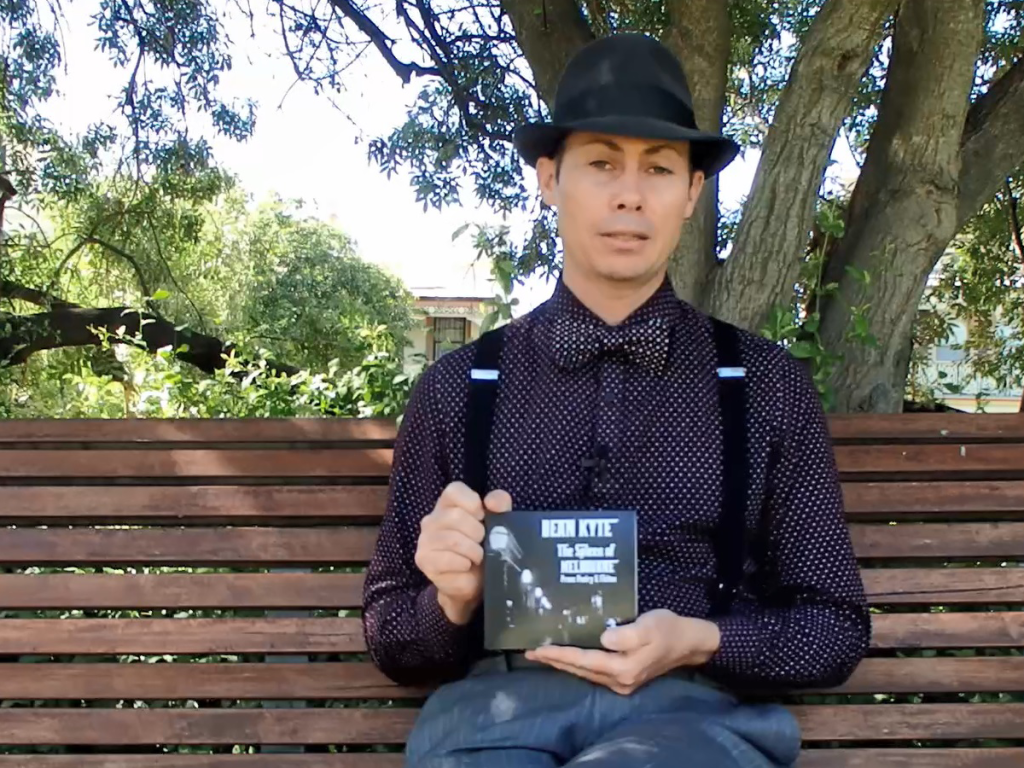
Dean Kyte on location with The Spleen of Melbourne CD.
Formats currently in stock
“The Spleen of Melbourne” [CD audiobook]
Personally signed, sealed and gift-wrapped by author. Price includes worldwide postage. Purchase the physical CD and get bonus MP3 versions of all the tracks absolutely free!
A$25.00
“The Spleen of Melbourne” [MP3 audiobook]
12 MP3 tracks downloadable onto any device, plus bonus trailer. 24-page PDF booklet featuring Dean Kyte’s evocative photographs of Melbourne. Worldwide delivery within 24 hours.



 deankyte.com