Taking you line by line through the last three verses of Baudelaire’s « Les Phares », Dean Kyte explains the paradoxical relationship that damnation has to praise in Baudelaire’s thought.
And in today’s video on The Melbourne Flâneur, I take you inside the softcover version of the book as I explain—with due reference to Baudelaire—the rationale behind my choice of such a bitter and pitiless title.
As I say in the video, what appears on its face to be a title utterly alienating in its satanic vituperation is in fact the highest possible homage that Baudelaire can render to God’s majesty, and the proof of his most fervent belief, as a heretical Catholic, in the Supreme Being.
Thus, at a plutonic hour of human history where faith in God and human goodness could not be more ridiculous, I too assert, in taking this title, my quixotic faith in what is highest in man by ‘praising with sharp damnation’ what is lowest in our species, we irredeemable children of the tribe of Cain.
For there must no longer be any doubt in our present year, even to the somnambulistic billions who would make ‘the Woman Question’ and ‘the Jewish Question’ of the nineteenth and twentieth centuries suddenly ‘the Human Question’ of the twenty-first, that Baudelaire’s apocalyptic prophecy of modernity—a veritable ‘Age of Iron’—has now properly revealed itself in our day.
The time could not be more right for the apparition of this book.
One hundred twenty-one years to the very day of my birth, Baudelaire writes in his journal that ‘today … I suffered a singular alarm: I felt the wind of the wing of madness pass over me.’
Charles Baudelaire is the Alpha of the dandy-flâneur, the man, in modernity, who still seeks to be a ‘man’—to live heroically in the strength of all our human frailties and the humility of our profound limits—and I am the Omega, the decadent result of two centuries of societal degeneracy in the West, the last quixotic figure, in the armour of my hat and suit, to intransigently ‘hold the faith’ in that utterly discredited, unconscionable project of embodying ‘Homo Occidentalis’ in all his risible nobility.
So, as a mad Aquarian, an avatar of the New, destiny has elected me for a task, chers lecteurs;—to be the ‘postrunner’ of this great fallen angel of modernity, this great albatross of a luciferic intellect who found his wingspan so vast he couldn’t walk easily among us, and interpret to the Anglosphere, as an evangelist after the fact, the poetry and prose poetry of Charles Baudelaire.
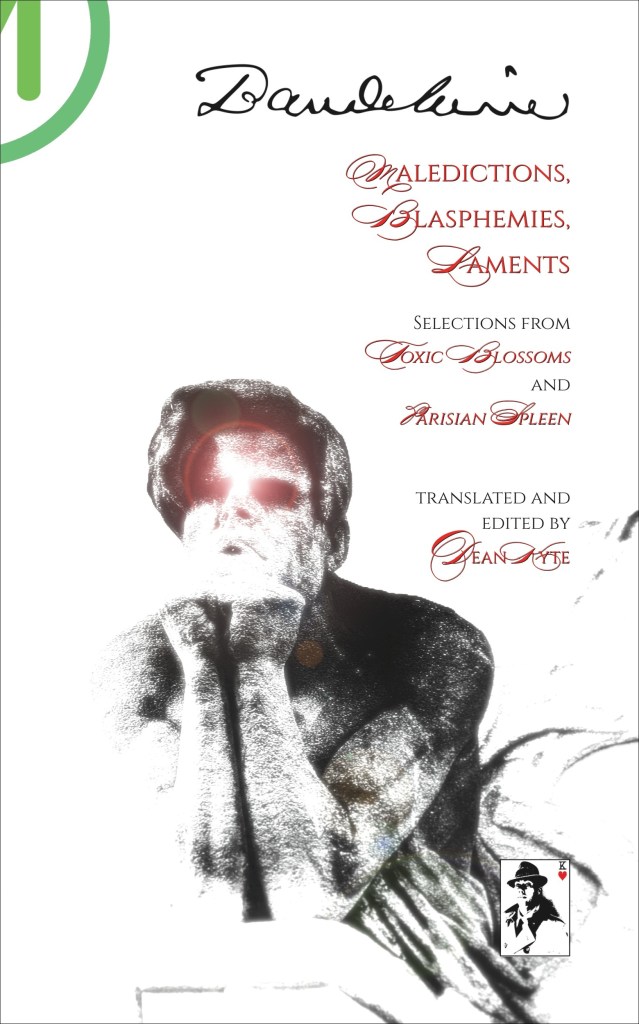
And I’m pleased as punch to advise you that Maledictions, Blasphemies, Laments is on the verge of seeing the light of day.
I explain the origins of the book’s title in the video above, but here below, I am posting for the first time the line-up of fifty pieces I have selected from Les Fleurs du mal and Le Spleen de Paris to take the field as the Baudelairean ‘dream team’ and represent our poet.
So, here we go…
From Toxic Blossoms (Les Fleurs du mal):
“To the Reader” (« Au Lecteur »)
From “Spleen and Ideal” (« Spleen et Idéal »):
“Blessing” (« Bénédiction »)
“The Albatross” (« L’Albatros »)
“Elevation” (« Élévation »)
“Correspondences” (« Correspondances »)
“The Venal Muse” (« La Muse vénale »)
“The Faithless Monk” (« Le Mauvais moine »)
“Illfated” (« Le Guignon »)
“Past Life” (« La Vie antérieure »)
“Beauty” (« La Beauté »)
“The Ideal” (« L’Idéal »)
“The Giantess” (« La Géante »)
“The Jewels” (« Les Bijoux »)
“Hymn to Beauty” (« Hymne àla Beauté »)
“You’d let all mankind dally in your alley…” (« Tu mettrais l’univers entier dans ta ruelle… »)
“With her raiment, sinuous and nacreous…” (« Avec ses vêtements ondoyants et nacrés… »)
“The Possessed” (« Le Possédé »)
“An Apparition” (« Un Fantôme »)
“I make a gift of these verses to you so that if my name…” (« Je te donnes ces vers afin qui si mon nom… »)
“Vespers” (« Chanson d’après-midi »)
“Spleen” (« Quand le ciel bas et lourd pèse comme un couvercle… »)
“Warning” (« L’Avertissement »)
From “Parisian scenes” (« Tableaux parisiens »):
“The Sun” (« Le Soleil »)
“The Swan” (« Le Cygne »)
“To a Passerby” (« À une passante »)
“Evening Twilight” (« Le Crépuscule du soir »)
From “Wine” (« Le Vin »):
“The Soul of Wine” (« L’Âme du vin »)
From “Toxic Blossoms” (« Les Fleurs du mal »):
“Epigraph for a Condemned Book” (« Épigraphe pour un livre condamné »)
“The Two Wellbred Girls” (« Les Deux bonnes sœurs »)
From “Rebellion” (« Révolte »):
“Litanies of Satan” (« Les Litanies de Satan »)
From “Death” (« La Mort »):
“A Connoisseur’s Dream” (« Le Rêve d’un curieux »)
“The Journey” (« Le Voyage »)
I have selected fully one-fifth of the total number of poems published in the three editions of Les Fleurs du mal which Baudelaire, and then his mother, saw through the press.
At least twenty per cent of every section of Les Fleurs du mal is represented in Maledictions, Blasphemies, Laments, and because Baudelaire’s poetry collection is a psychological novel with a narrative order, in selecting at least a fifth of the poems from every section, I have taken care to choose those works which I think best highlight the themes of that section and carry the overarching drama forward.
The figure of one-fifth includes the six pieces that were struck from the first edition as obscene, banned in France, and were only subsequently available in Belgium among Les Épaves (1866).
One of the censored poems, « Les Bijoux », is included, and as you can see, that piece, which I published in my first collection of Baudelaire translations, Flowers Red and Black (2013), is listed in orange.
With the exception of « Spleen », the titles in orange are works from the earlier book which are still in the buffer awaiting revision.
As this post goes to press, I am about to start revising « Spleen », which I also translated in the years preceding the publication of Flowers Red and Black but declined to include in that book, so this poem will see the light of day for the first time in Maledictions, Blasphemies, Laments.
And the word ‘revise’ in this instance basically means ‘completely rewrite’.
So it’s going to be interesting when I look at “The Jewels” again in a couple of weeks, because this is by far my most well-known translation of a work by Baudelaire, the piece that often cliched sales of Flowers Red and Black. Is this poem going to run true to form with the rest of the book and am I going to see the text in a whole new light?
What I can tell you for certain is that a revised version of “The Jewels” will include a translation of the newly revealed ninth verse that was discovered in 1928, written in Baudelaire’s hand, in a first edition of Les Fleurs du mal which he gave to a friend but only made public when that copy came up for auction in 2019.
These are the last outstanding selections from Les Fleurs du mal that I am yet to translate. They’re Baudelaire’s most famous poems; they’re among my longest selections, and they’re going to be the greatest tests of my interpretative abilities.
So that’s Les Fleurs du mal. Now let’s look at what you can expect to read from Le Spleen de Paris.
From Parisian Spleen (Le Spleen de Paris):
“To Arsène Houssaye” ( « À Arsène Houssaye »)
“The Stranger” (« L’Étranger »)
“The Artist’s Confiteor” (« Le Confiteor de l’artiste »)
“A Troll” (« Un plaisant »)
“Twin Suite” (« La Chambre double »)
“The Buffoon and the Venus” (« Le Fou et la Vénus »)
“At an Hour after Midnight” ( « À une heure de matin »)
“Crowds” (« Les Foules »)
“Invitation to the Journey” (« L’Invitation au voyage »)
“Hungry Eyes” (« Les Yeux des pauvres »)
“The Magnanimous Gambler” (« Le Joueur généreux »)
“Sozzle Yourself” (« Enivrez-vous »)
“Windows” (« Les Fenêtres »)
“The Port” (« Le Port »)
“Lost Halo” (« Perte d’auréole »)
“Anywhere Out of the World ” (« N’importe où hors du monde »)
“Epilogue” (« Épilogue »)
One-third of the total number of pieces from Le Spleen de Paris will be featured in Maledictions, Blasphemies, Laments, including Baudelaire’s prefatory letter to Arsène Houssaye—which ought to be considered a prose poem in its own right—and the poem that Baudelaire appends as epilogue to the collection.
And you’ll notice we have one text in red: « Le Port ». After I complete the revision of « Spleen », that short, pretty little prose poem is next on my list.
So, if you’ve been keeping count, chers lecteurs, you’ve clocked 49 pieces and I promised you fifty. What’s the big 5-0?
“Fanfarlo” (« La Fanfarlo »)
The translation of Charles Baudelaire’s only known original short story is now complete.
The longest, most ambitious translating project I’ve undertaken in any language was completed to my satisfaction at the end of last month after 134 hours and seven drafts of work.
A task I approached with trepidation and misgivings, thinking I would be merely giving the reader a ‘bonus’ text that was still going to cost me time and sweat, I now believe to be one of the major selling points of Maledictions, Blasphemies, Laments.
One of the reasons I think this version of « La Fanfarlo » will last for quite a long time as an introduction to what is, for English readers, an overlooked part of Baudelaire’s œuvre is my decision to include footnotes to the text.
I found that there were three types of instance where a footnote would aid the reader’s understanding, the most important being the occasional footnote that takes you inside my process as a translator, shows you clearly what the French is and how it can be variously interpreted, and what ultimately informed the choice I’ve gone with in the text based on my intimacy with Baudelaire’s typical modes of thinking and expression.
So, 86 per cent of the poems, prose poems—and fiction—of Charles Baudelaire that you will shortly be reading in Maledictions, Blasphemies, Laments is now locked in.
And this week, apace with my final revisions and translations, I pulled out my trusty essay plan and began plugging in points and sources for the last remaining major task before this book goes to print:—my contribution, an 8,000-word critical monograph on Baudelaire that I hope will serve to honourably introduce the man, the myth, the œuvre to the English-speaking world.
But what I write in the critical monograph introducing Maledictions, Blasphemies, Laments, I intend to be my definitive statement on Baudelaire—at least for the next ten years, when I will have doubtless more translations of his work to offer the English-speaking world.
When I published Flowers Red and Black in 2013, I had no idea that people would see such a close connection between Baudelaire and myself, as parallel lives across centuries, souls who cannot take quiet desperation.
I am truly the ‘mon semblable, mon frère’ (‘my double, my brother’) whom he salutes in the last line of the very first poem of Les Fleurs du mal, « Au Lecteur »—a fraternal spirit of revolt.
What I say about Baudelaire in the critical monograph will be the fruit of some seventeen years of working intimately with the thoughts of a literary mind that is as much a black mirror to my own as Edgar Allan Poe’s was to Baudelaire’s.
And I intend it to stand the test of future times and tastes as Baudelaire’s critical essays on Poe have proven their lasting value as perspicacious insights into that poor unfortunate’s life and work from a fraternal spirit who knew the horror he was experiencing only too well.
I am now taking pre-orders for Maledictions, Blasphemies, Laments, and I invite you to get onboard now.
The price point I am looking at for the softcover version advertised in the video above is $A32.00, exclusive of shipping.
(For my American readers, that’s approximately $20.50 in your yanquí dinero.)
For that price, you’re going to receive:
A 180-page illustrated softcover edition with pages printed in full colour
Autographed and wax-sealed by me as a guarantee of authenticity
Handwritten, personalised inscription from me to you
Complementary custom bookmark
My proposal to you is to purchase now to guarantee your copy at that price point in the initial print run, and after I go to print, I will invoice you for shipping.
And by pre-ordering, you will also join the community of consumers who have already committed to purchase Maledictions, Blasphemies, Laments. I’m sending emails on a monthly basis to my readers, staying accountable by keeping them up to date with my progress towards publication—and taking them inside my Artisanal Desktop Publishing process, the joys and vagaries of writing, designing and publishing this book with exclusive content not posted here on The Melbourne Flâneur.
So, avail yourself of the order form below and book your ticket to Cythera on the Baudelaire boat.
“Maledictions, Blasphemies, Laments” [softcover]
Personally signed, sealed and inscribed by author. Comes with custom bookmark. Pre-order your copy and join an exclusive community of readers anticipating the release of Dean Kyte’s new book!
As I explain in the video above, the book features one-fifth of the total number of poems published in the three editions of Baudelaire’s Les Fleurs du mal (1857), plus one-quarter of the prose poems from Le Spleen de Paris (1869).
But in addition to the 47 poems and prose poems I’ve selected as representative examples of Baudelaire’s flâneurial philosophy, as a bonus, I’ve also chosen to translate the M’sieu’s only work of fiction—“La Fanfarlo” (1847), adding significant value to this volume as a complement to the selections I have made from Les Fleurs du mal and Le Spleen de Paris.
At nearly 11,000 words in the original, “La Fanfarlo” is the most ambitious translation project I have undertaken in any language.
For the past month, I’ve been deeply engaged in hewing out a version of the source text in English, and as this post goes to press, I’m immersed in the third of five drafts, approximately half-way through the process of bringing this story to life in English.
The value of “La Fanfarlo” is chiefly documentary: preceding the bulk of Baudelaire’s œuvre as presented in the first two parts of Maledictions, Blasphemies, Laments, this ‘long short story’ will retrospectively show the 25-year-old poet first rehearsing the ideas and turns of phrase we recognize more brilliantly expressed in the poems and prose poems.
Published in January 1847, the story is a fictionalized account of Baudelaire’s first meeting with the Creole actress Jeanne Duval (c. 1820—after 1862), the Haitian beauty the poet would call his ‘Vénus noire’, and who, as his muse and mistress, is the recognizable inspiration behind at least four of the poems I’ve translated in Maledictions, Blasphemies, Laments:—“Les Bijoux”, “Avec ses vêtements ondoyants et nacrés…”, “Un Fantôme”, and “Je te donnes ces vers afin que si mon nom…”.
Jeanne Duval is ‘la Fanfarlo’ of the story’s title—an exotic dancer who has her hooks sunk deep in a Parisian dandy, M. de Cosmelly.
This gent’s wife, Mme. de Cosmelly, is a minor aristocrat from Lyon, where, in her innocent girlhood, she was once friendly with a rakish young man who has grown into Samuel Cramer, Parisian poet-about-town, a dandy-flâneur who is clearly Baudelaire under another name.
“La Fanfarlo” begins in imitation of Balzac’s novella “La Fille aux yeux d’or” (1835), with Samuel crossing paths with Mme. de Cosmelly in the jardin du Luxembourg.
But then it morphs into a curious variation on the plot of Choderlos de Laclos’ epistolary novel Les Liaisons dangereuses (1782), with the virtuous Mme. de Cosmelly—who is like a strange combination of the marquise de Merteuil wrapped in the girlish wile of Cécile de Volanges—plotting with Samuel, who fancies himself a novice vicomte de Valmont.
Mme. de Cosmelly engages the poet to take Fanfarlo off her husband’s hands and thus deliver him back into the amorous arms of his neglected wife—who gives Samuel to believe that she will bestow her gratitude upon him in the appropriate way.
As I’ve been working on translating this story over the last month, I’ve conceived of “La Fanfarlo” in several different ways. One of them is as a prophetic manifesto of Baudelaire’s artistic intent as a poet.
At the time the short story was published, Baudelaire was beginning his career as a journalist in Paris’s artistic milieu. While a few of the poems that would later appear in Les Fleurs du mal had been published in Parisian newspapers, Baudelaire was mainly known for his two lengthy reviews of the Salon exhibitions in 1845 and 1846.
In fact, the cover of Le Salon de 1846 advertises the imminent publication of the work that, eleven years later, would see the light of day under the allegorical title of Les Fleurs du mal.
Conversely, in “La Fanfarlo”, written in the months after Baudelaire’s Salon review was published in May 1846, his hero’s one claim to literary fame is as the author of a juvenile collection of sonnets—Baudelaire’s speciality—published under the equally inscrutable and difficult to translate title of “Les Orfraies”.
Le lendemain il la trouva, la tête inclinée par une mélancolie gracieuse et presque étudiée, vers les fleurs de la plate-bande, et il lui offrit son volume des Orfraies, recueil de sonnets, comme nous en avons tous fait et tous lu, dans le temps où nous avions le jugement si court et les cheveux si longs.
Samuel était fort curieux de savoir si ses Orfraies avaient charmé l’âme de cette belle mélancolique, et si les cris de ces vilains oiseaux lui avaient parlé en sa faveur ; mais quelques jours après elle lui dit avec une candeur et une honnêteté désespérantes :
— Monsieur, je ne suis qu’une femme, et, par conséquent, mon jugement est peu de chose ; mais il me paraît que les tristesses et les amours de messieurs les auteurs ne ressemblent guère aux tristesses et aux amours des autres hommes. … De plus, j’ignore pourquoi vous chérissez tant les sujets funèbres et les descriptions d’anatomie. Quand on est jeune, qu’on a comme vous un beau talent et toutes les conditions présumées du bonheur, il me paraît bien plus naturel de célébrer la santé et les joies de l’honnête homme, que de s’exercer à l’anathème, et de causer avec des Orfraies.
The next day, he located the lady, her head inclined by a gracious and almost studied melancholy towards the flowers of the parterre, and offered her his volume of Raptorsongs, a collection of sonnets of the type we have all written and read in days when we were so short in judgment and long in hair.
Samuel was most curious to discover if his Raptorsongs had charmed the soul of this beautiful melancholiac, and if the cries of these dreadful birds had spoken to her in his favour. But a few days later, she told him with a disheartening candour and honesty:
—Monsieur, I am merely a woman, and consequently, my judgment is a thing of small worth. But it appears to me that the passions and distresses of you authorial gentlemen hardly bear resemblance to the loves and sadnesses of other men. … Moreover, I know not why you so cherish funereal subjects and anatomical descriptions. When one is young, when one has, as you do, a great talent and all the presumed conditions for happiness, it seems to me much more natural to celebrate health and an honest man’s joys than to practise anathema and to declaim in piercing cries.
— Charles Baudelaire, “La Fanfarlo” (1847, p. 9 [my translation, third draft])
Thus, the piercing cries of birds of prey which form the discordant music of Samuel Cramer’s sonnets in “La Fanfarlo” will, a decade later, become the ‘noisome posy’, the ‘toxic blossoms’—which is how I have chosen to translate Les Fleurs du mal in Maledictions, Blasphemies, Laments—and the title Baudelaire devises from Cramer’s recueil is prescient in its sinister ambiguity, anticipating the multiple insinuations that other translators have unimaginatively reduced to the literal phrase of ‘the flowers of evil’.
Baudelaire is barely commenced upon the project that will become Les Fleurs du mal. Yet he anticipates the critiques that will be levelled against his poisonous bouquet and rehearses them in “La Fanfarlo” by placing them in the mouth of Mme. de Cosmelly.
He also articulates his rebuttal—the rebuttal he might have given at his future obscenity trial—by ventriloquizing his self-defence through Samuel.
Madame, plaignez-moi, ou plutôt plaignez-nous, car j’ai beaucoup de frères de ma sorte ; c’est la haine de tous et de nous-mêmes qui nous a conduits vers ces mensonges. C’est par désespoir de ne pouvoir être nobles et beaux suivant les moyens naturels, que nous nous sommes si bizarrement fardé le visage. Nous nous sommes tellement appliqués à sophistiquer notre cœur, nous avons tant abusé du microscope pour étudier les hideuses excroissances et les honteuses verrues dont il est couvert, et que nous grossissons à plaisir, qu’il est impossible que nous parlions le langage des autres hommes. Ils vivent pour vivre, et nous, hélas ! nous vivons pour savoir. Tout le mystère est là.
Madame, pity me—or rather, pity us; for there are many brethren of my kind. It is the hatred of everything—and of ourselves—which has led us to these lies. It is out of the despair of impotence to be noble and beautiful through natural means that we have so bizarrely farded our faces. We have so applied ourselves to over-refining the human heart, we have so abused the microscope so as to study the hideous growths and shameful warts with which it is covered—and which we inflame with pleasure!—that it is impossible that we should speak the language of other men. They live to live, and we, alas!—we live in order to know. The whole mystery lies in that.
— Charles Baudelaire, “La Fanfarlo” (1847, p. 10 [my translation, third draft])
This eloquent plea is, moreover, perspicacious to an extraordinary degree in that it reveals Baudelaire’s total awareness of his malady—his absolute inability to make his way in the world as either man or poet—so young in life. Through Samuel to Mme. de Cosmelly, Baudelaire throws himself upon the mercy of a future court of public opinion just as, following the adverse finding against him at his obscenity trial, he would seek the clemency of the Empress Eugénie.
In another of its dimensions, I see “La Fanfarlo” as rehearsing elements of the future ‘novel of realistic intrigue’—which is the umbrella term I apply to all subspecies of the crime novel, from the detective story to the spy thriller—any work of genre fiction that depends for its motive upon the revelation of a concealed truth.
Baudelaire is a proto-noir writer: his flâneurial ethos, drawing on the contemporary influences of Balzac, Eugène Sue, and Poe, braids the æsthetic strands of Gothic fiction and Romanticism with the emergent rational sensibility of science characteristic of the over-civilized city-man that, later in the nineteenth century, will produce the novel of realistic intrigue as the quintessential literary investigation of modern, metropolitan life.
I will go further than this and posit that Les Liaisons dangereuses is a proto-crime novel—perhaps the first crime novel—and specifically a proto-roman noir.
Noir as a literary and cinematic æsthetic rather than a genre in its own right is a stylization of the genre of realistic intrigue so as to produce the humane mood—the experiential atmosphere—associated with the commission of true acts that demand dissimulated concealment.
Which is to say that rage, fear, greed, melancholy, remorse—the whole gruesome psychology of cardinal sin associated with crime—are the transcendent subject of noir rather than the plot-based mechanics of the generic mystery or detective story.
In the pre-revolutionary epoch described by Les Liaisons dangereuses, well before Napoleon instituted the world’s first official police force in Paris to regulate public morals, ‘crime’ is a purely moral, ethical transgression rather than the legal matter that the generic novel of realistic intrigue will make of the humane dilemma to commit or not to commit.
Thus, understood in this way, Les Liaisons dangereuses—which we know from some illuminating notes that Baudelaire read with avidity—is a prototypical work of crime fiction, and, more specifically, of the stylistically abstracted and æstheticized variant on the novel of realistic intrigue we call the roman noir.
One of the archetypal tropic situations of noir—one which we see repeated in Baudelaire’s life, in his poetry, and in this single short story he chooses to commit to paper—is the triangular configuration of a man uncomfortably posed between two women, the good, domestic, ‘Madonna’ type, and the whore, the bad girl, the femme fatale who lures him into crime’s moral morass, the emotional place of wrongdoing where noir resides.
In “La Fanfarlo”, Baudelaire rehearses this archetypal trope of noir which we will recognize, a century later, more properly worked out in the romans noirs of David Goodis or in a movie like Pitfall (1948).
Even if she has a vestigial quality of the marquise de Merteuil, we may imagine Mme. de Cosmelly, ‘virginally maternal’, as pre-emptive of the presidential Apollonie Sabatier, to whom Baudelaire would later dedicate some of his most tender and reverential odes to women in Les Fleurs du mal.
As viewed from Samuel’s perspective, she is described throughout the story as a ‘femme honnête’, in spite of her Machiavellian trickery. In the parlance of the day, a woman’s ‘honesty’ is a function of her sexual purity—and as continently amorous wife, Mme. de Cosmelly is set up in distinct contrast to Fanfarlo—the femme fatale kept by her husband, incontinently available as a ‘fille publique’ upon the stage.
As per the triangular sexual dynamics that René Girard will later brilliantly identify as characteristic of the French nineteenth-century psychological novel, in “La Fanfarlo” Baudelaire sketches out the tropic plot of the later noir thriller, and it is precisely the æsthetic emphasis on the triangular structure of the psychological motive forces beneath the superficial mechanics of the plot that distinguishes noir from the generic crime, mystery, or detective story.
The moral dimensions of crime, the consequential human interest element of ethical transgression—beyond the bloodless legal mechanics of justice—that are implicit in this triangular structure of diverging, equivalent, but oppositional psychological forces, the ambiguous positioning of Samuel Cramer between Mme. de Cosmelly and Fanfarlo, between madone et putain, is what, I think, places this story in the primordial region of the nascent novel of realistic intrigue.
As primitive femme fatale, la Fanfarlo contrasts as a Dabrowskian ambivalent ambitendency in Samuel’s desires with the madonal/maternal Mme. de Cosmelly.
As a transparent disguise for Jeanne Duval—the second most important woman in Baudelaire’s life after his mother—the description he lavishes on Fanfarlo is the first sketch of the Baudelairean feminine ideal we will later recognize in the pages of Les Fleurs du mal—a totemically Orientalist representation of the fetishistically artificial femme fatale—literally ‘noire’ in her glorious négritude.
Elle fut accusée d’être brutale, commune, dénuée de goût, de vouloir importer sur le théâtre des habitudes d’outre-Rhin et d’outre-Pyrénées, des castagnettes, des éperons, des talons de bottes, — sans compter qu’elle buvait comme un grenadier, qu’elle aimait trop les petits chiens et la fille de sa portière, — et autres linges sales de la vie privée, qui sont la pâture et la friandise journalière de certains petits journaux. On lui opposait, avec cette tactique particulière aux journalistes, qui consiste à comparer des choses dissemblables, une danseuse éthérée, toujours habillée de blanc, et dont les chastes mouvements laissaient toutes les consciences en repos. Quelquefois la Fanfarlo criait et riait très-haut vers le parterre en achevant un bond sur la rampe ; elle osait marcher en dansant. Jamais elle ne portait de ces insipides robes de gaze qui laissent tout voir et ne font rien deviner. Elle aimait les étoffes qui font du bruit, les jupes longues, craquantes, pailletées, ferblantées, qu’il faut soulever très-haut d’un genou vigoureux, les corsages de saltimbanque ; elle dansait, non pas avec des boucles, mais avec des pendants d’oreilles, j’oserais presque dire des lustres. Elle eût volontiers attaché au bas de ses jupes une foule de petites poupées bizarres, comme le font les vieilles bohémiennes qui vous disent la bonne aventure d’une manière menaçante, et qu’on rencontre en plein midi sous les arceaux des ruines romaines ; toutes drôleries, du reste, dont le romantique Samuel, l’un des derniers romantiques que possède la France, raffolait fort.
She was accused of being brutal, common, devoid of taste, of wanting to important into the theatre some customs from across the Rhine or beyond the Pyrenees—castanets, spurs, heeled boots—quite apart from the fact that she was as bibulous as a grenadier, that she bore too much affection for small dogs and her concierge’s daughter—and other such dirty laundry drawn from her private life which are the daily lifeblood and confections of certain small newspapers.
They would oppose him with that particular tactic of journalists, which consists of drawing comparisons between unlike things—an ‘ethereal dancer’ – always habited in white – and whose ‘chaste movements’ could not disturb the peace of any conscience. Sometimes, Fanfarlo would direct very loud tears and laughter towards the stalls in finishing off a leap above the footlights;—she would even dare to walk in dancing. Never would she wear those insipid gauzy dresses which permit everything to be seen and nothing to be imagined. She was fond of stuffs which made a sound—long, crunchy, sequined, metallic skirts that it was necessary to raise very high with a vigorous knee; clowny blouses. She would dance—not with earrings, but with pendants hanging from her ears;—I might almost dare to say, with chandeliers. She might willingly have fastened to the bottom of her skirts a host of bizarre little dolls—as the old gypsy women who tell your fortune in a menacing manner do, and whom one encounters at the height of noon under the arches of Roman ruins;—all kinds of amusements, moreover, over which the romantic Samuel—one of the last Romantics that France possesses—went very much mad.
— Charles Baudelaire, “La Fanfarlo” (1847, pp. 22-3 [my translation, second draft])
Thus, expressionistic to a Germanic degree, Fanfarlo primitively anticipates Sacher-Masoch’s Wanda von Dunajew, the gilded, metallic, mineral divine slatterns of Klimt, the deformed, degenerately angular mutant beauties of Schiele, and the utterly artificial fräulein flappers of Wedekindian Weimar Kinema.
As in the developed film and roman noir, Samuel falls prey to the fatal woman—but the fatality of la Fanfarlo’s arachnid trap is ‘les Limbes’ of common-law marriage. Just like the bohemian Baudelaire, a sexual liberal who was more than a century ahead of his time in his interracial proclivities, Samuel commits the only scandal available to the sexually un-scandal-izable French by ‘living in sin’ with his mistress.
In an original re-inversion of the later canons of law and order inverted by noir, Baudelaire’s hell is that of bourgeois convention and respectability, as Cramer succumbs to what he considers the ‘maladie d’araignée’—the ‘spider sickness’—of pregnancy.
In fine, the ‘bad girl’, Fanfarlo, leads the fallen hero off the straight path of art and into the inferno of domesticity as the father of twins rather than dangerously liberating him from the impotent prison of the hearth.
In the character of Samuel Cramer, so scrupulously delineated in the opening pages, Baudelaire curiously anticipates archetypal figures of the later, established genre from Sherlock Holmes to Philip Marlowe—and even to James Bond.
When Baudelaire is writing “La Fanfarlo”, the detective story is still so new a genre as to not even have that name. Indeed, the whole idea of a ‘detective’, that quintessentially flâneurial professional who can only bud up under conditions of late-civilized, urbanized modernity, is still yet to be fully articulated in the collective imaginary.
Baudelaire’s poetic hero, Edgar Allan Poe, writes the first detective story, “The Murders in the Rue Morgue”—set, significantly, in Paris—in 1841.
The first, plagiarized translations into French of Poe’s short story are published in the Paris newspapers in June and October 1846, and an ensuing lawsuit brings the name of Poe to the attention of the Parisian public for the first time—and doubtless to Baudelaire’s.
It is perhaps not insignificant that Poe’s detective, Auguste Dupin, is a chevalier—a knight—in the Légion d’honneur. In a conspicuous non sequitur diatribe to Mme. de Cosmelly, Samuel rails against the chivalrous, medieval romances of Sir Walter Scott, comparing them very disfavourably to the modern, psychological approach taken by ‘nos bons romanciers français’.
And yet, as Francis S. Heck observes in his article “Baudelaire’s ‘La Fanfarlo’: An Example of Romantic Irony” (1976), in his short story, Baudelaire burlesques the chivalrous romantic plot of a novel by the ‘ennuyeux’ Scott—just as he is burlesquing Les Liaisons dangereuses.
In some sense, as a dandy-flâneur, as a free-floating, mobile agent in the social scape of Paris, the poet Cramer fulfils the as yet undefined rôle of a private detective: He is charged with a secret mission by his Dulcineac ‘client’, Mme. de Cosmelly—the typical society dame who will later come through Sam Spade’s and Philip Marlowe’s pebbled glass door, setting the Scott-like plot of a detective novel in motion.
And like Spade or Marlowe, in the meta-ironic style with which Baudelaire limns Samuel Cramer, this knight-errant going forward in his lady love’s service with a Valmontian ethical flexibility and a latitude of action to guide him through the social strata of Paris is more than usually quixotic.
The popular notion of a ‘private investigator’ of confidential matters that Poe first posits with the archetypal figure of C. Auguste Dupin not yet being articulated as a definitive ‘type’ in the physiognomy of modern urban life, Samuel Cramer nevertheless fulfils the prototypical rôle of a ‘private inquiry agent’, an unofficial investigator in Mme. de Cosmelly’s behalf, and a champion in defence of her domestic interests.
But even as we first encounter Samuel, Baudelaire’s description of his digs overlooking the jardin du Luxembourg, in one of the most fashionable quartiers of Paris for a free-floating social aspirant allied with—but not quite of—the élite, foreshadows Sherlock Holmes’s ‘rooms’ at 221B Baker Street in Marylebone.
Un jour chaud et doré se précipita dans le cabinet poudreux. Samuel admira comme le printemps était venu vite en quelques jours, et sans crier gare. Un air tiède et imprégné de bonnes odeurs lui ouvrit les narines, — dont une partie étant montée au cerveau, le remplit de rêverie et de désir, et l’autre lui remua libertinement le cœur, l’estomac et le foie. — Il souffla résolûment ses deux bougies dont l’une palpitait encore sur un volume de Swedenborg, et l’autre s’éteignait sur un de ces livres honteux dont la lecture n’est profitable qu’aux esprits possédés d’un goût immodéré de la vérité.
Du haut de sa solitude, encombrée de paperasses, pavée de bouquins et peuplée de ses rêves, Samuel apercevait souvent, se promenant dans une allée du Luxembourg, une forme et une figure qu’il avait aimées en province, — à l’âge où l’on aime l’amour.
A warm and golden light rushed into the dusty study. Samuel admired how quickly the spring had come—in a matter of days, and without warning. An atmosphere, mild and steeped in pleasant scents, opened the portals of his nostrils, a fraction of which, having mounted to his brain, filled him with dreams and desires while another licentiously stirred his heart, stomach and spleen. He resolutely snuffed out his two candles, one of which was still twitching atop a volume of Swedenborg while the other was guttering above one of those shameful books whose perusal merely profits spirits possessed with an immoderate appetite for truth.
From his lofty solitude encumbered with papers, paved with books, and peopled by his dreams, Samuel would often glimpse, strolling in an allée of the Luxembourg Gardens, a face and figure that he had loved in the countryside at the age when one is in love with love itself.
— Charles Baudelaire, “La Fanfarlo” (1847, pp. 4-5 [my translation, third draft])
In that brief but vivid sketch—in which we also recognize Baudelaire’s own tastes for the occult, alchemy and esotericism, to which his poems and prose poems give ample testimony—the Faustian magus style of Samuel’s chambers is not dissimilar to Dupin’s muffled bibliothèque or Holmes’s platonic realm of pure rationality, where the science of the chemistry kit is perfectly reconciled with the art of the violin.
As a primordial essay at the archetypal hero of the novel of realistic intrigue, Samuel evokes Holmes in his domain as much as he evokes Bond in his person.
In one of his mythic dimensions, the figure of James Bond accomplishes a modern type that has its first clear personification in the Romantic figure of Lord Byron.
We know that Baudelaire, as the latest poet of Romanticism, was deeply impressed by Byron’s heroic example—as were many of his contemporaries across the Channel, including his friend and mentor Delacroix, who interpreted some of Byron’s verses on canvas.
On the whole, the Parisians, adopting the mode of dandyism that had commenced in London, were much more receptive to English trends in the nineteenth century than the reverse, the islanders displaying their usual xenophobic suspicion for Continental fads, particularly those originating with the frivolous French.
As a translator from English, Baudelaire, like his contemporaries, was deeply immersed in cultural trends across the Channel and held a deep reverence for the well-worked consumer products of English artisanry and manufacture, which appeared to him, as to his cronies, to represent the nec plus ultra in good taste.
Of course, Ian Fleming’s James Bond is an utterly slavish advertisement for the sophisticated English gentleman, and a significant part of the charm of the Bond novels as examples of the genre of realistic intrigue resides in the inclusion of actual ‘marques’—brand names that testify to Fleming’s exquisitely snobbish good taste.
I contend that a straight line can be drawn from Lord Byron to James Bond that leads through Sherlock Holmes and passes equally through the character of Samuel Cramer as an entity clearly emulative of Byron but anticipating the refined, recuperated dandyism of Bond.
Bond completes the Byronic Übermensch that Sherlock Holmes would appear to be, except for his absence of heart, his invulnerability to the fairer sex. In the modern English literary tradition where chivalry is gradually sublimated to the modern project of science, commerce, engineering and empire-building, Byron, the heroic Romantic, a nobleman kicking against all these bourgeois pricks, ultimately becomes Bond, the romantic Hero, eminently middle-class but an aspirant to democratic nobility via the meritocracy of dandyism.
Samuel Cramer, who is as much a pseudonymous disguise for Charles Baudelaire as James Bond is for Ian Fleming, is this Byronic Übermensch burlesqued: The poet, quixotically hobbled by his romantic spleen, is charged by Mme. de Cosmelly as her agent in the secret mission to break up her husband’s affair by seducing la Fanfarlo.
And, uncannily, just as Bond, true to his cryptically middle-class origins, is not even an Englishman at all, being the product of a Scot out of a French-Swiss woman, so too does Baudelaire make a point of Samuel’s exotic mixed heritage, imparting the soupçon of something extra to the je-ne-sais-quoi of his dandyism.
Samuel Cramer, qui signa autrefois du nom de Manuela de Monteverde quelques folies romantiques, — dans le bon temps du Romantisme, — est le produit contradictoire d’un blême Allemand et d’une brune Chilienne. Ajoutez à cette double origine une éducation française et une civilisation littéraire, vous serez moins surpris, — sinon satisfait et édifié, — des complications bizarres de ce caractère.
Samuel Cramer, who, in days gone by,—in the good old days of Romanticism, that is,—signed some romantic fantasies with the name of Manuela de Monteverde, is the contradictory issue of a pale German and a tanned Chilean woman. Add to this double origin a French education and a literary culture and you will be less surprised—if not satisfied and edified—by the bizarre complications of his character.
— Charles Baudelaire, “La Fanfarlo” (1847, p. 1 [my translation, third draft])
Like Bond, who continues to impersonate the perfect Englishman in the imagination of a public ignorant of Fleming’s antecedents for him, Samuel’s mixed heritage is operationalized by Baudelaire to contrast—or exotically harmonize—a traditionally phlegmatic, Northern – even ‘masculine’ – side of this idealized version of himself with a more spontaneous, Southern – ‘feminine’ – side.
One could argue that Bond’s superheroic success at every endeavour is at least in part a function of the reconciliation of masculine and feminine, of rational and responsive elements of ‘race’ in his character: he unites the ‘imperturbable’ Scot with the sophisticated French-Swiss and—like nineteenth-century dandies in Paris such Baudelaire and his creation Cramer—effectively ‘passes’ for an Englishman.
So, in many ways, “La Fanfarlo”, as a work contemporary with Poe’s detective stories, written alongside the very birth of the genre of realistic intrigue that defines the modernity that Baudelaire himself would give the name to, is a fascinating exploration of primordial forms and structures in the Zeitgeist of mid-nineteenth-century Paris.
The work is by no means a success: Baudelaire demonstrates that he has no particular talent for fiction as he has an indisputable genius for poetry and the kind of perspicacious philosophical observation that comes through in his critical writings.
Though this work may not be great fiction, it is a subtle and penetrating study written in a suggestive and æsthetic style which would not have seemed out of place in the nineties. It is chiefly interesting now because, with rare insight and a singular power of self-analysis, Baudelaire has studied his own personality in the person of Samuel Cramer the hero; it does not show enough experience and diversity of knowledge of human nature to be great fiction.
After “La Fanfarlo”, Baudelaire’s career as a fictioneer would be solely restricted to the handmaiden’s rôle of translator as he threw himself with holy zeal into the mission of setting versions of Poe’s extraordinary tales before the French public—versions that are still considered definitive, and which are studied in French high schools today.
“La Fanfarlo” tells us an enormous deal about Baudelaire—about his life, about his relationships with women—in a medium—that of fiction—he would never again explore in his own behalf, and thus, it throws a documentary sidelight on the vision of his character I have traced in Maledictions, Blasphemies, Laments through my selections from Les Fleurs du mal and Le Spleen de Paris.
This ‘long short story’ will thus add considerable value to the volume as a unique document that throws another facet of interpretation upon the poems and prose poems.
With the completion of the translation of “La Fanfarlo” next month, I will be ready to open the doors to pre-orders of Maledictions, Blasphemies, Laments in a variety of formats ahead of its release in June.
You can register your interest in being notified when I am ready to accept down payments for pre-ordered copies of the book by entering your email address into the registration form below. That will put you on the mailing list of prospective collectors, and I will send you the first ‘chapterlet’ of the introductory monograph I am writing for the book to give you a taster of what to expect in June.




 deankyte.com