The Melbourne Flâneur launches into an impromptu recitation of Baudelaire’s “Correspondances” as he strolls under the ‘living pillars’ of Geelong City Hall.

Sons et paroles, couleurs et formes, le visible surtout, ne sont pourtant que des symboles de l’idée, symboles qui naissent dans l’âme de l’artiste quand il est agité par le saint-esprit du monde; ses œuvres ne sont que des symboles à l’aide desquels il communique aux autres âmes ses propres idées.

Sounds and words, colours and shapes—above all, the visible—are, nevertheless, merely symbols of the idea, symbols that arise in the artist’s soul when he is shaken by the holy spirit of the world. His works are but symbols through whose aid he communicates his own ideas to other souls.

— Heinrich Heine, « Le Salon de 1831 », De la France (1867, pp. 346-7 [my translation])

In “Heine and the French Symbolists” (1978), Haskell M. Block demonstrates that it was the German poet Heinrich Heine, who had settled in Paris in 1831, who introduced into French poetic thought a notion that was then prevalent in German Romanticism.

The idea of a fundamental and unitary correspondence between sense phenomena such as sound, scent and colour would have profound ramifications for the development of French prosody in the nineteenth century, influencing the poet whom Charles Baudelaire would hail, in the dedicatory device prefacing Les Fleurs du mal, as the ‘perfect magician in the field of French letters’, Théophile Gautier, and subsequently Baudelaire himself.

Heine, a melancholic yet ironic poet, would die in Paris in 1856, the year before the publication of the first edition of Les Fleurs du mal. In tracing the extent of Heine’s influence on French poets throughout the century, Block shows that Baudelaire had read deeply in Heine’s poetry and prose, and the correspondences in style and outlook between the older German poet and his younger French contemporary are striking, the more so because, as Block says, ‘despite these affinities, Heine is not a major force in shaping Baudelaire’s poetics or poetry.’

He did, however, influence Baudelaire’s æsthetics and, along with Diderot, Heine would provide Baudelaire with a model on which to base his reviews of the Salon exhibitions of 1845 and 1846. In the latter, Baudelaire cites directly from Heine’s review of the 1831 exhibition, substituting the name of his own artistic hero, Eugène Delacroix, for that of the Orientalist Alexandre-Gabriel Decamps, as a more convincing proof of Heine’s theory of correspondences:

En fait d’art, je suis surnaturaliste. Je crois que l’artiste ne peut trouver dans la nature tous ses types, mais que les plus remarquables lui sont révélés dans son âme comme la symbolique innée d’idées innées et au même instant.

In matters of art, I am a supernaturalist. I believe that the artist cannot find all his models in nature, but that the most remarkable are revealed to him in his soul simultaneously as the innate image of innate ideas.

— Heine (1867, p. 349 [my translation])

But as Block explains, this Germanic theory of a precise correspondence between the platonic Idea and the actual form that it takes in nature, symbolic of itself, was more philosophical than mystical, owing more to the speculations of Kant than to those of Swedenborg.

For the German Romantics, imagistic symbols had more of a psychological character than an esoteric one.

In appropriating this German Romantic philosophical idea that Heine had imported into France and superimposing it upon the artistic temper and process of France’s foremost contributor to the Romantic movement, Baudelaire would conflate the intellectual conception of a poetic correspondence between the phenomena of nature with the æsthetic supernaturalism to which Heine claimed to be an adherent.

From his hero Delacroix, Baudelaire would imbibe the belief, as expressed in his sonnet Correspondances, the most powerfully compressed æsthetic manifesto of the French nineteenth century, that nature—the sensual world that actually surrounds us—is nothing more or less than a ‘dictionnaire hiéroglyphique’, whose signs, as Richard Sieburth says in Late Fragments (2022), ‘always pointed elsewhere or beyond.’

In this sense of the ‘real’, Baudelaire was, like Heine, a ‘supernaturalist’ in artistic matters, one who sought the holy-spiritual model that is over and above an object’s manifestation in nature.

But Baudelaire goes further than Heine and the philosophically-inclined Germans.

If the magickal grimoire of the alchemists is simply, etymologically, a grammar, a book that sets forth the precise syntax and morphology of the Logos such that, when the Word of God is correctly pronounced and articulated, it will call forth invisible spirits latent in the natural, then the ‘hieroglyphical dictionary’ of visible nature is correspondent with the invisible Verbe—the Holy Word (and thus Christ as the Word made flesh)—that is consubstantial with the signs and symbols of the sensual phenomena that daily surround us.

Baudelaire had developed this notion from his readings of the scientist and Christian mystic Emmanuel Swedenborg, who, unlike Heine, would indeed be a ‘major force’ in shaping his poetics, as the sonnet “Correspondances” makes clear.

In addition, it is known that Baudelaire was familiar with the work of his elder contemporary Alphonse-Louis Constant, a former priest, an occasional poet and socialist literary man-about-Paris in the febrile years leading up to the fall of the July Monarchy, and better known to posterity as an occultist under the name he would take after the rise to power of Napoleon III, Eliphas Lévi.

Lévi, as Jon Leaver explains in an endnote to his article “‘Sorcellerie évocatoire’: Magic and Memory in Baudelaire and Eliphas Lévi” (2012), had also published a poem entitled “Correspondances” in his collection Les Trois harmonies (1845).

Leaver cites two instances of similar poetic ideas emerging from Lévi’s phraseology, but concludes that, despite some superficial similarities, it is ‘actually unhelpful’ to seek a source for Baudelaire’s sonnet in the elder man’s poem. I agree that, from the examples cited, Lévi’s concept of correspondence between man and nature appears to be less sophisticated than the immensely compressed, highly elliptical, and yet cosmically telescopic thesis Baudelaire presents as the very basis of his æsthetic credo in Les Fleurs du mal.

It is unknown whether Baudelaire had read the poem or even if he had met Lévi, despite both poets moving in the same Fourierist circles. However, in a footnote to the poem L’Imprévu, published in the late, abortive collection Les Épaves (1866), Baudelaire recommends to the reader Lévi’s Dogme et rituel de la haute magie (1854-6) as a secondary source on ‘sorcery, demonology, and satanic ritual’ useful to interpretation of the poem.

L’analogie est le seul médiateur possible entre le visible et l’invisible, entre le fini et l’infini. …

[L]’analogie est le quintessence de la pierre philosophale, c’est le secret du mouvement perpétuel, c’est la quadrature du cercle, … c’est la racine de l’arbre de vie, c’est la science du bien et du mal.

Analogy is the only possible intercessor between the visible and the invisible, between the finiite and the infinite. …

[A]nalogy is the quintessence of the Philosopher’s Stone; it is the secret of perpetual motion and the squaring of the circle; … it’s the root of the Tree of Life and the Knowledge of Good and Evil.

— Eliphas Lévi, Dogme et rituel de la haute magie (2008, pp. 215, 217 [my translation])

Thus, the essence of poetry itself—the operation of likening two disparate things via the correspondence of analogy—is, as Lévi explains, a fundamentally alchemical operation that calls forth from the visible and bounded the invisible and the infinite.

Séparer le subtil de l’épais, dans la première opération, qui est tout intérieure, c’est affranchir son âme de tout préjugé et de tout vice : ce qui se fait par l’usage du sel philosophique, c’est-à-dire de la sagesse ; du mercure, c’est-à-dire de l’habileté personnelle et du travail ; puis enfin du soufre, qui représente l’énergie vitale et la chaleur de la volonté. On arrive par ce moyen à changer en or spirituel les choses même les moins précieuses, et jusqu’aux immondices de la terre. C’est en ce sens qu’il faut entendre les paraboles de la tourbe des philosophes … et des autres prophètes de l’alchimie ; mais dans leurs œuvres, comme dans le grand œuvre, il faut séparer habilement le subtil de l’épais, le mystique du positif, l’allégorie de la théorie. Si on veut les lire avec plaisir et avec intelligence, il faut d’abord les entendre allégoriquement dans leur entier, puis descendre des allégories aux réalités par la voie des correspondances ou analogies indiquées dans le dogme unique :

Ce qui est en haut est comme ce qui est en bas, et réciproquement.

To divide the etheric from the carnal, in the first operation—which is entirely internal—is to liberate the soul of every prejudice and vice. This is accomplished through the employment of philosophical salt, which is to say, wisdom; through mercury, which is personal skill and labour; then, finally, through sulfur, which represents vital energy and the fervour of the will. By this process, one attains the ability to transform even the least precious things—right down to the filth of the earth—into spiritual gold. It is in this sense that one must understand the allegories of sod spoken of by the philosophers … and other prophets of alchemy. Yet in their works, as in the Magnum Opus, it is necessary to adroitly divide the subtle from the gross, the mystical from the scientific, the allegorical from the theoretic. If we desire to read these works with satisfaction and discernment, we must first understand them allegorically in their entirety, then descend from that level to concrete realities along the path of correspondences or analogies indicated in the only dogma:

As above so below, and vice versa.

— Lévi (2008, p. 152 [my translation])

Even in the disenchanted world of modernity, the objects of our actuality double as the signs of the inexpressible definitions in eternity that they refer to.

And thus, in taking for his hieroglyphic dictionary the unpoetic realm of the urban real, Baudelaire’s alchemical praxis as the first poet of modern life is a proto-noir ‘expressionism’ of what he had gathered, via Heine, from the earlier generation of German Romantics. His is the first form of a réalisme poétique.

As Alain Robbe-Grillet puts it, before being ‘something’—something that is graspable by and meaningful for human comprehension—objects are simply there.

And before this implacable ‘there-ness’, this ‘-ness’, according to Max Nordau, the degenerate feels mystified and plagued by doubts as to the unsearchable first causes of this implacable reality. ‘He is ever supplying new recruits to the army of … seekers for the philosopher’s stone, the squaring of the circle and perpetual motion’—the very problems that, according to Lévi, are solved by the alchemical operation of analogy, by the Baudelairean principle of poetic correspondence.

In Nordau’s account of poetic and artistic degeneration under the conditions of scientific, capitalistic, technological modernity, the good doctor can see no place for the poet, at least insofar as he occupies the traditional rôle he has played in all pre-Cultural societies—that of the priest, the prophet, the shaman, the man who, as I say in my translation of Baudelaire’s “Correspondances” above, ‘traverses this hierophantic grove of glyphs’, bridging, integrating the two hemispheres of the brain, the discreet, rational domain governed by Logos, and the holistic realm of perceived correspondences high and low, between all phenomena, presided over by Imago.

Baudelaire, as what Dr. Raymond Trial called ‘the typical superior degenerate’, is the cream and the crest of Western Civilization, a late-born member of the first generation to live under the declining ‘nouveau régime’ of Western modernity.

And as—(by comparison to ourselves)—the most healthy specimen of this type of ‘superior degenerate’, as an intransigent résistant, a Romantic revolter, an anti-Nietzschean naysayer to the liberal shibboleths of infinite scientific and social progress, Baudelaire finds himself left out of Nordau’s account of a ‘sane’—which is to say, etymologically, ‘healthy’—poetry.

Instead, he is the fountainhead, for Nordau, of the insane in poetry—the ‘malsain’.

In this rigidly rational, positivist régime that has driven us all, over the last two and a quarter centuries, to experience the crucible of paralyzing hysteria that Baudelaire was among the first to go through, we have seen how little place there is for poetry in the modern world, how little poetry there seems to be in the sensual phenomena of our actuality.

Yet from this bleak and noirish facticity, the unprepossessing ‘thereness’ of the inescapably ugly urban environment—‘the filth of the earth’, as Lévi calls it—Baudelaire discovered in the miasma of his Parisian reality the incantatory magick, the ‘evocative sorcery’, as he would call it, of the Verbe-made-flesh, of the indexical sign consubstantial with its correspondent referent in eternity, and thus the spell of rhythm and rhyme as the essential operation that transformed the base dross of his splenetic actuality into the incorruptible gold of an Ideal whose image is still chanted through the French-speaking world.

In Les Fleurs du mal, Baudelaire seeks to reclaim the pre-Cultural rôle of the poet as shaman, as witchdoctor, the esoteric alchemist of a society disenchanted by Luciferic positive science, the benighted mage who distils the healing quintessence from the poisonous herbarium of correspondent, actual nature that he gathers in the grimoire of his collection’s pages.

The built, lapidary environment of Baudelaire’s actual ‘nature’ is an utterly novel environment for Western man to attempt to colonize and thrive in. The Parisian megalopolis, the renovated Rome of the Civilized West, the Benjaminian ‘Capital of the Nineteenth Century’ stretching forth the tentacles of its cultural imperium of taste under the auspices of Napoleon III even to the antipodes of Melbourne, was a technological marvel of good living—a veritable ‘machine à vivre’—such as had never been seen before.

From hysterical Paris, fatigued, according to Nordau, by the general nervous exhaustion brought on by an unremitting tumult of frenzied revolution—political, cultural, artistic—modernity’s chief mechanism of mimetic propagation, fashion—the famous Paris fashion, desired by all the world—broadcast itself to the whole Occidental diaspora as le dernier cri in how to live comme il faut.

Benjamin quotes the Decadent and Symbolist poet Jules Laforgue as saying that Baudelaire was the first to speak of Paris ‘as someone condemned to live in the capital day after day.’ To be where all the world wants to be was, for this native-born Parisian, to be in ‘hell’, and Baudelaire baldly calls Paris by that name in his correspondence.

He is at the vanguard, on the barricades of this agonistic encounter with a ‘new nature’, mineral rather than vegetable, technological rather than magickal, artificial and spectacular rather than organic and authentic, that we have long regarded as our ‘new normal’.

The Paris of the mid-nineteenth-century—which is still the Paris of today—is necessarily an alienating environment. The medieval ‘forêt de symboles’ that Baudelaire had traversed in his youth falls beneath the ram and blow of Baron Haussmann’s renovations to be replaced by the new, geometric, astral order that we recognize today, a Lapis of glass, marble, macadam, iron and asphalt.

Even the Manhattan of Baudelaire’s transatlantic contemporary, Walt Whitman, is still rustic and provincial, and as yet nothing to compare, in world-historical terms, with the technological Babel of new hieroglyphs mutating daily around the islands of the Seine.

Everything Baudelaire beholds in his flâneries through the capital, practising, with diffuse attention, his ‘fantasque escrime’, speaks obscurely—‘de confuses paroles’— of the portentous future we now recognize as our globalized present. To capture, by a correspondent language, the ephemerality of the actual in this flux of mutating impressions that the cataract of fashion pushes past one’s eyes into the abyss of the past is to disengage what is eternal about these transitory phenomena.

In pre-Cultural social organizations, the medicine man, according to Michel Bounan, embodies, for his community, the rôle of the ‘universal living subject’—man in his correspondent relationship to the cosmos, something like Lévi’s vision.

The poet in scientistic modernity, finding his gnostic, shamanistic rôle deprecated by ‘the market’, that volatile, atomized, democratic entity which replaces the embodied ‘church’ of the community, now finds himself suddenly rendered impotent, stripped of the magickal powers that his prestigious command of the Verbe once invested him with, and alienated from this materialistic order deracinated from the eternal ground of Spirit.

In this brave, new, ‘re-cruded’ world of fungible commodities, the poem, that abstract, conceptual artwork with its roots plunged deeply in the purely oral pre-Culture of Western man’s infancy, as invocatory prayer to God and celebratory praise of the hero, must make a further leap beyond the technological revolution of writing.

In Baudelaire’s time, the press, that Gutenbergian innovation upon written language which, in the eighteenth century, had roused, stoked and maintained the sanguinary inferno of the Revolution, had, by the mid-nineteenth century, made the word as gross a journalistic commodity as the more tangible materials that supported Parisian life—coffee, chocolate, precious metals, iron and textiles.

From his early period on, he viewed the literary market without any illusions.  In 1846 he wrote: ‘No matter how beautiful a house may be, it is primarily, and before one dwells on its beauty, so-and-so many meters high and so-and-so many meters long.  In the same way, literature, which constitutes the most inestimable substance, is primarily a matter of filling up lines; and a literary architect whose mere name does not guarantee a profit must sell at any price.’  Until his dying day, Baudelaire had little status in the literary marketplace.

— Walter Benjamin, “The Paris of the Second Empire in Baudelaire”, The Writer of Modern Life: Essays on Charles Baudelaire (2006, p. 65)

In the marketplace of newspapers, reviews, and publishing houses of Paris, where he was, for owners, editors and printers alike, a frequent nuisance and encumbrance, Baudelaire, already alienated from this progressive order of laissez-faire trade, must sell his wares, these magickal words that remain the high-water mark of correct usage in modern French, as base articles of merchandise ‘by the gross’.

Baudelaire must do this, moreover, going cap in hand to the bourgeois ‘traders in words’, virtually begging them to print poems that, by the end of the century, will be regarded as among the immortal articulations of the language, on the lowest terms, for the meanest means of his subsistence, while simultaneously committing himself in hope and faith to the pre-enlightened Magnum Opus of reconstituting the magick Verbe, the Lapis Philosophorum, in an outré prosody that the journalists of the day regard as virtually worthless.

… [L]e grand oeuvre est quelque chose de plus qu’une opération chimique : c’est une véritable création du verbe humain initié à la puissance du verbe de Dieu même.

… [T]he Magnum Opus is something greater than a chemical operation: it is a veritable creation of human Logos initiated into the power of the very Word of God.

— Lévi (2008, p. 316 [my translation])

As Marc Eigeldinger explains in his article Baudelaire et l’alchimie verbale (1971), in one of its dual aspects, the alchemical process involves a conquest of temporality via the operatio of transmuting the base and corrupted world of matter. In its other aspect, it is the effort to revalorize the Word, to reimbue it with its sacred quality, and to quarry from its correspondent hieroglyphs in material nature a symbolic—which is to say, poetic—language buried in the dross of our fallen world.

In his article, Eigeldinger cites a letter that Baudelaire wrote to Alphonse Toussenel in January 1856. There, he goes exoterically further than he does in “Correspondances”, explicitly stating his belief to the naturalist and journalist that ‘la Nature est un verbe, une allégorie, un moule, une repoussé — Nature is a language, an allegory, a mold, a matrix’.

It is thus the case that the act of literary translation is an act of alchemical transmutation: Baudelaire’s unremunerative labour to decipher the hieroglyphical dictionary that is the modern environment of Paris, converting the ensouled symbology of the megalopolis’s ‘piliers vivants’ into the incorruptible, abstract artifacts of poems that correspond precisely and eternally with these material symbols’ ephemeral actuality, is an esoteric operation upon himself.

It is the attempt to revalorize his miserable existence of an all-too-brief moment, some 46 years of poverty and illness, loneliness and salutary madness that seem to him an eternal and infinite hell.

He was not to leave for Hell so soon.  Catulle Mendès chanced to meet him at the Gare du Nord: shabby, sullen, almost menacing.  He explained that he had come to Paris on business, and that he was going back to Brussels, but that he had missed the evening train.  Mendès lived near the station, in the rue de Douai.  He offered him a bed for the night.  Baudelaire accepted the offer.

In the rue de Douai, he stretched himself out, fully dressed, on the sofa, asked for a book, and began to read.  Suddenly he dropped the book, and asked: ‘Do you know, mon enfant, how much money I have earned since I began to work, since I was born?’

‘There was in his voice a heartrending bitterness of reproach and, as it were, of protest.  I shuddered [Mendès remembered].  “I don’t know,” I said.  “I’m going to count it out to you,” he cried.  And his voice grew exasperated as if with rage … He listed, with their payments, the articles, the poems, the prose poems, the translations, the re-publications, and, adding them all up, in his head, … he announced: “The total profits of my whole life: fifteen thousand eight hundred and ninety-two francs and sixty centimes!”  He added, with chattering teeth: “Note those sixty centimes—two Havana cigars!”’

Jacques Crépet was later to calculate that Baudelaire had earned 10,000 francs; Claude Pichois and Jean Ziegler were to put the sum at 9,900 francs.

On that summer night in Paris, in 1865, Mendès’ increasing sadness turned to anger:

‘I thought of the famous novelists, the prolific melodramatists, and … I thought of this great poet, this strange and delicate thinker, this perfect artist who, in twenty-six years of laborious existence, had earned about one franc seventy centimes a day.’

— Joanna Richardson, Baudelaire (1994, pp. 424-5)

In a proposed, unfinished epilogue intended for the second edition of Les Fleurs du mal, Baudelaire drafted two lines that have become the most cited lines in the language as they express the intention behind his alchemical poetic art: ‘Car j’ai de chaque chose extrait la quintessence, | Tu m’as donné ta boue et j’en ai fait de l’or — For, out of all things I have drawn forth the quintessence: | Alms of mud have you made me, and I’ve made gold from the putrescence’ [my translation].

Baudelaire transcends his impotent alienation from the means of industrial literary production that is enjoined upon him as a condition of living in materialistic modernity. But he is torn between the higher, esoteric sorcery of his craft and the crude demands of capitalism, the need, like that of the prostitutes he venerates, to ‘harvest gold from his celestial coffers’.

If, as I argue, Les Fleurs du mal should be understood as an alchemical tract, as a record of Baudelaire’s Faustian quest for the Lapis and the Elixir that will make modern urban life bearable, the most depressing critical realization is that, under the diabolical tyranny of capital, the inestimable gold he has fashioned as one of the great patrimonies of world literature, at the ultimate price of his life and soul, is a result of the unholy act of transmutation that the alchemists of old warn against:—the attempt by Baudelaire to make his leaden life into the mere filthy lucre he needed to survive it.


You’ve just been reading the first draft of a ‘chapterlet’ from the critical monograph on Baudelaire which will form the introduction to my forthcoming book of translations of Baudelaire’s poems and prose poems, Maledictions, Blasphemies, Laments: Selections from Toxic Blossoms & Parisian Spleen.

All 51 pieces in the book—33 poems, 17 prose poems, and 1 short story—are now complete.

As I put the final touches to the book, my last task is to complete a 10,000-word critical monograph on Charles Baudelaire in which I explain how, in his life and work, he both prophesies and embodies the decadence, decline, and degeneration of modern man that we are now experiencing all throughout the West—and particularly in the Anglosphere.

Pre-order your copy using the links below.

Félix Bracquemond, “Frontispiece for ‘Les Fleurs du mal’” (1857), 26.4 × 18 cm, The Metropolitan Museum of Art, New York.
Félix Bracquemond, “Frontispiece for Les Fleurs du mal (1857), 26.4 × 18 cm, The Metropolitan Museum of Art, New York.

The title of Charles Baudelaire’s only completed book of poetry has remained an inscrutable rebus for English translators, despite the simplicity of the title’s formulation—two nouns, one concrete, one abstract, the definite article in its plural form, and a preposition implying possession of the concrete noun by the abstract.

This simple phrase, ‘Les Fleurs du mal’, presents no obvious difficulty to translation, and yet it has confounded generations of English translators for over a century, almost all of whom have collapsed in defeat on the prosaically literal, unpoetic phrase ‘The Flowers of Evil’.

In his indispensable commentary Baudelaire’s Tragic Hero: A Study of the Architecture of Les Fleurs du Mal (1961), D. J. Mossop states that a literal rendering of the central metaphor of the title might be ‘Poems (i.e. works of æsthetic beauty) written on the subject of evil’.

But Mossop is only stating half the problem.

We see at once from Mossop’s account what the basic problem for the English translator has been—the fact that the concrete noun ‘fleurs’ (literally, prosaically, ‘flowers’) is doing double service as an abstract noun in this context—but not that the second term of the equation, the abstract noun ‘mal’—traditionally interpreted by the English-speaking peoples in an absolute moralistic sense as ‘evil’—is also doing double service in its meaning.

Baudelaire’s original intention was that his collection should be published with an allegorical frontispiece, and his friend and publisher, Auguste Poulet-Malassis, gave the commission to the engraver Félix Bracquemond, who executed a number of designs based on Baudelaire’s specifications, including the variation above.

The image was to show an allegorical figure that was both skeleton and tree, rooted to the earth, and surrounded by the Seven Deadly Sins in the form of seven weedy flowers.

None of the variations that Bracquemond produced satisfied Baudelaire, and the closest that a graphic artist would come to realizing the allegorical device that Baudelaire envisioned would be in 1866, when the poet’s idée fixe was revived by Félicien Rops and applied as frontispiece over his last, brief collection of ‘scraps’ and banned works, Les Épaves.

Félicien Rops, “Frontispiece for Les Épaves” (1866).
Félicien Rops, “Frontispiece: The Waifs (Les Épaves)” (1866), 16 × 10.2 cm, National Gallery of Art, Washington, D.C.

In addition to the emblematic intent behind the formulation ‘Les Fleurs du mal’, Baudelaire’s chosen title must be understood in light of the prefatory dedication of the collection that he makes to his ‘master and friend’, Théophile Gautier.

In her 1994 biography of Baudelaire, Joanna Richardson shows that the precise wording of the dedicatory device was carefully worked out and ratified by Gautier in collaboration with Baudelaire.

On 9 March [1857], he [Baudelaire] sent the patient Malassis ‘the new dedication, discussed, agreed and authorised by the magician, who explained to me very clearly that a dedication should not be a profession of faith – which also had the fault of drawing attention to the dangerous side of the work.’

— Joanna Richardson, Baudelaire (1994, p. 210)

As elliptical and ambiguous as the title itself, the dedication to Gautier has been the source of over a century of contention as critics have wrangled over its wording, some seeing in it Baudelaire’s propensity for base flattery towards a well-placed confrère, others his talent for the most cynical satire, laughing up his sleeve at a man of letters, powerful in his day, now diminished in history’s eyes as compared to the lowly poet supplicating Gautier for his critical protection of the work.

But in lieu of the unsatisfactorily realized allegorical image that Baudelaire intended to serve as frontispiece to the collection and explain the meaning of its title, this emblematic invocation of the ‘poète impeccable’ Gautier, whom Baudelaire calls the ‘parfait magicien ès lettres françaises — perfect magician in the field of French letters’ (my translation), is the key for the English translator to properly interpret the meaning of the elusive and enigmatic phrase ‘Les Fleurs du mal’.

Théophile Gautier, Baudelaire’s senior by a decade, had been his co-researcher in the poetic effects produced by drugs when they had both been living in the hôtel Pimodan on the île Saint-Louis in the 1840s.

In Une collaboration Gautier-Gérard: L’Étude sur Henri Heine signée de Nerval (1955) Jean Richer revealed that, during those years, Gautier wrote a substantial part of Gérard de Nerval’s critical study on the poetry of Heinrich Heine, in which the Baudelairean notion of ‘correspondences’ found its entry into French literature from the German Romantics.

Nous préférons vous offrir un simple bouquet de fleurs de fantaisie, aux parfums pénétrants, aux couleurs éclatantes.

We prefer to offer you a simple bouquet of fantastical flowers, with penetrating scents and flamboyant colours.

— Gérard de Nerval, “Les Poésies de Henri Heine”, Revue des Deux Mondes, Nouvelle série, XXIII (1848, p. 224 [my translation])

In that short statement we already perceive the essential traits distinguishing the poems that Baudelaire will begin to lay before the public over the next decade.

The metaphorical notion of the poem as being a ‘flower’, a proportionate, symmetrical form with its regular lines of syllables branching from a single axial stem of text, an exquisite, exotic miniature that emits an æsthetically pleasing quality to the ear, one that is sonically correspondent to the pleasing scent and colour which strike nose and eye, was thus well-established in the Parisian literary milieu by the time Baudelaire embarked upon Les Fleurs du mal.

Across the Channel, we can trace an etymological line between the Middle English ‘poesy’ (imported from the French ‘poésie’) and ‘posy’, a small bunch of flowers, a nosegay or ‘bouquet’, to use Nerval’s term for the collection of works he selects to translate from Heine.

And it should be noted, in passing, that the Greek origins of their common cognate ‘poiesis’ emphasizes the ‘artificial’ nature of the poem: it is a ‘creation’, a ‘production’—a work of art, in fine, that rivals the natural beauty of God’s creation.

The archaic meaning of ‘posy’ dating from the Middle English period of Norman influence is both ‘poetry’ and an ‘arrangement of flowers’. It is also, in this obsolete usage, ‘an emblem or emblematic device’—just like the allegorical image conceived by Baudelaire as a frontispiece for his collection and the dedicatory device he worked out in collaboration with Gautier.

There should therefore be no reason why generations of English translators, with hardly an exception, should all have collapsed in defeat upon the gauche and unpoetically literal phrase ‘The Flowers of Evil’ to translate the invocatory formula ‘Les Fleurs du mal’.

Once the ancient relationship between the concrete and abstract senses of ‘poesy’ are seen, half the battle in understanding Baudelaire’s cryptic intention with this phrase is won, and the possibilities for new, more accurate essays on the esoteric meaning of the formula increase substantially.

However, the wearisome literal-mindedness of the English-speaking peoples in seeing only ‘flowers’ in ‘fleurs’ is as nothing compared to their unsubtle Protestantism, which insists on seeing nothing but absolute evil in the second term of the equation, ‘mal’.

Given Mossop’s explanation, that Baudelaire’s poems are ‘works of æsthetic beauty’ that correspond with the floral products of divine craftsmanship, the Gordian way that all comers have attempted to square the impossible circle in their minds, blasphemously affirming that concrete examples of God’s handiwork can only be, in the condensed way Baudelaire expresses himself in this phrase, Satanic masterpieces, appears to me not only the consequence of the absurd materiality of the English language, but of our gross, wrongheaded Protestantism as English-speaking peoples.

Baudelaire, to be sure, is the most absolute moralist in poetry since Dante.

But, as Mossop puts it, ‘One’s attitude may be no less moral when one is conscious of the evil that is within one, than when one is conscious of one’s own virtue and the evil of others. One may be none the less against evil, for being aware that part of one is for evil…. Similarly, Baudelaire’s complex attitude … is not the simple attitude of being “against evil”, nor is it the equally simple attitude of being “for evil”: it is the complex attitude of being “against evil including the evil part of himself which is for evil”.’

The simplistic theology of a Luther or Calvin cannot hope to cope with the Catholic subtlety of such an involuted moral argument.

Baudelaire very clearly bore the physical stigmata of a fall from moral grace.

If he did not contract syphilis from his first sexual encounter with a prostitute at the age of eighteen, within a few such encounters, he was certainly carrying within himself the seeds of a slow-acting poison that would eventually cripple him, degrade his mental faculties, and render the most peerless singer of the French language in the last 200 years almost mute.

Thus, for Baudelaire, the condition of ‘badness’, of ‘wrongness’ signified by the word ‘mal’ is not so much moral as physical:—it is from his embodied experience of ‘doing ill’—‘the evil part of himself which is for evil’—that the ‘maladydu mal proceeds, not from the absolute, abstract condition of Capital-E ‘Evil’ that almost all previous English translators have simplistically settled upon.

As the wording of the emblematic device dedicated to Gautier reveals, when Baudelaire calls the poems gathered in his collection ‘ces fleurs maladives’, he is not referring, in the first instance, to the absolute moral principle that encompasses all that is ‘bad’ and ‘wrong’, from sin to error.

Baudelaire’s first concern is with physical health.

Dean Kyte takes you inside The Melbourne Edition of his new book of Baudelaire translations, Maledictions, Blasphemies, Laments, explaining the meaning of Baudelaire’s dedication to Théophile Gautier.

The titles of both of his major collections of prosody refer explicitly to the physical state of ill-health as the correspondent analogue for mental health, and the psychosomatic caduceus, the involuted double helix of the mind-body problem, the homeostatic regulation of the temporal, outer man by the eternal, inner person and vice versa, lies at the centre of Baudelaire’s conception du mal.

Hence, Baudelaire dedicates to the perfect magician Gautier ‘ces fleurs maladives’—‘these unhealthy, sickly, unwholesome flowers’—but also these ‘evil poems’, these perverse creations, these artificial ‘paper flowers’ whose ‘badness’ or ‘wrongness’ is inextricable from their formal beauty as poetry.

These are ‘fantastical blooms of imagination’—flamboyant, pungent effusions, as per Nerval—that are themselves ‘sickly’, and which induce sickness—malady—in the reader.

In 1857, the very year in which Baudelaire first published the bouquet of ‘unwholesome flowers’ he presented to Gautier, the pre-Freudian psychiatrist Bénédict Morel published his pioneering Traité des dégénérescences physiques, intellectuelles, morales de l’espèce humaine et des causes qui produisent ces variétés maladives.

In that work, Morel proposed a simple definition of human degeneration, one that would be frequently cited throughout the second half of the nineteenth century.

… [L]’idée plus claire que nous puissions nous former de la dégénérescence de l’espèce humaine, est de nous représenter comme une déviation maladive d’un type primitive.

… [T]he clearest notion we can possibly form of the phenomenon of degeneration in the human species is to represent it to ourselves as an unwholesome deviation from a primal type.

— Bénédict Morel, Traité des dégénérescences physiques, intellectuelles, morales de l’espèce humaine et des causes qui produisent ces variétés maladives (1857, p. 5 [my translation])

According to Max Nordau, who would adopt Morel’s definition, it is this derivation from a basic, healthy type of man that produces the ‘stigmata’—that is a technical, not moralistic term, Nordau assures us—of physical and intellectual degeneration.

The leading cause of this ‘unwholesome deviation’ from basic health, according to Morel, is poisoning—addiction to narcotics and stimulants, such as alcohol and tobacco, which alternately depress and excite the human organism, and the consumption of polluted foods.

Nordau, writing forty years after Morel, adds another etiological factor to these ‘noxious influences’ in his Degeneration (1895)—‘residence in large towns.’

Under the conditions of modern, technological capitalism in these great ‘machines à vivre’ taking their model from Paris, Walter Benjamin’s ‘Capital of the Nineteenth Century’, man, according to Nordau, ‘breathes an air charged with organic detritus; he eats stale, contaminated, and adulterated food; he feels himself in a state of constant nervous excitement, and one can compare him without exaggeration to the inhabitants of a marshy district.’

‘No matter which party one may belong to,’ wrote Baudelaire in 1851, ‘it is impossible not to be gripped by the spectacle of this sickly population, which swallows the dust of factories, breathes in particles of cotton, and lets its tissues be permeated by white lead, mercury, and all the poisons needed for the production of masterpieces…; the spectacle of this languishing and pining population to whom the earth owes its wonders, who feel hot, crimson blood coursing through their veins, and who cast a long, sorrowful look at the sunlight and shadows of the great parks.’ … Baudelaire supplied his own caption for the image he presents.  Beneath it he wrote the words: ‘La Modernité.’

— Walter Benjamin, “The Paris of the Second Empire in Baudelaire”, in The Writer of Modern Life: Essays on Charles Baudelaire (2006, pp. 102-3)

According to Nordau, these poisonous environmental conditions attendant on modern life in great cities produce a ‘fatigue’—an escalating ‘burnout’ of the human organism—an hysterical malady that places increasing wear and tear on the brain and tissue of each successive generation of human beings undergoing the ordeal of modernity.

‘The resistance that modernity offers to the natural productive élan of an individual is out of all proportion to his strength,’ Benjamin writes, and, as Nordau notices, in no place on earth were the nerves of human beings more frayed in the nineteenth century than in Benjamin’s capital of modernity itself—the epicentre of a political revolution that, in its continuing aftershocks, had become a social, cultural, and artistic revolution.

It was in this poisonous atmosphere of addiction, fashionable excitation, debased victuals, and political volatility that Charles Baudelaire was born and lived almost all of his brief, unhappy life.

Les Fleurs du mal are therefore not, as generations of English translators have so crudely rendered them, ‘The Flowers of Evil’.

In their exoteric aspect, the ‘allegorical image’ Baudelaire intended by that title, Les Fleurs du mal are emblems of malady, of a physical debility which is correspondent with a mental degeneration and vice versa.

As stigmatized derivatives of a primal, healthy type ‘before the Fall’ of modernity, it is only in this sense that these exotic, poisonous cultivars, weedy, unnatural blooms that Baudelaire has nursed in the hothouse of his soul—itself formed in the ‘artificial paradise’ of Paris—should be regarded as the products of an absolute immorality.

The skeletal Tree of Knowledge depicted by Rops—Science in its essence—unbandages man’s eyes from the blissful ignorance of God’s Nature.

When we enter the condition of modernity, we enter an artificial paradise, a fallen place of our own making, seductive and yet poisonous, in which the generations of Adam who work in the big cities bear the marks of Science’s guilty knowledge on their bodies and in their brains.

In its exoteric dimension, the title ‘Les Fleurs du mal’ might better be rendered, as I have chosen to do so, as ‘Toxic Blossoms’: these are creations of poisonous beauty that throw us back on the secondary paradox that arises from the primary fact of their being:—From whence does the Good, the True, the Beautiful really proceed?—from God, or from the Devil?


You’ve just been reading the first draft of a ‘chapterlet’ from the critical monograph on Baudelaire which will form the introduction to my forthcoming book of translations of Baudelaire’s poems and prose poems, Maledictions, Blasphemies, Laments: Selections from Toxic Blossoms & Parisian Spleen.

All 51 pieces in the book—33 poems, 17 prose poems, and 1 short story—are now complete.

As I put the final touches to the book, my last task is to complete a 10,000-word critical monograph on Charles Baudelaire in which I explain how, in his life and work, he both prophesies and embodies the decadence, decline, and degeneration of modern man that we are now experiencing all throughout the West—and particularly in the Anglosphere.

Pre-order your copy using the links below.

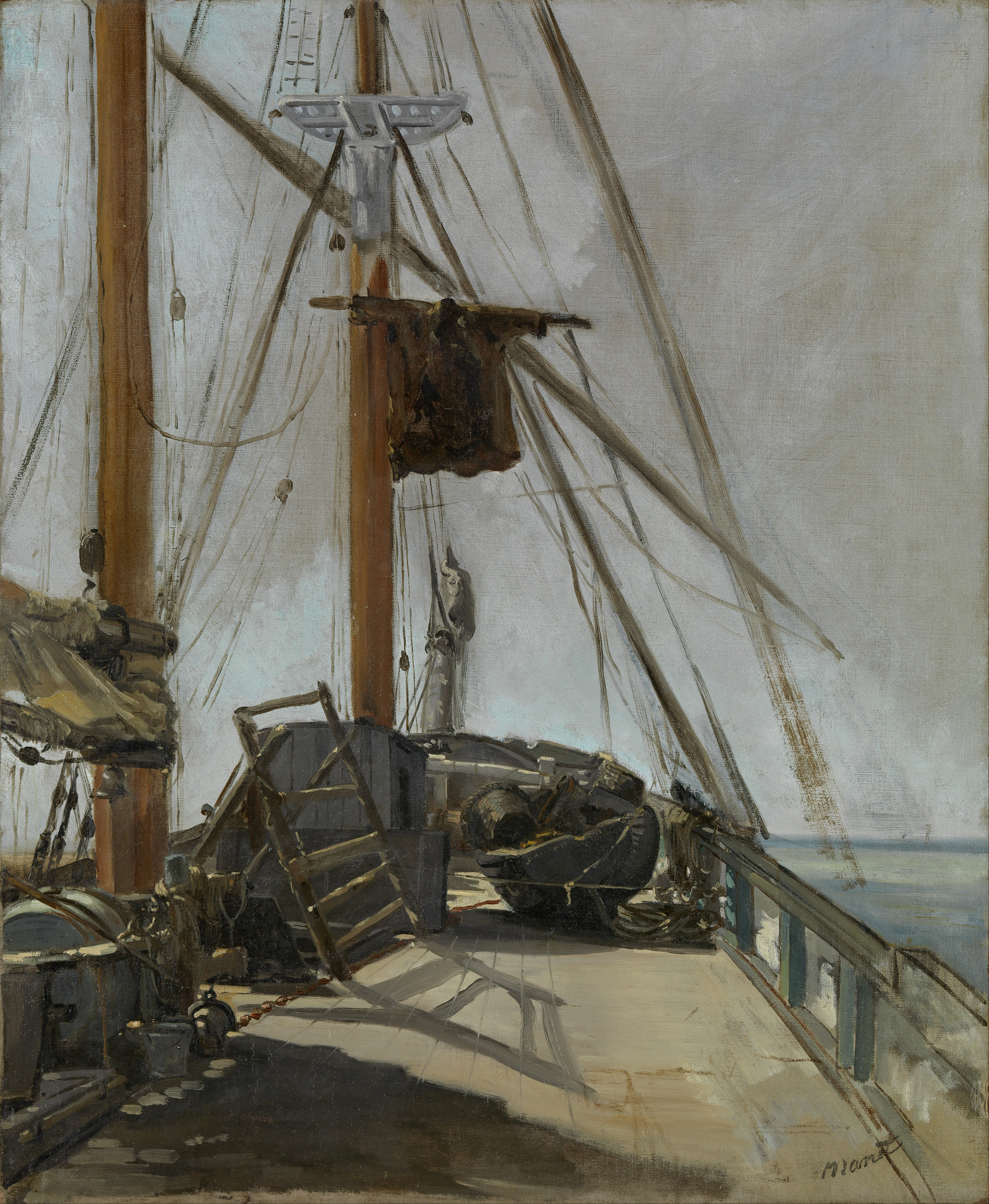
Édouard Manet, “The ship’s deck” (c. 1860), oil on canvas, 56.4 cm × 47.0 cm, National Gallery of Victoria, Melbourne.
Édouard Manet, The ship’s deck (c. 1860), oil on canvas, 56.4 cm × 47.0 cm, National Gallery of Victoria, Melbourne.

Croyez-vous que vous soyez le premier homme dans ce cas ? Avez-vous plus de génie que Chateaubriand et que Wagner ? On s’est bien moqué d’eux cependant ? Ils n’en sont pas morts. Et pour ne pas vous inspirer trop d’orgeuil, je vous dirai que ces hommes sont des modèles, chacun dans son genre, et dans un monde très riche et que vous, vous n’êtes que le premier dans la décrepitude de votre art.

Do you think you’re the first man to have been laughed at? Have you more genius than Chateaubriand and Wagner? Have they not been made fun of? They haven’t died of it. And so as not to puff up your pride too much, I will tell you that these men are models, each in his own field and in a very rich world, and that you—you are merely the first in the degeneracy of your art-form.

— Charles Baudelaire to Édouard Manet, letter of 11 May, 1865 [my translation]

Baudelaire’s recognition of a incipient degeneracy in the art of Édouard Manet would be the most significant remark, either public or private, that the poet would make on the work of his painter-friend, and, indeed, Baudelaire’s slighting comparison of Manet to another personal friend whose genius, by contrast, he had been the first man in France to recognize—Richard Wagner—is telling. As Spengler observes: ‘Between Wagner and Manet there is a deep relationship, which is not, indeed, obvious to everyone but which Baudelaire with his unerring flair for the decadent detected at once.’

It is an enduring mystery of criticism why Baudelaire, so sensitively attuned to the etiolation of forms that would, in time, mark itself out as the pathological trait of modern art—and so quick, moreover, to perceive the chthonic correspondences between his project of a modern, urban poetry and the work of artists in other media whose formal æsthetics bore similarities to his own—should have signally failed to see that it was Manet—not Constantin Guys—whom future historians and critics would deem to have embodied Baudelaire’s own notions of modern artistic heroism, as the quintessential ‘Painter of Modern Life’.

Beaucoup de gens attribueront la décadence de la peinture à la décadence des mœurs. …

Avant de rechercher quel peut être le côté épique de la vie moderne, et de prouver par des exemples que notre époque n’est pas moins féconde que les anciennes en motifs sublimes, on peut affirmer que puisque tous les siècles et tous les peuples ont eu leur beauté, nous avons inévitablement la nôtre.

… [N]’a-t-il pas sa beauté et son charme indigène, cet habit tant victimé ? N’est-il pas l’habit nécessaire de notre époque, souffrante et portant jusque sur ses épaules noires et maigres le symbole d’un deuil perpétuel ? Remarquez bien que l’habit noir et la redingote ont non seulement leur beauté politique, qui est l’expression de l’égalité universelle, mais encore leur beauté poétique, qui est l’expression de l’âme publique ; — une immense défilade de croque-morts, croque-morts politiques, croque-morts amoureux, croque-morts bourgeois. Nous célébrons tous quelque enterrement.

Le spectacle de la vie élégante et des milliers d’existences flottantes qui circulent dans les souterrains d’une grande ville, — criminels et filles entretenues, — la Gazette des Tribunaux et le Moniteur nous prouvent que nous n’avons qu’à ouvrir les yeux pour connaître notre héroïsme.

La vie parisienne est féconde en sujets poétiques et merveilleux. Le merveilleux nous enveloppe et nous abreuve comme l’atmosphère ; mais nous ne le voyons pas.

Le nu, cette chose si chère aux artistes, cet élément nécessaire de succès, est aussi fréquent et aussi nécessaire que dans la vie ancienne : — au lit, au bain, à l’amphithéâtre. Les moyens et les motifs de la peinture sont également abondants et variés ; mais il y a un élément nouveau, qui est la beauté moderne.

Car les héros de l’Iliade ne vont qu’à votre cheville, ô Vautrin, ô Rastignac, ô Birotteau, — et vous, ô Fontanarès, qui n’avez pas osé raconter au public vos douleurs sous le frac funèbre et convulsionné que nous endossons tous ; — et vous, ô Honoré de Balzac, vous le plus héroïque, le plus singulier, le plus romantique et le plus poétique parmi tous les personnages que vous avez tirés de votre sein !

Many people will attribute the decadence in painting to the degeneration of customs. …

Before we investigate what the epic side of modern life may be and prove, through example, that our era is not less fruitful in sublime motifs than antiquity, it may be averred that since every age and nation has possessed its proper beauty, we, inevitably, have our own.

… Has it not its beauty and its native charm, this oh-so-maligned suit? Is not the suit essential for our age, suffering and bearing upon its very shoulders, puny and black, the symbol of a perpetual mourning? Note well that the black suit and frock coat have not merely their social beauty (which is the expression of universal equality), but also their poetic beauty, which is the expression of the public spirit:—an immense cortège of undertakers – political morticians, romantic embalmers, middleclass funeral directors. We are all of us celebrating some sort of burial.

The spectacle of fashion and of the countless floating existences which circulate in the bowels of a great city—crooks and whores—the court reports and tabloids prove to us that we have merely to open our eyes to meet with our brand of heroism.

Parisian life is abundant in marvellous and poetic subjects. The marvellous surrounds us and suckles us like the air, but we do not see it.

The nude, that object so dear to artists, that essential ingredient of success, is just as common and indispensable as it was in antique life: in the bed, the bath, upon the stage. The means and the motifs of painting are equally abundant and varied; but there is a new element—modern beauty.

For the heroes of the Iliad do not come up to your ankle, O Vautrin, O Rastignac, O Birotteau!—and you, O Fontanarès, who haven’t dared to recount to the public your chagrins under the tail coat, funereal and wracked with sobs, that all of us wear. —Nor you, O Honoré de Balzac; you, the most heroic, the most original, the most romantic and poetic of all the characters you have drawn forth from your heart!

— Charles Baudelaire, « Salon de 1846 », Curiosités esthétiques (1868, pp. 193, 194, 195, 196-7, 198 [my translation])

It is clear that Baudelaire sees the essence of modern beauty as crime—committing le mal.

The heroes of modern life, far superior to the strong men of antiquity, are the decadent, elegant criminal masterminds of the Balzacian social network of the city, the dandiacal flâneurs for whom the funereal uniform of the black frock coat is a democratic disguise that allows the artistic observer to take the total measure of the urban scene, du grand monde au demi-monde.

L’ordre social, l’action de la société sur l’individu, dans les diverses phases et aux diverses époques, ce réseau d’institutions et de conventions qui nous enveloppe dès notre naissance et ne se rompt qu’à notre mort, sont des ressorts tragiques qu’il ne faut que savoir manier. Ils sont tout à fait équivalents à la fatalité des anciens ; leur poids a tout ce qui était invincible et oppressif dans cette fatalité ; les habitudes qui en découlent, l’insolence, la dureté frivole, l’incurie obstinée, ont tout ce que cette fatalité avait de désespérant et de déchirant : si vous représentez avec vérité cet état de choses, l’homme des temps modernes frémira de ne pouvoir s’y soustraire, comme celui des temps anciens frémissait sous la puissance mystérieuse et sombre à laquelle il ne lui était pas permis d’échapper, et notre public sera plus ému de ce combat de l’individu contre l’ordre social qui le dépouille ou qui le garotte, que d’Œdipe poursuivi par le Destin, ou d’Oreste par les Furies.

Social order—the action of society upon the individual—in various phases and during various epochs; this network of institutions and conventions which catches us in its toils at the moment of our birth and is only broken at the hour of our death, furnishes the mainspring for tragedy which the dramatist need only know how to manipulate. These institutions and conventions are perfectly equivalent to the ‘destiny’ of the ancients; their gravitas possesses everything that was invincible and oppressive in the ancient notion of ‘fate’. The customs that flow from them—insolence, frivolous cynicism, stubborn unconcern—is replete with all that ‘fate’ had in it to inspire heartbreak and despair: If you truthfully depict this state of affairs, modern man will tremble from his incapacity to extricate himself from it just as the man of ancient times used to quiver beneath the obscure and sombre power from which he was forbidden to escape, and our modern audience will be more moved by the individual’s fight against the social order which seeks to strip or strangle him than by Œdipus pursued by Destiny, or Orestes by the Furies.

— Benjamin Constant, « Réflexions sur la tragédie », Revue de Paris (1829, p. 136 [my translation])

Echoing the insight of Benjamin Constant nearly two decades before him, Baudelaire is of the view that urban crime is the sole field of heroism available to men possessed of any spirit of adventure in modernity.

And artists—whether of word or paint—are the supreme outlaws, the supreme non-conformers to the social order.

The dandy-flâneurs, those ‘æsthetic terrorists’ of the bourgeois order who act in resolute defiance of the safetyist constraints of the law—who seek to break the social network of the civilized community binding them to impotence from birth to death, and who refuse to serve the metropolitan machine in the slavery of ‘gainful employment’, preferring instead what I call ‘productive indolence’—those elegant, artistic, criminal souls, deserters of their society but drawn like moths, by grace of their macabre curiosity, to it—to be the ironic witnesses of its criminal beauty, its crime against humanity—are the only heroes in modern life equal to the ancients.

Manet, a dandiacal flâneur as given as Baudelaire to Balzacian survey of the great machine à vivre that was the modern metropolis of Paris, wore the uniform of the fashionable man about town for his undercover excursions into observation of its many strata and facets.

Baudelaire had no lack of opportunities to observe Manet at this idle labour and know that, with the appropriate changes being made, Manet’s visual style and technique was the counterpart to his own literary approach to the modern urban scene of Second Empire Paris.

As two dandy-flâneurs, the poet had often been the painter’s Balzacian bosom companion—the Paul de Manerville to his Henry de Marsay—on sketching expeditions to the jardin des Tuileries.

With his black stovepipe, his exuberant black silk bowtie, his prematurely greying locks and his Satanic profile, Baudelaire would more than once provide Manet with the subject for a snapshot-like sketch that, in its curious caricatural indefiniteness, would trace with ‘vague precision’ the smeary mark that Baudelaire would leave on the margins of the vast, Balzacian tableau of modern Parisian life, a figure in the background, like Vautrin, only afterwards to be recognized as the absolute centre of the cultural scene for the whole nineteenth century.

Édouard Manet, Musique aux Tuileries (1862), oil on canvas, 
76 cm × 118 cm, Hugh Lane Gallery, Dublin. (Baudelaire’s portrait is circled in red.)
Édouard Manet, Musique aux Tuileries (1862), oil on canvas,
76 cm × 118 cm, Hugh Lane Gallery, Dublin. (Baudelaire’s portrait is circled in red.)

Thus, as David Carrier, summarizing the position of critics who have lamented Baudelaire’s stunning failure of perspicacity in appreciating the revolutionary rôle that Manet would play in the art of the future, regretfully puts it, ‘it is embarrassing that a great critic failed to see the value of the work of a friend.’

‘It has been alleged,’ writes Joanna Richardson, ‘that Baudelaire did not appreciate Manet at his true worth. … It might indeed be said that Delacroix concealed the modernity and the stature of Manet from him.’

Baudelaire was caught up as a partisan in the great controversy that would preoccupy French art during the second third of the nineteenth century, and which would only retrospectively appear to history as a minor theatre of conflict, a very distant skirmish from the front lines of avant-garde battle that were then drawing themselves behind Manet and in opposition to his sure sense of what constituted modern beauty.

This was the great contest between the primacy of line—precise, classical draughtsmanship as personified by Ingres—and the vibrancy of colour as the expression of romantic emotion, and personified by Baudelaire’s enduring hero, Delacroix.

Manet resolved the problem of line and colour in a novel way that nevertheless looked back—with ambiguous irony—to the classical models claimed by the two masters. Manet’s lines, as in Olympia (1863), were often gross in their salience, an infantile perversion of Ingres’ tin-type kind of design, his fields of unbroken colour vibrant but inharmonious to sensibilities that admitted that Delacroix, despite his lack of draughtsmanly clarity, achieved something poetic and musically suggestive in his tonal arrangements.

In « Le Peintre de la vie moderne », Baudelaire would call genius ‘childhood wilfully, skilfully regained’, and in the novelty of Manet’s visual style, an apparently infantile—even imbecilic—degeneracy of facture that was, in fact, meticulously laboured over as a way of expressing the spectacle of modern Paris in its marvellous, poetic welter of instantaneous impressions, the painter proved that he possessed the ‘lively sense organs and the analytic spirit which enable him to impose order upon the sum of visual materials unconsciously amassed’ which Baudelaire ascribed to Guys.

Manet was half a generation younger than Baudelaire and was thus somewhat removed from the pitched contention between neo-classical line and romantic colour: Born on 23 January 1832, Manet was ineluctably destined, like Baudelaire, to be pilloried by the establishment in his lifetime, shunted to the margins of Parisian society as a stubborn madman one could do nothing with, only to become posthumously influential, lionized for the moral determination of his conscientious rebellion against the artistic mores of the Second Empire, vindicated as the most intransigent stumbling-block upon which the future edifice of modern art would be founded.

January 23rd is a sinister and potent date.

The Sabian symbol for the third degree of Aquarius, coinciding with the Sun’s transit through it on this date, is ‘A deserter from the navy’: That image symbolizes the rebellious—indeed, criminal—abandonment of a rigid, hierarchical structure, an established institution, an ark-like architecture that is designed to safely carry one over ‘le gouffre’ (to use a word we frequently encounter in Baudelaire’s maritime poetry)—the bitter abyss, the hellish, mazy chaos of the waves that are ever under man’s feet.

In his refusal to serve a structure he sees as foundering, the rebellious deserter who jumps ship chooses to become an uncompromising outlaw of society.

In their youths during the 1840s, both Baudelaire and Manet had been forced by their respective families to quit what the older man’s stepfather called ‘the slippery streets of Paris’ and take long, exotic sea voyages—brutal separations designed to quell the rebellious desires of their hearts for poetry on the one hand and painting on the other.

Manet had been forced on a voyage to Rio de Janeiro by his father—a judge—to qualify for induction into the Navy. Manet studiously failed the entrance examinations twice, his non-conforming Aquarian spirit refusing to submit to his father’s authority as it would later refuse to submit to the established judgments of the Académie des beaux-arts.

In the end, by his strategy of ‘compliant resistance’, going along with his father’s dictates while secretly sabotaging them by his intransigent determination to do nothing but become a painter, Manet would get his own way and be allowed to enter to atelier of Thomas Couture.

Baudelaire’s stepfather, the maréchal du camp Aupick, ‘violently disturbed’ by young Charles’s avid pursuit of ‘the perdition of the streets of Paris’, would bundle the aspiring poet off to India, hoping that the exoticism of the East would return a matured young man inclined to read law—or at least, as mother and stepfather muttered between themselves, privately recognizing that they were up against a similarly stubborn case, a poet who would write of honourable subjects and not the ambulatory muses of the Parisian streets.

Baudelaire jumped ship in Mauritius, and within eight months would be back on the ‘slippery streets’ of the capital, returning, as Manet would do some seven years later, as indissuadable from the mad career pathway he was determined to pursue as when he had left, but bringing to his vision of the modern Parisian spectacle all the decadent exoticism he had absorbed in Cape Town, Mauritius, and Réunion.

Thus, January 23 is a date that portends criminal rebellion, the radical overthrow of all monolithic structures of orthodox ‘right thought’ designed to float us, as in an ark, safely over the raging sea of life.

On the same date in 1862, his friend Manet’s thirtieth birthday, the forty-year-old Baudelaire would do what he would hardly ever do in the pages of his Journaux intimes, and mark this fatal date as a dark and potent inflection point in his life.

J’ai cultivé mon hystérie avec jouissance et terreur. Maintenant, j’ai toujours le vertige, et aujourd’hui, 23 janvier 1862, j’ai subi un singulier avertissement, j’ai senti passer sur moi le vent de l’aile de l’imbécillité.

I have cultivated my hysteria with relish and dread. Nowadays, I always feel vertigo, and today, 23 January 1862, I suffered a singular presentiment:—I felt the wind of the wing of mental degeneration sweep over my being.

— Charles Baudelaire, « Mon Cœur mis à nu » (1864, p. 130 [my translation])

And on the same date 121 years later, in the wastes of Australia, I would enter this world of ennui.


You’ve been reading the first draft of the second ‘chapterlet’ in the critical monograph on Baudelaire which will form the introduction to my forthcoming book of translations of Baudelaire’s poems and prose poems, Maledictions, Blasphemies, Laments: Selections from Toxic Blossoms & Parisian Spleen.

This book is on the verge of being born and will be out before Christmas. I urge you to purchase copies in your choice and quantity of formats now using the payment buttons below, with invoicing for shipping to occur when the first batch of orders goes to press at the end of this month.

Édouard Manet, “Olympia” (1863-5), oil on canvas, 130.5 cm × 190 cm, musée d’Orsay, Paris.
Édouard Manet, Olympia (1863-5), oil on canvas, 130.5 cm × 190 cm, musée d’Orsay, Paris.

L’usage social de la liberté littéraire deviendra de plus en plus rare et précieux. Les grandes démocraties de l’avenir seront peu libérales pour les écrivains ; il est bon de planter très haut des poètes drapeaux comme Baudelaire.

On pourra les agiter de temps en temps afin d’ameuter le petit nombre des esclaves encore frémissants.

The social use of free literary expression will become increasingly rare and precious. The great democracies of the future will be very illiberal for writers; it is therefore good to plant poets like Baudelaire upon the highest eminences as standards.

We will be able to wave them from time to time so as to riotously rouse the small number of slaves still trembling for freedom.

— Guillaume Apollinaire, introduction to L’Œuvre poétique de Charles Baudelaire (1924) [my translation]

In May of 1865, the talk of tout Paris was the scandal of the Salon, the inclusion of Édouard Manet’s Olympia in the annual exhibition of painting and sculpture held by the Académie des beaux-arts. Two years earlier, Manet had been in the thick of an agitation, his provocative canvas Le Déjeuner sur l’herbe serving as a convenient standard behind which a group of disaffected artists could rally, petitioning the Emperor, Napoléon III, in protest at their rejection by the jury. Now Manet was at it again with something that had been accepted by the jury but which was—if possible—even more outrageous a slap in the face than his Luncheon on the grass had been.

Manet had expected trouble, but from a different quarter, his other entry in the Salon of that year, a history painting showing the Saviour being insulted by the Roman soldiers, going unremarked as compared to Olympia, an uncompromising nude of a contemporary Parisian prostitute so offensive in her frankness that she excited embarrassed ridicule from visitors to the Louvre when she did not actually excite physical attack. Manet, a naïve revolutionary with an earnest desire for the respectability of the Académie, was nonplussed. He wrote his friend, the poet Charles Baudelaire, who had frequently covered the Salon as an art critic of exquisite though outré tastes, seeking guidance and reassurance.

Je voudrais bien vous avoir ici mon cher Baudelaire, les injures pleuvent sur moi comme grêle…. J’aurais voulu avoir votre jugement sain sur mes tableaux car tous ces cris agacent, et il est évident qu’il y a quelqu’un qui se trompe.

I very much wish you were here, my dear Baudelaire, for insults rain on me like hail…. I should have liked to have your healthy judgment on my paintings, for all these cries grate on me, and it’s clear that someone is in the wrong.

— Édouard Manet to Charles Baudelaire, undated letter of early May 1865 [my translation]

The 44-year-old poet was then in Brussels, where he had been for over a year, escaping his Parisian creditors, attempting to sell the rights to his works to Belgian publishers, giving scarcely attended lectures on modern French art to the uncultured Bruxellois, drinking heavily, and roundly hating the place, which he condemned in poems and pamphlets. Sick, penniless, within a year of suffering a mysterious crisis that would leave him partially paralyzed, almost mute, and barely sensible, two years away from his death, Baudelaire had little time for Manet’s complaint. Hearing without sympathy his friend’s lament from the capital of fashion and culture, on 11 May, 1865, Baudelaire fired off an exasperated epistle from the Godforsaken Belgian backwater to the man whom future generations would acknowledge to have been the reluctant, unfairly crucified father of modern art.

Croyez-vous que vous soyez le premier homme dans ce cas ? Avez-vous plus de génie que Chateaubriand et que Wagner ? On s’est bien moqué d’eux cependant ? Ils n’en sont pas morts. Et pour ne pas vous inspirer trop d’orgeuil, je vous dirai que ces hommes sont des modèles, chacun dans son genre, et dans un monde très riche et que vous, vous n’êtes que le premier dans la décrepitude de votre art.

Do you think you’re the first man to have been laughed at? Have you more genius than Chateaubriand and Wagner? Have they not been made fun of? They haven’t died of it. And so as not to puff up your pride too much, I will tell you that these men are models, each in his own field and in a very rich world, and that you—you are merely the first in the degeneracy of your art-form.

— Charles Baudelaire to Édouard Manet, letter of 11 May, 1865 [my translation]

Those last, emphasized words would be prophetic, not merely of Édouard Manet’s destiny to embody the title that his friend had incorrectly or churlishly ascribed to another, lesser artist, to be the Painter of Modern Life’, but it would equally be prophetic of the destiny of Baudelaire himself: By the end of the century, this poet, mocked and derided in his lifetime for his own pretensions to academic respectability as a troubadour of prostitutes, would be regarded by the physician and social critic Max Nordau as having been the fountainhead of degeneracy in modern life and the chef d’école in the Decadent movement of modern poetry, and early in the next century, T. S. Eliot would declare that modernism in poetry had definitively begun with Charles Baudelaire.


What you have just read is the proposed first ‘chapterlet’ of the critical monograph that opens my forthcoming book of translations drawn from the works of Baudelaire: Malediction, Blasphemies, Laments: Selections from Toxic Blossoms & Parisian Spleen.

With 96 per cent of the poems, prose poems—and fiction (!)—of Charles Baudelaire now translated and in place, Maledictions, Blasphemies, Laments is on-track for release before Christmas.

Pre-orders for the book in three formats—the hardcover dust jacket “Melbourne Edition”, the Economy Softcover version, and the PDF eBook—are now being accepted at an early-bird price.

Select your choice and quantity below to secure your copies in the desired formats, with invoicing for shipping to occur when the first print run occurs in a month’s time.

Taking you line by line through the last three verses of Baudelaire’s « Les Phares », Dean Kyte explains the paradoxical relationship that damnation has to praise in Baudelaire’s thought.

My new book of translations drawn from the works of Charles Baudelaire, Maledictions, Blasphemies, Laments: Selections from Toxic Blossoms and Parisian Spleen, is fast coming to press.

And in today’s video on The Melbourne Flâneur, I take you inside the softcover version of the book as I explain—with due reference to Baudelaire—the rationale behind my choice of such a bitter and pitiless title.

As I say in the video, what appears on its face to be a title utterly alienating in its satanic vituperation is in fact the highest possible homage that Baudelaire can render to God’s majesty, and the proof of his most fervent belief, as a heretical Catholic, in the Supreme Being.

Thus, at a plutonic hour of human history where faith in God and human goodness could not be more ridiculous, I too assert, in taking this title, my quixotic faith in what is highest in man by ‘praising with sharp damnation’ what is lowest in our species, we irredeemable children of the tribe of Cain.

For there must no longer be any doubt in our present year, even to the somnambulistic billions who would make ‘the Woman Question’ and ‘the Jewish Question’ of the nineteenth and twentieth centuries suddenly ‘the Human Question’ of the twenty-first, that Baudelaire’s apocalyptic prophecy of modernity—a veritable ‘Age of Iron’—has now properly revealed itself in our day.

The time could not be more right for the apparition of this book.

One hundred twenty-one years to the very day of my birth, Baudelaire writes in his journal that ‘today … I suffered a singular alarm: I felt the wind of the wing of madness pass over me.’

Charles Baudelaire is the Alpha of the dandy-flâneur, the man, in modernity, who still seeks to be a ‘man’—to live heroically in the strength of all our human frailties and the humility of our profound limits—and I am the Omega, the decadent result of two centuries of societal degeneracy in the West, the last quixotic figure, in the armour of my hat and suit, to intransigently ‘hold the faith’ in that utterly discredited, unconscionable project of embodying ‘Homo Occidentalis’ in all his risible nobility.

So, as a mad Aquarian, an avatar of the New, destiny has elected me for a task, chers lecteurs;—to be the ‘postrunner’ of this great fallen angel of modernity, this great albatross of a luciferic intellect who found his wingspan so vast he couldn’t walk easily among us, and interpret to the Anglosphere, as an evangelist after the fact, the poetry and prose poetry of Charles Baudelaire.

And I’m pleased as punch to advise you that Maledictions, Blasphemies, Laments is on the verge of seeing the light of day.

I explain the origins of the book’s title in the video above, but here below, I am posting for the first time the line-up of fifty pieces I have selected from Les Fleurs du mal and Le Spleen de Paris to take the field as the Baudelairean ‘dream team’ and represent our poet.

So, here we go…

From Toxic Blossoms (Les Fleurs du mal):

  • “To the Reader” (« Au Lecteur »)

From “Spleen and Ideal” (« Spleen et Idéal »):

  • “Blessing” (« Bénédiction »)
  • “The Albatross” (« L’Albatros »)
  • “Elevation” (« Élévation »)
  • “Correspondences” (« Correspondances »)
  • “The Venal Muse” (« La Muse vénale »)
  • “The Faithless Monk” (« Le Mauvais moine »)
  • “Illfated” (« Le Guignon »)
  • “Past Life” (« La Vie antérieure »)
  • “Beauty” (« La Beauté »)
  • “The Ideal” (« L’Idéal »)
  • “The Giantess” (« La Géante »)
  • “The Jewels” (« Les Bijoux »)
  • “Hymn to Beauty” (« Hymne à la Beauté »)
  • “You’d let all mankind dally in your alley…” (« Tu mettrais l’univers entier dans ta ruelle… »)
  • “With her raiment, sinuous and nacreous…” (« Avec ses vêtements ondoyants et nacrés… »)
  • “The Possessed” (« Le Possédé »)
  • “An Apparition” (« Un Fantôme »)
  • “I make a gift of these verses to you so that if my name…” (« Je te donnes ces vers afin qui si mon nom »)
  • “Vespers” (« Chanson d’après-midi »)
  • “Spleen” (« Quand le ciel bas et lourd pèse comme un couvercle… »)
  • “Warning” (« L’Avertissement »)

From “Parisian scenes” (« Tableaux parisiens »):

  • “The Sun” (« Le Soleil »)
  • “The Swan” (« Le Cygne »)
  • “To a Passerby” (« À une passante »)
  • “Evening Twilight” (« Le Crépuscule du soir »)

From “Wine” (« Le Vin »):

  • “The Soul of Wine” (« L’Âme du vin »)

From “Toxic Blossoms” (« Les Fleurs du mal »):

  • “Epigraph for a Condemned Book” (« Épigraphe pour un livre condamné »)
  • “The Two Wellbred Girls” (« Les Deux bonnes sœurs »)

From “Rebellion” (« Révolte »):

  • “Litanies of Satan” (« Les Litanies de Satan »)

From “Death” (« La Mort »):

  • “A Connoisseur’s Dream” (« Le Rêve d’un curieux »)
  • “The Journey” (« Le Voyage »)

I have selected fully one-fifth of the total number of poems published in the three editions of Les Fleurs du mal which Baudelaire, and then his mother, saw through the press.

At least twenty per cent of every section of Les Fleurs du mal is represented in Maledictions, Blasphemies, Laments, and because Baudelaire’s poetry collection is a psychological novel with a narrative order, in selecting at least a fifth of the poems from every section, I have taken care to choose those works which I think best highlight the themes of that section and carry the overarching drama forward.

The figure of one-fifth includes the six pieces that were struck from the first edition as obscene, banned in France, and were only subsequently available in Belgium among Les Épaves (1866).

One of the censored poems, « Les Bijoux », is included, and as you can see, that piece, which I published in my first collection of Baudelaire translations, Flowers Red and Black (2013), is listed in orange.

With the exception of « Spleen », the titles in orange are works from the earlier book which are still in the buffer awaiting revision.

As this post goes to press, I am about to start revising « Spleen », which I also translated in the years preceding the publication of Flowers Red and Black but declined to include in that book, so this poem will see the light of day for the first time in Maledictions, Blasphemies, Laments.

And the word ‘revise’ in this instance basically means ‘completely rewrite’.

While I was translating Baudelaire’s short story, « La Fanfarlo » between February and April, instead of working on the few remaining poems I have left to translate, I began to revise the pieces from Flowers Red and Black, but in every instance I found myself writing completely new translations of these existing poems.

So it’s going to be interesting when I look at “The Jewels” again in a couple of weeks, because this is by far my most well-known translation of a work by Baudelaire, the piece that often cliched sales of Flowers Red and Black. Is this poem going to run true to form with the rest of the book and am I going to see the text in a whole new light?

What I can tell you for certain is that a revised version of “The Jewels” will include a translation of the newly revealed ninth verse that was discovered in 1928, written in Baudelaire’s hand, in a first edition of Les Fleurs du mal which he gave to a friend but only made public when that copy came up for auction in 2019.

You will also notice that, in the list above, there are three titles in red: « Le Cygne », « Les Litanies de Satan », and « Le Voyage ».

These are the last outstanding selections from Les Fleurs du mal that I am yet to translate. They’re Baudelaire’s most famous poems; they’re among my longest selections, and they’re going to be the greatest tests of my interpretative abilities.

So that’s Les Fleurs du mal. Now let’s look at what you can expect to read from Le Spleen de Paris.

From Parisian Spleen (Le Spleen de Paris):

  • “To Arsène Houssaye” ( « À Arsène Houssaye »)
  • “The Stranger” (« L’Étranger »)
  • “The Artist’s Confiteor” (« Le Confiteor de l’artiste »)
  • “A Troll” (« Un plaisant »)
  • “Twin Suite” (« La Chambre double »)
  • “The Buffoon and the Venus” (« Le Fou et la Vénus »)
  • “At an Hour after Midnight” ( « À une heure de matin »)
  • “Crowds” (« Les Foules »)
  • “Invitation to the Journey” (« L’Invitation au voyage »)
  • “Hungry Eyes” (« Les Yeux des pauvres »)
  • “The Magnanimous Gambler” (« Le Joueur généreux »)
  • “Sozzle Yourself” (« Enivrez-vous »)
  • “Windows” (« Les Fenêtres »)
  • “The Port” (« Le Port »)
  • “Lost Halo” (« Perte d’auréole »)
  • “Anywhere Out of the World ” (« N’importe où hors du monde »)
  • “Epilogue” (« Épilogue »)

One-third of the total number of pieces from Le Spleen de Paris will be featured in Maledictions, Blasphemies, Laments, including Baudelaire’s prefatory letter to Arsène Houssaye—which ought to be considered a prose poem in its own right—and the poem that Baudelaire appends as epilogue to the collection.

I was convinced that these two pieces—which I had no previous intention of translating—needed to be included when I was in Brisbane in December. Reading Sonya Stephens’ insightful little book Baudelaire’s Prose Poems: The Practice and Politics of Irony (2000) at the State Library of Queensland convinced me that these were inescapable framing texts.

And you’ll notice we have one text in red: « Le Port ». After I complete the revision of « Spleen », that short, pretty little prose poem is next on my list.

So, if you’ve been keeping count, chers lecteurs, you’ve clocked 49 pieces and I promised you fifty. What’s the big 5-0?

“Fanfarlo” (« La Fanfarlo »)

The translation of Charles Baudelaire’s only known original short story is now complete.

The longest, most ambitious translating project I’ve undertaken in any language was completed to my satisfaction at the end of last month after 134 hours and seven drafts of work.

A task I approached with trepidation and misgivings, thinking I would be merely giving the reader a ‘bonus’ text that was still going to cost me time and sweat, I now believe to be one of the major selling points of Maledictions, Blasphemies, Laments.

One of the reasons I think this version of « La Fanfarlo » will last for quite a long time as an introduction to what is, for English readers, an overlooked part of Baudelaire’s œuvre is my decision to include footnotes to the text.

I found that there were three types of instance where a footnote would aid the reader’s understanding, the most important being the occasional footnote that takes you inside my process as a translator, shows you clearly what the French is and how it can be variously interpreted, and what ultimately informed the choice I’ve gone with in the text based on my intimacy with Baudelaire’s typical modes of thinking and expression.

So, 86 per cent of the poems, prose poems—and fiction—of Charles Baudelaire that you will shortly be reading in Maledictions, Blasphemies, Laments is now locked in.

And this week, apace with my final revisions and translations, I pulled out my trusty essay plan and began plugging in points and sources for the last remaining major task before this book goes to print:—my contribution, an 8,000-word critical monograph on Baudelaire that I hope will serve to honourably introduce the man, the myth, the œuvre to the English-speaking world.

What I’ve written about Baudelaire on The Melbourne Flâneur, I’ve written off the cuff.

But what I write in the critical monograph introducing Maledictions, Blasphemies, Laments, I intend to be my definitive statement on Baudelaire—at least for the next ten years, when I will have doubtless more translations of his work to offer the English-speaking world.

When I published Flowers Red and Black in 2013, I had no idea that people would see such a close connection between Baudelaire and myself, as parallel lives across centuries, souls who cannot take quiet desperation.

I am truly the ‘mon semblable, mon frère’ (‘my double, my brother’) whom he salutes in the last line of the very first poem of Les Fleurs du mal, « Au Lecteur »—a fraternal spirit of revolt.

What I say about Baudelaire in the critical monograph will be the fruit of some seventeen years of working intimately with the thoughts of a literary mind that is as much a black mirror to my own as Edgar Allan Poe’s was to Baudelaire’s.

And I intend it to stand the test of future times and tastes as Baudelaire’s critical essays on Poe have proven their lasting value as perspicacious insights into that poor unfortunate’s life and work from a fraternal spirit who knew the horror he was experiencing only too well.

I am now taking pre-orders for Maledictions, Blasphemies, Laments, and I invite you to get onboard now.

The price point I am looking at for the softcover version advertised in the video above is $A32.00, exclusive of shipping.

(For my American readers, that’s approximately $20.50 in your yanquí dinero.)

For that price, you’re going to receive:

  • A 180-page illustrated softcover edition with pages printed in full colour
  • Autographed and wax-sealed by me as a guarantee of authenticity
  • Handwritten, personalised inscription from me to you
  • Complementary custom bookmark

My proposal to you is to purchase now to guarantee your copy at that price point in the initial print run, and after I go to print, I will invoice you for shipping.

And by pre-ordering, you will also join the community of consumers who have already committed to purchase Maledictions, Blasphemies, Laments. I’m sending emails on a monthly basis to my readers, staying accountable by keeping them up to date with my progress towards publication—and taking them inside my Artisanal Desktop Publishing process, the joys and vagaries of writing, designing and publishing this book with exclusive content not posted here on The Melbourne Flâneur.

So, avail yourself of the order form below and book your ticket to Cythera on the Baudelaire boat.

“Maledictions, Blasphemies, Laments” [softcover]

Personally signed, sealed and inscribed by author. Comes with custom bookmark. Pre-order your copy and join an exclusive community of readers anticipating the release of Dean Kyte’s new book!

A$32.00

Dean Kyte walks you through the dust jacket for the hardcover edition of his new book of Baudelaire translations, Maledictions, Blasphemies, Laments.

June 2025 sees the scheduled release of my new book of translations drawn from the works of Charles Baudelaire, Maledictions, Blasphemies, Laments: Selections from Toxic Blossoms and Parisian Spleen.

As I explain in the video above, the book features one-fifth of the total number of poems published in the three editions of Baudelaire’s Les Fleurs du mal (1857), plus one-quarter of the prose poems from Le Spleen de Paris (1869).

But in addition to the 47 poems and prose poems I’ve selected as representative examples of Baudelaire’s flâneurial philosophy, as a bonus, I’ve also chosen to translate the M’sieu’s only work of fiction—La Fanfarlo (1847), adding significant value to this volume as a complement to the selections I have made from Les Fleurs du mal and Le Spleen de Paris.

At nearly 11,000 words in the original, “La Fanfarlo” is the most ambitious translation project I have undertaken in any language.

For the past month, I’ve been deeply engaged in hewing out a version of the source text in English, and as this post goes to press, I’m immersed in the third of five drafts, approximately half-way through the process of bringing this story to life in English.

The value of “La Fanfarlo” is chiefly documentary: preceding the bulk of Baudelaire’s œuvre as presented in the first two parts of Maledictions, Blasphemies, Laments, this ‘long short story’ will retrospectively show the 25-year-old poet first rehearsing the ideas and turns of phrase we recognize more brilliantly expressed in the poems and prose poems.

Published in January 1847, the story is a fictionalized account of Baudelaire’s first meeting with the Creole actress Jeanne Duval (c. 1820—after 1862), the Haitian beauty the poet would call his ‘Vénus noire’, and who, as his muse and mistress, is the recognizable inspiration behind at least four of the poems I’ve translated in Maledictions, Blasphemies, Laments:—Les Bijoux, Avec ses vêtements ondoyants et nacrés…, Un Fantôme, and Je te donnes ces vers afin que si mon nom….

Jeanne Duval is ‘la Fanfarlo’ of the story’s title—an exotic dancer who has her hooks sunk deep in a Parisian dandy, M. de Cosmelly.

This gent’s wife, Mme. de Cosmelly, is a minor aristocrat from Lyon, where, in her innocent girlhood, she was once friendly with a rakish young man who has grown into Samuel Cramer, Parisian poet-about-town, a dandy-flâneur who is clearly Baudelaire under another name.

La Fanfarlo” begins in imitation of Balzac’s novella La Fille aux yeux d’or (1835), with Samuel crossing paths with Mme. de Cosmelly in the jardin du Luxembourg.

But then it morphs into a curious variation on the plot of Choderlos de Laclos’ epistolary novel Les Liaisons dangereuses (1782), with the virtuous Mme. de Cosmelly—who is like a strange combination of the marquise de Merteuil wrapped in the girlish wile of Cécile de Volanges—plotting with Samuel, who fancies himself a novice vicomte de Valmont.

Mme. de Cosmelly engages the poet to take Fanfarlo off her husband’s hands and thus deliver him back into the amorous arms of his neglected wife—who gives Samuel to believe that she will bestow her gratitude upon him in the appropriate way.

As I’ve been working on translating this story over the last month, I’ve conceived of “La Fanfarlo” in several different ways. One of them is as a prophetic manifesto of Baudelaire’s artistic intent as a poet.

At the time the short story was published, Baudelaire was beginning his career as a journalist in Paris’s artistic milieu. While a few of the poems that would later appear in Les Fleurs du mal had been published in Parisian newspapers, Baudelaire was mainly known for his two lengthy reviews of the Salon exhibitions in 1845 and 1846.

In fact, the cover of Le Salon de 1846 advertises the imminent publication of the work that, eleven years later, would see the light of day under the allegorical title of Les Fleurs du mal.

Conversely, in “La Fanfarlo”, written in the months after Baudelaire’s Salon review was published in May 1846, his hero’s one claim to literary fame is as the author of a juvenile collection of sonnets—Baudelaire’s speciality—published under the equally inscrutable and difficult to translate title of “Les Orfraies”.

Le lendemain il la trouva, la tête inclinée par une mélancolie gracieuse et presque étudiée, vers les fleurs de la plate-bande, et il lui offrit son volume des Orfraies, recueil de sonnets, comme nous en avons tous fait et tous lu, dans le temps où nous avions le jugement si court et les cheveux si longs.

Samuel était fort curieux de savoir si ses Orfraies avaient charmé l’âme de cette belle mélancolique, et si les cris de ces vilains oiseaux lui avaient parlé en sa faveur ; mais quelques jours après elle lui dit avec une candeur et une honnêteté désespérantes :

— Monsieur, je ne suis qu’une femme, et, par conséquent, mon jugement est peu de chose ; mais il me paraît que les tristesses et les amours de messieurs les auteurs ne ressemblent guère aux tristesses et aux amours des autres hommes. … De plus, j’ignore pourquoi vous chérissez tant les sujets funèbres et les descriptions d’anatomie. Quand on est jeune, qu’on a comme vous un beau talent et toutes les conditions présumées du bonheur, il me paraît bien plus naturel de célébrer la santé et les joies de l’honnête homme, que de s’exercer à l’anathème, et de causer avec des Orfraies.

The next day, he located the lady, her head inclined by a gracious and almost studied melancholy towards the flowers of the parterre, and offered her his volume of Raptorsongs, a collection of sonnets of the type we have all written and read in days when we were so short in judgment and long in hair.

Samuel was most curious to discover if his Raptorsongs had charmed the soul of this beautiful melancholiac, and if the cries of these dreadful birds had spoken to her in his favour.  But a few days later, she told him with a disheartening candour and honesty:

—Monsieur, I am merely a woman, and consequently, my judgment is a thing of small worth.  But it appears to me that the passions and distresses of you authorial gentlemen hardly bear resemblance to the loves and sadnesses of other men. … Moreover, I know not why you so cherish funereal subjects and anatomical descriptions.  When one is young, when one has, as you do, a great talent and all the presumed conditions for happiness, it seems to me much more natural to celebrate health and an honest man’s joys than to practise anathema and to declaim in piercing cries.

— Charles Baudelaire, “La Fanfarlo” (1847, p. 9 [my translation, third draft])

Thus, the piercing cries of birds of prey which form the discordant music of Samuel Cramer’s sonnets in “La Fanfarlo” will, a decade later, become the ‘noisome posy’, the ‘toxic blossoms’—which is how I have chosen to translate Les Fleurs du mal in Maledictions, Blasphemies, Laments—and the title Baudelaire devises from Cramer’s recueil is prescient in its sinister ambiguity, anticipating the multiple insinuations that other translators have unimaginatively reduced to the literal phrase of ‘the flowers of evil’.

Baudelaire is barely commenced upon the project that will become Les Fleurs du mal. Yet he anticipates the critiques that will be levelled against his poisonous bouquet and rehearses them in “La Fanfarlo” by placing them in the mouth of Mme. de Cosmelly.

He also articulates his rebuttal—the rebuttal he might have given at his future obscenity trial—by ventriloquizing his self-defence through Samuel.

Madame, plaignez-moi, ou plutôt plaignez-nous, car j’ai beaucoup de frères de ma sorte ; c’est la haine de tous et de nous-mêmes qui nous a conduits vers ces mensonges. C’est par désespoir de ne pouvoir être nobles et beaux suivant les moyens naturels, que nous nous sommes si bizarrement fardé le visage. Nous nous sommes tellement appliqués à sophistiquer notre cœur, nous avons tant abusé du microscope pour étudier les hideuses excroissances et les honteuses verrues dont il est couvert, et que nous grossissons à plaisir, qu’il est impossible que nous parlions le langage des autres hommes. Ils vivent pour vivre, et nous, hélas ! nous vivons pour savoir. Tout le mystère est là.

Madame, pity me—or rather, pity us; for there are many brethren of my kind.  It is the hatred of everything—and of ourselves—which has led us to these lies.  It is out of the despair of impotence to be noble and beautiful through natural means that we have so bizarrely farded our faces.  We have so applied ourselves to over-refining the human heart, we have so abused the microscope so as to study the hideous growths and shameful warts with which it is covered—and which we inflame with pleasure!—that it is impossible that we should speak the language of other men.  They live to live, and we, alas!—we live in order to know.  The whole mystery lies in that.

— Charles Baudelaire, “La Fanfarlo” (1847, p. 10 [my translation, third draft])

This eloquent plea is, moreover, perspicacious to an extraordinary degree in that it reveals Baudelaire’s total awareness of his malady—his absolute inability to make his way in the world as either man or poet—so young in life. Through Samuel to Mme. de Cosmelly, Baudelaire throws himself upon the mercy of a future court of public opinion just as, following the adverse finding against him at his obscenity trial, he would seek the clemency of the Empress Eugénie.

In another of its dimensions, I see “La Fanfarlo” as rehearsing elements of the future ‘novel of realistic intrigue’—which is the umbrella term I apply to all subspecies of the crime novel, from the detective story to the spy thriller—any work of genre fiction that depends for its motive upon the revelation of a concealed truth.

Baudelaire is a proto-noir writer: his flâneurial ethos, drawing on the contemporary influences of Balzac, Eugène Sue, and Poe, braids the æsthetic strands of Gothic fiction and Romanticism with the emergent rational sensibility of science characteristic of the over-civilized city-man that, later in the nineteenth century, will produce the novel of realistic intrigue as the quintessential literary investigation of modern, metropolitan life.

I will go further than this and posit that Les Liaisons dangereuses is a proto-crime novel—perhaps the first crime novel—and specifically a proto-roman noir.

Noir as a literary and cinematic æsthetic rather than a genre in its own right is a stylization of the genre of realistic intrigue so as to produce the humane mood—the experiential atmosphere—associated with the commission of true acts that demand dissimulated concealment.

Which is to say that rage, fear, greed, melancholy, remorse—the whole gruesome psychology of cardinal sin associated with crime—are the transcendent subject of noir rather than the plot-based mechanics of the generic mystery or detective story.

In the pre-revolutionary epoch described by Les Liaisons dangereuses, well before Napoleon instituted the world’s first official police force in Paris to regulate public morals, ‘crime’ is a purely moral, ethical transgression rather than the legal matter that the generic novel of realistic intrigue will make of the humane dilemma to commit or not to commit.

Thus, understood in this way, Les Liaisons dangereuses—which we know from some illuminating notes that Baudelaire read with avidity—is a prototypical work of crime fiction, and, more specifically, of the stylistically abstracted and æstheticized variant on the novel of realistic intrigue we call the roman noir.

One of the archetypal tropic situations of noir—one which we see repeated in Baudelaire’s life, in his poetry, and in this single short story he chooses to commit to paper—is the triangular configuration of a man uncomfortably posed between two women, the good, domestic, ‘Madonna’ type, and the whore, the bad girl, the femme fatale who lures him into crime’s moral morass, the emotional place of wrongdoing where noir resides.

In “La Fanfarlo”, Baudelaire rehearses this archetypal trope of noir which we will recognize, a century later, more properly worked out in the romans noirs of David Goodis or in a movie like Pitfall (1948).

Even if she has a vestigial quality of the marquise de Merteuil, we may imagine Mme. de Cosmelly, ‘virginally maternal’, as pre-emptive of the presidential Apollonie Sabatier, to whom Baudelaire would later dedicate some of his most tender and reverential odes to women in Les Fleurs du mal.

As viewed from Samuel’s perspective, she is described throughout the story as a ‘femme honnête’, in spite of her Machiavellian trickery. In the parlance of the day, a woman’s ‘honesty’ is a function of her sexual purity—and as continently amorous wife, Mme. de Cosmelly is set up in distinct contrast to Fanfarlo—the femme fatale kept by her husband, incontinently available as a ‘fille publique’ upon the stage.

As per the triangular sexual dynamics that René Girard will later brilliantly identify as characteristic of the French nineteenth-century psychological novel, in “La Fanfarlo” Baudelaire sketches out the tropic plot of the later noir thriller, and it is precisely the æsthetic emphasis on the triangular structure of the psychological motive forces beneath the superficial mechanics of the plot that distinguishes noir from the generic crime, mystery, or detective story.

The moral dimensions of crime, the consequential human interest element of ethical transgression—beyond the bloodless legal mechanics of justice—that are implicit in this triangular structure of diverging, equivalent, but oppositional psychological forces, the ambiguous positioning of Samuel Cramer between Mme. de Cosmelly and Fanfarlo, between madone et putain, is what, I think, places this story in the primordial region of the nascent novel of realistic intrigue.

As primitive femme fatale, la Fanfarlo contrasts as a Dabrowskian ambivalent ambitendency in Samuel’s desires with the madonal/maternal Mme. de Cosmelly.

As a transparent disguise for Jeanne Duval—the second most important woman in Baudelaire’s life after his mother—the description he lavishes on Fanfarlo is the first sketch of the Baudelairean feminine ideal we will later recognize in the pages of Les Fleurs du mal—a totemically Orientalist representation of the fetishistically artificial femme fatale—literally ‘noire’ in her glorious négritude.

Elle fut accusée d’être brutale, commune, dénuée de goût, de vouloir importer sur le théâtre des habitudes d’outre-Rhin et d’outre-Pyrénées, des castagnettes, des éperons, des talons de bottes, — sans compter qu’elle buvait comme un grenadier, qu’elle aimait trop les petits chiens et la fille de sa portière, — et autres linges sales de la vie privée, qui sont la pâture et la friandise journalière de certains petits journaux. On lui opposait, avec cette tactique particulière aux journalistes, qui consiste à comparer des choses dissemblables, une danseuse éthérée, toujours habillée de blanc, et dont les chastes mouvements laissaient toutes les consciences en repos. Quelquefois la Fanfarlo criait et riait très-haut vers le parterre en achevant un bond sur la rampe ; elle osait marcher en dansant. Jamais elle ne portait de ces insipides robes de gaze qui laissent tout voir et ne font rien deviner. Elle aimait les étoffes qui font du bruit, les jupes longues, craquantes, pailletées, ferblantées, qu’il faut soulever très-haut d’un genou vigoureux, les corsages de saltimbanque ; elle dansait, non pas avec des boucles, mais avec des pendants d’oreilles, j’oserais presque dire des lustres. Elle eût volontiers attaché au bas de ses jupes une foule de petites poupées bizarres, comme le font les vieilles bohémiennes qui vous disent la bonne aventure d’une manière menaçante, et qu’on rencontre en plein midi sous les arceaux des ruines romaines ; toutes drôleries, du reste, dont le romantique Samuel, l’un des derniers romantiques que possède la France, raffolait fort.

She was accused of being brutal, common, devoid of taste, of wanting to important into the theatre some customs from across the Rhine or beyond the Pyrenees—castanets, spurs, heeled boots—quite apart from the fact that she was as bibulous as a grenadier, that she bore too much affection for small dogs and her concierge’s daughter—and other such dirty laundry drawn from her private life which are the daily lifeblood and confections of certain small newspapers.

They would oppose him with that particular tactic of journalists, which consists of drawing comparisons between unlike things—an ‘ethereal dancer’ – always habited in white – and whose ‘chaste movements’ could not disturb the peace of any conscience.  Sometimes, Fanfarlo would direct very loud tears and laughter towards the stalls in finishing off a leap above the footlights;—she would even dare to walk in dancing.  Never would she wear those insipid gauzy dresses which permit everything to be seen and nothing to be imagined.  She was fond of stuffs which made a sound—long, crunchy, sequined, metallic skirts that it was necessary to raise very high with a vigorous knee; clowny blouses.  She would dance—not with earrings, but with pendants hanging from her ears;—I might almost dare to say, with chandeliers.  She might willingly have fastened to the bottom of her skirts a host of bizarre little dolls—as the old gypsy women who tell your fortune in a menacing manner do, and whom one encounters at the height of noon under the arches of Roman ruins;—all kinds of amusements, moreover, over which the romantic Samuel—one of the last Romantics that France possesses—went very much mad.

— Charles Baudelaire, “La Fanfarlo” (1847, pp. 22-3 [my translation, second draft])

Thus, expressionistic to a Germanic degree, Fanfarlo primitively anticipates Sacher-Masoch’s Wanda von Dunajew, the gilded, metallic, mineral divine slatterns of Klimt, the deformed, degenerately angular mutant beauties of Schiele, and the utterly artificial fräulein flappers of Wedekindian Weimar Kinema.

As in the developed film and roman noir, Samuel falls prey to the fatal woman—but the fatality of la Fanfarlo’s arachnid trap is ‘les Limbes’ of common-law marriage. Just like the bohemian Baudelaire, a sexual liberal who was more than a century ahead of his time in his interracial proclivities, Samuel commits the only scandal available to the sexually un-scandal-izable French by ‘living in sin’ with his mistress.

In an original re-inversion of the later canons of law and order inverted by noir, Baudelaire’s hell is that of bourgeois convention and respectability, as Cramer succumbs to what he considers the ‘maladie d’araignée’—the ‘spider sickness’—of pregnancy.

In fine, the ‘bad girl’, Fanfarlo, leads the fallen hero off the straight path of art and into the inferno of domesticity as the father of twins rather than dangerously liberating him from the impotent prison of the hearth.

In the character of Samuel Cramer, so scrupulously delineated in the opening pages, Baudelaire curiously anticipates archetypal figures of the later, established genre from Sherlock Holmes to Philip Marlowe—and even to James Bond.

When Baudelaire is writing “La Fanfarlo”, the detective story is still so new a genre as to not even have that name. Indeed, the whole idea of a ‘detective’, that quintessentially flâneurial professional who can only bud up under conditions of late-civilized, urbanized modernity, is still yet to be fully articulated in the collective imaginary.

Baudelaire’s poetic hero, Edgar Allan Poe, writes the first detective story, “The Murders in the Rue Morgue”—set, significantly, in Paris—in 1841.

The first, plagiarized translations into French of Poe’s short story are published in the Paris newspapers in June and October 1846, and an ensuing lawsuit brings the name of Poe to the attention of the Parisian public for the first time—and doubtless to Baudelaire’s.

It is perhaps not insignificant that Poe’s detective, Auguste Dupin, is a chevalier—a knight—in the Légion d’honneur. In a conspicuous non sequitur diatribe to Mme. de Cosmelly, Samuel rails against the chivalrous, medieval romances of Sir Walter Scott, comparing them very disfavourably to the modern, psychological approach taken by ‘nos bons romanciers français’.

And yet, as Francis S. Heck observes in his article “Baudelaire’s ‘La Fanfarlo’: An Example of Romantic Irony” (1976), in his short story, Baudelaire burlesques the chivalrous romantic plot of a novel by the ‘ennuyeux’ Scott—just as he is burlesquing Les Liaisons dangereuses.

In some sense, as a dandy-flâneur, as a free-floating, mobile agent in the social scape of Paris, the poet Cramer fulfils the as yet undefined rôle of a private detective: He is charged with a secret mission by his Dulcineac ‘client’, Mme. de Cosmelly—the typical society dame who will later come through Sam Spade’s and Philip Marlowe’s pebbled glass door, setting the Scott-like plot of a detective novel in motion.

And like Spade or Marlowe, in the meta-ironic style with which Baudelaire limns Samuel Cramer, this knight-errant going forward in his lady love’s service with a Valmontian ethical flexibility and a latitude of action to guide him through the social strata of Paris is more than usually quixotic.

The popular notion of a ‘private investigator’ of confidential matters that Poe first posits with the archetypal figure of C. Auguste Dupin not yet being articulated as a definitive ‘type’ in the physiognomy of modern urban life, Samuel Cramer nevertheless fulfils the prototypical rôle of a ‘private inquiry agent’, an unofficial investigator in Mme. de Cosmelly’s behalf, and a champion in defence of her domestic interests.

But even as we first encounter Samuel, Baudelaire’s description of his digs overlooking the jardin du Luxembourg, in one of the most fashionable quartiers of Paris for a free-floating social aspirant allied with—but not quite of—the élite, foreshadows Sherlock Holmes’s ‘rooms’ at 221B Baker Street in Marylebone.

Un jour chaud et doré se précipita dans le cabinet poudreux. Samuel admira comme le printemps était venu vite en quelques jours, et sans crier gare. Un air tiède et imprégné de bonnes odeurs lui ouvrit les narines, — dont une partie étant montée au cerveau, le remplit de rêverie et de désir, et l’autre lui remua libertinement le cœur, l’estomac et le foie. — Il souffla résolûment ses deux bougies dont l’une palpitait encore sur un volume de Swedenborg, et l’autre s’éteignait sur un de ces livres honteux dont la lecture n’est profitable qu’aux esprits possédés d’un goût immodéré de la vérité.

Du haut de sa solitude, encombrée de paperasses, pavée de bouquins et peuplée de ses rêves, Samuel apercevait souvent, se promenant dans une allée du Luxembourg, une forme et une figure qu’il avait aimées en province, — à l’âge où l’on aime l’amour.

A warm and golden light rushed into the dusty study.  Samuel admired how quickly the spring had come—in a matter of days, and without warning.  An atmosphere, mild and steeped in pleasant scents, opened the portals of his nostrils, a fraction of which, having mounted to his brain, filled him with dreams and desires while another licentiously stirred his heart, stomach and spleen.  He resolutely snuffed out his two candles, one of which was still twitching atop a volume of Swedenborg while the other was guttering above one of those shameful books whose perusal merely profits spirits possessed with an immoderate appetite for truth.

From his lofty solitude encumbered with papers, paved with books, and peopled by his dreams, Samuel would often glimpse, strolling in an allée of the Luxembourg Gardens, a face and figure that he had loved in the countryside at the age when one is in love with love itself.

— Charles Baudelaire, “La Fanfarlo” (1847, pp. 4-5 [my translation, third draft])

In that brief but vivid sketch—in which we also recognize Baudelaire’s own tastes for the occult, alchemy and esotericism, to which his poems and prose poems give ample testimony—the Faustian magus style of Samuel’s chambers is not dissimilar to Dupin’s muffled bibliothèque or Holmes’s platonic realm of pure rationality, where the science of the chemistry kit is perfectly reconciled with the art of the violin.

As a primordial essay at the archetypal hero of the novel of realistic intrigue, Samuel evokes Holmes in his domain as much as he evokes Bond in his person.

In one of his mythic dimensions, the figure of James Bond accomplishes a modern type that has its first clear personification in the Romantic figure of Lord Byron.

We know that Baudelaire, as the latest poet of Romanticism, was deeply impressed by Byron’s heroic example—as were many of his contemporaries across the Channel, including his friend and mentor Delacroix, who interpreted some of Byron’s verses on canvas.

On the whole, the Parisians, adopting the mode of dandyism that had commenced in London, were much more receptive to English trends in the nineteenth century than the reverse, the islanders displaying their usual xenophobic suspicion for Continental fads, particularly those originating with the frivolous French.

As a translator from English, Baudelaire, like his contemporaries, was deeply immersed in cultural trends across the Channel and held a deep reverence for the well-worked consumer products of English artisanry and manufacture, which appeared to him, as to his cronies, to represent the nec plus ultra in good taste.

Of course, Ian Fleming’s James Bond is an utterly slavish advertisement for the sophisticated English gentleman, and a significant part of the charm of the Bond novels as examples of the genre of realistic intrigue resides in the inclusion of actual ‘marques’—brand names that testify to Fleming’s exquisitely snobbish good taste.

I contend that a straight line can be drawn from Lord Byron to James Bond that leads through Sherlock Holmes and passes equally through the character of Samuel Cramer as an entity clearly emulative of Byron but anticipating the refined, recuperated dandyism of Bond.

Bond completes the Byronic Übermensch that Sherlock Holmes would appear to be, except for his absence of heart, his invulnerability to the fairer sex. In the modern English literary tradition where chivalry is gradually sublimated to the modern project of science, commerce, engineering and empire-building, Byron, the heroic Romantic, a nobleman kicking against all these bourgeois pricks, ultimately becomes Bond, the romantic Hero, eminently middle-class but an aspirant to democratic nobility via the meritocracy of dandyism.

Samuel Cramer, who is as much a pseudonymous disguise for Charles Baudelaire as James Bond is for Ian Fleming, is this Byronic Übermensch burlesqued: The poet, quixotically hobbled by his romantic spleen, is charged by Mme. de Cosmelly as her agent in the secret mission to break up her husband’s affair by seducing la Fanfarlo.

And, uncannily, just as Bond, true to his cryptically middle-class origins, is not even an Englishman at all, being the product of a Scot out of a French-Swiss woman, so too does Baudelaire make a point of Samuel’s exotic mixed heritage, imparting the soupçon of something extra to the je-ne-sais-quoi of his dandyism.

Samuel Cramer, qui signa autrefois du nom de Manuela de Monteverde quelques folies romantiques, — dans le bon temps du Romantisme, — est le produit contradictoire d’un blême Allemand et d’une brune Chilienne. Ajoutez à cette double origine une éducation française et une civilisation littéraire, vous serez moins surpris, — sinon satisfait et édifié, — des complications bizarres de ce caractère.

Samuel Cramer, who, in days gone by,—in the good old days of Romanticism, that is,—signed some romantic fantasies with the name of Manuela de Monteverde, is the contradictory issue of a pale German and a tanned Chilean woman. Add to this double origin a French education and a literary culture and you will be less surprised—if not satisfied and edified—by the bizarre complications of his character.

— Charles Baudelaire, “La Fanfarlo” (1847, p. 1 [my translation, third draft])

Like Bond, who continues to impersonate the perfect Englishman in the imagination of a public ignorant of Fleming’s antecedents for him, Samuel’s mixed heritage is operationalized by Baudelaire to contrast—or exotically harmonize—a traditionally phlegmatic, Northern – even ‘masculine’ – side of this idealized version of himself with a more spontaneous, Southern – ‘feminine’ – side.

One could argue that Bond’s superheroic success at every endeavour is at least in part a function of the reconciliation of masculine and feminine, of rational and responsive elements of ‘race’ in his character: he unites the ‘imperturbable’ Scot with the sophisticated French-Swiss and—like nineteenth-century dandies in Paris such Baudelaire and his creation Cramer—effectively ‘passes’ for an Englishman.

So, in many ways, “La Fanfarlo”, as a work contemporary with Poe’s detective stories, written alongside the very birth of the genre of realistic intrigue that defines the modernity that Baudelaire himself would give the name to, is a fascinating exploration of primordial forms and structures in the Zeitgeist of mid-nineteenth-century Paris.

The work is by no means a success: Baudelaire demonstrates that he has no particular talent for fiction as he has an indisputable genius for poetry and the kind of perspicacious philosophical observation that comes through in his critical writings.

Though this work may not be great fiction, it is a subtle and penetrating study written in a suggestive and æsthetic style which would not have seemed out of place in the nineties. It is chiefly interesting now because, with rare insight and a singular power of self-analysis, Baudelaire has studied his own personality in the person of Samuel Cramer the hero; it does not show enough experience and diversity of knowledge of human nature to be great fiction.

— Enid Starkie, Baudelaire (1933, p. 130)

After “La Fanfarlo”, Baudelaire’s career as a fictioneer would be solely restricted to the handmaiden’s rôle of translator as he threw himself with holy zeal into the mission of setting versions of Poe’s extraordinary tales before the French public—versions that are still considered definitive, and which are studied in French high schools today.

La Fanfarlo” tells us an enormous deal about Baudelaire—about his life, about his relationships with women—in a medium—that of fiction—he would never again explore in his own behalf, and thus, it throws a documentary sidelight on the vision of his character I have traced in Maledictions, Blasphemies, Laments through my selections from Les Fleurs du mal and Le Spleen de Paris.

This ‘long short story’ will thus add considerable value to the volume as a unique document that throws another facet of interpretation upon the poems and prose poems.

With the completion of the translation of “La Fanfarlo” next month, I will be ready to open the doors to pre-orders of Maledictions, Blasphemies, Laments in a variety of formats ahead of its release in June.

You can register your interest in being notified when I am ready to accept down payments for pre-ordered copies of the book by entering your email address into the registration form below. That will put you on the mailing list of prospective collectors, and I will send you the first ‘chapterlet’ of the introductory monograph I am writing for the book to give you a taster of what to expect in June.

Front cover image of the softcover edition of “Maledictions, Blasphemies, Laments: Selections from ‘Toxic Blossoms’ and ‘Parisian Spleen’”, by Charles Baudelaire, translated and edited by Dean Kyte.

Dean Kyte’s new book of translations from Baudelaire, Maledictions, Blasphemies, Laments: Selections from Toxic Blossoms and Parisian Spleen, is on track for release in June.

To register your interest in buying a copy and receive exclusive monthly updates delivered to your inbox, enter your email below.

When you sign up, Dean Kyte will send you the first chapter of his critical introduction to the book!

Go back

Your message has been sent

Warning