
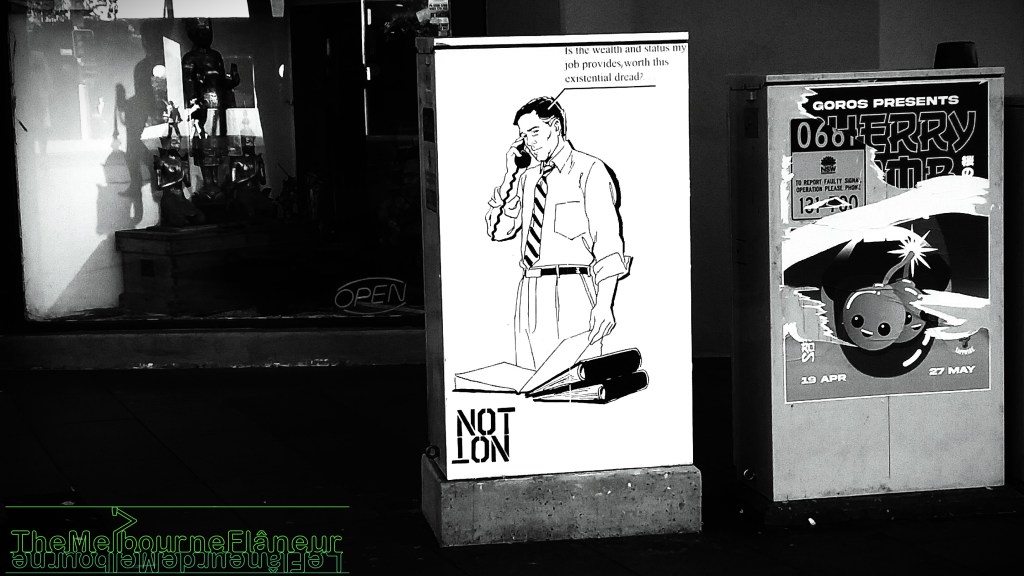
Today on The Melbourne Flâneur I publish my first ‘amplified flânograph’ in quite a while—one of those photographs, taken in the course of mes flâneries, which later inspire something in me—a prose poem, a capsule essay or a ficción—and to which I add the third dimension of an evocative soundscape.
I photographed this signal box one weekday morning in May. I was coming out of the post office at the head of Oxford Street, annual runway for Sydney’s world-famous Gay and Lesbian Mardi Gras, and as I was crossing the street to get to Hyde Park, juggling my shipment of a brand new product—(more on that to come, chers lecteurs)—I was struck by this traffic signal box, one of three, looming towards me from the opposite sidewalk.
Despite having my arms full and nothing but my phone on me, I had to get a shot, sensing, ‘détective des belles choses’ that I am, that there was a clue for me in the message graphed on the side of this signal box.
I was not wrong.
“The Price”, the short story that eventually emerged two months later out of the image above, is an example of one of my literary crime ficciones, what I am calling the ‘nouvelle démeublée noire’—literally, the ‘unfurnished dark short story’.
Basically, the concept of the nouvelle démeublée I’m pioneering is a synthesis of the principles of the French Nouveau Roman (or ‘New Novel’) combined with Willa Cather’s notion of a ‘novel démeublé’ or ‘unfurnished’ novel.
Whatever is felt upon the page without being specifically named there—that, it seems to me, is created. It is the inexplicable presence of the thing not named, of the over-tone divined by the ear but not heard by it, the verbal mood, the emotional aura of the fact or the thing or the deed, that gives high quality to the novel or the drama, as well as to poetry itself.
—Willa Cather, “The Novel Démeublé”, The New Republic (April 12, 1922)
Though I am writing with respect to the French Nouveau Roman, I call these ‘unfurnished’ pieces in which something unsaid is nevertheless felt by the reader as a mood of ambiguity nouvelles démeublées because nouvelles nouvelles (literally, ‘new short stories’) just doesn’t make sense in French.
Last year, French literature celebrated the hundredth anniversary of the birth of Alain Robbe-Grillet, whose violently abstracted and anti-human style I take as my guiding light in the composition of these pieces, while 2023 marks the seventieth anniversary of a landmark event in modern letters: the first publication of a Robbe-Grillet novel, Les Gommes (The Erasers, 1953).
It’s difficult to convey what a scandal Les Gommes represented, first in French literature, then in English, as Robbe-Grillet’s literary influence as the ‘chef d’école’ of the Nouveau Roman was absorbed into Anglophonic culture—particularly in the U.S., where he enjoyed some celebrity as an avant-garde novelist and filmmaker in the sixties.
The apparition of Robbe-Grillet on the literary scene in 1953 represented the emergence of a literary pill that was particularly bitter and difficult to digest even for the most ‘modern’ sensibilities, and the publication of Les Gommes is one of those red-letter moments in twentieth-century history where a writer definitively crosses a boundary of taste that was previously believed to be uncrossable.
While Borges flirts with postmodernism in the thirties and forties, dancing on the threshold of it, it is Robbe-Grillet, in Les Gommes, who boldly and definitively steps through that portal into a vertiginous realm of infinite ambiguity and uncertainty, of radical scepticism and doubt.
Where Joyce’s Ulysses (1922) marks the frontier of modernism, the line in the sand after which nothing can be written that isn’t fundamentally ‘modern’ in its sensibility and style, Les Gommes marks the red line of postmodernism, a definite break with the modern tradition; and after its publication in 1953, we cannot ‘unsee’ the world as Robbe-Grillet shows it to us in that novel—as inhuman as his vision is to many readers, and as much as literature has sought to beat a cowardly retreat from the frontier of the Nouveau Roman he leads us up to.
Les Gommes owes a substantial debt to Ulysses: like Joyce’s novel, it transpires over the course of 24 hours, and like Ulysses, there is an archetypal mythic structure buried in Les Gommes. But where Joyce takes Homer’s Odyssey as the structural basis for Leopold Bloom’s flânerie around Dublin on June 16, 1904, Robbe-Grillet turns instead to Sophocles and the archetypal detective story of Western literature—Œdipus Rex.
For Les Gommes is a kind of ‘existential detective thriller’. Its protagonist is Wallas, a detective (an ‘agent spécial’ as we are continually reminded) assigned to the investigative bureau attached to the Ministry of the Interior—a secret policeman, in other words.
Wallas has been dispatched to an unnamed northern port city to investigate a political assassination, the murder of Daniel Dupont, a professor of economics, by a shadowy anarchist organization which has been waging a campaign of terror: Every night for the past week, at exactly 7:30 p.m., a member of the Deep State cadre to which Dupont belongs has been murdered.
Arriving late at night, just hours after the assassination, Wallas takes a room for the night at the Café des Alliés, a suburban bistro right next door to the victim’s home at the corner of the rue des Arpenteurs and the Boulevard Circulaire which girds the inner city. At the point where Robbe-Grillet takes up the syuzhet, it’s dawn on the morning after the shooting.
Il s’agit d’un événement précis, concret, essentiel : la mort d’un homme. C’est un événement à caractère policier—c’est-à-dire qu’il y a un assassin, un détective, une victime. En un sens, leurs rôles sont même respectés : l’assassin tire sur la victime, le détective résout la question, le victime meurt. Mais les relations qui les lient ne sont pas aussi simples qu’une fois le dernier chapitre terminé. Car le livre est justement le récit des vingt-quatre heures qui s’écoulent entre ce coup de pistolet et cette mort, le temps que la balle a mis pour parcourir trois ou quatre mètres—vingt-quatre heures « en trop ».
The novel is about an event that is precise, concrete, essential: a man’s death. It’s a typical mystery story incident—which is to say that there’s an assassin, a detective, and a victim. In a sense, even their rôles remain the same: the assassin shoots the victim, the detective solves the riddle, and the victim dies. But the relations which unite them are not quite that simple after you’ve read the last chapter. For the book is precisely the tale of 24 hours which pass between the shot being fired and the death, the time it takes for the bullet to travel three or four metres—24 additional hours.
—Alain Robbe-Grillet (my translation)
We know right from the prologue who the shooter is: It’s Garinati, a hired gun who is as incompetent to kill Daniel Dupont as Wallas is to solve Dupont’s murder—although admittedly, in Wallas’s defence, it is rarely the case in a mystery story that a detective is sent to investigate a murder that hasn’t actually happened.
For here too Robbe-Grillet yanks out the mystery, if not the suspense, right at the beginning of the book: Yes, Garinati has snuck into Dupont’s office and shot him, but the wound is only superficial. Despite the papers’ claim that the assassin shot the professor in the chest, Garinati is pretty sure he only got Dupont in the arm. It is Dupont, hiding out in the clinic of Dr. Juard, a shady gynæcologist, who has faked his own death so as to buy 24 hours—the time he needs to sneak back into his villa, grab some important documents, and amscray to the capital.
Thus there is a décalage, a ‘slippage’ in the traditional rôles of these three characters which is equally a lag in time: like Wallas’s stopped watch—stopped, coincidentally, at 7:30 p.m.—Robbe-Grillet has thrust a stick through the spokes of Les Gommes’ cyclical plot, and for 24 hours, the clockwork of the traditional detective story plot labours vainly against that resistance, struggling to advance, until the characters rotate, through a series of interstitial or extra-temporal changes, into their final positions and the generic narrative machinery can start ticking over again.
Robbe-Grillet says that Wallas ‘solves the riddle’, putting particular emphasis on the detective’s traditional rôle, but that’s not really the case. It’s Laurent, the police commissioner out of whose busy hands the case is removed early on, who works out, by a process of logical ratiocination, why the evidence fails to add up.
Rather, in his Œdipal rôle, it is the riddle that solves Wallas—and this is what I mean when I say that Les Gommes is an ‘existential’ detective thriller: our ‘agent spécial’ from the Bureau des Enquêtes is on a mission both epistemological and ontological—a quest in search of himself.
Quête/enquête—quest and investigation: If Wallas fails to solve a mystery twisted enough to riddle a sphinx, it’s because the agent spécial’s rôle in proceedings is purely flâneurial rather than inquisitive.
Right from the third sentence of Chapter 1, in introducing our sleuth, Robbe-Grillet tells us that Wallas has an ‘apparence de flâneur’, that he’s dressed rather nattily for the working-class faubourg of the rue des Arpenteurs, and that he lounges with a certain leisure that makes him a subject of surprise—and even of shock—for the workers making their way to the port.
Thus our ‘agent spécial’, who will spend most of the day exploring the city on foot, going into cafés and automats and ducking into stationer’s shops, is really in town to do something other than collar a killer. He’s an agent of fate.
Œdipus (whose name literally translates as ‘Swollen Foot’) is the first flatfoot, the first gumshoe in Western literature; to him is given the fateful (and fatal) rôle of solving the primal mystery to ‘Know Thyself’.
He’s a tragic detective. Where Joyce chooses another wanderer, Odysseus, ‘the master craftsman of crime’, as his archetype for Mr. Bloom, restoring the classical hero to the humble stature of a man, with Wallas, Robbe-Grillet does not elevate the man to the super-heroic level of the ‘Great Detective’. Wallas, whose ‘pieds sont enflés à force de marcher’ by the dawn of the following day from his traipsings around town, is not a figure who inspires great confidence.
He’s a poor Œdipus, a poor solver of riddles, and as a wanderer through the circular labyrinth of the unfamiliar city, his rôle is purely flâneurial. Rue des Arpenteurs, rue Joseph-Janeck, rue de Brabant, rue de Berlin… this man with swollen feet is condemned to trudge through a salience landscape he increasingly has little heart for, finding himself continually at crossroads with oblique turnings, drawbridges that are raised before him, and on tramways which lead him away from where he actually wants to go.
(It’s no coincidence that the street spoking off the Boulevard Circulaire which leads Wallas to his fate is called the rue des Arpenteurs: arpenter is ‘to pace back and forth’, in the manner of a surveyor, and Wallas spends a great deal of time walking up and down this unprepossessing street, surveying it.)
The pauvre petit bonhomme is such an incompetent detective that he cannot even find his ideal eraser—a quest tangential and incidental to the plot but one which overtakes Wallas’s ostensible mission the more he is diverted and discouraged by his failing to get effectively on the trail of Garinati—who, bizarrely, is trying to catch up with the detective in order to discover if he actually did kill Dupont.
As Alain-Michel Boyer says in his journal article “L’Énigme, l’enquête et la quête du récit: La fiction policière dans Les Gommes et Le Voyeur d’Alain Robbe-Grillet” (1981), right from the beginning, rather than leading his case, Wallas is led by it: he ‘gums up the works’, seeming to gain less impetus as he proceeds, and finds himself continually effaced in his quest to discover who rubbed out Dupont—for, strangely, every piece of evidence, every eye-witness testimony points to a shooter who resembles Wallas himself.
The question quite legitimately arises in the reader’s mind as to why Wallas is actually there since he has so little will for the work, is too self-effacing to question witnesses, treats his urgent mission almost as a pleasure trip, and only really seems motivated to inquire about the eraser he is desperate to buy in every stationer’s shop he comes to.
Much has been made about the significance of the objects accruing in Wallas’ pocket which give Les Gommes its title. An object that is insignificant to the plot becomes the obsessional lapis of all meaning.
Bruce Morrissette, Robbe-Grillet’s evangelist to the Anglophonic world, was the first to suggest that the half-erased brand name printed on the rubber was either Œdipe or Œdipus.
Spoken together, however, the remaining letters D and I sound in French like ‘dé’—the first syllable of the Latin deus. Of course, Œdipus solved a riddle in which the life of man was equated with a day, and our ‘agent spécial’ has been sent to the city to ‘accomplir son œuvre d’inéluctible justice’—something that might be said of an instrument of God on a ‘Day of Judgment’.
But equally, the unusual cubic form of this particular eraser suggests a dé—a die, reminding me of Cæsar’s fateful remark at the Rubicon: ‘The die is cast’ (Alea iacta est).
Though Morrissette is doubtless right, the alternative symbolic interpretations I suggest merely go to prove Robbe-Grillet’s later point that ‘no sooner does one describe an empty corridor than metaphysics comes rushing headlong into it.’
I’m not wedded to either of these interpretations, which disgust me only slightly less than Morrissette’s: any symbolic interpretation of the erasers is ‘on the nose’.
Though it’s probably not the case in this novel so over-determined with occult meaning (that, I think is Les Gommes’ weakness as compared to Robbe-Grillet’s work from La Jalousie [1957] onwards), I would prefer to think, in the spirit of the author’s later work, that there is no significance to the erasers at all—that they are merely there.
We live in an over-determined world where everything may be interpreted indexically as a clue. ‘Le Nouveau Roman, c’est le roman policier pris au sérieux’—‘The New Novel is the crime novel taken seriously,’ Ludovic Janvier stated. This is to say that the Nouveaux Romanciers—particularly Robbe-Grillet—were involved in a sensemaking enterprise.
As Boyer concludes in his 1981 article, paraphrasing Nietzsche, with the Robbe-Grilletian Nouveau Roman, the crime novel fundamentally ‘becomes what it is’—a first-principles, scientific attempt to describe—and thus make some preliminary sense—of a puzzling world from which we have become radically decoupled, and where the report of our own senses must now be taken with scepticism.
… [É]tant donné que le crime est la condition sine qua non du récit de l’enquête, l’enquête est la mise à jour du récit du crime, le récit du récit. … L’enquête, chez Robbe-Grillet, vise en revanche à substituer, au récit d’un crime et d’une enquête sur ce crime, l’histoire même de ce récit. Elle est la quête d’un roman. …
Meurtre ou rapt, la situation initiale de tout roman policier est un manque. Il s’agit donc non seulement de transformer l’énigme en récit, mais de circonscrire ce manque, et de le combler. De sorte que le travail de l’écriture et celui du détective sont une lutte contre le silence des objets et le mensonge ou le mutisme des personnages. L’indicible devient question, puis langage. Qui a tué? ou Pourquoi a-t-on tué? ne sont les interrogations essentielles, mais plutôt: comment peut-on faire de cet événement prétexte—mort d’un homme—un récit? Et la question, comment écrire le crime? s’ouvre alors à une autre question, plus énigmatique encore: comment écrire?
Given that crime is the indispensable condition of the account of the investigation, the investigation is the bringing to light of the account of the crime, the account of the account. … On the other hand, Robbe-Grillet’s literary inquiry aims to substitute, in place of the account of a crime and the investigation into this crime, the very story of this account. It is the ‘quest for a novel’. …
Whether it’s a murder or an abduction, the initial situation of all crime novels is an absence. It is thus a question not only of transforming the enigma into an account, but to circumscribe this absence, and to fill it in, such that the work of writing and that of the detective are a struggle against the silence of objects and the characters’ lies or their refusal to speak. The unsayable becomes a question, hence, language. Who is the killer? or Why have they killed? are not the essential questions, but rather: How does one of make of this pretextual incident—a man’s death—an account? And the question, How to write the crime? then opens itself up to another, more enigmatic query: How to write?
—Alain-Michel Boyer, “L’Énigme, l’enquête et la quête du récit: La fiction policière dans Les Gommes et Le Voyeur d’Alain Robbe-Grillet” (1981, pp. 81-2 [my translation])
Given an initial void in knowledge, working backwards from that absence, the writer of literary crime fiction, if he is as intellectually honest as Robbe-Grillet, as determined to start from a place of first principles and to eschew the pathetic fallacy of humanistic magical thinking, is eventually led to ask himself: ‘What is it to write?’, or ‘What is writing?’
By playing with the generic elements of para-literature in a postmodern way, Robbe-Grillet constructs a meta-narrative out of the detective genre in Les Gommes, one which contains the generic elements and deals with the essential epistemological question of the form:—‘What is it to know?’
Footsore and weary from his flânerie, at the end of Les Gommes, Wallas comes eventually to know himself in a startling twist of his traditional rôle: Unlike Œdipus, who puts his own eyes out when he discovers who he really is, the murderer of his father and the husband of his mother, Wallas becomes suddenly ‘unblinded’ when he recognizes himself as the man he has been searching fruitlessly for all throughout the day.
Thus Robbe-Grillet shows us that there is a fundamental ontology—a beingness—to the detective’s fundamentally epistemological rôle as a ‘special agent’ in society, as one charged ‘to know’.
And for a dandiacal literary flâneur like myself, the détective des belles choses, the chasseur after beauty who is ever on the hunt for the æsthetic frisson of ‘the marvellous’, the most vivified being lies in knowing, as a city like Sydney, as hellishly labyrinthine as the unnamed harbour city of Les Gommes, gives up clues to the mystery I am writing about in images like those above.
“The Price” is the first audio track I’ve created using assets I’ve recorded myself ‘on location’, recreating Steve’s and Lance’s flânerie down—and across—Oxford Street after midday on a weekday afternoon, like a Method actor getting into the ‘rôles’ of the two characters I’ve created as a writer.
And it’s the first piece I’m officially publishing as a ficción adjacent to the story-world of the literary crime podcast I’ve been plotting since the second Melbourne lockdown, and which is now slowly moving into production—an existential detective thriller which I describe as something like a series such as Mad Men (of which Clive James said that ‘what sounds at first like a quick thriller by Raymond Chandler threatens to turn into a slow novel by Henry James’) meeting a David Lynch movie—I’m thinking of something like Blue Velvet or Mulholland Dr.—with this weird and unholy progeny being set on the streets of Melbourne.
“The Price” will give you some idea of the Jamesian/Robbe-Grilletian literary style I’ve developed for the series over the last three years. If you’re intrigued to hear the podcast, the best way you can support production of the project is to drop $A2 on the audio track below—or click the Share link to re-post it on your social media and help me to build a prospective audience for it.
 deankyte.com