
The spaces of cinematic and literary noir have their roots in the supernatural vision of Poe. In this video essay, Dean Kyte reads a thoughtful, lyrical passage from Patricia Highsmith’s Strangers on a Train (1950).

He was staying at the Hotel Montecarlo, about ten blocks from the Hotel Ritz, a great shabby building that looked like the former residence of a military general. One entered it through a wide carriage drive, paved in black and white tile like a bathroom floor. This gave into a huge dark lobby, also tile floored. There was a grotto-like bar-room and a restaurant that was always empty. Stained marble stairs wound around the patio, and going up behind the bellhop yesterday, Guy had seen, through open doorways and windows, a Japanese couple playing cards, a woman kneeling at prayer, people writing letters at tables or merely standing with a strange air of captivity. A masculine gloom and an untraceable promise of the supernatural oppressed the whole place, and Guy had liked it instantly, though the Faulkners, including Anne, chaffed him about his choice.

His cheap little room in a back corner was crammed with pink and brown painted furniture, had a bed like a fallen cake, and a bath down the hall. Somewhere down in the patio, water dripped continuously, and the sporadic flush of toilets sounded torrential.

When he got back from the Ritz, Guy deposited his wristwatch, a present from Anne, on the pink bed table, and his billfold and keys on the scratched brown bureau, as he might have done at home. He felt very content as he got into bed with his Mexican newspaper and a book on English architecture that he had found at the Alameda book-store that afternoon. After a second plunge at the Spanish, he leaned his head back against the pillow and gazed at the offensive room, listened to the little ratlike sounds of human activity from all parts of the building. What was it that he liked, he wondered. To immerse himself in ugly, uncomfortable, undignified living so that he gained new power to fight it in his work? Or was it a sense of hiding from Miriam? He would be harder to find here than at the Ritz.

—Patricia Highsmith, Strangers on a Train (1950, pp. 50-1)

As un adhérent du Nouveau Roman who has decentred characters from his narratives and made architecture their star, I was delighted when I read the passage above in Patricia Highsmith’s Strangers on a Train (1950) last year.

Though a little purple round their edges—(as stained, perhaps, as the place they describe)—I nevertheless felt, for three paragraphs, almost as if I were reading one of my own ficciones intercalated into Highsmith’s literary crime novel.

In those three paragraphs, Patricia Highsmith imagines—fully a dozen years before Resnais and Robbe-Grillet—Marienbad, albeit she sites that labyrinthine hôtel onirique en Mexique, the land loved by the surrealists.

Strangers on a Train is a young novelist’s book: the brushwork is a little loose, the colour a little too chromatic. Highsmith is not yet in possession of the tight, Jamesian command of character and moral situation she will evince but half a decade later in The Talented Mr. Ripley (1955). Yet more so than in that book (which the Library of America chose to include as a representative example in its collection Crime Novels: American Noir of the 1950s), Strangers on a Train is definitely a roman noir.

And, as a mere slip of a girl at thirty, Highsmith had at least written a novel which could command the attention of Hitchcock.

A couple of months ago in Melbourne, I saw Hitchcock’s 1951 adaptation of Strangers on a Train in what I’m sure must have been the first time in over twenty years. It was the second half in a double-bill that included North by Northwest (1959)—(can you believe seeing those two together on the big screen in one night?)—and whereas I knew every line and shot of the first film by heart, Strangers on a Train had slumbered so long in my memory that it was virtually like seeing it fresh.

Like Highsmith’s novel, technically I was surprised to find the film a little slipshod for Hitch: he has a matte photograph of Washington’s Capitol that manages to jump three times in a single setup; he relies a little too heavily on ill-matching stock footage for the tennis match, and the pro doubling for Farley Granger can’t possibly be mistaken for him at a distance.

But I walked out of that double feature into a dark, rainy, prematurely chill midnight in Carlton pulling my trenchcoat more tightly about me and thinking that, if a legitimate case can be made for any of Alfred Hitchcock’s films as being ‘noir’, then surely Strangers on a Train is at least as viable a contender as the oft-proposed Shadow of a Doubt (1943).

The Highsmith/Hitchcock intersection points to something fundamental about this vaporous thing called ‘noir’: both the novelist and the cinéaste are moralists in the domain of crime fiction, tellers of ‘moral tales’, though the telling of such contes moraux comes more naturally to the writer than to the filmmaker, who must principally convey his moral tone visually rather than by means of language.

There’s a whole tedious chapter (if memory serves) of Notre-Dame de Paris (1831) in which Victor Hugo bangs on with his usual exhausting gusto about the architecture of the eponymous Parisian cathedral, sententiously arguing for it as a veritable ‘bible in stone’ whose every arch and capital is a letter in its visual language.

Film noir is primarily a ‘tonal’ quality of the cinematic treatment of those things in actuality which must serve the filmmaker as his alphabet—the streets, the buildings, the people, their fashions and conveyances, of modernity.

As an historical phenomenon, film noir was an æsthetic movement in the visual treatment of actuality, a distinctly expressionistic inflection of cinema’s native tendency towards realism.

As a stylistic movement proper to the artistic medium of film rather than a literary genre, film noir was, therefore, a set of ‘visual strategies’ for treating urban modernity that encompass all aspects of the cinematic apparatus but principally those native to the medium—lighting, camerawork, mise-en-scène and montage.

Film noir was an æsthetic portfolio of techniques for subjectively inflecting the image of built space, and as such, it produces an impression of ‘hyper-reality’, and thus a mood of ‘dis-ease’ in the viewer as he encounters a form of the ‘uncanny valley’ in the anthropocentric environment of the modern city.

The image of the city, this social environment built by humans ostensibly for humans—but which actually serves to alienate human beings precisely because of its ‘over-humanness’, its continual reference to anthropocentric concerns—becomes unsettlingly ambiguous in film noir.

As a tonal mood to depictions of the city, the affective character of film noir suggests an uncanny ‘doubleness’ to the faces which the spaces of modern actuality present to us when they are reduced to pure, geometric, architectonic forms by black-and-white cinematography.

… [O]blique and vertical lines are preferred to horizontal. Obliquity adheres to the choreography of the city, and is in direct opposition to the horizontal American tradition…. Oblique lines tend to splinter a screen, making it restless and unstable. Light enters the dingy rooms of film noir in such odd shapes—jagged trapezoids, obtuse triangles, vertical slits—that one suspects the windows were cut out with a pen-knife. No character can speak authoritatively from a space which is being continually cut into ribbons of light.

—Paul Schrader, “Notes on Film Noir”, Film Comment, (Spring, 1972, p. 11)

Richard W. Allen, drawing on the thinking of André Bazin, states in his article “The Aesthetic Experience of Modernity: Benjamin, Adorno, and Contemporary Film Theory” (1987) that ‘film is essentially a non-intentional medium’ (my emphasis);—that, all things being equal, if the filmed image is not too heavily inflected, its reproduction of actuality produces in the viewer an impression of realism.

I say ‘realism’ because a totally uninflected image—one that is Newtonianly objective, which does not assume the position of a limited, subjective observer—is presently impossible to us. That’s still one of the charming limits of the artistic medium of cinema: a filmed image partakes of the ‘genre’ of realism without ever attaining the objective reality of which it gives the viewer a convincing impression.

In this sense, at its least inflected, even a documentary film may be as much a work of ‘realism’ as a novel by Zola—and fall as far short of a purely scientific description of actuality as his pretenses to ‘objectivity’ through the literary medium of long-form fiction.

But what forcibly struck the French-Italian critic Nino Frank in the article where he coined the term ‘film noir’ to describe a certain genre of American policier was precisely this vigorous impression of a ‘new realism’—a ‘neorealismo’, if you will—in these wartime thrillers, detective stories for the most part, but also reverse-engineered stories—like Double Indemnity (1944)—in which ordinary men and women lured into committing crime played the starring rôles rather than the sleuth uncovering their guilt.

Ainsi ces films « noirs » n’ont-ils plus rien de commun avec les bandes policières du type habituel. Récits nettement psychologiques, l’action, violente ou mouvementée, y importe moins que les visages, les comportements, les paroles – donc la vérité des personnages, cette « troisième dimension » …. Et c’est un gros progrès : après les films comme ceux-ci, les personnages des bandes policières usuelles ont l’air de fantoches. Or il n’est rien à quoi le spectateur d’aujourd’hui soit plus sensible qu’à cette empreinte de la vie, du « vécu », et, pourquoi pas, à certaines atrocités qui existent effectivement et qu’il n’a jamais servi à rien d’occulter ; la lutte pour la vie n’est pas une invention actuelle.

Thus these ‘dark’ movies have nothing in common with the usual kind of detective yarns. Distinctly psychological stories, action, in these films, whether violent or frenetic, is less important than the faces, behaviours, words—hence, the truth of these characters, that ‘third dimension’…. And this is a major step forward: after movies like these, characters in the usual detective stories appear insubstantial. Now, there is nothing towards which today’s filmgoer might be more sensitive than this trace of life, of ‘life as it is lived’, and—why not?—towards certain atrocities that actually exist, and which it has never done any good at all to hide: The struggle for life is not a current invention.

—Nino Frank, “Un nouveau genre policier : l’aventure criminelle”, L’Écran français (August 1946 [my translation])

Frank was writing two years to the month after the Liberation of Paris, and ‘life as it is lived’ during what the French call ‘les années noires’ of the Nazi Occupation had certainly been dark and full of ‘certain atrocities’.

Just as, for the Italians, the dying months of Nazi Occupation give fruitful birth to a ‘new realism’ in cinema that trenchantly refuses to hide those ‘certain atrocities’ which actually exist in the struggle for life, so for the French, more keyed to the existential implications of the crime genre, film noir, as a stylistic inflection of generic thriller material, adds a ‘third dimension’ to cinema—that of the moral psychology of crime.

By German Expressionism out of French Poetic Realism, film noir is a set of visual strategies that forcibly inflect with psychological subjectivity the ‘objective’ image photographed by this non-intentional artistic medium: the architectonic shapes and spaces of urban modernity become effective ‘crime scenes’, freighted with desire, rage, melancholy and dread.

As Paul Schrader outlines in “Notes on Film Noir”, how the spaces of urban modernity are lit, the time of day at which they are photographed, whether the setting is given as much compositional emphasis as the actors, and how active a rôle the cinematic apparatus plays in advancing the narrative determines to what extent the image of actuality photographed is inflected with a moral character we call, after the French wartime experience of doubleness and ambiguity in the places of modernity, ‘noir’.

Carl Plantinga goes a great distance towards staking out the conceptual terrain of what constitutes a tonal ‘mood’, or what he calls an ‘affective character’, in film, art, and literature, taking Orson Welles’ Touch of Evil (1958) as his particular example in “Art Moods and Human Moods in Narrative Cinema” (2012).

Building on the work of Greg M. Smith, Plantinga argues that the plot-based ‘events’ in both literary and cinematic narratives (as, for instance, in both Highsmith’s and Hitchcock’s respective versions of Strangers on a Train) are clothed and cloaked in ‘an affective experience that permeates the fictional world of the work.’

Plantinga argues that this enveloping ‘mood’ of a given film ‘is something like its affective “character”,’ and that, to use his example, ‘[i]n Touch of Evil we could describe this [mood] as dark, foreboding, anxious, and unbalanced.’

As per Schrader’s iconographic summary of film noir stylistics, a preponderant percentage of scenes in Touch of Evil are shot in low light, at nighttime or in sombre interiors, with light sources stabbing stark rays into the frame from outré angles. Certainly, the baroque emphasis on the built environment of the Mexican border-town is given as much visual prominence as the actors. And, from the very first and famous shot crossing the frontier, Welles actively employs the cinematic apparatus to drive the moral tale he has to tell forward.

As Plantinga puts it, in a film noir like Touch of Evil (which he says is particularly effective at conveying its global mood of dread, anxiety and unbalance), the form of the film as much as its visual content is charged with an affective character whose essential qualia we might call ‘noir’.

… [T]he film noir may set the scene in a city late at night, the empty streets deserted and the rain falling, a few figures huddled in isolated doorways—all suggestive of darkness, wetness, coldness, and loneliness. On the soundtrack are the strains of melancholy music, together with the faint sounds of a quarreling couple in some nearby apartment.

—Carl Plantinga, “Art Moods and Narrative Moods in Narrative Cinema” (2012, p. 465)

In film noir, the visual ‘content’ of urban architectural forms—buildings, streets, doorways, apartments—undergo an epiphanic formal treatment. The qualities of darkness, emptiness, wetness, coldness and loneliness described by Plantinga in this imaginary example—not to mention the muted sound of anger—cloak the city in a shroud—but it’s a glamorous shroud.

In this epiphanic formal treatment, this intentional subjective inflection of visual content that carries no affective character in itself, the images of cities and the typical structures within them are glamorized by the cinematic apparatus, bringing out a supposed ‘poetic realism’ immanent in these objective structures, their implicit ‘photogénie’, their ‘sexy’ appeal to the camera’s non-intentional eye.

It’s arguable that what Frank was responding to in 1946 as a new realism in Hollywood crime dramas was in fact a ‘hyper-reality’ that the cinematic apparatus, with glamorizing intentionality, was painting on the banal visual content of actuality.

As I demonstrate in the video essay at the top of this post, somehow the hour of the day, the tightness of the aperture, the least inflection one can give to a photographed image of actuality in what was simply intended as a background for a Mexico City driving shot;—somehow all this plus the intrinsic, reductive beauty of black-and-white as an æsthetic limitation and inflection of reality works together to make even the most banal image of city streets and buildings ‘noir’.


On a personal note, your Melbourne Flâneur joined the new social medium AirChat this week and he’s loving it. Here’s a link to my feed:

https://www.air.chat/themelbflaneur

I’ve been very resistant to social media and I’m typically glacial in the speed of my take-up when it comes to new technologies, but when I heard about AirChat, I jumped on it. After twenty years of standing on the sidelines watching the other kids play, I think this is social medium I’ve been waiting for.

So far, AirChat gives evidence of being the perfect social medium for a writer to rehearse his ideas in public. I’ve been putting the voice-to-text AI through its paces by reading aloud daily drafts of a new short story I’m working on, and as you can see in the quick and dirty video below, the AI accurately renders complex sentences featuring a technical vocabulary of architectural and mathematical terms which (according to the OED) are typically not among the most frequently used words in English.

Dean Kyte has joined AirChat and he thinks it’s going to be a game-changer for introverted writers seeking a viable social medium with which to communicate their words to a primarily oral, rather than literate, audience.

I also find that it copes with my slippages into French and Italian pretty well, often correcting itself when it mistakes a foreign word for one that sounds similar in English. It seems to search the Internet for self-corrections: in an exchange with Naval Ravikant where I invoked the name of Carlo Gozzi, the AI subsequently fixed up its initial misrendering of ‘gotsy’ based on the context of my voice note—what is called a ‘chit’ on AirChat.

In addition to giving the good folk on AirChat a daily earful of what I have been writing in the mornings, I’ve also posted a few random thoughts throughout the day based on the notes I’ve taken from my readings in researching this article.

So if you would like to interact with your Melbourne Flâneur, take vicarious, asynchronous part in my flâneries, or perhaps listen in or contribute yourself to some of the generative intellectual conversations that are happening on AirChat, I invite you to follow me @themelbflaneur.
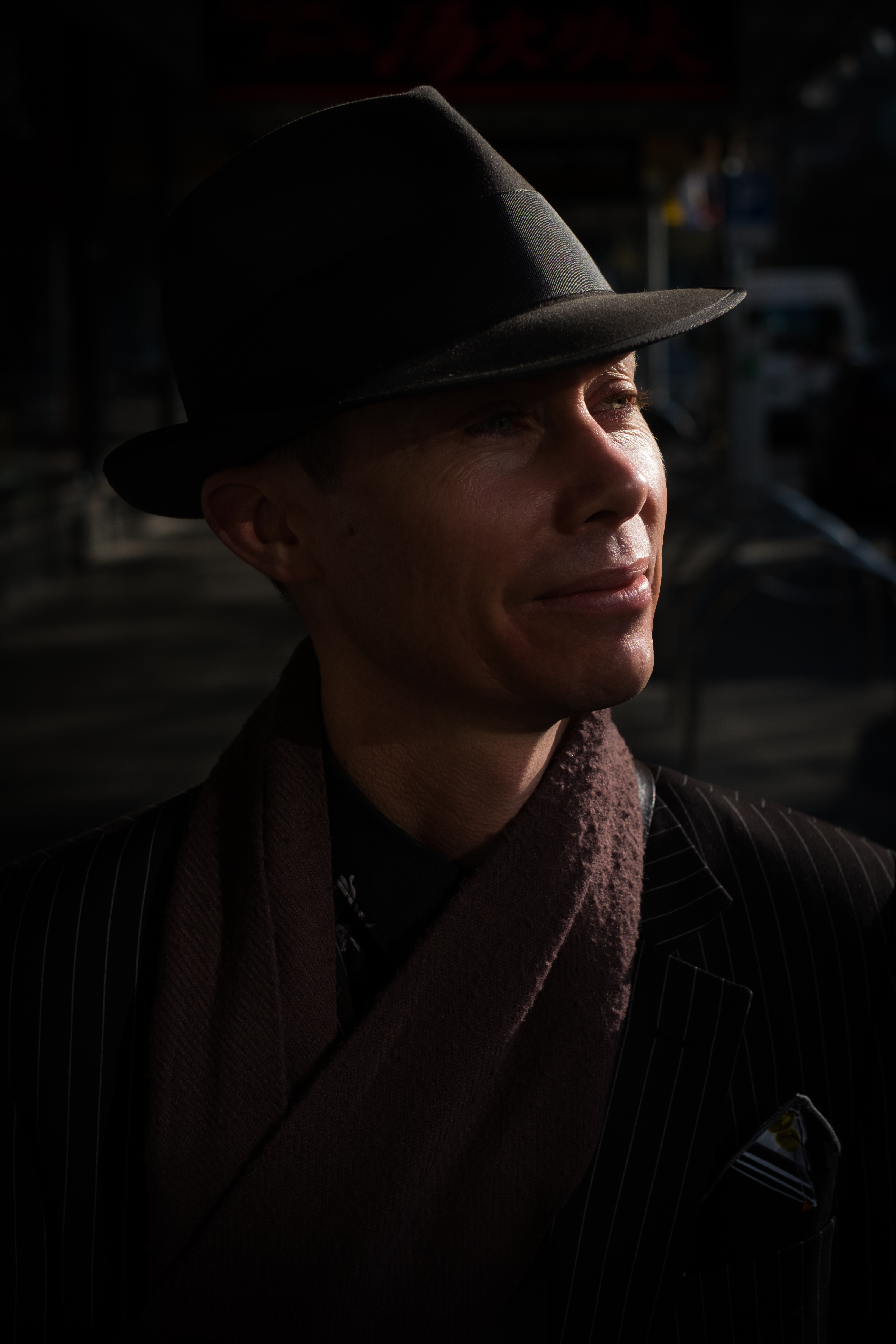
Dean Kyte, as photographed by Alfonso Perez (@alfonsoperezphotography on Instagram).
Hors des ombres: Portrait of Dean Kyte, photographed by Alfonso Perez de Velasco.

Being a Daygamer myself (albeit one who considers himself ‘retired’ from the Game), your Melbourne Flâneur is a very tough cookie to crack: knowing every trick and technique for stopping a stranger in the street, you can’t arrest the flow of my flânerie if I don’t want to stop for you.

But photographer Alfonso Perez de Velasco (@alfonsoperezphotography on Instagram), ‘loitering with intent’ near the corner of Lonsdale street, caught me on a good day as I sailed confidently down Elizabeth street, and I couldn’t turn down his sincere and complimentary request to snap a portrait of me, the photo you see above.

It’s perhaps too much of a cliché to say that this talented Madrileño now living and working in Melbourne has painted me in a typically Spanish light, with shades of Ribera about me, but I think he’s captured something essential about your sombre, sombrero’d scribe, that blend of light and dark inside a single look which is eminently Goyesque.

With my humour and melancholy, my Machiavellianism and my empathy, I am nothing if not contradictory, and I think Alfonso captures that ambiguity nicely.

It’s a handsome portrait, and very much in keeping with the moody Melbourne style of Alfonso’s street scenes, which really resonate with me. Though he works in muted colour, if you check out his photos on Instagram, I think you will agree there’s a certain similarity with my own black-and-white flânographs around town.

I was feeling ‘everything plus’ that day, all suited up and sharp enough to shave with as I recovered my mantle as a man about town.

As you can just make out in the photograph, I had my chalk-stripe, slightly zootish, suit on—what I call my ‘Big Sleep suit’. It’s my take on that handsome double-breasted chalk-stripe suit that Bogart sports in The Big Sleep (1946) while he’s flirting outrageously with Lauren Bacall.

I was wearing a black shirt with a grey-and-white floral pattern, dark silver tie, black display kerchief with grey Martini glasses on it (courtesy of Fine And Dandy and Brisbane Hatters), and a dark grey vintage Stetson Whippet to cap the ensemble. The slightly clashing touch of chocolate-coloured scarf and gloves was my only concession to the tardy onset of the Melbourne winter. I had my Dunn & Co. trenchcoat slung casually over my Czechoslovakian officer’s map-case, which serves as a stylish satchel for porting my tablet.

I was everything the well-dressed writer-about-town ought to be.

I wasn’t, as Raymond Chandler says, ‘calling on four million dollars’—(tant pis)—but I was just about to call on Elite Office Machines Co. in Carlton to pick up my freshly serviced Silver Reed typewriter.

So I was feeling O.K. that day.

Dean Kyte, as photographed by Alfonso Perez (@alfonsoperezphotography on Instagram).
Light and dark inside a single look: Humorous and melancholic, Machiavellian and empathetic, writers are ambiguous characters.

During lockdown, I had a chance to catch up on some reading, and one of the books that came my way was Jocks and Nerds: Men’s Style in the Twentieth Century (1989), by Richard Martin and Harold Koda. It was written at the tail end of the ‘Greed is Good’ eighties, so there’s a touch of quaintness about the authors’ commentary: though acknowledging that standards have slipped since the 1960s, Messrs. Martin and Koda have no clue as to how far they will descend in the thirty years up to the present day.

Their thesis is simple yet compelling: ‘We believe that men are knowing in making choices among style options, and that they dress to create or recreate social roles. Both men and women seek to realize roles and identities, but since men’s options in dress would appear to be the more acutely restricted, perhaps selecting a role has assumed more importance for them than it has for women. A man’s role is his operative identity; style choices follow therefrom.’

I like the phrase ‘operative identity’, for it points to the fundamental ‘uniformity’ of men’s style, the basis of almost every garment in the masculine wardrobe in an historical military analogue.

Indeed, Martin and Koda identify twelve such ‘operative identities’ that we men tend to take on as the social rôles by which we choose to be known, and their book is arranged in an ascending hierarchy of these ‘types’, from the ‘Jocks’ and ‘Nerds’ of the title, through the ‘Military Man’, ‘Hunter’ and ‘Sportsman’, up to the ‘Businessman’, ‘Man about Town’ and ‘Dandy’.

The argument seems true that, due to the mobility of action that is the masculine prerogative, at a certain point early in a man’s life, he chooses the rôle that he is going to play, the branch of ‘the Services’ he is going to go into.

Is he going to be a soldier? a blue-collar worker? a white-collar worker? a professor? There’s a ‘uniform’ for every métier that men undertake, and even the most récherché uniform, that of a literary dandy like yours truly, is thoroughly—albeit subtly—based in a military antecedent.

Martin and Koda go on to say: ‘Conventional wisdom has it that men dress to be conventional, but those with insight into male dress might hold that men dress to realize dreams, to be themselves through being someone other than themselves. If, as Shakespeare would have it, “apparel oft proclaims the man,” perhaps it is true that it both claims and proclaims him.’

I agree, for not only do we know a man by the uniform he wears, but the key point is that, unlike for the dames, our trade, boulot or profession is our operative identity: a man is the job he does, and in subscribing to the uniform, he subscribes equally to the professional etiquette of the rôle.

We have certain expectations of the cowboy, just as we have certain others of the lawyer, and the man who inhabits the uniform of either trade will seek earnestly to inhabit the professional expectations we have of him.

Indeed, for most men, it is a point of honour that their behaviour and comportment is congruent with the deportment of their life’s rôle.

But is there, you may ask, really a ‘uniform’ for a writer?

Well, Martin and Koda are instructive on this point, for not only is their book liberally seasoned with pictures of men of letters, but it opens with a spread lifted from the pages of Harper’s Bazaar Uomo in which a contemporary spin is placed on the ‘looks’ of such literary giants as James Joyce, F. Scott Fitzgerald, and Henry Miller, among others, demonstrating that men who spend their lives ‘off the stage of life’, cloistered in their studies, may be equally ‘leaders of fashion’ to other men.

‘Would a businessman care to walk in the shoes of James Joyce?’ Martin and Koda ask. ‘In the intimacy of a clothing decision, he might, signalling an affinity with the writer. … [T]he male chooses a family tree, a heritage, a sense of identity or likeness that is most compelling because it is not enunciated but simply visually implied.’

And indeed, surveying this spread and the other portraits of writers in this book, one sees a subtle uniform ‘visually implied’: the rakish chapeau, the tie—whether straight or bow—which is more alluring than the usual garotted neckwear, the suit of emphatic cut, or of bold stripes or mysterious patterns, the raincoat which is ported quixotically in all weathers.

I have observed elsewhere on this vlog the unusual number of writers who tend to be dandies. Why should we men of letters, cloistered away from celebrity-hungry eyes in our airy towers of intellect, be so passionate about such an ephemeral subject as fashion?

Well, as I said in my post on ‘What is a flâneur?’, there is no better prima facie indication of an orderly mind than the attention to detail that a man pays to his deportment. If a man cannot order the outer world of his person—(or, worse still, declines to do so, for this betrays a manque of strategy in his thinking)—it is doubtful whether he possesses the energies to order his abstract inner world through words.

In his book Legendary Authors and the Clothes They Wore (2017), fashion journalist Terry Newman made a close reading of thirty authors and their sartorial style, arguing that the distinction between the ‘outer’ and ‘inner’ man of letters is not really as invidious as one might think at first glance, with an analogue of the writer’s unique literary style manifesting in the arena of his personal style.

Reversing the lens, is there anything that could be divined about my style as a writer from how I dress?

Dean Kyte, as photographed by Alfonso Perez (@alfonsoperezphotography on Instagram).
Dandy in the underworld: The dandy and the gangster both appropriate and subvert the businessman’s style.

Well, judging from Alfonso’s pictures, I probably look like the man who runs the Melbourne underworld. More than once have others compared my sartorial style—the love of loud pinstripes and clashing contrasts of dark shirts and light-coloured ties—with that of Al Capone.

As Philip Mann observes in The Dandy at Dusk: Taste and Melancholy in the Twentieth Century (2017), the gangster, like the dandy, masters the sober uniform of the Businessman and pushes it to a récherché extreme, beyond the conventions of conservative rectitude, to the point of parody. The gangster, like the dandy, is the rebellious ‘inversion’ of the rôle of the Businessman. But whereas the dandy in some sense ‘satirizes’ the hypocrisy of the bourgeois Establishment, the gangster savagely exposes the blood on the Businessman’s hands, making no bones about the fact that the easy wealth of his ill-gotten gains comes from ‘making a killing’.

Certainly, the rather Italianate character of my prose, full of mannerist touches, might have an analogue in my Medicean love of outrageous intrigue.

It’s interesting to note that the Businessman eschews black in his wardrobe, whereas the gangster and the dandy both revel in it. As Martin and Koda say, ‘The rebel wears black. … Black serves as a sign of social militancy and provocation for men in a way that it does not for women. … [M]en in this century have worn gray or a limited palette of colors in deliberate avoidance of black. When black enters the wardrobe, it arrives with arresting authority and with a social goad.’

It’s the colour not merely of the transgressive Businessman personified by the gangster, but the colour of artists and poets, according to Martin and Koda. Citing Valerie Steele’s Paris Fashion (1988), they describe the ‘triumph of black’ habitually ported by Charles Baudelaire as a ‘bohemian black’ which synthesizes the poet’s aspirations towards the Establishment of the French Academy with his inescapable outcast nature as an unreconstructable renegade.

And in its rebellious association with men who are intellectual threats to the established order of their societies, there is not merely something ‘clerical’ in the nature of black, according to Martin and Koda, but something perversely ‘spiritual’ about this most abjured colour: there is an almost satanic ‘purity’ and ‘cleanliness’ about black, and the man who takes on the rebellious rôle of artist or poet takes on the uniform of an heretical priesthood, dedicating himself to ‘l’art pour l’art’.

I don’t know that I’m so habitually ensconced in black as I am in Alfonso’s photos, but certainly the Velázquean voluptuousness and elegance of black, its noirish, tenebrist radiance—with all the ambiguity and contradictions it suggests—makes it a staple of my wardrobe, a colour that synæsthetically resonates with my nature.

It’s a colour which symbolically connotes a man—whether he be gangster, spy, priest or poet—engaged in some shadowy enterprise, and as I said above, a writer’s work takes place ‘off-stage’, in the ‘backstage’ of life.

Nevertheless, there is a subdued ‘flamboyance’ about the writer: taking the stage only retroactively in the imagination of his readers, the deeply introverted, dandified man of letters perhaps sublimates his repressed performativity in the dark radiance of his uniform.

The trenchcoat, that outrageously démodé relic of the First World War has, ‘[i]n an almost inexplicable combination of meanings and implications,’ according to Martin and Koda, become inextricably associated with men who make their living by the pen and the typewriter, whether they are reporters or writers.

It has transformed itself, they say, from its weatherable functionality as a dependable part of an officer’s uniform, to the ‘sign of the individualist’ in civilian life.

‘It has since come to be identified with good taste,’ Martin and Koda write, ‘but with romantic overtones associated with writers, artists, and individualists…. Defying the convention of the wool overcoat, some men have insisted on wearing the trench coat as standard outer wear, not waiting for rain to justify the versatile and quixotic coat of the visionary….’

On the day Alfonso snapped me, I had just conveyed my freshly relined woollen overcoat to the dry-cleaner in anticipation of the Melbourne winter, so I just had my trenchcoat with me as a potential topcoat.

I would have had it anyway, for in Melbourne, one needs to be prepared for any eventuality—even at the risk of appearing ‘quixotic’—and I rarely step out the door without my trusty Dunn & Co. raincoat, which can equally serve as sufficient insulation against an autumnal Melbourne breeze.

I think the ‘visionary’ nature of this article of apparel probably stems from the ‘quixotic’ tendency of certain careful men (as any man of letters should be) to port it in all weathers, as a dependable, respectable, all-weather topcoat.

Winston Churchill, visionary individualist as a statesman, though quixotic to his contemporaries, was the writer not only prescient enough to foresee ‘the gathering storm’ of the Second World War from a long way off, but was the historian capable of compassing its complexity in retrospect, and he stubbornly ported his Aquascutum in fair weather as in foul.

With certain American writers—Henry Miller and William S. Burroughs among them—the trenchcoat has attained to the status of a signature element in their wardrobes, its patrician associations with officer’s garb and its democratic appropriation after the First World War suggesting a reversal of these writers’ pulpy American origins and their take-up by sophisticated Parisian publishers.

The trenchcoat’s style, like their literary styles, suggests the ‘down-at-heels’ elegance of a declassed gentleman.

For myself, being fundamentally a Parisian at heart, the trenchcoat is an ‘incontournable’ part of my uniform as a flâneur. It’s both strange and a testament to its hardiness and adaptability that this fundamentally British article should undergo so many transatlantic crossings, becoming indissociably associated in the public imaginary first with America, as the garment-of-trade of the intrepid reporter and gumshoe, and then with the French capital, as the grey flag of world-weary existentialists like Camus and Sartre, the tails of their raincoats flapping against the grey Parisian sky.

More than London, the trenchcoat, as article of choice of both Philip Marlowe and Jef Costello, seems as much the symbol of rainless L.A. as of perennially grey Paris, and Melbourne, sharing something of the atmospheric effects of the latter, is also a city in which the incognito camouflage of its mysterious greyness is appropriate for the writer-flâneur, a man whose profession is to be an ‘undercover reporter’ of life.

The thing about a trenchcoat is that, like a hat or a good pair of shoes, it requires the patina of age to look elegant. As Messrs. Miller and Burroughs demonstrate, a trenchcoat needs to look fashionably rumpled—like those gents themselves.

I’ve had my dun-coloured Dunn & Co. almost all my adult life—and it’s probably older than I am, since I acquired it in an op-shop on the Gold Coast when I was a mere gamin of twenty, by which time the venerable British brand had gone the way of all fashion.

It has traipsed with me through the jardin du Luxembourg, as my sole insulation against miserable days in Paris, just as it has served as an improvised blanket under which to do some fooling around with demoiselles Daygamed in Melbourne’s Treasury Gardens.

The Fedora and the trenchcoat, as the crown and the gown of your Melbourne Flâneur, this ‘prince qui jouit partout de son incognito’, as M. Baudelaire says, are probably the key symbols of my style, both personal and literary.

I’m most grateful to Alfonso Perez de Velasco for his handsome portraits of me, and I recommend that you check out his Instagram or visit his website to see more of his photographs, including Melbourne street scenes, other denizens of our fair city, and interesting travel pictures from around Asia.

In today’s complicated and highly entangled world, problems are not solved by following straight lines, but by understanding the mysterious web of connections.

You may be a start-up entrepreneur in Carlton with a revolutionary app, but to ensure that your ideas are truly solid going forward, they need to be rigorously challenged by a mind competent to tease out the strands of complexity.

Dean Kyte brings a bespoke approach to the preparation of strategic documentation of high complexity for small businesspeople and individual entrepreneurs in Melbourne.

With his Bespoke Document Tailoring service, Dean will work with you in an intimate, face-to-face setting, helping you to test the architecture of your thought to ensure the logic is truly solid.

His serene and gentle exterior belies an incisive mind.  Both a challenging critic and a tactful diplomat, if it doesn’t make sense, Dean will tell you so and work with you until it does.  He brings a novelist’s skills to organizing an effective content strategy for you and the art of the poet to articulating your message with eloquent precision.

To learn how Dean Kyte can help you eloquently articulate the complexities of your vision, fill out the Contact form to arrange a private measure with him.